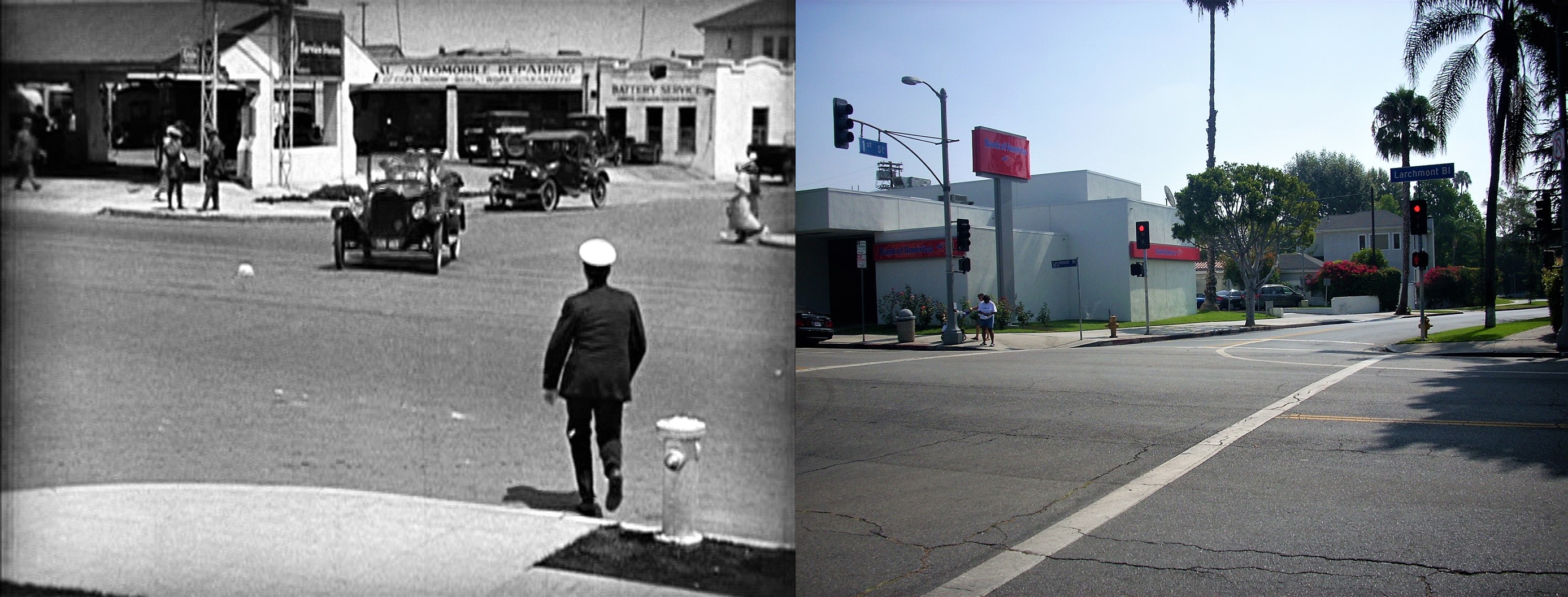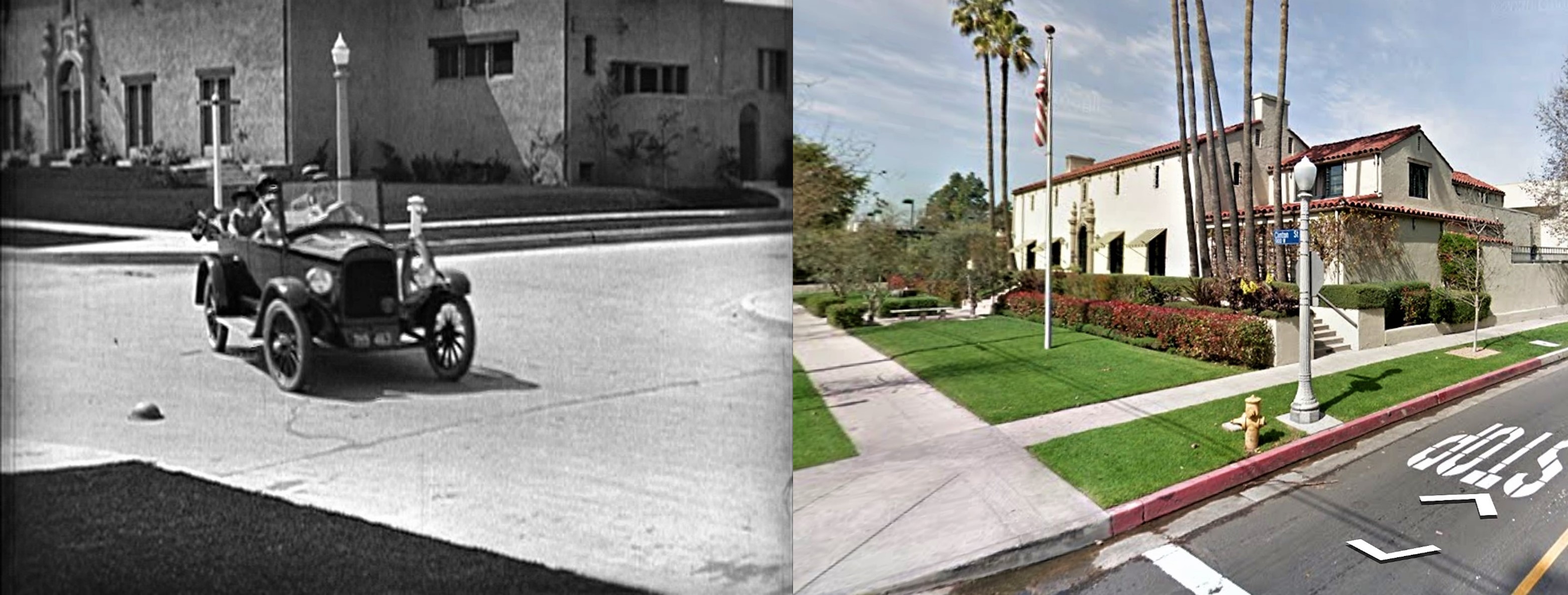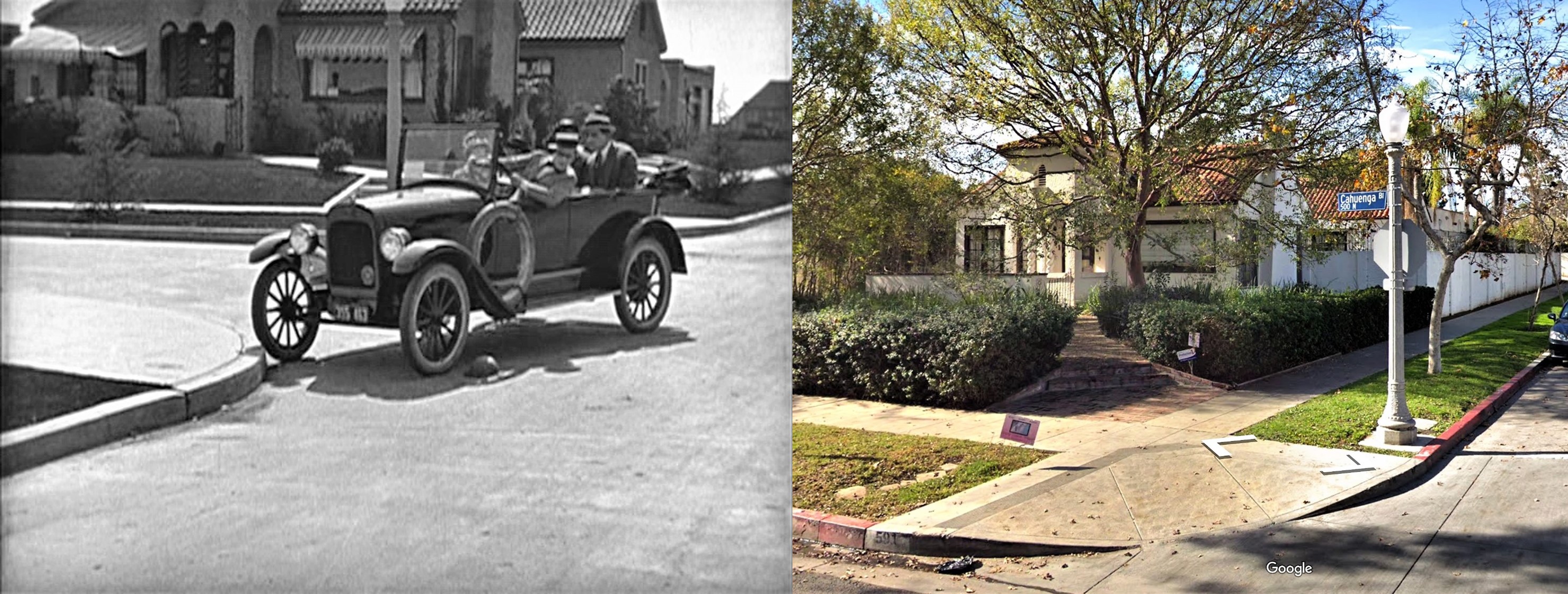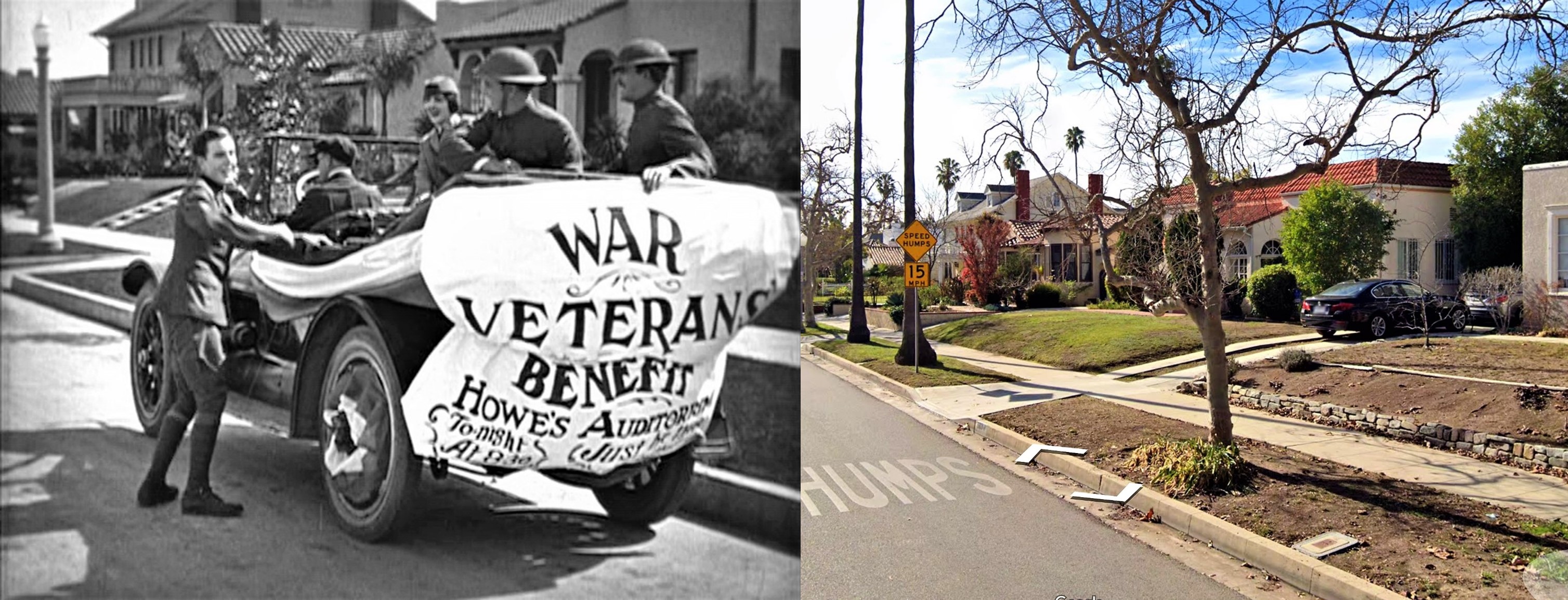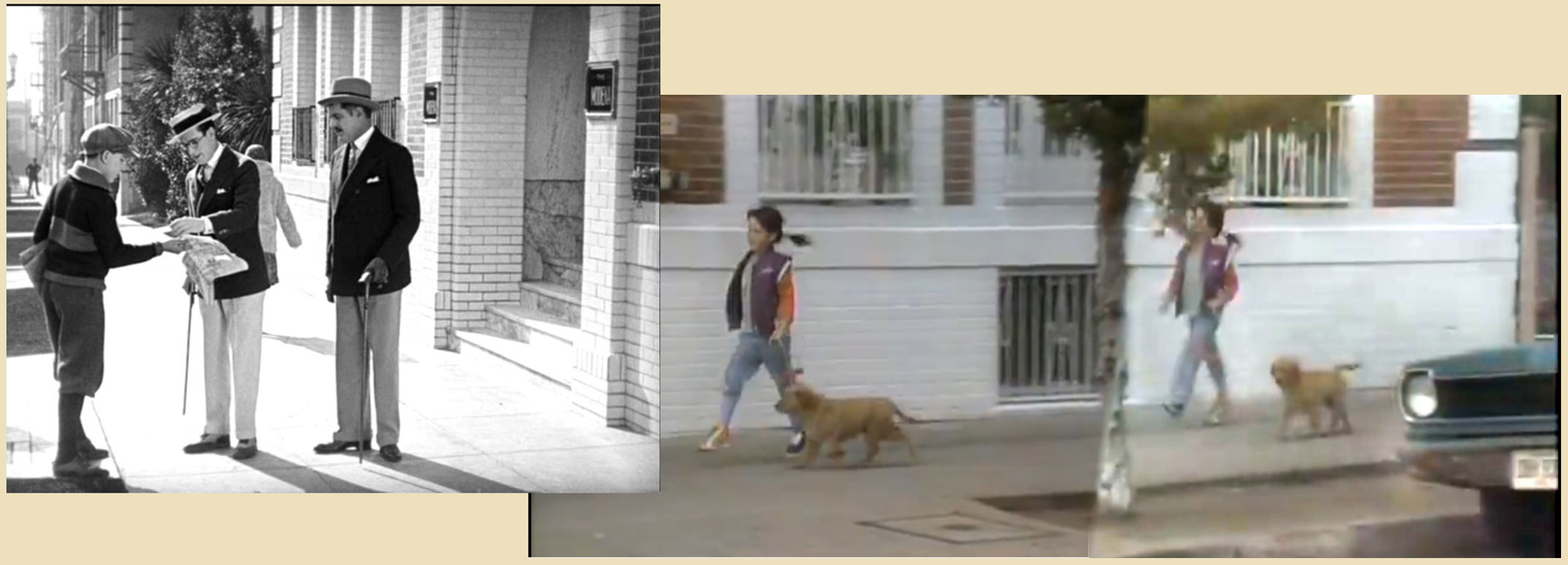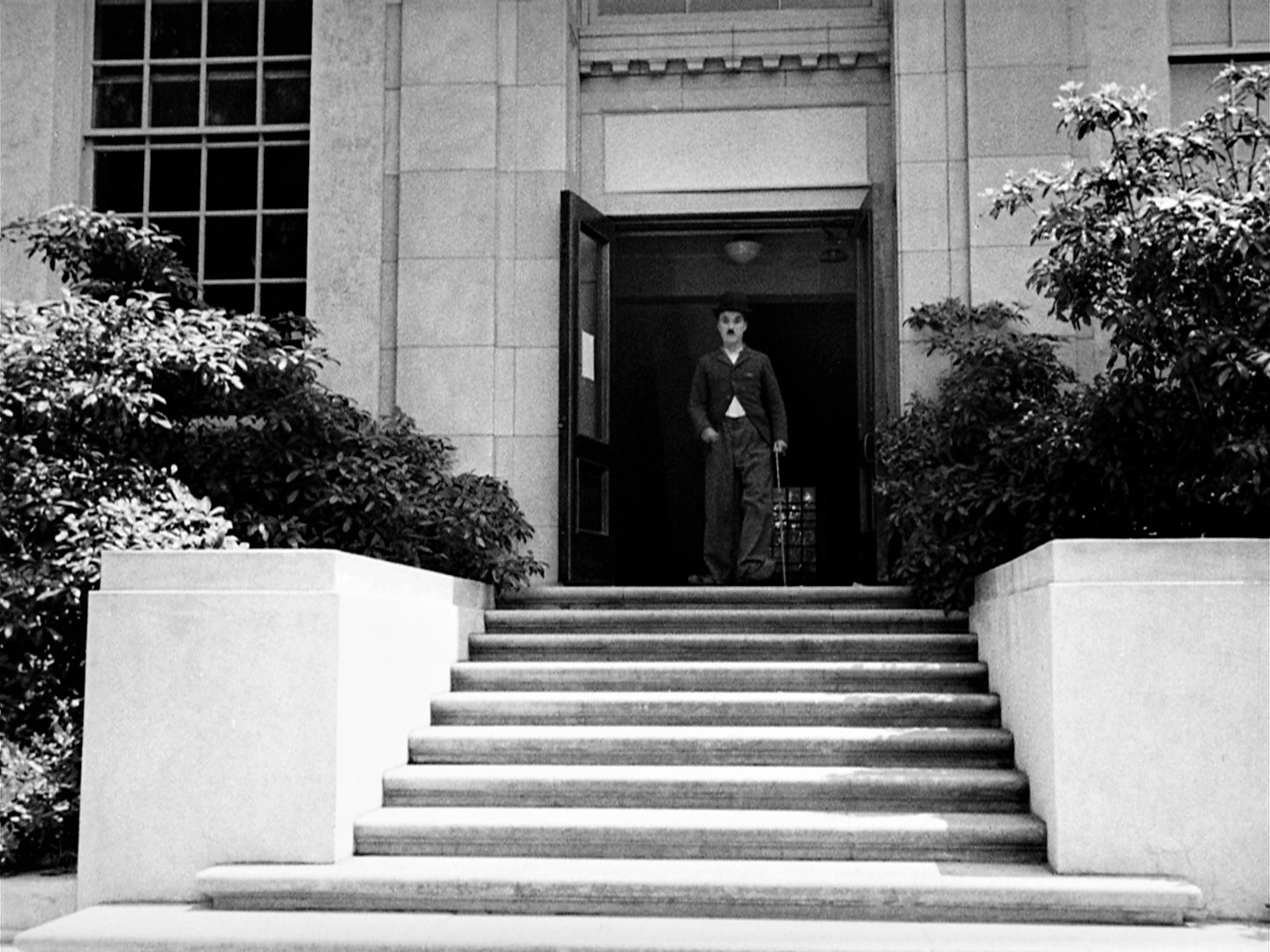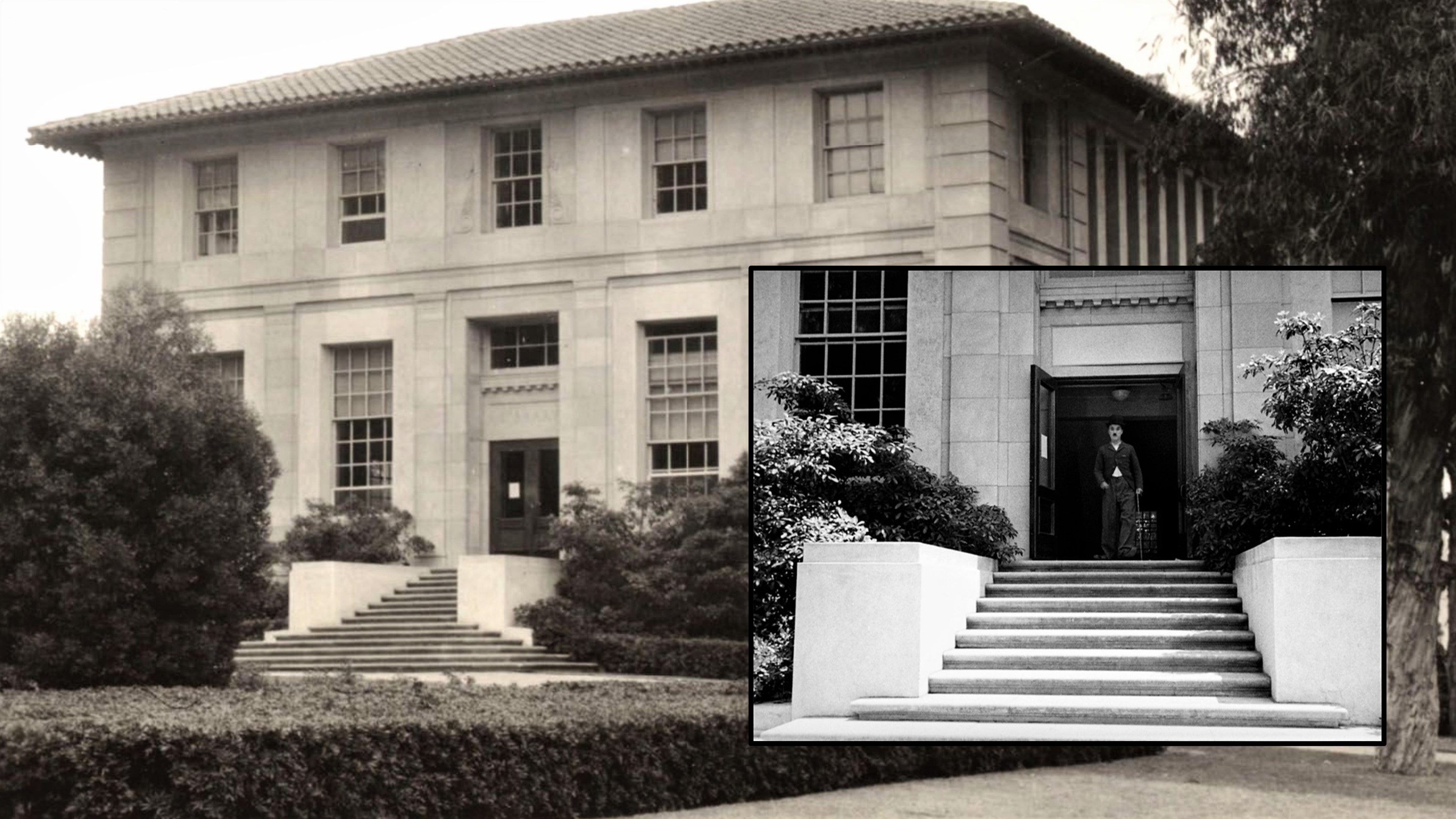
How Laurel & Hardy Filmed Duck Soup – Flicker Alley Year One Blu-ray Release

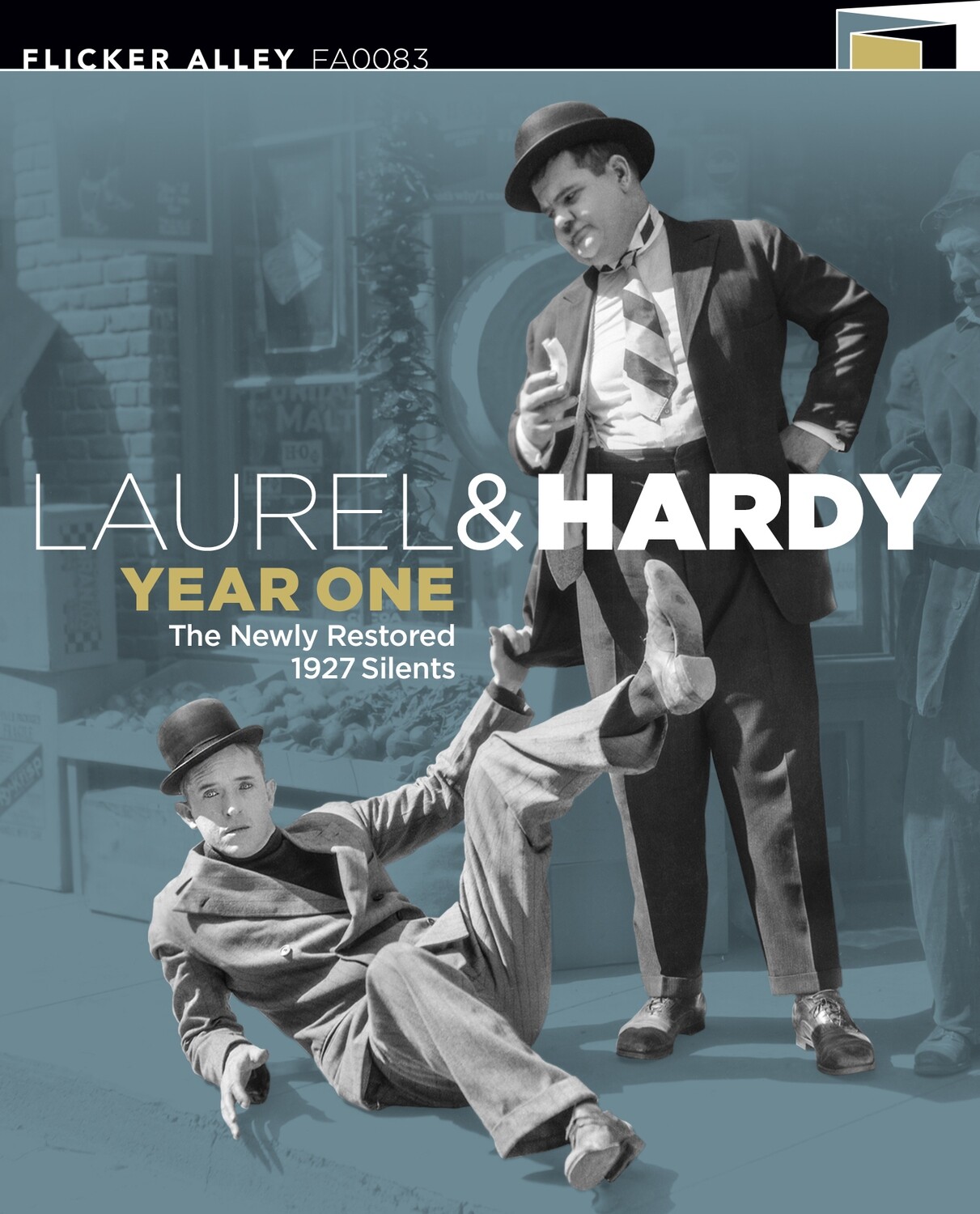
Hooray for Flicker Alley releasing Laurel & Hardy: Year One, a beautifully presented 2-disc Blu-ray set of Stan and Ollie’s 1927 films. The all-new restorations look stunning, meticulously assembled from the best available materials contributed by archives and collectors around the world. I was honored to present a bonus video essay providing an overview of the locations appearing in several films, showing how Stan and Ollie made humble Main Street in Culver City their cinematic home. As fully explained in this post below, many Duck Soup locales require more diagrams and explanation than feasible for a brief visual essay, so my bonus program encourages interested viewers to check out this blog instead for more details.
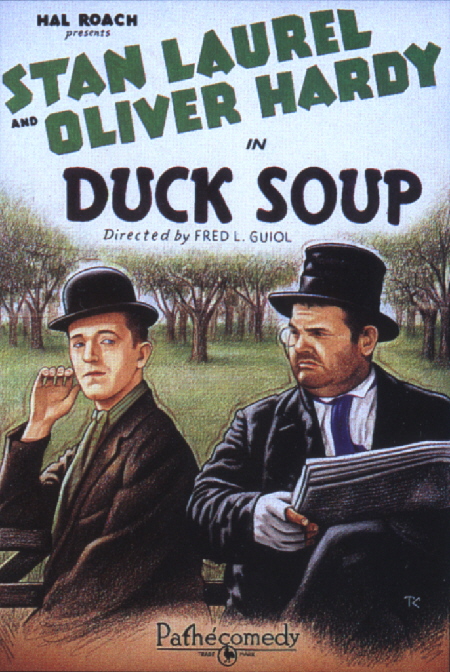
Although they had appeared onscreen together in The Lucky Dog (1921), the Hal Roach short Duck Soup (1927) marks the first time Stan Laurel and Oliver Hardy were paired as comedy leads. They play a couple of hoboes who flee a surly forest ranger conscripting tramps to fight a raging fire. The film begins in Westlake (now MacArthur) Park, where they dash off, grab a bicycle in Culver City, pedal up and down Grand Avenue in Bunker Hill, only to crash in front of a Beverly Hills mansion. This post examines the many classic landscapes appearing in this landmark film.

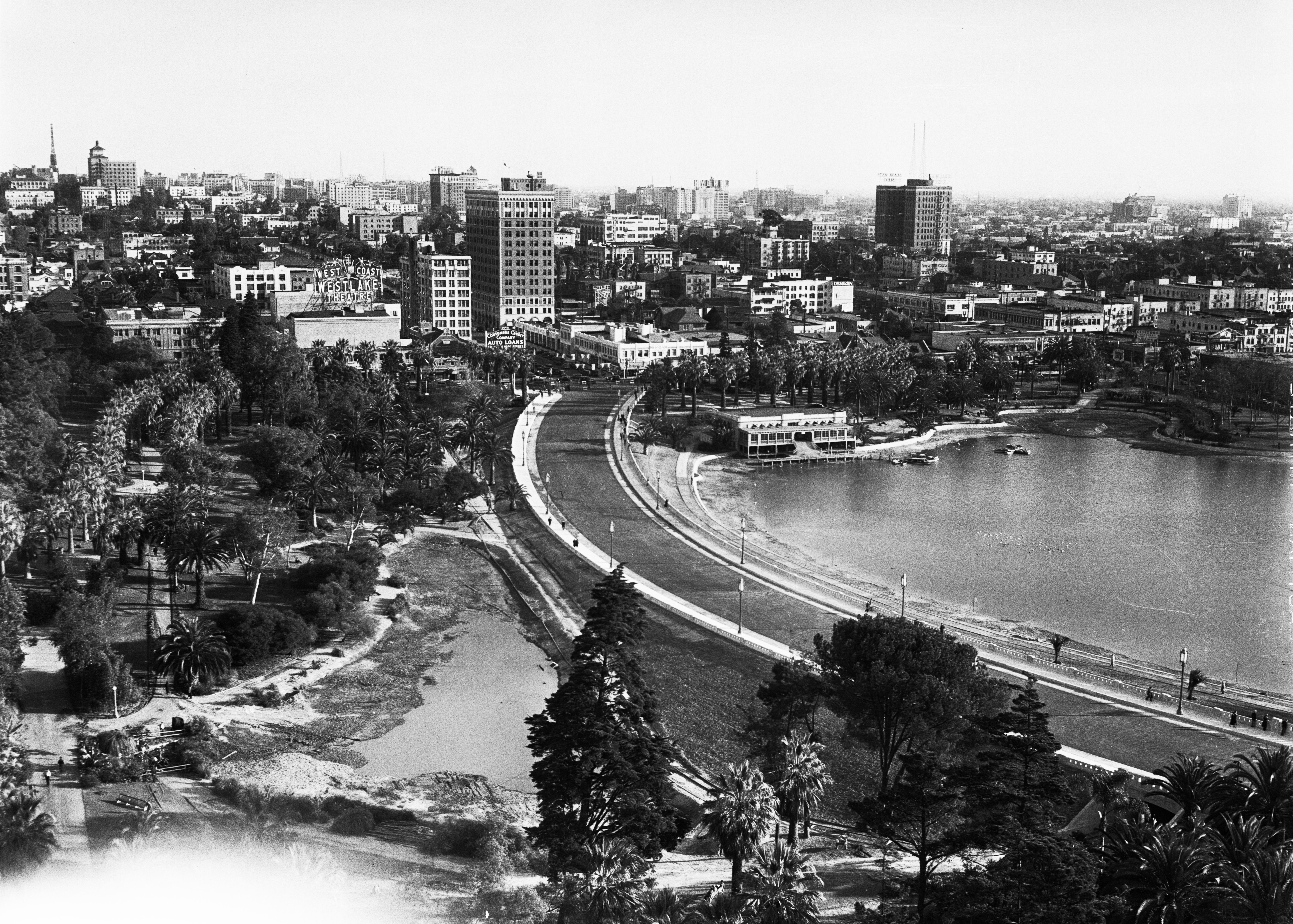
Forest rangers scour Westlake (MacArthur) Park, looking for bums to fight the fire, with a matching view seen from the other side looking to the NW at right LAPL. It appears the awning shaded a seating area for concerts performed in the pergola standing in the water.

At left, Joe Cobb looks toward the lakeside shaded seating area in the Our Gang comedy Dog Heaven (1927), with a matching color postcard view, LAPL, and closer view of the forest rangers grabbing bums.

Ollie cheerily greets the menacing forest ranger played by Bob Kortman.

Stan and Ollie casually saunter away, followed by the ranger, who tracks their every step as they begin to flee. This was likely filmed in the NW corner of the park, with the now-demolished Regent Apartments peeking over the trees at back. For comparison the same corner of the park revealing the Regent appears to the right in this scene from Lige Conley’s 1920 short A Fresh Start. The Regent (1913-1983) appeared in many films, and portrayed the facade of the restaurant where Charlie Chaplin worked in The Rink (1916), inset, read more HERE.

Looking at the NW corner of the park, with the lawn (oval) where the ranger likely chased the Boys in relation to the Regent – LAPL, USC Digital Library.

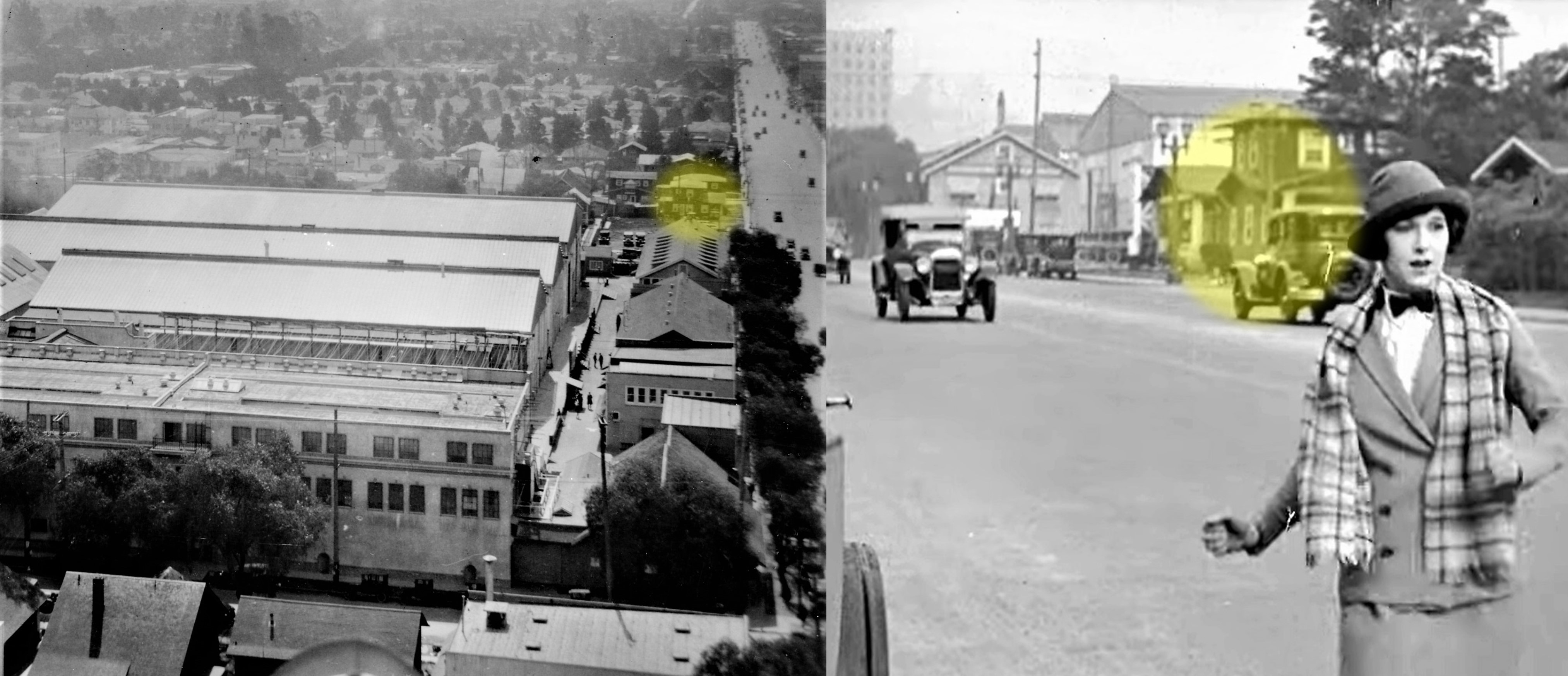
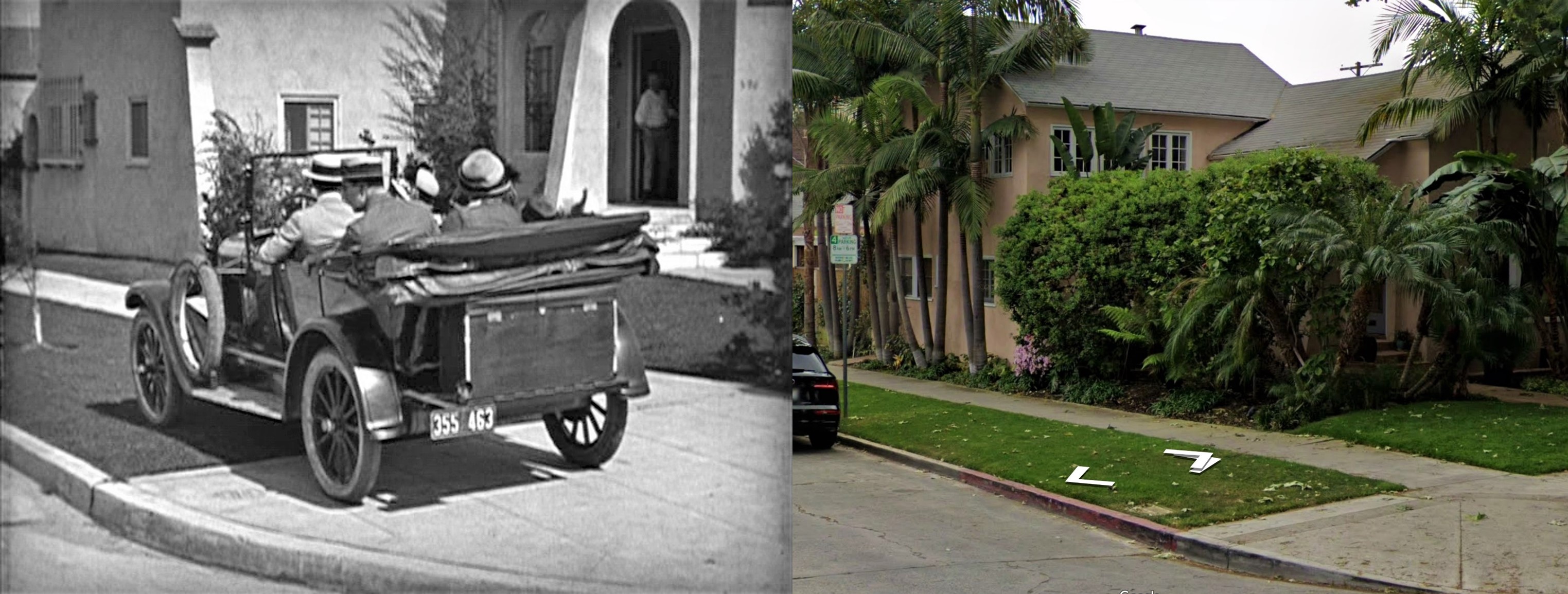
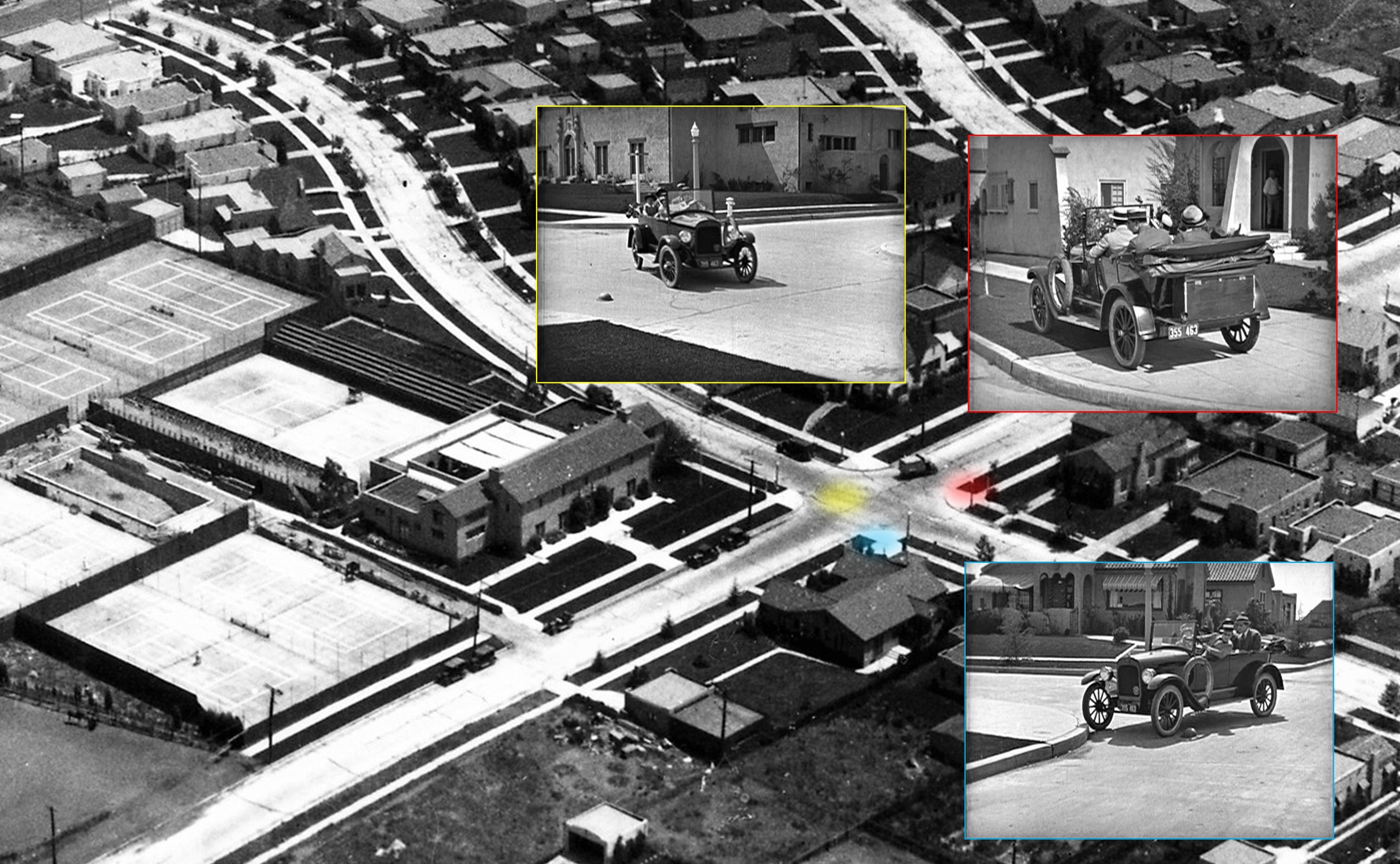
Running for their lives, Stan and Ollie turn the sharp corner from Culver Blvd. right (north) up Main Street in Culver City. Marc Wanamaker – Bison Archives.

As they pedal away, behind them (yellow box) is the alley (now lost) where they would later unsuccessfully attempt to switch their mismatched pants during Liberty (1929). I document their rooftop antics in that film HERE. While the Culver Hotel remains in the modern view, lower right, the south side of Culver Blvd. across from the corner has been completely redeveloped. (C) 2020 Microsoft.

We now jump to downtown. Here they travel south down Grand from 6th Street.

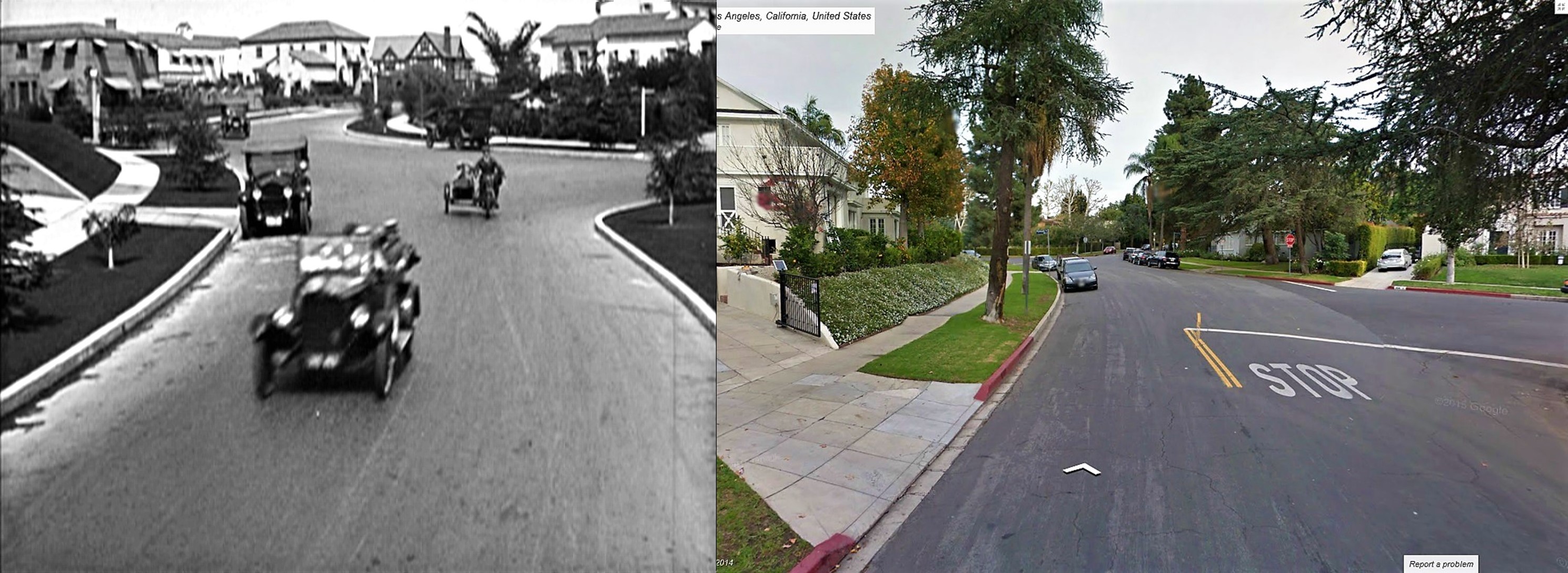
A point of view shot, left, speeding down Grand toward 5th, with a matching photo view LAPL. The large lawn on the right corner was part of the grounds for the LA Public Library, and is now the site of the library’s Mark Taper Auditorium.

Stan and Ollie race down Grand toward the former library lawn on the corner of 5th, past the former Biltmore Garage on the left, also seen in the 1934 Carole Lombard film Gay Bride upper right.

The bike odessy begins with Stan and Ollie crossing Grand Ave. west along 3rd Street, matching the arrow in this map designed by Piet Schreduers. Shown here, the section of 3rd Street on Bunker Hill above the 3rd Street Tunnel was just two blocks long, running from Angels Flight on Olive to Bunker Hill Ave.

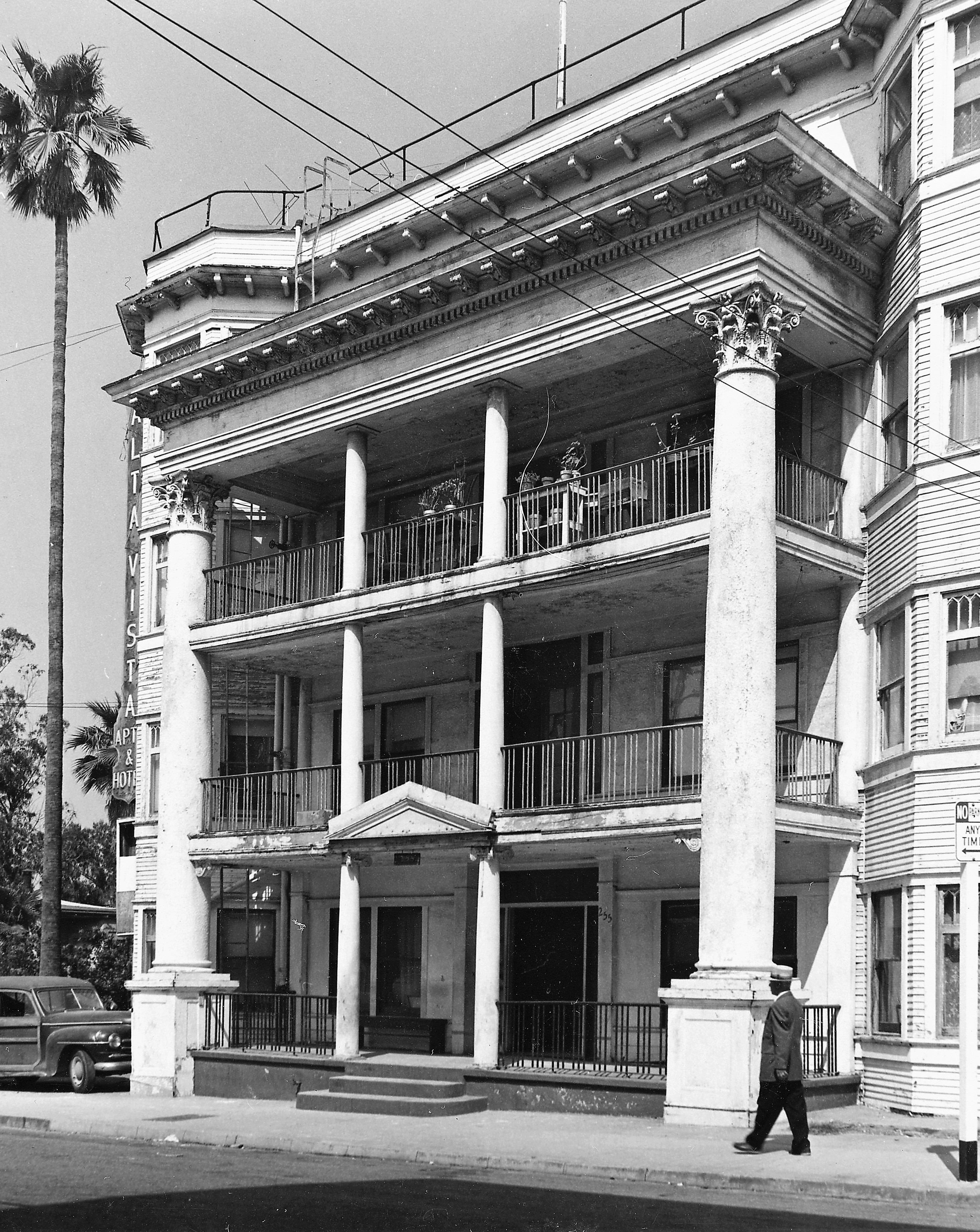
Poor Oliver really pedaled Stan west uphill along 3rd from the corner of Grand. The matching color view comes from Marilyn Monroe’s 1956 movie Bus Stop during a scene intended to portray Phoenix Arizona! The Alta Vista Apartments, far left, appear again later below.
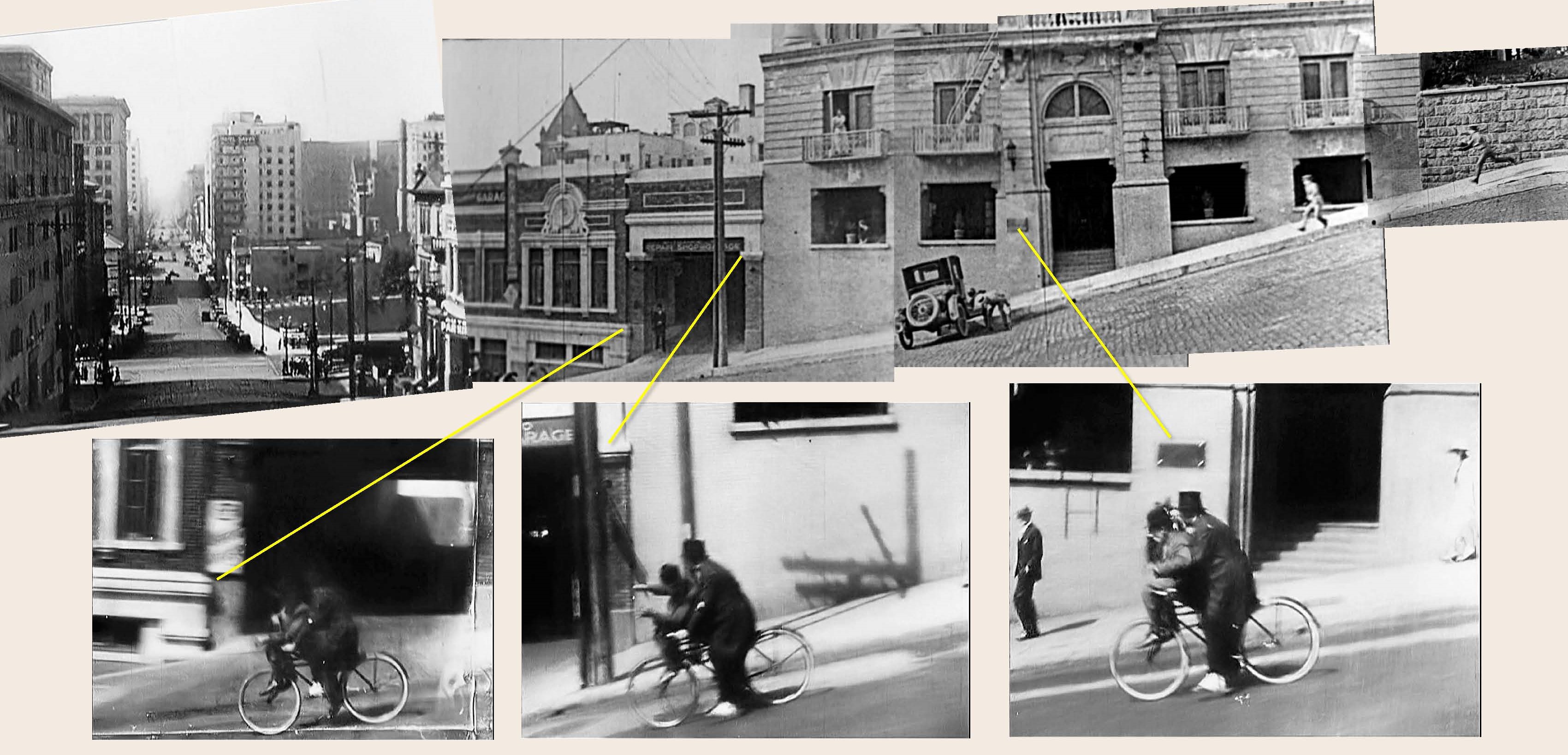
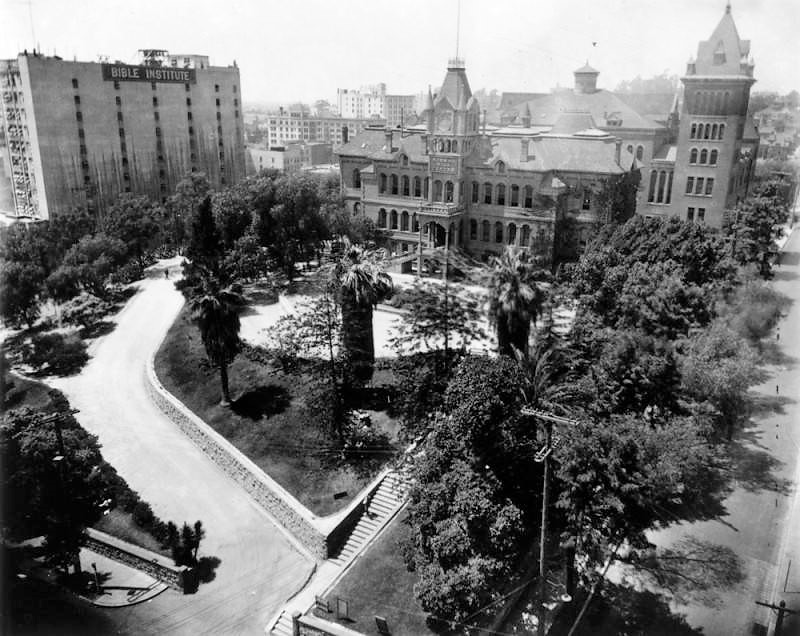
Click to enlarge – this panoramic view shows the backdrop as Stan and Ollie’s stunt doubles race south down Grand toward the corner of 5th. The far left frame comes from the movie, the other frames come from Africa F.O.B. (1922) starring Monty Banks, shown racing on foot down the street. Details mark the doorway to the former Sherwood Apartments at 431 S. Grand, and J. W. Johnson’s garage at 437 S. Grand. The pyramid peeking out in back belonged to the former State Normal School (inset), torn down to accommodate the LA Public Library opening on that site in 1926. LAPL.

Thanks to Jim Dawson, the Sherwood Apartments portray San Francisco (look how steep the street is) during the opening scenes, at left, from Ida Lupino’s 1953 drama The Bigamist.

Opposite views of 3rd between Grand and Bunker Hill Ave., with Duck Soup looking west to the left, toward the corner blade sign for the Alta Vista Apartments (inset right), and Harold Lloyd’s race to the church in Girl Shy (1924) looking east to the right. Among Lloyd’s surviving films the corner of 3rd and Grand, depicted here, is where he filmed more often than any other spot in town. Most traffic along 3rd St passed through the tunnel beneath Bunker Hill. Only two blocks long, the short parallel section of  3rd St above the tunnel had little traffic and was easy to shut down for filming. California State Library. Novelist John Fante lived here briefly in 1933, immortalizing it (as the fictional Alta Loma) in his classic 1939 Bunker Hill novel Ask The Dust.

Above, Stan and Ollie travel south down Grand, with a garage at back, matched with stock footage of Bunker Hill used during a traveling car scene for the 1949 Columbia release Shockproof. The footage, available from the Internet Archive, was projected behind the actors sitting in a prop car filming inside a sound stage, creating the illusion they were driving outside. I have an extensive post documenting the numerous landmarks to appear in this Bunker Hill stock footage you can read HERE.

Further south, the lost Zelda Apartments (box) appears in both shots. The tall Sherwood Apartments, mentioned above, towers on the left behind Stan, while the edge of the Sherwood appears to the left of the 1949 frame.

The chase continues, matching views looking up Grand from 5th, with the library lawn to the left, and the former Biltmore Theater (Ben Hur sign) to the right.
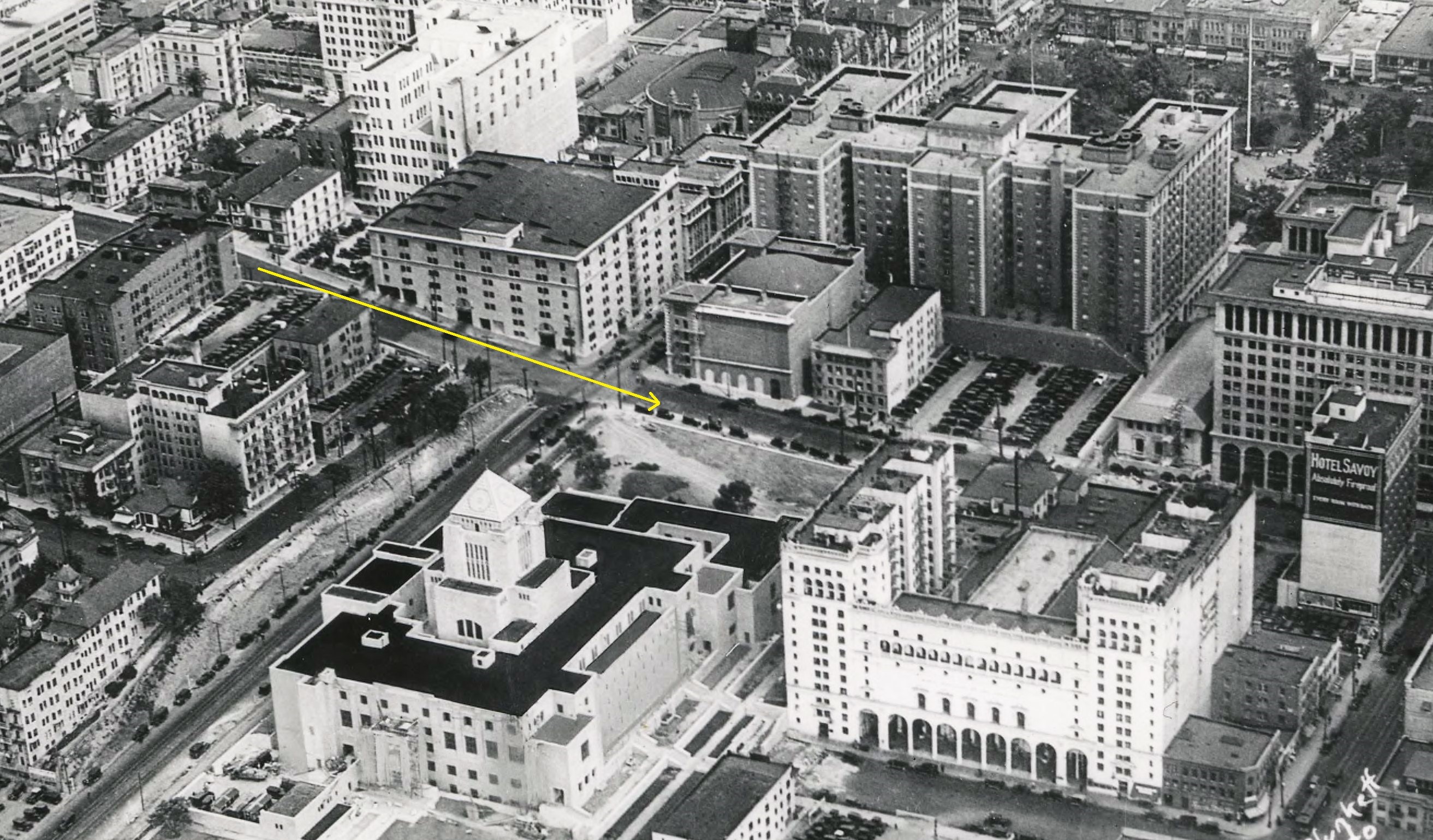
A final view, tracing Stan and Ollie’s path along Grand, starting from the Sherwood Apartments to the left, then past the rooftop cars parked at Johnson’s garage to the right, then the Biltmore Garage across the street on the corner, and after crossing 5th, the Biltmore Theater on the other corner, all now lost, with the beautiful pyramid-capped LA Public Library in the foreground.

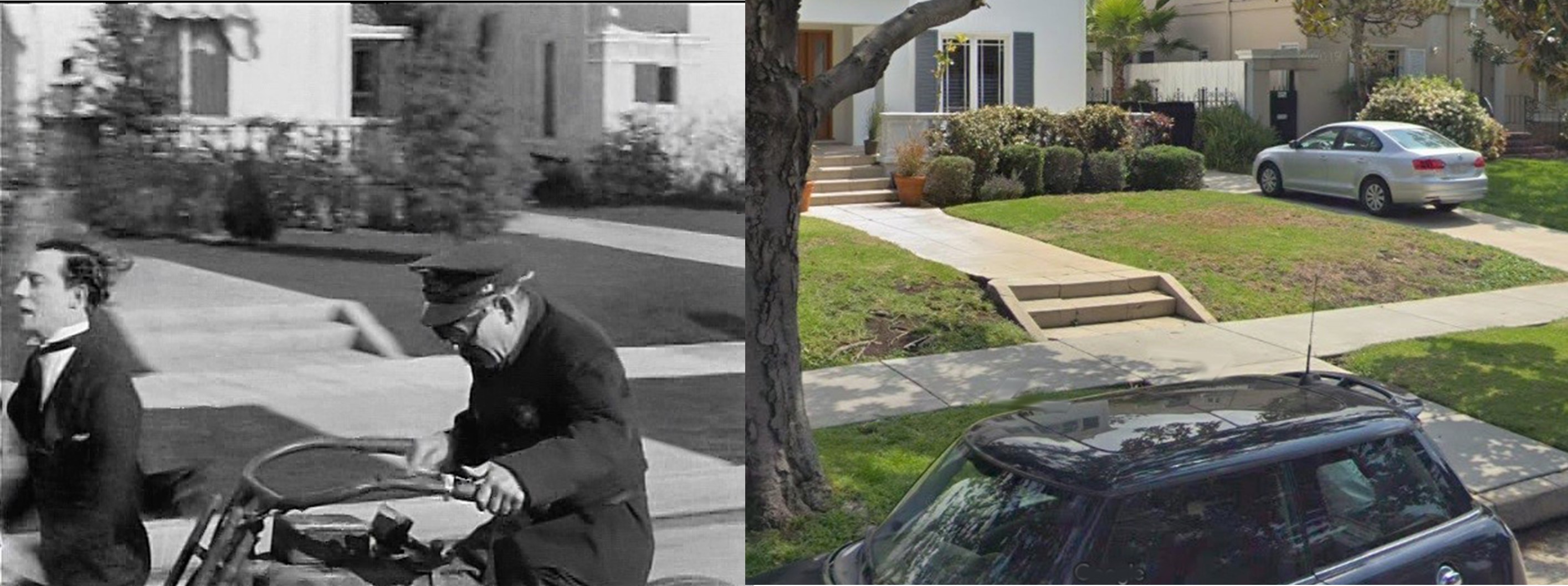
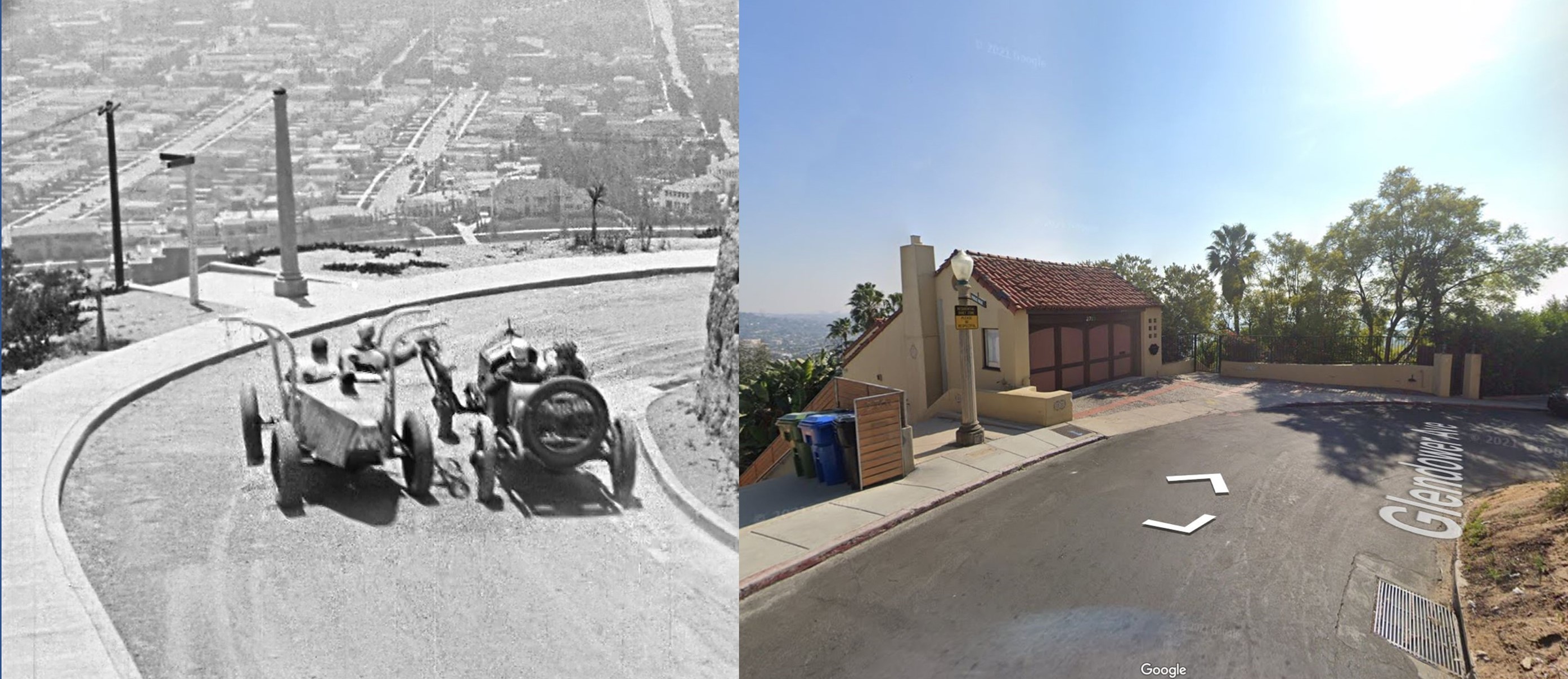
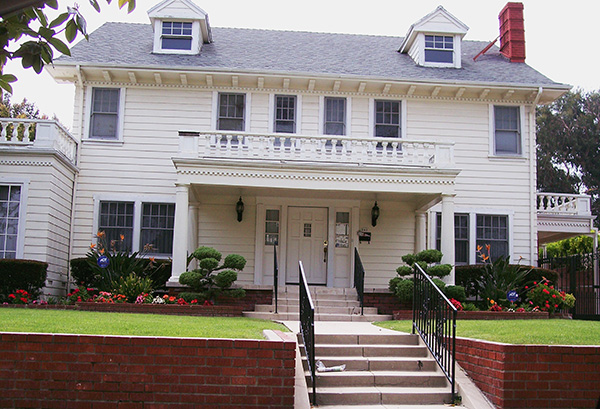
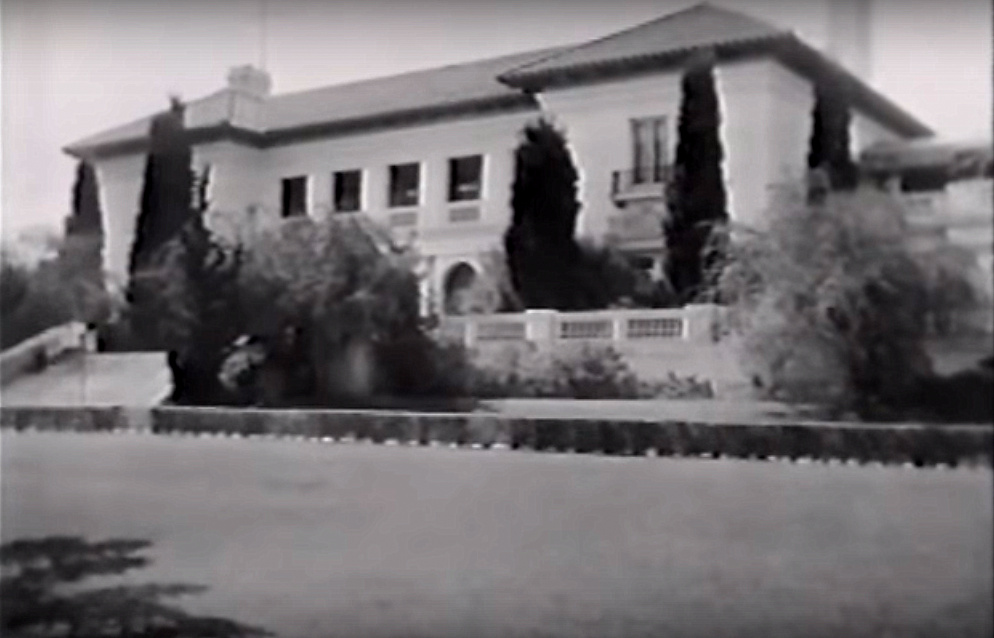
Leaving downtown behind, the Boys crash in front of 815 N. Alpine Drive in Beverly Hills, once standing on the SW corner of Sunset, and are soon pursued by the rangers. Flight c-4686, frame 24, UCSB Library.

This stately home also portrayed the governor’s mansion during Stan and Ollie’s The Second Hundred Years (1927). The lines and dimensions of the new home suggest the original home was first completely demolished. The neighboring home to the left in the movie frame appears to have since been remodeled.

Los Angeles residential historian Duncan Maginnis made this amazing discovery, and has identified many other homes appearing in classic silent films. He is the author of the amazingly rich and fascinating series of historical blog posts about classic Los Angeles neighborhoods, including BERKELEY SQUARE; WESTMORELAND PLACE; WILSHIRE BOULEVARD; ADAMS BOULEVARD; WINDSOR SQUARE; ST. JAMES PARK; and FREMONT PLACE.
The clue was the Max Whittier mansion looming tall in the background. Once standing on the NW corner of Sunset and Alpine, the Whittier home also no longer exists, but was notorious in the 1980s because a wealthy Saudi prince painted it gaudy colors, and lined the place with nude statues painted flesh color with highlighted genitals and pubic hair, creating quite a sight for tourists along Sunset Blvd. The inset image comes at 1:48 from a Youtube history video about Mr. Whittier. The image with the car above appears at 2:45, while the image upper left image above comes from the Alice Howell comedy Distilled Love (1920), in which Oliver Hardy plays a villain.

Both views look north. Dressed as a maid, Stan loads stolen goods into a moving van, with the Whittier home looming in the background. The aerial view is from 1938.

A modern view shows both homes have been completely rebuilt. (C) 2020 Microsoft.

Captured by the rangers and forced to fight a fire, the movie ends with Stan and Ollie struggling with a loose and powerful fire hose on an open field beside Carson Street, a popular Roach filming site south of the studio. The central home behind them at 8885 Carson appears, for example, in the Charley Chase film All Wet (1927) upper right, and the silent Our Gang comedy The Fourth Alarm (1926) lower right.

As first reported by Jim Dallape as part of the Back Lot Tour blog documenting scenes filmed around the Roach Studio, the final scene was staged in the open field to the south, with the home at 8885 Carson Street (yellow oval) marked in each image. Marc Wanamaker – Bison Archives; flight c-6926x, frame 36, UCSB Library.

Remarkably this home still stands. While the modern view shows the front facing Carson Street, the side of the home appearing in the film now abuts a cinder-block wall, blocking the view.

I want to express again my thanks to Duncan Maginnis, and my particular thanks to Dave Lord Heath, and his encyclopedic Hal Roach Studio films blog Another Nice Mess, for his insight and assistance with researching this post. Read Dave’s post about Duck Soup HERE.

This once lost movie was reconstructed with prints of the film preserved by the British Film Institute, a short scene preserved in the Library of Congress, and extra frames preserved in the Filmoteka Narodowa (FINA), as assembled and restored by the tireless efforts of Serge Bromberg, Eric Lange, and Lobster Films Laboratories.

Laurel & Hardy: Year One features all new restorations sourced from the best available materials contributed by archives and collectors around the world, as restored by Blackhawk Films® and Lobster Films in Paris. This comprehensive deluxe Blu-ray 2-Disc collection features thirteen extant films produced in 1927 and two additional films from before they were officially a team. First posted in April 2020, this Duck Soup blog has been updated with stunning new Blu-ray frame grabs from the film.

Please check out my latest YouTube video, revealing new visual discoveries about how Buster Keaton made The General, and the other dozen-plus videos on my YouTube Channel.

Where it all started, near the site of the hobo roundup at MacArthur Park.

Posted in Beverly Hills, Bunker Hill, Duck Soup, Laurel and Hardy | Tagged , , , , , , , , , , | 2 Comments

How Charlie Chaplin and Jackie Coogan Made The Kid at the Plaza de Los Angeles

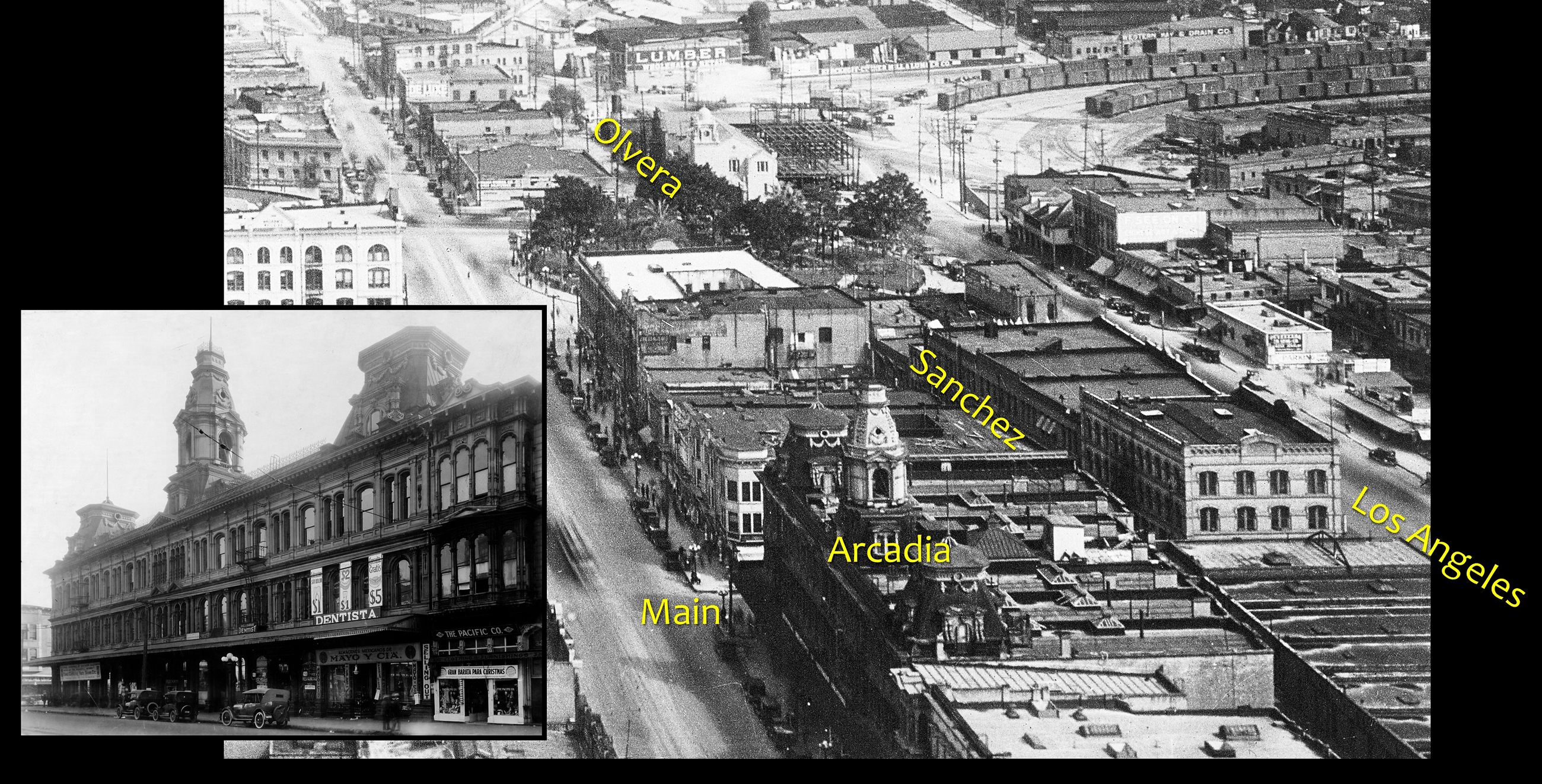
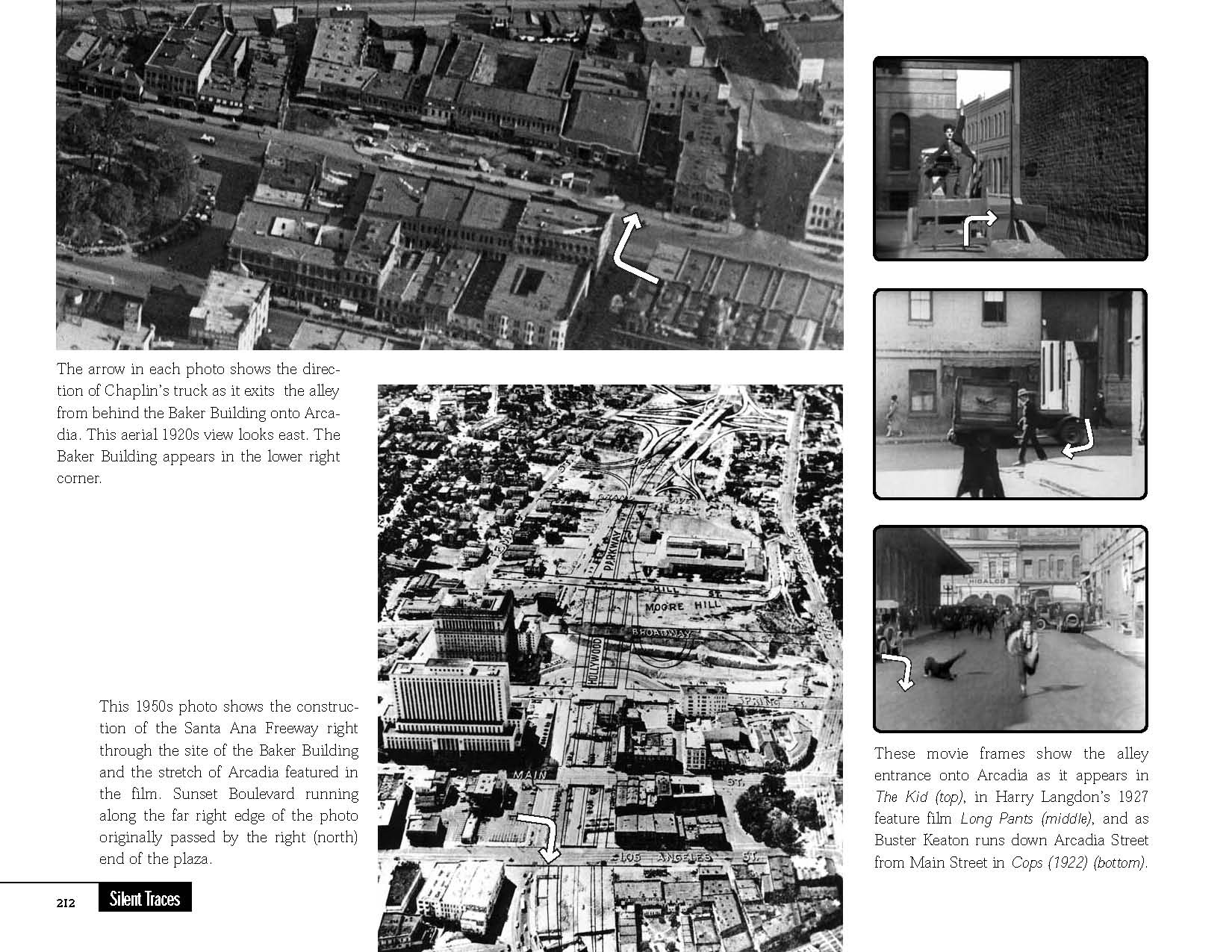
Time travel back over a century ago, as Charlie Chaplin and Jackie Coogan lead a personal tour around the Plaza de Los Angeles while making The Kid (1921) and other early films.

Charlie and Jackie famously reunite on Olvera Street, you can still visit today, but their movies provide dozens of fascinating glimpses of weary, working-class districts downtown, mostly demolished decades ago.

One tantalyzing discovery, a scene from Buster Keaton’s Cops (1922) reveals the building where Charlie filmed the rooftop chase and rescue of Jackie during The Kid.

On August 27, 2023, the Academy of Motion Pictures Arts and Sciences Museum is screening Harold Lloyd’s Safety Last! to honor its 100th anniversary, with a live orchestra performing Carl Davis’s original score, conducted by Angel Velez, and hosted by Harold’s granddaughter Suzanne Lloyd. Details – tickets HERE. I love so many films, so many comedians, but NOTHING tops watching Safety Last! with a large audience, gasping and shrieking at every turn. Step-by-step, this video shows how Harold made this masterpiece film.

Check out my YouTube channel, with over a dozen videos showing the visual history hidden in silent films.

Posted in Chaplin Tour, The Kid | Tagged , , , , , , | 3 Comments

The Keaton-Fairbanks Hollywood Fire Station

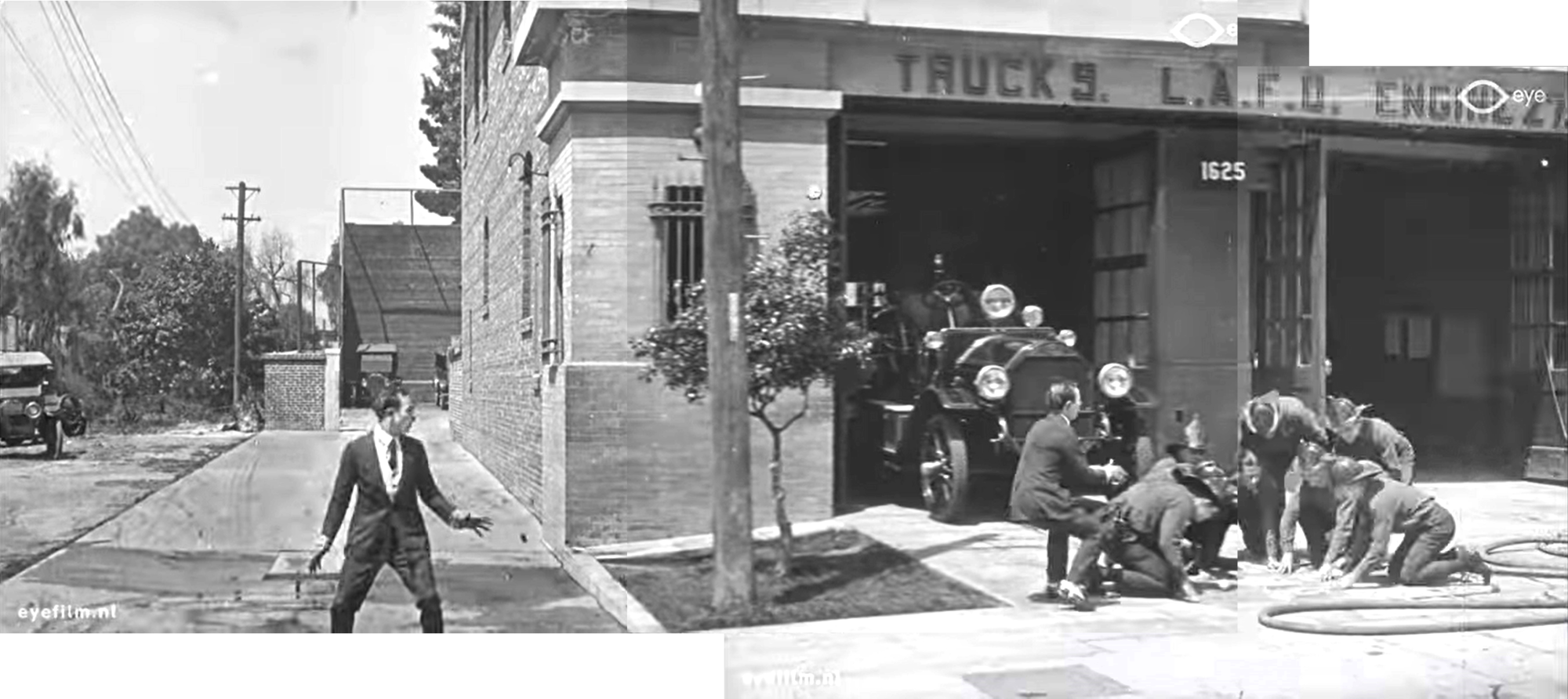
Buster Keaton filmed FIVE movies at the former Hollywood Fire/Police Station. Douglas Fairbanks was likely the first major star to film here, and so far as known the only star to film the now lost building from all sides. Teaser – other huge stars filmed here too, check the end of this post. Once situated at 1625-1627-1629 Cahuenga, steps south from the Chaplin-Keaton-Lloyd Alley, with Buster’s help let’s follow Doug for a time-travel tour around the Keaton-Fairbanks Hollywood Fire Station. Photo Hollywood historian Tommy Dangcil.


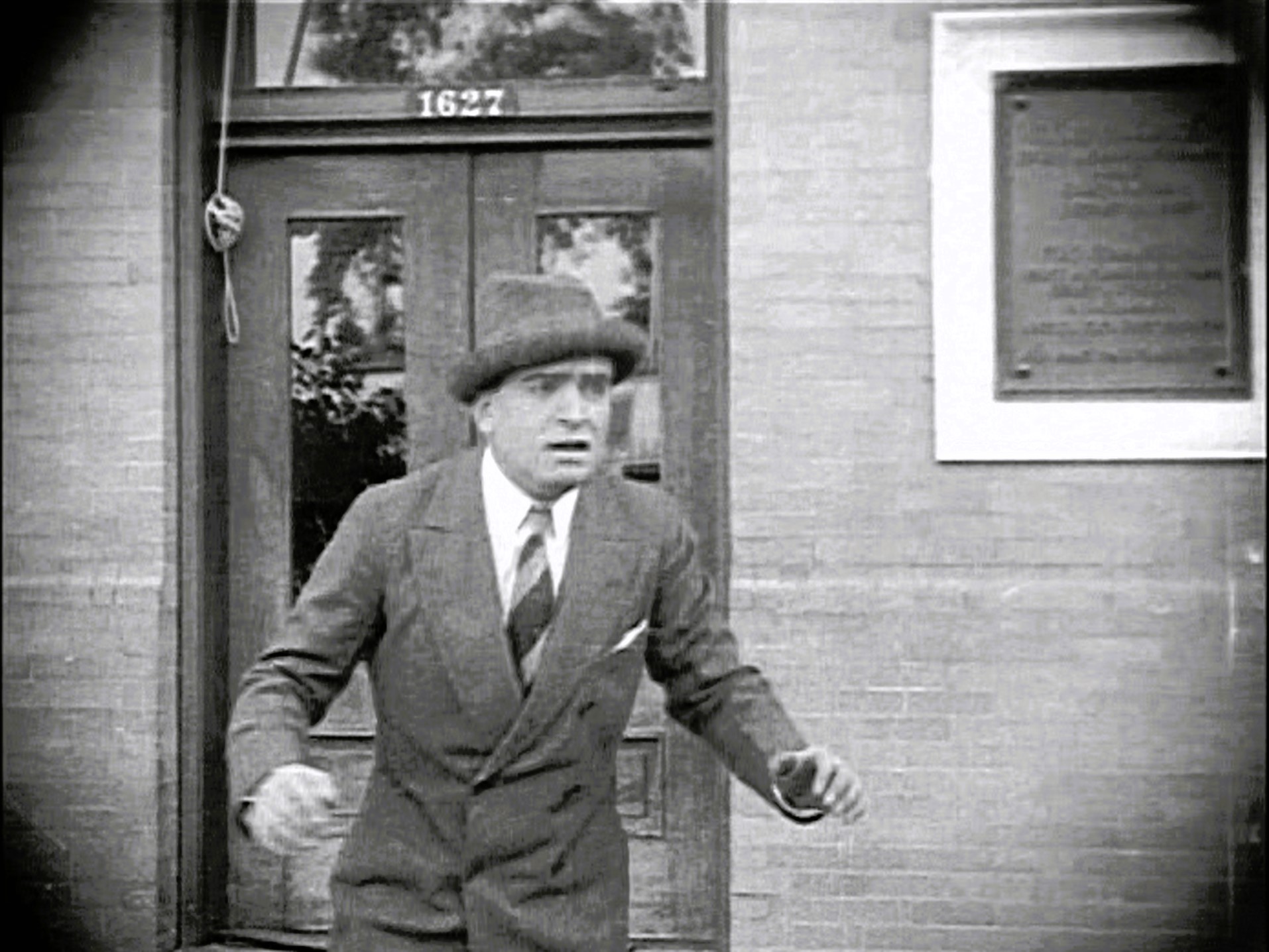
ONE: Cultivated from his 1916 comedy Flirting With Fate, Doug’s five-point tour (see annotated route below), begins at the 1627 Cahuenga central entrance to the joint station. The plot – faced with financial and romantic troubles, Doug hires an anonymous assassin to kill him. Doug’s fortunes suddenly reverse, but unaware his faceless killer has found God and repented his evil ways, Doug fears his now cherished life is threatened by every person he meets. Doug filmed many scenes around the 1600 block of Cahuenga, including a quick dash beside the Chaplin-Keaton-Lloyd Alley stairway. Purchase Doug’s film on DVD at Flicker Alley – A Modern Musketeer. YouTube link HERE.

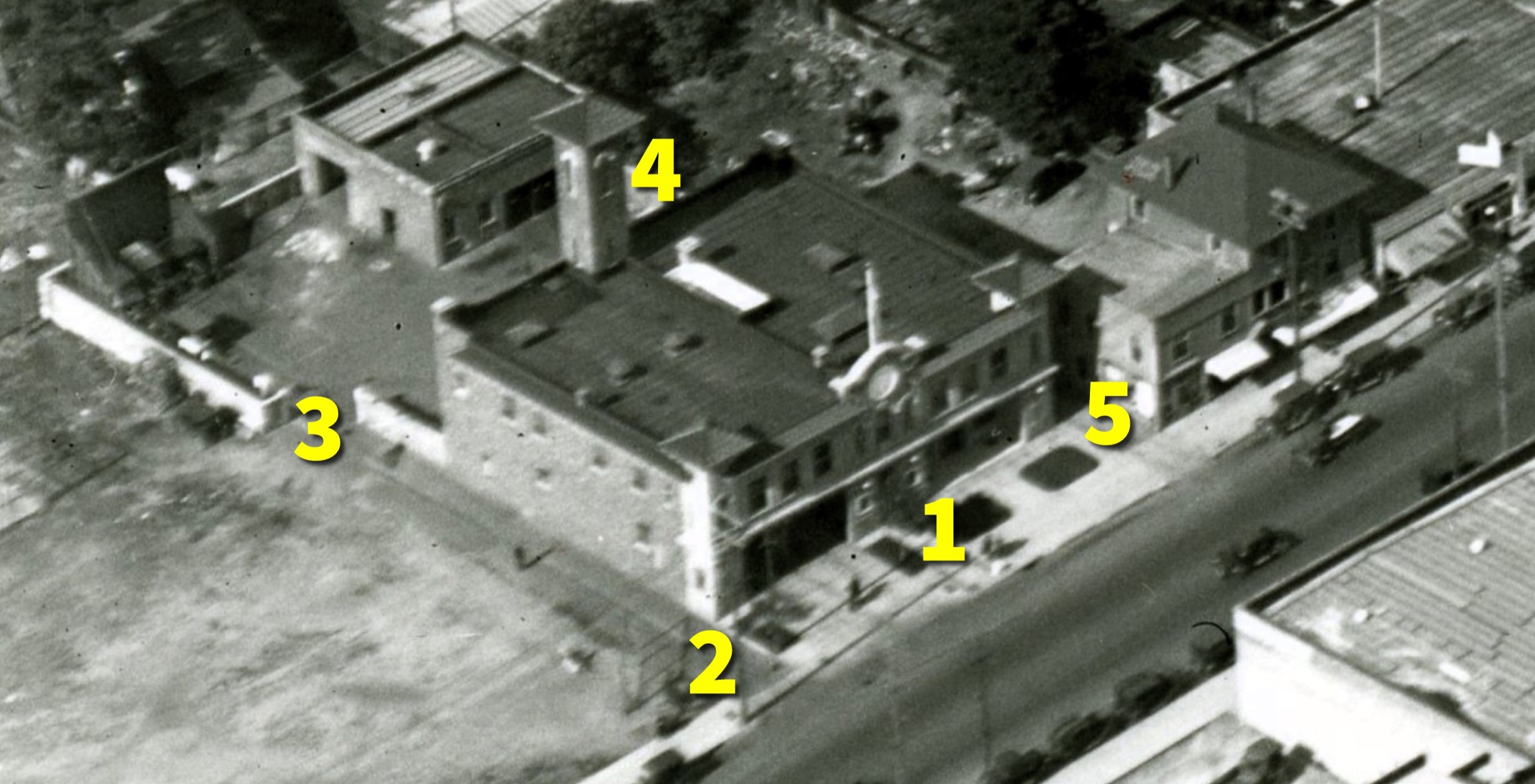
This 1922 aerial view looking NW marks the five points of Doug’s clockwise tour around the joint fire/police station on Cahuenga. HollywoodPhotographs.com.

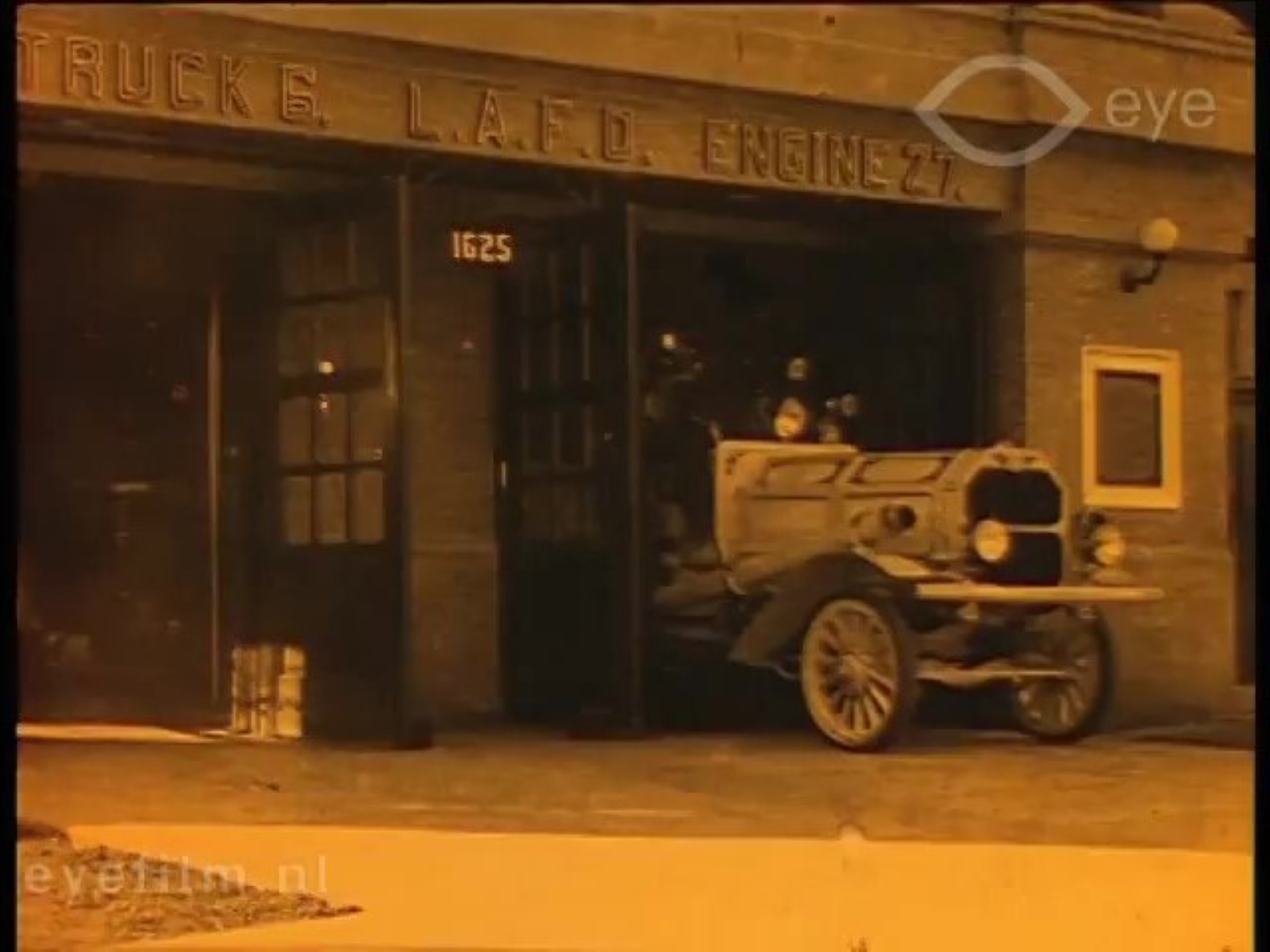
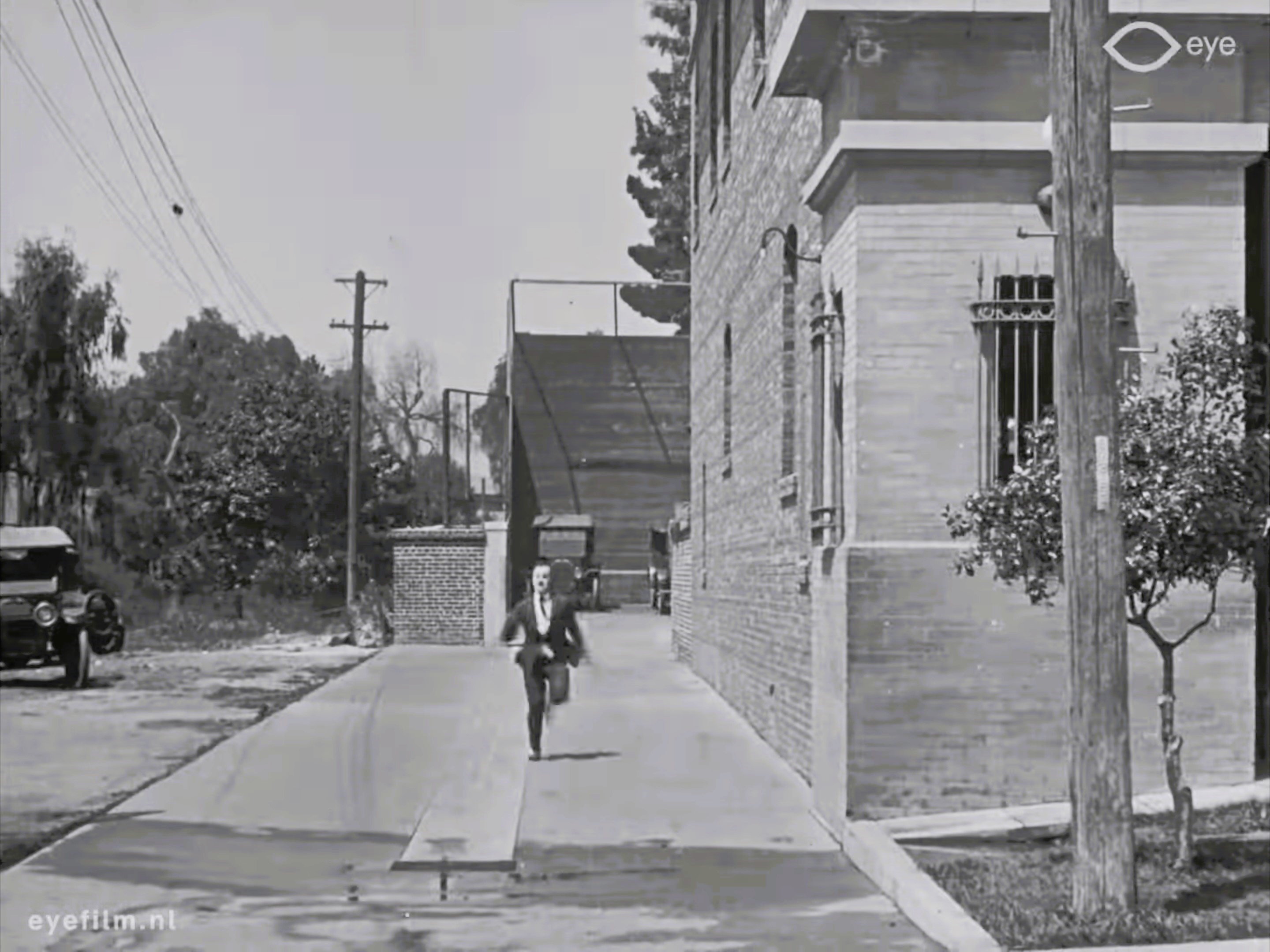
The joint station was constructed in 1913. Before starting the tour, consider this rare 1914 view from One of the Bravest, hosted on YouTube by Eye Filmmuseum. Note the 1625 Cahuenga street address. This marks the station’s earliest screen appearance I’ve yet been able to identify.

TWO: Moving clockwise now to the station’s SE corner. Thanks again to the Eye Filmmuseum, this composite view was created from Nr. 631 of their Bits & Pieces YouTube series of short, unidentified film clips. After seeing it posted on YouTube HERE, viewer @kathleens.4324 identified the brief clip as the Sid Smith and Harry McCoy Hallroom Boys comedy Put and Take (1921).

TWO: Looking west at the wide driveway south of the station. You can understand why Buster filmed along this quiet “alley” for three films; a wide space, plenty of room on the empty lot for his crew, with day-long full exposure to the sun, standing just blocks north from his studio at 1025 Lillian Way. Other images show a tennis court stood further west to the left behind those cars. The empty lot was built over by 1923.

Above, scenes from Keaton’s Neighbors (1920) left, and two views from The Goat (1921), filmed along the “alley” south of the station.

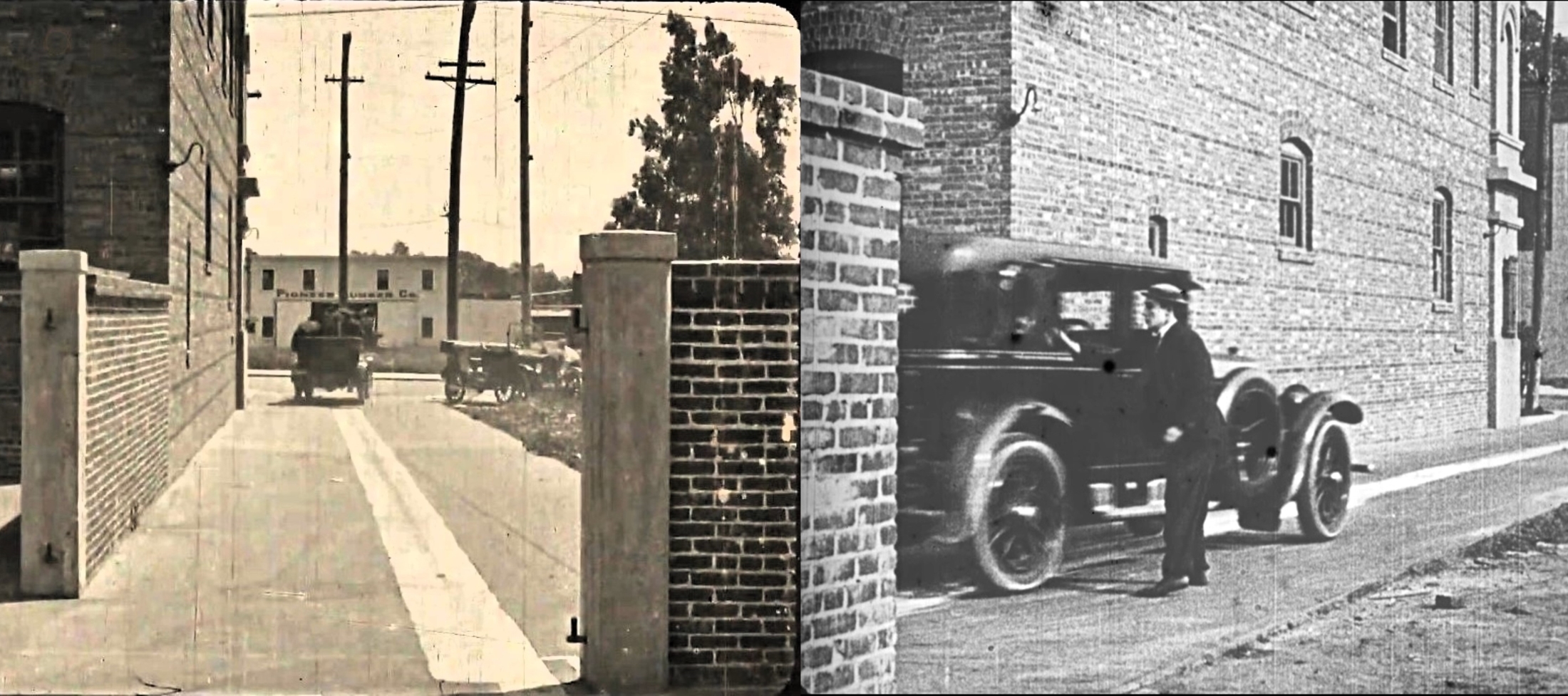
THREE: Above left, the same brick wall and gate appear in reverse view in the 1917 Gale Henry comedy The Masked Marvels (posted on YouTube HERE by Joseph Blough). Joseph has posted dozens of rare and wonderful early silent films – please check out his YouTube Channel for more fun discoveries.

THREE: This similar view with Buster appears in Hard Luck (1921).

Next, a closer view reveals the hanging sliding doors of the PIONEER LUMBER CO. once standing along Comso Street one block to the east. The same PIONEER sign and hanging doors appear during Cops (1922) as Buster affixes a boxing glove to an extension towel rack traveling south down Cosmo. Doug filmed many scenes from Flirting With Fate running around this same lumber yard. In 1917 the south end of the Cahuenga block, north of Selma, was still undeveloped, providing an unobstructed view of Cosmo.

THREE: Continuing Doug’s clockwise tour around the station, visual clues from Put and Take and The Masked Marvels clearly show Doug is running through the gated opening leading to the garage and storage yard behind the joint fire/police station. Doug’s view looks south across vacant land toward Selma. The view east, above right, shows that by 1917 the swinging metal gates behind Doug had been removed.

THREE: Remarkably, opposite views of the same brick wall appear on film, looking south with Doug, and looking north with Buster in The Goat. The windows above the wall in Buster’s frame stand far north of the station, and appear again more clearly below.

THREE: Turning the back corner of the joint fire/police station, now looking north, we see the garage and storage yard behind the station, enclosed by a brick wall. The image to the left appears in Soldiers of  Security, a 1926 LA-sponsored political campaign film encouraging voters to approve better pay for their firemen and policemen. Read Hollywood historian Mary Mallory’s post about the film HERE.

FOUR: Doug leaps over the brick wall enclosing the back of the joint fire/police station. Now looking SE at the station’s NW corner, we see the ground floor of the police station had barred windows to secure the prisoners.

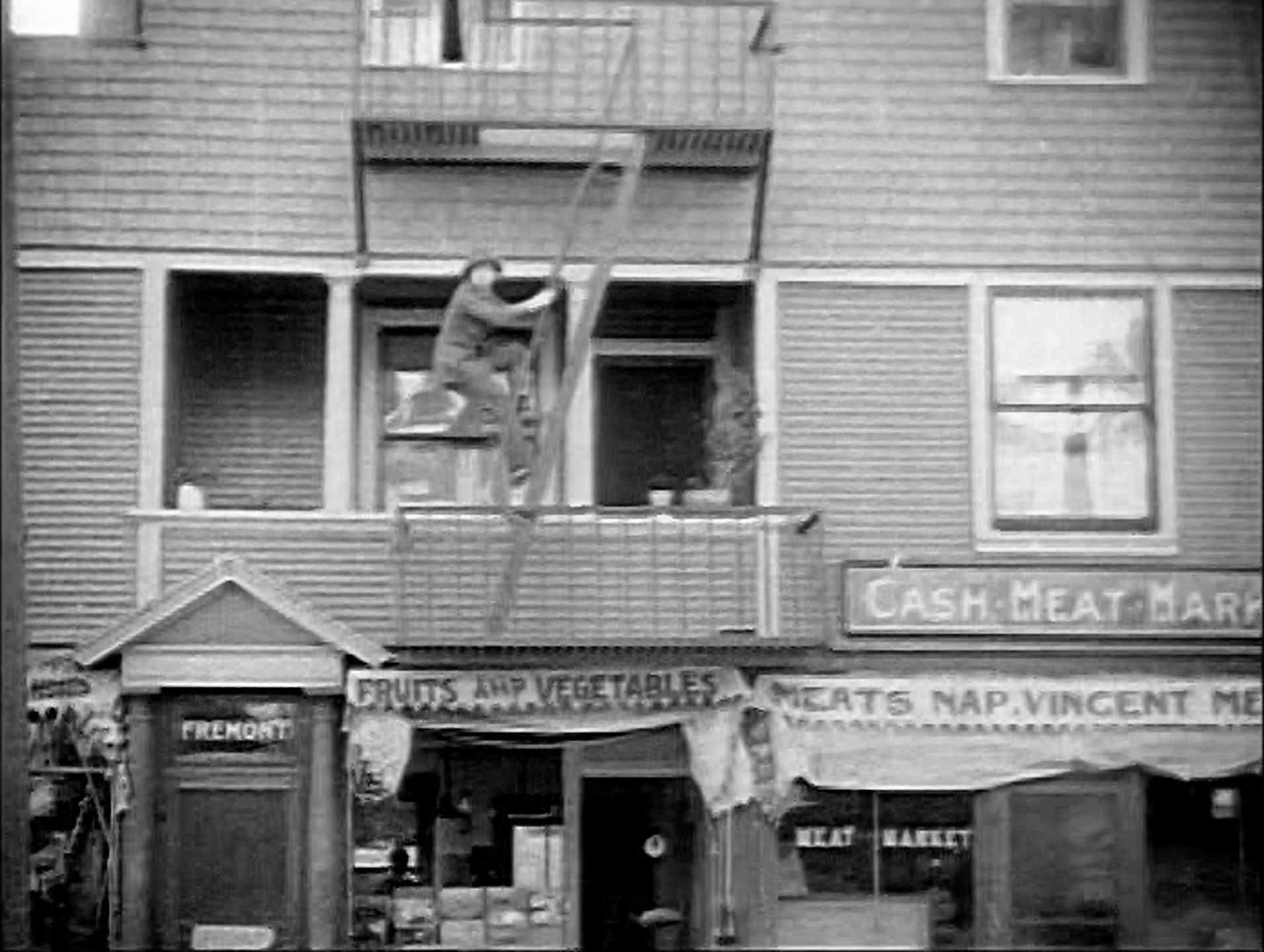
FOUR: Looking south down Cahuenga toward the joint fire/police station, the same north-facing windows highlighted. If you click to enlarge you can see people playing tennis beyond the station tower. The three story building in the foreground is the Fremont Hotel Doug also climbs during the film.

FIVE: Completing his circuit running around the station, Doug runs between the NE corner of the station and the neighboring bike repair shop located at 1633 Cahuenga. During Flirting With Fate Doug also climbs up the front three-story fire escape of this building, the Fremont Hotel. HollywoodPhotographs.com.

FIVE: Above left, looking north from The Masked Marvels (YouTube HERE), comedienne Gale Henry appears beside the police station entrance, revealing its 1629 Cahuenga address. The matching wooden siding of Doug’s bike shop appears behind Gale.

FIVE: Above left, this 1926 view from Soldiers of Security (see LA City Archives YouTube clip) also reveals the 1629 address. The police entrance appears too in the 1919 Lyons and Moran comedy Taking Things Easy. Working with the Library of Congress, Michael Aus has made several early Lyon and Moran comedies, including Taking Things Easy, available to grateful fans. Visit his eBay listing where you can purchase such films directly. The sale proceeds benefit the Niles Essanay Silent Film Museum.

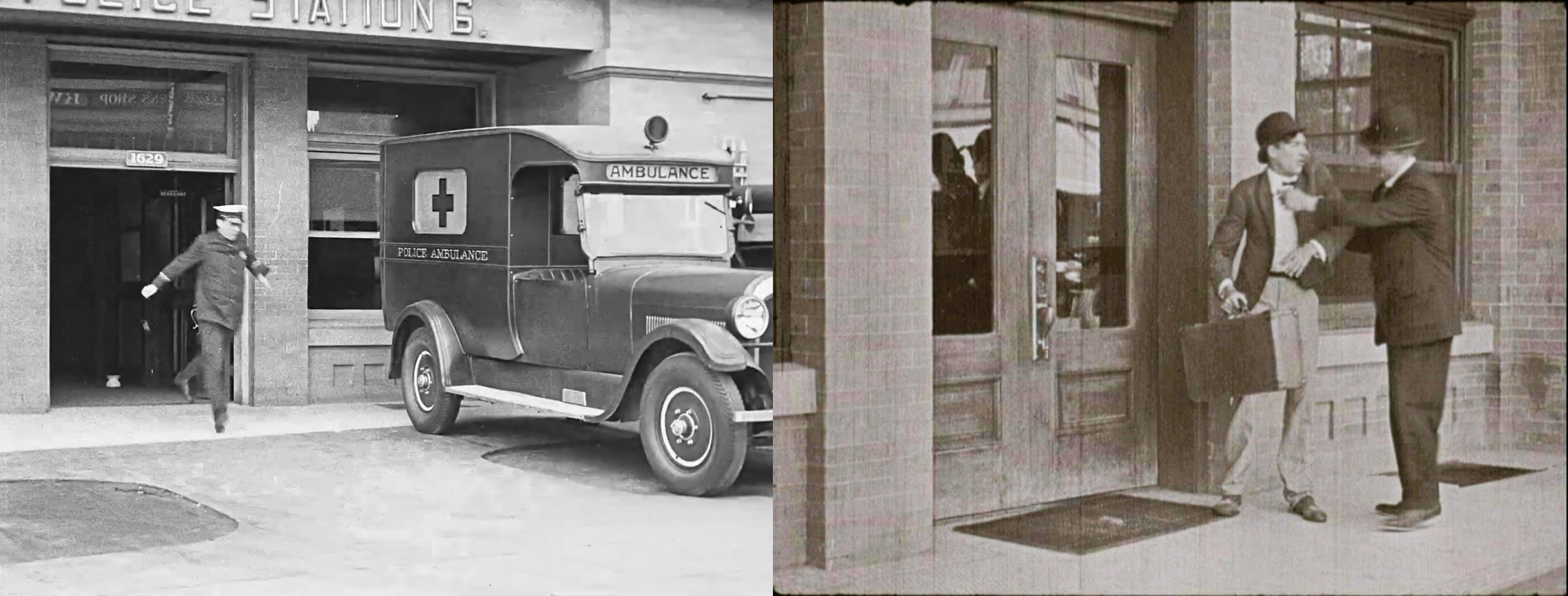
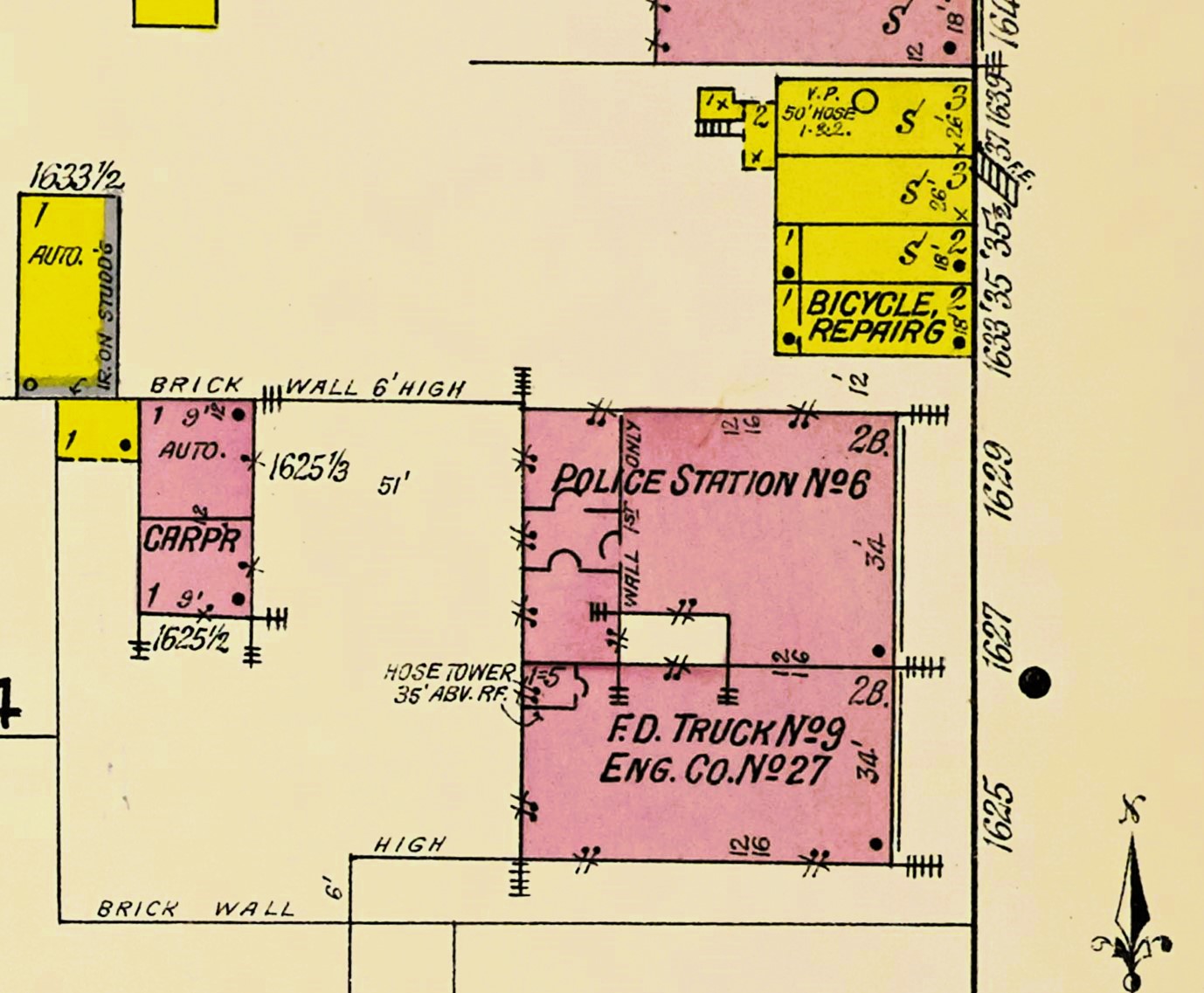
ONE: completing the loop tour, SURPRISE, Charlie Chaplin filmed Easy Street (1917) at the same central entrance where we began our tour with Doug at the top of this post. If you click to enlarge, you can even make out the words POLICE COMMISSION and FIRE COMMISSION on the right plaque. I didn’t emphasize Charlie here because Easy Street was already the subject of this prior post chaplin-leads-the-gang-to-the-hollywood-police/, explaining how Stan Laurel, Harry Langdon, Harold Lloyd, Lloyd Hamilton, and even Our Gang also filmed at the station. Also, Buster and Doug captured numerous views of the station, while Charlie recorded just this single tight shot. Inset: click to enlarge – this detail from the 1919 Sanborn Fire Insurance Map Vol. 10 Page 1051 shows the joint station, its Cahuenga street addresses, the six foot high brick wall surrounding its garage and back storage yard, and the bicycle repair shop and protruding fire escape “F.E.” appearing with Doug above.

Wrapping up, this post focused on Doug’s five-point tour around the station, supported by scenes from Keaton’s Neighbors, Hard Luck, and The Goat, a trio of films explained further in this prior post front-and-back-cameos-100-years-of-a-hollywood-landmark/. Buster also filmed many scenes here from his debut feature comedy Three Ages (1923), both above, including a scene within the station.

Likewise, during The Cameraman (1928) Buster rides a fire engine into the station, providing more cinematic glimpses of the station’s interior. In closing this prior post mary-pickford-and-the-silent-stars-meet-at-one-hollywood-corner/ shows other views from Flirting With Fate.

No matter how rare or obscure, each moment captured on film expands our visual history of the silent film era. We should all be grateful to the Eye Filmmuseum, Joseph Blaugh, and Michael Aus, for preserving and sharing these cinematic puzzle pieces that enable us to walk with Buster and Doug around the Keaton-Fairbanks Hollywood Fire Station. Purchase Flirting With Fate on DVD at Flicker Alley – A Modern Musketeer.

Please check out my latest YouTube video, revealing new visual discoveries about how Buster Keaton made The General.

Below, while the joint fire/police station was demolished long ago, the “alley” driveway where Buster and other comedians filmed remains.

Posted in Buster Keaton, Doug Fairbanks, Gale Henry, Hollywood History | Tagged , , , , , , , , , , , | 3 Comments

Rooftop Vistas from Silent Film – Hal Roach’s “Radio Mad”

Imagine visiting an apartment rooftop a century ago, the things you’d see. Overflowing with LA history, the Hal Roach comedy Radio Mad (1924) also reveals novel views of silent films such as Safety Last! and A Woman of Paris (below), as well as insight to underground poet Charles Bukowski. PLEASE CLICK TO ENLARGE EACH HIGH DEFINITION IMAGE.

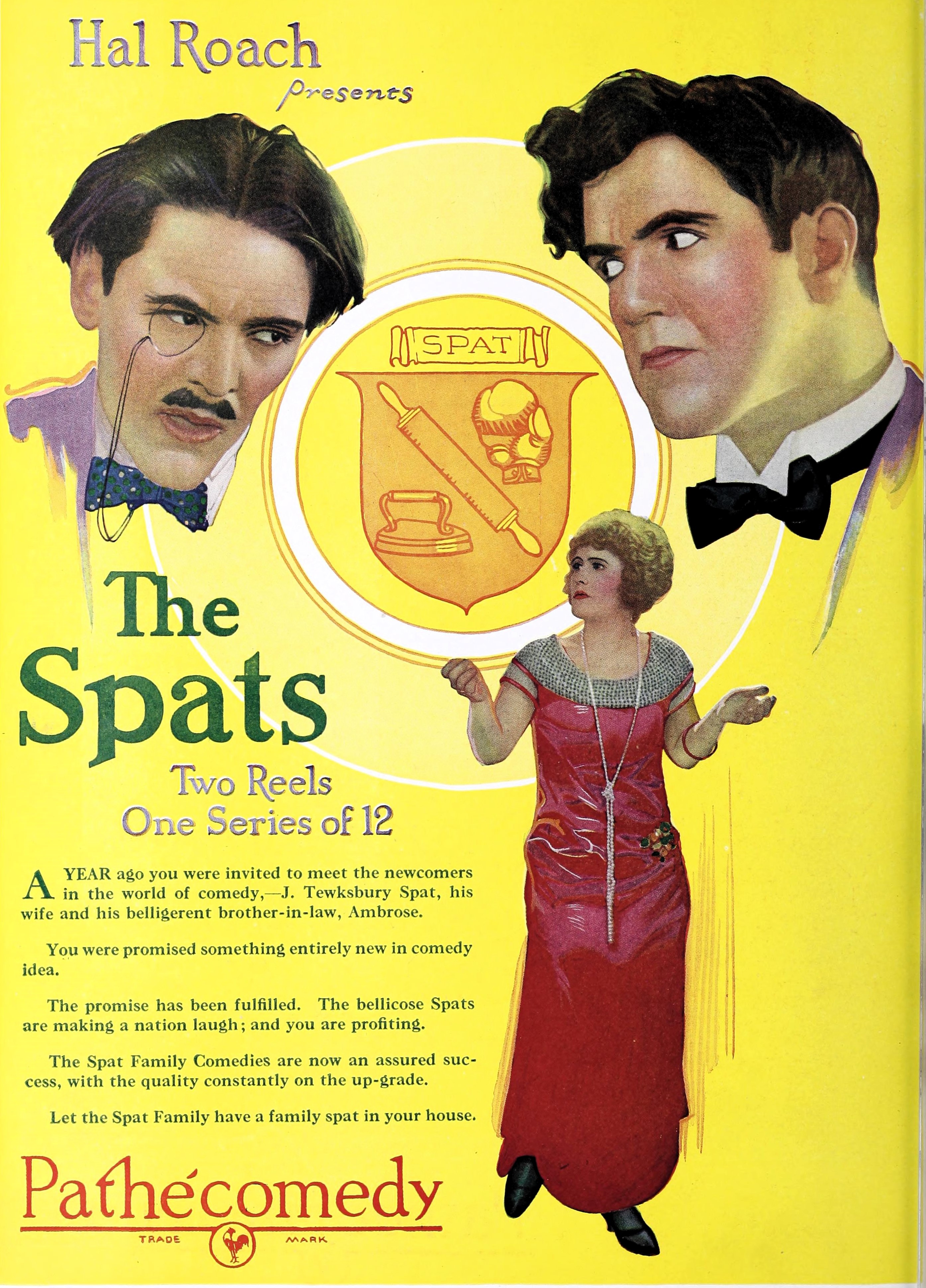
Radio Mad (view on YouTube HERE) was an entry in the aptly named “Spat Family” comedy series about a bickering married couple and her live-in brother. Frank Butler played the mustachioed imbecile husband J. Tewksbury Spat, Laura Roessing played his wife Mrs. Spat, and her belligerent Brother Ambrose was played by Sidney D’Albrook. In Radio Mad slapstick mayhem ensues when Husband Spat and Brother Ambrose attempt to install a rooftop antenna for Mrs. Spat’s new radio, dealing with pesky dogs, high voltage electrical wires, and a jealous gun-toting neighbor, all before starting a fire that sends the Spats fleeing their home.

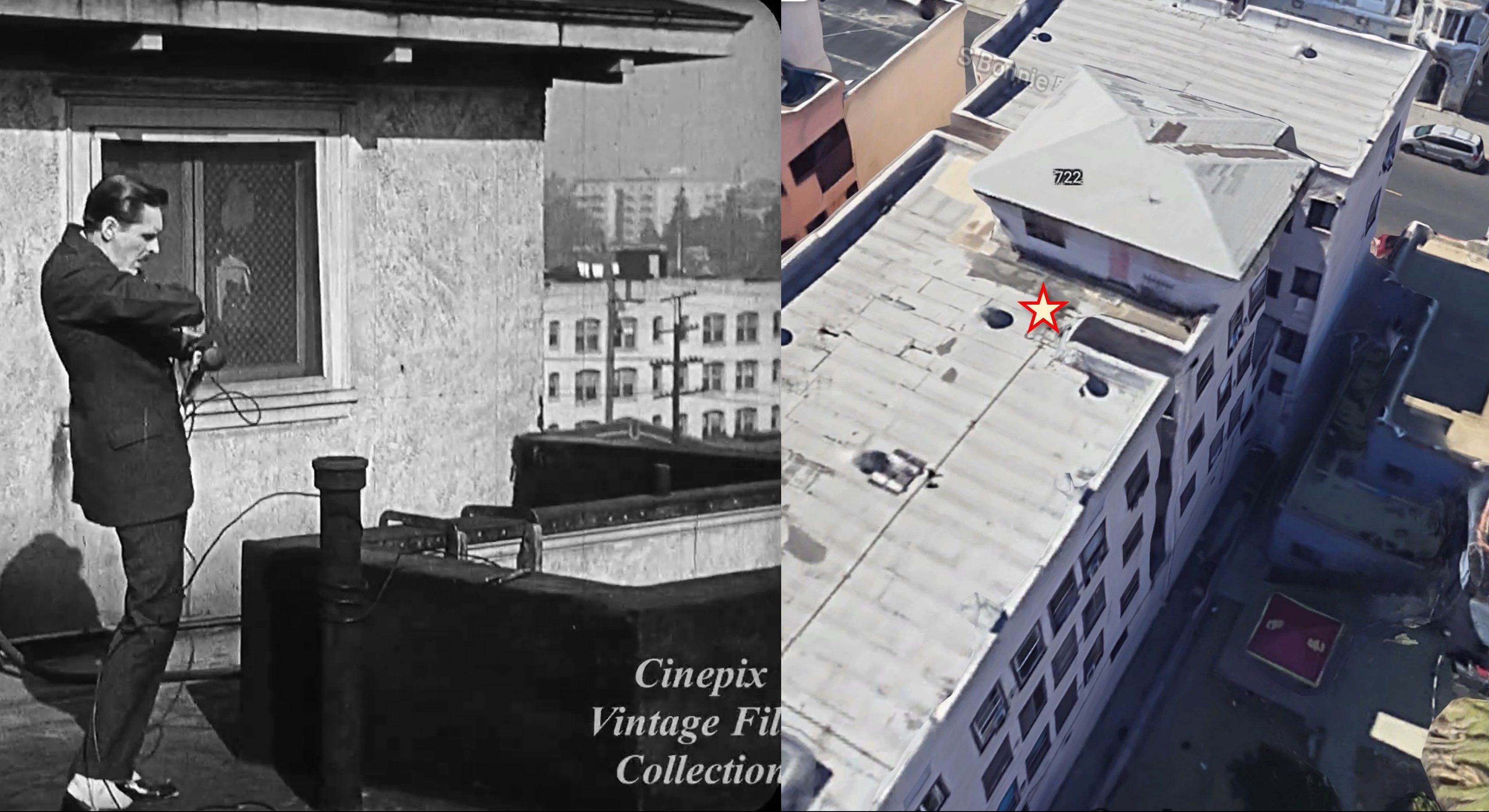
The Spat Family lived at the regally named Princess Apartments above (stripped of ornamentation but still standing at 722 S Bonnie Brae), once adjacent to magnificent buildings and homes now lost to history. Standing east of Westlake (now MacArthur) Park, the rooftop provides unique vantage points of where other silent movies were made.

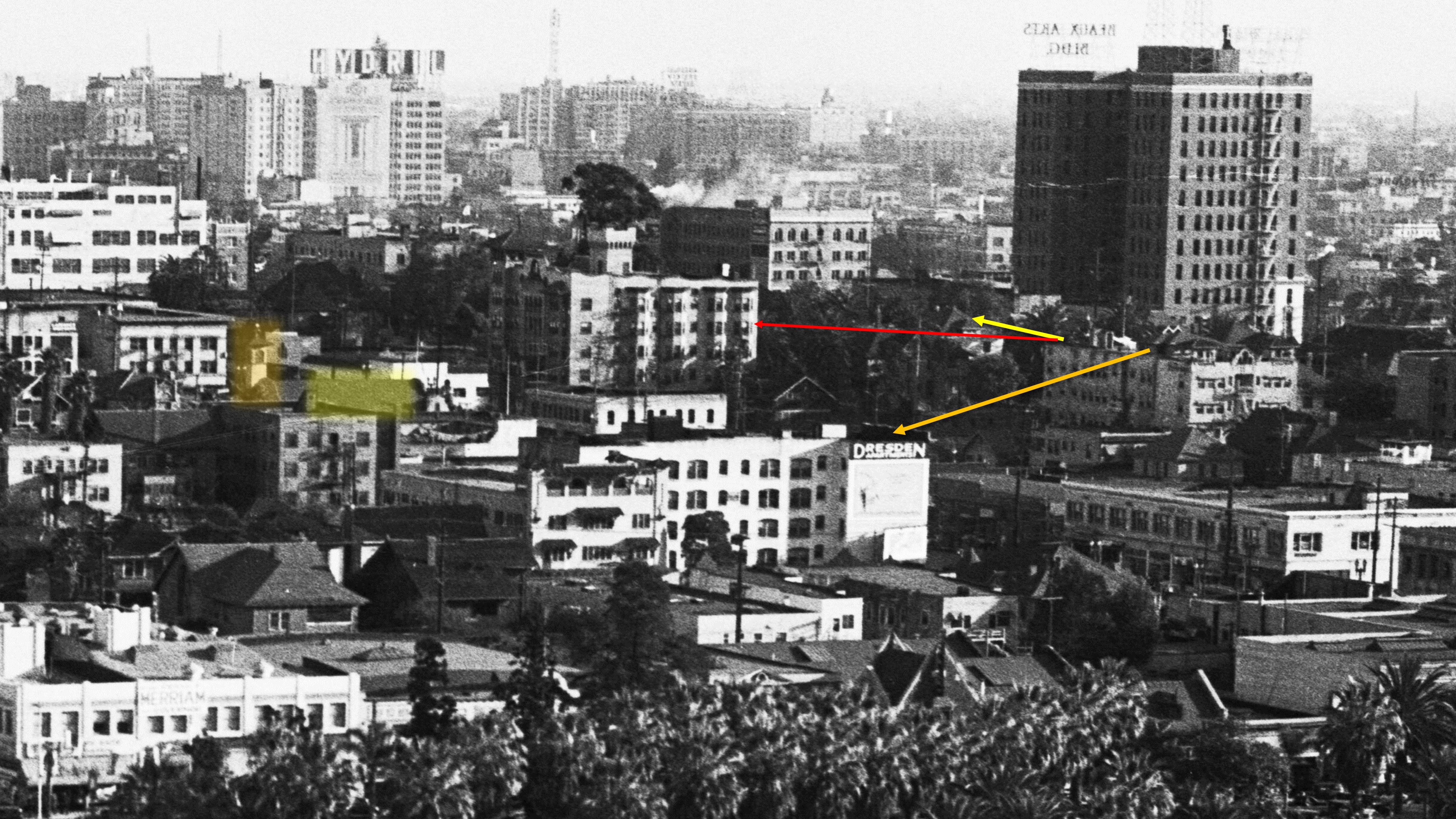
The Dresden Apartments appearing in Safety Last!

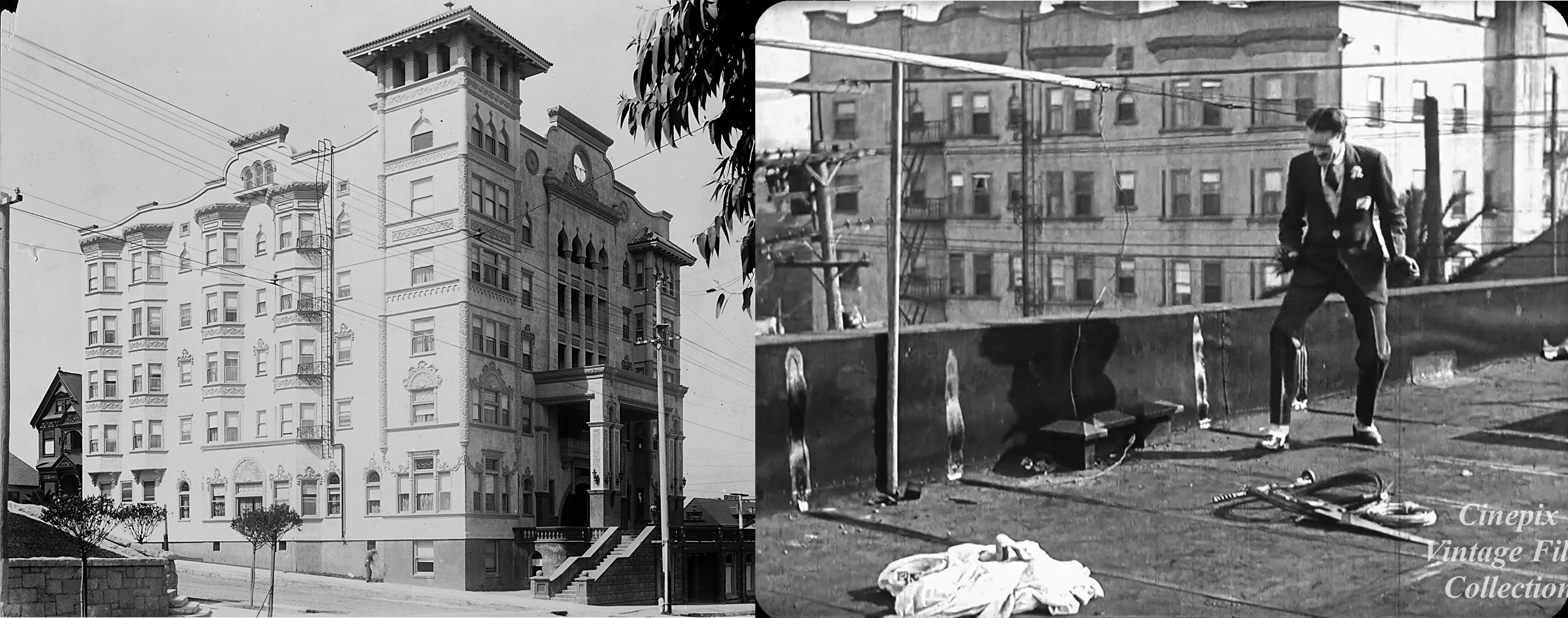
To begin, looking northwest behind Mr. Spat reveals the east side of the Dresden Apartments still standing at 1919 W 7th. As posted HERE, Harold Lloyd learns early in Safety Last! that his roommate Bill Strother is a human spider when he climbs the Dresden to escape an angry cop.

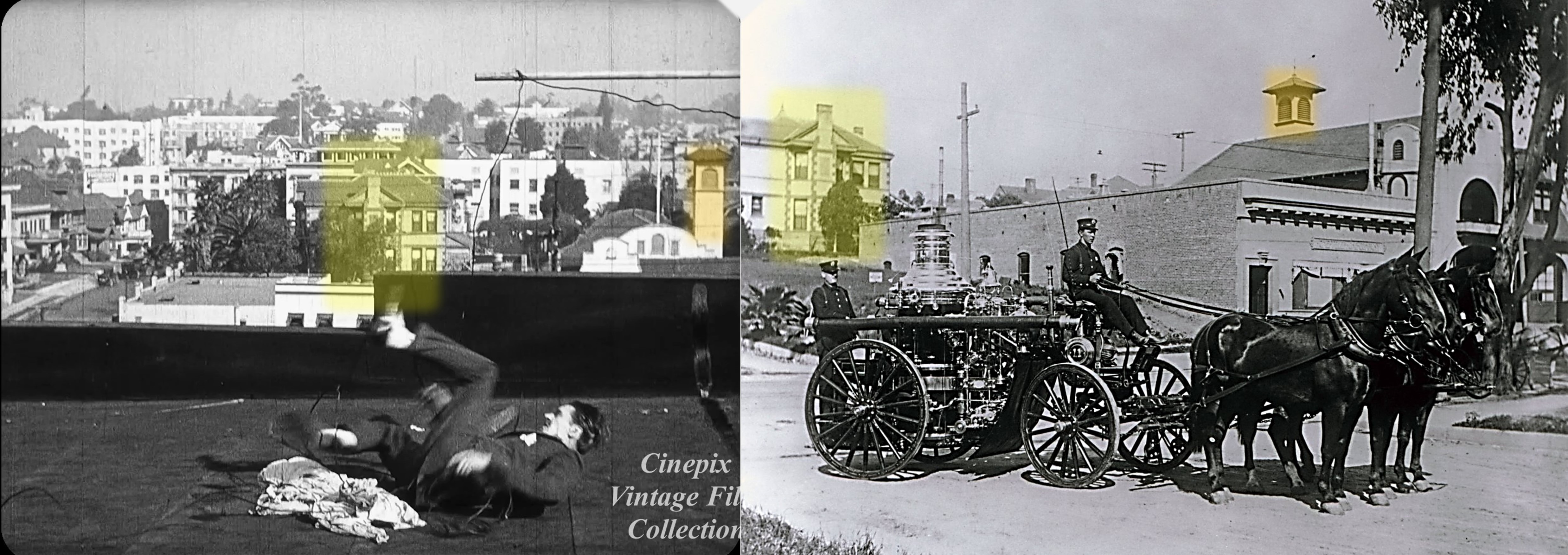
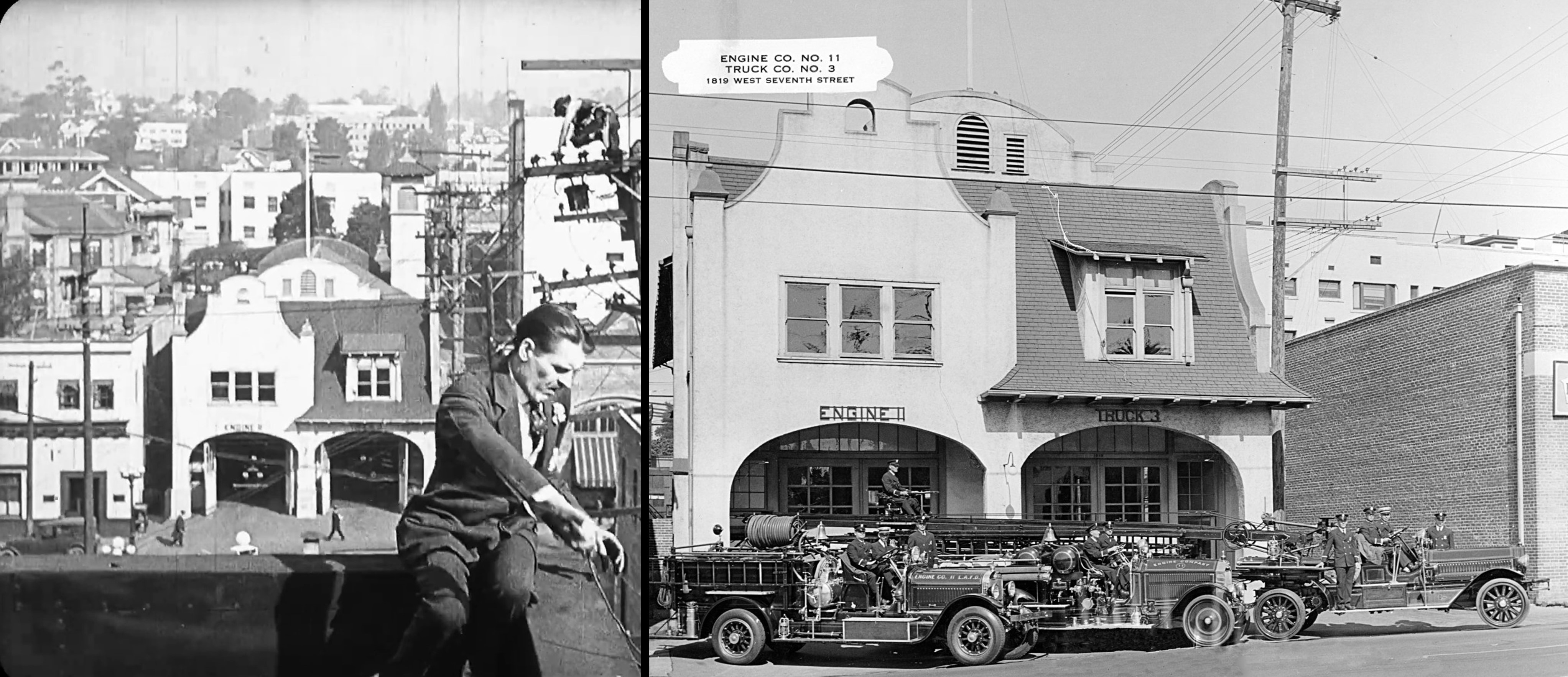
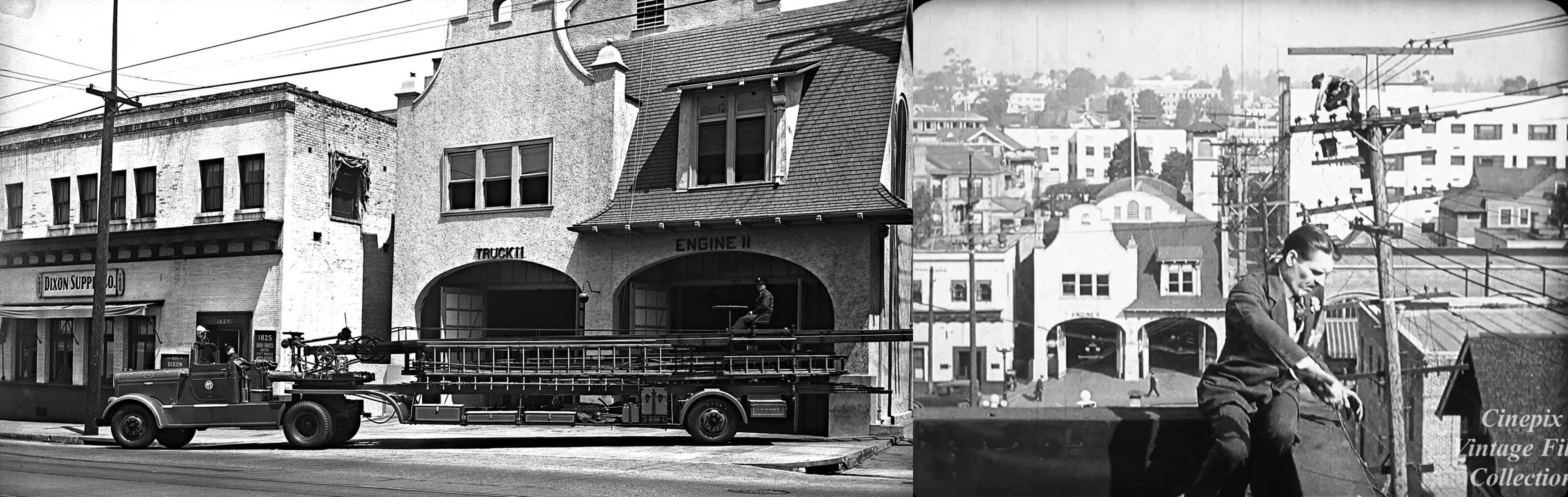
Looking north provides views of the grand lost home at 680 S Bonnie Brae (yellow) and the fire department tower (orange) of Engine Co. No. 11 (LAFD Historical Archive).

Closer views of Engine Co. No. 11 at 1819 W 7th – the modern LAFD Station No. 11 still occupies the site today (LAFD Historical Archive).

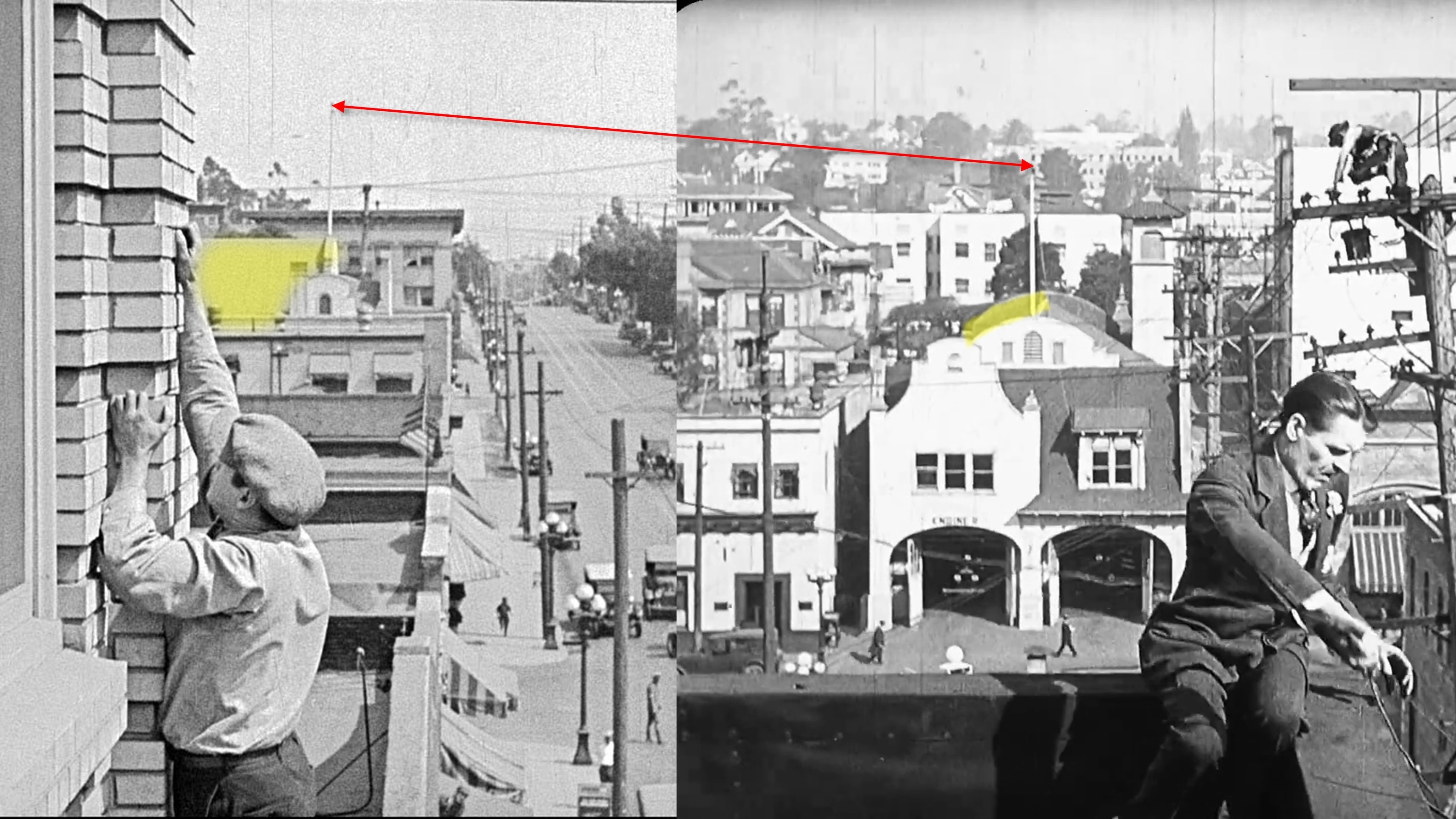
The Radio Mad fire station actually appears in the background during Safety Last! as Bill scales the Dresden in this scene looking east down 7th Street. The west side of the station roof (yellow) and matching flag pole (arrow) appear in both films.

But there’s more. Charles Bukowski’s sleazy but fun poem Fire Station (for Jane with love) takes place at this station, as reported by my Esotouric historic LA tour company friends Richard Schave and Kim Cooper. The poem chronicles how Charles and his “girlfriend” earn funds to continue their drunken afternoon adventures by providing “entertainment” to bored firemen awaiting the next alarm. You can visit the station as part of Esotouric’s upcoming Charles Bukowski historic bus tour on August 12, 2023. You can read the full poem HERE and watch Charles himself read the poem on YouTube HERE.

Switching views, we see the NE corner (left) and on film the SW corner of the grand Hotel Pepper that once stood on W 7th and Burlington. USC Digital Library.

> Sigh < Can you imagine visiting this spectacular building in its prime? It was demolished in 1965, replaced by this mundane US Post Office building. The front of the Princess Apartments appears at back (yellow). Huntington Digital Library.

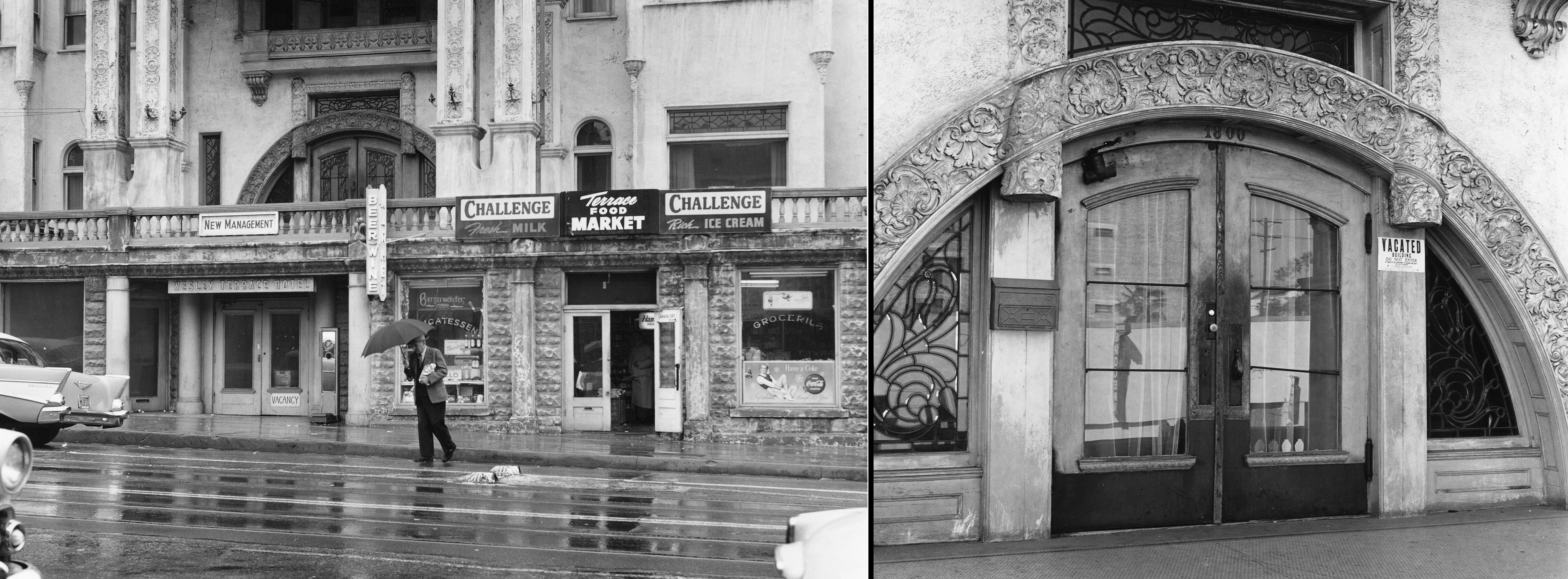
The Hotel Pepper was later named Hotel Wesley Terrace – the pre-demolition “VACATED” entrance photo was taken in 1964. California State Library Image One and Image Two.

Again looking NW, further back behind Frank Butler stands the Ansonia Apartments (yellow) at 2205 W 6th St., home to Edna Purviance (center) during Charlie Chaplin’s A Woman of Paris (1923), matched with a modern view. All three images show the east side of the building.

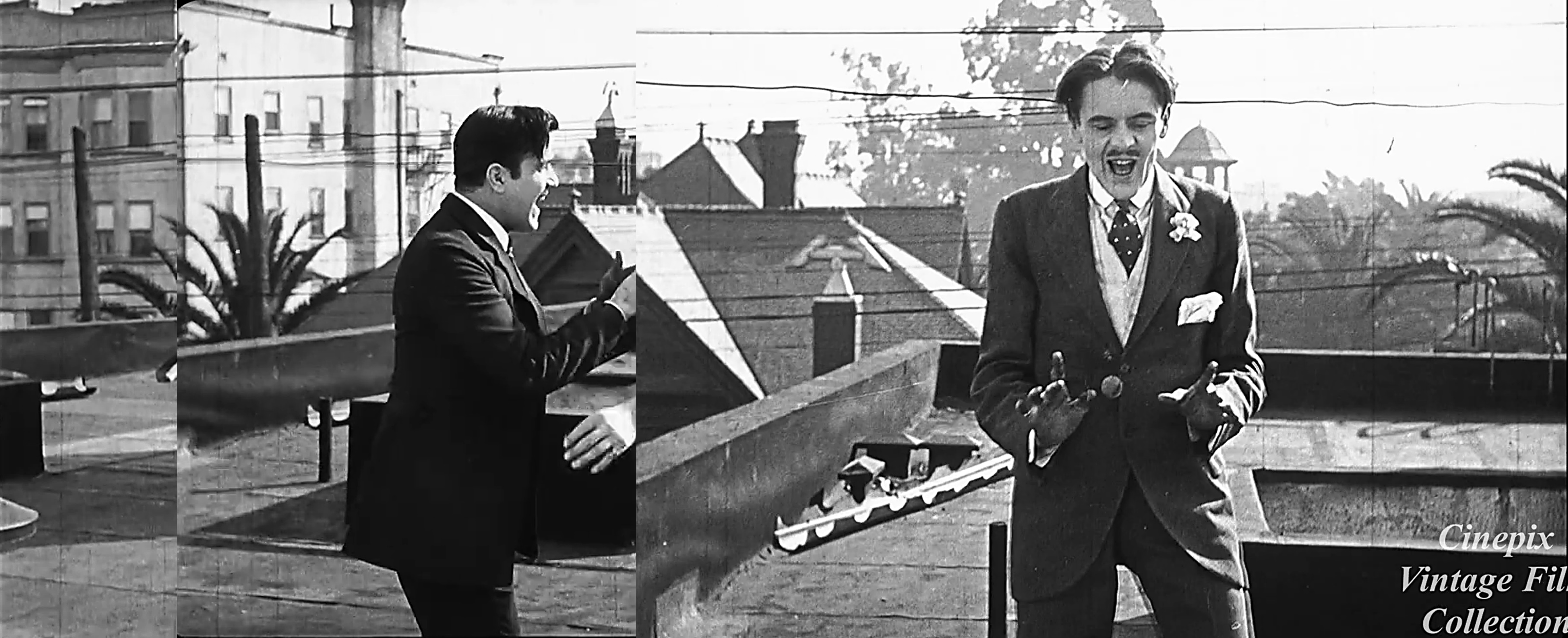
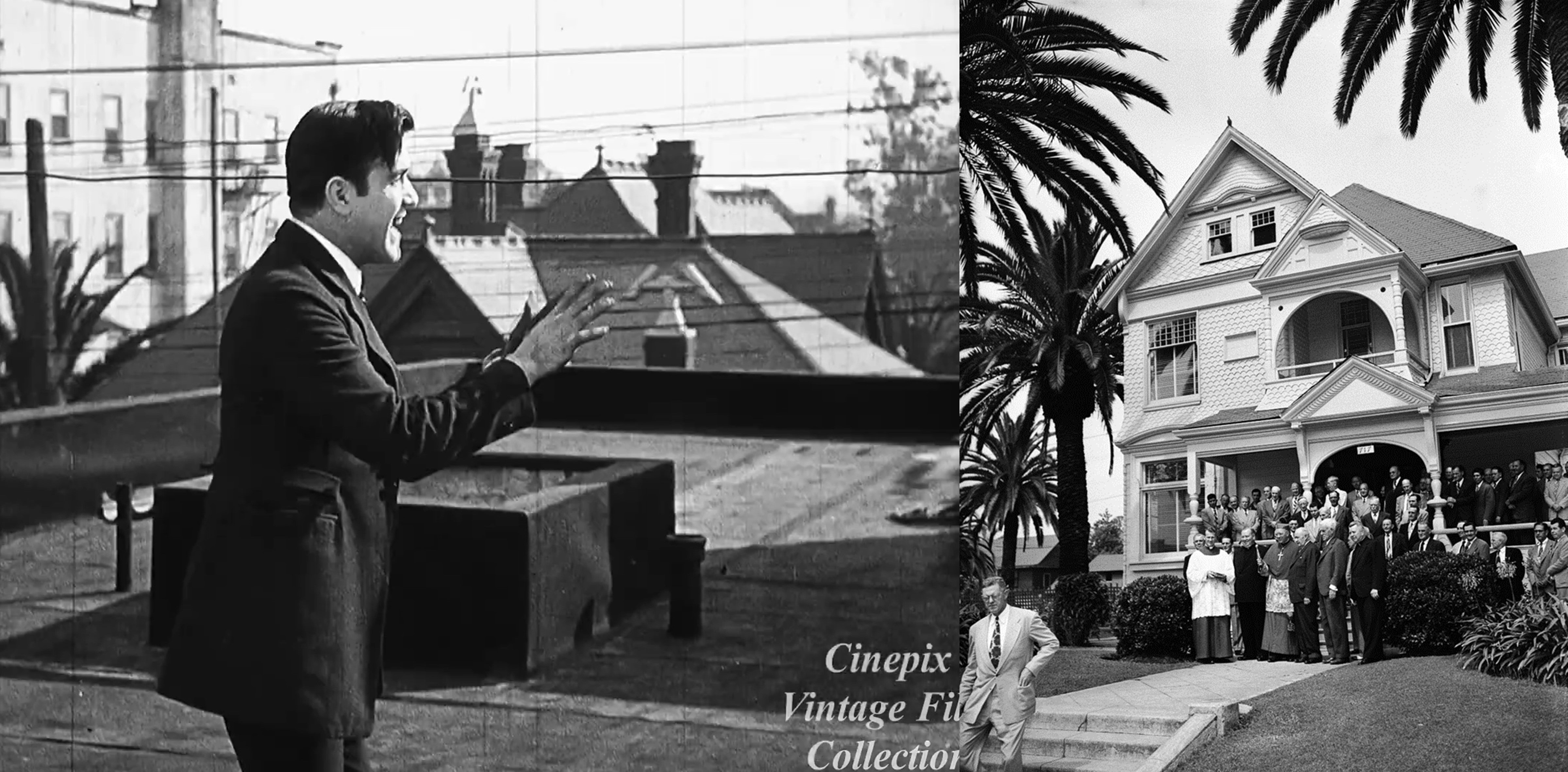
From the roof with Brother Ambrose left and Husband Spat right, now looking east at the back of the Hotel Pepper and the elaborate chimneys and tower domes of the neighboring homes at 717 and 720 S Burlington.

Back and front views of long lost 717 S Burlington. USC Digital Library.

For context, here’s a view looking SE over the newly completed extension of Wilshire Blvd. across Westlake (MacArthur) Park. USC Digital Library.
Looking closer now towards the Princess Apartments – the orange tower and yellow roof of Engine Co. No. 11 at left. The orange arrow points to the Dresden Apartments Bill Strother climbed in Safety Last!, the red arrow points to the west side of the Hotel Pepper, and the yellow arrow points to the grand homes on S Burlington mentioned above.

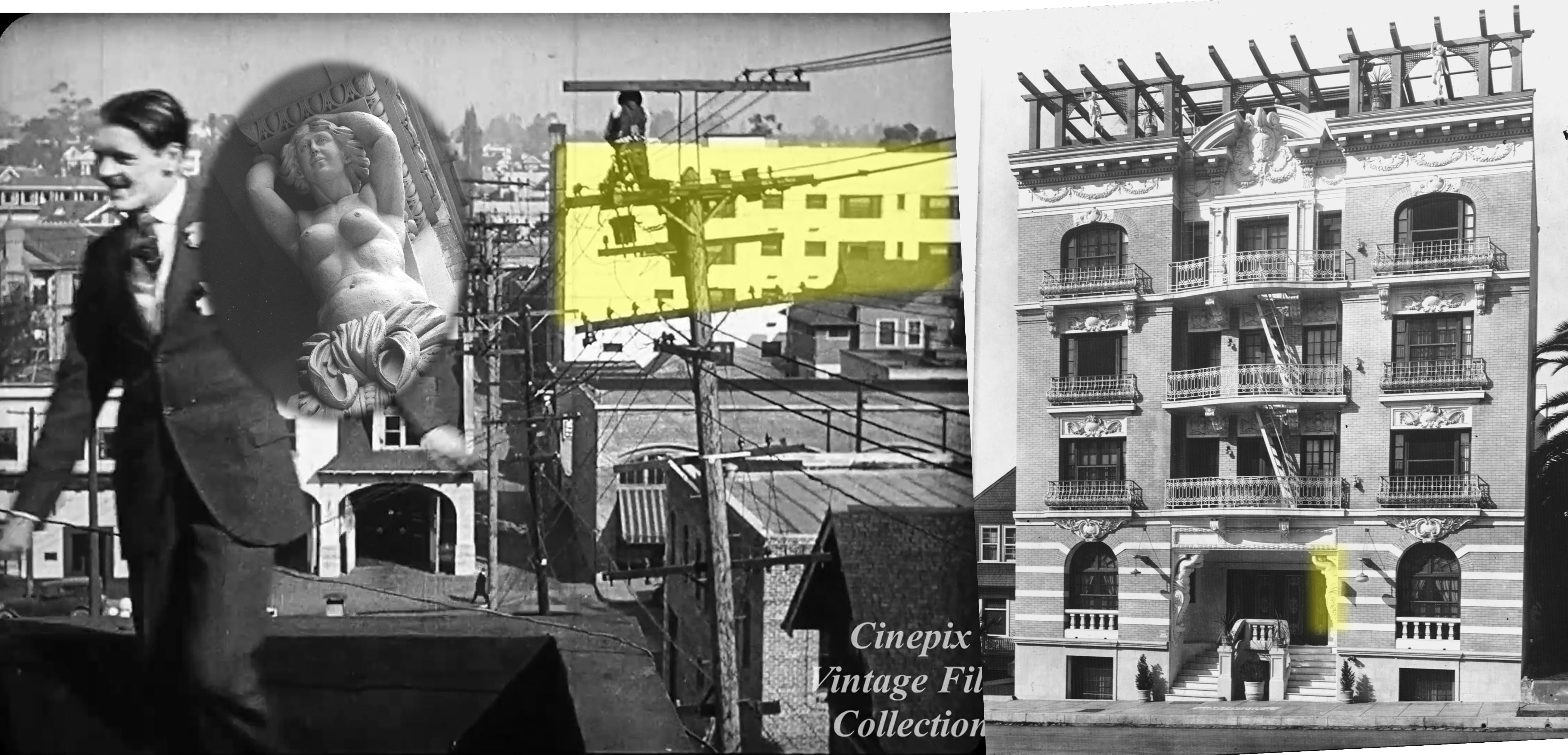
Another lost treasure, looking north at the south side of the La France Apartments (yellow), noted for its grand entryway figures (inset), once standing on 681 S Burlington. Front view USC Digital Library – inset California State Library.

[Update] – the now lost La France Apartments portrayed the home of Detective Sledge Hammer during the mid-1980s TV sitcom entitled Sledge Hammer!, which spoofed Clint Eastwood’s Dirty Harry movies.

Looking NW, the star marks Frank Butler’s spot on the roof of 722 S Bonnie Brae.

A parting view looking NE, the Dresden Apartments (orange), new LAFD Station 11 (yellow), Post Office site of the Hotel Pepper (pink), and the Princess Apartments (red).

Thank you so much to CINEPIX for posting this fun and historic film.

Special thanks also to author and historian Steve Vaught – his fascinating and entertaining Paradise Leased blog looks back on classic Hollywood and Southern California architecture, and inspired this post.

Below, the Princess Apartments still reigns at 722 S Bonnie Brae.


Posted in Hal Roach Studios, Safety Last! | Tagged , , , , , , , | Leave a comment

The Ghosts of Trolleys Past – Harold Lloyd’s Haunted Spooks

Paul Ayers, attorney, SoCal historian, and Altadena hiking trail expert and restorer (Paul on Facebook, Paul’s channel on YouTube) has shared many remarkable location discoveries over the years, including the Little Tramp’s walking-away-alone finale spot from Charlie Chaplin’s The Circus (1928). I’m happy to host guest blogger Paul’s amazing post regarding the lost LA trolley history appearing in an early silent film. Take it away Paul.

+               +              +

The first silent movie location puzzle I solved for John involved a railway scene. In his initial work, Silent Echoes, John actually asked his readers for help with a location, specifically, that of the motorcycle-meets-train segment from Keaton’s Sherlock Jr. I had a fairly extensive library of out-of-print train books, and in one, I found that the shot took place in Atwood, a Santa Fe whistlestop in northeast Orange County. (Read about The Circus walk-alone finale and the Sherlock Jr. stunt HERE).

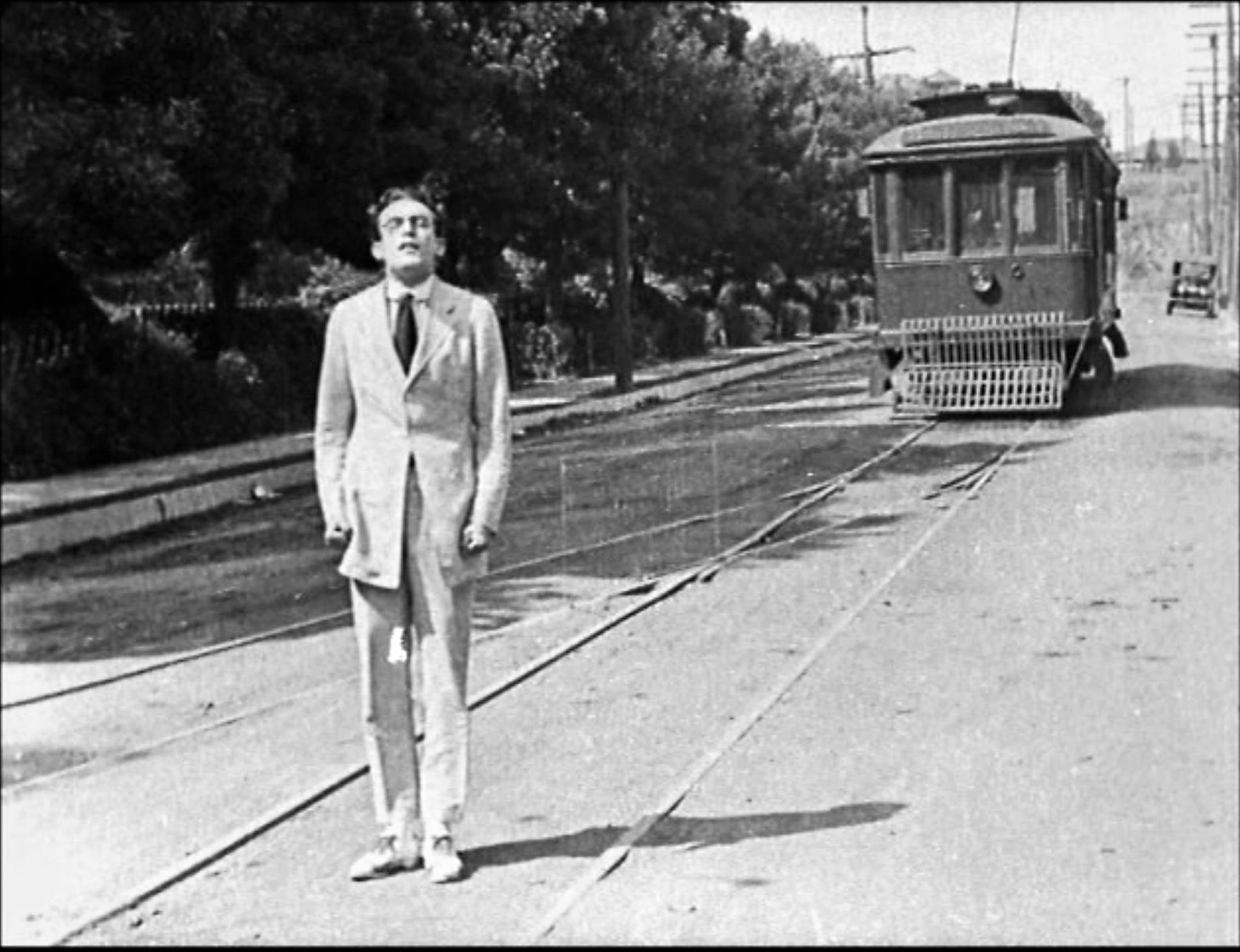
Since that time I have identified a number of rail-related locations. These include the use of the Ontario Southern Pacific station in Harold Lloyd’s The Freshman, the Santa Fe line between Inglewood and Redondo beach in Buster Keaton’s The Goat and Lloyd’s An Eastern Westerner, the Hynes Union Pacific station in Lloyd’s Girl Shy, and the Southern Pacific’s Tropico station, also in Lloyd’s An Eastern Westerner. It is not uncommon that when John has a railroad problem to solve, he gives it to me to work on. The latest puzzle and the subject of this blog is the attempted suicide-by-streetcar from Lloyd’s 1920 two-reeler, Haunted Spooks.

Beginning about nine minutes into the film, Lloyd learns that a girl he is infatuated with is being wooed by another man. Despondent he resolves to end his life. Happily he does not succeed but in his efforts to do so, laughs are generated.

One of the attempts involves standing in front of an oncoming streetcar; this plan is foiled when the car switches to a parallel track just before hitting him. It was the location of this scene that John asked me to identify.

Based on the locations that John had already identified, it was clear that the scene was shot in Los Angeles. Accordingly, it was a fair assumption that the shot utilized a line of one of the two streetcar companies operating in Los Angeles in the 1920s, the Los Angeles Railway [LARy] or the Pacific Electric [PE] Railway.

A primary difference between the two railways was their track gauge, which is the space between the rails. PE used standard gauge of 4’ 8 ½”, LARy used narrow gauge of 3’6”. It was apparent to me that the track seen in the footage was narrow gauge. As such, it was fairly certain that the car and track used in the scene belonged to LARy.

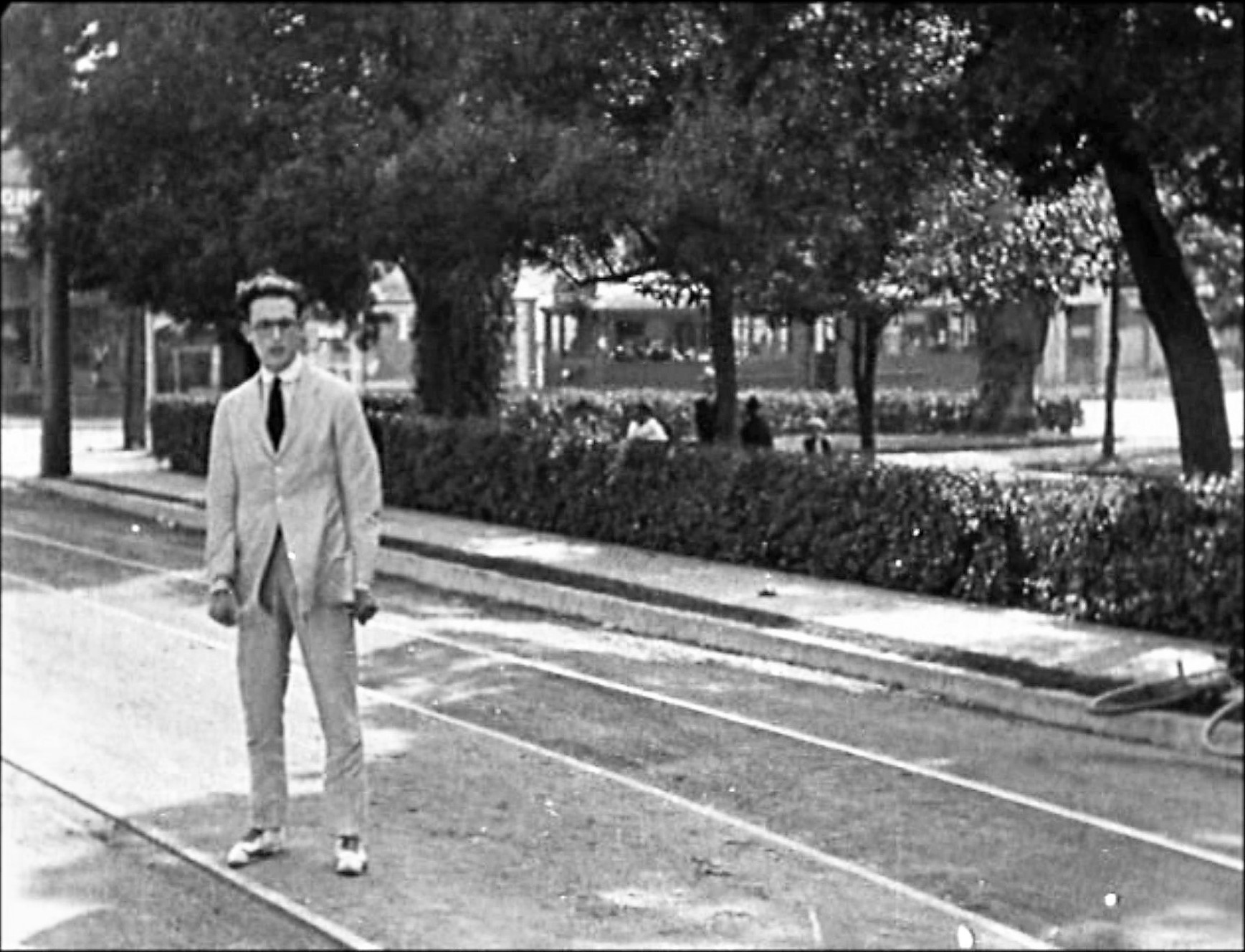
There were certain specific aspects of the setting which provided clues as to the scene’s location. Above, the track was laid in a single block with “T” intersections at both ends, and a slight incline.

At the lower end of the block, above, a streetcar appears moving in the background. Looking in this direction, at frame right, a park-like open space lined with shrubbery is seen; here we see children observing the filming.

Looking uphill beyond the street-side shrubbery, a bare road cut is seen, while above, buildings, with specific architectural elements, are visible.

You can watch the brief scene on this non-official YouTube clip starting at 9:46.

In addition to these specific clues, one general rule guided my efforts. Silent movie scenes which involved trains or trolleys usually took place on little-used or abandoned routes; the simple reason for this was that the rail companies did not want heavily used lines to be disrupted by filming. The Santa Fe line from Inglewood to Redondo Beach provides a good example of this rule in action. Originally opened as a tourist line to Redondo, this role had been supplanted by direct PE lines to the beach city and by the late teens the line had become a seldom used freight line. This and its proximity to Hollywood, made it perfect for filming, and it was used by such diverse directors as Keaton [The Goat], Lloyd [An Eastern Westerner] and D.W. Griffith [Intolerance]. Mary Pickford filmed here as early as 1912 for A Beast at Bay – read more HERE.

There followed a three month period of trying to figure out where in the LARy system the subject trackage was. Many locations were reviewed and discarded because they did not match the specific elements discussed above. Books and maps were pored over, internet searches and views of locations undertaken, all to no avail. Ultimately the solution came, as it often does, by taking a look at a resource which seemed to have nothing to do with the problem.

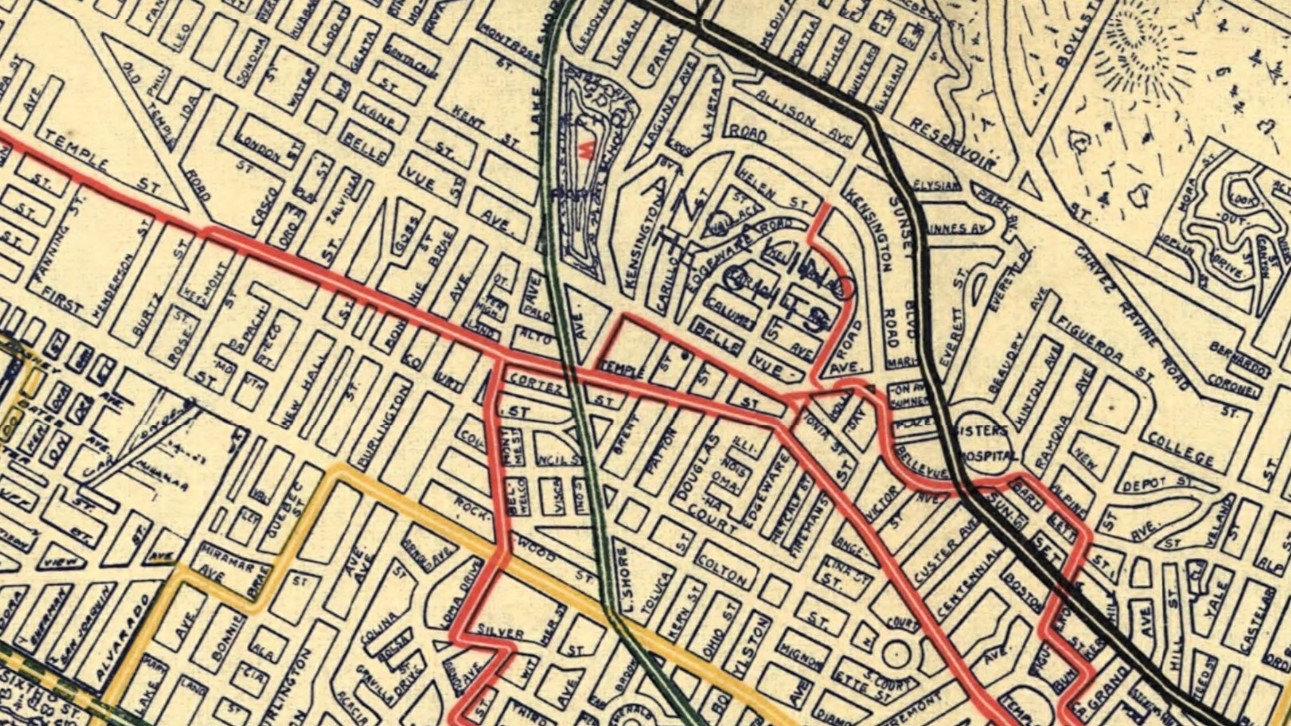
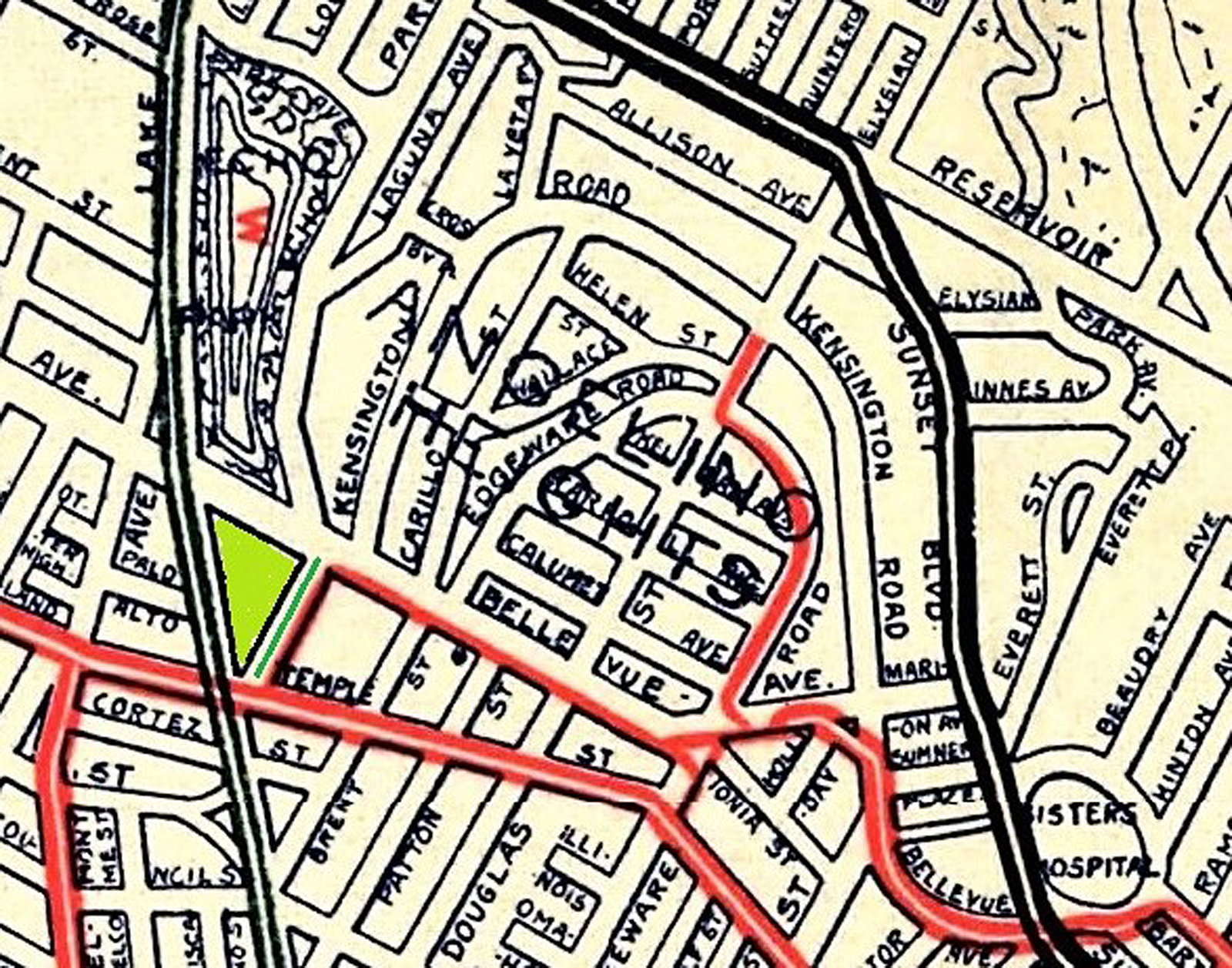
The standard research map for LARy lines is the 1938 route map; it did not reveal any trackage that satisfied the specifications of the scene. In taking another look at my rail maps I found a 1906 map (above) which I had not reviewed as feeling it too early to provide an answer to my problem. What it revealed was an extension to the LARy “C Line” which by 1938 had been abandoned, thus not on the 1938 route map. This extension ended on a single block run on what was then Echo Park Road (“the block”). The block had T intersections at either end; the southern intersection was with Temple Street, the northern with Bellevue Avenue.

The discovery of the C Line extension quickly led to confirmation of the single block (green line above) as the sought location by additional proofs. Just west of the block between Temple and Bellevue was the Echo Park Playground (green triangle above), an open area that matched the park-like area shown in the frame with Harold and the children. Temple Street, which formed the south end of the block had a heavily traveled streetcar line. Looking in the other direction, a road cut seen in the film matched that on the north side of Bellevue; somewhat amazingly, the road cut survives to this day. Finally, building elements seen in the film, above the road cut, matched structures, some of which still survive, on Kensington Road, which intersects with Bellevue just to the east of the block.

A 1908 map of the same block (red line) where Harold filmed beside the Echo Park Playground.

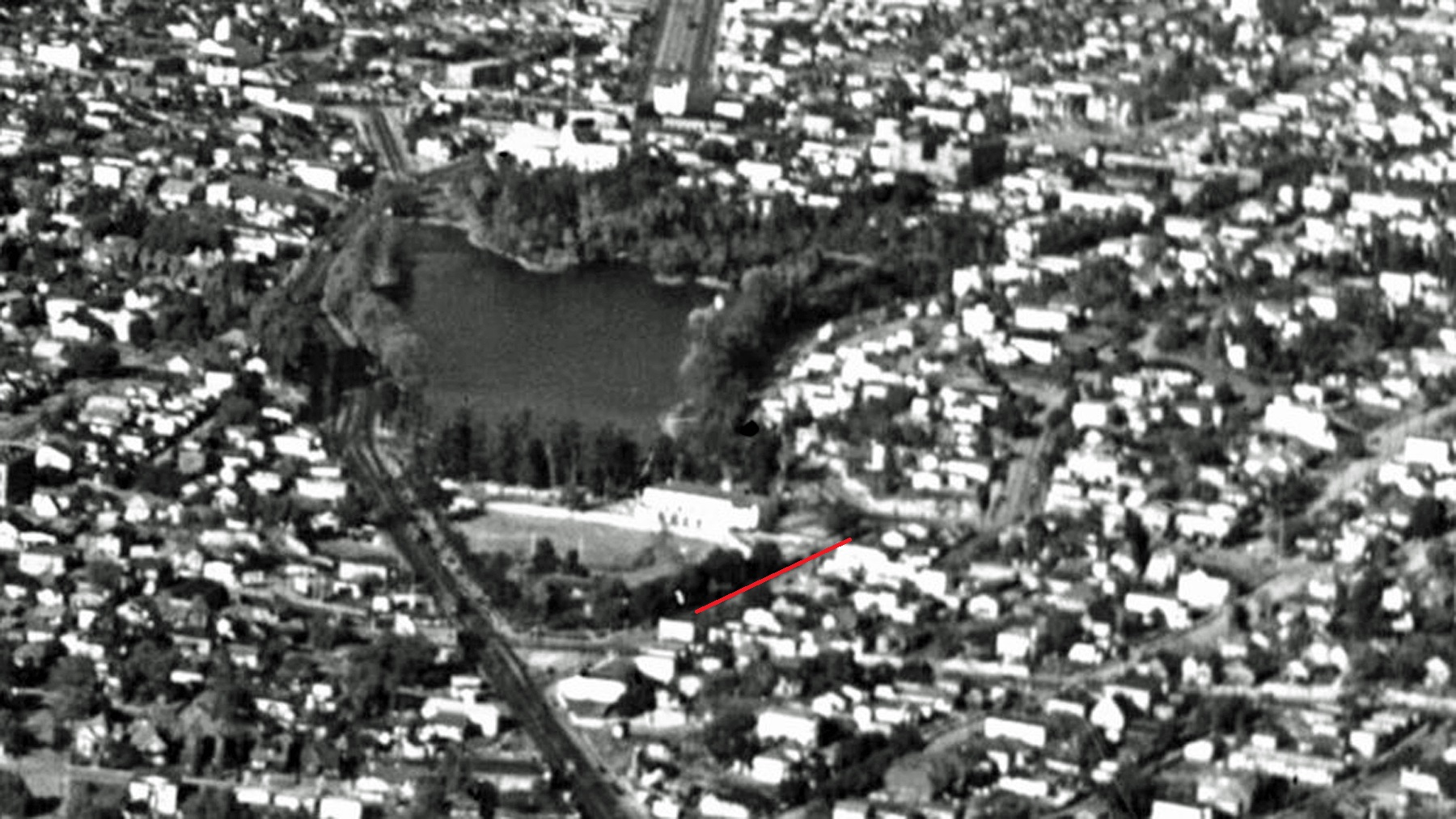
1938 view of Harold’s block (red line) on Echo Park Road – USC Digital Library

For context the north end of the Echo Park Playground and the prominent road cut along Bellevue at back. Harold stood far out of frame at right near the south end of the playground, with the road cut behind him and the playground to his left – Huntington Digital Library

Looking north – the extant home at 1128 W Kensington appears at back

1128 Kensington – matching 1920 view north and 1941 view east – c-7334_104 FrameFinder

In retrospect one of the challenges of finding the location was its absolute obliteration by the construction of the Hollywood Freeway in the 1950s; if Lloyd were standing in the same position as seen in the subject scene he might be dodging freeway traffic. Happily with the scene and the identification of its location we have a marvelous remembrance of a bygone Los Angeles.

+               +              +

Thank you so much Paul for this amazing discovery. My book Silent Visions shows where Harold filmed other failed suicide scenes from Haunted Spooks at the Millbank Mansion at 3344 Country Club Drive, at Lincoln Park, and at Hollenbeck Park.

Below the scene location today – the stretch of Echo Park Road between Temple and Bellevue where Harold stood no longer exists.

Posted in Harold Lloyd, Paul Ayers, Trolleys | Tagged , , , , , , | 6 Comments

Silk Hat Raymond Griffith at Swanky Fremont Place

Ben Model is a silent film SUPER-HERO. Now the subject of four posts at this site, Ben’s indie Undercrank Productions has released dozens of rare silent movies to home audiences. His latest Blu-ray production now for sale, Raymond Griffith: The Silk Hat Comedian, features two previously unavailable Griffith feature comedies Paths to Paradise (1925) and You’d Be Surprised (1926), along with a video essay by film author-historian Steve Massa.

As Ben and Steve explain, Raymond Griffith is one of the best-kept secrets of silent comedy. During a twenty-five year career he not only wrote, directed and produced movies, but was also the star of nine comedy features for Paramount. Because of the disappearance and unavailability of his work he’s been forgotten. Both films are presented in stunning, sparklingly clear 2K digital restorations of archival 35mm prints preserved by the Library of Congress accompanied with new theatre organ scores by Ben.

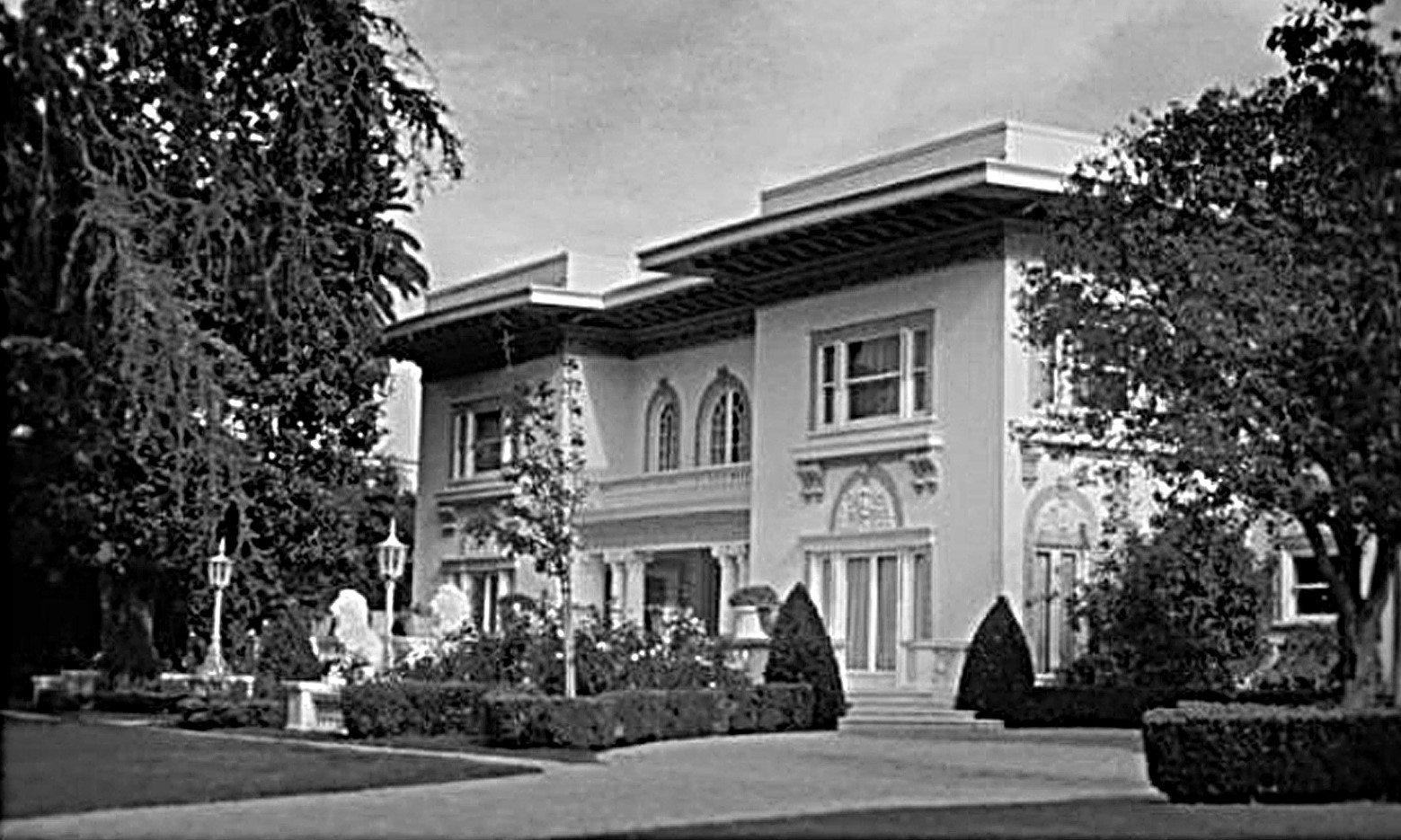
To keep things brief, this post will focus on one small detail from Paths to Paradise – the millionaire’s mansion is portrayed by the magnificent home at 56 Fremont Place (above), once rented for a year in 1918 by Mary Pickford, and in 1919 by Mary Miles Minter. You can read all about the home’s incredible history at 56 FREMONT PLACE. [Residential historian Duncan Maginnis is the author of the amazingly rich and fascinating series of historical blog posts about classic Los Angeles neighborhoods, including BERKELEY SQUARE; WESTMORELAND PLACE; WILSHIRE BOULEVARD; ADAMS BOULEVARD; WINDSOR SQUARE; ST. JAMES PARK; and the other homes at FREMONT PLACE. Duncan’s skillful research and wonderful writing have frequently been invaluable to studying silent film locations.]

Co-star Betty Compson and Raymond at 56 Fremont Place

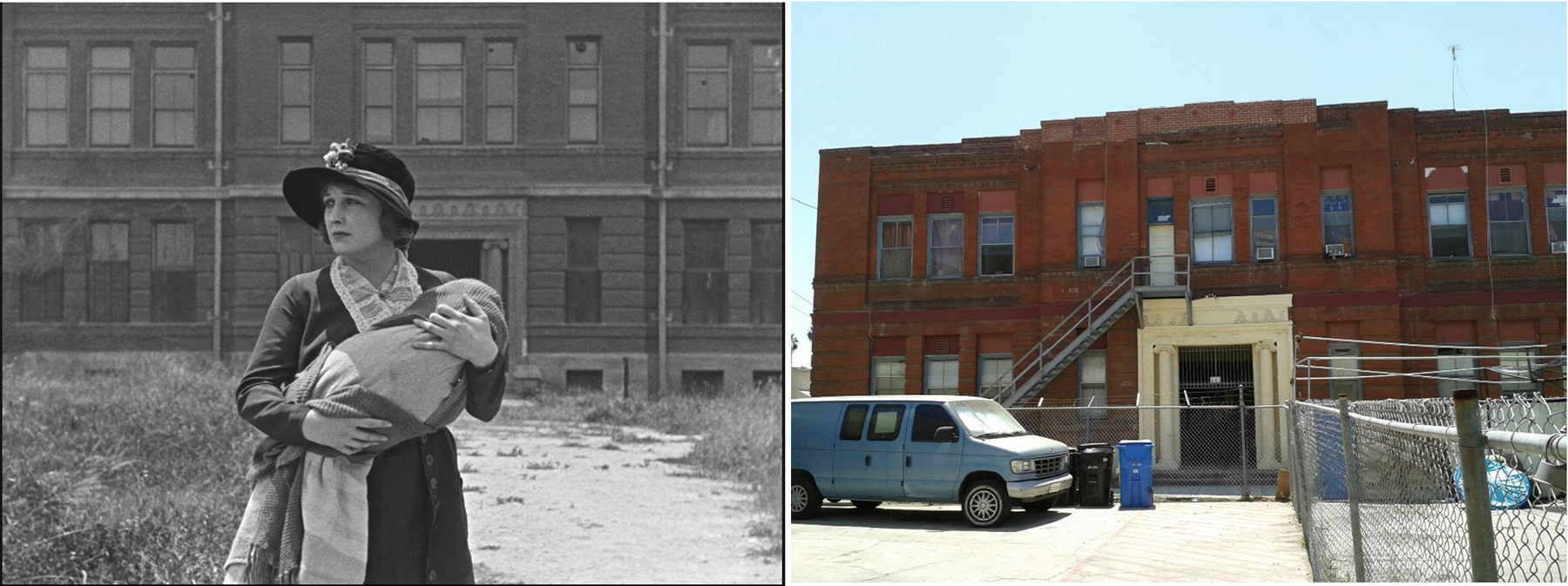
I became aware of Fremont Place researching Charlie Chaplin’s The Kid (1921), as distraught single mother Edna Purviance abandons her new-born baby in a millionaire’s limousine across the street, at 55 Fremont Place. Perhaps Mary residing here put this location on Charlie’s radar. You can read all about these early The Kid scenes HERE, and can watch them on my YouTube video (screen grab below) HERE.

Edna Purviance in The Kid – Muhammad Ali would later own 55 Fremont Place

Movies inform and entertain. But each newly available silent film also offers greater insight into other films, and to the past.

Above, Betty and Raymond flee the mansion with stolen diamonds. Above right, 56 Fremont Place appears as Jean Harlow’s home in the 1933 feature Bombshell.

A more detailed glimpse, the 56 painted curb number appears during Raymond’s film, and above right with Edward Everett Horton during No Publicity (1927), another film Ben restored and made available for sale.

A wide view of 56 Fremont Place as it appears during The Red Kimono (1925), where many scenes were filmed at 53 Fremont Place – read more HERE.

In closing, two more views of the home. [Note – the Raymond frame grabs are razor sharp – please click to enlarge if they do not appear clearly on this main page.]

Aside from Ben Model’s duties as resident accompanist for MoMA in New York, the Library of Congress, and performing at silent screenings around the country, his indie Undercrank Productions has released well over 22 rare silent movie DVDs. I only became aware of the delightful Alice Howell comedies (Alice Howell Collection) (see my post HERE), the equally delightful Doug MacLean light comedies (The Douglas MacLean Collection) (see my post HERE), and the series short silent comedies starring character actor Edward Everett Horton (Edward Everett Horton: 8 Silent Comedies) (see my post HERE), because Ben had first tirelessly assembled, restored, scored, and released these essential early films to home video. More remarkably, Ben and Steve Massa host live-streamed silent film comedy shows The Silent Comedy Watch Party Sunday afternoons at 3pm EDT on YouTube.

Incredibly, this beautiful home still stands.

Posted in Ben Model | Leave a comment

Wonderful Wanda Wiley … Who? Part Two – lost on Beaudry

Wonderful Wanda Wiley is my favorite rediscovered silent film comedienne. Her charm, girl-next-door appeal, and athletic stunt-work are on great display in her 1927 comedy short A Thrilling Romance.

Wanda portrays a struggling novelist, buried by stacks of rejection letters.

Things get worse when the mailman throws back Wanda’s piles of rejection letters, prompting her apartment landlady to evict Wanda by unceremoniously rolling her down two flights of stairs.

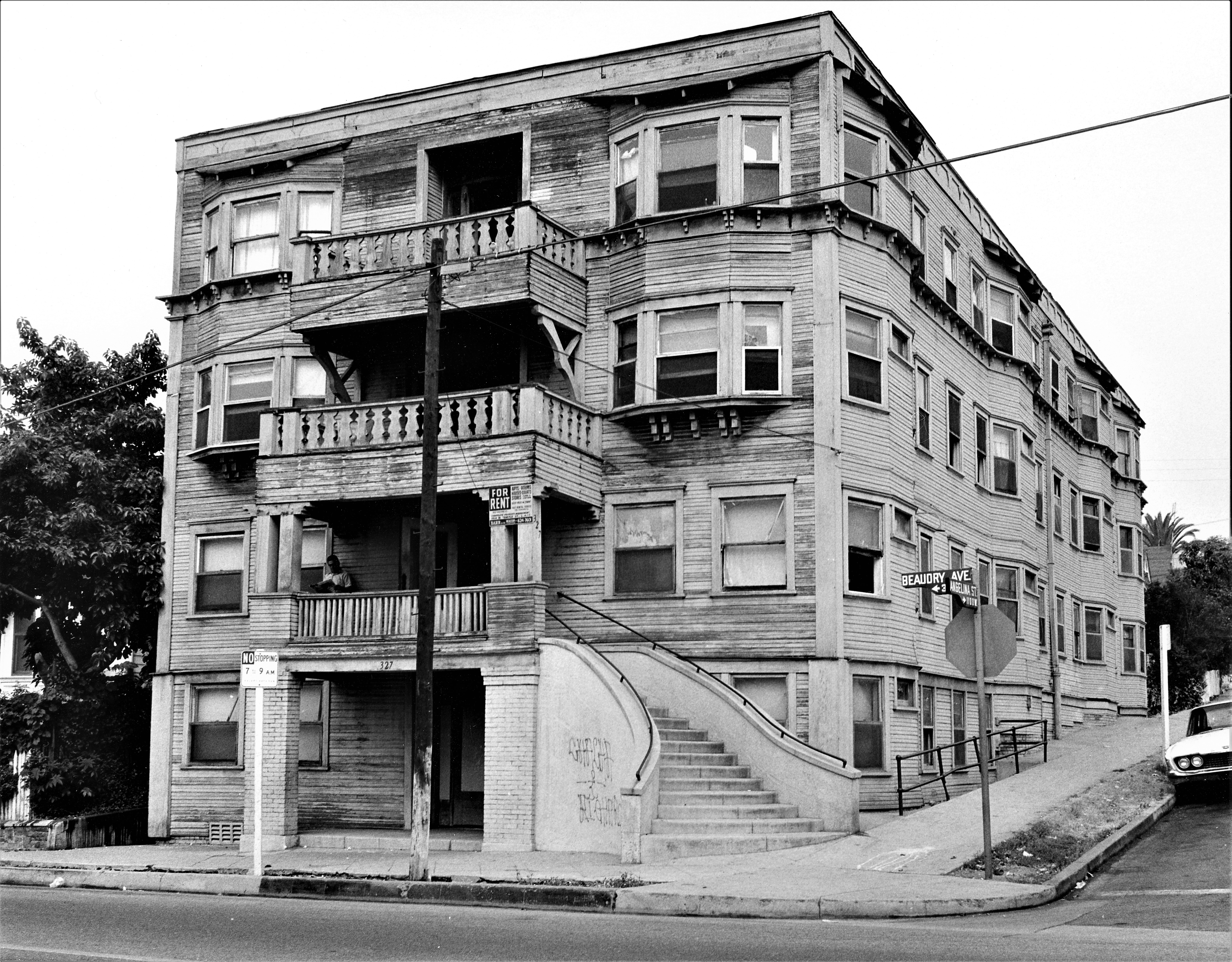
Wanda’s apartment setting intrigued me, so many unique details – the strangely configured corners, upper floor entrance stairs, a small store to the left side (notice the “OLF’S GROCERIES at back), the 327 address, and the uphill corner at right.

The apartment also stood on a corner a very short block from a trolley line (see the passing trolley above right).

While the “OLF’S” grocery store sign clue led nowhere, a breakthrough came noticing the sign for “TEMPLE SWEET SHOP” across the street. Temple Street had an active trolley line.

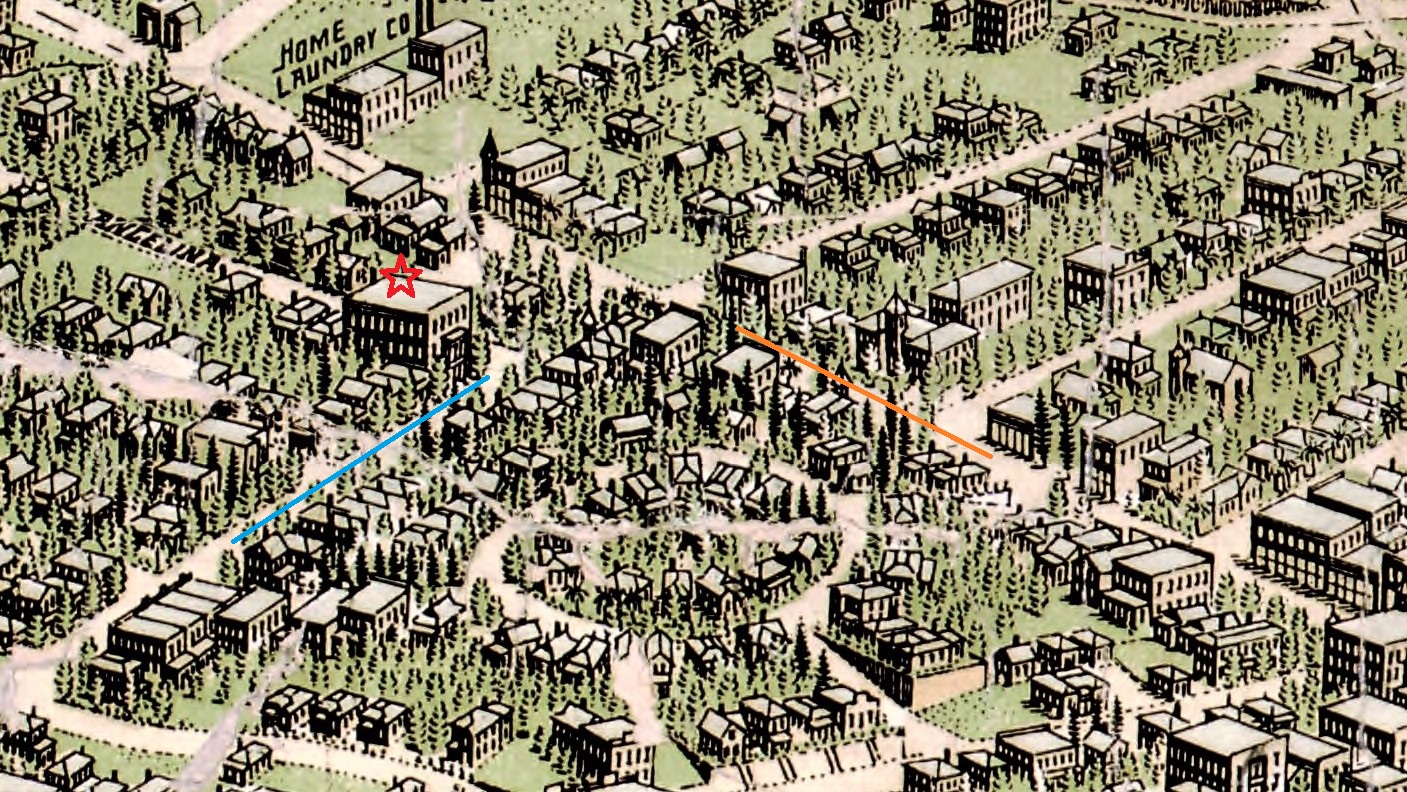
Wanda’s apartment (star) stood on the corner of Beaudry (blue) and Angelina near Temple (orange) -1909 map. The wonderful circle of homes on North Court – South Court now lie beneath the 110 Freeway.

By tracing vintage maps and aerial photos, I noticed a matching configuration of streets and corners at Beaudry Avenue at Angelina just south of Temple.

[UPDATE] This photo from noirish Los Angeles shows Wanda’s Beaudry apartment – arrow. We’re looking west along Temple with the Figueroa underpass in the foreground.

Wanda’s “327” address appears on the building, and a quick search for “327 Beaudry” on the Calisphere photo archive search site revealed three remarkably detailed photos of the now lost building.

As we see, Wanda filmed at the Northwest Apartments (now lost) at 327 N. Beaudry on the southwest corner of Angelina. The apartments were later occupied by Japanese-Americans prior to their evacuation to internment camps in 1942.

It’s rare to ponder about an unusual filming location, suddenly solve it, and then quickly find three separate vintage photos precisely documenting the long lost site.

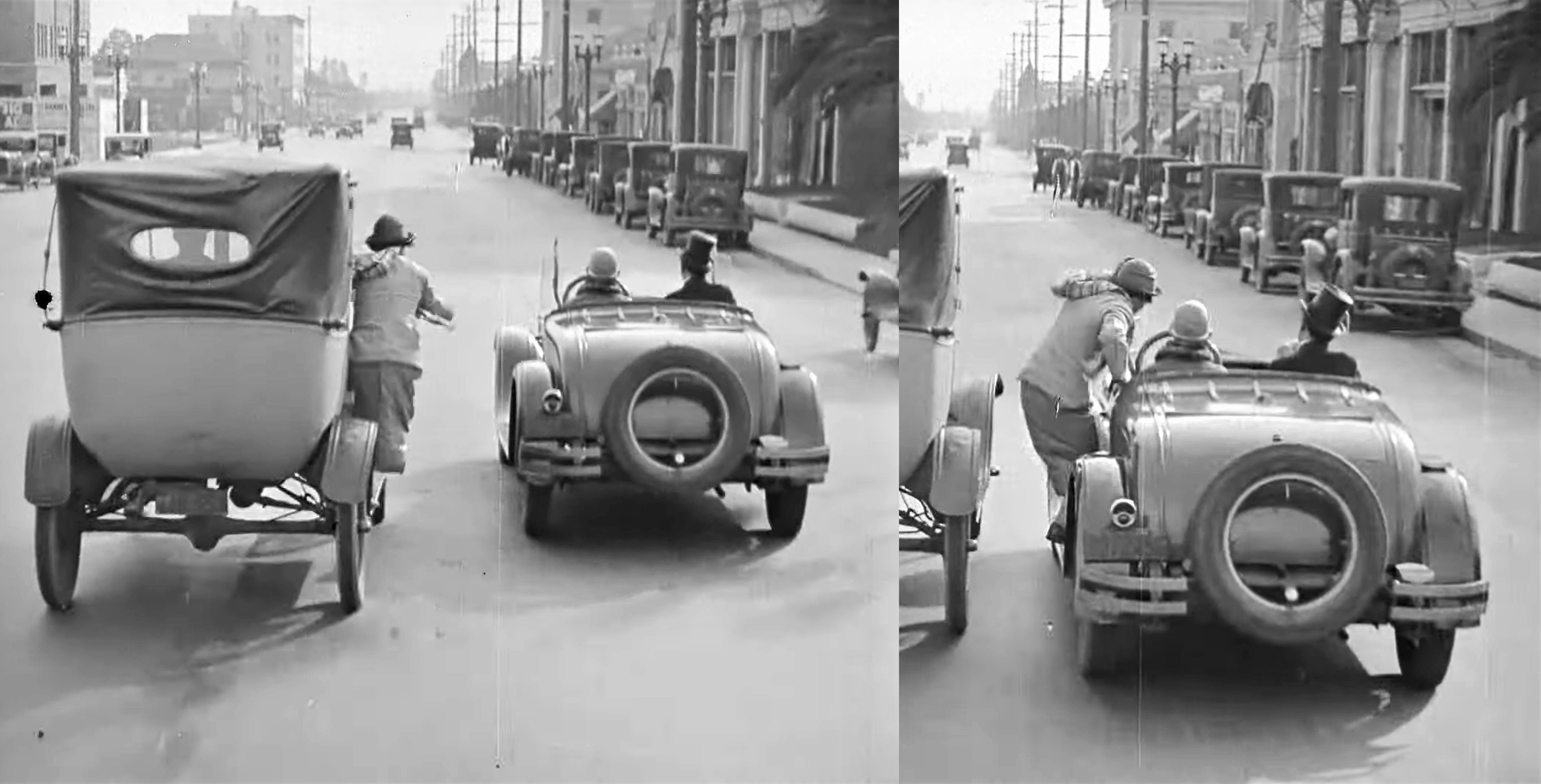
As mentioned, despite her glamor and charm, Wanda was a slapstick heroine. Also from A Thrilling Romance, that’s her leaping between moving automobiles, heading south down Vine St., as described in my first post about Wanda. The post also shows Wanda filming on Vine south of the Famous-Players Lasky Studio – please read the post HERE.

It’s tragic Wanda has been almost completely forgotten, and that nearly all of her films are lost. But you can enjoy several of her films on Joseph Blough’s YouTube Channel, including Queen of Aces (1925) HERE, Won By Law (1925) HERE, Jane’s Trouble (1926) HERE, and Even Up (1927) HERE, as well as A Thrilling Romance posted below. Also, thanks to author/historian Jim Dawson for reminding me Ben Model and Steve Massa host the Danish Film Institute’s copy of Wanda’s A Speedy Marriage (1925) HERE. I hope you’ll check my YouTube Channel as well.

Below, Wanda’s long lost apartment stood on this now empty near left corner of Angelina St.

Posted in Wanda Wiley | 7 Comments

The Little Tramp’s Screen Debut – Charlie Chaplin’s Kid Autos – They Were What ?!?

My latest YouTube video presents Charlie Chaplin’s screen debut of “The Little Tramp,” while explaining what exactly were “kid auto races.” Below, a few scenes from the video, and further below, my original post about the film from 2011.

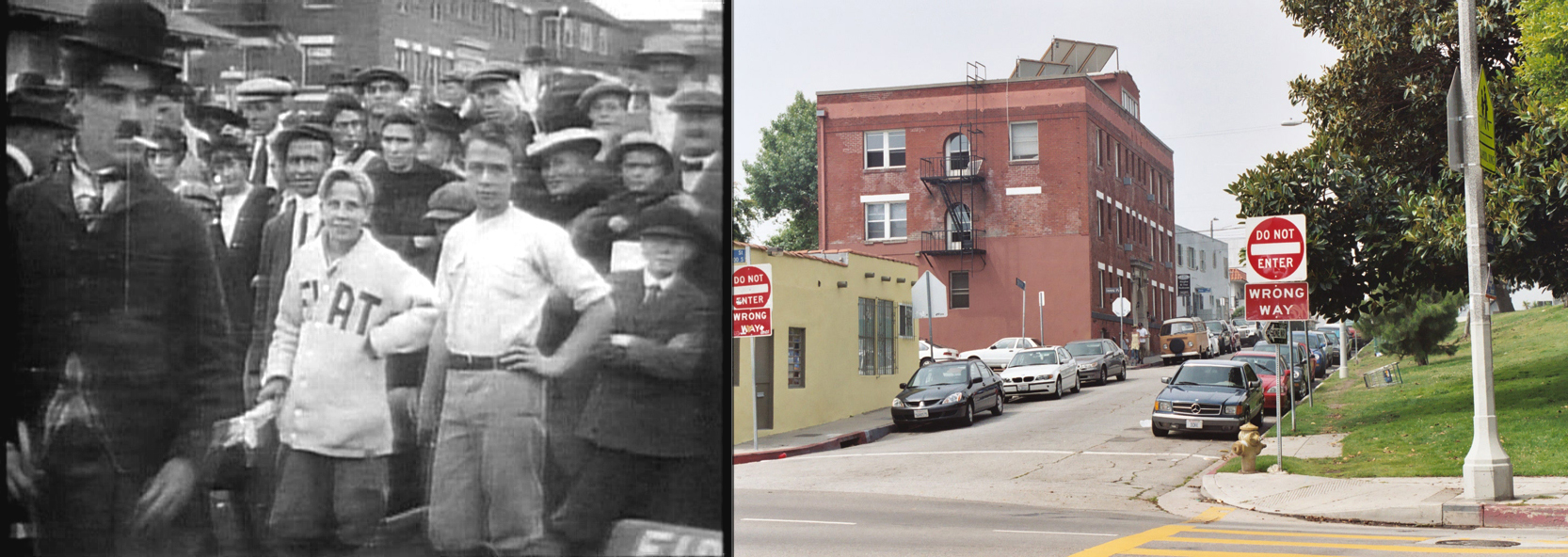
January 10-11, 1914, Chaplin’s first public appearance dressed as The Little Tramp, in Kid Auto Races at Venice, Cal., at the corner of Main and Westminster in Venice, CA. Color photos Jeff Castel de Oro.

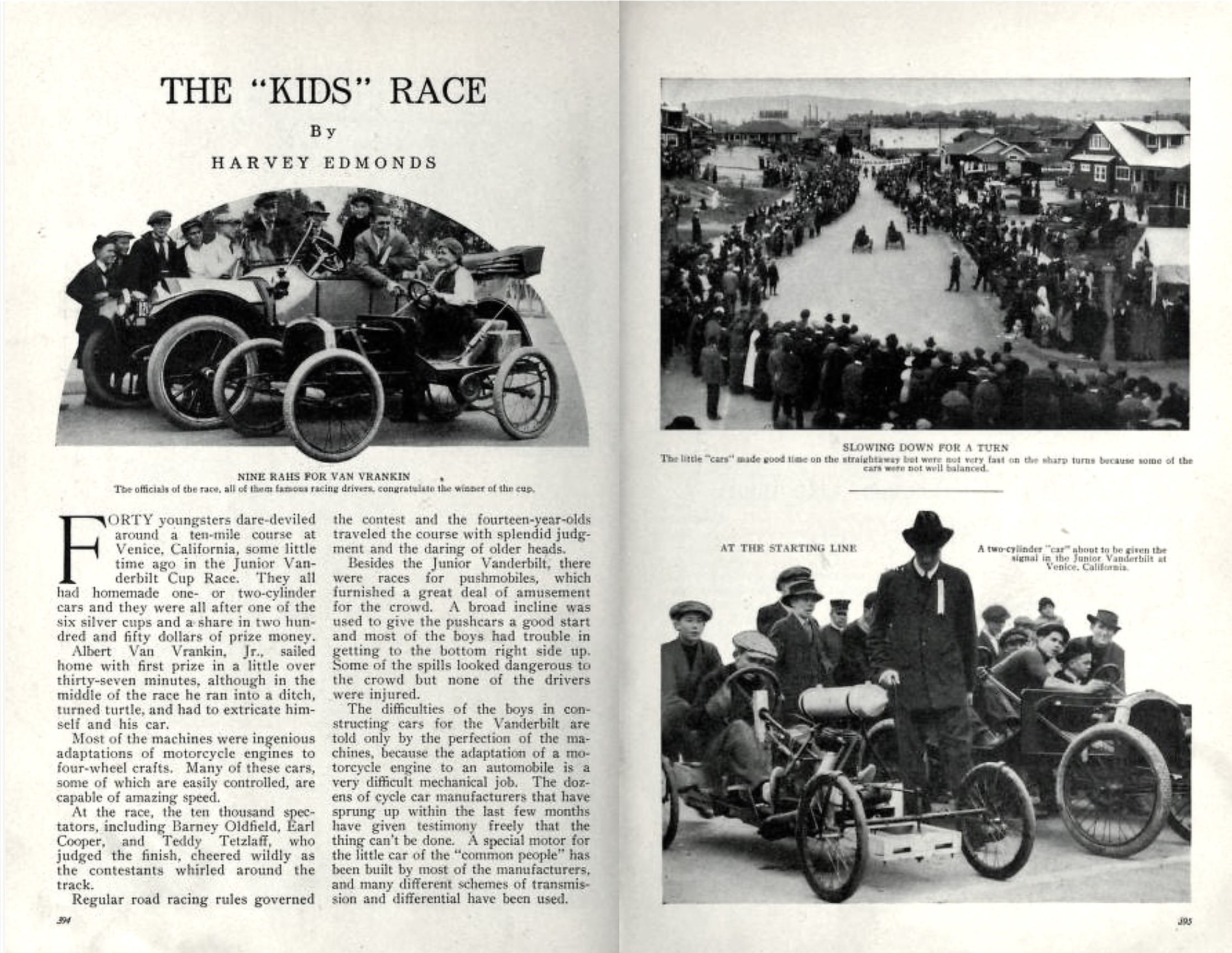
The Junior Vanderbilt Cup Race

Inducted now into the National Film Registry of the Library of Congress, Kid Auto Races at Venice, Cal. was Charlie Chaplin’s second motion picture release, and the first release to feature his Little Tramp persona.  It was filmed at the Junior Vanderbilt Cup Race held in Venice, California on Saturday, January 10, 1914, and at the children’s pushmobile race held there the following day.  The weekend shoot capped a busy week for Charlie at Mack Sennett’s Keystone Studio following the holidays.  (Note: Brent Walker, author of the definitive Sennett Studio history Mack Sennett’s Fun Factory reports Chaplin commenced shooting Mabel’s Strange Predicament (1914), in which Charlie wears the tramp costume for the first time, prior to the weekend filming of Kid Auto, but Mabel was not finished and released until after Kid Auto was released.  Thus, the Venice race that Saturday was the first time members of the public had ever witnessed Charlie dressed as the Little Tramp.)

In my book Silent Traces I explain how Chaplin filmed most of the scenes from Kid Auto at the corner of Second (now Main Street) and Westminster in Venice, while looking either north, south, or west, and how several background homes and buildings there are still standing.  I have posted a few photos here.

Main and Westminster, looking west towards the ocean, at what was a hillside country club with tennis courts (fences), and what is now the Westminster Dog Park.
Although the film title mentions a “Kid Auto Race,” I was never able to determine what in the world was a Kid Auto Race?  Thankfully, Todd von Hoffmann, associated with www.VeniceHeritageMuseum.org, and co-author of The Von Hoffmann Bros.’ Big Damn Book of Sheer Manliness, contacted me with the solution, as reported in the May, 1914 issue of Technical World Magazine.

From Technical World Magazine, May 1914

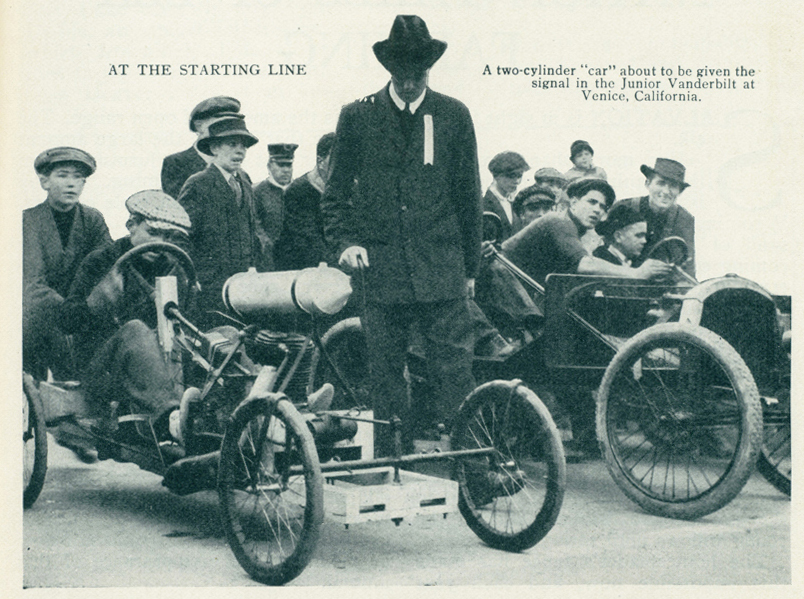
The Kid Auto Race at Venice was, in fact, a sanctioned ten-mile race in which fourteen year old boys piloted home-made one or two-cylinder cars, many adapted from motorcycle engines, while vying for a share of $250 in prize money (that’s ~$7,500 today!).  From today’s litigate-first, bubble-wrap your child perspective, it is almost inconceivable that untrained and unlicensed youths, without helmets, safety equipment, or even seat belts, were once actively encouraged to race one another along the streets of Santa Monica and Venice.

Click to enlarge.  A photo of the Kid Auto Race appearing in Technical World Magazine (upper left), a modern view up Main from Westminster (lower right), and two comparable movie frames.

The article also describes the pushmobile race held the following day, where Chaplin was also filmed, as motorless carts raced down a steep ramp.  Three of the houses pictured in the background below are still standing (see Google Street View links in the caption).  In the far background between Charlie 3 and 4 stands the former Race Thru The Clouds twin-track racing roller coaster, once located along the former Venice Lagoon.

Looking south from Main (at the time Second) and Westminster, at the pushmobile ramp.  Three homes in the back, the far left on San Juan, the other two along Horizon Avenue, still remain (Google Street View links).

I have set forth the complete text of the magazine article below.  While the reporter duly transcribed his narrative of the event, he was either oblivious to, or deliberately chose to ignore, the antics portrayed by Chaplin there at the time.

May, 1914 Technical World Magazine, submitted by Todd von Hoffmann,

Forty youngsters dare-deviled around a ten-mile course at Venice, California some little time ago in the Junior Vanderbilt Cup Race. They all had homemade one- or two-cylinder cars and they were all after one of the six silver cups and a share in two hundred and fifty dollars of prize money.

Albert Van Vrankin, Jr. sailed home with first prize in a little over thirty-seven minutes, although in the middle of the race he ran into a ditch, turned turtle, and had to extricate himself and his car.

The starting line for the Kid Auto Race at Venice

Most of the machines were ingenious adaptations of motorcycle engines to four-wheel crafts. Many of these cars, some of which are easily controlled, are capable of amazing speed.

At the race, the ten thousand spectators, including Barney Oldfield, Earl Cooper, and Teddy Tetzlaff, who judged the finish, cheered wildly as the contestants whirled around the track.

Regular road racing rules the contest and the fourteen-year-olds traveled the course with splendid judgment and the daring of older heads.

Besides the Junior Vanderbilt, there were races for pushmobiles, which furnished a great deal of amusement for the crowd. A broad incline was used to give the pushcars a good start and most of the boys had trouble in getting to the bottom right side up.  Some of the spills looked dangerous to the crowd but none of the drivers were injured.

The difficulties of the boys in constructing cars for the Vanderbilt are told only by the perfection of the machines, because the adaptation of a motorcycle engine to an automobile is a very difficult mechanical job. The dozens of cycle car manufacturers that have sprung up within the last few months have given testimony freely that the thing can’t be done. A special motor for the little car of the “common people” has been built by most of the manufacturers, and many different schemes of transmission and differential have been used.

Check out the dozen videos about Charlie Chaplin, Buster Keaton, and Harold Lloyd hosted on my YouTube Channel.

All images from Chaplin films made from 1918 onwards, copyright © Roy Export Company Establishment. CHARLES CHAPLIN, CHAPLIN, and the LITTLE TRAMP, photographs from and the names of Mr. Chaplin’s films are trademarks and/or service marks of Bubbles Incorporated SA and/or Roy Export Company Establishment. Used with permission.

Posted in Charlie Chaplin, Venice | Tagged , , , , , , , , , | 4 Comments

Silent Star Mabel Normand – the Game Girl’s Trio of Triumphs

As seen in the two previous posts, the Wonderful Wanda Wiley leapt between moving cars on Vine Street, and rollicked at the edge of the Santa Monica Slapstick Comedy Cliffs. But silent star “game girl” Mabel Normand took some good shots too. With dozens of heroic scenes to choose from, here are but three examples of Mabel giving it her all (1912 photo left).

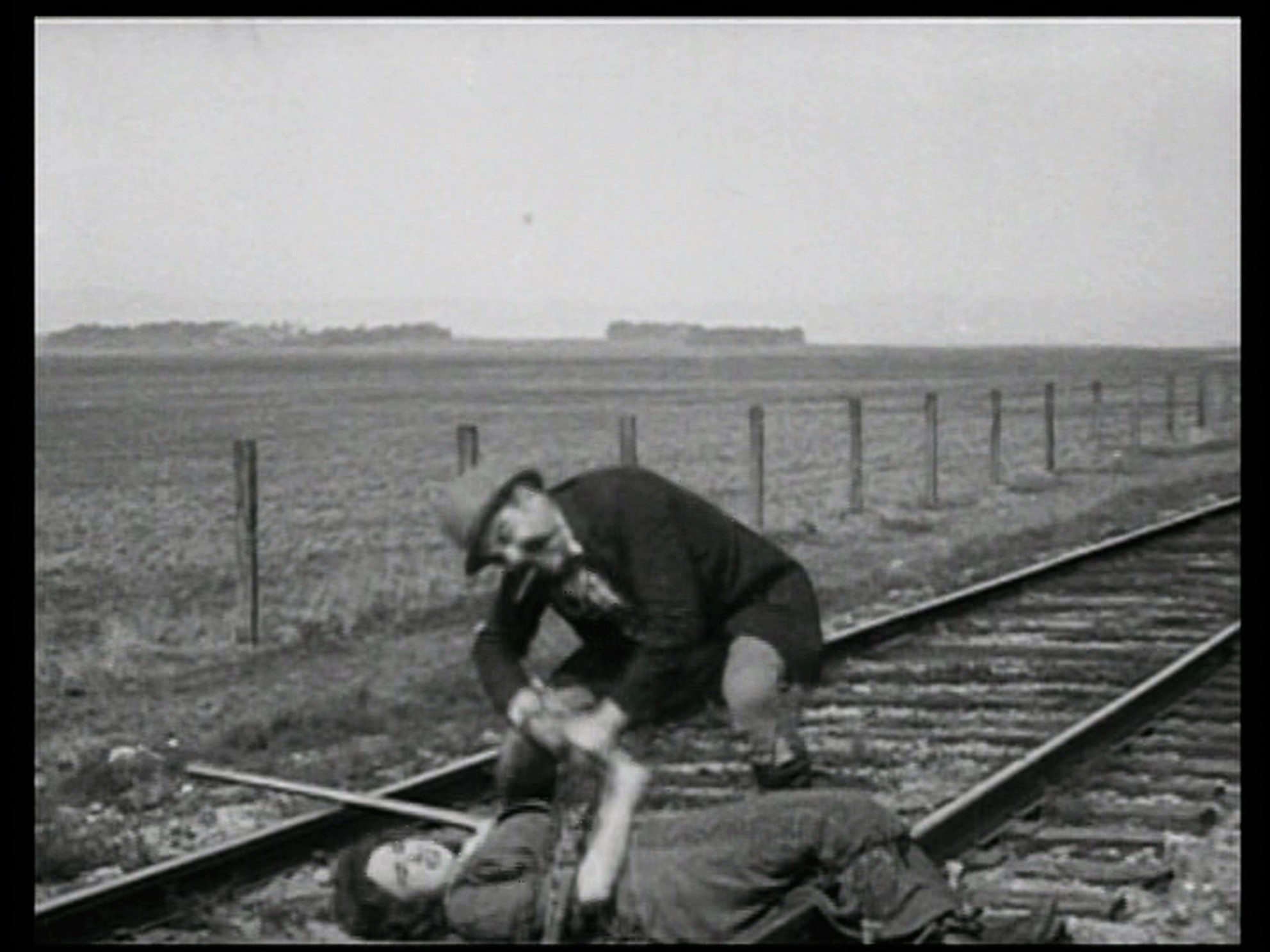
First, Ford Sterling ties Mabel to the railroad tracks during Barney Oldfield’s Race for a Life (1913). This classic scene was staged along the frequently filmed north-south stretch of track that ran along what would later become the east boundary of LAX International Airport.

The distinctive windbreak of trees appearing behind Mabel once stood south of W. Manchester Ave. outside of Inglewood, and are also clearly visible left to right in these scenes from Mary Pickford’s A Beast at Bay (1912), D. W Griffith’s Intolerance (1916), and Buster Keaton’s The Blacksmith (1922). This post about Mary’s film HERE provides many more views of this long-forgotten filming site, and its formidable silent film history.

Mabel clings to the roof of the Castle Towers Apartment in Mickey.

Mabel’s wildly popular 1918 feature Mickey climaxes with a thrilling roof-top rescue staged years before Harold Lloyd stunned audiences with his high-rise climb in Safety Last! (1923).

Looks can be deceiving – a seemingly matching wide and close view of Mabel’s rooftop climb?

Reportedly the highest grossing film of the year, Mickey was the only film produced by Mabel’s independent studio set up for her by Mack Sennett. You can read more about Mabel’s roof-top stunts HERE.

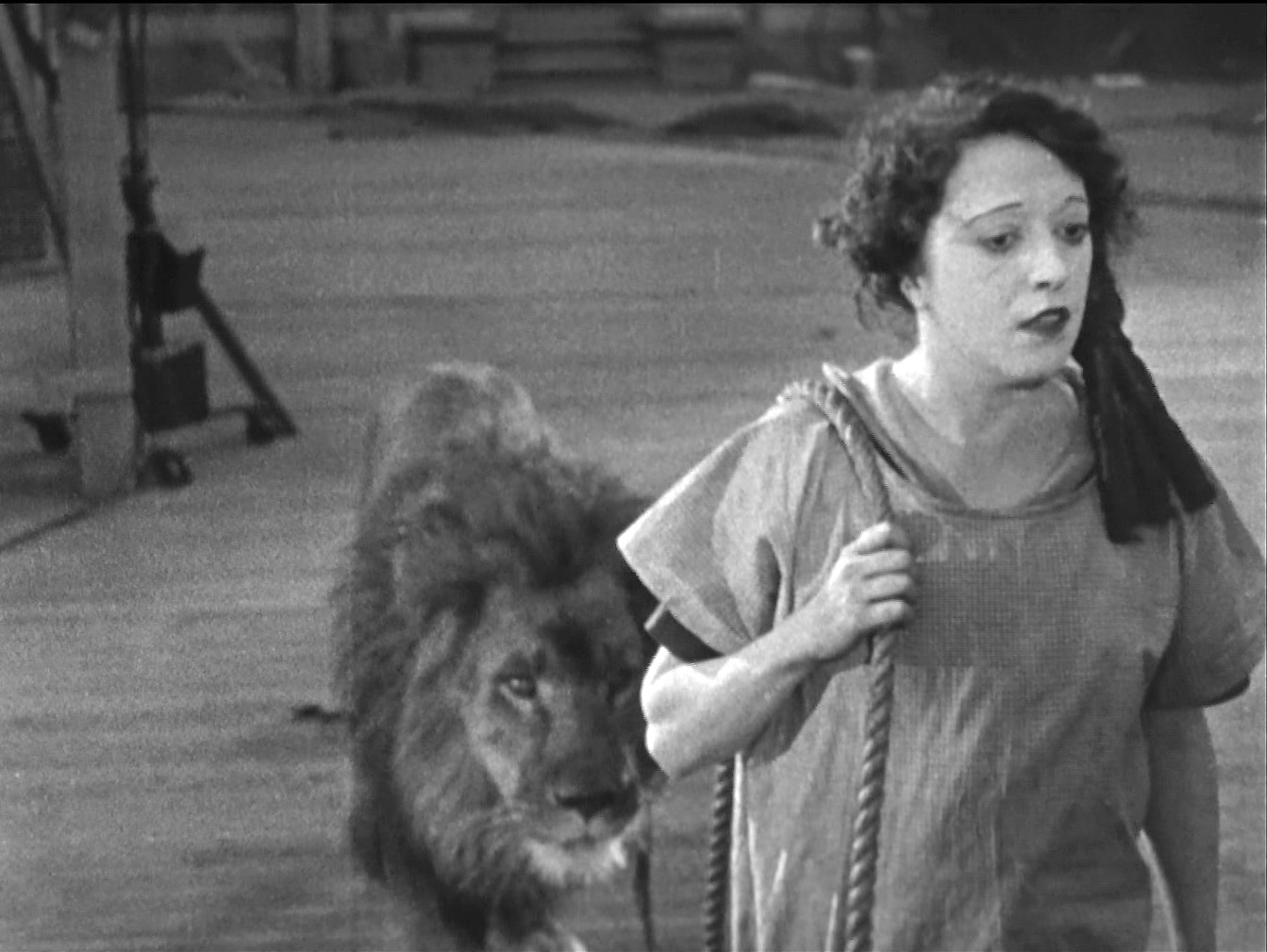
Not a care in the world, Mabel blithely leads Numa for a walk

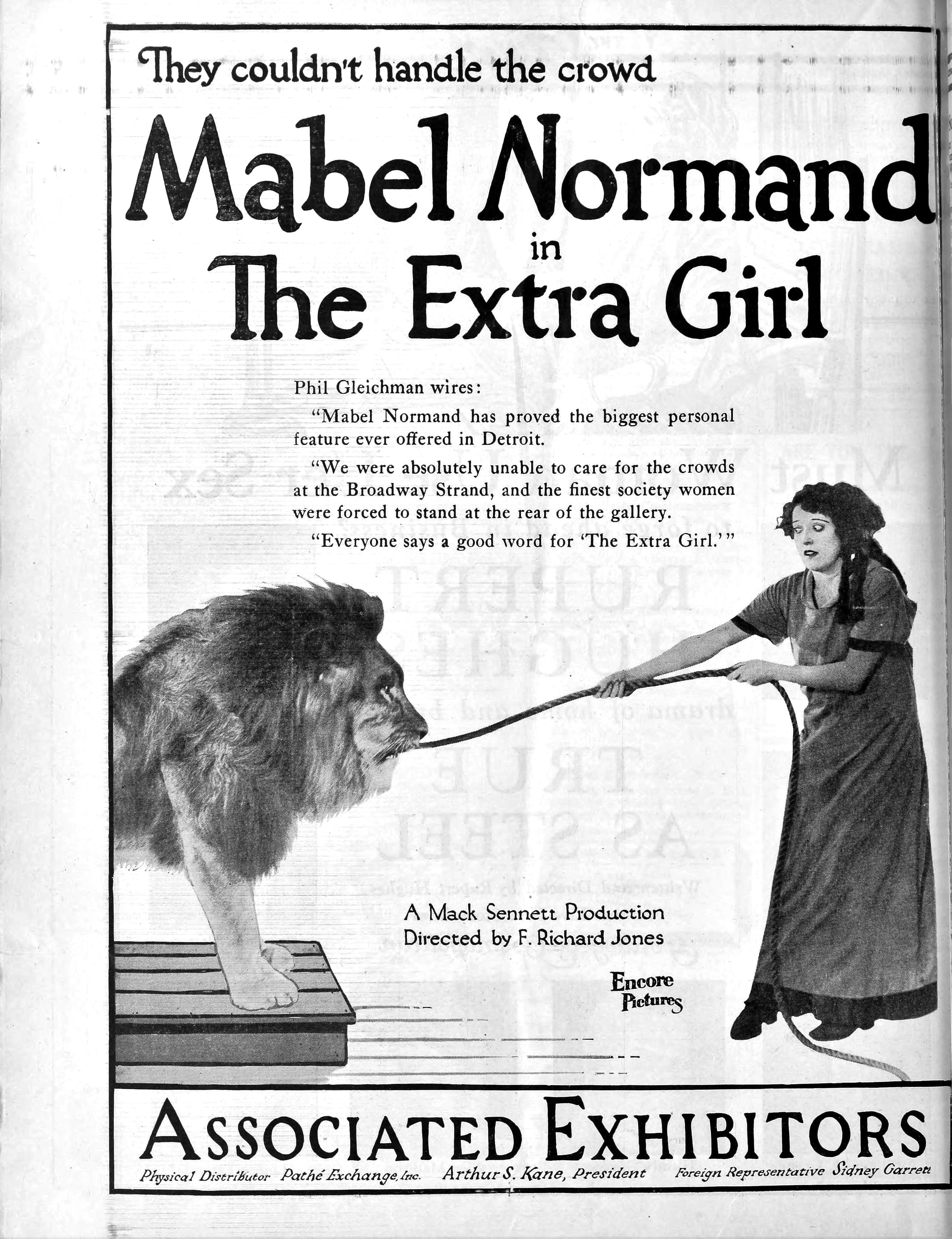
Last, during The Extra Girl (1922), Mabel plays a small-town girl/wannabe movie actress who lands a job working for a film studio wardrobe department. One of her menial tasks is tending to the studio mascot Teddy the dog, who happens to be made up that day with a lion costume. Instead, Mabel absentmindedly enters the studio’s lion cage (they all had one then, right?), and leads a real live lion for a walk around the studio as comedic mayhem ensues.

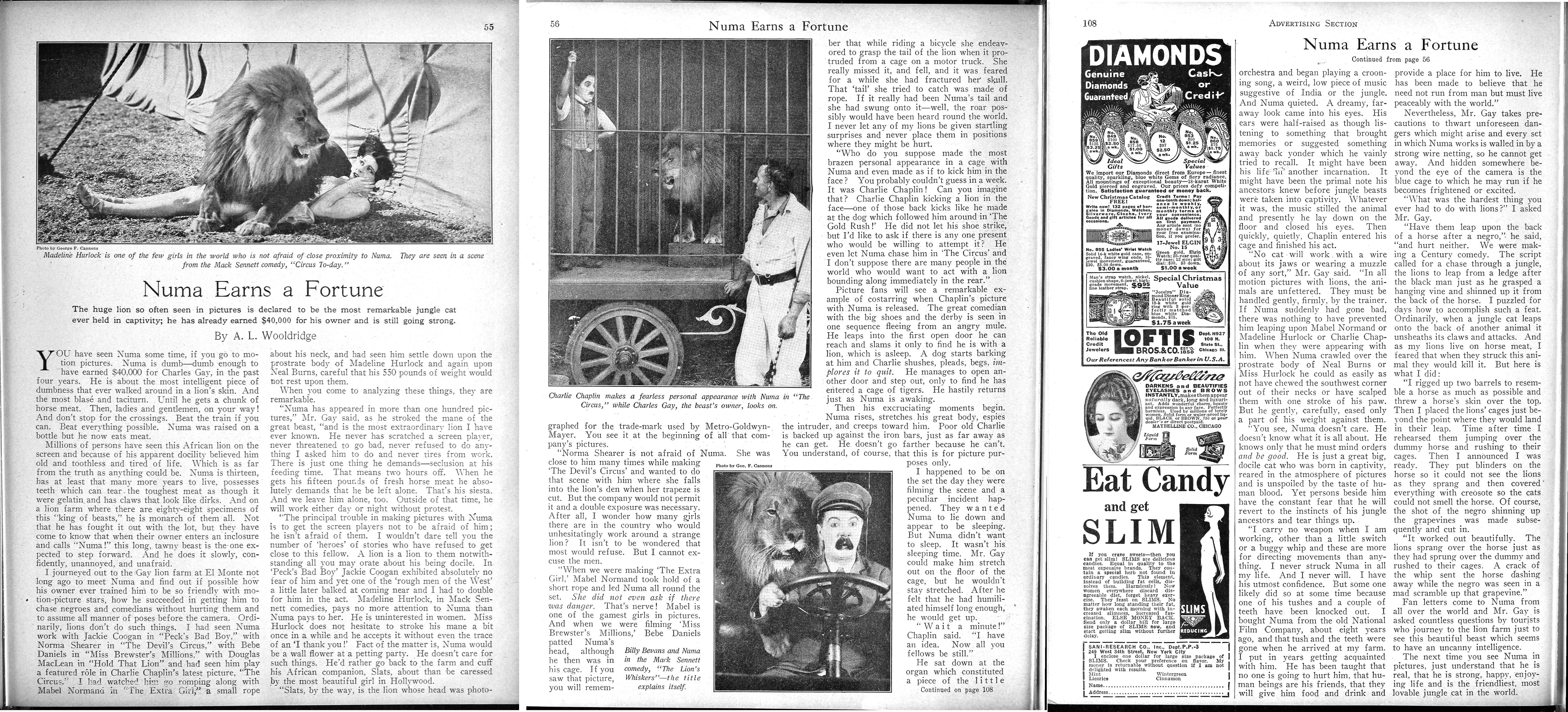
It doesn’t minimize Mabel’s heroic courage to explain the lion was Numa, a 550 pound 13 year old specially trained beast managed by Charles Gay at the Gay lion farm in El Monte. In a 1927 Picture Play Magazine profile story “Numa Earns a Fortune,” Charles reports Numa has appeared in over 100 pictures, without ever scratching a screen player. Numa’s sole demand is to be left in solitude for two hours during his daily feeding of 15 pounds of horse flesh. Otherwise Numa works day or night without protest (photo left).

Charles explains “When we were making ‘The Extra Girl,’ Mabel Normand took hold of a short rope and led Numa all round the set. She did not even ask if there was danger. That’s nerve! Mabel is one of the gamest girls in pictures.” [emphasis original]

Below, the full “Numa Earns a Fortune” article, Picture Play Magazine, January 1927, page 55, click to enlarge. As you can see Numa also appeared with Charlie Chaplin in The Circus (1928).

Mabel Normand “is one of the gamest girls in pictures.” Indeed, no truer words were ever spoken.

Check out my videos about Charlie Chaplin, Buster Keaton, and Harold Lloyd hosted on my YouTube Channel.

Posted in Mabel Normand | Tagged , , , , , | Leave a comment

Santa Monica’s Slapstick Comedy Cliffs – How Did They Do It?

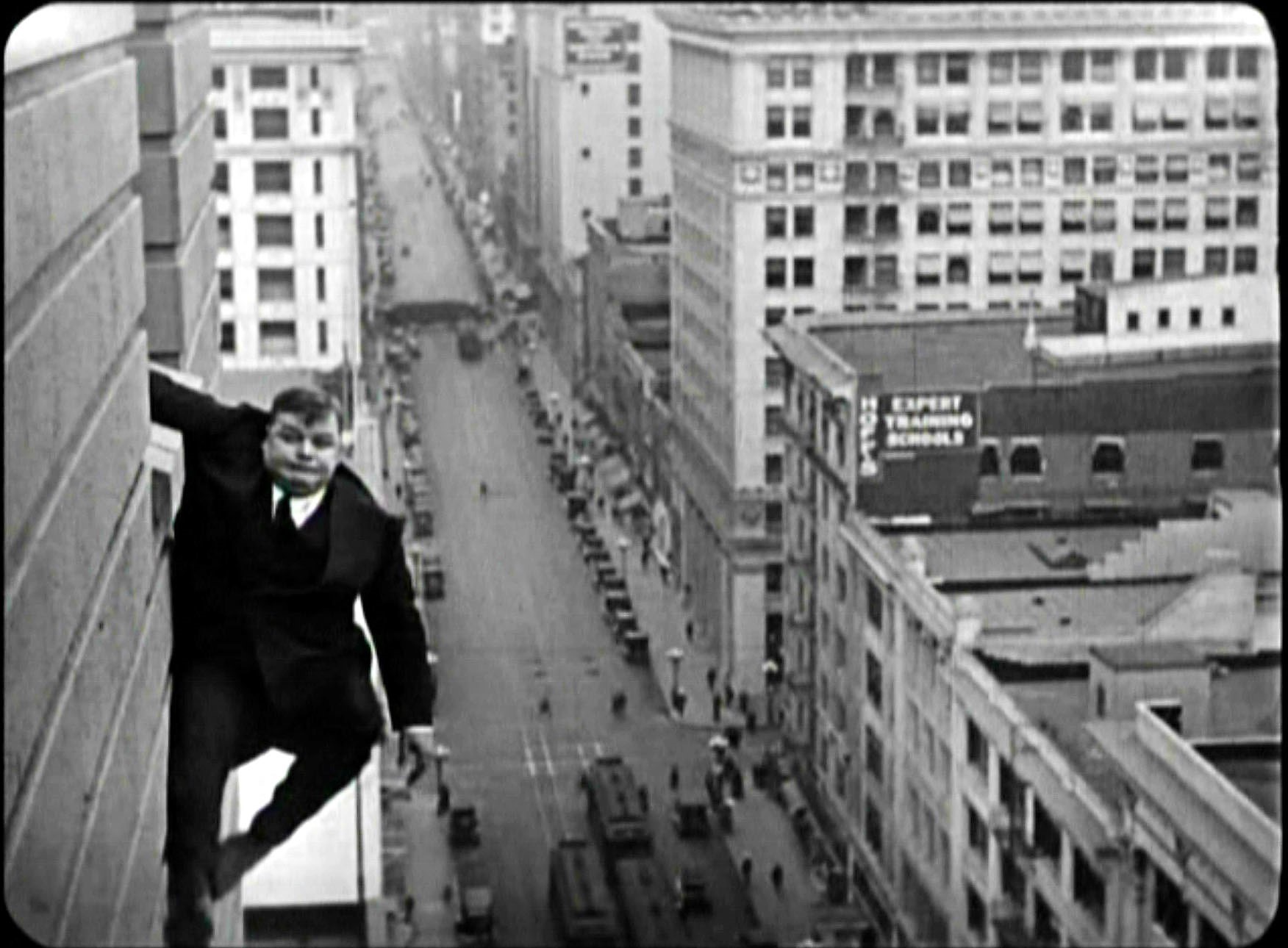
Although Harold Lloyd was the most accomplished, dozens of others silent comedians also filmed “stunt” comedies climbing up or hanging from tall buildings. As reported many times in this blog, one very common technique was to construct a small building façade overlooking the Hill Street Tunnel (left – click to enlarge). Whenever you see a “HOTEL LA CROSSE” sign in the background you know the stunt scene was filmed above the former tunnel. Comedians also filmed looking south from above the former Broadway Tunnel and looking west from above the Third Street Tunnel – see more HERE.

Harold took this technique to the next level by building elaborate rooftop sets. But constructing sets wasn’t even necessary. Many downtown buildings had one-story penthouses or one-story rooftop maintenance buildings far from the edge of the roof that were safe for comedians to climb. That’s how Roscoe Arbuckle performed his high-rise “stunt” during The Life of the Party (1920) – see more HERE – he’s simply hanging two feet above the stepped-back terraced roof of the Bartlett Building at 215 W. 7th St. As such, nearly all high-rise comedies were safely filmed no more than a few feet above a solid surface.

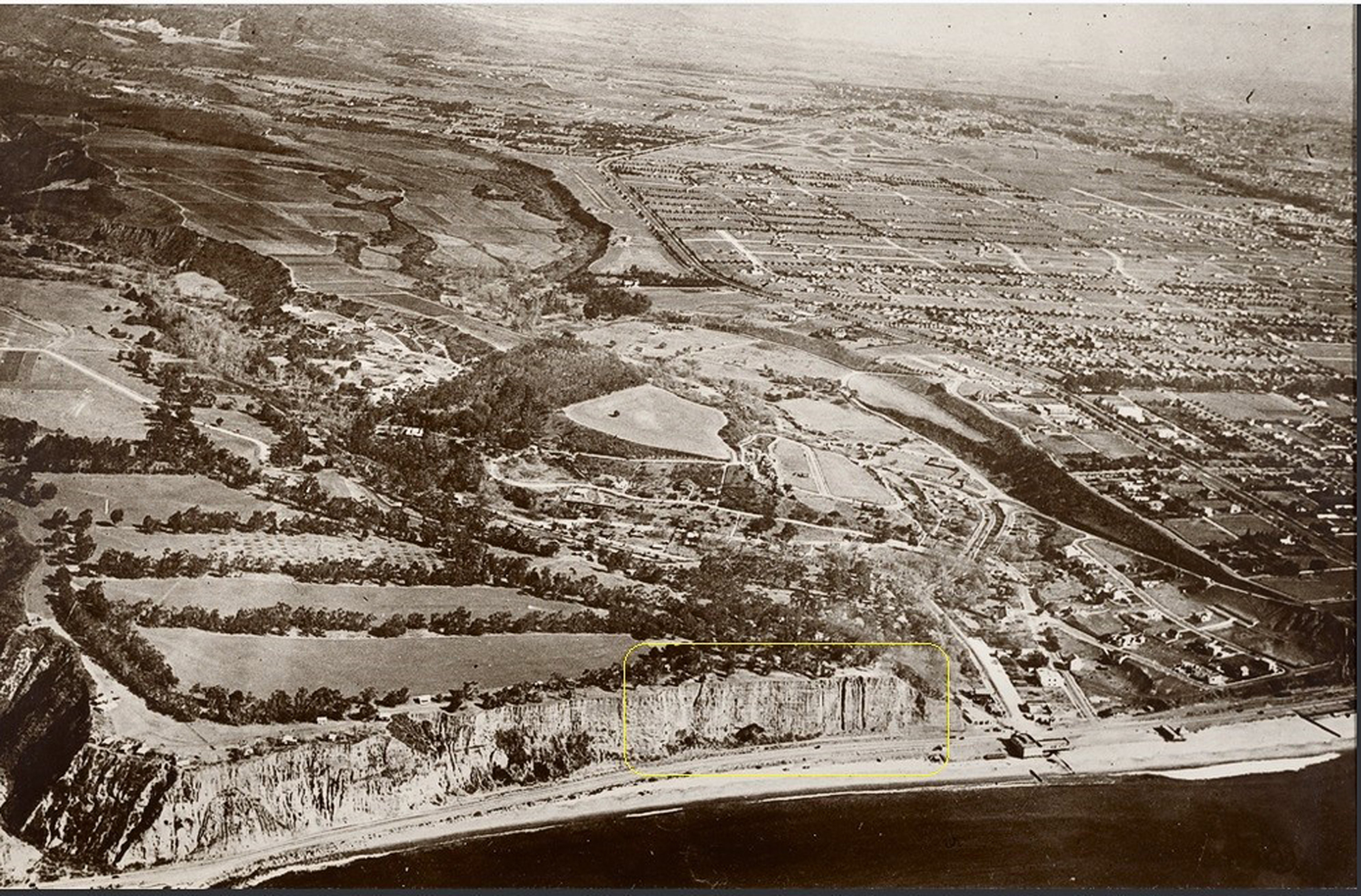
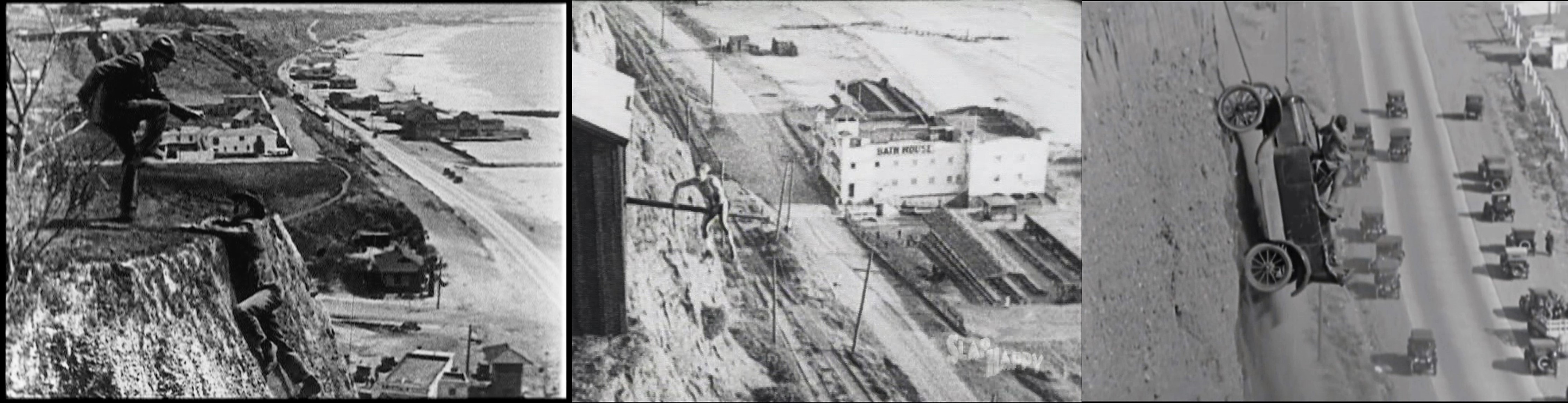
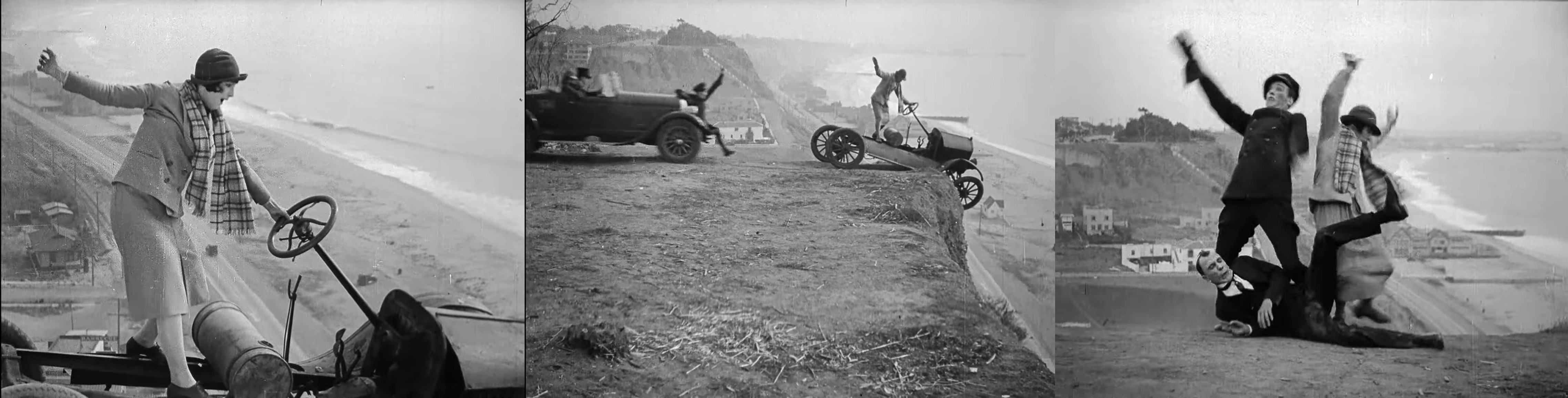
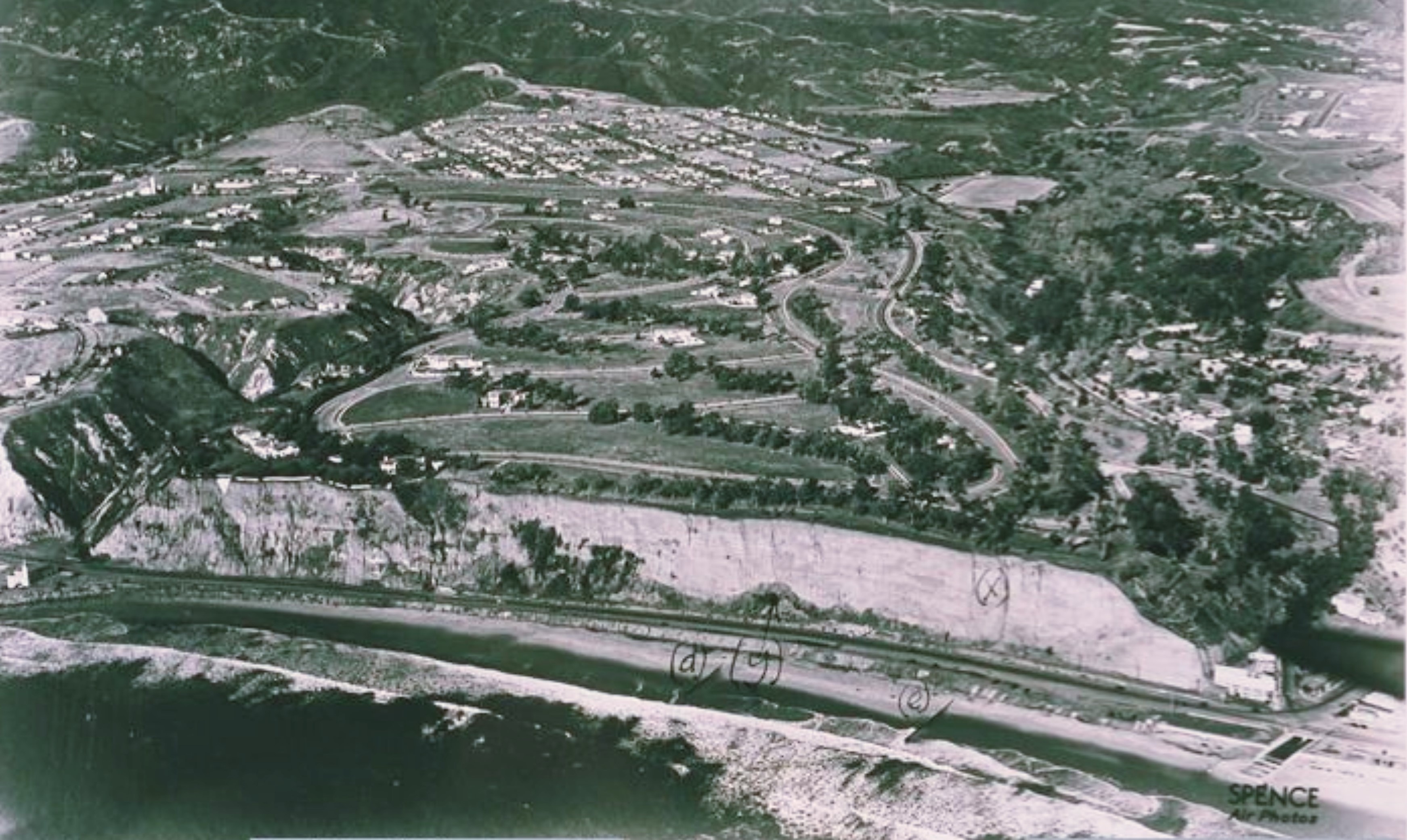
But how then do you explain the other mecca for silent comedy stunts, the seaside cliffs overlooking Santa Monica Canyon and what is now the Pacific Coast Highway? Its unique geographic features, and the prominent Bundy Bath House pictured here in the background with Al St. John, and at the top of this post, easily confirm this frequently used location, looking south from the corner of the palisades just north of W. Channel Road. Santa Monica Public Library.

View east of the filming cliff (marked) left of W Channel Road heading inland

But while the high-rise camera tricks and safety precautions make perfect sense, I remain completely baffled about the literal cliff-hanging comedies filmed here.

To begin, imagine if, and I repeat if, the cliffside was defined by a series of stepped plateaus rather than a continuous straight drop. If so, perhaps the drop from the top edge of the cliff to the first plateau below might be only a few feet. That way comics could safely tumble about near the edge, drive speeding cars toward the edge, and yet still be protected from a full fall by the lower-level plateau below immediately out of camera view. (Above A Thrilling Romance, Special Delivery, and Wall Street Blues.)

View north toward the Bundy Bath House (center) and cliff location – Huntington Digital Library

There are two huge problems with this theory. First, none of the vintage cliffside photos I’ve studied suggest naturally occurring staggered plateaus were ever present.

The bigger problem, these cliffside comedies often depict comics and cars being dragged up and down the face of the cliff itself. Unlike the safely filmed high-rise comedies, these scenes aren’t faked, the comics are truly in mid-air. (Above 10 Minute Egg, Al St. John in Special Delivery and/or Aero-Nut, and Wall Street Blues.)

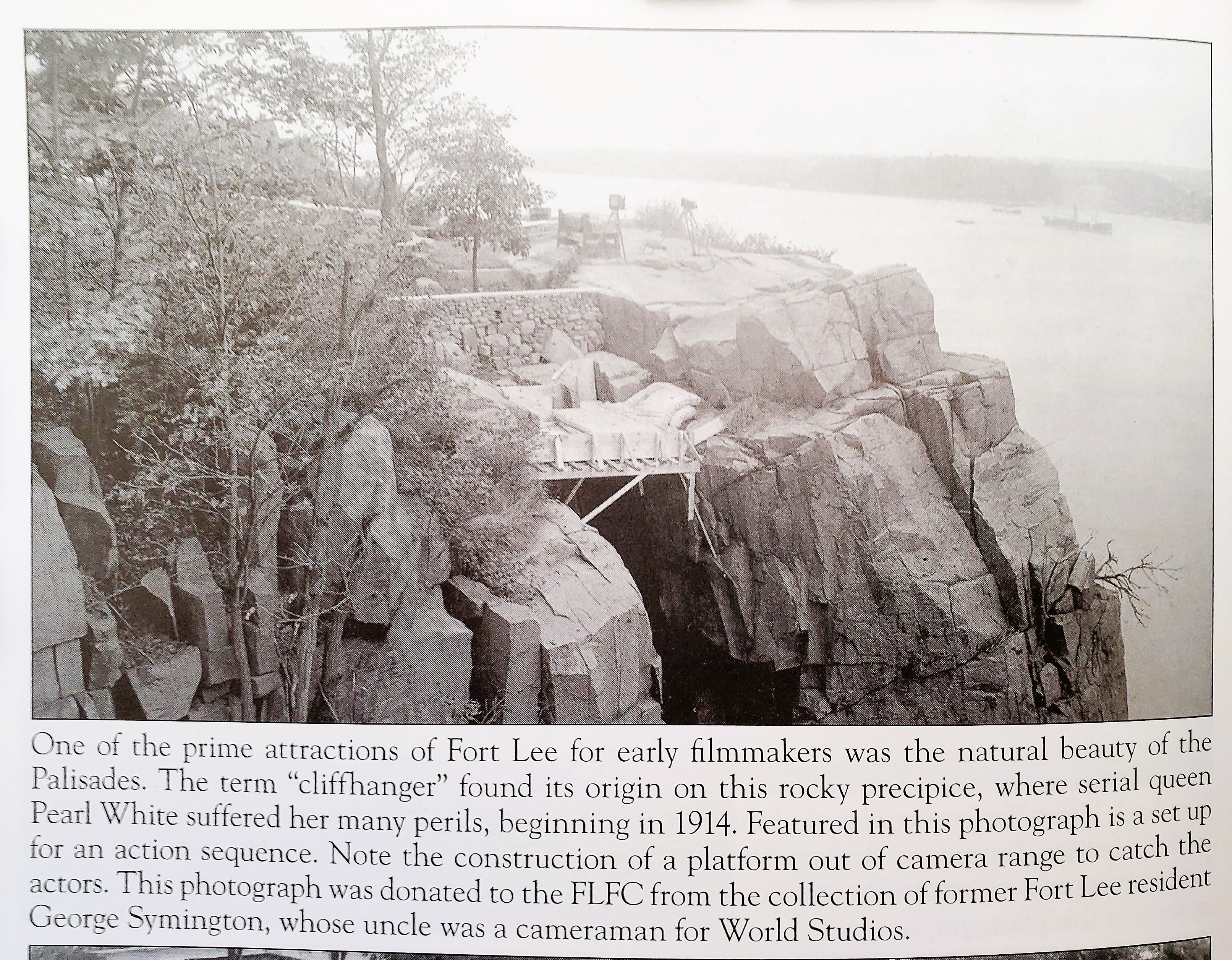
Does anyone know how these Santa Monica scenes were accomplished? Perhaps filmmakers built safety platforms below the visible cliff edge. For comparison, page 86 of “Fort Lee – Birthplace of the Motion Picture Industry” by the Fort Lee Film Commission, depicts a safety platform built on the Fort Lee Palisades. But could such a platform in Santa Monica protect racing automobiles from teetering over the edge?

The Santa Monica cliffsides appear in so many slapstick comedies. Even our heroine, the Wonderful Wanda Wiley above, took her spills at the cliff edge during A Thrilling Romance (1927), covered in the prior post.

1931 view east – W Channel Road at far right. Santa Monica Public Library

So what do you think? The geographic location is the easy answer. But how did they safely film here, over and over again? Were there natural little plateaus out of view below protecting the actors? Did they build huge safety platforms high up against the side of the cliff? That seems quite challenging and expensive. Or were the comedians simply crazy? This remains a top unsolved mystery.

Check out my videos about Charlie Chaplin, Buster Keaton, and Harold Lloyd hosted on my YouTube Channel.

Below, looking up at the cliffside north of W Channel Road today:

Posted in Wanda Wiley | 10 Comments

Wonderful Wanda Wiley … Who?

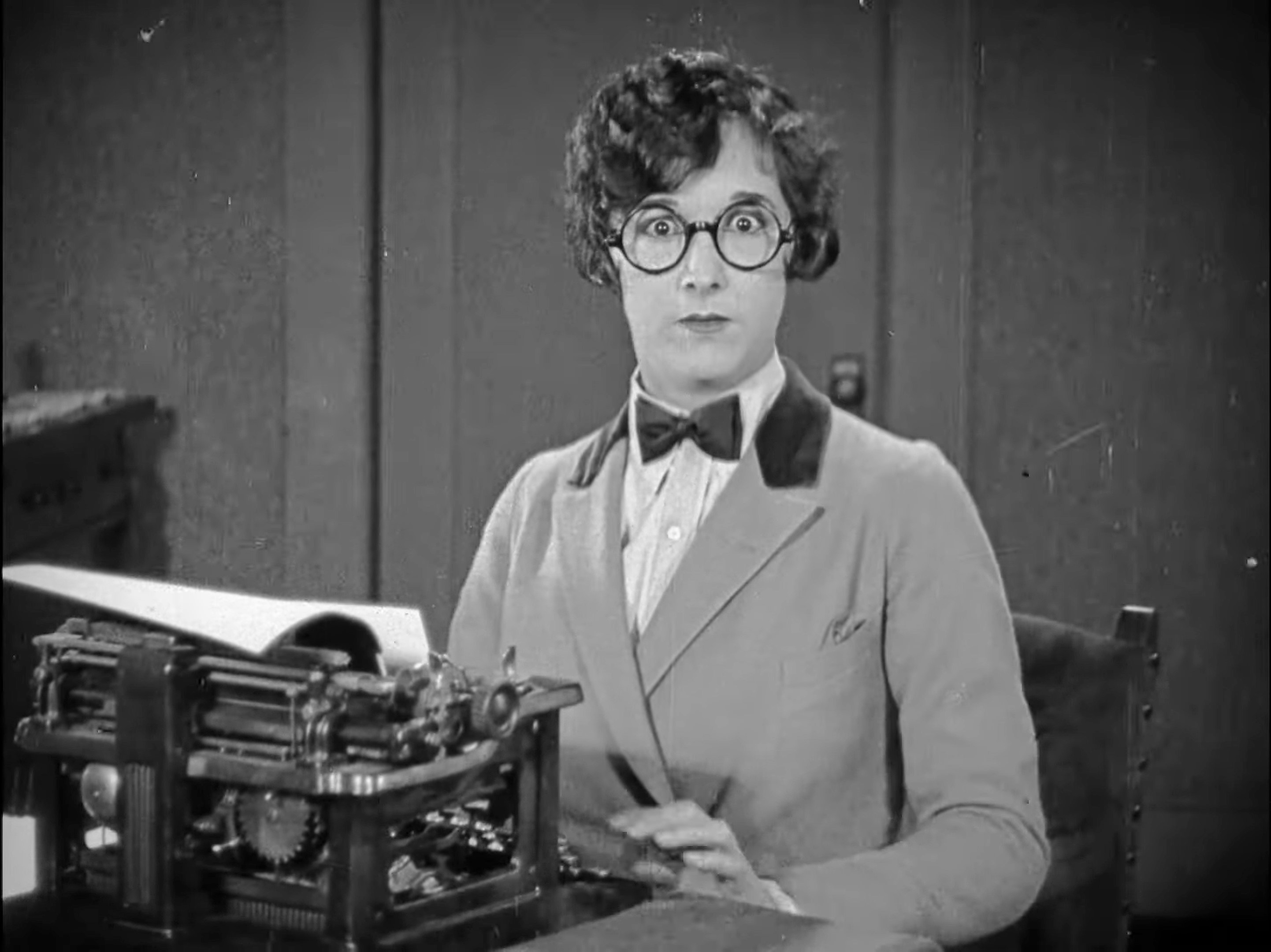
Wonderful Wanda Wiley was a spirited, athletic silent film comedienne, whose charm and girl-next-door appeal made her the female equivalent of Harold Lloyd’s “All-American Boy” (sometimes she even wore glasses). [Fun update – Wanda and Harold share the same April 20 birthday!] Ever ready, she bravely rolled down stairways, dived on cement sidewalks, and jumped between moving automobiles (see further below), anything for a laugh, matching her male colleagues blow by blow. Despite her slapstick antics, Wanda also posed for glamor publicity stills, above – read more on Lantern Media.

Wanda made a series of wonderful silent short comedies for Century Studios at Universal between 1924-1927. While most of her films are sadly lost, thanks to silent film superheroes Ben Model, Steve Massa, and Joseph Blough, you can enjoy some of her work on YouTube. This post highlights Wanda’s captivating comedy A Thrilling Romance (1927), where she plays a struggling author. On their Silent Comedy Watch Party YouTube link HERE, you can enjoy Ben’s musical accompaniment for the film along with Steve’s discussion of Wanda’s career. Joseph’s YouTube link HERE presents a silent but more visually clear copy of the film.

A Thrilling Romance is great fun, and it was exciting to discover Wanda’s on-screen charms, a talented star I’d never heard of before (ad above). I highly encourage you to enjoy her film. But the movie is also a remarkable time-travel machine, offering so many views of early Hollywood that this first post will cover only rare, perhaps unique views along Vine Street, including the long lost Famous Players – Lasky Studio.

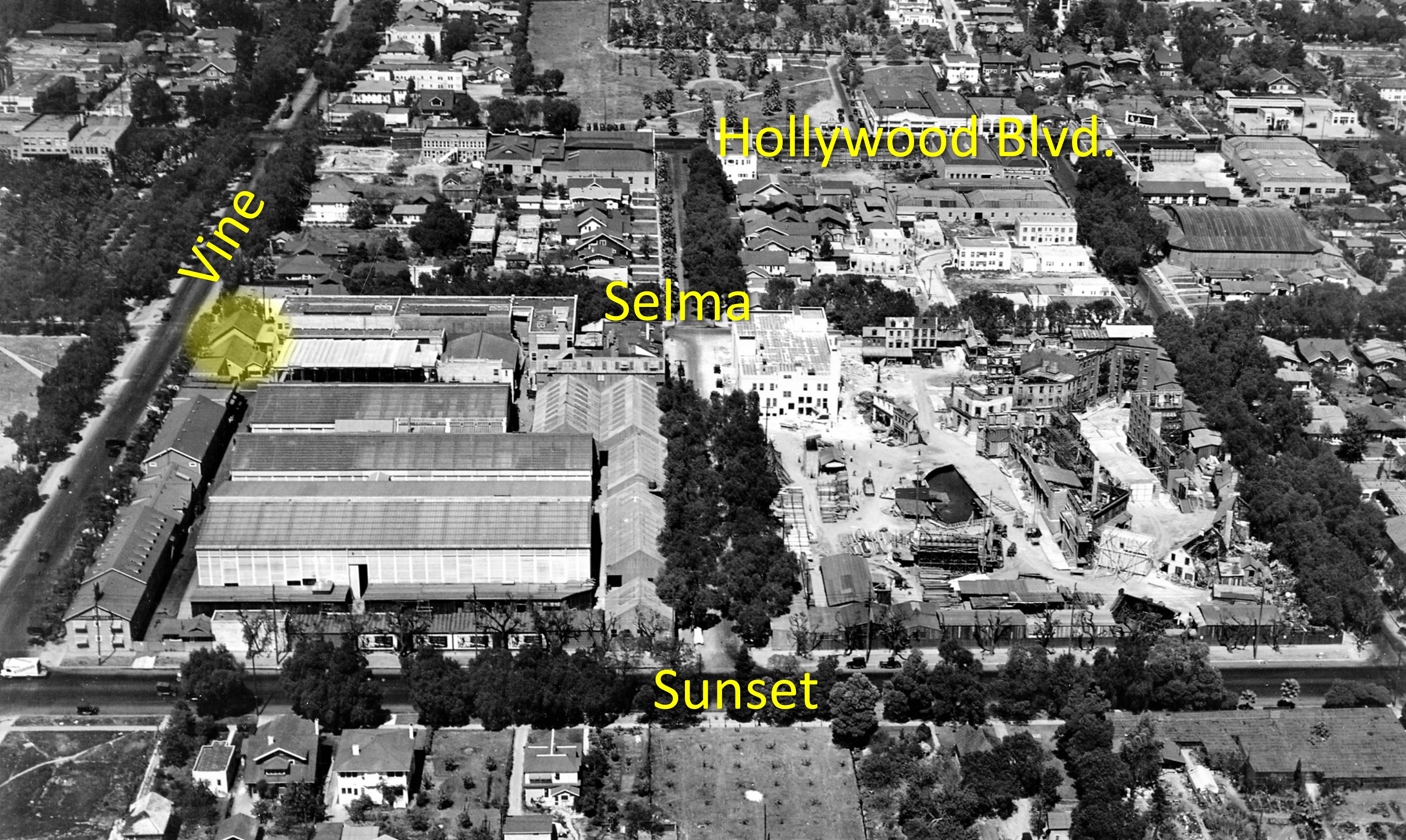
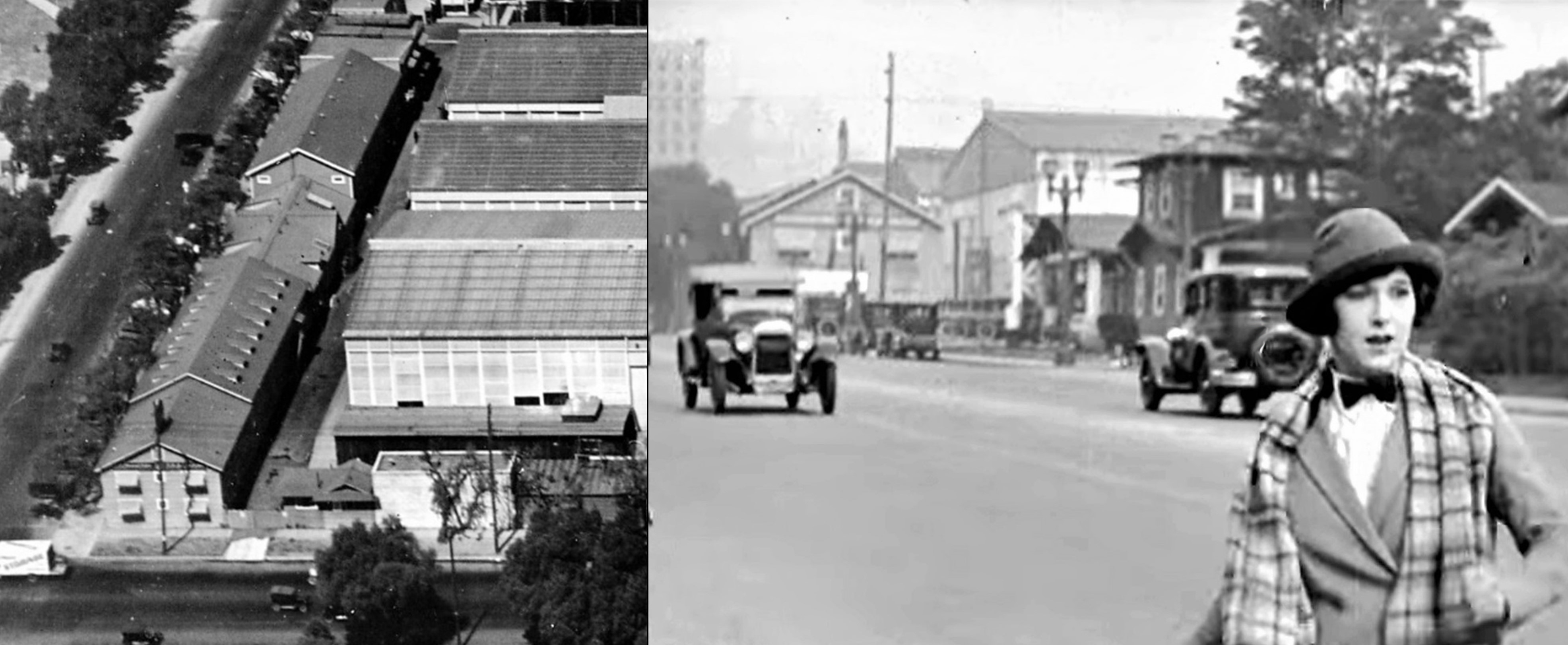
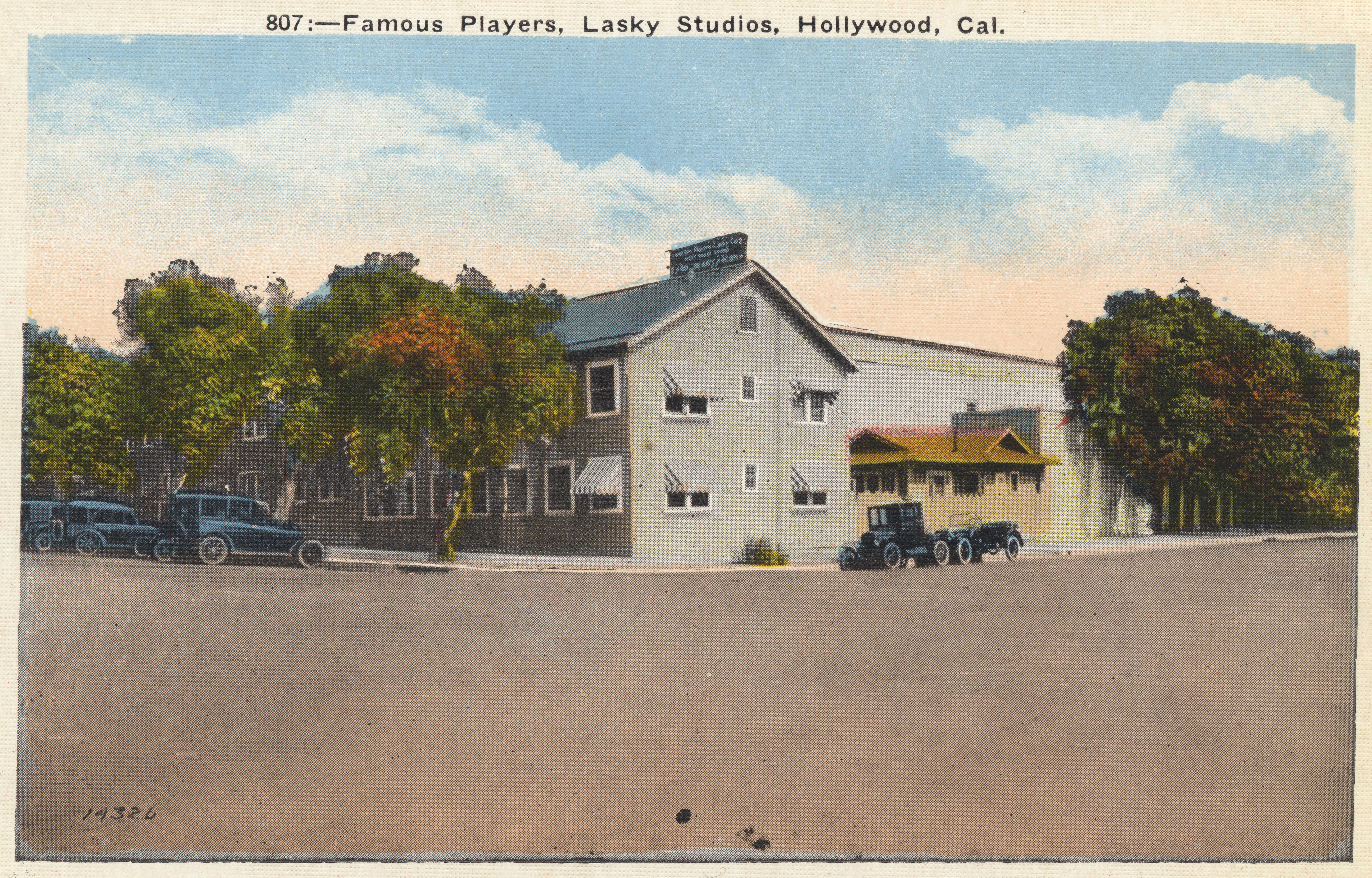
Hollywood fans may know the small barn where Cecil B. De Mille filmed The Squaw Man in 1914, and later relocated to serve as the Hollywood Heritage Museum, originally stood at the SE corner of Selma and Vine as part of the Famous Players – Lasky Studio. Click to enlarge – this 1921 aerial view above looks north – the Selma and Vine Lasky barn highlighted. But pay attention to the lower left corner of Sunset and Vine. Marc Wanamaker – Bison Archives.

When Wanda, pictured here in 1927 paired with the 1921 aerial view, chases after a bag of stolen money, she runs down Vine with the rarely photographed SUNSET corner of the Famous Players studio behind her. (To be clear, Wanda was not working at this studio when filming beside it).

Update: above, the Sunset corner of Famous Players – California State Library.

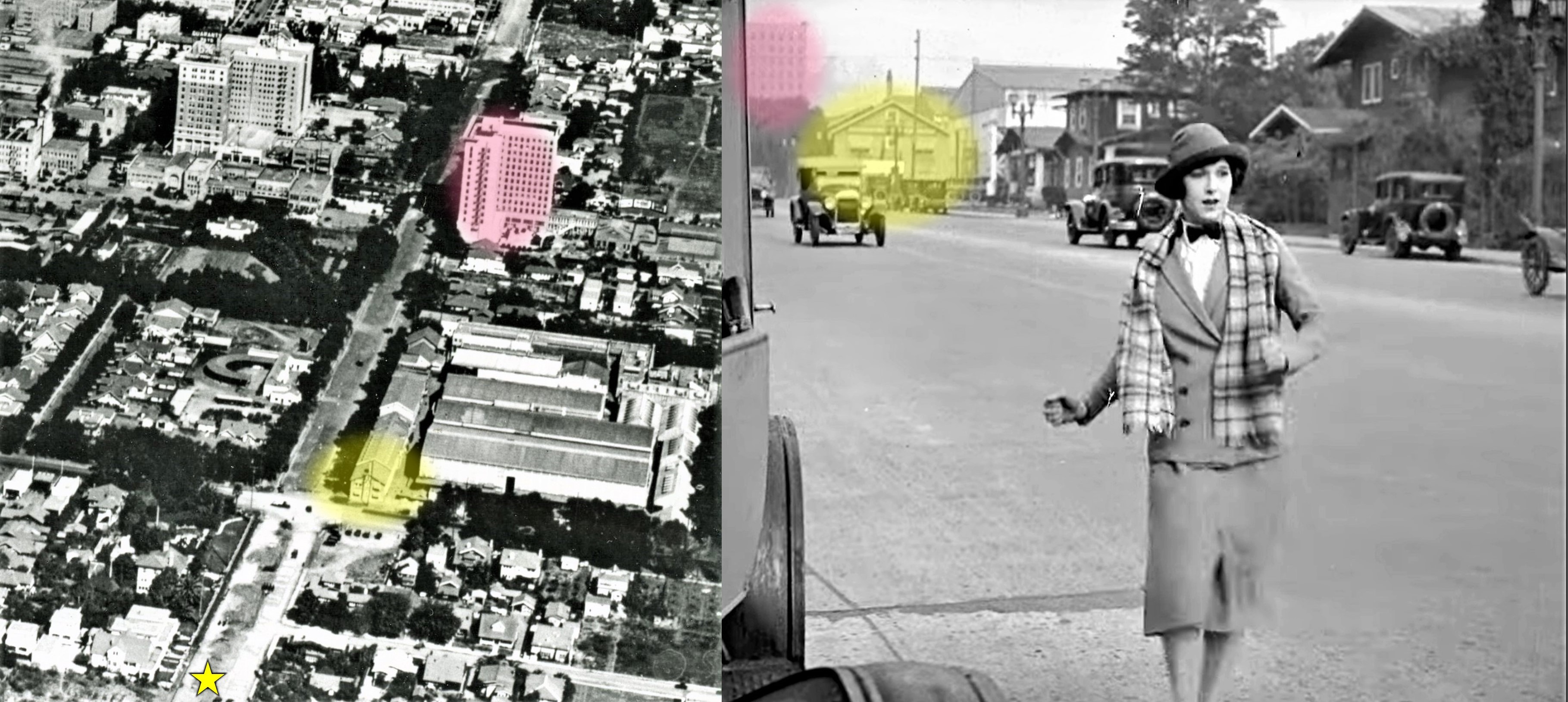
Click to enlarge – this 1924 aerial view at left is color-coded to Wanda’s 1927 view. At back in pink stands the Taft Building at Hollywood and Vine, built in 1923, the yellow spot marks the Sunset corner of Famous Players, and the star marks Wanda among the homes near 1415 Vine Street. HollywoodPhotographs.com.

Click to enlarge – a reverse view, circa 1918, of the Sunset and Vine corner of Famous Players, Wanda standing among the now lost early residences. USC Digital Library.

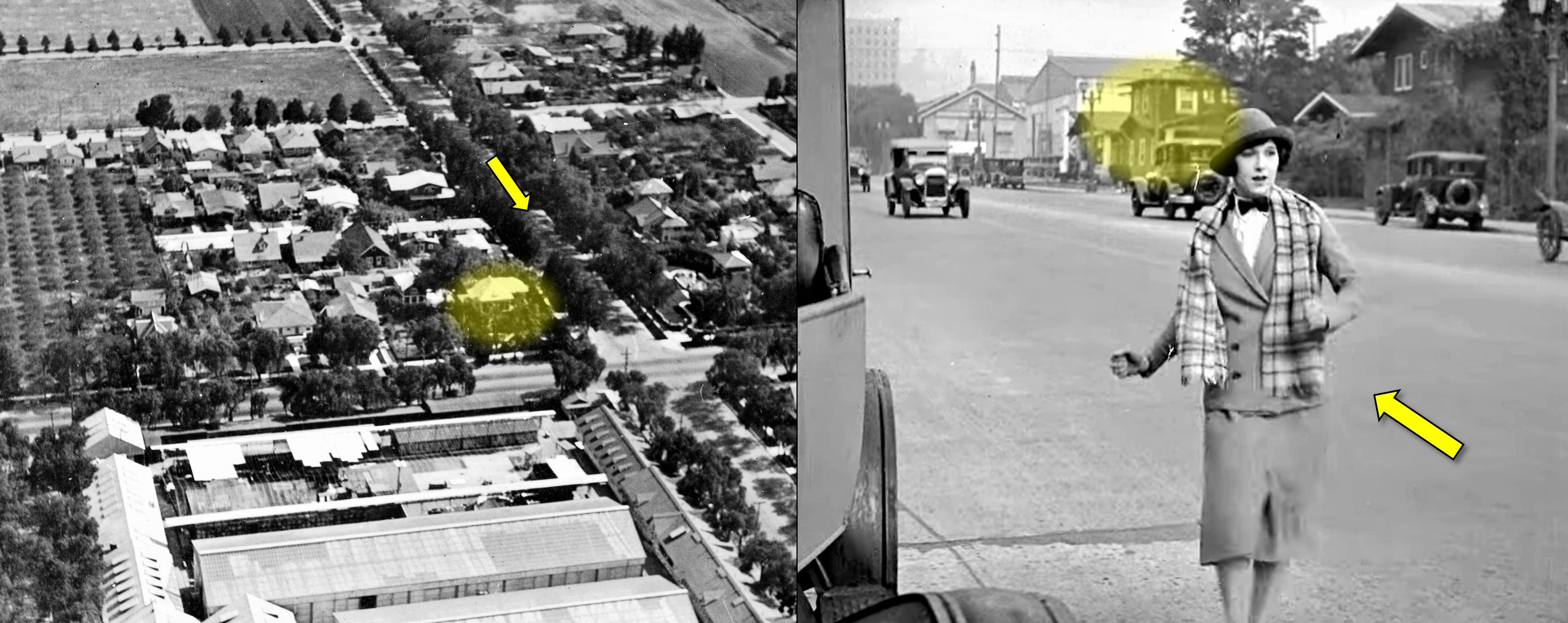
Click to enlarge, this time a 1919 aerial view of Famous Players, looking south down Vine, again matched with Wanda looking north. Marc Wanamaker – Bison Archives.

Above, a better view north of the Taft Building. USC Digital Library.

Above, these scenes filmed looking north reveal the staggered walls that once lined the west side of Vine between De Longpre and Leland Way. I am unable to locate any photos of these long lost homes.

Click to enlarge – a much closer view of the 1924 aerial photo looking north. Wanda and her hero taxi driver Earl McCarthy stand on the west side of Vine (star), with the white porch arches of 1415 Vine Street behind them.

As mentioned, despite her glamor and charm, Wanda was also a slapstick heroine. That’s her leaping between moving automobiles, heading south down Vine St.

View south towards the Colehurst Apartments, 1106 N. Vine, left at back.

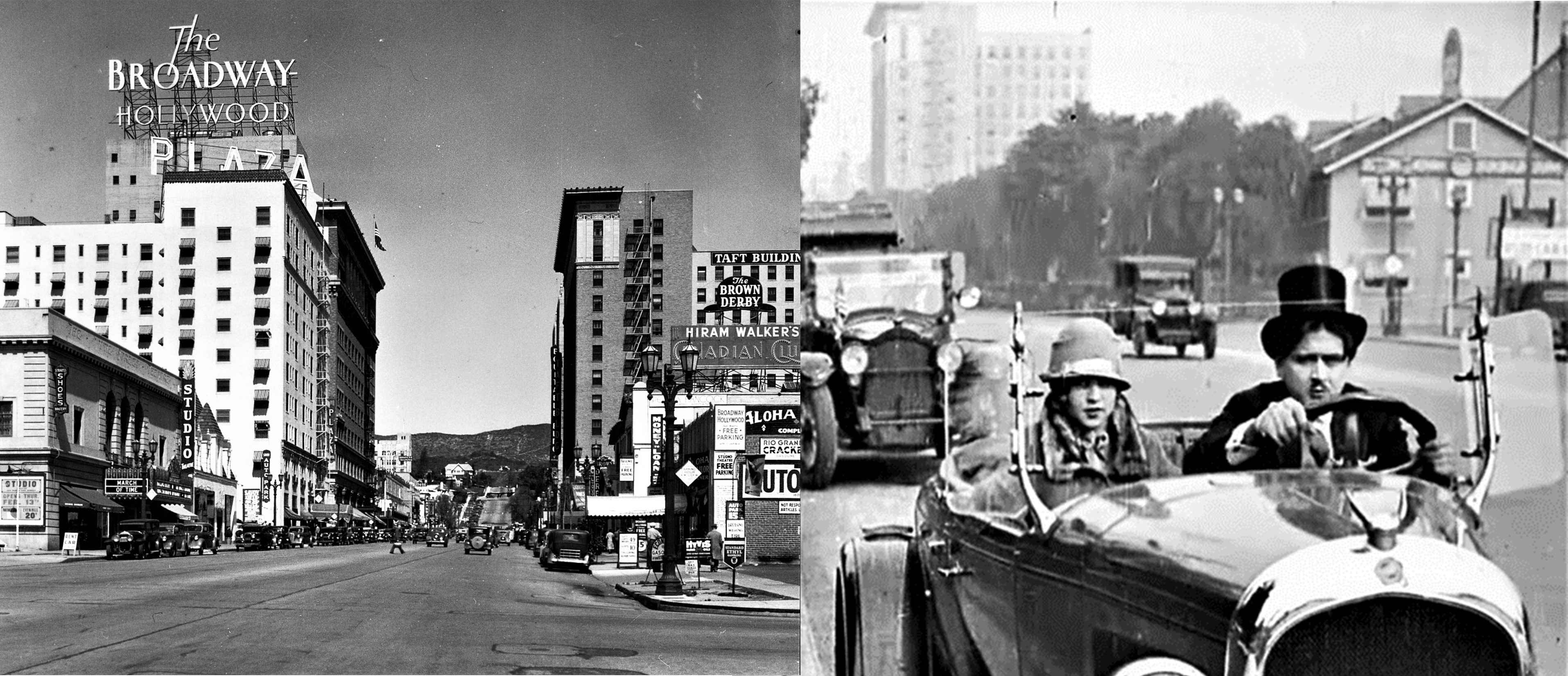
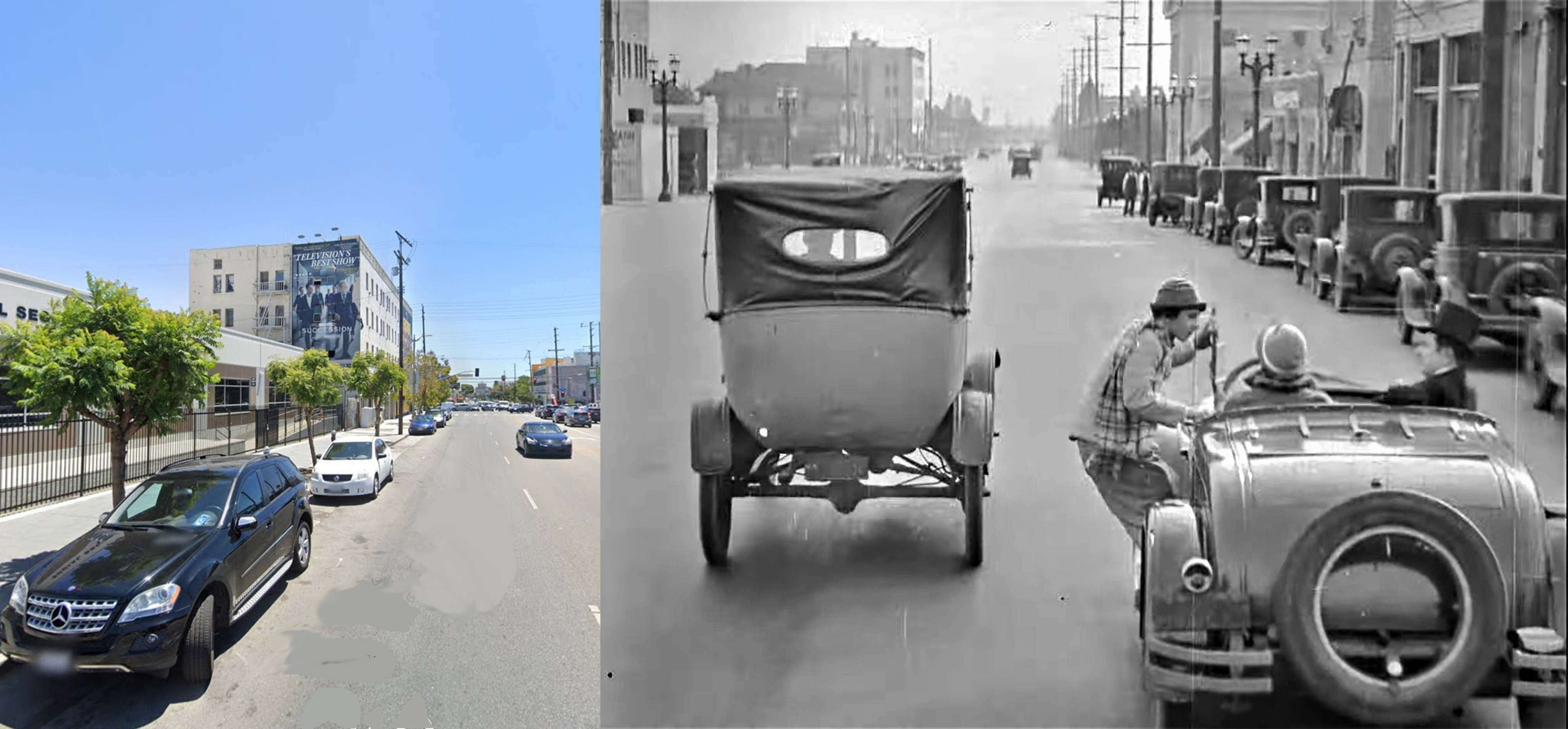
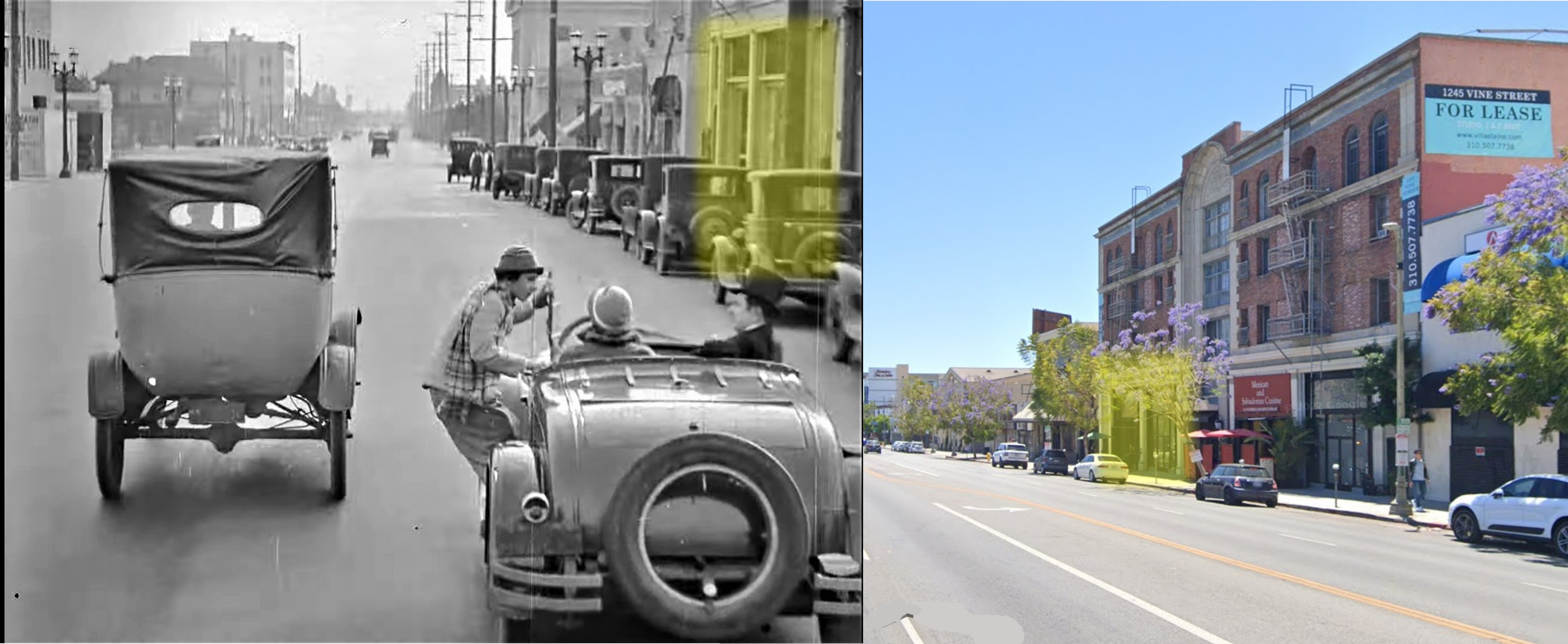
The St. George Court Apartments at 1245 Vine

Click to enlarge – vintage views of the Colehurst Apartments (left) and the St. George Court Apartments (above) appearing with Wanda. The Colehurst stands on the NE corner of Santa Monica Blvd. and Vine, a short block from the former Buster Keaton Studios. Buster filmed at this Santa Monica and Vine intersection several times, but only before the Colehurst was built in 1924. LAPLUSC Digital Library.

Above, Wanda spills down the cement stairway of her apartment at 327 Beaudry Ave., dives on the sidewalk among many scenes filmed on Cahuenga, near Selma, the favorite Hollywood filming block for Charlie Chaplin, Buster Keaton, and Harold Lloyd, and even visits the frequently filmed cliffs overlooking Santa Monica Canyon. Details to follow in a later Wanda Wiley post – stay tuned. [Update – check out post number two about Wanda HERE.]

Click to enlarge – Universal Weekly September 17, 1924 Vol. 20 No. 7 – Lantern Media

Wanda Wiley becomes now the fourth fantastic silent film comedian brought to my attention for the first time by Ben Model. Aside from Wanda, I only became aware of the delightful Alice Howell comedies (Alice Howell Collection), the Doug MacLean light comedies (The Douglas MacLean Collection), and the pre-talkie films of Edward Everett Horton (Edward Everett Horton: 8 Silent Comedies), because Ben had first tirelessly assembled, restored, scored, and released these essential early films to home video. I’ve posted stories about these releases from Ben elsewhere on my blog.

It’s tragic Wanda has been almost completely forgotten, and that nearly all of her films are lost. But you can enjoy several of her films on Joseph Blough’s YouTube Channel, including Queen of Aces (1925) HERE, Won By Law (1925) HERE, Jane’s Trouble (1926) HERE, and Even Up (1927) HERE, as well as A Thrilling Romance posted below. Thanks to author/historian Jim Dawson for reminding me Ben Model and Steve Massa also host the Danish Film Institute’s copy of Wanda’s A Speedy Marriage (1925) HERE. I hope you’ll check my YouTube Channel as well.

Below, looking north up Vine toward Leland Way, close to where Wanda stands on Vine near the top of this post.

Posted in Hollywood History, Wanda Wiley | Tagged , , , , | 16 Comments

Hiding in plain sight – more cinematic magic from Buster Keaton’s Go West

Known only as “Friendless,” Buster finds himself working on an Arizona cattle ranch during Go West. There he meets Brown Eyes the cow when he kindly removes a painful rock stuck in her hoof. Soon after she returns the favor by interceding when a bull comes charging at Buster. Friendless no more, Buster and Brown Eyes are inseparable for the rest of the film.

Above, the touching scene when Buster first realizes another living being, Brown Eyes, actually likes him, has always struck me as perhaps the most sincerely emotional scene portrayed in Keaton’s work. But as we’ll see a bit later below, the scene also contains some cinematic magic, hiding in plain sight.

Now fast friends, Buster later protects Brown Eyes from being seared by a red-hot cattle brand by painlessly shaving a brand mark on her instead. Above, Buster shows his tonsorial handiwork to the rancher.

Next, in a scene that echoes Buster dislodging the rock from Brown Eye’s hoof, the rancher’s daughter, played by Kathleen Myers, beckons Buster to join her beside a well to help remove a splinter from her hand.

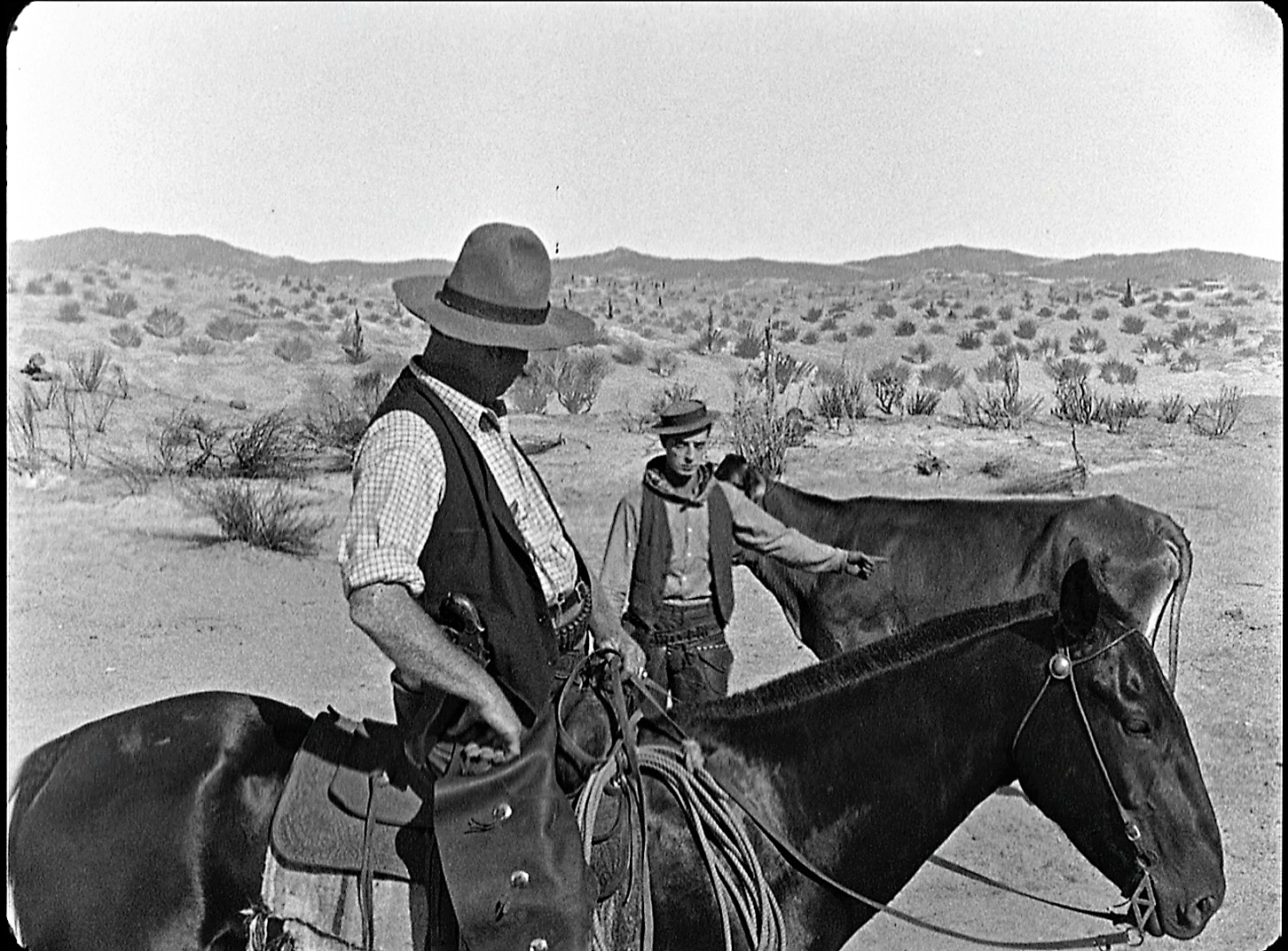
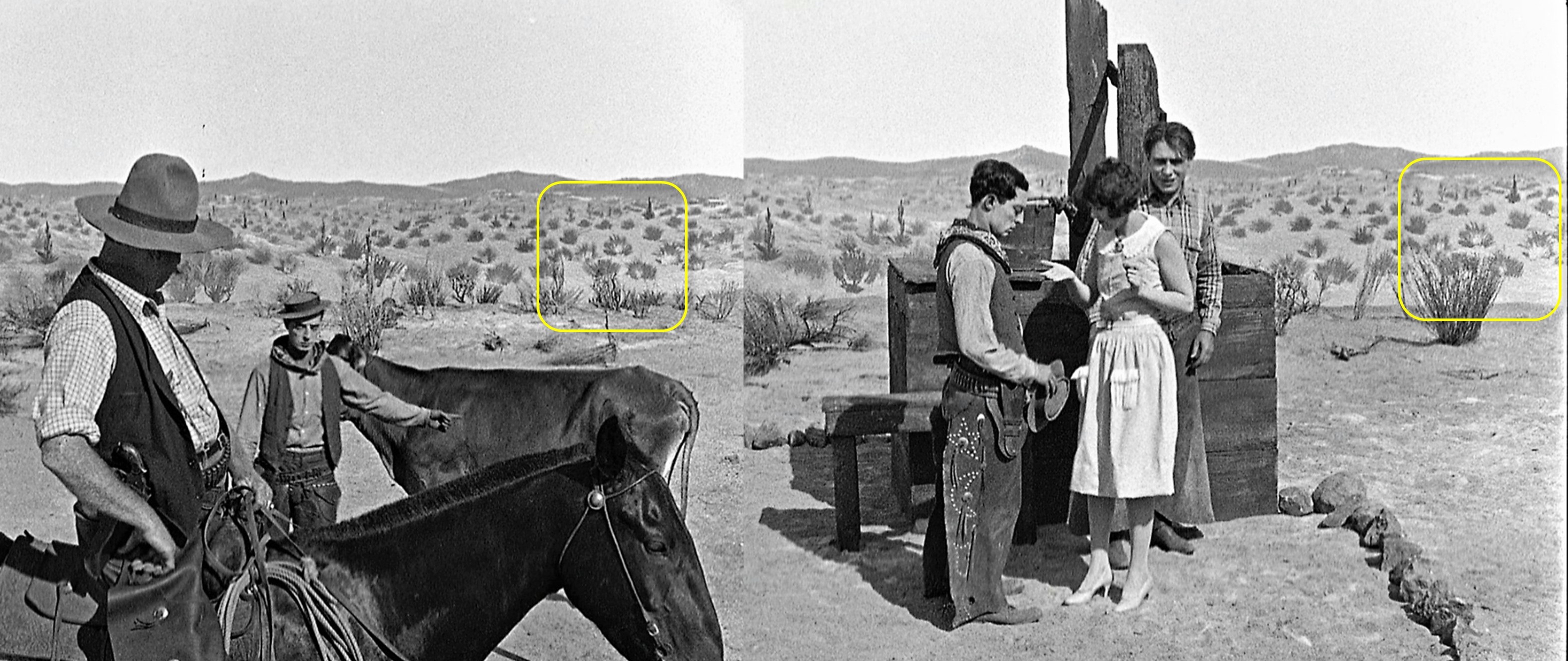
Looking closely (click to enlarge), both scenes were filmed in front of a painted backdrop. A prop well was added for Kathleen’s scene, but matching painted details appear in both shots. Very clever Buster!

As first documented in my book Silent Echoes, and in this recent post updated with wonderful color photos taken by dedicated EPA attorney and devoted Keaton fan Marie Muller, Keaton filmed the ranch scenes at Tap Duncan’s Valley Ranch more than 50 miles north of Kingman, Arizona, and the cattle loading scenes in Hackberry, located along historic Route 66 about 20 miles NE from Kingman, and 30 miles south of the ranch. Above, matching views at Hackberry as they prepare the cattle to board the train – photo Marie Muller.

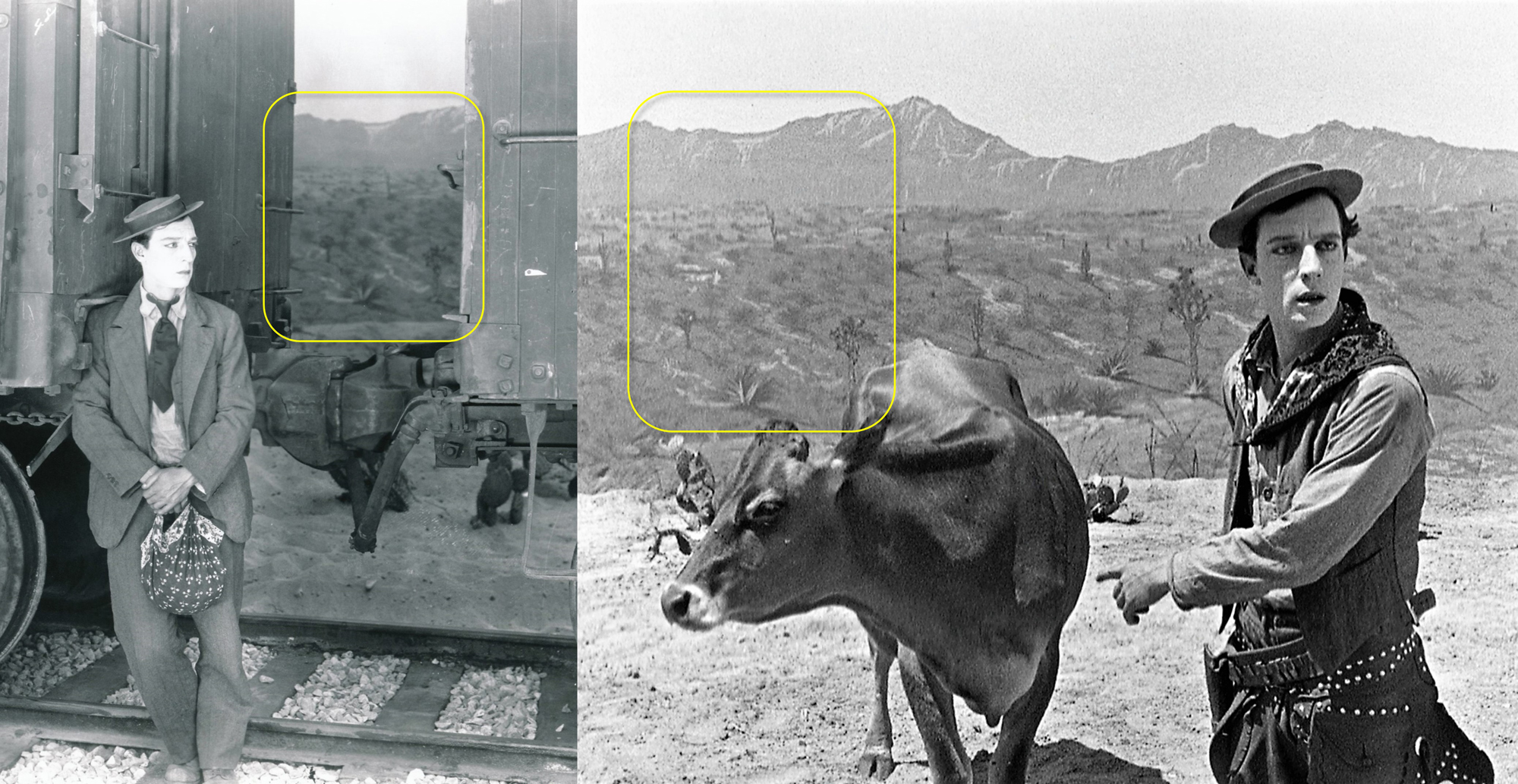
Above, knowing she will be transported by train to the slaughter house, Buster pleads to spare Brown Eye’s life, presented as if filmed at the Hackberry loading dock. Having visited Hackberry in person, and relishing the high definition details visible in the film’s Blu-ray release, I studied the above scene closely, hopeful some ridge lines in the background might match up.
That’s when I realized Buster had staged these two emotional scenes, first meeting Brown Eyes, and later pleading for her life, in front of the same painted backdrop. Another bit of cinematic magic, hiding in plain sight. Very clever indeed.

The same painted backdrop also appears in this publicity still above (click to enlarge), one of a series of stills of Buster posing with regional freight cars staged with appropriate painted backdrops such as northern snow, southern cotton fields, and eastern rolling hills. While I have no access to contemporary records confirming this, logic dictates these painted backdrop scenes were filmed in Hollywood at Buster’s studio, under his complete control, and not at some remote, dusty ranch.

I discovered these painted backdrops preparing my Go West visual essay for the 2021 Eureka Entertainment Masters of Cinema release of Go West, along with Keaton’s Our Hospitality and College. With thanks to Kino-Lorber, the visual essay I prepared for KL about College is also included in the new Eureka release.

Another special effect – the upper floors are painted on glass

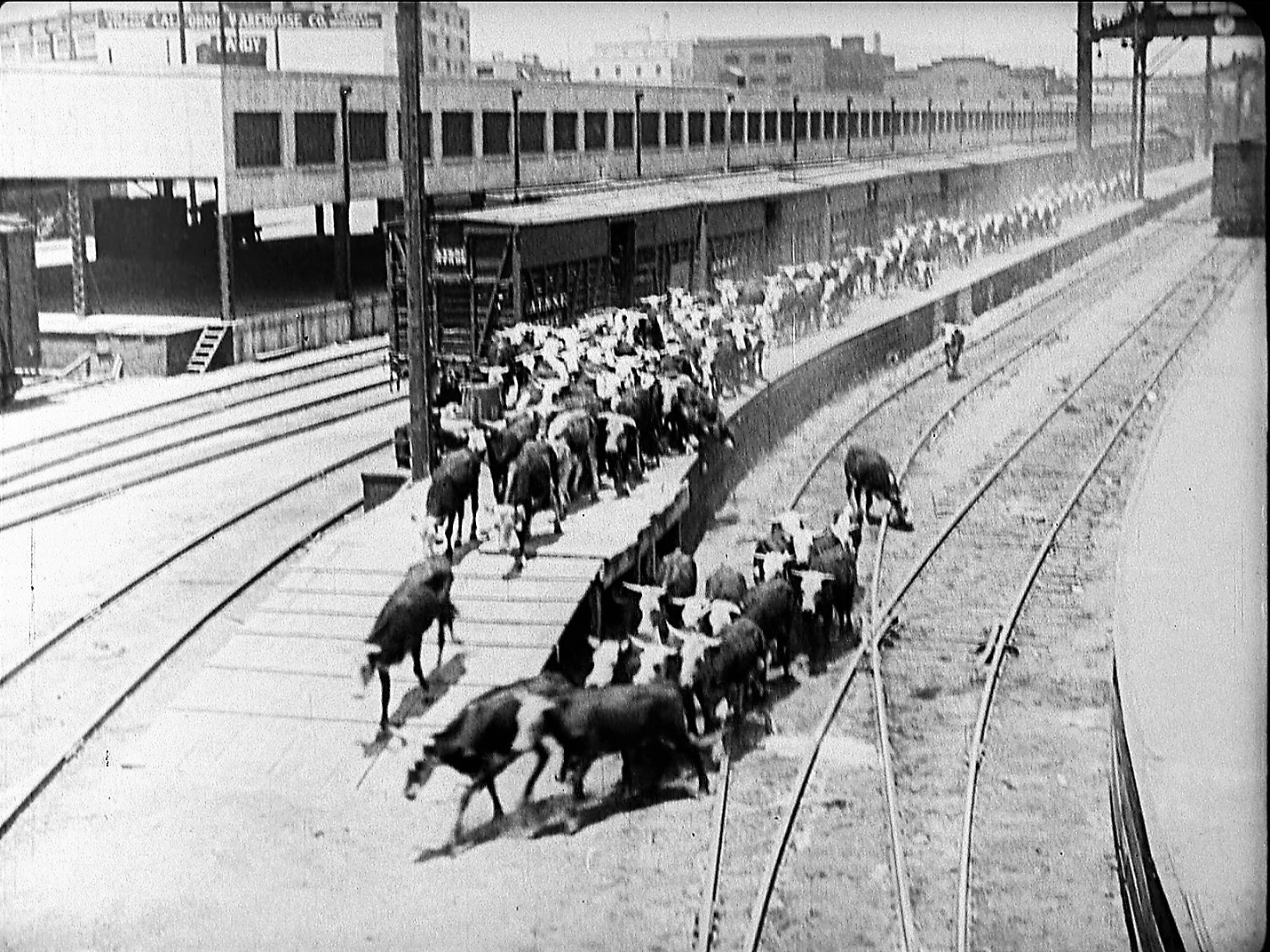
Though considered a lesser Keaton film, Go West remains a staggering accomplishment. Think of the logistics. Buster filmed for weeks in the Arizona desert, hundreds of miles from home, while enduring the summer heat. Buster worked with several farm animals, training them to perform on command, and wrangled a herd of at least 100 live cattle on real downtown streets, at 4th and Merrick near the former LA Santa Fe freight yard (above). Buster staged many sequences atop moving trains, presaging the even more elaborate scenes that would appear later in The General. And last, Buster employed many special visual effects so convincingly, including the painted backdrops revealed here, we don’t even notice. It all appears effortless on the screen thanks to Buster Keaton’s incredible talent as a comedian and filmmaker.

Check out the videos (11 now) about Buster, Charlie Chaplin, and Harold Lloyd hosted on my YouTube Channel.

Below, along Route 66, the Hackberry ridgeline appearing above – zoom in for a closer look.

Posted in Buster Keaton, Go West | Tagged , | 9 Comments

Buster Keaton’s “Electric House” Home

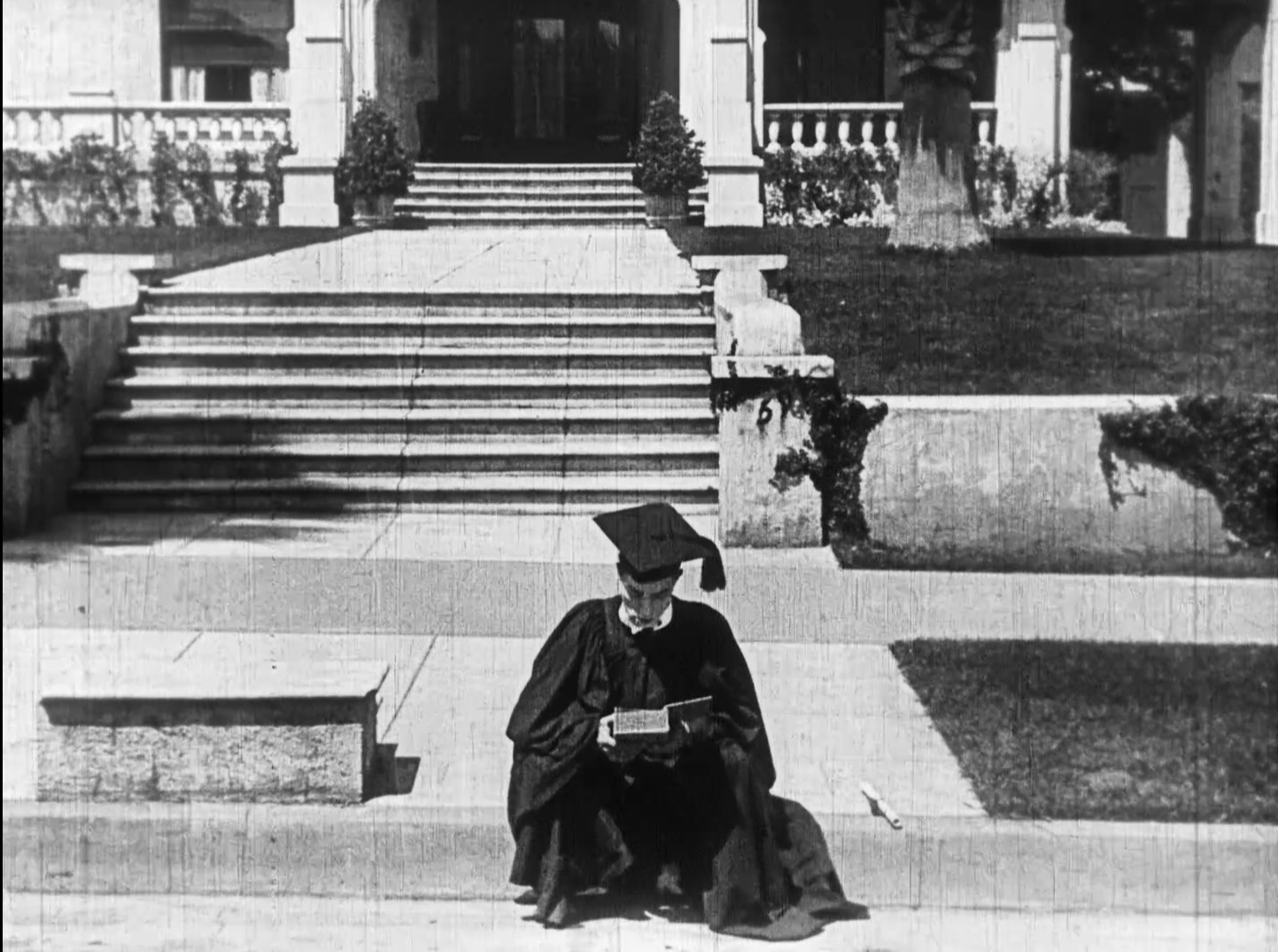
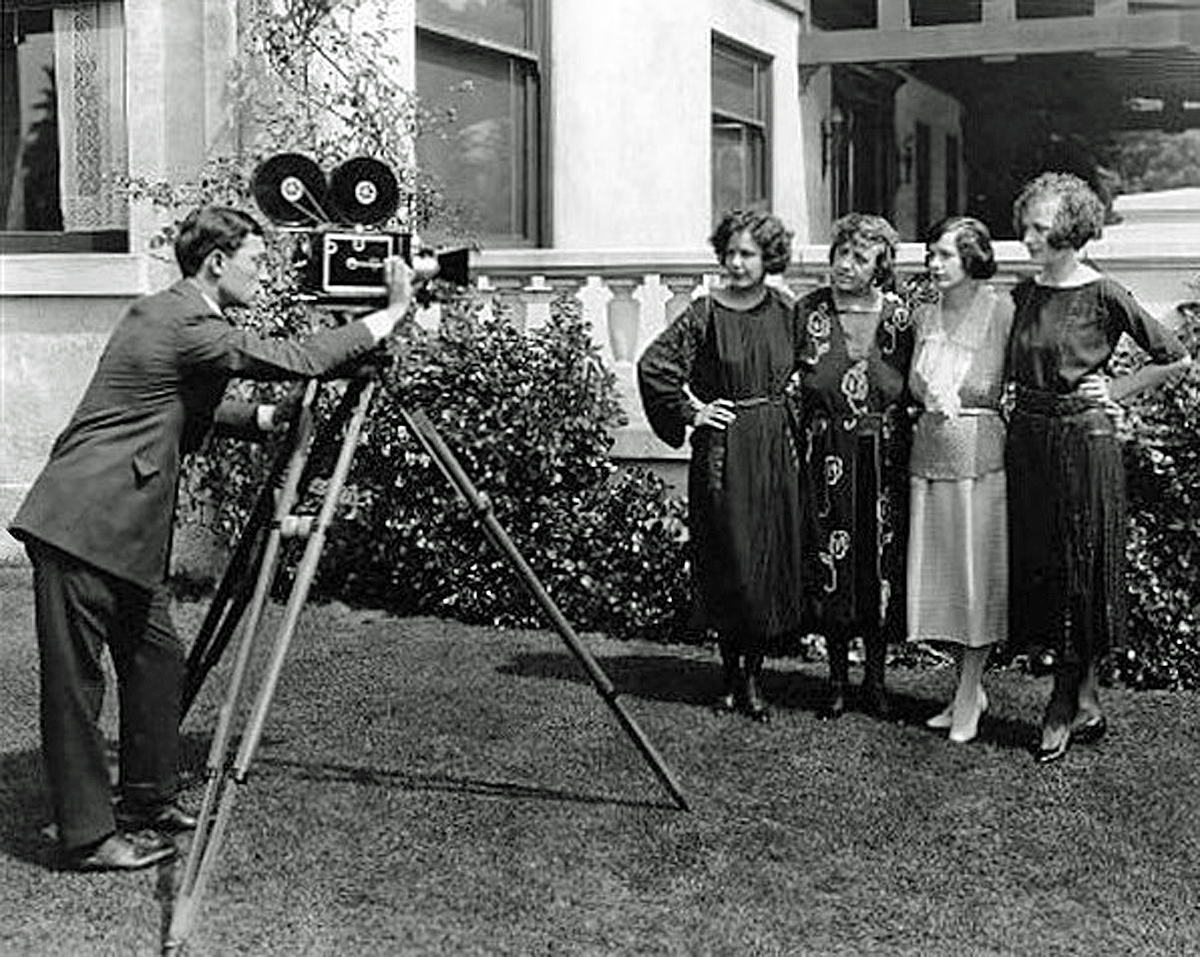
Buster filmed the graduation scenes from The Electric House (1922) at a commercial site still standing, just blocks away from his once magnificent real-life home (above) appearing later in the film.

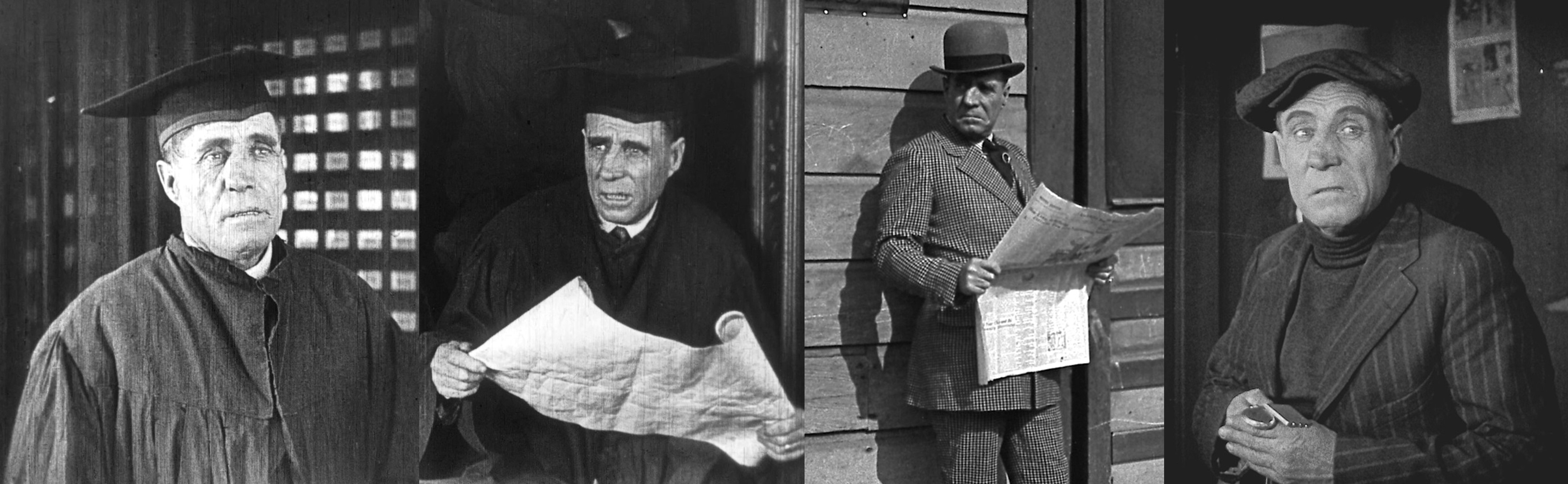
The film opens with graduating botanist Buster mistakenly receiving the electrical engineering degree intended for broken-nosed character actor Steve Murphy above, who also cons Buster in Cops (1922 – 2nd from right), and holds him hostage in Sherlock Jr. (1924 – far right).

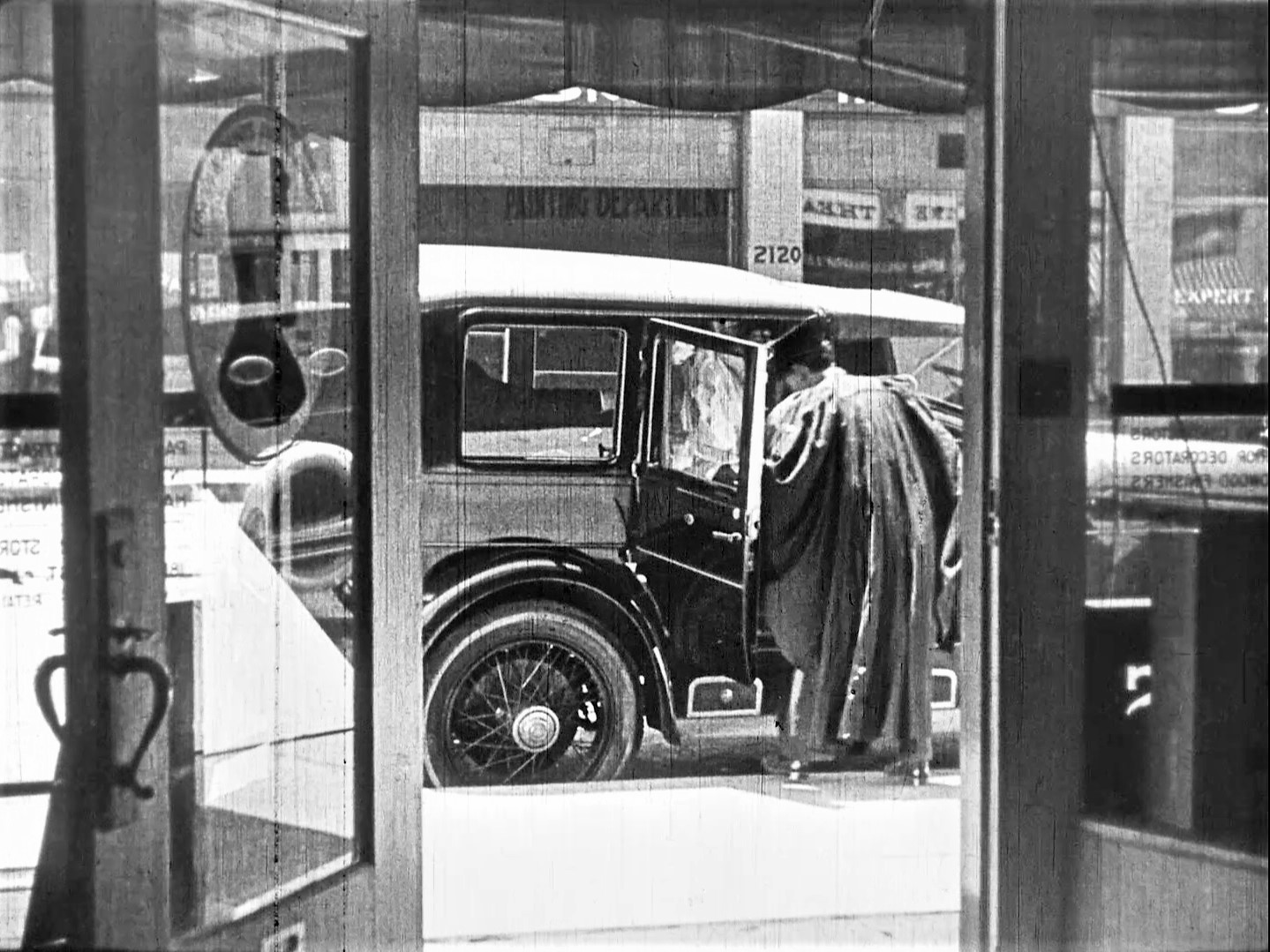
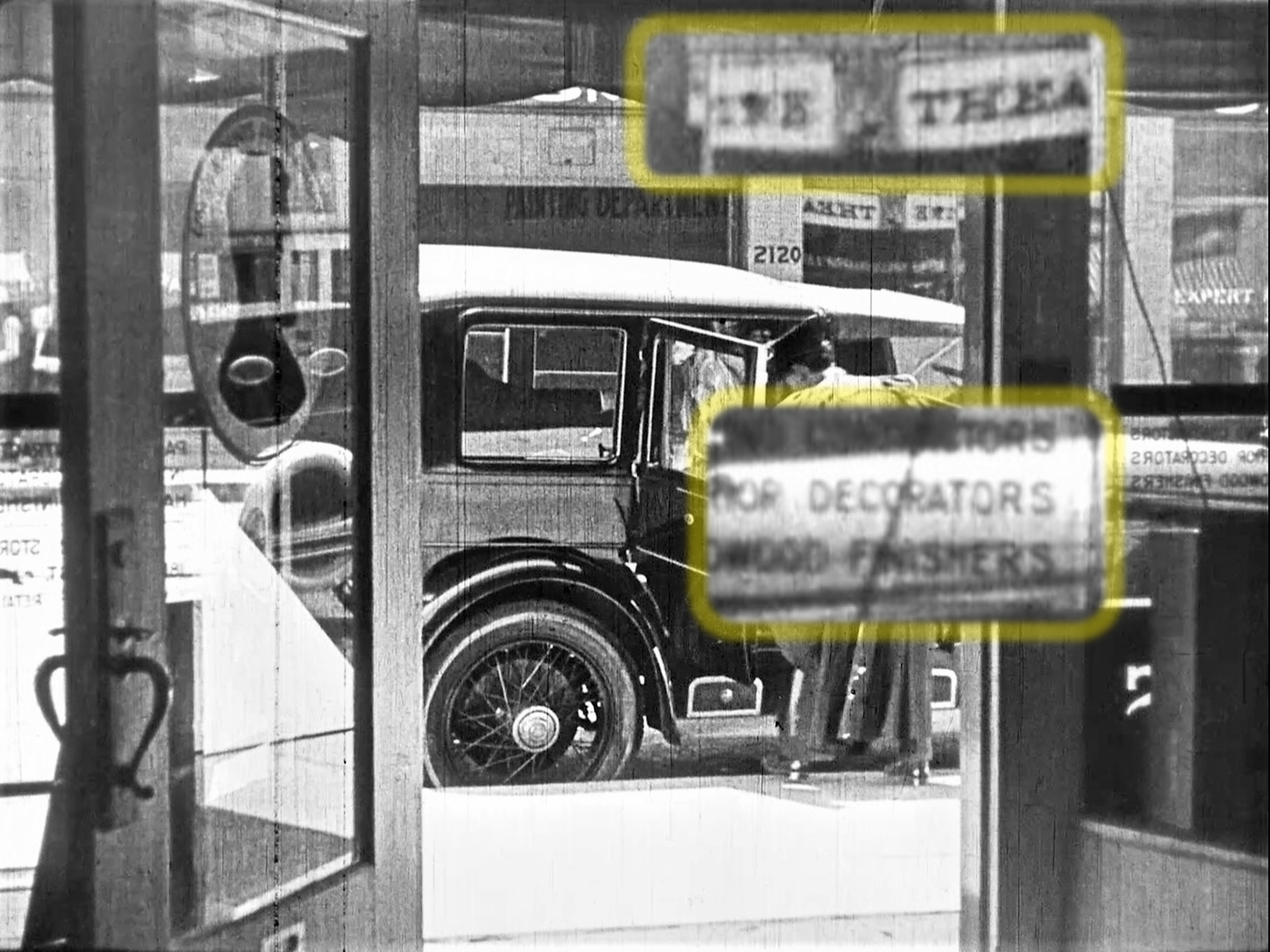
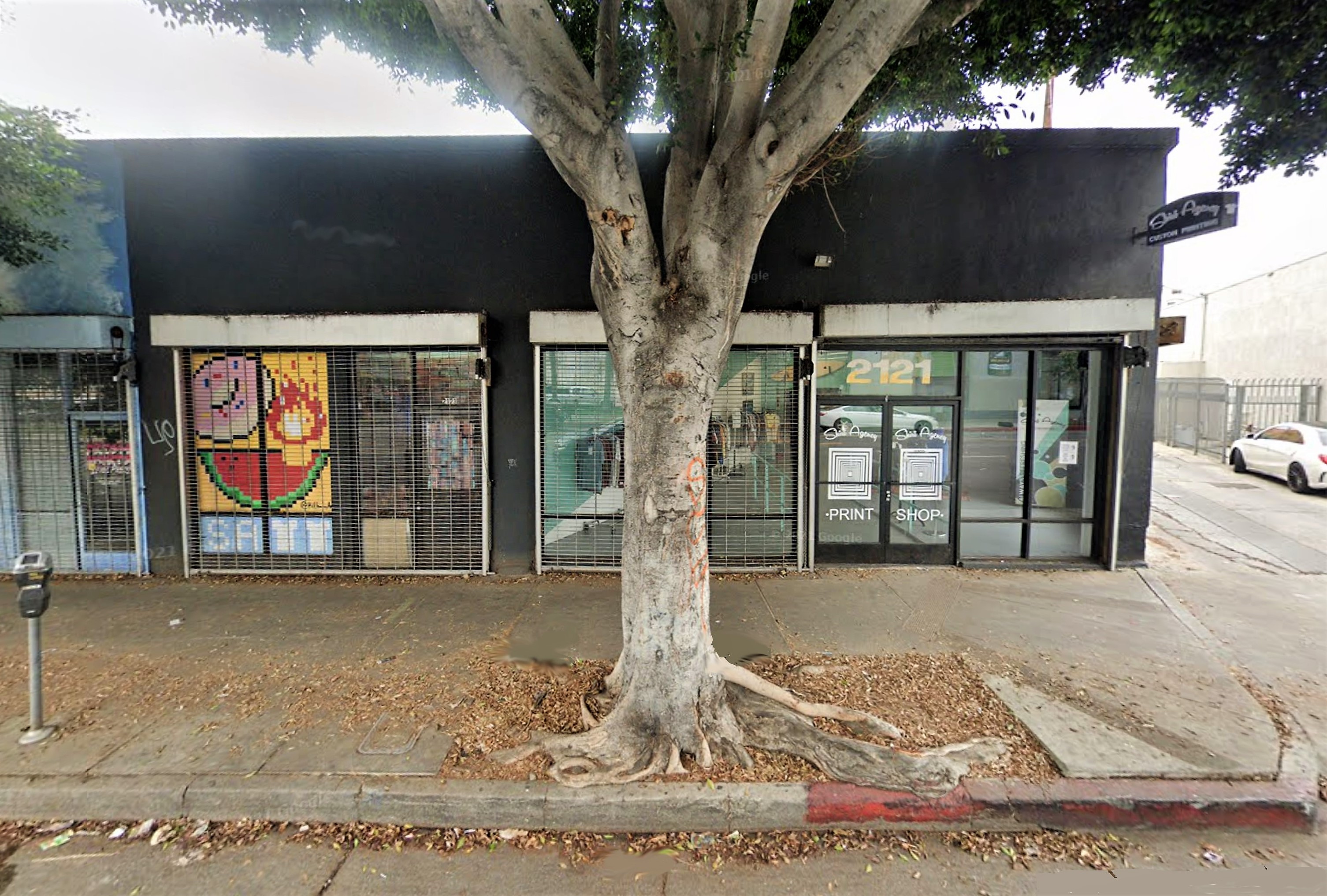
Mistaken to be an electrical engineer, Buster is immediately hired to upgrade Big Joe Robert’s mansion. Above, Buster enters Joe’s limousine. The graduation ceremony was filmed inside an interior decorator shop at 2121 W Pico. The storefront still exists today. Above, the initial clue was the 2120 address of a car painting garage across the street (you can read “PAINTING DEPARTMENT” (expanded) on the interior back wall).

Next, you can read “..IOR DECORATORS” painted (reversed) on the store window, and “..IRE THEA..” (reversed) reflected in the garage window. Assuming “THEA” referred to a theater, I checked odd-numbered theater addresses proximate to “2120,” and the EMPIRE THEATER at 2129 W Pico quickly confirmed the location. While the garage building is gone, Buster’s graduation site and the theater building remain standing.

The stately mansion appearing in the film, 59 Westmoreland Place, was Buster’s real life home at the time. It stood just a few blocks west from the graduation film site. Above, Buster exits a limo in front of his own home.

The estate appearing in the film near Hoover and Pico, 59 Westmoreland Place, was in fact Buster and Natalie’s home during the time of filming. Considering Buster was still making short films, barely two years into his independent filmmaker career, his (Natalie’s?) choice of residence at the time seems quite impressive. You can read the “59” address behind Buster, the “9” obscured a bit by the vine.

Buster and the Talmadges beside the front porch. He seems outnumbered

What images of the home don’t convey is that the mansion was part of an ill-fated development. Restricted so that only palatial homes could be built on its flat, expansive lots, Westmoreland Place failed to catch on, and as the elite increasingly chose to live further west, in more secluded and hilly neighborhoods, most of the giant lots sat empty. Built in 1909, Buster’s home stood two empty parcels north of, and in full view of, the busy Pico trolley line, and was just steps from the low-rent commercial center where Buster received his diploma earlier in the film.

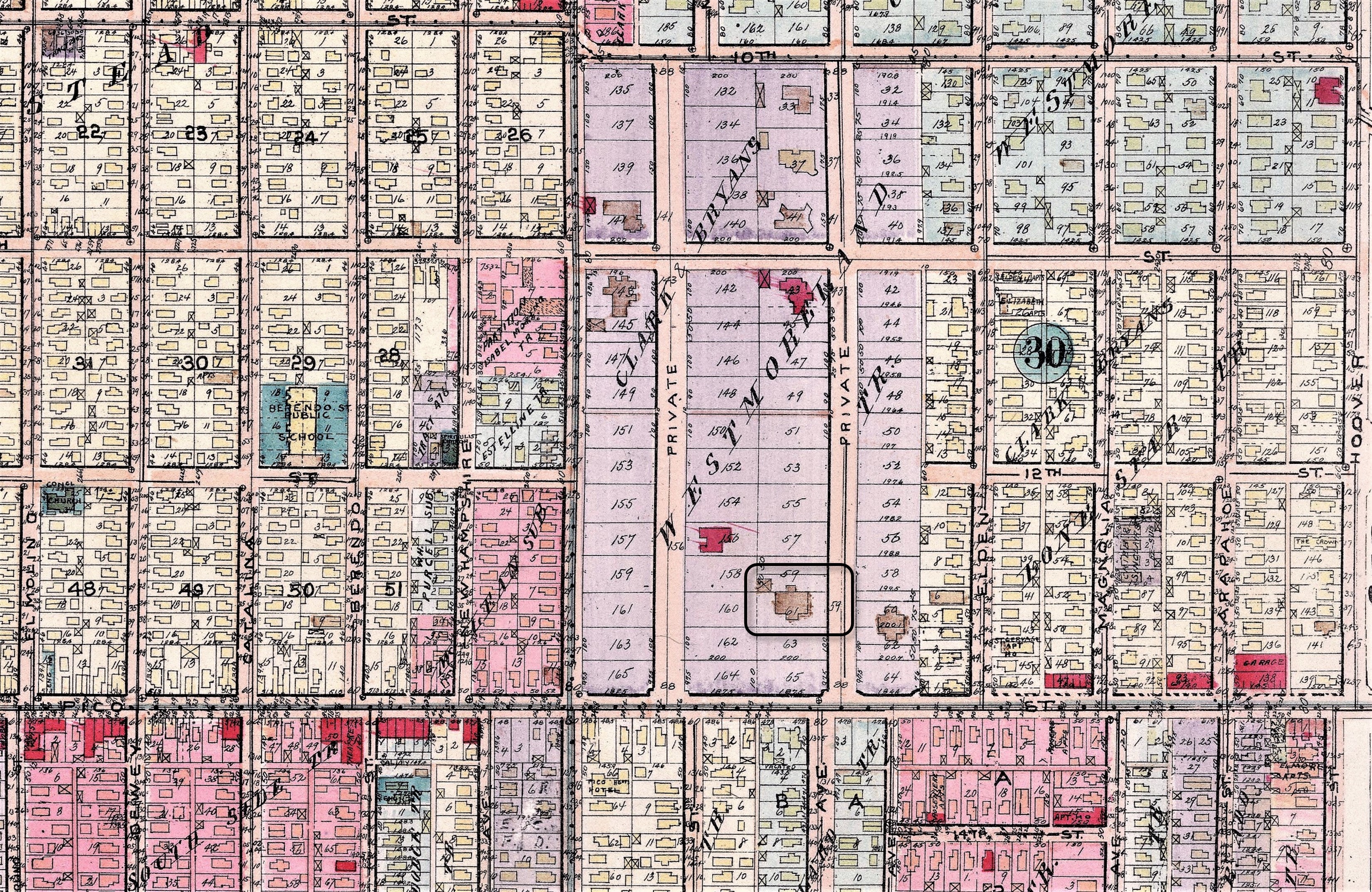
This 1920 map shows Buster’s 59 home (box), one of the few homes in the purple shaded Westmoreland development, also two empty lots east (right) of the busy Vermont Ave trolley line. Although the house was very impressive, especially for a man as young as Buster, it was not the best locale. Adjacent to ordinary commercial streets and trolleys, the neighborhood lacked the prestige and seclusion befitting a rising star, prompting the Keatons’ next move further west to upscale Ardmore Avenue. I now better understand why Natalie wanted to move.

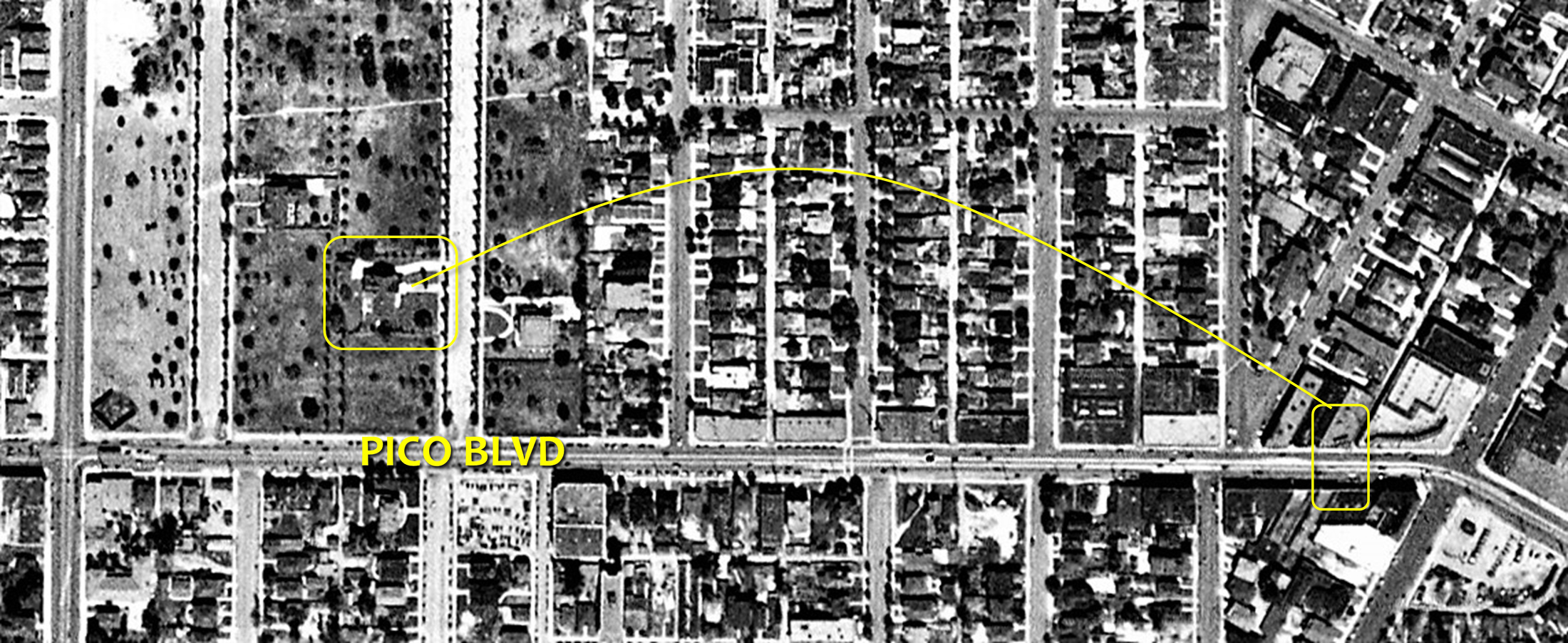
A matching vintage aerial view, Buster’s home (left box), clearly visible from the Pico and Vermont trolleys, was just blocks from the graduation location (right box). So few homes were built at Westmoreland that by 1923 civic leaders considered condemning the development site as a desperately-needed urban park. Eventually the covenants were overturned, and apartment blocks began to fill the empty lots. Buster’s home was demolished in 1979. Residential historian Duncan McGinnis provides a full history of 59 Westmoreland Place – read more HERE.

Buster’s graduation site – 2121 W Pico

Check out the videos (11 now) about Buster, Charlie Chaplin, and Harold Lloyd hosted on my YouTube Channel.

Below, the approximate location, now renumbered, of Buster’s once grand home at 59 Westmoreland Place.

Posted in Buster Keaton | Tagged , , , , , | 2 Comments

New revelations about Safety Last! and The Kid

Two recent YouTube videos revealing new details from Harold Lloyd’s Safety Last!, and Charlie Chaplin’s The Kid, are now uploaded to my YouTube Channel. The channel includes a playlist of other video presentations hosted by museums and other groups.

Hang on – how Harold Lloyd made Safety Last!

A few sample slides below, see how Harold filmed atop increasingly taller buildings, five in all, how a single scene was filmed atop three different buildings, also scenes near USC, MacArthur Park, and at the Chaplin-Keaton-Lloyd Alley in Hollywood. 

The background music is a piano rag I wrote 47 years ago (!), and transcribed as a Musescore file. Here’s a YouTube video showing a computer (not me) playing the piano rag.

How Edna lost and Charlie found the baby who became The Kid

Chaplin’s beautiful scores for The Kid accompany this detailed study of the movie’s opening scenes, showing step by step views of early Hollywood, and the Plaza/Chinatown neighborhoods downtown, to reveal where Edna Purviance lost and Charlie found the baby who became “The Kid.”

Posting these videos has been a lot of fun. Rather than explain, it’s far more satisfying to show these details, so viewers can see for themselves. My blog has numerous other posts about Safety Last! and The Kid, see below.

https://silentlocations.com/category/safety-last/

https://silentlocations.com/category/the-kid/

Thank you so much – this is now video number 11, and I hope to continue uploading new videos every month or so to my YouTube Channel.

Posted in Chaplin - Keaton - Lloyd Alley, Charlie Chaplin, Harold Lloyd, Safety Last!, The Kid | Tagged , , , , , , , , | 7 Comments

The Kid, Cops, Intolerance revealed in a 125 year old photo

When the great silent comedians filmed the streets of LA one hundred or more years ago, many of those settings were already decades old. Focusing on a single vintage photo, let’s explore one of the most fascinating film locations in all of cinematic history.

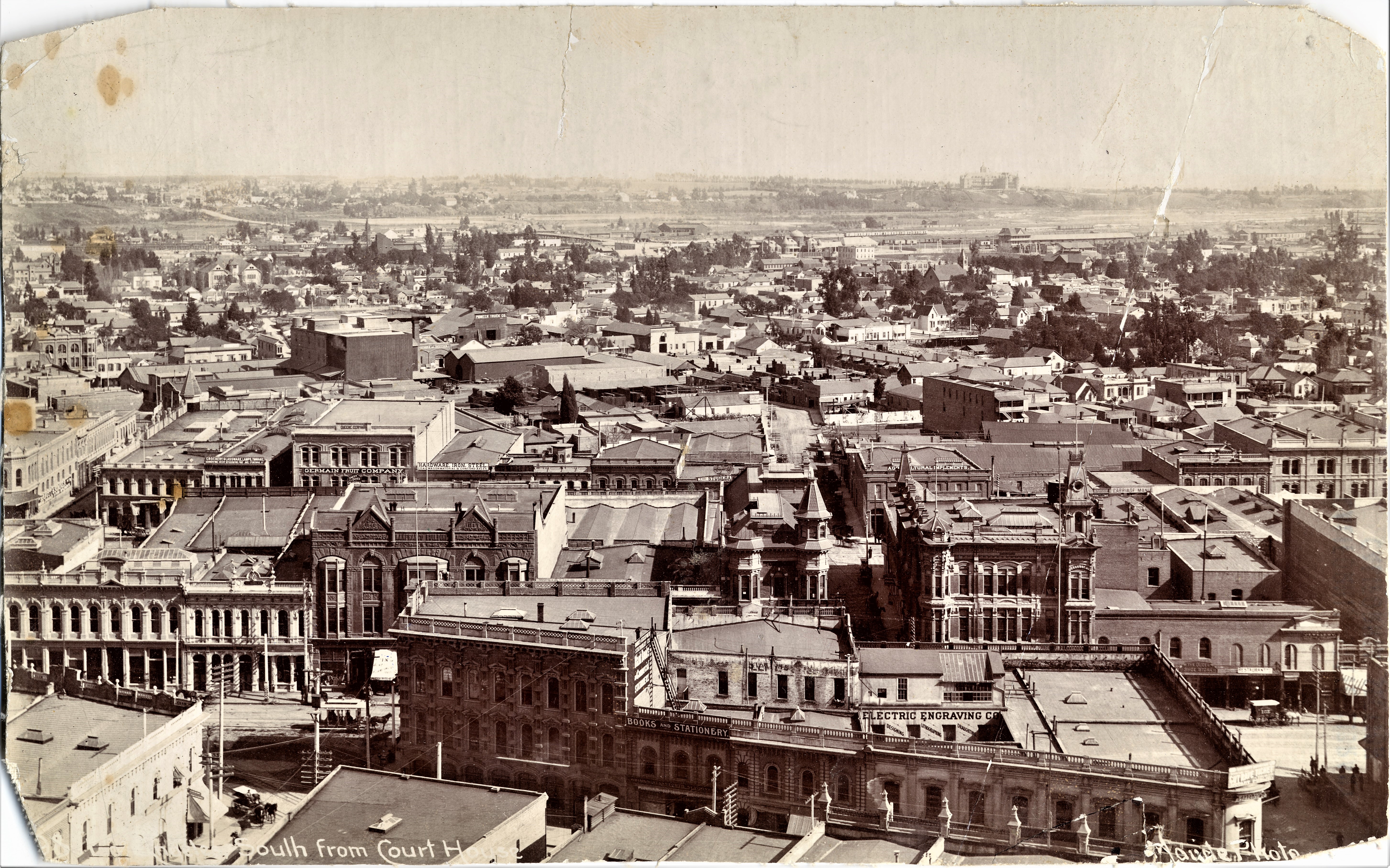
Click to enlarge – this amazing 1897 photo looks east from the tower of the former Los Angeles County Court House once standing at Temple and Broadway in downtown. The prominent corner building facing us just right of center, with the pointed cap tower, is the former Amestoy Building at Main and Market. The left-right street in the foreground is Main Street, with Spring Street along the bottom merging into it. Looming on the horizon at right stands the “cozy” former Los Angeles Orphanage at 917 South Boyle Avenue, built in 1890. California State Library.

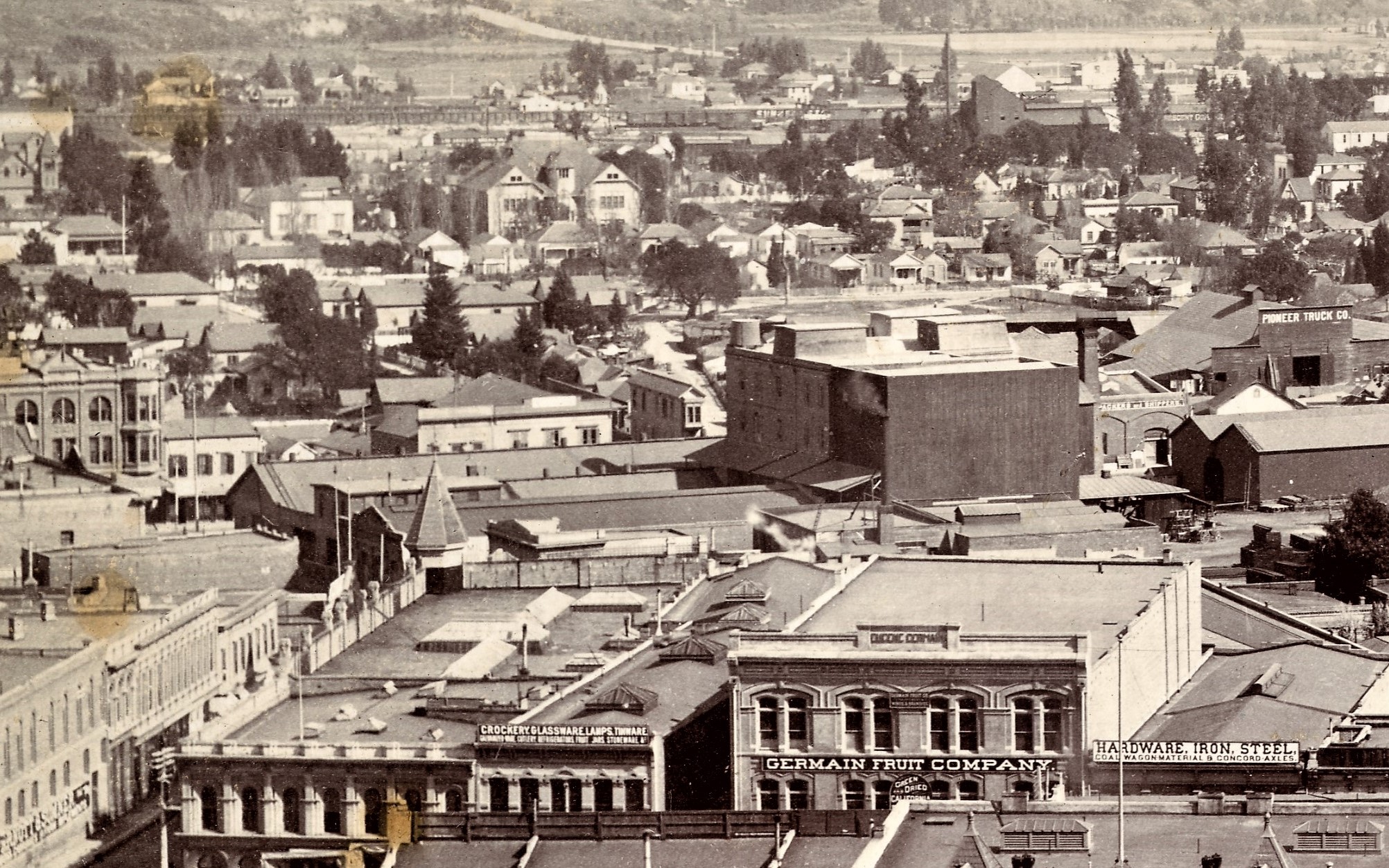
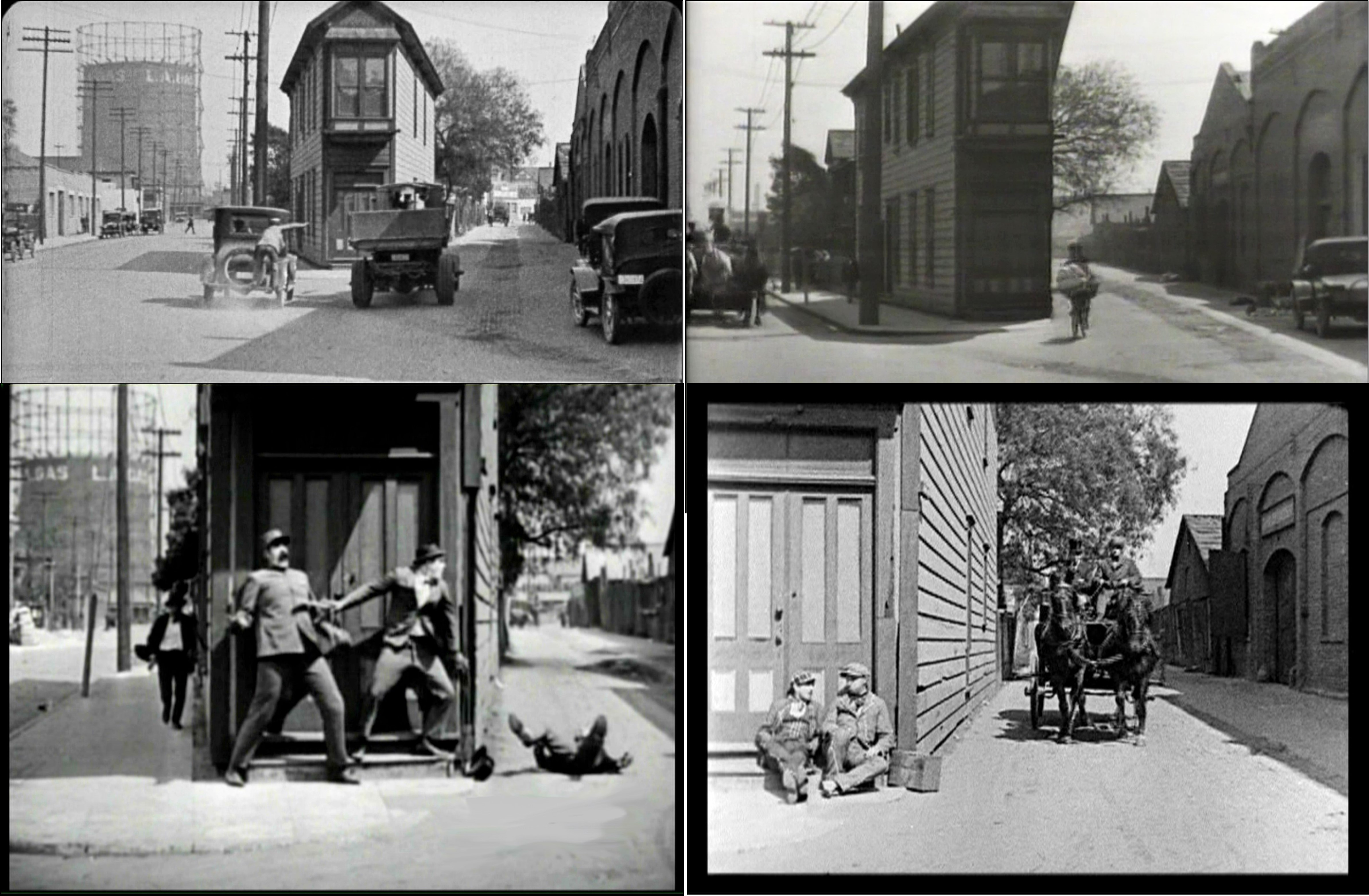
Click to enlarge – a closer view, way at back. The center of the image reveals the narrow intersection of Ducommun Street and Labory Lane, marked by a very narrow two-story triangle building at 412 Ducommun. Do you see it?

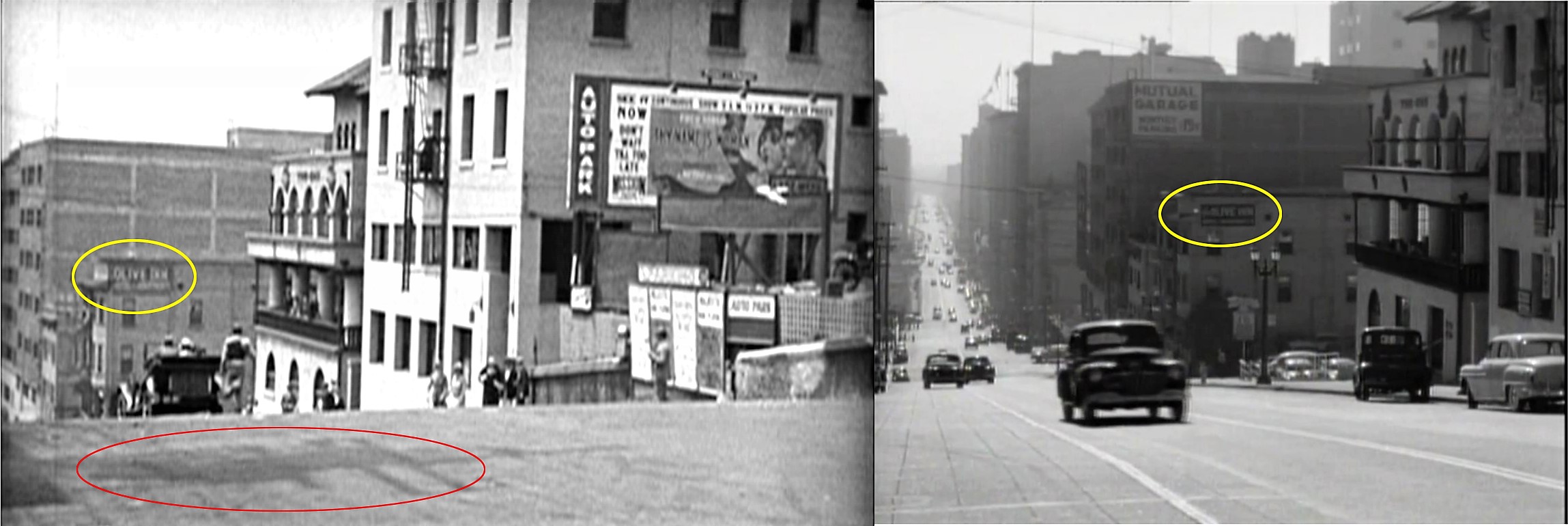
If I could time travel to silent movie locations, after first visiting Court Hill (read more HERE), this would be stop number two, the narrow corner of Ducommun and Labory, just east of Alameda street, a few blocks from the Plaza de Los Angeles. To begin, this corner was Buster Keaton’s favorite place to film, he staged a dozen scenes here for The Goat and Cops, far more so than anywhere else in town. Above, Buster practices signalling a left-hand turn during Cops. That’s the Hotel Strasbourg to the left in all three images across from the triangle building, more later.

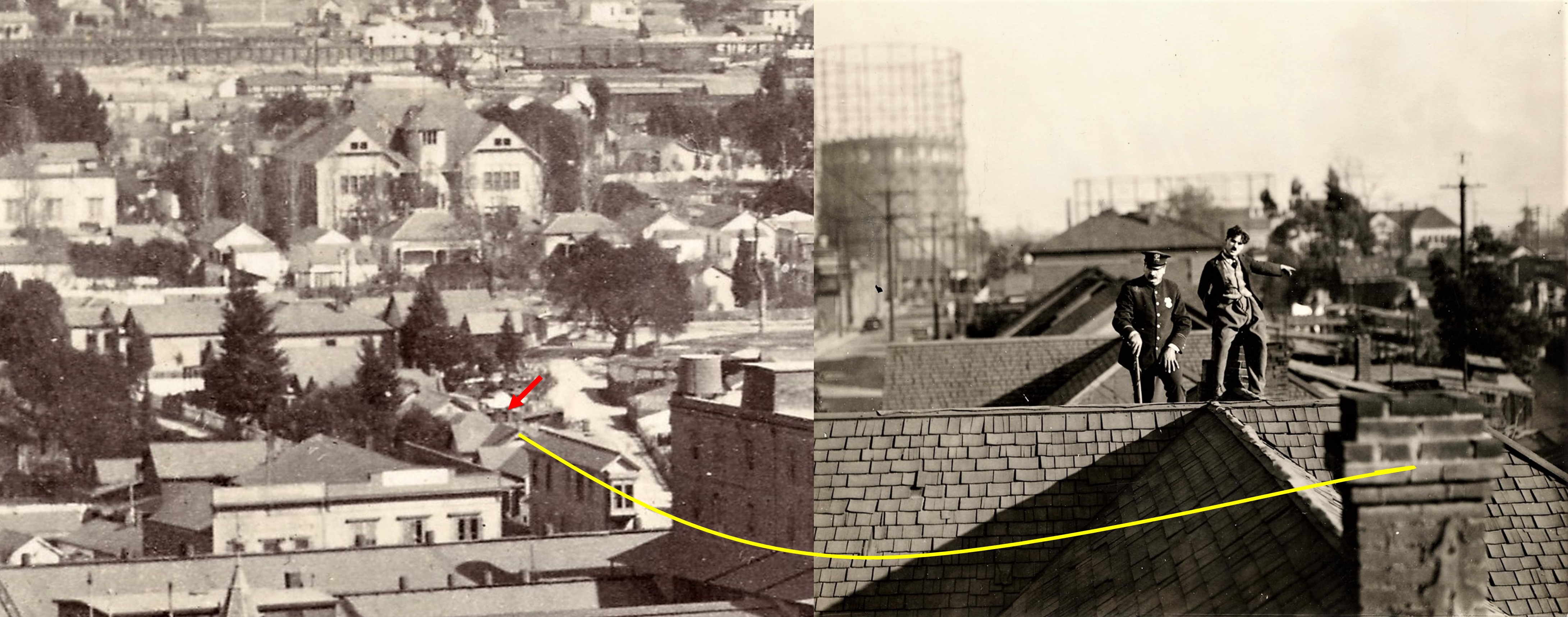
Next, Charlie Chaplin filmed the rooftop chase from The Kid atop these homes on Ducommun, and fought with the orphanage official in the truck driving down Labory Lane to the right. Looking close, the yellow line marks the foreground chimney in each image, the red arrow marks Charlie’s spot on the roof. The prominent 3-story Amelia Street Public School appears at back to the right in each image, its roof lowered half a floor. The Ducommon natural gas holding tank behind Charlie wasn’t yet built in 1897.

Click to enlarge – a quartet of images looking east at the triangle building, with Ducommun to the left, Labory Lane to the right. Upper left is Derby Days, upper right is an unidentified scene from Episode Two of the Brownlow-Gill Hollywood series, lower left is the Sennett comedy Call A Cop, and lower right is the Gaylord Lloyd comedy (Harold’s brother) Dodge Your Debts. The narrow building allowed filmmakers to show audiences both sides of a chase. A similar crazy filming corner stood nearby (read more HERE).

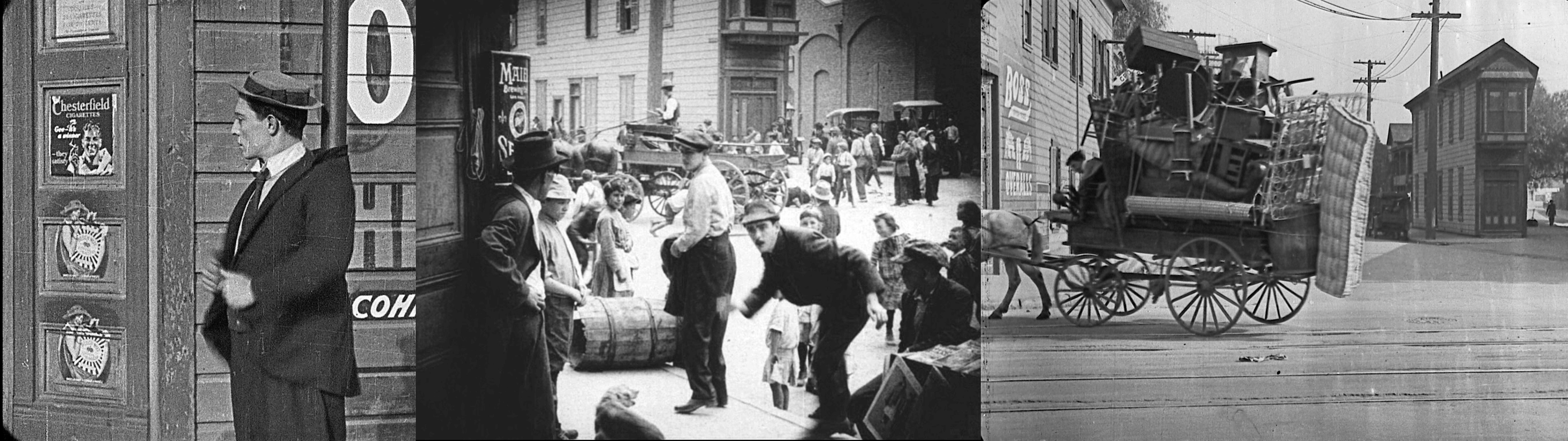
I’ve only just started, and could write ten more pages about Ducommun at Alameda, especially focusing on all the Keaton scenes. But in closing, this remarkable triangle building also appears during the “modern” sequence from D.W. Griffith’s Intolerance, when Robert Harron desperately seeks to rescue Mae Marsh from the Strasbourg Hotel. The same Strasbourg front door side panel – click to enlarge – appears at the far left of each frame; from The Goat at left, from Intolerance at center, and from Cops at right.

The 412 Ducommun triangle building likely appeared in dozens more films, and if it hadn’t been demolished in 1923, would likely have had more starring roles. In closing, above here’s a montage of some of the other Keaton scenes filmed at Alameda and Ducommun.

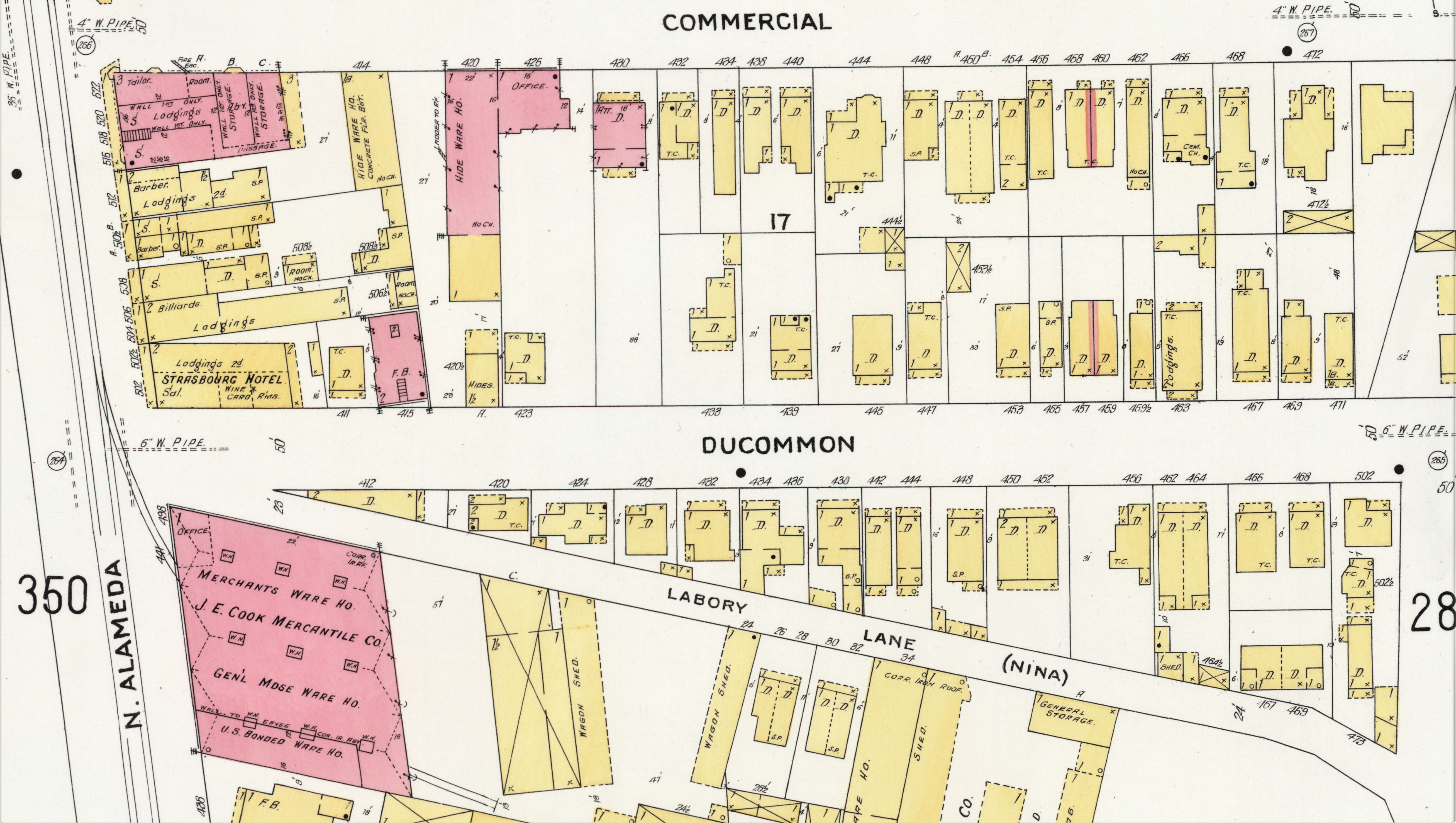
Click to enlarge – a 1906 Sanborn map, Vol 3 Page 279. LOC. Buster filmed many scenes from The Goat and Cops beside, and at the corner of, the Strasbourg Hotel. 415 Ducommun, the red brick building, is the home where the family loads their furniture onto Buster’s wagon. The “F.B.” marked on it stands for “Female Boarding,” a Sanborn euphemism for bordello.

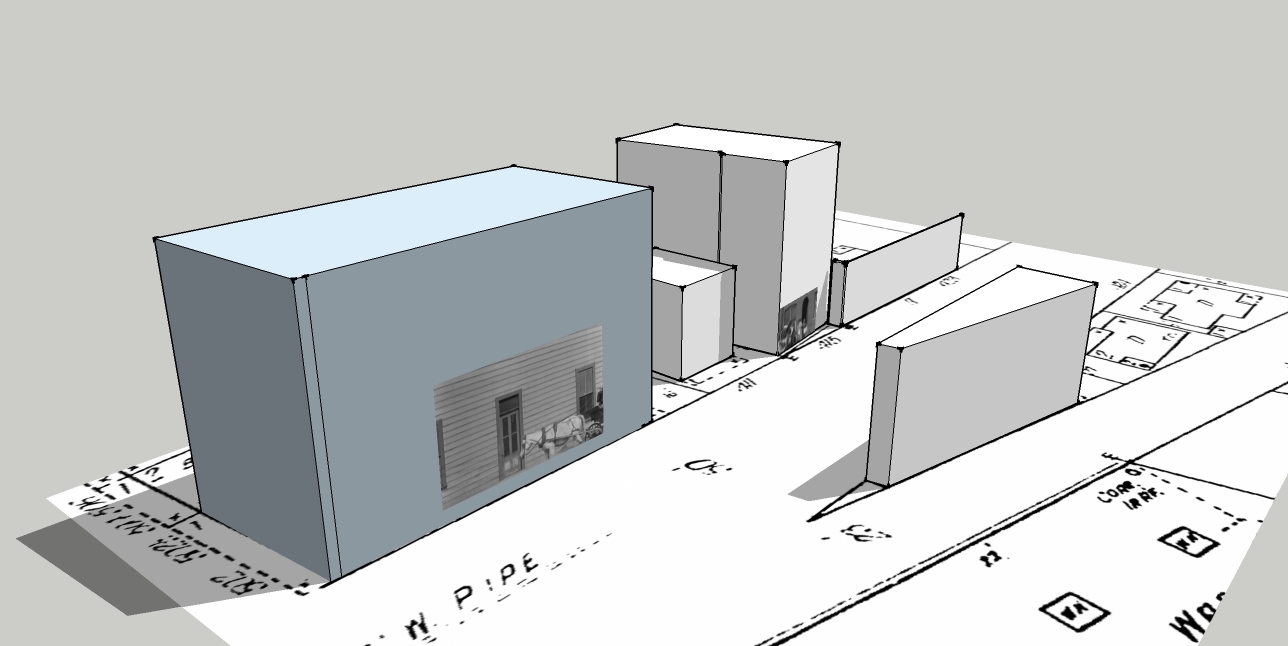
An early crude attempt at a 3D model. Imagine a fully realized virtual model where Buster made The Goat and Cops, Larry Semon filmed Frauds and Frenzies, and Charlie made The Kid. Any takers?

A special appeal – if I had the skill and resources to create a virtual 3D model of any historic LA film site, it would be of this long lost corner of Ducommun, Labory, and Alameda. It appears in many films, from many angles, and several vintage maps confirm the exact position of each building. If you know any 3D modeling expert who’d like a fun project, let me know, and I can supply all the files and images.

I now have TWENTY videos on my YouTube Channel. Check out To The Church – How Buster Keaton Made Seven Chances.

Below – Ducommun at Alameda today, completely rebuilt – spin around for a full view.

Posted in Buster Keaton, Charlie Chaplin, Los Angeles Historic Core | Tagged , , , , | 9 Comments

Harold Lloyd’s “Hot Water” Sherlock turkey troubles

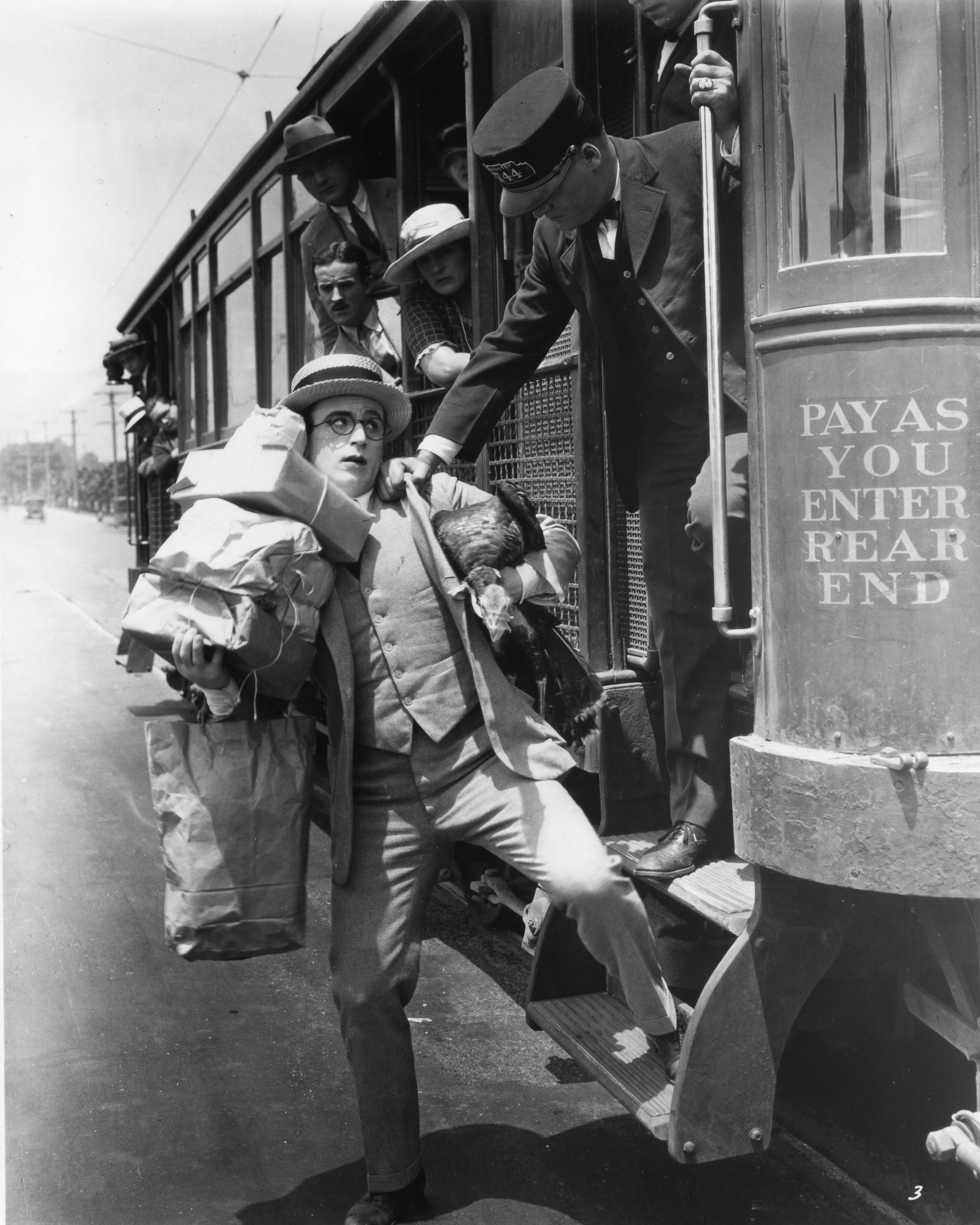
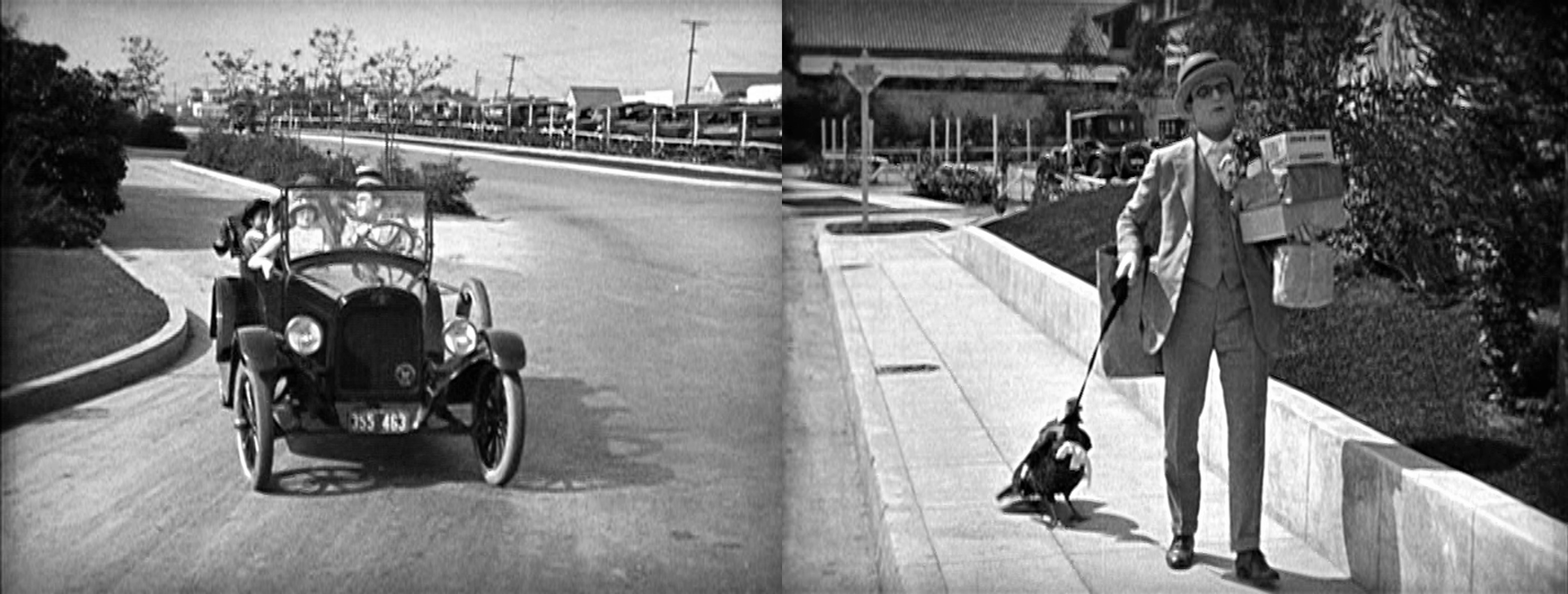
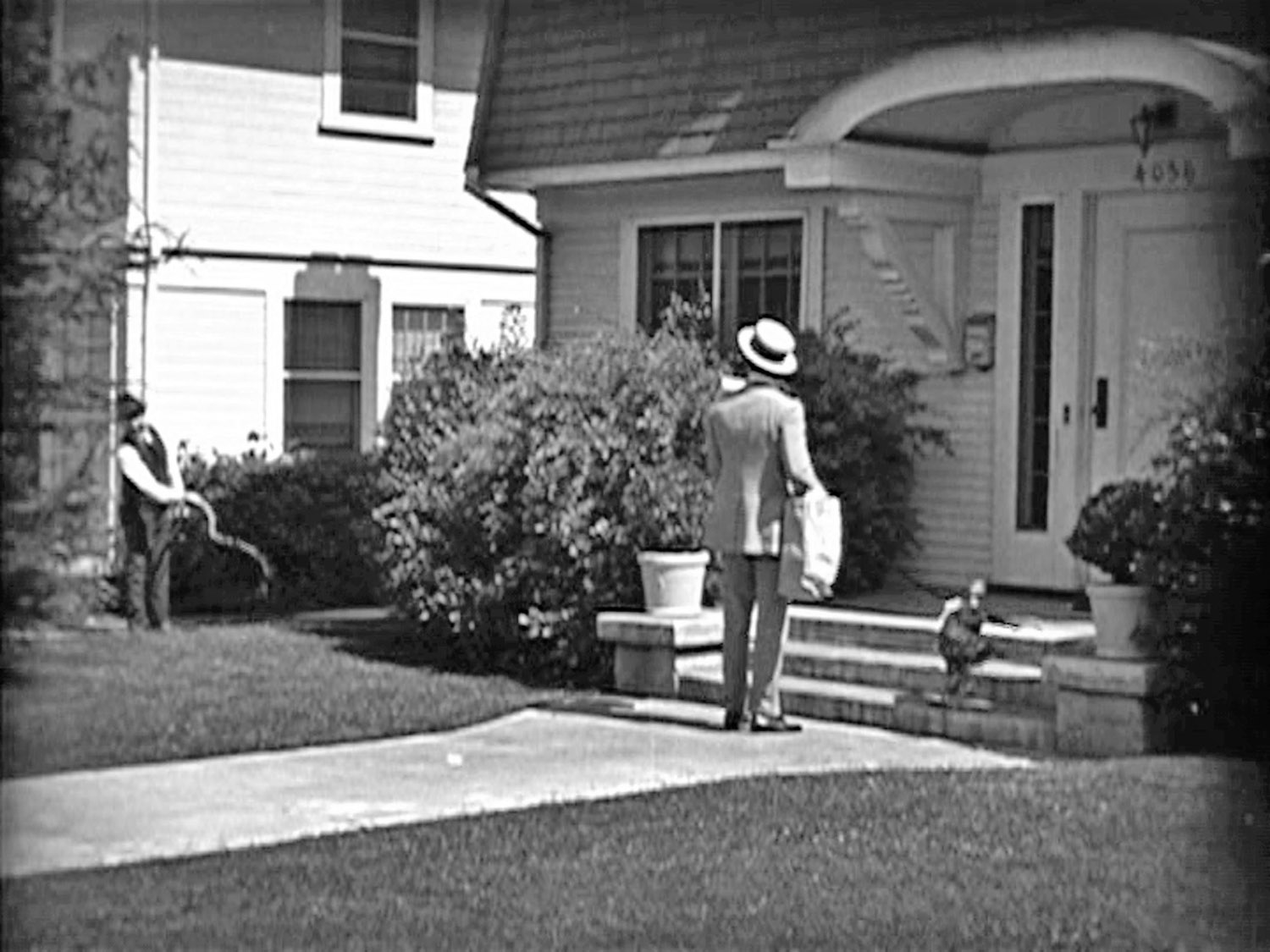
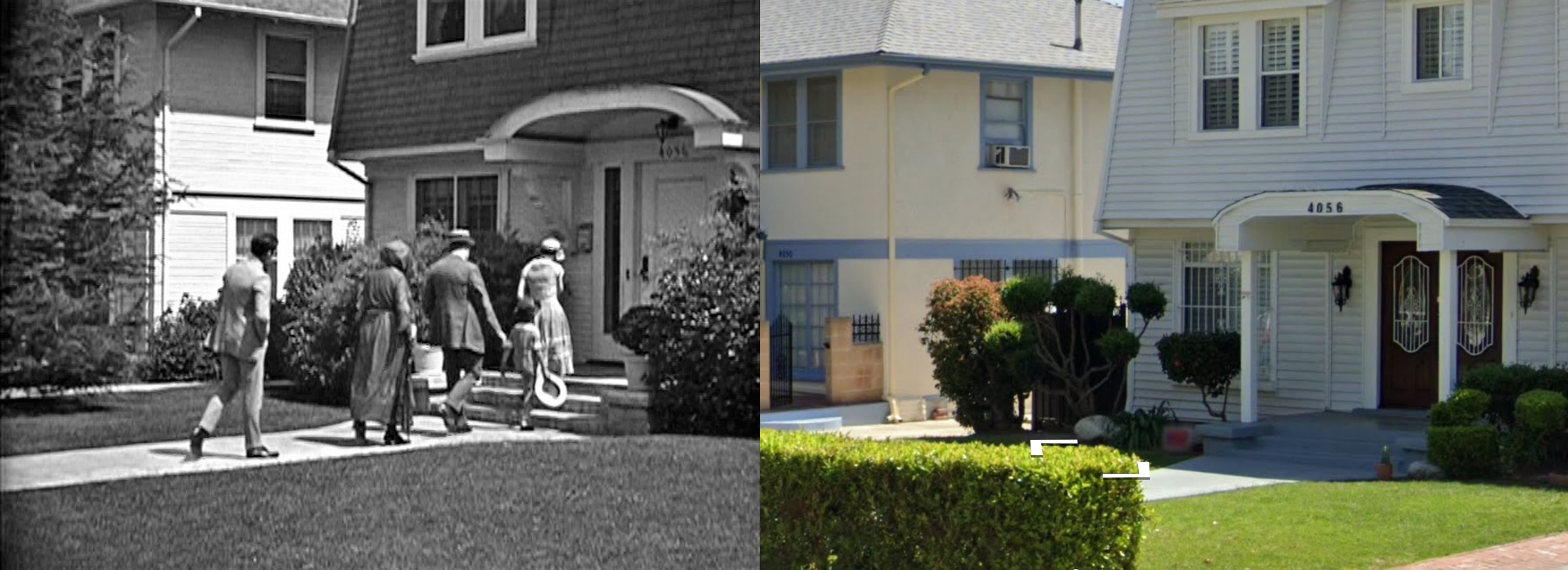
Wrangling a live turkey on a trolley, forced to walk it home, overlapping Buster Keaton’s Sherlock Jr., even more visual history is now revealed from Harold Lloyd’s Hot Water (1924).

Newlywed Harold’s day is shattered when his better half calls to ask “hubby dear” to pick up a “few things for dinner” on the way home. Already overwhelmed with packages, lucky Harold wins the store raffle, a free live turkey we’ll call Tom. Harold and Tom somehow board a crowded trolley.

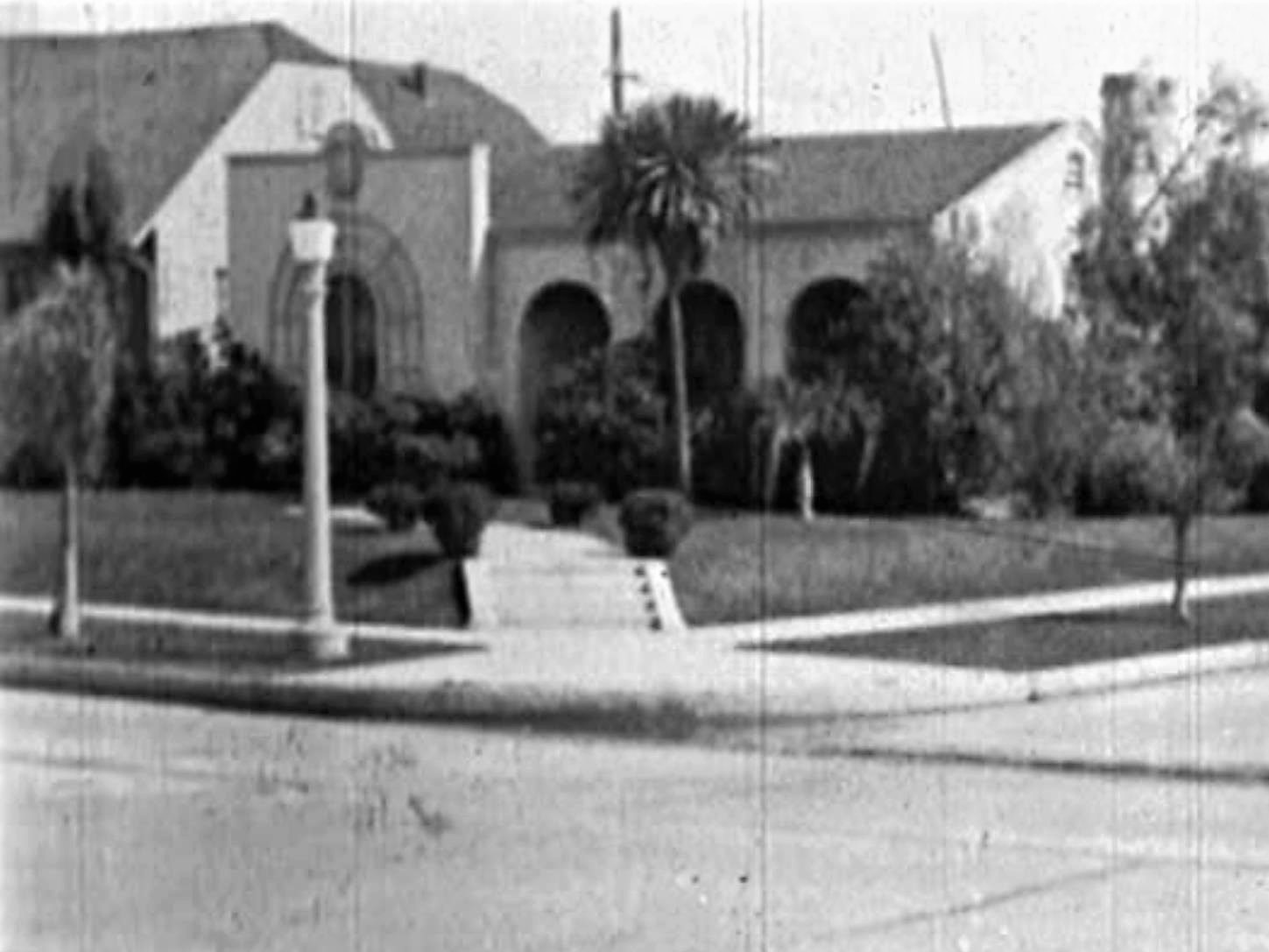
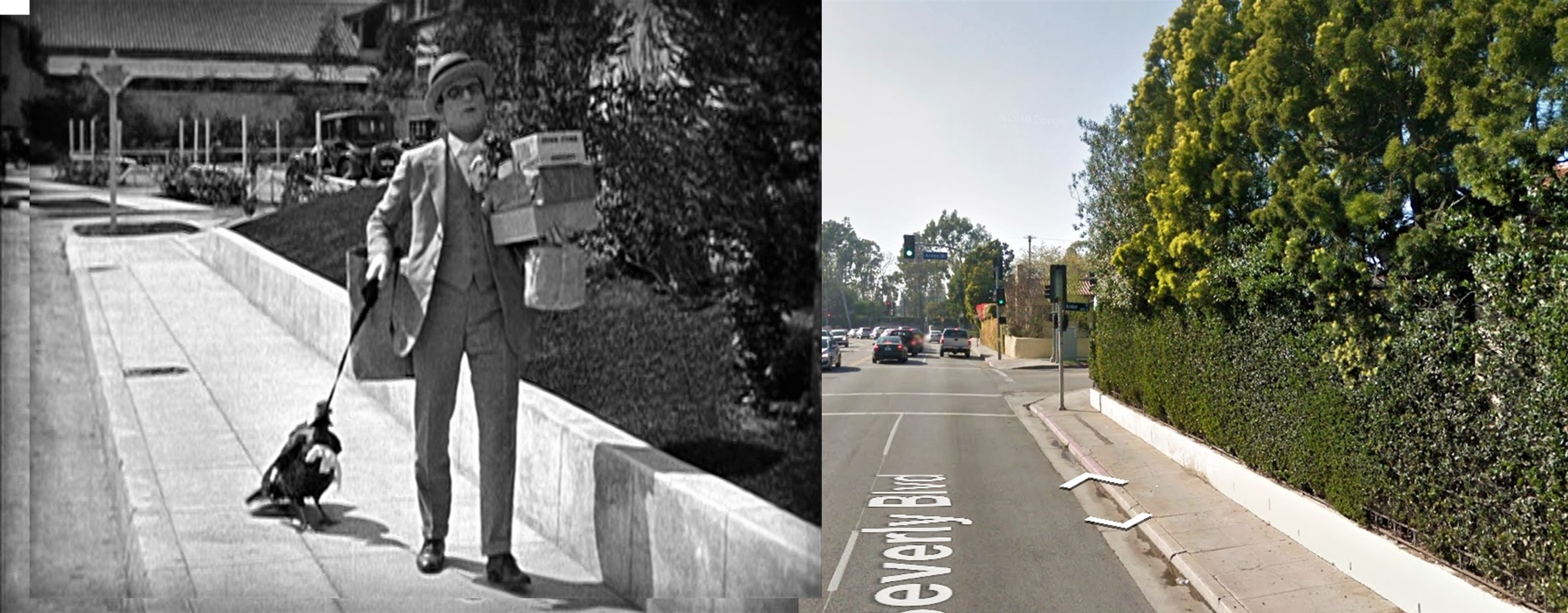
The trolley was a studio prop towed north past 162 S Lucerne Blvd, also seen here during Sherlock Jr. (1924). The evil henchman appearing to spy on Buster up the street, character actor Steve “Broken Nose” Murphy, is actually looking the wrong way.

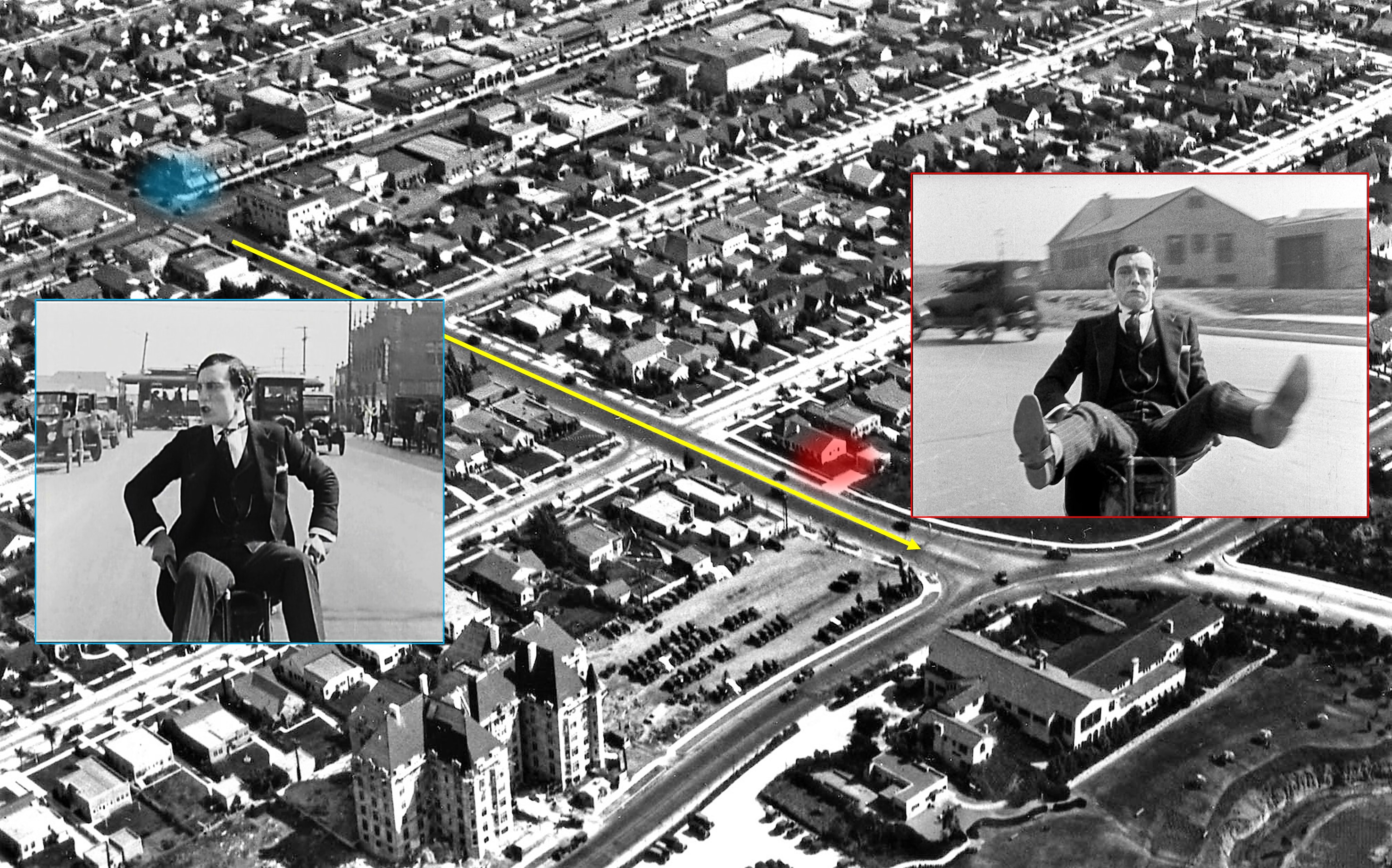
Sherlock’s assistant Gillette (played by Ford West) pulls Buster over at 220 S Lucerne, a block to the south, behind from where Murphy is supposedly spying on them. More incongruous, the shot including all three actors (left), as Buster leaps onto the bike and they ride off, was filmed several blocks away, north of Beverly looking south down Larchmont.

Buster and Gillette take off north along the same route as the Hot Water turkey trolley, passing the same 162 S Lucerne home appearing with Harold. In all a dozen homes along S Lucerne appear with Buster and Gillette (numbers 158 to 256, although sometimes edited out of sequence) during their Lucerne ride. Of course, no sooner do they begin then Gillette immediately falls off of the bike (as reported HERE), leaving Buster unaware no one is driving. The scene was shot looking east along Eleanor from the corner of the Keaton Studio at Lillian Way (right), with Buster performing the fall for Ford West as his stunt double.

As with many homes on N Beachwood appearing in Hot Water (see prior post) 162 S Lucerne has been remodeled, its three-arch open porch now enclosed for more floor space. The home stands on the NE corner of W 2d, just west of Larchmont, close to where Harold filmed other Hot Water scenes. The corner home appears in other silent comedies, at left in the Charles King 1926 comedy Please Excuse Me. Harold’s trolley passes by many other Larchmont-area homes during the lengthy scene, which remain to be documented. As expected, fussy Tom wrecks havoc, upsetting all the passengers.

Fed up, the conductors toss Harold and Tom off the trolley, filmed looking west on Sunset Blvd approximately near Ogden Dr. As solved by historian and frequent contributor Paul Ayers, this single track Pacific Electric line ran on Sunset between Gardner Jct. and Laurel Canyon Blvd. from 1911 to 1924. Perhaps the line had already closed when Harold filmed here. Also looking west, the frame at right from the 1919 Lyons & Moran comedy Waiting at the Church (also HERE) shows matching tree and ridge lines, and even the same house with a white chimney to the right. Working with the Library of Congress Michael Aus has made these entertaining, little-known Lyons & Moran films available to eager fans. Visit his eBay listing, and his full eBay store of silent films, where the sale proceeds benefit the Niles Essanay Silent Film Museum.

Thrown from the trolley, as Harold leads Tom home, a distinctive broad building appears behind them. The curved details at the left reminded me of another scene from Sherlock Jr., where driverless Buster blissfully races west down Beverly from Larchmont toward the Wilshire Country Club. Buster’s scene is noteworthy, not only for his stuntwork, but for the rare photo depiction of the front of the club.


Buster cycles west along Beverly past Larchmont towards the prominent, rarely photographed front of the Wilshire Country Club at back.

Click to enlarge – matching details, the curve of the road, and more details below confirm the Wilshire Country Club appears behind Harold. As reported in The Larchmont Chronicle celebrating the club’s 2019 centennial, the original club house was demolished in 1971, its replacement demolished in 2001, and the resulting third clubhouse was further remodeled in 2008.

Caption from the Wilshire Country Club’s history page “The original Clubhouse completed in 1922 on the corner of Rossmore Ave. and Temple Street, which became Beverly Blvd. upon its construction through the golf course in 1924.” Given the dense foliage, this photo was taken well after Buster and Harold filmed here in 1924.

Matching views looking west of Harold and Tom walking along Beverly Dr from the near corner of S Arden Blvd, and the Rossmore corner of the Wilshire County Club one block further back.

Once the Wilshire Country Club crossed my radar, it suddenly became clear this odd street pattern to the left during Harold’s family car excursion shows the corner of the club, north up Rossmore from Beverly, with the club’s driveway traffic islands behind Harold, and the club parking lot to the right across the street. Narrow white posts outline the club parking lot in both images. See aerial view below.

For context, this aerial view looking SE shows Harold’s two scenes along Beverly. The narrow white posts in both movie frames outline the Wilshire Country Club parking lot across the street. LAPL.

Buster filmed Sherlock Jr. all around this neighborhood too. Here are just two of his many scenes matched to the same photo.

I again want to thank Zebra 3, a self-described film location hobbyist reporting on IMDb, for sharing all the locations he discovered as reported in this prior Harold’s Hot Water, Happy Days post. His insights prompted me to revisit Hot Water, resulting in this Part 2 post.

I now have TEN videos on my YouTube Channel. To learn more about Sherlock, check out Case Closed – How Buster Keaton Made Sherlock Jr.

Below, where Harold and Buster filmed at 162 S Lucerne

Posted in Buster Keaton, Harold Lloyd, Hot Water, Lyons and Moran, Paul Ayers, Sherlock Jr. | Tagged , , , , | 1 Comment

Flying “Lizzies of the Field” – Part 2

One of silent comedies’ craziest scenes, race cars zooming down a ramp, flying through the air, landing in a pile atop each other, marks the exciting climax to Lizzies of the Field (1924), the Mack Sennett Comedies Studio production recently restored and released by Dave Glass and Dave Wyatt as part of their striking two-disc Blu-ray release of nearly 20 comedies starring Billy Bevan. The two reel film, discovered in the Eye Filmmuseum archive, scanned by Lobster Films, and restored by Lobster and Dave Glass, is presented complete and in stunning detail for the first time. This prior post, Part One, shows where they filmed Lizzies along roads near the yet-to-be-built Griffith Park Observatory.

Brent Walker, author of Mack Sennett’s Fun Factory, reports the flying car stunt was a major event. Sennett sent not only all of his own studio cameramen, but also Alvin Knechtel of Pathe News, to document the crash. As Brent reports, the stunning scene had long been familiar, having been featured in compilation films including Robert Youngson’s 30 Years of Fun (1963), and in Paul Killiam’s The Fun Factory (1960), and The Great Chase (1962).

Brent writes at page 386 of his book the hill was located near Rowena St. and Armstrong St. near Silver Lake. When I contacted Brent, he recalled a script or other papers in the AMPAS Sennett Collection files had mentioned the jump being staged near this locale, while few other Sennett locations were ever referenced.

Click to enlarge – intrigued by the Blu-ray clarity of the film, I focused on the imposing hilltop building overlooking the jump site. After searching vintage photos on Calisphere, I quickly found it – the former Monte Sano Foundation at 2834 Glendale Blvd. USC Digital Library. Read more about Monte Sano HERE.

Click to enlarge – with this background reference point fixed, it became easy to orient the stunt filming site geographically. The Monte Sano building (red box) has given way to condominiums on re-named Waverly Drive, and Armstrong St. has since been re-named W Silver Lake Drive, but as Brent correctly reports, the crash stunt was staged along hills and fields SW from the corner of Rowena and Armstrong.

Knowing the locale, it’s clear to see this view looking to the NW shows Griffith Park, and the distinctive Beacon Hill in the background. Paul Ayers.

This current Google Maps view shows the path of the cars down the ramp, arrow, and the former site (red box) of the Monte Sano building.

Above, covered in this Part One post, matching views of the auto race appearing earlier in Lizzies along 2763 Glendower Ave.

Thanks again to Dave Glass and Dave Wyatt for their heroic work. Here’s the link to the Dave Glass YouTube channel, loaded with dozens of rare silent comedies.
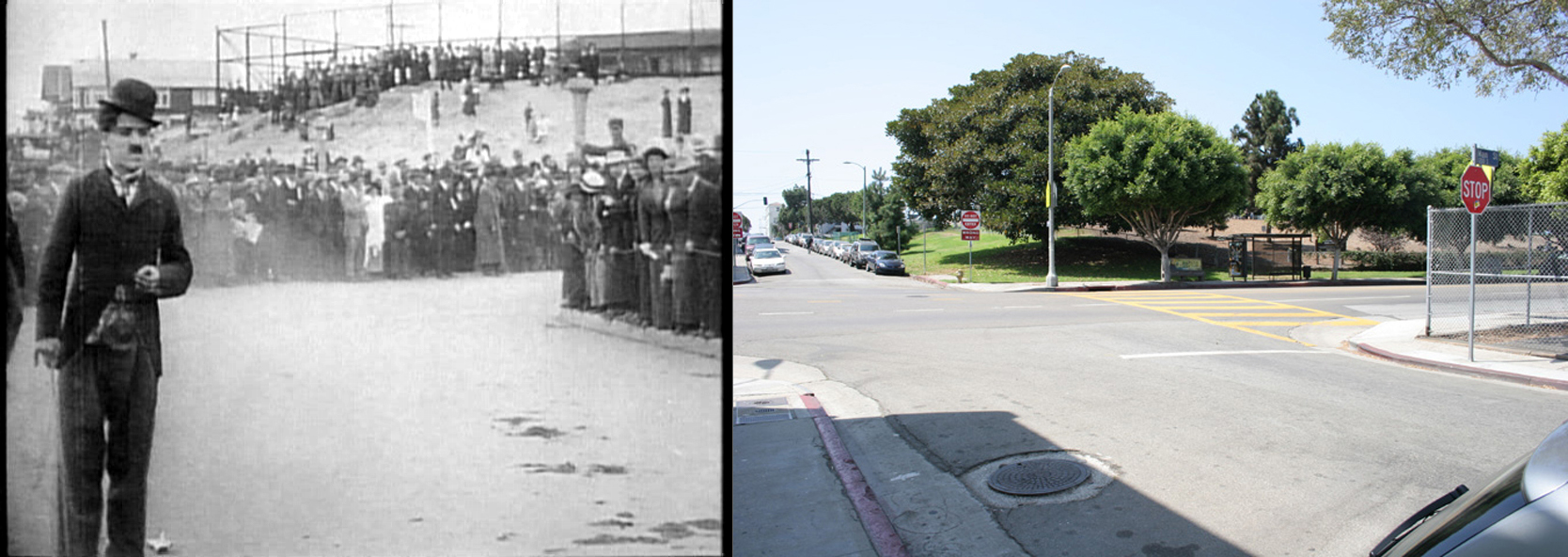
I now have TEN videos on my YouTube Channel. If you like detective stories, check out Case Closed – How Buster Keaton Made Sherlock Jr.

Below, Shadowlawn Ave follows the slope of the auto jump ramp within the SW corner of Rowena and W Silver Lake Dr (formerly Armstrong).

Posted in Billy Bevan, Keystone Studio | Tagged , , | 1 Comment

Jackie Coogan’s Charlie Chaplin’s Lost LA Alley – The Rag Man

Jackie Coogan returned twice more to an LA alley where he made The Kid with Charlie Chaplin. Early LA streets, now lost, appear in Jackie’s The Rag Man (1925).

Jackie plays an orphan who becomes a successful junk dealer working with character actor Max Davidson as his guardian and business partner. As shown further below, Jackie (and Charlie) cross paths with Buster Keaton and Harry Langdon in downtown LA.

I was stunned to learn most of The Rag Man was filmed on location in New York, and as reported in Mark Phillips’ phenomenal NYC IN FILM blog, many of these vintage locales remain recognizable today – read all about The Rag Man at https://nycinfilm.com/2017/12/24/rag-man-1925/. Above, looking north at Sutton Place from E 57th. Mark’s work documenting New York based movies is extraordinary, impeccably photographed and researched. I strongly encourage you to check Mark’s blog for your favorite NYC movies.

Back in LA, compare Jackie’s frame with a matching frame from The Kid. Both show the same “ARCADIA” street sign on the wall across the way (you can actually read it if you enlarge Charlie’s frame). To the right in both frames is Sanchez Alley, running north from Arcadia towards the Plaza de Los Angeles. The north end of Sanchez remains today, but the southern end of Sanchez, perpendicular to Arcadia, which ran north-south from Main St to Los Angeles St, were all demolished for a freeway. Mark’s blog has some great aerial views of this spot.

Charlie filmed his scene from The Kid as if the orphanage truck was speeding around a street corner. The truck, out of necessity, was quite narrow. Jackie’s broader view shows the corner was in fact a narrow passageway between buildings leading to a rear loading dock, depicted below in another of Jackie’s films, My Boy (1921).

Jackie’s My Boy frame at the right (hosted on YouTube) shows the entrance was enclosed by a vertically raised and lowered gate. Eye Filmmuseum.

Jackie loads new merchandise onto his junk cart in front of the open gated entrance. His frame forms a virtual panoramic view of the Baker Building, as Buster flees the police running south down Arcadia from Main St towards Los Angeles St during Cops (1922). Mark astutely reports that Eddie Cline, Buster’s co-director for many of his early shorts, also directed The Rag Man. So Eddie must have felt quite at home here, after already directing Buster’s chase scene at the same spot.

Above, facing the Arcadia entrance way, in a view looking SE, a friendly preacher checks on Jackie. The NW corner of the Hotel de Paris building appears behind him – note the matching twin-curves within single curve arch details in both images. The full photo looks north up Arcadia from Los Angeles St towards Main St, passing midway the south end of Sanchez Alley.

Matching views north looking up Arcadia towards Main St, the Baker Building to the left. This was all lost to a modern freeway.

Above, closer views of the detailed columns outlining the Baker Building perimeter. Once the most glamorous building in town, it fell on hard times, later serving as headquarters for Good Will Industries, before being demolished for a freeway. LAPL

Click to enlarge – a panoramic view of the west side of Arcadia, with Harry Langdon in Feet of Mud (1924), the Plaza Jewelry Co. at 114 Arcadia, Jackie (center) and Buster at right.

Looking north from Arcadia Street and Sanchez Alley towards the Plaza de Los Angeles. The inset photo is the Baker Building facing Main. These early streets appear in dozens of films, including Chaplin’s Police (1916), and Keaton’s Neighbors (1920), covered in great detail in my Chaplin book Silent Traces at pages 107-112. To whet your appetite here below are pages 211 and 212 discussing Arcadia and the Baker Building.

SilentTraces page 211

SilentTraces page 212

In closing, do yourself a favor and check out Mark Phillips’ phenomenal NYC IN FILM blog, covering classic NYC films from all decades, and especially his in-depth coverage of  The Rag Man at https://nycinfilm.com/2017/12/24/rag-man-1925/.

Another bonus, my latest YouTube video shows how Edna Purviance lost, and Charlie Chaplin found, the baby who would become The Kid. Jackie portrays The Kid, but he doesn’t appear, as this only covers the baby being found.

So much of early LA has been lost, but intriguing glimpses remain hidden in the background of silent film. Below, “Arcadia” is now an access road parallel to the freeway, viewed here looking at the north end of Sanchez. Rotate the image to see the freeway behind.

Posted in Charlie Chaplin, The Kid | Tagged , , , , , , , , | 3 Comments

Harold Lloyd’s “Hot Water” “Happy Days” Home

Harold’s home stands on two different blocks and TV’s Happy Days Cunningham home appears nearby. So many new locales from Hot Water (1924) were found and shared by eagle-eyed reader Zebra 3, a self-described film location hobbyist, who shares what he finds on IMDb.

Hot Water, a parody of domestic bliss, is best known for its famous set pieces, including Harold’s attempt to ride a crowded streetcar while carrying armloads of groceries and a live turkey, and his disastrous inaugural outing in his new car, with his pesky in-laws in tow. Above Harold and live turkey arrive at 4056 W 7th Street, note the doorway address.

Above, a full view of the family home. Remarkably, all other Hot Water scenes presented as taking place in front of their home were filmed two miles away on N Beachwood Dr.

Above, Harold eagerly accepts delivery of the new family auto, with 575 N Beachwood at back. The distinctive porch has now been remodeled. The scene is presented as if in front of Harold’s 4056 home on W 7th, which is actually two miles away.
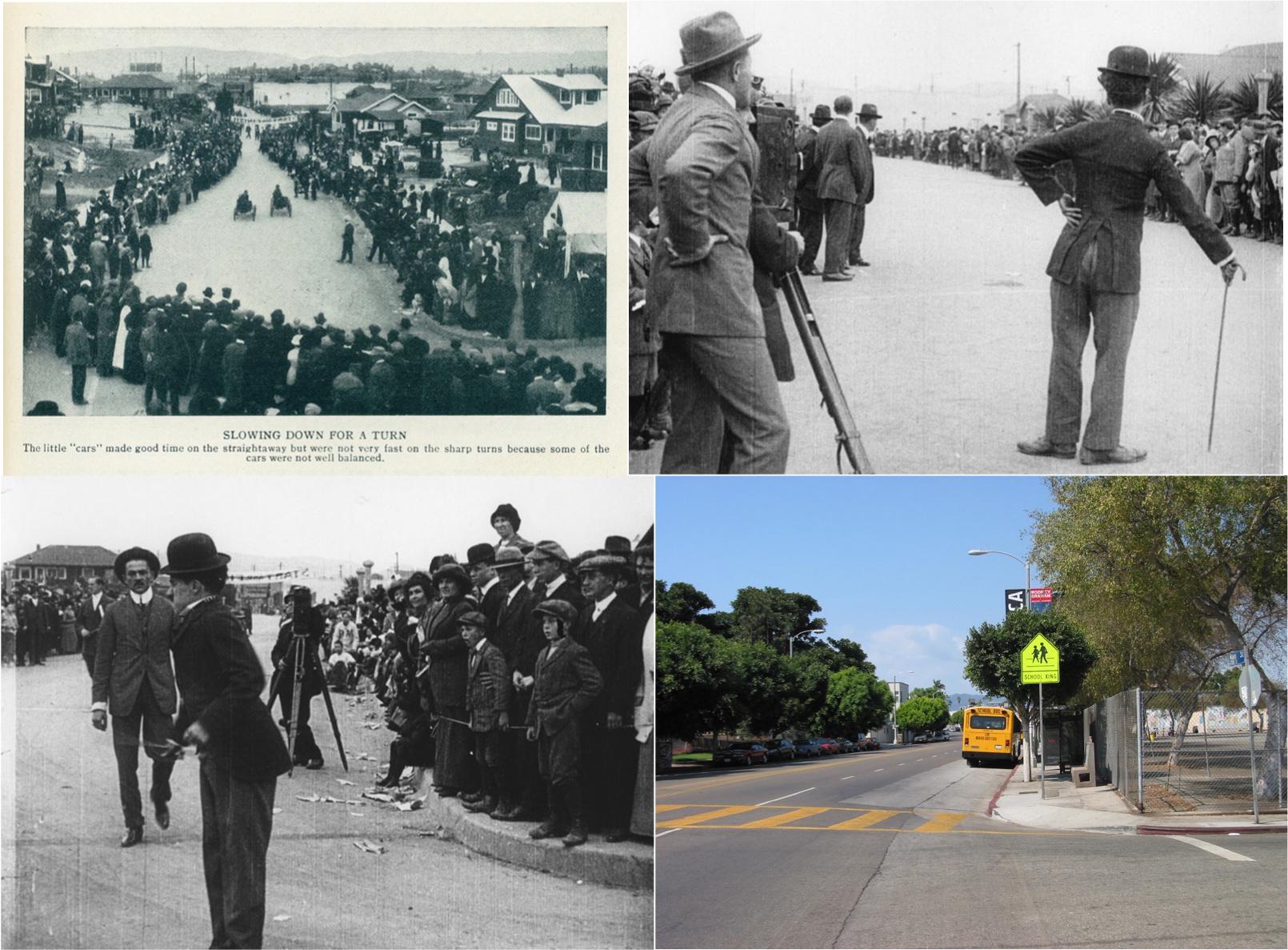
Above, Harold proudly presents the new family car to his wife portrayed by Jobyna Ralston, with 565 N Beachwood in the background. The distinctive trio of window arches were later removed. The audience was not expected to notice the discrepancy between the 4-digit address of the family home (4056), and the many 3-digit addresses appearing during the Beachwood scenes.

The family poses for a photo portrait before leaving on their inaugural auto tour, with 570 N Beachwood at back (see address behind Jobyna). The trio of stylish arched windows (box) peeks over the hedge.

A closer view of 570 N Beachwood as Jobyna delights at seeing Harold’s new family car.

Views south down Beachwood as Harold’s in-laws pile into the car. 565 Beachwood (box) originally had an arched entrance, but the homes down the street appear unchanged.

A far (left) and closer (middle) view of 565 N Beachwood, home to Harold’s friendly neighbor, who takes a photo portrait of the family in their new car. The Sanborn maps show the 565 home was originally “L” shaped, with only a front room to the right of the arched entrance. Now expanded, the remodeled home has front rooms on both sides of the front door.

The friendly neighbor prepares to take the Lloyd family portrait, with the porch entrance to 591 N Beachwood behind him. Visible further north, the duplex still standing at the NW corner of Clinton St.

A bad omen, no sooner does the Lloyd family embark on their maiden auto safari, they nearly collide with a milk cart. Notice the N 581 Beachwood home to the left originally did not have a stairway leading from the front door down the lawn to the sidewalk.

This studio interior scene shows Harold unloading his groceries inside the front door. The photo backdrop appears to be 522 N Beachwood, which also did not originally have a stairway leading from the front door down the lawn to the sidewalk.

As I report at page 161 of my Harold Lloyd book Silent Visions, Harold immediately gets in trouble by turning left around the wrong side of a traffic button, here the NE corner of W 1st and S Larchmont.

Also from my book, the cop lets Harold off with a harsh scolding. Always, ALWAYS, pass to the right side of a traffic button. 108 S Larchmont appears at back.

Back to new discoveries. Unbeknownst to Harold, a jubilant WWI veteran has accidentally lost his helmet in the street, seen here looking at the Los Angeles Tennis Club at the NW corner of N Cahuenga and Clinton.

Harold mistakes the helmet for a traffic button, and ever the good citizen, reverses course to drive properly around the right side. The corner home of 591 N. Cahuenga appears at back.

The big reveal, when the soldier stops to retrieve his helmet, this view looking south shows two-story 565 N Cahuenga at back. Decades later, the house portrayed the Cunningham family home during the hit 1970-80s sitcom Happy Days. But Harold filmed here first. Read all about the Happy Days home at Lindsay Blake’s I’m Not A Stalker filming locations website.

Above, the homeowner at 590 N Cahuenga screams “get off my lawn!” as Harold and family make a hasty retreat.

For context, this vintage photo shows the Los Angeles Tennis Club on the NW corner of N Cahuenga and Clinton, along with three views of Harold’s car. LAPL.

Avoiding the traffic buttons, the family speeds westerly along W 2nd past the corner of S Plymouth at right, near W 1st and Larchmont, another discovery made after my book was published.

From here on all hell breaks loose, taking the family across S Lafayette Park Place, Santa Monica, and past the former Hollywood fire station, all as reported in my book. Another discovery, reported on my blog soon after my book came out, the car careens out of control down Olive St downtown, the Bunker Hill film noir locale appearing in the The Turning Point (1952) above right.

I’ll save this for another post, but before Harold buys the car I’ve also found where Harold is ejected from the trolley on Sunset Blvd, approximately near Ogden Drive, and his route walking the turkey home along Beverly Drive past Arden Drive. Stay tuned for Part Two.

661 Shatto Place – Punky Brewster

For even more Harold Lloyd – mid 1980s sitcom connections, check out where Harold filmed For Heaven’ Sake (1926) at 661 Shatto Place, appearing in the opening credits for Punky Brewster.

Again, let’s all give Zebra 3 a great big shout out for these incredible discoveries, and for sharing them with us, and on IMDb.

Below, an April 2011 view of 575 N Beachwood, before the remodel, seemingly across the street from Harold’s family home at 4056 W 7th. You can explore up and down the street on your own.

Posted in Harold Lloyd, Hot Water | Tagged , , , , , | 7 Comments

Charlie Chaplin’s “Modern Times” Sanitarium Solved

Charlie Chaplin used the former Occidental College Hall of Letters (still standing) to portray the charity hospital where Edna Purviance delivers her baby in The Kid (1921). But “cured of a nervous breakdown but without a job” during Modern Times (1936), Charlie used the Mary Norton Clapp Library at the new Occidental College campus in Eagle Rock to portray the hospital where he leaves to start his life anew.

The library opened in 1923 with two entrances, the east entrance flanked by a pair of columns, and the more modest north entrance used by Chaplin. The south side has no entrance, and vintage photos confirm the west side of the library, now covered by a 1971 expansion of the building, also had no entrance. I had long been intrigued by this simple scene, which in fact, was the final unsolved exterior from the entire movie.

Click to enlarge – north end of Mary Norton Clapp Library – Occidental College

I want to thank reader Mark Smith who reached out with an intriguing inquiry that directly prompted this post. During his audio commentary to the Criterion Collection Blu-ray release of Modern Times, Chaplin biographer David Robinson explains “The building used for the exterior is Occidental College.”

Mark wondered if this would have been the old Highland Park Occidental campus where Charlie filmed The Kid (above left). But the stairway seemed more contemporary. The Highland Park campus was built in 1897, while the Eagle Rock campus began construction in 1912.

Click to enlarge – built in 1924, east entrance with columns left, Charlie’s north entrance right Occidental College

I logged onto Calisphere, the search platform that includes nearly every online California photo archive, to study the “new” Occidental campus, and soon zeroed in on the library as the likely candidate. Notice above the original rectangular dimensions, the east side twice as long as the north.

Preparing this post reminded me Charlie had filmed an alternate ending to Modern Times, where the Gamine, the Little Tramp’s companion portrayed by Paulette Goddard, becomes a nun, and Charlie heads out once more all alone on the open road. Their discarded farewell scene was also staged beside the Clapp Library stairs. See all 13 Chaplin Archive photos of the discarded farewell scene.

It’s fascinating to realize Charlie filmed this brief, mundane scene, requiring a simple “institutional” doorway entrance, all the way out in Eagle Rock, about 14 miles from his studio located at 1416 N. La Brea. He couldn’t find a closer set of stairs? Filming the extended alternate ending may have been a factor when choosing the site, but it still seems like a long way to go.

Numerous articles on this blog cover Charlie and Mary Pickford filming at the old Hall of Letters building at the former Highland Park campus, and the downtown factory exteriors where Charlie goes berserk in Modern Times. To learn more, please search this site, and also check out my Chaplin book Silent Traces, and the wonderful Criterion Collection Blu-ray of Modern Times, which includes my visual essay.

This link archives historic photos of the Mary Norton Clapp Library, including this view above of the north side. Charlie’s north doorway was originally flanked by twin pairs of windows. The library was expanded in 1955, making the library dimensions now more “square” than rectangular. Chaplin’s doorway may have been moved or rebuilt. The large the modern extension to the right was built in 1971.

Matching views south – Charlie’s doorway marked at left in 1938, 1955 expansion middle, 1971 expansion right. Is it still the same doorway Charlie used? UCSB FrameFinder

For more visual detective work, check out “Case Closed – How Buster Keaton made Sherlock Jr.” accompanied by renowned pianist and composer Michael D. Mortilla.

Check out the library on Google Maps below

Posted in Charlie Chaplin, Modern Times | Tagged , , , , | Leave a comment