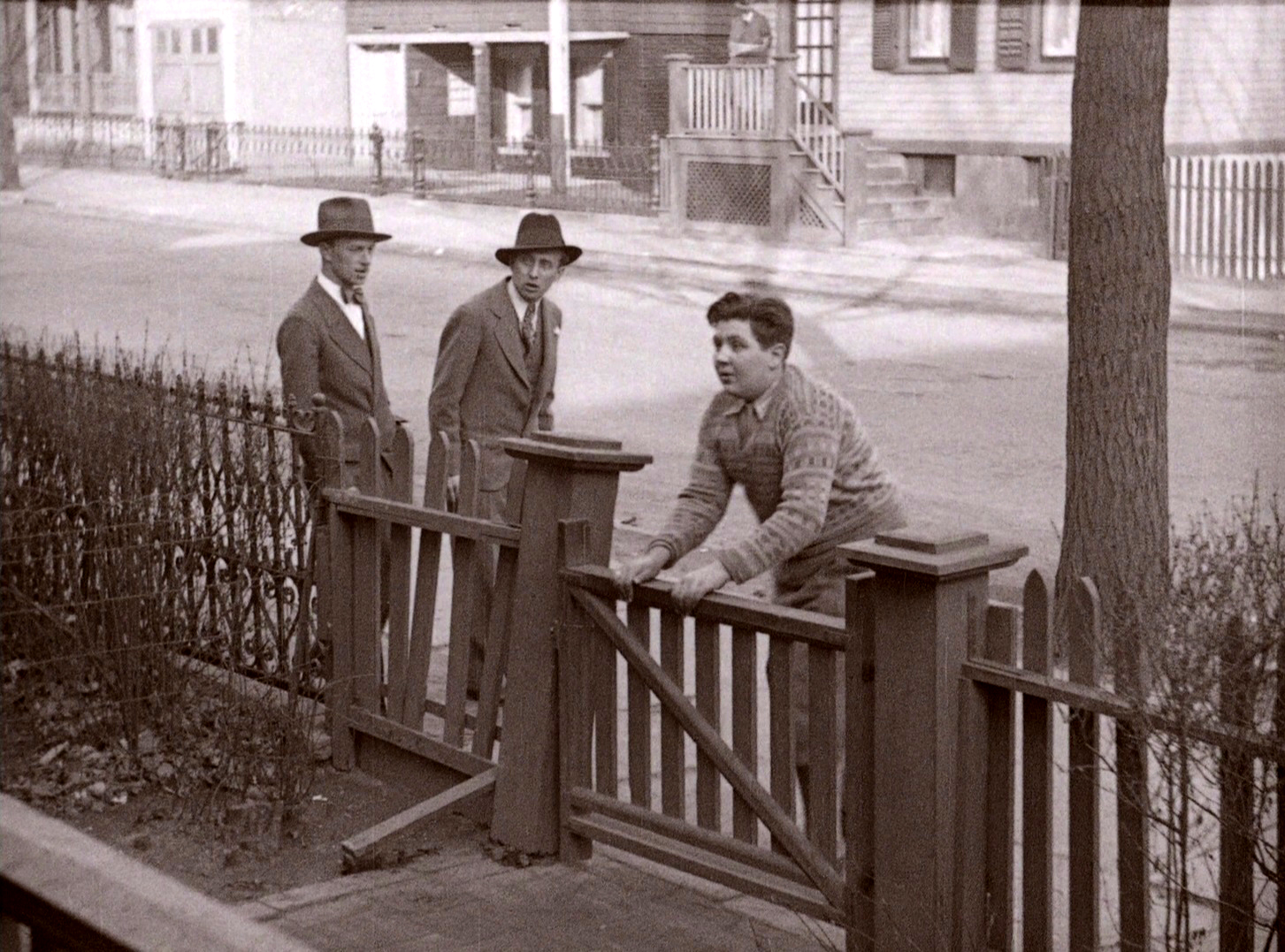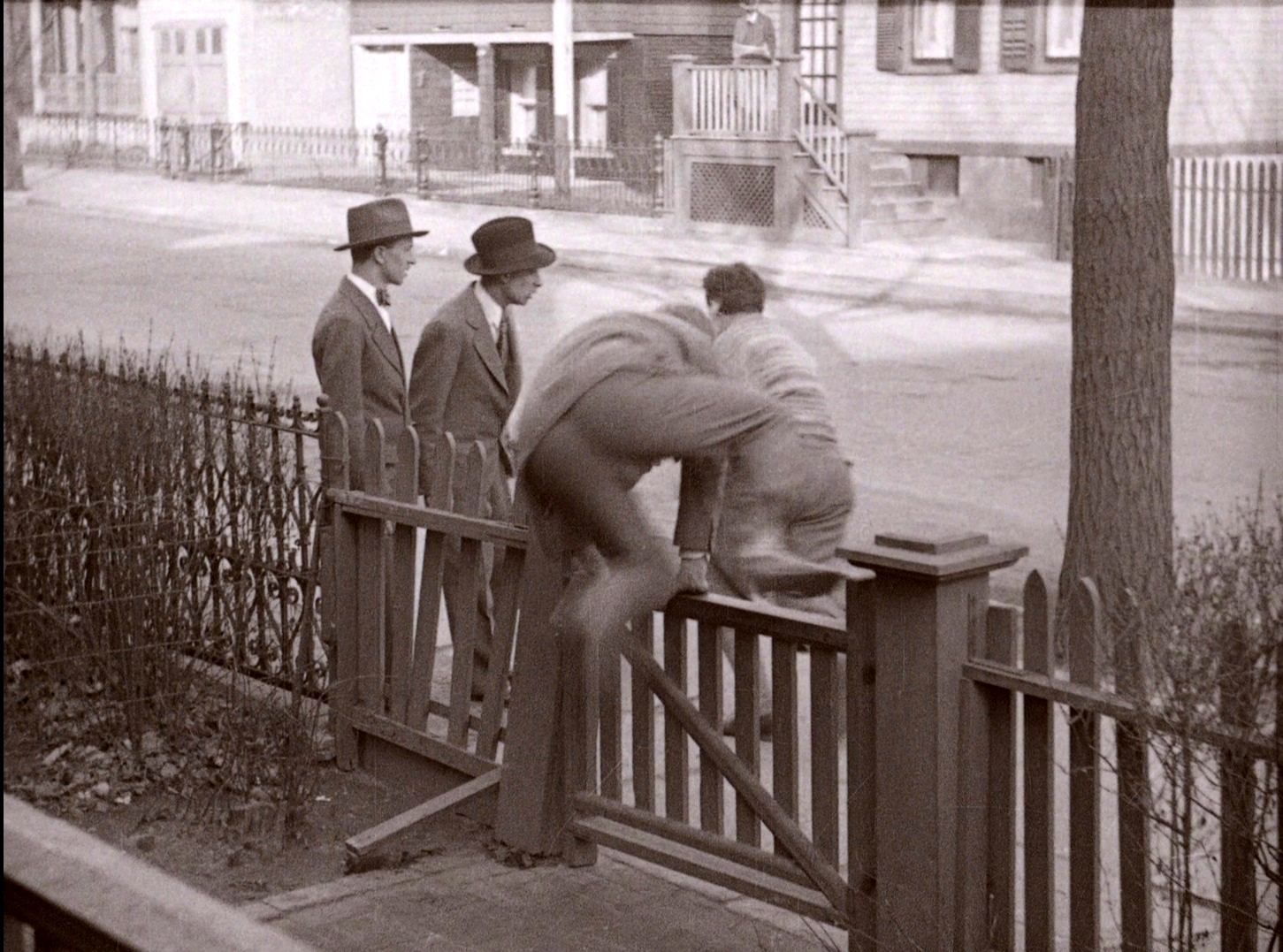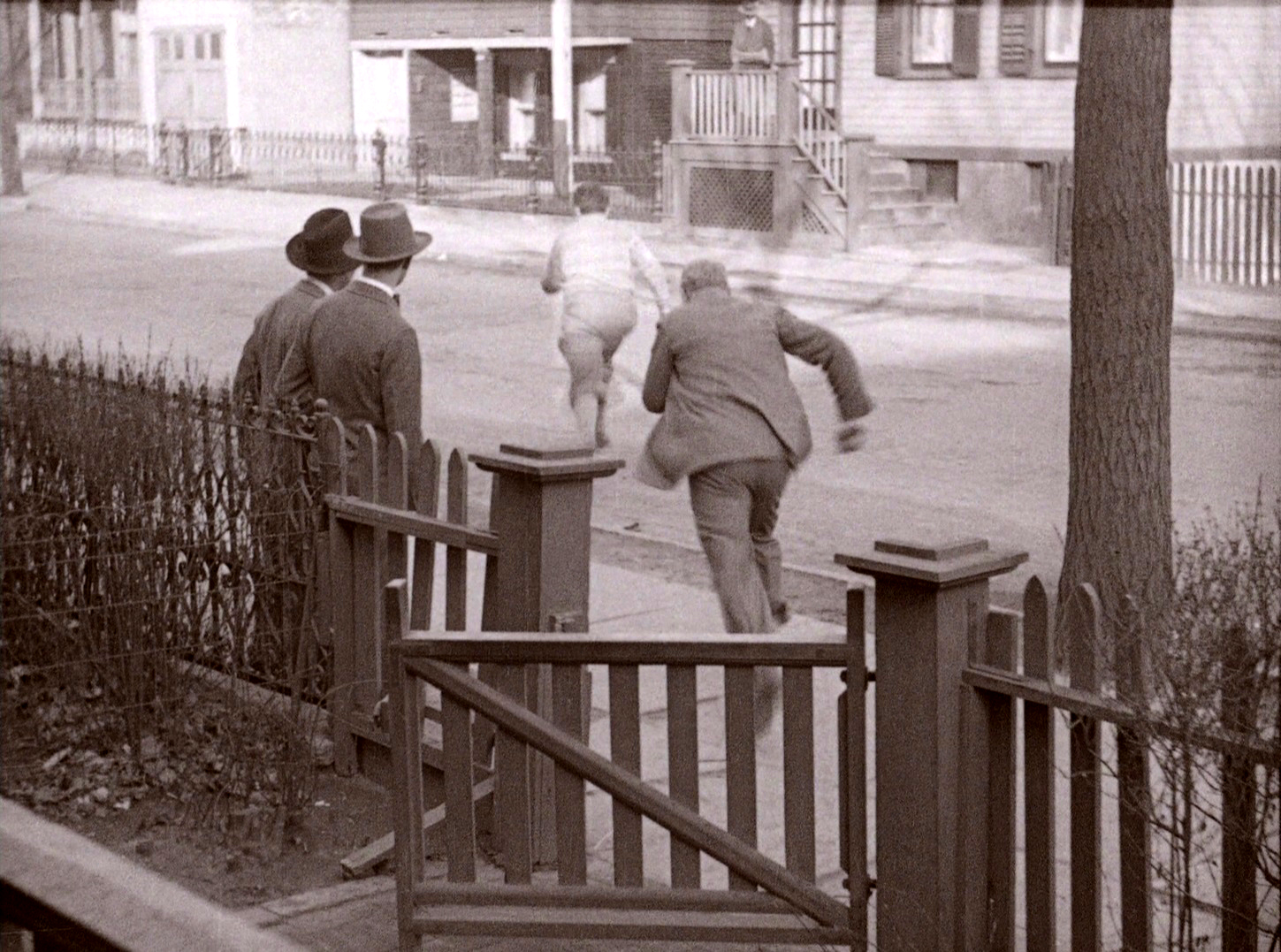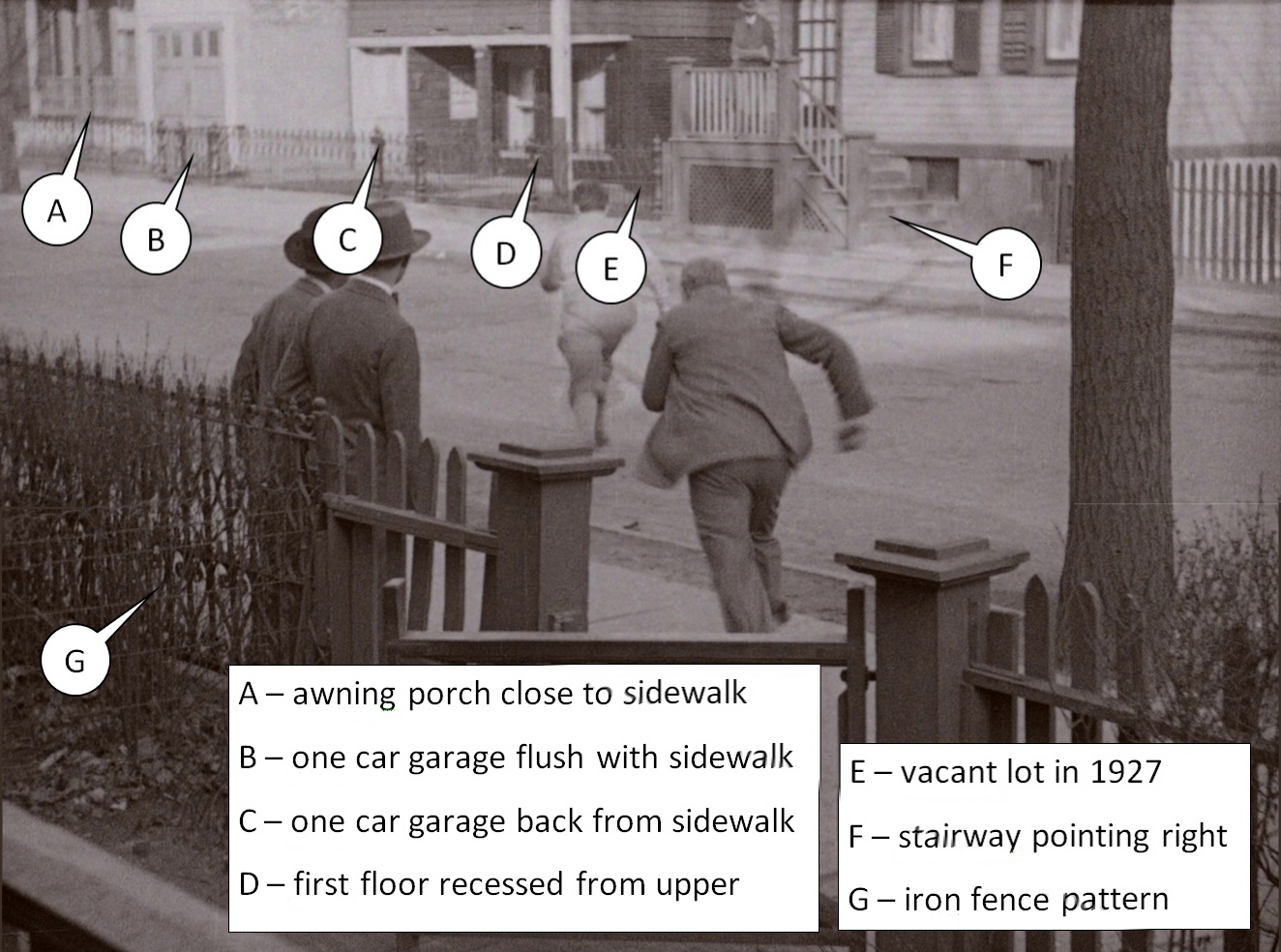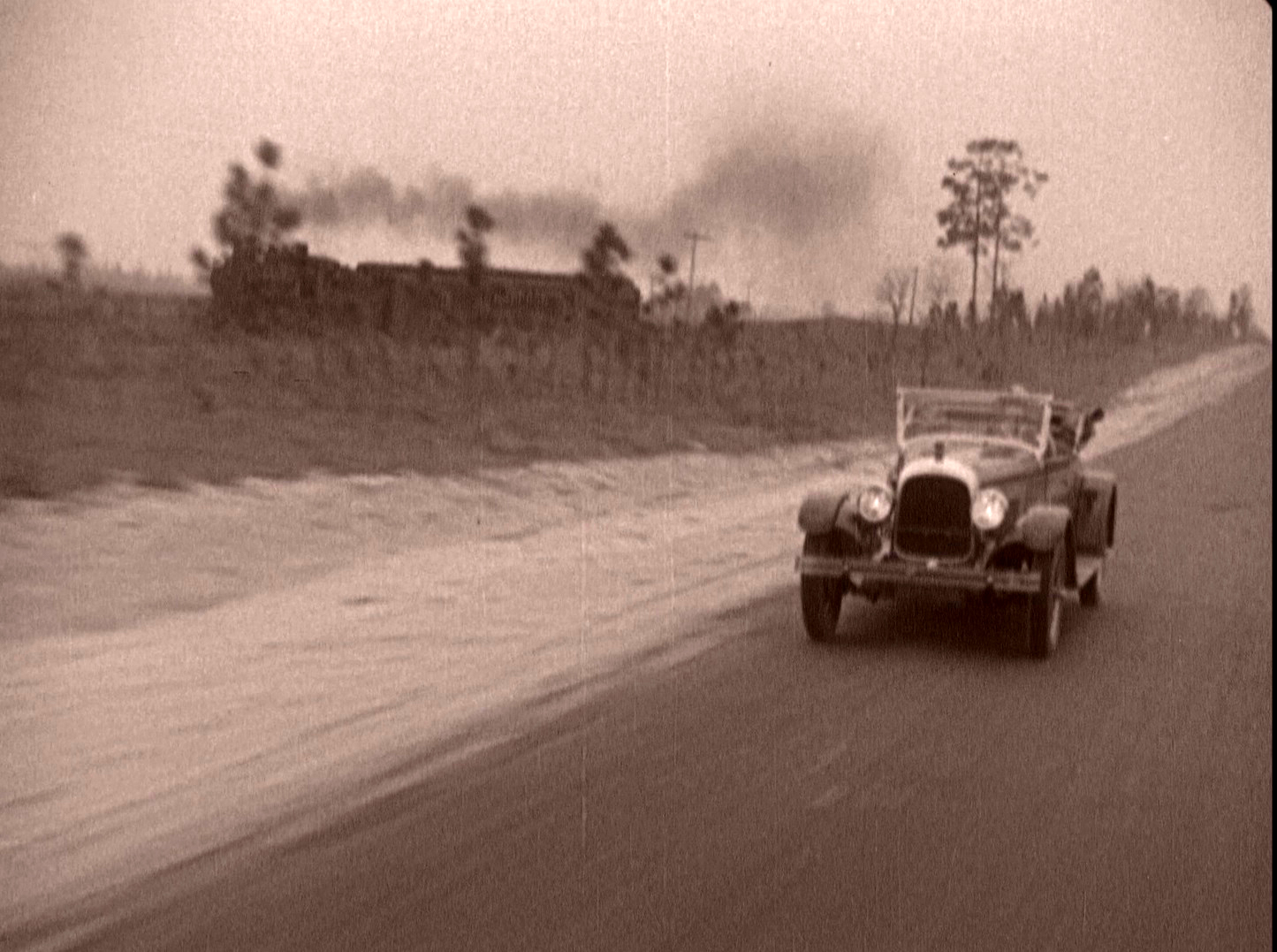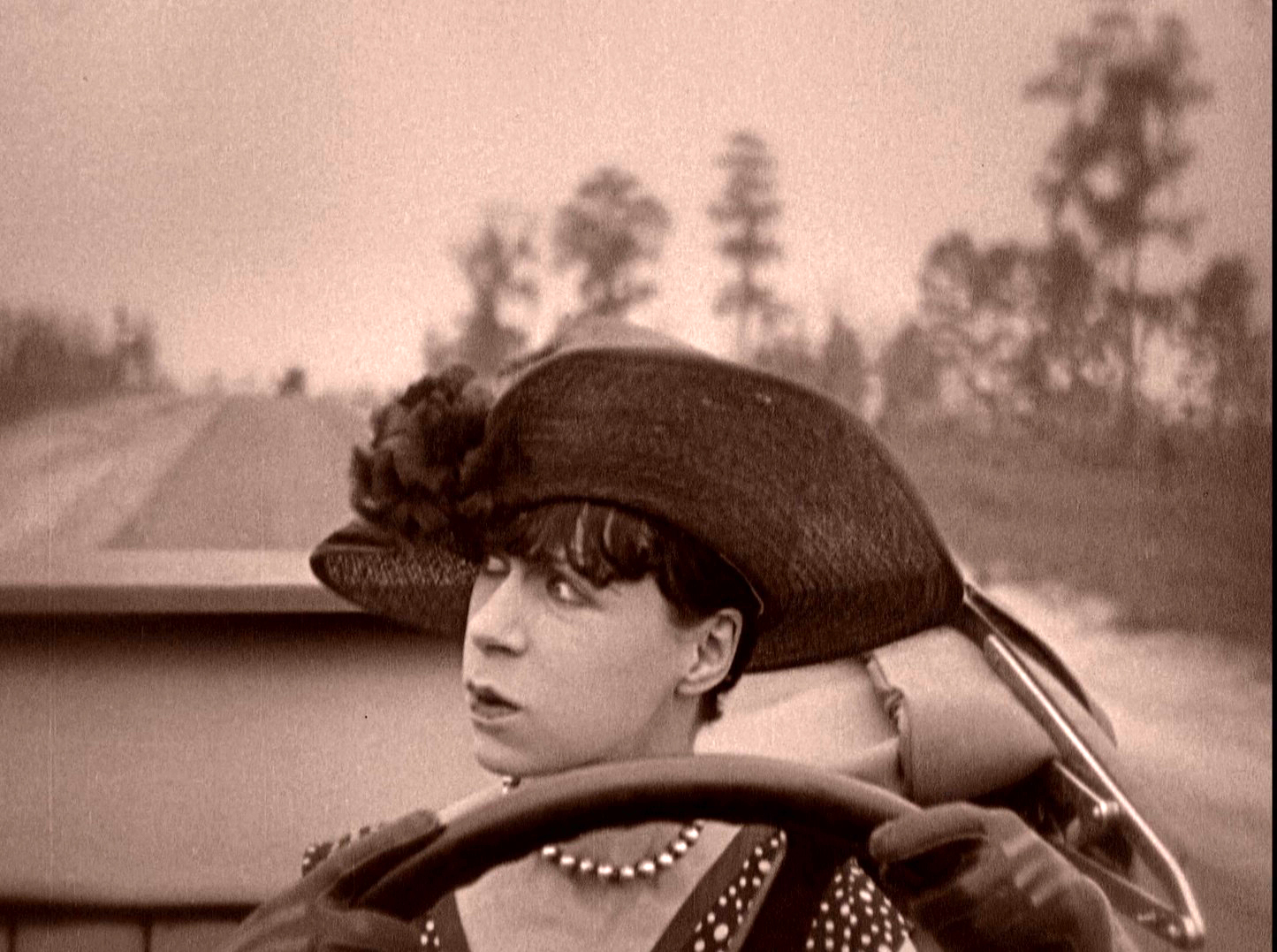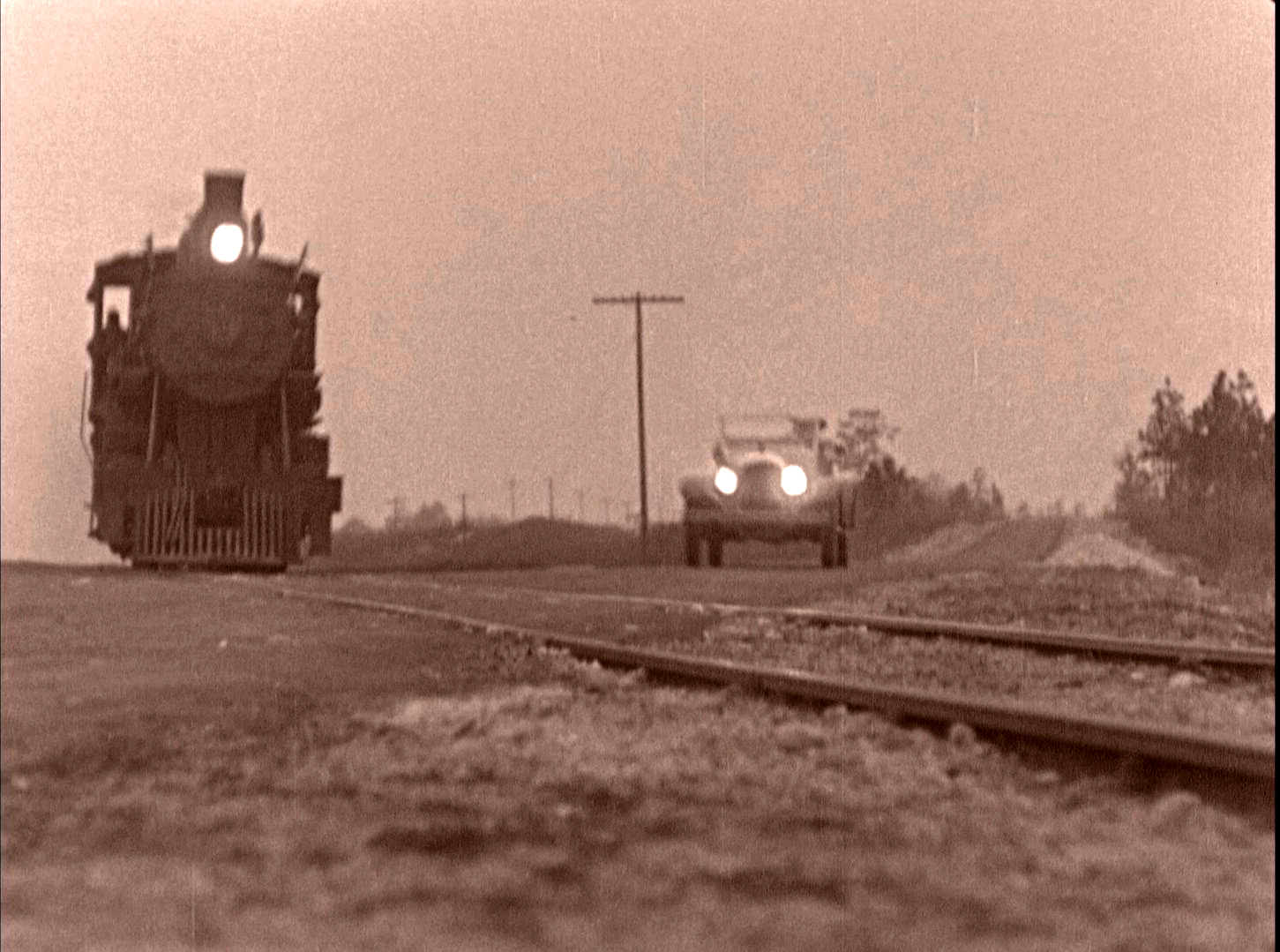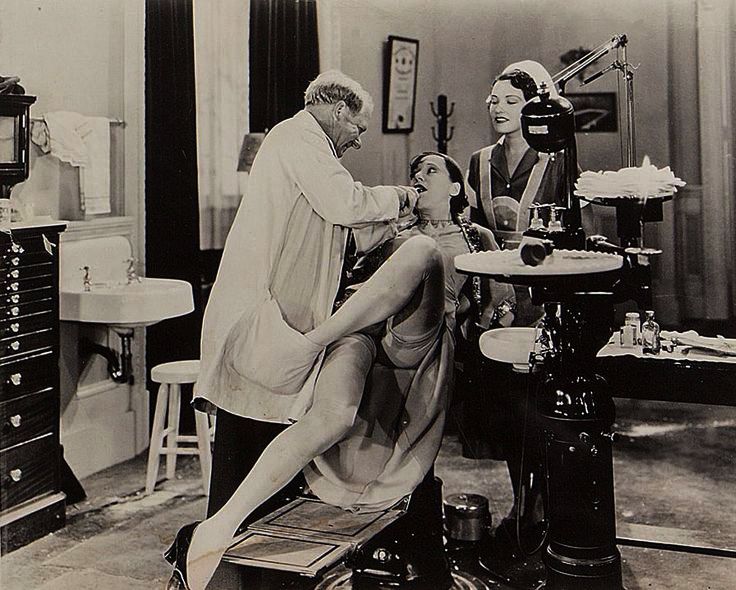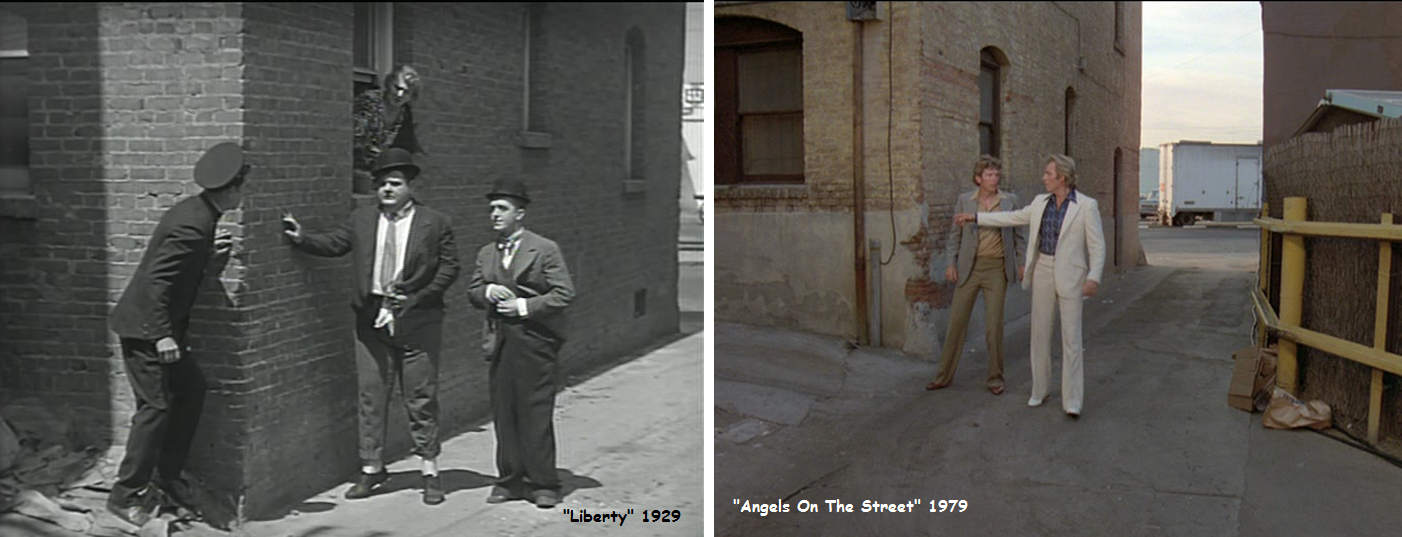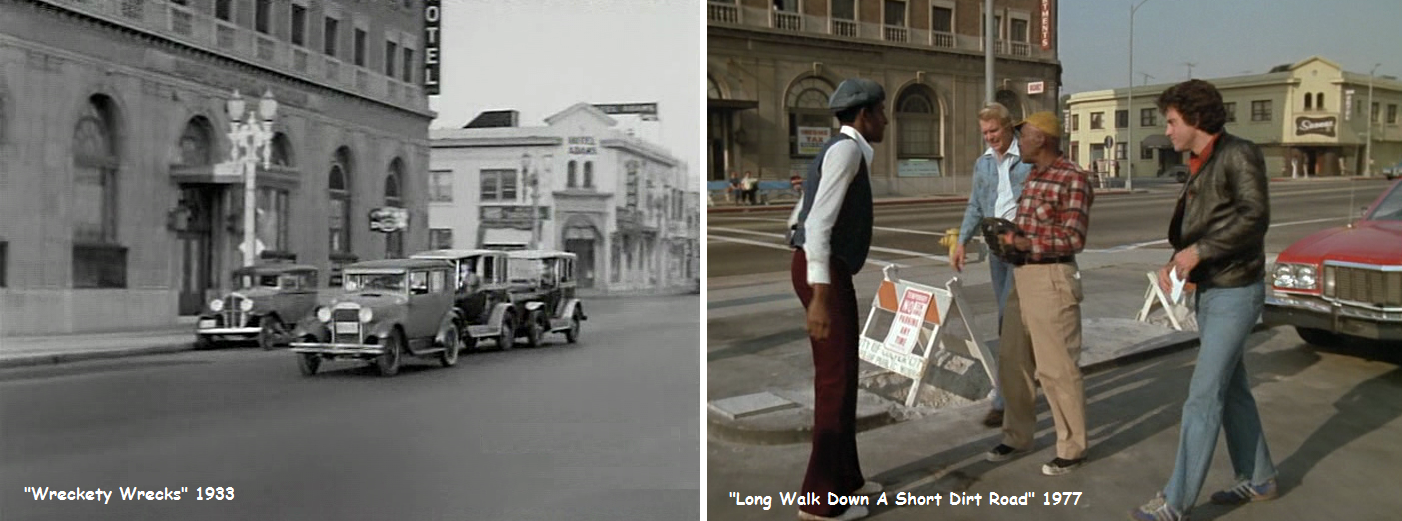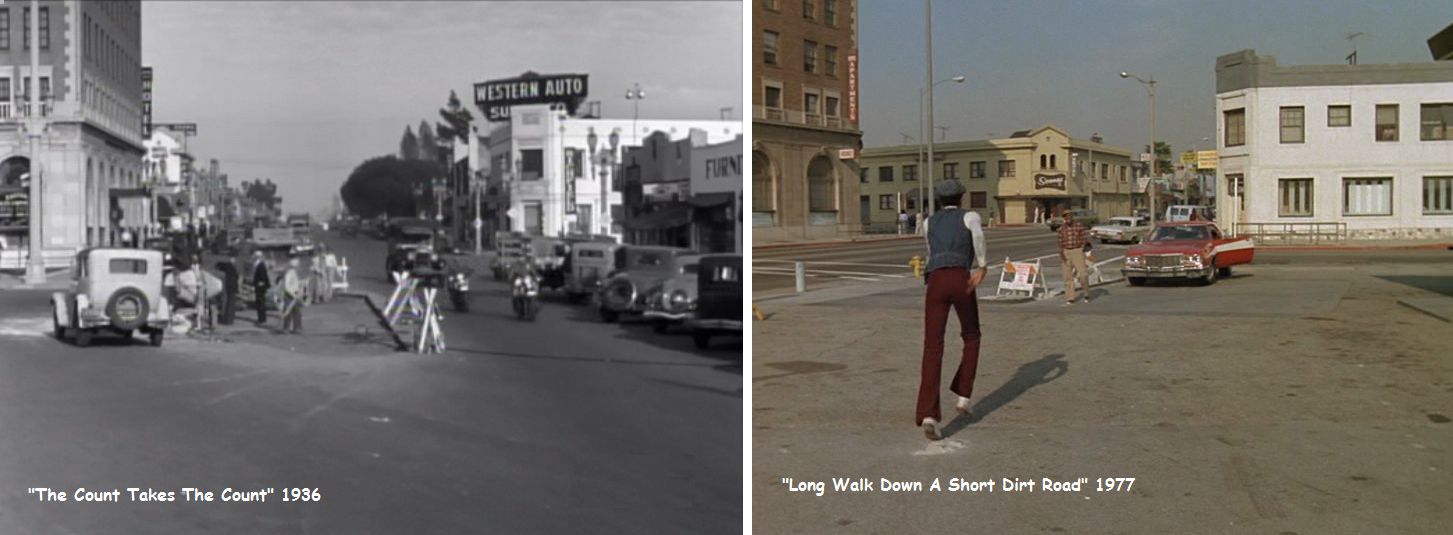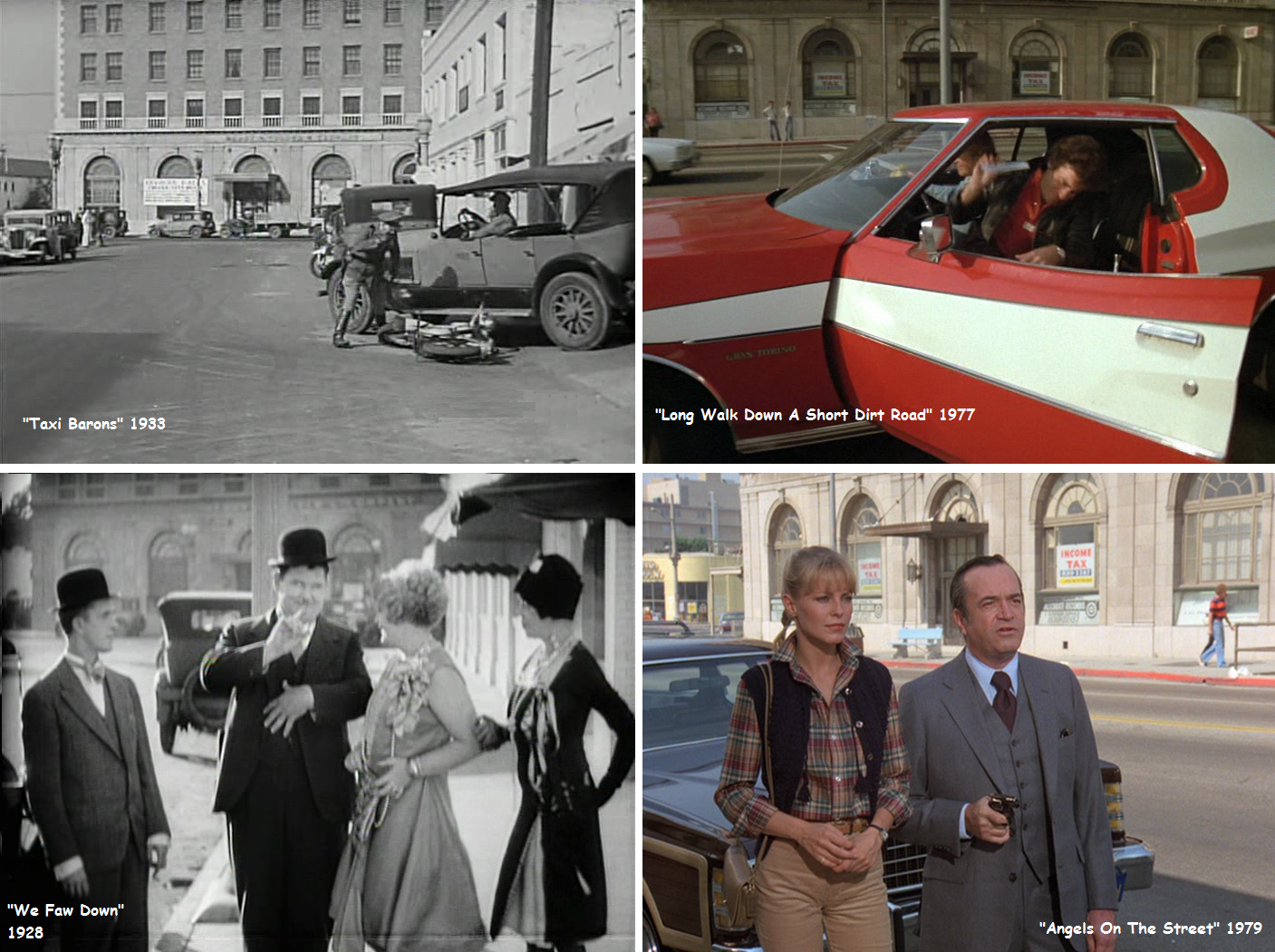
Before the Chaplin-Keaton-Lloyd Alley

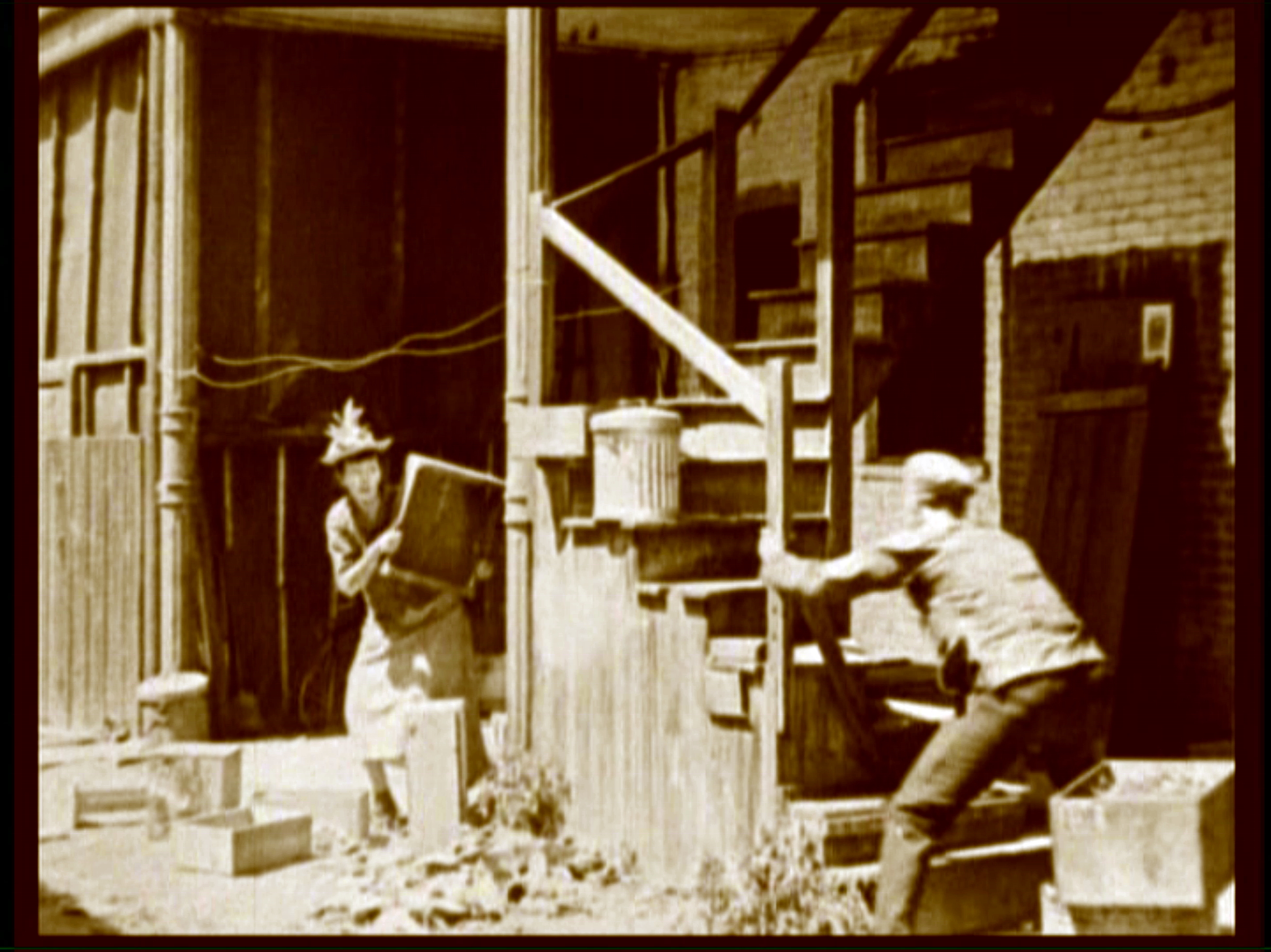
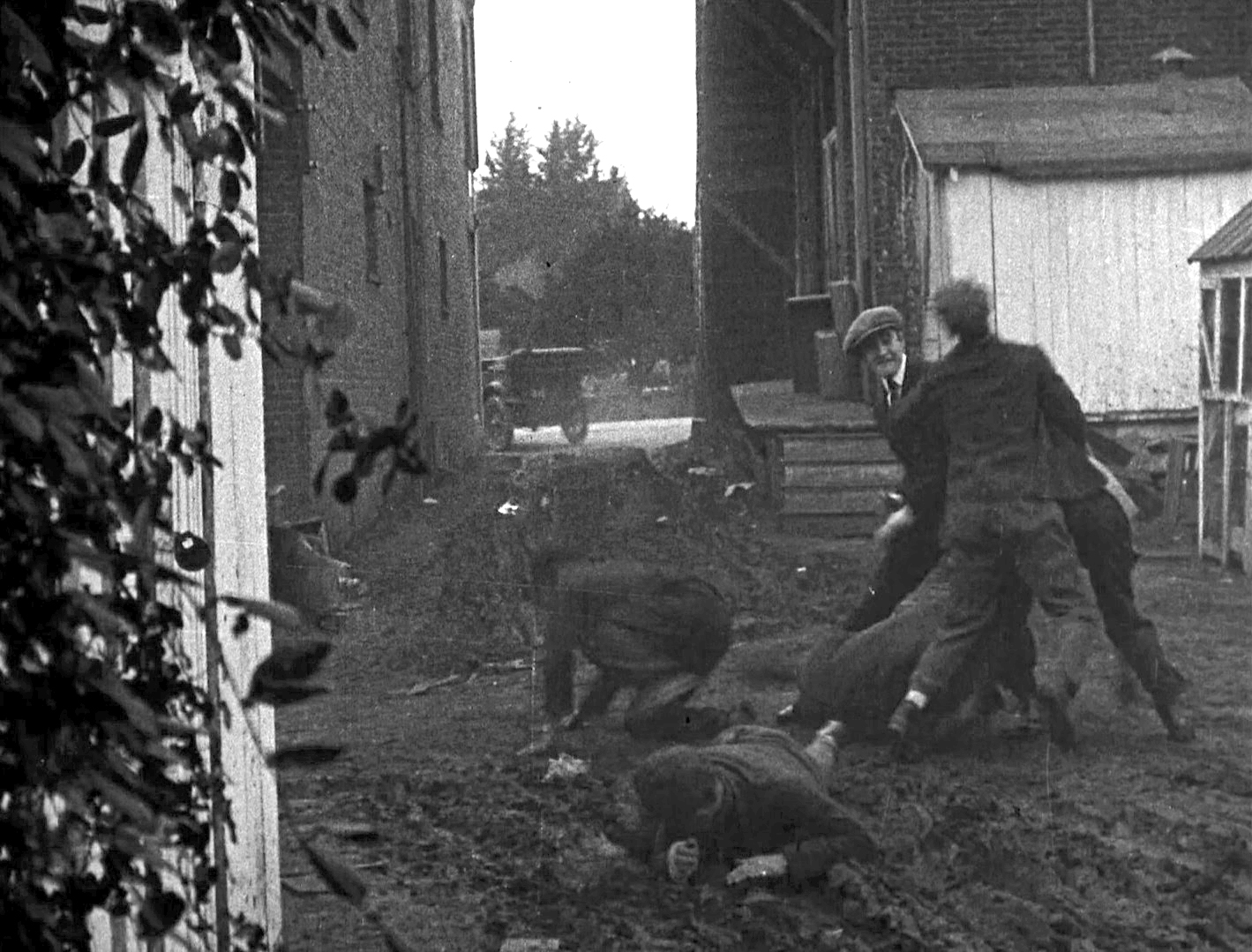
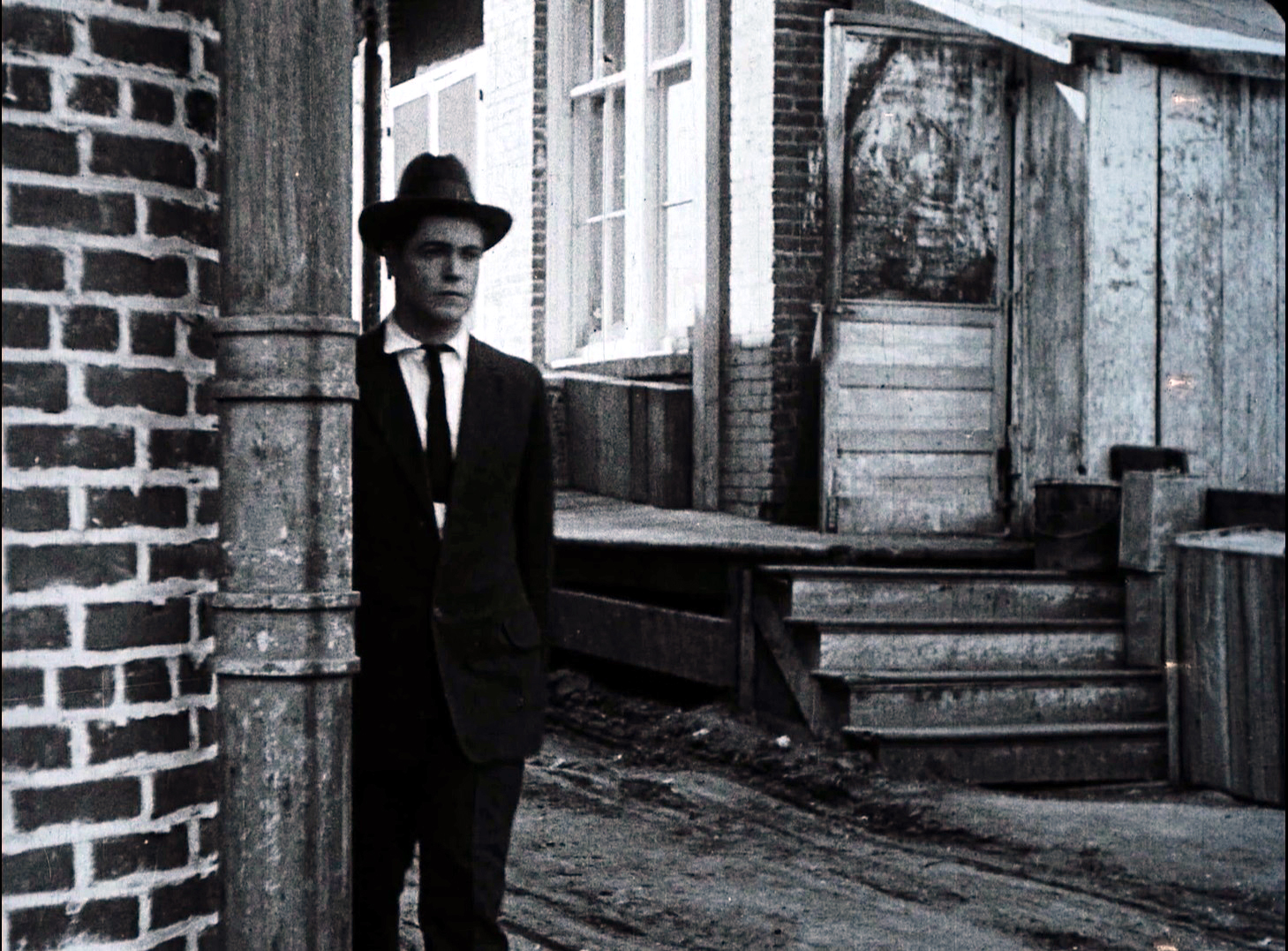
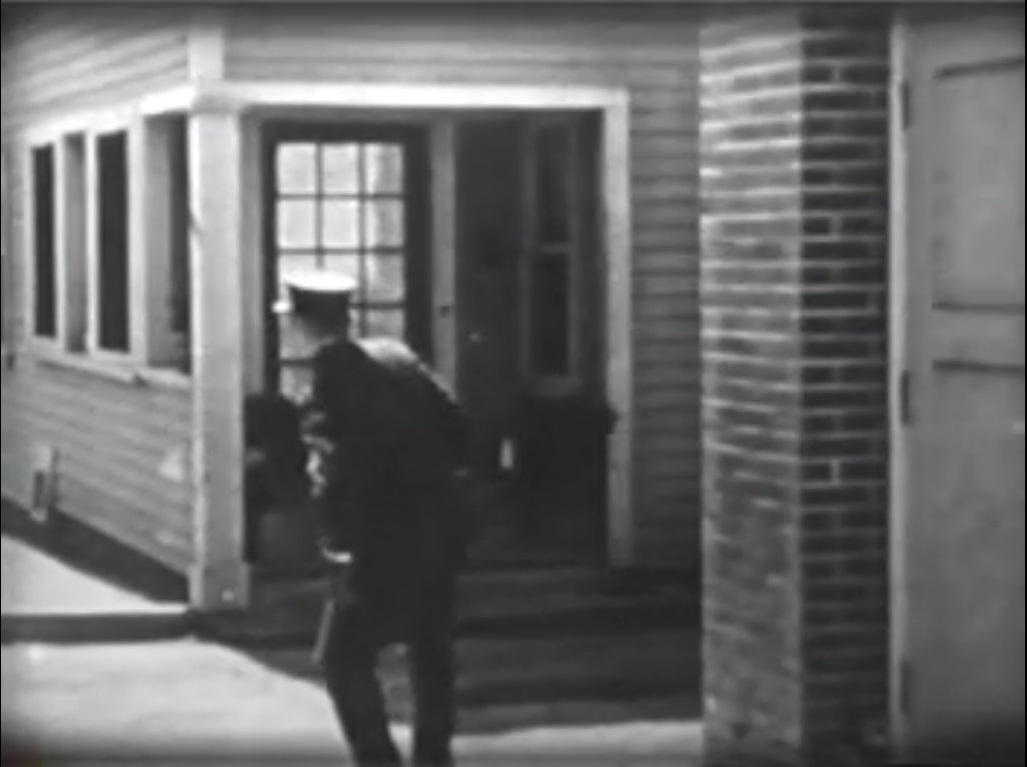
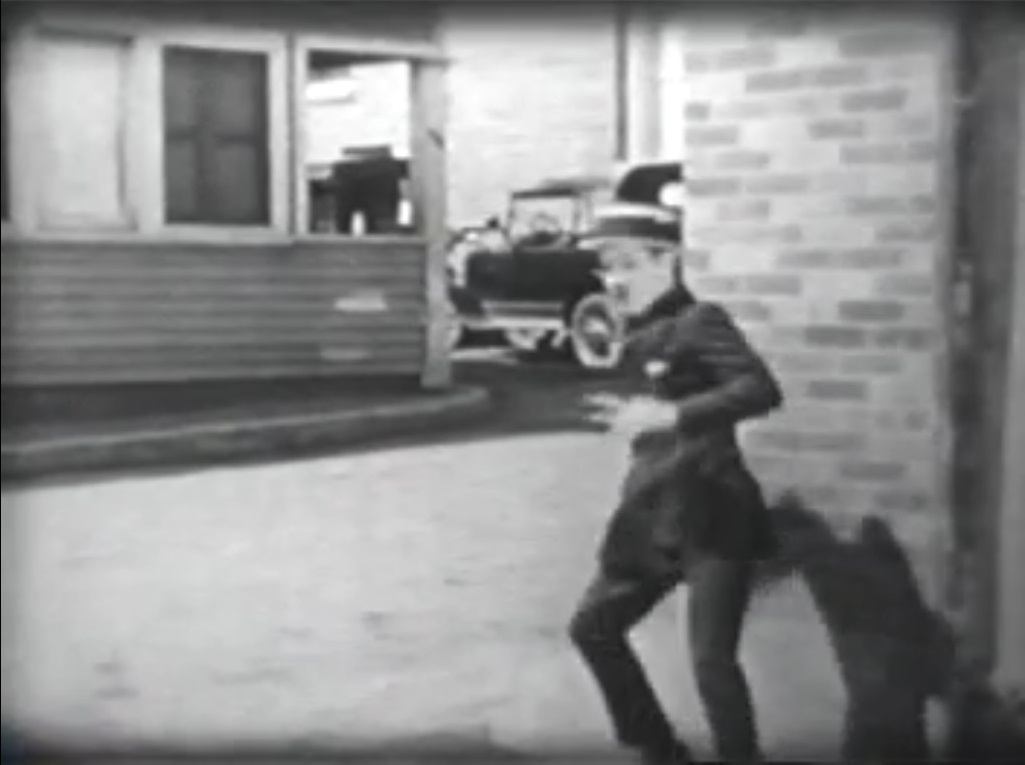
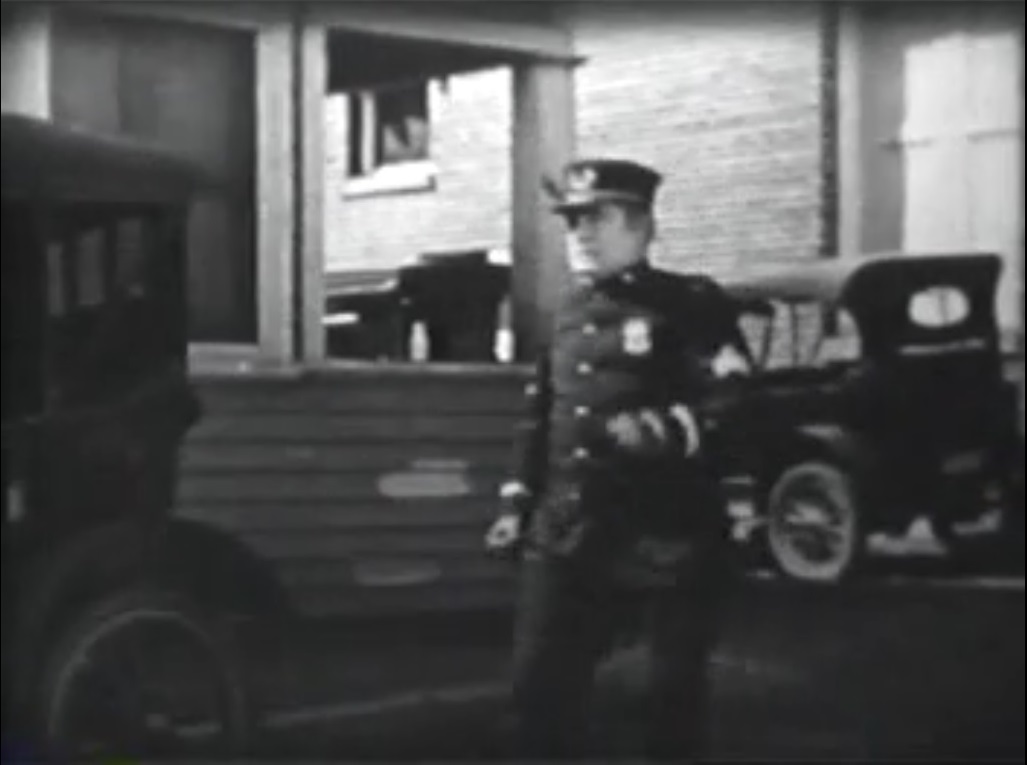
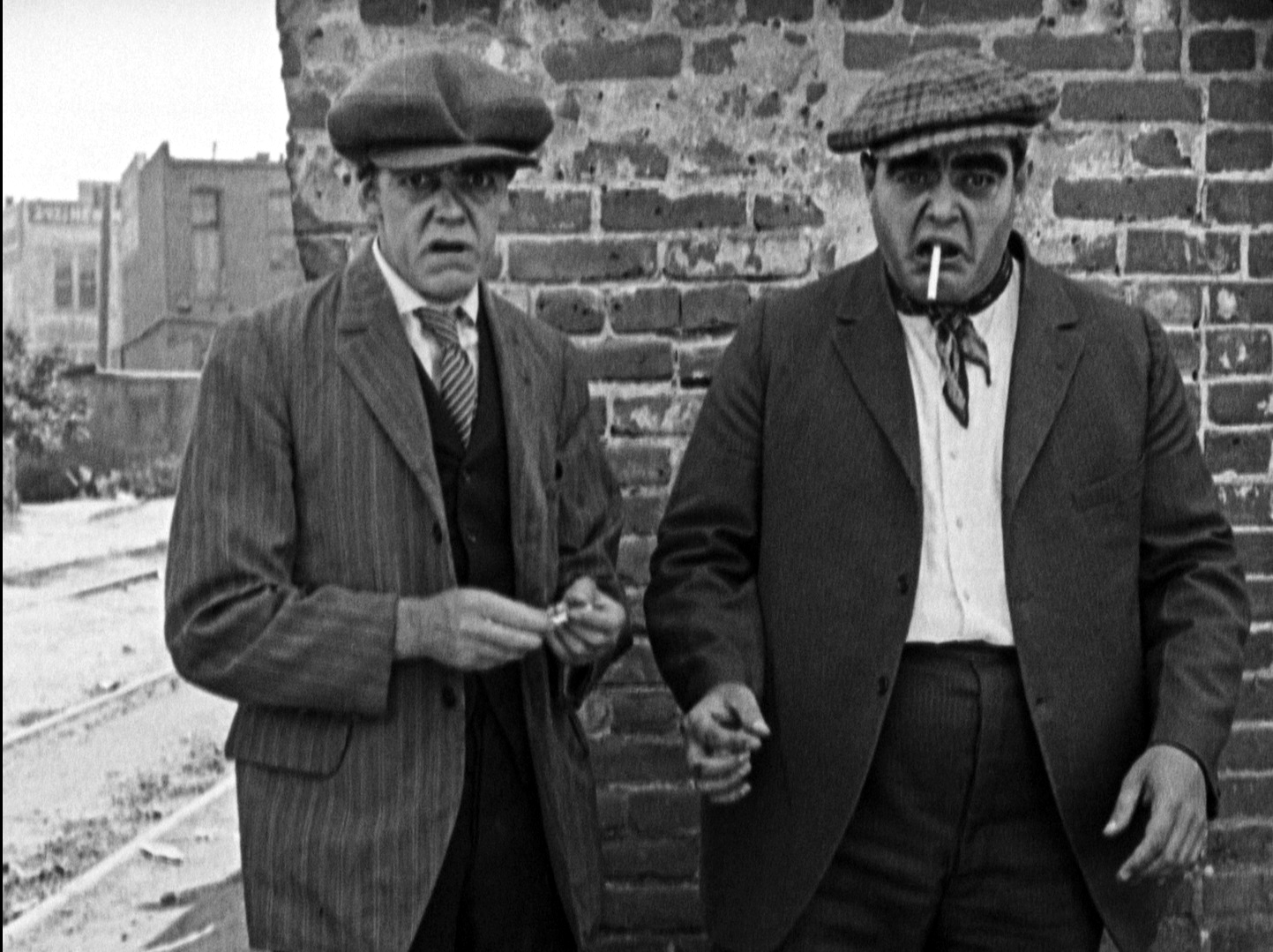
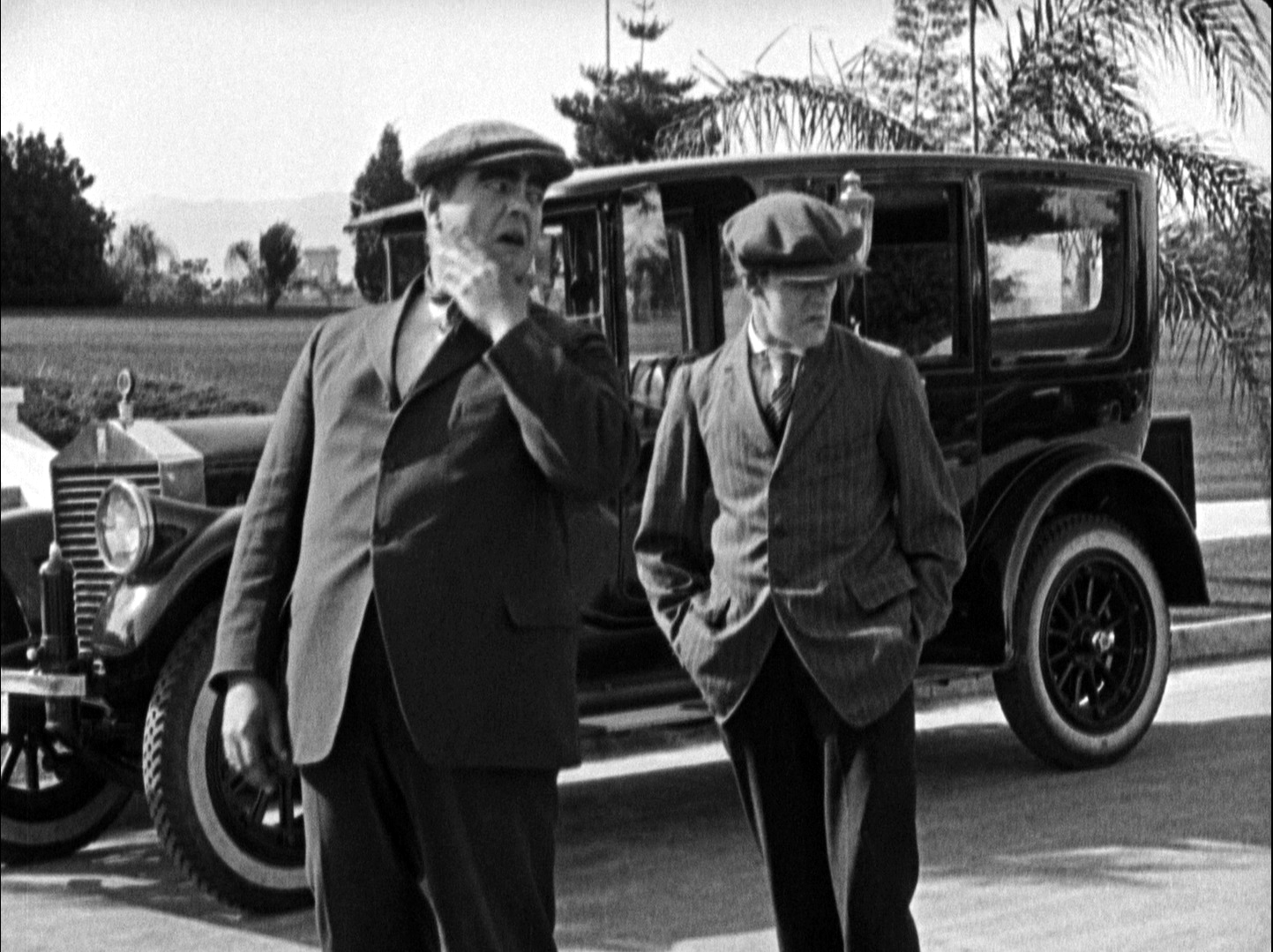
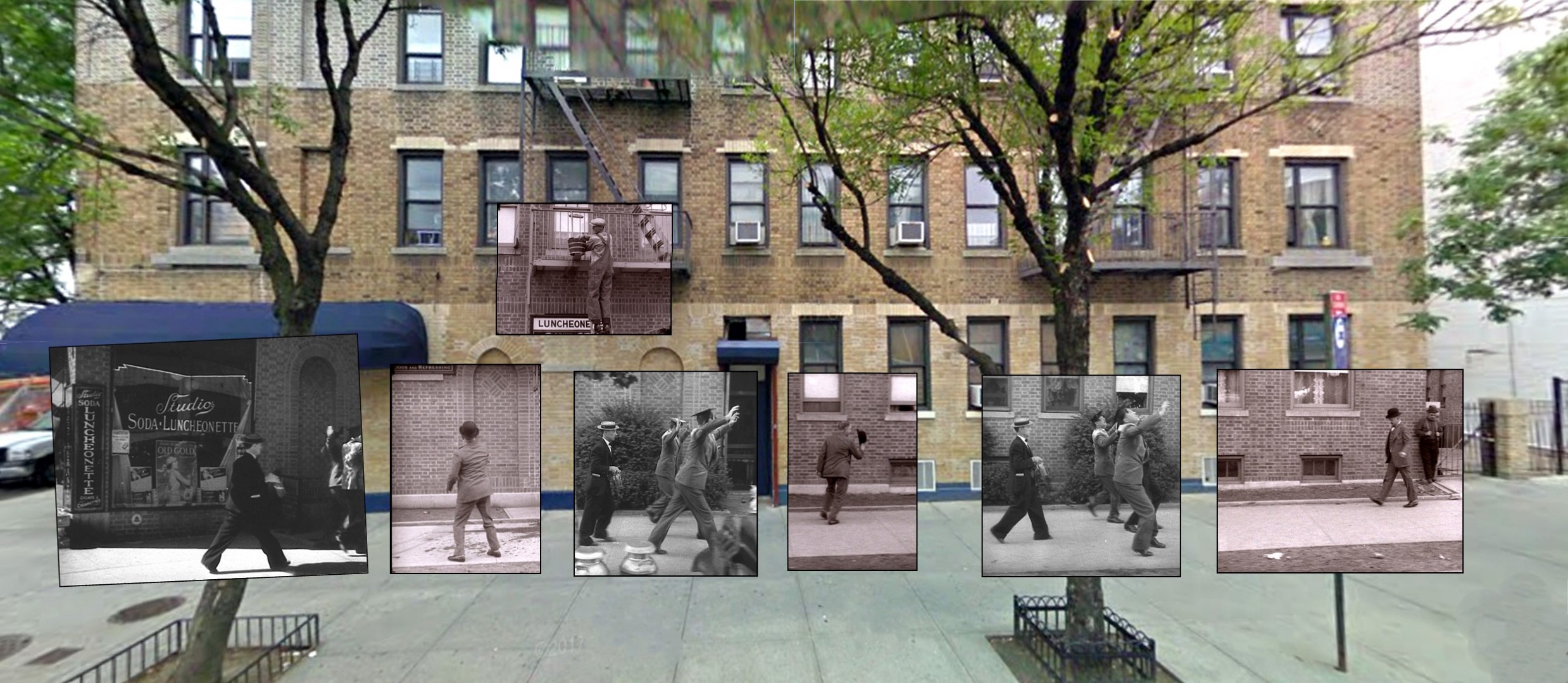
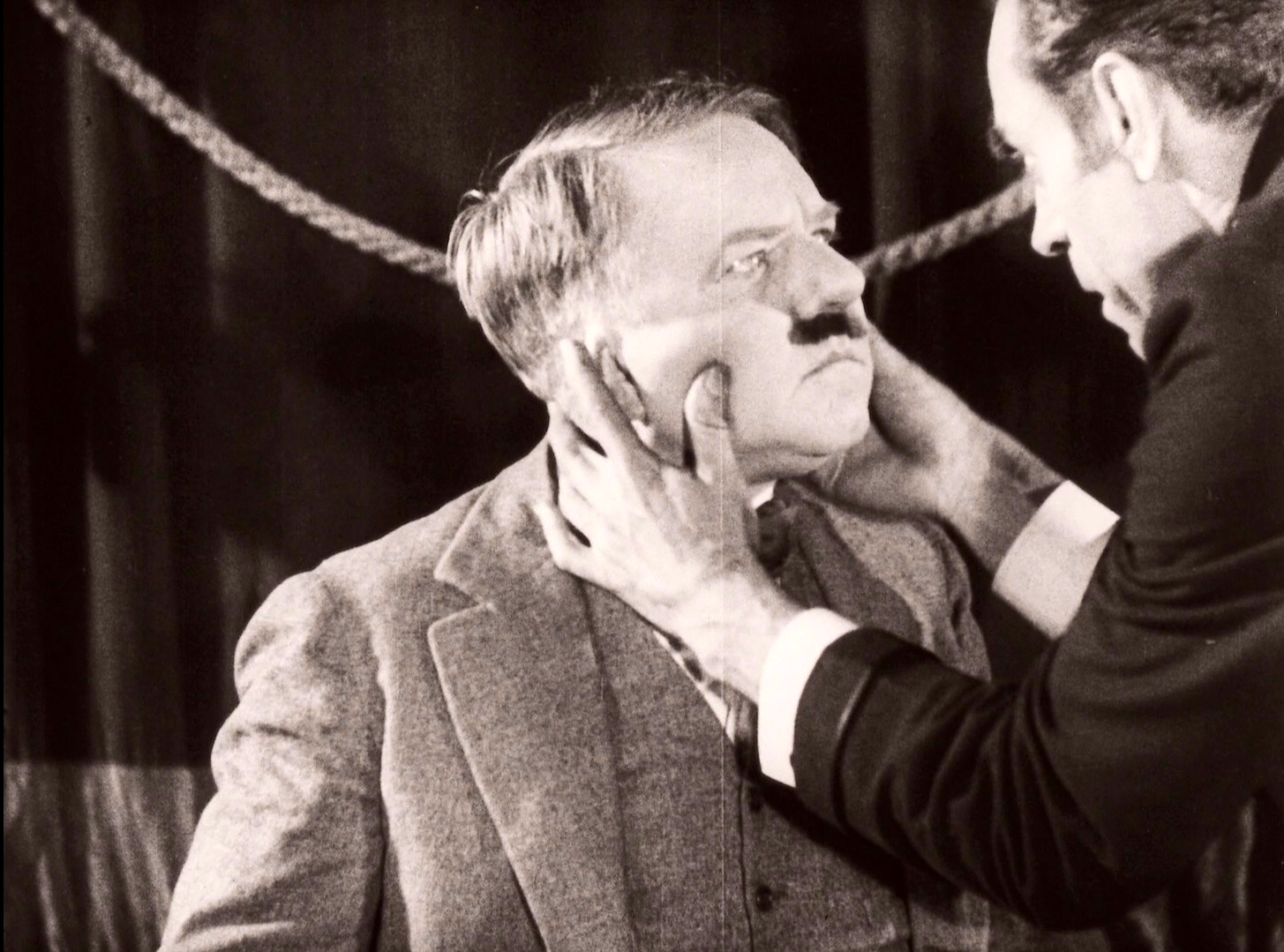
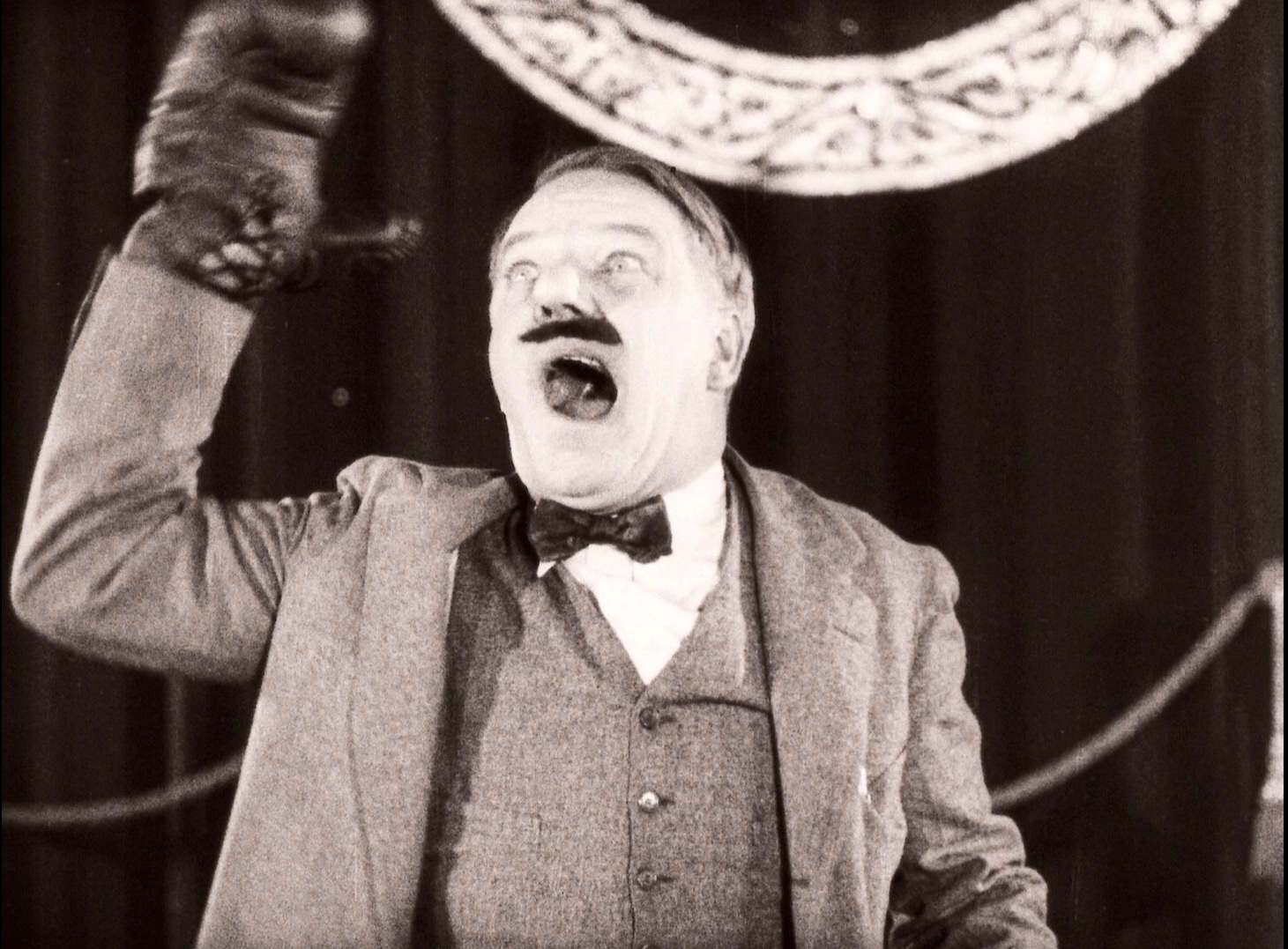
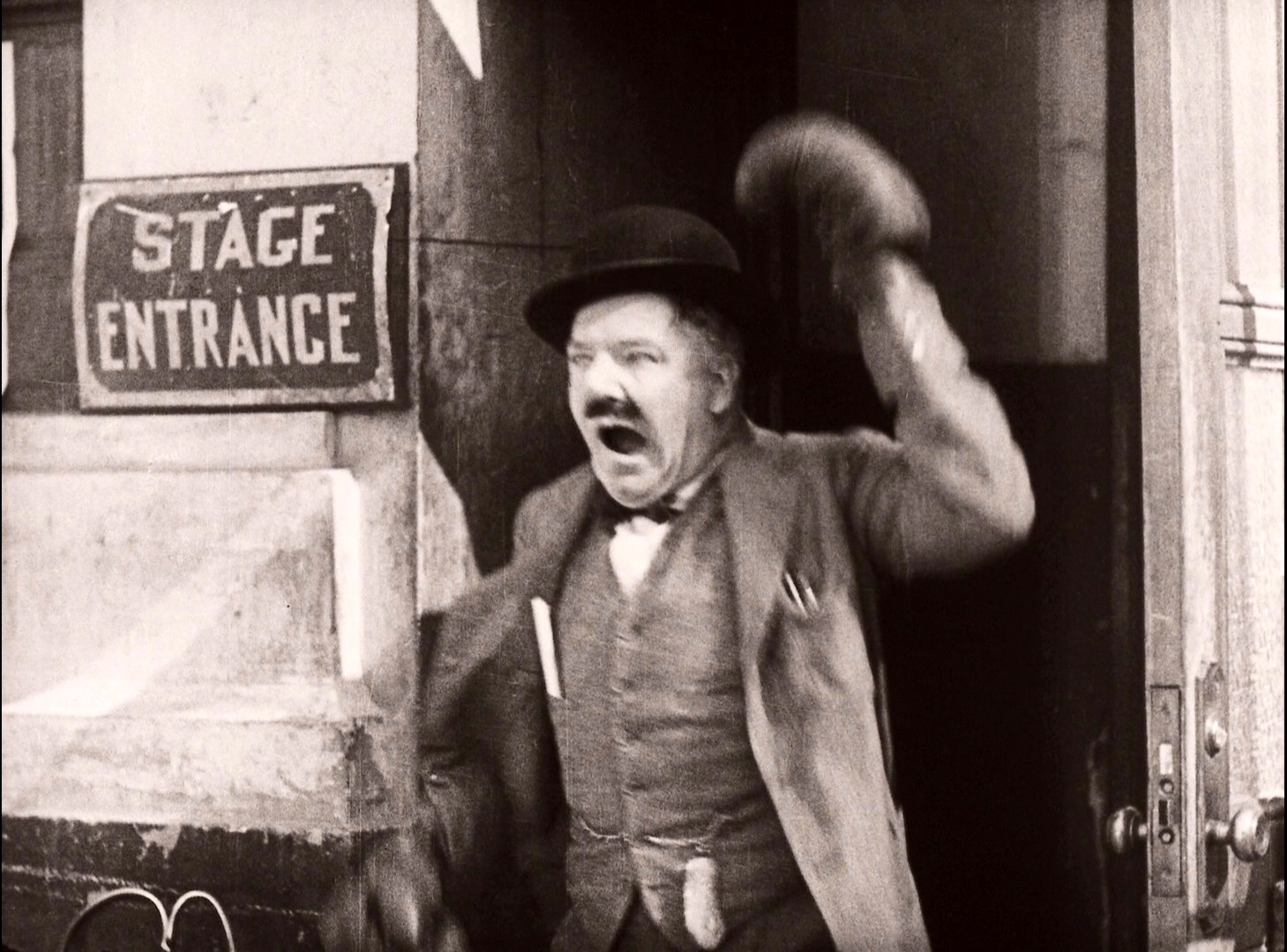
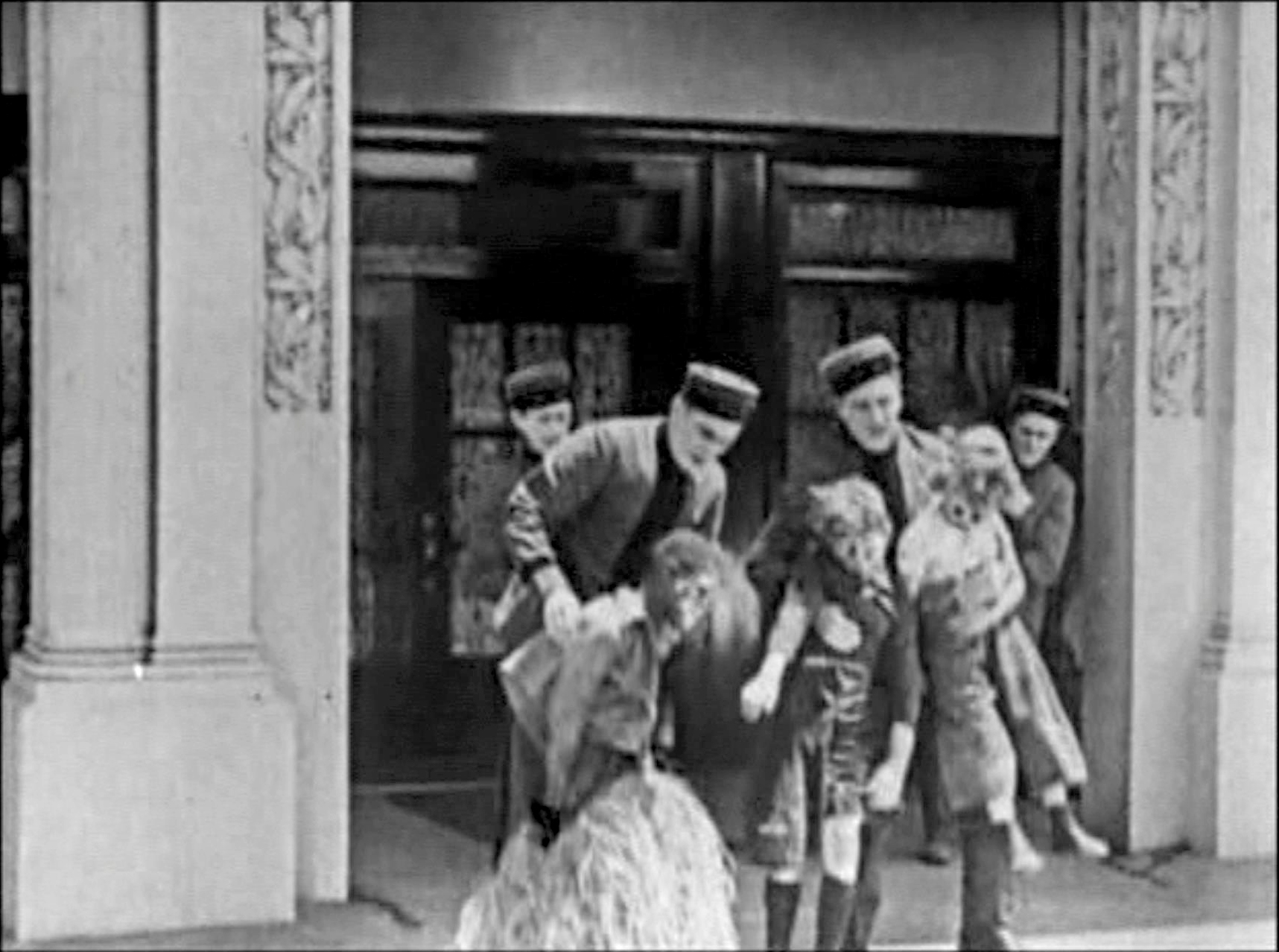
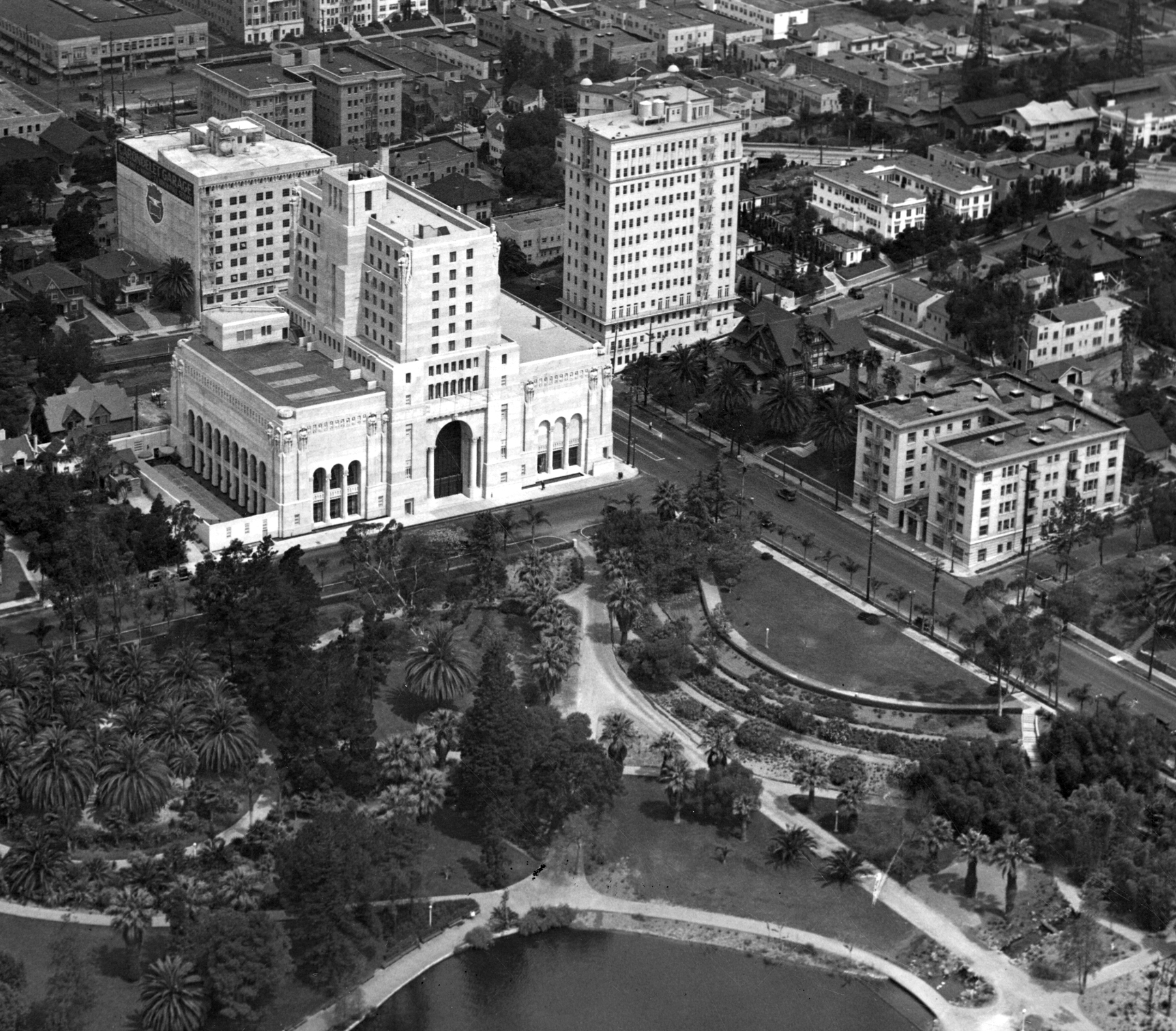
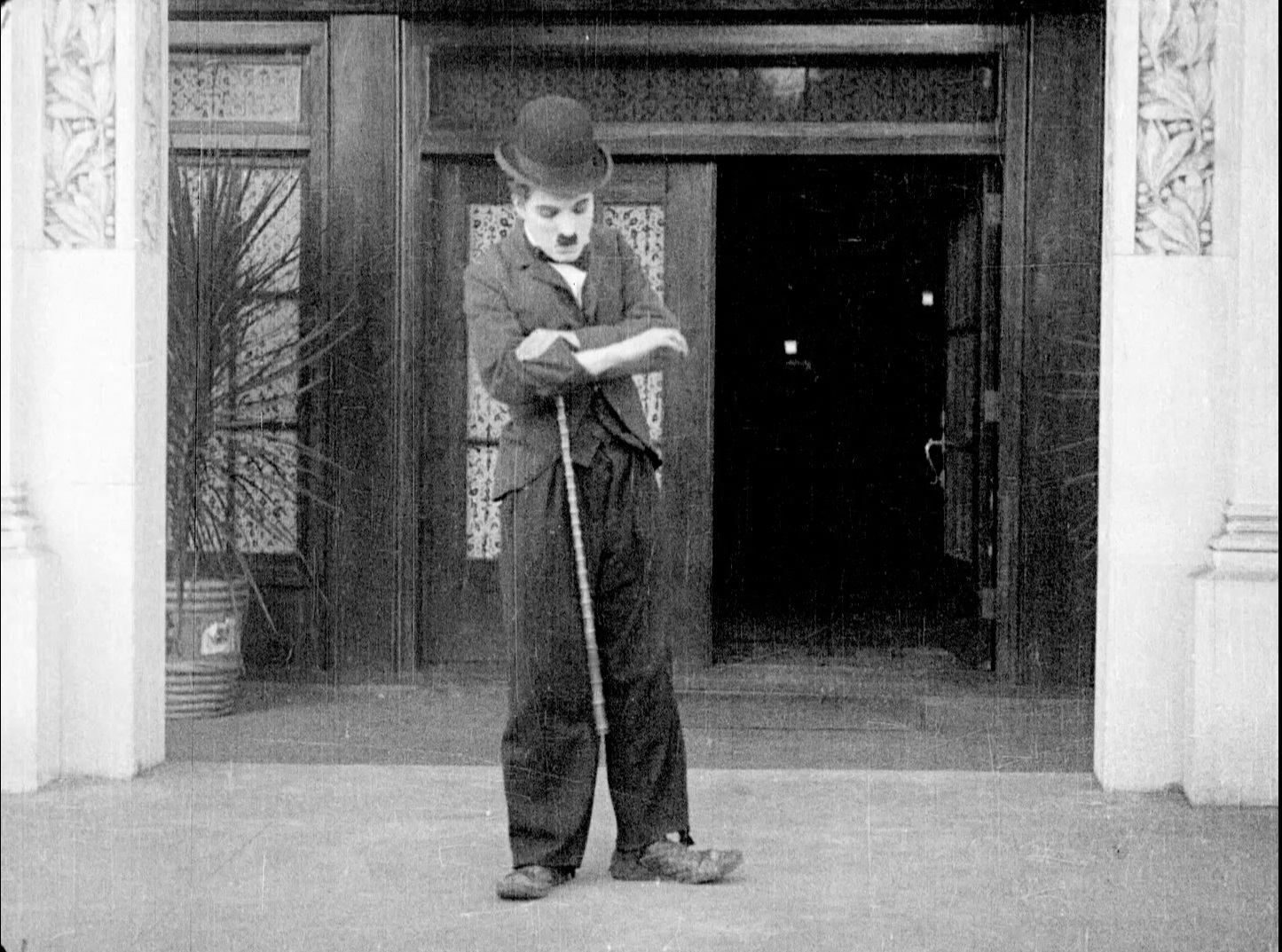
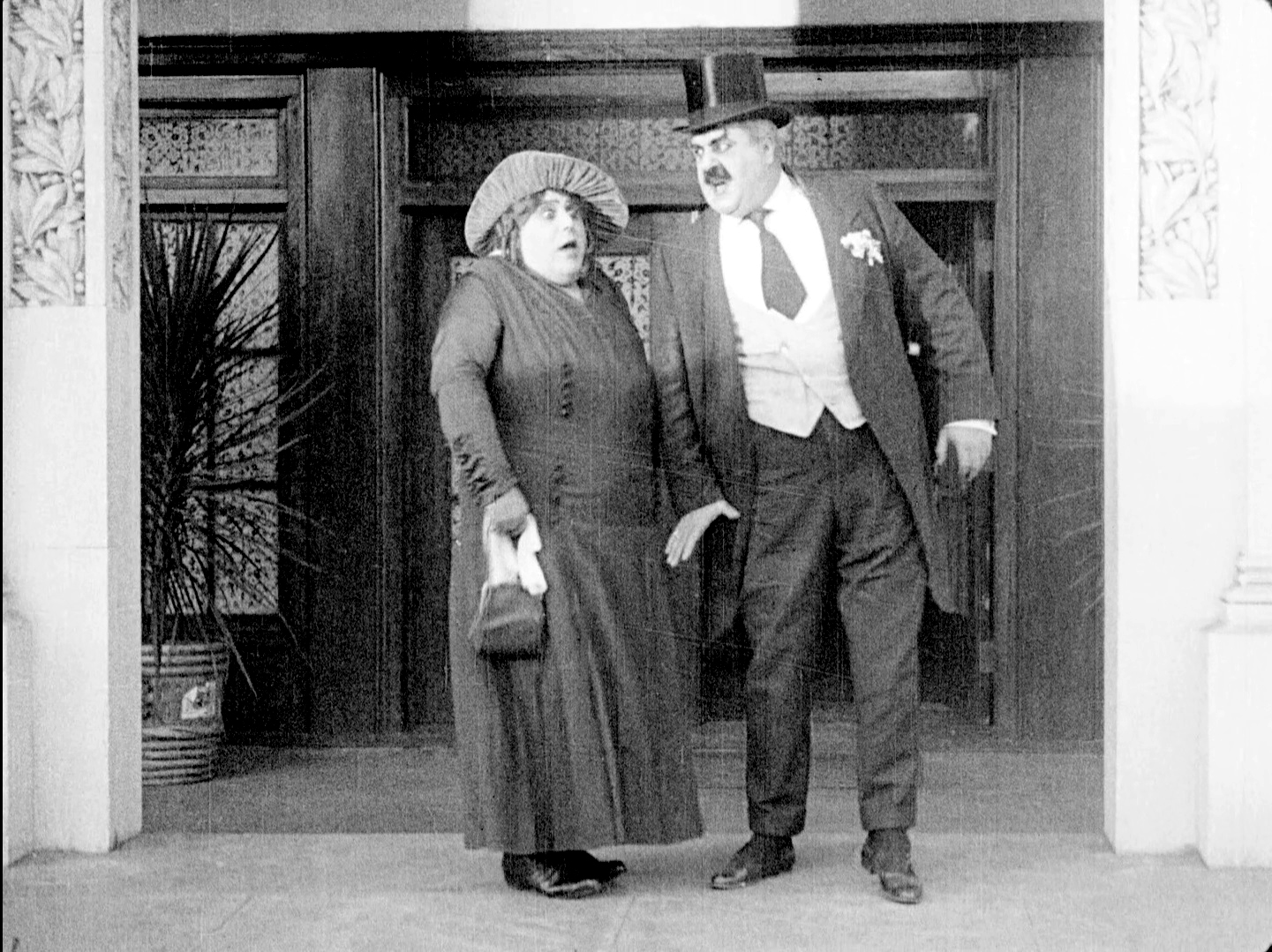
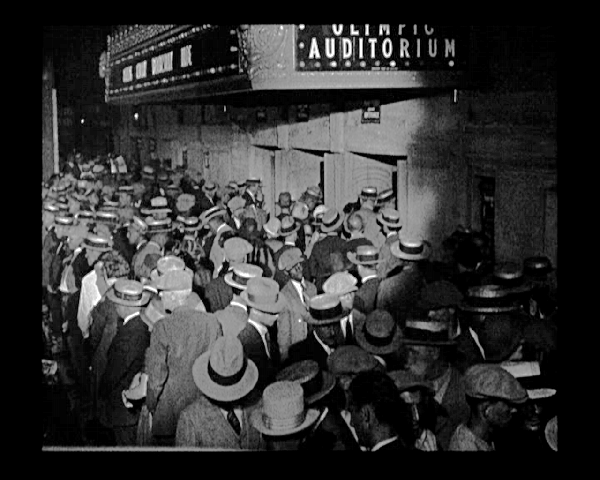
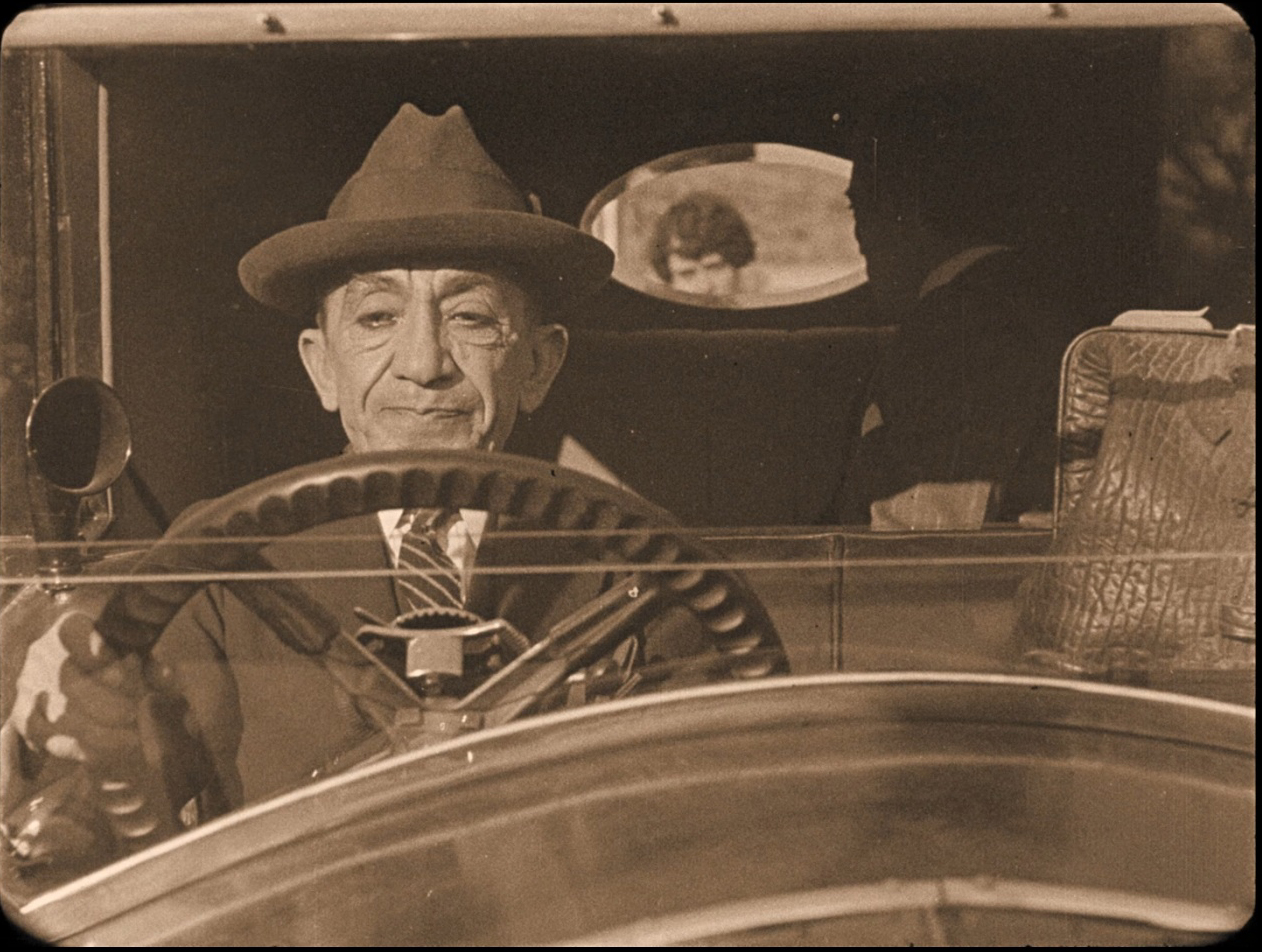
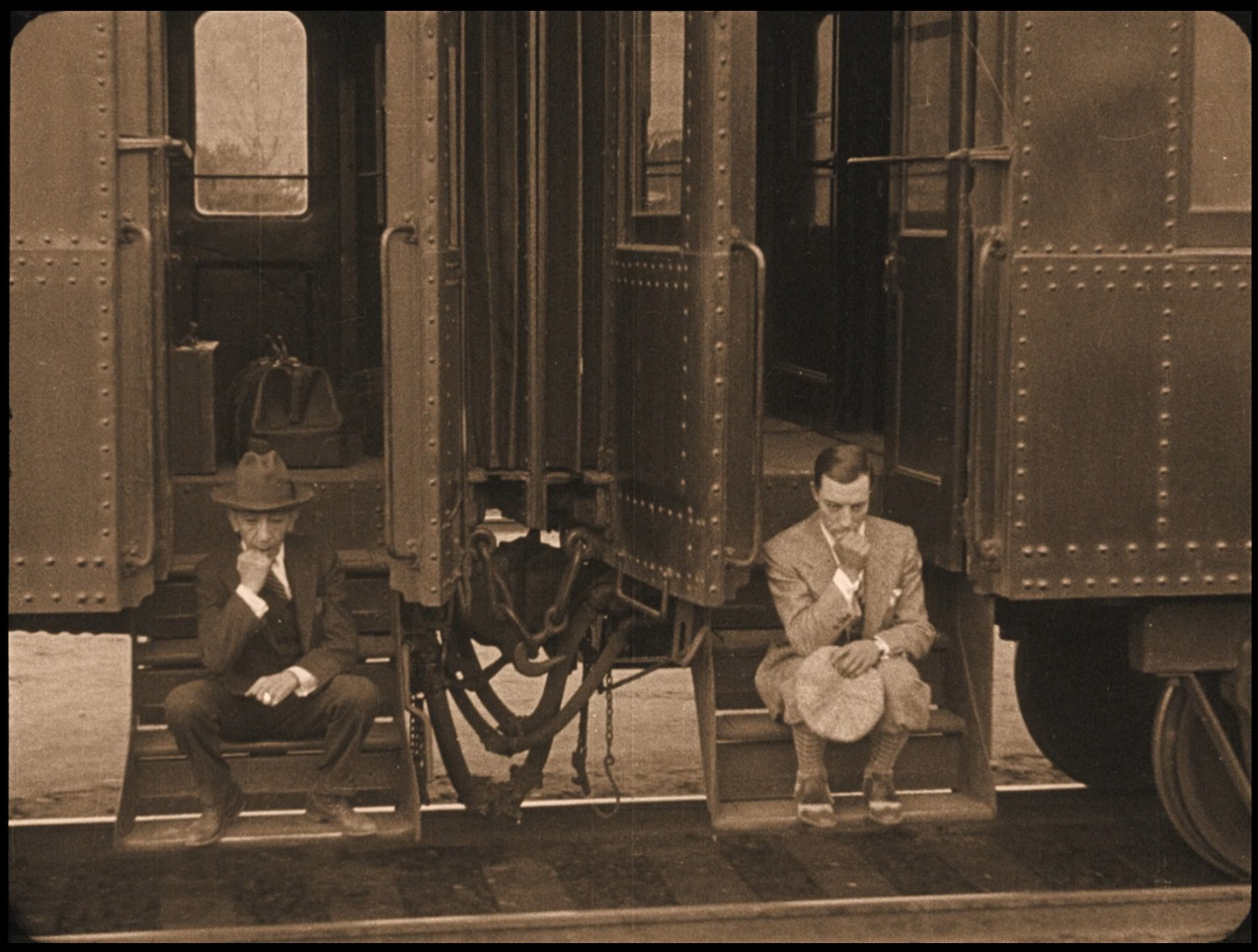
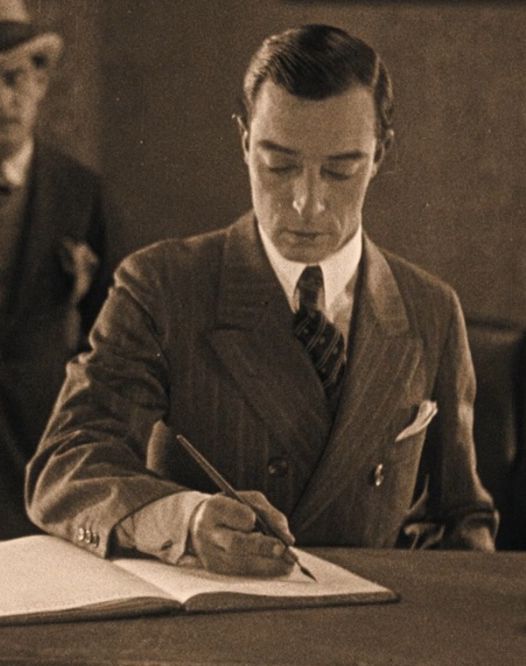
The beautiful new Kino Lorber Blu-ray release Pioneers: First Women Filmmakers is a revelation, a six-disc set featuring dozens of early films created by women, many unseen for decades. One of the biggest surprises was witnessing the Chaplin-Keaton-Lloyd alley appear in several films, each made years before the gents all filmed there.

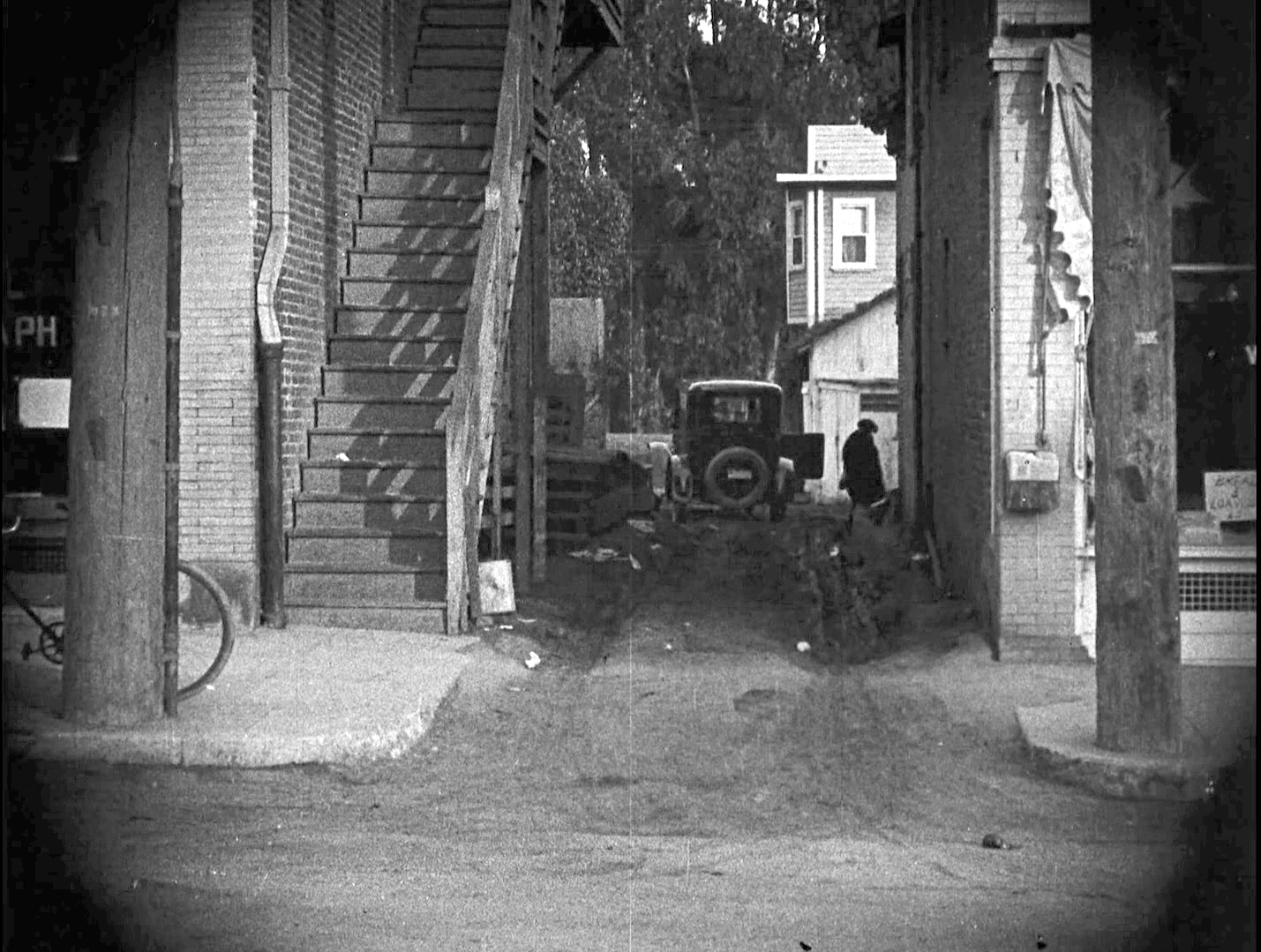
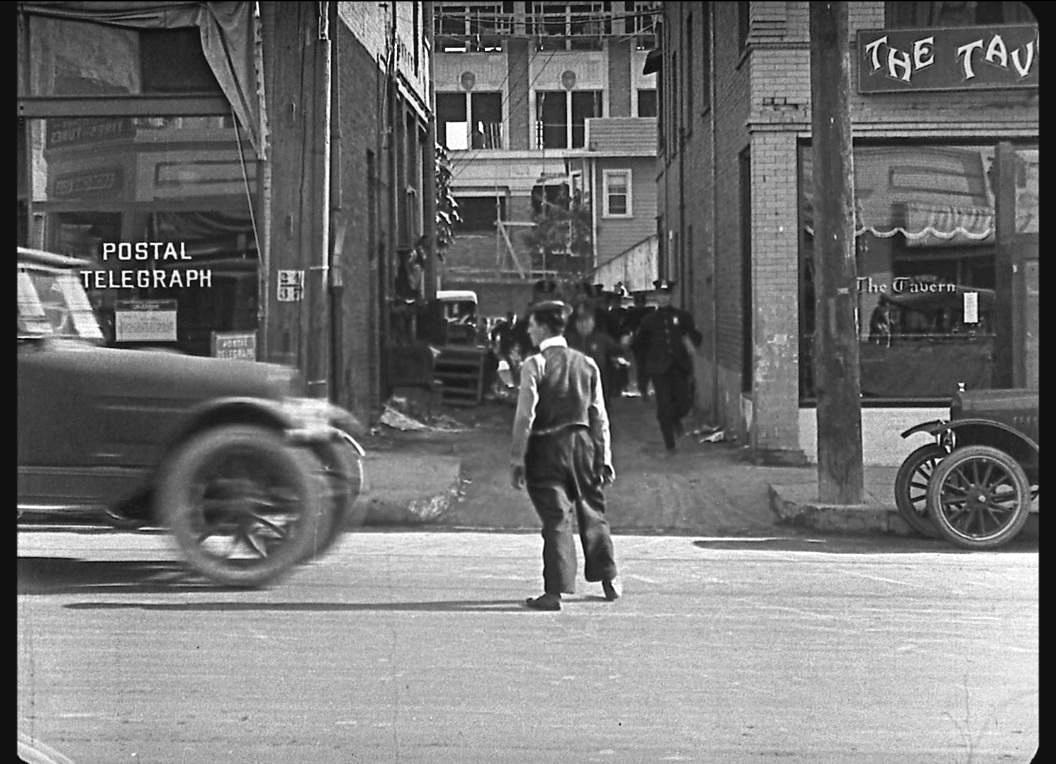
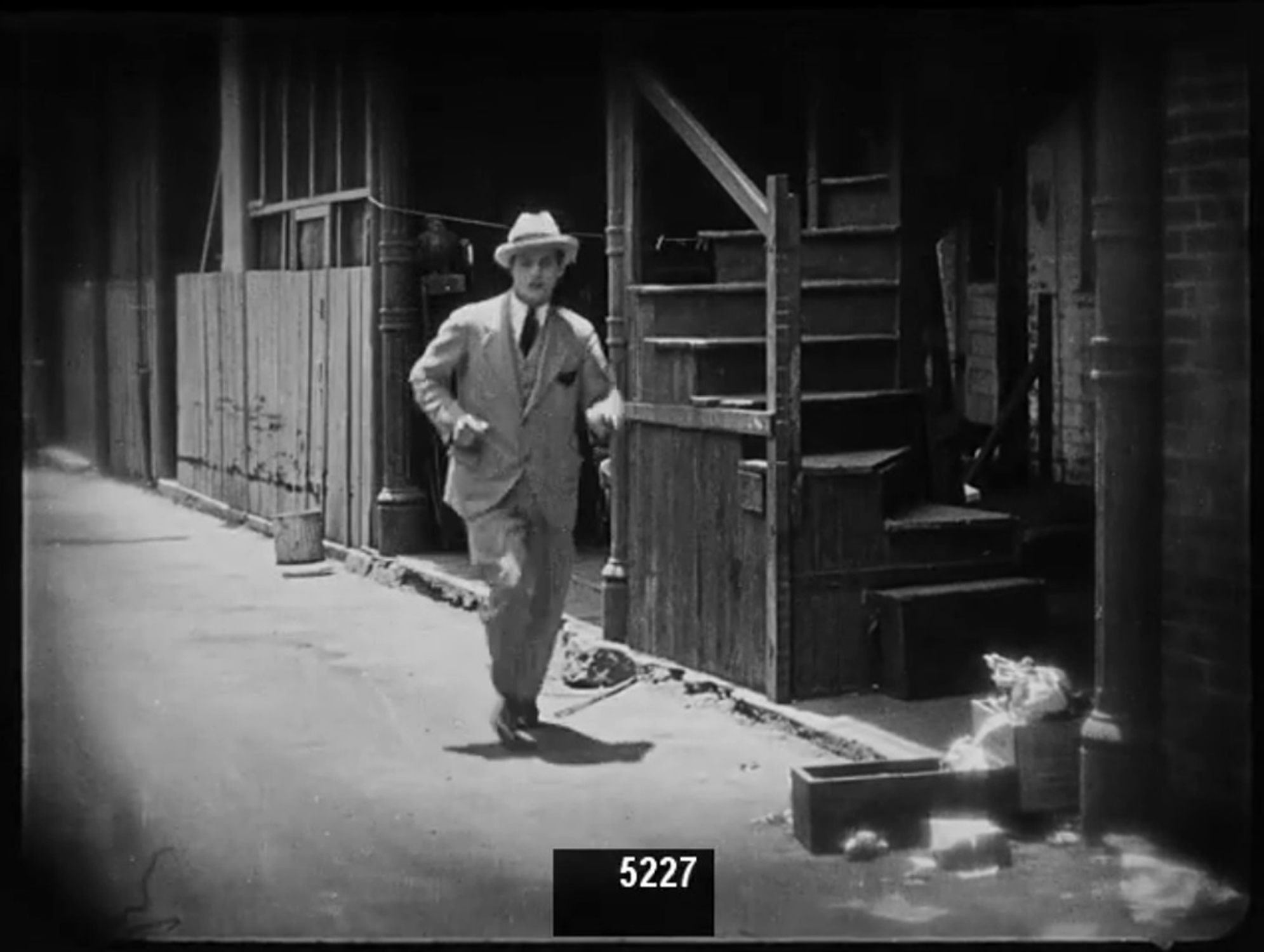
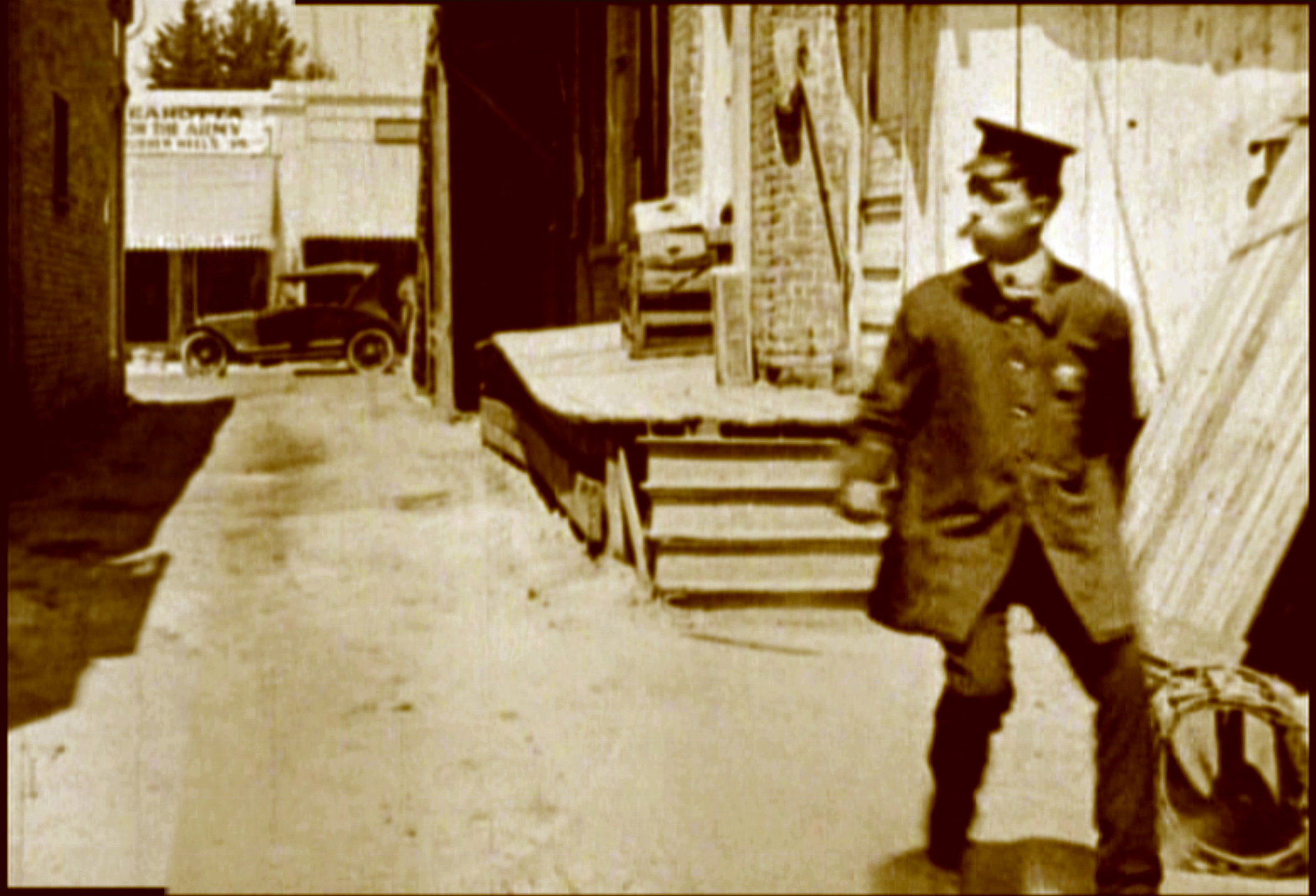
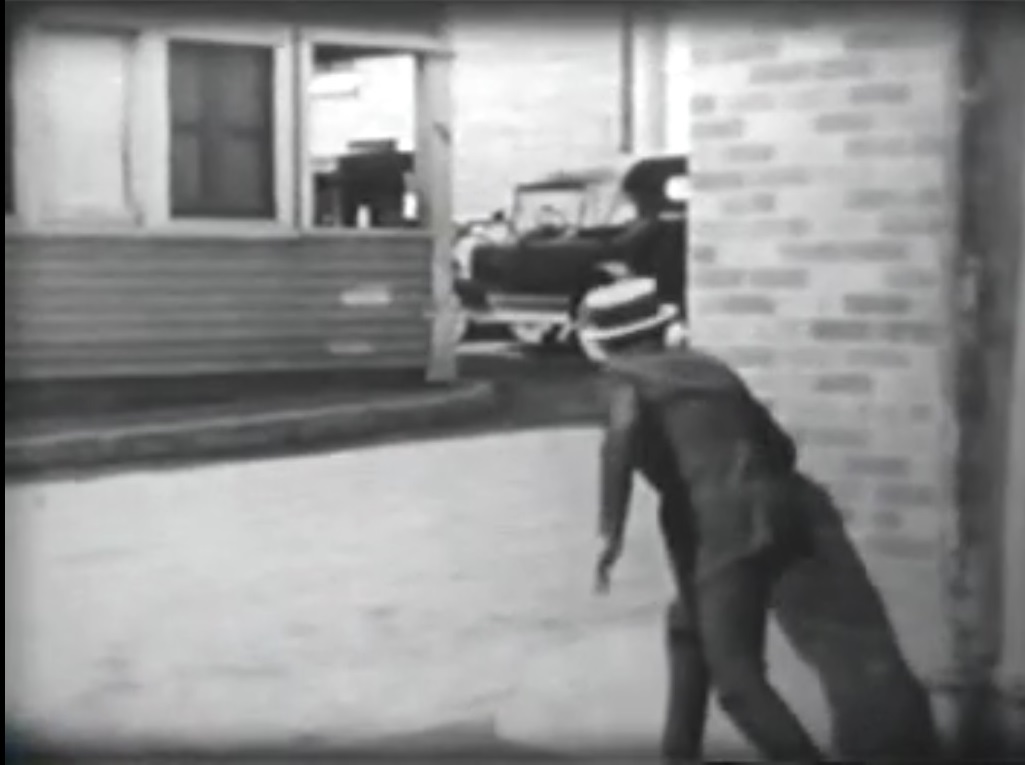
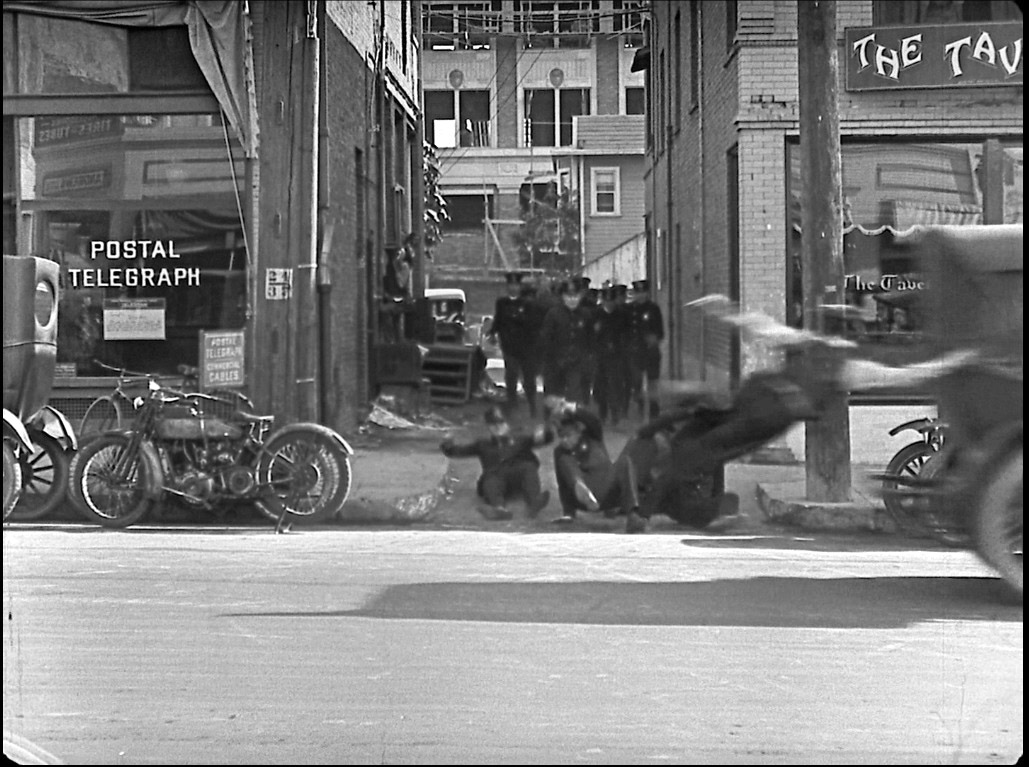
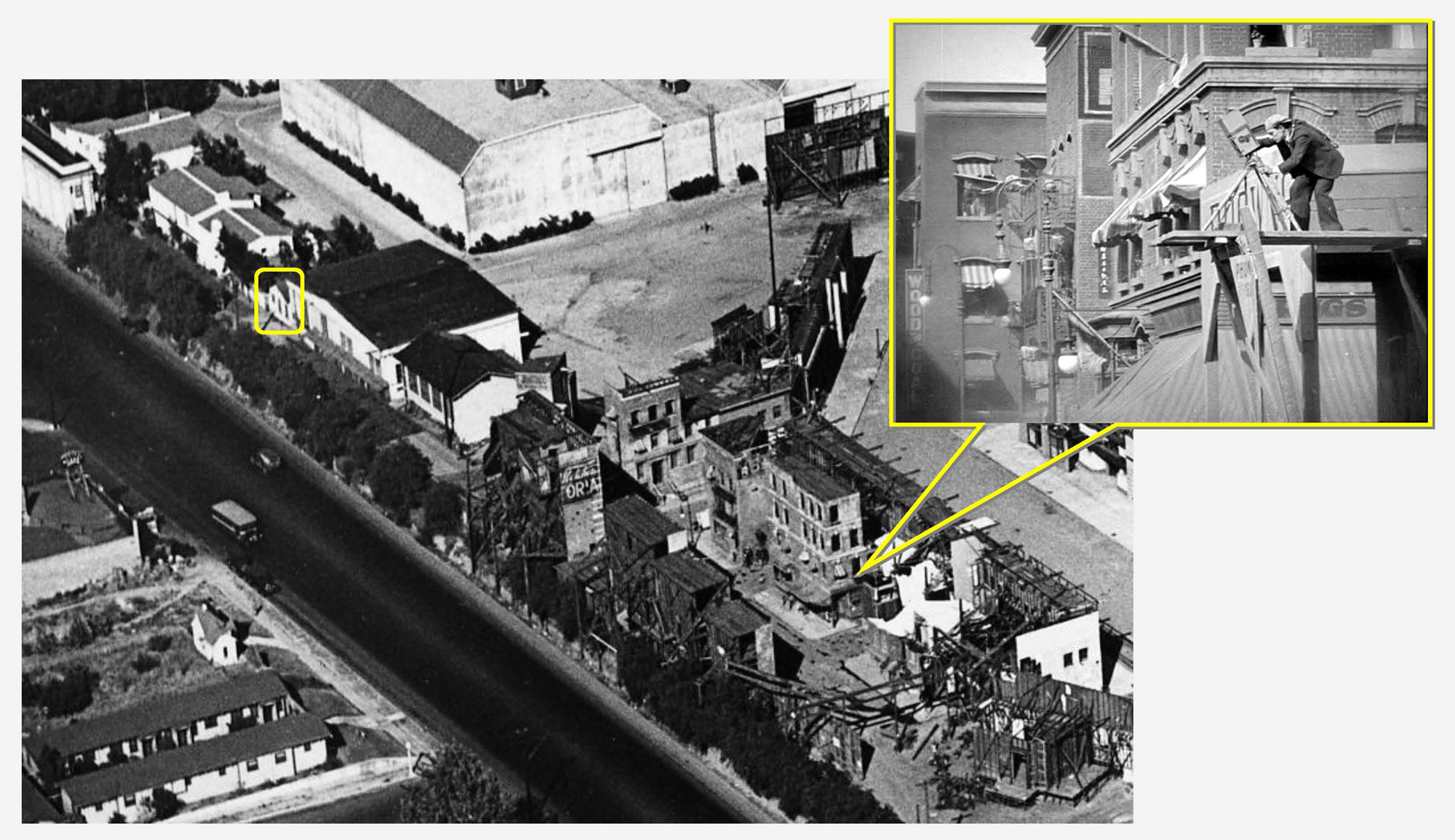
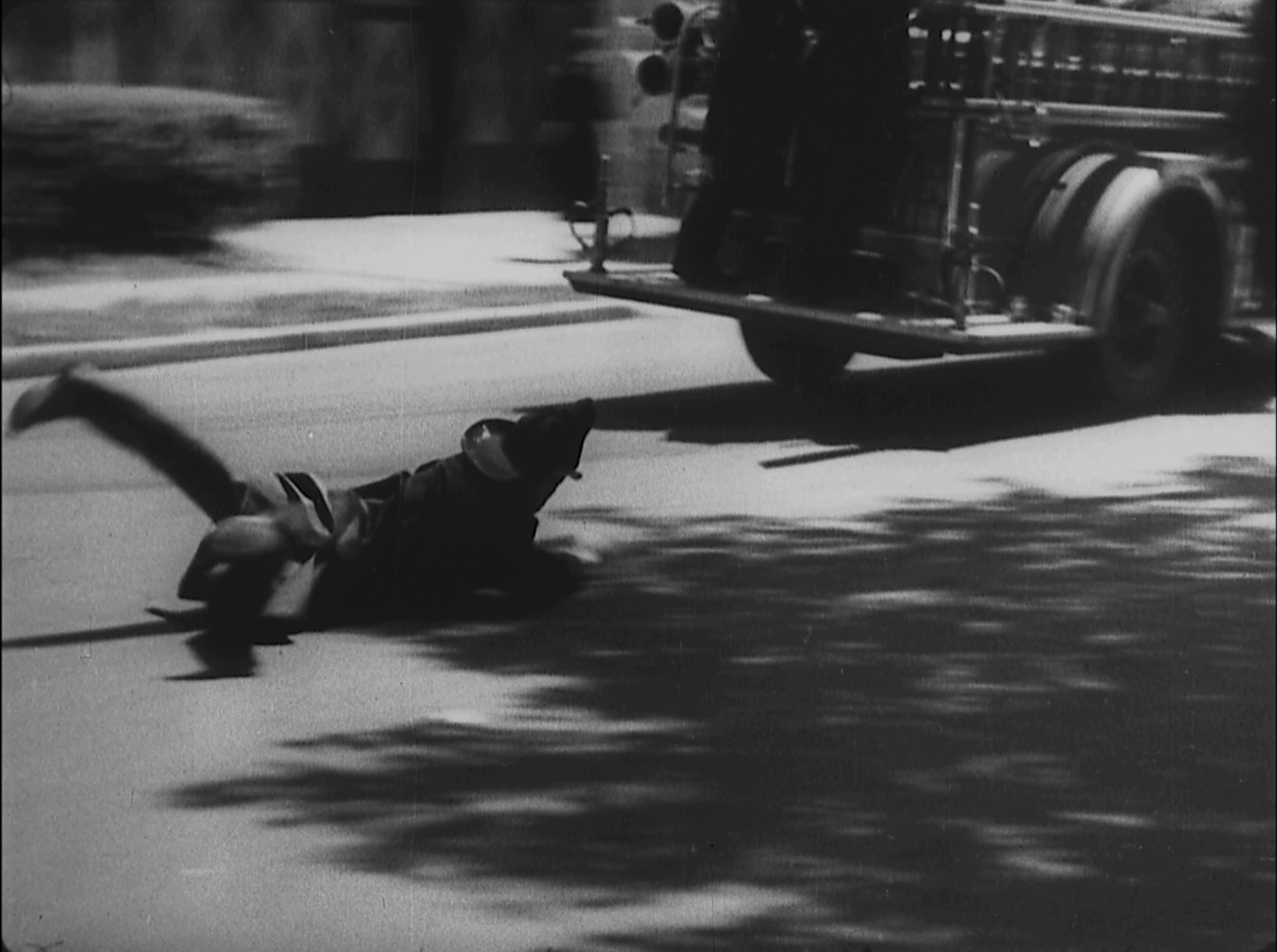
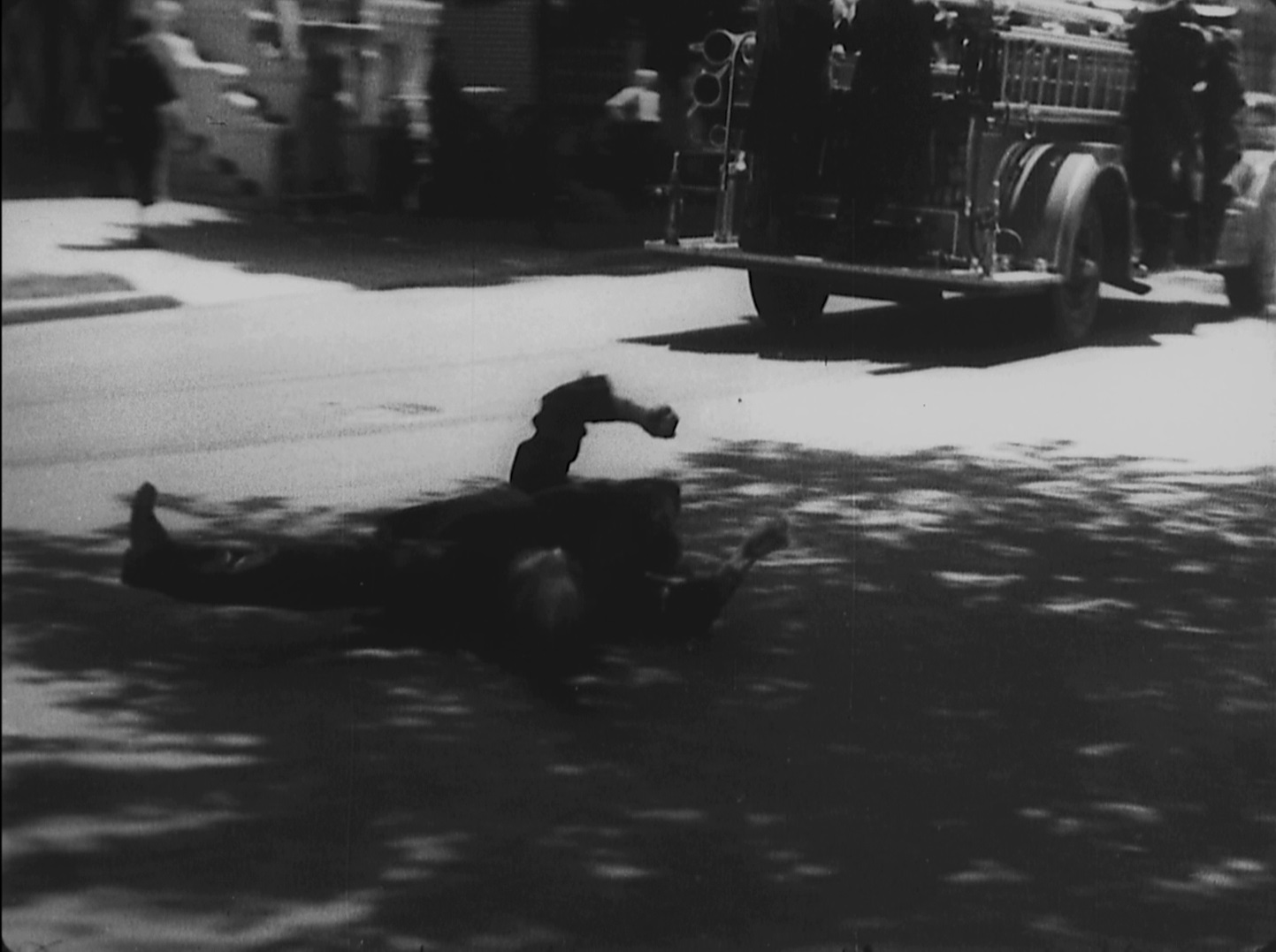
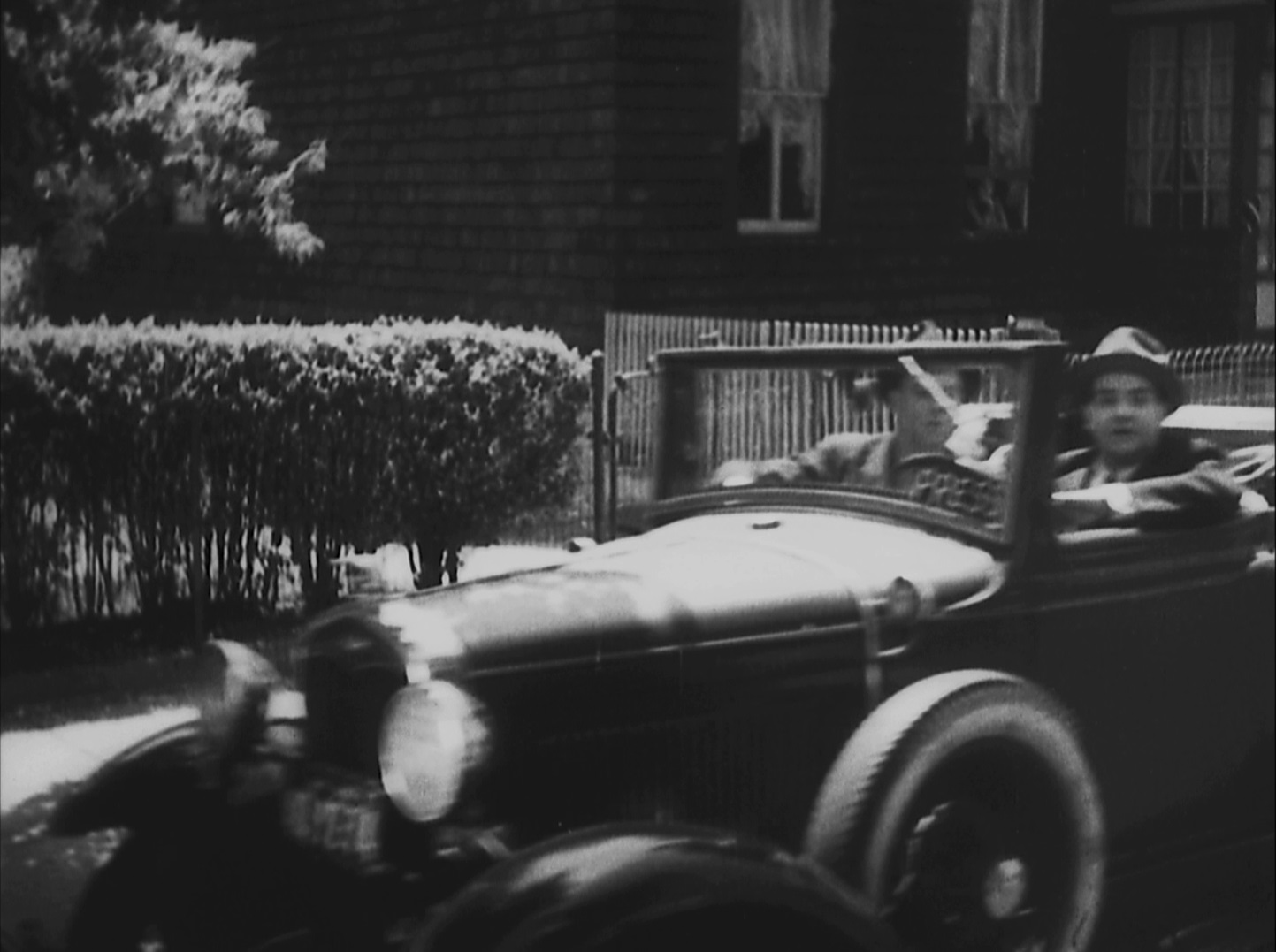
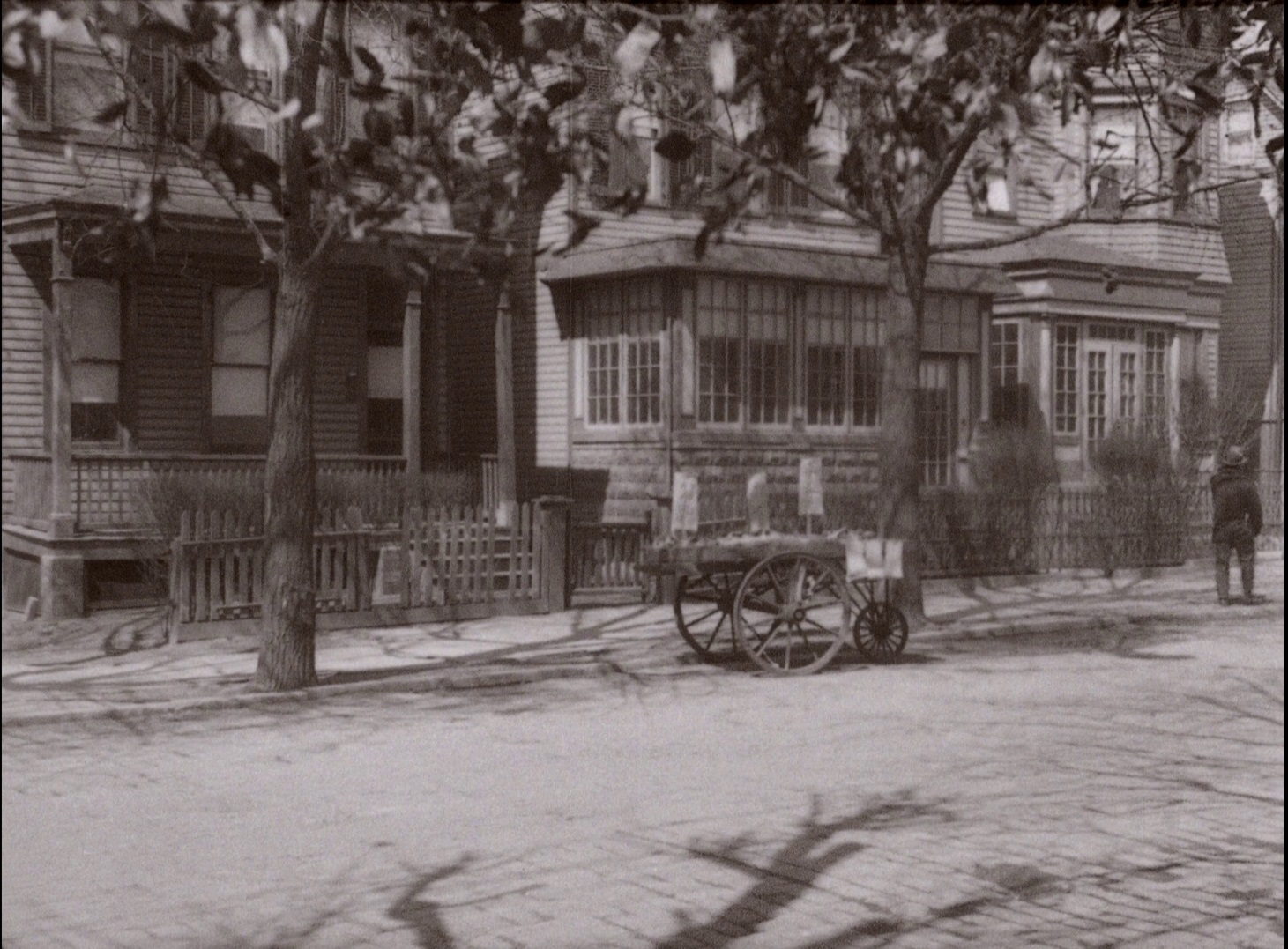
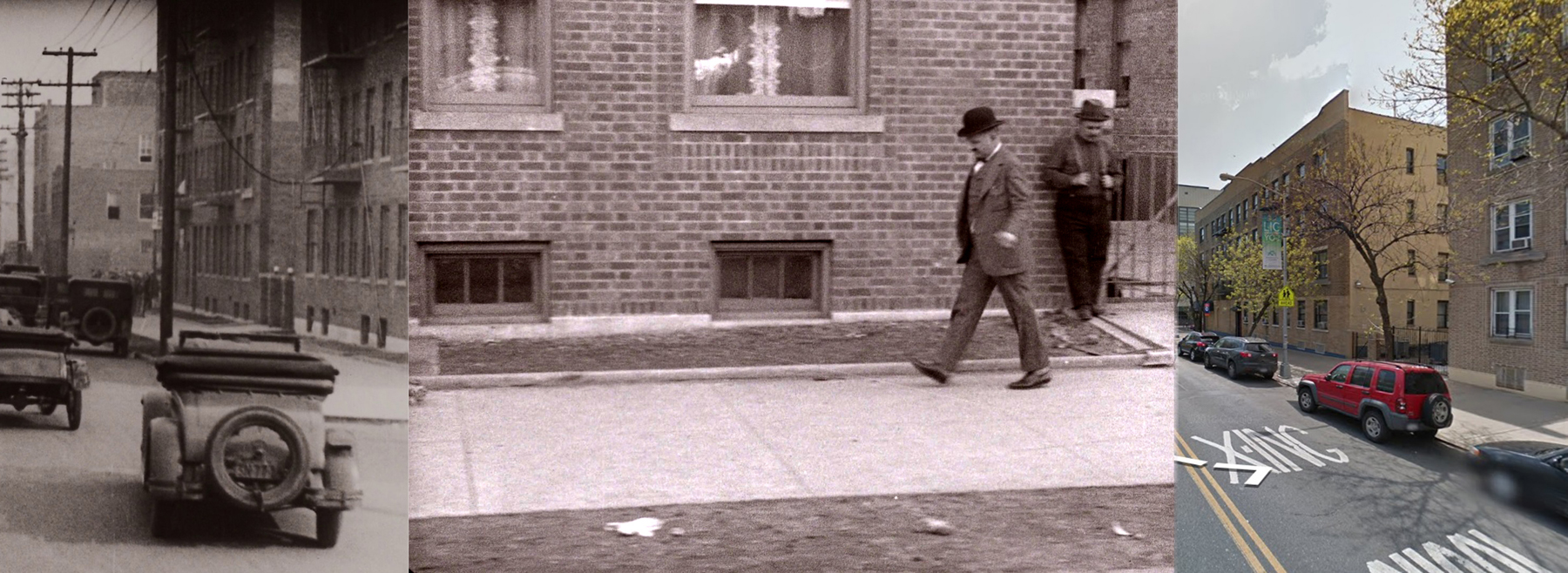
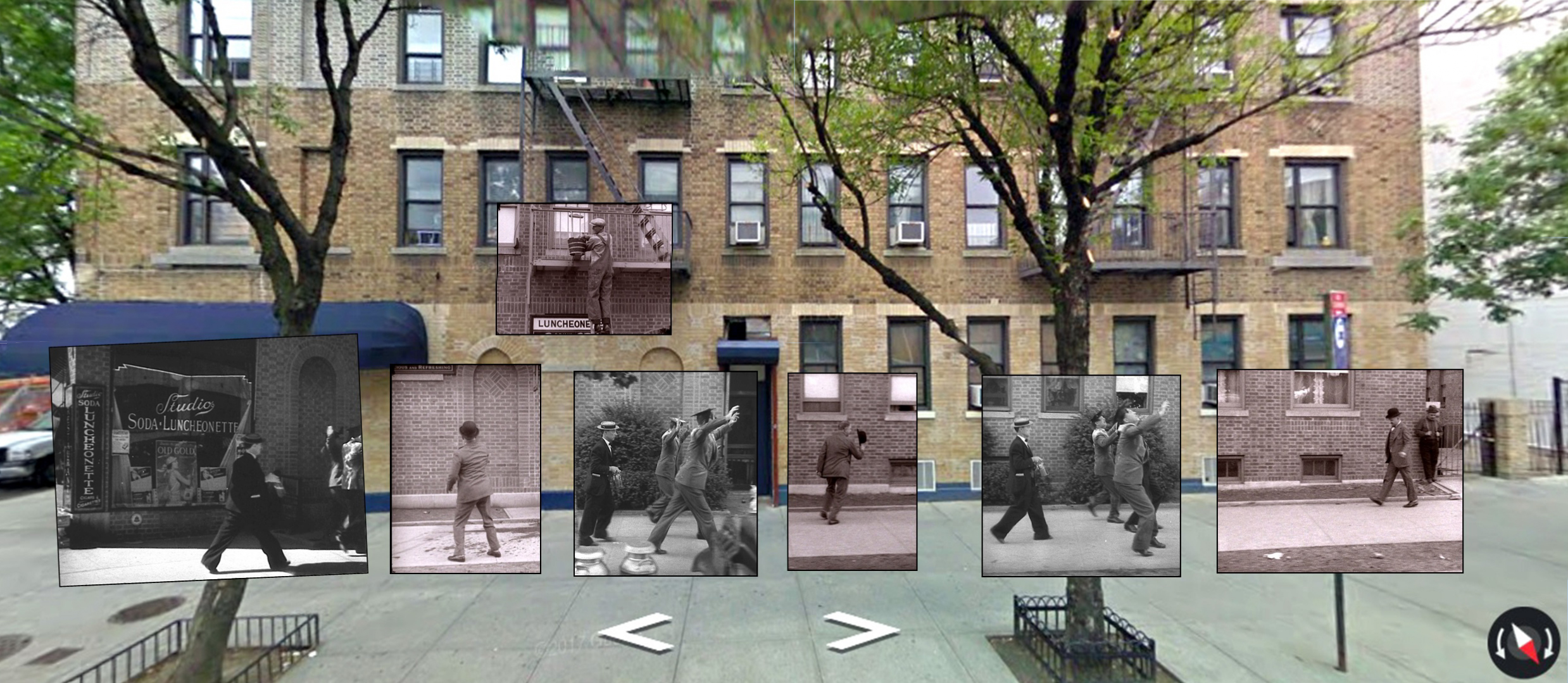
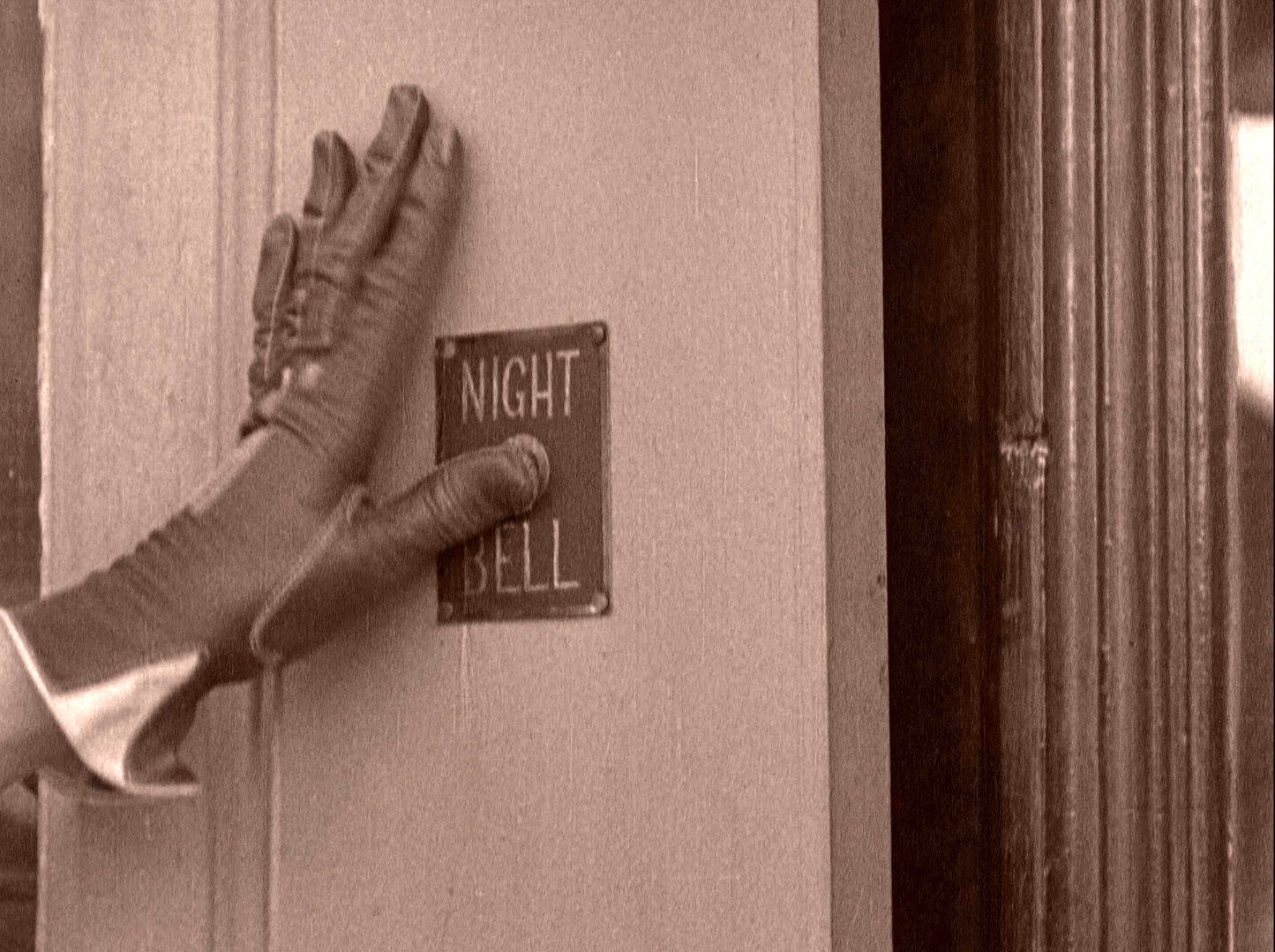
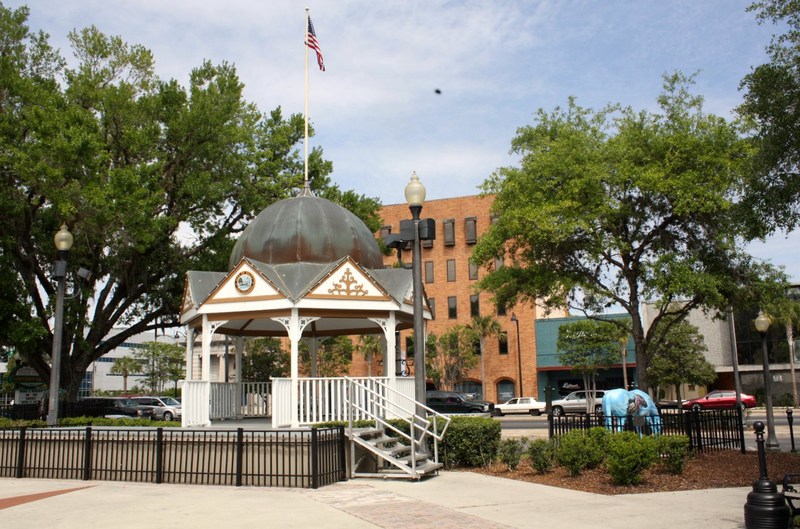
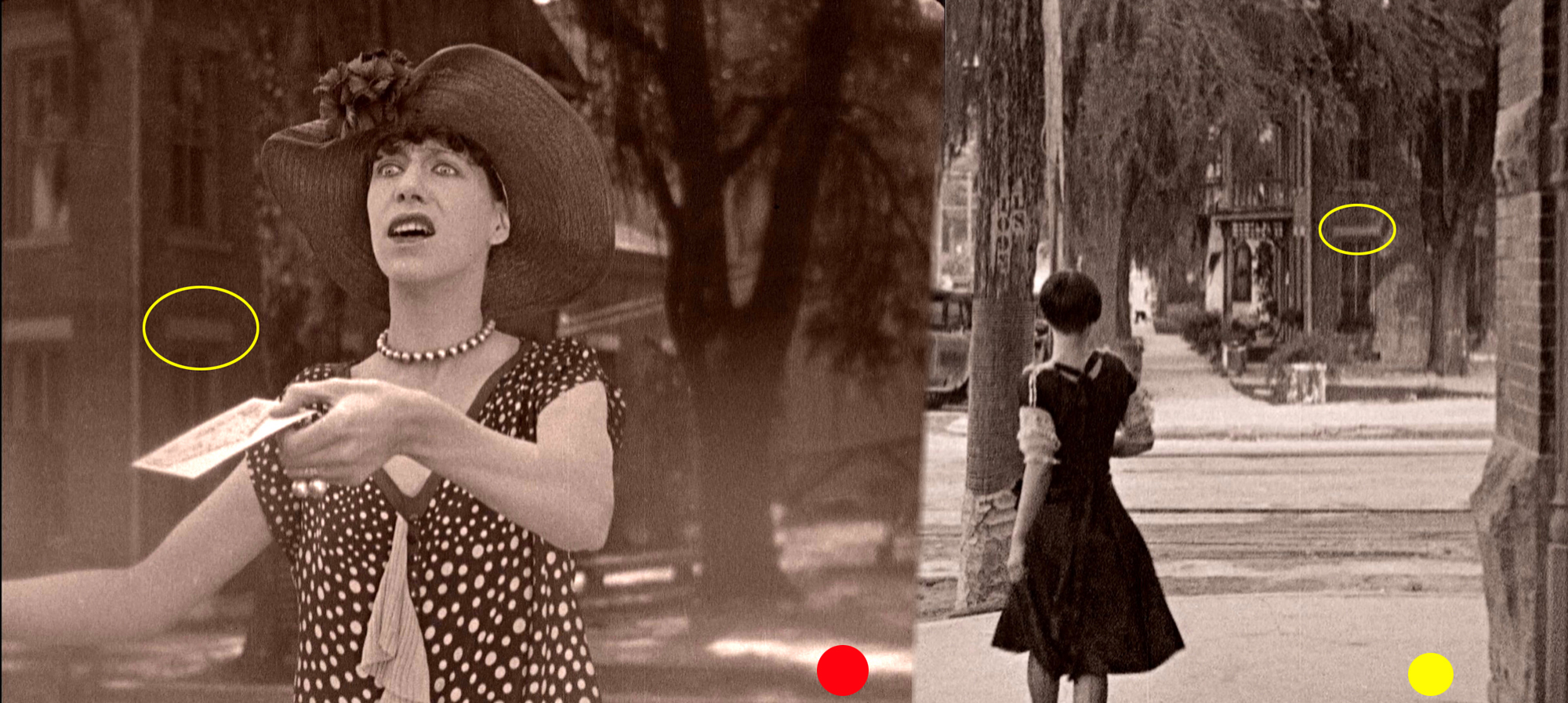
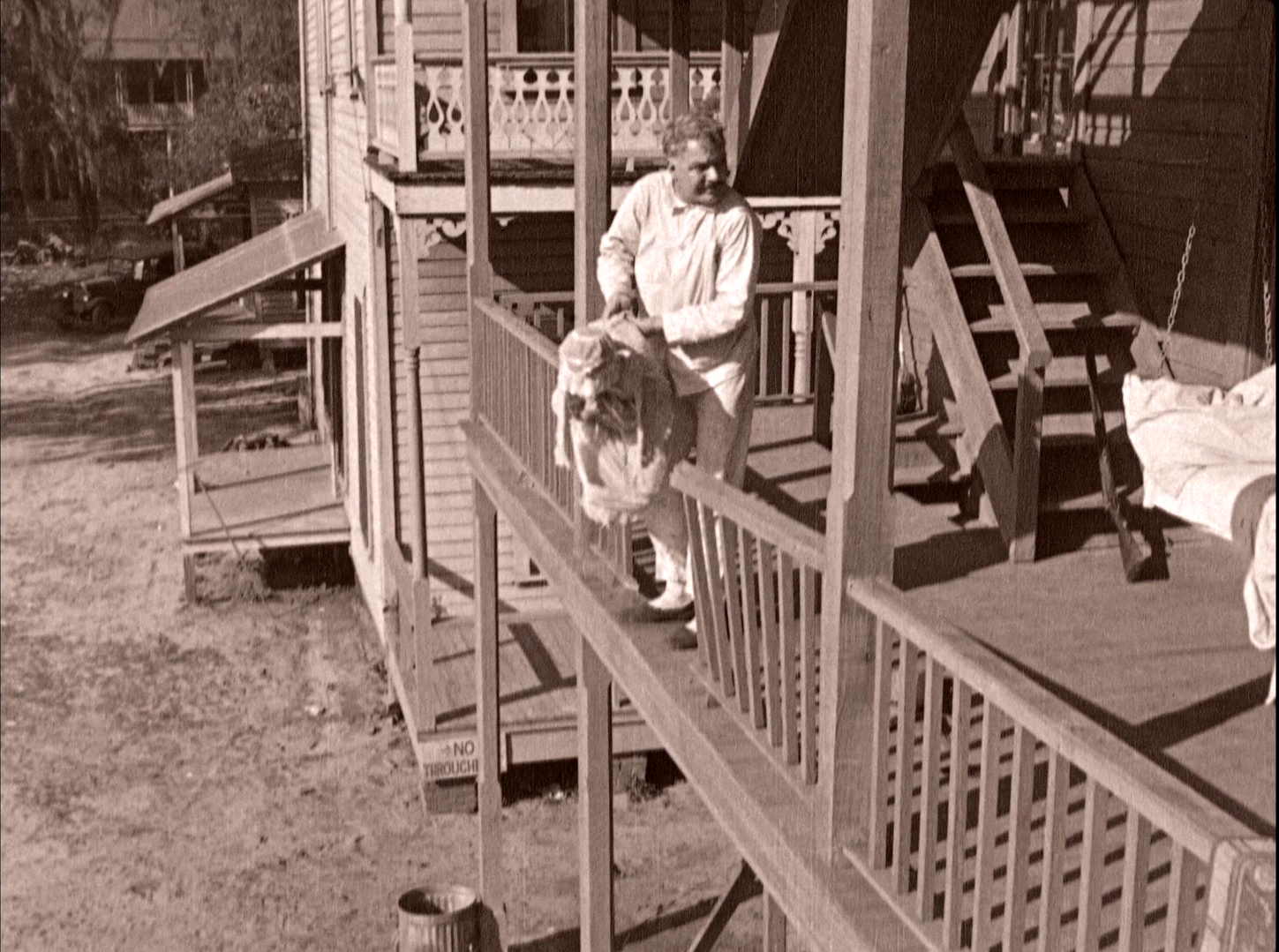
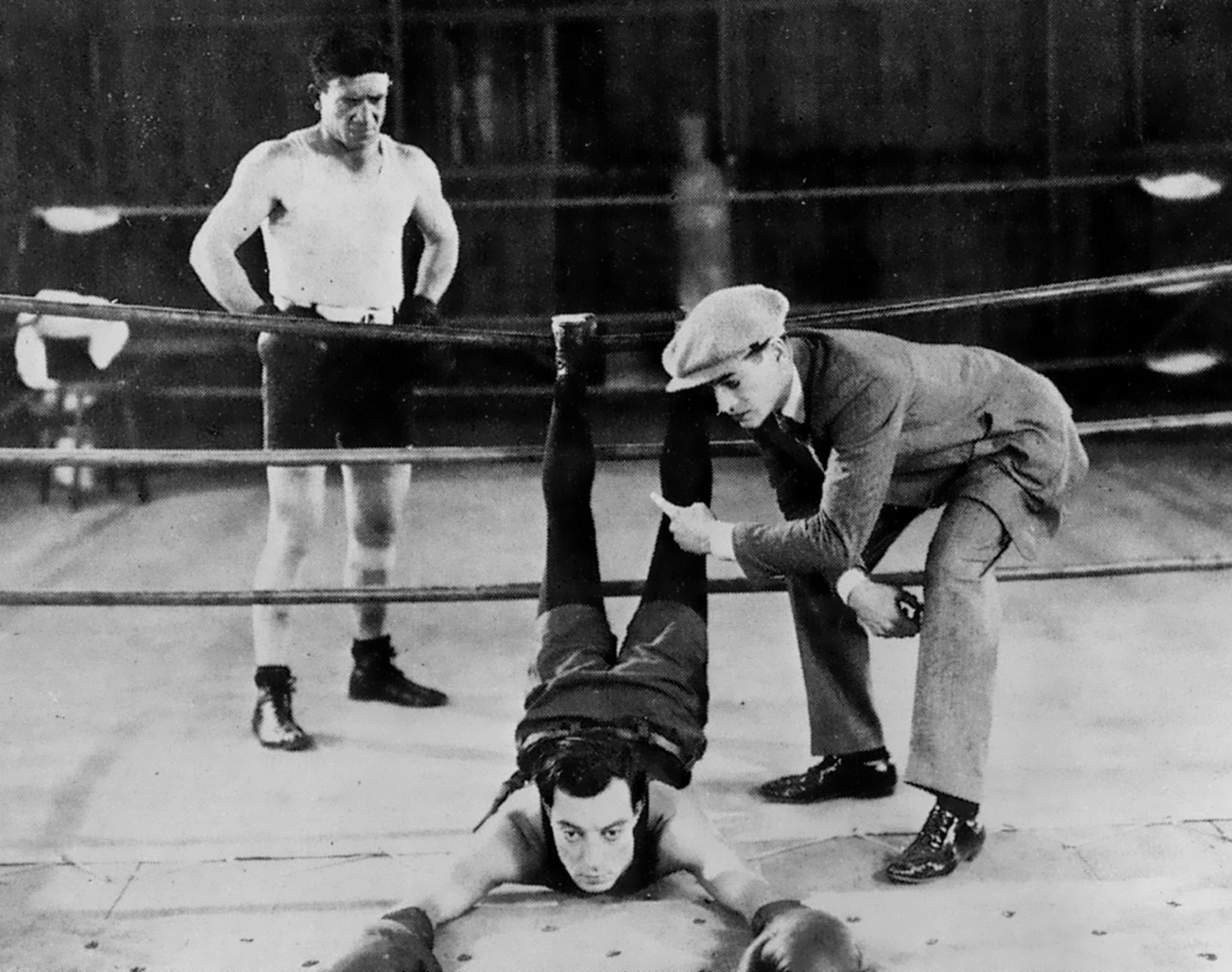
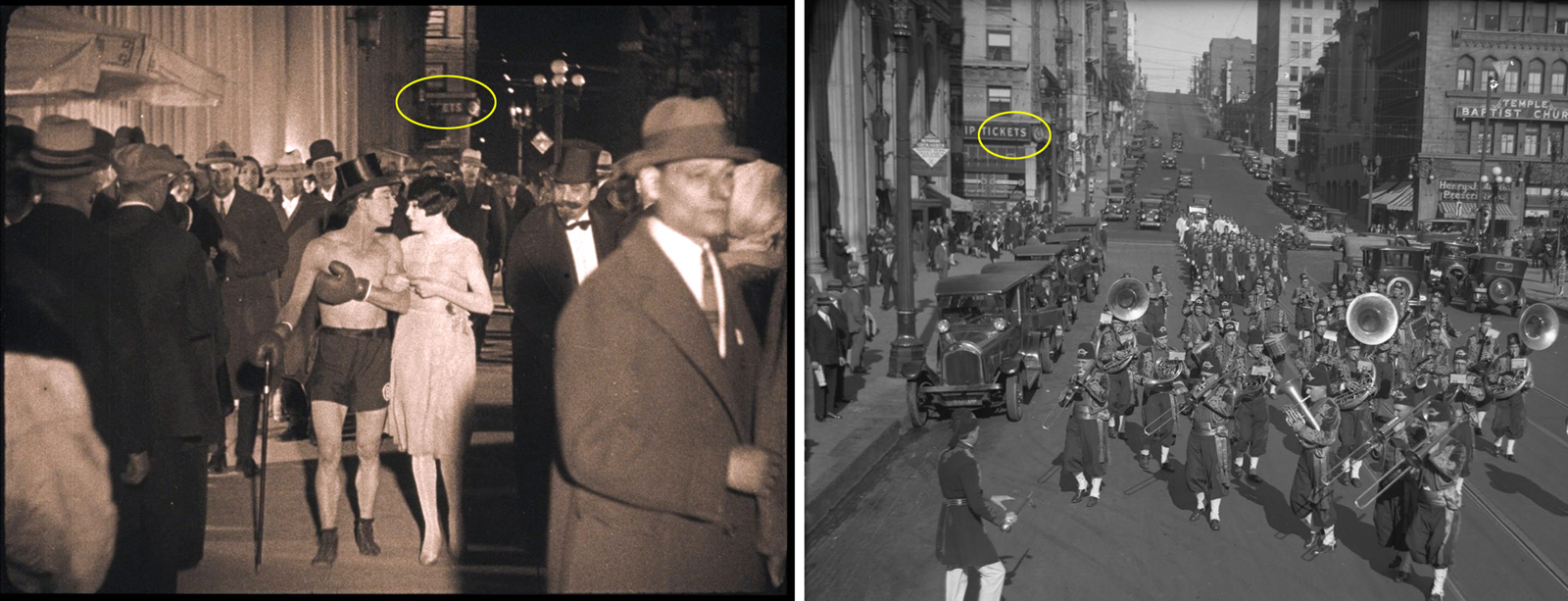
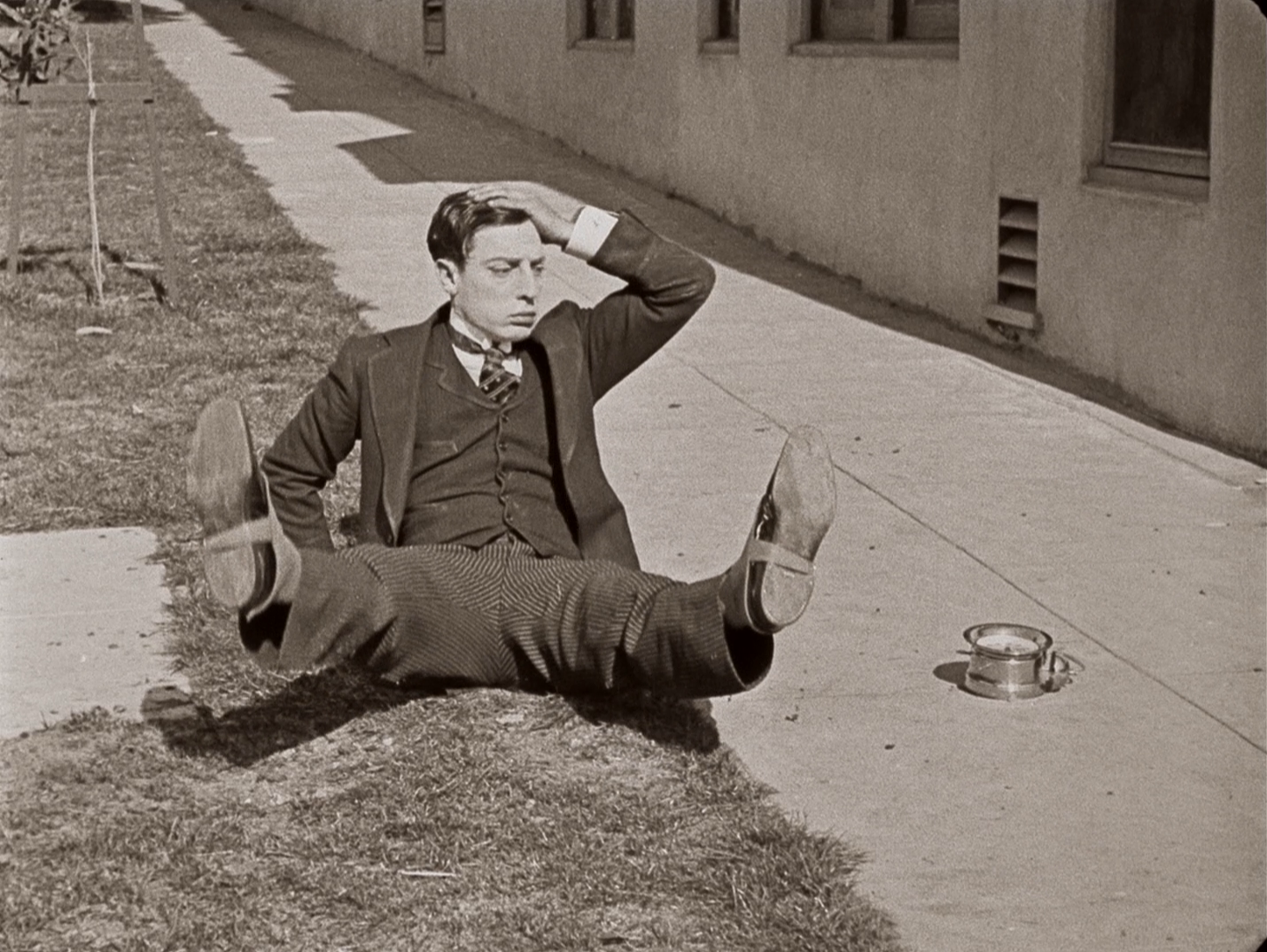
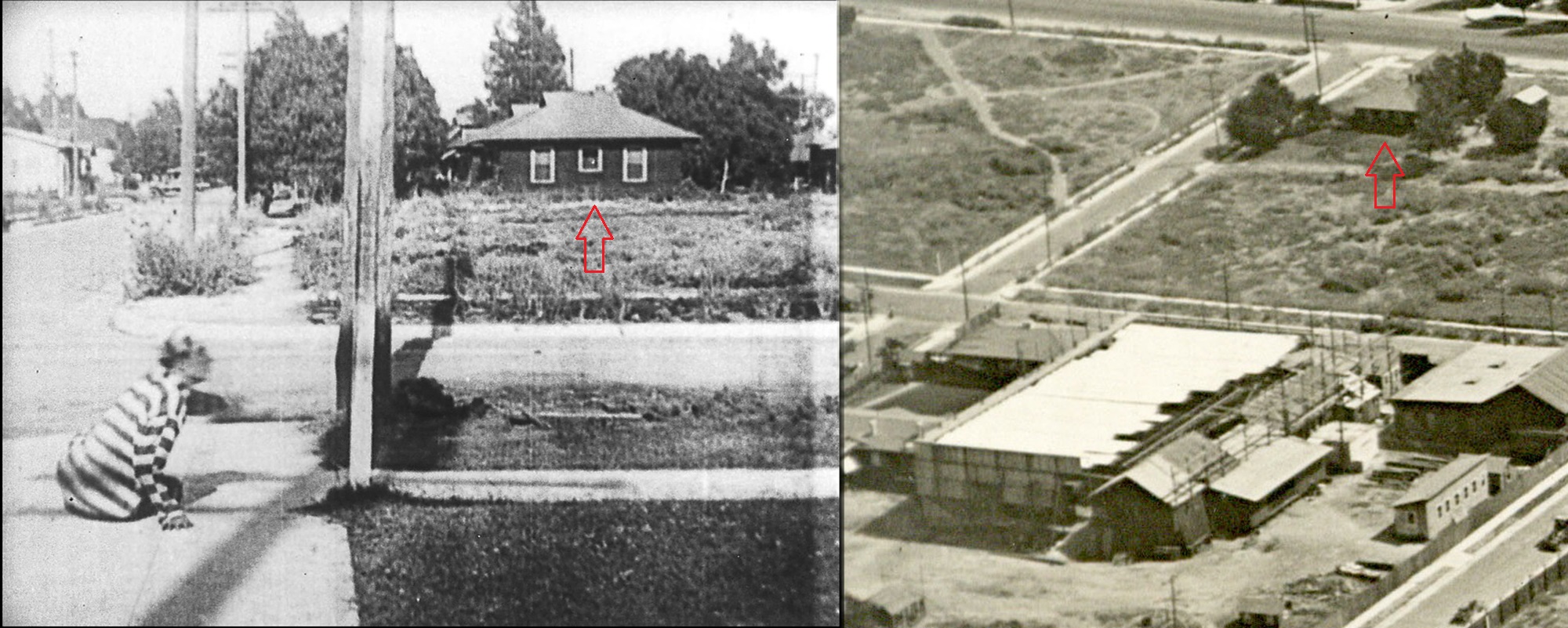
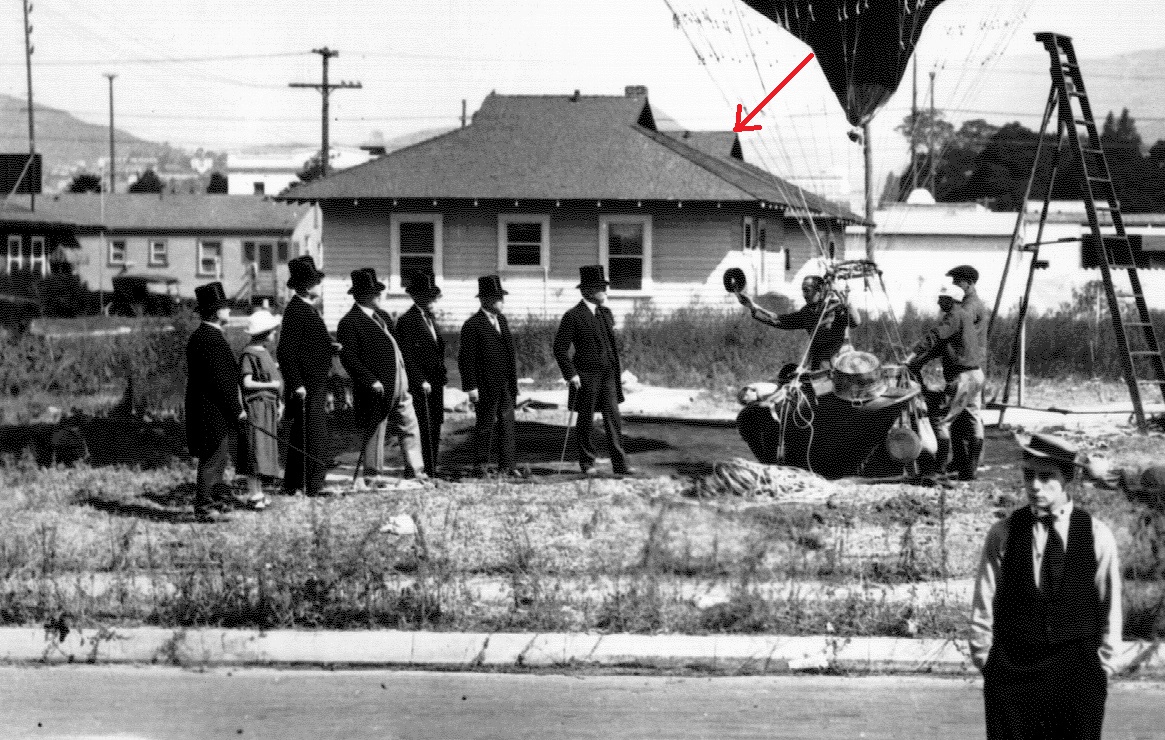
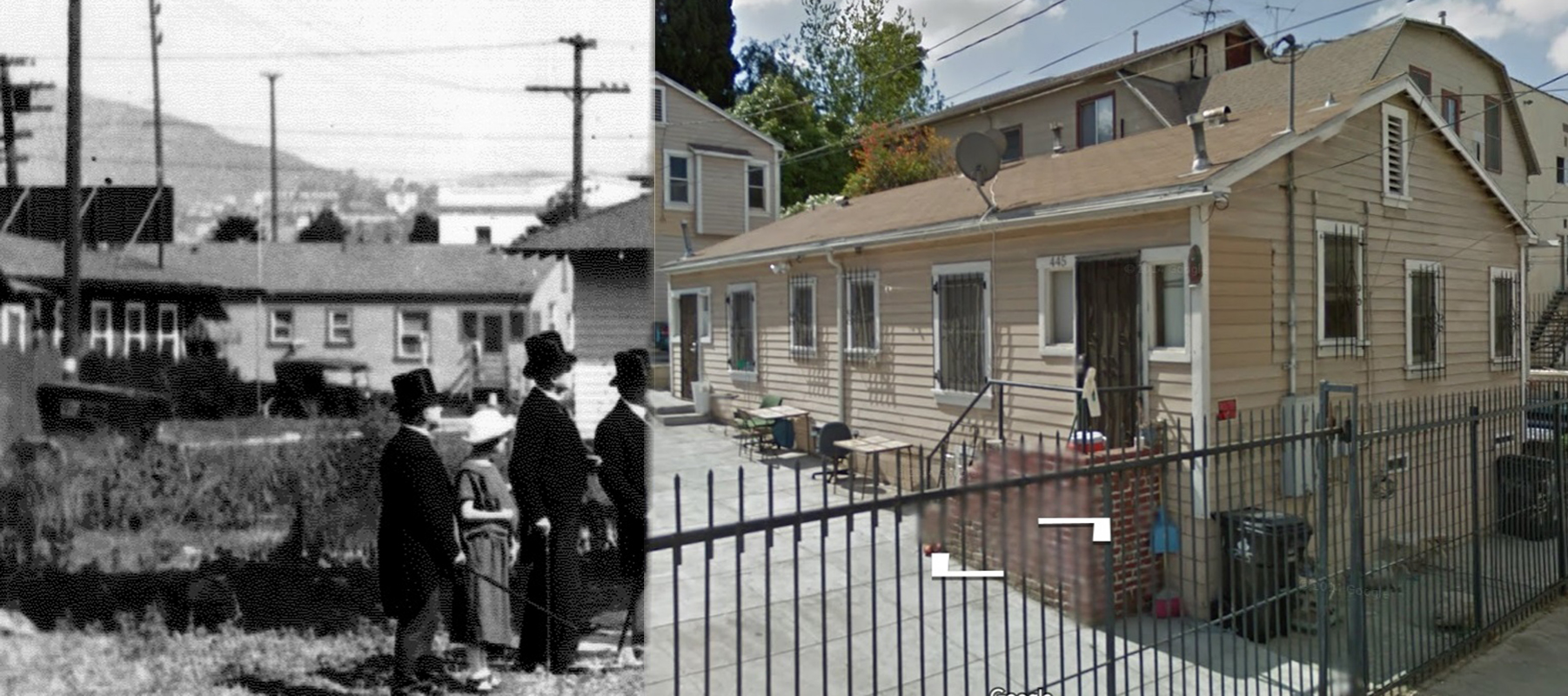
Above, matching views from The Purple Mask (1917), written and co-directed by its star Grace Cunard, and Buster Keaton in Cops (1922), both filmed looking east from Cahuenga just south from Hollywood Boulevard. In all, three early Universal films from the Kino Lorber set were filmed here.

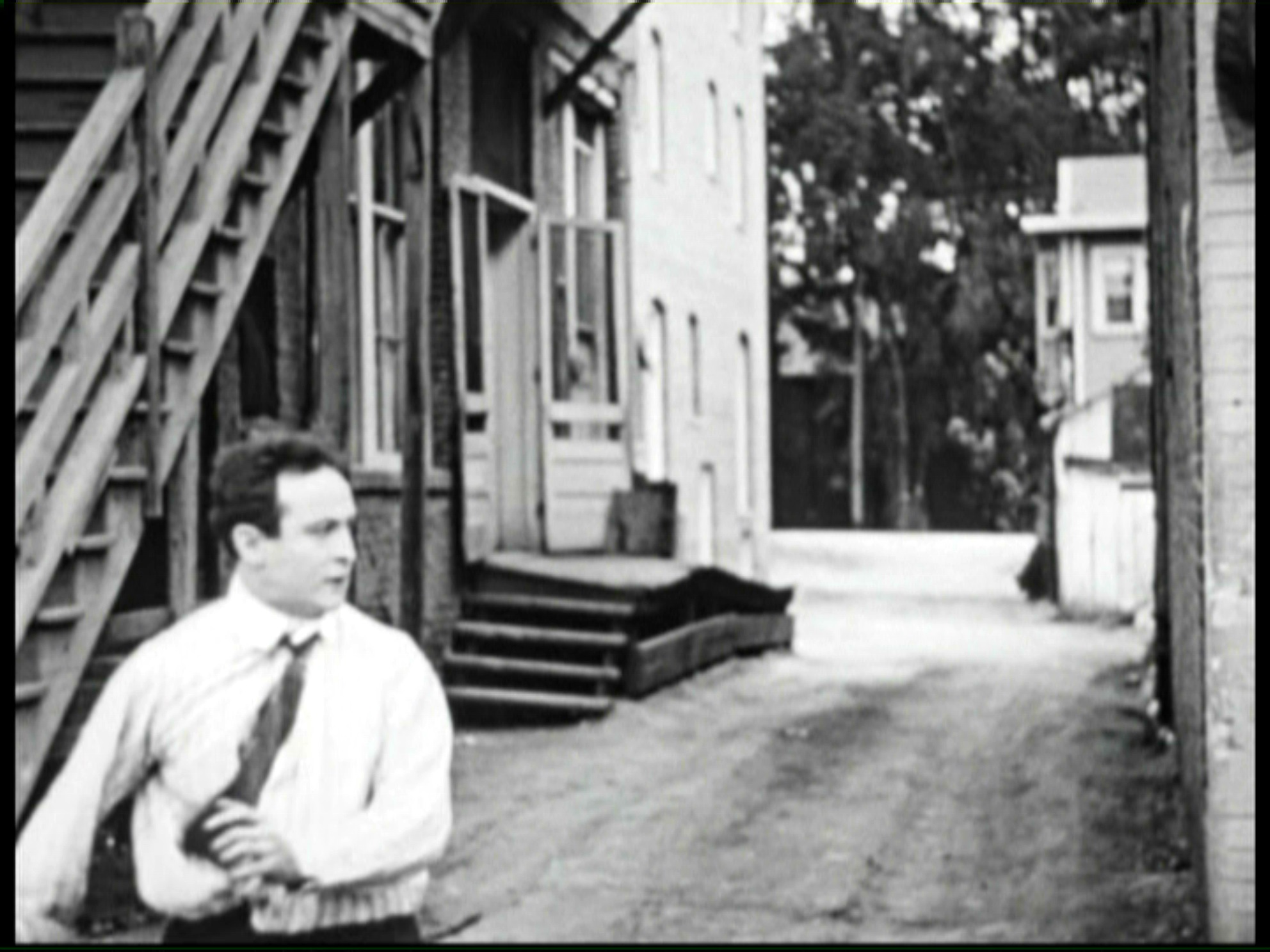
A trio of views, The Purple Mask, Harry Houdini in The Grim Game (1919), and Buster in Cops. It makes you wonder, if three early surviving Universal films were made here, as well as Houdini’s early Paramount release, how many films that don’t survive were made here as well? Perhaps a dozen? More?

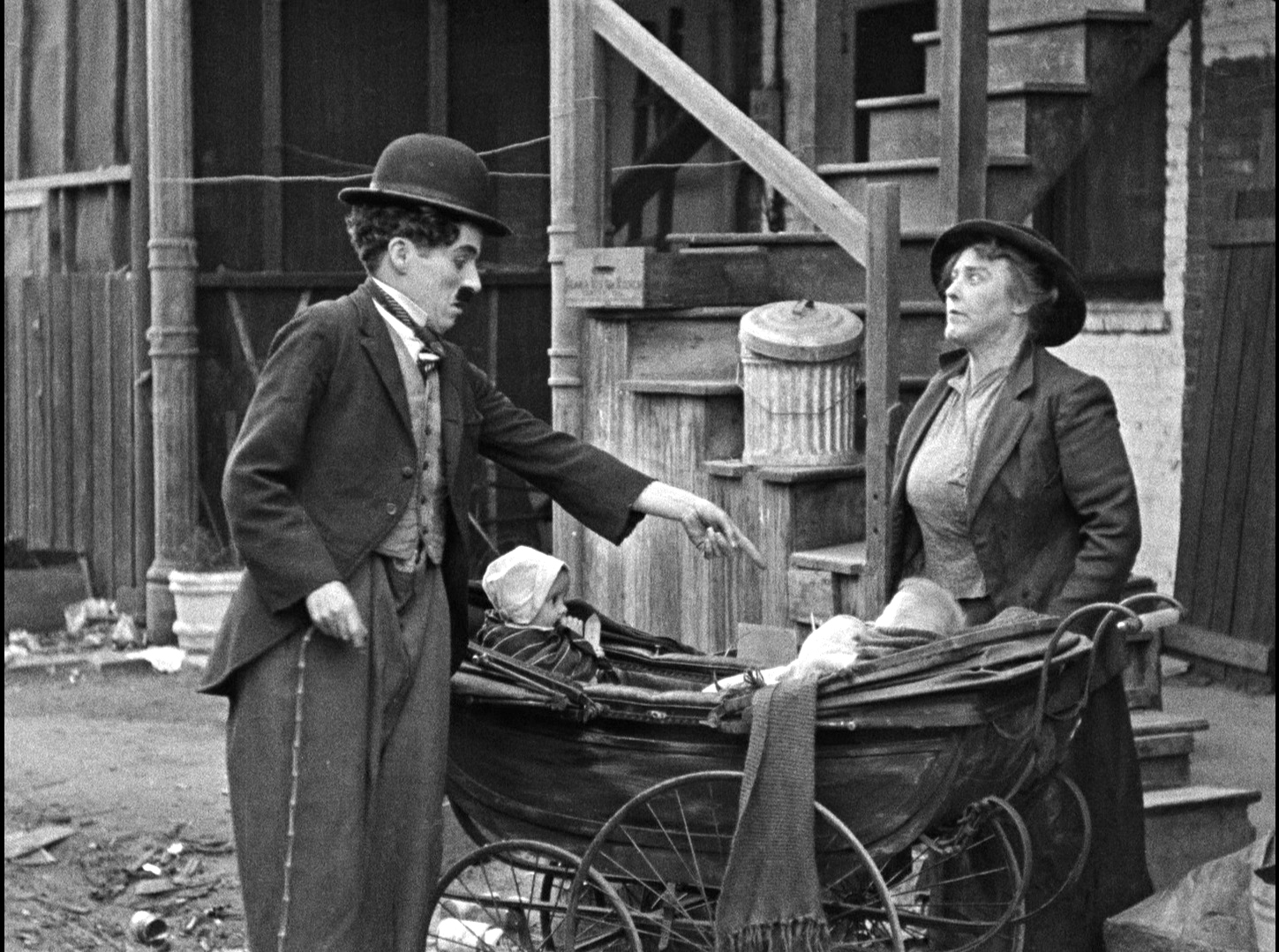
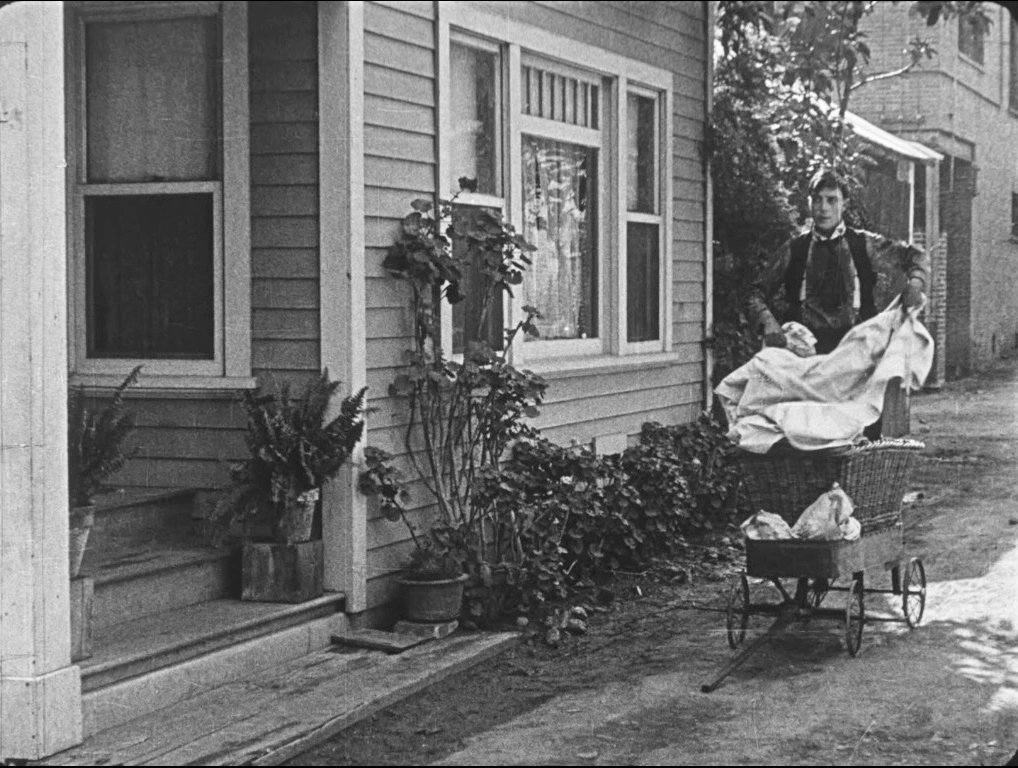
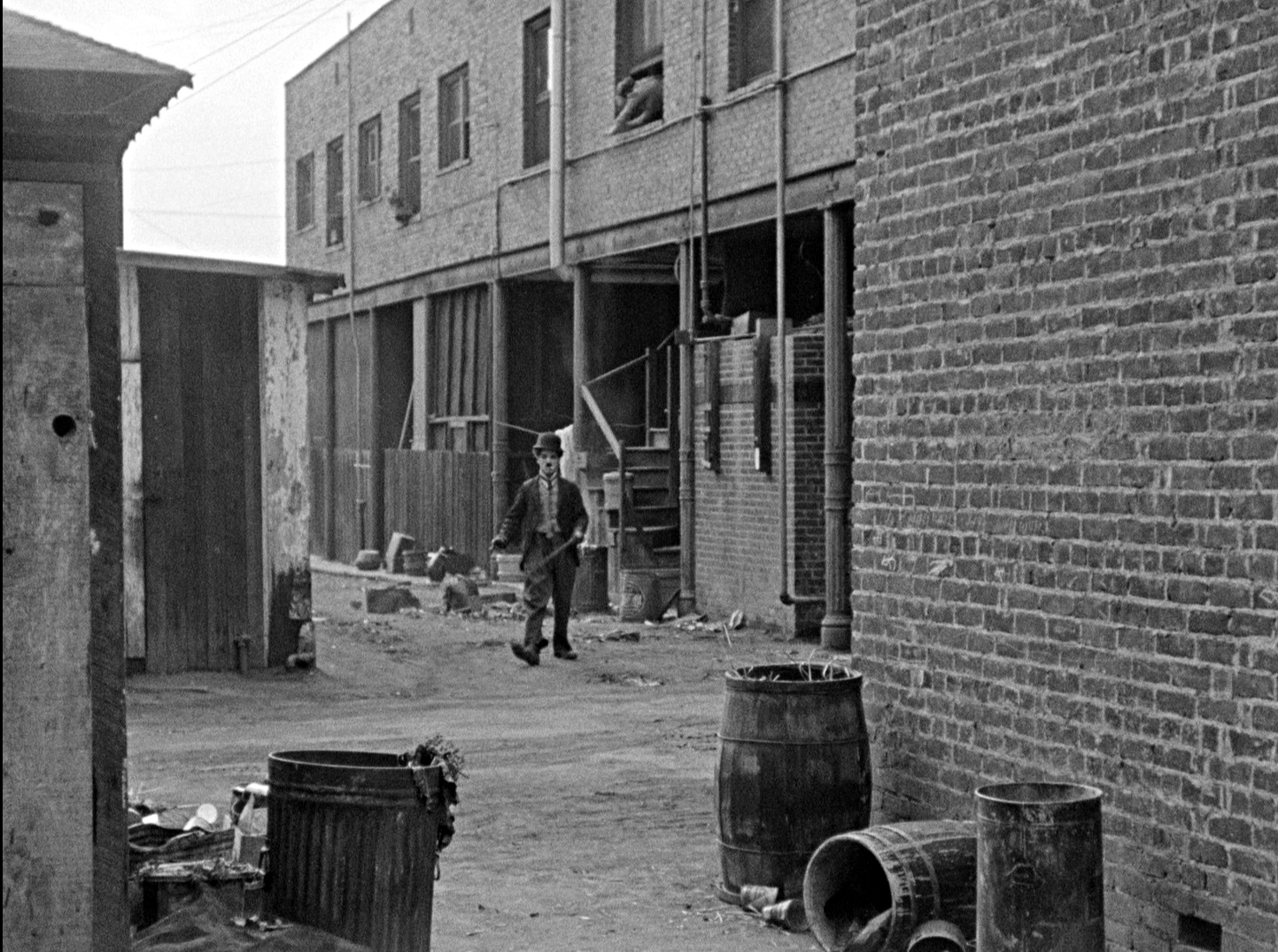
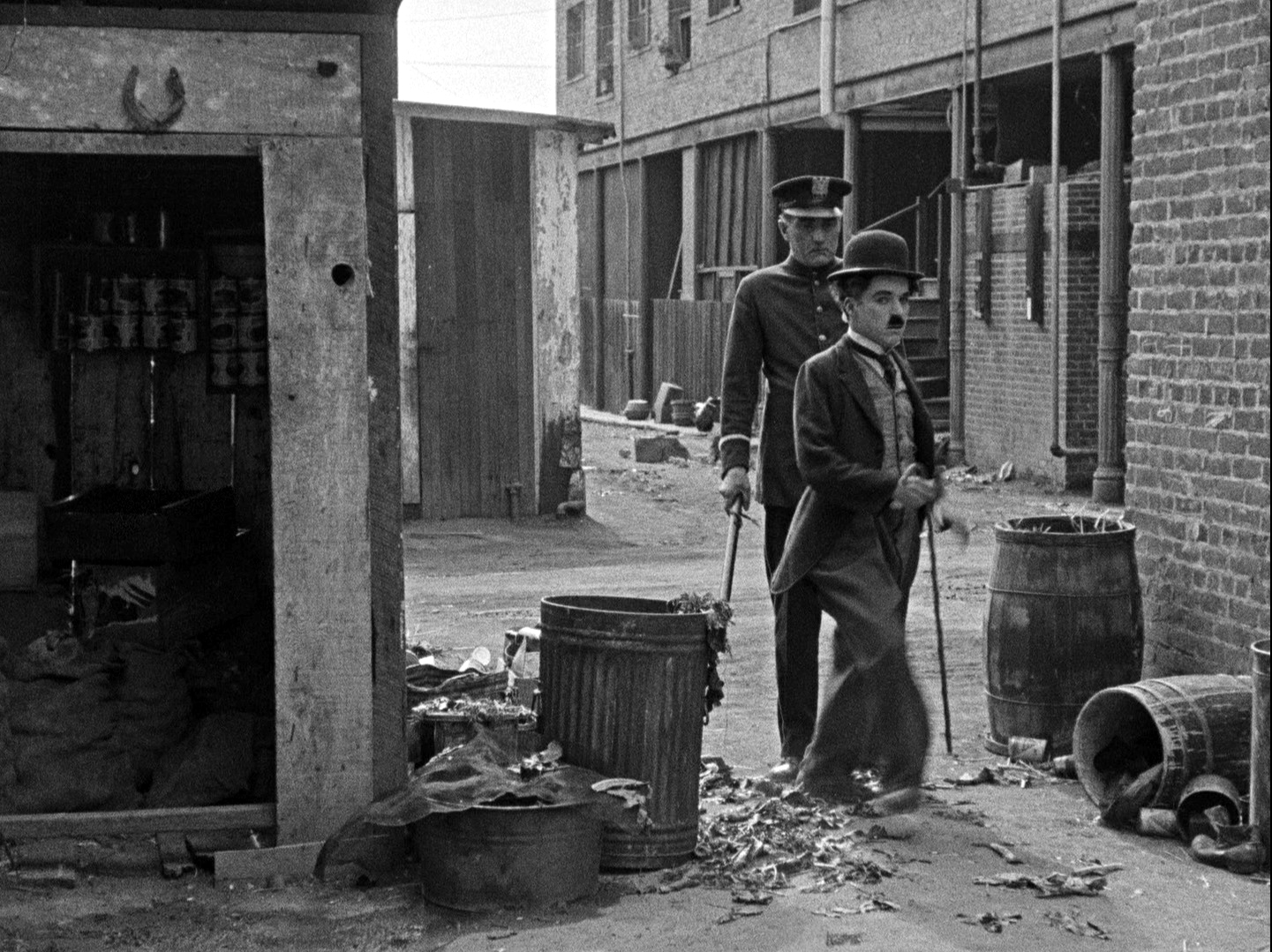
The alley is T-shaped, the east-west part with Buster appearing above. Here now is the north-south part, looking south at the back of some brick ovens appearing with Grace Cunard in The Purple Mask, and with Chaplin in The Kid (1921). Hollywood was sparsely developed during the mid-teens of the last century. The intersection of Hollywood Boulevard and Cahuenga was one of the few commercial corners in town. Since Universal was close by, the alley was likely used out of necessity or convenience. The Famous Players – Lasky Studio, where Houdini filmed The Grim Game, was closer still, just a couple of blocks away.

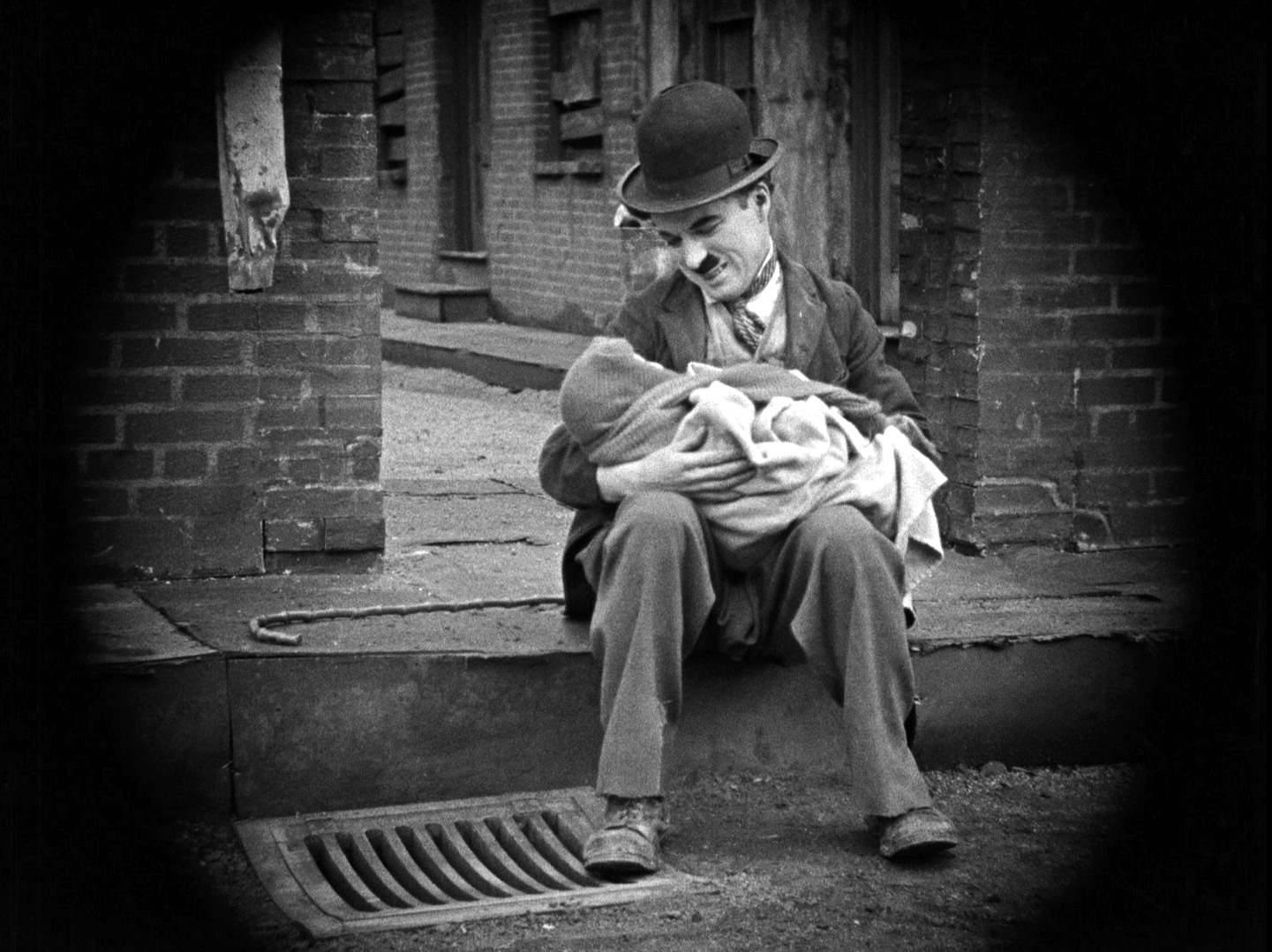
Looking north up the alley, from Eleanor’s Catch (1916), starring and directed by Cleo Madison, and Charlie in The Kid. Twenty years ago, before hundreds of silent films became available to home viewers, I’d struggle to find a single location in a single film. Once solved, it somehow felt this must be the setting’s unique appearance on film. These early Universal films completely destroy this false assumption. Instead, it makes perfect sense that these locations were commonly known and frequently used. Thus, when Chaplin, Keaton, and Lloyd filmed here (for a total of at least six different films), they weren’t pioneers capitalizing on their own clever sense of locales. They were simply filming where everyone already knew to film.

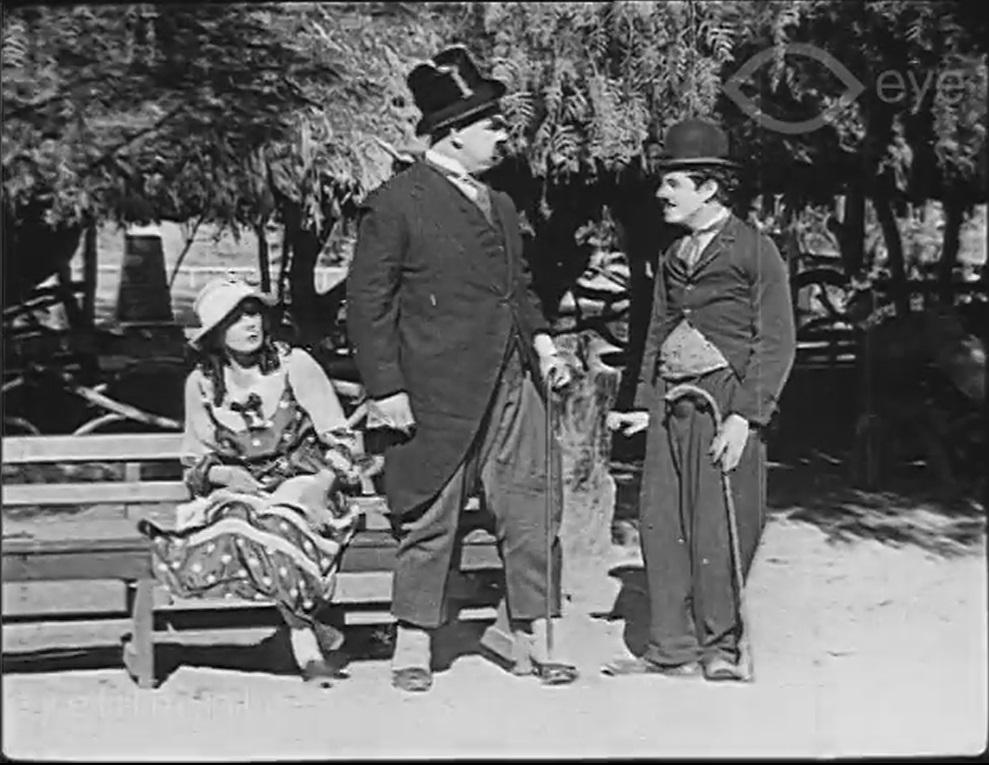
A closer view of the alley stairs, from co-director Lois Weber’s Where Are My Children? (1916) and Charlie and Minnie Stearns in The Kid.

Another trio, Gale Henry in her self-produced comedy The Detectress (1919), Charlie and Minnie, and a scene from a later movie, The Last Edition (1925), a film that makes great use of the alley, and the common thread that originally tied all of the alley discoveries together.

Views looking west down the alley from Cosmo towards Cahuenga, The Purple Mask at left, and Buster Keaton’s Neighbors (1920) at right. Notice the white shed to the right of center in both shots. The far side of Cahuenga across the street has no buildings in the 1917 view. Notice too the corner pole left of center in the Keaton frame – it appears below.

This cast iron corner pole is still present, appearing in 1916 in Eleanor’s Catch, beside Lisa Marie as Vampira in the Johnny Depp biopic Ed Wood (1994), and a modern view today.

Three views looking west towards Cahuenga showing the back of the alley loading dock, in The Purple Mask, Eleanor’s Catch, and The Detectress.

Above, the Cahuenga entrance to the alley appearing with Colleen Moore disguised as a man in Her Bridal Nightmare (1919), and a scene from the Al Christie comedy Hubby’s Night Out (1917) linked on YouTube.

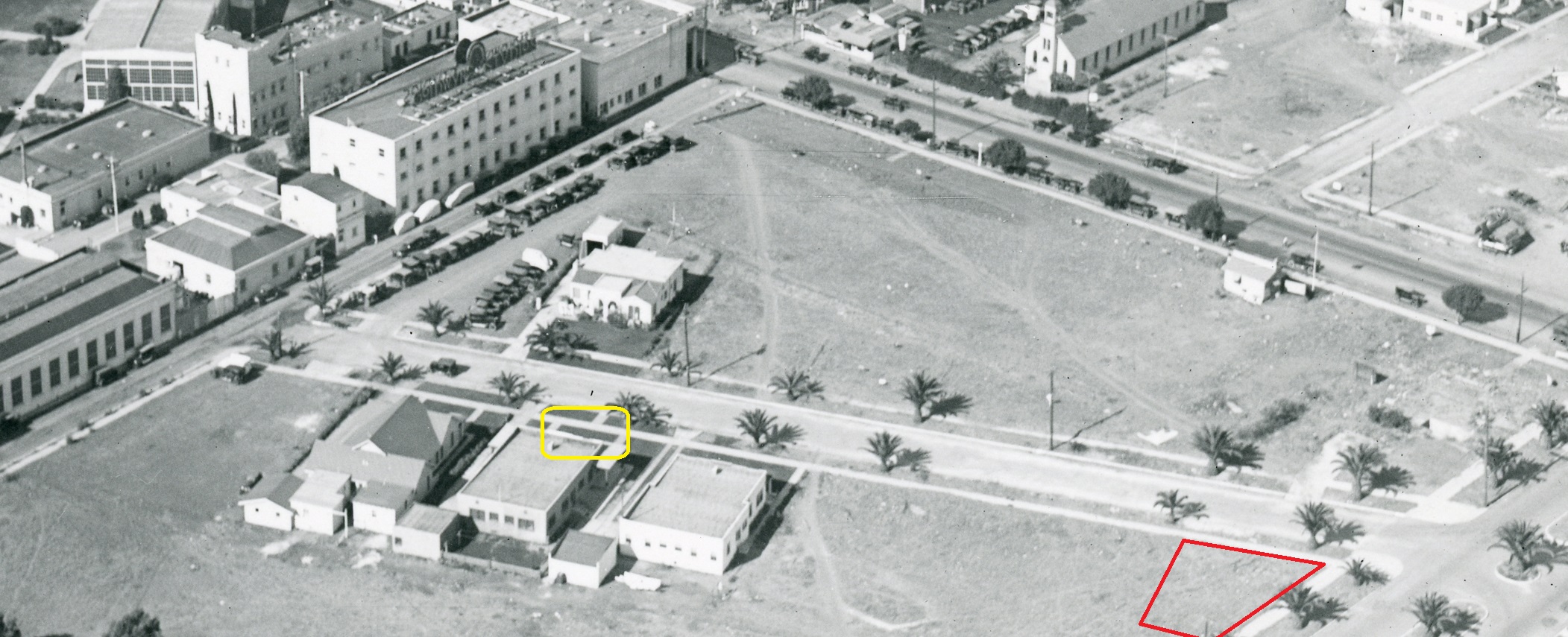
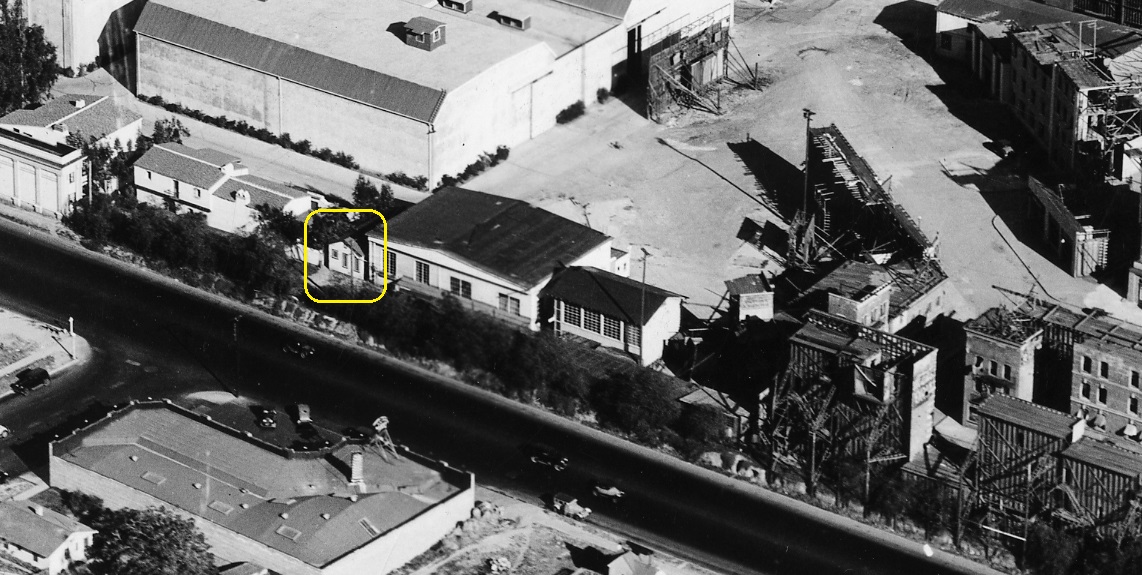
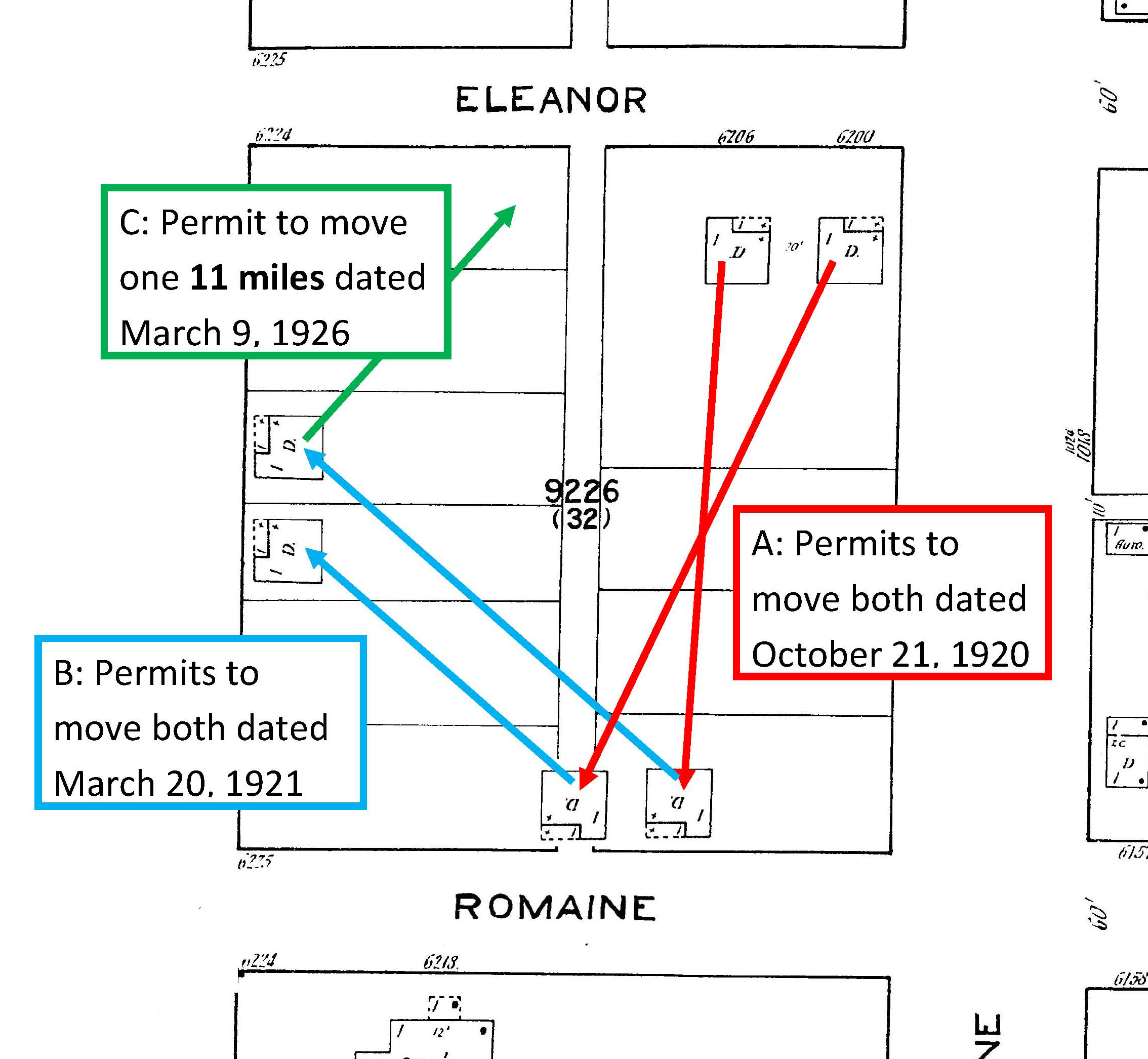
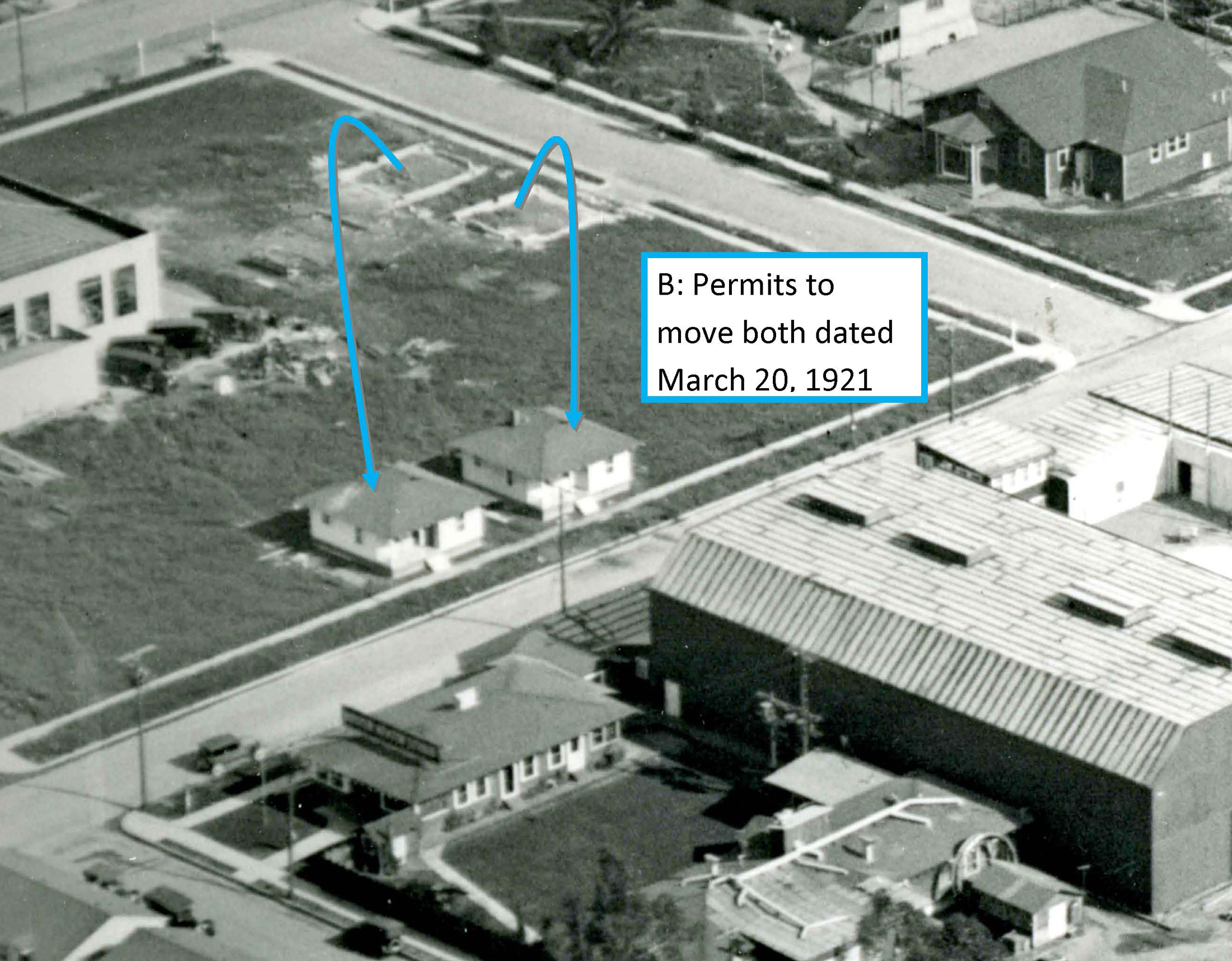
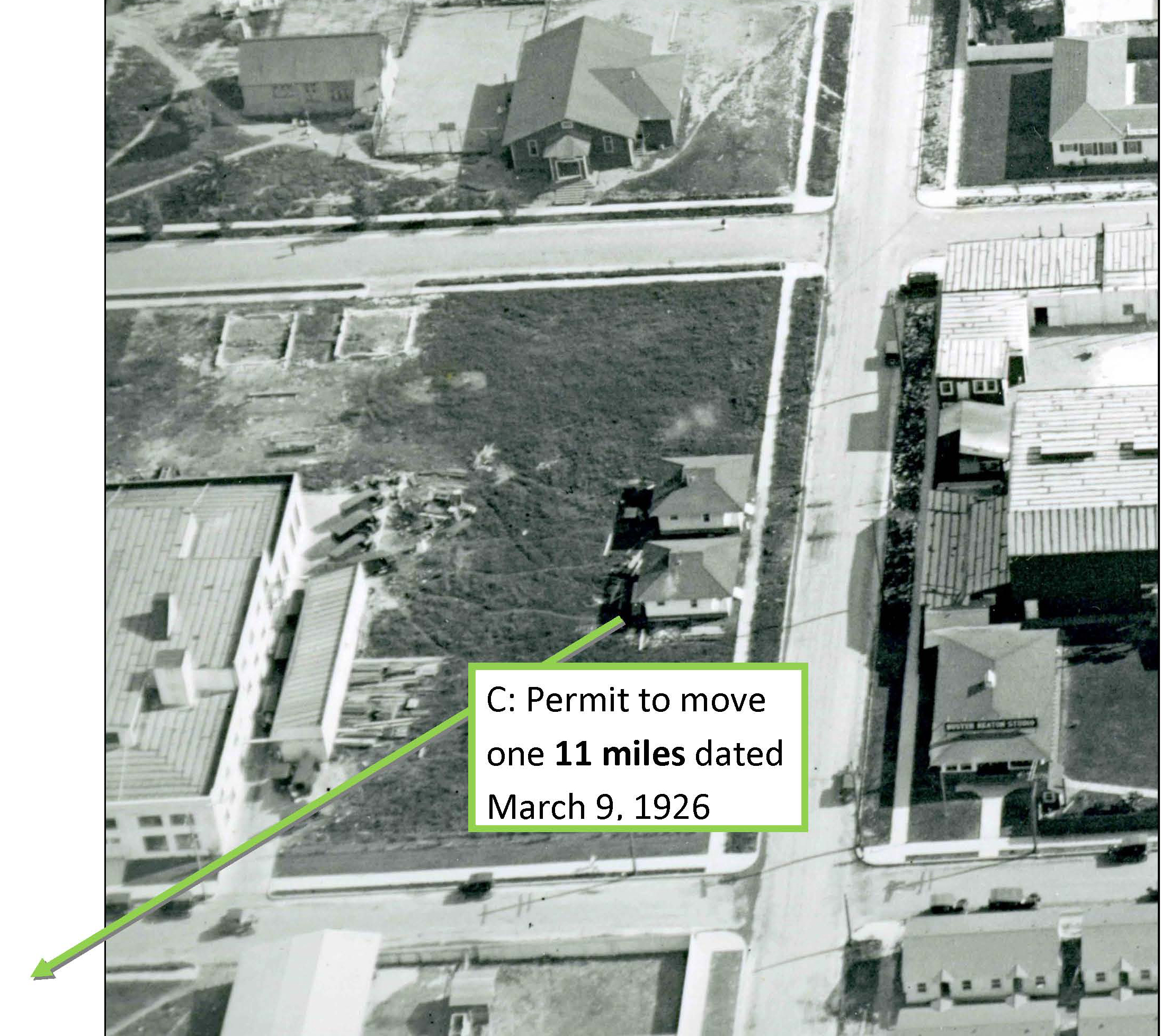
Above, a 1919 view of the T-shaped alley. When Chaplin filmed scenes for The Kid here, the studio records note that on December 1, 1919, he filmed at “Hall’s grocery,” and the next day at “Hall’s alley.” Christopher C. Hall owned a grocery store at 6382 Hollywood Blvd., that backed onto this alley. Further, in 1913 he built the distinctive two story home on the alley at 1645 Cosmo (oval photo above), just steps from his store. So “Hall’s alley” was an appropriate name. The star above marks where the camera stood on Cahuenga to film the back of Mr. Hall’s home appearing in these three scenes above. Note: in Keaton’s view above the trees that belonged to the Jacob Stern estate are blocked from view by the Palmer Building on Cosmo nearing completion. At right, Keaton hides in a laundry basket beside Mr. Hall’s home during Neighbors. Notice the corner cast iron pole behind Buster which still remains. The home was demolished in 1956.

Above, more views of  Mr. Hall’s house at 1645 Cosmo from Billy West’s Don’t Be Foolish (1920) linked on the Internet Archive. Check out Kino Lorber Blu-ray release Pioneers: First Women Filmmakers.

Part of the Chaplin-Keaton-Lloyd Alley, a view west from Cosmo towards Cahuenga today, with Mr. Hall’s home long since gone. Zoom to see the corner cast iron pole still standing.

Posted in Chaplin - Keaton - Lloyd Alley, Hollywood Tour, Lois Weber | Tagged , , , , , , , , , , , , , , , | 8 Comments

Chaplin falls for The Kid – every scene now identified

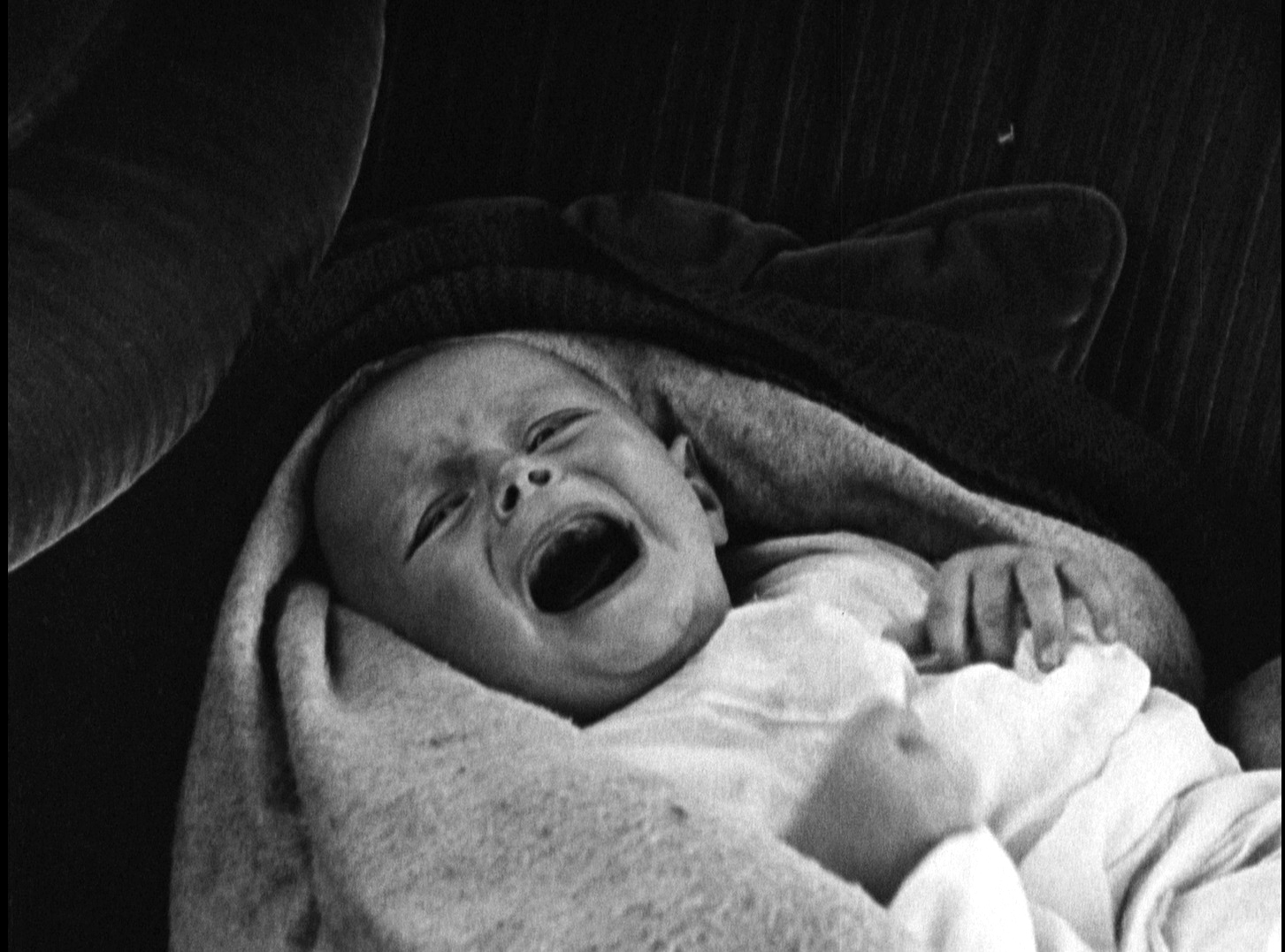
Charlie Chaplin’s masterpiece The Kid (1921) tells the story of the Little Tramp discovering, trying to avoid, and eventually falling in love with an abandoned infant, played out scene by scene at the end of this post. As I write in a prior post, you can see bystanders watching the filming, such as a delighted girl peeking through a screen door as Charlie strolls by a matron with a baby carriage. But where was this filmed? [UPDATE – my new YouTube video shows this entire post – https://youtu.be/7NG7JeIfKcs

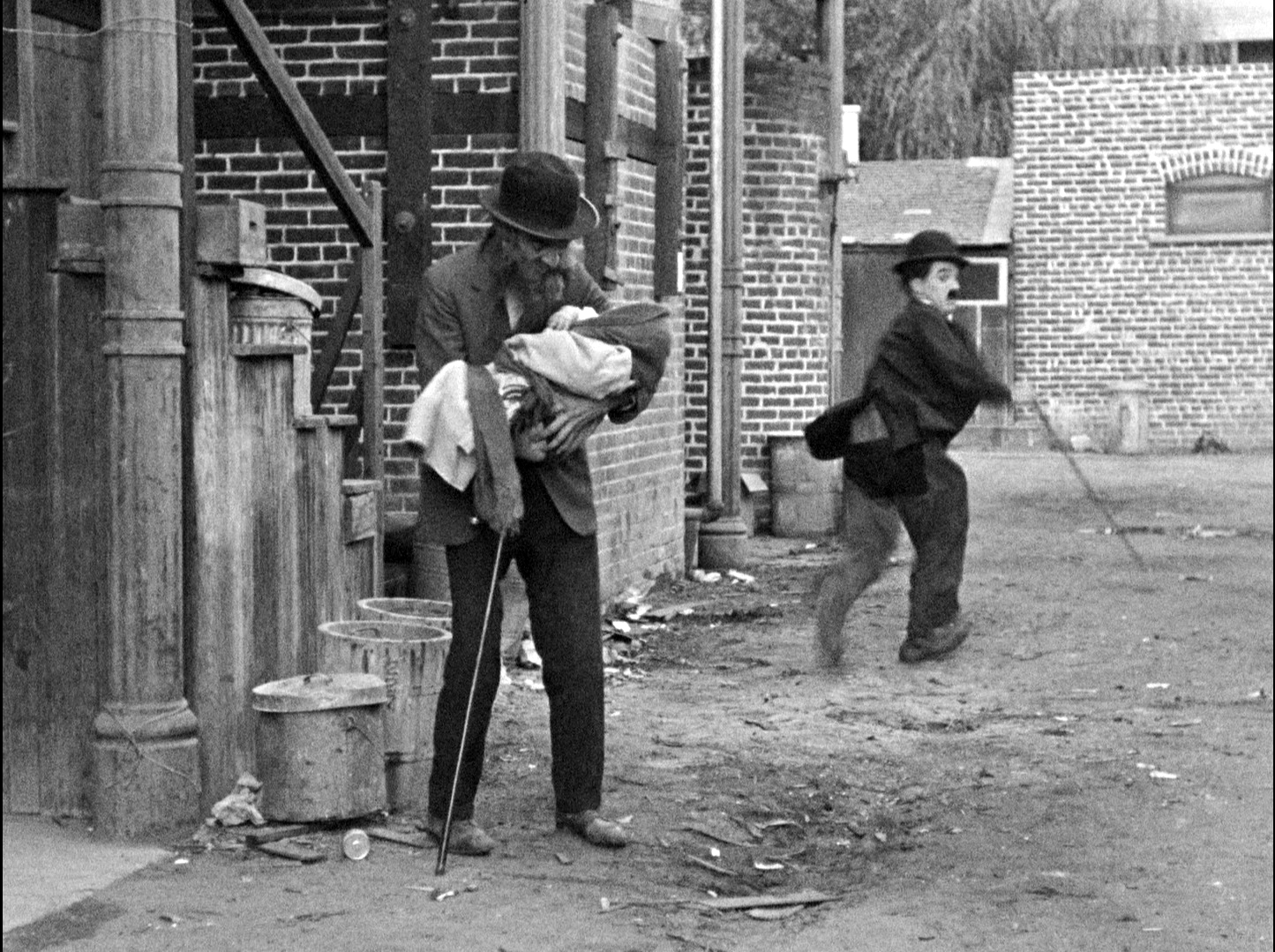
Likewise, Charlie gives the baby to an old man at the Chaplin-Keaton-Lloyd alley in Hollywood (left), but then the old man exits an alley beside a 713 address, nowhere near Hollywood. Where was this filmed? As shown below, every scene in the entire sequence leading to Charlie falling for the kid is now identified. While many of these locations appear in my book Silent Traces, and in other posts including How Charlie Chaplin Filmed The Kid, these two key scenes eluded detection for years.

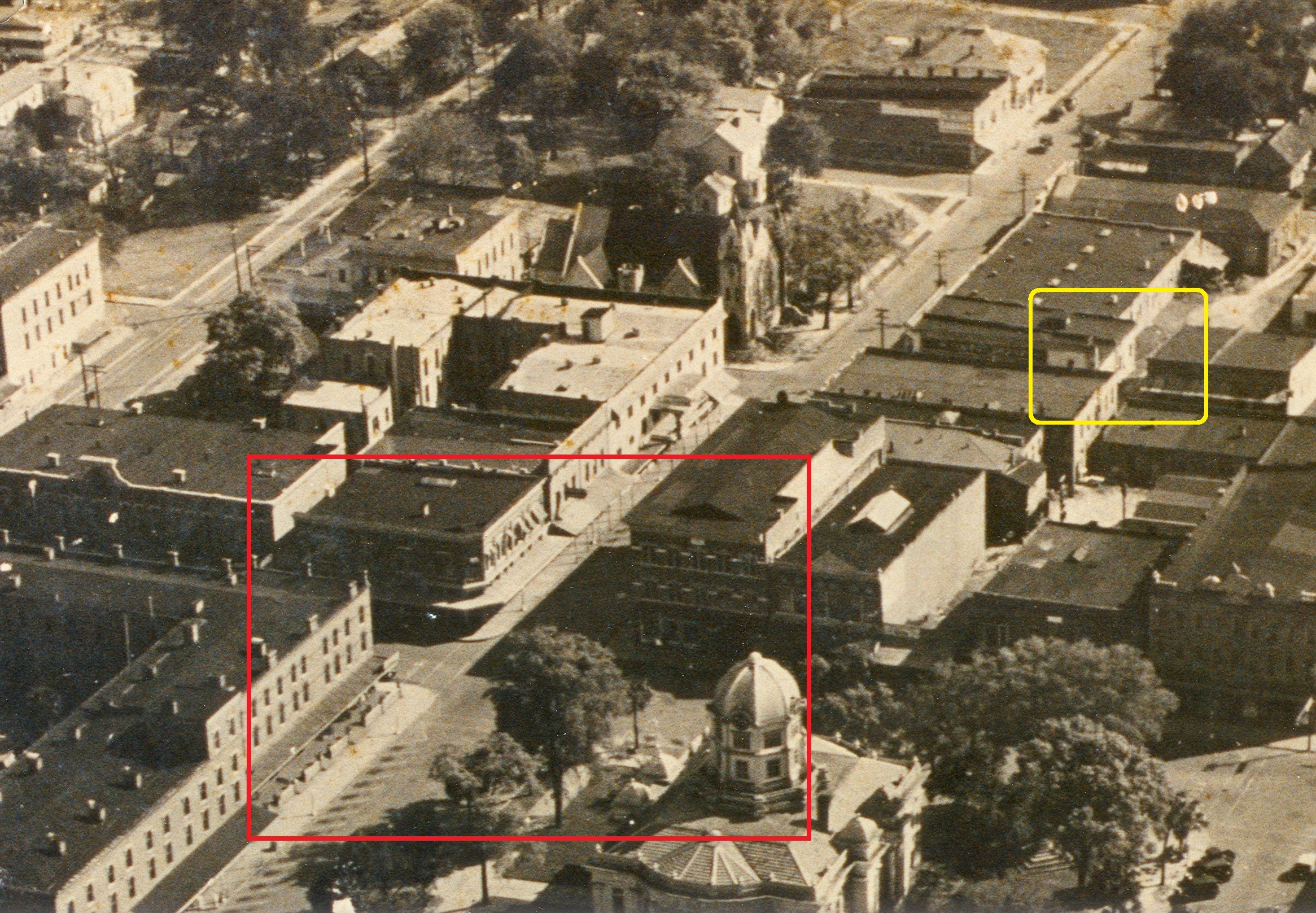
Click to enlarge – 1935 view looking west at the existing Hall of Justice, the Plaza de los Angeles, and Olvera Street. The red oval (left) marks the old man with the baby, the yellow oval marks where the thieves stood, and the orange oval (right) marks the matron with the stroller. Chaplin filmed many scenes in Chinatown, and both north and south of the Plaza. Chinatown would be demolished to build the Union Train Station. Much of the area to the left is now lost to the 101 freeway. USC Digital Library

To begin, let’s focus on when the thieves discover there’s an abandoned baby inside their stolen car. This was filmed at the back of the former Rescue Mission, beside a rail spur branching off from the main rail line along Alameda, next to a crumbling brick wall. Although the above photo was taken over a dozen years later, the yellow oval marks where they stood. Below, the yellow “X” marks where they stood.

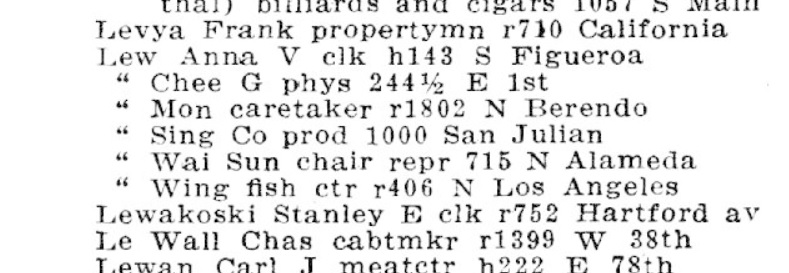
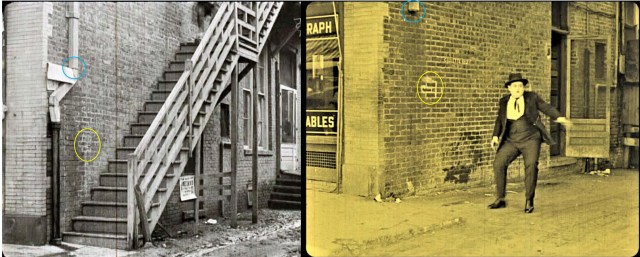
Above, the yellow “X” and yellow oval show where the thieves stood when they realize there’s a baby inside the car. The aerial view directly above looks east, taken at the time Chaplin filmed, with building #2 on the corner of Alameda, running left-right, and Aliso, running up-down along the right. This entire view is now lost to the freeway. The red arrow above and to the right marks the old man’s path along an alley beside 713 N. Alameda. If you click to enlarge the movie frame, you’ll see “713” beside the doorway, and a sign on the alley wall that seems to say “Lew Wai Sun Chair Repairing 715 Alameda” – matching the 1921 city directory entry for chair repairer Lew Wai Sun at 715 N Alameda. The vintage Baist and Sanborn fire insurance maps confirm the alley setting at the time of filming, all just steps from where the car thieves discover the baby.

Click to enlarge. More than fifteen years after Chaplin filmed, the alley and one story building where the old man stepped towards Alameda (red arrow) appears here filled in with a two story building. The gray buildings were constructed after Chaplin filmed. The corner building (2) at Alameda and Aliso was demolished for a gas station. USC Digital Library

The above photo (click to enlarge) shows the same 713 doorway appearing beside the old man, only the original alley and one story wood structure to the right are replaced by a brick two story building. The crumbling building where the thieves stood (yellow oval above) has been rebuilt.

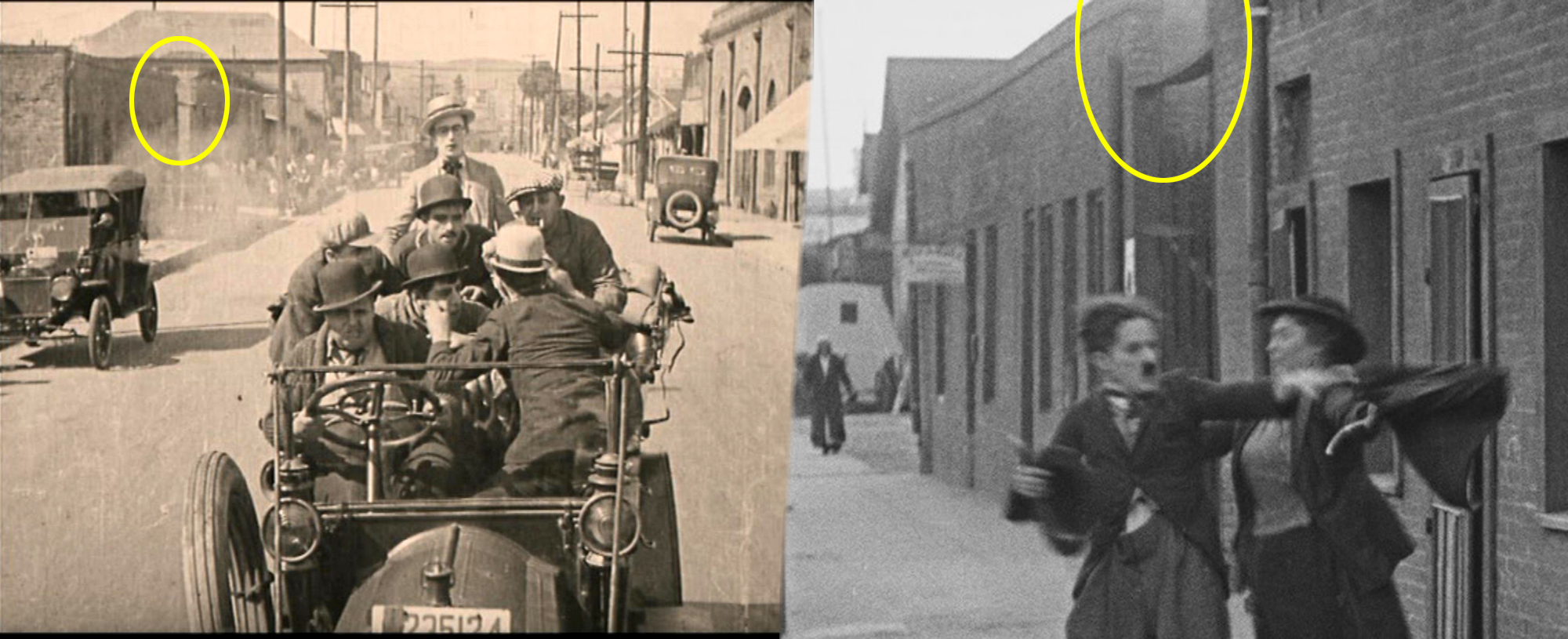
Next, I had long suspected the scene where the matron beats Charlie with her umbrella (above center) was filmed in Chinatown. After all, Chaplin filmed many other scenes there, and the shot of the thieves speeding into Chinatown from Alameda down Napier, above left, revealed some good candidate buildings on the right side of the street. But pesky facts got in the way. First, a reverse view photo of Napier (at right) showed these buildings had arched windows and doorways, unlike the rectangular windows and doors appearing in Chaplin’s scene. Further, the 645 address above the center doorway precluded any street within Chinatown. So I was stuck.

A big break came when author Carrie Pomeroy contacted me with some questions about The Kid, and to share some information she had garnered after spending a week in Bologna, Italy (!) poring over the Chaplin Studio production records for The Kid.

Charlie with Minnie (and her baby Virginia) Stearns at THE Hollywood alley

Charlie with the “Legit Bum” Dan Dillon at THE Hollywood alley

For starters, among Carrie’s many fascinating accounts, she reports: “For December 1, 1919, the records say they filmed at Hall’s Grocery with Minnie Stearns (the umbrella-wielding mother), her baby daughter Virginia Stearns, Walter Lynch as a cop, and Dan Dillon, described as “Legit Bum” on the daily production sheet.” I searched the city directories, and discovered there was a Hall’s Grocery once located at 6382 Hollywood Boulevard. The back of Hall’s Grocery stood along, wait for it, the Chaplin-Keaton-Lloyd alley! While I was already absolutely certain about the alley, it was fun to have this confirmed in the records, and I now knew the names of all of the actors, and when Chaplin filmed there. When filming there again the next day the studio records refer to it as “Hall’s Alley.”

Dan Dillon, who plays the “legit bum” (Charlie’s not legit?) was busy the next day December 2, 1919, filming at three places – “Hall’s Alley, Chinatown and Mexican Quarters.” We now know “Hall’s Alley” means the Chaplin-Keaton-Lloyd alley in Hollywood, and that “Chinatown” refers to the alley at 713 Alameda. But where were these Mexican Quarters?

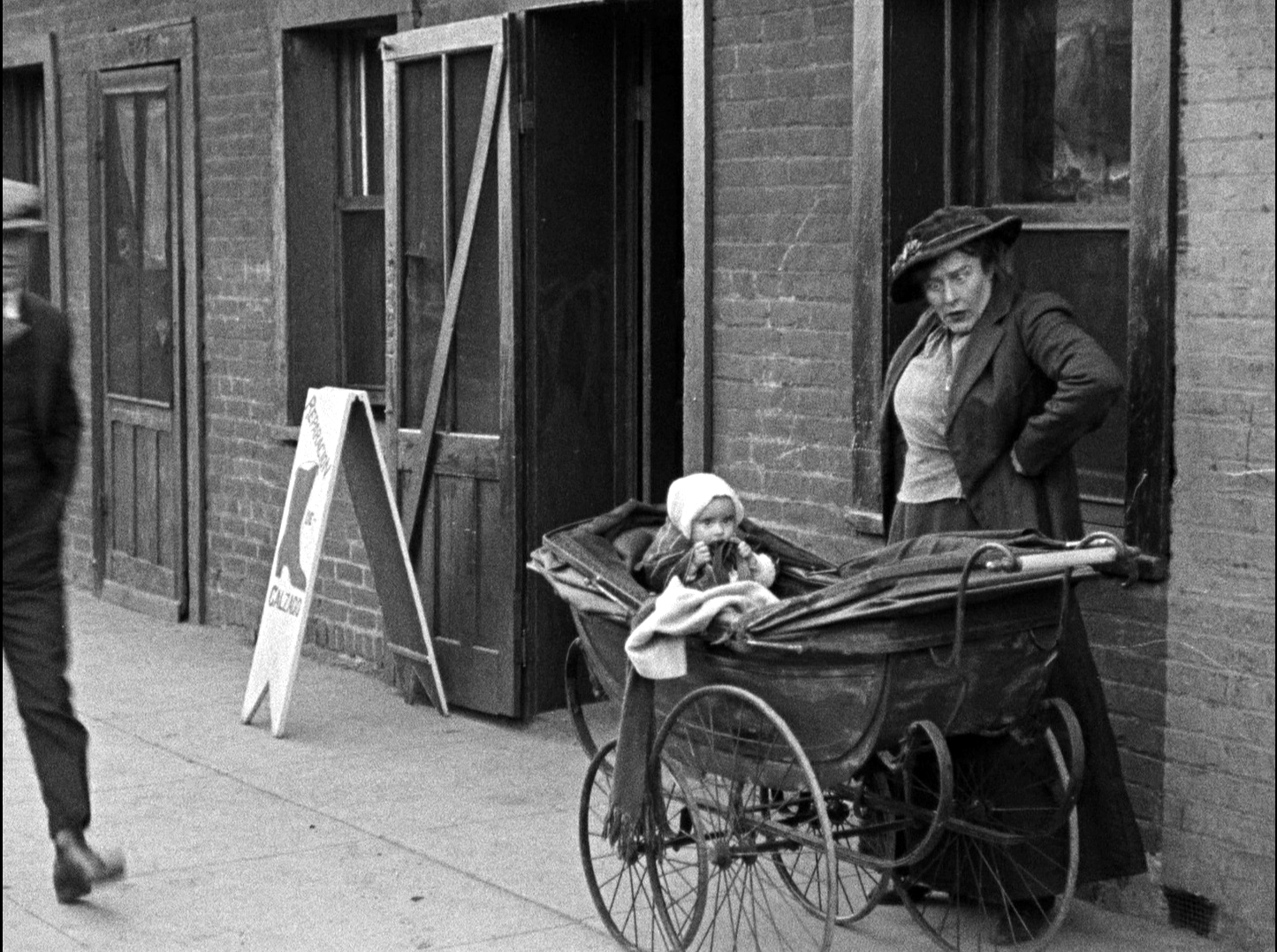
To begin, this frame of the girl peeking at Charlie has a Spanish sidewalk sign reading “Reparacion de Calazado” or “Shoe Repair,” while a 645 address appears over a doorway. With Chinatown mostly east and south of the Plaza, I realized that “645” and “Mexican Quarters” might indicate the streets a few blocks north of the Plaza. So Carrie’s report put me on the right track.

Harold Lloyd runs towards Charlie’s spot

As it often happens, the best clues for solving a location are found in other films. Harold Lloyd, Snub Pollard, and other Hal Roach stars filmed frequently along New High Street north of the Plaza. Somehow, when glancing at Lloyd’s appearance in From Hand to Mouth (1919), I noticed the low brick buildings with rectangular doors and windows, and made the connection. After a quick flurry checking maps and other features, it was clear Charlie had filmed on New High Street beside the same buildings where Lloyd had filmed.

Above, views north (left) and south (right) of 641-643 New High Street (red box).

During another scene in From Hand to Mouth, the gap between the buildings, spanned by a wooden gate support, appears in both views above. The corner of Ord Street appears behind Harold.

As Harold travels further south down New High Street, the peaked roof (oval) behind Charlie comes into view.

Harold returned in 1926 to film scenes from For Heaven’s Sake. Here, Harold runs south down New High towards the corner of Ord Street.

Again from For Heaven’s Sake, looking north, Harold races a wagon south down New High from the corner of Ord Street.

Last, a final view south on New High from For Heaven’s Sake, with the same “645” building (red box) in each shot. The building marked “Y” is a bakery built in 1923, replacing the building “Z” that stood during Charlie’s December 2, 1919 filming.

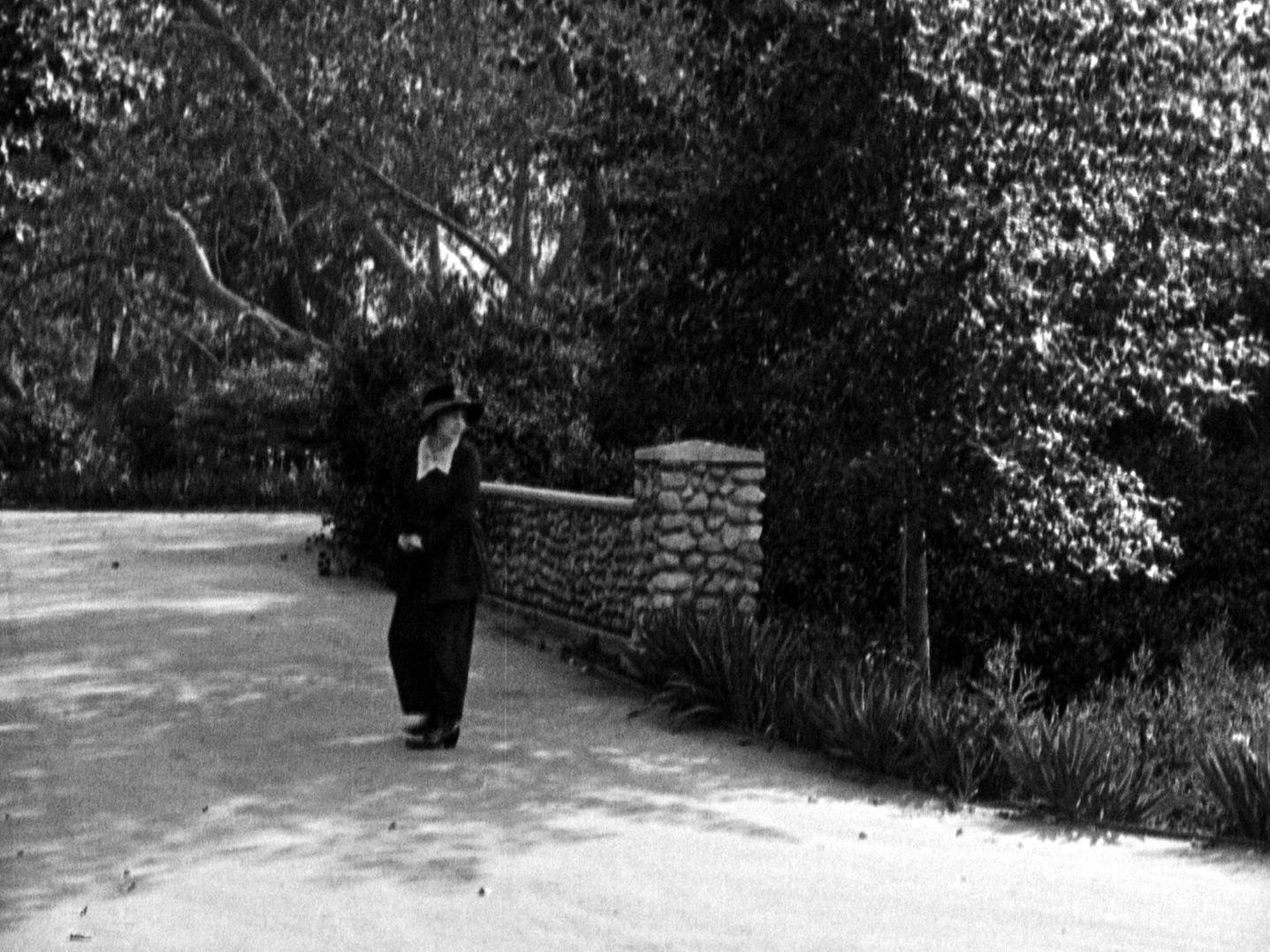
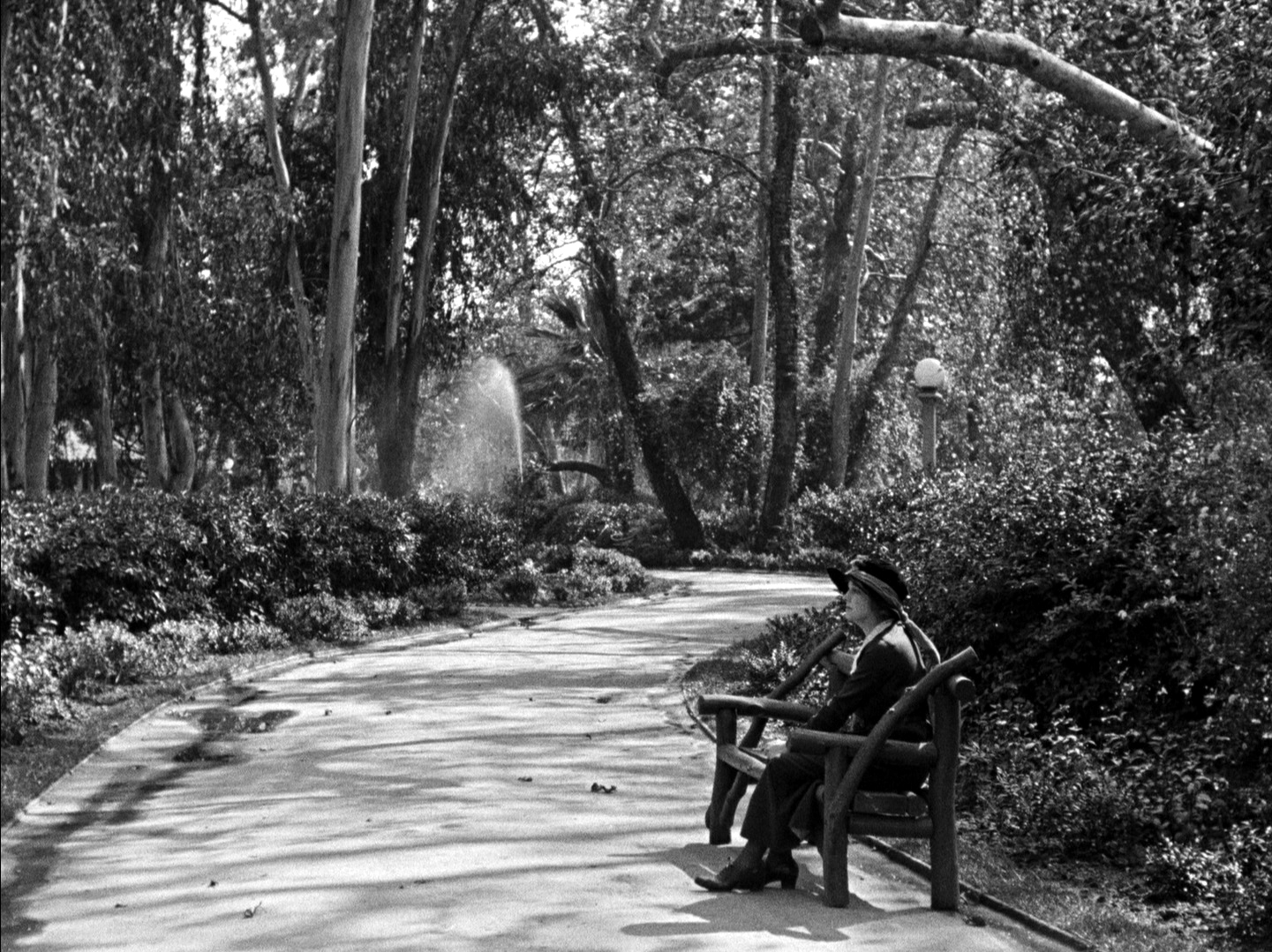
Wrapping things up, Carrie also reported that Edna filmed at “Sunset Park” on December 4, 1919, Lafayette Park’s former name. While direct photo confirmation remains elusive, I’d long suspected Edna filmed her forlorn bench scenes here. The Los Angeles Times reports the city began plans to change the Sunset Park name in January 1919, with the new park name officially dedicated with great ceremony on September 6, 1920. Thus, late in 1919 the Chaplin studio records used what was then the correct name for the park.

Lafayette (Sunset) Park in City Lights

Lafayette Park is on Wilshire Boulevard next to the Town House Apartments at Wilshire on the corner of Commonwealth Avenue, where Charlie buys up all the Blind Flower Girl’s flowers in City Lights. The park is close to where Chaplin filmed several other movies, so it was familiar territory to him. So with Carrie’s help this final shot of the sequence was also identified.

Here below is every shot in the sequence where Charlie first encounters and falls in love with the kid, followed by a brief identification of each shot.

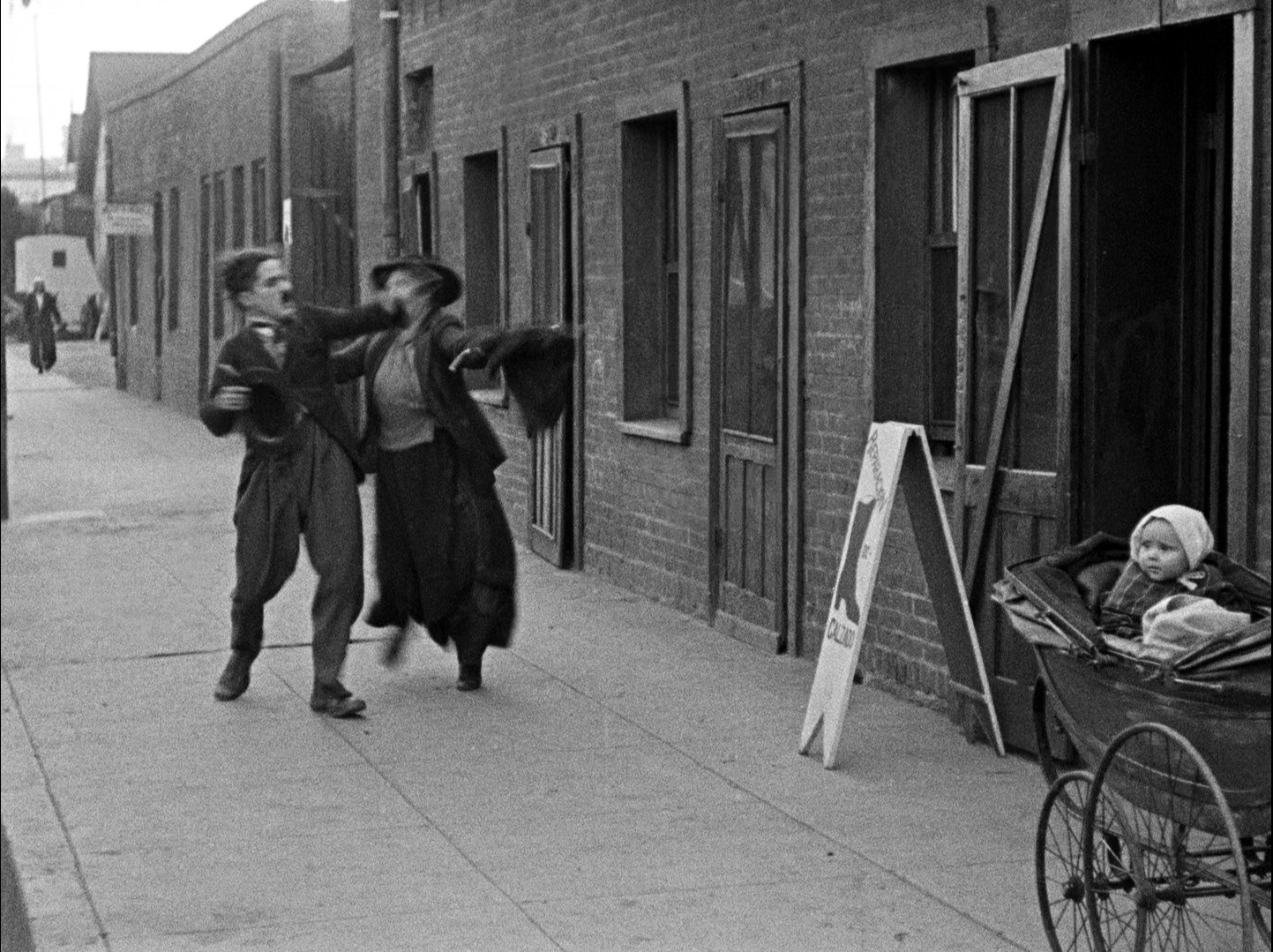
Edna abandons the baby in a limousine parked at 55 Fremont Place, later the home of Muhammad Ali, then enters Sunset Park. Thieves steal the car, and drive east down W. 8th Street, which shows the back of 55 Fremont Place. The thieves (identified by Carrie from the studio records as Albert Austin and A. Thalasso) discover the infant after parking the car behind the skid row Rescue Mission, where train tracks branch off from Alameda south of the Plaza de los Angeles downtown. Thalasso hides the baby at the north end of the Chaplin-Keaton-Lloyd alley in Hollywood, then the thieves drive down Napier Street from Alameda into the heart of the former Chinatown. Back at the Chaplin-Keaton-Lloyd alley in Hollywood (i) Charlies discovers the infant, (ii) tries to return him to Minnie Stearns, and (iii) hands the baby to Dan Dillon, the legit bum. NEW – returning south of the Plaza downtown, Dillon, the legit bum carries the baby at 713 Alameda. NEW – Dillon, the legit bum strolls near 645 New High Street north of downtown, and places the baby in Minnie’s baby carriage. Charlie dodges a cop (identified by Carrie as Walter Lynch) back in Hollywood at the Chaplin-Keaton-Lloyd alley. New – back on New High Street, Charlie strolls past Minnie, who bashes him with her umbrella, and calls in Walter the cop. The sequence ends with Charlie sitting on a curb on a backlot set at his Hollywood studio at 1416 N. La Brea, where he falls for the kid, and decides to raise him as his own son.

Carrie’s biggest surprise was discovering The Kid was not shot chronologically as she had expected. The scenes with Edna at the hospital and the thieves stealing the car and dumping the baby were the first scenes filmed in August 1919, followed by scenes with Chaplin and the baby in the attic and Jackie Coogan and Chaplin in the attic later that month. Scenes developing Edna’s story (the church wedding, the Pasadena Bridge sequence) weren’t shot until much later, in November, and to her surprise, the scenes here with Chaplin finding and trying to get rid of the baby were actually filmed in December 1919. The reception scene at which Edna and Carl Miller’s characters meet and the scene with Carl Miller in his artist’s garret weren’t filmed until February 1920. Carrie reports Edna and Carl’s outdoor balcony party scenes were filmed at the residence of Annie Stimson at 845 W. Adams Blvd., a home still standing.

My new YouTube video shows the discoveries in this post

Click to enlarge. A final view north, showing the matron’s baby carriage (orange oval) on New High Street to the left, the circular Plaza right of the center, where the thieves discover the baby (yellow oval), and the alley beside 713 N. Alameda (red arrow, oval) far right.

All images from Chaplin films made from 1918 onwards, copyright © Roy Export Company Establishment. CHARLES CHAPLIN, CHAPLIN, and the LITTLE TRAMP, photographs from and the names of Mr. Chaplin’s films are trademarks and/or service marks of Bubbles Incorporated SA and/or Roy Export Company Establishment. Used with permission. Check out the wonderful Blu-ray edition of The Kid – Criterion Collection.

Below, the site at 645 New High Street, now a parking lot.

Posted in Chaplin - Keaton - Lloyd Alley, Charlie Chaplin, For Heaven's Sake, Harold Lloyd, The Kid | Tagged , , , , , , , , , , , , , , | 15 Comments

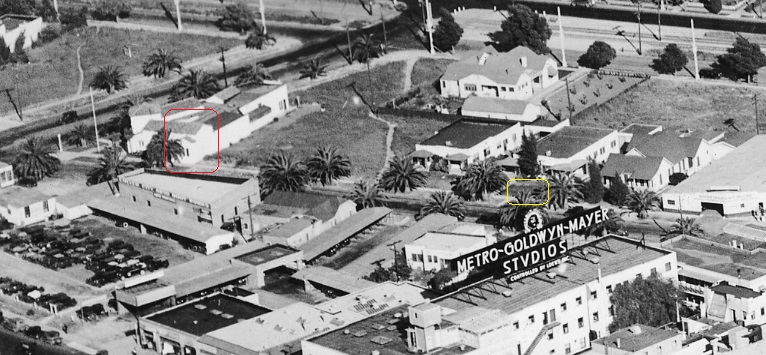
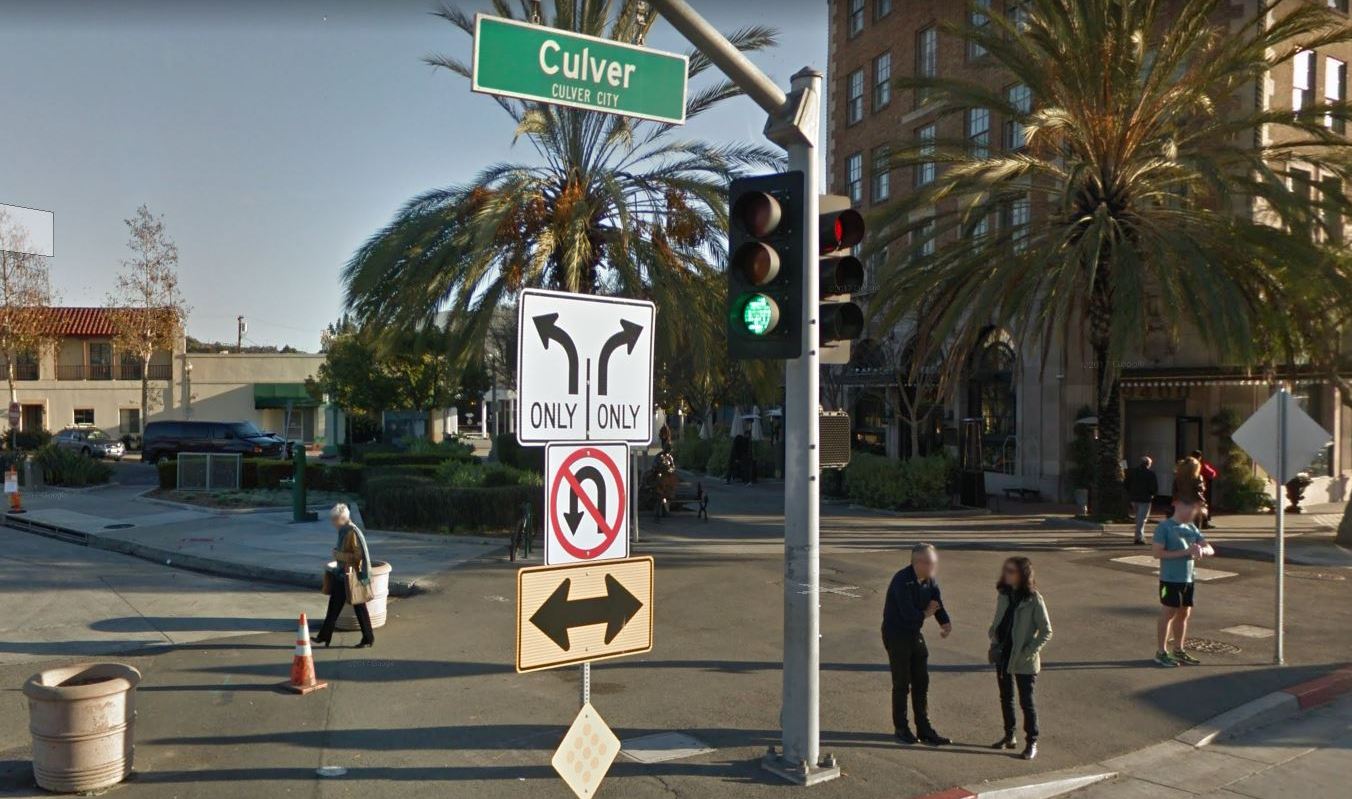
Keaton’s Bungalow Outside MGM

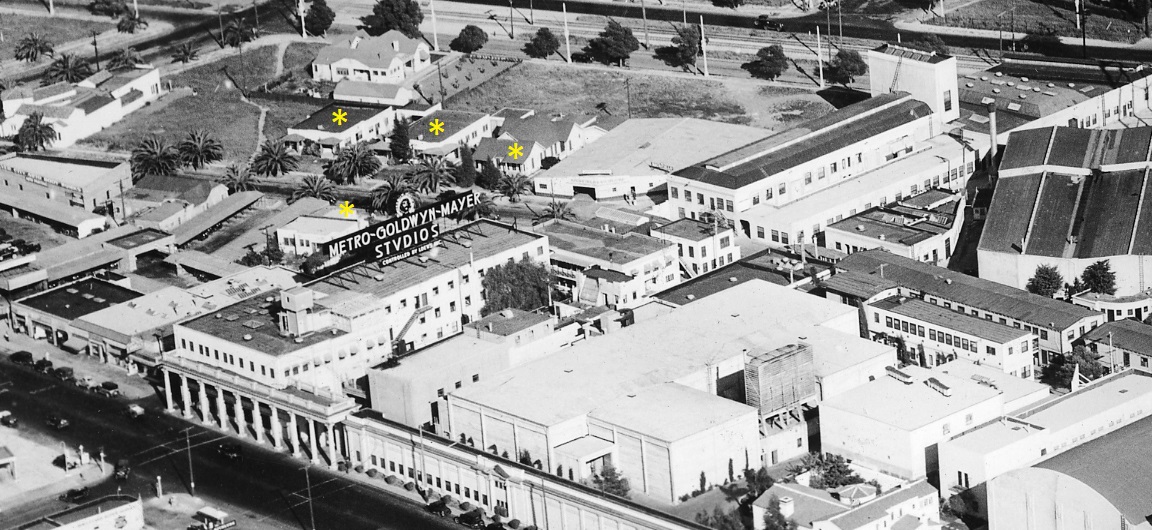
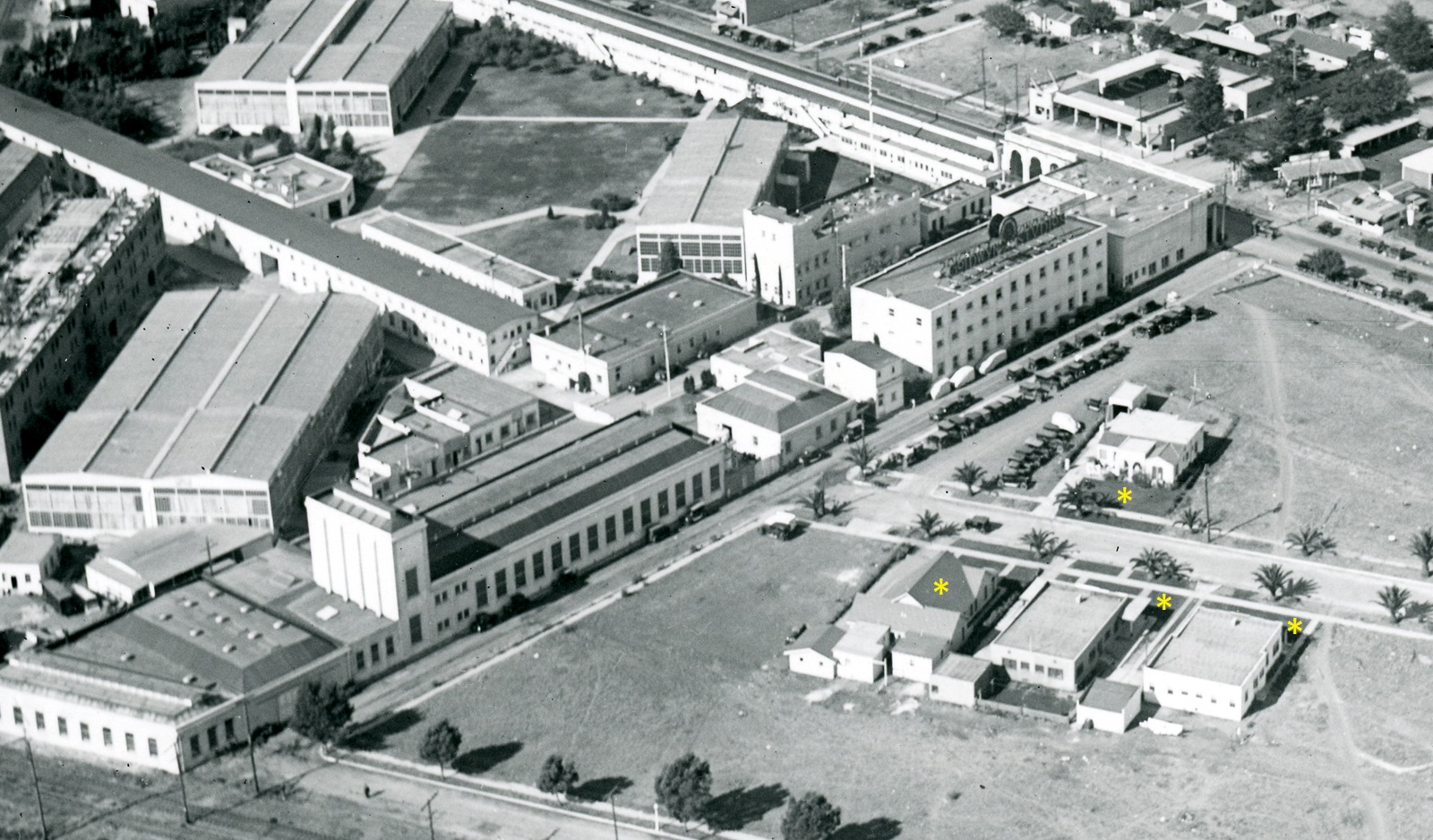
When Buster Keaton joined MGM in 1928, he rented a bungalow near, but off site from, the MGM campus, infuriating studio head Louis B. Mayer, as Keaton was (one of) the only star(s) to rent space off of the lot. To rectify this, in 1930 or so MGM built Keaton a personal dressing room on the MGM lot, with living space and private kitchen, jokingly dubbed Keaton’s Kennel. My earlier post identifies exactly where the Kennel stood on the MGM lot, not far from the New York backlot set where Keaton filmed scenes from The Cameraman (1928) and Sidewalks of New York (1931).

But where was Keaton’s original bungalow off campus? He writes at page 214 of My Wonderful World of Slapstick that it was located where the Irving Thalberg Memorial Building now stands in Culver City, which places it on former Grant Avenue. Studying vintage maps and aerial photos, there were only a few candidate homes.

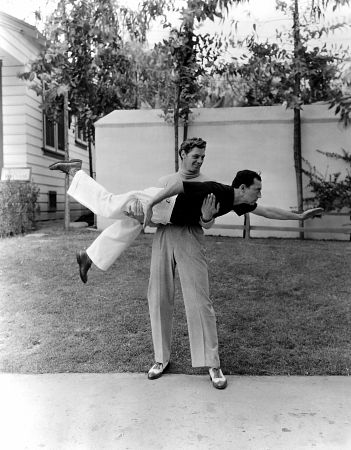
Somehow I came across these fun photos I had seen years before, Buster posing before a wide angle camera lens to create a series of distorted, attention-grabbing images. I then found a photo of him posing with director Edward Sedgwick, and realized that the background street in each image looked familiar.

A 1924 view north of Grant Avenue next to the then Goldwyn Studio, before the funeral parlor on Grant and Madison (red box) was constructed. Keaton posed within the yellow box. HollywoodPhotographs.com

As confirmed by the Sanborn fire insurance maps and these aerial views, Keaton staged all four photos adjacent to MGM looking east down Grant Avenue towards the distinctive tiled roof of the Noice and Son funeral parlor at the corner of Madison and Grant.

1933 view south of Grant Avenue, showing the funeral home (red) and lawn where Keaton posed (yellow).

A closer study shows Keaton posed for all four photos in front of the center home, a duplex actually, with the address 10132 – 10132-1/2 Grant Avenue. Given there were so few other candidate homes available, it seems most likely Keaton would only pose in front of the place he was actually renting.

Given Keaton is wearing a similar short sleeve shirt, and the picture codes for the wide view shots and these radio poses all seem to begin with “MCMP,” I think it likely Buster took these above interior shots inside the same Grant Avenue bungalow, all as part of the same publicity shoot. Notice the plain curtains, fancy light fixture, and flowery wallpaper.

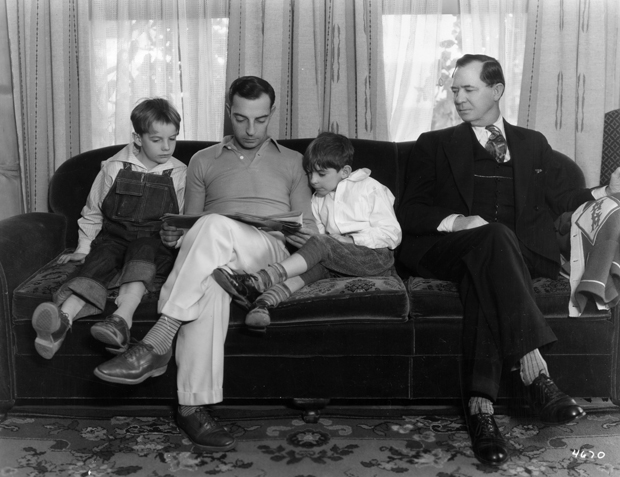
Inside the Keaton Kennel

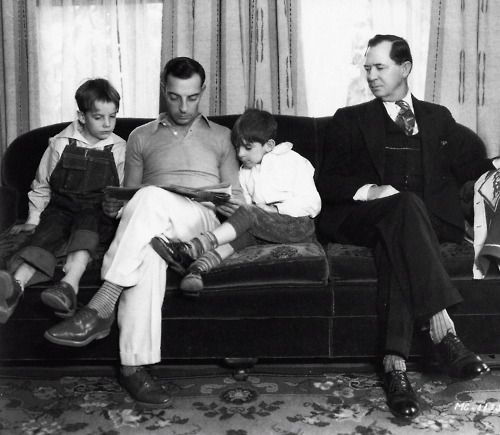
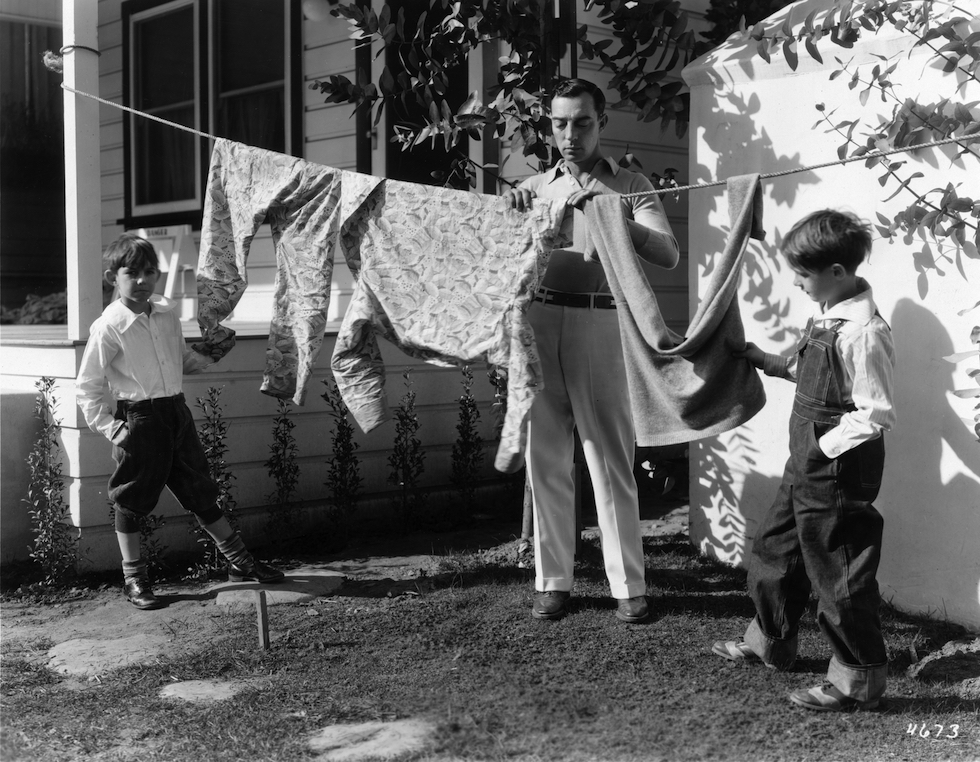
This photo of Buster (wearing long sleeves) with his sons and his father Joe was taken inside the Kennel on the MGM lot – the picture codes of Buster and his sons posing outside of the Kennel (4673, 4675) match the code for this interior view (4670), as do their clothes. The curtains here are not plain, and there appears to be no wallpaper. As such, I believe the above radio photos above were not taken inside the Kennel.

UPDATE: from Robert Mouton – Wallace Berry took over Keaton’s Kennel inside MGM, August 1933 The New Movie Magazine – see comments below.

Below, a matching view east along what was once Grant Avenue, taken in front of the Thalberg Building entrance.

Posted in Buster Keaton, Culver City, Keaton Studio | Tagged , , , , , , | 11 Comments

Oliver Hardy at the Chaplin-Keaton-Lloyd Alley

The block of Cahuenga south of Hollywood Boulevard was the most popular spot in town to film silent movies. As I’ve written in numerous tours and posts, everyone filmed there, from Douglas Fairbanks and Mary Pickford, to Charlie Chaplin, Buster Keaton, and Harold Lloyd. Even Stan Laurel, Harry Langdon, and Lloyd Hamilton filmed there. But it seemed that one holdout, until now, was Oliver Hardy. Instead, it turns out he was one of the first stars to film on this hallowed ground.

The Dutch Eye Filmmuseum recently posted Chaplin imitator Billy West’s 1918 barber shop comedy His Day Out (see YouTube link below) co-starring Oliver Hardy as his comic foil. Hardy had a long career in films before pairing with Stan Laurel in 1927, and appeared in many Billy West comedies, often channeling Chaplin’s nemesis Eric Campbell.

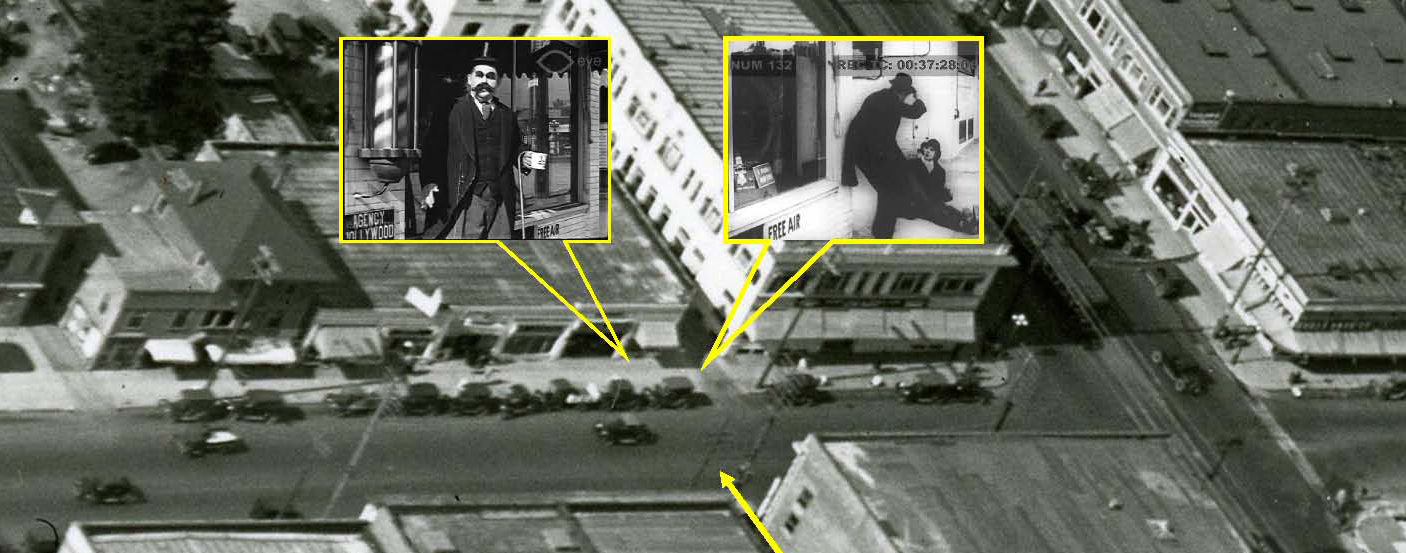
During the film Hardy briefly appears beside a barber pole, belonging to H. F. Graham’s barber shop at 1649 Cahuenga, off camera to the left. Oliver is in fact exiting from the 1651 Cahuenga vulcanizing store next door – notice the distinctive “FREE AIR” sign. Confirming the site, Colleen Moore filmed her 1920 comedy Her Bridal Nightmare beside the same vulcanizing store, where you can read “TUBES” and “TIRES” in the window, and see more clearly the store corner next to an alley entrance. That’s her sitting on the ground.

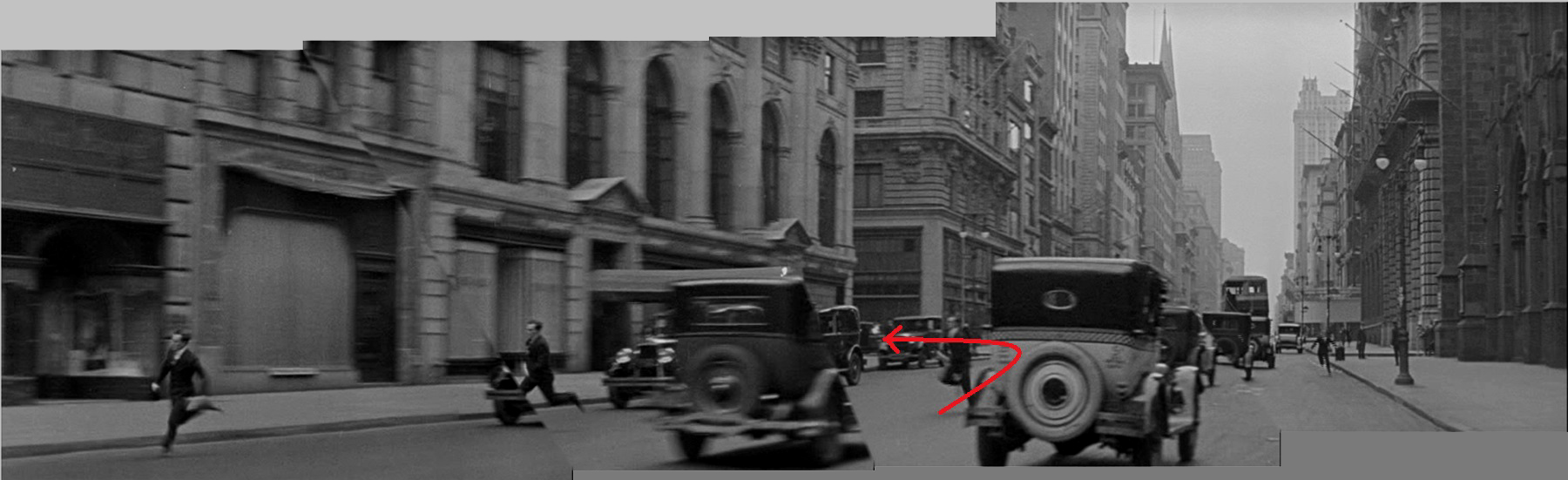
Looking west at Cahuenga running left to right, with Hollywood Blvd. at the right. Ollie and Colleen filmed their scenes across the street from where Buster Keaton runs onto Cahuenga from the Chaplin-Keaton-Lloyd alley to catch a passing car one-handed in Cops (1922) (see inset at top of post above). The arrow marks Buster’s path running towards Cahuenga. Mary Pickford filmed at the same alley spot as Colleen, and Douglas Fairbanks climbed the three story Fremont Hotel to the left in this view – read more HERE.

Reversing Keaton’s frame from Cops reveals the cut off corner of the vulcanizing store across the street reflected in the window, matching the modern view. Hardy stood just to the right of the modern palm tree. You can actually read “TIRES” and TUBES” reflected over the Keaton movie frame corner doorway.

The Pest - Rivals_Page_2

UPDATE: as reported HERE, Oliver Hardy (and Billy West) actually filmed at the alley in their 1925 comedy Rivals, see above.

Blink and you’ll miss it, but at 10:54 Hardy steps outside directly across the street from the Chaplin-Keaton-Lloyd alley. Say what you will about Billy West, but he was very adept with his impersonation.

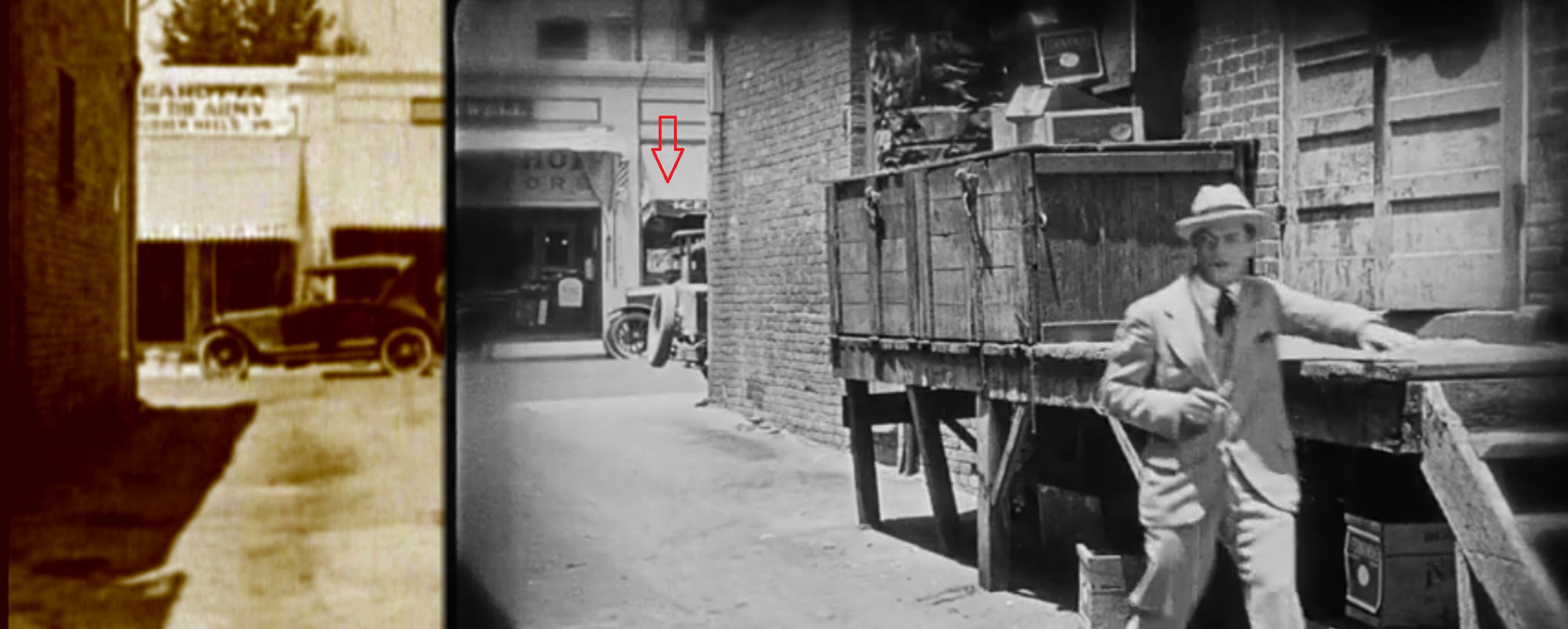
A merged panoramic view west down the Chaplin-Keaton-Lloyd alley towards where Oliver Hardy stood on Cahuenga (arrow), created from The Detectress (1919) left, and The Last Edition (1925). By 1925 the vulcanizing store had become a restaurant.

One interesting detail, reflected behind Ollie we can see the gas station that once stood on the NE corner of Hollywood and Cahuenga before the 6 story Security Trust and Savings Bank Building was completed there in 1922, Also appearing, the 5-globe style street lamps that once stood along Hollywood Blvd., as appearing in this detail photo of Harold Lloyd from Why Worry? (1923) standing at the NW corner of the same intersection.

His Day Out is remarkable for other reasons. To begin, the opening sequence was filmed beside Hollywood glamour portrait photographer Nelson Evans’ studio once located at 6039 Hollywood Blvd., next door to the St. Anne’s Infant Home. Signs for both appear during the film. The view matches a similar scene from Harold Lloyd’s 1918 comedy Look Pleasant Please, appearing here with Snub Pollard.

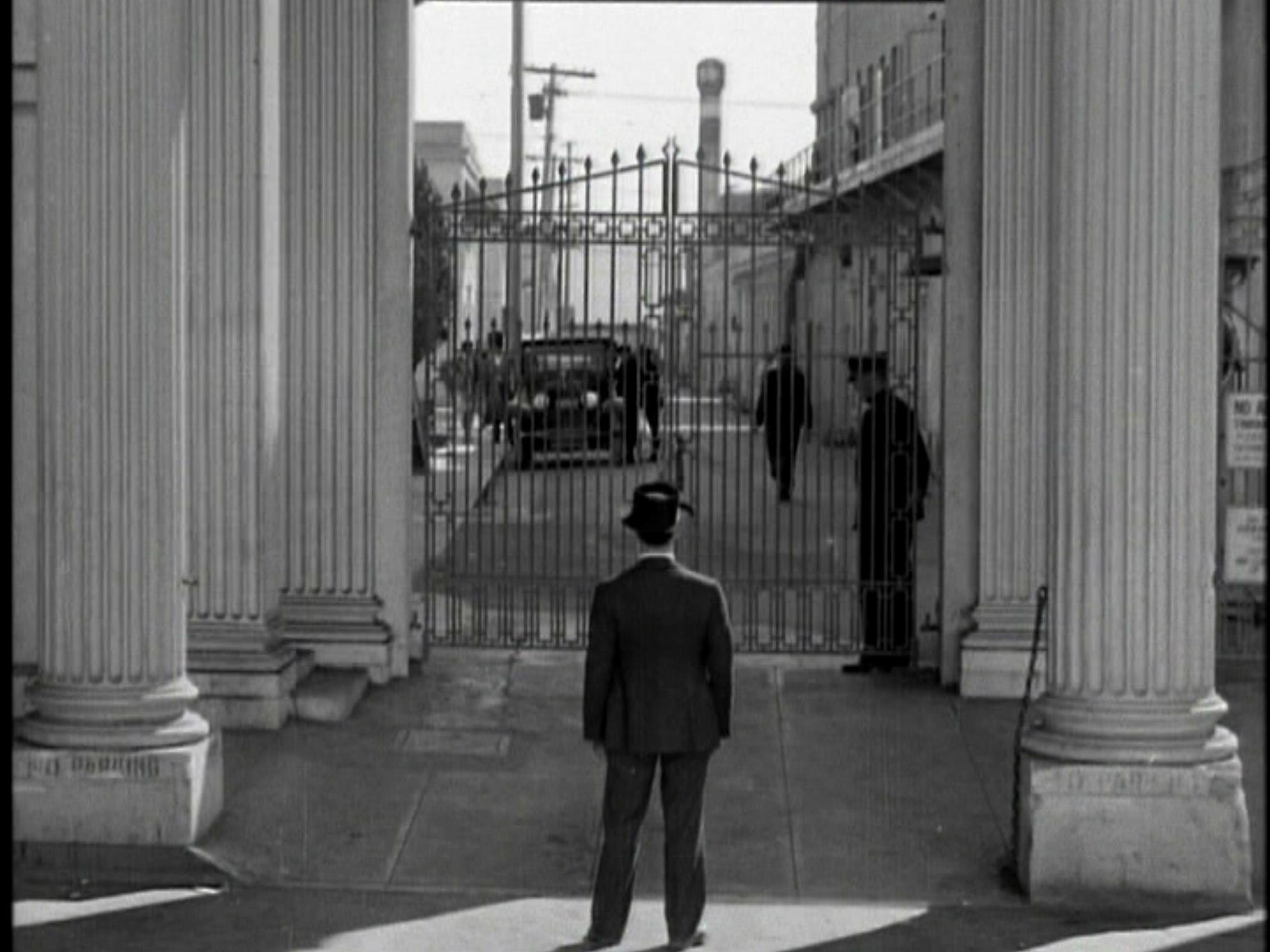
His Day Out also includes scenes filmed (upper right) at the south gated auto entrance to noted architect Edwin Bergstrom’s mansion at 590 N. Vermont, later home to theater magnate Alexander Pantages, before it was razed in 1951 to build a Jewish community center (now home to West Coast University). The upper left images combine scenes from Harry Houdini’s feature The Grim Game (1919) with the opening scenes from Keaton’s Cops, both at the mansion’s north pedestrian entrance gate (read more about The Grim Game HERE). The bottom wide shot of the mansion entrance was stitched together from pioneer film-maker Lois Weber’s 1916 drama Where Are My Children?

Above, matching views of the Bergstrom mansion appearing in His Day Out, left, and in Where Are My Children?

Returning to Hollywood, Colleen Moore (dressed as a man) and Harry Houdini both filmed beside the Cahuenga entrance to the Chaplin-Keaton-Lloyd alley. The alley staircase behind them appears in this full reverse view from The Detectress. The staircase was removed by the time Keaton filmed Cops.

Before becoming a Japanese grocery – LAFire.com

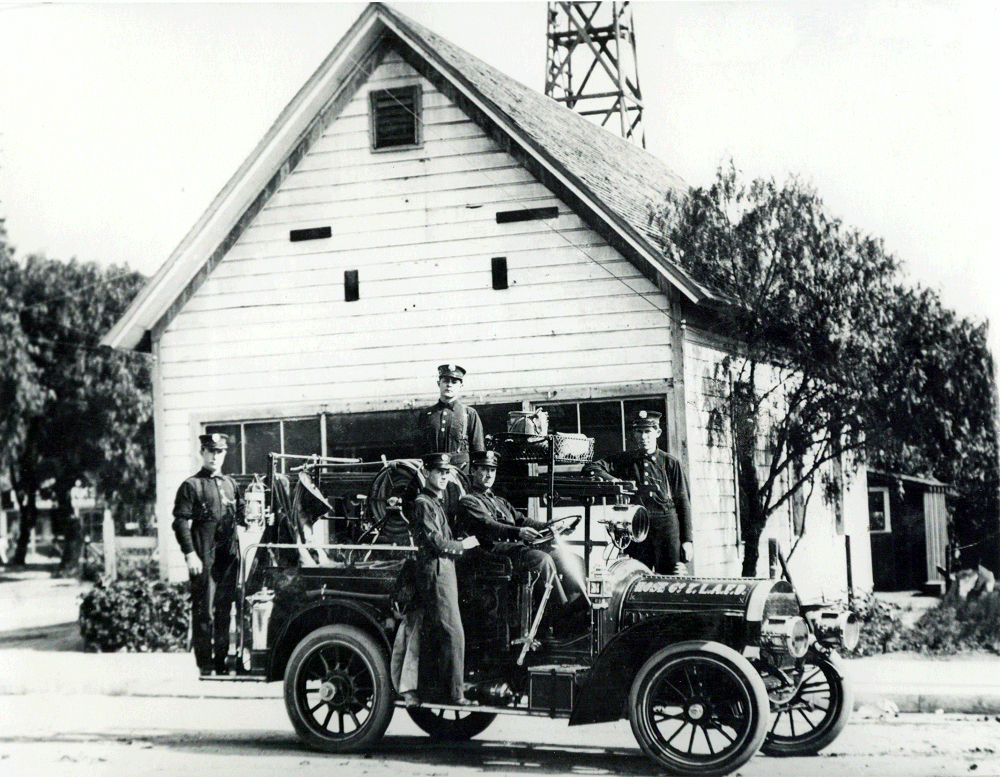
Above left, Colleen Moore ran all around Cahuenga during Her Bridal Nightmare, here matching views south from the corner of Selma towards the Toribuchi Grocery, featuring “Japanese Rice and Tea” appearing in Buster Keaton’s The Goat (1921). Originally a small church, the grocery building previously served as Hollywood’s first fire station, Hose Co. No. 7, replaced by the larger joint fire/police station up the block that opened in 1913. The Sanborn maps and old phone books show that around 1920 there were a number of Japanese businesses, a Japanese laundry, baths, lodgings, and even a small Japanese school along Cahuenga north of Sunset. The story of this small Japanese enclave in Hollywood merits further attention.

His Day Out – courtesy Eye Filmmuseum; Her Bridal Nightmare courtesy Serge Bromberg-Lobster Films

Below, Oliver and Colleen’s vulcanizing store is now an adult book shop.

Posted in Laurel and Hardy | Tagged , , , , , , , , , , , , , , , , , , , , , , , | 2 Comments

Buster Keaton and W.C. Fields in Astoria

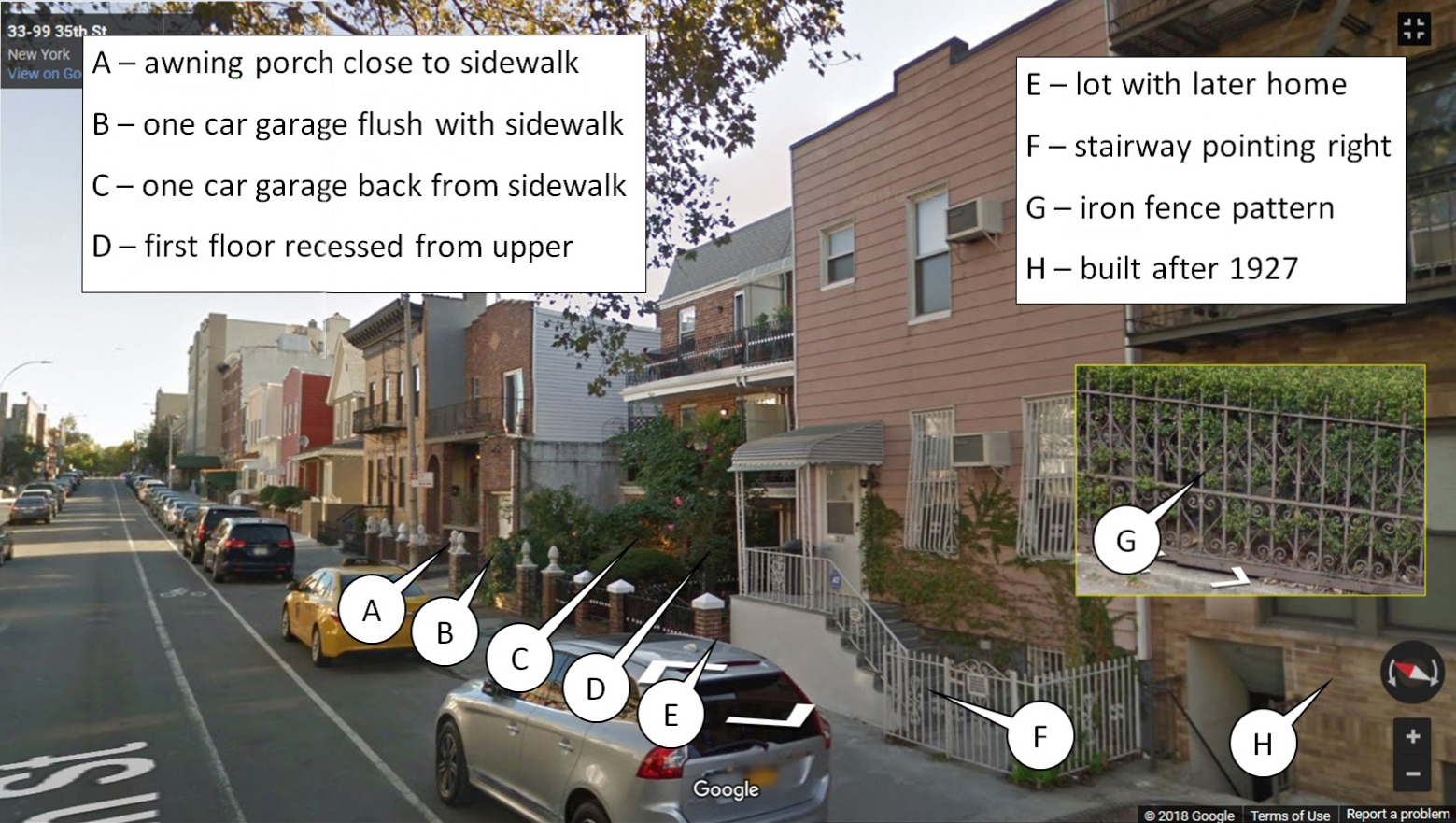
Click to enlarge – Buster Keaton filmed The Chemist and W.C. Fields filmed Running Wild beside the same apartment on the SW corner of 35th Ave. and 35th St. The Astoria studios where they both worked stands on the opposite NE corner.

Buster Keaton and W.C. Fields filmed alongside the same Astoria apartment building, nine years apart. Who knew? While working on a post connecting Fields’ It’s The Old Army Game with Keaton’s The Cameraman (1928) and Harold Lloyd’s Speedy (1928) (all filmed at 5th Ave. and 57th St. in New York), I was reminded that Keaton had later filmed a few short comedies for Educational in Astoria. I hadn’t seen them for years, and nearly fell out of my chair during The Chemist (1936), as it was clear Keaton filmed beside the same apartment appearing with W.C. Fields in Running Wild (1927) (see my detailed post about Fields filming in Astoria HERE). The apartment still stands at the SW corner of 35th Ave. and 35th St. in Astoria – opposite from the studio on the NE corner. Buster was already familiar with Astoria, as his prior Educational short Blue Blazes was also filmed in Queens, mostly along 34th Ave. north of the studio (see my detailed post HERE).

Buster plays an erstwhile chemist, who early in the film tries his love-potion on Marlyn Stuart. She’s parked beside the 35-10 35th St. entrance to the __ Gardens apartment, around the corner from the same apartment depicted from the side, above.

The apartment is one of four identical buildings that fill up the north end of the block along 35th Ave. between 34th and 35th Streets. Keaton’s unit on the SW corner of 35th St., with its adjoining twin further south, both appear above as Keaton tempts Marlyn with his love potion.

Marlyn’s boyfriend objects to the experiment, dragging Buster from the car. Looking north up 35th St. we see the studio laboratory building (box) on the NW corner of 35th Ave. up the street from the small box marking the general spot of Buster’s car. The main shooting stage (1) stands just off camera to the right. Note the barbershop pole.

Later in the film, Buster develops a powdered compound that explodes on contact with water. When the bad guys accidentally coat themselves with the powder, Buster rounds them north up the street with a threatening seltzer bottle. The same apartment awning during Marlyn’s scene appears behind them. To the right, Fields drives west along 35th Ave. towards the same corner in Running Wild, with matching barber shop poles, and corner signs for the Studio Pharmacy.

Armed with his seltzer bottle, Buster leads the bad guys west along 35th Ave. from the corner of 35th St., as first shown at the top of this post. Directly above, pausing for a moment between the two apartment blocks, the group realizes it is about to rain and dash further west along the street towards the jail house. The sepia movie frame, from Fields’ Running Wild, also looks west along 35th Ave. from the corner of 35th St.

Buster and Bill face each other, nine years apart.

The Chemist marks a reunion of sorts – the first time in 11 years, since portraying “Friendless” in Go West (1925), that Buster’s character wears his trademark flat hat. (As a joke a store clerk briefly slips the hat on Keaton in Steamboat Bill, Jr. (1928), but that was decidedly not his character’s hat.)

The Chemist and Keaton’s 15 other short films made for Educational (1934-1937) are available in the “Lost Keaton” set from Kino Lorber.

Below, looking SW at the Astoria corner where Bill and Buster filmed. The corner of the studio stands directly opposite, behind.

Posted in Astoria, Buster Keaton, New York, W.C. Fields | Tagged , , , , , , , , , , , | 5 Comments

Buster Keaton’s Kennel on the MGM lot

Click to enlarge – 1932 – looking SE along Washington Blvd. towards the back of Keaton’s Kennel (box) on the MGM lot. The “New York” set appearing in The Cameraman (1928) appears to the far right.

Keaton at the MGM gate – Free and Easy (1930)

As one of MGM’s biggest stars, Buster Keaton once had a private bungalow dressing room on the studio lot, jokingly dubbed “Keaton’s Kennel.” A reader correctly wrote long ago that the Kennel stood along the north side of the lot, but the precise location remained a mystery. So when noted biographer James Curtis (who’s busy now working on Keaton) asked me to look into the Kennel, I eagerly jumped in. As we’ll see, part of the challenge is that Keaton himself conflated facts and descriptions of the place.

To begin, what did the Kennel look like? These publicity photos of Buster with his sons Bobby and Jimmy show the Kennel was quite narrow, with only a double window and a single door facing a covered porch, with a sidewalk path to the right, leading to the front steps, and a large building looming very close on the left side. At right, an inside view with grandpa Joe Keaton, taken the same day (notice the matching clothes).

View SE showing the 4 too wide bungalows (*) on Grant Ave. Steven Bingen.

Keaton writes at page 214 of My Wonderful World of Slapstick that his bungalow was located where the Irving Thalberg Memorial Building now stands, and that it was named the “Kennel” because Keaton’s 170 pound St. Bernard dog Elmer was a fixture sunning himself on the front porch. But as shown in vintage aerial views and the Sanborn fire insurance maps, the bungalows along what was then Grant Ave. (later replaced by the Thalberg Building) were more than twice as wide as the Kennel.

View NW showing the 4 too wide bungalows (*) on Grant Ave. HollywoodPhotographs.com

Keaton joined MGM in 1928, yet the Kennel does not appear on the 1929 Sanborn fire insurance map, nor in early 1930 aerial photographs of the studio. So perhaps it was built late in 1930. The Kennel photo at right, taken during the same publicity photo session as the other shots (notice the matching clothes), shows Buster and his sons hanging up to dry the distinctive pajama costume Keaton wore during Parlor, Bedroom, and Bath, released February 28, 1931, suggesting the Kennel was built prior to that date. Other accounts explain that Keaton began his MGM tenure renting a bungalow near, but off-site from, the MGM campus, infuriating studio head Louis B. Mayer, as Keaton was the only star to rent space off of the lot. Since Keaton worked at MGM for more than two years before the Kennel was built, the likely scenario is that Keaton indeed first began renting a place off campus on Grant Ave., as he remembers in his book, and then later moved on campus once the Kennel was built. (You can read about Keaton’s Grant Ave. bungalow HERE). For some reason Keaton conflates the Grant Ave. bungalow and the MGM Kennel in his account. [Update – Johnny Weissmuller gives Buster an aerial swimming lesson, revealing the east side of the Kennel behind them.]

So where was the Kennel? At left, it stands in the center of this 1934 aerial view looking north. Notice how it is long and skinny, with a sidewalk path along the right to the front porch. The broad view above shows it stood along Washington Blvd. directly across from the terminus of Motor Ave, immediately to the right of Rehearsal Hall A (A). Further east of the Kennel stood the Short Subject Department (B), originally John Gilbert’s Spanish bungalow, the First Aid Department (C), the Little Red Schoolhouse (D), and more dressing rooms (E), all as reported by Steven Bingen, Stephen X. Sylvester, and Michael Troyan in their wonderful book M-G-M: Hollywood’s Greatest Backlot. The red arrow above points east along the “New York” backlot appearing in The Cameraman and The Sidewalks of New York (1931).

Click to enlarge – view SE – the Kennel (box) in relation to a scene from The Cameraman.

As shown here, the Kennel stood just yards to the east of the “New York” backlot set where Keaton filmed The Cameraman in 1928 (before the Kennel was built), and later scenes for The Sidewalks of New York in 1931 (after the Kennel was built). Given the proximity, I like to imagine Keaton walking from the Kennel to film his 1931 scenes on the “New York” backlot.

Above, three views looking east along the “New York” backlot, The Cameraman, upper left, The Sidewalks of New York, lower left, and a matching 1933 aerial view.

UPDATE: from reader Robert Mouton – Wallace Berry took over Keaton’s Kennel inside MGM, August 1933 The New Movie Magazine.

Keaton was abruptly fired early in 1933, following completion of What No Beer? (Keaton staged the beer barrel avalanche from that film on Court Street – read about it HERE.) The Kennel remained long enough following Keaton’s departure in 1933 to appear in a 1934 aerial view, but a later aerial view shows it was demolished by 1947.

You can read all about Keaton’s prior Grant Ave. bungalow just outside of MGM at THIS POST.

Below, the MGM gate today, where Keaton stood (see top of post) during Free and Easy.

Posted in Buster Keaton, Culver City, Keaton Studio | Tagged , , , , , , , | 12 Comments

Buster Keaton’s Blue Blazes in Astoria

While working on posts covering W.C. Fields filming It’s The Old Army Game (1926) and Running Wild (1927) at the Paramount Astoria Studios on 35th Avenue and 35th Street, I remembered Keaton had made a few short comedies for Educational in Astoria in 1936.

I hadn’t seen these films for many years, and with the image quality available at the time, never gave them much thought for study. I did note back then that the firehouse appearing in Blue Blazes (1936) was still standing at 37-22 29th St. (Museum of the Moving Image). But once I checked out Kino Lorber’s “Lost Keaton” Blu-ray release of Keaton’s 16 Educational shorts, I was excited to see so many Astoria locales and looked deeper.

As we’ll see, Keaton filmed three sequences from Blue Blazes on 34th Ave. that runs along the north end of the Astoria Studio. When Paramount closed the plant down it became available for independent productions during the 1930s such as Keaton’s shorts for Educational. At the start of WWII the US Army bought the studio, where it became the Signal Corps Photographic Center, and later the Army Pictorial Center, covering war efforts and producing training films. This 1955 aerial view looking north at the studio, with 34th Ave. at back, comes from Bob Perkins, host of the Army Pictorial Center website, that honors the people who worked there.

Keaton kicks off Blue Blazes with an amazing stunt (A) below, slipping off the back of a speeding fire engine, and sliding and rolling into a sitting position.

(A) The turn begins looking east down 34th Ave. from 37th St., with the doorways to 37-11 and 37-17 34th Ave. in the left background.

Completing the left turn on to 37th St., we see to the south the white square corners of 34-11 37th St., the entrance (yellow line) of the two story home 34-15 37th St., and then repeating patterns of four identical apartments further down the street. I’ll mention these buildings again during scene (B) below.

Keaton’s three scenes on 34th Ave. (A) looking east down 34th Ave. from 37th St., (B) looking NE at the corner of 34th Ave. and 36th St., and (C) looking NE on the corner of 34th Ave. and 37th St.

Buster filmed sequence (A) above, and two later scenes (B) and (C) further below, at 34th Ave. along 36th and 37th Streets, within a block of the studio facing 35th Ave. between 35th and 36th Streets. This aerial detail shows 34th Ave. at the north end of the studio.

(not local) Above, following Buster’s spill, the engine suddenly stops to reverse directions. This scene was not filmed adjacent to the studio, but beside a large apartment at 30-76 35th St. a few blocks due north of the studio which is also on 35th St.

Buster chases after his engine past the apartment at 30-76 35th St.

Buster grabs the passing engine, pulling him mid-air, reminiscent of his prior stunt in Day Dreams (1922), filmed along Santa Monica Blvd. a few blocks west of his studio.

(B) Returning close to the studio, the crew races south and makes a screeching left turn. As Buster hops off to hook up a hose to the corner hydrant, the engine continues without him.

(B) Buster’s fire truck traveled south down 36th St. past a trio of  tall-short-tall homes that are still standing. The home to the right (32-79) with the side windows (box) faced a vacant lot both in 1936 and in this 2007 Google Street View photo. This home is now flanked by a modern two-story home.

(B) Continuing south down 36th St., the tree (circle) standing in front of the now lost home address 32-83 appears later in the film, at right, as the newspaper reporters snap Buster’s photo rescuing the fire chief’s daughters. The lost home’s front steps (red box) and the side of the house with windows now blocked by a modern home (yellow box) appear in the previous pair of images above. The inset view shows the reporters driving north up 36th St. from the corner of 34th Ave.

(B) Buster runs with the hose to the corner of 36th St. as his engine races east down 34th Ave. without him. The buildings to the upper right behind him are the same appearing in this prior scene (inset).

(B) Looking more closely, the matching buildings along 37th St. further confirm the site. The building at left, with the square bay towers, is 34-11 37th St., while the short building next door is 34-15. Then four identical apartment blocks stand in a row, now painted with contrasting details. These are the same buildings all appearing down the street behind Buster after he falls from the back of the fire engine during scene (A) discussed above.

(B) Another aerial view looking north at Buster’s spot (yellow circle) on 34th Ave. and 36th St., lining up with the buildings on 37th St. The red circle matches scene (A) above and scene (C) below.

Bob Perkins, the Army Pictorial Center website, reports the above 1955 aerial view was sent to him by Ron Hutchinson (HUTCHINSON, RON, SP5, still photographer, assistant cameraman and projectionist, January 1961 to January 1963).

(B) then and now – looking east down 34th Ave. from the corner of 37th St.

(C) The final sequence close to home features Buster’s one-man fire brigade, an assembly of wagons, ladders and bicycles.

(C) Buster crosses 34th Ave. at 37th St. The corner home was later extended to the rear (red circle). Notice the one-way street sign both now and at the time of filming.

(C) A closer view up the street reveals matching window details (yellow line) on the apartment at 32-85 37th St.

Above – click to enlarge – a final overview of Buster’s numerous filming sites along 34th Ave. with the studio in the foreground. The house portrayed as W.C. Fields’ home in Running Wild (1927) (inset) still stands a bit north of 34th Ave. at 32-62 35th St. beyond the left edge of this photo. You can read my Running Wild post HERE.

Blue Blazes and Keaton’s 15 other short films made for Educational (1934-1937) are available in the “Lost Keaton” set from Kino Lorber.

Below, a Google Street View of the apartment at 30-76 35th St., the more remote location not appearing in the above aerial view.


Posted in Astoria, Buster Keaton, New York | Tagged , , , , | 7 Comments

It’s The Old Army Game – W.C. Fields in New York with Buster Keaton and Harold Lloyd

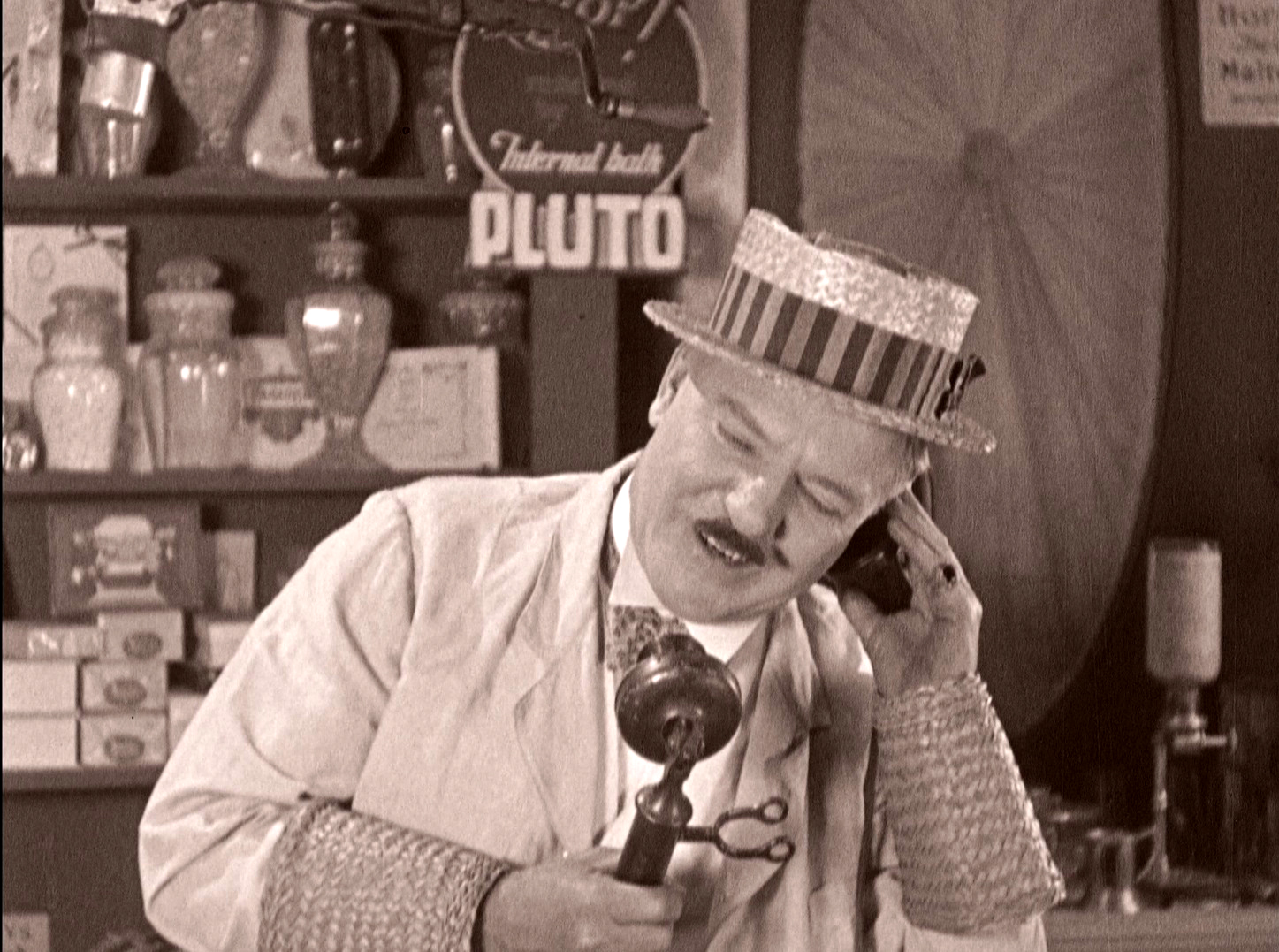
The wonderful new Kino Lorber Blu-ray release of W. C Fields and Louise Brooks in It’s The Old Army Game (1926) is a must-have for any Fields, Brooks, or silent comedy fan. As I’ve reported at length in several prior posts, Fields and Brooks filmed extensively on location in Ocala, Florida, as well as at El Mirasol in Palm Beach. But capping things off, Fields also filmed many scenes in New York, where Buster Keaton filmed The Cameraman and Harold Lloyd filmed Speedy.

It’s The Old Army Game involves a New York real estate swindler played by William Gaxton who uses Fields’ Florida drug store to sell questionable investments to the local townsfolk, but has a change of heart after falling for Louise Brooks. Midway during the film we’re introduced to a couple of New York police detectives planning a trip south to Florida to arrest Gaxton.

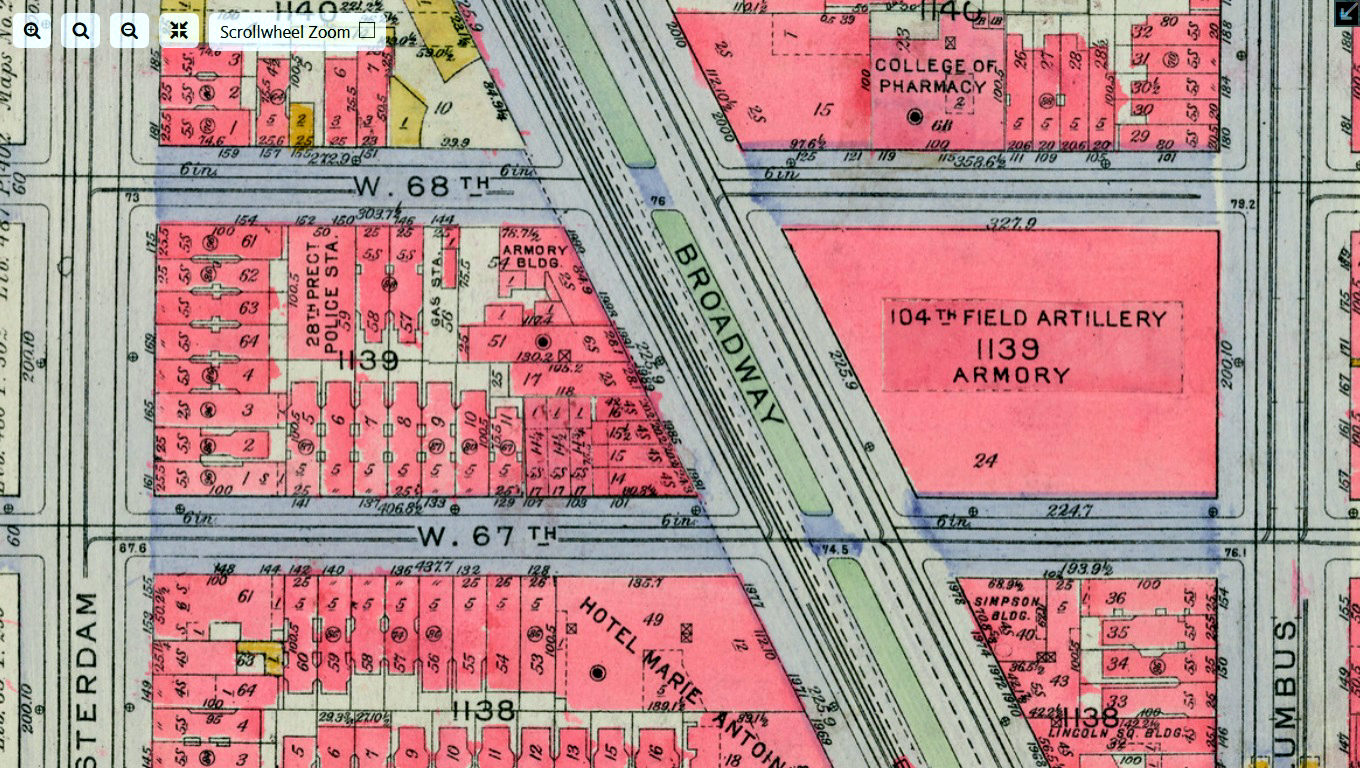
The establishing shot for the detectives was filmed in 1926 on the front steps of what was then Precinct 9A in New York, formerly at 150 W. 68th St. The matching photo of Precinct 28 was taken on April 3, 1918, as posted courtesy of Lynne Awe at PoliceNY.com., whose great uncle Edward Policke is somewhere in the photo.  The NYPD precincts were redrawn and renumbered twice during the 1920s. According to NYPDAngels.com, Precinct 28 was renumbered Precinct 9A on July 18, 1924, and renumbered again to Precinct 20 on July 3, 1929. At right, a 1923 Bromley Map of New York showing the 28th.

(This matching 1930 Bromley map shows the renumbered 20th.) Pat Storino at NYPDHistory.com confirms the precinct’s identity-changing history, with this image from the NYPD Patrolmen’s Benevolent Association. The caption explains the 1927 photo shows the officers of the 9A Precinct, “currently the 20th Precinct, located at 150 West 68th Street, west of Broadway and Amsterdam Avenue. The photo, which was taken in the summer of 1927, was lent to Brooks Costume Company in 1966 for technical assistance in the Broadway production of ‘Auntie Mame.'” Thus, the original Precinct 28, later becoming Precinct 20, was captured on film in 1926 during the brief time it was numbered 9A.

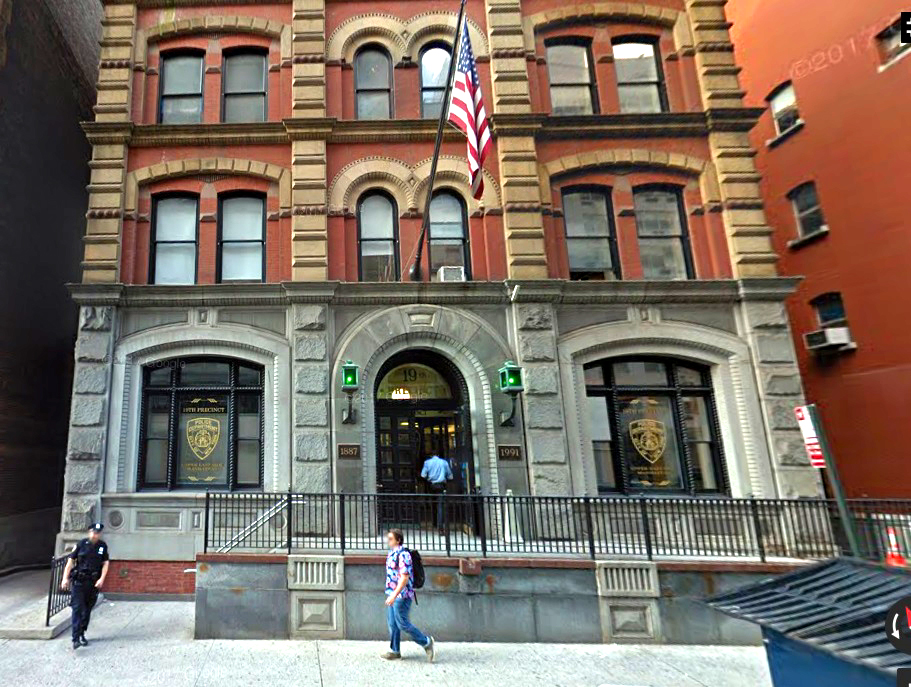
While a generic gray-glass high rise at the SW corner of Broadway and W. 68th has subsumed Fields’ precinct house, its cousin, the 19th Precinct house across Central Park at 153 E. 67th St., reveals their common architectural DNA. Given that the movie was made in Astoria Queens, where Fields also filmed Running Wild (1927) (see post here), I wondered how they chose this seemingly “remote” station, but even so, it was less than five miles from the studio.

These evocative scenes of all the policemen at the former 9A Precinct whets our appetite for when Fields visits Manhattan later in the film.

To begin, we’re introduced to Fields driving south down 5th Ave. from 57th St., the northern-most of five traffic towers behind him. Most notably, behind Fields to the left is the Cornelius Vanderbilt mansion (see similar detail at upper right, and as it appears, at right, looking south down 5th in Keaton’s The Saphead (1920)). When Harold Lloyd came to New York in 1927 to film Speedy, his matching view of 57th at the upper left reveals the mansion had already been demolished to make way for Bergdorf Goodman. The color view shows the Plaza Hotel towering over the Vanderbilt.

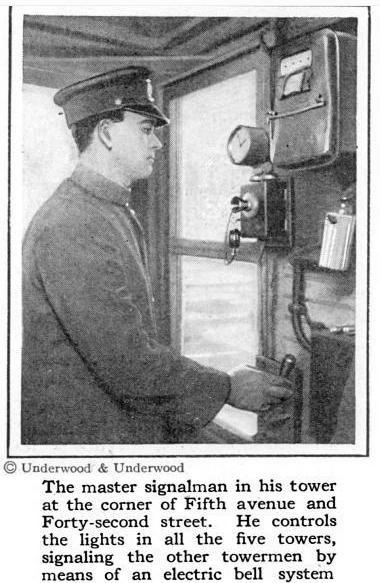
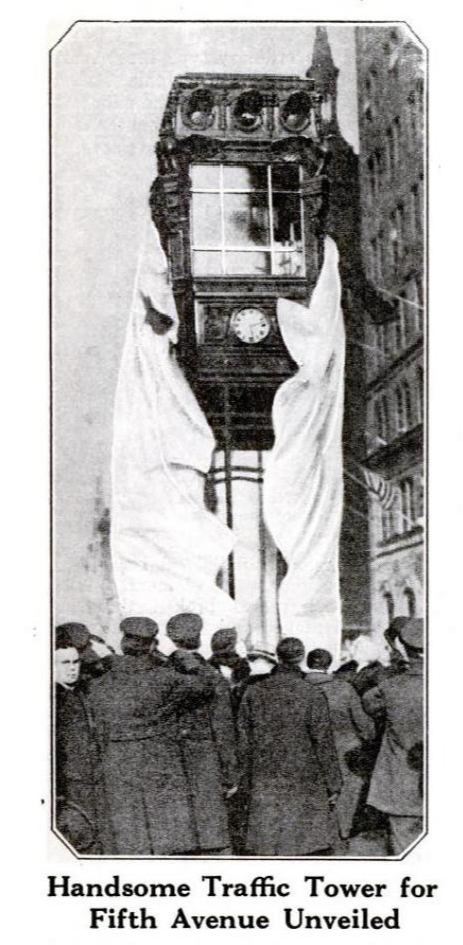
Click to enlarge maps above. As reported in the January 1921 Popular Science magazine, five traffic towers, using the block signal system originally developed by the railroads, were installed on traffic islands along 5th Ave. at 34th, 38th, 42nd, 50th, and 57th Streets. First installed in 1920, the towers were replaced with permanent bronze towers in 1923. By sending electric signals to control men located in each tower, the master signalman at 42nd St. could control the lights along 5th, allowing all 5th Ave. traffic to move at the same time. Despite its initial success, the tower islands blocked traffic lanes, and were removed in 1929.

As I report in my Harold Lloyd book Silent Visions, Harold filmed Speedy extensively along 5th Ave. while driving Babe Ruth to Yankee Stadium. Above, looking north, are the traffic towers at 34th St. left, and 42nd St. right, appearing in Speedy.

Returning to Fields, after driving a bit further south, he turns left from 5th onto E. 55th St. Notice the Vanderbilt mansion, red line, replaced now by Bergdorf Goodman in the modern view. Several buildings along 5th Ave. at back have been remodeled or rebuilt, but the two within the matching boxes appear unchanged.

Matching street signs from 1926 and today. I don’t know if E. 55th was one way at the time, or if the sign was a prop.

As Fields completes his left turn onto E. 55th we see what was then the Hotel Gotham at the left, and the 5th Ave. Presbyterian Church to the right.

Fields looking west, Keaton looking south. It nearly seems mandatory to include 5th Ave. if you’re going to film on location in New York. Two years after Fields, Buster’s sprint to Marceline Day’s apartment in The Cameraman (1928) (she thinks she’s still talking to him on the phone after agreeing to a date when he appears suddenly behind her), was filmed looking south down 5th Ave. at 55th, with the same Hotel Gotham and 5th Ave. Presbyterian Church appearing at back. In prior posts, Bob Egan located both Buster’s Manhattan apartment, and Marceline Day’s apartment, bookending this scene.

A panorama of Keaton’s sprint up 5th Ave. from 55th, compared to Fields’ left turn.

With a trick of editing, Fields is no longer on E. 55th, but on E. 62nd, where his car breaks down after being struck by oncoming traffic. Bob Egan found these locations as well. Looking west, the corner building to the left is the Knickerbocker Club, founded in 1871. The headquarters at 2 E. 62nd St. was completed in 1915. [Note: reader Andy Charity first identified these E. 62nd St. locations to me over a year ago (!), but I somehow lost track. It was Andy who solved that Buster runs past Bergdorf Goodman during The Cameraman, as explained in this post HERE.]

Still looking west, the four balcony brackets behind Fields’ head at 1 E. 62nd are easily visible. The ongoing construction behind Fields is for 810 5th Ave. (built with a 62nd St. entrance), a 13-story apartment tower that replaced a pair of 6 story and 4 story apartments facing 5th Ave.

Looking north, the impressive gated entry to 11 E. 62nd St. appears here.

Looking west, the central buildings are replaced by the modern Rennert Mikvah synagogue at 5 E. 62nd (red awning), while vintage buildings flank each side.

The following year Fields would also film Running Wild (1927) at the Astoria Studios in Queens, appearing several times during that film (see complete post HERE). Yet the studio makes a brief cameo here too, as a fleet of taxis race towards Fields’ car, the back end of the 36th St side of the studio appears in the shot (1929 photo (Marc Wanamaker – Bison Archives).

Another view looking west at Fields’ destroyed car, the Knickerbocker Club appearing in the far background.

My great thanks to New York history expert, and NYC pop culture locations blogger Bob Egan of PopSpotsNYC.com, for his assistance with this post. Check out Bob’s new book Pop Culture New York City: The Ultimate Location Finder. As mentioned above, Bob has located both Buster’s Manhattan apartment, and Marceline Day’s apartment, as they appear in The Cameraman. Thanks also to Pat Storino at NYPDHistory.com.

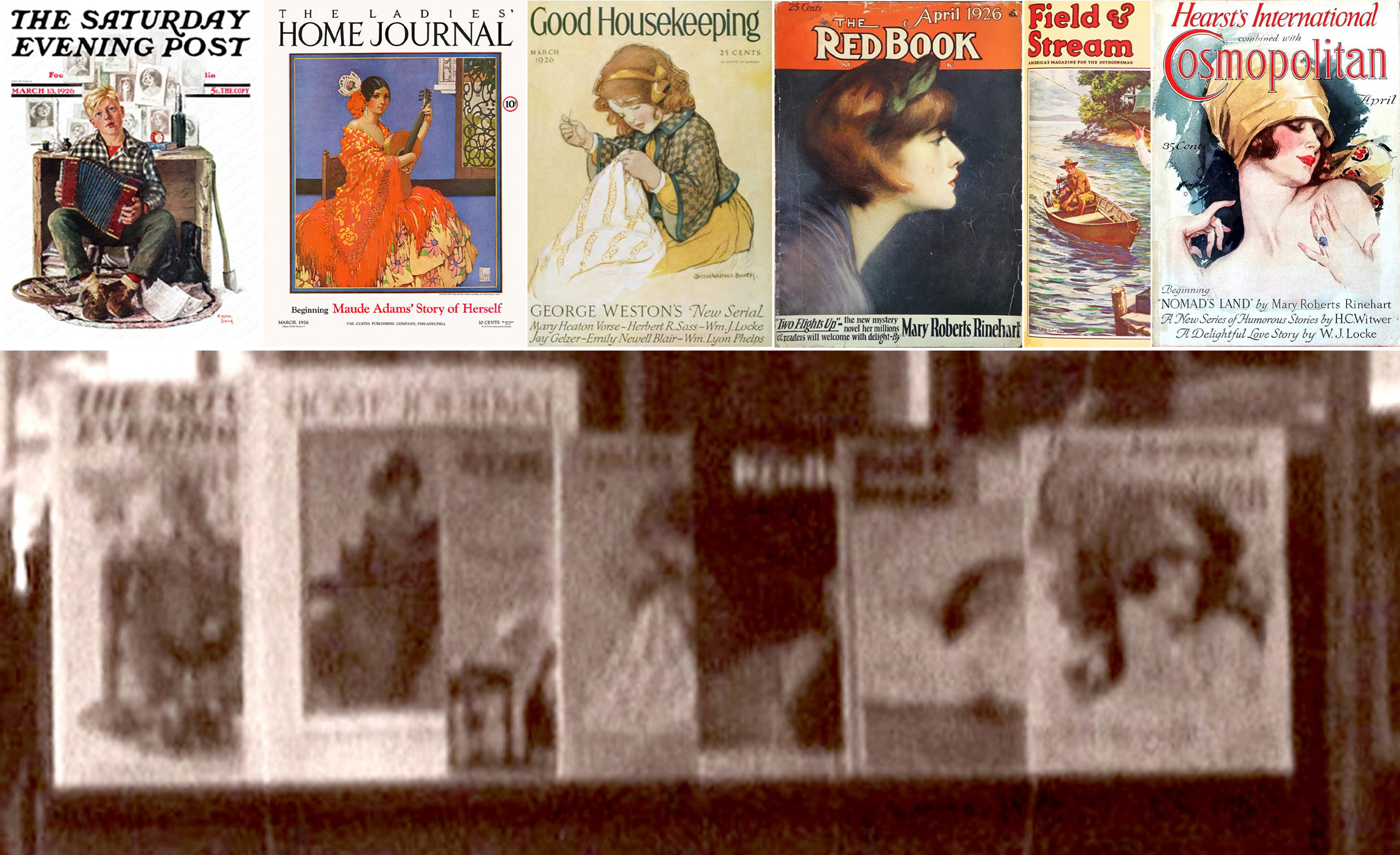
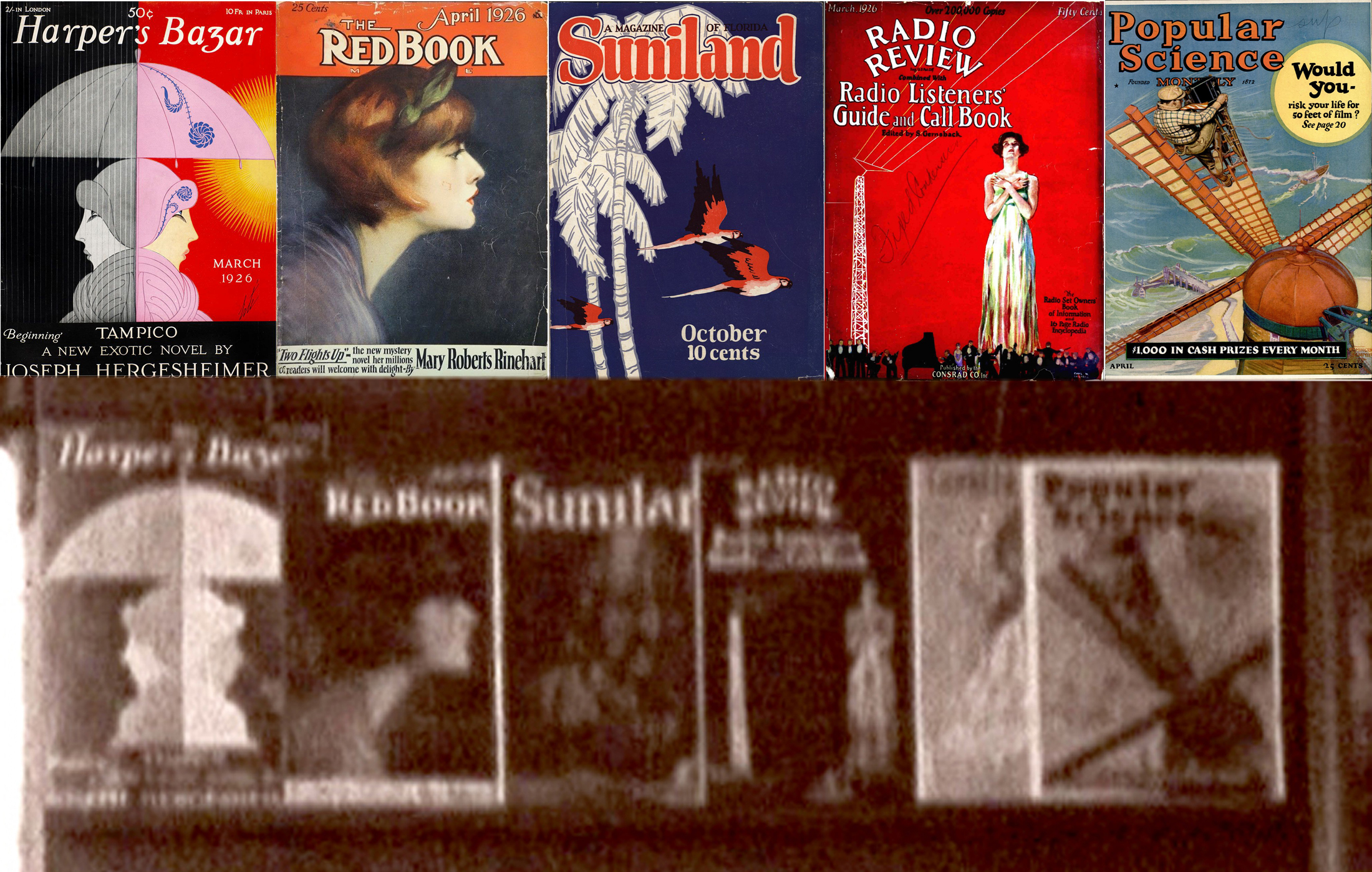
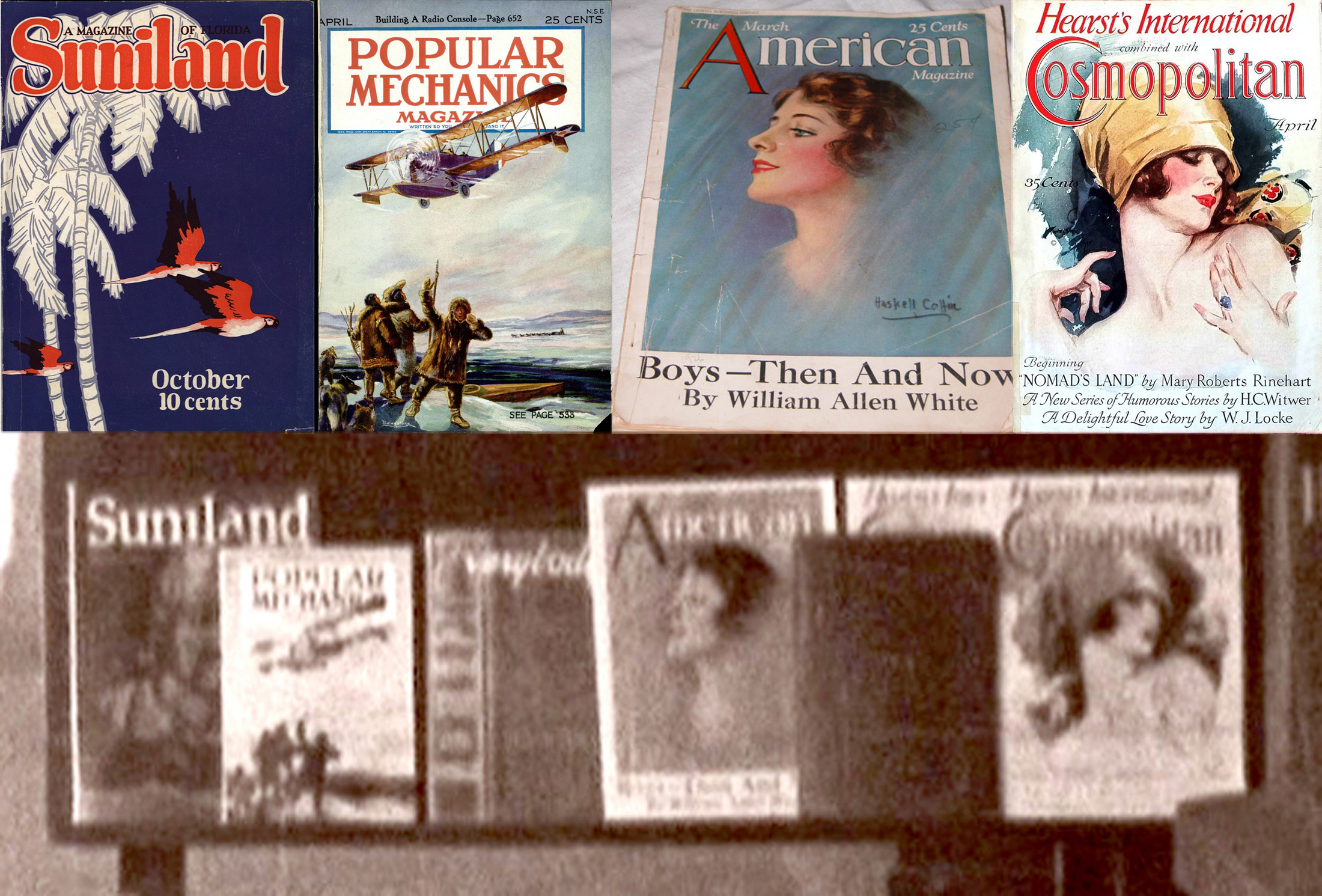
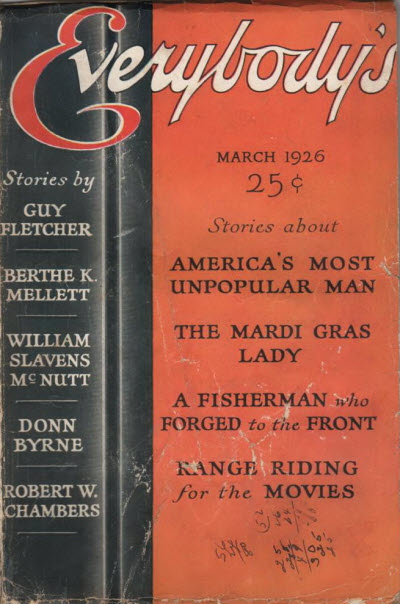
Aside from being popular entertainment, silent movies are also an invaluable historic record, providing rare glimpses of the past that are often overlooked. The new Kino Lorber Blu-ray release of It’s The Old Army Game is exceptionally deep, providing dozens of views of historic Ocala Florida, Palm Beach Florida, magazines popular during March and April 1926, and as seen here, even New York.

Below, 11 E. 62nd St.

Posted in It's The Old Army Game, Manhattan, New York, W.C. Fields | Tagged , , , , , , , , , , , | 15 Comments

It’s The Old Army Game – W.C. Fields and Louise Brooks in Ocala Florida – Part Three – Fields Chased Around Town

Here’s the third and final post about W.C. Fields and Louise Brooks filming It’s The Old Army Game (1926) in Ocala, Florida. In the first post Fields plays an embattled pharmacist dealing with rude customers, nagging relatives, and pesky firefighters. Fields’ corner store still stands at the SW corner of Broadway and Main (now 1st). In the second post Fields’ employee Louise Brooks attracts an admirer, a smitten real estate promoter from New York played by William Gaxton, who follows Louise from the train station and around town. The plot gets underway here in the third post, when Fields allows Gaxton to sell real estate investments from his store. (In a reverse on the speculative 1920s Florida real estate boom, Gaxton sells New York property interests to people living in Florida!)

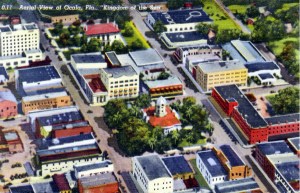
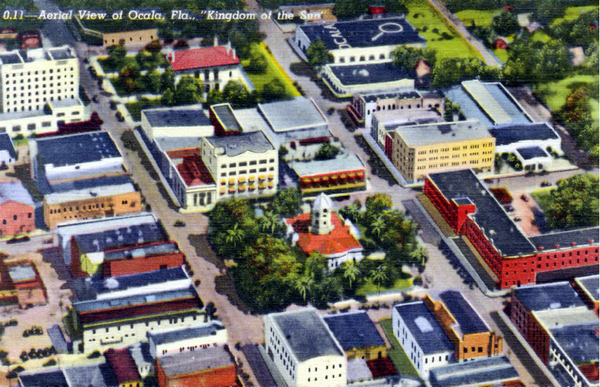
Above, inside the store, the property interests are selling like hotcakes. While these store scenes were filmed on an interior stage in Astoria, Queens, New York (where Fields later filmed Running Wild in 1927), the giant photo-mural in the background accurately represents the view you would have seen looking from the true corner drug store doorway – the large red brick Ocala House Hotel that once stood along the east (right) side of the town square, prominent in this vintage postcard looking north. Fields’ shop is the orange building to the lower right.

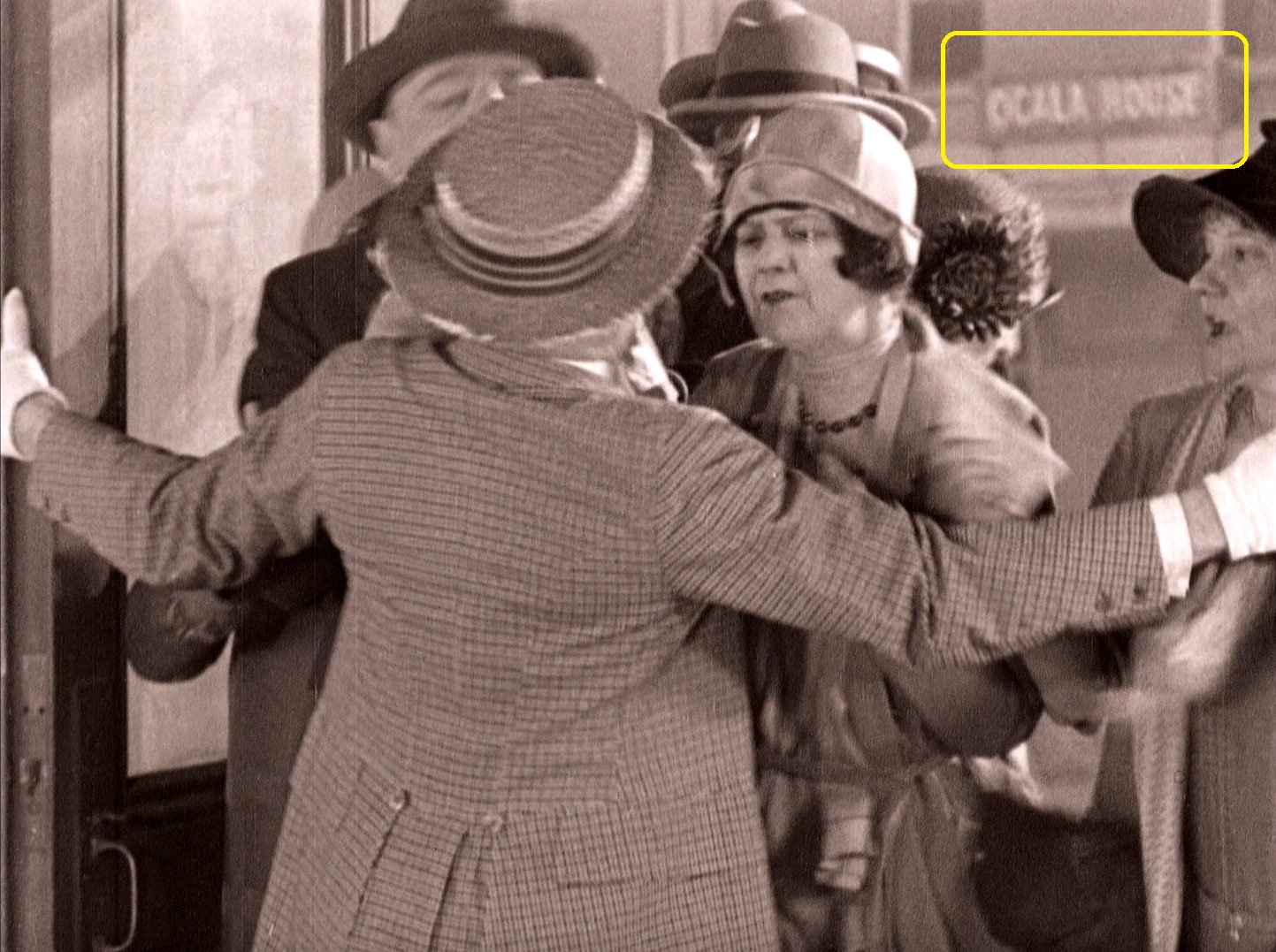
The giant photo-mural behind Fields upper left reveals the distinctive brick porch of the Ocala House, appearing earlier in the film in this true location shot above of Gaxton searching for Louise in the prior post. Later in the film Fields runs past this same porch, as described below. At left, you can read “OCALA HOUSE” on the photo-mural in this shot.

When Fields flees a mob later in the film, he runs north up Main (now 1st) towards Broadway, providing a more complete view of the Ocala House that stood east of the town square, matching this closer view of Gaxton searching for Louise from the prior post.
I’m fascinated by the Ocala House appearing on camera, because contemporary 1920s photos of this lost landmark are hard to find. (The above views are circa 1890 and 1950). When a devastating 1883 fire on Thanksgiving Day destroyed most wooden structures in town, the Ocala House Hotel was re-built with brick in 1884, serving as a local landmark for decades before being demolished in the 1960s. The hotel site today is an open lot.

Cutting from the frenzied sales inside Fields’ store, we see a pair of New York police detectives planning Gaxton’s arrest for fraud. I cover this and all other New York scenes in the film in the next post.

Next, Fields takes a break from the real estate sales for a disastrous family picnic staged on the grounds of the Stotesbury estate, El Mirasol, in Palm Beach – detailed in this post.
After discovering the real estate fraud, Fields heads to New York to try to set things right (see future post about New York). Unbeknownst to Fields, Gaxton, reformed by Louise Brooks’ love, comes through on the investment deals, and suddenly everyone in town has become wealthy. Above, Gaxton shares the good news beside the former Marion County Courthouse. At right, from the first post, the south end of the courthouse appears behind Gaxton earlier in the film as he stares into Fields’ corner shop window.

Views looking west towards the former courthouse. The bandstand in the postcard (or its replica) now stands in the center of the square.
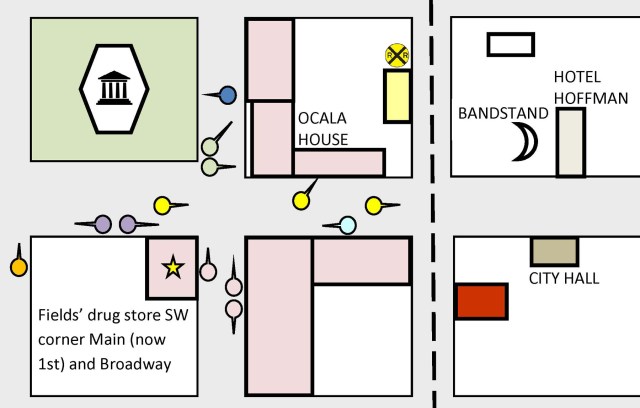
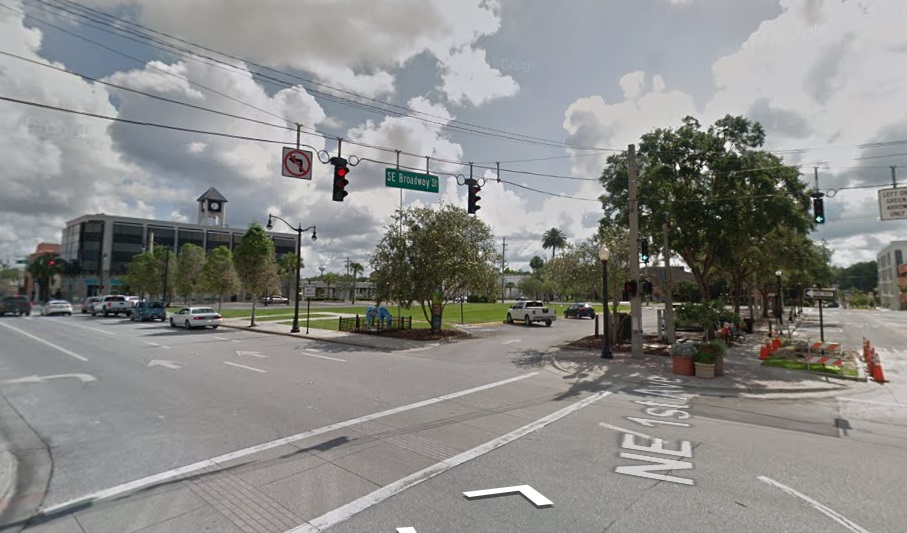
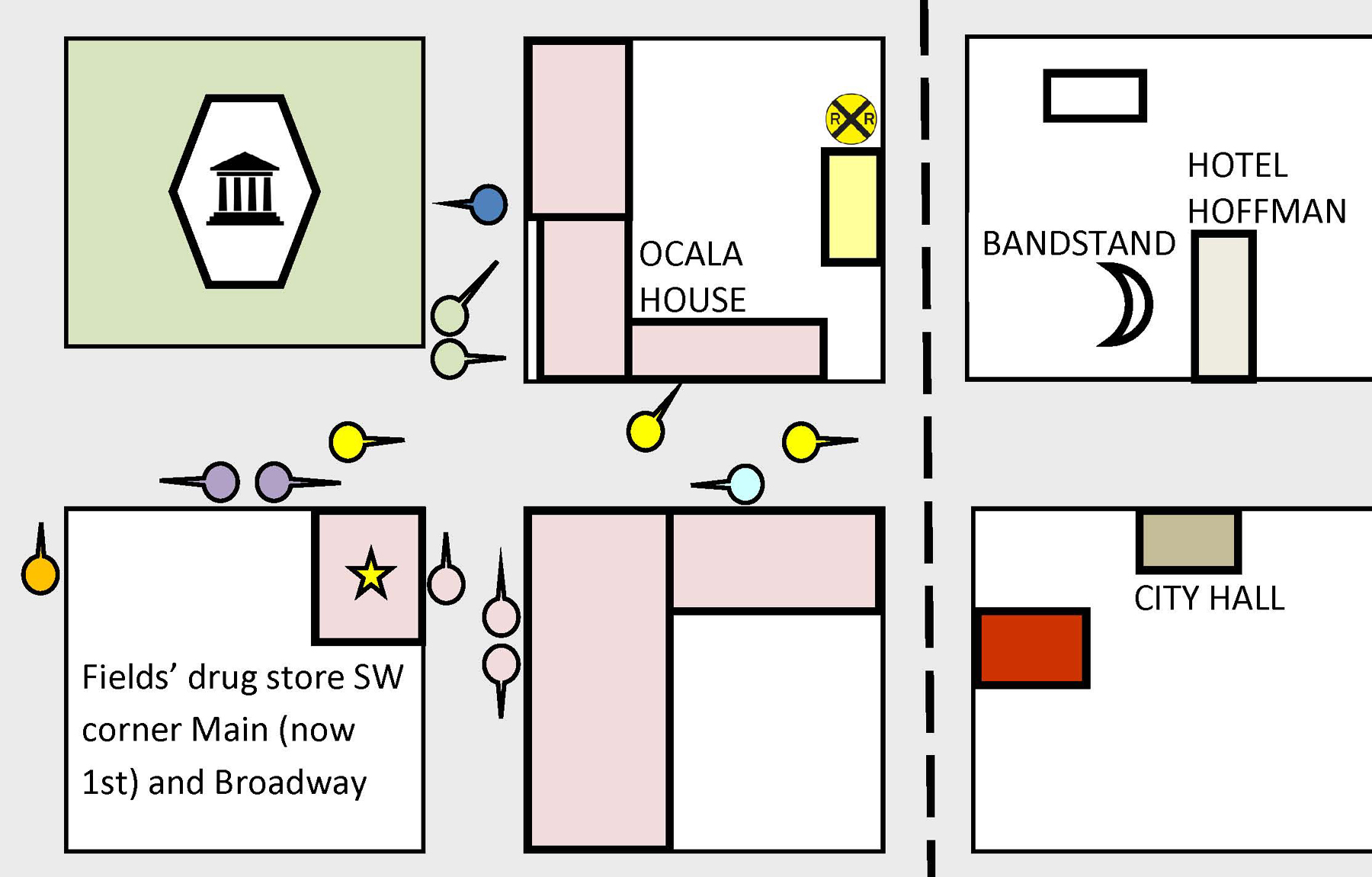
Looking north – Fields’ route chased by the mob was limited to left-right along Broadway, Magnolia (orange) at left, and Main (now 1st) (pink). Osceola at right still has train tracks running north-south.

Returning from New York, seemingly a failure, Fields sneaks into town fearing a tar and feather mob reception. Instead, the ecstatic townspeople want to give Fields a hero’s welcome, resulting in their comedic chase around town.

To begin the chase, Fields sprints east along Broadway from Main (now 1st) towards Osceola. His corner drug store appears at far back behind him, while closer at back is the same sidewalk scale Louise strolls by in the prior post.

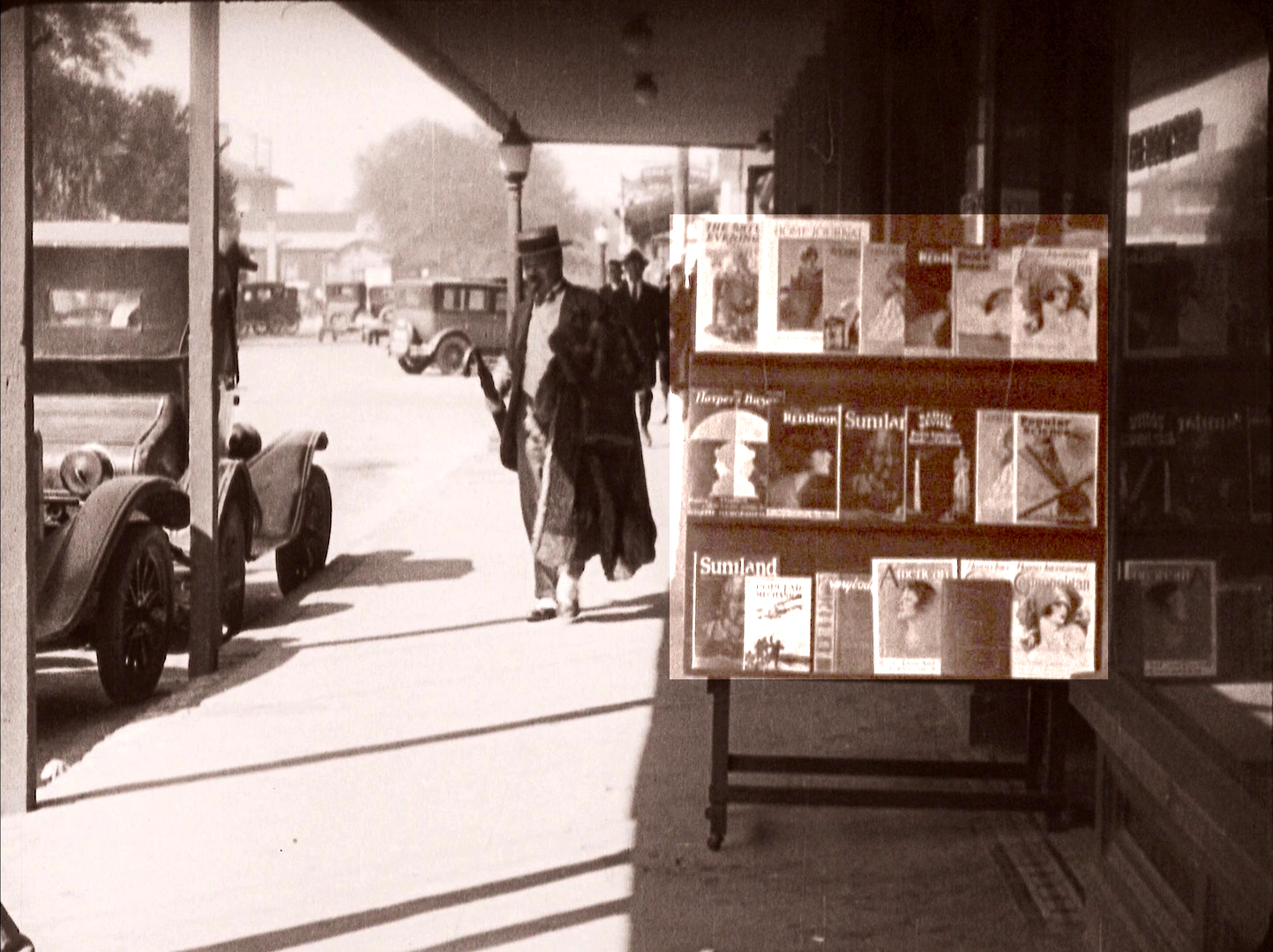
Fields runs south down Main (now 1st) from Broadway, upper left view looks south, lower left looks north towards a magazine rack loaded with March and April 1926 publications, all discussed in this post. The vintage postcard looks north up Main (now 1st) from Fort King. Fields ran south towards us on the right – the red line points to the “EAT” sign discussed below. The postcard striped corner awning of the Harrington Hall hotel, see postcard above, also appears behind Louise, below. The left side buildings in the postcard remain standing – those to the right are all gone. [Update: Florida historian Lisa Bradberry writes that Fields, Brooks, director Sutherland, and the rest of the crew, stayed at Harrington Hall. Here are her two articles from 2005 about the filming W. C. Fields filming in Florida – 2005 articles by Lisa Bradberry.]

The prominent “EAT” sign appearing behind Fields and Louise is barely visible in the postcard above. Here, looking south, the view behind Fields shows the truncated store corner at the SW corner of Fort King – it appears to be the same building today.

Zooming in on this view north we see the two chimneys on the right (east) end of the former Ocala Post Office – the line of sight depicted at right. The postcard photo was taken after 1924, as the Sanborn fire insurance maps from that year show no buildings north of the square that would block the view of the Post Office from Fields’ spot.

At left, a crowd of elated townspeople joyfully recognize Fields passing by, and are eager to hail him a hero. Both views show the corner brick porch of the former Ocala House, once standing at the NE corner of Broadway and Main (now 1st).

Fields dashes west along Broadway towards Magnolia. The sidewalk awnings above Fields were not yet built in the earlier vintage photo. The yellow box marks the same south window on the E. W. Agnew & Co. building. This could be the same building with the red awning, now heavily remodeled, standing there today.
Again running west along Broadway from his corner store on Main (now 1st), only this time looking east, as Fields hopes to slip by unnoticed. The blue dot marks where Fields and Louise appeared near the sidewalk scale, mentioned previously. The men’s hat window display complements the reverse view of the matching window display appearing early in the film behind Elise Cavanna.

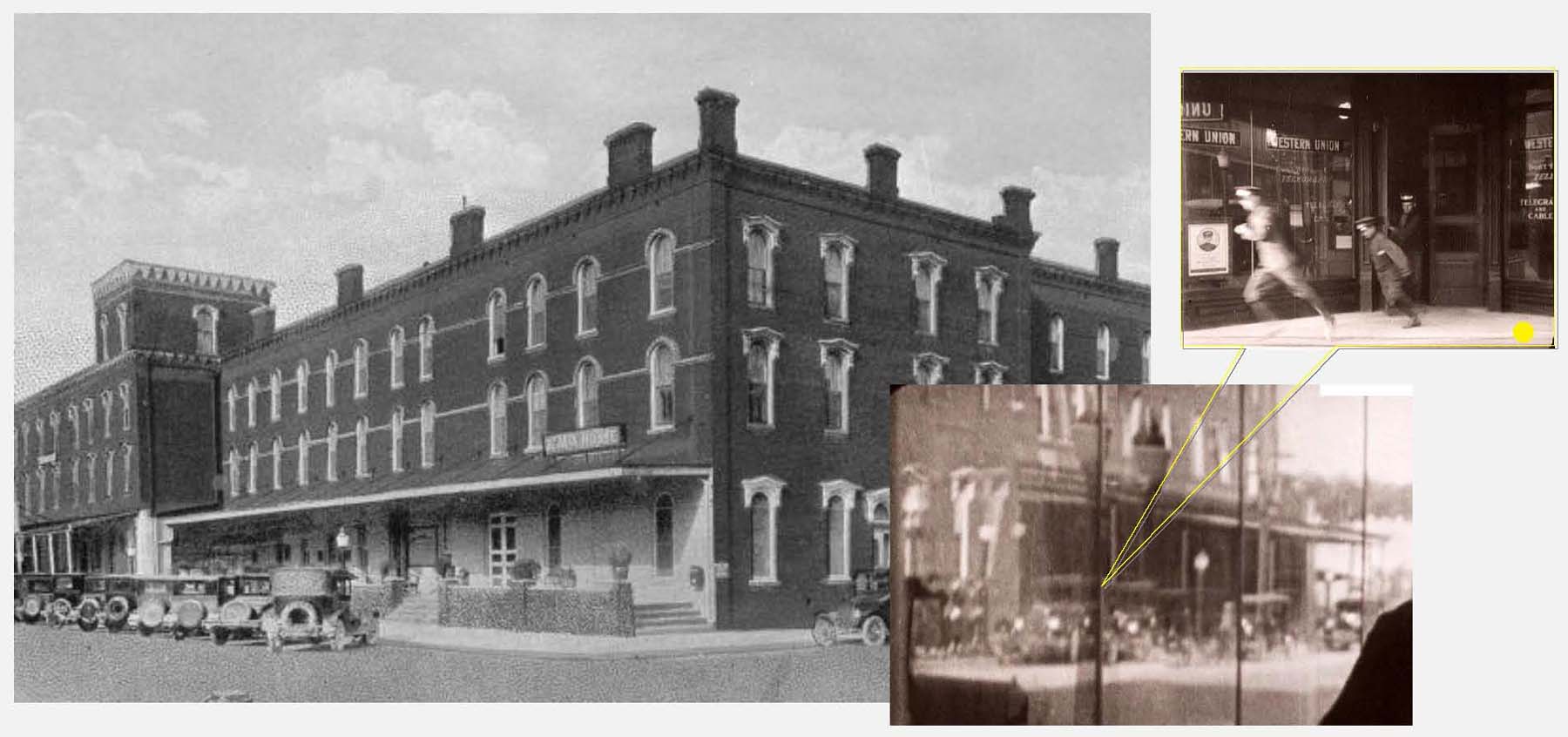
By reversing these movie images, the combined window reflections provide a rare view of the south side of the Ocala House facing Broadway.

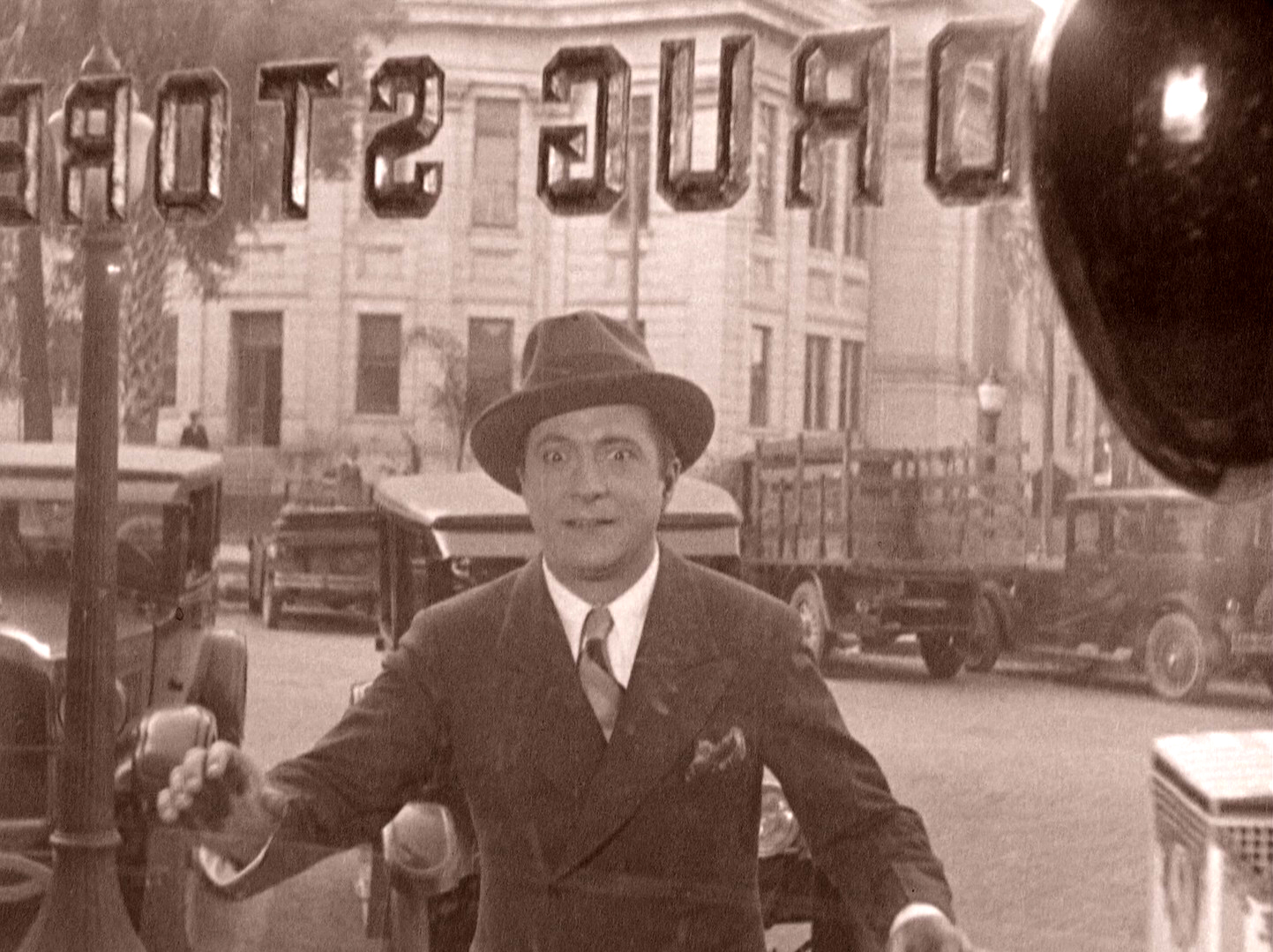
This combined image shows the NE corner of Broadway and Main (now 1st), and the site of the Western Union shop on the south side of the Ocala House appearing moments later in the film.

Fields races north up Main (now 1st) alongside his corner store on Broadway – the trees are part of the town square across from the Ocala House visible to the right.

Looking north up Magnolia at Broadway, Fields attempts sneaking past a security guard, with the Ocala National Bank building still standing behind him on the far NE corner of Magnolia and Silver Springs.

Looking north, a closer view of the bank visible behind Fields, along with matching corner masonry details visible in the vintage photo looking east down Broadway from Magnolia.

In the final tracking shot, Fields runs west towards the camera along Broadway from Osceola, as a huge crowd to the east masses downhill behind him. The view roughly matches the prior view of Louise at the same corner, with the train tracks running left-right along Osceola.

[Update: Ocala historian Evan Landrum provided this post card above showing the side of City Hall, matching the view with Louise. The fire station is around the corner to the right.]

A bit further west, both the former Ocala bandstand (left), and prominent second floor porch of the former Hotel Hoffman (right), appear briefly behind Fields (see map above for details).

Even further west along Broadway, Fields runs past the Western Union shop (box) mentioned previously.

Fields has now run west along Broadway from Osceola past the corner of Main (now 1st). Looking due east, the corner brick porch of the Ocala House Hotel appears to the left.

A later shot of the security guard struggling to keep up was also filmed looking east down Broadway from Osceola, the train tracks running left-right along Osceola are visible in the film, and still present today. The modern view now includes a train crossing sign.

[Update: Above left, Fields dashes for safety hiding in the “county jail.” While I was unable to identify this spot, Ocala historian Evan Landrum supplied convincing evidence that the “jail” shot was staged at the back of a store at the SW corner of Main (now 1st Ave.) and Fort King. Notice the matching staggered rooftop firewall dividers (yellow boxes above). While too lengthy to list them all here, Evan noted many unique features in the movie frame that match exactly with details from his vintage color Sanborn map, including a sheet metal awning that extends almost to the corner of the building as depicted in the movie frame, and I am convinced he is correct.]

Above, the Sanborn maps, and a matching view of the “jail” building today. Consider too that nearly the entire film was shot within a block of Fields’ drug store at Broadway and Main, and this “jail” setting was also just a block away. The above aerial above and below is likely from the 1930s, and the metal awning appearing in the movie frame, and depicted on the map, has since been removed.
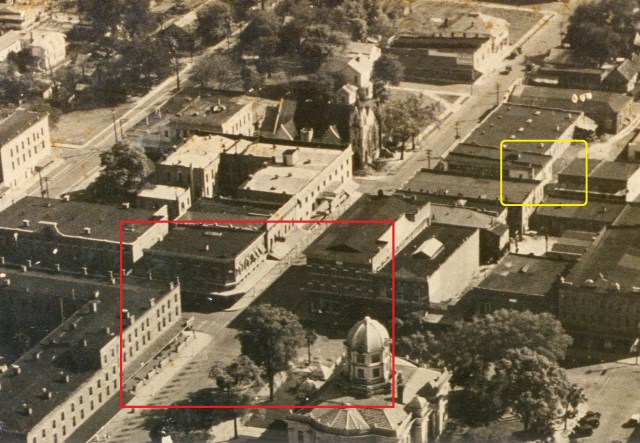
[Update: this aerial view supplied by Evan Landrum, looking SE, shows the corner of Broadway and Main (now 1st) (red box), where Fields’ drug store stands, and where many scenes were staged, and the jail scene setting a block further south (yellow box).]

All’s well that ends well; Fields is the home-town hero, we’re offered sage advice about swallowing birds in the hand, and true love triumphs. This delightful comedy is a wonderful precursor to Fields’ “talkie” career, and reminds us yet again of how vintage movies are also a vibrant historic record of the past.

Update: this formerly unsolved shot of the fire crew responding to Fields’ false fire alarm (see first post) was filmed looking east down Fort King towards the Fort King Apartments at the SW corner of Tuscawilla, built some time between the 1924 and 1930 editions of the Sanborn fire insurance maps.

Historic Ocala Preservation Society President Brian Stoothoff writes that the previously unidentified scene above of people from an arched porch running to greet Fields was likely filmed at the Ritz Historical Inn, 1205 E. Silver Springs Blvd., built in 1925, and now listed on the US National Register of Historic Places. The above images certainly look consistent. Moreover, given the Ritz was brand new in 1926, it’s easy to speculate Fields, Brooks, and the rest of the film crew might have stayed here during filming, as opposed to the Ocala House that appears in the film, that at the time was already several decades old.

[Update: I had pondered where the above shot of people exiting the bus was staged, and once again Ocala historian Evan Landrum supplied the answer. The view looks east along Broadway, with the trees beside City Hall at back, while to the right of the lamppost you can see a sign for the Marion Cafe that once stood at 118 Broadway.]

Both views above look east down Broadway. In the shot with the bus, the corner where Louise stood would be at back, on the right side of the street, and is blocked from view by the bus.

[Update: be sure to check out Florida historian Lisa Bradberry’s two articles from 2005 about the filming W. C. Fields filming in Florida – 2005 articles by Lisa Bradberry.]

Click to enlarge. [Update: Ocala historian Evan Landrum supplied this 1930s view looking SE, with the Fields drug store corner marked with a star across from the court house. Nearly every exterior scene in the film was staged somewhere within this amazing photo.]

Kino Lorber It’s The Old Army Game.

Photo sources: The State Library and Archives of Florida, Marion County Historical Photographs.

Looking north at the Ocala National Bank building.

Posted in It's The Old Army Game, Ocala Florida, W.C. Fields | 7 Comments

W.C. Fields Running Wild in New York

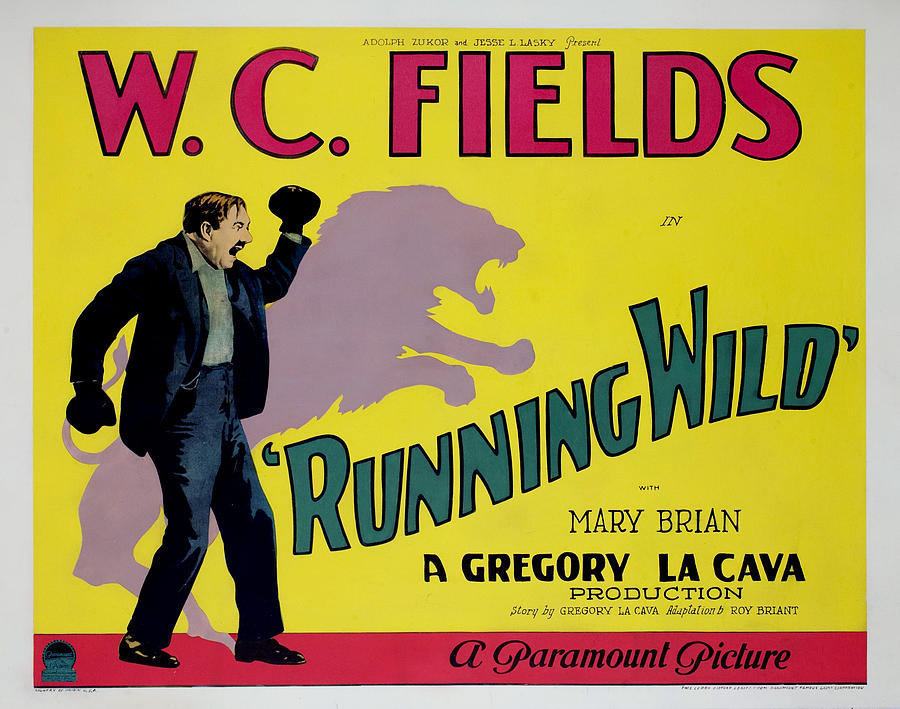
Having studied the new Blu-ray release of W.C. Fields and Louise Brooks in It’s The Old Army Game (1926) (with more posts to come), let’s focus on the beautiful Kino Lorber Blu-ray release of Fields’ Running Wild (1927), another wonderful comedy loaded with visual history, this time filmed in Astoria, Queens. Fields plays a meek shipping clerk, a widower cherished by his adult daughter, but cruelly mistreated by his second wife and step-son. When accidentally hypnotized, Fields roars to life, rightfully asserting himself the master at both work and at home. The movie was filmed at the Paramount Astoria Studios on 35th Avenue and 35th Street, with many exteriors filmed within a block or two of the studio.

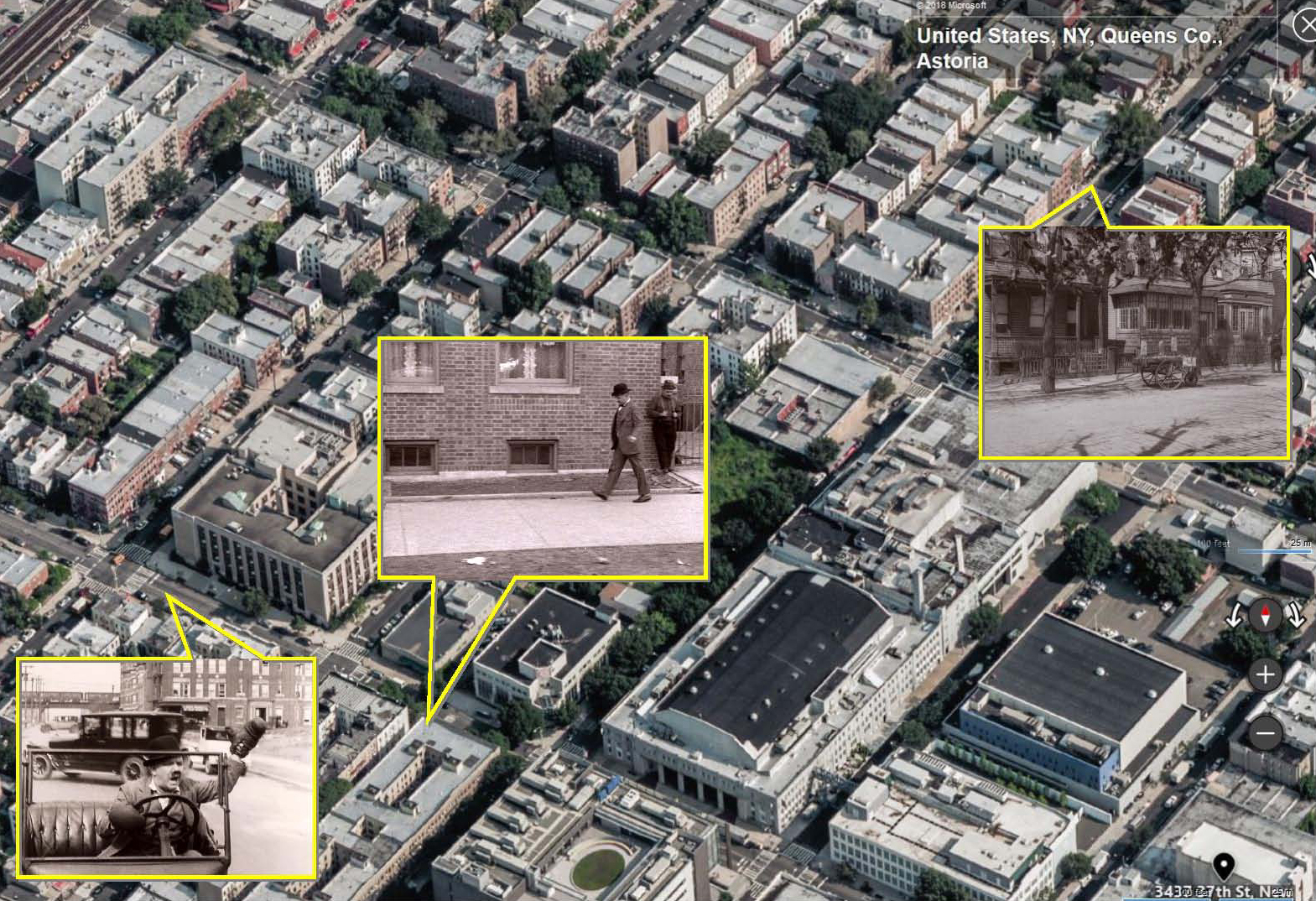
Looking north – three of many scenes staged close to the studio (large arched roof). Fields’ house (upper right) stands at 32-62 35th Street, while Fields walks to work (middle) along the corner opposite from the studio. Roaring with confidence, Fields drives east (lower left) along 35th Avenue from 33rd Street towards the studio. (C) 2018 Microsoft

Above, scenes from throughout the movie were all filmed close to the studio. Noted Fields biographer James Curtis explains that “in March, 1927 the Astoria studio was closed by Famous Players and all the companies moved to California where production would be consolidated under B.P. Schulberg. (It took talkies and the urgent need for stage-trained actors to force the re-opening of the studio.) It fell to Jesse Lasky to personally approve the making of Running Wild in New York, so they had the entire run of the studio while making it. Without Lasky, it would have been done in Los Angeles. Personally, I think the Long Island locations are an asset to the film, and that it wouldn’t have tuned out as well if made in California.” Thank you Jim, I agree the locations really help set off the film.

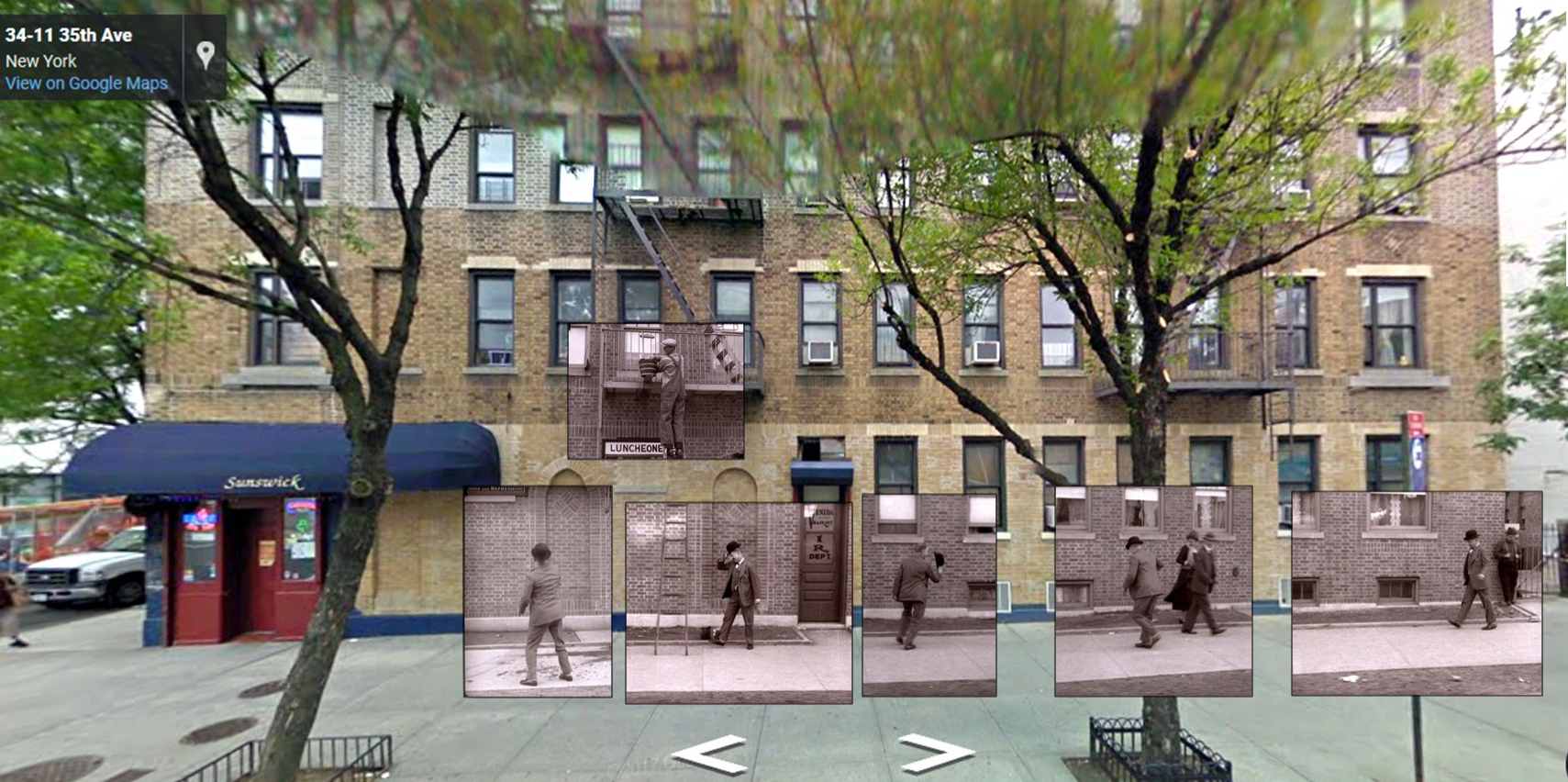
Meek and superstitious, Fields walks to work, careful to avoid stepping on any cracks, and later dodging a ladder set up on the sidewalk.

Walking to work, carefully not stepping on cracks or beneath a ladder.

These early scenes above were filmed walking east along 35th Avenue towards the SW corner of 35th Street, with the studio standing on the opposite NE corner.

Afraid to cross the street, Fields pauses beside some school kids at the NE corner of 36th Ave and 34th St.

A cop holds back traffic, the view looks SE down 36th Ave from 34th St towards the intersection of 35th St at back.

Fields and the children cross 34th St under the policeman’s watchful gaze.

Safely reaching the NW corner of 36th Ave and 34th St, Fields continues on his way to work.

Later in the film, Fields flees for his life from an infuriated shopkeeper, turning the NE corner of the Astoria Studio at 35th Ave and 35th Street.

Fields seeks refuge in a handy doorway, leading to the backstage of a theatrical hypnotist act already in progress. The doorway at 34-31 (or so) 35th St, flanked by windows on both sides, is now the side entrance to the Kaufman Astoria Studios.

Fields responds so aggressively to the hypnotic suggestion that he is a lion that he knocks out the hypnotist and flees the stage before the spell can be undone.

King of the World – Fields zooms east along 35th Ave with the 31st St elevated tracks and matching buildings east from 32nd St behind him.

This POV shot looks east down 35th Ave approaching the intersection of 34th St.

Traveling a bit further east, the NW corner building at 35th Ave and 33rd St appears at back.

Modern views of the studio front entrance, at left, and the twin apartments, at right.

As Fields races along 35th Ave towards the studio, the two story studio laboratory building appears to the far left, with the studio formal front entrance columns further at back. The arrow in this 1921 photo (Marc Wanamaker – Bison Archives) shows Fields’ walking path above avoiding the sidewalk cracks – the apartment in that scene would be built on the foreground vacant lot.

The POV shot at left includes the twin apartments between 34th and 35th Streets, where Fields walks to work avoiding the sidewalk cracks.

Switching perspective, Fields drives west towards the SW corner of 35th Ave and 35th St, then along the same sidewalk, and towards the same ladder, that Fields encountered on foot earlier in the film. The corner drug store was fittingly named the “Studio Pharmacy.”

This shot was staged a bit further afield, the NW corner of 31st Ave and 34th St.

A view of Fields’ house, to the left at 32-62 35th St, one block north of the studio, moments before he slams his car into the tree out front. Though the three homes have all been modernized, their proportions and configuration remain the same, especially the stone porch of the middle house. I found this spot by dumb luck. On a whim I decided to check for homes near the studio, and found this almost immediately.

Although snapped from his hypnotic trance, Fields retains his swagger, and the film ends as he chases his terrified step-son up the street.

A careful analysis of the 1927 view above, and the matching Google Street View 90 years later below, reveals numerous unique details appearing in both images. I live in California, and may never visit this spot in person, yet thanks to the internet it’s possible to confirm vintage and remote locations by simply working from a computer.

At left, here’s one location from Fields’ race home that I have not been able to identify. Presumably it too is close to the studio, if still standing. Likewise, these scenes of Fields at the right may have been filmed against one of the studio buildings. Notice the corridor bridge crossing above a downgrade drive. Although the doorway at right reads “14th Precinct,” the true 14th had a 229 W 123rd address, conflicting with the “452” address appearing in another shot. Since the “Harvey & Co.” sign is a prop for a fictitious company, the precinct sign is likely a prop too.

Bonus: the back end of the 36th St side of the studio (1929 photo (Marc Wanamaker – Bison Archives) appears during a New York scene from Fields’ earlier silent comedy It’s The Old Army Game). I already have 5 posts about It’s The Old Army Game, filmed with Louise Brooks in Ocala and Palm Beach Florida, and will soon issue a bonus post about the scenes filmed in New York, where W.C. Fields crossed paths with Buster Keaton and Harold Lloyd (who knew?)

Bonus update – I just discovered Buster Keaton filmed The Chemist (1936) alongside Fields’ Running Wild apartment. Stay tuned for a future post about Buster’s Astoria films.

Check out Kino Lorber’s Blu-ray release of Fields’ Running Wild.

Below, the Kaufman Astoria Studios today.

Posted in Astoria, New York, W.C. Fields | Tagged , , , , , , , , , , | 9 Comments

It’s The Old Army Game – W.C. Fields and Louise Brooks in Ocala Florida – Part Two – Louise Strolls Around Town

This next post about the wonderful new Kino Lorber Blu-ray release of It’s The Old Army Game is authored mostly by noted Louise Brooks author and expert Thomas Gladysz, with (my comments) limited to the Ocala Florida historic settings appearing in the film. Take it away Thomas! +    +     +

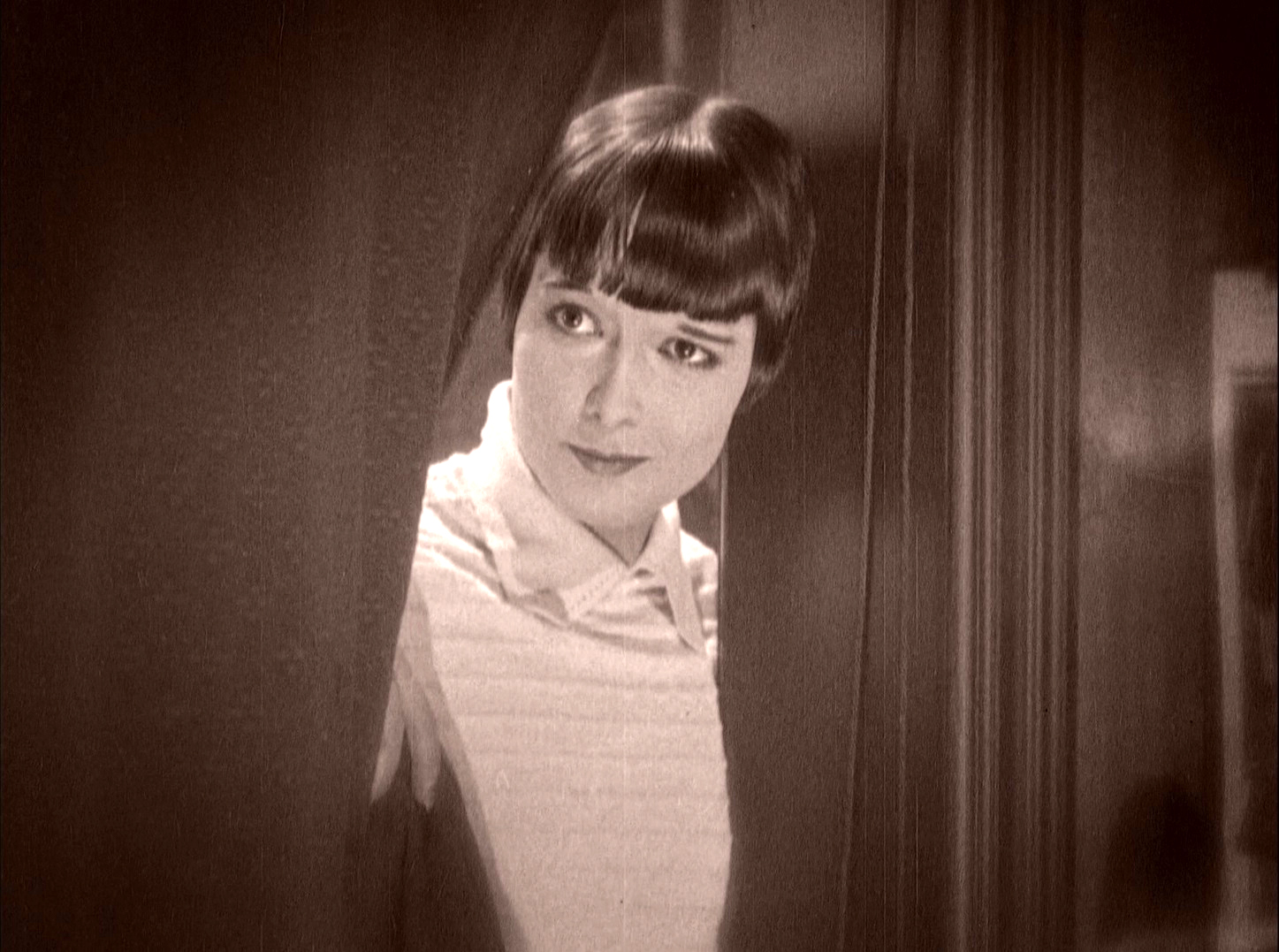
Released by Famous Players-Lasky in May of 1926, It’s the Old Army Game is a comedy about a befuddled, small town druggist, played by W.C. Fields, who gets involved with a real estate scam. Louise Brooks, on the verge of stardom, plays the druggist’s assistant.

Clarence Badger was originally assigned to direct, but the film was soon turned over to Edward Sutherland, a onetime actor and Keystone Cop who began his directing career just a few years before with the help of Charlie Chaplin. The film was announced, at first, as starring Fields and future “It girl” Clara Bow, but as she was needed on the West Coast to shoot Mantrap (1926), the female lead fell to Brooks. Just nineteen-years old, the film was Brooks’ fourth; it reunited her with the 47 year old Fields, who was starring in his first Paramount film under a new contract. By all accounts, Fields and Brooks were fond of one another, having worked together the year before in the Ziegfeld Follies. In Lulu in Hollywood, Brooks mentions that the two would sometimes hang out together in Fields’ dressing room, and sometimes shared a drink.

It’s the Old Army Game was in production in February and March of 1926. Aside from interiors shot at Paramount’s Astoria Studios on Long Island and a few scenes at the end of the film shot in Manhattan, a fair amount of It’s the Old Army Game was shot in and around Ocala and Palm Beach, Florida. Though Paramount had made other movies in Ocala – including scenes for the earlier Brooks’ film, The American Venus – the small Florida town was more than just an amenable southern location. It fact, it was pivotal to the story told in It’s the Old Army Game. At the time, there was a Florida real estate boom, and many a northerner was duped into buying Florida lots. It’s the Old Army Game reverses the scam, and has gullible Floridians duped into buying New York lots.
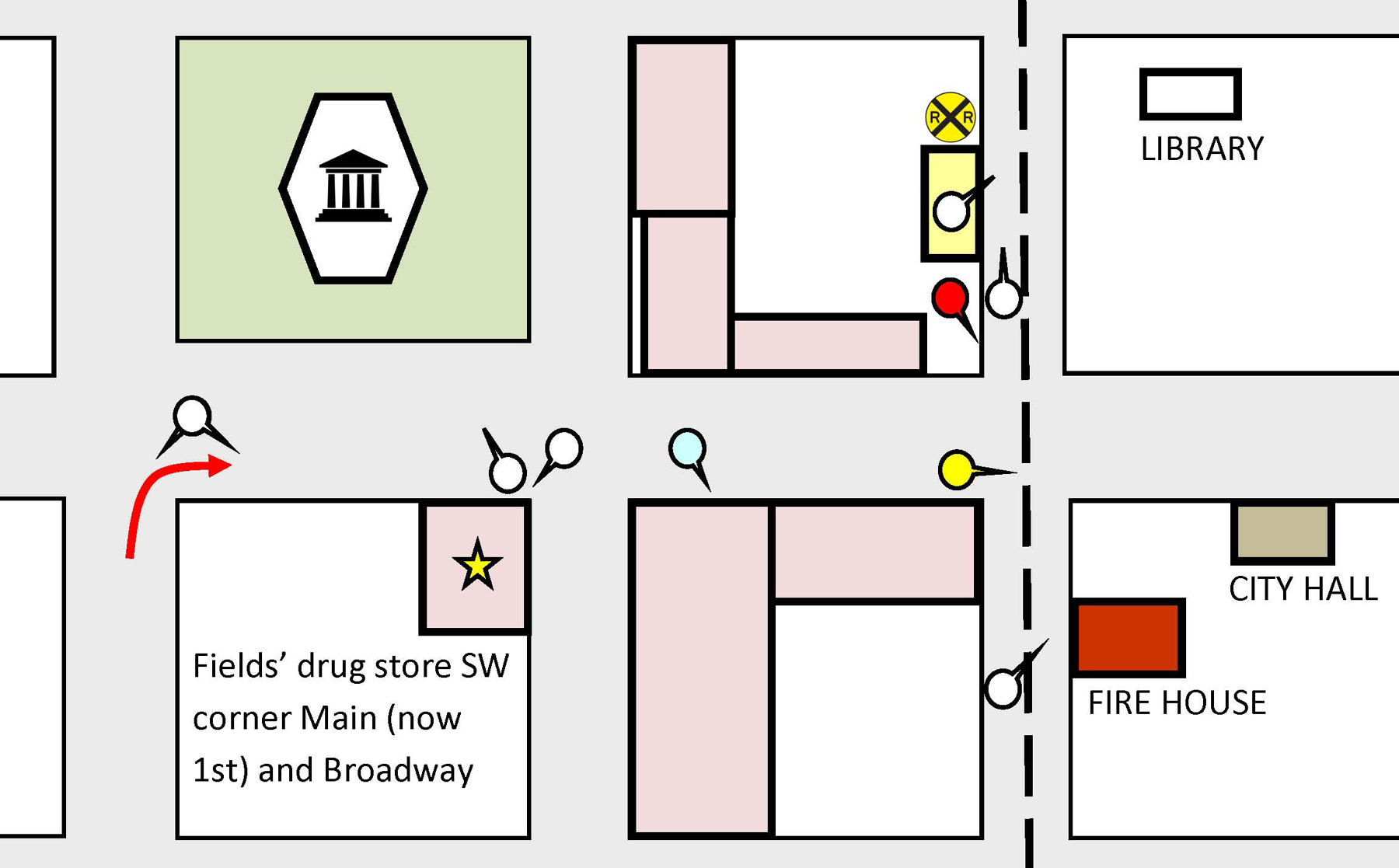
Ocala Florida, looking north, with Fields’ drug store (star) still standing at the SW corner of Main (now 1st) and Broadway. The point of view (POV) directional arrows match the many shooting angles, color highlights below. The scenes where Louise and William Gaxton follow each other include the former train station, library, fire station, and city hall, filmed east-west along Broadway and north-south along Main (now 1st).

Though not especially well known today, It’s the Old Army Game is a pivotal film in career of W.C. Fields. It was the first in which he enjoyed top billing, and the first in which he had substantial input. Based on a story by J. P. McEvoy and scripted by Thomas J. Geraghty and J. Clarkson Miller, the film incorporated material from Fields’ 1924 stage show, The Comic Supplement, as well as portions of Fields’ act from the Ziegfeld Follies of 1925.  Fields’ silent films, which include So’s Your Old Man (1926), Two Flaming Youths (1927), and the recent Kino Lorber release Running Wild (1927), can be seen as a kind of warm-up for Fields’ iconic body of work from the 1930s. Notably, material from the Follies as well as It’s the Old Army Game were reworked in what is widely considered Fields’ best sound feature, It’s a Gift (1934).

It’s the Old Army Game is also an important film in Brooks’ career. Though it was only the third for which she received a screen credit, critics were already taking notice of the up-and-comer with a short bob. Exhibitor’s Herald stated, “Louise Brooks is the other important person in the picture and, as insinuated rather bluntly on the occasion of her first appearance — in The American Venus — she’s important. Miss Brooks isn’t like anybody else. Nor has she a distinguishing characteristic which may be singled out for purposes of identification. She’s just a very definite personality. She doesn’t do much, perhaps because there isn’t much to do but probably because she hits hardest when doing nothing, but nobody looks away when she’s on screen. If Miss Glyn should say that Miss Brooks has ‘it,’ more people would know what Miss Glyn is raving about. But in that case she would not be raving.”

(Picking up from Part One, it’s love at first sight when William Gaxton arrives in town, spying Louise inside the Atlantic Coast Line Railway passenger station, that stood a block east of the city square. Behind him appears the west end of the Ocala library across the street – the end facing to the right in this post card.)

(Louise glances back flirtatiously at William before fleeing the station, then strides east along Broadway from Main (now 1st), hoping he’ll follow her. The sidewalk scale behind her appears both in an earlier scene from the first post, and here further behind Fields as he flees a mob later on in the film. The window right of the scale reflects the former court house.)

(Louise travels east along Broadway, a confused Gaxton seeks out her trail.) William Gaxton plays William Parker, Brooks’ love interest and the President of the High-and-Dry Realty Company. Born in San Francisco as Arturo Antonio Gaxiola, Gaxton worked mostly on stage, finding his greatest success in George Gershwin’s Of Thee I Sing (1933) and other Broadway musicals during the 1930s and 1940s.

[Update: Ocala historian Evan Landrum provided this post card above showing the side of City Hall, matching the view with Louise. The fire station is around the corner to the right.]

(The distinctive porch entrance of the Hotel Hoffman appears in the background, placing this scene looking east down Broadway at Osceola, the train station off camera to the left. The train tracks running left-right behind Louise continue to run along Osceola today. At back to the right of Louise is a side view of city hall, discussed in the prior post.)

(Louise stands looking east from the corner of the Merchants Block built in 1892. The vintage views look west towards her spot – the yellow box matches the stone and brick details in her movie frame.)

In Lulu in Hollywood, Brooks recounts what an entertaining person Gaxton was off camera, and how funny he was when he read aloud from Gentleman Prefer Blondes when the company wasn’t working or drinking; Brooks also speculates that Gaxton was bitter about what he regarded as his failure as an actor in It’s the Old Army Game — his first film, and role he thought would launch his film career. (Gaxton searches for Louise in front of the former Ocala House hotel, looking north to the corner of Silver Springs Blvd.)

(Four of the five buildings north of Silver Springs Blvd. appear in the film – the center vintage building (box) has been remodeled and expanded.)

(Gaxton searches for Louise in front of the distinctive brick porch of the former Ocala House hotel.)

(Louise searches for William, turning right from Silver Springs north onto Main (now 1st). Despite the modern shades the corner building appears to be relatively unchanged.)

(Louis pauses by a magazine stand on Main south of Broadway, that appears later when Fields believes he’s being chased by a mob. Notice the matching “EAT” sign behind Louise and above Fields’ hat in the shots looking south. The numerous vintage magazines are identified in this prior post.

It’s the Old Army Game is notable for another reason. Brooks married its director, Eddie Sutherland, in July of 1926, as the film was opening across the United States. Their marriage, and the fact that he was the director and she a star of It’s the Old Army Game made news just about everywhere. (The union was short-lived; news of their divorce announced here in Variety April 24, 1928.) Also notable is the fact that among the supporting players was Sutherland’s Aunt, the stage actress Blanche Ring. In this, one of her rare film appearances, Ring plays Tessie Gilch, who Brooks’ character refers to as her “Aunt.” Tessie is smitten with Fields, and early on asks him to remove something in her eye. [Ring’s sister was Frances Ring, who was married to Thomas Meighan, a rugged leading man and Paramount film star who appeared with Brooks in The City Gone Wild (1927).]

(A female clerk stops William to make a sales pitch and Louise assumes the worst. The magazine rack to the far left appears in the prior scene (red box), with other vintage magazines, including the April 1926 McCall’s, hanging center from the doorway.)

(Louise fumes at William and the female clerk  – we’re looking south down Main (now 1st) from Silver Springs Blvd. towards Fields’ corner drug store – will love prevail?)

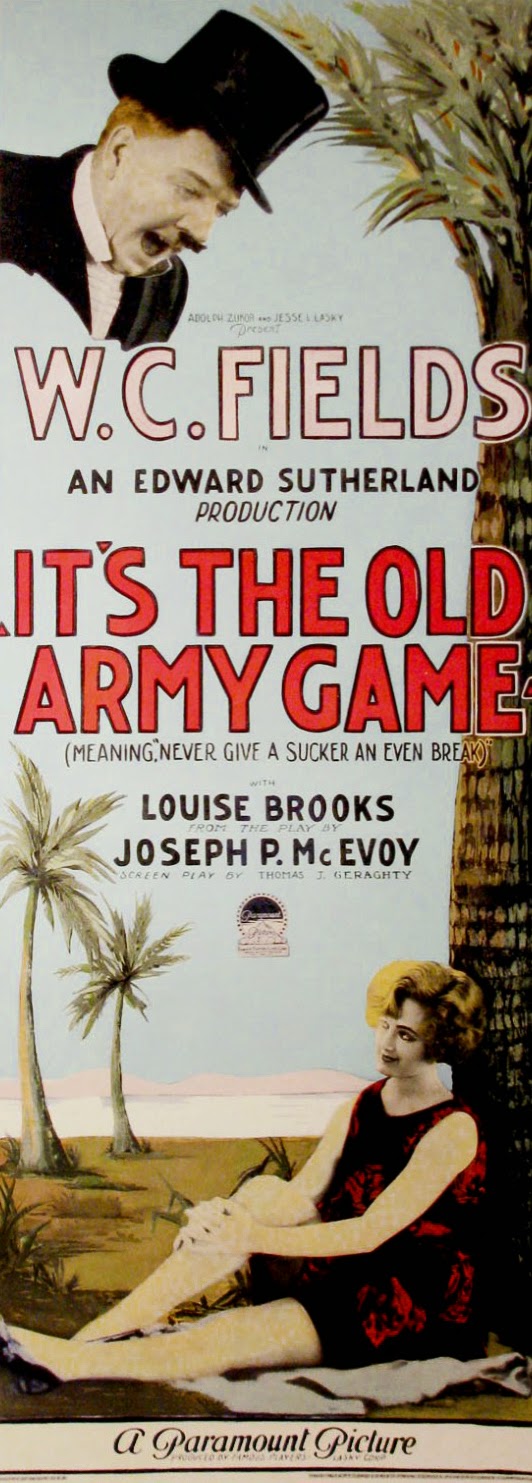
Paramount was taking a bit of a chance on Fields, a Vaudeville actor, who despite his stage renown on the East Coast, was still a little known talent in the movies. After screening the film, one theater manager in Ohio wrote “… the name Fields, so far, means nothing in the small town,” while a Kansas manager stated “Back to the stage for this guy. He is terrible.” One North Carolina manager opined, “I don’t see where Paramount found Fields, or why they continue to boost a star that will absolutely kill an exhibitor’s business.” Advertisements for the film tried to explain its unusual title (“meaning never give a sucker an even break”) and to suggest Fields and this film were a “new kind” of comedy.

Nevertheless, It’s the Old Army Game received good notices, but didn’t prove the box-office hit Paramount was looking for. In what was a typical review of the time, the Newark Star-Eagle stated, “This picture not only affords a good deal of typical Fields comedy in a suitable story frame, but also reveals the possibilities of Louise Brooks, Follies girl who is making decidedly good in the cinema. . . . All told, Fields need not regret his first Paramount production.”

(Did Louise and William patch things up? Of course.) [Update: Florida historian Lisa Bradberry reports the above “love shots” were filmed  on the Bingham estate in Palm Beach called Figulus, bordered on the west side by Lake Worth Lagoon. The main estate is gone, but the Binghams gave a portion of it to daughter Frances and husband Chester Bolton, who built there the Casa Apava estate still standing at 1298 South Ocean Blvd. The picnic scenes (see further below) were filmed at the Stotesbury estate.] In the Cleveland Plain Dealer, Ward W. Marsh wrote, “Louise Brooks and William Gaxton carry what is generally known as the necessary love interest. Gaxton amounts to nothing, but Miss Brooks parades the personal magnetism to the limit, and late in the story is found wandering around in a bathing suit—for no sound reason except to display a form which assuredly needs not a bathing suit to set it off. There is no complaint, however, on the appearance in the bathing suit.”

Lisa Bradberry further reports that beginning February 28, 1926, Brooks and Gaxton spent the first of three days filming at the Silver Springs resort nearby. Hundreds of people gathered to watch them film scenes featuring a glass bottom boat ride and later feeding a deer. Director Eddie Sutherland was injured in a boating mishap, spraining his arm. (Note: these Silver Springs scenes are either missing or cut from the final print). Since W. C. Fields was not required for any of the scenes at Silver Springs, and construction on the back porch set had yet to be completed, he took the opportunity to drive through Marion County, spending some time in the country. On March 3 Fields would begin the first of several days filming scenes on the newly constructed back porch set. Check out Lisa’s two articles from 2005 about the filming W. C. Fields filming in Florida – 2005 articles by Lisa Bradberry.

(I’ll soon wrap up the visual history of W.C. Fields in Ocala, Florida in a third post, but as a break my next post will cover the many Astoria locations, see sample above, appearing in Fields’ Kino Lorber release Running Wild.)

(Check out my prior posts showing the disastrous family picnic sequence filmed in Palm Beach at El Mirasol, the estate of Edward T. Stotesbury, above, and Part One that introduces Bill and Louise in Ocala, Florida.)

Thank you so much Thomas!

Thomas Gladysz is the author of the forthcoming Louise Brooks, the Persistent Star, as well as three earlier books on Brooks’ films. He is currently at work on The Films of Louise Brooks, a comprehensive study of the actress’ movie career. Here is a link to the Louise Brooks Society webpage on It’s the Old Army Game.

Read all about Louise at Thomas Gladysz’ Louise Brooks Society Blogspot.

Also a shout-out to Ben Model for performing the musical score – Ben’s Undercrank Productions has released numerous rare silent film titles on DVD, and to author James L. Neibaur for the audio commentary.

Click to enlarge. [Update: Ocala historian Evan Landrum supplied this 1930s view looking SE, with the Fields drug store corner marked with a star across from the court house. Nearly every exterior scene in the film was staged somewhere within this amazing photo.]

Photo sources: The State Library and Archives of Florida, Marion County Historical Photographs.

Looking north at the corner where Louise turns up the street.

Posted in It's The Old Army Game, Louise Brooks, Ocala Florida, W.C. Fields | Tagged , , , , , , | 1 Comment

It’s The Old Army Game – W.C. Fields and Louise Brooks in Ocala Florida – Part One

If you love W.C Fields, Louise Brooks, silent comedy, or time-traveling via a beautiful vintage movie, you’ve got to get the wonderful new Kino Lorber Blu-ray release of It’s The Old Army Game (1926). In only his sixth onscreen role, Fields plays a long-suffering pharmacist, similar to his embattled grocer character portrayed in It’s A Gift (1934), whom both endure nagging relatives and scores of thoughtless customers. Although there is no Carl La Fong, both films feature scenes of Fields attempting to sleep on a back porch, and disastrous family picnics errantly staged on the grounds of a private estate (here in Florida at El Mirasol in Palm Beach). Director Eddie Sutherland, who would marry Louise (briefly) shortly after the film’s premiere, points a loving camera her way, capturing dozens of shimmering close-ups in what proved to be her earliest surviving starring role.

Much of the film takes place beside the 1926 all-American town square centered in Ocala, Florida, where several buildings remain standing today. It was fun “decoding” a silent-era locale in another state, and having identified so many scenes, I’ll be presenting Ocala in three posts. The Point of View (POV) map below orients the camera angles for the opening scenes. [Bonus: Noted Louise Brooks author and expert Thomas Gladysz contributed to this post, and will take the lead role commenting in the next post about this special film.]

Ocala Florida, looking north, with Fields’ drug store (star) still standing at the SW corner of Main (now 1st) and Broadway. The point of view (POV) directional arrows match the many shooting angles, some colored as highlighted below. Early scenes include the former train station, library, fire station, and city hall. The action begins when late night customer Elise Cavanna speeds north around the corner of Magnolia onto Broadway (left arrow)

The movie begins with eccentric actress Elise Cavanna speeding into town in front of a locomotive, her first screen appearance. Gladysz writes that Cavanna started as a dancer and stage comedian before entering films in 1926, appearing in another Brooks’ film, Love Em and Leave Em (1926), as well as four other films with Fields, most notably The Dentist (1932), where her scenes as a writhing patient in a dentist chair were deemed so risqué they were edited out of later television broadcasts.

Looking SW, Elise turns right (east) from Magnolia onto Broadway. On the corner at back stands the First National Bank of Ocala building, built in 1886.

Eager to make a purchase, Elise races right to left along Broadway from Magnolia towards Fields’ corner drug store on Main (now 1st) – the corner store appears at the left edge of both vintage photos looking SW. The corner Holder’s Block building was built in 1885.

Elise arrives at the corner of Main (now 1st) and Broadway, once home to W.C. Field’s drug store, and now the popular Harry’s Seafood Bar & Grille. Frantically she rings the night bell, waking Fields from his sleep.

These views all look to the NW – as Elise strides to the corner drug store, the former Marion County Court House in the central town square appears at back. What is she so desperate to purchase so late at night? A two cent stamp – that she doesn’t even pay for. [Update: Florida historian Lisa Bradberry writes that the actual drug store used was named, appropriately, the Court Pharmacy. Here are Lisa’s two articles from 2005 about the filming W. C. Fields filming in Florida – 2005 articles by Lisa Bradberry.]

Three more views of the court house looking to the NW – here, later in the film, love interest William Gaxton is excited to spot Louise through the corner drug store window. The band stand visible in the post card was relocated between 1924 and 1930 (it appears on the 1924 Sanborn fire insurance map, but not on the 1930 map). Given the camera angles it may not have been present during the 1926 filming either. The restored bandstand now sits in the center of city square (left).

Elise seeks to post her letter, but misses the outbound mail train. This was filmed at the Atlantic Coast Line Railway passenger station that stood north-south a block east of the city square, on Osceola Avenue, still fitted with a rail line today. Notice the long awning, high on the side facing the trains and sloping low at back.

Two more scenes looking north up Osceola Avenue past the train station, when William Gaxton arrives in town, left, and when Fields returns from New York, right. The home at the right appears on the Sanborn maps.

Looking southeast at left, and due east at right, towards matching windows on the former city hall.

Elise fails to post her letter on the outbound train, her distraught reaction likely filmed looking SE from the station. Compare the window and tree details of Elise with this shot of Louise looking east towards city hall, and the red and yellow POV arrows on the map. Assuming the views match, then each provides a rare glimpse of the former Ocala city hall, for which I have found no historic photos.

Infuriated that Fields somehow delayed her letter, Elise seeks revenge by pulling the fire alarm in front of Fields’ shop. You can see the same men’s hat display (center) in the wide view of the shop (yellow box).

As shown on the map above, the clanging fire bell stood just a block east of Fields’ store.

This view looks north up Osceola towards the fire station standing a block due east of Fields’ store. You can see train tracks in the movie frame running up the street.

The fire engines arrive at the corner of Main (now 1st) and Broadway. The 1910s post card looks south down Main, and reveals the corner store once had a shed roof canopy similar to its neighbors.

Of course there is no fire, so to get rid of the pesky firemen seeking free ice cream sodas in the middle of the night, Fields sneaks out and pulls the fire alarm in front of the store due east of his store (blue POV arrow on map). Behind Fields, looking east to the far left, is a sidewalk scale that Louise Brooks saunters by later in the film, looking west back towards where Fields is standing.

Update: this shot of the fire crew responding to Fields’ false alarm was filmed looking east down Fort King towards the Fort King Apartments at the SW corner of Tuscawilla, built some time between the 1924 and 1930 editions of the Sanborn fire insurance maps.

With the firemen gone, Fields attempts to resume sleeping, this time on the back porch. The back porch from It’s A Gift was apparently a set built on the studio lot, while I sense this home could have been “real.” [Update: Florida historian Lisa Bradberry writes that the three-story back porch set was constructed at the rear of the Hi-Way Hotel. Here are Lisa’s two articles from 2005 about the filming W. C. Fields filming in Florida – 2005 articles by Lisa Bradberry.]

The next morning, back at the train station a block east of the square, love interest William Gaxton arrives in town. He first glances Louise inside the station, and is immediately smitten. Behind him, as shown better below, is the original Ocala library.

This shot within the Ocala station shows the west end of the Ocala library across the street – the west end facing to the right in this post card.

Flirtatious, Louise glances back at William before fleeing the station, with William scrambling after her. In the next post we’ll see how Louise and William follow each other around town, all shot on just a few blocks adjacent to the town square. A third post will track Fields’ efforts to outrun a welcoming mob he thinks intends to do him harm following his return home from New York.

So stay tuned for future posts about filming in Ocala, and check out my prior posts showing the disastrous family picnic sequence filmed in Palm Beach at El Mirasol, the estate of Edward T. Stotesbury, above

and the numerous vintage magazines appearing onscreen with Louise Brooks during the production.

Thomas Gladysz is the author of the forthcoming Louise Brooks, the Persistent Star, as well as three earlier books on Brooks’ films. He is currently at work on The Films of Louise Brooks, a comprehensive study of the actress’ movie career. Here is a link to the Louise Brooks Society webpage on It’s the Old Army Game.

Read all about Louise at Thomas Gladysz’ Louise Brooks Society Blogspot.

Also a shout-out to Ben Model for performing the musical score – Ben’s Undercrank Productions has released numerous rare silent film titles on DVD, and to author James L. Neibaur for the audio commentary.

Click to enlarge. [Update: Ocala historian Evan Landrum supplied this 1930s view looking SE, with the Fields drug store corner marked with a star across from the court house. Nearly every exterior scene in the film was staged somewhere within this amazing photo.]

Photo sources: The State Library and Archives of Florida, Marion County Historical Photographs.

Below, W.C. Field’s drug store, now home to Harry’s Seafood Bar & Grille.

Posted in It's The Old Army Game, Louise Brooks, Ocala Florida, W.C. Fields | Tagged , , , , , | 8 Comments

It’s The Old Army Game – W.C. Fields and Louise Brooks Bring Magazines to Life

The new Kino Lorber Blu-ray release of It’s The Old Army Game (1926) starring W.C. Fields and Louise Brooks is wonderful; an entertaining comedy, a beautiful print, lovingly staged close-ups of Louise, and dozens of time travel moments filmed on location in Ocala, Florida, to be covered in a later post.

One captivating detail appears twice during the film – a book store’s sidewalk magazine display, loaded with March and April 1926 issues of popular magazines. Above, Louise pretends to glance through a Redbook while keeping an eye on her love interest played by William Gaxton. Later Fields runs past the same stand, momentarily providing a direct view of its contents.

Zooming in, the top row of the magazine stand (above) displays the March 13, 1926 issue of The Saturday Evening Post, the March issues of The Ladies Home Journal and Good Housekeeping, and April issues of Redbook and Cosmopolitan. Also, represented by a June 1926 issue, is either the March or April 1926 issue of Field & Stream.

The next row features the March 1926 issues of Harper’s Bazar and Radio Review, and the April 1926 issue of Popular Science. The March or April issue of the Florida travel magazine Suniland is represented by the October 1926 issue. That’s another Good Housekeeping peeking left of the Popular Science.

The bottom row of the stand displays the April 1926 issue of Popular Mechanics and March 1926 issue of American. Update: reader Jill Hobgood reports that the bottom magazine third from the left is the March 1926 issue of Everybody’s Magazine. Thanks so much Jill for tracking this down.

There are so many scenes filmed in Ocala that I will cover them in a later post, but if you can’t wait to see some other early Florida locations, check out my prior post showing how the disastrous family picnic sequence was filmed in Palm Beach at El Mirasol, the estate of Edward T. Stotesbury.

It’s The Old Army Game shows us, once again, the rich visual history hidden in the background of silent films. Stay tuned for a detailed account of Fields and Brooks filming on location in Ocala, Florida.

Read all about Louise at Thomas Gladysz’ Louise Brooks Society Blogspot.

Posted in It's The Old Army Game, Louise Brooks, Ocala Florida, W.C. Fields | Tagged , , , , | 13 Comments

New Buster Keaton Self-Guided Tours

The Buster Keaton June 15-17 Celebration Weekend was a huge success, and the site of Buster’s former studio (where Chaplin also filmed his Mutual shorts) is now graced with a beautiful commemorative plaque. As part of the long weekend, I led

several updated walking tours along Cahuenga and Cosmo, where Keaton filmed eight different movies, and a new tour around the Keaton Studio site.

You can download the updated Hollywood tour PDF here. Hollywood’s Silent Echoes Cahuenga Tour 2018.

Here is the new PDF tour of Keaton’s studio site. BK Weekend Studio Tour Guide 2018 – Bengtson.

Below is a nicely edited video of one of the Keaton studio tours, posted by Ken Mitchroney, covering many sites on the PDF tour – thank you so much Ken.


Many people worked very long and hard to make this weekend such a success, including Alek Lev, Bob Borgen, Patty Tobias, Beth Pedersen, and Vicki Smith, all officers of the International Buster Keaton Society. I also want to thank the volunteers who assisted with my tours, Binnie Brennan, Connie Sanocki, and Charlie Pecoraro. Thanks also to Quixote Studios, the site of the former Keaton Studio, that graciously supplied the chairs, tables, shade tents, and related equipment for the dedication ceremony.

If any readers participated on either tour, and took some photos they can share, I would very much appreciate hearing from you.

Last, I was honored to be one of the speakers at the dedication ceremony. Here is the text of my brief speech:

“Buster Keaton knew the streets of LA like the back of his hand. He’d travel everywhere to find just the right setting for a joke, and he often matched scenes that were filmed miles apart. Though he was particular as a filmmaker, he was also pragmatic. As some of you have already seen today, he conveniently filmed dozens of scenes right here in his home studio neighborhood.

There are echoes of Buster everywhere you look. Right at this corner, Buster walked into a street sign, knocking himself down, in Convict 13. He crossed the street here following Ward Crane in Sherlock Jr. And while doing a stunt for another actor, in Sherlock Jr. he also fell off the back of a motorcycle right in this intersection behind you.

And let’s not forget that over 100 years ago Charlie Chaplin spent perhaps the happiest years of his career filming 12 comedy shorts for the Mutual Company, right here at the same studio. So in this same intersection behind you, Charlie and a group of firemen once chased each other making The Fireman in 1916.

Hollywood was still an agricultural community when the studio was built here in 1914. The former Cahuenga Valley Lemon Growers warehouse stood right across the street. You can actually see stacks of lemon crates appearing in a couple of Buster’s early films. Can you imagine, Buster inhaled the fragrance of lemons while working here!

Keaton liked to film close to home. He filmed three movies a block over from here at Santa Monica and Vine. And just a bit further north, Keaton filmed scenes for EIGHT different movies on just one block of Cahuenga. As some of you saw this morning, there remains there an alley where Chaplin filmed The Kid, Keaton filmed Cops, and Harold Lloyd filmed Safety Last! So at this one alley, the Three Kings of Silent Comedy each filmed an iconic masterpiece, each movie has been inducted into the National Film Registry of the Library of Congress – and you can still visit this alley today. So perhaps someday, with your support, this alley will be recognized as a Los Angeles Historic Cultural Monument.

Time does not stand still, especially in Hollywood. It wasn’t practical to convert Buster’s small studio to make talking pictures, and so it was demolished in 1931. The block was completely rebuilt with some satellite buildings for the Technicolor lab, and the early KMTR radio/KCOP television studios, but they too have since been demolished. Nearly every landmark Buster would have recognized here has been built over as well. And yet, there’s still a magnetic attraction that comes from knowing you’re standing in the very same spot. Charlie Chaplin, and especially Buster Keaton, spent some of the best years of their lives walking these sidewalks, filming on these streets. It was once all real, and their silent echoes still reverberate gently. So here’s to Charlie and Buster, as we honor them today. Thank you very much.”

Posted in Buster Keaton, Chaplin Studio, Charlie Chaplin, Keaton Studio | 4 Comments

Ghosts of the Past – the Regent Apartments – costar with Chaplin, Weber, Sennett and Roach

The classic Regent Apartment (1913-1983) facing Westlake (MacArthur) Park once co-starred with Charlie Chaplin, and appeared in other silent productions with Lois Weber, Mack Sennett, and Hal Roach. As shown here, the Regent’s front entrance portrayed the restaurant where Charlie worked as a waiter in The Rink (1916). Time is fleeting. This haunting image, Charlie’s ghost superimposed over the ghost of a long lost vintage apartment, really moved me. For the first time, more than 100 years later, we can appreciate Charlie’s movie environment when filming The Rink, but only decades after it was all destroyed.

Left – east on Hollywood towards Cahuenga, Wife and Auto Trouble (1916) – right, west at the same spot, Tillie’s Punctured Romance (1914).

For some reason my brain is keenly attuned to pattern recognition. Maybe I would have survived well in the jungle eons ago. But the pieces all came together when TCM recently broadcast the early Sennett comedy Wife and Auto Trouble (1916). The film caught my eye because many scenes were filmed on Hollywood Boulevard at Cahuenga, at nearly the same spot as where Chaplin and Marie Dressler filmed Tillie’s Punctured Romance (1914), only looking east instead of west.

Fast Company – note small gap at left

One setting from WAAT (left above) seemed familiar, but in the movie it was falsely presented as if set on Hollywood Boulevard when it was not. After checking my library of movie frame grabs, I realized it matched a building portraying a hotel in the silent Our Gang comedy Fast Company (1924)(right above), also broadcast on TCM. Aside from a similar oblique view, which more broadly showed the building corner, Fast Company also provides a front on view of the entrance. Interestingly, I noticed that the decorative pillars flanking the entrance were not flush with the wall – instead, there was an open air gap on the far sides of the pillars as well. So there were three ways, not one, to walk through the pillar entrances to the front door.

That triggered another association. I’d recently studied Lois Weber’s Shoes (1916), which famously filmed scenes in Pershing Square downtown. Interestingly, the insert shots (above) depicting the north side of street facing the park were not filmed downtown, but at

The Regent – at right – looking over Westlake Park. LAPL.

6th Street, the north street facing Westlake (now MacArthur) Park instead. In one shot (above left) you can clearly read that the building supposedly facing Pershing Square is named the Regent Apartments, which stood at 2401 W. 6th Street at the corner of S. Park View Street.

While I was fascinated that Shoes depicted the actual name of the apartment, I also noticed that the entranceway had projected pillars. In other words, there were three ways, and not one, to walk among the pillars towards the front door. So I quickly checked, and confirmed that the Regent appearing in Shoes was the same building as in Fast Company, and thus also appearing in WAAT.

But I wasn’t done. Somehow the decorative trim on the entrance pillars seemed familiar. I scanned through folders of unsolved images, when I realized it likely matched the restaurant exterior in The Rink. The details all matched up – another confirmation.

While I had a few aerial photos showing the Regent from afar (see above), I searched in vain for a vintage street level image. Unsuccessful, I contacted some colleagues for help, and was thrilled when Historic Los Angeles blogger Duncan Maginnis provided me with a link to these USC Digital Library images (above). They weren’t indexed under the name “Regent,” but somehow Duncan was already aware of these photos, and passed them along.

During Shoes the Regent appears in full view, just part of the background across the street. So you can see there was more than one way to pass through the entrance. Interestingly, the three movies to film there closer up hid this detail. Either they filmed the entrance obliquely, looking up the street (above right), so you wouldn’t easily notice the other entranceways, or it they filmed in tight close up (above left), cropping the other entranceways from view.

As I report in my book Silent Traces, Chaplin filmed the scenes of Edna Purviance’s apartment in A Woman of Paris (1922) nearby (above), at the Ansonia Apartments at 2205 W 6th Street, just two short blocks east of the Regent. So Chaplin was on familiar turf when he returned her with Edna.

The Regent was demolished in 1983, and an 80’s style “modern” office building stands there today in its place, home to the Consulate General of Mexico.

All images from Chaplin films made from 1918 onwards, copyright © Roy Export Company Establishment. CHARLES CHAPLIN, CHAPLIN, and the LITTLE TRAMP, photographs from and the names of Mr. Chaplin’s films are trademarks and/or service marks of Bubbles Incorporated SA and/or Roy Export Company Establishment. Used with permission.

Below, the site of the former Regent Apartments.

Posted in Charlie Chaplin | Tagged , , , , , , , , , , , | 7 Comments

Keaton’s Battling Butler – A Knockout Finish to the SF Silent Film Festival

The 2018 San Francisco Silent Film Festival closes Sunday, June 3 with a screening of Buster Keaton’s self-directed comedy Battling Butler (1926), hosted by Leonard Maltin, and honoring recently deceased festival Board member, beloved television writer and director Frank Buxton, who among his many accomplishments once worked on stage with Keaton himself.

Above, early in the film Keaton used the front entrance of the Talmadge Apartments, owned by his sister-in-law actress Norma Talmadge, and married to Buster’s boss Joe Schenck, to portray Keaton’s family mansion.

Buster plays an effete millionaire who seeks to impress a girl (played by Sally O’Neil) by allowing her to mistakenly believe he is a champion boxer sharing the same name.  As might be guessed, the movie ends when amateur Buster, spurred by love and honor, defeats the pro boxer in a fight and wins the girl’s heart. As explained in my book Silent Echoes, Sally’s hometown scenes were filmed in old Kernville, a small town in the Kern County foothills later submerged by the Lake Isabella Dam completed in 1954.

Above, Keaton’s welcoming crew march toward the Mountain House Inn (where Keaton and crew stayed during filming), now submerged under Lake Isabella – California State Library.

Click to enlarge. The extant Olympic Auditorium appearing in Keaton’s Battling Butler and in the Three Stooges’ Punch Drunks (1934).

Key scenes took place in the newly opened Olympic Auditorium, still standing at 18th and Grand in downtown Los Angeles.  Construction began on January 10, 1925, with world champion fighter Jack Dempsey on hand for the ceremonies, breaking ground with a steam shovel.  Dempsey returned when the completed arena opened August 5, 1925, and was presented with a solid gold lifetime ticket, the size of a calling card, good for all future events at the venue.  The so-called “Punch Palace” was built in preparation for the 1932 Los Angeles Olympic Games, and was the largest arena of its kind west of New York City, reportedly seating up to 15,300.  The boxing and wrestling hall could be converted to host other programs, and the California Grand Opera Company performed there during October 1925.

Buster and his valet, played by Snitz Edwards, sit stunned in Olympic Auditorium, after the formerly obscure boxer who shares Keaton’s name has unexpectedly become champion.

Buster and his valet, played by Snitz Edwards, sit stunned after witnessing a formerly obscure boxer who shares Keaton’s name unexpectedly win a championship bout.

The marquee in Punch Drunks

The marquee as it appears in Punch Drunks

Because Buster started working on Battling Butler only months after the arena first opened, its role in the movie could be its debut appearance on film.  Aside from appearing with the Three Stooges in Punch Drunks, the arena has been used as a location for classic films such as Rocky (1976) and Million Dollar Baby (2004).  You can find my five other posts about Buster and the Stooges HERE.

Remarkably, the William Holden film noir drama The Turning Point (1952) has strong connections to all three leading silent comedy stars.  The movie not only makes great use of the arena where Buster filmed (see below), it also shares noir locations on Bunker Hill with Harold Lloyd’s 1924 feature Hot Water, and in the gas tank district with Charlie Chaplin’s 1936 comedy Modern Times.

Four views of the Olympic Auditorium from The Turning Point

Four views of the Olympic Auditorium from The Turning Point

Battling Butler concludes with Buster, decked out in boxing shorts and a silk top hat, strolling down a city boulevard at night with Sally on his arm, oblivious to the curious onlookers surrounding them.

ca

Click to enlarge.  The Biltmore Hotel, designed by Schultze & Weaver in 1922, is located on Olive Street facing Pershing Square.  Keaton strolled from the corner of 5th and Olive, with the San Carlos Hotel across 5th Street, which bears a “STEAMSHIP TICKETS” sign (oval) in each image.  UCLA Libraries – Digital Collection.

Unlike Buster’s contemporary Harold Lloyd, Keaton seldom filmed in the downtown Los Angeles Historic Core, and locating this concluding shot eluded me for years.  But once I determined that Harold had used the Olive Street entrance of the classic Los Angeles Biltmore Hotel for scenes from For Heaven’s Sake, I realized Keaton had filmed here too.  The Biltmore has appeared in dozens of films.

bb 18Although perhaps less celebrated than other Keaton works, I’ve always found Battling Butler to be quite charming.  The film contains many thoughtfully composed scenes, such as Buster’s fiancé framed bb 75through the rear window of his limousine, receding into the distance as Buster drives away (left), and a tracking shot of Buster and Snitz, lost in thought, sitting on the steps of a moving passenger train (right).

Some other interesting visual framing devices from Battling Butler

Some other interesting visual framing devices from Battling Butler

bb 31 cA final remark, Battling Butler also contains a clear image of Buster’s injured right index finger during a scene where he registers at a hotel.  Buster trapped his finger in a clothes mangler as a young child, and had to have the tip amputated. bb 09 This shot to the right, of “Buster” holding an engagement ring, was filmed using a hand double.  It is a strange coincidence that both Buster and Harold Lloyd had injured right hands and employed hand doubles in their films.

The screening of Battling Butler will feature a new restoration by Cineteca di Bologna in collaboration with Cohen Collection, with the event sponsored by McRoskey Mattress Company, and copresented by the California Film Institute, the Exploratorium, and the Niles Essanay Silent Film Museum.

Battling Butler (C) 1926 Metro-Goldwyn-Mayer Corporation. (C) renewed 1954 Loew’s, Inc. Punch Drunks copyright Columbia Pictures Industries, Inc.  The Turning Point (C) Paramount Pictures Corporation.

Today the Olympic Auditorium is home to a church.

Posted in Buster Keaton, Film Noir, The Turning Point, Three Stooges | Tagged , , , , , , , , , , , , , , , | 11 Comments

Keaton’s Seven Chances – On The Clock

Late for church, during Seven Chances (1925) Buster Keaton must marry by 7:00 p.m. that evening in order to inherit a fortune. But what time is it? Having just lost his pocket watch down a sewer drain, Buster stops in a clock shop for help, only to realize every timepiece in the store tells a unique story. When all seems lost, providence intercedes on Buster’s behalf. A woozy drunkard, enraged by his ringing alarm clock, tosses it out the window, where it conveniently konks Buster on the head, reminding him of the correct time.

You never know what you’ll find just by keeping your eyes open. When I was in SoCal last month to introduce The Great Dictator at the Alex Theater in Glendale, I happened to drive along Franklin Avenue towards Hollywood, when passing the corner of Cheremoya, I noticed what seemed to be a familiar corner. I made a note to remember the spot, and when I returned home, checked my Seven Chances Blu-ray, and ta-dah! It was the correct spot.

Keaton was bonked on the head beside the Cheremoya apartments, completed in 1924 at 5987 Franklin, at the NE corner of Cheremoya. With this discovery I’m close to uncovering nearly every location from the film – many new discoveries are documented in other posts HERE, and in my book Silent Echoes. Thanks Rena Kiehn for the current “now” photo.

My all time favorite location – the late Mrs. Eleanor Keaton on the steps of the Seven Chances church at 2610 La Salle Avenue.

The Cheremoya Apartments at the corner of Franklin.

Posted in Buster Keaton, Seven Chances | Tagged , , , , , , , , | 9 Comments

The Surviving Sherlock Jr. Bungalow

Click to enlarge – looking south down Lillian Way from the corner of Eleanor. Buster trails Ward Crane in Sherlock Jr.

A bungalow that appears in Buster Keaton’s Sherlock Jr. (1924), and in his early short film Convict 13 (1920), is still standing today at 4908 McKinley Avenue, when it was moved 11 miles away from Buster’s studio in 1926, the third time the modest home had been moved in less than six years.

Click to enlarge – looking east down Eleanor from the corner of Lillian Way. Buster in Convict 13.

Built prior to 1912, a pair of small bungalows once stood at 6206 and 6200 Eleanor, half a block east from the Keaton Studio front corner office. Remarkably the pair of homes was moved twice, first in 1920, and again in 1921. Even more remarkably, one of the pair survives today after being moved a third time in 1926.

The Los Angeles Department of Building and Safety posts searchable historic building permits and other records online – accessible at  https://www.ladbs.org/services/check-status/online-building-records. The permits tell an incredible story. When the California Laundry purchased the corner of Eleanor and Vine in order to build a large two-story cement laundry building, it moved the pair of Eleanor bungalows a block south under permits issued on October 21, 1920.

Click to enlarge. Step A – the homes are moved in 1920 from Eleanor to Romaine. Marc Wanamaker – Bison Archive.

Above, looking NE with what would become the Buster Keaton Studio in the foreground, 6206 Eleanor is moved to 6207 Romaine; 6200 Eleanor is moved to 6209 Romaine.

Click to enlarge. Step B – the homes are moved in 1921 from Romaine to Lillian Way. HollywoodPhotographs.com.

For some reason, the California Laundry, owner of the bungalows, moved them again just 5 months later from Romaine to Lillian Way. Above, looking SE, 6209 Romaine moved to 1010 Lillian Way; 6207 Romaine moved to 1016 Lillian Way.

Click to enlarge. Step C – the home at 1016 Lillian Way is moved in 1926 to 4908 McKinley Avenue. HollywoodPhotographs.com.

Above, looking south, 1016 Lillian Way was moved again in 1926. Notice the large California Laundry facility facing Eleanor, where the pair of homes originally stood, and the prominent foundations along Romaine where the pair of homes had recently stood.

Three views of the same home.

Click to enlarge – from The Balloonatic (1923) looking north at the bungalows, 1010 Lillian Way at front, 1016 Lillian Way (arrow) at back.

I had always been intrigued by the pair of bungalows appearing so prominently in Keaton’s The Balloonatic (above), and somehow sensed they looked similar to the homes appearing in Convict 13 (further above). But it never occurred to me that they were the same homes, and I always assumed they had long since been demolished. That changed when I recently discovered three small duplexes built across from the Keaton Studio were moved in the 1940s and 1950s, and are still standing (see below). Realizing that homes were once commonly moved, I checked the city permits, and was stunned to learn this incredible story.

This duplex once adjacent to the Keaton Studio is still standing – read more at the link.

Decades later, peripatetic homes that once stood watch over the Keaton Studio can rightfully claim a tangible link to early Hollywood history.

Below, Keaton’s Sherlock Jr. co-star still standing at 4908 McKinley Avenue.

Posted in Keaton Studio, Sherlock Jr. | Tagged , , , , , , , , , | 5 Comments

Chaplin’s The Great Dictator – Author Presentation at the Alex

Charlie Chaplin’s brilliant and courageous challenge to tyranny, The Great Dictator (1940), remains sharply relevant today. I will be introducing this classic film at the beautiful Alex Theater in Glendale on Thursday, April 19, 2018, and signing copies of my Chaplin book Silent Traces. David Totheroh, grandson of Chaplin’s long-time cameraman Rollie Totheroh, will also be on hand for a Q&A after the screening.

The refugees cross Trifuno Creek near Peter Strauss Ranch – discovery and photo by Jeff Castel De Oro.

Looking north at the Chaplin Studio backlot.

My intro will address highlights of Chaplin’s career, details of the film’s remarkable history and production, and several then and now locations, some unchanged after nearly 80 years. To the right is a composite image of Chaplin’s backlot, from 16mm home movie footage taken by Charlie’s half-brother Sydney.

Intact globe found by the Russians in Hitler’s ruined office.

The screening is hosted by the Alex Film Society, which presents programs of classic feature films, cartoons, newsreels, and short subjects at the theater.

If you live in the Los Angeles area, I hope you’ll consider supporting the Alex Film Society by attending my talk and book-signing at the Alex Theater on Thursday, April 19.

All images from Chaplin films made from 1918 onwards, copyright © Roy Export Company Establishment. CHARLES CHAPLIN, CHAPLIN, and the LITTLE TRAMP, photographs from and the names of Mr. Chaplin’s films are trademarks and/or service marks of Bubbles Incorporated SA and/or Roy Export Company Establishment. Used with permission. Big Bertha cannon photo the Totheroh Family Collection, courtesy of Frank Underwood.

Posted in Charlie Chaplin | Tagged , , , , , , , | 7 Comments

From Roach’s to Roaches – Stan & Ollie Meet Starsky & Hutch

Guest blogger Jim Dallape, creator with Robert Winslow of the remarkable Hal Roach Studios Backlot Tour, reports how TV’s Starsky & Hutch and Charlie’s Angels filmed in the same places as Laurel & Hardy and other Roach stars. Take it away, Jim –

Conveniently located within walking distance to Culver City, the Hal Roach Studios would often use the newly constructed downtown area for location shooting. Fans of the studio’s silent comedies will easily recognize Culver’s Main Street, which runs north from Washington Boulevard towards Venice Boulevard, where portions of such films as Laurel and Hardy’s PUTTING PANTS ON PHILIP, LEAVE EM’ LAUGHING and ANGORA LOVE, among others, were shot.

The most prominent landmark in downtown Culver City is the six story triangular Harry Culver Building which opened on September 4, 1924 on Main Street between Washington and Culver Boulevards (it can actually be seen while under construction in Our Gang’s, SUNDOWN LTD.). This “skyscraper” was designed to house Harry Culver’s (the city’s namesake and prominent citizen) headquarters on the lower two floors with the top four floors being designated The Hunt Hotel, later to be the Culver Hotel.

Recognizable across Main Street from the Culver’s front door was the two story Adams Hotel, seen in several Roach films but mostly remembered today for its alleyway made famous in L&H’s LIBERTY.

Downtown Culver City exemplified class and dignity, from its fine hotels and growing number of stores and businesses, to the dozens of oil wells gracing the Baldwin Hills to the south. This entire area offered a freshness and charm that the Roach studio took great advantage of in its excellent comedy shorts.

By the 1970’s, though, the bloom had worn off.  Many of the storefronts were now vacant or boarded.  The Culver Hotel building which had been passed from owner to owner over the years was now known for its frayed carpet and musty smell. The Adams was considered to be more of a flophouse than a respectable hotel. The entire area gave the appearance of a sleazy neighborhood.

Just as Hollywood filmmakers had once used the city for location shooting, TV producers now looked at it as a perfect background to depict the rundown neighborhoods required for their popular detective shows. The team of Aaron Spelling and Leonard Goldberg used the downtown area for episodes of their “Charlie’s Angels” and “Starsky & Hutch” programs. Shows that depicted drugs, prostitution, and assassins were now shot on the same locations where Laurel and Hardy and Charley Chase had once made us all laugh.

Downtown Culver City has seen a revival in recent years. The Culver Hotel has been beautifully restored and the once boarded or empty buildings are again alive with new shops, restaurants, and a theater. They’ve closed Washington Blvd. on the south side of the Culver to create a pedestrian mall with trees, benches and fountains. Fans of old Hollywood can once again experience that same charm and freshness that Hal Roach found so alluring nearly 100 years ago.

Spelling-Goldberg Productions chose to shoot two episodes of their Starsky & Hutch series in the downtown area – “Snowstorm” which originally aired on 10/1/1975 and “Long Walk Down A Short Dirt Road” which aired on 3/12/1977. They also shot the 4th season Charlie’s Angels episode, “Angels On The Street”, there, which debuted 11/7/1979.

Oliver Hardy passes the Loughin Building, the “Liberty” alley entrance, and the Adams Hotel as he runs down Culver Boulevard in the direction of Main Street and the Culver Hotel in DO DETECTIVES THINK (1927). The shot on the right is the same area, looking towards the Culver Hotel, as seen in 1979 in “Angels On The Street”.

Laurel and Hardy attempt to change into their correct pants in the alleyway behind the Adams Hotel in 1929’s LIBERTY. The alley was used again in 1979 for a Charlie’s Angels episode. A prostitute (actress Amy Johnson) is chased into the alley by her pimps. Fifty years later the window nearest Culver Blvd. had been converted to a doorway and the middle window had been made taller.

Stan and Ollie are standing on the Culver Boulevard side of the Adams Hotel, just a little past the alleyway entrance, in WE FAW DOWN from 1928.  Nearly the exact same shot was used again in 1979 for “Angels On The Street.” Main Street and the Culver Hotel are in the background of both scenes. Unfortunately this entire block of buildings, including the Adams, no longer exists and has been replaced by a parking lot.

Main Street between Culver and Washington Boulevards was used many times by the Roach Studios for their location shooting. Above left, Glenn Tryon is seen in 1926’s “45 MINUTES FROM HOLLYWOOD” with the front of the Adams Hotel on the left side of the frame and the Safeway Store in the background. By 1933, the Safeway had become Master Market as seen in Charley Chase’s MIDSUMMER MUSH. Jaclyn Smith and Shelly Hack stand on the sidewalk in front of the Adams Hotel in “Angels On The Street”. The Safeway/Master Market was by then “Mark the Carpetbagger”.

The same area is seen again from the Culver Hotel side of Main Street in the 1928 Max Davidson comedy, THE BOY FRIEND, and again in 1975 from “Snowstorm.”

Below is the same area today.

Stan and Ollie stand to the left of the front door of the Culver Building in 1927 during PUTTING PANTS ON PHILIP. Nearly 50 years later, Starsky & Hutch are about to duck for cover in “Snowstorm”. By 1975 only the mounting holes for the “Harry H. Culver And Company” plaque remained.

Stan and Ollie can’t stop laughing in LEAVE ‘EM LAUGHING in 1928 as they exit the Culver Building. The “Snowstorm” shot on the right shows the hotel’s new entrance and generally rundown appearance just prior to gunshots being fired.

The 1932 Taxi Boys short, HOT SPOT, shows us the Washington Boulevard side of the Culver Building with Main Street and the Adams Hotel in the background. Starsky & Hutch park their Gran Torino in about the same place in 1977.

We can again see the Culver and the Adams Hotels from Washington Boulevard, but from a slightly different angle, in the Taxi Boys film, WRECKETY WRECKS, in 1933.  Starsky & Hutch show us the same view again forty four years later.

Charley Chase’s, THE COUNT TAKES THE COUNT, gives us a nice view looking up Washington Boulevard towards Main Street with the Culver Hotel on the left and the Adams Hotel visible beyond. By the time Starsky & Hutch take a “Long Walk Down A Short Dirt Road” forty one years later, several of the buildings seen on the right in the Chase film (in front of the parked cars) were gone. But the road barricades remained.

Washington Boulevard has now been converted to a beautiful pedestrian mall.

Looking from Van Buren Place towards Washington Boulevard in TAXI BARONS from 1933 and WE FAW DOWN from 1928, we get another view of the south side of the Culver Hotel. Paul Michael Glaser and David Soul give us a similar view in 1977 while Cheryl Ladd and David Doyle attempt to stop a crime in “Angels On The Street” two years later.

The iconic Culver Hotel is now on the register of historic places. Film and TV fans will be able to visit this beautiful building for years to come and experience what filmmakers have always loved about downtown Culver City.

Jim Dallape’s incredible Hal Roach Studios Backlot Tour provides detailed maps, tours, and screenshots of the Roach backlot. Here’s Jim’s Story –

“Born and raised in the Detroit area, I’ve been a lifelong Hal Roach Studio fan.  Even as a kid I was impressed by the sense of nostalgia for a time long ago that the Roach films conveyed. As a teenager I discovered that many of the old films were actually shot on location with real buildings and not on some studio mockup on a sound stage – and that some of those locations still existed.

I owned many books on movie locations and am especially fond of then and now type photo comparisons. I joined the local Sons of the Desert tent (The Dancing Cuckoos) in 1976 because of my fondness for Laurel and Hardy, and currently write and edit the tent’s newsletter.

I conceived and created the Hal Roach Studios Backlot Tour that can be found on the “Another Nice Mess” website (lordheath.com) because I wanted to know the layout of the Roach lot but couldn’t find any information on it.”

Chaplin-Keaton-Lloyd-sign

Charlie, Buster, and Harold each filmed a masterpiece at an alley you can still visit today. Please help support naming the alley by posting a review on Google Maps. Prototype alley sign design by noted Dutch graphic artist – Piet Schreuders. Download a 4-page brochure about the alley HERE. This video further explains the alley – if you can, please leave a thumbs up and share it with others.

Back to our main story – thank you Jim for sharing with us an absolutely fascinating post. The color images add an entirely new dimension. For more 1970’s TV connections to silent movies, be sure to read my post about Peter Falk as Columbo and the Silent Clowns.

“Snowstorm” © 1975, “Long Walk Down a Short Dirt Road” © 1977, “Angels On The Street” © 1979 Spelling-Goldberg Productions

Posted in Charley Chase, Culver City, Hal Roach Studios, Laurel and Hardy | Tagged , , , , , , , , | 13 Comments