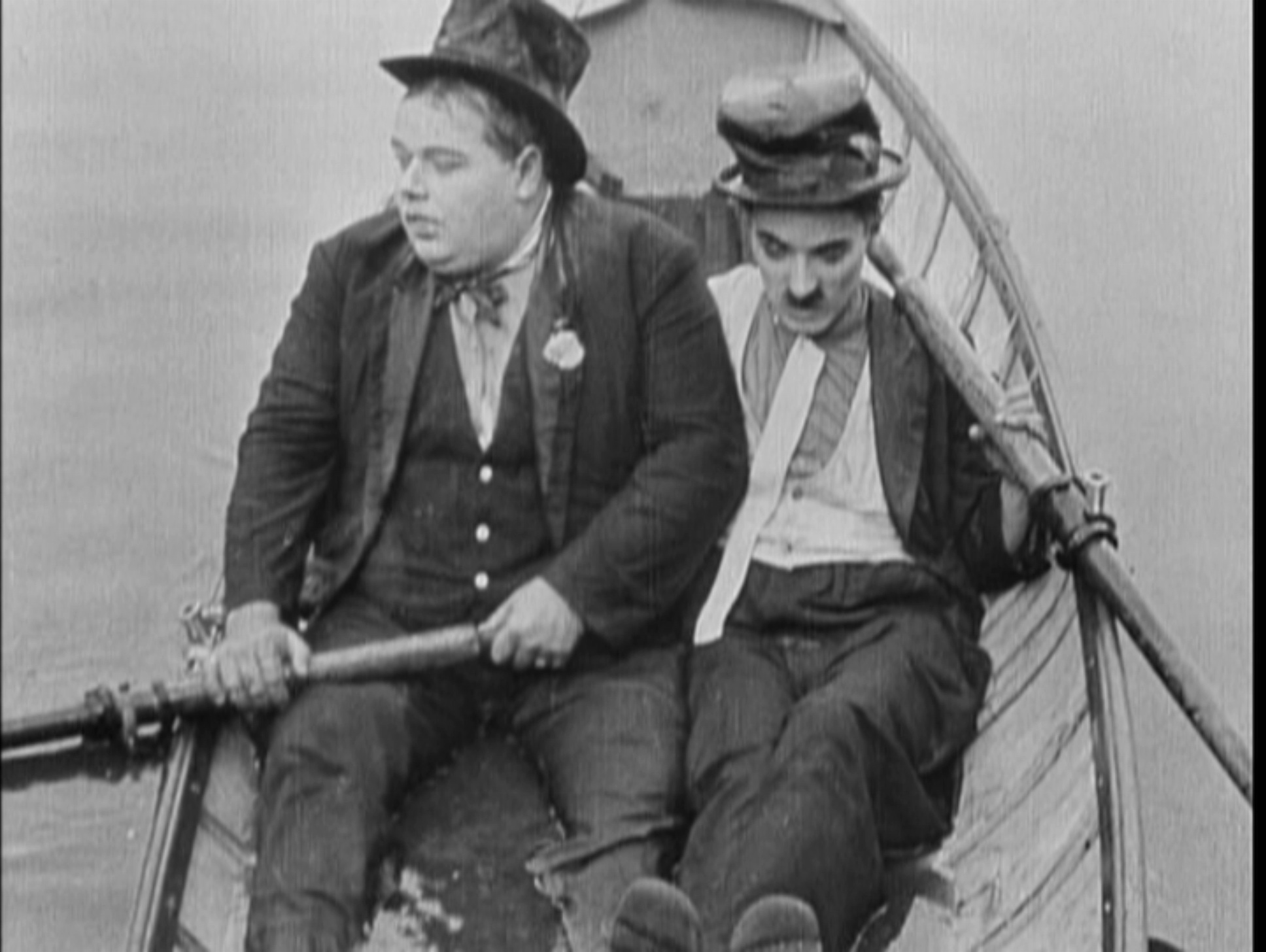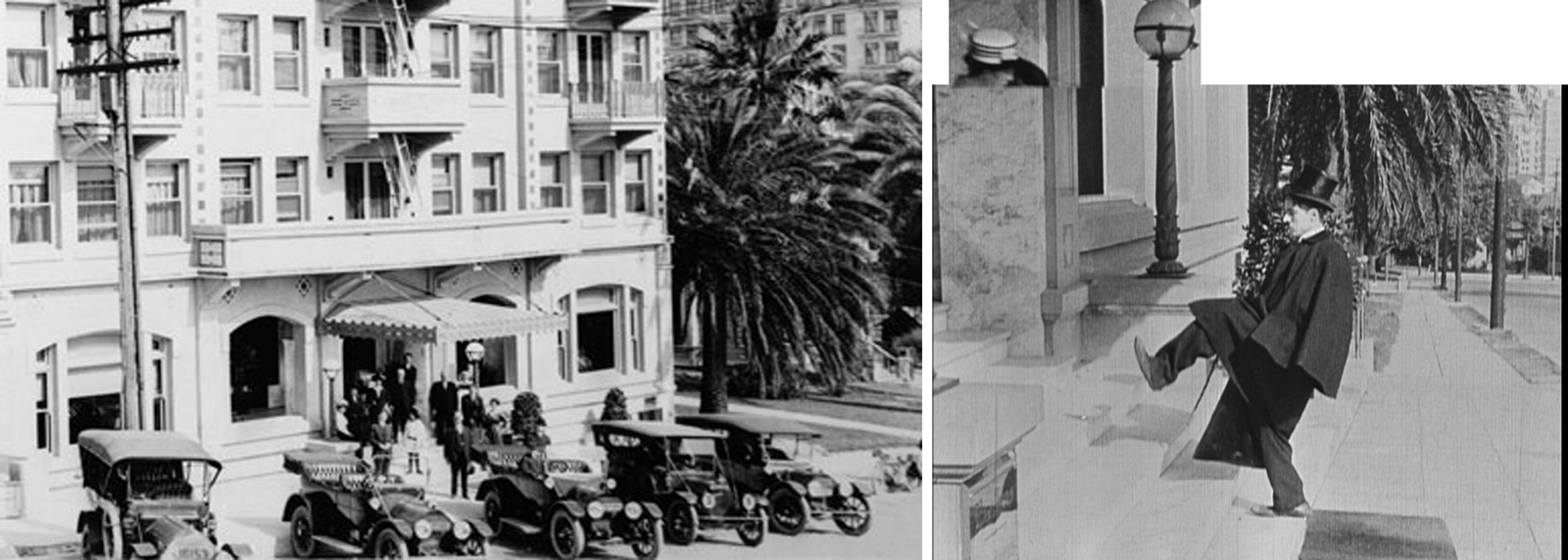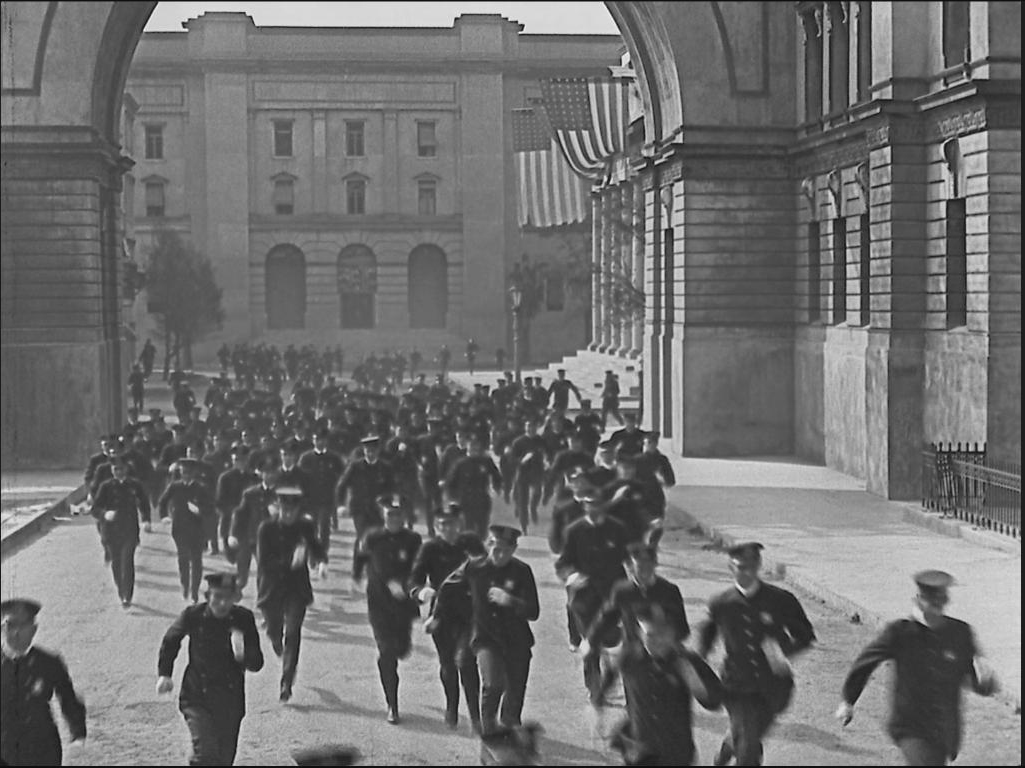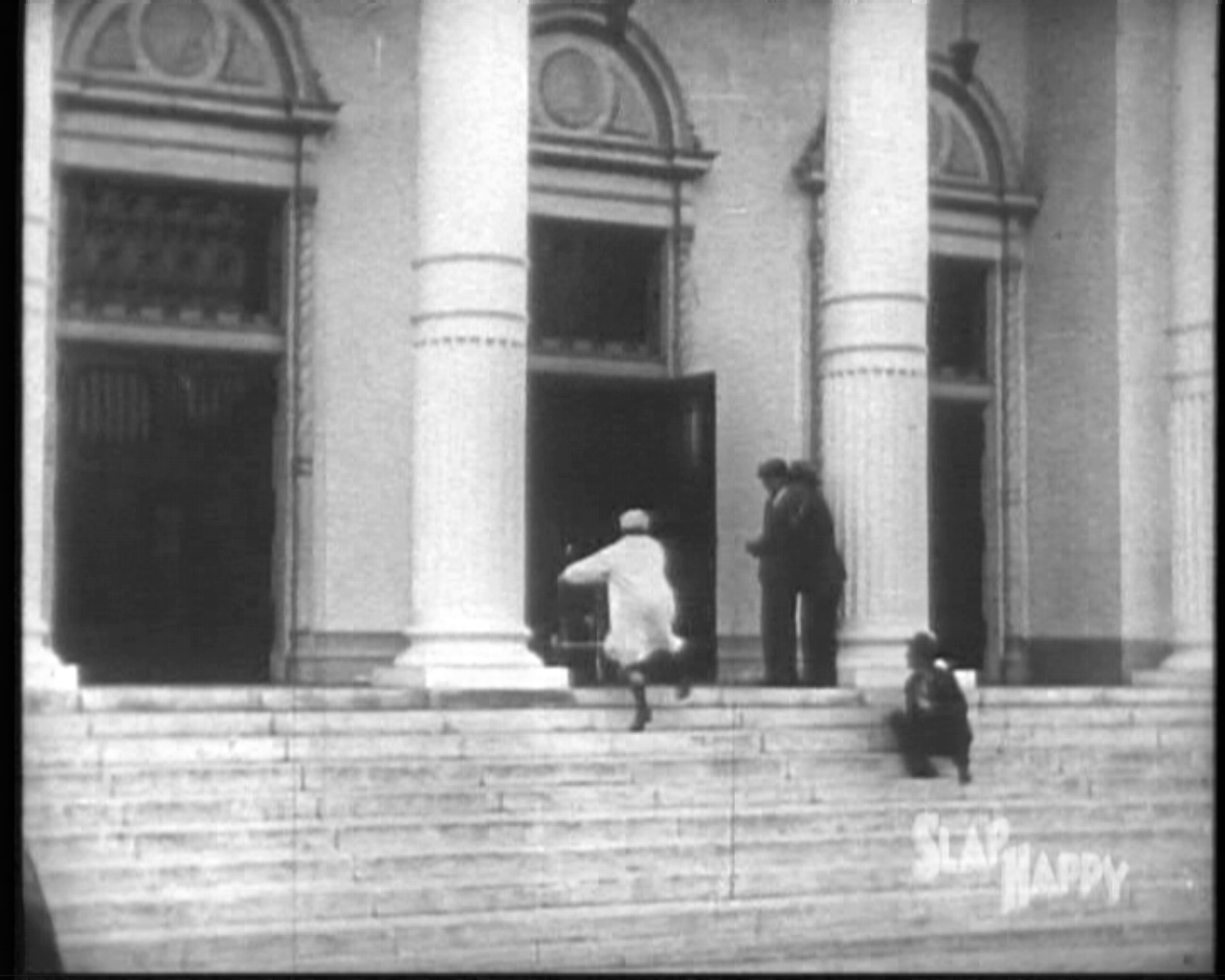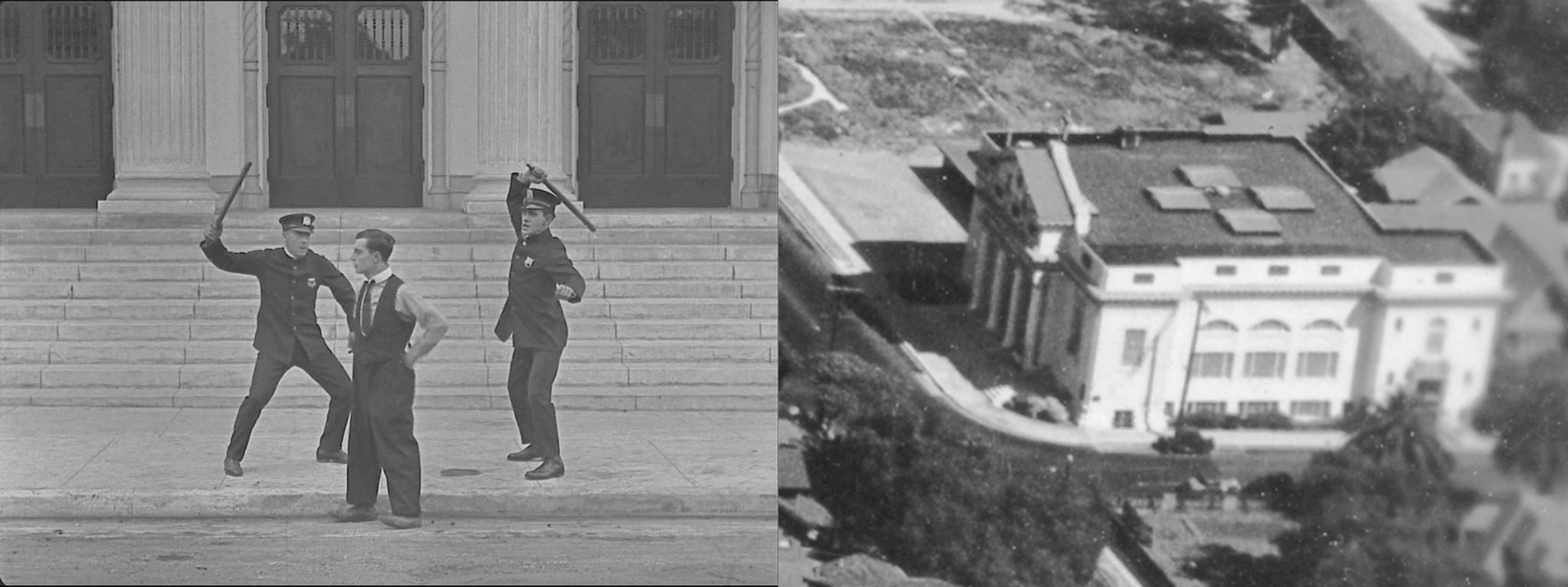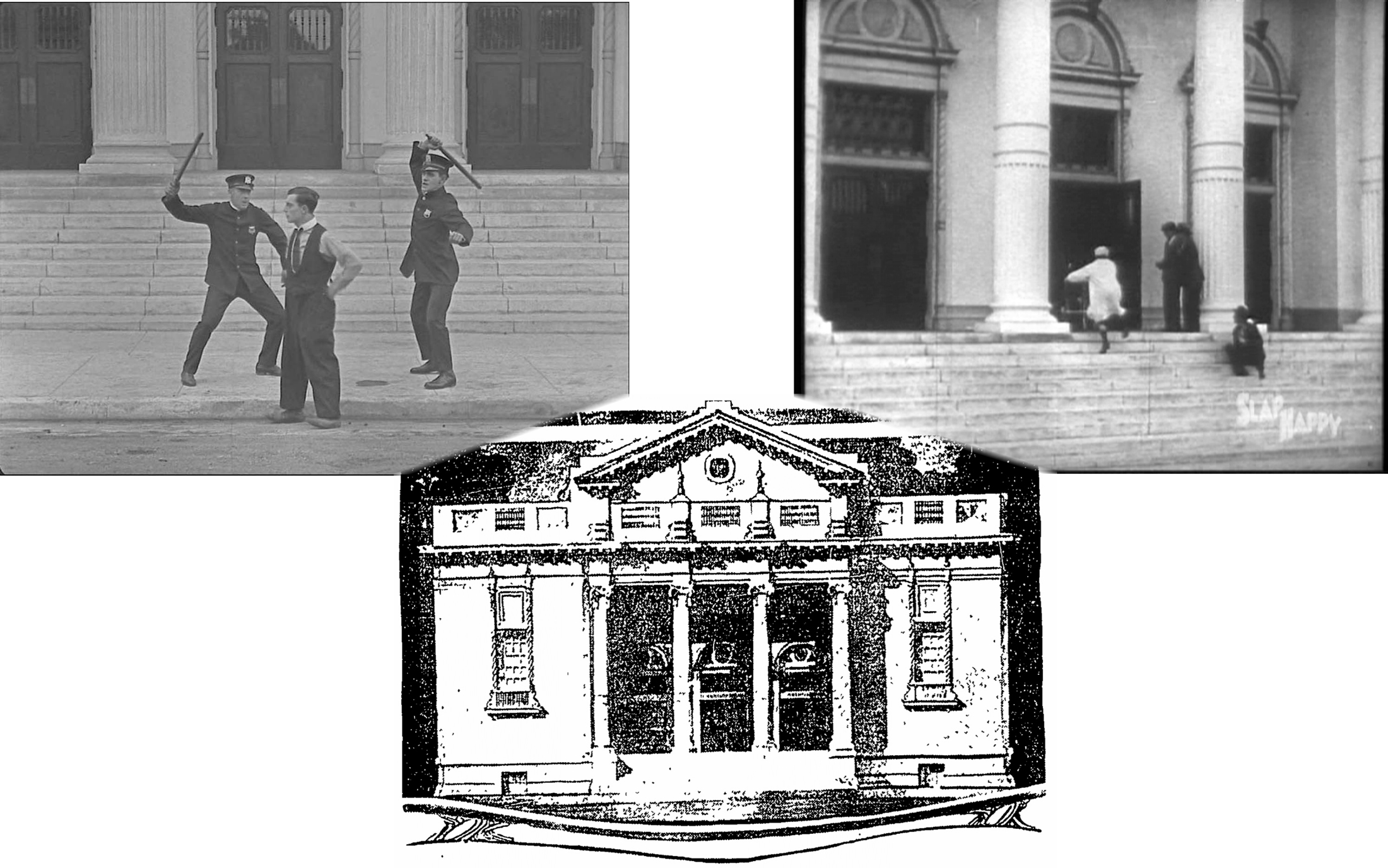
Buster and the Three Stooges at the Columbia Ranch – Part 3

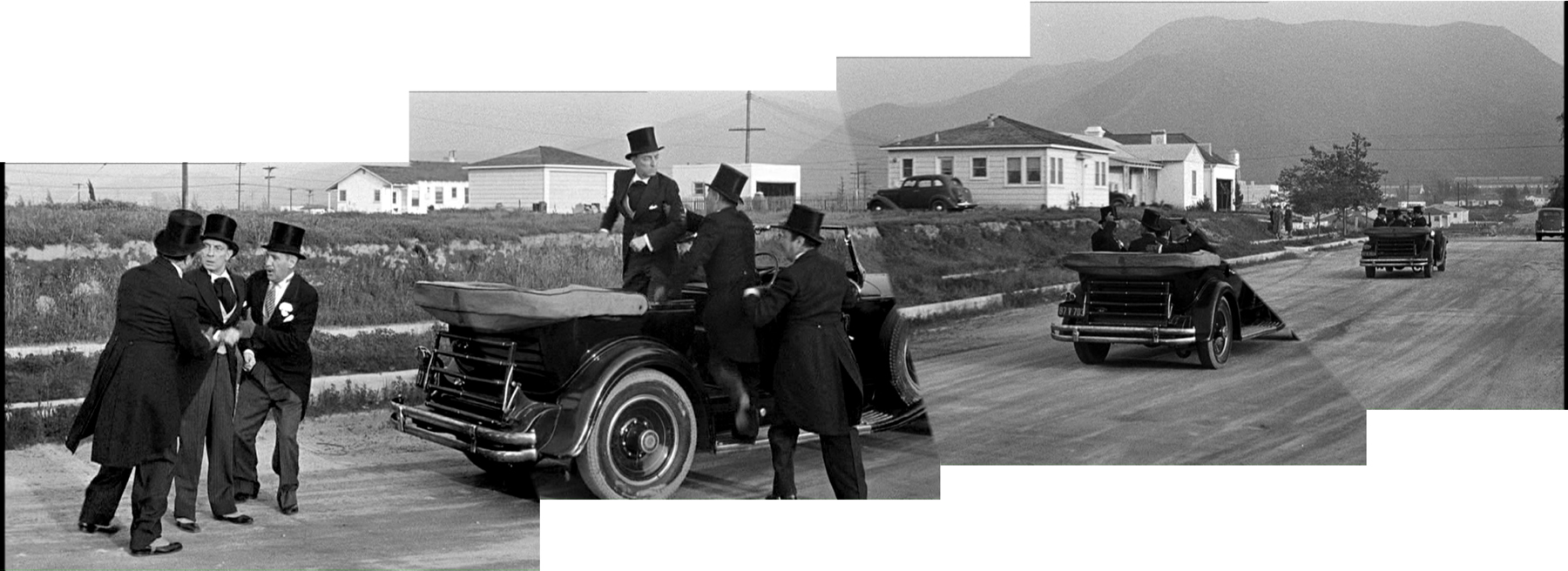
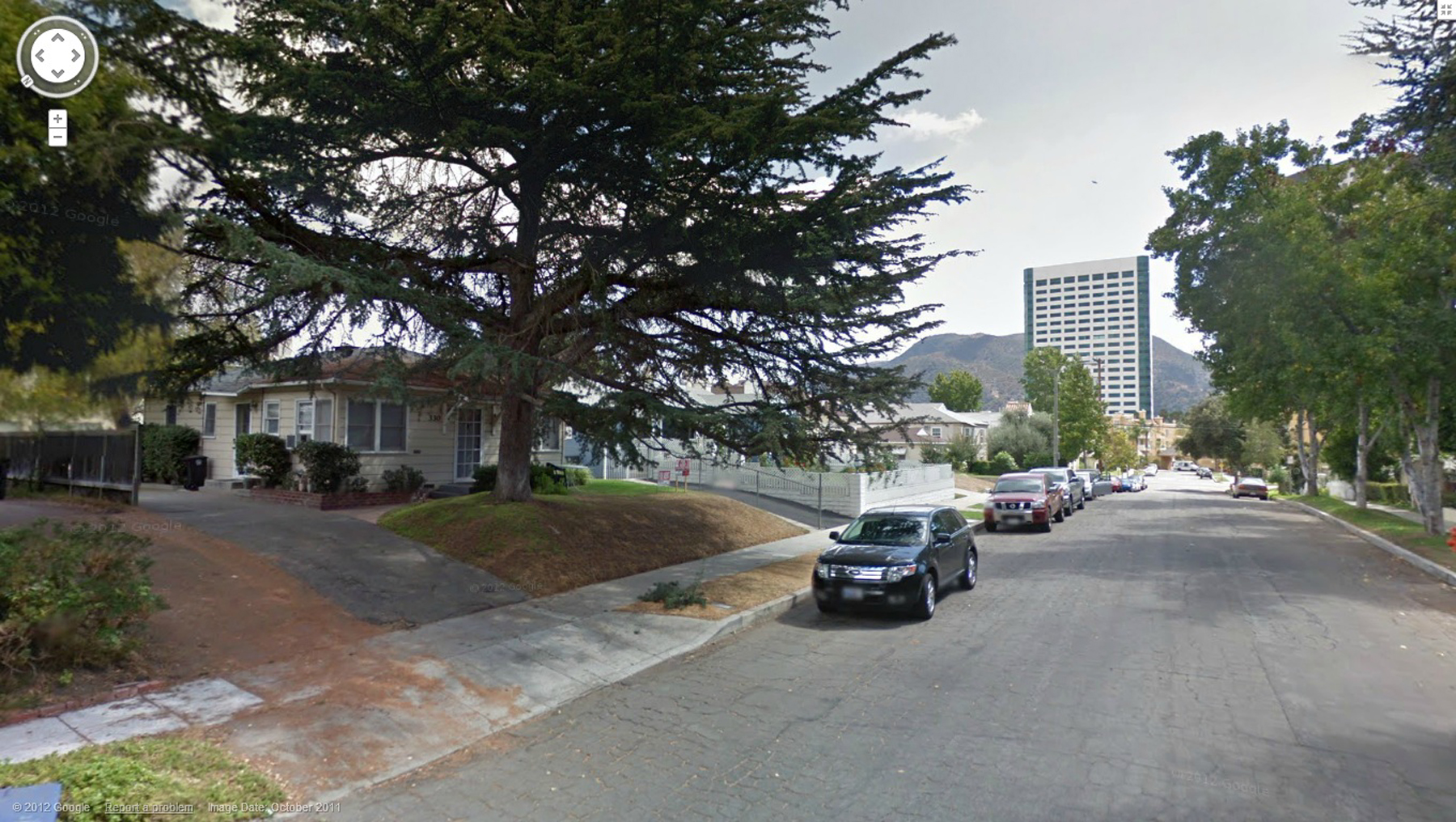
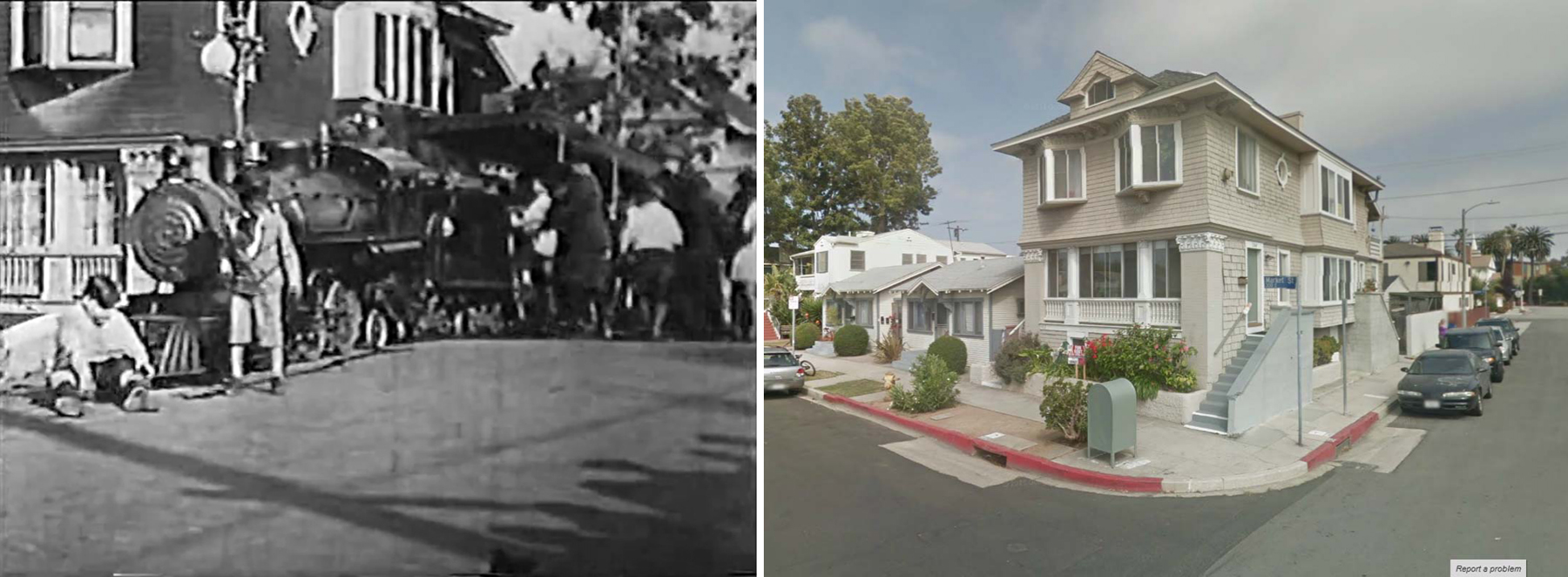
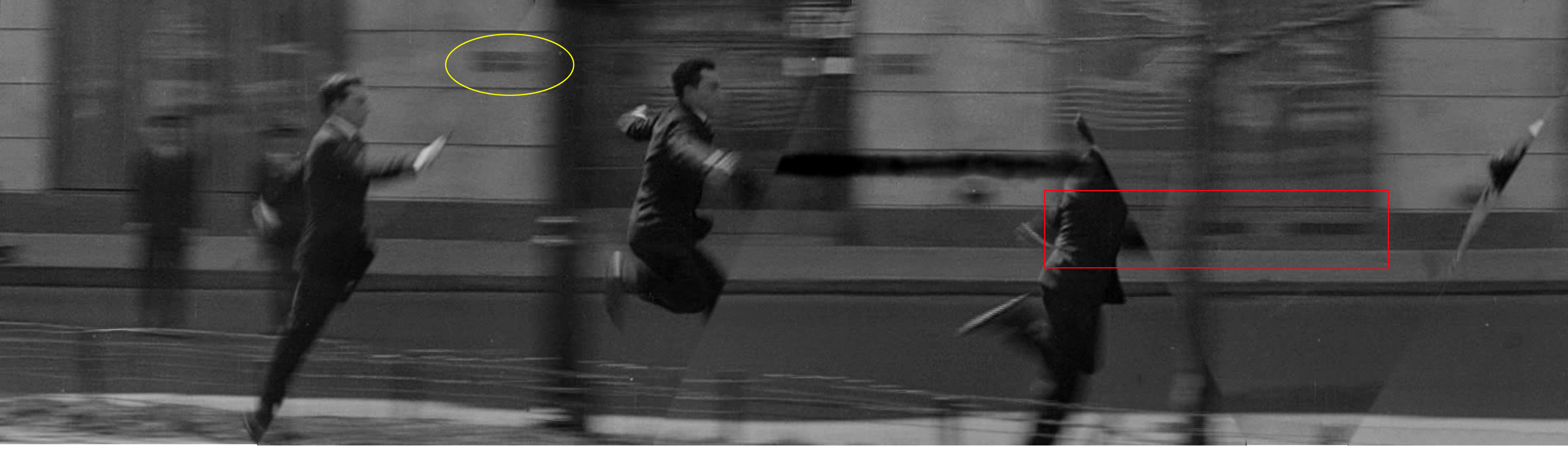
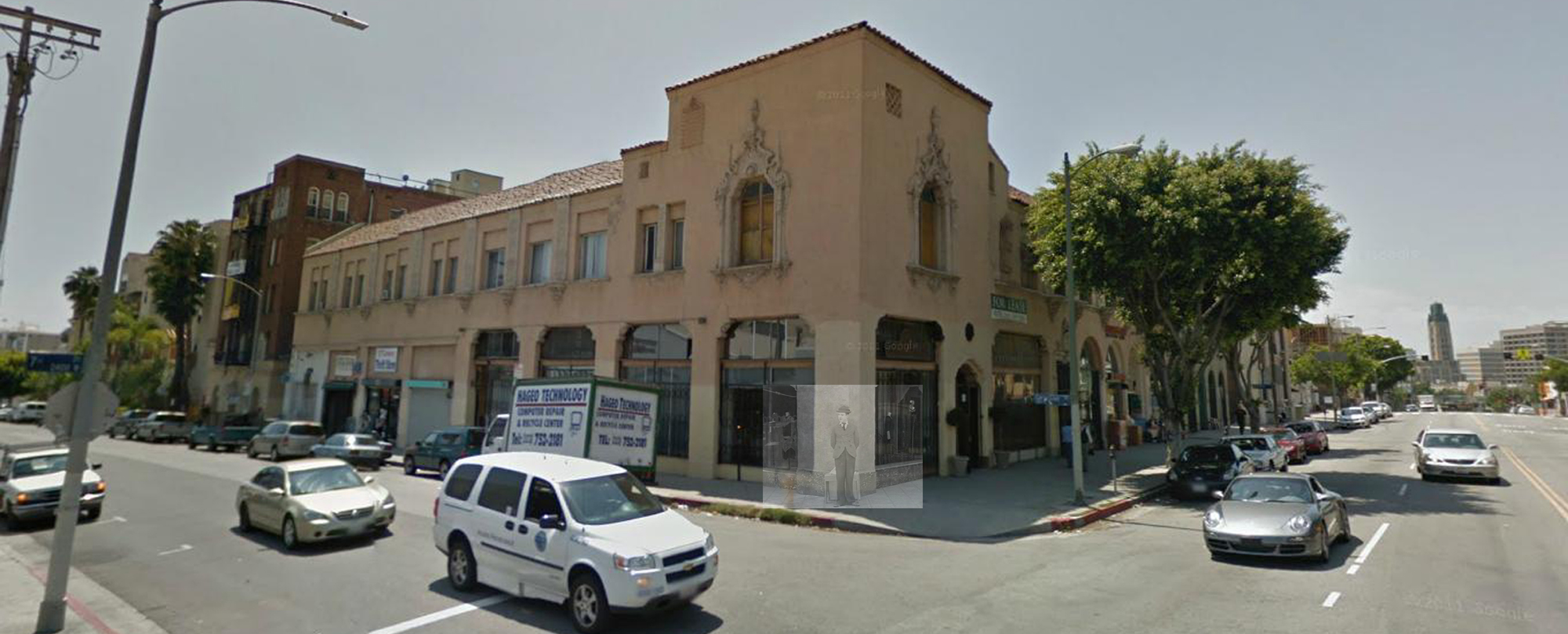
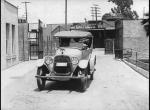
Buster in General Nuisance – looking south down Kenwood Street from Oak towards the Warner Bros. Studio in the far distance, nestled at the foot of Mt. Lee and Cahuenga Peak.

(C) 2012 Google

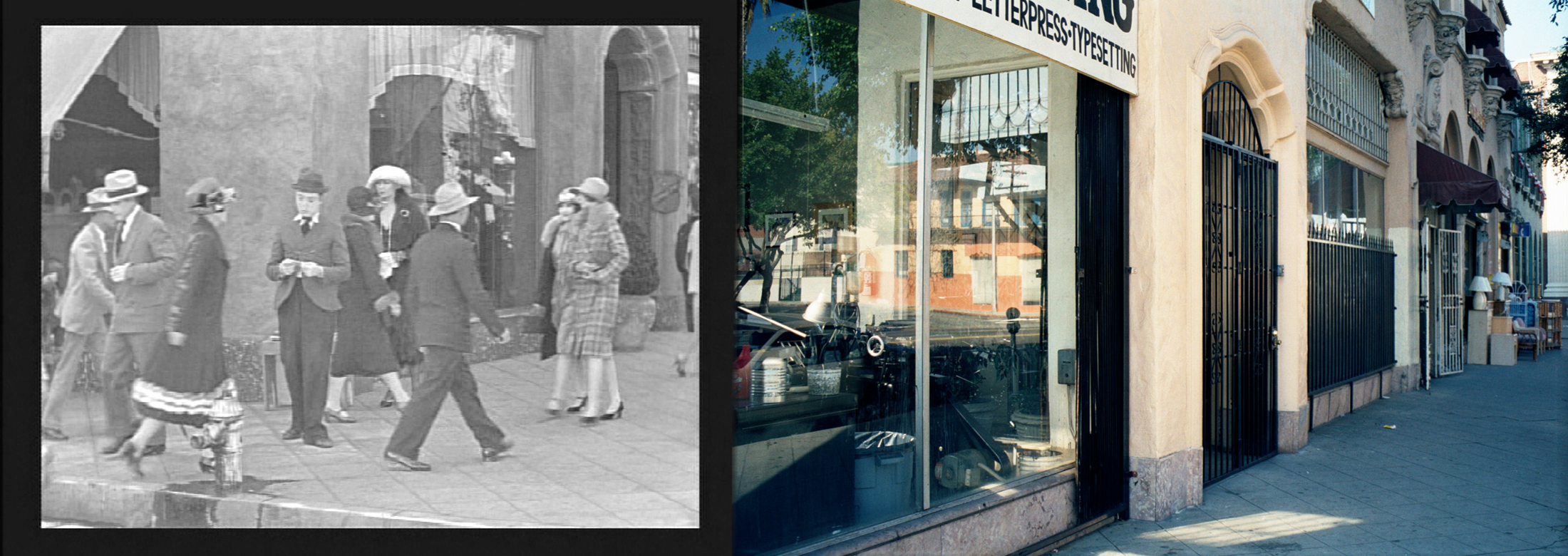
As discussed in prior posts, Buster Keaton and the Three Stooges nearly crossed paths in Cops (1922) and Soup To Nuts (1930) (see HERE), and did cross paths in Neighbors (1920) and Soup To Nuts (see HERE), before filming their respective Columbia short subjects General Nuisance (1941) and Boobs in Arms (1940) on the same back lot called the Columbia Ranch located in Burbank at the corner of Oak Street and Hollywood Way (see Part 1 HERE and Part 2 HERE).   Concluding this series, we’ll look at where Buster filmed scenes on Kenwood Street just south of the Columbia Ranch, known today as the Warner Brothers Ranch.

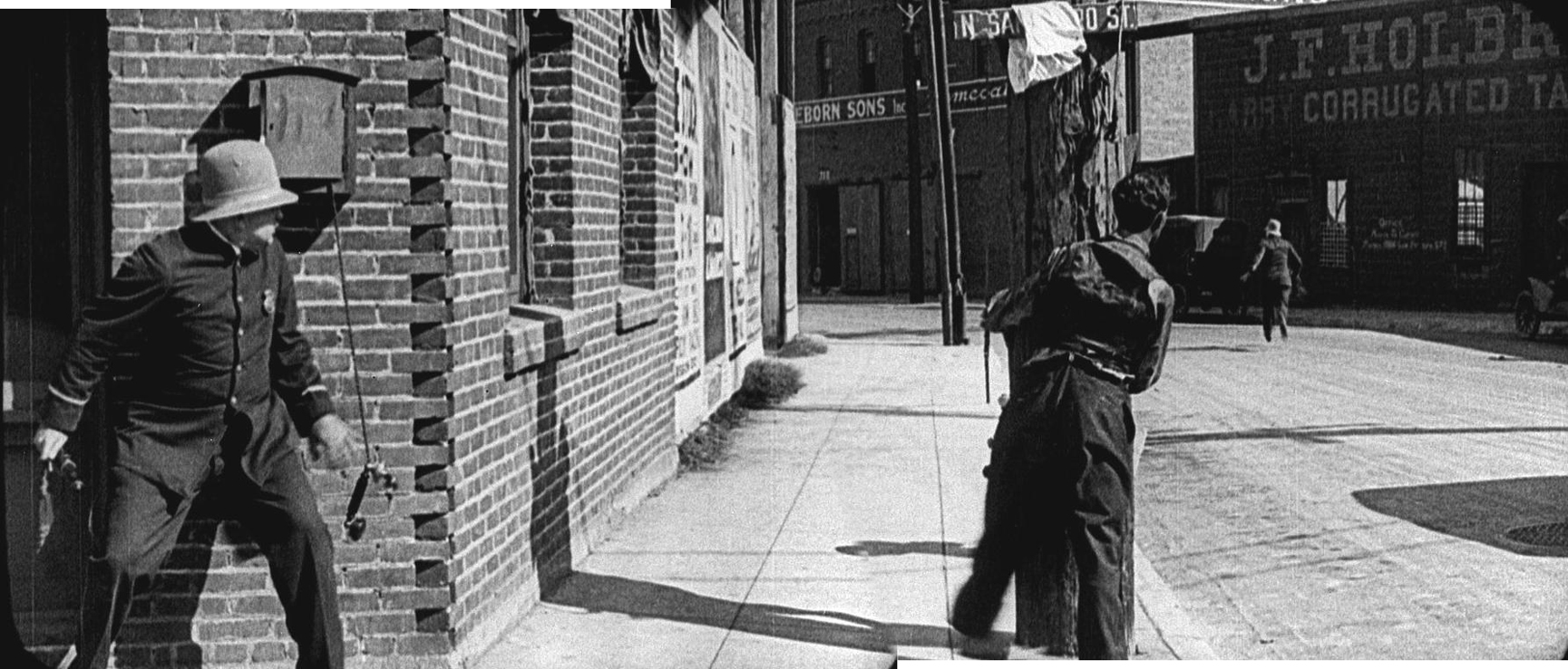
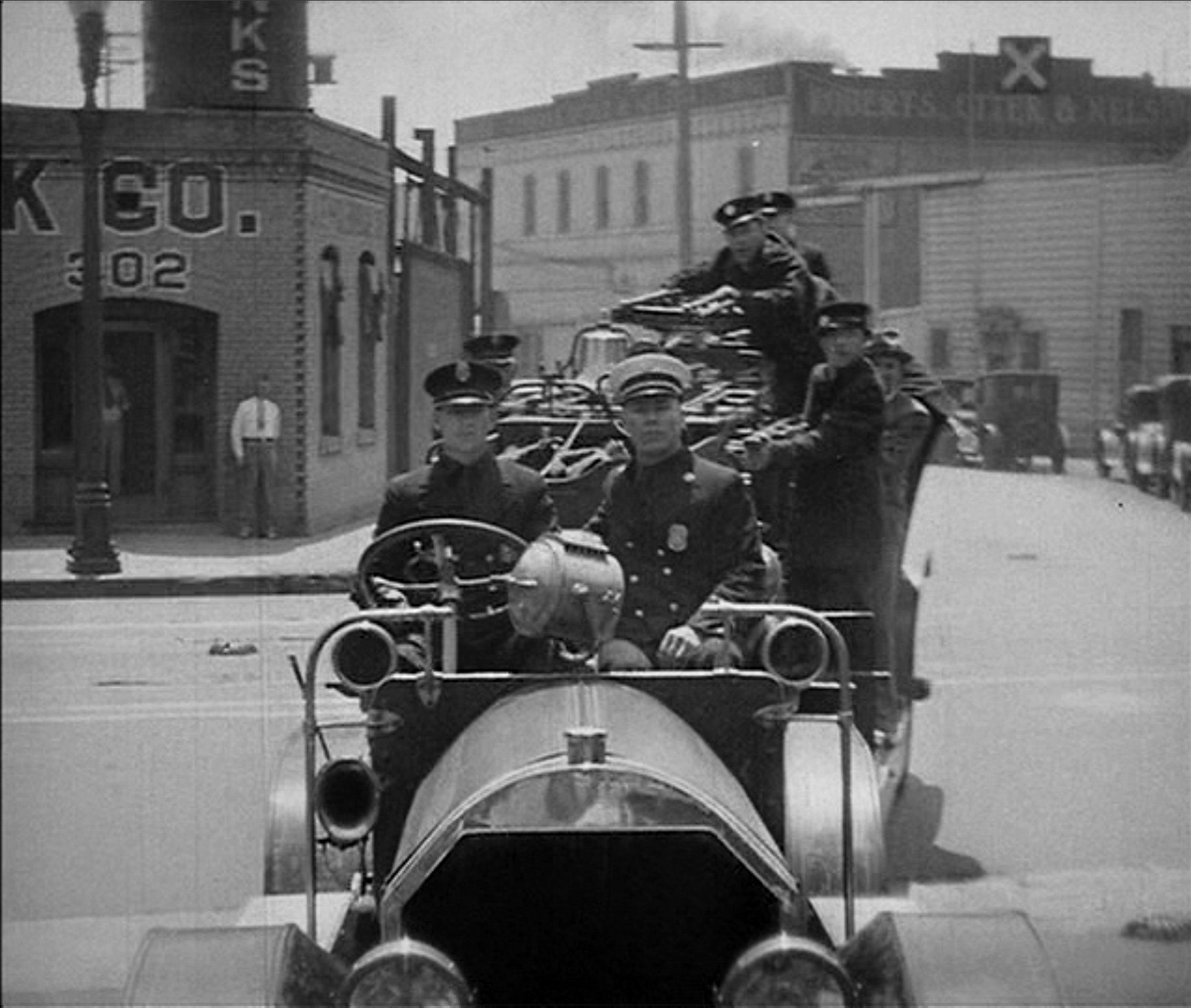
In General Nuisance Buster portrays an effete millionaire who enlists in the army to impress a woman who prefers a man in uniform.  Buster’s scenes were filmed along Oak Street and Kenwood Street, adjacent to the Columbia Ranch.

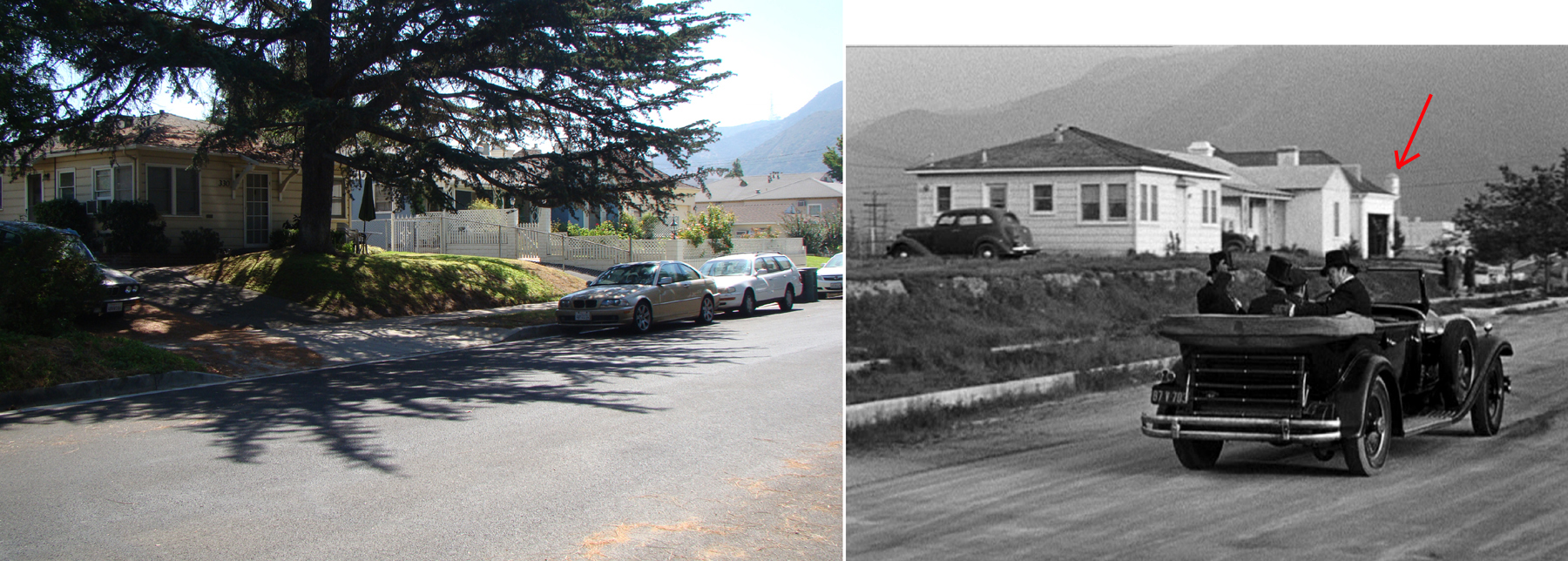
Click to enlarge.  Left to right – three extant homes, 330, 324, and 320 Kenwood – the arrow marks the Warner Bros. Studio water tower.  330 Kenwood also appears below.

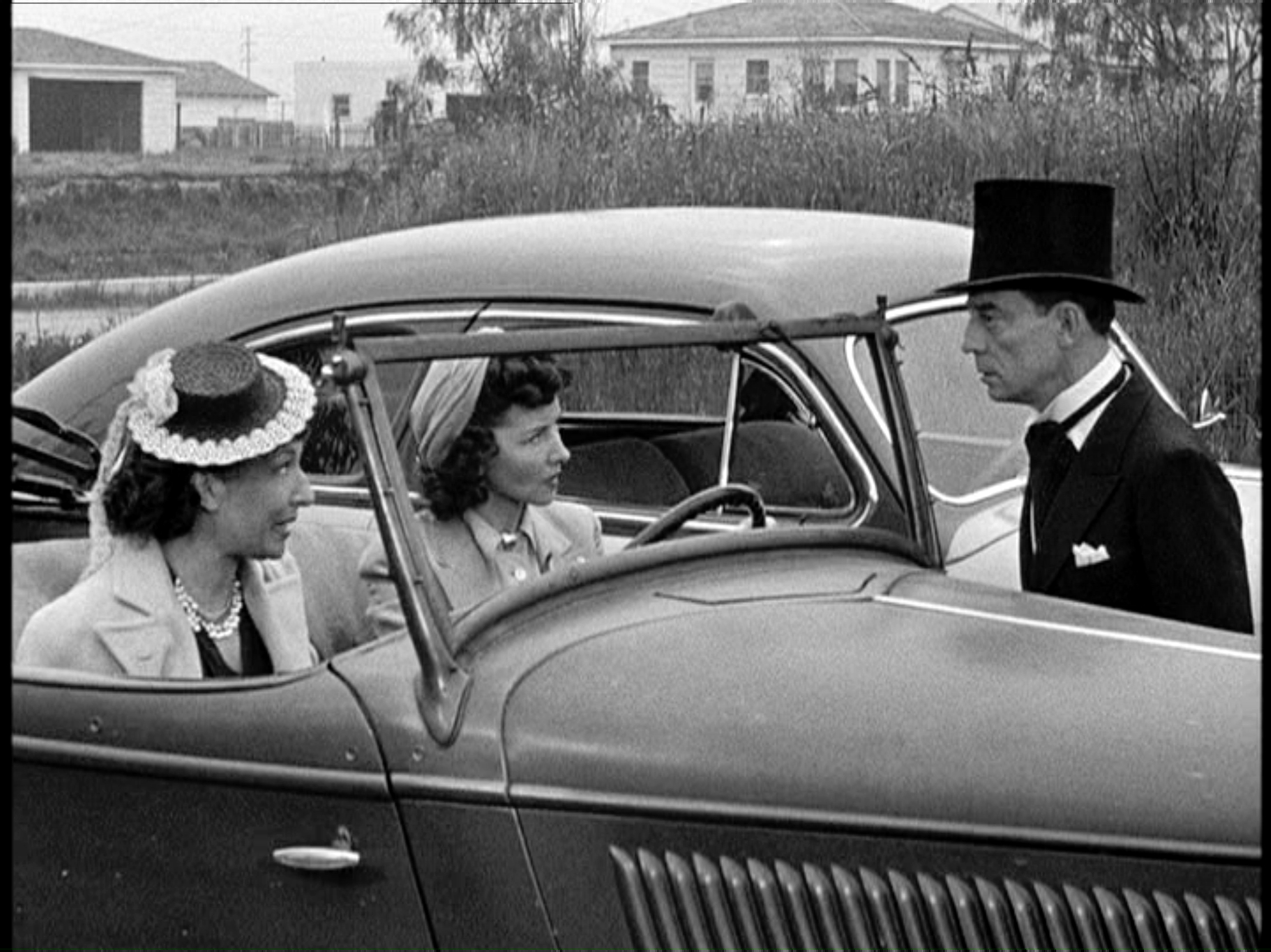
330 Kenwood appears behind Buster.

Above, Buster hitches a ride south down Kenwood with some diplomats after his car breaks down.  The three extant homes visible above were then the only homes on the block.  The prominently exposed front home (330) now has a towering pine tree on its once bare lawn.  Earlier, Buster meets two women parked along Oak Street (left), as the same home at 330 Kenwood appears in the background.  The detached garage for 330 Kenwood (open door at left) has been replaced with a two-story mother-in-law unit.

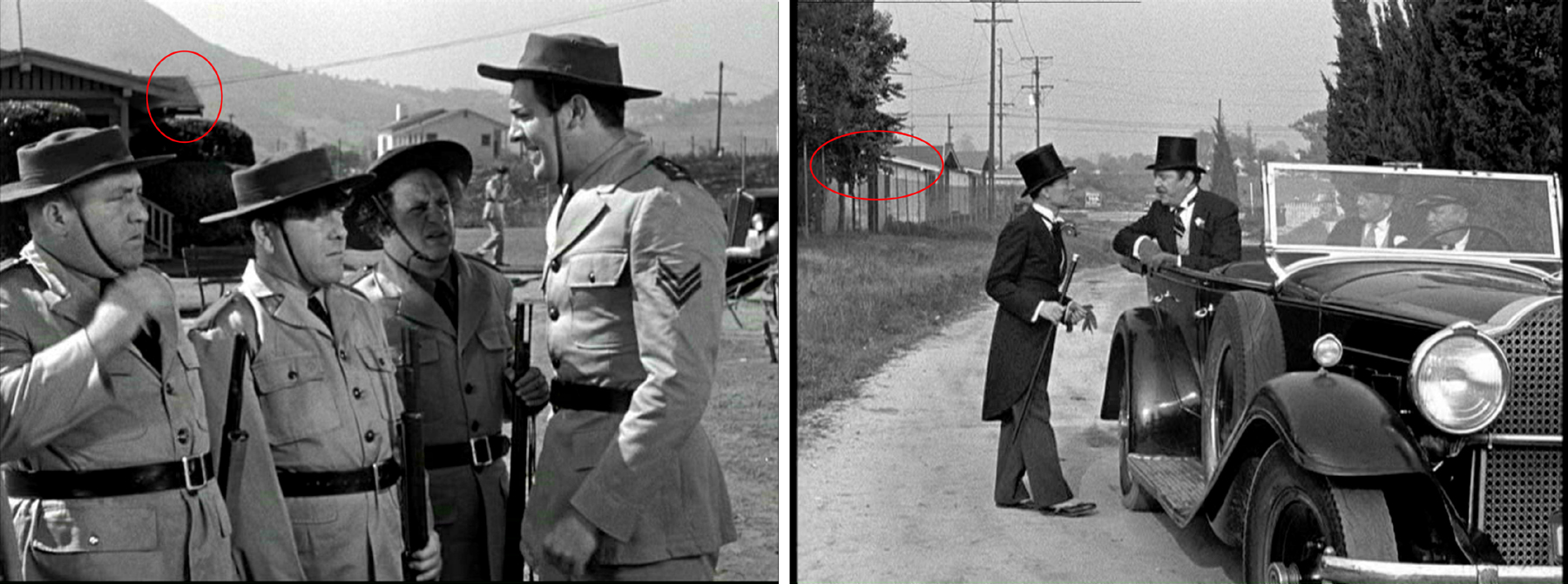
Each oval marks the west side of the same Columbia Ranch bungalow – Buster’s view looks east down Oak.

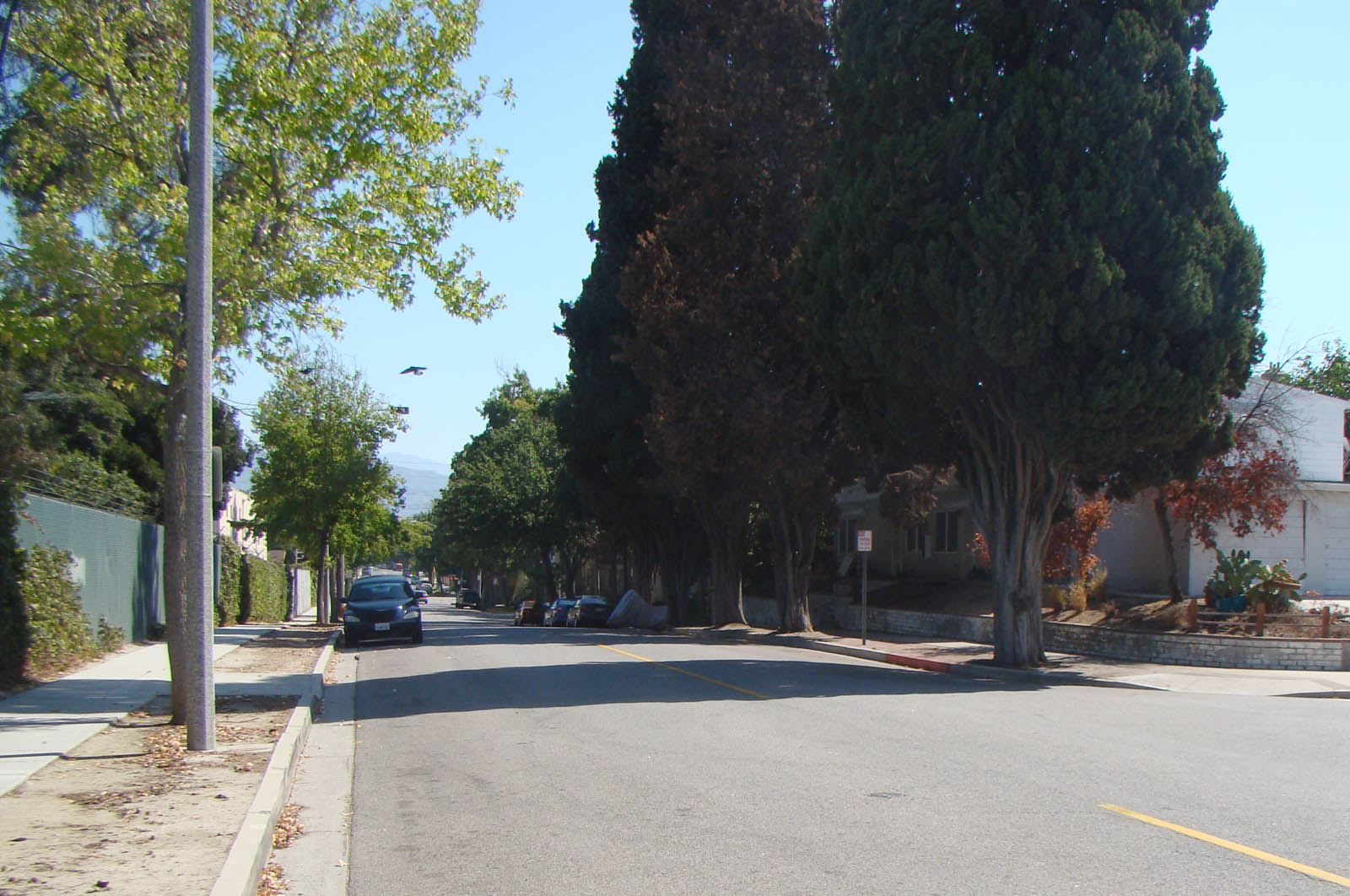
East down Oak today

Above right, Buster’s car breaks down on Oak Street, looking east along the south border of the Columbia Ranch.  In the back you can see a pair of twin bungalows on the studio property that appear prominently later in Buster’s film and, as explained in my prior posts, during the Stooges’ Boobs In Arms, appearing above left.  The western-most of the two bungalows, marked with an oval above, was replaced by a large structure, but its twin to the east remains standing near the Oak/Hollywood Way corner entrance to the Warner Brothers Ranch.

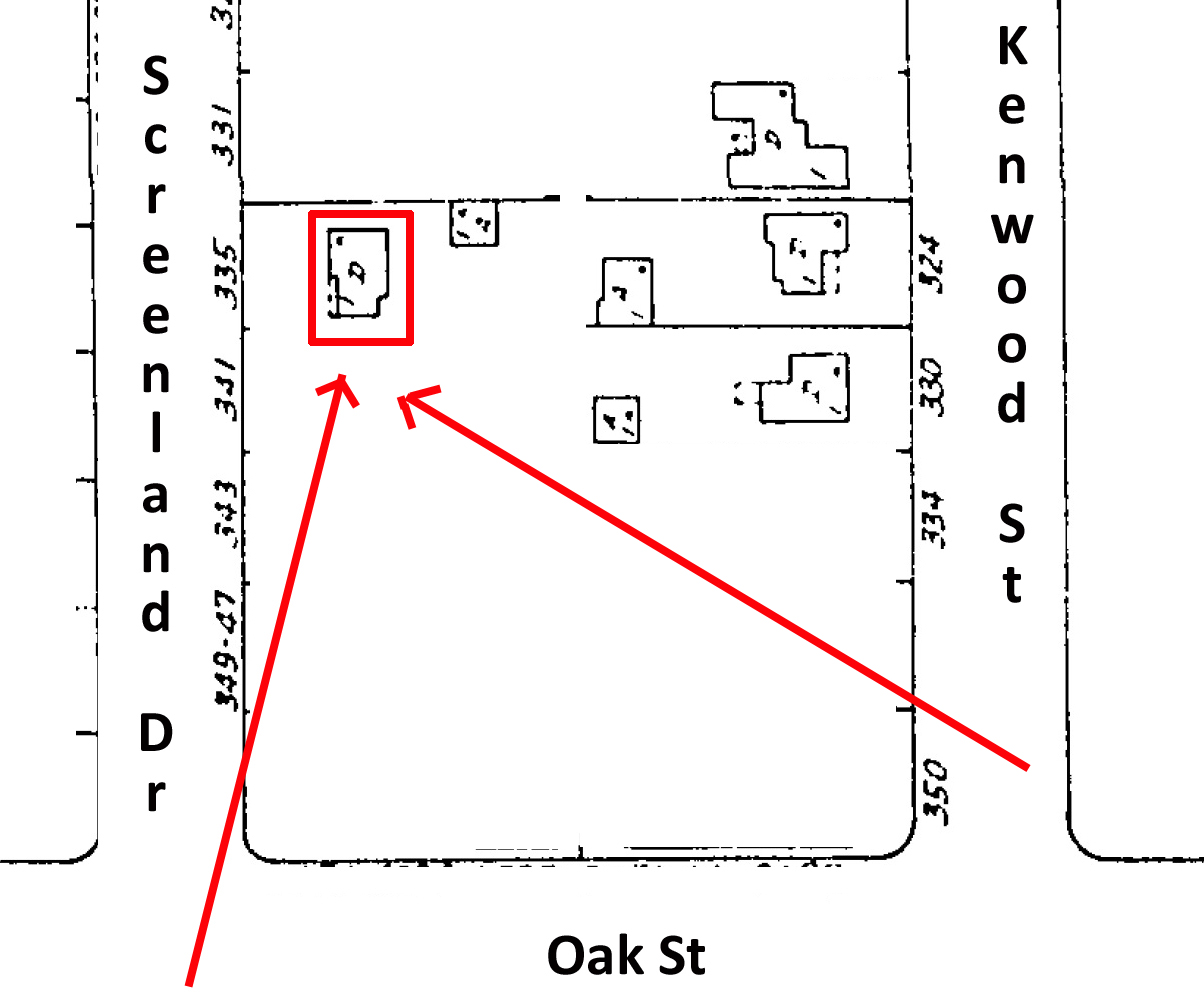
Two views of the north side (box) of 335 Screenland Drive, now lost.

You can get a sense of how bare suburban development was here in the early 1940s by comparing these images above from the two movies.  Each image shows the north face of the bungalow that once stood at 335 Screenland Drive – at the time the only home on the block.  Today large apartment blocks squat along both sides of Screenland Drive.  The map at the left looks south, and shows the point of view from the Stooges’ movie (left arrow) and from Buster’s movie (right arrow) towards the home at 335 Screenland.  Only four homes (and three detached garages) stood on the bare land south of the Columbia Ranch during the time of filming.

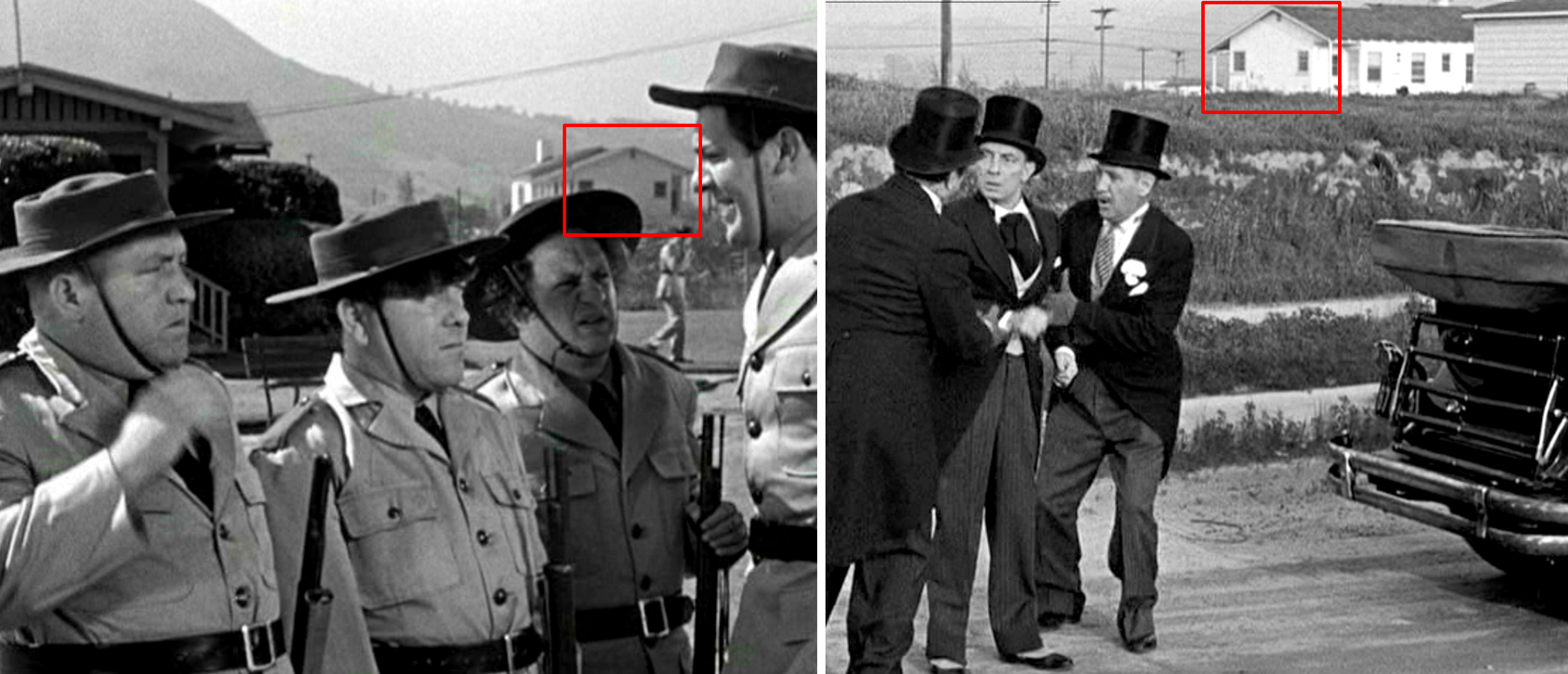
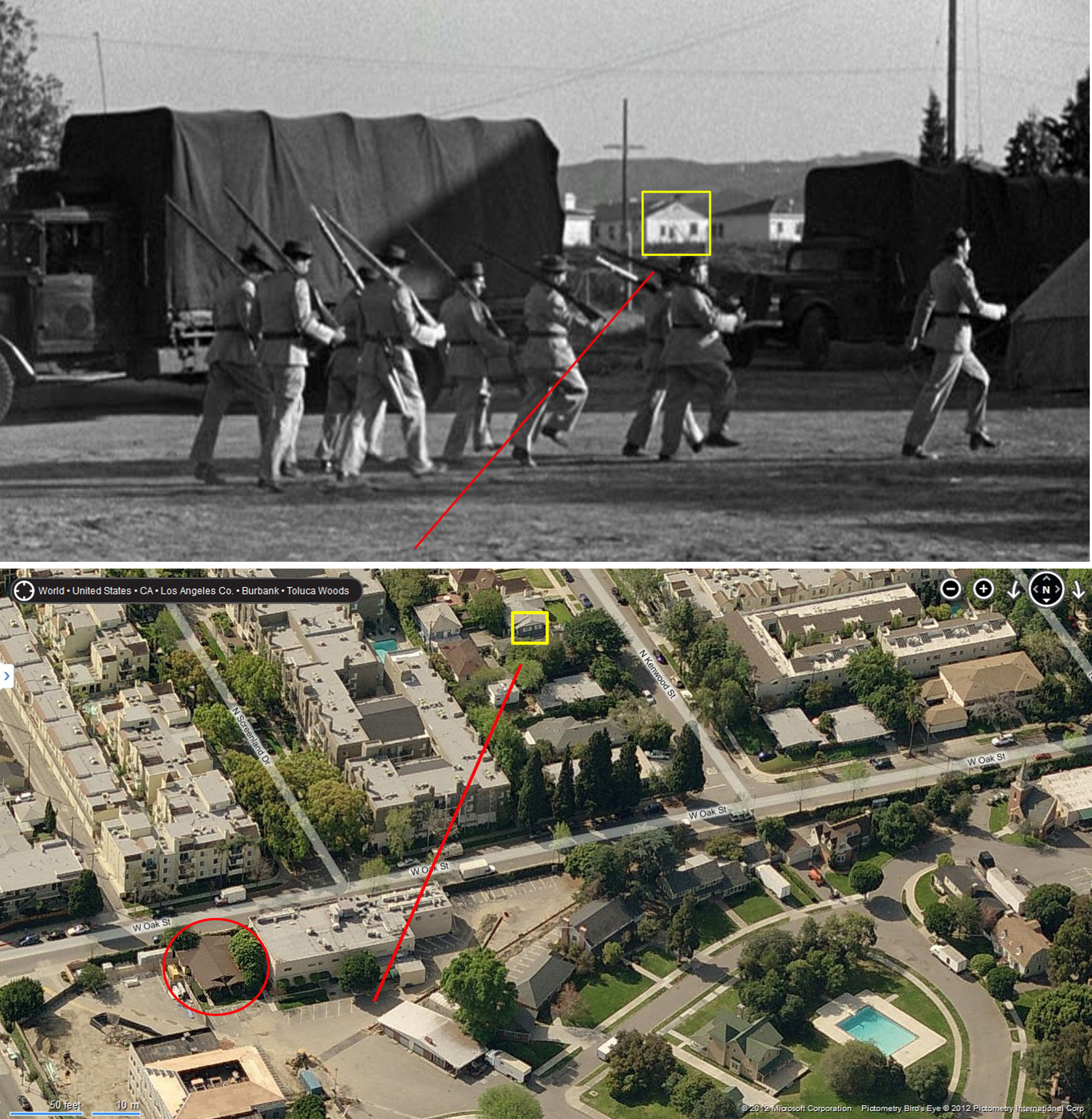
During the Stooges’ drill practice scene from Boobs In Arms, shown above, you can also look south from the studio and see the north face of the extant bungalow at 224 Kenwood, marked with a yellow box.  To the right of the yellow box in the Stooges frame is the north side of 330 Kenwood, the home discussed above.  The matching modern aerial view, shown above, looks south from what is now the Warner Brothers Ranch toward 224 Kenwood.  The red oval above marks the surviving of the twin bungalows mentioned previously.  I explain other features visible in this aerial view in my prior posts.

For information on the Columbia Ranch, I highly recommend the unofficial ranch website here.

Jim Pauley’s new book The Three Stooges: Hollywood Filming Locations has dozens and dozens of photos of the Columbia Ranch backlot and the various sets.

The Mike McDaniel and Wes Clark Burbank history website Burbankia can be found here.

Movie frame images copyright Columbia Pictures Industries, Inc.  Aerial view (C) 2012 Microsoft Corporation – Pictometry Bird’s Eye (C) 2012 Pictometry International Corp.

Posted in Buster Keaton, Columbia, Three Stooges | Tagged , , , , , , , , , , , | 5 Comments

Harold Lloyd – By the Sad, Santa Monica Waves

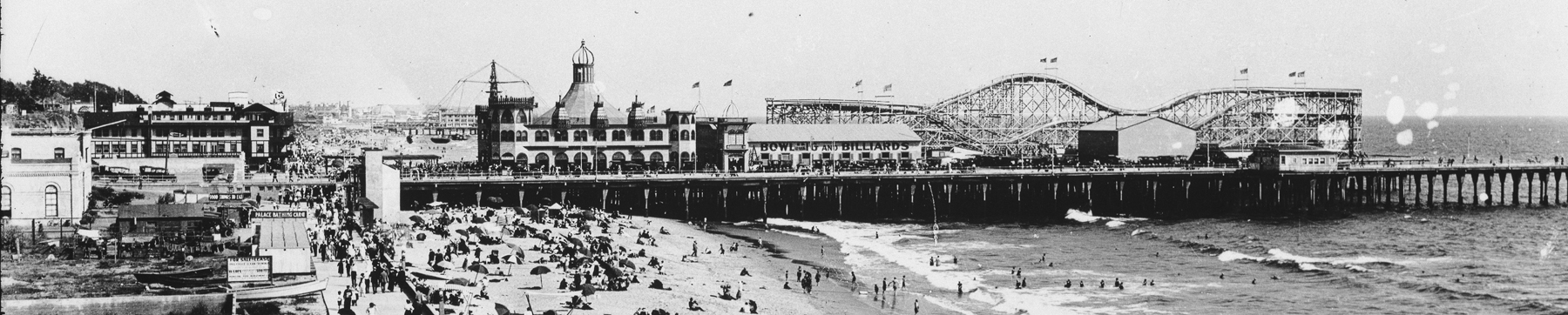
Click to enlarge.  The Santa Monica Pier, circa 1917.  The carousel was built in 1916, the bowling and billiard parlor to the right opened in 1917, along with the Blue Streak Racer roller coaster, a dual track racing coaster, at back  –  Department of Special Collections, University of Southern California.

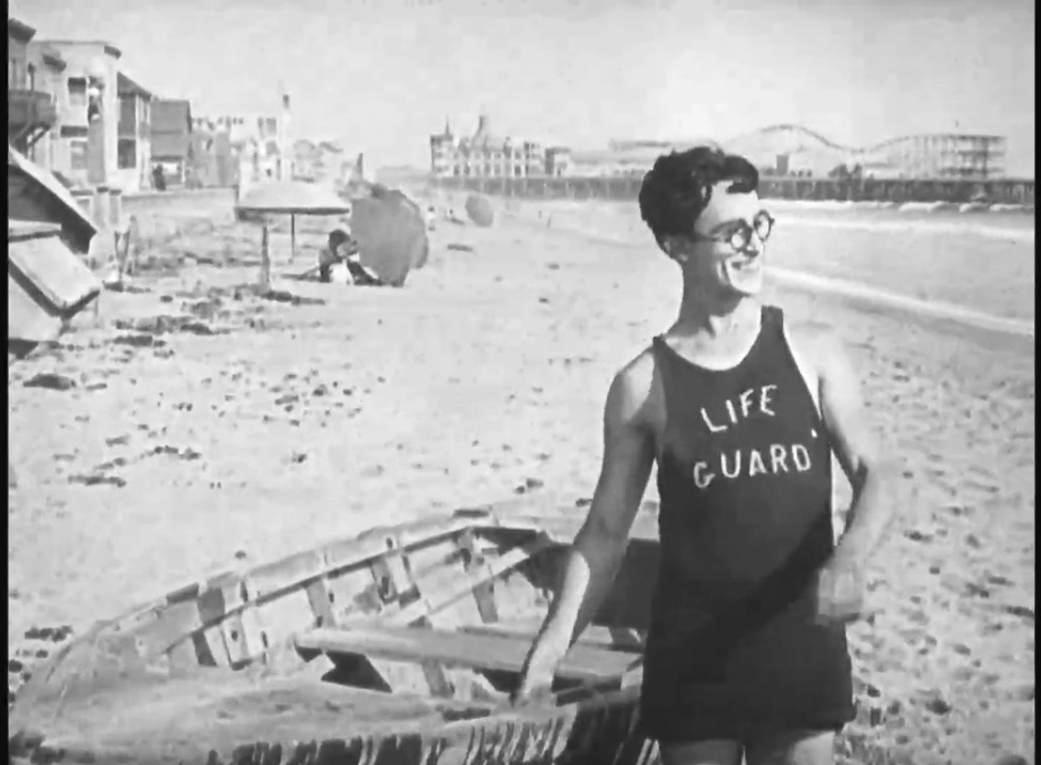
Harold in full David Hasselhoff mode at the same beach where the Baywatch TV show was later filmed.

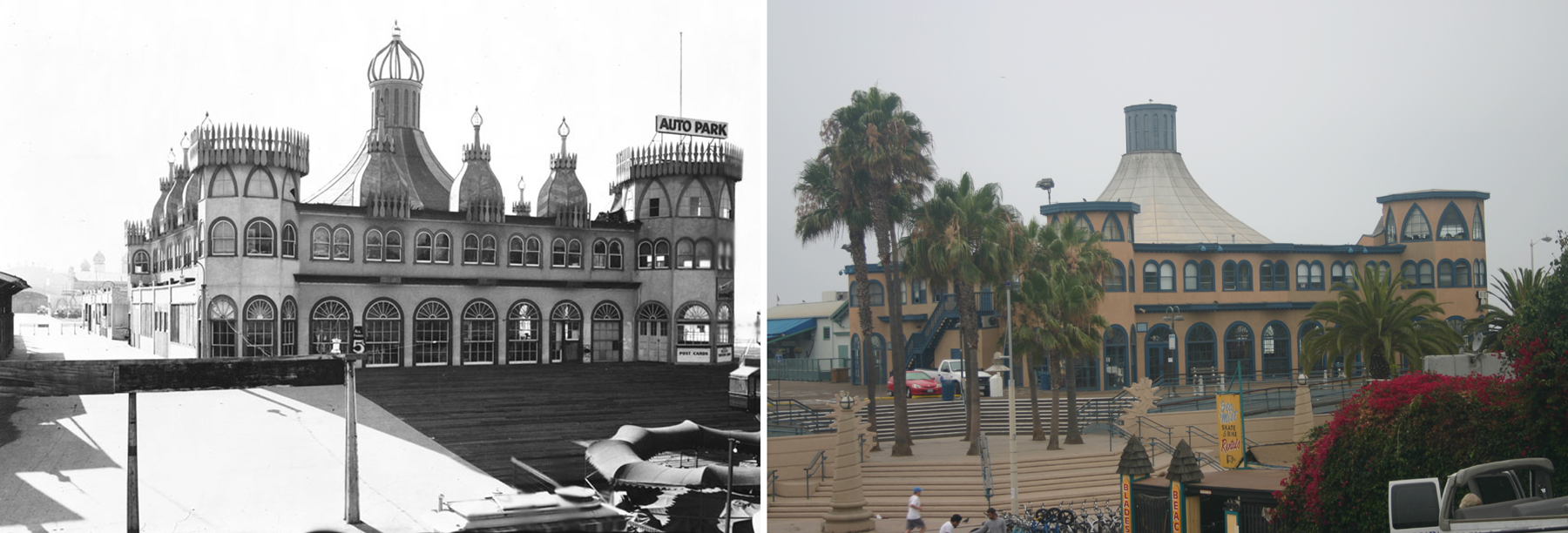
During Harold Lloyd’s 1917 short film, By The Sad Sea Waves, Harold pretends to be a beach life guard in order to impress the ladies.  Filmed where David Hasselhoff would film Baywatch many decades later, By The Sad Sea Waves provides a wonderful time capsule view of the Santa Monica pier, and the Looff Carousel and Hippodrome, still in use after nearly 100 years.  (The film title is a play on words of “by the glad sea waves,” a somewhat obscure figure of speech at the time.)   Built in 1916, the distinctive carousel served as an important location for the 1973 Best Picture The Sting, and is Santa Monica’s first National Historic Landmark.

The Looff Carousel and Hippodrome – Santa Monica’s first National Historic Landmark.  The carousel served as an important location for the 1973 Best Picture The Sting.  Department of Special Collections, USC – Tony Barraza.

Leisure time and disposable income were in short supply at the turn of the prior century, but as the working class began earning higher wages, and receiving both Saturdays and Sundays off from work, a need arose for local and inexpensive pastimes, and beachfront amusement parks provided welcome entertainment.  After saving their nickels, factory workers and office clerks could hop on the trolley and lose themselves for a day at the beach.  Many Southern California beach communities had amusement park piers during the silent-film era, and as I explain in great detail in my book Silent Visions, Lloyd filmed at nearly every one of them.

Looking south on the filming site from Palisades Park in Santa Monica – Santa Monica Public Library

Harold attends to a drowning victim – one of many scenes filmed at this spot.

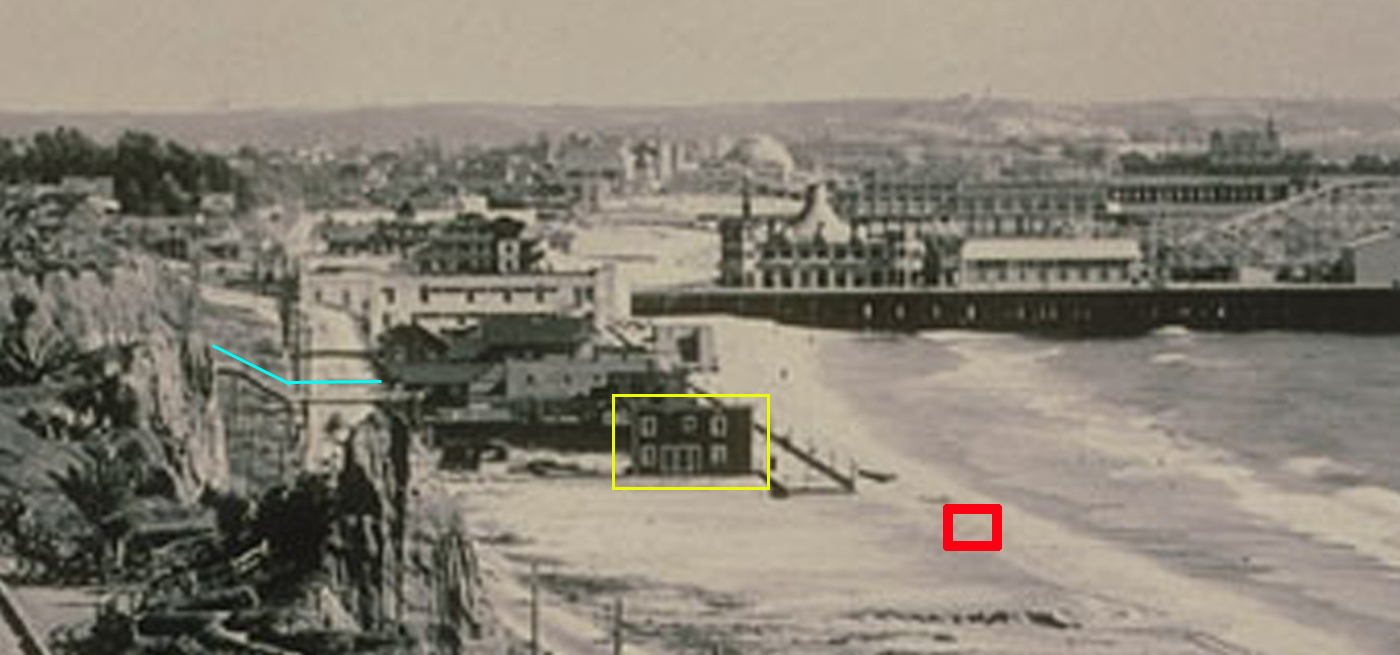
The above photo, taken from Palisades Park overlooking the ocean in Santa Monica, looks south towards the Santa Monica Pier, and shows where most of the scenes from the movie were filmed (left).  The blue line marks the stairway and pedestrian bridge leading down from Palisades Park to the beach.  Though now rebuilt with cement, the bridge still stands in the same spot, across from the bluff-top terminus of Arizona Avenue.  The yellow box marks the former apartment house at 1255 Ocean Front, once the northernmost structure along the cement promenade leading from the pier.  You can see the terminus of the promenade in the background of several scenes.

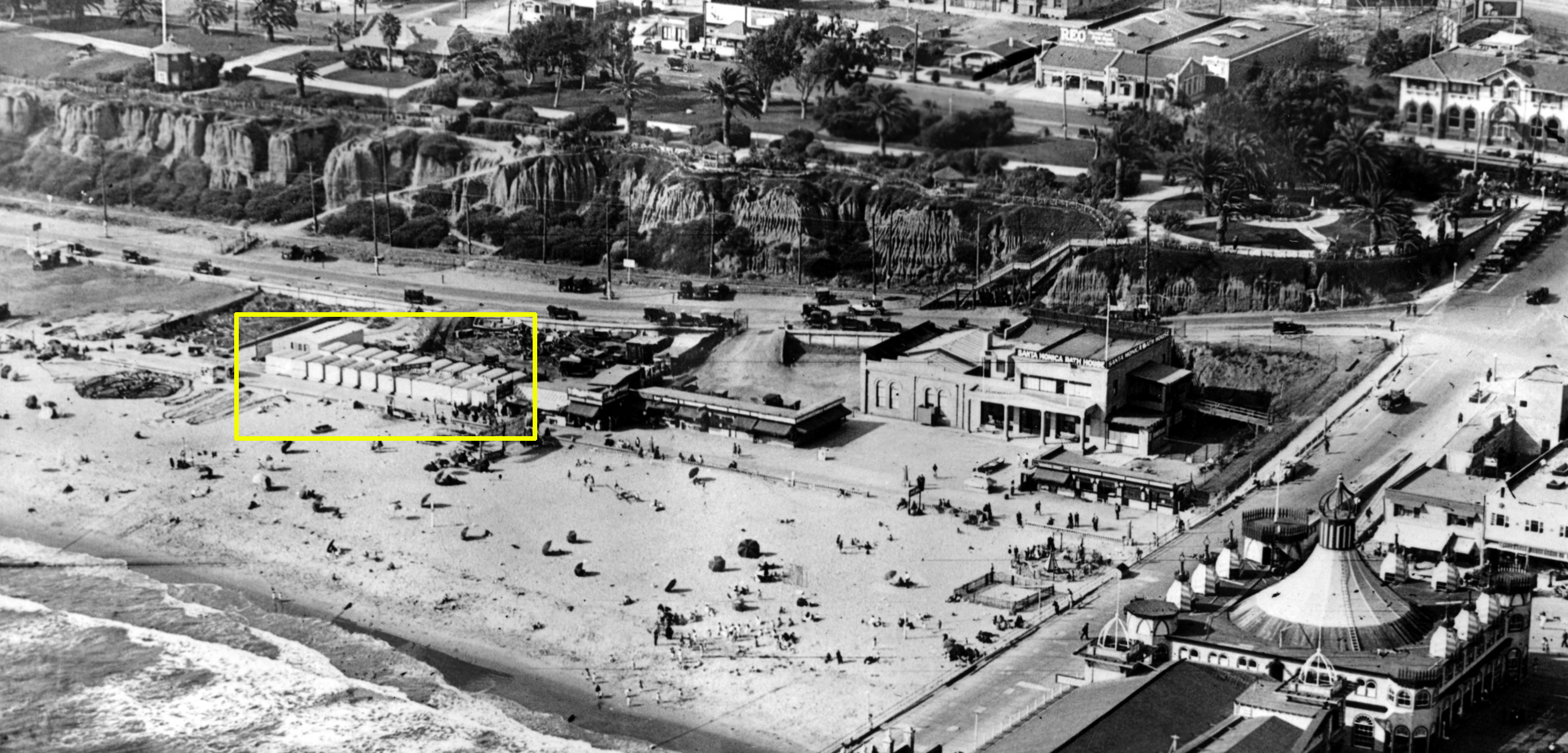
Click to enlarge.  Matching views looking south (left) and north (right) at the Palace Bathing Car beach dressing rooms.  USC Digital Archive.

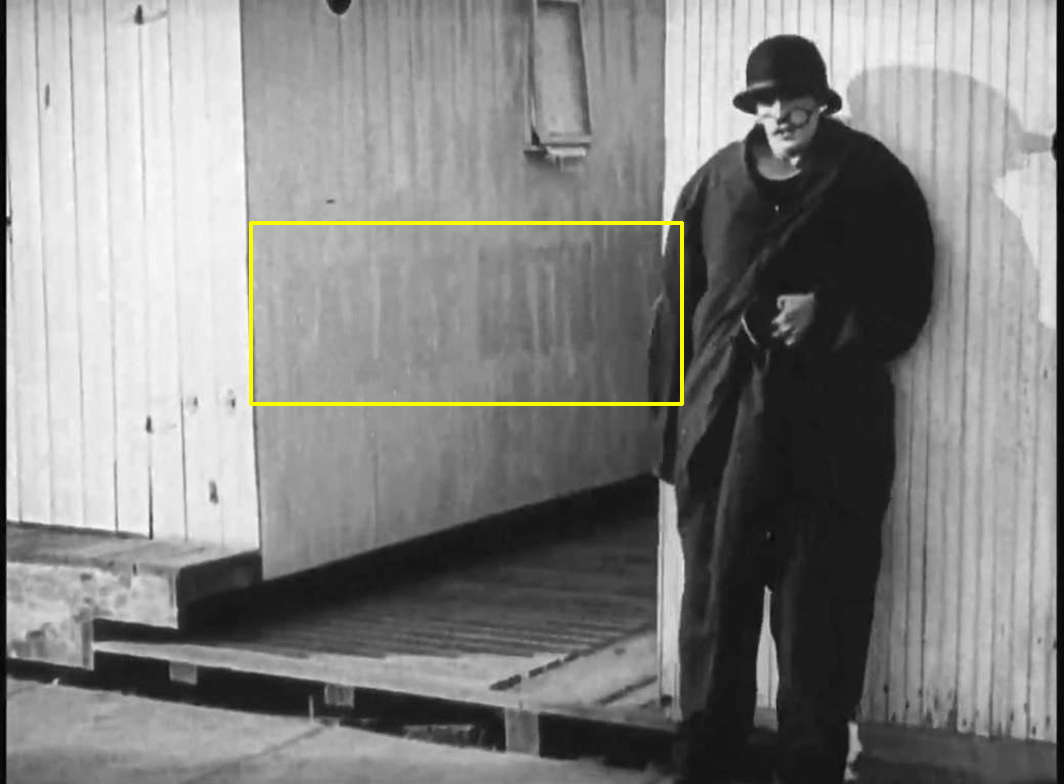
Wearing an impromptu disguise, Harold hides from the police beside a Palace Bathing Car beach dressing room, also pictured above and below (yellow boxes).

At the time of filming, most Los Angelenos would arrive at the beach by trolley, wearing suits and ties, and other formal street clothes.  They would then rent heavy wool bathing suits from one of the numerous bath houses along the coast, changing either at the bath house, or at small beach dressing rooms available for rent, such as the Palace Bathing Car rooms pictured here, marked by yellow boxes.

A view of the Santa Monica Pier, with the Looff Carousel at the lower right, and the Palace Bathing Car dressing rooms (yellow box) –  Security Pacific National Bank Photograph Collection/Los Angeles Public Library.

Below, a view of the Santa Monica Pier today, with the only original structure, the Looff Carousel, at the upper right.  Left-click on the photo, and move it around to see the neighboring beach and bluffs.

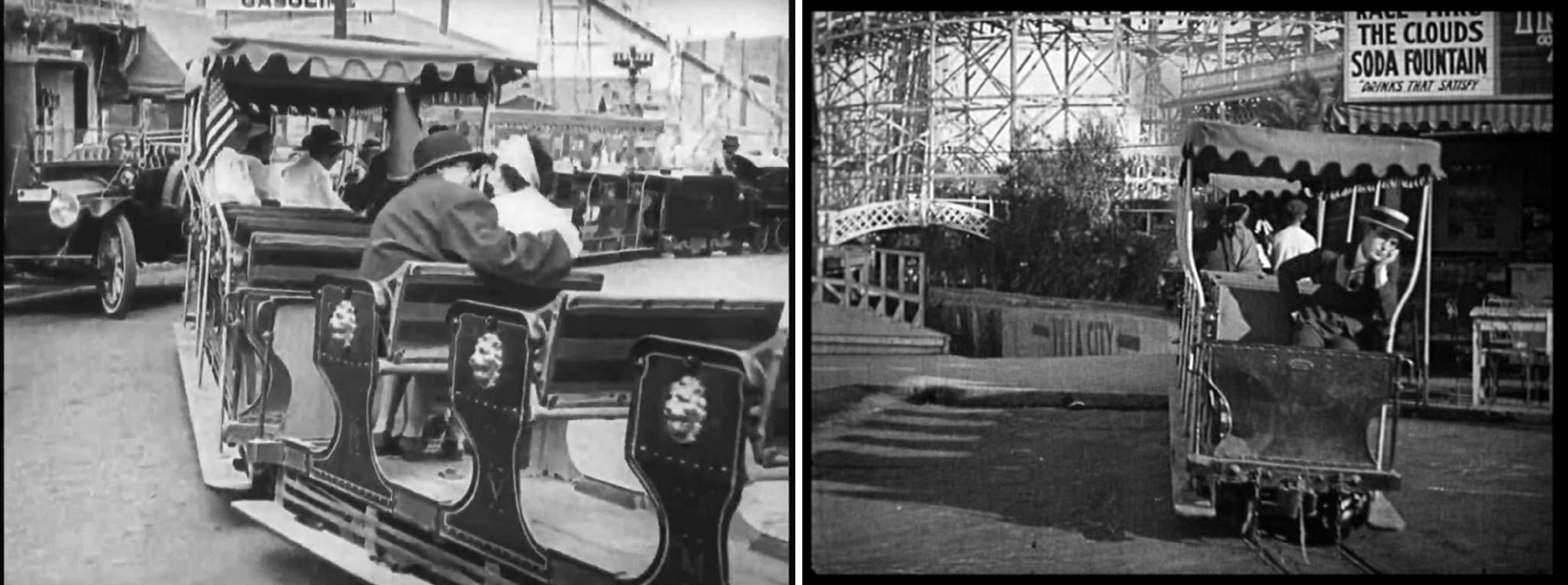
The movie concludes as Harold and recent conquest Bebe Daniels ride off into the sunset aboard the Venice Miniature Railway (see below), a popular beachside attraction that once operated about two miles south of Santa Monica.  Harold used the same railway to conclude his short comedy Number Please? (1920), only in this film Harold loses the girl, and rides off all alone.

All Aboard!!  By The Sad Sea Waves to the left, Number Please? to the right – in the background stands the former Race Thru The Clouds roller coaster that stood beside the former Venice lagoon.

The Venice of America beach resort, pictured below, was built on reclaimed marshland by developer Abbot Kinney starting in 1904.  The planned community was situated on eight miles of man-made canals, radiating from a large central lagoon that featured real gondolas and gondoliers imported from Italy, and a two-block business district noted for its covered arched walkways and Venetian Renaissance architecture.  Today the lagoon and most of the canals have been paved over, and most of the buildings have been streamlined or demolished.   Venice was also home to the former Abbot Kinney amusement pier that appears in several Chaplin, Keaton, and Lloyd comedies.

Kinney installed the Venice Miniature Rail Road (V.M.R.R.) in 1905, as both a tourist attraction and as a means to escort potential home builders and buyers to look at the subdivided parcels he was promoting. The train was very popular for its time, but it interfered with traffic, and was shut down in 1925 when Venice was incorporated into Los Angeles.

The YouTube site below is an early silent Century Comedy Kids comedy, copying the Our Gang format, that has amazing historical footage of the railway in action – you can even see the letters V.M.R.R. on the side of the cab.  At 8:55 marks the corner of Market Street and Riviera, depicted directly below.  The main intersection of Windward and Pacific, pictured further below, appears at the 8:18 and 14:34 marks in the video.

ca

Market Street and Riviera in Venice, CA

Looking west down Windward Avenue towards the ocean.  Venice Miniature Rail Road – Marc Wanamaker – Bison Archives

Below, the same Venice corner at Windward Avenue and Pacific Avenue today.  The corner building on the right has had the top floor removed.

HAROLD LLOYD images and the names of Mr. Lloyd’s films are all trademarks and/or service marks of Harold Lloyd Entertainment Inc. Images and movie frame images reproduced courtesy of The Harold Lloyd Trust and Harold Lloyd Entertainment Inc.

Posted in Harold Lloyd | Tagged , , , , , , , , , , , , , | 15 Comments

Buster Keaton – Three Stooges – LAPL Author Lecture

I want to thank everyone for attending my Silent Footsteps lecture held September 15 at the Los Angeles Public Library Taper Auditorium, hosted by Photo Friends.

Using archival photographs, vintage maps, and then and now comparison photos, I led a virtual tour across the lost-and-found neighborhoods of Bunker Hill, Court Hill, and the downtown Los Angeles Historic Core, as documented in the films of Charlie Chaplin, Buster Keaton, and Harold Lloyd.

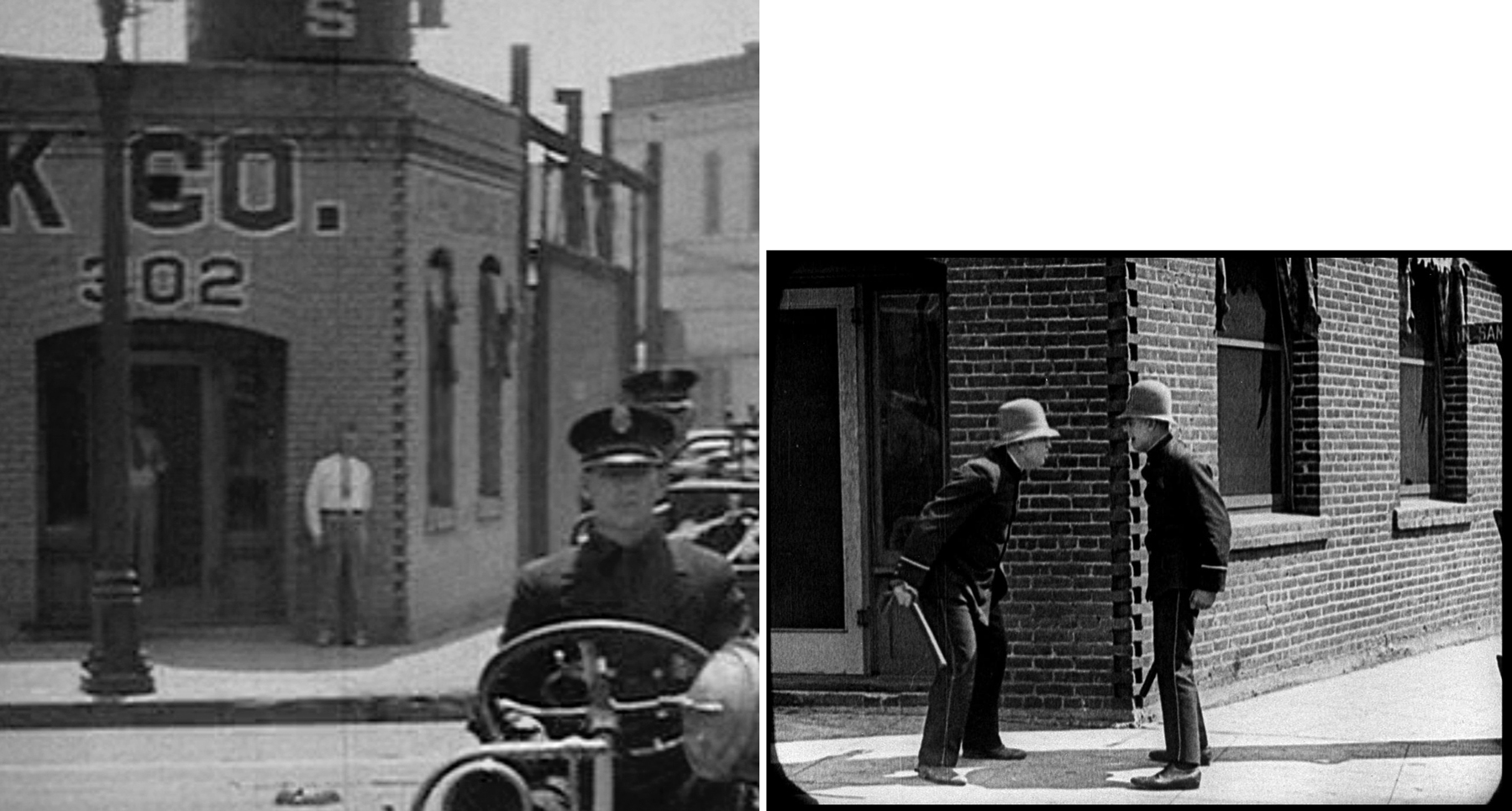
Part of my talk contrasted Buster Keaton’s classic short films Neighbors, The Goat, and Cops with scenes from the very first film appearance of the Three Stooges in Soup To Nuts (1930) (see prior post).   I will elaborate on this discovery in a later post, but for now here are Buster and the Stooges, filmed ten years apart in the shadow of City Hall, looking south down Market Street (now lost) from the corner of San Pedro.

Notice the brick work detail on the corner of the building below.

Click to enlarge – looking south down Market Street at San Pedro –  Soup To Nuts and Neighbors

Soup To Nuts Copyright 1930 Fox Film Corporation.   Neighbors licensed by Douris UK, Ltd.  Flyer design – Amy Inouye – Future Studio

Posted in Buster Keaton, Three Stooges | Tagged , , , , , , , , | 6 Comments

Charlie Chaplin – The Kid’s Tearful Olvera Street Reunion

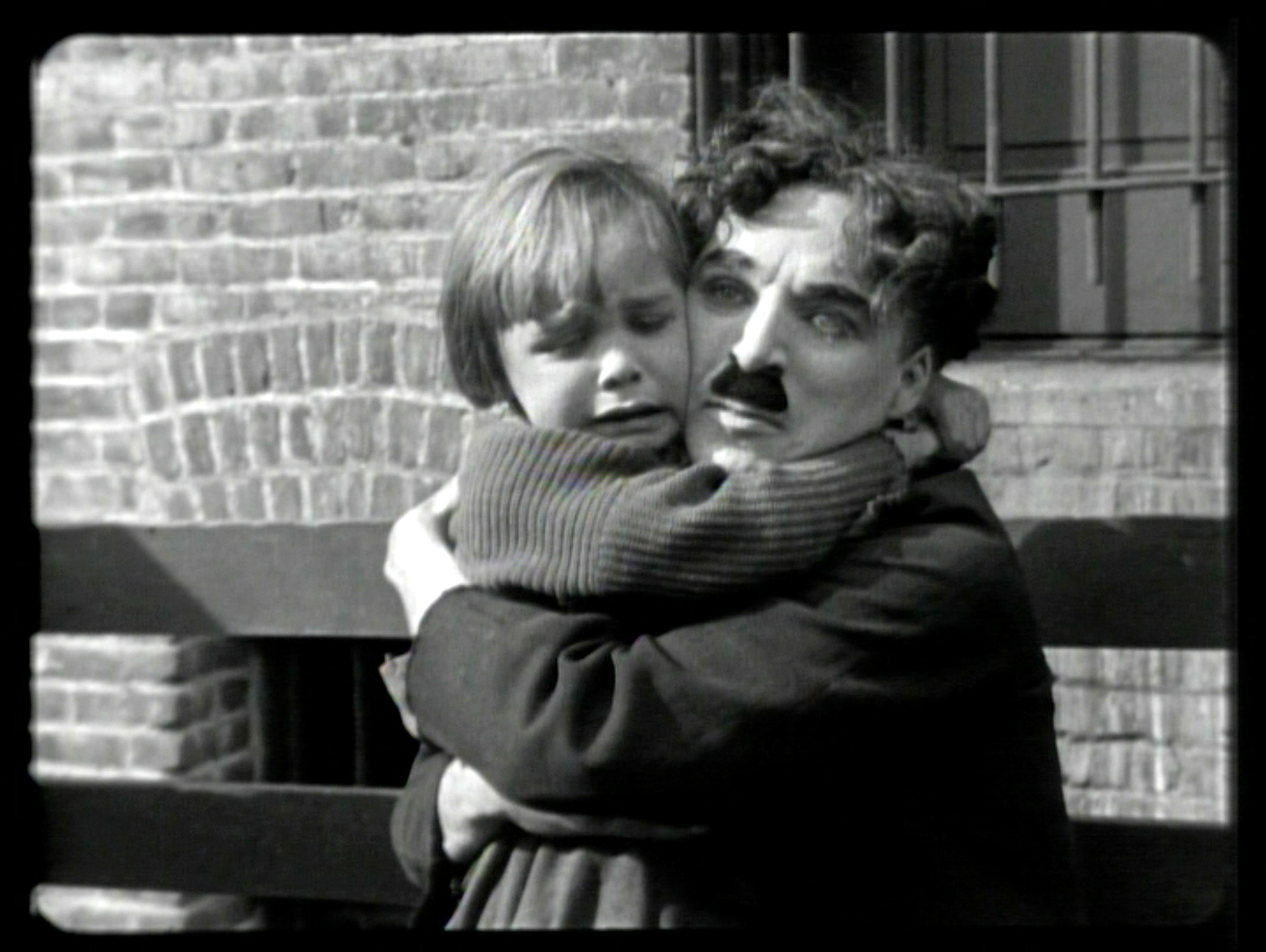
The heart-tugging reunion in The Kid (1921) played between Charlie Chaplin’s Little Tramp and his “adopted” son (Jackie Coogan) remains one of the most emotionally charged scenes in all of film history.  Remarkably, the setting for this iconic scene remains standing, and is passed unknowingly by hundreds of tourists every day.  As shown here, the reunion took place on Olvera Street, a colorful Mexican marketplace and cultural center, just north of the Plaza de Los Angeles, that has been a top downtown tourist spot for over 80 years.

Originally named Wine Street, Olvera Street was renamed in honor of Judge Augustin Olvera, a signatory to the Mexican surrender to the United States in January 1847, and later the first Superior Court Judge of Los Angeles County.  The street is home to the oldest building in town, the Avila Adobe, built in 1818, and the Pelanconi House, the oldest brick house in the city, dating from 1855.  Olvera Street runs south towards the Plaza de Los Angeles, where Felipe de Neve and a band of settlers founded the city on September 4, 1781.  Other city landmarks surround the Plaza, including the Plaza Fire Station, built in 1884, which has appeared both in Buster Keaton’s The Goat (1921) and the contemporary television crime drama Bones. 

You can read a complete overview of all of The Kid locations at this post How Charlie Chaplin Filmed The Kid.

Matching views looking south down Olvera Street towards the trees standing in the Plaza de Los Angeles. City Hall, towering in the background, was completed in 1928.  The left balcony (to the left of Charlie) is the back of the Sepulveda House (1887), today home to the El Pueblo Visitors Center.  The center balcony (appearing above Charlie’s head) is the Pelanconi House. Built around 1855–87, it is the oldest brick building in the city. Today it is home to the La Golondrina Cafe, founded by Consuelo Castilo de Bonzo, which has operated there since the opening of Olvera Street in 1930. Photo courtesy Dr. Lisa Stein Haven.

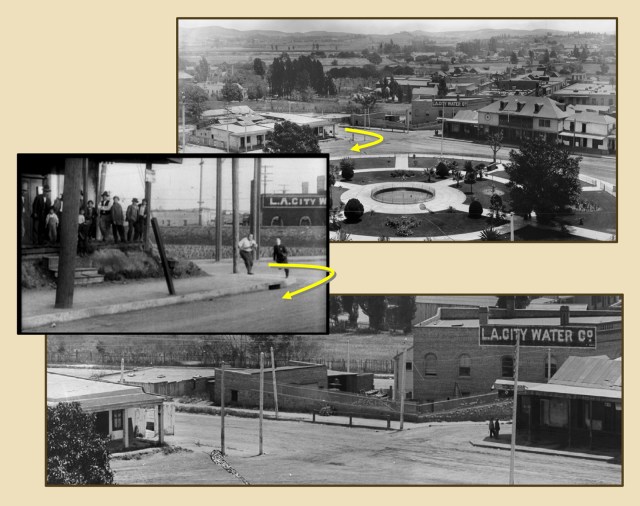
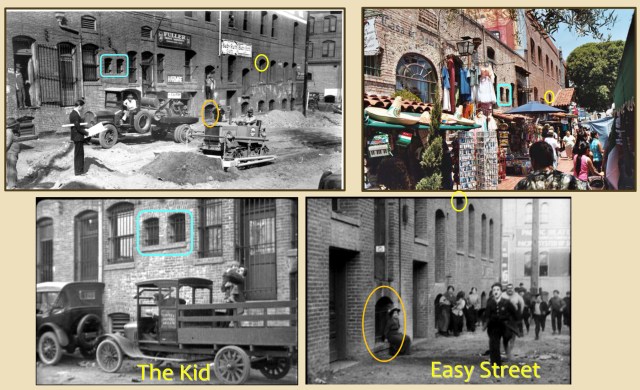
Chaplin fashioned his tenement set for his earlier short film Easy Street (1917) after Methley Street, in his boyhood London neighborhood Lambeth. To add greater realism, he also filmed at the Plaza de Los Angeles (below), and at the same Olvera Street spot where he filmed The Kid.

07 plaza

Click to enlarge. Eric Campbell chases Charlie onto the Plaza de Los Angeles in Easy Street.  USC Digital Library.

08 olvera

Click to enlarge. Chaplin used the same spot for both films.

In 1928, when civic leader Christine Sterling learned that the Avila Adobe was set to be demolished, she rallied a campaign to restore the building, while converting Olvera Street into a Mexican cultural center.  Olvera Street opened on Easter Sunday, 1930, and has been a popular tourist destination ever since.

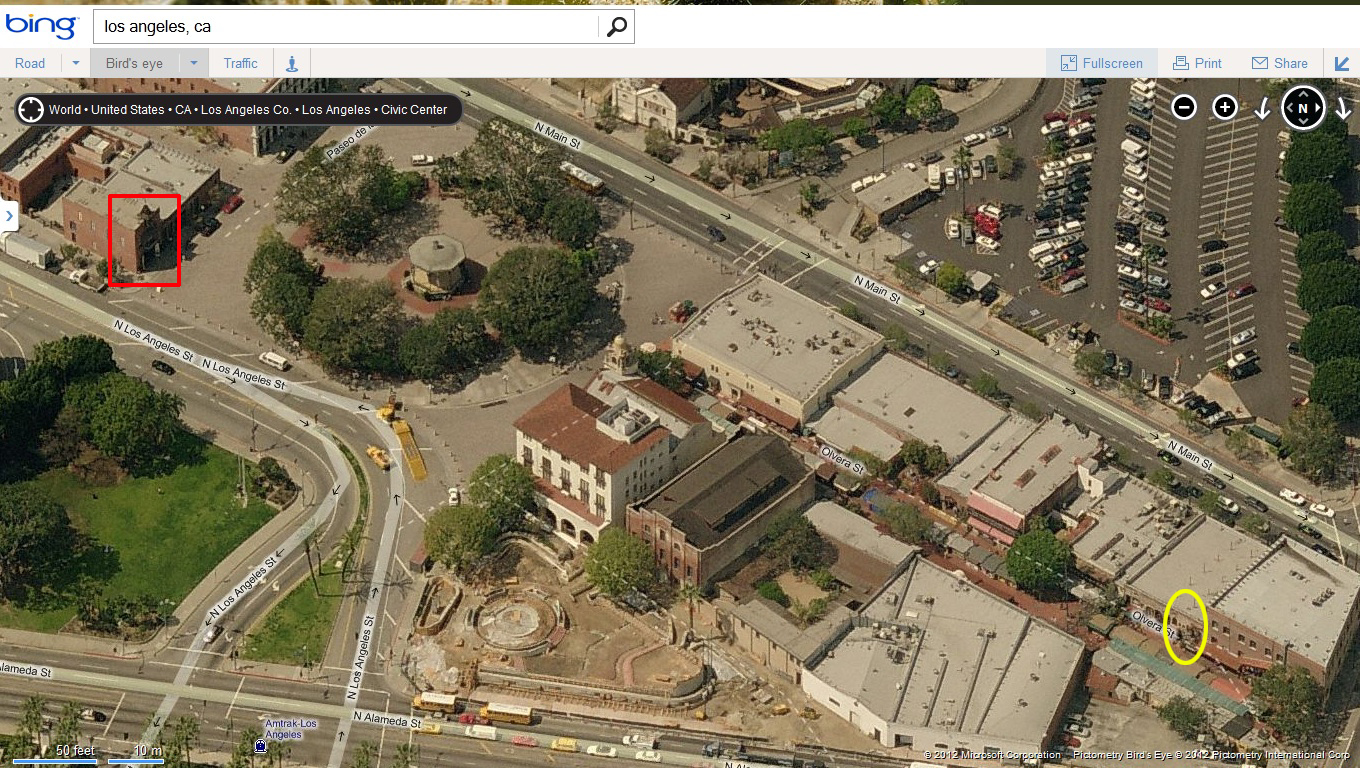
The box marks the fire station appearing in The Goat and in Bones, mentioned above, and the oval marks where Chaplin filmed The Kid. (c) 2012 Microsoft Corporation, Pictometry Bird’s Eye (c) 2012 Pictometry International Corp.

Gerald Smith, Bonnie McCourt, and David Totheroh, the grandson of Chaplin’s cameraman Rollie Totheroh, discovered this location, in part, from clues revealed during a 1964 family interview with the senior Totheroh.  To read more about The Kid and Easy Street, check out my book Silent Traces.

Please help support naming the alley by posting a review on Google Maps. Prototype alley sign design by noted Dutch graphic artist – Piet Schreuders. Download a 4-page brochure about the alley HERE. This video further explains the alley – if you can, please leave a thumbs up and share it with others.

All images from Chaplin films made from 1918 onwards, copyright © Roy Export Company Establishment. CHARLES CHAPLIN, CHAPLIN, and the LITTLE TRAMP, photographs from and the names of Mr. Chaplin’s films are trademarks and/or service marks of Bubbles Incorporated SA and/or Roy Export Company Establishment. Used with permission.

Posted in Charlie Chaplin, The Kid | Tagged , , , , , , , , , , , | 12 Comments

Charlie Chaplin, Ron Swanson, and Parks and Recreation

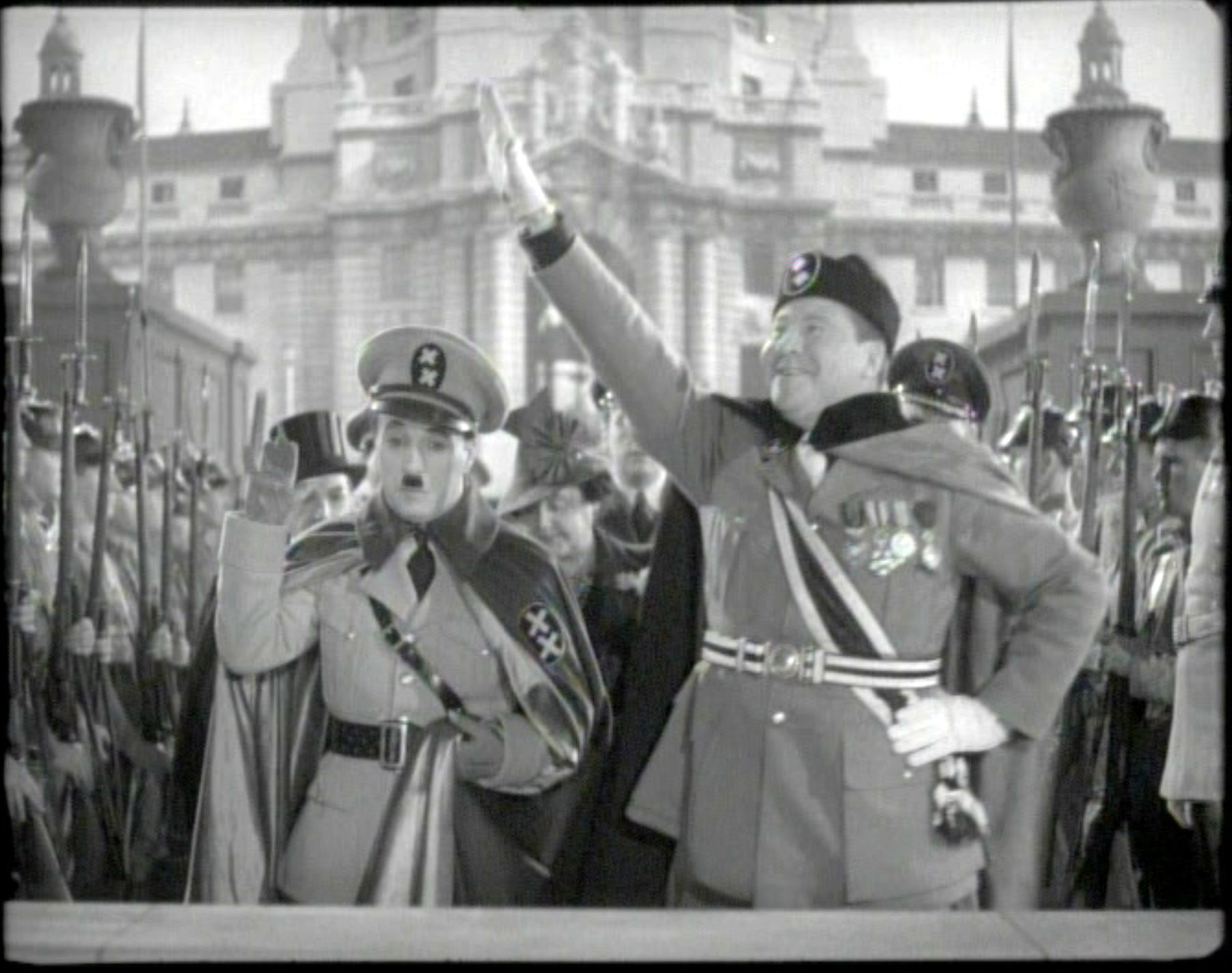
Charlie Chaplin and Jack Oakie in The Great Dictator

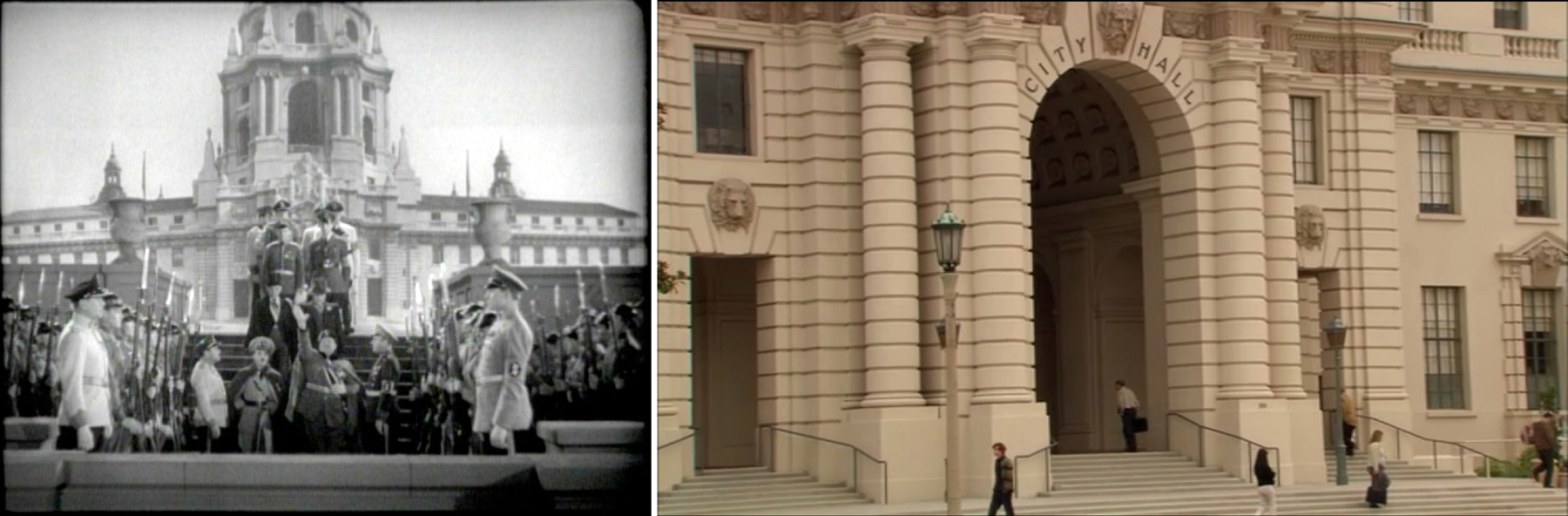
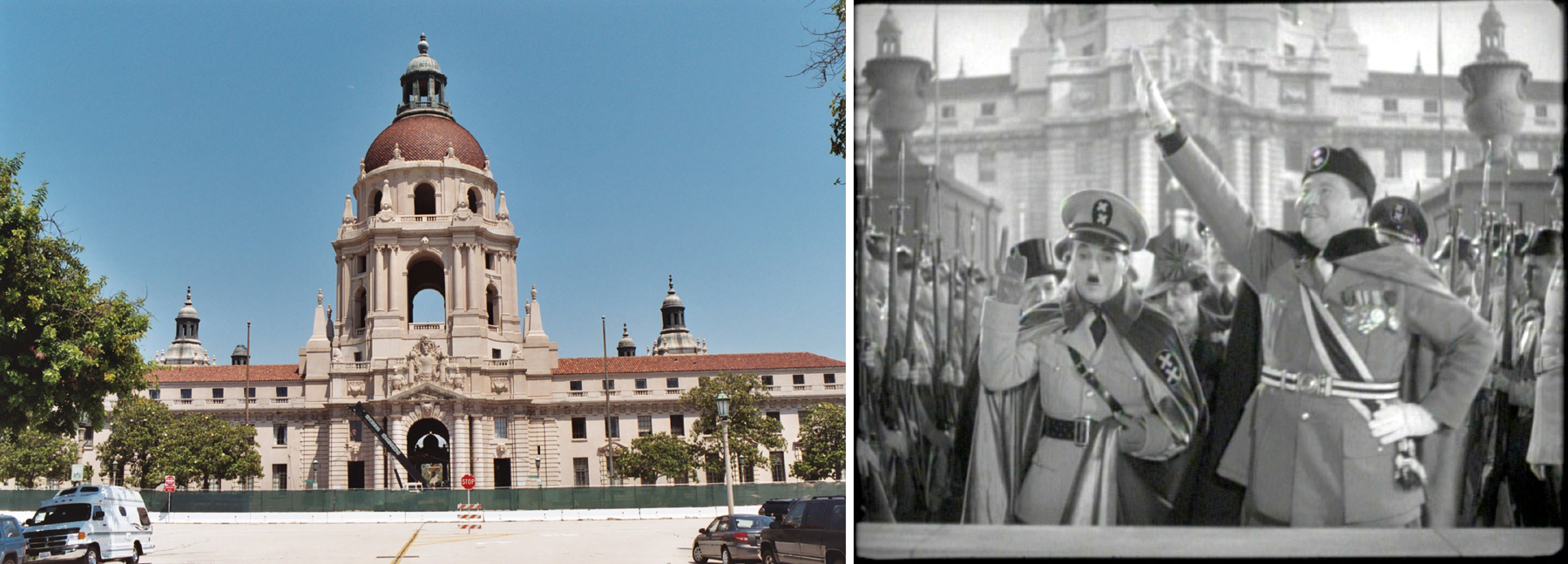
Location filming has been staged in Los Angeles now for well over a century.  It should come as no surprise then that contemporary television shows share exterior settings that once appeared in classic films.  In one prior post I explain how The Office TV show shares a connection to Harold Lloyd and film noir.  In another recent post I show connections between the popular crime procedural Bones and Buster Keaton. Now its time to show the connection between Charlie Chaplin, and the popular mockumentary style sitcom Parks and Recreation.  During Chaplin’s bold political satire The Great Dictator (1940), Charlie’s character Adenoid Hynkel stages an enormous rally to greet Dictator Benzino Napaloni (played by Jack Oakie).  Although filmed inside a soundstage, the Pasadena City Hall appears as a backdrop during the scene.

Pasadena City Hall, in The Great Dictator (left) and in Parks and Recreation (right).

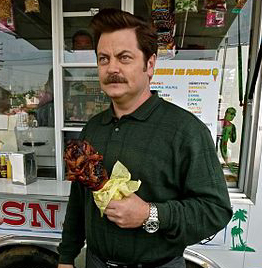
Nick Offerman as Ron Swanson

The same Pasadena City Hall stands in for the City Hall of Pawnee, Indiana, the fictional town portrayed in the Parks and Recreation television show.  Given that Pawnee is supposed to be just an average town, the show rarely (never?) depicts the building’s massive baroque dome, but instead uses tight shots of the entrance arch, flanked by the words “CITY HALL,” giving the building a more modest sense of scale.  One thing in the show that is not modest is popular character Ron Swanson’s mustache.  The meat-eating Libertarian played by Nick Offerman sports a mustache three times larger than Chaplin’s.

Designed in 1925 by John Bakewell, Jr., and Arthur Brown, the Pasadena City Hall building is located at 100 N. Garfield Avenue at Union Street in Pasadena.

All images from Chaplin films made from 1918 onwards, copyright © Roy Export Company Establishment. CHARLES CHAPLIN, CHAPLIN, and the LITTLE TRAMP, photographs from and the names of Mr. Chaplin’s films are trademarks and/or service marks of Bubbles Incorporated SA and/or Roy Export Company Establishment. Used with permission.  Parks and Recreation (C) Universal Television.

Posted in Charlie Chaplin, TV Shows | Tagged , , , , , , , , , , , | 1 Comment

Keaton’s Sherlock Jr. Hollywood Vault (with Harold Lloyd too)

The arrow points east down Hollywood Boulevard from a small park at La Brea towards a gas station on Sycamore (box) and the extant Johnny Grant Building (oval).  The Garden Court Garage, now lost, stood to the left of the oval, across the street from the also lost Garden Court Apartments (1).   The Mary Moll home (2) became the site of the Roosevelt Hotel.   The lost Hotel Hollywood (3) stood at Hollywood and Highland.  Baist’s Real Estate Surveys of Los Angeles 1921 – Plate 040. HistoricMapWorks.com

Sherlock Jr. steps out his door as a trolley passes by.

In his 1924 comedy Sherlock Jr., Buster Keaton portrays a daydreaming movie theater projectionist who fancies himself a great detective.  During the movie’s lengthy dream sequence, Buster’s character, after falling asleep on the job, finds himself living wild adventures on the projected movie screen as Sherlock Jr., the world’s greatest detective.   Here, Sherlock opens a massive wall safe in his mansion to reveal that it is actually his front door, leading out onto a busy street.

Looking east down Hollywood Boulevard, circa 1924, the Garden Court Apartments (1), the palm trees in front of the Hotel Hollywood (3), the palm trees at the Mary Moll home, future site to the Roosevelt Hotel (2), the corner of the extant Johnny Grant Building (oval), with a nine-arch facade, and the gas station billboard on the corner of Sycamore (box).  Delmar Watson Photography Archive – The Watson Family Photography Archive.

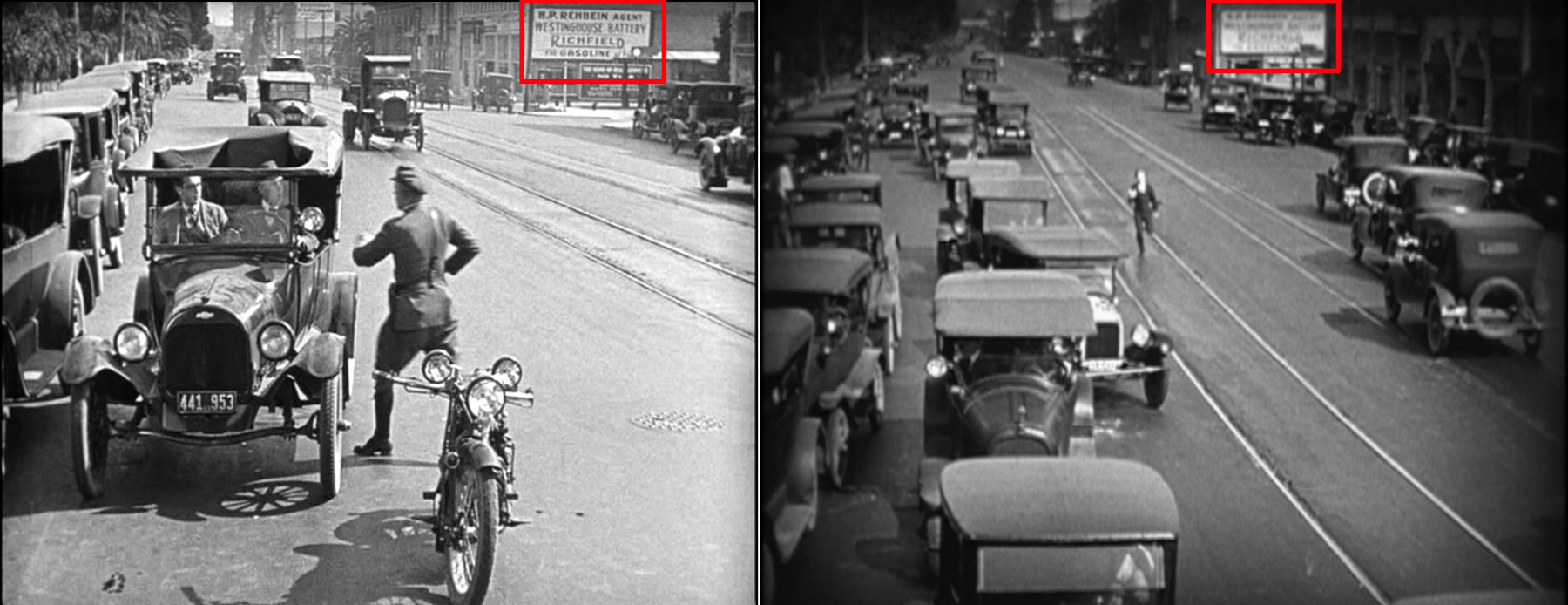
Keaton filmed this scene from a special set built on a small triangular park that is now called the Hollywood La Brea Gateway.  The view looks east down Hollywood Boulevard from the park.  The white billboard for the H. P. Rehbein Richfield gas station (red box above) on the corner of Sycamore appears above Buster’s hat (left).  Across the street stood the Garden Court Apartments (1), a former Hollywood landmark where stars such as John Gilbert, Rudolph Valentino, Lillian Gish, and in later years Marilyn Monroe once lived.  The property fell on hard times, and was shut down in 1980, and demolished in 1984.

Click to enlarge. The gas station on the corner of Sycamore (box), the Garden Court Apartments (1), the extant Johnny Grant Building (oval), the Mary Moll home, future site of the Roosevelt Hotel (2), and the Hotel Hollywood (3).  The Garden Court Garage, mentioned below, now lost, stands to the left of the oval.  Delmar Watson Photography Archive – The Watson Family Photography Archive.

Girl Shy, looking east towards the Mary Moll home palm trees (2) and the extant Johnny Grant Building (oval).

Buster was not the only comedian to film on the west end of Hollywood Boulevard.  These frames to the left and below come from Harold Lloyd’s Girl Shy (1924), Why Worry? (1923), and I Do (1921).   The H.P. Rehbein Richfield gas station on the corner of Sycamore was later replaced by the multi-story Rehbein office building in 1925.  Buster ran west past the Rehbein office building, while wearing a red devil suit, during the cattle stampede in his later comedy Go West (1925).

The same H. P. Rehbein Richfield gas station billboard appears in Girl Shy (left) and in Why Worry ? (right).

Two separate buildings, the extant Johnny Grant Building (left), with its extant corner (oval, appearing in all of the shots above), and the Garden Court Garage (right), now lost, shared a common nine-arch facade that stood along the south side of Hollywood Boulevard across the street from the Garden Court Apartments (1).  The right image is from Harold Lloyd’s short I Do (1921).  If you expand the other images above showing the corner of the Johnny Grant Building (oval), you can see nine arches in all, not merely five.

The arrow points east down Hollywood Boulevard, from the park on La Brea, where Buster built his vault set, towards the Rehbein Building (box, where the gas station stood on Sycamore), and the extant Johnny Grant Building (oval), adjacent to the Roosevelt Hotel (2), that now stands on the site of the former Mary Moll home.  The Garden Court Apartments (1) and Hotel Hollywood (3) appear unchanged.  Department of Special Collections, University of Southern California.

My special thanks to Antoinette Watson at the Watson Family Photographic Archive for the two vintage photos posted above.

Below, a modern Google Street View looking east towards the Hollywood La Brea Gateway, with Hollywood Boulevard stretching away from the camera in the background.  The small foreground park, with the palm trees, is where Keaton built his vault set for Sherlock Jr.  The white HIS shuttle bus is traveling the same path as the trolley during the movie.

Sherlock Jr. licensed by Douris UK, Ltd.  HAROLD LLOYD images and the names of Mr. Lloyd’s films are all trademarks and/or service marks of Harold Lloyd Entertainment Inc. Images and movie frame images reproduced courtesy of The Harold Lloyd Trust and Harold Lloyd Entertainment Inc.

Posted in Buster Keaton, Sherlock Jr. | Tagged , , , , , , , , , , , , , , , , , | 8 Comments

More Buster in Manhattan – The Cameraman, Part II

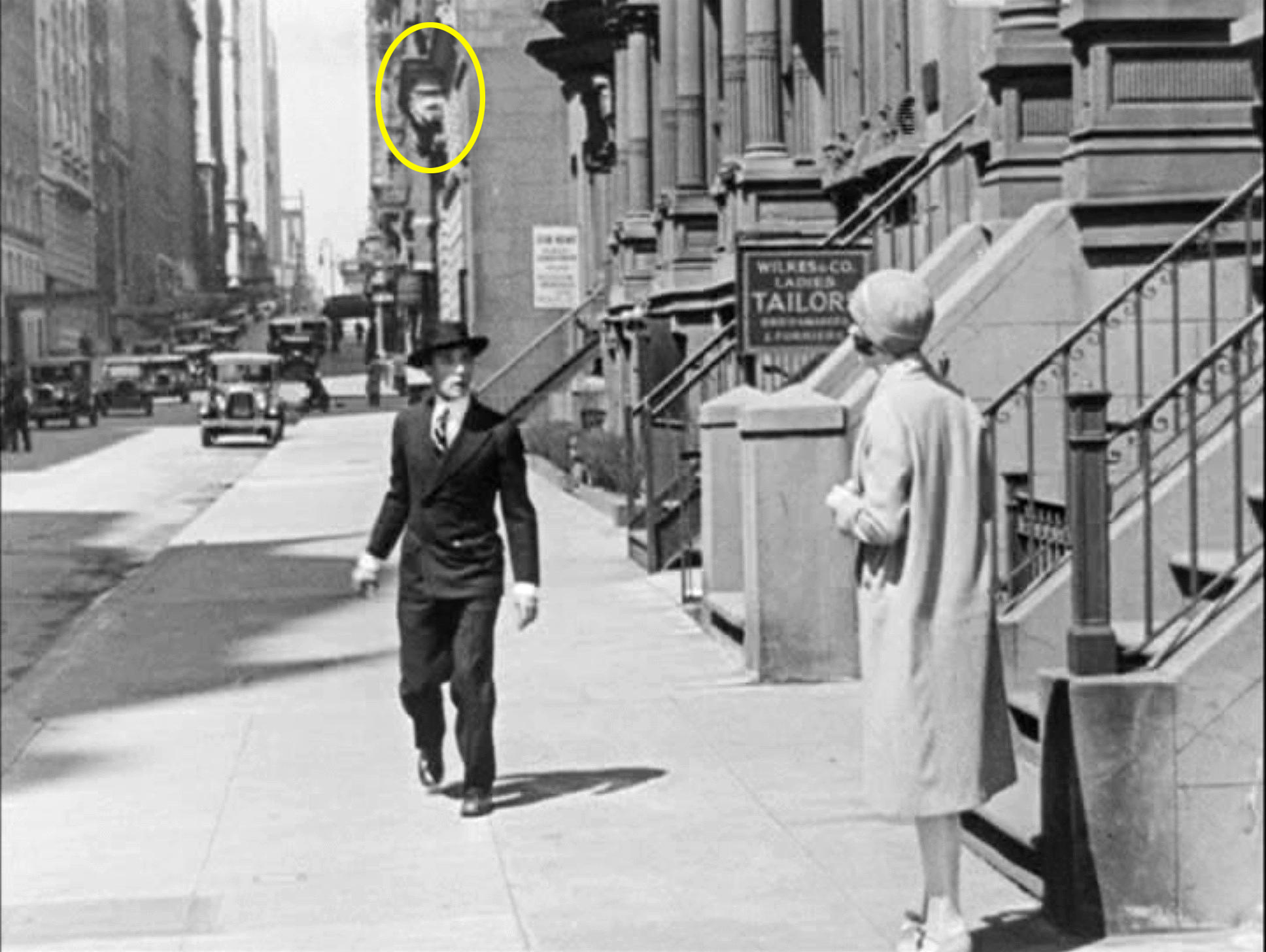
Click to enlarge.  The cornice (oval) behind Buster Keaton belongs to the extant Coronet Apartments at the NE corner of 6th Avenue and W 58th Street (see oval below in modern view).   The sign reads “Wilkes & Co Ladies Tailor,” that once stood at 37 W 58th Street.

Bob Egan’s fascinating website PopSpotsNYC.com explores visual archeology similar to my own.  But instead of looking at silent-era comics, his site concerns places “where interesting events in the history of Pop Culture took place; like album cover shots, places where movies and tv shows were filmed, and sites on which paintings were based.”  I wrote Bob to say hi, and in response was surprised to learn that an early Bob Dylan album cover was shot on Jacob Street just around the corner from where Buster Keaton shot Film (1964) in the shadow of the Brooklyn Bridge, as described in my post Buster Keaton’s Manhattan Project.

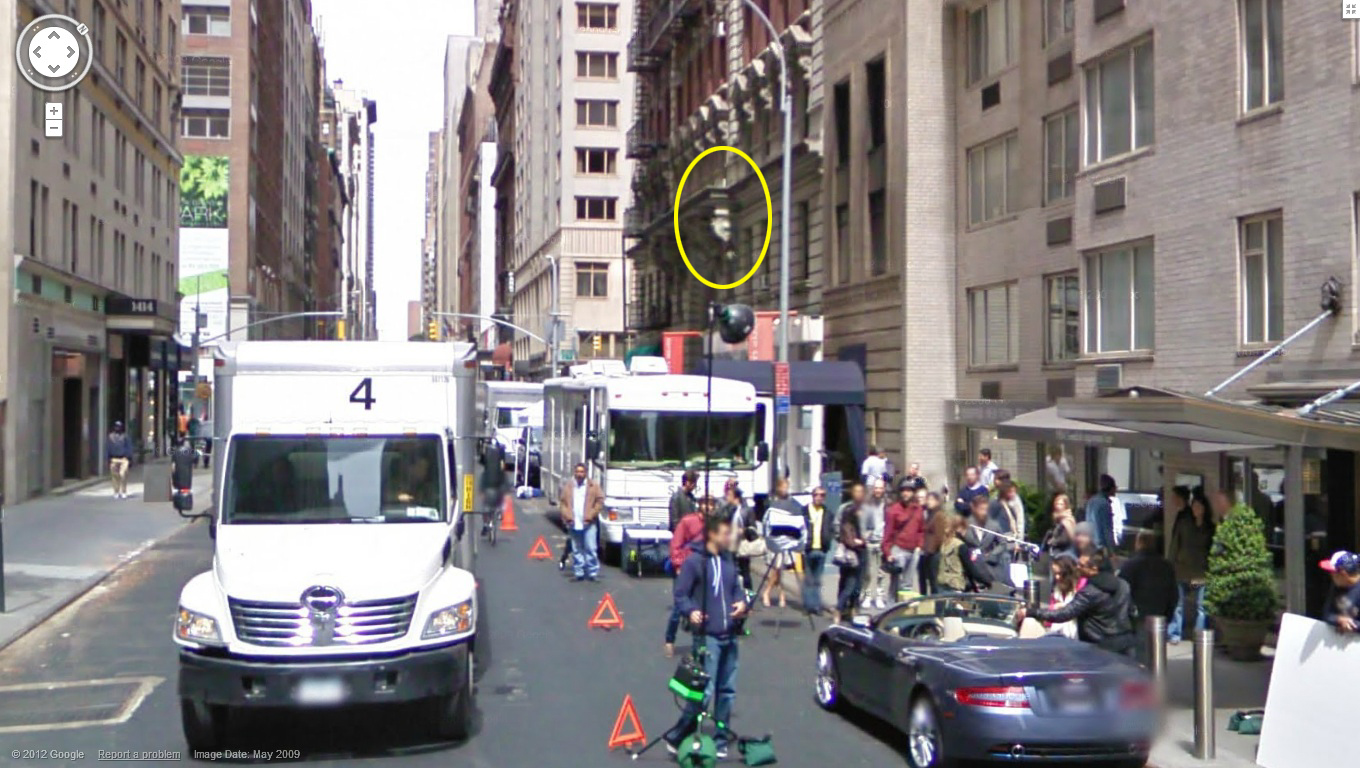
Nearly 85 years later, a modern film crew shooting in the same spot as Buster. (C) 2012 Google

While I’m based in California, Bob visits the New York Public Library frequently, so when he offered to help me look things up, I mentioned the above scene from Buster Keaton’s 1928 feature The Cameraman, where Buster takes Sally (played by Marceline Day) out for a stroll.  Beside her apartment is a sign for Wilkes & Co. Ladies Tailor.   Bob quickly wrote back that Wilkes was situated at 37 West 58th Street in Manhattan, half a block from the Plaza Hotel.  Harold Lloyd stayed at the Plaza when filming Speedy (1928), so if Buster stayed there too, this setting would have been a particularly convenient location for Buster to shoot.  While Marceline’s apartment is long gone, the cornice of the extant Coronet Apartments appears behind Buster’s head.  More fun, the Google Street View of this setting shows a contemporary camera crew shooting a movie at the same spot where Buster had filmed nearly 85 years prior.

Click to enlarge.  The urn-decorated third floor balcony of the back of the extant Steinway Building (box) appears behind Buster further west down W 58th Street, past 6th Avenue.  The other buildings to the right in the vintage view all seem to remain standing.  The oval marks the extant Coronet Apartment on the near corner of 6th Avenue.  (C) 2012 Google.

On close examination, it appears that all of the buildings behind Buster in the far right of the frame, on the block of 58th Street due west of 6th Avenue, are also still standing.

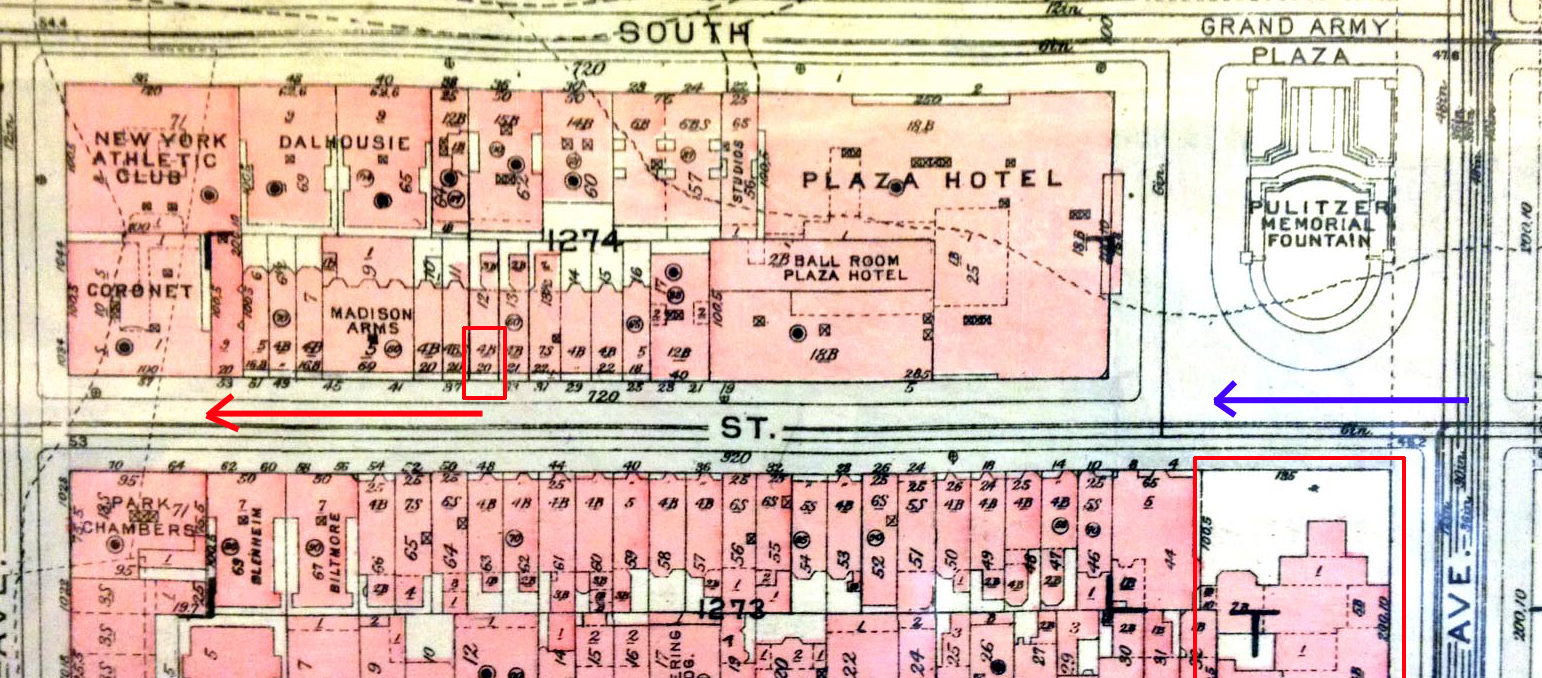
The red arrow marks the point of view from Marceline’s apartment (small box) towards the Coronet.  The purple arrows marks Buster’s path as he races in front of Bergdorf-Goodman, while hopping a low fence in front of the Pulitzer Memorial Fountain.  The large red box on the right marks the now lost Cornelius Vanderbilt mansion, the future site to Bergdorf-Goodman.  New York Public Library.

When I looked at this map Bob also sent me, I realized that Buster had filmed an immediately preceding scene on the same block.  Buster’s date with Sally begins when she calls to say she is free to see him.  The joke is that Buster drops the phone, and races so swiftly on foot to her apartment, that he arrives there before Sally realizes he is no longer on the phone.  Buster begins his sprint running up 5th Avenue, as shown in my original The Cameraman post.  But just prior to arriving at her place, reader Andy Charity discovered that Buster ran past the recently opened Bergdorf-Goodman department store facing the Pulitzer Memorial Fountain.   We can see from the above map that Marceline’s apartment (left box) stood half a block from where Buster ran across the park (purple arrow).  The rest of this post is an update of my story about Harold, Buster, Bergdorf-Goodman that ran last year.

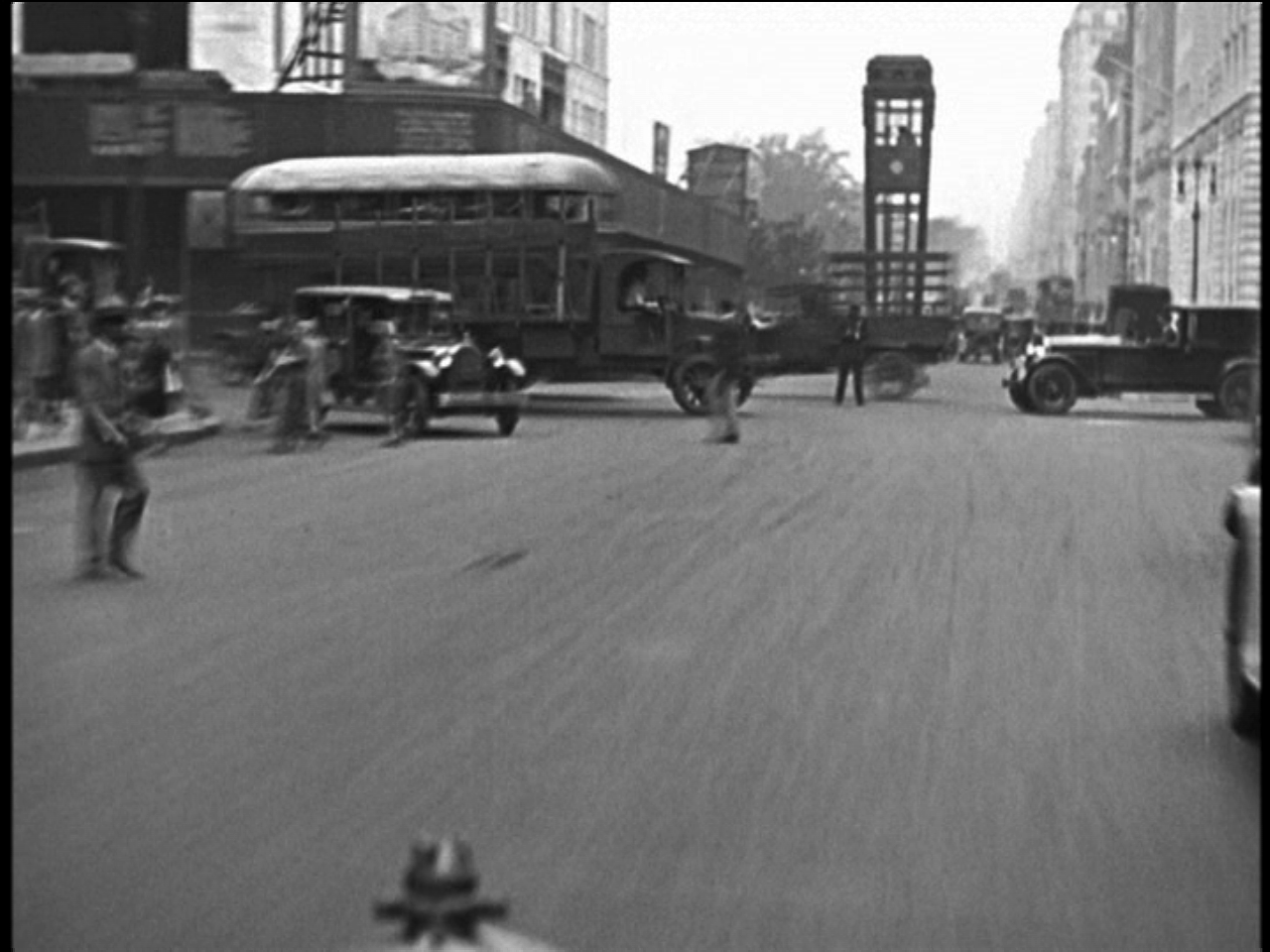
Looking north up 5th Avenue towards the corner of W 57th, and the Bergdorf-Goodman construction site at the upper left. The trees at back are part of the Pulitzer Fountain Park

Towards the end of Harold Lloyd’s manic taxi-ride driving Babe Ruth up 5th Avenue in New York during Speedy (released in 1928, but filmed during the summer of 1927), they approach W 57th Street, and the final of five traffic towers that once helped to regulate traffic flow along this major thoroughfare.  As I explain in Silent Visions, you can see at this corner the ongoing construction of the Bergdorf-Goodman store, built on the site of the former Cornelius Vanderbilt mansion.  A stock footage shot of the mansion appears briefly during Buster Keaton’s debut feature film The Saphead (1920) (see further below).

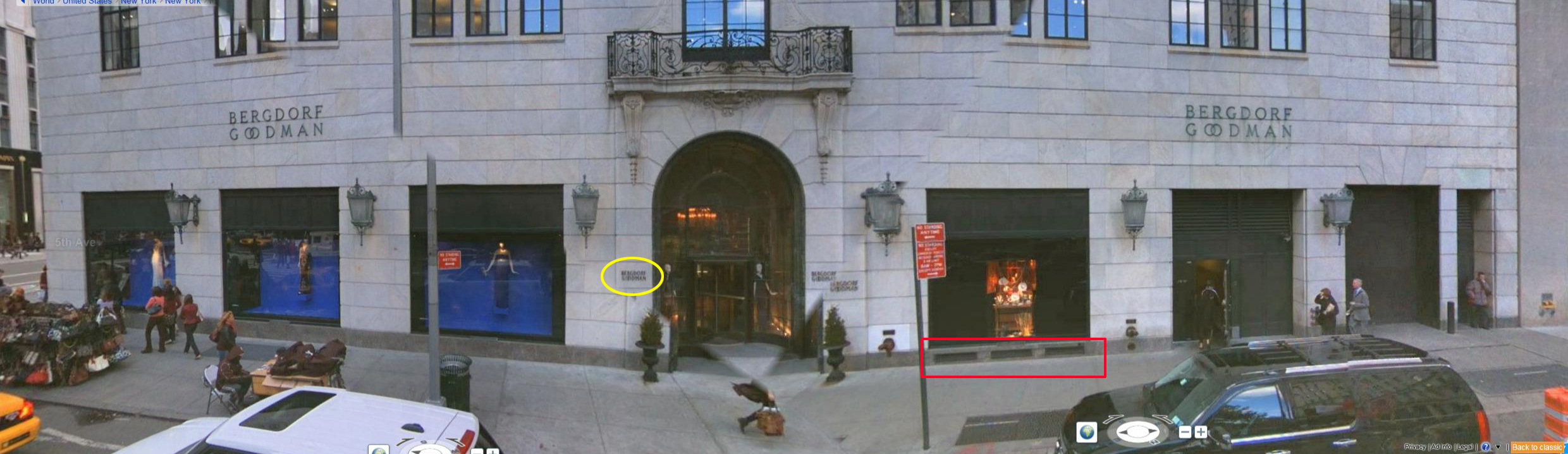
The W 58th Street facade of Bergdorf-Goodman, facing the Pulitzer Fountain Park.  The oval and box mark matching details in the Keaton panorama below.  Microsoft Streetside (C) 2010 Microsoft Corporation

Scene from The Cameraman.  The full panorama as Buster runs along W 58th Street from 5th Avenue.  He skips over a low wire fence that was part of the Pulitzer Fountain Park.

As shown here, eagle-eyed reader Andy Charity spotted that Buster Keaton ran west along W 58th Street from 5th Avenue, along the north face of the newly-opened Bergdorf- Goodman store, hopping over a short wire fence that was part of the landscaping for the Pulitzer Memorial Fountain across the street from the store.  So here, for once, the geographic portrayal of New York was quite accurate.  Coming west from 5th Avenue, Buster would have to pass Bergdorf-Goodman to reach Sally’s apartment further down the same street.

Both views show the SW corner of 5th and W 58th.  The Bergdorf-Goodman store was built on the site of the Cornelius Vanderbilt mansion, shown as it appears in The Saphead (1920) to the right.  The arrow marks the same relative spot, while the corner of the Pulitzer Fountain Park appears in the lower right corner.

Buster most likely did not realize as he ran past the SW corner of 5th and W 58th that the same SW corner appeared in his prior feature film set in New York.  But now we know what Buster knew, that two scenes from his date with Marceline were filmed on the same block, and likely the same day.

The Cameraman images (C) 1928 Turner Entertainment Co.

HAROLD LLOYD images and the names of Mr. Lloyd’s films are all trademarks and/or service marks of Harold Lloyd Entertainment Inc. Images and movie frame images reproduced courtesy of The Harold Lloyd Trust and Harold Lloyd Entertainment Inc.

Posted in Buster Keaton, Harold Lloyd, Manhattan, The Cameraman | Tagged , , , , , , , , , , , | 9 Comments

The Artist Locations Part 8 – the Paramount Backlot

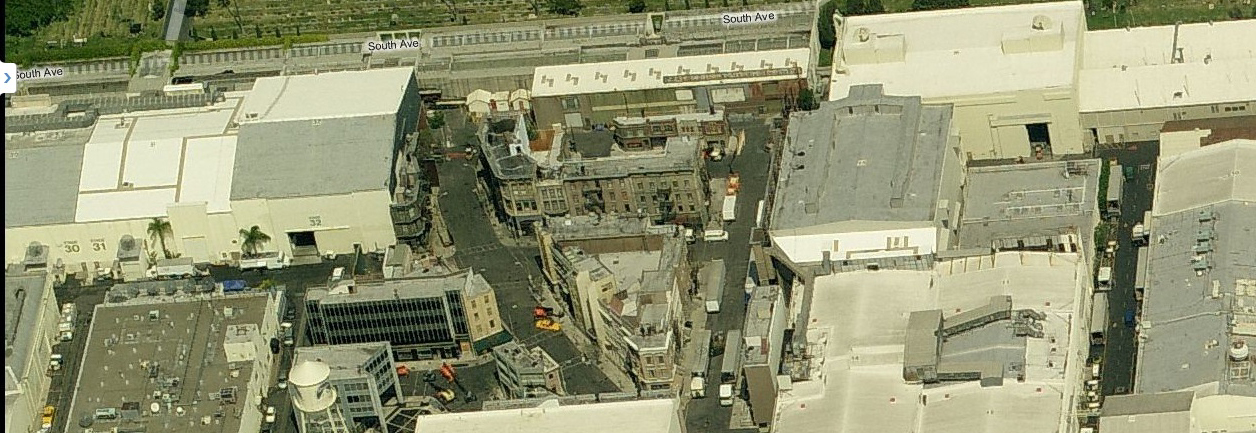
Looking north at the Paramount Studios backlot.  The Hollywood Forever Cemetery appears along the top edge.  (C) 2012 Microsoft Corporation, Pictometry Bird’s Eye (C) 2012 Pictometry International Corp.

Click to enlarge.  The Paramount Studios backlot.

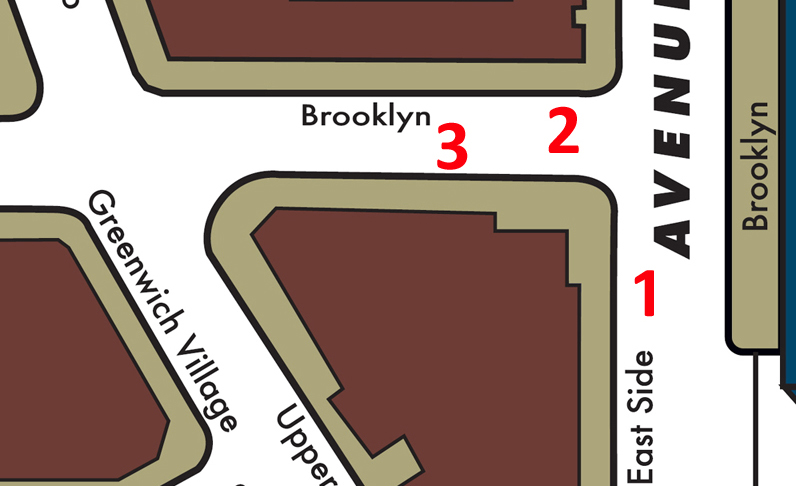
My first post about The Artist filming locations shows that the three different movie theater exteriors appearing in the movie were all filmed at the Warner Bros. backlot.  As shown here, apparently all of the other exterior city scenes from The Artist were filmed at the small New York City backlot at Paramount Studios.  This post identifies eight different backlot settings, keyed to the map to the left.

My very special thanks go to J. Eric Lynxwiler for allowing me to post his wonderful photos of the Paramount Studios backlot.  His Flickr Photostream, jericl cat’s photostream, which includes, in part, dozens of beautiful photos of vintage theaters, vintage matchbook covers, and vintage neon signs, may be accessed HERE.

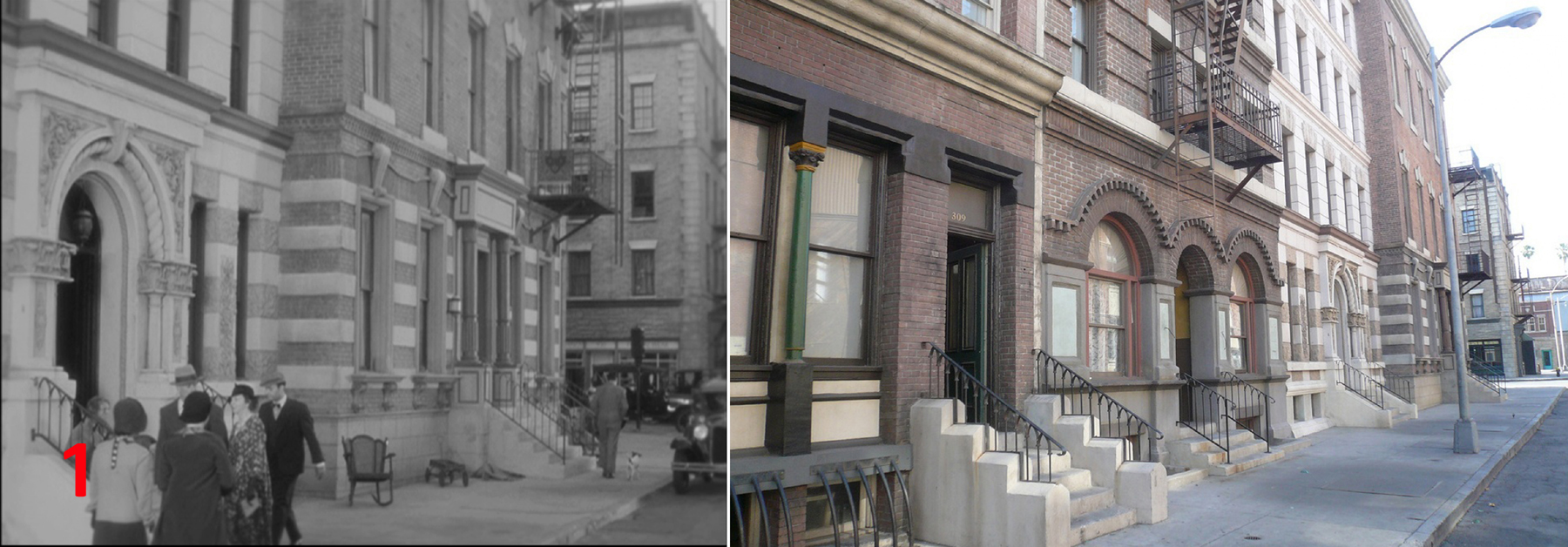
We begin with Scene (1), above, as character George Valentin strolls with Uggie the Dog north along the Lower East Side set towards the NW corner of the Brooklyn set.

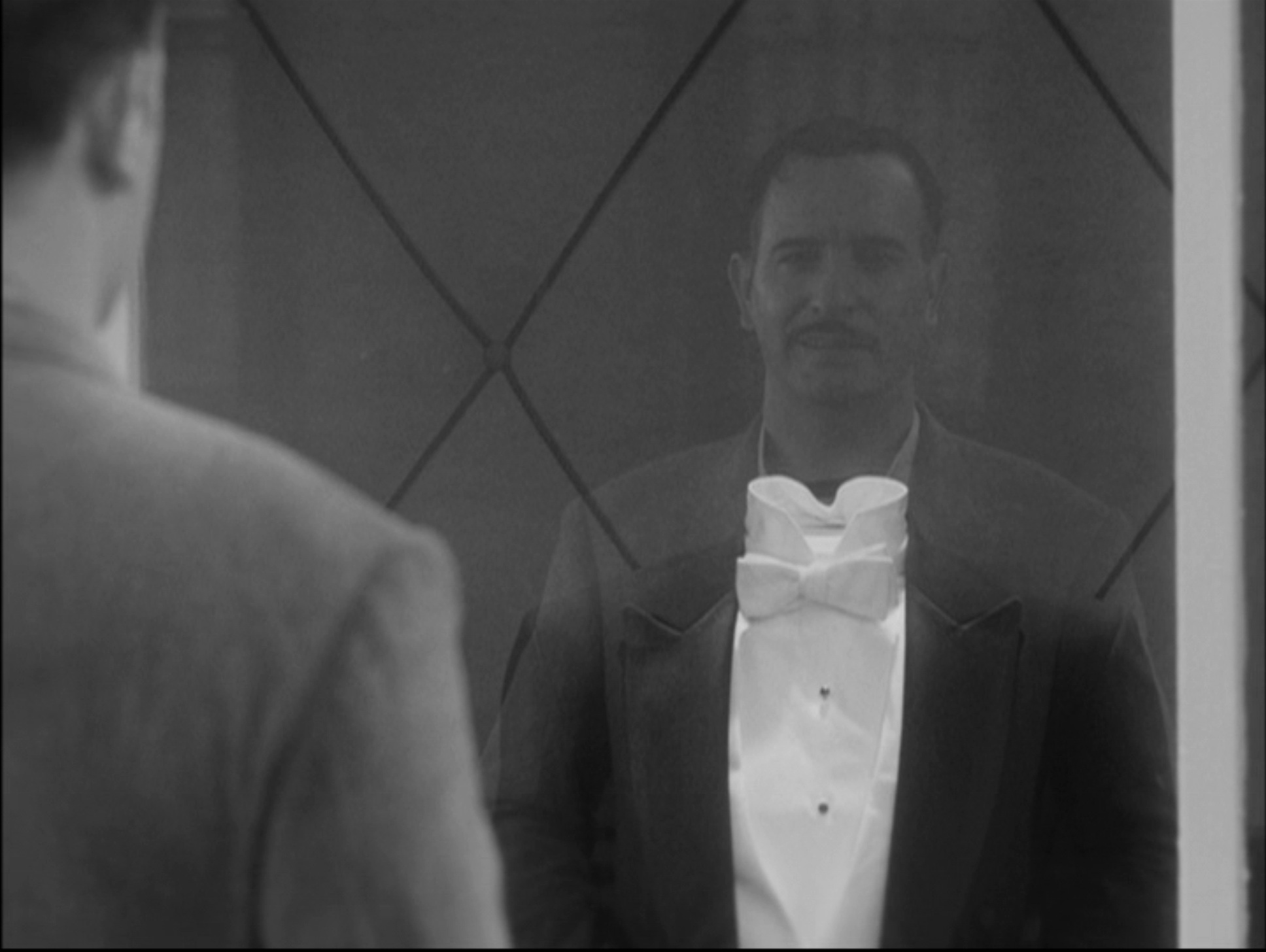
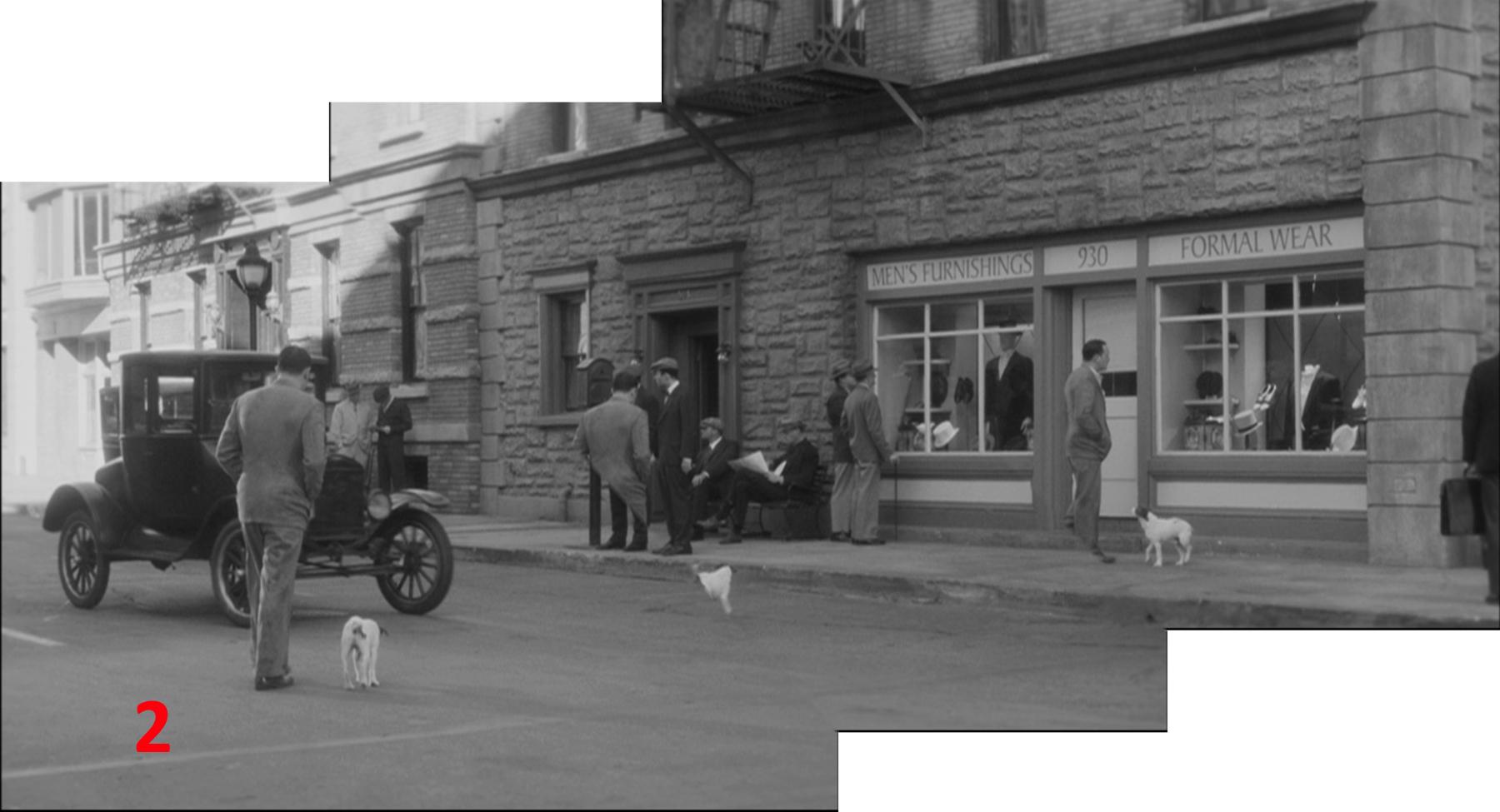
Scene (2) shows George crossing the Brooklyn street, walking north towards a corner men’s shop.  Once there, George gazes into the window, and sees his forlorn reflection align with a tuxedo on display, reminding him of happier days when he was a major silent film star.

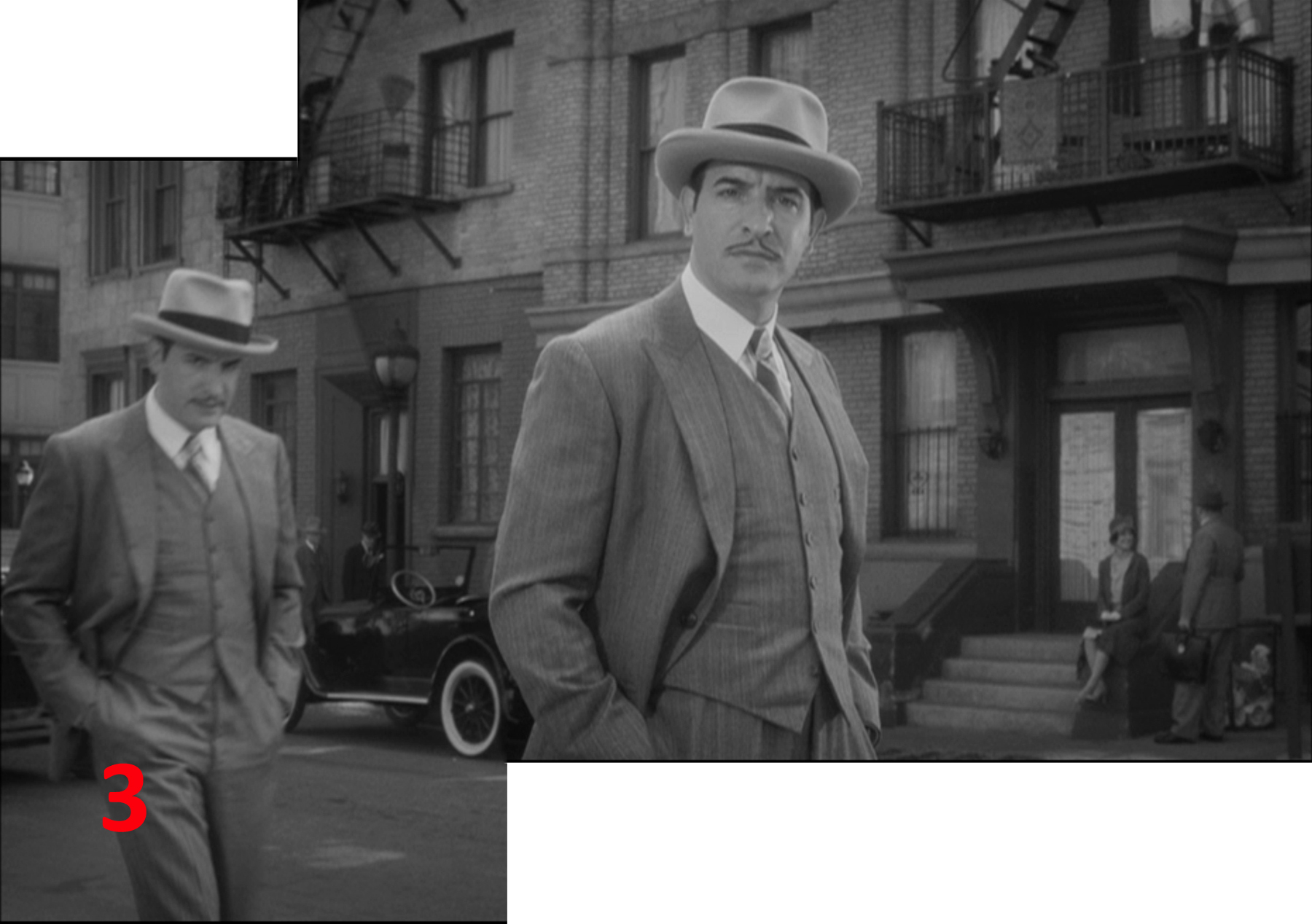
Below, Scene (3), still-prosperous George stops to inspect a banner promoting Peppy Miller’s new talking picture, and realizes it will premiere on the same day as his self-financed silent feature Tears of Love.   The movie’s failure triggers George’s spiral of despair.  This view looks south-east, at the opposite side of the Brooklyn street set, across from the men’s store (Scene (2)) side of the street.

The wall at the far left appears in Scene (6). (C) Matt Augustine – http://www.flickr.com/photos/mattapictures/3022788530/

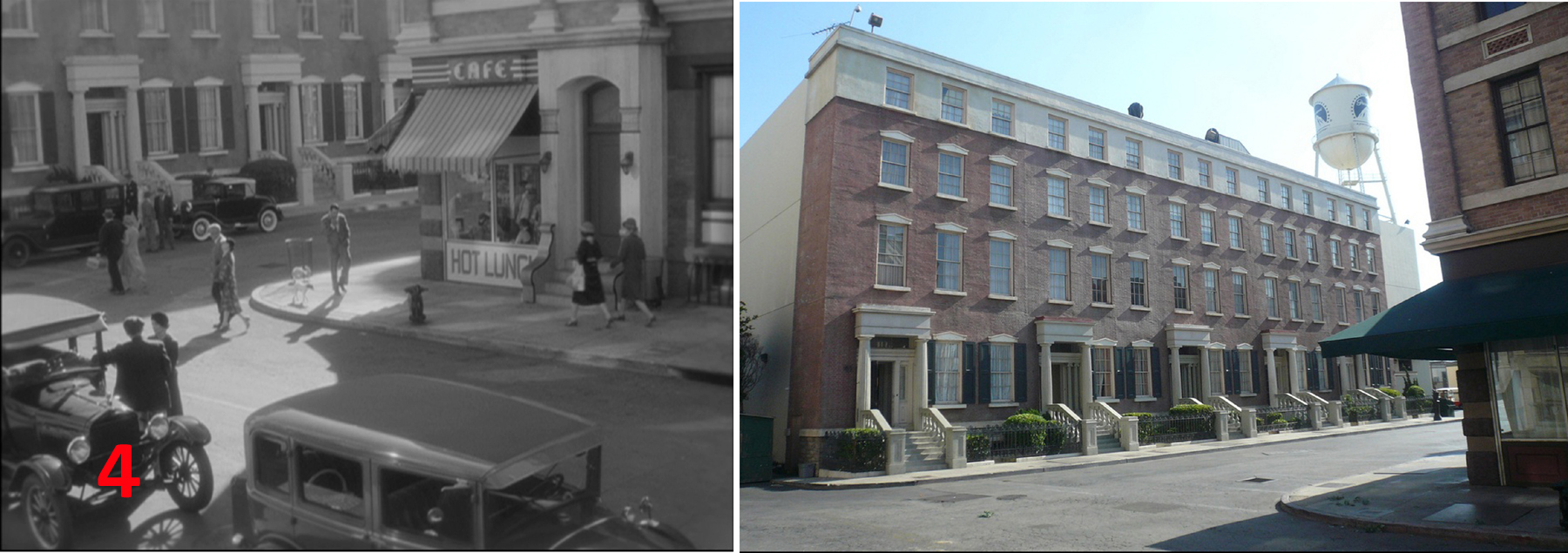
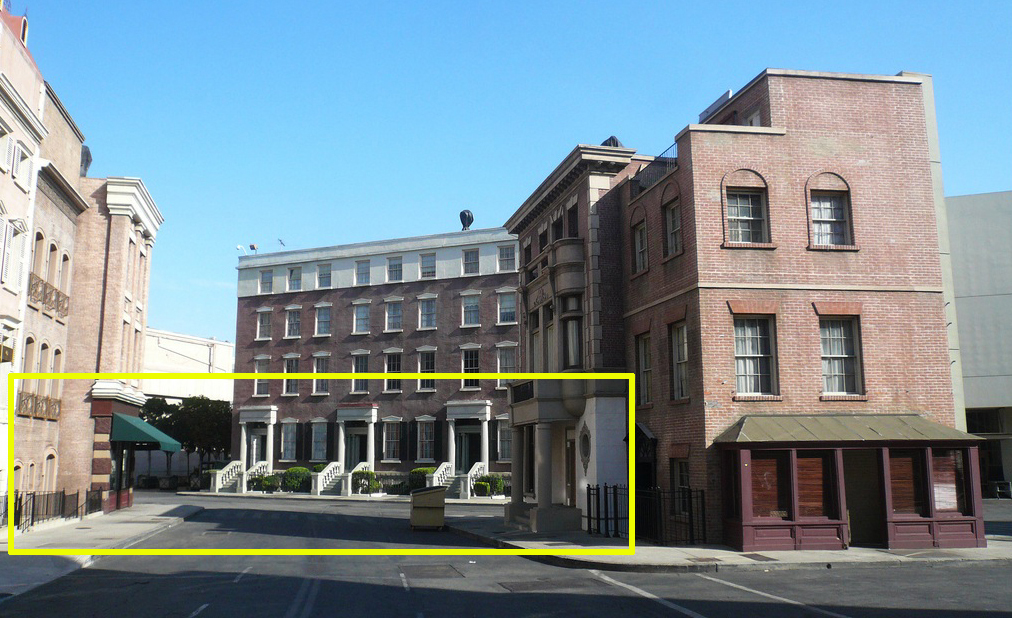
The next two scenes (4) and (5), were filmed as shown on the map to the left.  During Scene (4) below, filmed looking south-west towards Washington Square, and the studio water tower (out of view), George turns the corner going north onto the Upper East Side street.

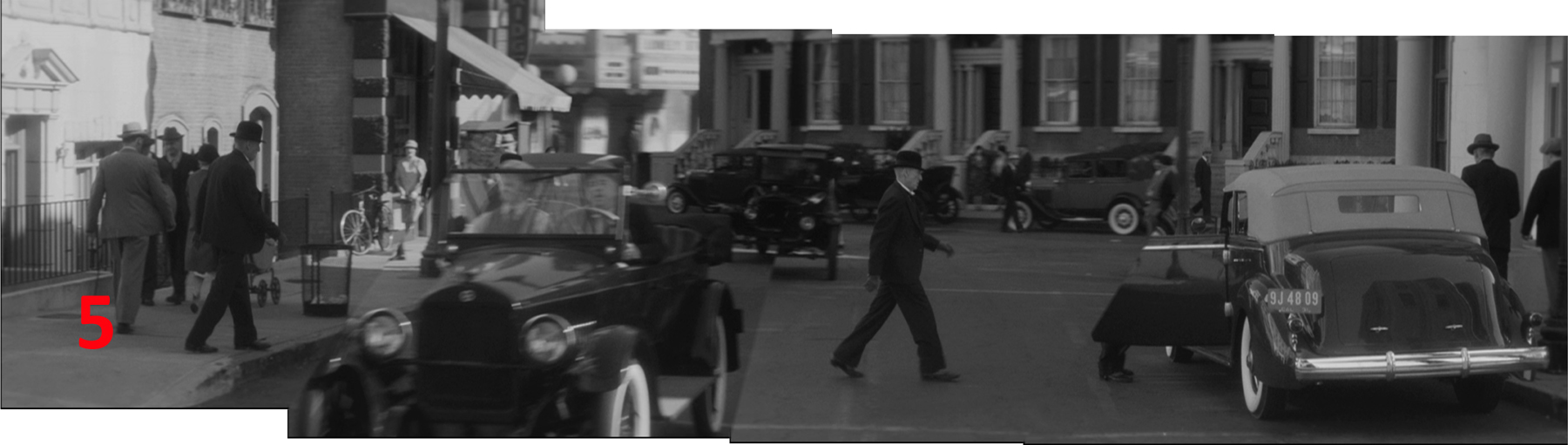
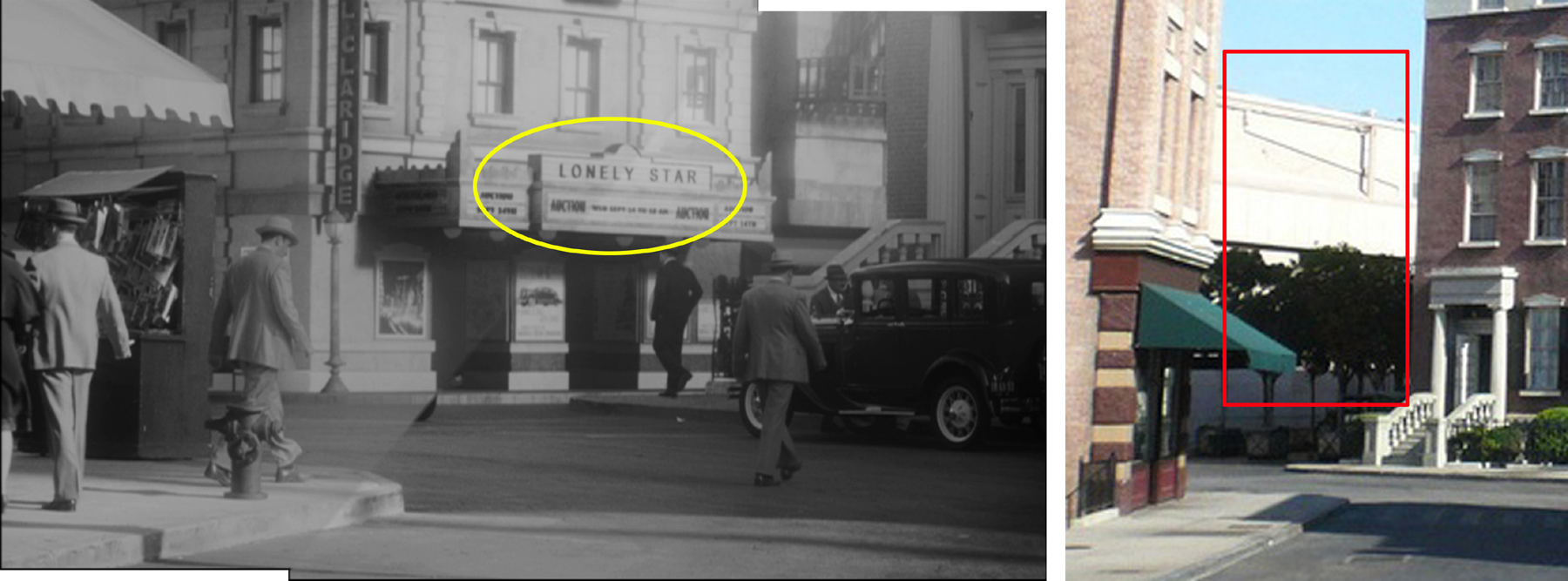
During Scene (5), filmed looking to the southeast, the gap between the Washington Square set, and the Brownstone set (right arrow), was covered with a green screen, and filled with a matte image of the Lonely Star Theater (see below).

Scene (4) above, a view looking south at the Washington Square set – the Warner Bros. water tower appears in the color view.

During Scene (5) above, looking south down the Upper East Side street towards Washington Square, George leaves the auction house after all of his possessions are liquidated.  Unbeknownst to him, Peppy Miller’s servant purchased George’s possessions upon her instructions.  Above, the servant leaves the auction house and crosses the street to report to Peppy.

This comparison view shows George crossing the gap between the Upper East Side set and the Washington Square set.  The Lonely Star Theater (oval), “standing” where Stage 14 is located (red box), was a matte image created with the help of a green screen covering up the stage and filling the gap between the sets.

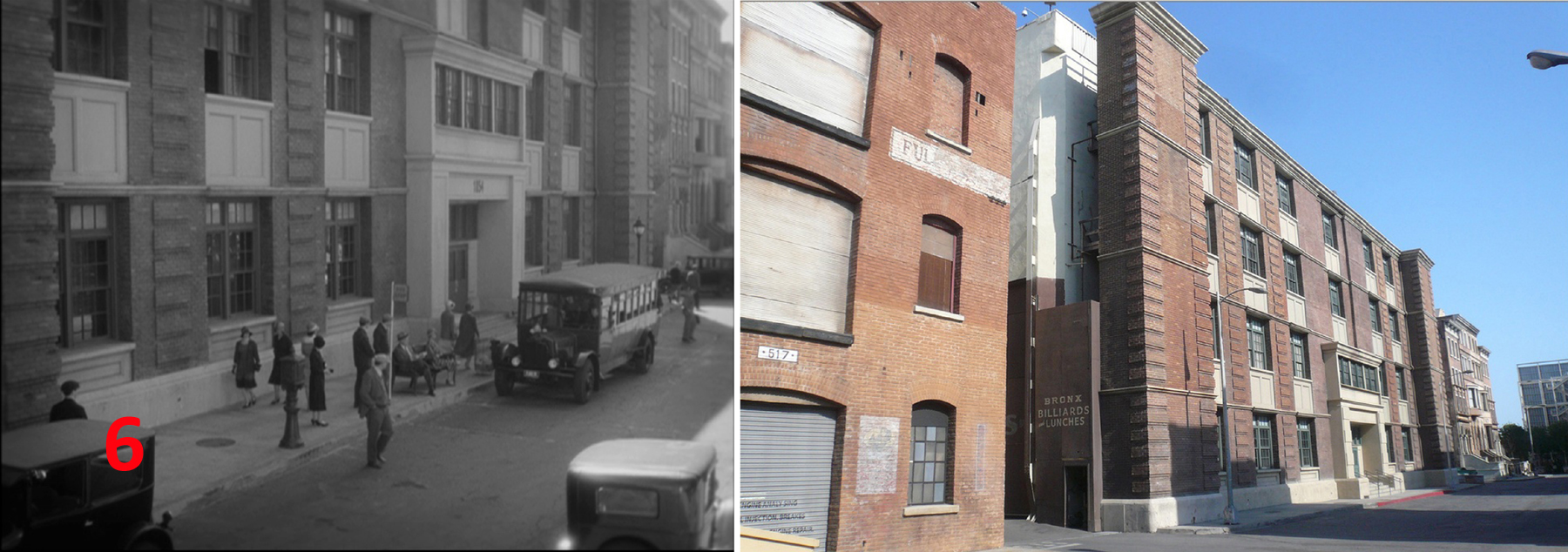
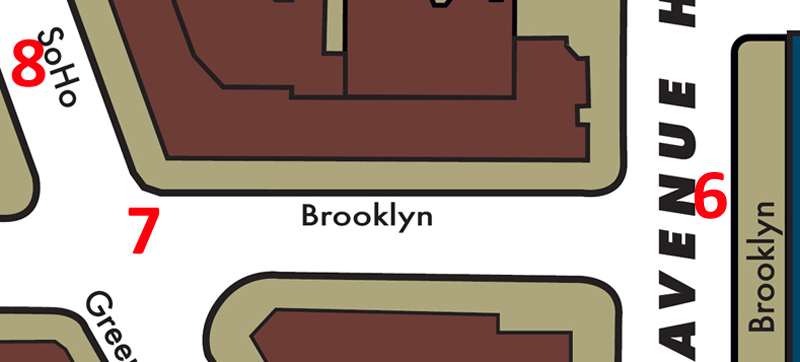
During Scene (6) Peppy arrives in Hollywood by bus (left), brimming with confidence following her unexpected publicity in the local newspapers.   The setting for the bus arrival (see map and photo below), was filmed looking south along the face of the Brooklyn set running along what is called Avenue H.

At the climax of the film, Peppy races her car to George’s apartment, hoping to arrive in time to avert a disaster.  Two of my prior posts Number One and Number Seven show some of the true exterior locations appearing during Peppy’s frantic drive.

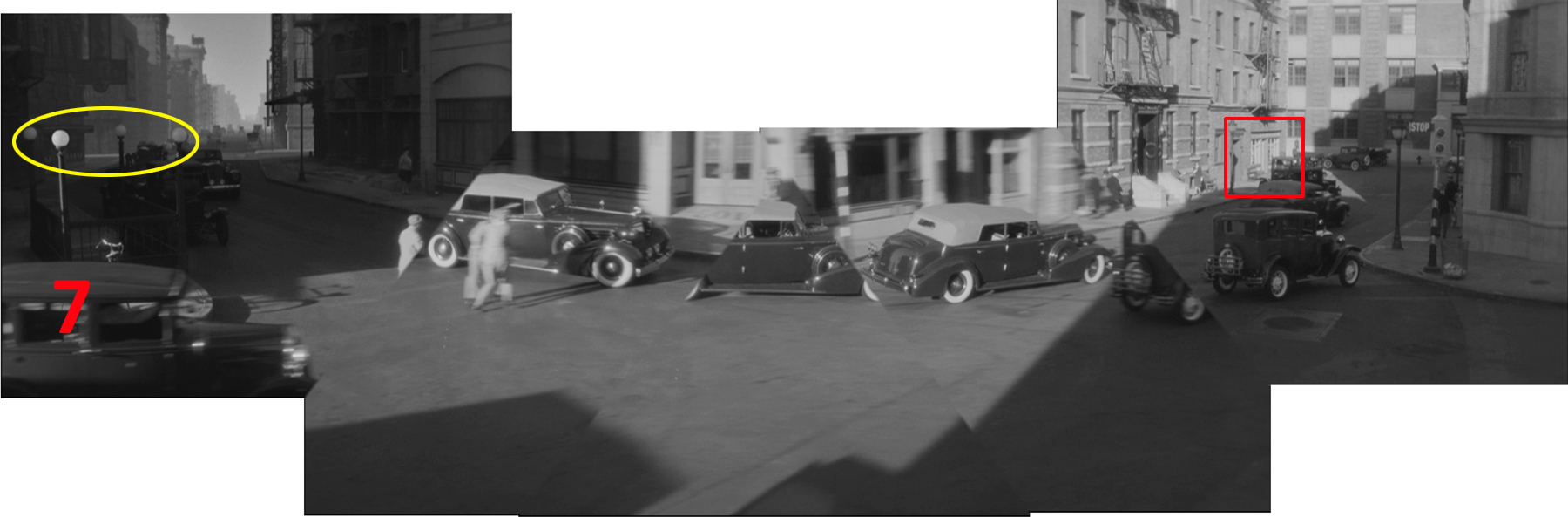
But other race scenes were filmed on the Paramount backlot. Scene (7) below shows Peppy driving from south to east around the corner of SoHo onto Brooklyn.

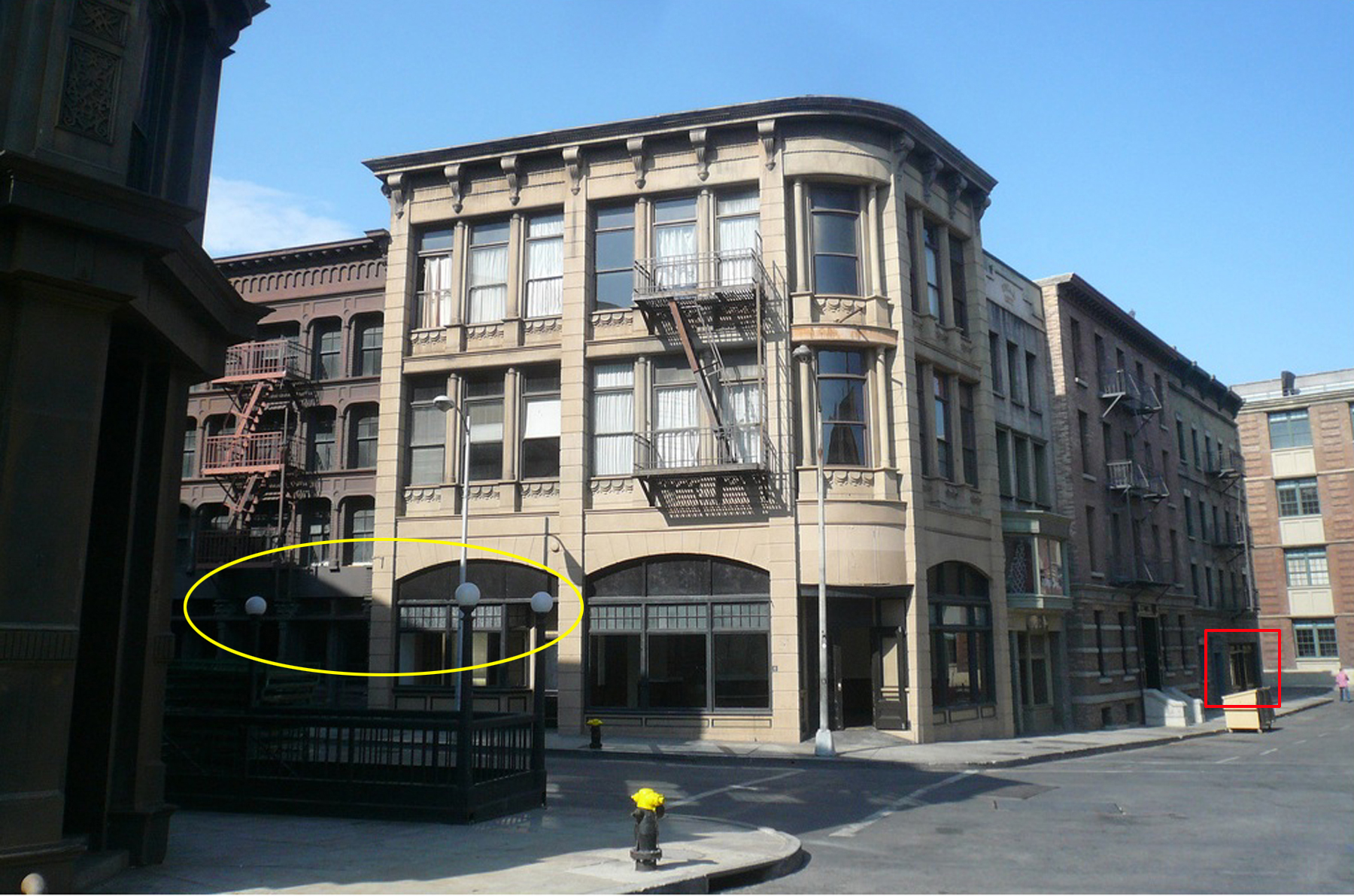
Peppy turns the corner from SoHo onto Brooklyn.  The tall buildings at the far left are a matte image.  The yellow oval marks the subway entrance lamps appearing in Scene (8) below.  The red box marks the men’s store set from Scene (2).

Scene (7) – the yellow oval marks the subway entrance lamps appearing in Scene (8) below.  The red box marks the men’s store set from Scene (2).

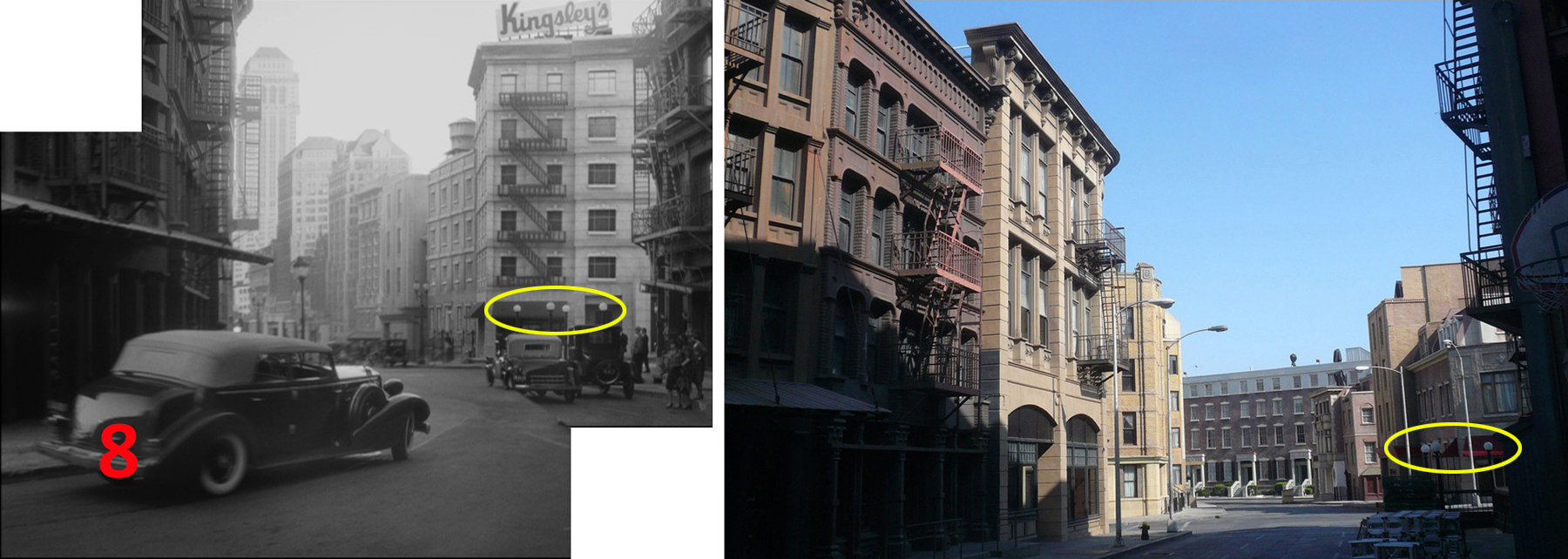
During Scene (8) below, Peppy races around the same backlot corner as Scene (7), only this time the view looks south instead of north.

The yellow ovals above mark the same subway entrance lamps appearing during Scene (7).   The tall buildings in the background are another matte image, covering up the Washington Square set that appears at the far background in the color image.

The original Paramount New York backlot was destroyed by fire in 1983, and fully rebuilt in 1992.  The New York set has appeared in hundreds of movie and television productions, including, by random example, the Coen brothers 2001 film noir feature The Man Who Wasn’t There.

The Artist (C) La Petite Reine, The Weinstein Company.  The Paramount Studios backlot map (C) 2012 Paramount Studios, may be accessed HERE.

Below, an aerial view north of the Paramount Studios backlot, with the Brooklyn set running left-right across the center.  You can expand the image, and zoom in and out, to get a better sense of this setting.

Posted in The Artist, Uncategorized | Tagged , , , , , , | 6 Comments

The Artist Locations – Part 7 – Uggie and Peppy Save the Day

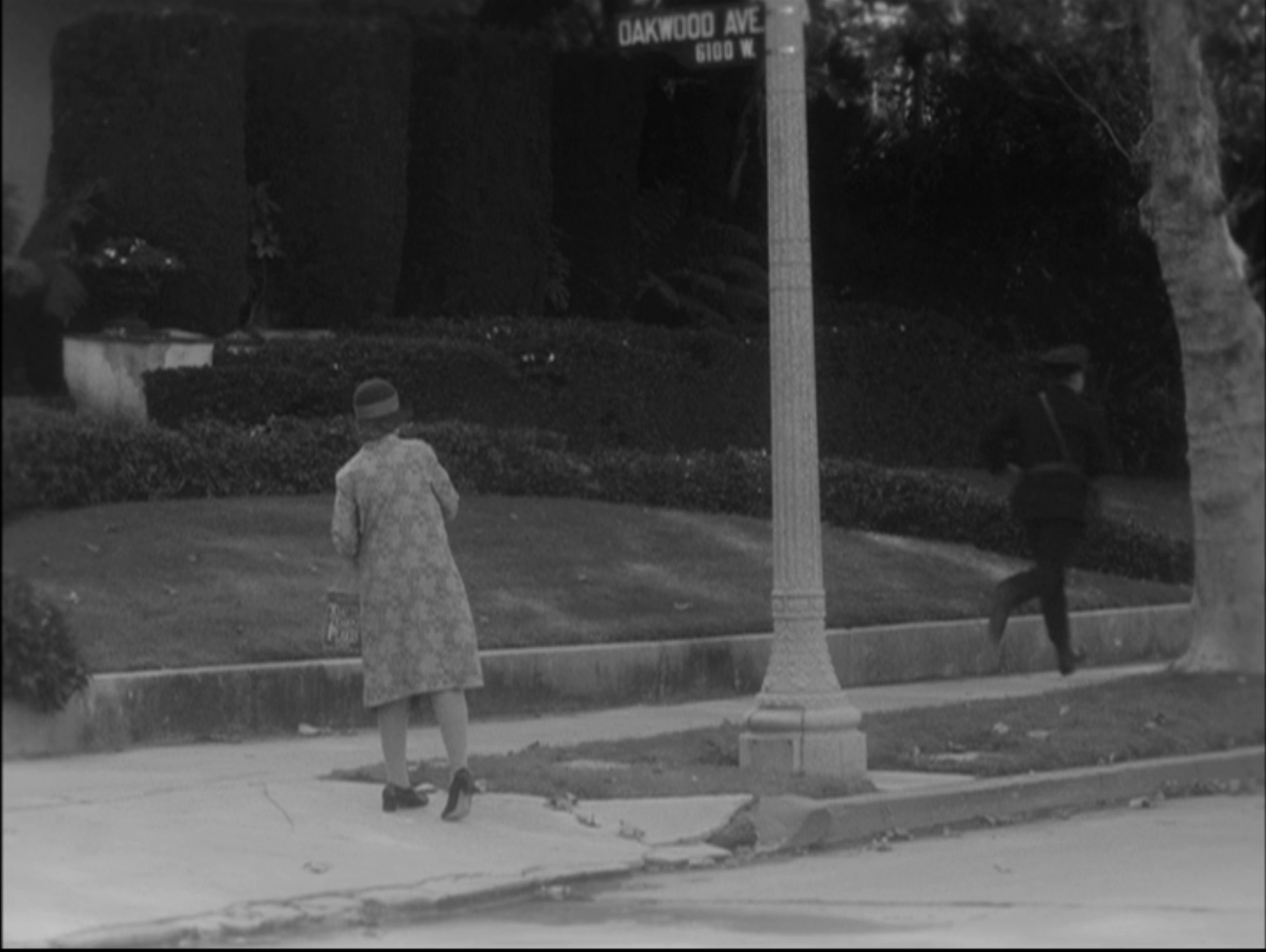
Uggie saves the day! Notice the street sign at the far right. (C) 2012 Google

Street sign – OAKWOOD AVE – 6100 W

Now that the multi-Oscar-winning Best Picture The Artist is available for study on home video, I can present more locations from the film, including the street sign mentioned in my first post (see left), visible when Uggie the dog summons a policeman to rescue his master George from a burning building.  The Uggie scenes were filmed at the corner of N. June Street and Oakwood near Hancock Park.  You can see all of my posts about The Artist HERE.

After capturing the cop’s attention, Uggie leads the cop down S. Hudson Avenue (see below), two blocks south of the Oakwood corner where they met, past the low brick retaining wall of 134 S. Hudson Ave.   My sixth post shows this scene being filmed.

Uggie racing past 134 S. Hudson Avenue.  (C) 2012 Google.

Lindsay Blake’s television and movie location blog ImNotAStalker.Com has several posts with locations from The Artist; including George Valentin’s apartment; the history of the Red Studios where much of The Artist was filmed; and the AFI “hospital” and the Wilshire Ebell where many interior scenes were filmed.  Thanks to Lindsay for identifying this spot –  below, a panoramic view of George Valentin’s apartment on W 21st Street.

4056 West 21st Street

4056 West 21st Street (C) 2012 Google

The driveway to 4061 West 21st Street – (C) 2012 Google

When Peppy Miller smashes her car into the tree standing before George’s apartment (left), you can see the driveway to 4061 West 21st Street across the way in the background.

Before arriving at George’s apartment, Peppy races around a narrow corner, going from north on Hudson Place to south on S. Hudson Avenue (below), the same street, above, where the cop follows Uggie beside 134 S. Hudson Avenue.  Another view from Peppy’s frantic drive to find George, at the corner of S. Hudson and W. 2nd Street, appears in my first post.

Peppy round the bend – looking south at the corner of Hudson Place (left) and S. Hudson Avenue (right)

Hudson Place (left) and S. Hudson Avenue (right) – (C) 2012 Google

Peppy racing past 104 S. Hudson

This view to the left, looking north, shows Peppy driving south from the narrow corner shown above.  Beside her is the distinctive fence alongside 104. S. Hudson Avenue.  As shown in my prior post (and below), this same section of wall appears during scenes between Uggie and the cop.

104 S. Hudson. (C) 2011 Microsoft Corporation

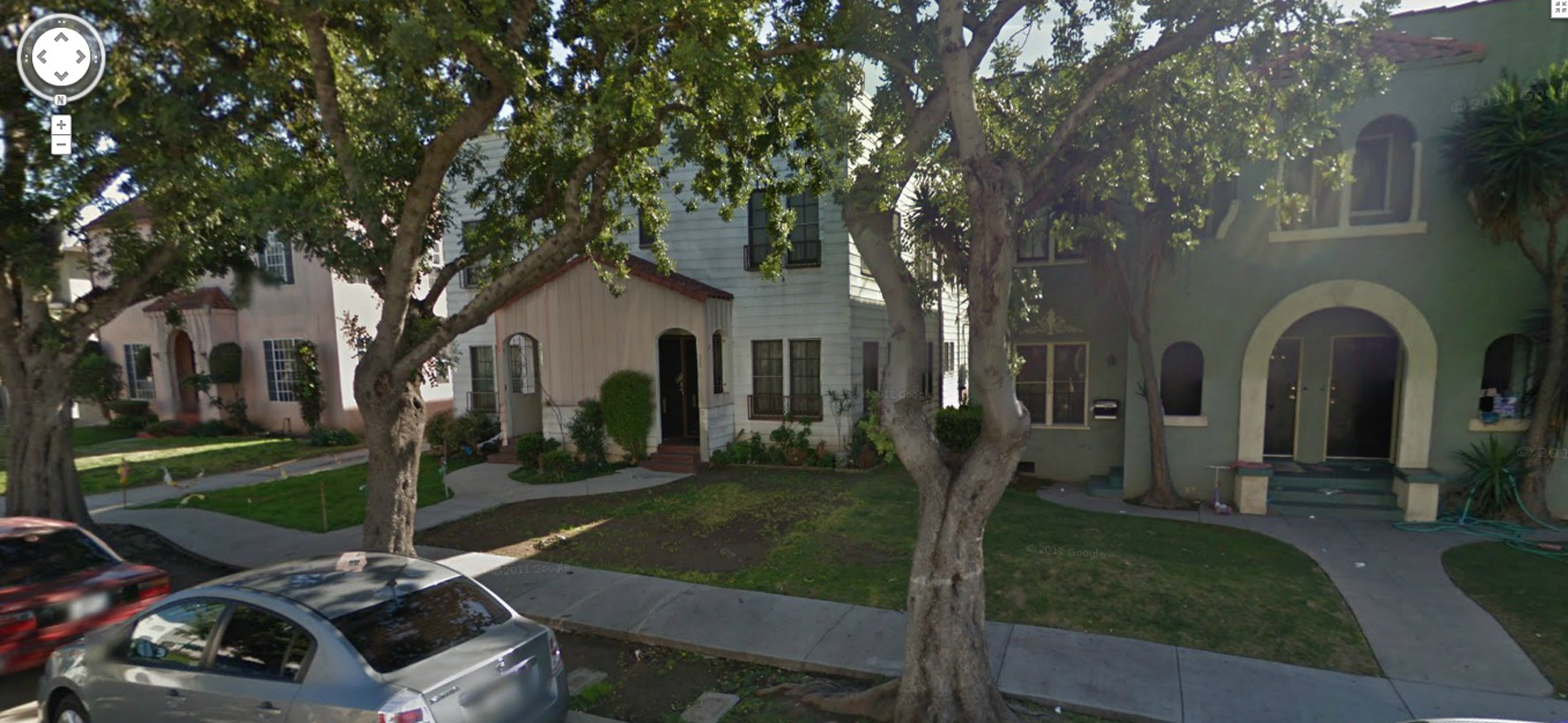
As explained in my first post, standing between Peppy’s mansion (56 Fremont Place, once the home of Mary Pickford), and George’s mansion (104 Fremont Place, just half a block away from Peppy), is the mansion Charlie Chaplin used when filming The Kid in 1921 (55 Fremont Place).  All three homes are part of Fremont Place, a gated community, so it is not possible to post Google Street View images of these homes.

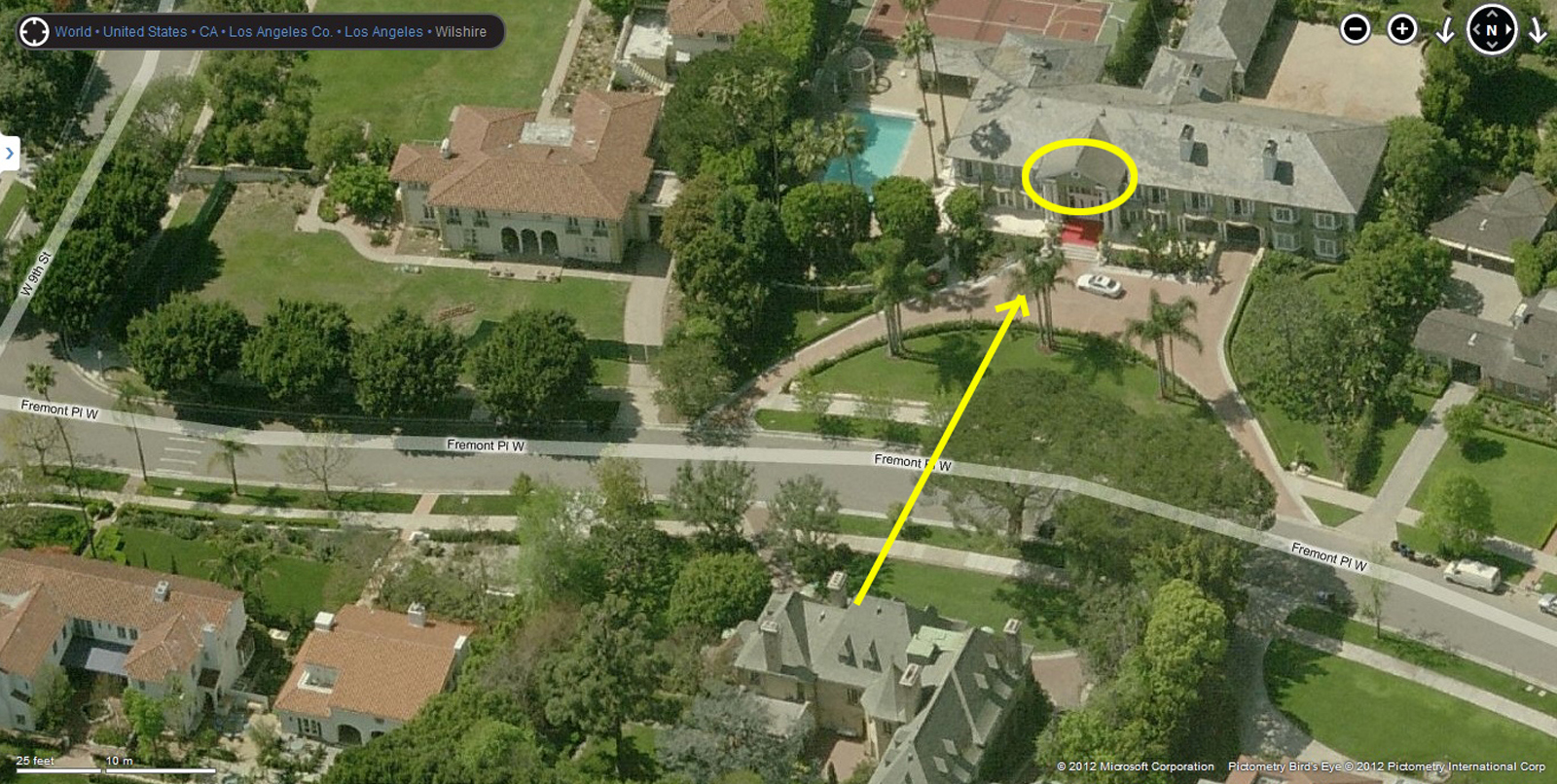
Click to enlarge.  Behind George, the front entrance to 101 Fremont Place

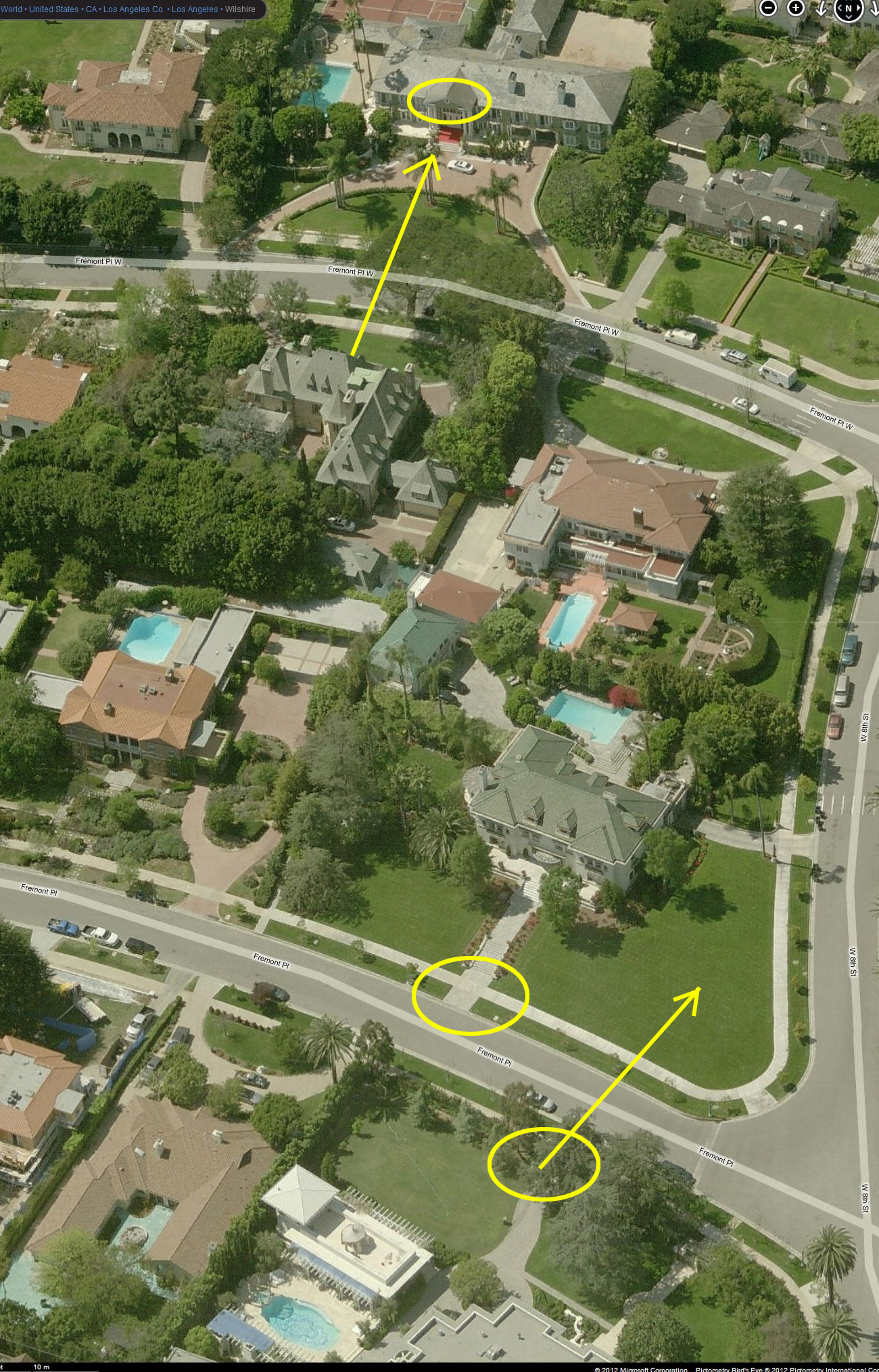
But with the Bing Maps Bird’s eye function, we can see the location of the mansions relative to one another.  At the left, as George leaves his home (the mansion located at 104 Fremont Place), we can see behind him, across the street, the entrance-way columns and pitched roof of 101 Fremont Place, matching the aerial view below.

The view from George’s front door to 101 Fremont Place (oval) across the street.  (c) 2012 Microsoft Corporation, Pictometry Bird’s Eye (c) 2012 Pictometry International Corp.

Peppy leaving 56 Fremont Place

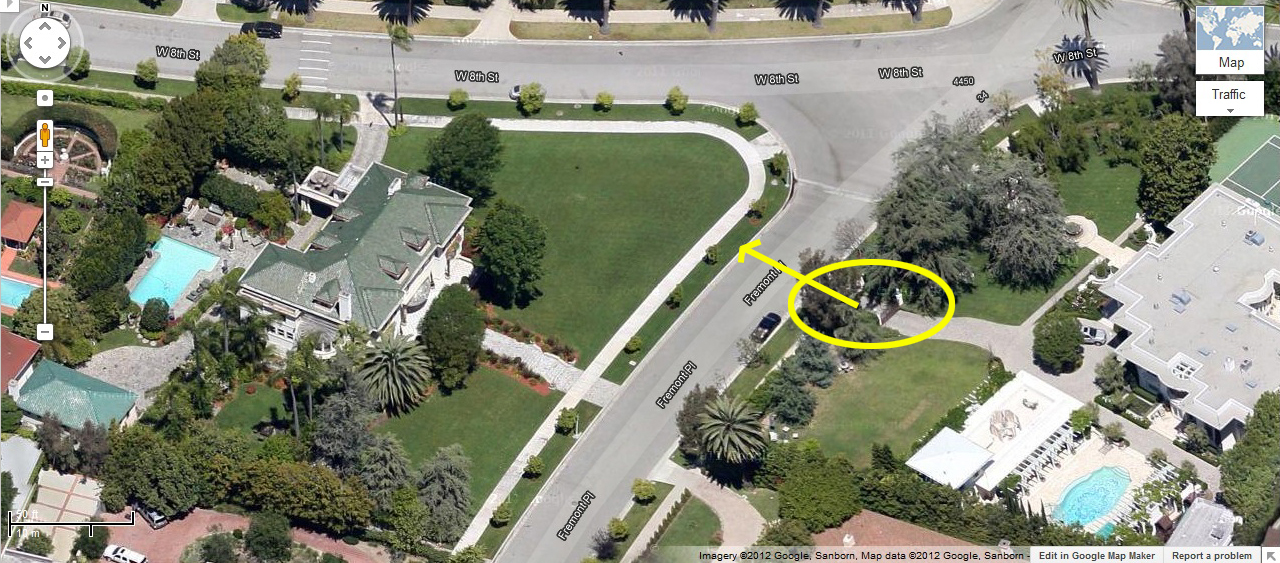
To the left, and below, when Peppy races through the front gate of her mansion to rescue George, you can see the lawn of 55 Fremont Place across the street, the mansion appearing in Chaplin’s The Kid.

The Kid

View from the gate of 56 Fremont Place towards the lawn of the mansion appearing in The Kid (inset above, right).  (C) 2012 Microsoft Corporation, Pictometry Bird’s Eye (C) 2012 Pictometry International Corp.

Wrapping it all up, this aerial view below, looking west, places the mansions into perspective.

Click to enlarge.  (c) 2012 Microsoft Corporation, Pictometry Bird’s Eye (c) 2012 Pictometry International Corp.

The top oval is 101 Fremont Place, across from George’s mansion.  The center oval is where Edna Purviance abandoned her newborn infant in front of 55 Fremont Place, in The Kid.  The bottom oval marks the entrance gate to 56 Fremont Place, Peppy’s home, that was once home to Mary Pickford.

The Artist (C) La Petite Reine, The Weinstein Company.  All images from Chaplin films made from 1918 onwards, copyright © Roy Export Company Establishment. CHARLES CHAPLIN, CHAPLIN, and the LITTLE TRAMP, photographs from and the names of Mr. Chaplin’s films are trademarks and/or service marks of Bubbles Incorporated SA and/or Roy Export Company Establishment. Used with permission.

Below, a map of 134 S. Hudson Ave.

Posted in The Artist | Tagged , , , , , , , , , , | 3 Comments

Chaplin’s Studio Pay Day

As documented in my Keaton book, and elsewhere on this blog (Mr. Keaton’s Neighborhood), Buster Keaton filmed over four dozen scenes and simple insert shots on the streets adjacent to his small studio.  In a similar vein, as described in my Chaplin book, Charlie Chaplin used the back porch of his studio office for a domestic scene in A Day’s Pleasure (1919) (left, see post Chaplin Medley, slide 7).

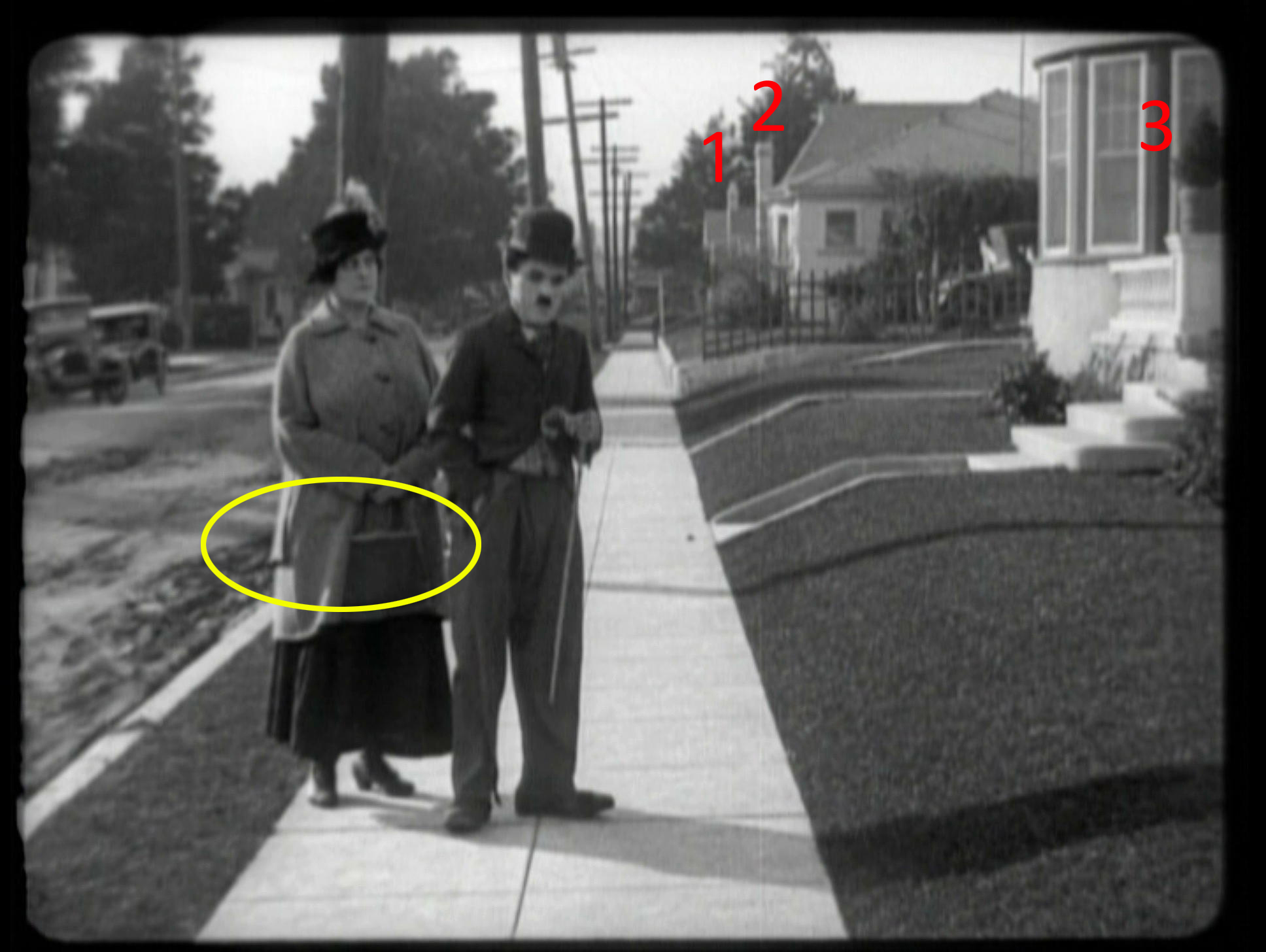
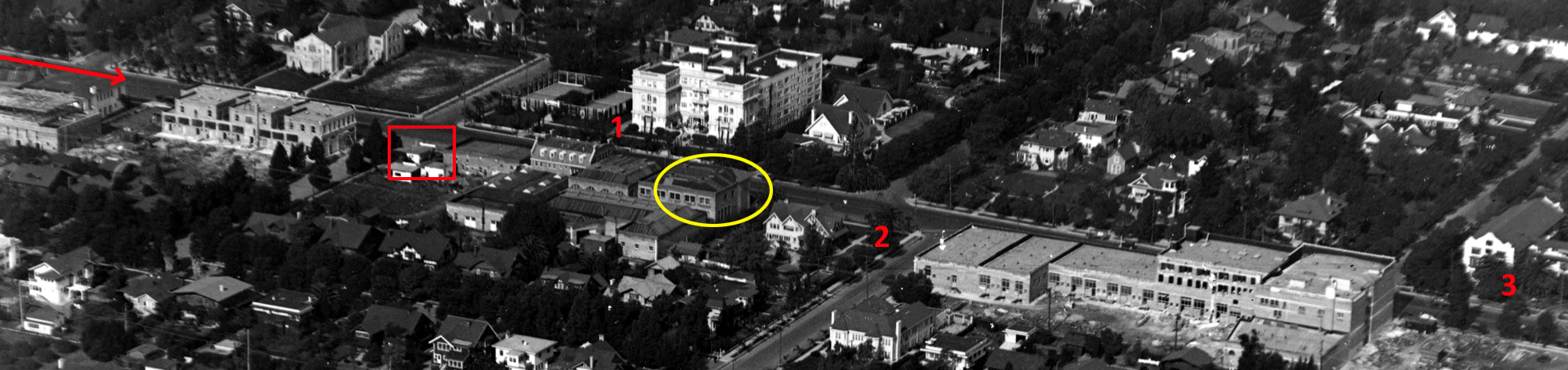
Vintage aerial photos confirm that Charlie also filmed a domestic street scene from Pay Day (1922) within steps of his studio.  During the scene, Charlie’s harridan of a wife, played by Phyllis Allen, confronts Charlie after work, demanding his entire week’s cash wages.  Unbeknownst to Charlie, she has just witnessed him hiding a few dollars in the brim of his hat.  During a comedic exchange, Phyllis first extracts all of the cash from Charlie’s pants, depositing it in her open purse.  For a moment Charlie thinks he has pulled one over on Phyllis, but she then demands to see his hat.  Topping the scene, while Phyllis extracts Charlie’s hidden wages from his hatband, Charlie furtively removes the balance of his pay from her open purse, making a net gain on the transaction.

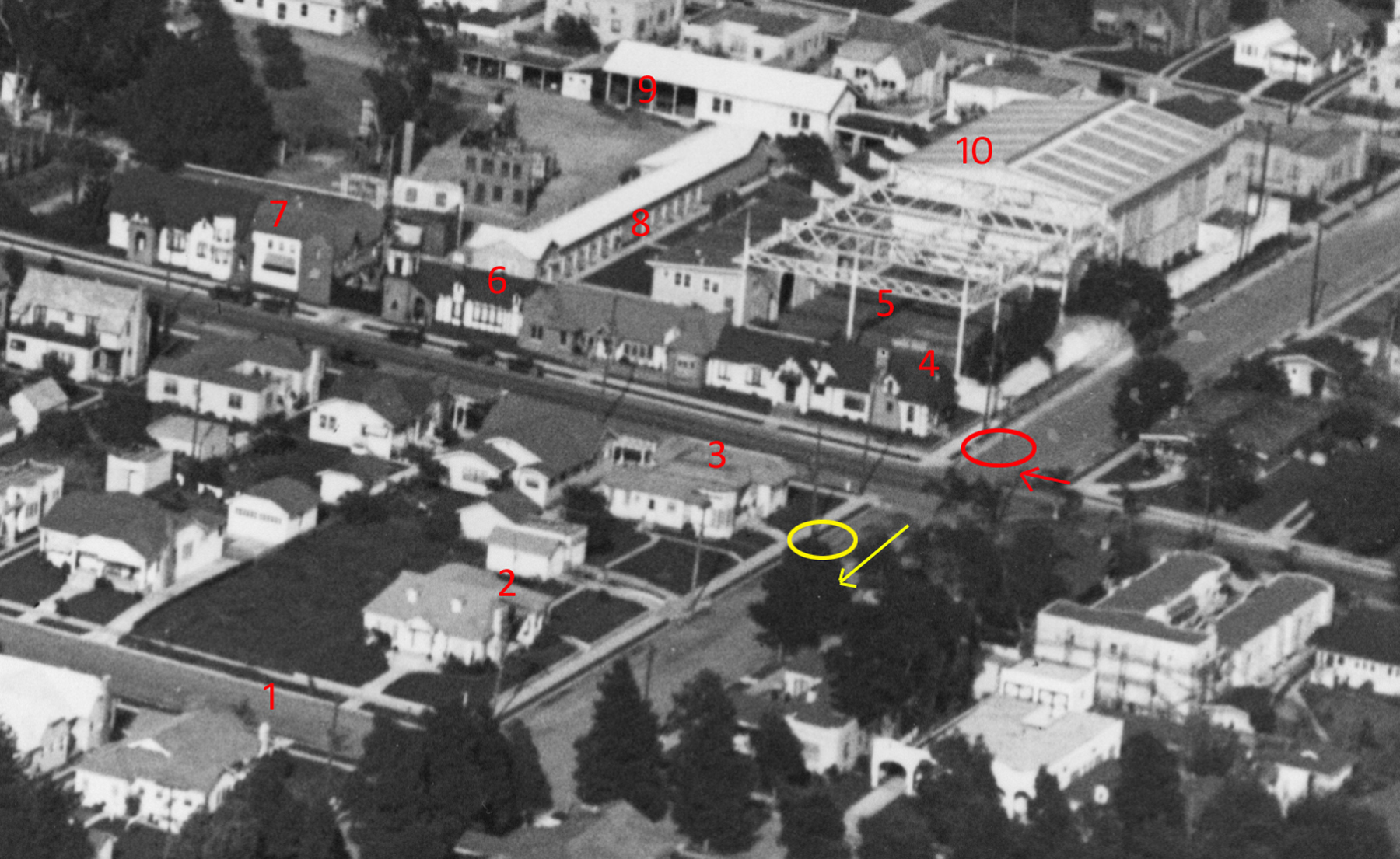
Click to enlarge. The red oval marks the A Day’s Pleasure corner site mentioned above, the yellow oval marks the telephone pole appearing behind Charlie and Phyllis in Pay Day below. The arrows show the camera’s point of view. HollywoodPhotographs.com

Looking west down De Longpre from La Brea. The oval marks the same telephone pole appearing in the aerial view above.

Chaplin filmed this scene (at left – click to enlarge) near the NW corner of De Longpre Avenue and N. La Brea, in front of a newly constructed bungalow with a distinctive circular bay (3), still standing (behind a wall) at 7101 De Longpre Avenue.  The land was still a lemon grove in 1919, more than a year after Chaplin completed constructing his studio on a former citrus orchard across the street.  As shown above, Chaplin likely walked to this filming site, which was actually closer to the back porch of his studio office than the studio’s enclosed filming stage!  The house further back in the movie frame (2) stood at 1400 N. Detroit Avenue, now lost, while the chimney of 1401 N. Detroit (1), now also lost, peaks out in the back.  Large apartment blocks stand on these homesites today.

The remaining annotations on the above aerial photo show Chaplin’s corner office (4), the open air shooting stage (5), that remained open until after Chaplin had completed City Lights in 1931, the studio projection room (6), the studio editing room and laboratory (7), the north wing of dressing rooms (8), the studio carpenter shop (9), and the studio closed shooting stage (10).  My book Silent Traces contains a lengthy chapter devoted to the Chaplin Studio, including all of its appearances in Chaplin’s films, and a private photo tour of how it looks today.

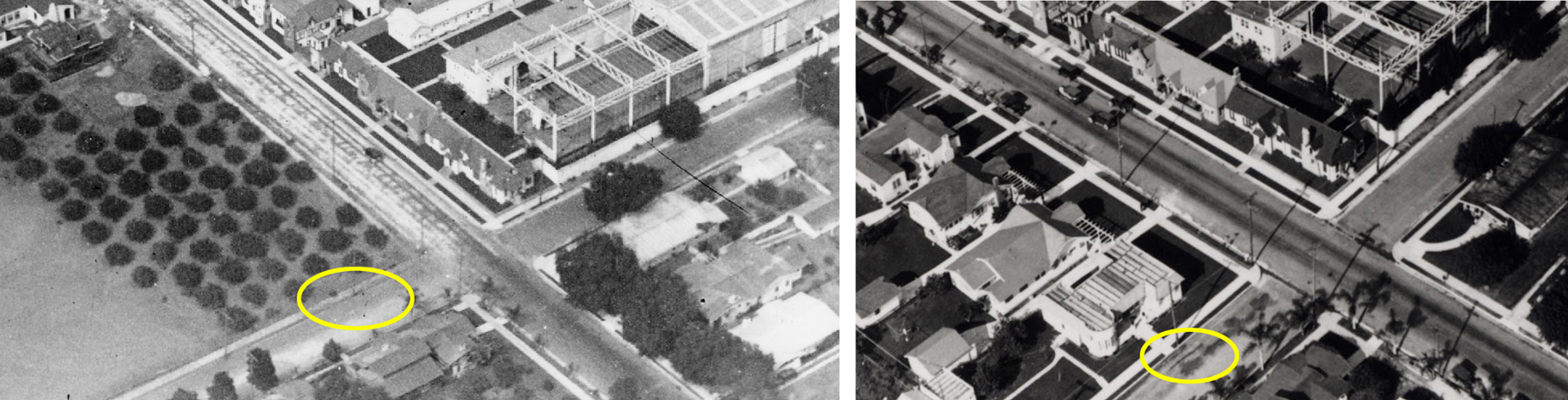
Matching views, from 1918, and 1922, showing the Pay Day filming spot (oval).  Jeffrey Vance Collection – Association Chaplin

Above, aerial views of the Pay Day filming spot, the NW corner of De Longpre and La Brea, before and after the bungalow at 7101 De Longpre was completed between 1919 and 1922.  Below, a Google view of the NW corner of De Longpre and La Brea today – the circular bay bungalow (3) to the left, the Chaplin corner office (4) barely visible through the trees on the right.

All images from Chaplin films made from 1918 onwards, copyright © Roy Export Company Establishment. CHARLES CHAPLIN, CHAPLIN, and the LITTLE TRAMP, photographs from and the names of Mr. Chaplin’s films are trademarks and/or service marks of Bubbles Incorporated SA and/or Roy Export Company Establishment. Used with permission.  http://www.hollywoodphotographs.com/

Posted in Chaplin Studio, Charlie Chaplin, Hollywood Tour | Tagged , , , , , , , , , , | 7 Comments

Laurel and Hardy, Charlie Chaplin – Four Silent Jailbreaks

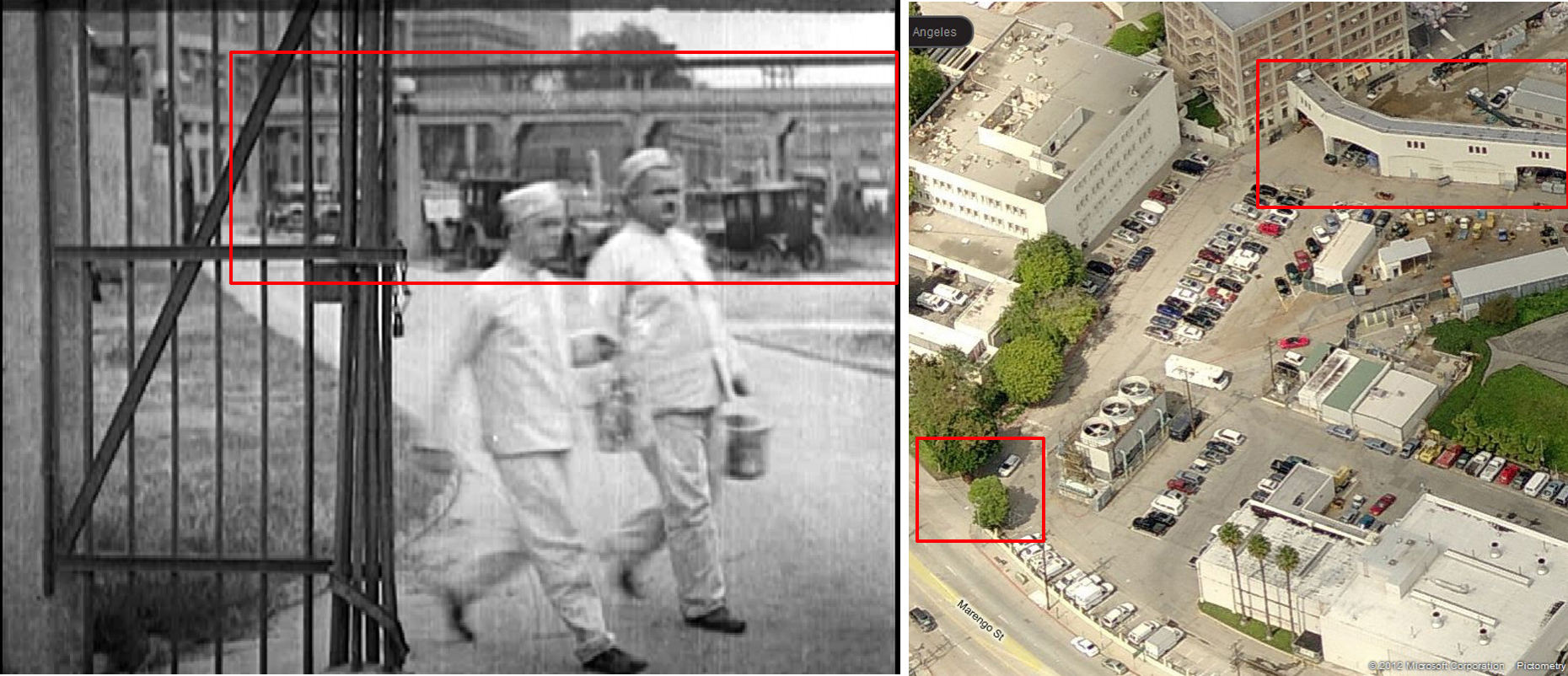
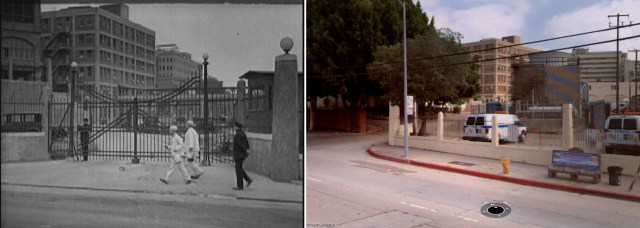
Laurel and Hardy in The Second Hundred Years (1927) – behind them, the extant six story Los Angeles County Hospital services building. (C) 2012 Microsoft Corporation

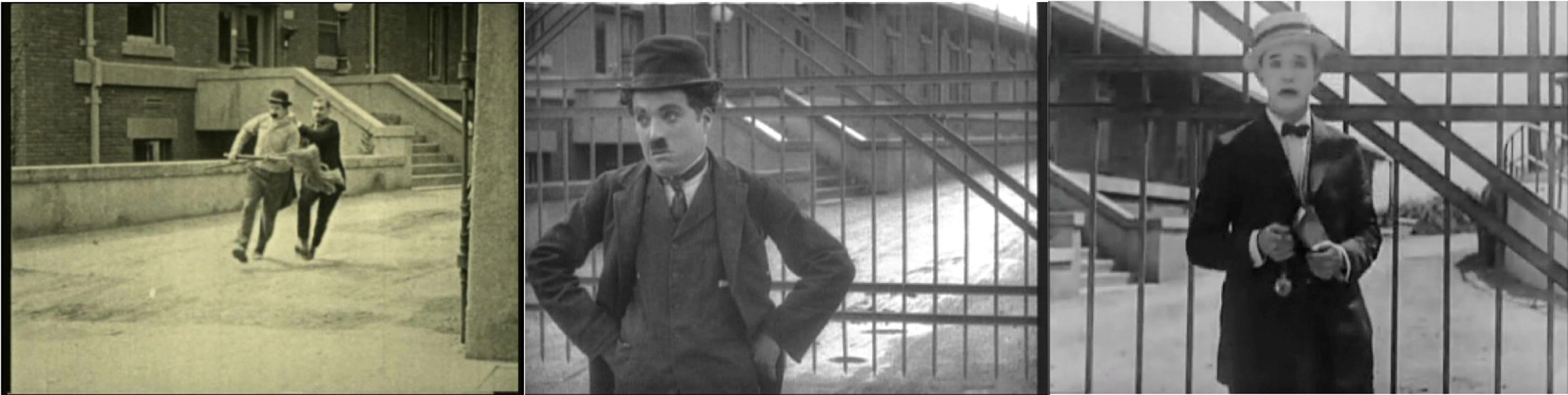
Jails and silent comedies!  A match made in heaven.  This post shows where (ONE) Laurel and Hardy filmed the jailbreak scene from The Second Hundred Years, (TWO) Charlie Chaplin filmed a prison release scene in Police, (THREE) Laurel and Hardy filmed being sent to prison in The Hoose-Gow, and (FOUR) Harold Lloyd and Laurel and Hardy filmed beside the Lincoln Heights Jail.

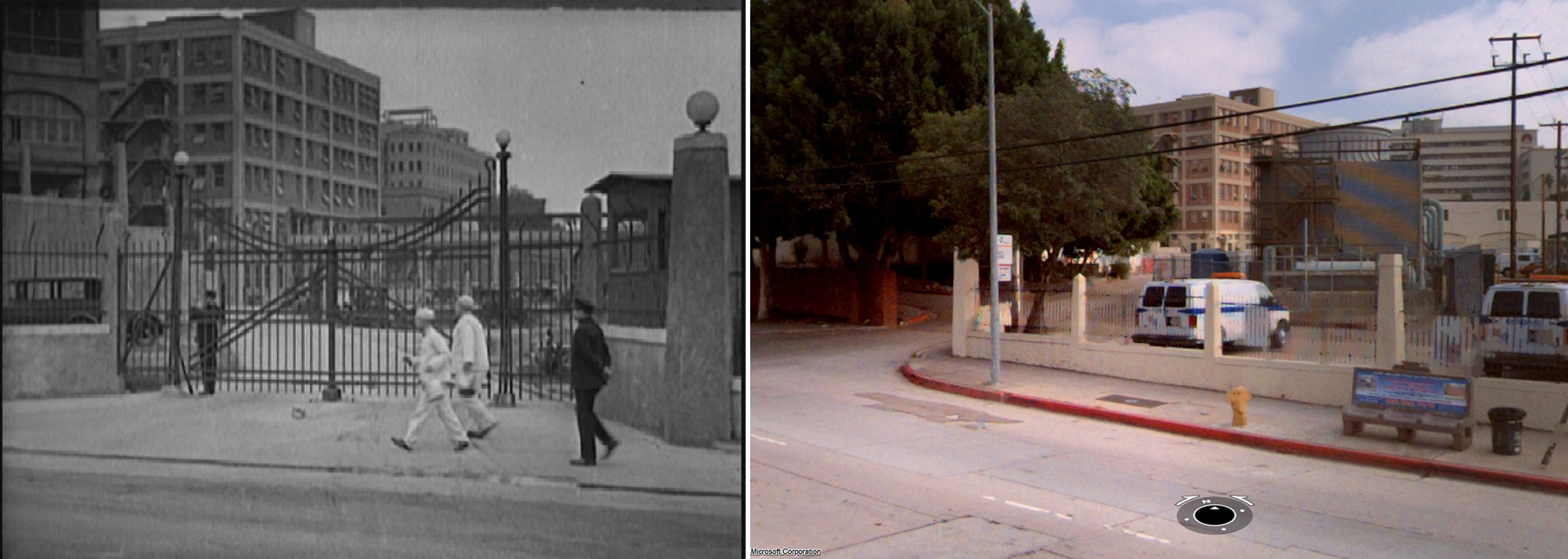
ONE – Laurel and Hardy at the LACH south gate
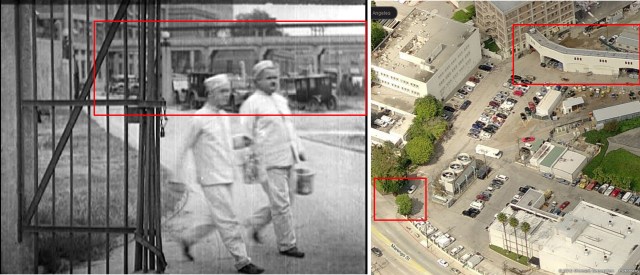
An elevated bridge, or causeway, still standing, connects the services building to facilities on the other side of a shallow ravine.  (C) 2012 Microsoft Corporation. Pictometry
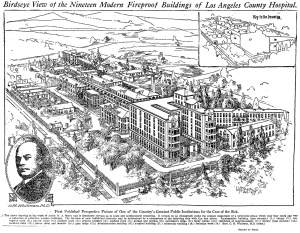
Click to enlarge.  March 9, 1913 – Los Angeles Times

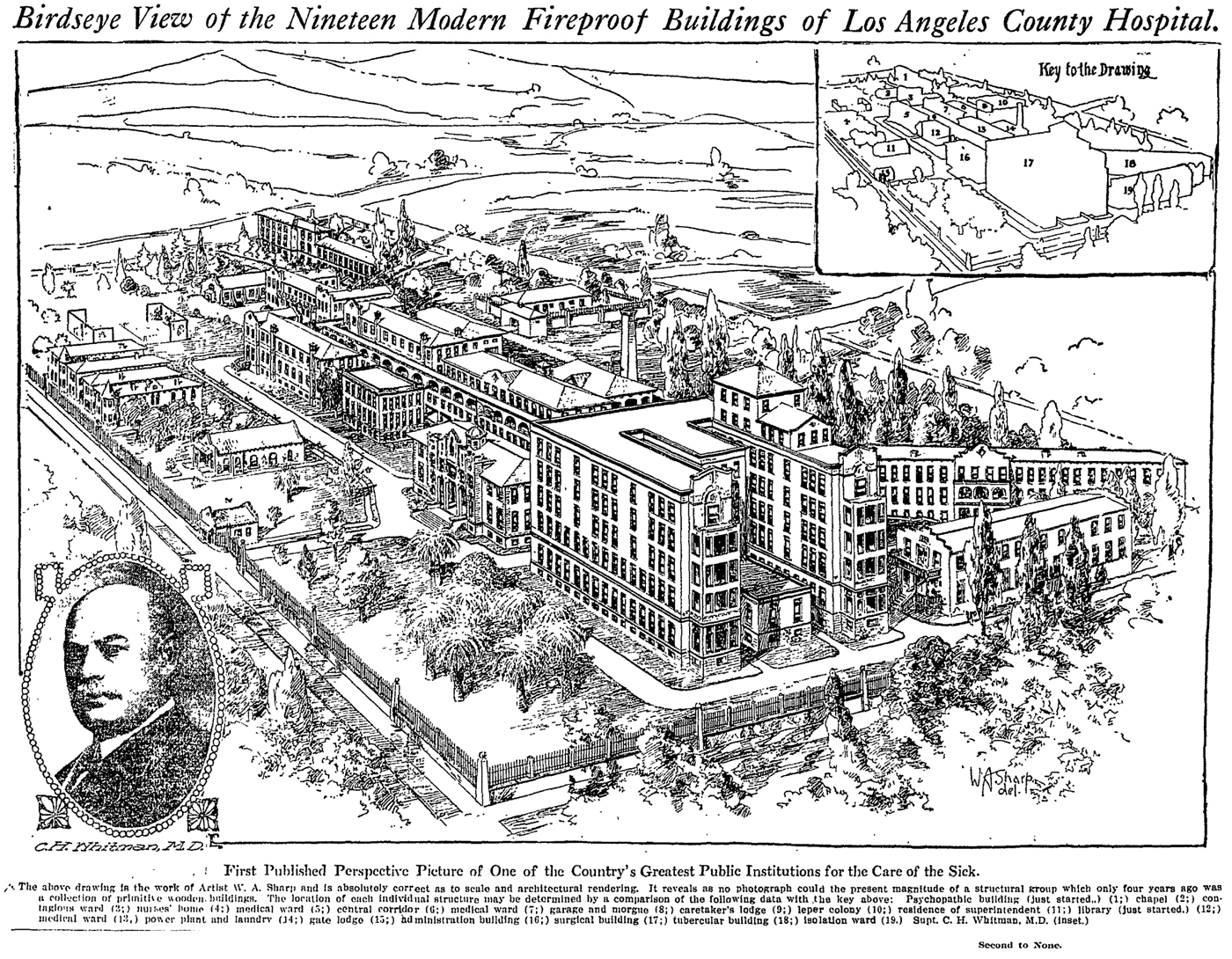
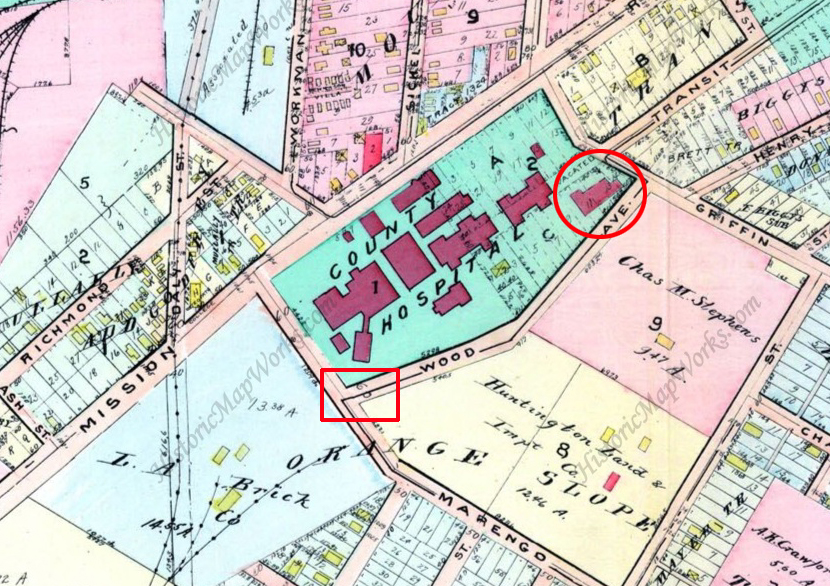
The above scenes from The Second Hundred Years were filmed at the south entrance gate to the former campus of the Los Angeles County Hospital, located at approximately 1651 Marengo Street.*   Construction for the campus began in 1913, initially comprised of nineteen fireproof buildings standing on fifteen acres bounded by Mission Road and Marengo Street, Griffith Avenue (now Zonal Avenue), and Wood Avenue (now lost).  As shown above, and at the end of this post, part of the south gate at what was once Wood Avenue still remains standing.  An ornamental fence of reinforced concrete and iron construction surrounded the grounds, and visitors and employees were required to pass through a gate lodge to ensure no one would enter the grounds without authorization.  The fence was one of the first innovations urged by superintendent Dr. C. H. Whitman when he took charge of the facility in 1909.  This jail-like fence caught the attention of early film-makers, as it appears in each of the films discussed here.

*I do not know whom to acknowledge in the Laurel and Hardy fan community for this original discovery, but will gladly credit them if someone will identify him or her to me.
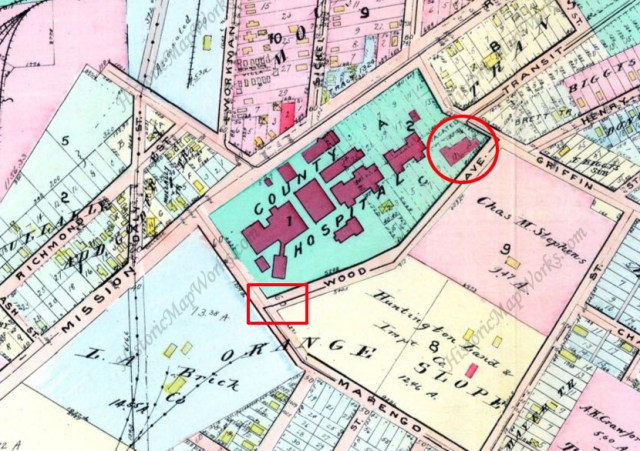
The box marks the south gate entrance employed by Laurel and Hardy (above), the oval marks the north gate beside the Psychopathic Hospital used by Charlie Chaplin, and others, (below). Baist’s Real Estate Surveys of Los Angeles 1914 – Plate 026. HistoricMapWorks.com

TWO – Charlie Chaplin at the LACH north gate
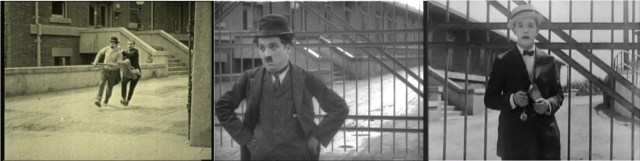
The north gate – Hank Mann in The Janitor (1919); Charlie Chaplin in Police (1916); Stan Laurel in Detained (1924).

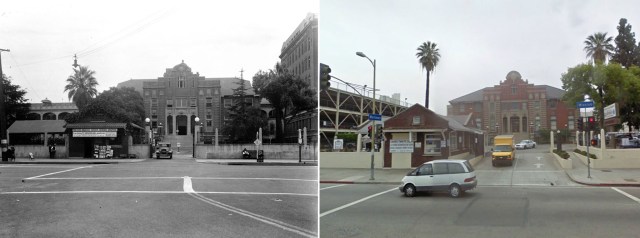
While Laurel and Hardy used the Los Angeles County Hospital campus south gate to film The Second Hundred Years, the above frames show that comedians Hank Mann, Charlie Chaplin, and then-solo act Stan Laurel all filmed at the north gate to the campus, as shown below, beside the Los Angeles County Psychopathic Hospital that opened on August 3, 1914.  With soft, cream-shaded walls, and accommodations for 100, the facility applied the latest scientific methods to treat patients suffering from drug and drink habits, and those afflicted with sudden manias.  Referrals to the asylum were handled by the Lunacy Commission, which handled an average of 130 insane persons a month.  The Sanborn Fire Insurance maps, and the Los Angeles Times drawing above, show that a small Leper Ward stood south of the Psychopathic Hospital.

As mentioned in my prior post, I did not know where this Chaplin setting was located until Mary Mallory, author of Hollywoodland, and who blogs regularly about classic Los Angeles and Hollywood at ladailymirror.com, suggested it might be in the neighborhood of the Laurel and Hardy gate.  Further research showed Mary was absolutely right.
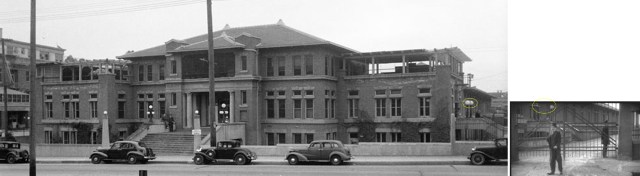
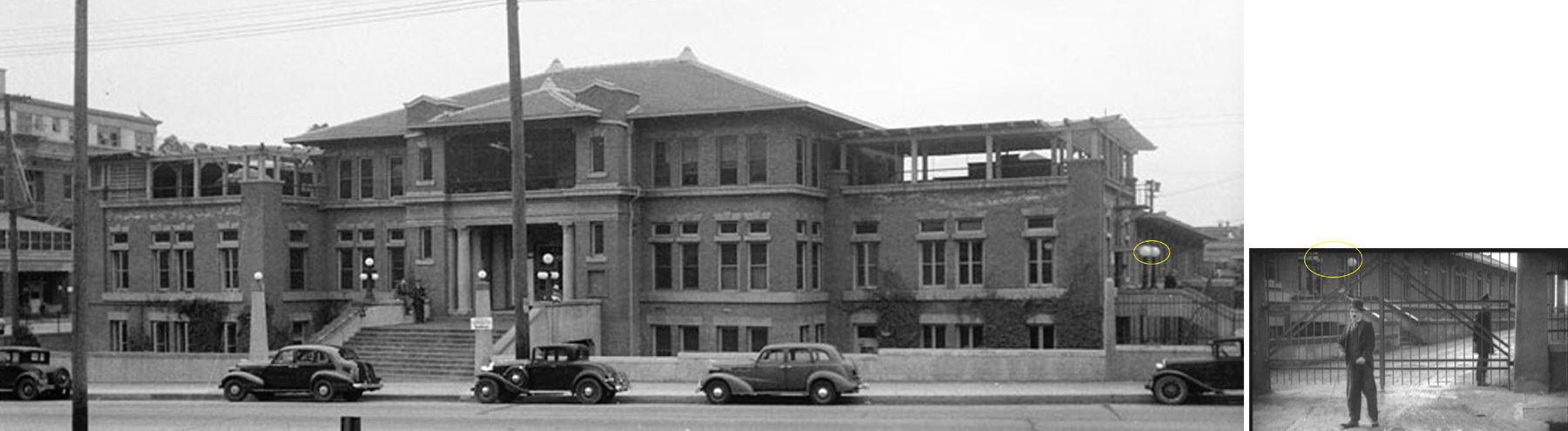
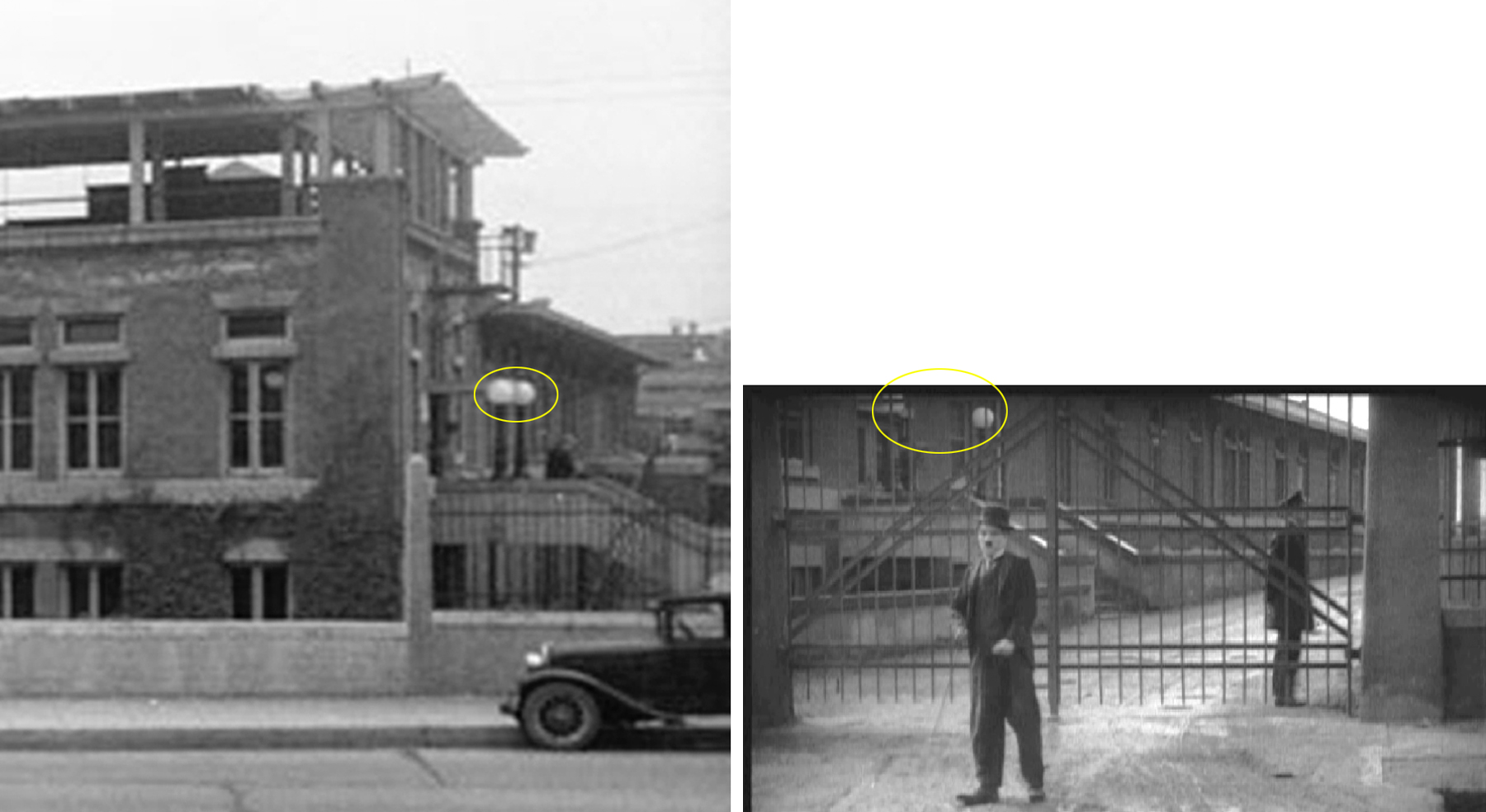
Click to enlarge.  Looking south at the Psychopathic Ward of the Los Angeles County Hospital building, on Griffin (now Zonal Avenue).  The yellow ovals identify the same matching side entrance lamps.  Security Pacific National Bank Photograph Collection/Los Angeles Public Library.
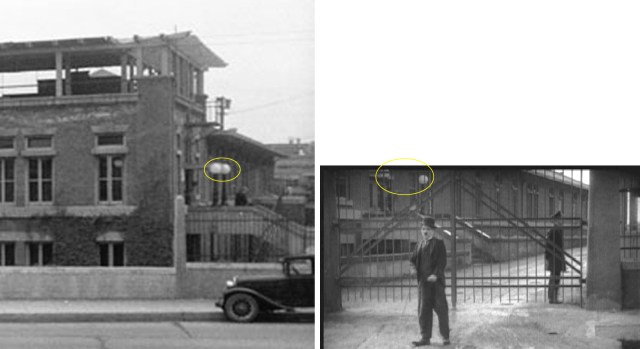
A larger comparison view of the Psychopathic Hospital and Charlie beside the north entrance gate.  The yellow ovals mark the same side entrance lamps.

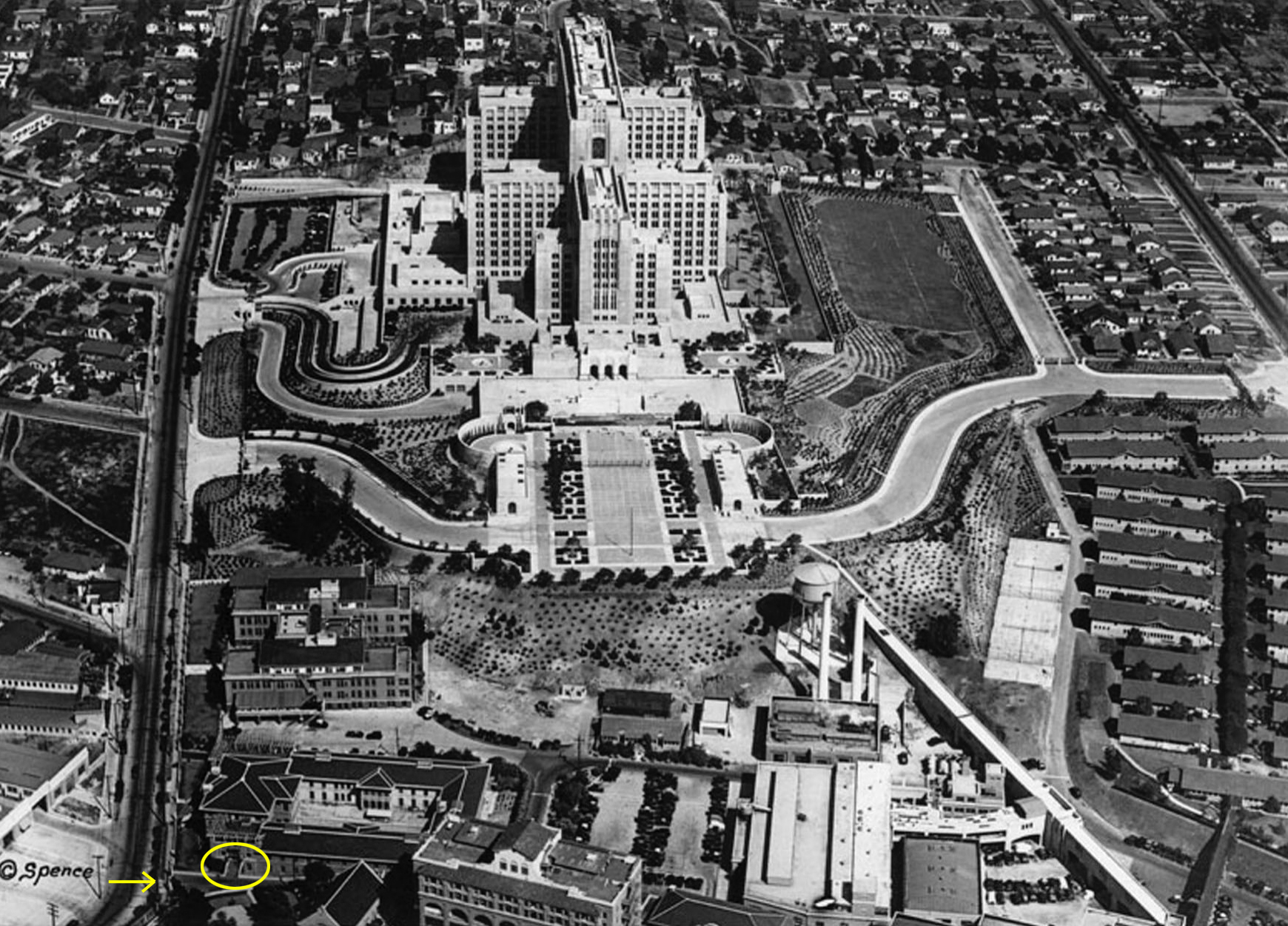
Photos of the Psychopathic Hospital, and several other of the original nineteen brick buildings that comprised the original Los Angeles County Hospital campus, are available for view by searching online at the LA Public Library, and the USC Digital Archive.  One such photo below shows the relation of the Psychopathic Hospital to the then-newly opened Los Angeles County – University of Southern California Medical Center complex, situated on an adjacent fifty-six acre hilltop parcel.  Silent film star Mary Pickford helped lay the cornerstone for the center on December 7, 1930.  The LAC-USC Medical Center remains one of the largest public hospitals in the country.
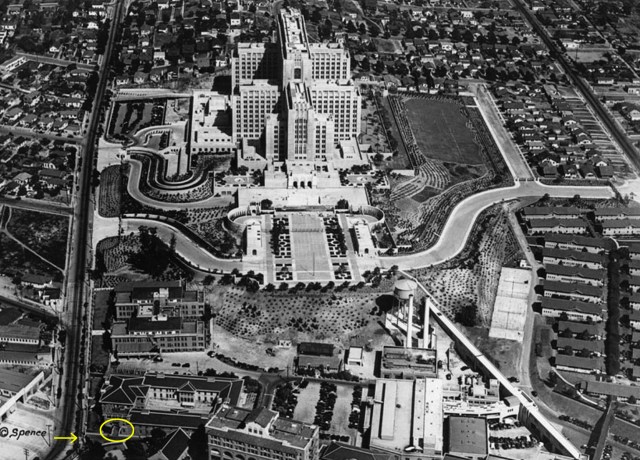
Click to enlarge.  The arrow shows the point of view of Chaplin’s camera towards the Psychopathic Hospital.  The oval encompasses the twin side entrance lamps highlighted above.  Security Pacific National Bank Photograph Collection/Los Angeles Public Library.

THREE – Laurel and Hardy return to the LACH south gate

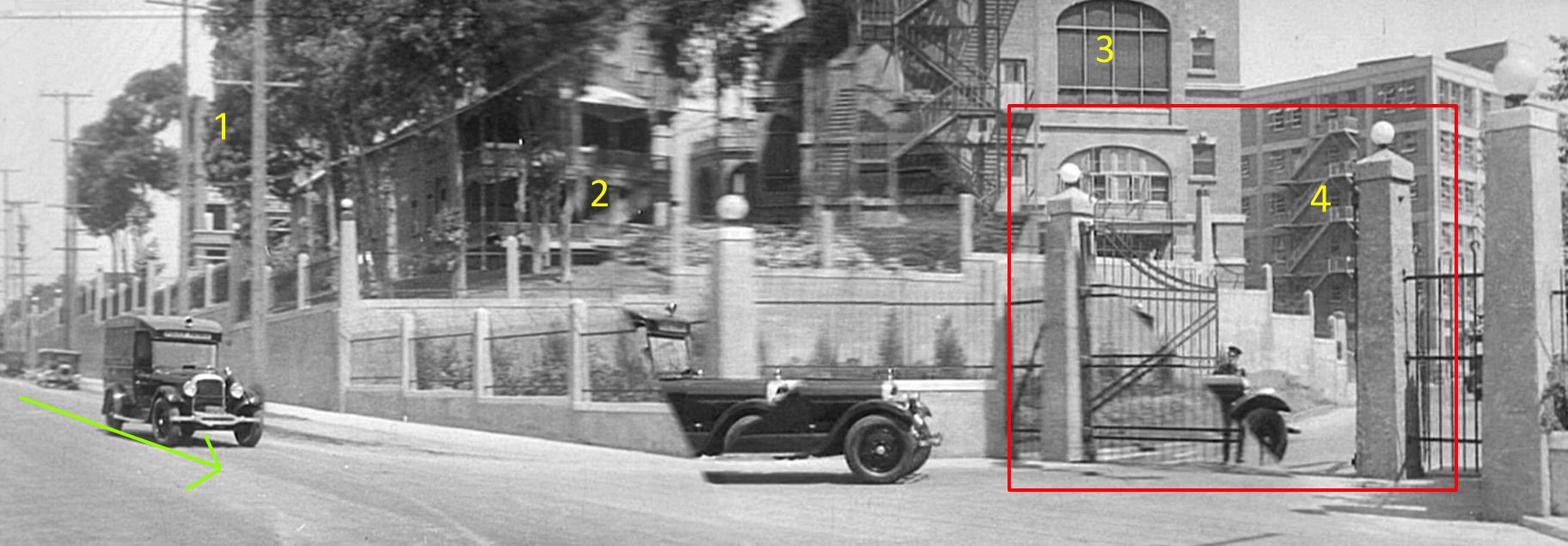
Laurel and Hardy returned to the Los Angeles County Hospital south gate entrance two years later to film the opening scenes from The Hoose-Gow.  The view below shows a paddy wagon traveling south down Marengo Street, from Mission Road, towards the south gate.
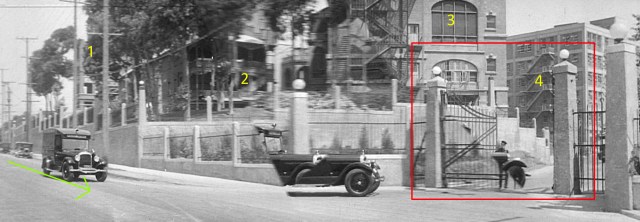
Traveling down Marengo Street in The Hoose-Gow (1929).

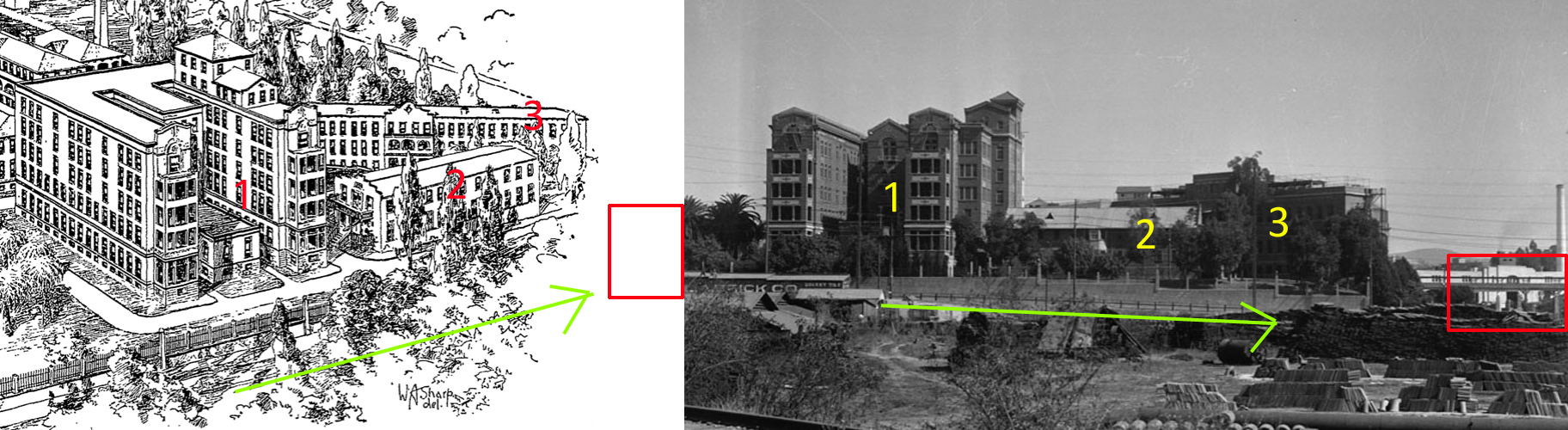
Annotated on the images above and below are (1) the Tuberculosis Ward built in 1912, (2) the Jail Ward (there was an actual jail on the campus!), (3) the Isolation Ward, and (4), above, the Services Building.  The green arrow in each image points down Marengo Street, the red box in each image marks the spot of the south gate.
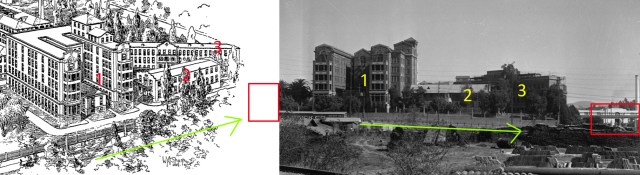
Click to enlarge.   Security Pacific National Bank Photograph Collection/Los Angeles Public Library.

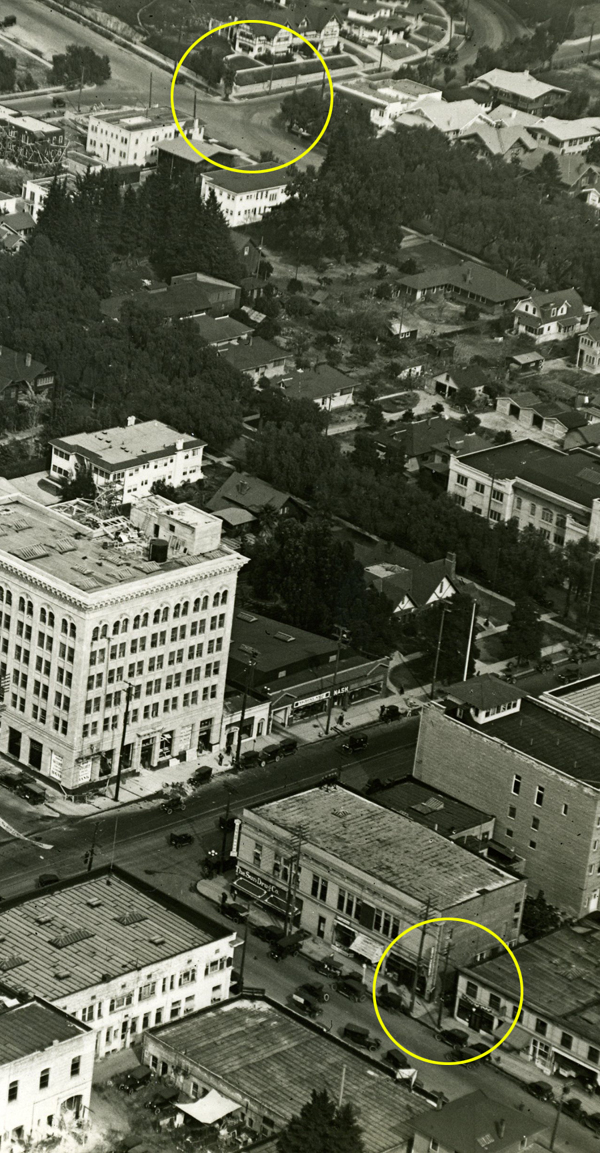
To put the pieces all into perspective, the aerial view below shows the different filming sites, dwarfed by the massive LAC-USC Medical Center, and where Harold Lloyd filmed a failed suicide attempt nearby in the deceptively shallow waters of Eastlake Park (now Lincoln Park) for a scene from his short comedy Haunted Spooks.
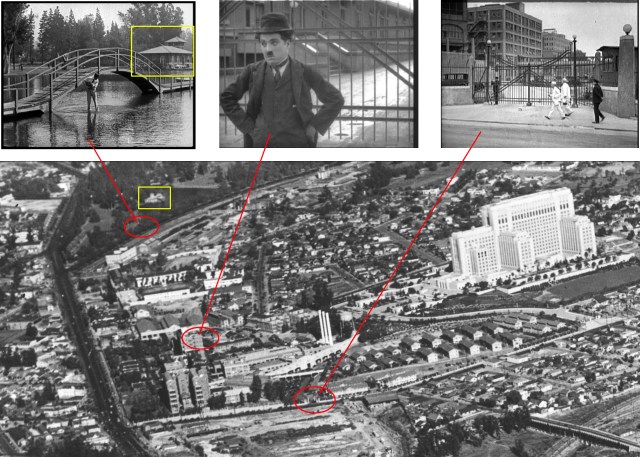
Click to enlarge. N. Mission Road runs along the left side.  Upper left, Harold Lloyd in Haunted Spooks (1920), the yellow box marks the extant Eastlake Park (now Lincoln Park) boathouse; upper center Charlie Chaplin beside the campus north gate on Zonal Avenue; upper right, Laurel and Hardy beside the campus south gate on Marengo Street.  Marc Wanamaker – Bison Archives

FOUR – Laurel and Hardy, and Harold Lloyd, at the Lincoln Heights Jail
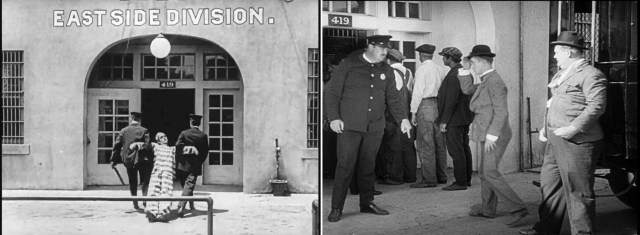
At the left, Harold Lloyd in Take A Chance (1918), to the right, Stan and Ollie from The Hoose-Gow.  Notice the matching address, man hole, and water spigot.
Take A Chance

Lastly, during the opening of The Hoose-Gow, immediately after the paddy wagon above enters the campus south gate, the action cuts to a shot of the wagon unloading in front of the former Los Angeles East Side Division city jail, at 419 N. Avenue 19, the same jail setting appearing in Harold Lloyd’s 1918 short comedy Take A Chance.  Lloyd’s producer at the time, Hal Roach, obviously remembered this jail setting, and used it again a decade later for the Laurel and Hardy short.  The jail was located a few blocks north of the hospital campus, just east of the Los Angeles River.
Shuttered Lincoln Heights Jail – (C) 2012 Google

I was able to identify the site because another jail scene from Take A Chance (inset above) shows the former West American Rubber Co., at 400 N. Avenue 19, across the street from the 419 address jail.  The jail was originally built in 1909, and expanded, as shown in The Hoose-Gow, in 1913.  The jail was re-built again in 1931 to the five-story structure still standing there today (inset right), and later closed in 1965.  Known as the Lincoln Heights Jail, the facility became infamous for Bloody Christmas, the vicious beating of Latino prisoners at the hands of the police, that took place on December 25, 1951, and portrayed in the James Ellroy novel and 1997 movie L.A. Confidential.

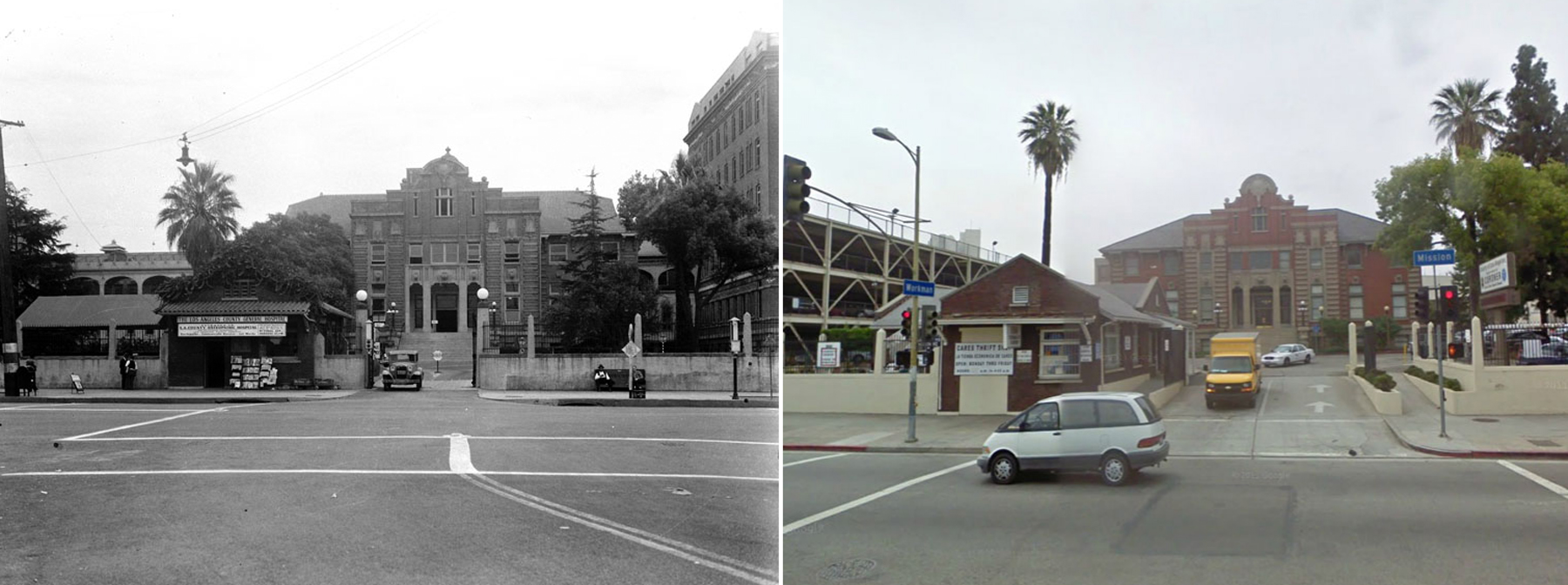
Today nearly all of the original Los Angeles County Hospital campus buildings have been demolished.  One holdout pictured below, 1104 N. Mission Road, originally the LACH Administration Building, is now used as headquarters for the Los Angeles County Coroner’s office.  The original brick gate lodge, to the left of the entrance road shown below (No. 15 on the above Los Angeles Times map) also still stands.
1104 N. Mission Road – now the Coroner’s Office.  Security Pacific National Bank Photograph Collection/Los Angeles Public Library.  (C) 2012 Google

You can find The Janitor on the Silent Comedy Mafia #1 DVD; Police can be found on the Chaplin Essanay Comedies Vol. 3 DVD; and Detained can be found on the Stan Laurel Collection Volume 2 DVD.  The Second Hundred Years, Hal Roach Studios, Inc.; (C) 2000 Richard Feiner and Company, Inc. and Hal Roach Studios [Trust].  The Hoose-Gow (B&W) (C) 1929 Metro-Goldwyn-Meyer; (C) Hal Roach Studios, Inc. ; (C) 2011 RHI Entertainment Distribution, LLC. 

HAROLD LLOYD images and the names of Mr. Lloyd’s films are all trademarks and/or service marks of Harold Lloyd Entertainment Inc. Images and movie frame images reproduced courtesy of The Harold Lloyd Trust and Harold Lloyd Entertainment Inc.

Below, a Google Street View of the remaining half of the south gate.

Posted in Charlie Chaplin, Harold Lloyd, Laurel and Hardy, Stan Laurel | Tagged , , , , , , , , , , , , , , , , , , , | 4 Comments

Two Hollywood Stunts – Lloyd and Keaton

1922 – Lloyd at top at Yucca and Vine.  Keaton at bottom near Hollywood and Cahuenga. HollywoodPhotographs.com

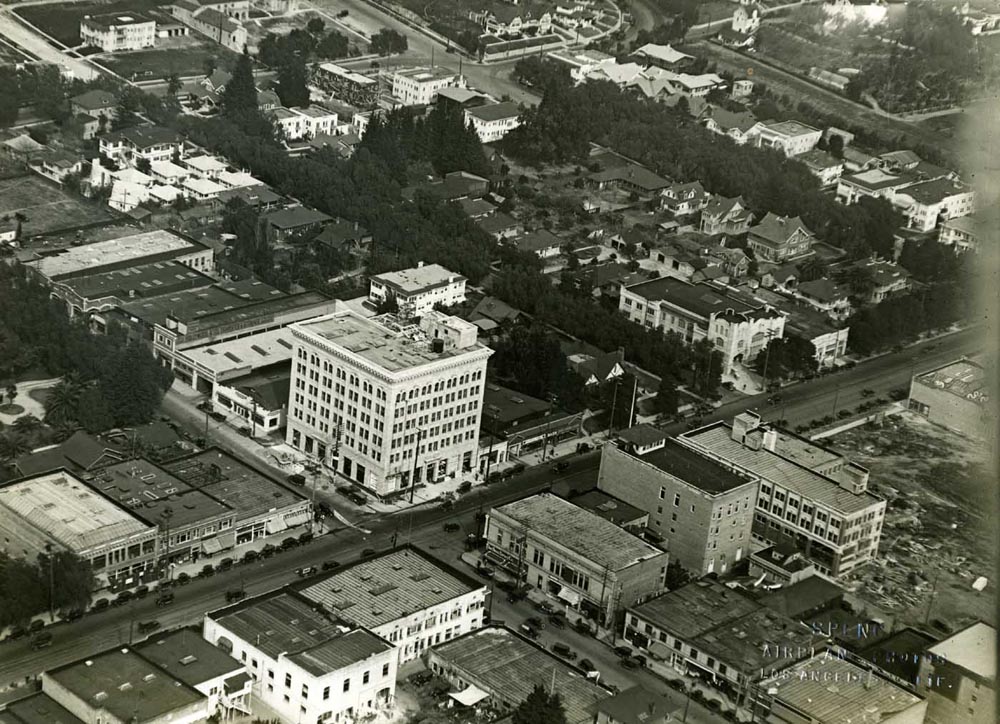
Just a quick post here about this aerial view taken in 1922 as the prominent Security Bank Building, at the NE corner of Hollywood Boulevard and Cahuenga, nears completion.  I could point out so many filming spots in this photo, but will limit it to just two.  Harold Lloyd’s runaway trolley stunt in Girl Shy (1924) (top oval), and Buster Keaton’s one-handed passing car grab in Cops (1922) (bottom oval). [Other Cops posts]

Click to enlarge.  Harold Lloyd swings from west on Yucca to south on Vine in Girl Shy.

Click to enlarge.  Buster Keaton grabs a passing car in Cops.  The alley still stands south of Hollywood Blvd.

HAROLD LLOYD images and the names of Mr. Lloyd’s films are all trademarks and/or service marks of Harold Lloyd Entertainment Inc. Images and movie frame images reproduced courtesy of The Harold Lloyd Trust and Harold Lloyd Entertainment Inc.

Cops licensed by Douris UK, Ltd.  Below, the Cops alley.  The building to the left was rebuilt in the 1930s, and today the alley is a bit more narrow.

Photo from HollywoodPhotographs.com

Posted in Buster Keaton, Cops, Girl Shy, Harold Lloyd, Hollywood Tour | Tagged , , , , , , , , , | 5 Comments

Chaplin, Arbuckle and The Rounders

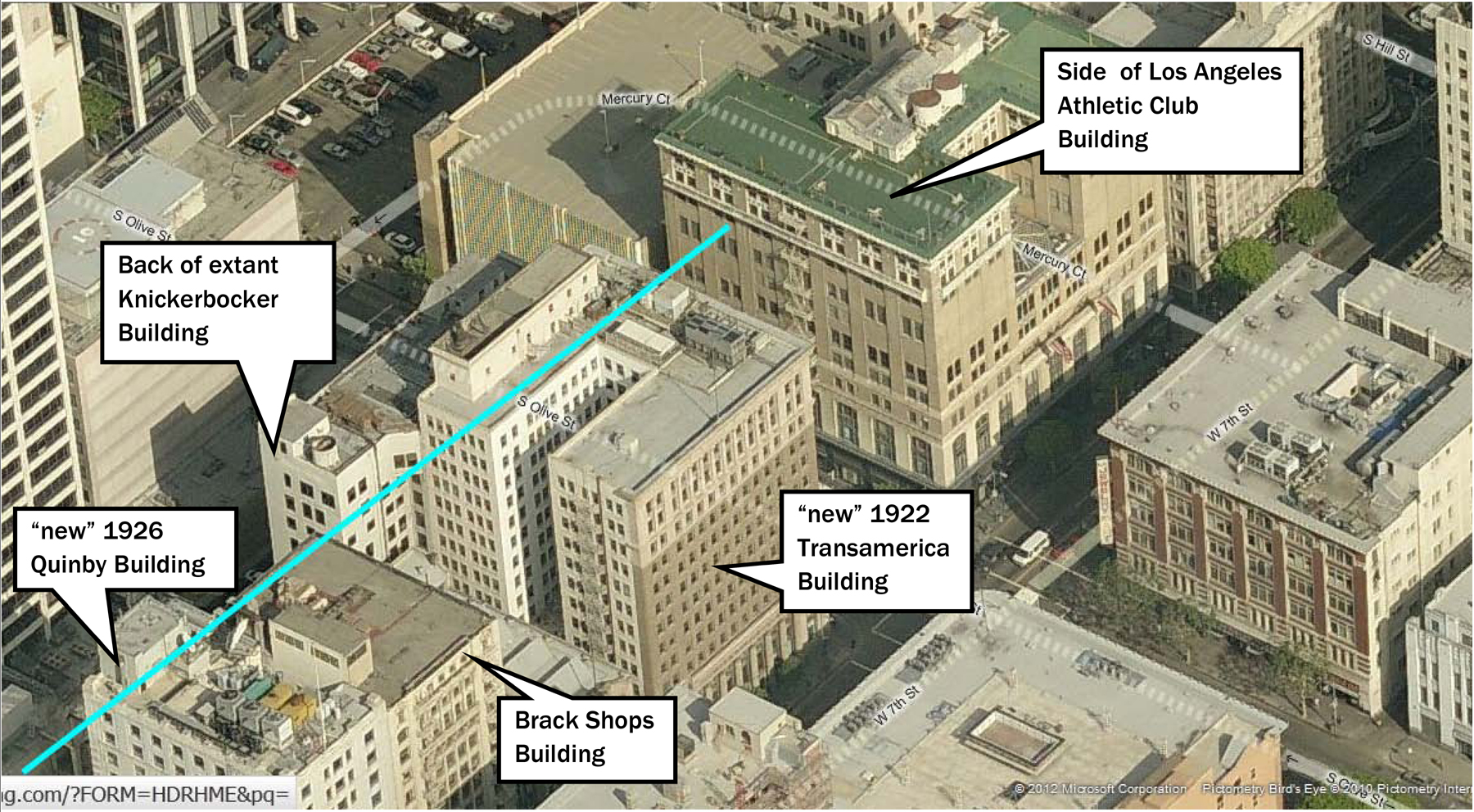
The blue line runs from the Rex Arms Apartments, at left, where Charlie and Roscoe play during The Rounders, to the Olive Street side of the LA Athletic Club to the right.   During scenes filmed at the Rex you can see a trolley travel along Figueroa (left oval), the original east termination of Wilshire Boulevard.  Wilshire was later was extended three blocks further east to Grand (right oval).  The right oval touches the pink Wilhelm Apartment, and yellow Casa Grande Hotel, both mentioned below. This image comes from the 1914 Baist Atlas of Los Angeles – HistoricMapWorks.com

All wet – Roscoe and Charlie

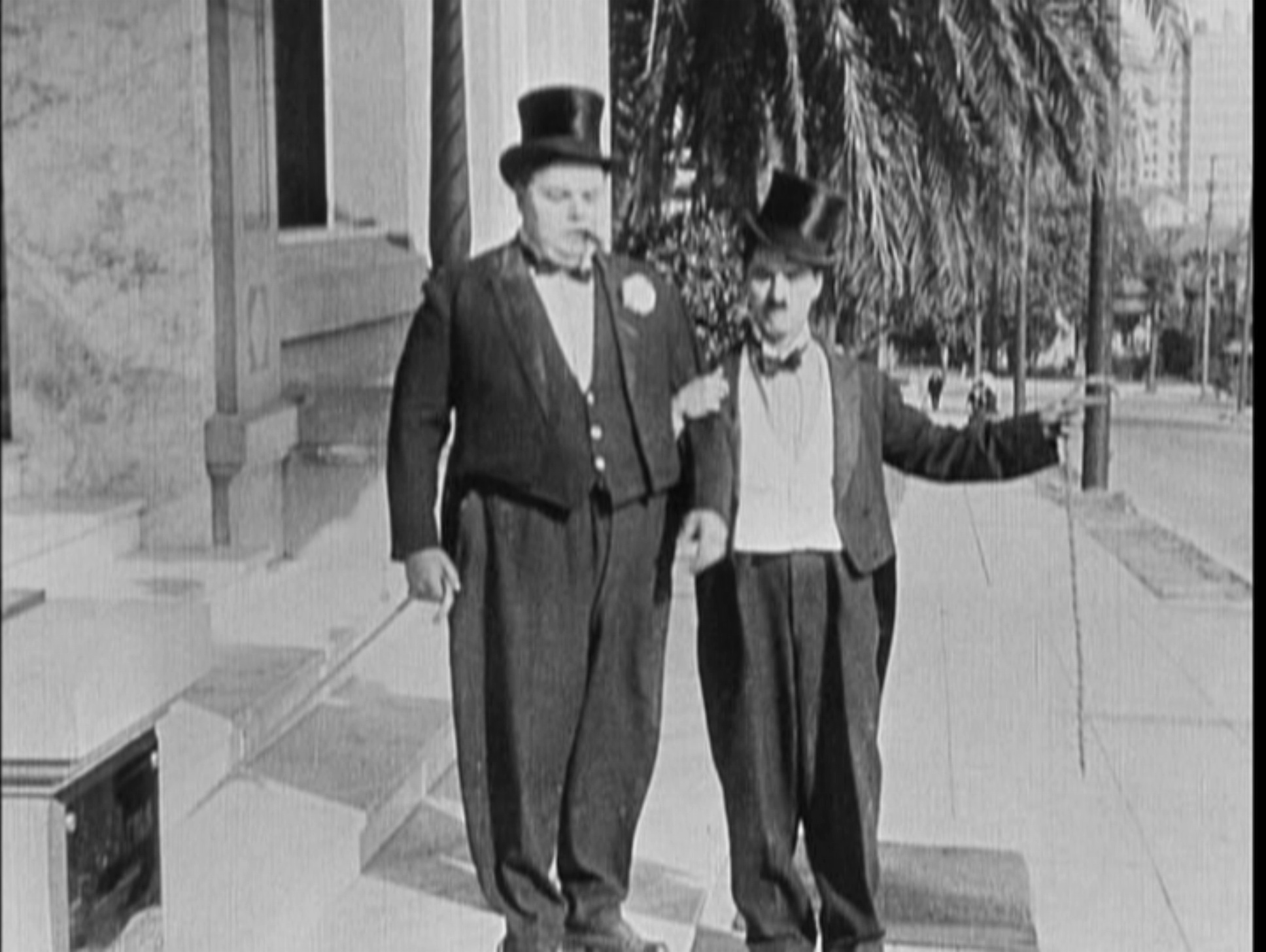
I’ve always enjoyed the comic interplay between Charlie Chaplin and Roscoe “Fatty” Arbuckle during their classic Keystone short The Rounders (1914).  Charlie and Roscoe play a couple of good time inebriates, or “rounders,” who empty their wives’ pocketbooks in order to finance another night out.  Much of the action takes place on the steps of the Rex Arms Apartments, as the gentlemen, and their wives, exit and enter the building.

Charlie on the steps of the now lost Rex Arms Apartments.  Notice the name plate and globe entrance lamps.

Rex Arms –               Apartments

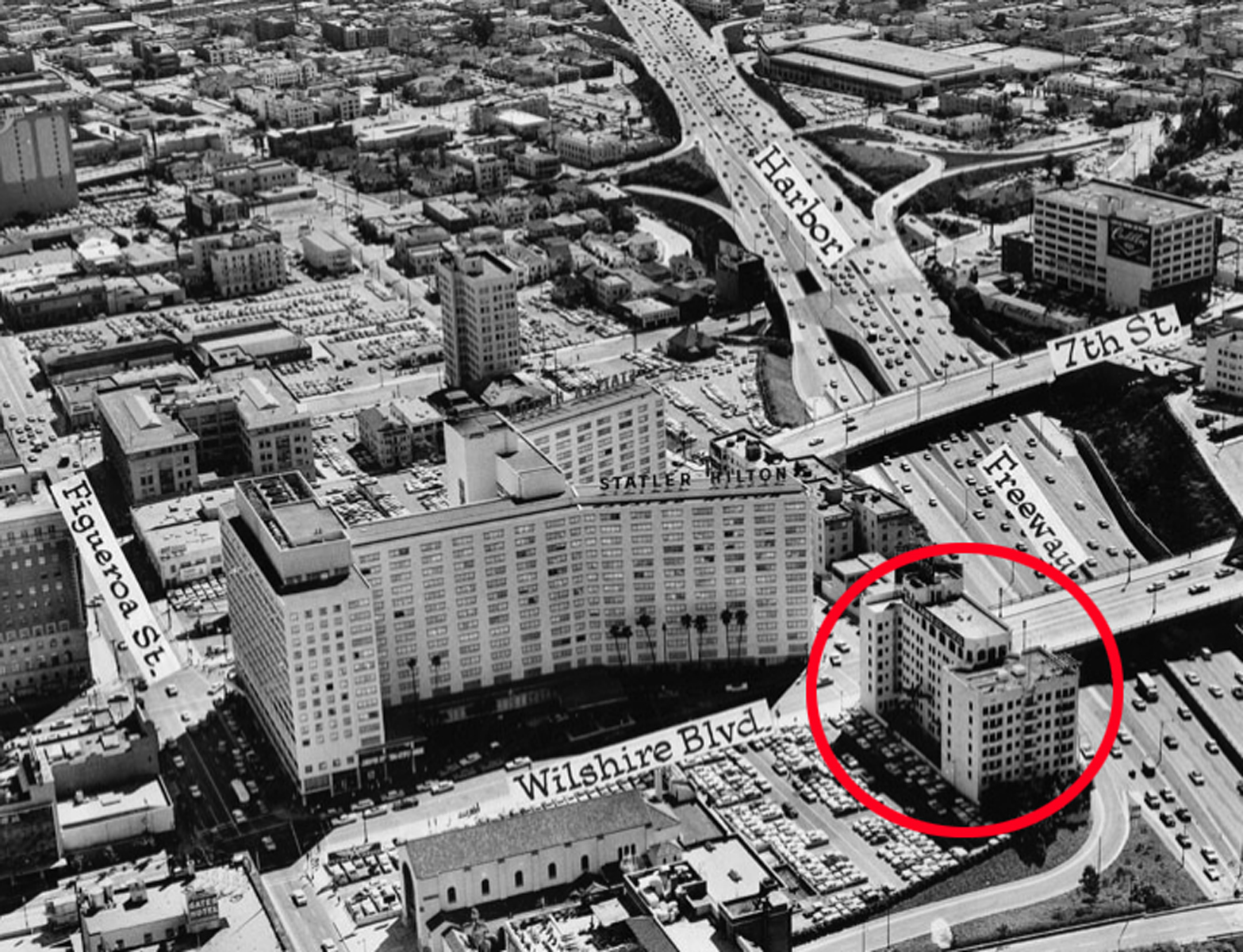
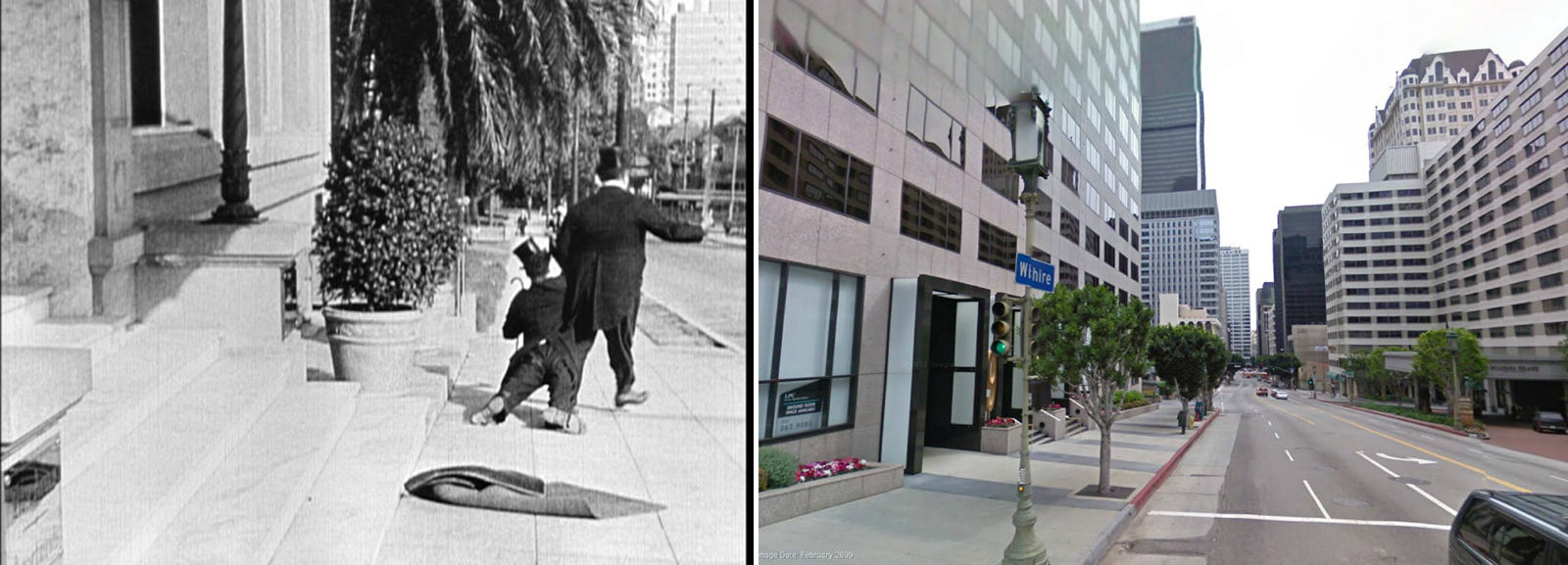
Built in 1912, the now lost Rex Arms was located at 945 Orange Street, just half a block west from the “T” intersection where Orange terminated at Figueroa.   Thanks to the image quality of the Chaplin at Keystone collection from Flicker Alley, I was able discern part of the brass name plate (see left).  Although the first word was ambiguous, it looked like the second word was “Arms.”  A quick search at the LA Public Library online city directories gave me the Orange Street address, but I was still baffled until I realized that Orange Street later became part of Wilshire Boulevard.  When The Rounders was filmed in 1914, Wilshire Boulevard terminated at the west side of Westlake Park (now MacArthur Park), and Orange Street, its symmetrical counterpart, commenced on the east side of the park.  When Wilshire was later extended through the park in the 1930s to hook up with Orange Street on the other side, the Orange name was subsumed into the Wilshire name.  Wilshire Boulevard was also later extended further east, three blocks closer to downtown, past Figueroa where Orange once ended, and now terminates at Grand Avenue.

The Rex Arms Apartments –  USC Digital Archive

The Rex Arms (oval) across from the 1,300 room Statler Hotel. Security Pacific National Bank Photograph Collection/Los Angeles Public Library.

The Harbor Freeway was built immediately adjacent to the Rex in the 1950s, but the apartment was spared, and stood a few more decades in the shadow of the massive Statler Hotel that opened in 1952.  With 1,300 rooms, the Statler was the largest hotel to open in the United States since the Waldorf Astoria in 1931.  As Steve Vaught writes in his blog Paradise Leased, the Statler will soon be demolished, a fate that befell the Rex Arms in 1978.  A 20+ story office building was built in place of the Rex in 1980.

Roscoe and Charlie – behind them, a view east towards downtown.

I know you can’t stop progress, but I was particularly disappointed to learn that the Rex Arms, the one building where Charlie and Roscoe had both appeared, was no longer standing.  I had really wanted to visit those same steps in person.  But I was gladdened by a further discovery.  After nearly a century, several downtown buildings that appear in the background of The Rounders are still holding on.

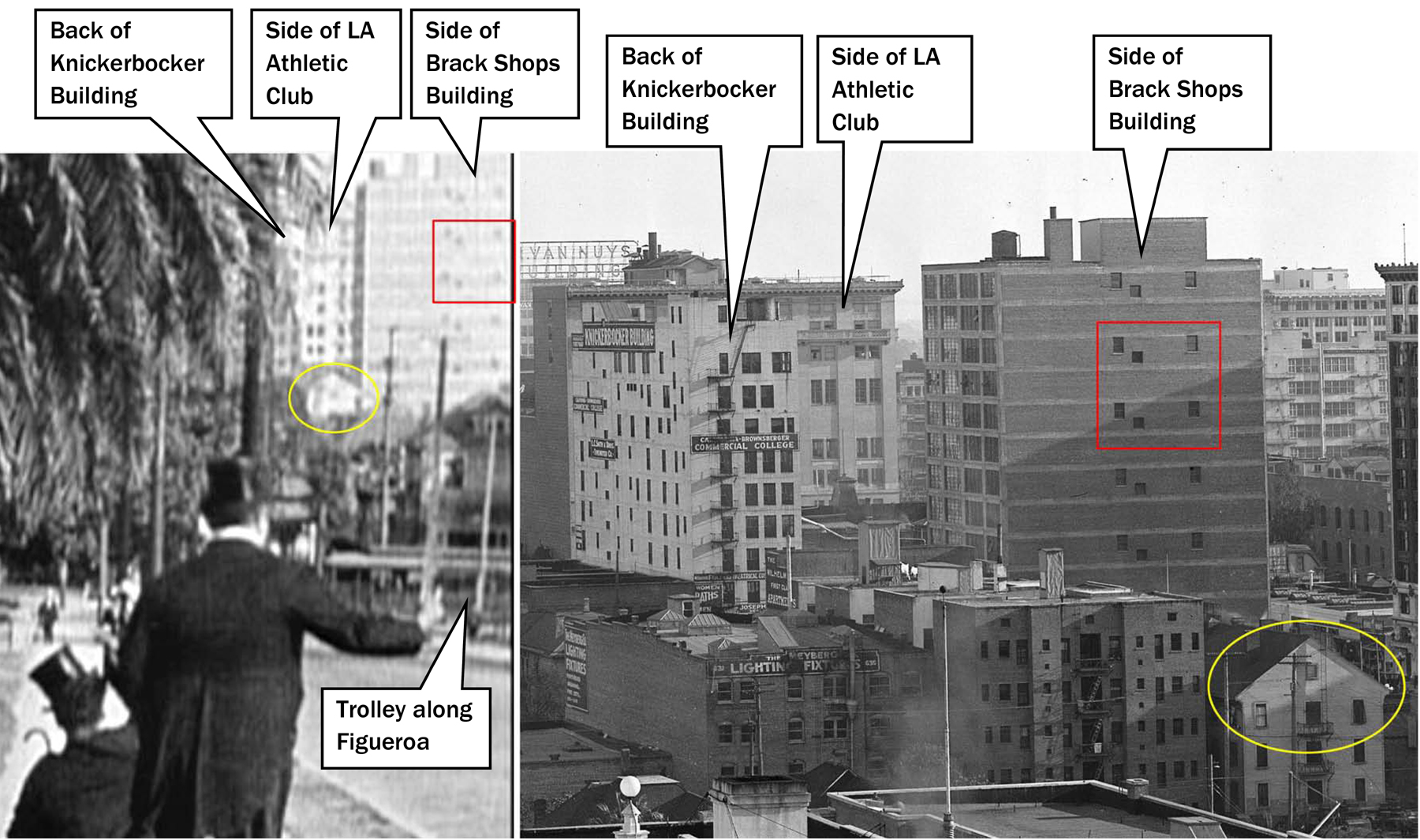
Click to enlarge.  As Roscoe drags Charlie east down Orange Street (now Wilshire Boulevard) towards the trolley crossing on Figueroa, three prominent, extant buildings from the downtown Historic Core appear in the background.  California Historical Society, Title Insurance and Trust Photo Collection, Department of Special Collections, University of Southern California

As Roscoe drags Charlie down the street, in the background you can see a trolley traveling along Figueroa, the street where Orange (Wilshire) once ended, as well as the downtown Los Angeles Athletic Club peeking from between the Knickerbocker Building and the Brack Shops Building.  For comparison, the red boxes above mark the side of the extant Brack Shops Building, at 527 West 7th Street, that stands in the middle of the block between Olive and Grand.  At the time the Brack Shops Building had no tall neighbors, so the exposed side of the building appears prominently during the movie.  The yellow oval marks the back of the Hotel Casa Grande, a wooden boarding house that once stood at 647 S. Grand, to the right of the former Wilhelm Apartments at 639 S. Grand.

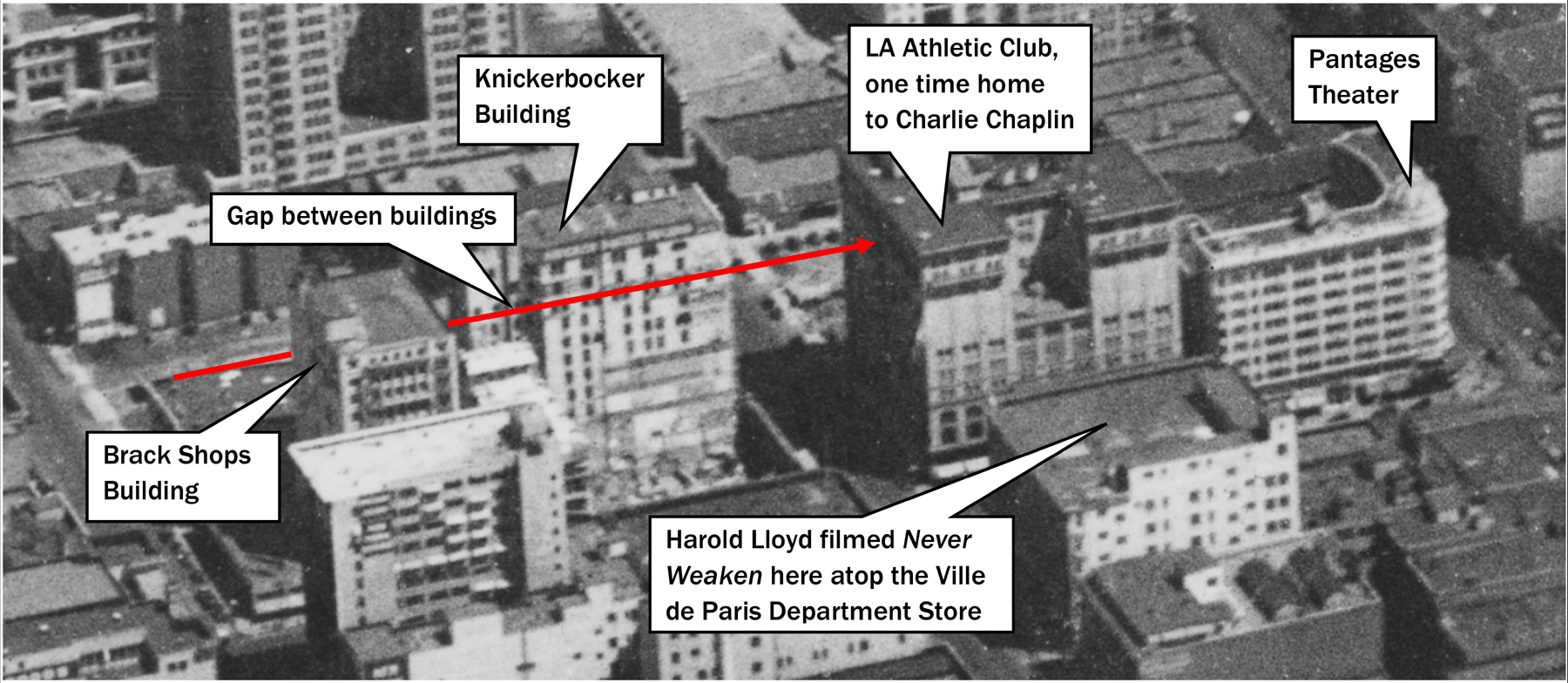
The arrow marks the line of sight from the front steps of the Rex Arms, passing between the Brack Shops Building and the Knickerbocker Building to the side of the LA Athletic Club on the corner of Olive and 7th.  Security Pacific National Bank Photograph Collection/Los Angeles Public Library.

Above, a circa 1921 aerial view shows the view line from the Rex Arms towards the Los Angeles Athletic Club, that opened in 1912, and is still standing at the corner of Olive and W. 7th.  At the time, there were no tall buildings next to the Knickerbocker Building, nor near the Brack Shops Building, allowing an unobstructed view of the club between the buildings.

Aerial view (c) 2011 Microsoft Corporation, Pictometry Bird’s Eye (c) 2010 Pictometry International Corp.

As this modern view shows, the Knickerbocker, Brack, and LA Athletic Club buildings are all still standing, but during the intervening years the Quinby Building at the corner of Grand and 7th now blocks the side view of the Brack Shops Building, and the Transamerica Building, at the corner of Olive and 7th, now blocks the side view of the Athletic Club.

Below, Roscoe drags Charlie off into the sunset, with matching views taken nearly 100 years apart.

(C) 2012 Google

Chaplin at Keystone: Copyright (C) 2010 by Lobster Films for the Chaplin Keystone Project.

Check out these other posts about Chaplin’s early Keystone filming.
Posted in Charlie Chaplin, Los Angeles Historic Core, Roscoe Arbuckle | Tagged , , , , , , , , , , , | 10 Comments

A Tale of Two Train Wrecks (and One Airport) – by Buster Keaton

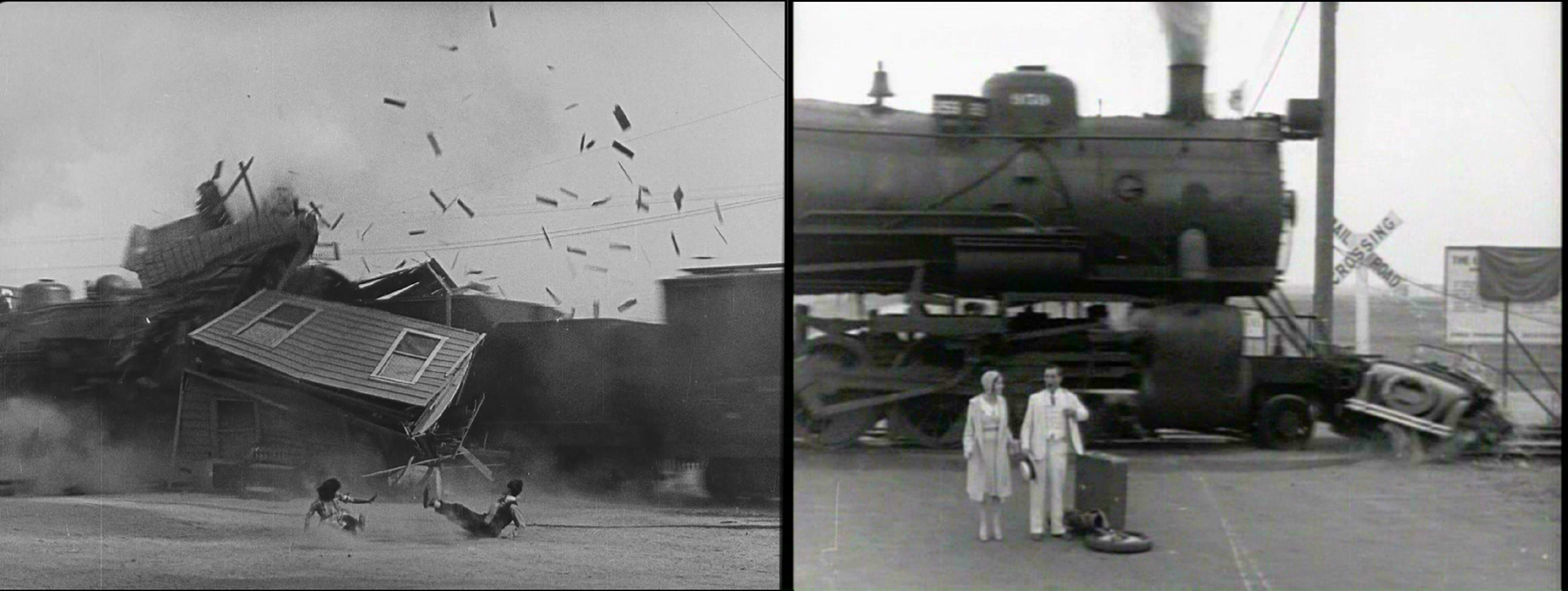
Train crashes from One Week in Inglewood (left), and Parlor, Bedroom and Bath at the future site of LAX (right).

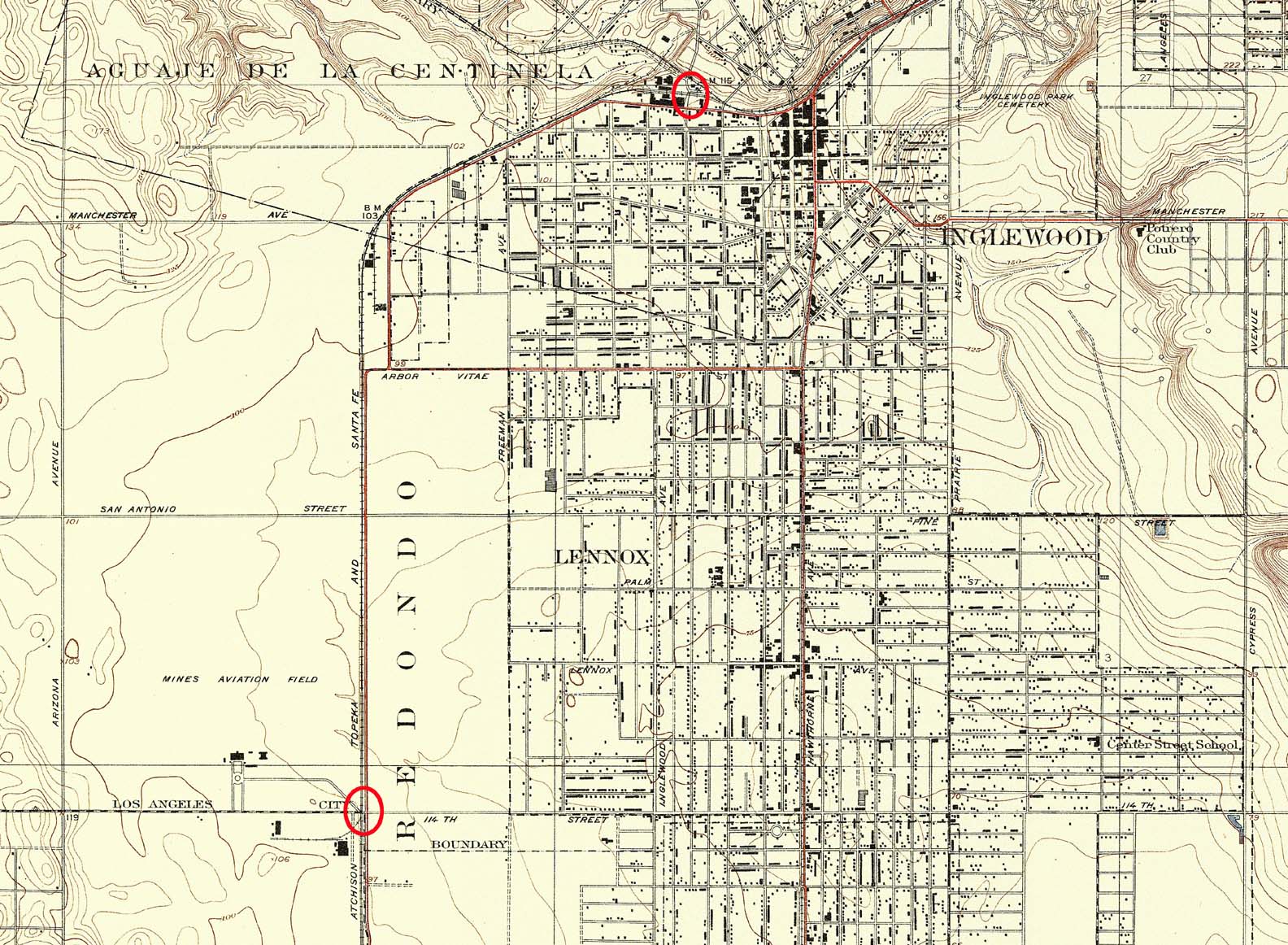
Buster Keaton’s debut film One Week (1920) was hailed as the comedy sensation of the year.  It ended with a powerhouse one-two gag that still wows audiences today.   Buster attempts to move his newly built home which becomes stuck at a train crossing.  A train from the east barrels down on the house, but passes safely by on a parallel track, disaster averted.  Two beats later, as Buster and the audience breath a sigh of relief, a train from the west plows right through the home, completely demolishing it.  The crash was staged in Inglewood, as I report in great detail in my book Silent Echoes, and in this prior post showing the Inglewood station.   Keaton repeated the joke eleven years later in his 1931 MGM talkie feature Parlor, Bedroom and Bath (available for viewing at the 36:00 mark here at the Internet Archive), and on DVD from the Warner Archive Collection.   In this version (see above) Buster’s small roadster breaks down on the tracks, and is spared by a southbound train before a northbound train does it in.  As shown below, the two crash scenes were filmed on the same rail line, a few miles apart.
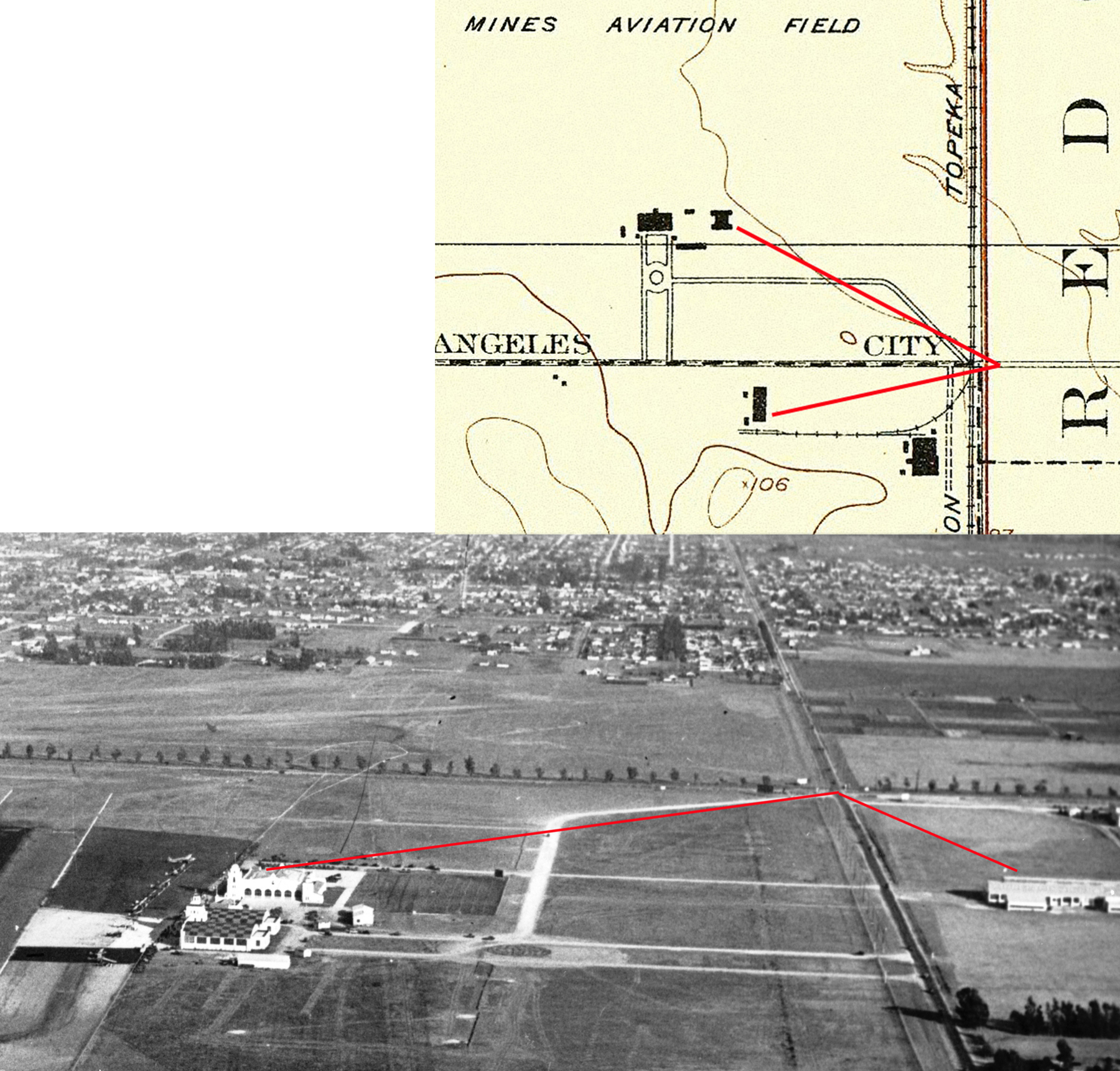
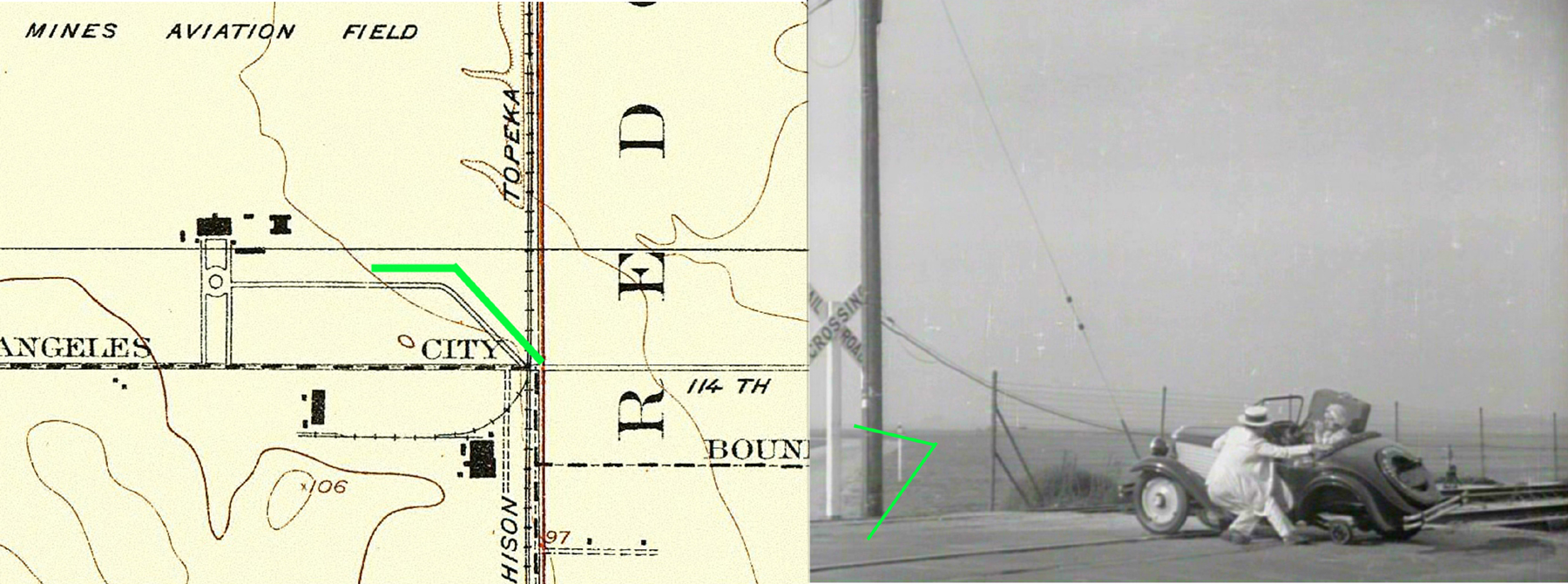
Click to enlarge 1930 map.  The upper oval in Inglewood marks the One Week train crash, the lower oval near Mines Aviation Field (future home to LAX) marks the Parlor, Bedroom and Bath train crash.  The long stretch of train tracks running north-south, and the frontage road running parallel to the tracks, was a popular spot to film locomotive chases for movies such as Intolerance (1916) and Barney Oldfield’s Race for a Life (1913).

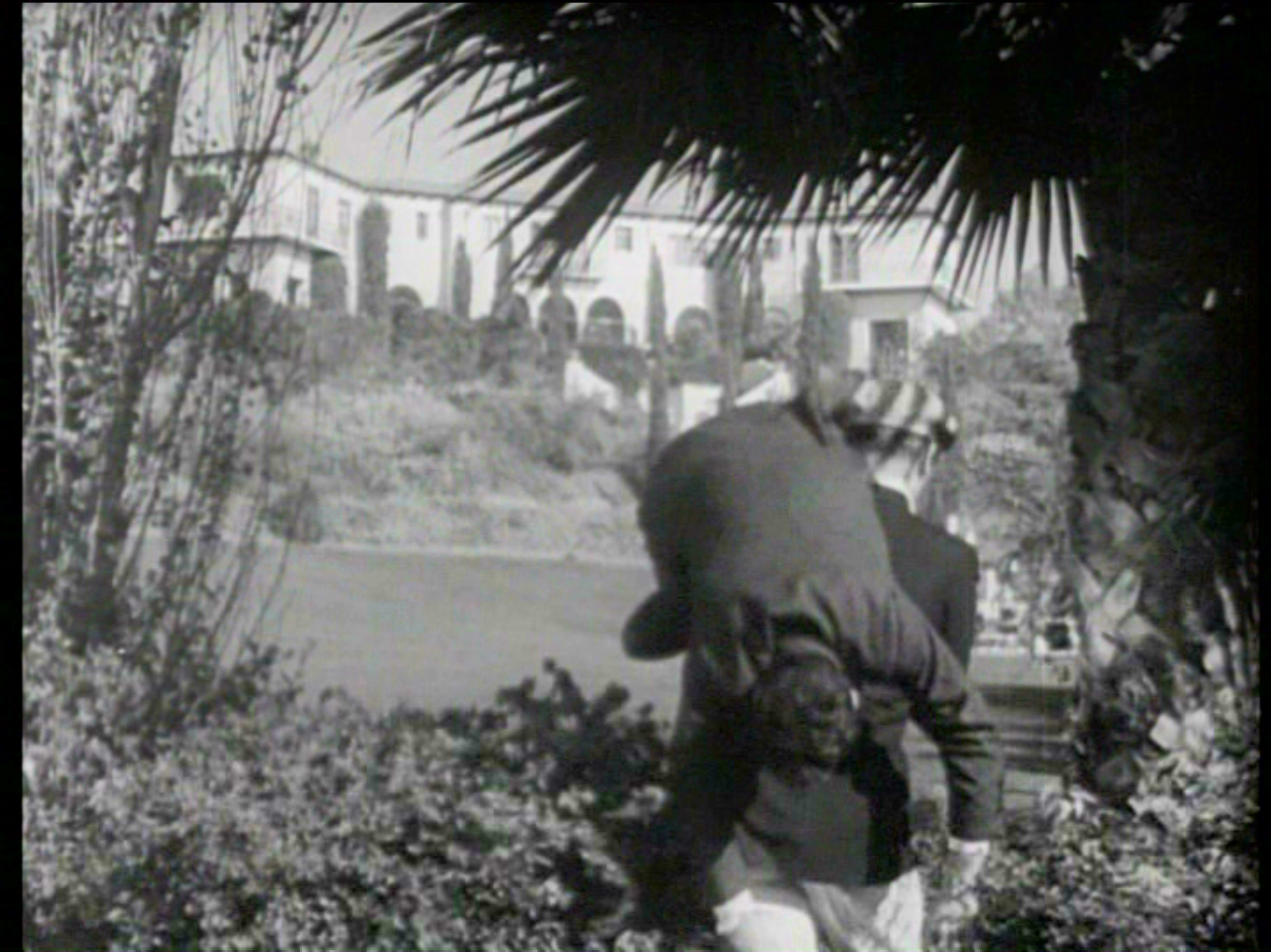
Reginald Denny carries an unconscious Buster towards Keaton’s actual home, The Italian Villa, used as a location for Parlor, Bedroom and Bath.

Parlor, Bedroom and Bath is a silly bedroom farce, and as far-removed from Keaton’s classic-style silent comedies as one can imagine.  Still, if you can accept it on its own terms, the movie is really quite enjoyable.  Buster plays a “never been kissed” bumpkin who is mistaken by the society crowd as a great lover.  The final third of the film takes place at a hotel where Buster woos a series of women in rapid succession, and is caught with each conquest by an increasingly impressed bell hop, played by Cliff Edwards (the future voice of Jiminy Cricket).  Despite the screwball plot, the train crash sequence from Parlor, Bedroom and Bath is cited by film scholars as an example of how Keaton could successfully introduce visual gags into his talking pictures when given the chance.  The movie is also noteworthy because Buster’s actual home (The Italian Villa, at 1018 Pamela Drive in Beverly Hills), appears as the high society playground where Buster meets the other characters. Aside from re-working one of Keaton’s best gags, what is also interesting about the Parlor, Bedroom and Bath crash scene is that it was filmed at the southeast corner of the former Mines Aviation Field, the future home to LAX, the Los Angeles International Airport.  Buster’s camera captured rare views of this wide-open landscape at the dawn of the aviation age.

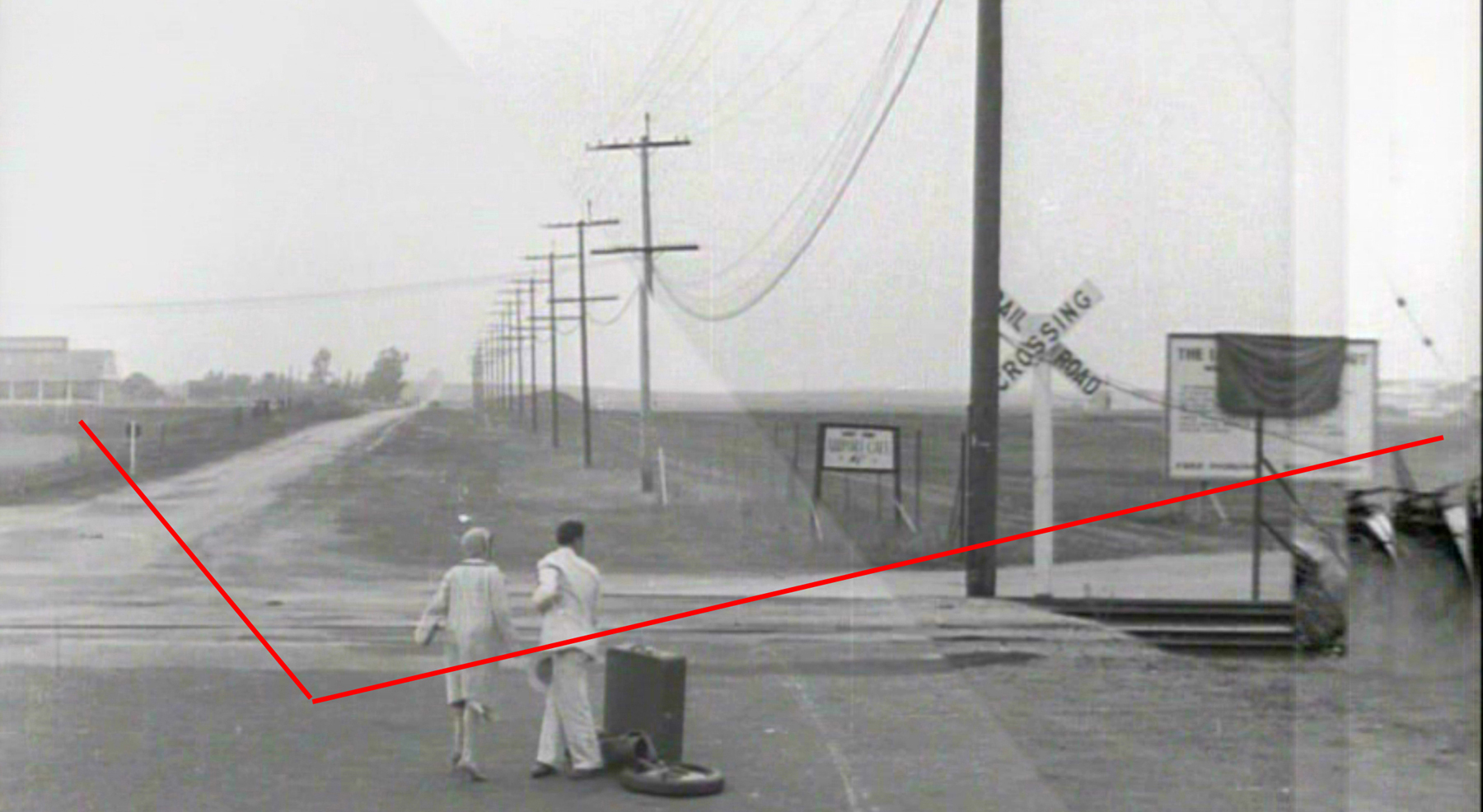
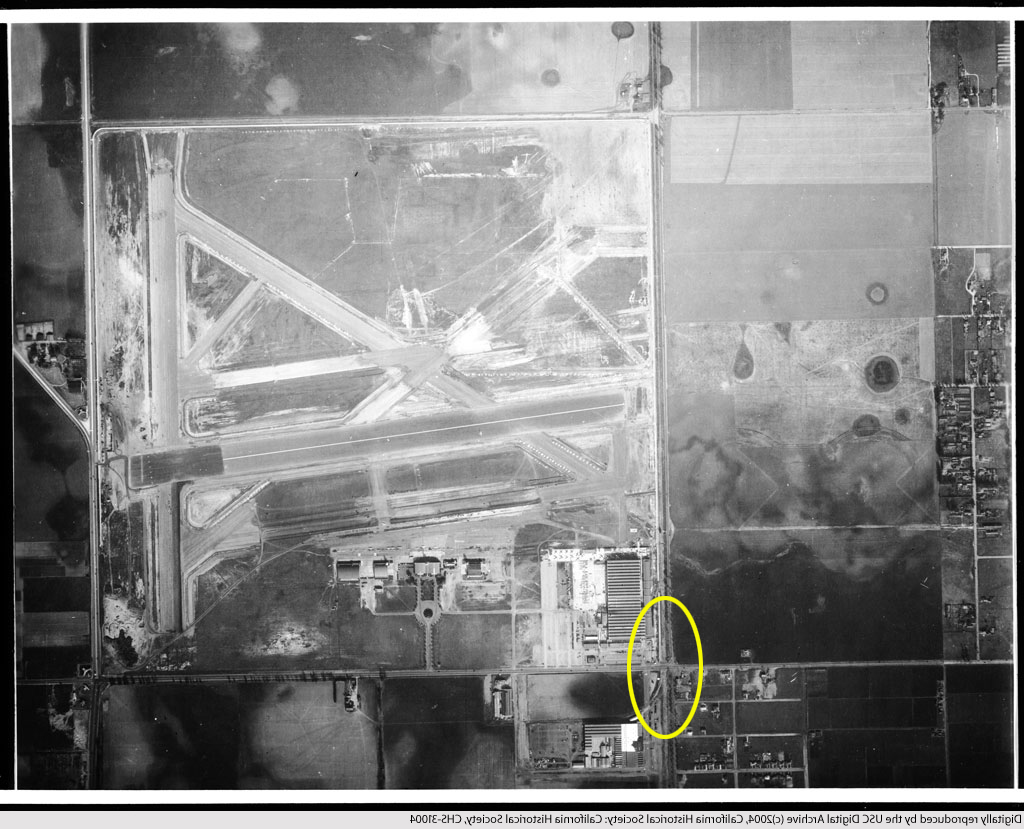
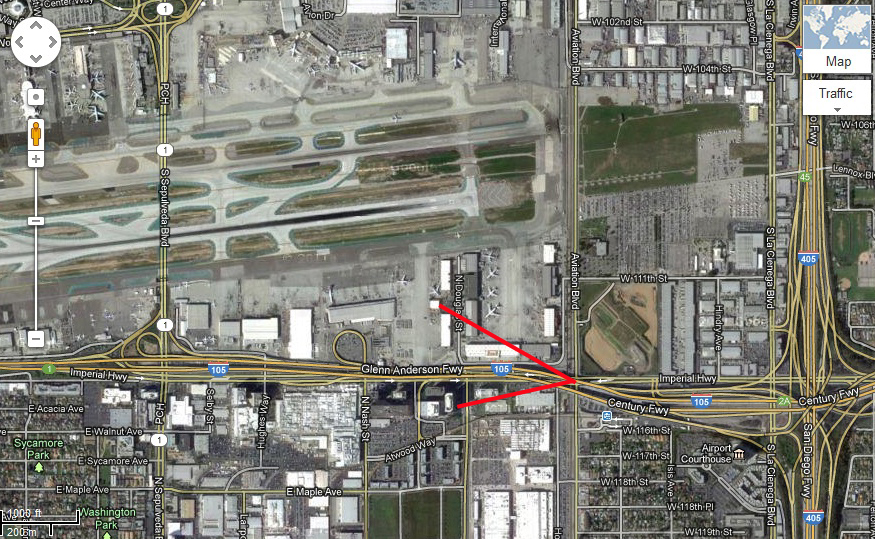
In the photo (looking east) the AT&SF train tracks run left to right, crossing Collingwood Street where the red lines meet.  The red lines mark the field of view visible during Keaton’s crash scene, as shown below.  The left red line points to the Mines Aviation Field east hangar, still standing, and the right red line points to the former Moreland Aircraft factory, both appearing in the film.  USC Digital Archive (c) 2004 California Historical Society

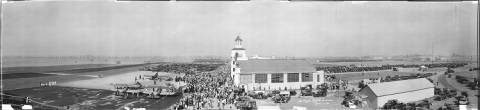
As shown on the above map and photo (both circa 1930), Buster’s car stalled where Collingwood Street (later 114th Street, and now W. Imperial Highway), running east-west, crosses the AT&SF rail line that runs north-south parallel to Redondo Boulevard (now Aviation Boulevard).   Mines Field, a former hayfield, was officially dedicated as Los Angeles Municipal Airport on June 7, 1930.  Mary Pickford reportedly made the formal dedication.

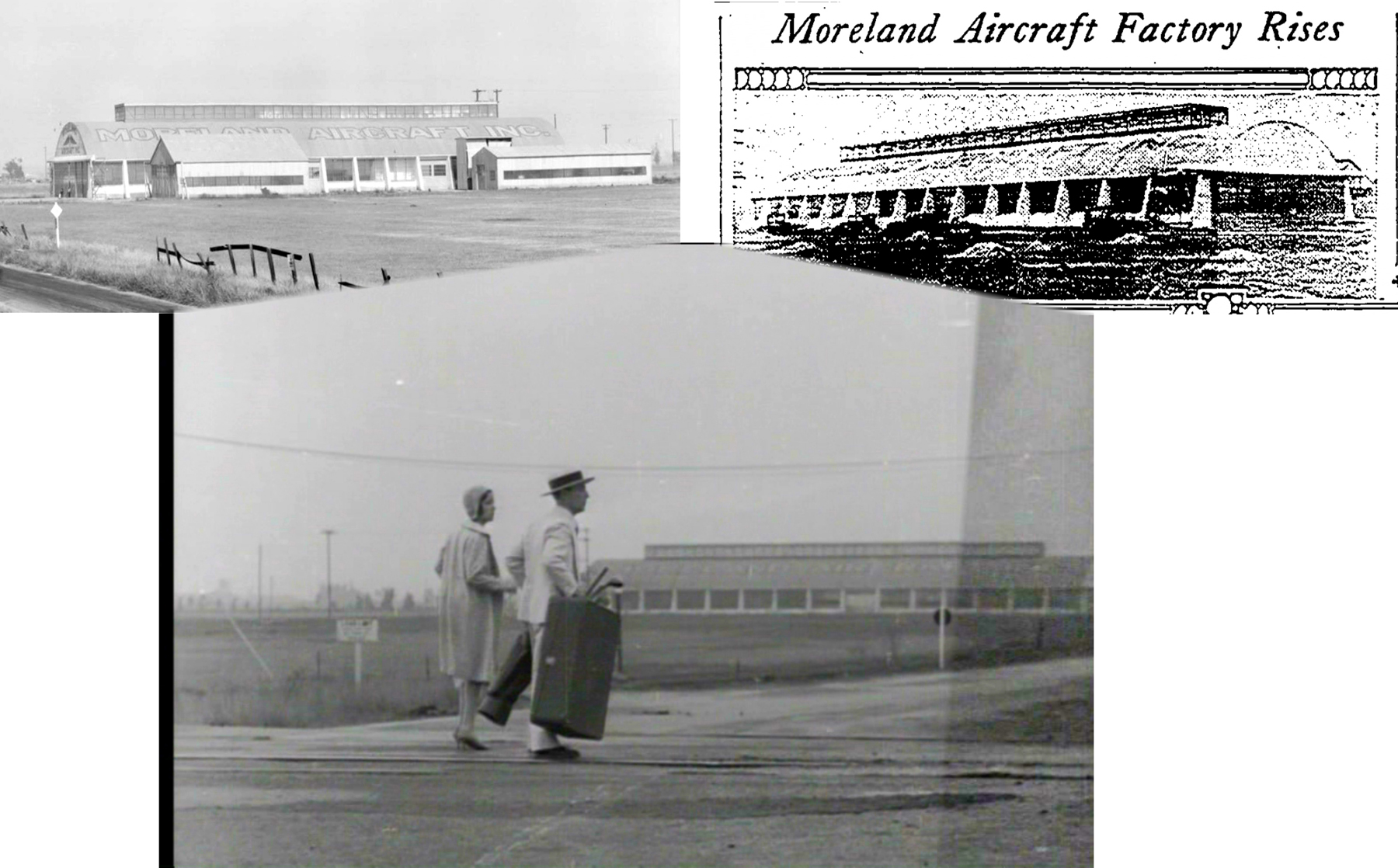
This view to the SW, after the car is demolished, looks to the Moreland Aircraft factory that opened in 1929 along what is now N. Douglas Street. The factory fell victim to the Great Depression, and closed in 1933. Upper left, view of the back – Huntington Digital Library, upper right, view of the front – Los Angeles Times Copyright 1929.

Above, Buster and actress Joan Peers set off on foot west down what is now the W. Imperial Highway after a train demolishes their car.  Behind them stands the former Moreland Aircraft factory.  Below, another aerial view of the train crash setting, this time taken during an airshow at Mines Field.

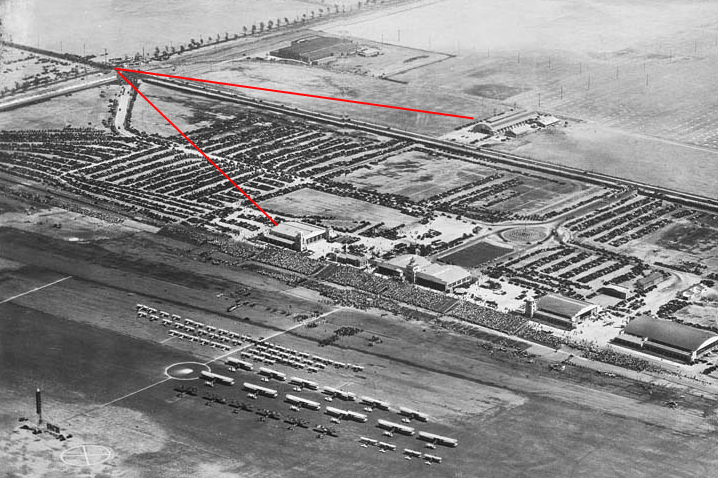
The train crash setting, this time looking to the SE during an air show at Mines Field.  Notice the packed grandstands, and the fields filled with parked cars.  USC Digital Archive (c) 2004 California Historical Society.

As Buster struggles to free his car you can see the airfield access road jog to the left (west).

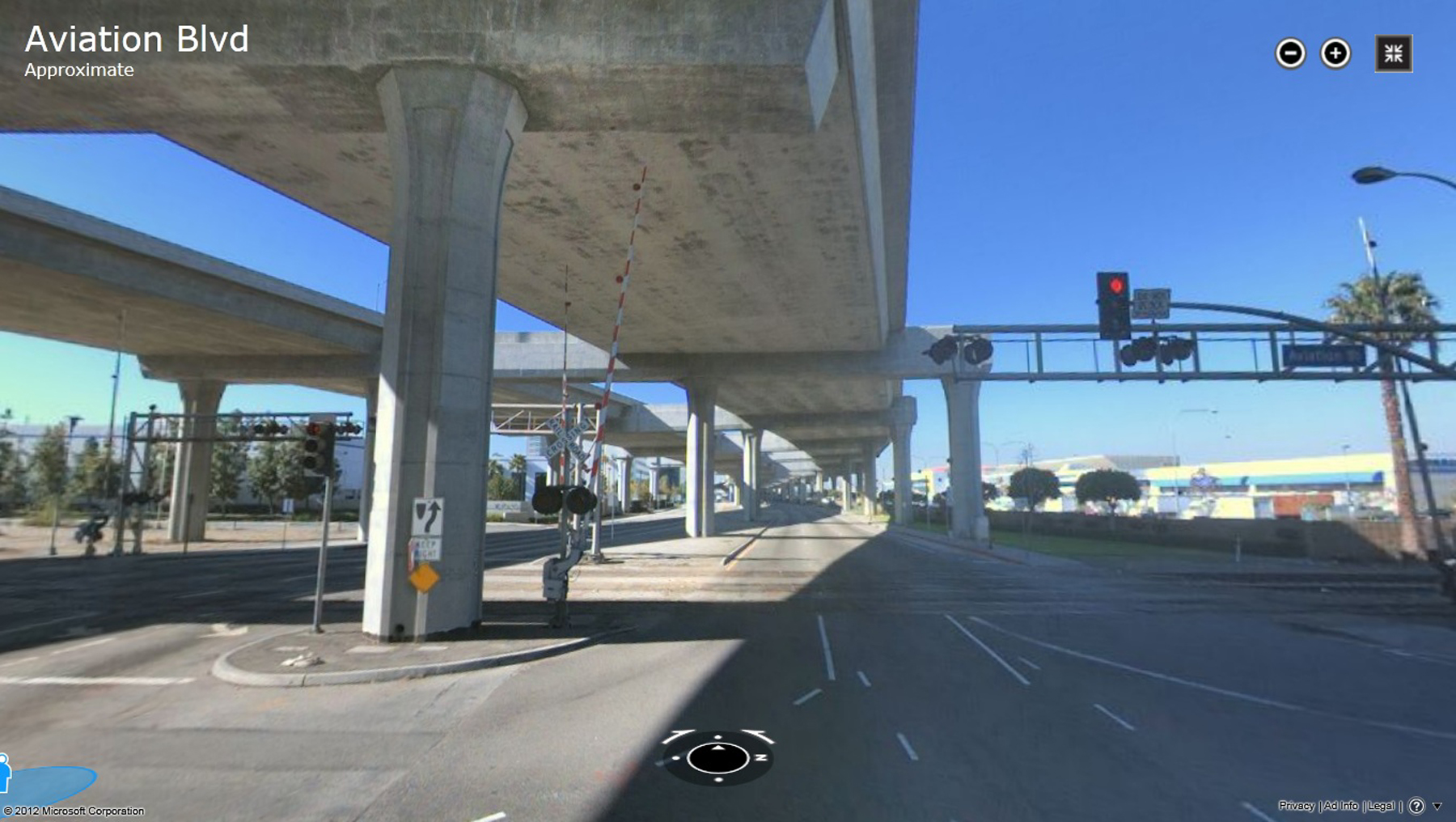
Below, a panorama looking west down the W. Imperial Highway from Aviation Boulevard – the red lines correspond to those on the photo and map above.  To avoid possible distraction, the large sign in the background, probably announcing the opening or further development of the new airport, is covered with a cloth.  As I explain in my book, while filming Neighbors (1920) Buster put a paper bag on a real street sign for the same reason.  The right edge of this panorama was made from narrow slices of clear view in front of the advancing train as the camera panned from left to the right.

1931 – view west down W. Imperial Highway from Aviation Boulevard.

2012 – view west down W. Imperial Highway from Aviation Boulevard.  (C) 2012 Microsoft Corporation.

Below, the extant east hangar airport building made a prior appearance on film during Feet First, Harold Lloyd’s 1930 talkie re-make of Safety Last!, during a scene where Harold stows away in an airmail delivery sack.

Above, Harold Lloyd’s plane lands at Mines Field in Feet First.  Lower left photo -National Register; modern day photo Julius Yang.
Below,  comparable aerial views of 1939 and today, with red field of view lines in the color images corresponding to the map and images above.

USC Digital Library

Note – this image is properly oriented, but was once reversed on the archive site. USC Digital Library.

The upper red line points to the still extant east hangar building. The Moreland building has long since been demolished. (C) 2012 Google.
For amazing, high detail panoramic photos of the June 7, 1930 opening of the Los Angeles Municipal Airport, check out these images from the Huntington Digital Library: view one, view two, and view three.  Be sure to zoom in to see all of the details. Jerry Miles has put together a YouTube video of historic images of Mines Field that you can view here. Parlor, Bedroom and Bath (C) 1931 Turner Entertainment Co.  One Week licensed by Douris UK, Ltd.  HAROLD LLOYD images and the names of Mr. Lloyd’s films are all trademarks and/or service marks of Harold Lloyd Entertainment Inc. Images and movie frame images reproduced courtesy of The Harold Lloyd Trust and Harold Lloyd Entertainment Inc. You can read more about the early history of LAX here, and about the east hangar, the first structure built at Mines Field, known as Hangar One, here.

annex-keaton-buster-parlor-bedroom-and-bath_01

The cloth covering the airport sign has been removed – DoctorMacro.com

Posted in Buster Keaton, One Week | Tagged , , , , , , , , , , , , , , | 18 Comments

Bones of the Past – the Bones TV Pilot and Buster Keaton

The Bones pilot episode – Dr. Temperance Brennan and Special Agent Seeley Booth begin to pull over to the curb along Pennsylvania Avenue, at 4th Street NW, with the US Capitol and the National Gallery of Art in view,  and complete their parking maneuver beside the Plaza Fire House at the El Pueblo de Los Angeles Historic Monument, on Los Angeles Street, with the tower of Los Angeles City Hall peeking overhead in the background.

Since my daughter has been enjoying the Fox Network crime drama Bones on Netflix, I thought I’d check out the pilot to see what the show was about.  Ostensibly set in Washington DC, the show teams up socially awkward forensic anthropologist Dr. Temperance Brennan with FBI Special Agent Seeley Booth, who relies more on his interpersonal skills and intuition to solve crimes.

Buster Keaton fleeing the police in The Goat.

I turned on the pilot episode, and began settling in, watching the lead characters bicker as they pulled their car over to the side of the road.  Suddenly, through the magic of film editing, the action jumped from the streets of Washington DC to the streets of Los Angeles with a single cut, jolting me from the couch.  While chuckling at the audacity of the show’s producers in daring to match shots filmed on different coasts, it dawned on me what was truly humorous – that my devotion to spotting vintage movie locations often prevents me from being completely drawn into compelling shows.

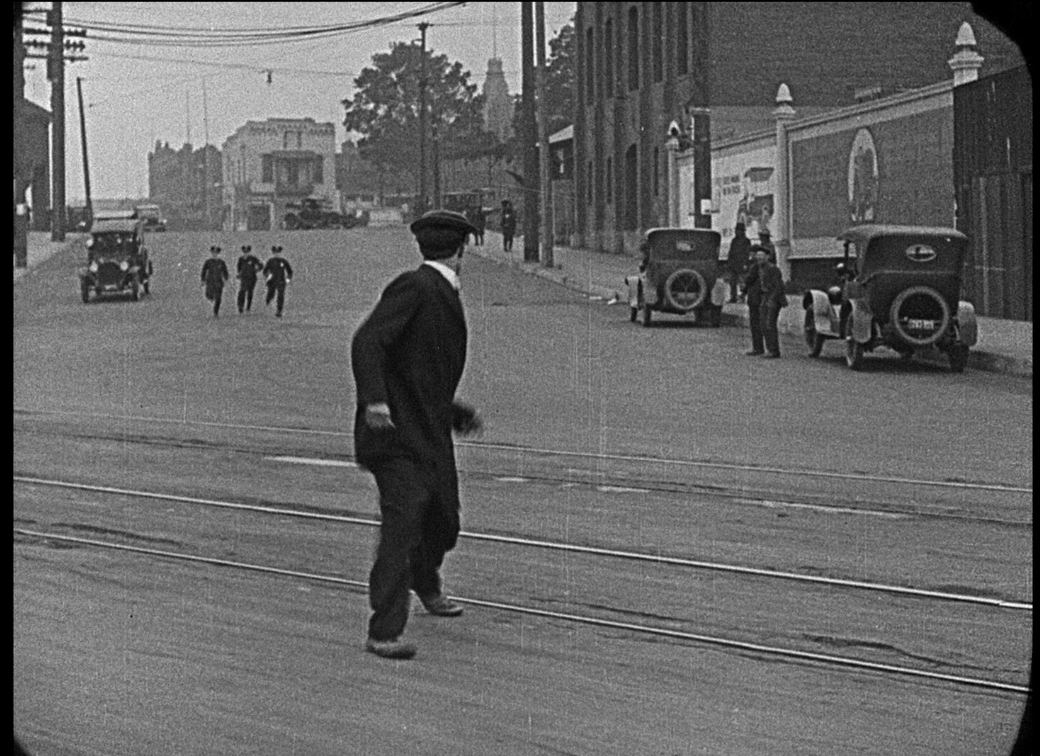
In my defense, it was hard for me not to notice the first Los Angeles exterior to appear in the show, as it was Plaza Firehouse, built in 1884 on the west side of the Plaza de Los Angeles.  The firehouse appears below during a scene from Buster Keaton’s 1921 short comedy The Goat.  The firehouse had been a challenging location to track down, and thus was burned into my memory.   

At top, Dr. Brennan and Special Agent Booth park their car beside the fire house in 2005.  Above, the fire house, then painted white, appears at the back center as Buster stares south down Los Angeles Street towards some fast approaching cops.   The large tree stands in the Plaza de Los Angeles.  The tower at the right background belonged to the former Baker Building on Main Street, now lost, a prominent early Los Angeles landmark.

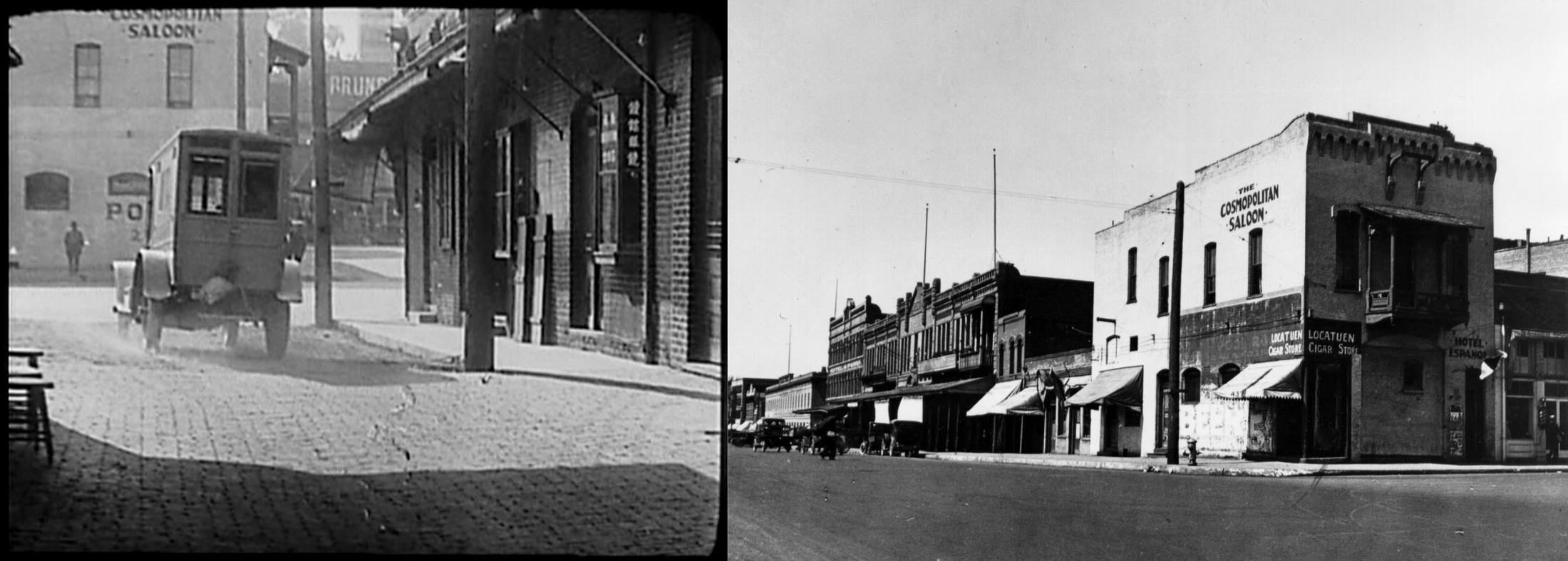
At the time Keaton filmed here in 1922, the fire house, then painted white, had been home to the Cosmopolitan Saloon, shuttered by Prohibition.   The fire house-saloon appeared in the 1916 immigrant drama, Gretchen the Greenhorn, starring Dorothy Gish (see below).

At left, the side of the fire station (then the Cosmopolitan Saloon) as it appeared in the 1916 Dorothy Gish immigrant drama Gretchen the Greenhorn, and at the right as it appeared in 1920.

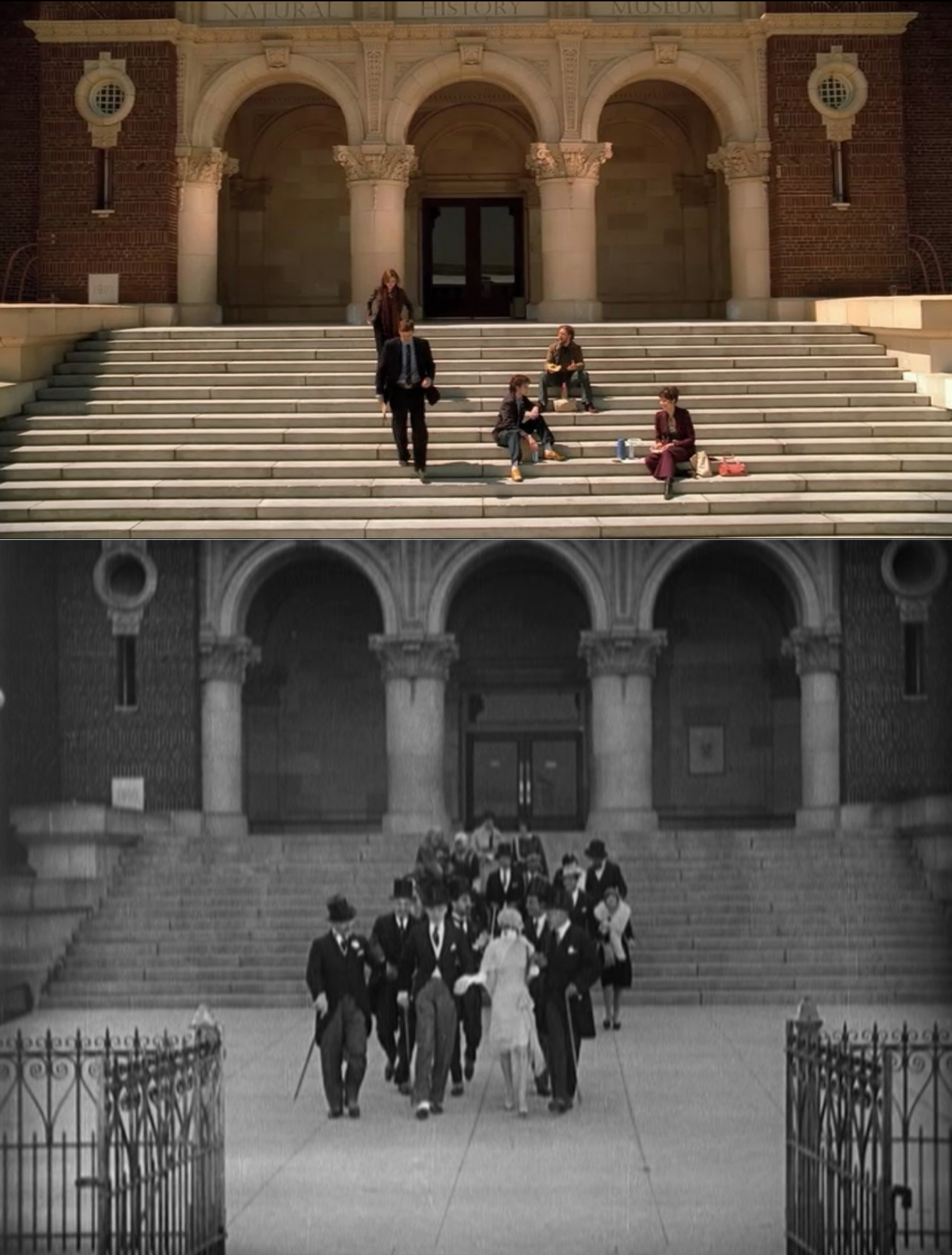
The next surprise in the show came moments later.  Dr. Brennan works at the fictional Jeffersonian Forensics Institute, supposedly set in Washington DC, but in reality filmed at the Los Angeles Natural History Museum in Exposition Park.  And yes, you guessed it, Buster Keaton had filmed there before too, for scenes from his 1927 campus comedy College, discussed in further detail at this post, and for this opening scene below from his final silent comedy Spite Marriage (1929).  As explained in this other post, Harold Lloyd filmed scenes from The Freshman (1925) here as well.

At top, Dr. Brennan follows Special Agent Booth down the steps of the “Jeffersonian Institute,” also the site of this early scene from Keaton’s feature comedy Spite Marriage.

For good measure, the pilot episode of Bones has a scene filmed on historic Carroll Avenue located in Los Angeles east of Echo Park.  Of the dozens of comparable residential streets that once graced Bunker Hill, Court Hill, and other lost neighborhoods, Carroll Avenue is one of the few Victorian-era streets to remain remarkably unchanged.  A goldmine for location scouts, Carroll Avenue has appeared in countless movies, including the 2011 biopic J. Edgar.  Notice below that the distinctly non-Washington DC area palm trees have been digitally removed from the shot to the left appearing in the Bones pilot.

At left, Brennen and Booth leave the home of the murder victim’s parents, located at 1316 Carroll Avenue in Los Angeles, and as seen on Google Street View to the right.  Carroll Avenue also portrayed a residential neighborhood of Washington DC in the 2011 Clint Eastwood-directed biopic J.Edgar.  The home at 1337 Carroll Avenue was used to portray the home Hoover shared with his mother.  Copyright 2012 Google.

It struck me while writing this post how the layers of history pop up everywhere, waiting to be discovered.   The fictional character Dr. Brennan can find a story hidden in the skeletal remains of a crime victim.  Yet as we see here, the vehicle for telling Dr. Brennan’s story, the pilot episode for the show itself, contains a similar hidden story.

Location filming has been staged in Los Angeles now for well over a century.  The Plaza Fire House appeared on film as early as 1916 (and likely much earlier), and continues to fill the background of film productions even today.  As time advances, our popular entertainment, film and television, will become increasingly dense with vestiges of the past, as long as we take the time to look.

Bones – Copyright (C) 2005 Twentieth Century Fox Film Corporation; Spite Marriage – Copyright (C) 1929 Turner Entertainment Co.; The Goat licensed by Douris UK, Ltd.

Posted in Buster Keaton, The Goat, TV Shows | Tagged , , , , , , , , , , , , , | 11 Comments

Hollywood 1926 – The Big Picture and How the Pieces Fit

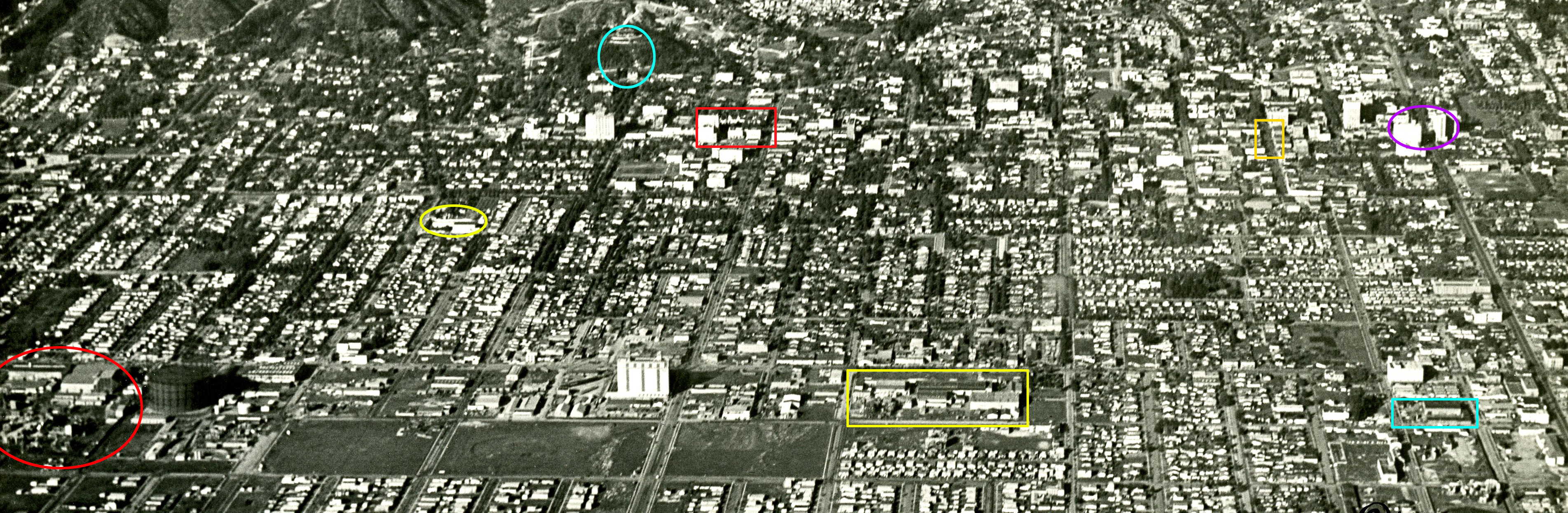
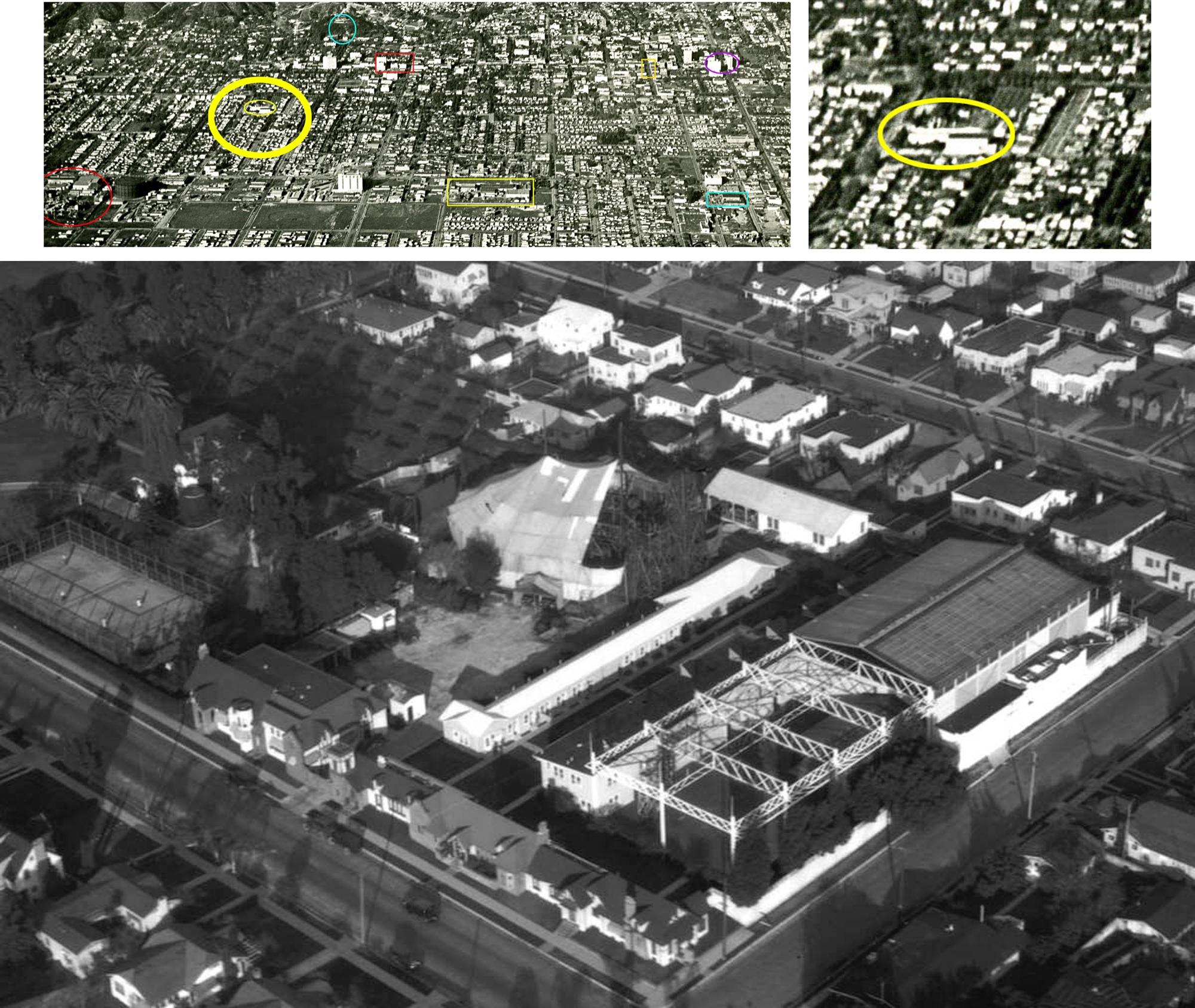
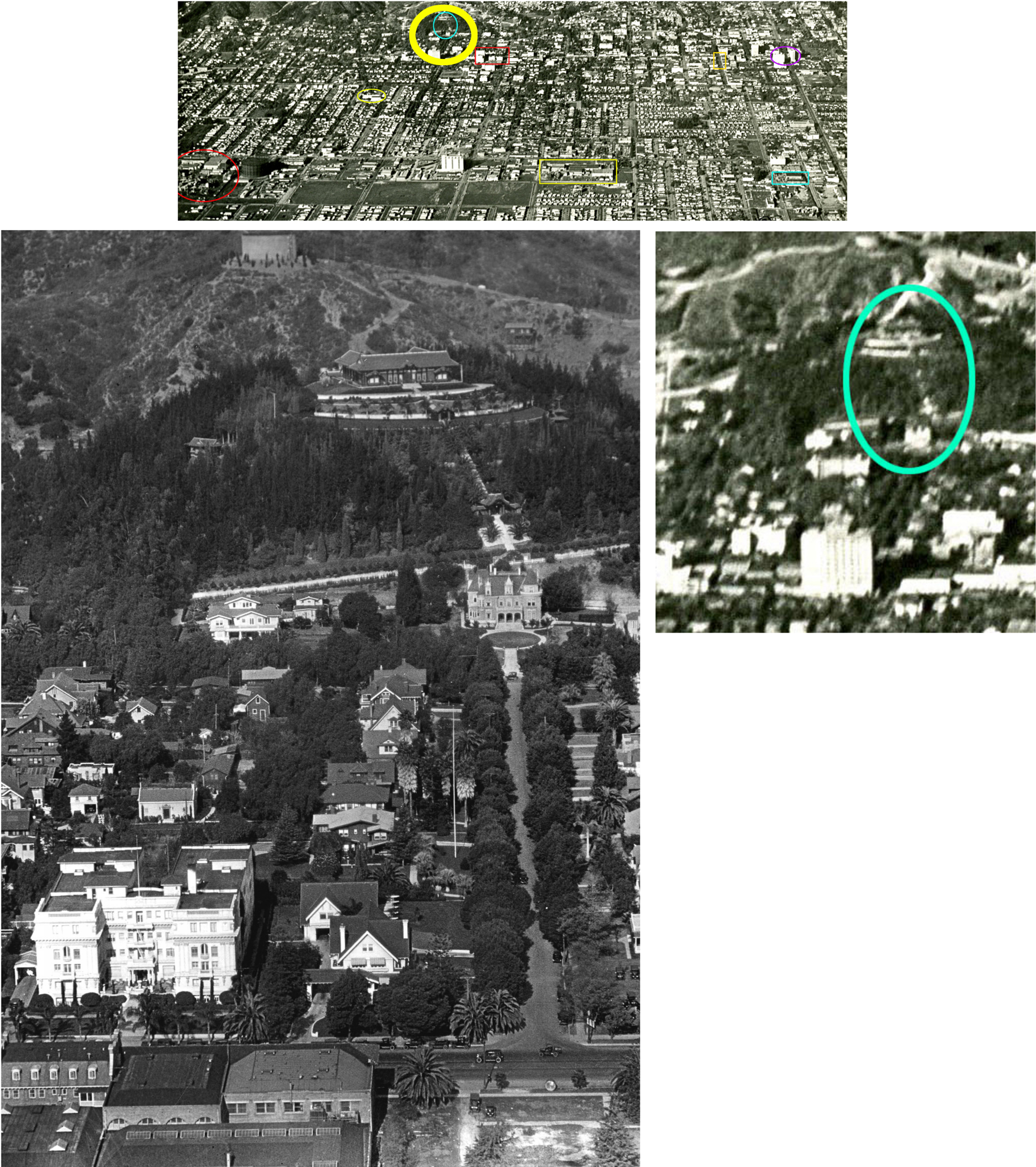
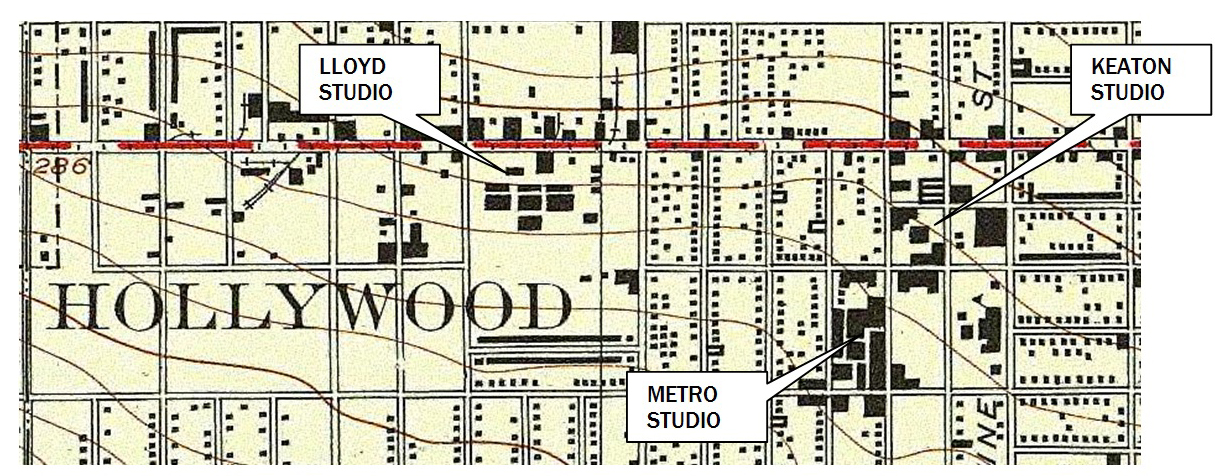
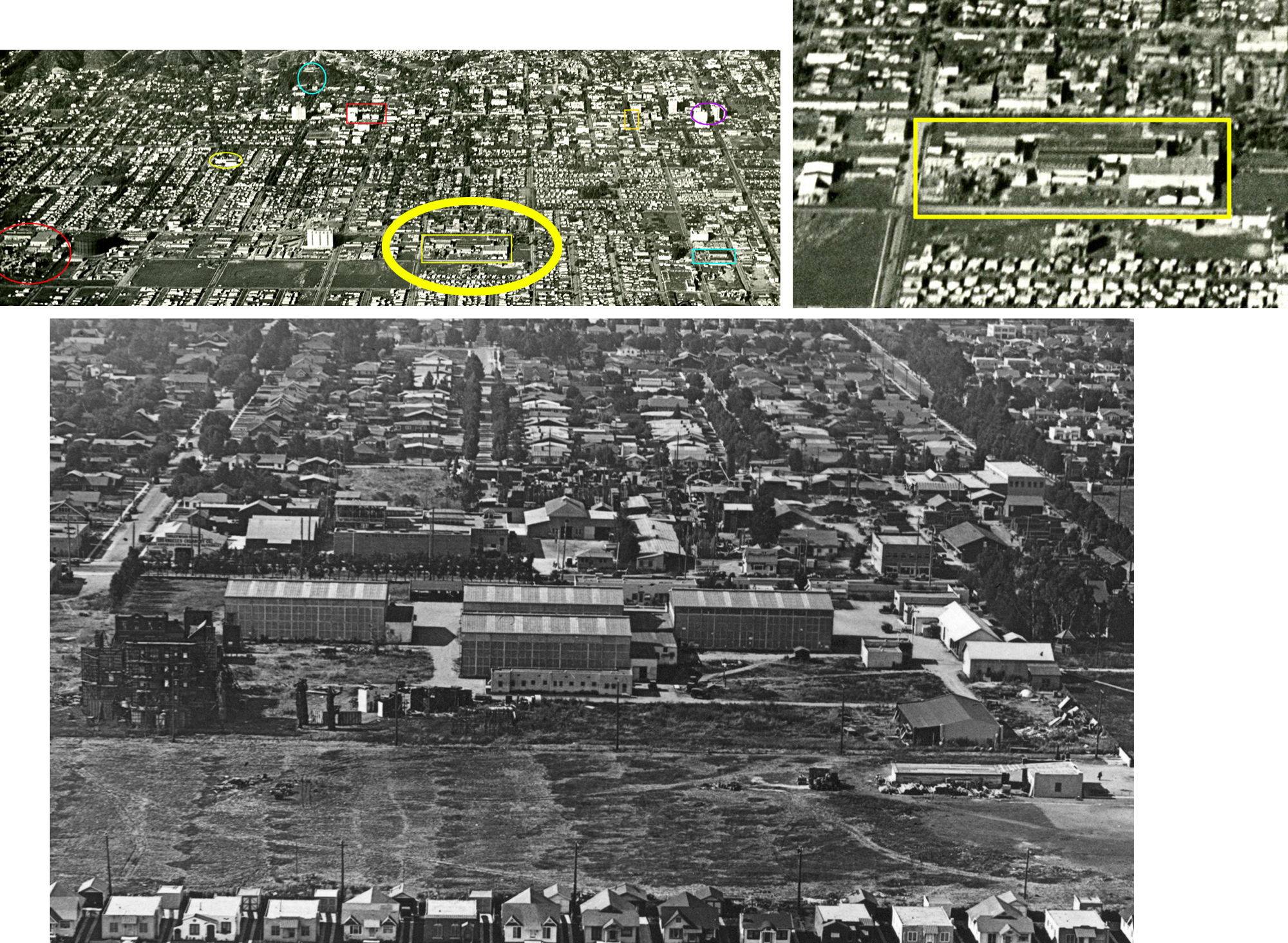
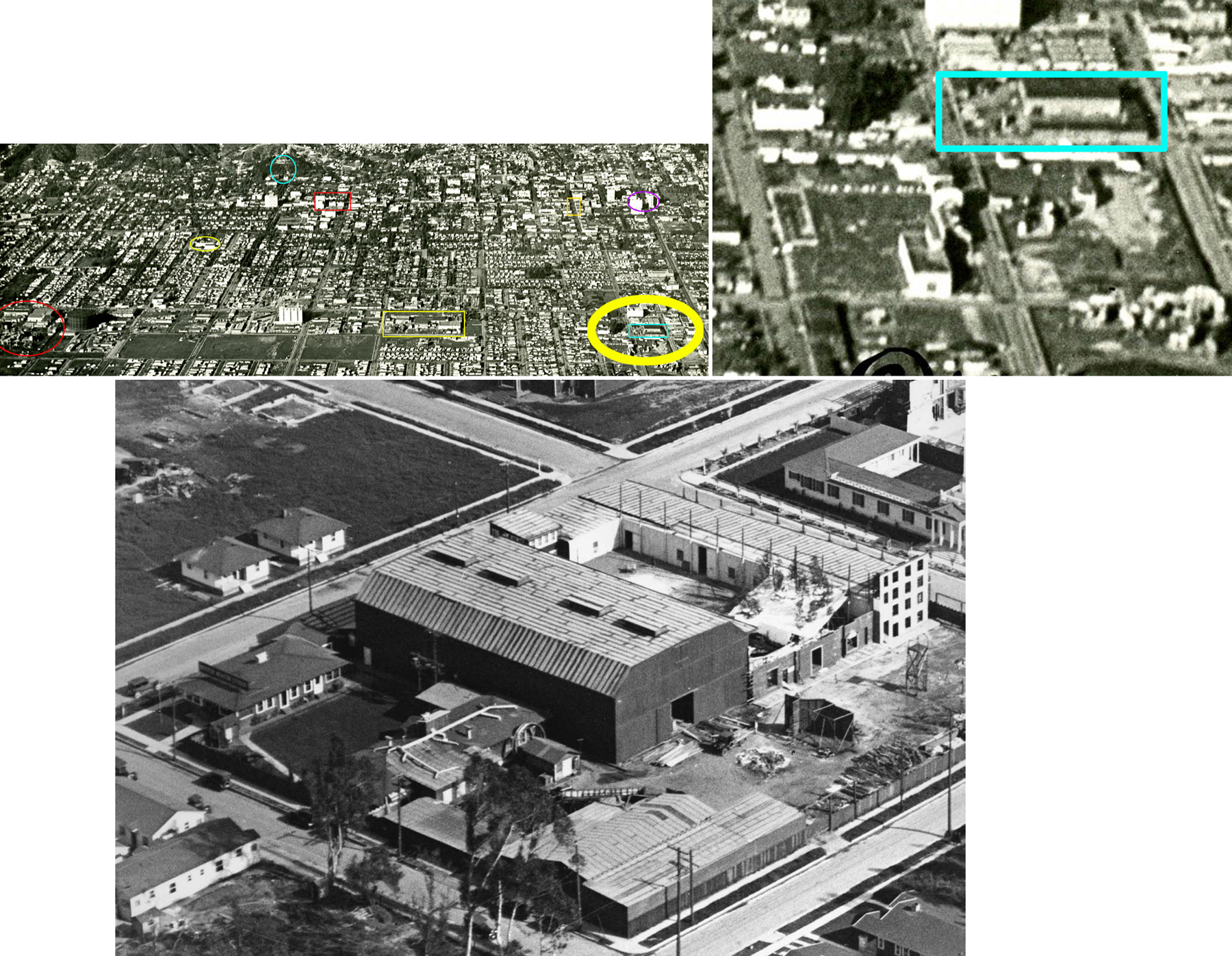
Click to enlarge.  Hollywood in 1926, looking north.  From left to right: the Pickford-Fairbanks Studio (red oval), the Chaplin Studio (yellow oval), the Bernheimer estate Yamashiro and future Magic Castle (teal oval), the Hollywood Hotel (red box), the Harold Lloyd (Hollywood Metropolitan) Studios (yellow box), the Keaton Studio (teal box), the block of Cahuenga south of Hollywood Boulevard where Keaton and Lloyd frequently filmed (orange box), and the intersection of Hollywood and Vine (purple oval). HollywoodPhotographs.com.

As much as I enjoy solving a movie location puzzle, and learning where a favorite scene was filmed, what I enjoy more is getting a sense of the context of how the movie was made.  I appreciate the craft that went into filming Harold Lloyd’s race to the altar in Girl Shy because I know how he traveled all across Los Angeles to capture the individual shots comprising the sequence.  Likewise, I’ve discovered that as a film-maker Buster Keaton was both uncompromising, and practical.  When called for, Buster would travel even hundreds of miles to capture the right setting for a gag, and yet he also filmed dozens of scenes directly adjacent to his small studio.  Armed with this knowledge, it is fun to imagine what must have been a common occurrence, Buster and his crew literally walking from the studio to set up a shot nearby.

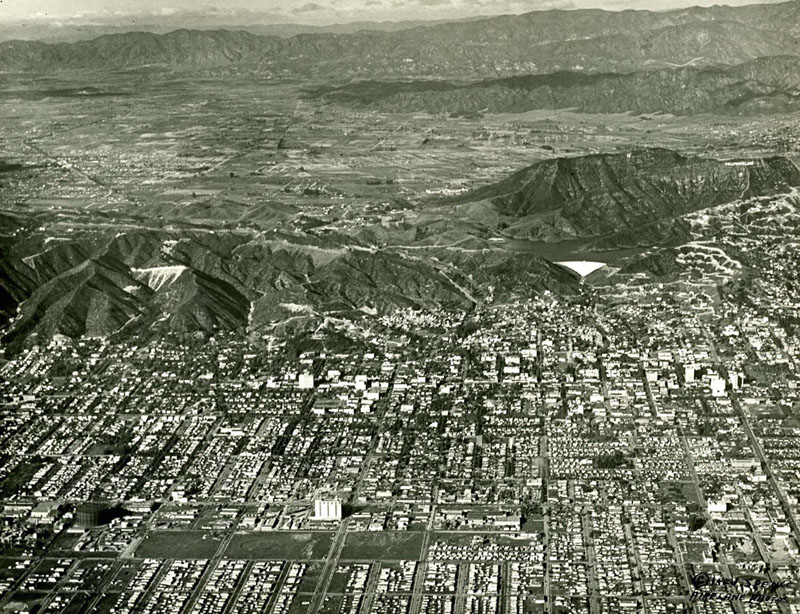
Hollywood – 1926 – HollywoodPhotographs.com

I grew up reading Hollywood history books, and became familiar with individual photos of the various studios and vintage landmarks.  But studying these images in isolation only took me so far.  Without a greater context, an understanding of how each place fit in, and related to the others, it was difficult to sense what Hollywood was really like.  Things began to change once I discovered vintage aerial photographs at resources such as the Los Angeles Public Library, and the Bruce Torrence Hollywood Historical Collection at HollywoodPhotographs.com.  For me, nothing surpasses armchair time-traveling more than a high resolution, vintage, oblique aerial photograph.

After studying such photos closely, I was stunned to realize that Harold Lloyd and Buster Keaton created their masterpieces working only a few blocks apart, and that Charlie Chaplin could easily pop over to the Pickford-Fairbanks Studio to have lunch with Doug and Mary.  These grand photos were the missing element that allowed me to fit each individual puzzle piece into place.  With this post I hope the “big picture” will emerge for you too, so you can sense how the pieces all fit together.  Please join me as we deconstruct a single aerial photo for a brief tour of early Hollywood.

UPDATE – I’ve fashioned this post into a video for my YouTube channel. Hollywood’s five biggest stars all filmed within one mile of each other.

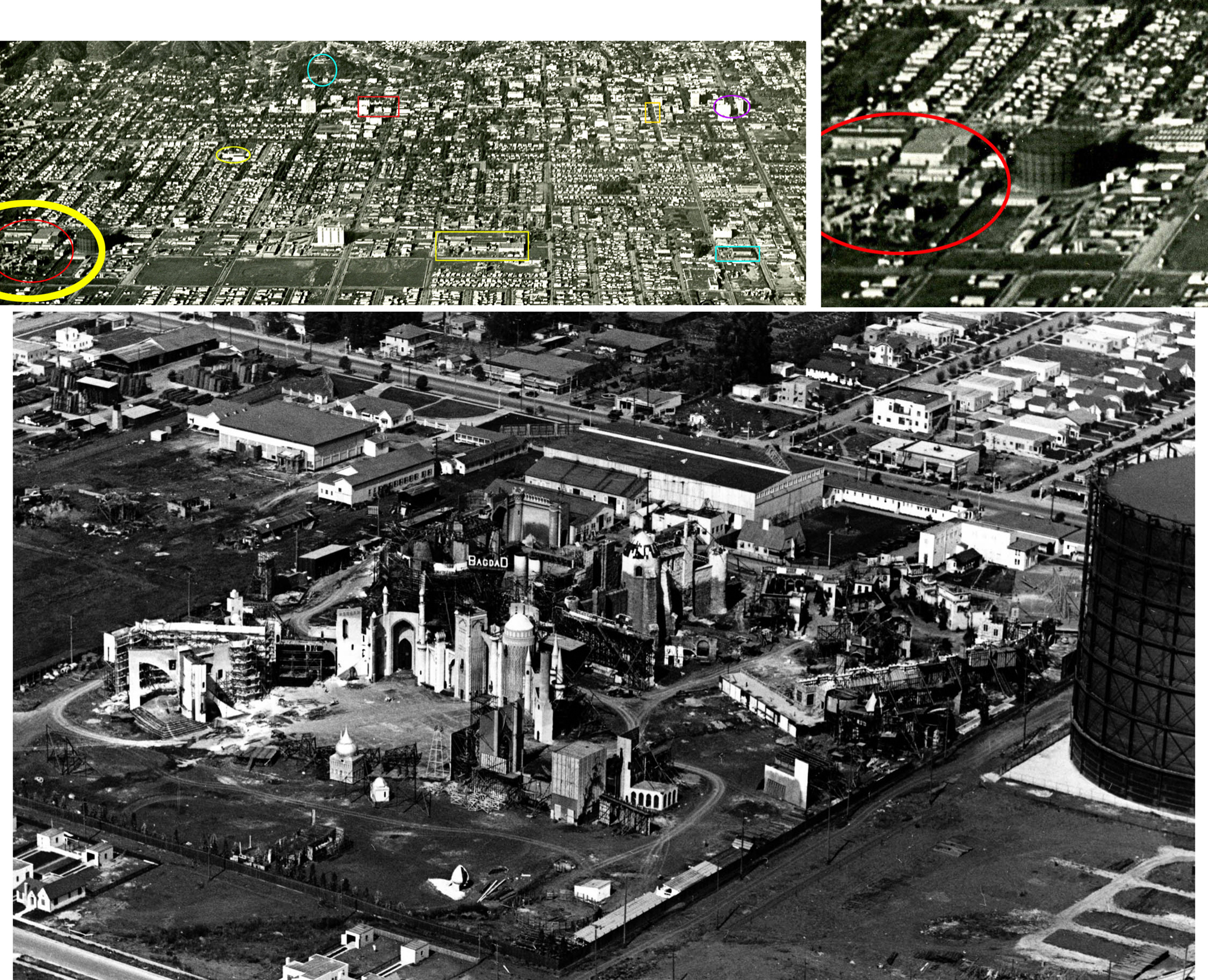
The Pickford-Fairbanks Studio – 7200 Santa Monica Boulevard.  Marc Wanamaker – Bison Archives

Above, the Pickford-Fairbanks Studio (future home to United Artists), and, standing in the foreground, the grand set for the Douglas Fairbanks fantasy epic The Thief of Bagdad (1924), with the castle set from Fairbanks’ Robin Hood (1922) standing behind.  By 1926 (see inset above) several filming stages were added.  Known today as The Lot, much of the studio is expected to be replaced by “low-rise, flexible office space,” as controversial plans to demolish and upgrade several historic structures have commenced, beginning with the destruction of the Pickford Building, built in 1927.

The Charles Chaplin Studio – 1416 N. La Brea Avenue.  Association Chaplin.

The small backlot above shows the half-circus-tent set built for Chaplin’s 1928 production The Circus.  The long white narrow building houses the studio’s many dressing rooms.  Only the right (east) end of the main filming stage is covered.   The west end of the main stage remained uncovered during the production of City Lights (1931), and was roofed over to accommodate the extra interior sets required for Modern Times (1936).  The studio is now home to the Jim Henson Company.

The hilltop Yamashiro estate, and the stairs leading down to what would become the Magic Castle.  The large white building in the main photo is the former Garden Court Apartments on Hollywood Boulevard.  The large white building in the inset photo is the Roosevelt Hotel, nearing completion, that opened May 15, 1927. Security Pacific National Bank Photograph Collection/Los Angeles Public Library.

On the hilltop above, Yamashiro, Adolph and Eugene Bernheimer’s Japanese-themed estate completed in 1914, is now home to a landmark Japanese restaurant of the same name.  A flight of 300 steps lead down from Yamashiro to the home built by banker Rollin B. Lane in 1909, at 7001 Franklin Avenue, now home to the Magic Castle, a restaurant and private club for magicians.

The Hollywood Hotel, now site to the Hollywood and Highland Entertainment Center.  HollywoodPhotographs.com

Above, with all the palms trees, the former Hollywood Hotel (1903-1956) at the NW corner of Hollywood and Highland, now home to the Hollywood and Highland Entertainment Center.  To the left, nearing completion, stands the El Capitan Theater at 6838 Hollywood Boulevard, which opened May 3, 1926.

The red line on this 1926 USGS topographic map marks the trolley line along Santa Monica Boulevard.  The Lloyd and Keaton Studios were located just a few blocks apart, with the former Metro Studios standing in between.

This view shows the Hollywood Metropolitan Studio, circa 1923, where Harold Lloyd later created his independent films.  Buster Keaton filmed a trolley stunt from Day Dreams (1922) directly in front of the studio, with the lumber yard and ice house on Santa Monica Boulevard, across the street from the studio to the north, appearing in the background.  HollywoodPhotographs.com

After amicably parting ways with producer Hal Roach, in 1924 Harold Lloyd filmed his first independently produced feature comedy Girl Shy at the Hollywood Metropolitan Studios, pictured above, a few blocks west of the Keaton Studio.  Lloyd’s production office stood at 1040 N. Las Palmas Avenue, at the left edge of the yellow box in the inset photo, which also shows Las Palmas traversing the west (left) edge of the studio.  A similar building stands at 1040 today – either a remodel of the original or a new structure.  As shown in the primary 1923 photo above, Las Palmas had not yet been extended south across Santa Monica Boulevard, and Lloyd’s future office had not yet been constructed.  The studio remains in active use, known today as the Hollywood Center Studios.

The Buster Keaton Studio, 1025 Lillian Way – HollywoodPhotographs.com.

The main view above, circa 1924, looks to the SE, while the inset view above looks north.  Keaton’s single shooting stage, appearing prominently in both images, was still open to the air during the filming of The Goat (1921), but was roofed over late in 1921, as revealed in newly discovered footage from The Blacksmith.  The four blocks beneath the teal box in the 1926 inset photo comprise the stages and backlots of the former Metro Studios.  Metro became part of MGM in Culver City in 1924, and by 1926 many Metro buildings had already been demolished.

The block of Cahuenga south of Hollywood Boulevard, circa 1924 – HollywoodPhotographs.com.

Pictured above, the block of Cahuenga south of Hollywood Boulevard, a few blocks north from the Keaton Studio, was Buster’s favorite place to film.  He shot scenes from at least seven movies at this location.  Charlie Chaplin filmed scenes from Tillie’s Punctured Romance (1914) and Modern Times at the corner of Hollywood and Cahuenga, and Harold Lloyd filmed scenes from Safety Last! (1923) and Girl Shy (1924), and Hot Water (1924) along Cahuenga as well. (More remarkably, the alley to the left is where Keaton filmed a scene from Cops (1922), Chaplin filmed a scene from The Kid (1921), and Harold Lloyd filmed a scene from Safety Last! – three masterpiece films all filmed at the same alley you can visit today.)  This prior post will take you to a PowerPoint presentation showing 13, but not all, locations used by Chaplin, Keaton, and Lloyd along Cahuenga.

Click to enlarge – view south down Cahuenga towards Keaton (teal) and Lloyd (yellow) studios – just blocks apart.  Security Pacific National Bank Photograph Collection/Los Angeles Public Library

This circa 1923 reverse angle view above looks south down Cahuenga from Hollywood Boulevard towards the large covered filming stage of the Keaton Studio (teal box), and the enclosed glass shooting stages of the Metropolitan Studio (yellow box).

The intersection of Hollywood and Vine – circa 1924. HollywoodPhotographs.com.

The main photo above shows the intersection of Hollywood and Vine, some time in 1924, after completion of the Taft Building at the SE (lower right) corner in 1923, but prior to construction of the Broadway – Hollywood Department Store on the SW (lower left) corner, that opened in 1927.   The Broadway appears nearly complete in the inset photo above.

Check out my video.

Thanks for coming along – I hope you enjoyed the tour.  You can download written Hollywood tours of where Buster Keaton and Harold Lloyd filmed at these other posts here and here.  My many thanks to Bruce Torrence, at HollywoodPhotographs.com, along with Marc Wanamaker of Bison Archives, and Christina Rice, Senior Librarian at the Los Angeles Public Library, for providing the amazing aerial views of vintage Hollywood.

Posted in Chaplin Studio, Hollywood Tour, Keaton Studio, Lloyd Studio | Tagged , , , , , , , , , , , , , , , | 20 Comments

How Harold Lloyd Filmed Girl Shy on Bunker Hill

Harold Lloyd racing past the Lovejoy Apartments at 3rd and Grand on Bunker Hill in Girl Shy.

The first slide of a PowerPoint Presentation you can download below.

The 2012 Turner Classic Film Festival in Hollywood will be screening Harold Lloyd’s first independently produced feature comedy Girl Shy (1924) on April 14, 2012 at the Egyptian Theater.  In that film, Harold discovers the woman he loves is about to marry a bigamist, and in a frantic race to the altar, Harold dashes all across Southern California by every conceivable mode of transport in order to halt the wedding.  I explain in a prior post how Lloyd filmed one sequence in Hollywood hanging from the pole of a runaway trolley car.
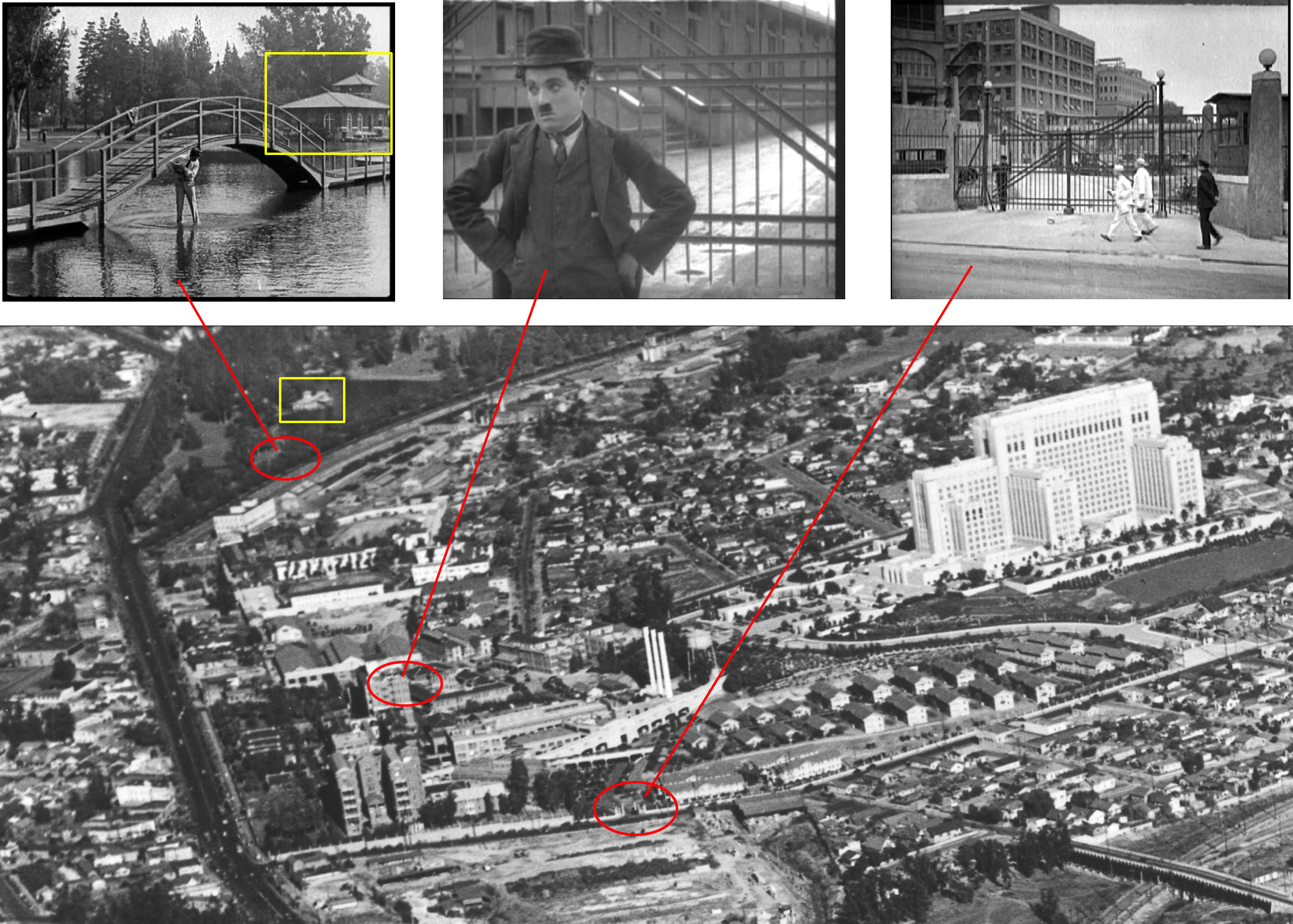
Later during the race, Harold rides a horse wagon on Bunker Hill, up and down Grand Avenue, and west down 3rd Street.   The corner of 3rd and Grand was Lloyd’s all-time favorite place to film – he shot scenes from seven different movies at this one spot, including Bumping Into Broadway (1919), An Eastern Westerner (1920), High and Dizzy (1920), Never Weaken (1921), Girl Shy, Hot Water (1924), and For Heaven’s Sake (1926).  As I explain in one of my most popular posts, you can see where Lloyd and other Hal Roach Studios stars, including Laurel & Hardy, filmed on Bunker Hill, as shown in some amazingly sharp movie footage posted by the Prelinger Archives.  Bunker Hill was completely demolished during the 1960s, and glass skyscrapers crowd the site today.  You can download a PowerPoint presentation below – here are static images.

01 02 03 04 05 06 07 08 09 10 11 12 13 14 15 16 17 18

You can download below a 21.5 MB PowerPoint presentation showing not only where and how Lloyd filmed the Girl Shy scenes atop Bunker Hill, but also shots from Never Weaken, Hot Water, and For Heaven’s Sake.  Most of the slides are animated, so wait a moment each time before clicking the “next” button.

How Harold Lloyd Filmed Girl Shy on Bunker Hill

You will need a PowerPoint viewer to watch the show, and can download a free PowerPoint viewer at this site.

My book Silent Visions documents Lloyd’s elaborate race to the altar in great detail, staged on the streets of Hollywood, San Fernando, Altadena, Palms, Culver City, Bunker Hill, Rampart Village, Fort Moore Hill, and downtown Los Angeles, as Harold commandeers automobiles, fire engines, motorcycles, trolleys, and horse wagons in his quest.

I am also posting here again a tour of several silent-era Hollywood locations Harold Lloyd used in Girl Shy, and various other films, as well as the sites for the Lloyd, Chaplin, and Keaton Studios.

Harold Lloyd Hollywood Film Locations – Silent Visions

HAROLD LLOYD images and the names of Mr. Lloyd’s films are all trademarks and/or service marks of Harold Lloyd Entertainment Inc. Images and movie frame images reproduced courtesy of The Harold Lloyd Trust and Harold Lloyd Entertainment Inc.

Posted in Angels Flight, Bunker Hill, Girl Shy, Harold Lloyd, Lloyd Thrill Pictures | Tagged , , , , , , , , | 13 Comments

Keaton – Cops – and the First Baptist Church of Hollywood

Click to enlarge.  A block south of the Egyptian Theater and the Hotel Christie stands the original First Baptist Church of Hollywood (oval) at 6682 Selma Ave. at the corner of Las Palmas.  Security Pacific National Bank Photograph Collection/Los Angeles Public Library.

Ready – aim – fail.  Buster in front of two poorly trained police and the First Baptist Church of Hollywood.

During the frenzied chase at the conclusion of Buster Keaton’s most famous short comedy Cops (1922), Buster grabs hold of a passing car one-handed that whisks him out of frame away from a mob of police (above).  As I explain in my book, and on my written Keaton and Lloyd tours posted here and here, Buster filmed this scene coming from an alley just south of the SE corner of Hollywood Blvd. and Cahuenga.  In the next shot (at left), Buster lands on his feet beside two cops armed with billy clubs.  Unaware of their presence, Buster blithely walks between them as they swing their clubs and, while missing him completely, simultaneously knock each other out.  Behind Buster during this scene stands a wide set of formal steps and a series of columns, that once belonged to the First Baptist Church of Hollywood.  The building stood at the SE corner of Las Palmas and Selma, a block nearly due south of the Egyptian Theater on Hollywood Blvd.

I first wondered if the above scene was filmed on a set, in front of the building with the flags and formal steps visible behind the civic archway shown at the right in Cops (click to enlarge), but a close inspection reveals the staircases do not match.  As I explain with confirming photos on one of my bonus programs for the new Kino Lorber Blu-ray release Buster Keaton: The Short Film Collection (1920-1923), the archway set shown here was built on the Goldwyn Studio backlot in Culver City, that would later become part of MGM.  (These photos show that the above set with the flags has a portico that reads “COTTON EXCHANGE,” and must have been built for some 1920 or 1921 Goldwyn feature production.  Does anyone know what this film might have been?)

My first break came quite a while ago watching Bobby Vernon’s final silent comedy short Sappy Service (1929), part of the highly recommended PBS series and multi-volume DVD SlapHappy Collection of silent comedy, where Bobby races to deliver a sedated doctor to court.  The “courthouse” steps appearing in the film (at left) matched the Keaton steps, while providing a broader view of the building, including an invaluable clue – the unique ocular detail design over each doorway.   I knew that this building’s reappearance on film, nearly 8 years after appearing in Cops, meant it was likely a real building, so I continued to keep my eye out for stately bank buildings or other structures fronted by columns and wide steps.

I have many research tools at my disposal.  Aside from its online photo collection, the Los Angeles Public Library has posted old city directories online, and the vintage Sanborn Fire Insurance Maps, and historic Los Angeles Times databases are also available to members for online searching.   But for richness of information, and imparting a true sense of the past, nothing surpasses a high resolution, vintage, oblique aerial photograph, which is how I discovered the setting for this post.
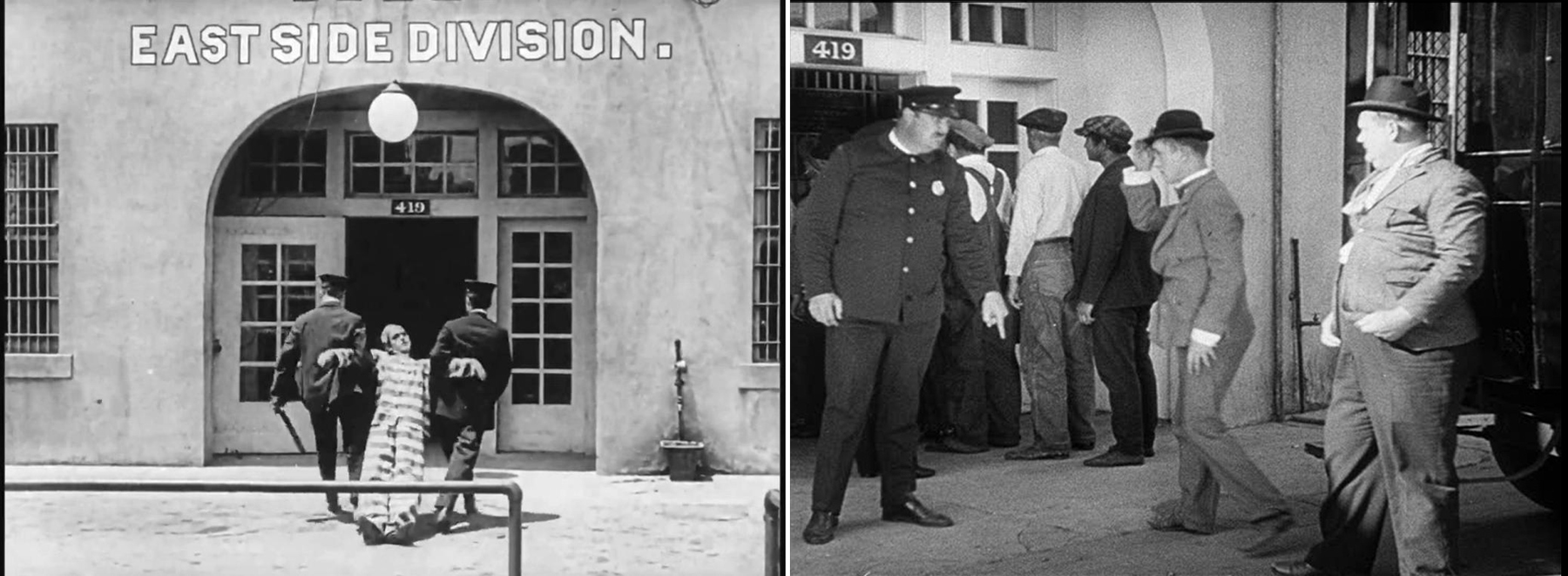
Click to enlarge.  The Keaton view looks south, as he is standing in the shadow cast by the church.

The aerial image above, and the larger image at the top of this post, are but small portions of an aerial photo that I obtained from the Los Angeles Public Library.  While poring over each street and landmark building, I became aware of a white building with columns and wide front steps (oval at top of post) that stuck me as being a candidate for Buster’s film.  I checked the spot on Google Street View, and while I was dismayed to see that a different building now stands in its place, it seemed to me that the slope of the sidewalk, and other details, were consistent with the movie frame.

The transitive theory of movie location verification. Keaton shot “A” matches other film “B”, other film “B” matches newspaper drawing “C” (note the ocular detail over the doors), ergo, Keaton shot “A” matches newspaper drawing “C.”  May 14, 1917, Los Angeles Times.

I checked the church on the historic online Los Angeles Times, and finally found an image confirming that Keaton’s setting for this joke was staged in front of the First Baptist Church of Hollywood.  Bids for construction of the church were put out in May of 1917, and the completed church was dedicated Sunday, January 20, 1918.  The church had a seating capacity of 1500, and a basement social hall seating 500.  Sadly, the structure was badly damaged during a fire on May 3, 1935.  Fifteen women members of the church, preparing for their annual May Day banquet in the basement kitchen, fled when the flames broke out and escaped unharmed.   The replacement church that stands on the site today was dedicated Sunday, September 27, 1936.

This vintage postcard shows the front of the church where Keaton filmed.

This vintage postcard shows the front of the church where Keaton filmed.

ca

The church as seen from the Bernheimer Estate, before the El Capitan Theater was built in 1926.

Internet Archive Cops Church Motion Picture News Vol 40 Oct-Dec 1929 oval

Above is a 1929 view of the church (oval) peeking out from behind the Egyptian Theatre.

Click to enlarge.  The Goat (red box) on Highland Ave., Cops (yellow oval) on Selma Ave.

To give you a broader perspective, this image above shows the relation of the church from Cops (oval) to the garage on Highland Ave. (box) where Keaton staged a gag from The Goat (1921), as explained in my prior post Keaton’s Highland Goat Garage.

Click to enlarge. Looking west down Hollywood Blvd. (1927) at the church (oval), and the side of the Egyptian Theater (box).  The tallest building, nearing completion at the back, is the Hotel Roosevelt. Marc Wanamaker – Bison Archives.

While I have yet to find any vintage photo of the original church, it appears as well in the above 1927 aerial view of Hollywood Blvd. looking west.  Perhaps the only extant close-up images of the former church survive in the silent comedies of Buster Keaton and Bobby Vernon.

Cops and The Goat are licensed by Douris UK, Ltd., and are available as part to the Kino Lorber Buster Keaton: The Short Film Collection (1920-1923).  The ShapHappy DVDs are available at http://slaphappycomedies.com/  You can read all about how Buster Keaton filmed Cops in my book Silent Echoes.

You can read about some of the other early Hollywood churches in this post by Steve Vaught at his Hollywood history and architecture blog Paradise Leased.

A view of the 1936 replacement First Baptist Church of Hollywood, 6682 Selma Ave.

Posted in Buster Keaton, Cops, Hollywood Tour, The Goat | Tagged , , , , , , , , , , | 7 Comments

Harry Langdon – The Strong Man Part 2

Click to enlarge.  Harry Langdon standing on the corner of Carondelet and W. 7th, in The Strong Man.  (C) 2012 Google.

Continuing my prior post about the vamp woman’s apartment in Harry Langdon’s 1926 comedy feature The Strong Man, Harry meets the unscrupulous woman, played by Gertrude Astor, at the corner of Carondelet Street and W. 7th Street.  With a suspicious cop on her tail, the woman hides her criminal boyfriend’s roll of cash in Harry’s coat.

Gertrude Astor is about to con Harry Langdon.  The doorway to the 2500 W. 7th Street appears at back.

Moments later, Gertrude drags Harry into a taxi parked in front of the Trebor Apartments, built in 1909, at 2520 W. 7th Street, just a few steps west of the corner where they met.

The Trebor Apartments at 2520 W. 7th

2520

Child actress Soleil Moon Frye walks her puppy past the Trebor in the opening credits to Punky Brewster

Lindsay Blake reports on her I Am Not A Stalker pop culture locations website that the Trebor Apartments also portrayed the home of Punky Brewster in the 1980s NBC sitcom.

The Strong Man (C) 1926 First National Pictures, Inc., (C) renewed 1954 Warner Brothers Pictures, Inc.

Posted in Harry Langdon, The Strong Man | Tagged , , , , , , , | 5 Comments

Help Please? – Silent Jailbreak – SOLVED

Hank Mann in The Janitor (1919); Charlie Chaplin in Police (1916); Stan Laurel in Detained (1924).

My friend Steve Vaught, who writes a wonderful blog about historic Hollywood and Southern California architecture at Paradise Leased, recently appealed to his readers, with great success, for help identifying certain classic Hollywood homes.  So I thought I would give this puzzle a public airing.
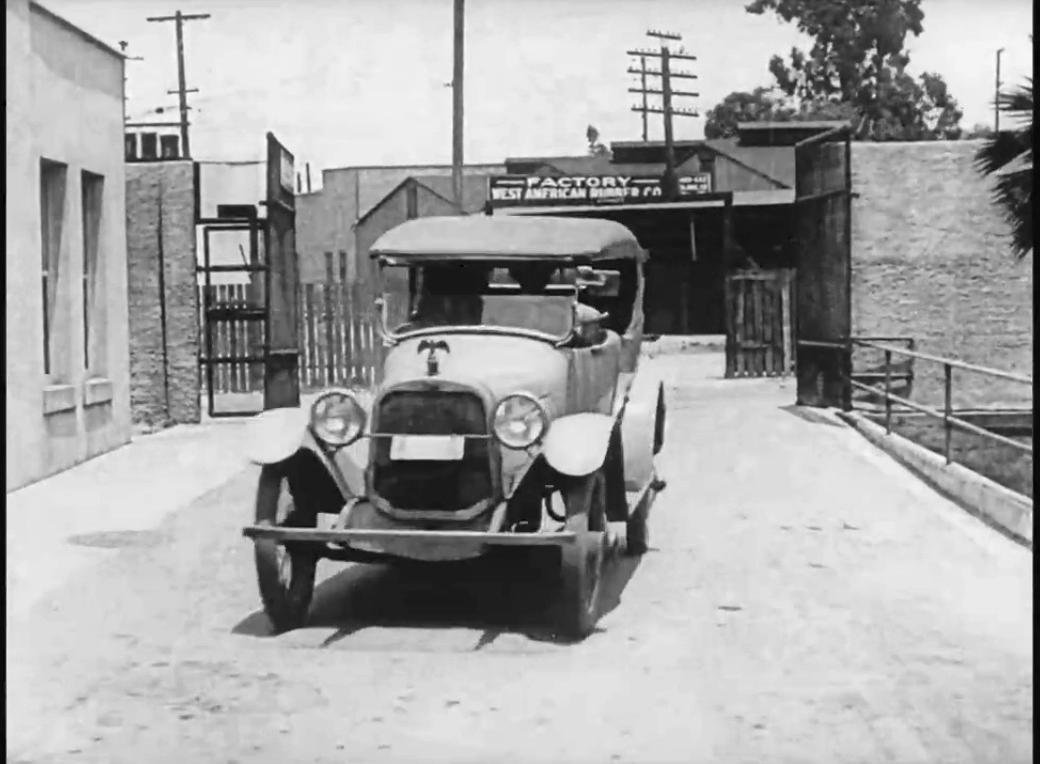
Charlie Chaplin, Stan Laurel, and lesser known comic Hank Mann all used the above setting as a jail location.  Although it almost looks as if it were some type of warehouse, the fact that three separate comics used it as a jail leads me to believe it was a real jail.   I’ve tried every which way to solve this puzzle, but have had no luck.  Does anyone have any ideas about where or what this might be?
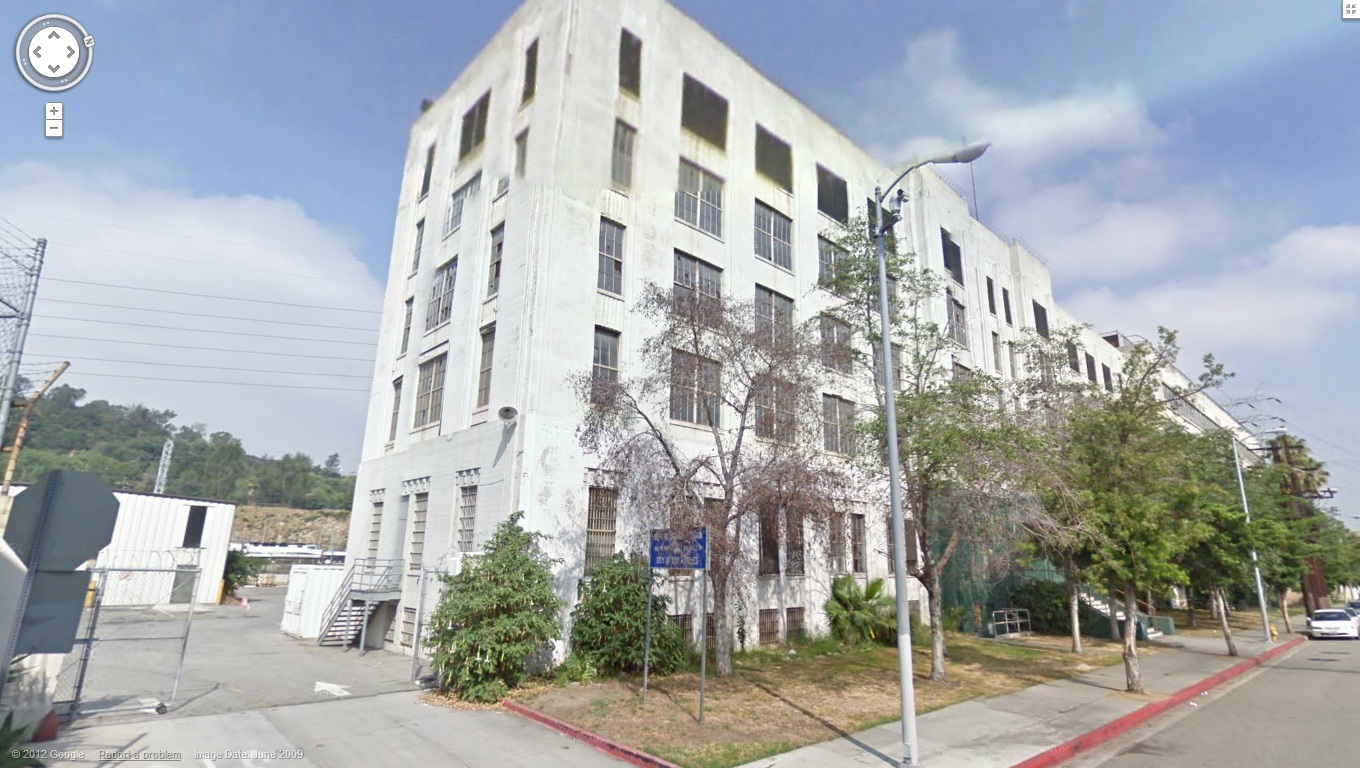
Hank Mann; Charlie Chaplin; Stan Laurel

A view of the gate from the inside, as it appears in Hank Mann’s The Janitor.

UPDATE – We already have a solution!

My friend Mary Mallory wrote in wondering if this setting might have been the LA County Morgue, at 1104 N. Mission Road, that appears as a “jail” in the Laurel & Hardy comedies The Second Hundred Years (1928), and The Hoose-Gow (1929).  This was the break I was looking for.

Click to enlarge. At left, looking south at the Psychopathic Ward of the Los Angeles County Hospital building, on Zonal Avenue. At right, Laurel & Hardy in The Second Hundred Years (1927), looking north at the Marengo Street gate to the Los Angeles County Hospital. Security Pacific National Bank Photograph Collection/Los Angeles Public Library.

The Morgue was actually part of the original Los Angeles County Hospital, a complex of about a dozen buildings standing on the east side of Mission Road between Zonal Avenue to the north and Marengo Street to the south.   The complex was built prior to 1915 (Chaplin filmed in 1916).  We know from the Laurel & Hardy frame above that the Morgue had gates identical to our mystery gate.  (The Laurel & Hardy gate, in fact, was on Marengo Street).  Moreover, the elements within the yellow box (above) of the Psychopathic Ward of the Los Angeles County Hospital seem to match the elements of the mystery spot.

I will confirm with a future post that the Chaplin jail was in fact the front gate to the former Psychopathic Ward.  While the Laurel & Hardy gate stood/stands on the south side of the hospital campus on Marengo Street, the Chaplin gate stood on the north side of the campus, by the bend in the road on Zonal Avenue (formerly Griffin Avenue), just east from the corner of Mission Road.

Imagery (C) 2012 Google. Map data (C) 2012 Google.

You can find The Janitor on the Silent Comedy Mafia #1 DVD; Police can be found on the Chaplin Essanay Comedies Vol. 3 DVD; and Detained can be found on the Stan Laurel Collection Volume 2 DVD.

Posted in Charlie Chaplin, Laurel and Hardy, Stan Laurel | Tagged , , , , , , , | 12 Comments