Restoration Premiere of Soft Shoes – Crossing Paths with Chaplin, Laurel, and Lloyd

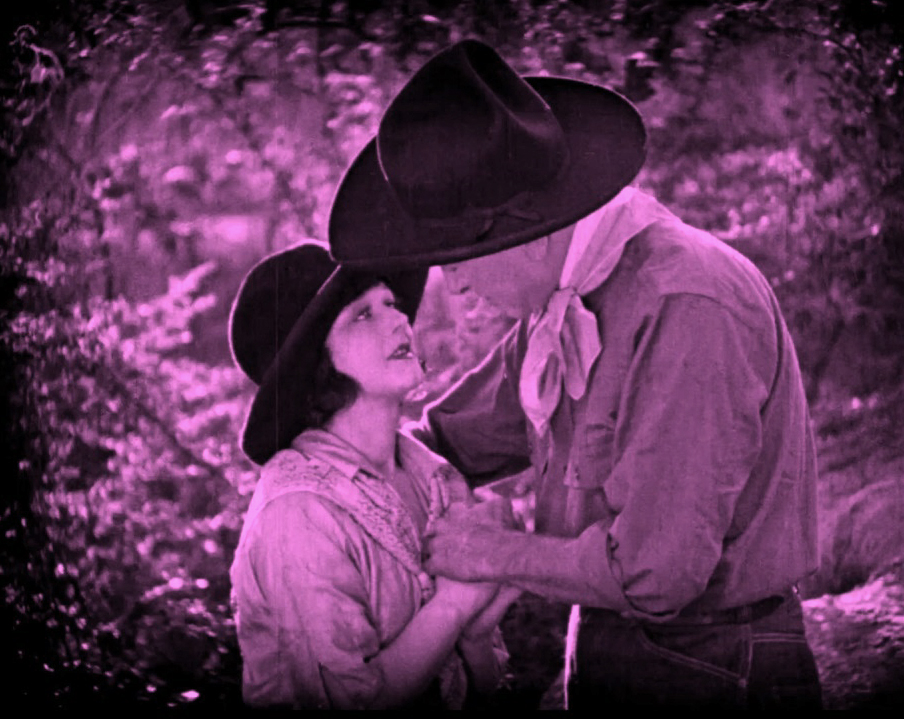
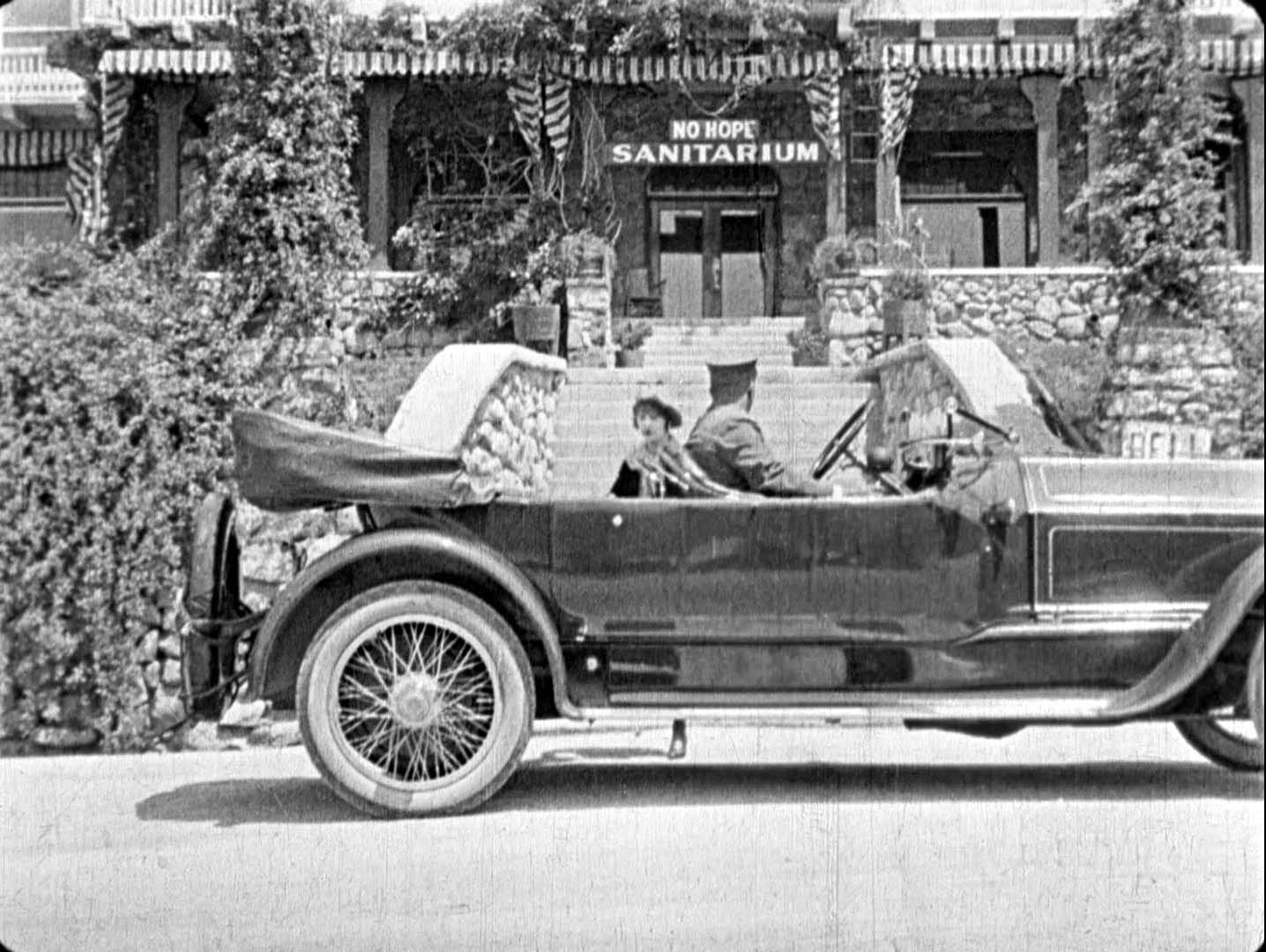
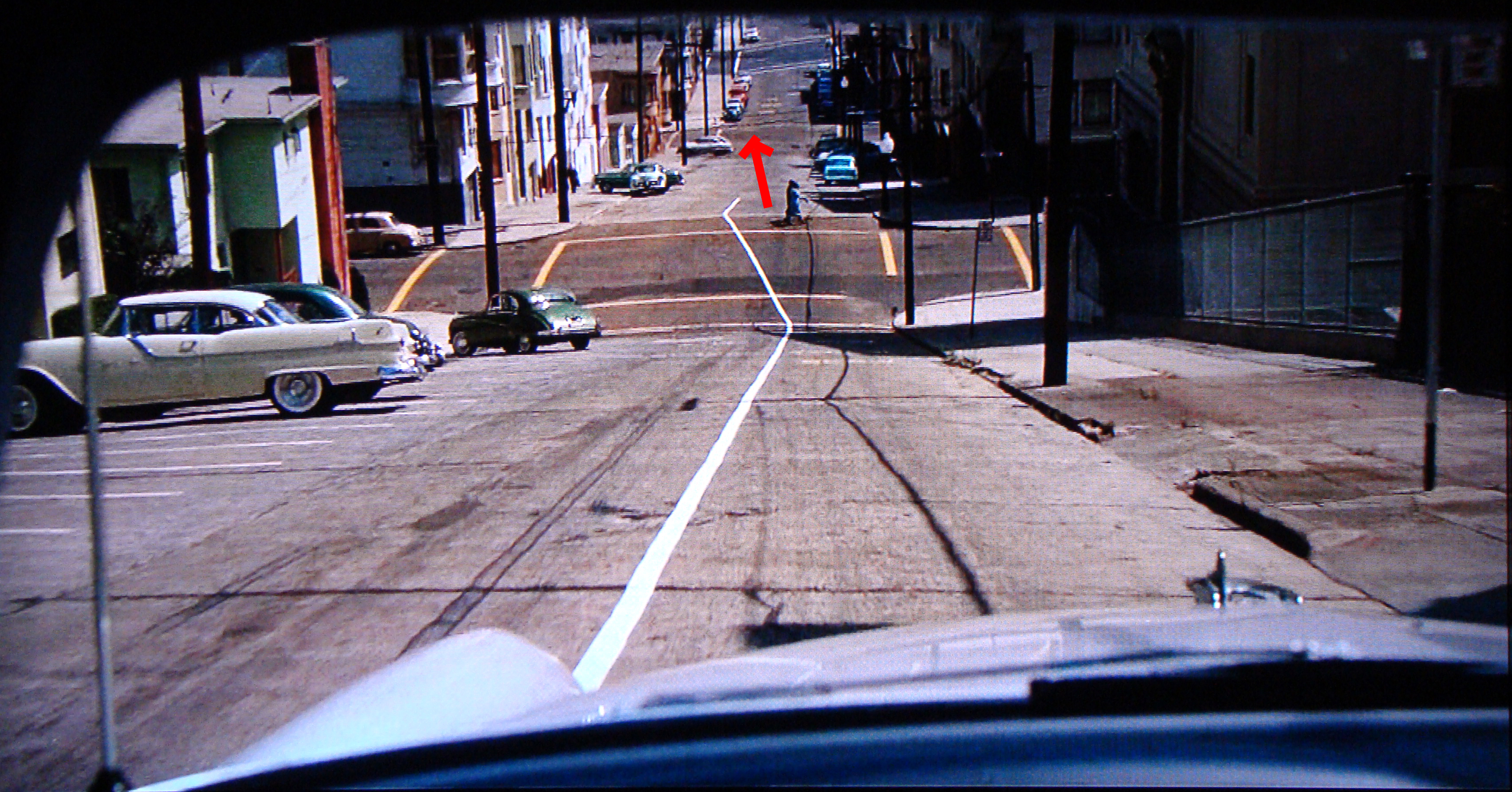
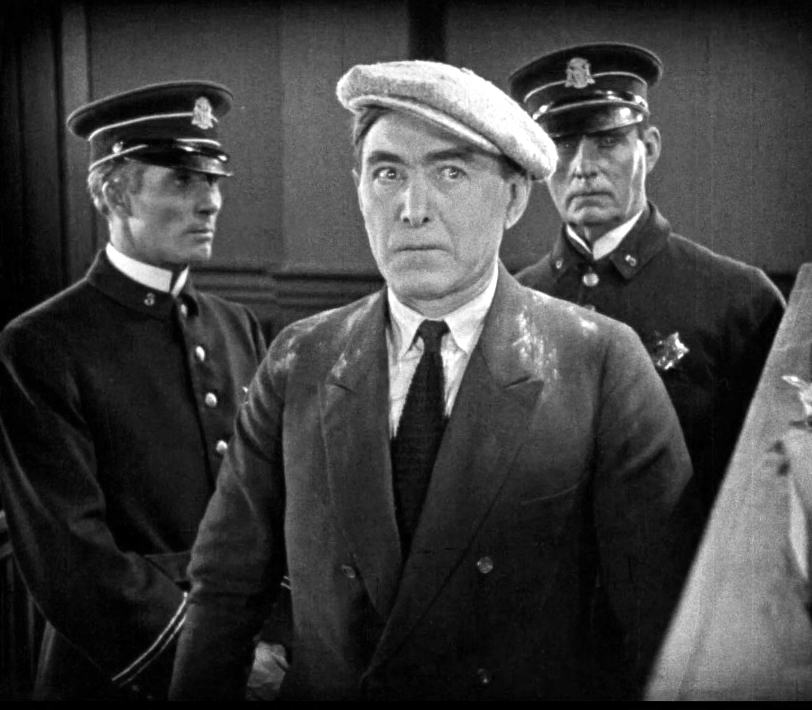
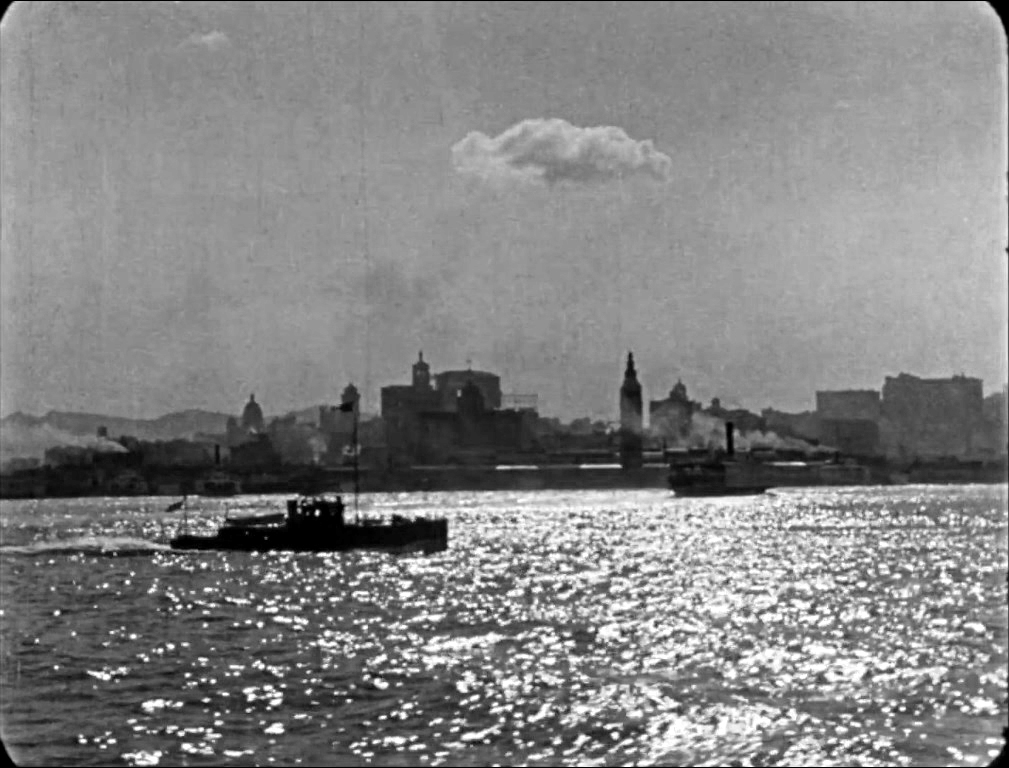
The San Francisco Silent Film Festival 2018 schedule has just been announced! One highlight is the Thursday, May 31 world premiere restoration of Universal’s 1925 Harry Carey action/drama Soft Shoes, in which Carey (right) seeks to rescue a young woman from a life of crime. Purportedly set in San Francisco, the film’s many exteriors were all filmed, unsurprisingly, in Los Angeles instead. But as shown below, the movie intersects remarkably with classic films made by Charlie Chaplin, Harold Lloyd, and Stan Laurel, while documenting historic LA settings, including its long lost Chinatown. This brief shot at left, looking west towards the Ferry Building, is the lone scene filmed in San Francisco.
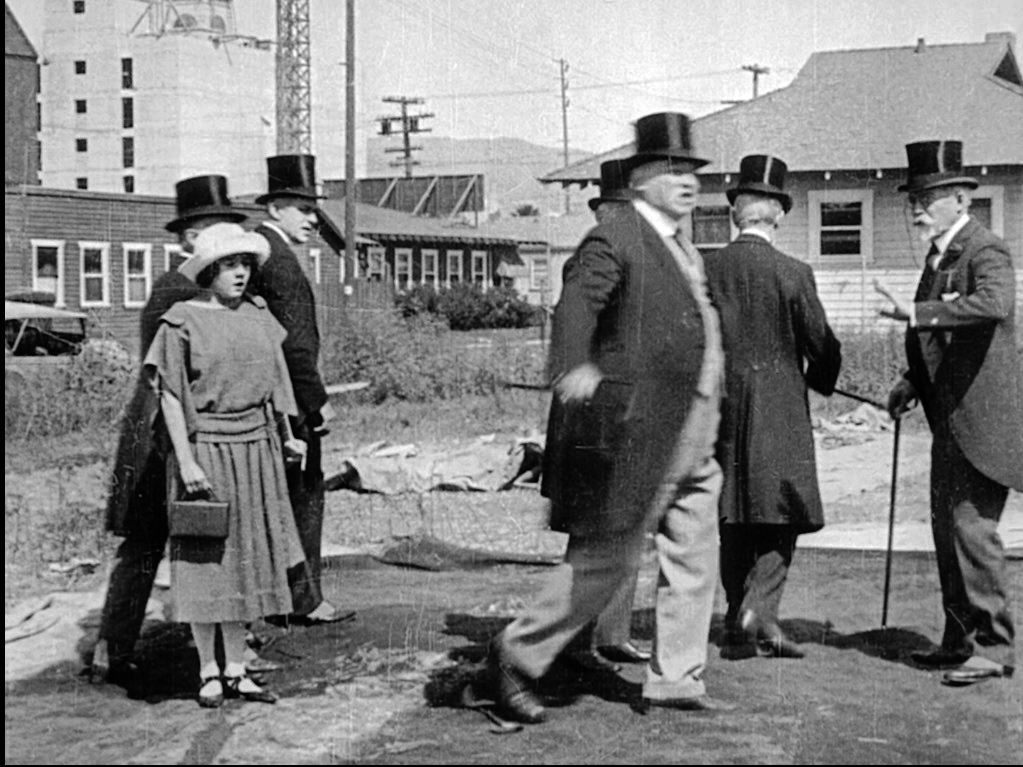
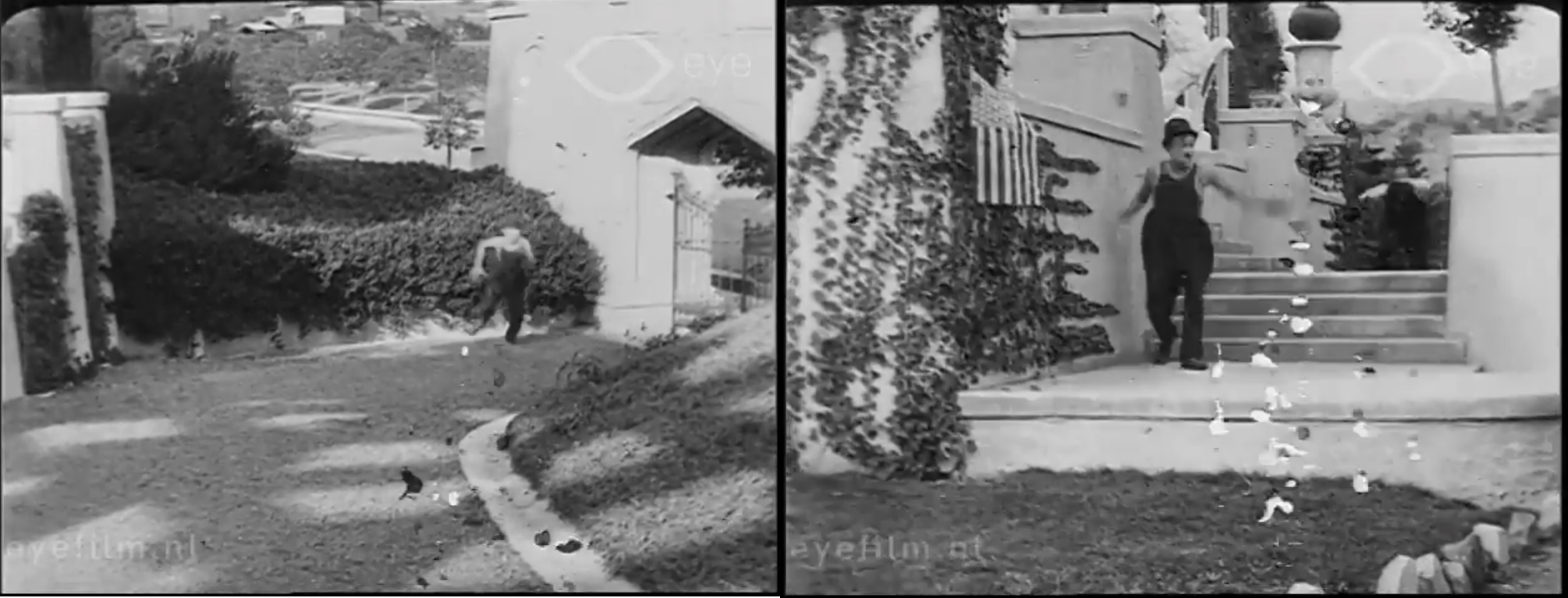
The afternoon screening also includes the 1924 Stan Laurel short comedy Detained, recently restored by Lobster Films in collaboration with the Fries Film Archief (Holland), below, where Stan’s prison release matches where Charlie Chaplin was released from prison in Police (1915), both beside the former north gate to the Los Angeles County Hospital – LAPL. Read more about them filming at the north hospital gate, and about Laurel & Hardy filming The Second Hundred Years (1927) and The Hoose-Gow (1929) at the west hospital gate HERE.

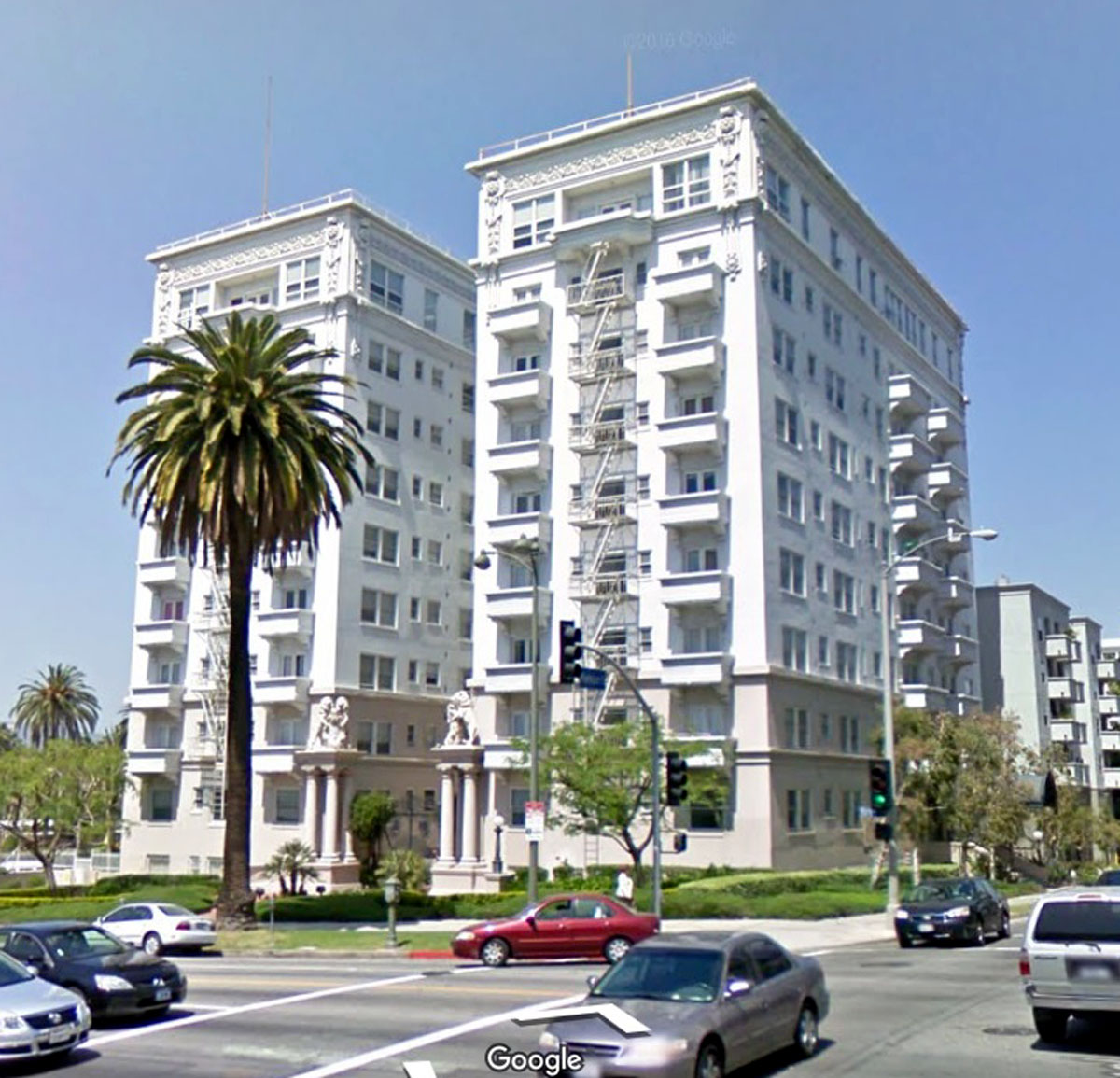
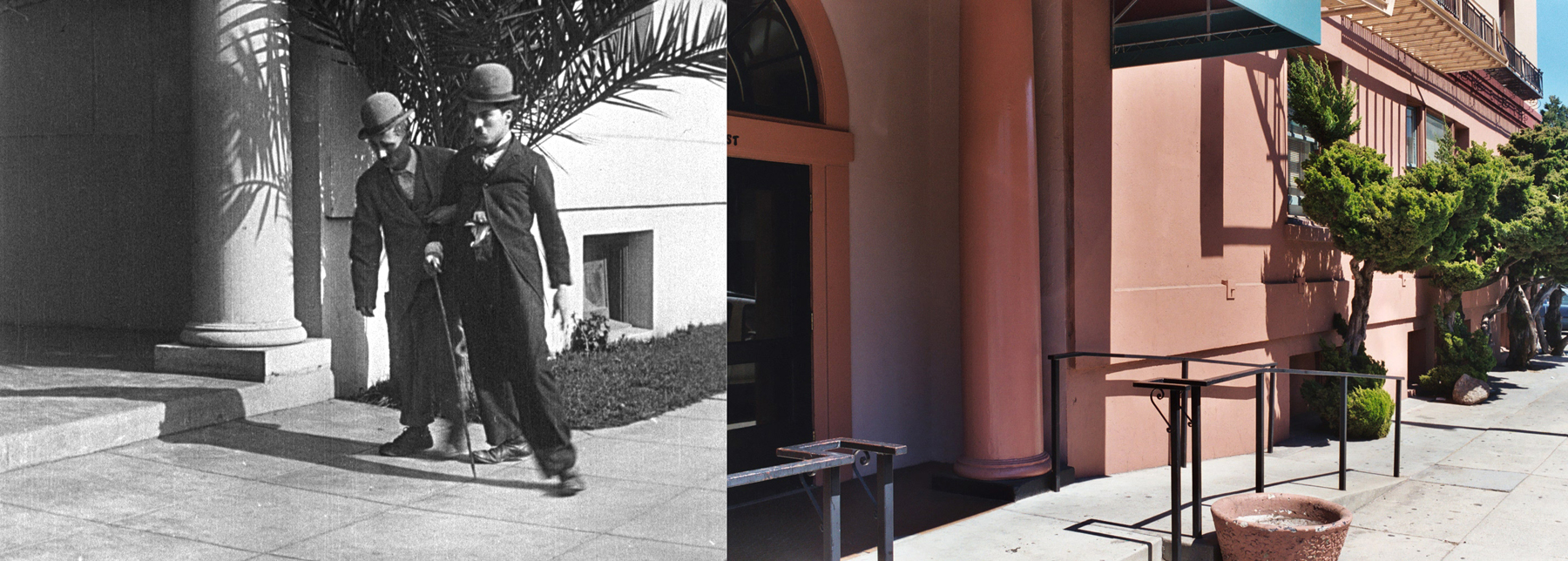
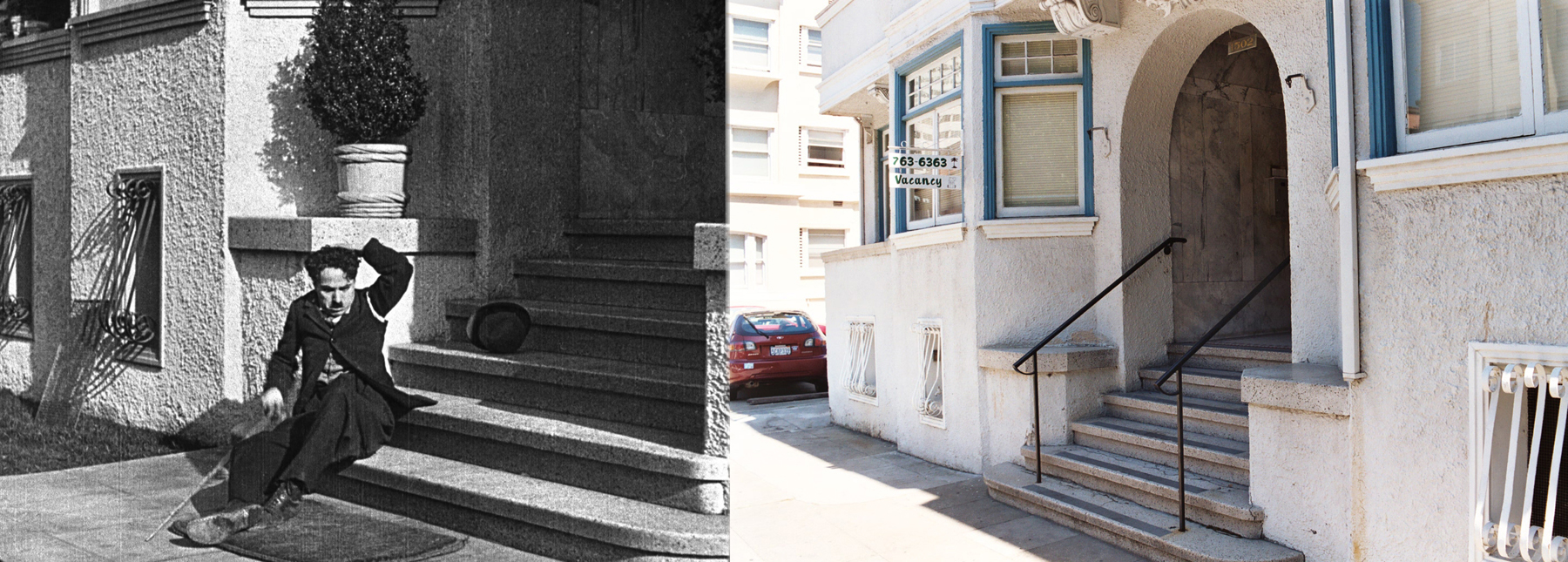
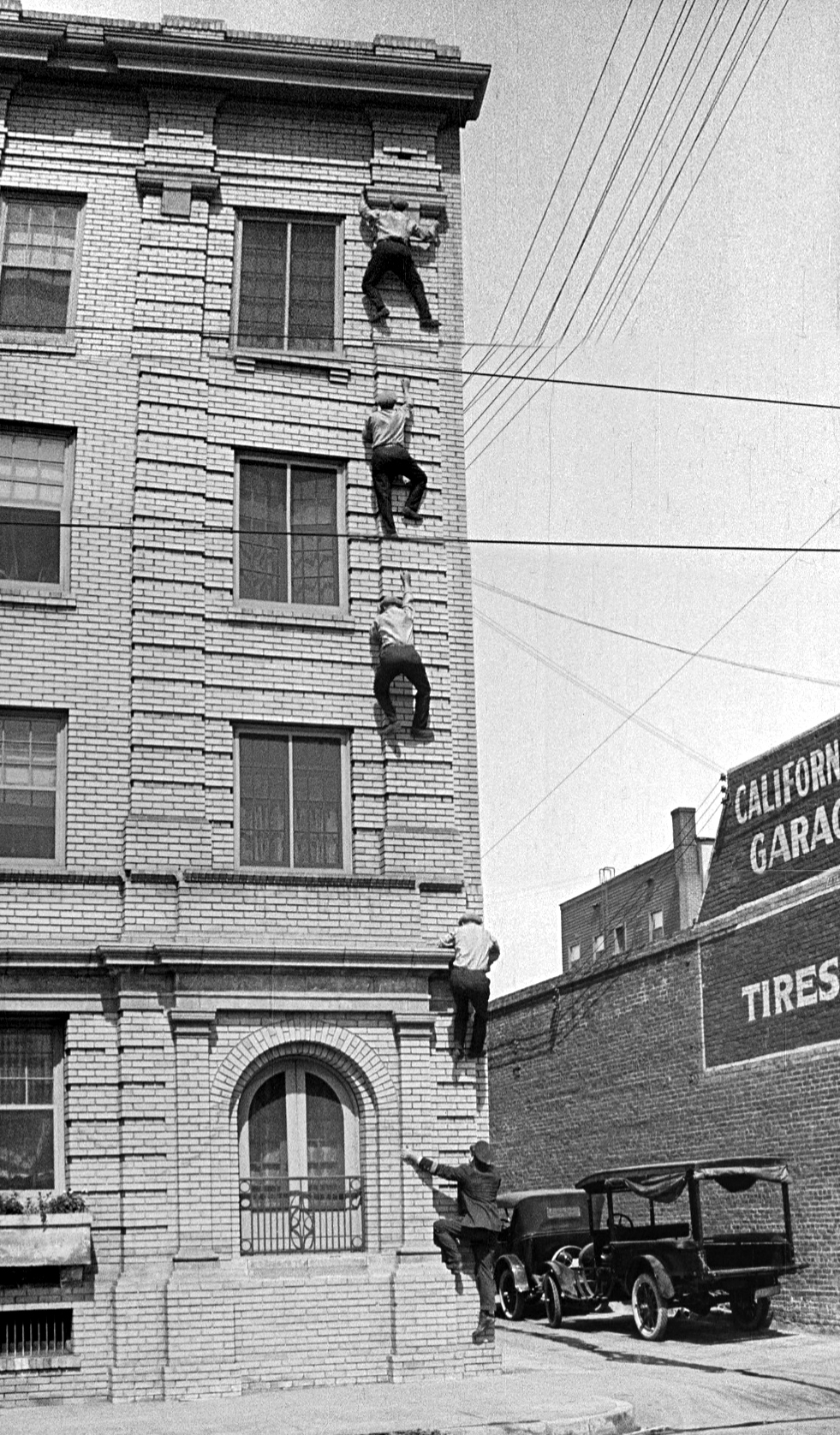
To begin, Soft Shoes depicts Harry Carey sneaking in and out of apartment buildings – the first to appear is the Bryson (lower left), still standing at 2701 Wilshire Boulevard near Lafayette Park.

The Bryson portrayed the front of the Mack Sennett Keystone Studios, upper left above, during one of Charlie Chaplin’s earliest movies, A Film Johnnie (completed February 11, 1914, barely his second month on the job). In that film Charlie’s “Little Tramp” pesters Keystone actors as they enter and depart the “studio.” While the true Keystone studio façade actually appears in dozens of other Sennett productions, for some reason the far more impressive Bryson was employed in the Chaplin film. (Upper right –LAPL). The Bryson’s prominent front fire escape appears several times during Soft Shoes, lower left above, along with the distinctive stone lions that still guard the apartment entranceway.

Built in 1913, the Bryson also appears prominently above Chaplin’s head during a scene from his Mutual comedy The Rink (1916), where Charlie meets Edna Purviance on the street at the SE corner of Wilshire Place and Ingraham (now Sunset Place). The Bryson may be best known as a setting described in Raymond Chandler’s 1943 Philip Marlowe detective classic The Lady in the Lake. Color photo Jeffrey Castel De Oro.
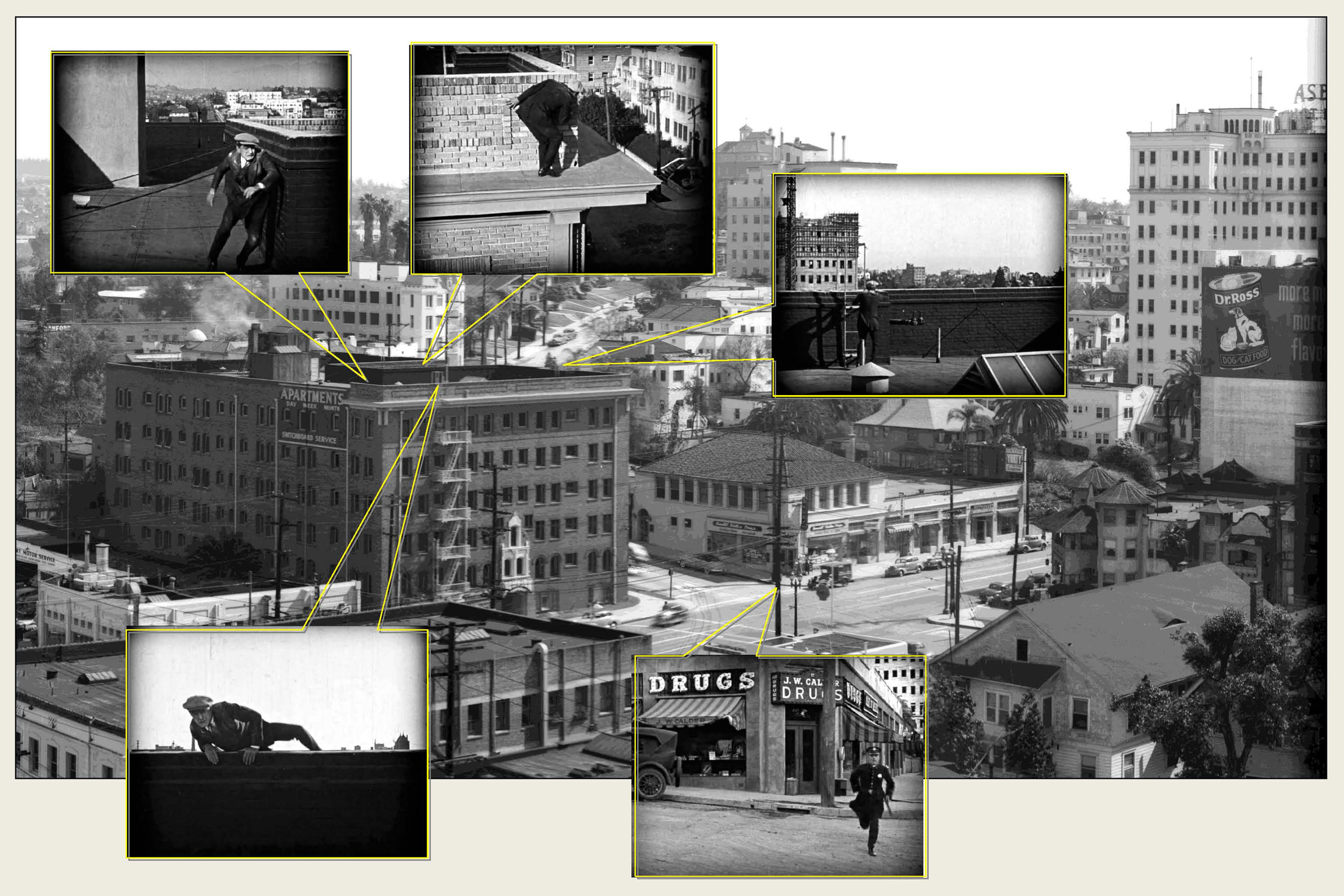
Soft Shoes also features the police chasing Harry around another high rise, including the roof, filmed at the Franconia Apartments still standing at 6th and Coronado north of MacArthur Park, pictured above facing 6th Street. The Asbury Apartments mentioned below appears to the far right. USC Digital Library.

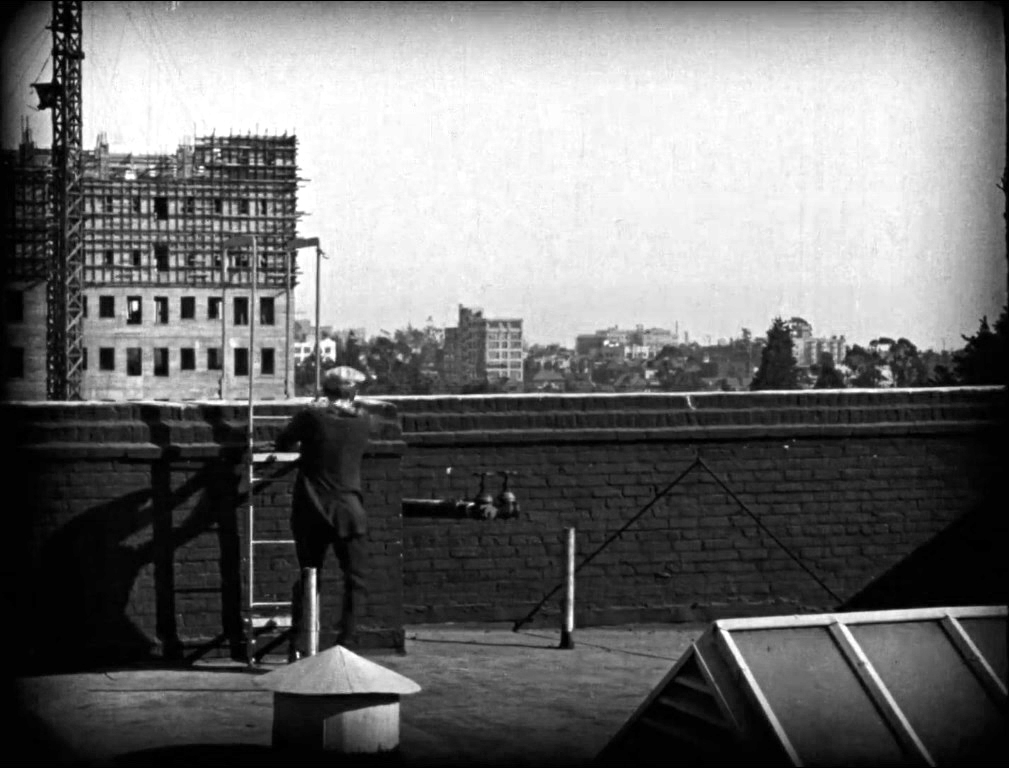
This scene of a cop racing towards what turned out to be the Franconia contains two vital clues. At the time J. W. Calder had two corner drug stores, but only his store at 2549 W 6th Street aligned with a tall building at back. As such, this shot above reveals the Asbury Apartments undergoing construction, which opened later in 1925, still standing at 2505 W. 6th Street. (Asbury left – USC Digital Library). By correctly assuming the rooftop scenes (click to enlarge – inset right) also depict the same Asbury Apartments under construction, triangulating back from the Asbury identified the Franconia as the primary shooting site.
The Franconia has a recessed fire escape shaft on each wing facing Coronado Street, put to good use as the cops follow Harry to the roof during Soft Shoes. The color image is the north wing shaft, the movie frame could depict either wing. Vintage photo Don Lynch.

Here Carey peeks north up Coronado, with buildings at back still standing. The Franconia’s decorative rooftop ledges were removed for earthquake safety reasons. Carey crouches on the south ledge of the north wing, while the camera peers across towards him from the south wing.

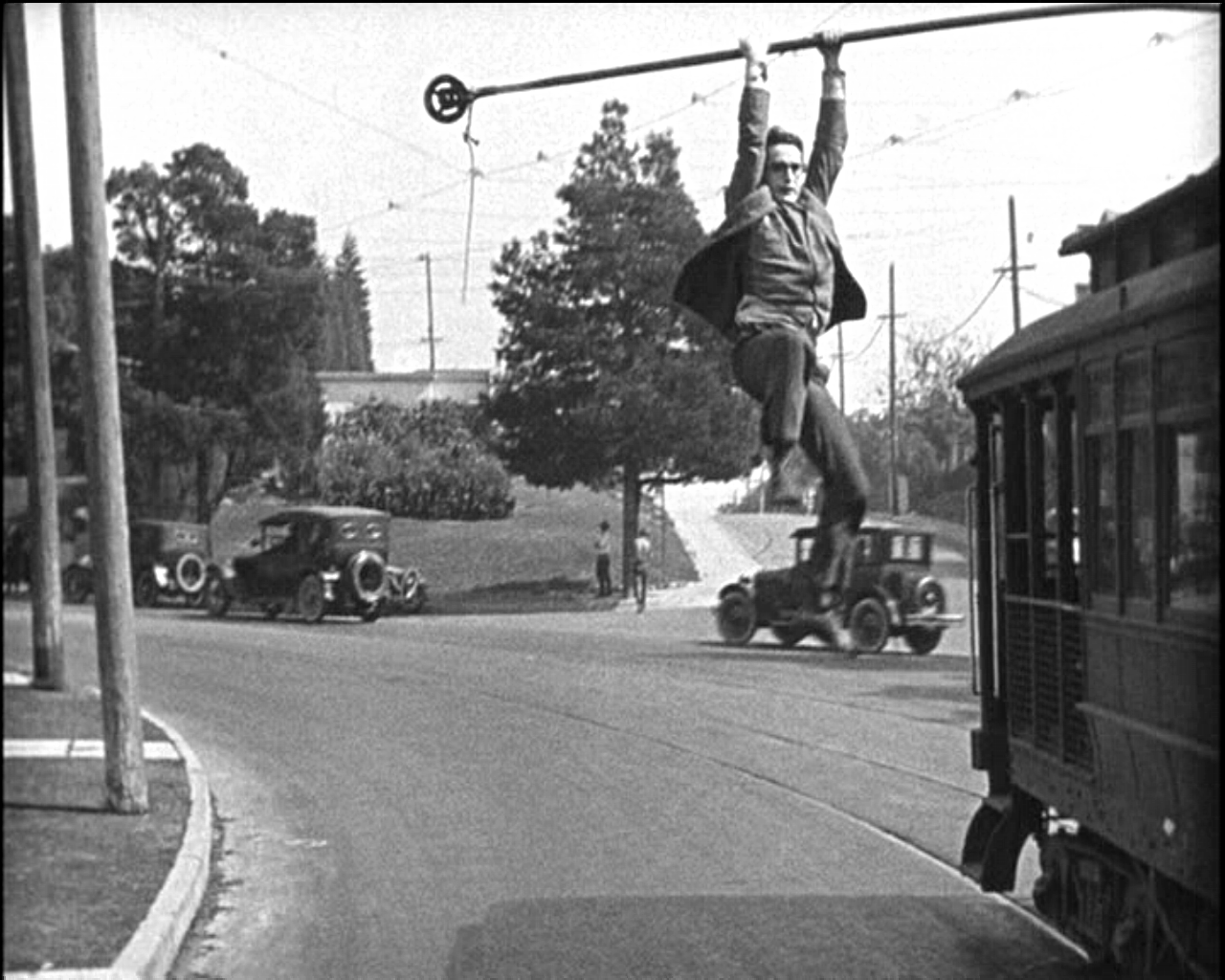
The view above looking NW from the Franconia roof (left) reveals a stretch of Rampart Boulevard, beginning with the Villa d’Este Apartments at 401 Rampart (A), to the corner of Rampart and W. 3rd Street (D), all appearing in Harold Lloyd’s For Heaven’s Sake (1926) (right, Harold with straw hat). As I explain in my Lloyd book Silent Visions, Harold filmed the drunken groomsmen bus scene, shown here, extensively on Rampart between 6th and 3rd, where nearly every building on the street appears onscreen and remains standing today. The Rampart corner (D) also appears in Lloyd’s Girl Shy (1924).

Below, further action takes place in Ocean Park, the small beach community south of Santa Monica.

Above left, a 1924 view east of Ocean Park, showing Ocean Front, Pier Avenue, and Marine Avenue (Huntington Digital Library). The photo documents the aftermath of the January 6, 1924 fire that destroyed the Pickering and Lick Piers. To the right, a circa 1915 view east down Pier Avenue and Marine Avenue (Huntington Digital Library). Note the church on Marine at back. The front vacant lot is where a billiard parlor (below) would be built.
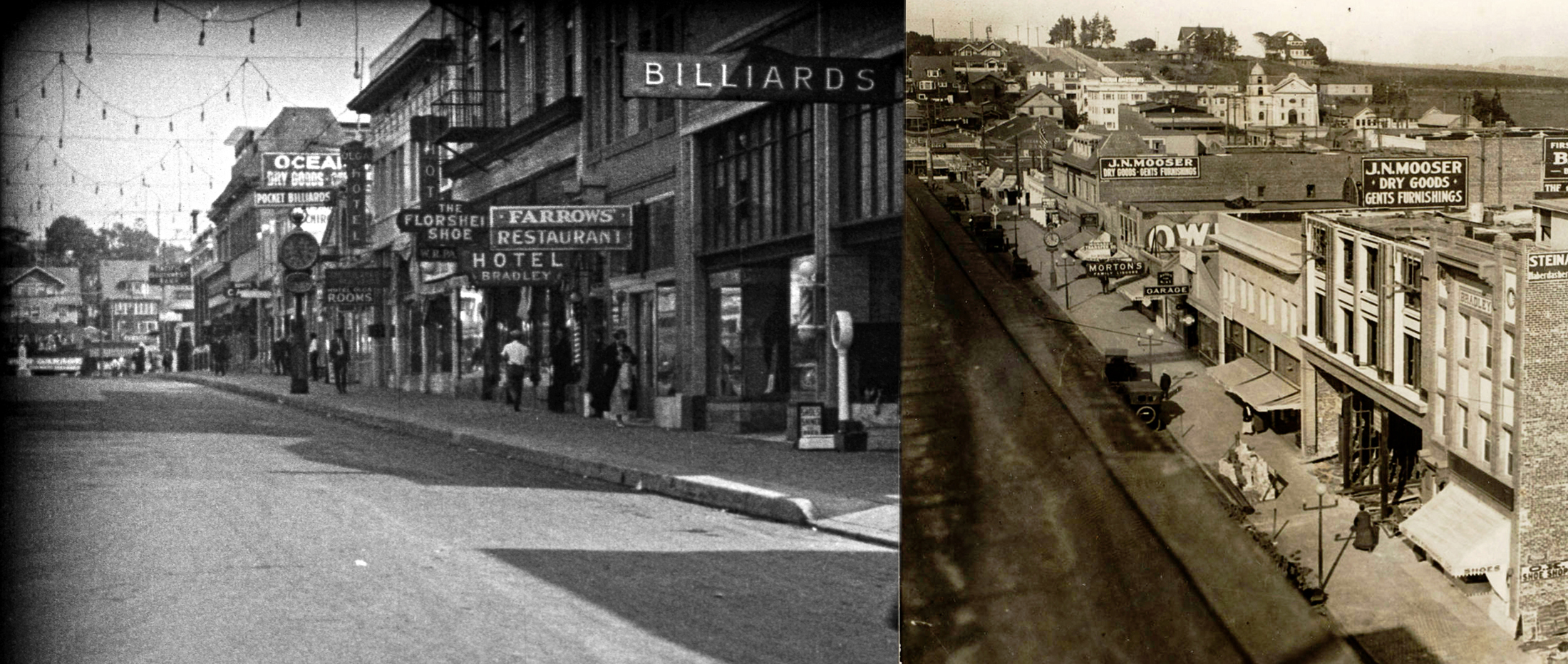
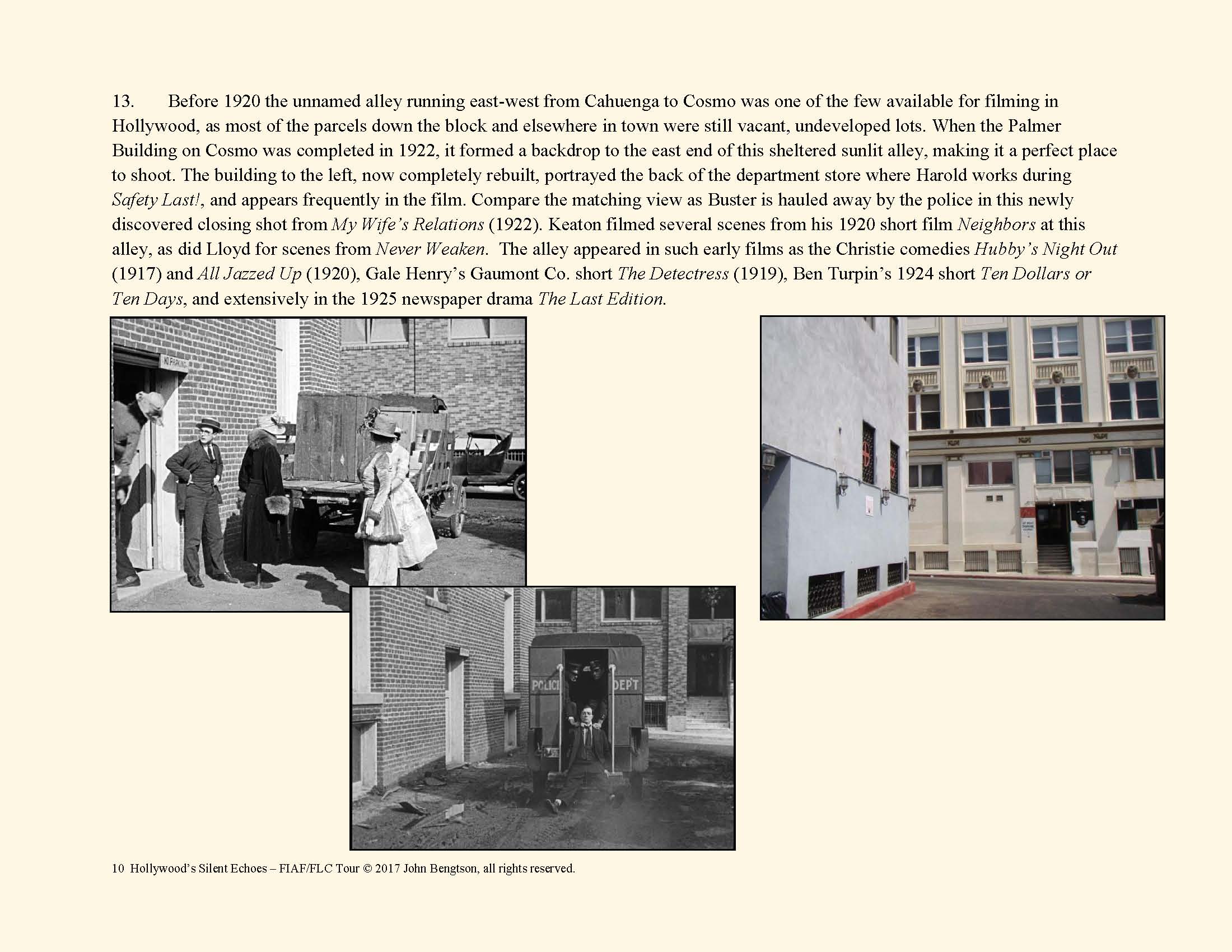
Click to enlarge. The “Billiards” building far right in the movie frame is newer, built after the photo was taken. The far right photo building says “BRADLEY” at the roof ledge, matching the Hotel Bradley in the movie frame. The J.N. Mooser Dry Goods building appears as Ocean Park Dry Goods in the movie frame. Note the matching sidewalk clock in both images.
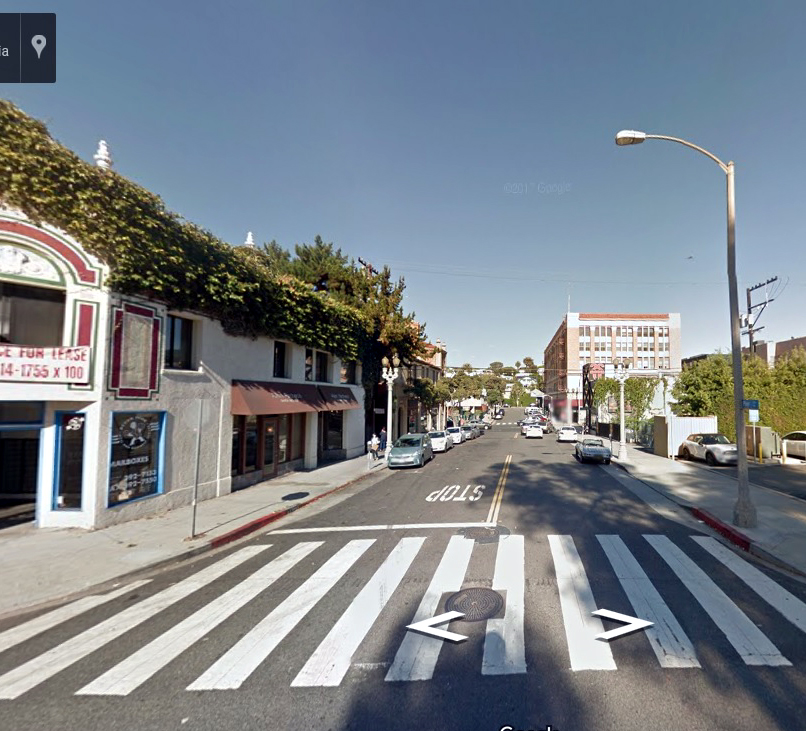
This scene above (cropped) of Carey fleeing by automobile was filmed looking east on Pier Avenue towards Main from what was once called Ocean Front (now Neilson Way), the grand promenade that originally fronted the beach. The “FARROW’S RESTAURANT” appearing at back once stood at 130 Pier Avenue, on the ground floor of the Hotel Bradley at 130 1/2 Pier Avenue. Further back stands the Olga Hotel at 142 1/2 Pier Avenue. None of the buildings captured in this scene remain in the modern view (left).

While none of the Pier Avenue commercial buildings appearing in the movie remain today, the rear of the uphill homes still standing at 3014 and 3018 3rd Street remain visible in the far background – compare above the movie, historic photo, and modern views. (Color image (C) 2018 Microsoft Corporation).

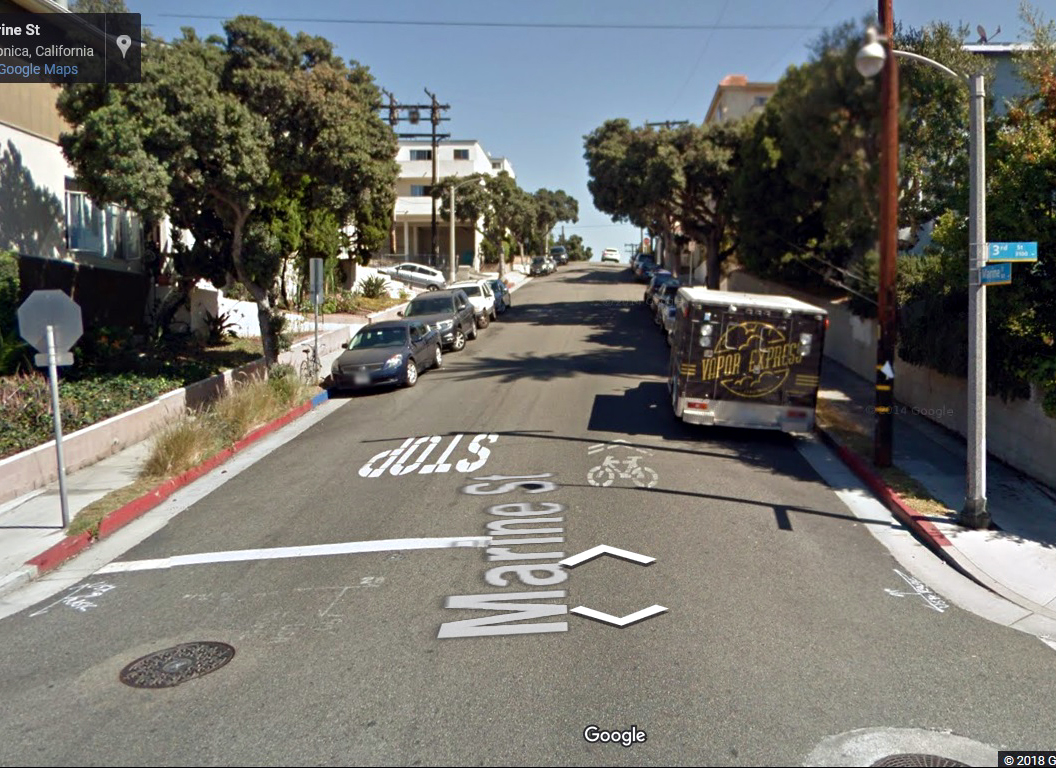
This view looks east down Marine Street, parallel to and a block south from Pier Avenue, towards the former St. Clement’s Church that once stood on the SE corner of Washington Boulevard (now 2nd Street) and Marine. The large building at the center of the movie frame is the side of the former Masonic Temple at 162 Marine.

A closer view of the west side of the former Masonic Temple (center), and at back, the former St. Clement’s Church (LAPL), both long demolished.

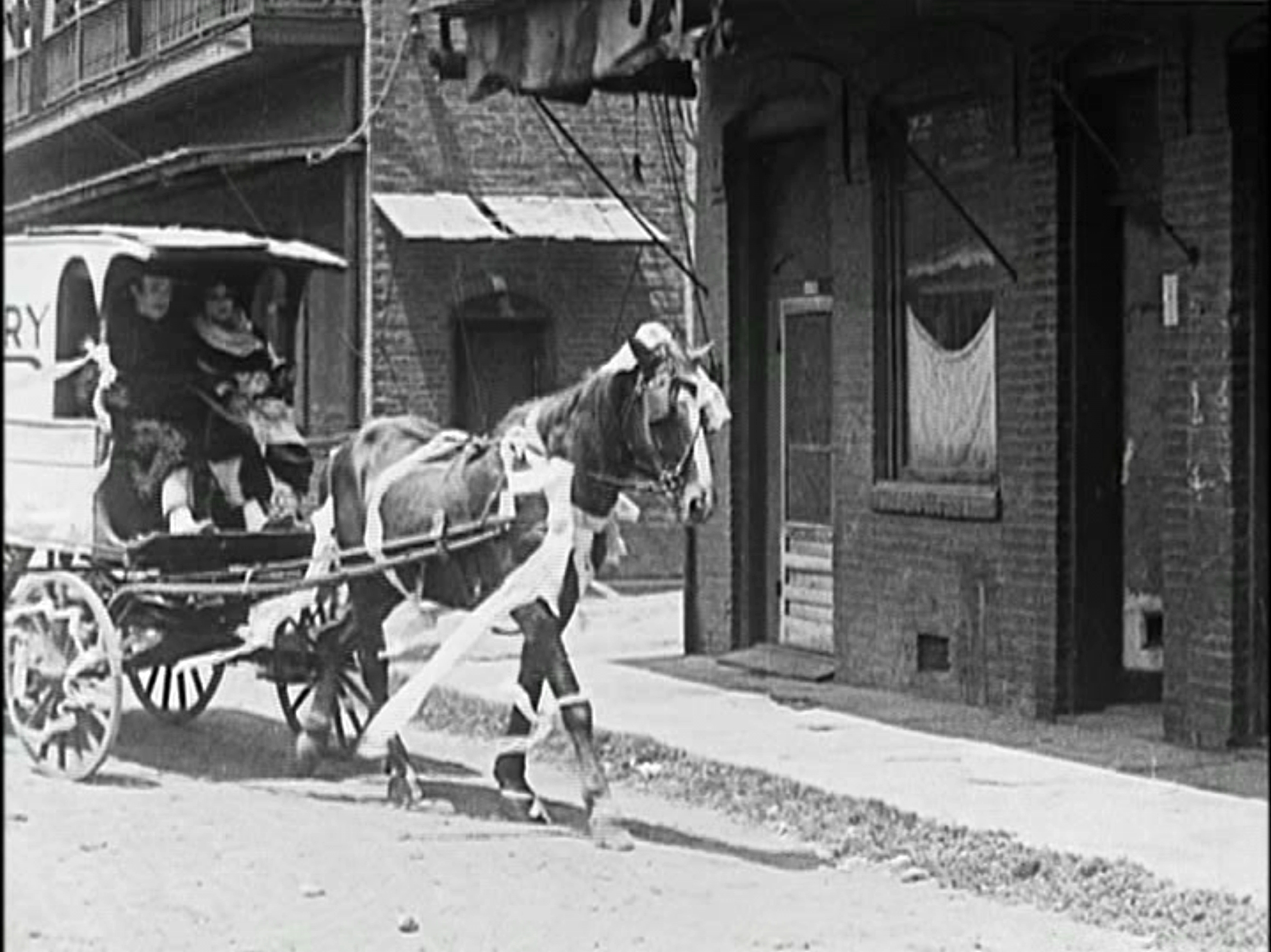
Moments later, Carey switches between cars as they pass on a steep hill, filmed just a block further east along Marine between 3rd and 4th. The retaining walls on the south side of Marine appearing in the film remain in place today. This aerial view clearly shows the Masonic Temple (box), the church (oval), and the hilly street with the retaining walls to the right (line) depicted in the film.

Late in the film, Carey and others run along dingy Chinatown alleys and street corners. Built in the 1880s, the original Chinatown grew east of the Plaza de Los Angeles on former grazing land owned by Mexican land baron Juan Apablasa and his son Cayetano. Denied property ownership, and restricted from living elsewhere, the Chinese suffered the neglect of their landlords, who left the privately owned streets of Chinatown unpaved. Crammed among noisy railroad tracks, towering gaswork plants, and the frequently overflowing Los Angeles River, Chinatown was the city’s least desirable address.

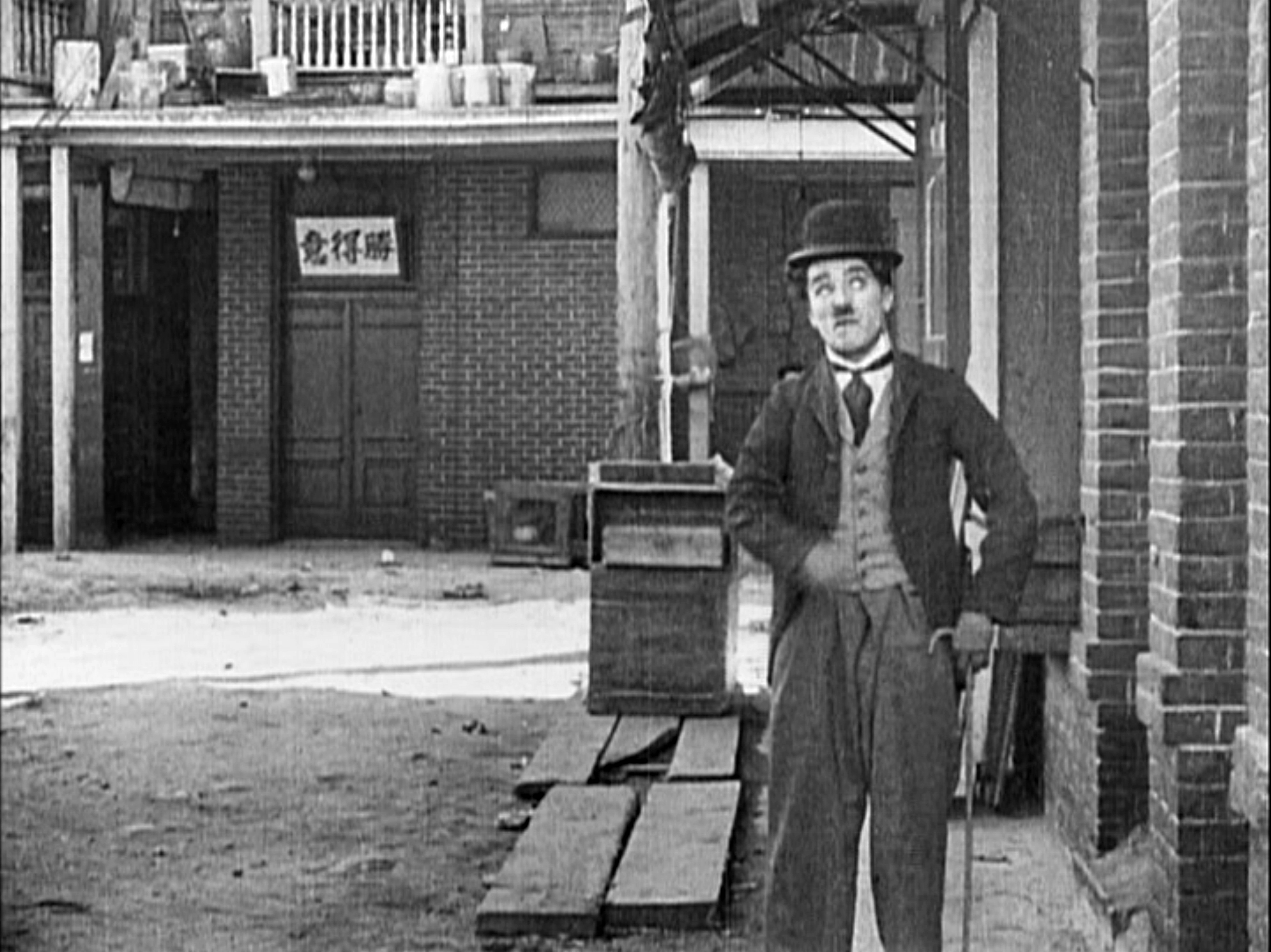
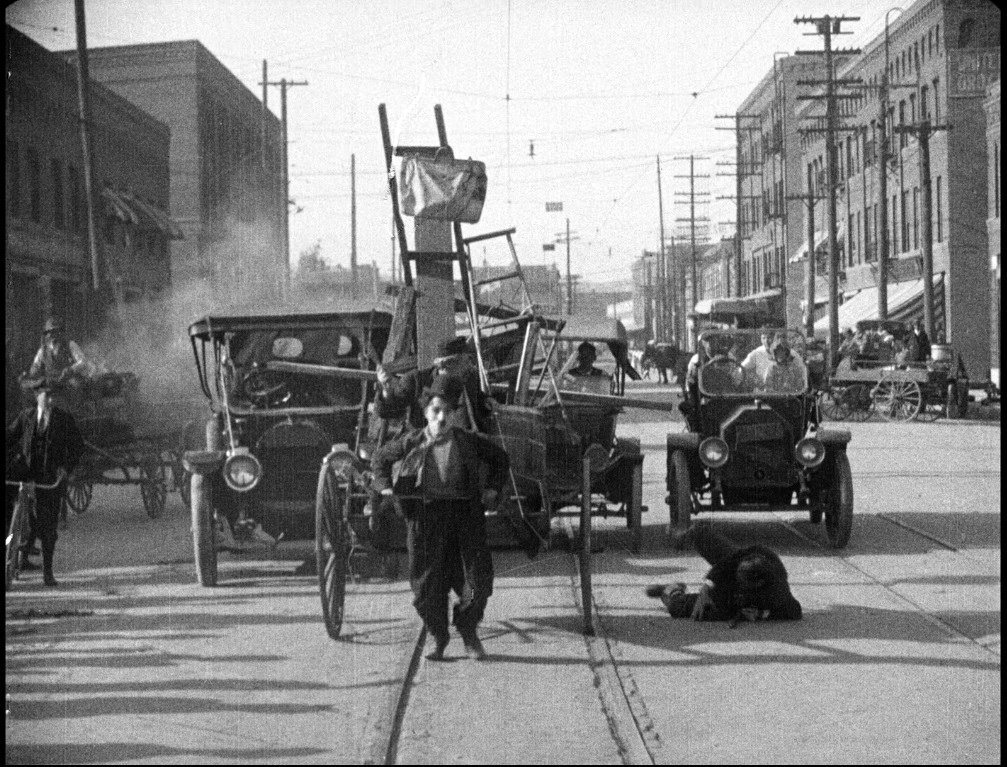
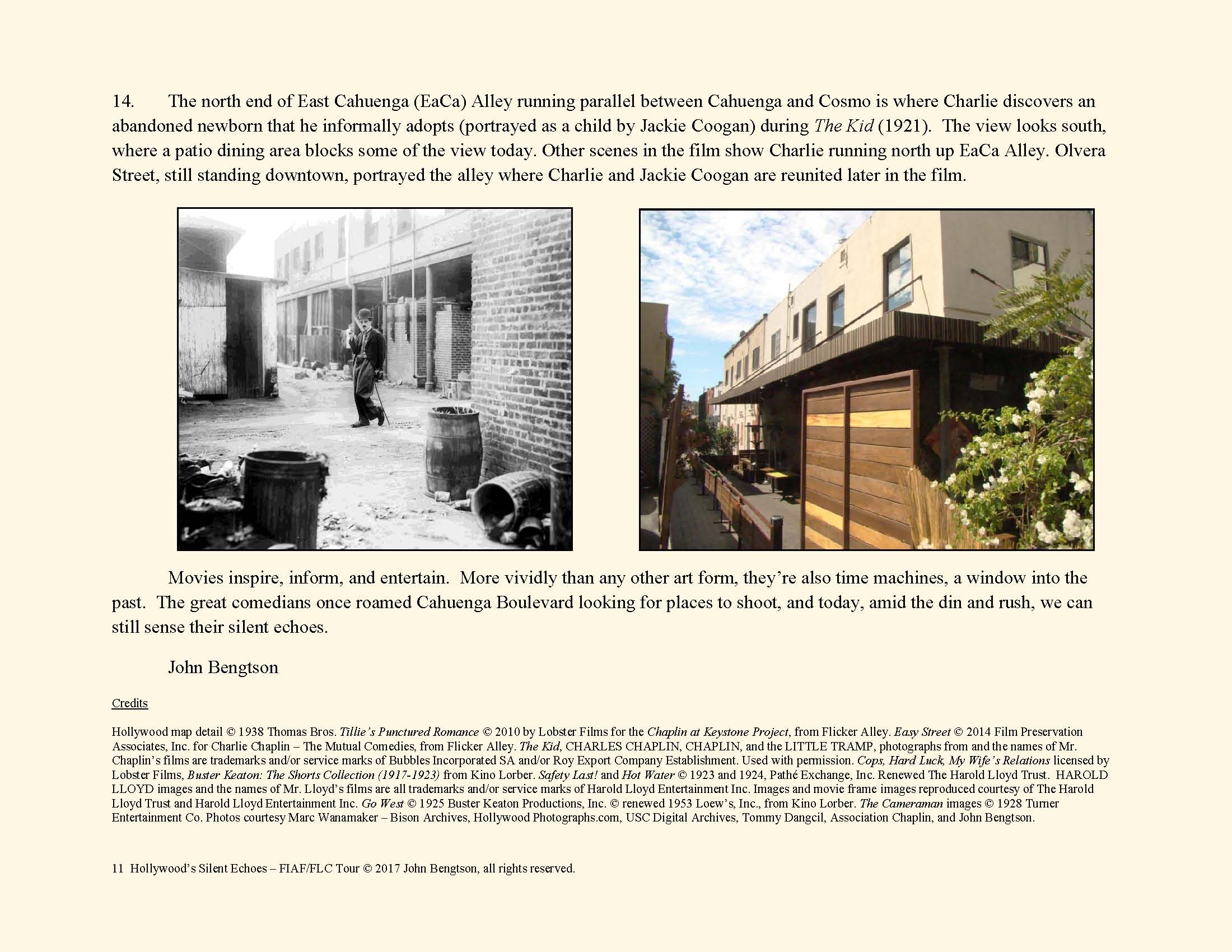
(Above, Huntington Digital Library, left, Soft Shoes upper right, Chaplin’s The Kid, lower right). Once the original leases expired, most of Chinatown was sold in 1914 to make way for the future Union Train Station. After years of litigation, the Chinese were evicted in 1934 for construction of the new terminal that opened to great acclaim in 1937. That same year community leaders formulated a master plan to develop a new Chinatown between Hill and Broadway, a mile northwest from its former site, where it remains today. Three identifiable scenes from Soft Shoes were filmed at the same spot, the corner of a narrow alley running from Marchesault Street to Apablasa Street, across from the corner of Cayetano Alley. Remarkably, one shot matches exactly where Charlie Chaplin filmed a critical scene from The Kid (1921). Here above (upper right Soft Shoes, lower right The Kid) are identical views looking south from Cayetano, across Apablasa, towards the narrow alley corner.

Above, Soft Shoes left, looking SW, a composite image from Chaplin’s The Kid, right, looking south. Both views show the same drainspout and corner alley bulletin board.

Upper left (yellow), Harry Carey runs south from Apablasa Street towards Marchesault Street, down a narrow connecting alley – this may be the only surviving image taken within this alley. Lower left (red), Chaplin at the corner of Cayetano and Apablasa. The purple arrow points west down Apablasa, matching Stan Laurel’s view, below. UC Santa Barbara c-2744_3.

A wide view looking west down Apablasa, with The Kid/Soft Shoes alley corner at the left. Stan Laurel appears at right in Mandarin Mixup (1924). Chaplin filmed Caught In A Cabaret (1914) beside the central building at back. You can read more about Chaplin and Laurel filming in Chinatown on Apablasa (below) in this post HERE.
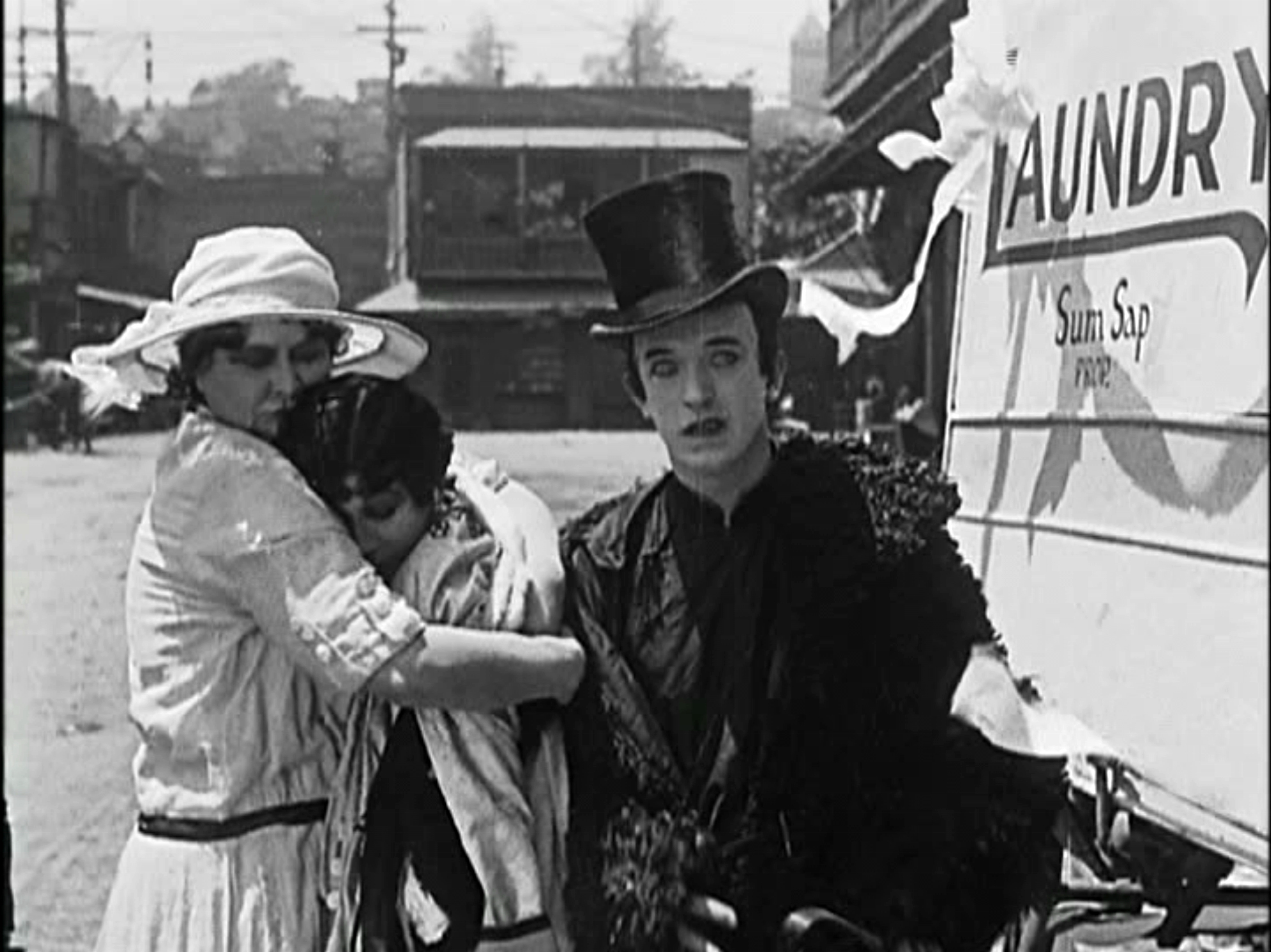
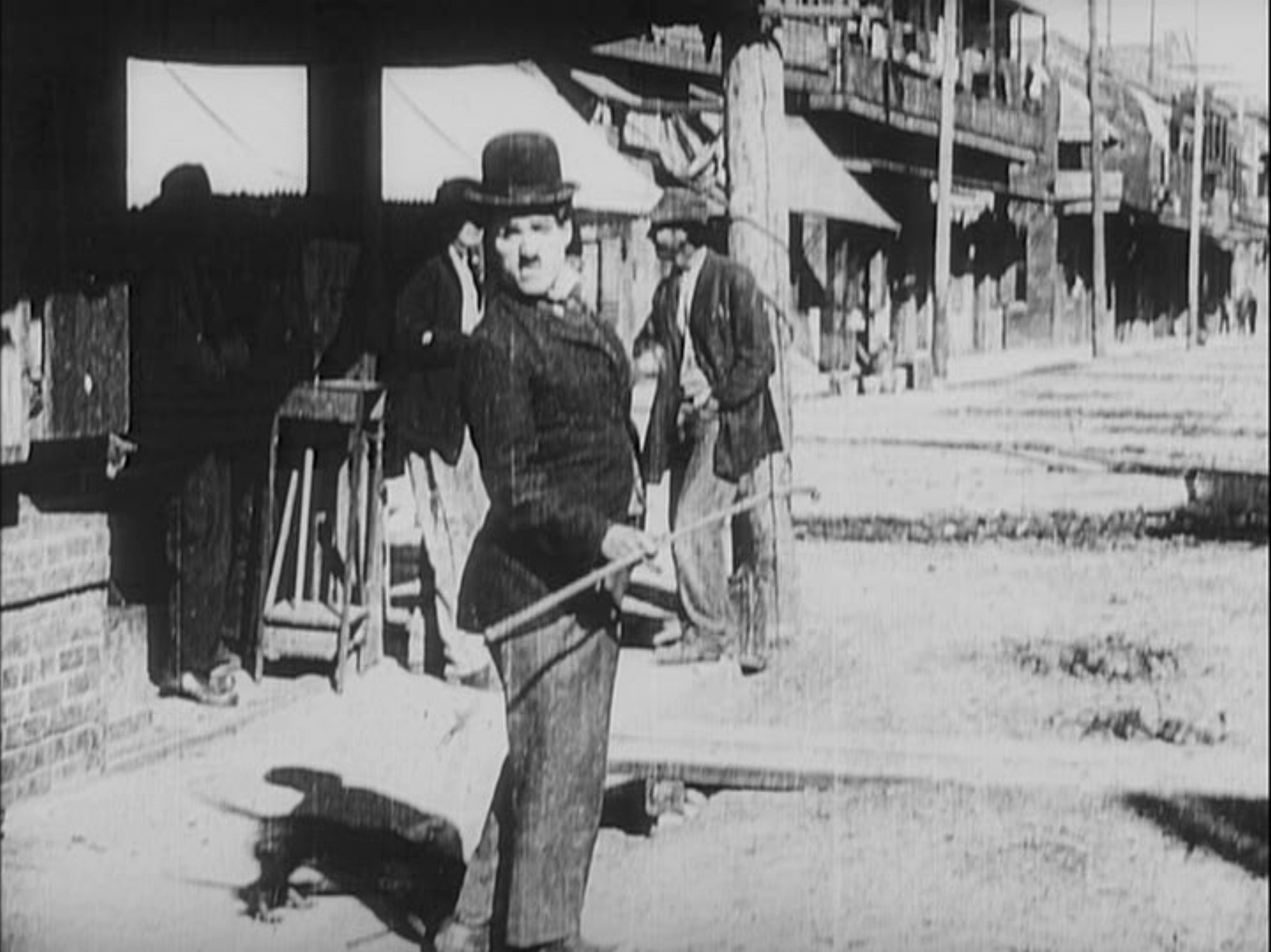
At left, is this a happy ending for Harry Carey? Come to the festival and find out. The 2018 Soft Shoes restoration was completed by the San Francisco Silent Film Festival in partnership with the Czech Republic’s Národní filmový archiv, under the supervision of SFSFF President Rob Byrne, with SFSFF recreating English titles from the original surviving Czech print. Funding for the restoration was generously provided by the National Film Preservation Foundation with additional funding from the San Francisco Silent Film Festival Film Preservation Fund.

All images from Chaplin films made from 1918 onwards, copyright © Roy Export Company Establishment. CHARLES CHAPLIN, CHAPLIN, and the LITTLE TRAMP, photographs from and the names of Mr. Chaplin’s films are trademarks and/or service marks of Bubbles Incorporated SA and/or Roy Export Company Establishment. Used with permission. HAROLD LLOYD images and the names of Mr. Lloyd’s films are all trademarks and/or service marks of Harold Lloyd Entertainment Inc. Images and movie frame images reproduced courtesy of The Harold Lloyd Trust and Harold Lloyd Entertainment Inc. The Kid – Criterion Collection; Chaplin’s Mutual Comedies; The Stan Laurel Slapstick Symposium Collection Volume 2, Eric Lange and Serge Bromberg, Lobster Films; Chaplin at Keystone Collection, Lobster Films for the Chaplin Keystone Project. Except where noted color images (C) 2018 Google.

Below, the Franconia Apartments.
Posted in Charlie Chaplin, Harold Lloyd, Stan Laurel | Tagged , , , , , , , , , , , , , , , , | 6 Comments

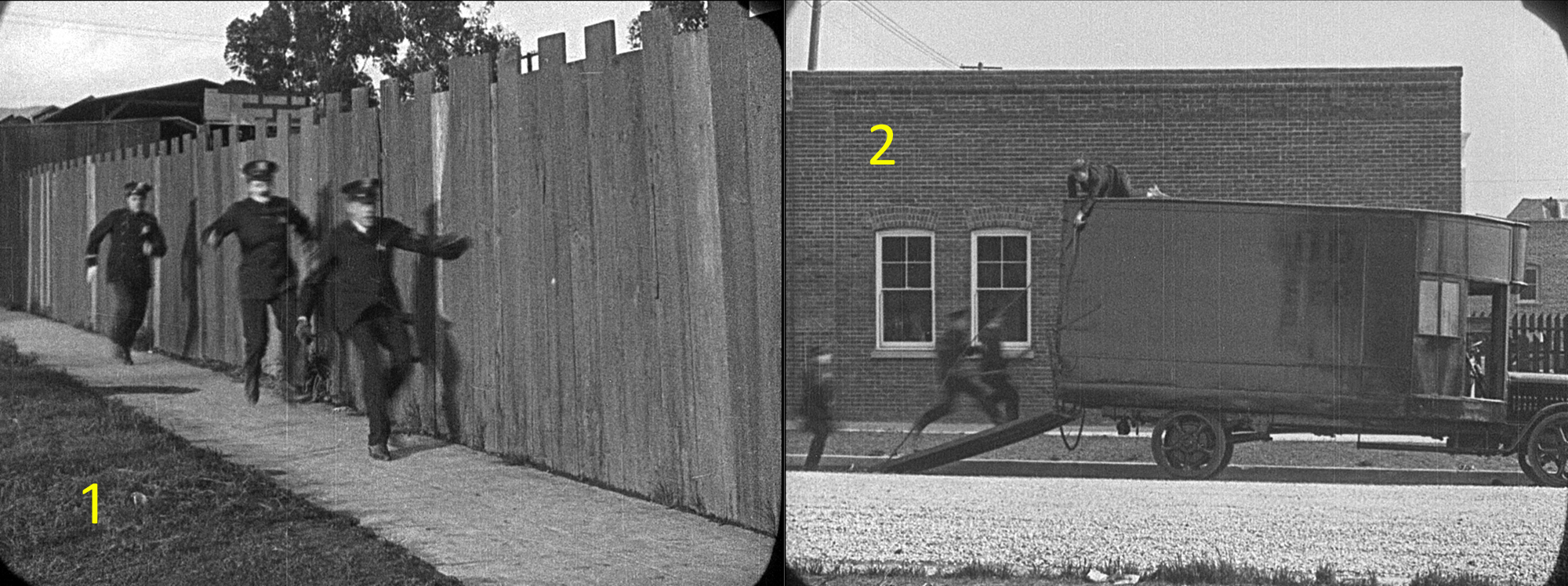
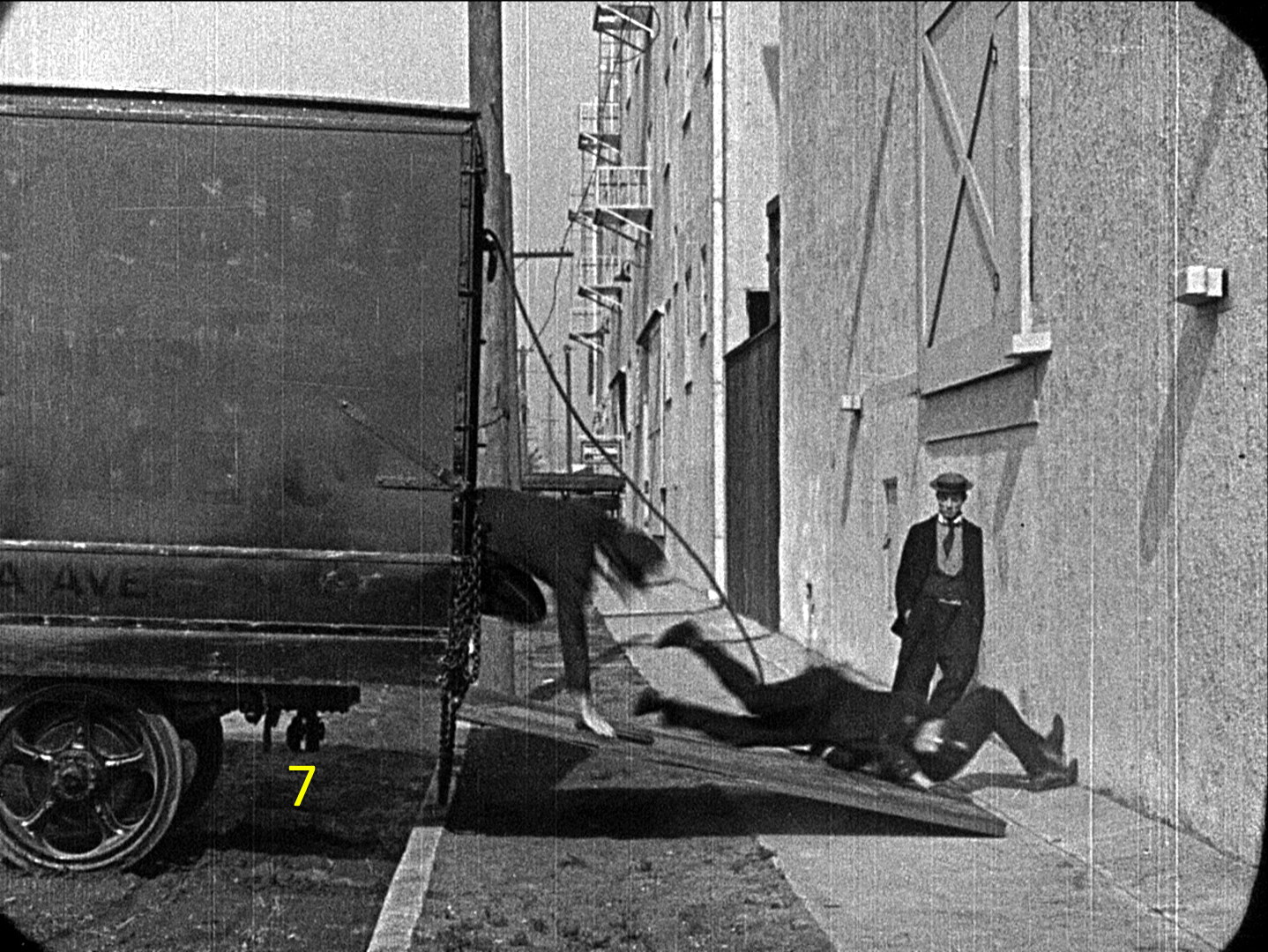
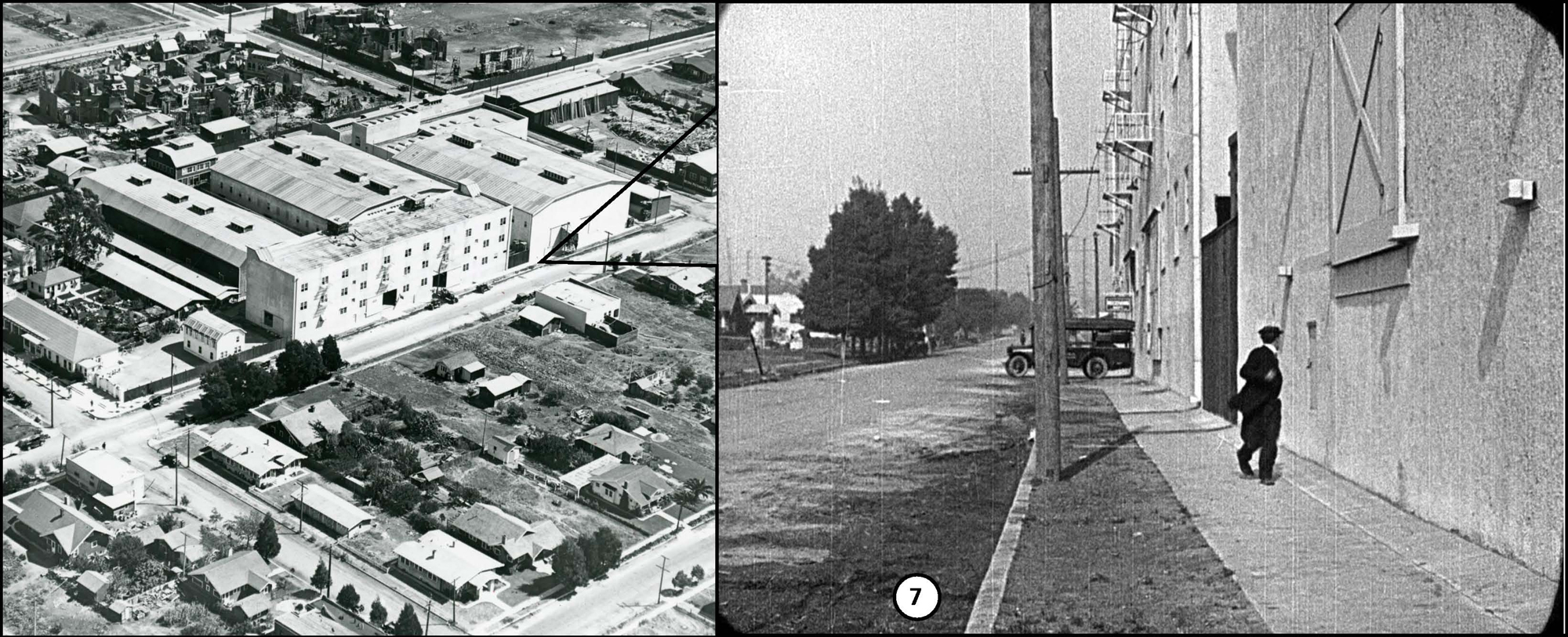
The Surviving Keaton Studio Neighbors

This duplex once adjacent to the Keaton Studio is still standing – more below.

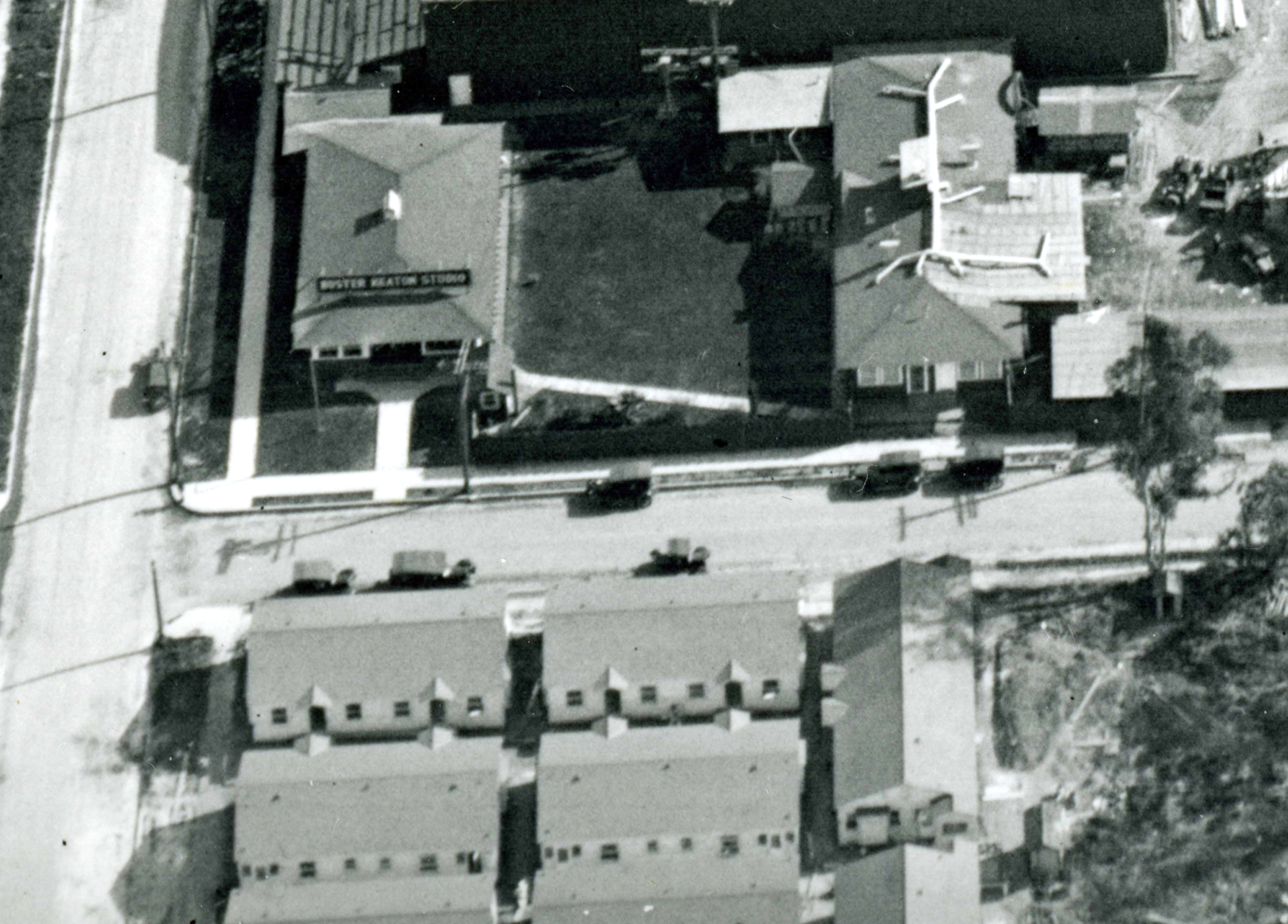
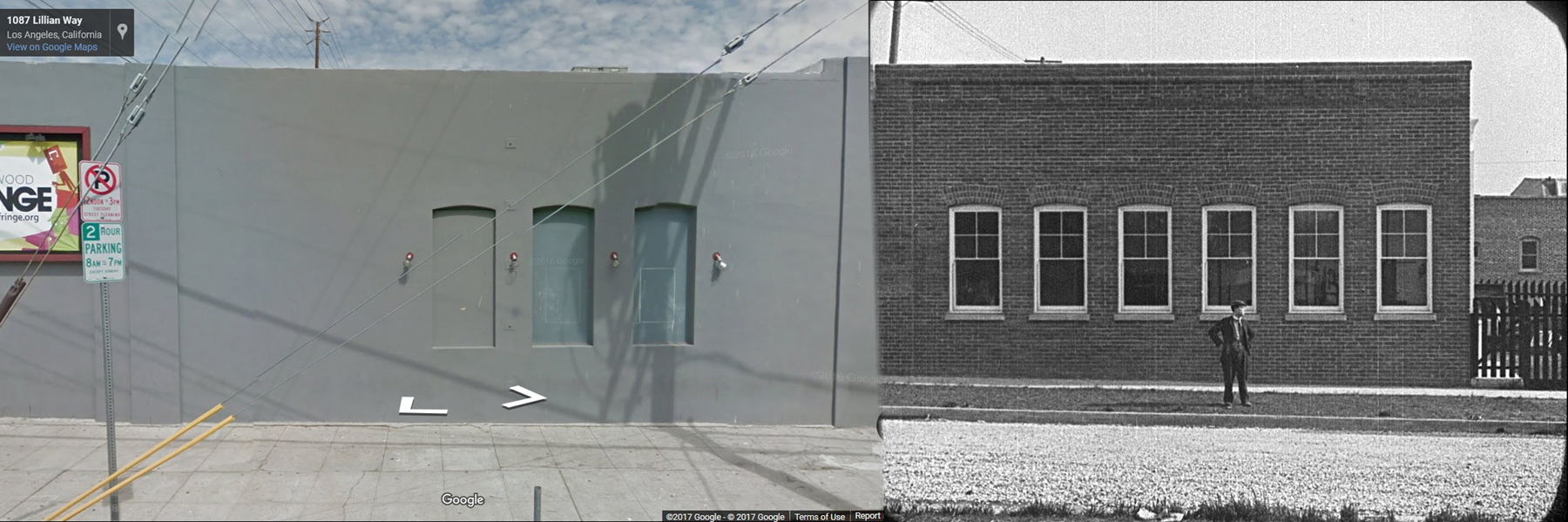
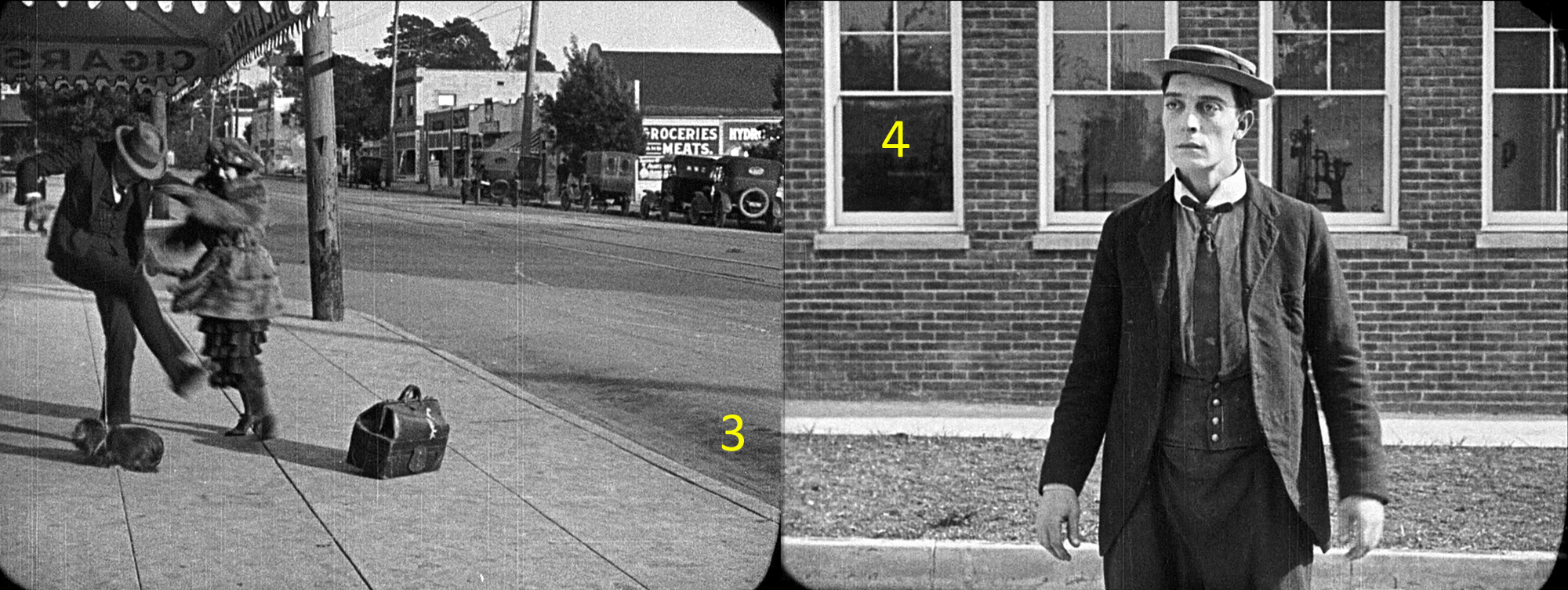
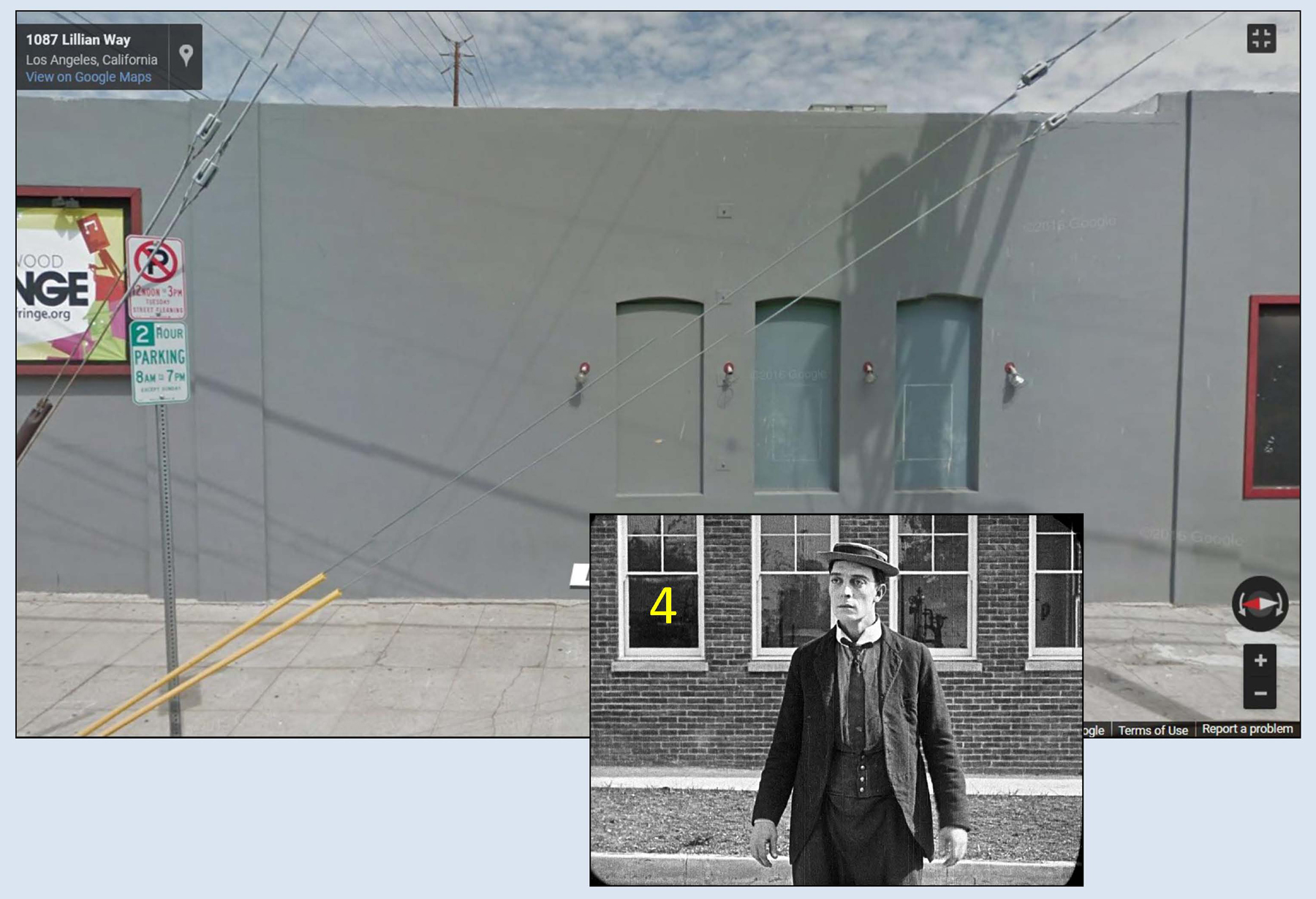
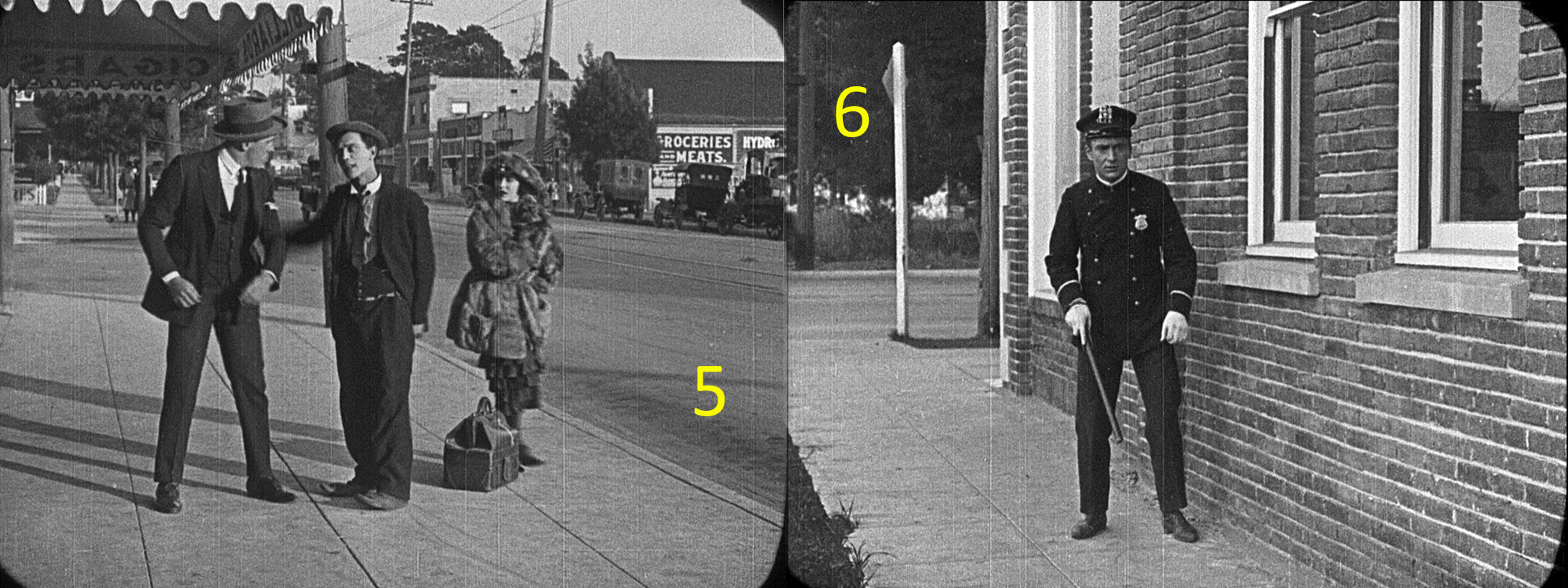
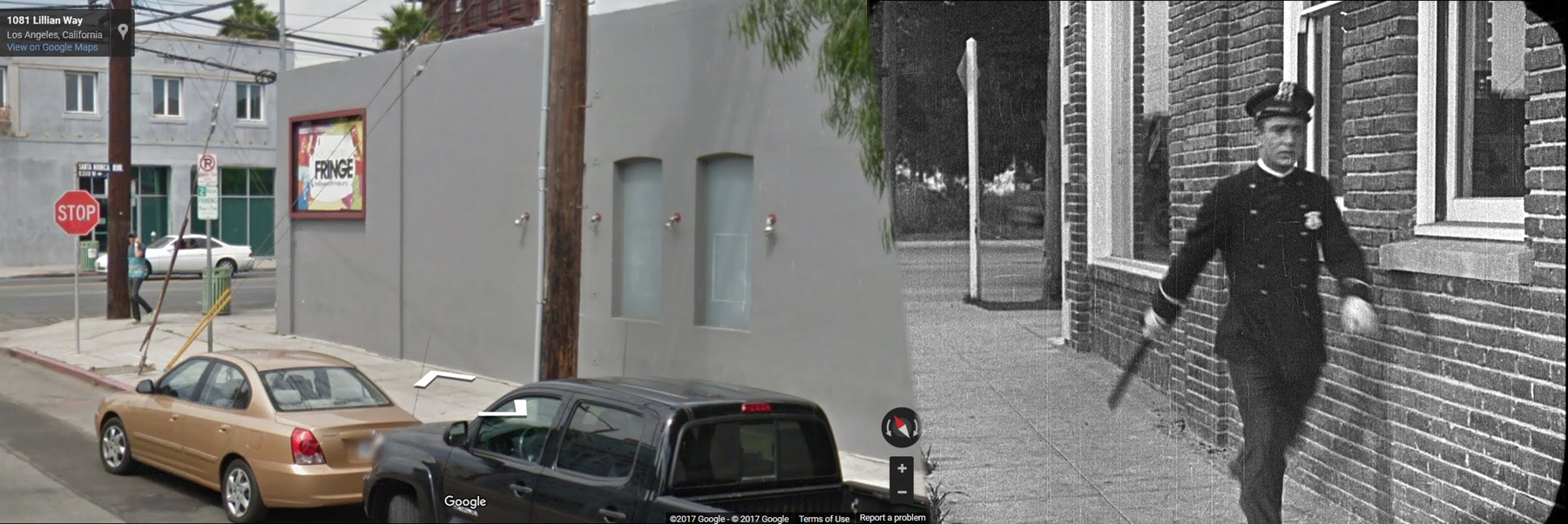
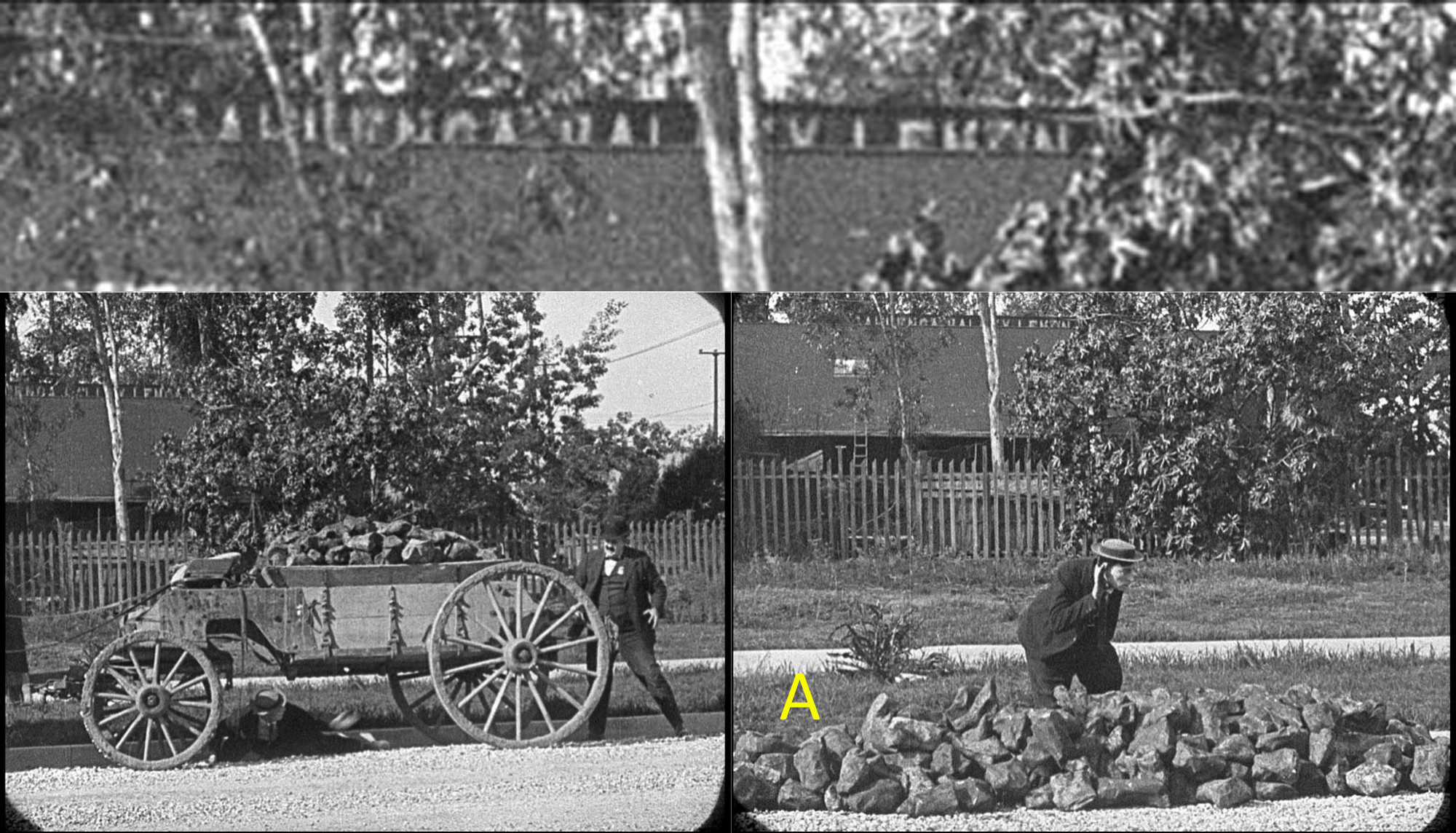
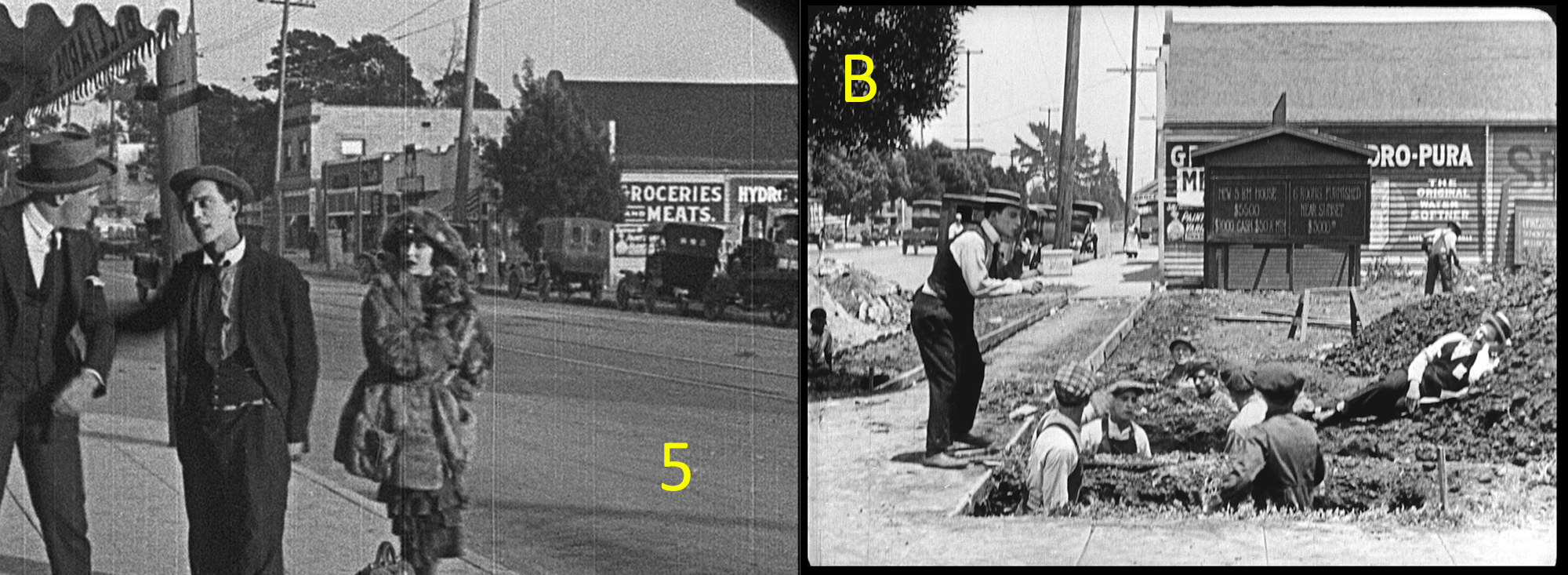
Buster Keaton unwittingly documented the urbanization of the once agricultural Colegrove region of Hollywood in the background of his films. As reported in my book Silent Echoes, the quaint Cahuenga Valley Lemon Growers Exchange warehouse once stood across the street from Buster’s small studio (see below), appearing in the background during scenes from his early shorts The Scarecrow (1920) and The Goat (1921) (see further below). By 1923, it was gone, replaced by a six story storage warehouse on Santa Monica Boulevard, still standing today, that appears to the upper left during this scene looking north from The Balloonatic (1923) (right). The dark horizontal rectangle near the center of this image is the back of the Keaton Studio sign, with many dressing room windows along Lillian Way to the left, and office bungalow windows at the center.

Looking north at the lemon warehouse across the street – Buster with Big Joe Roberts and Roscoe Arbuckle on the studio lawn.

Below, views of the warehouse, looking north at left, from The Scarecrow, and looking west, from The Scarecrow and The Goat, upper right and lower right. If you click to enlarge the lower right image you can actually read the warehouse sign through the trees above Buster.

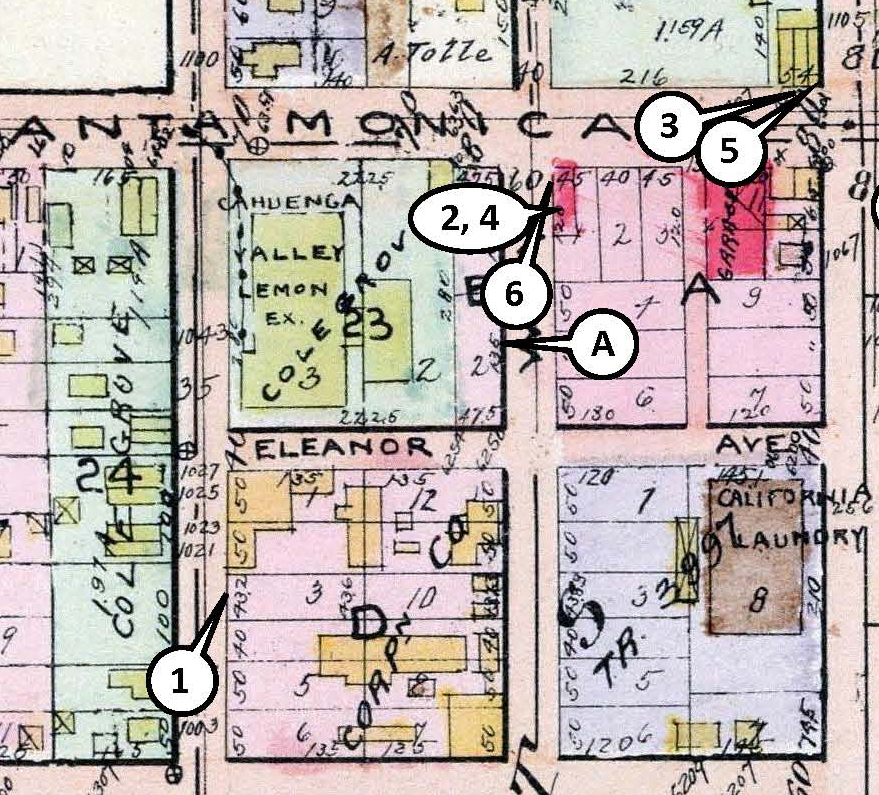
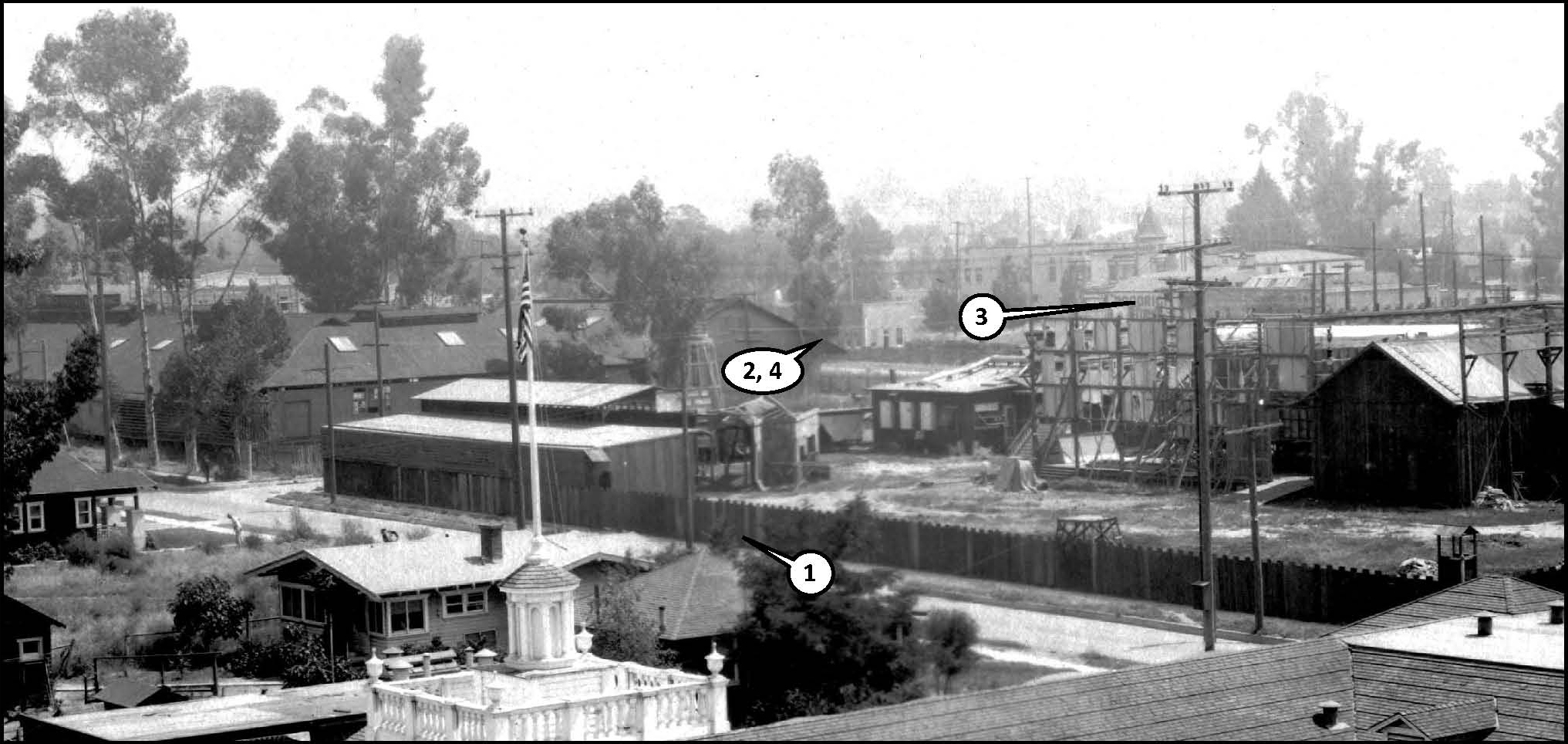
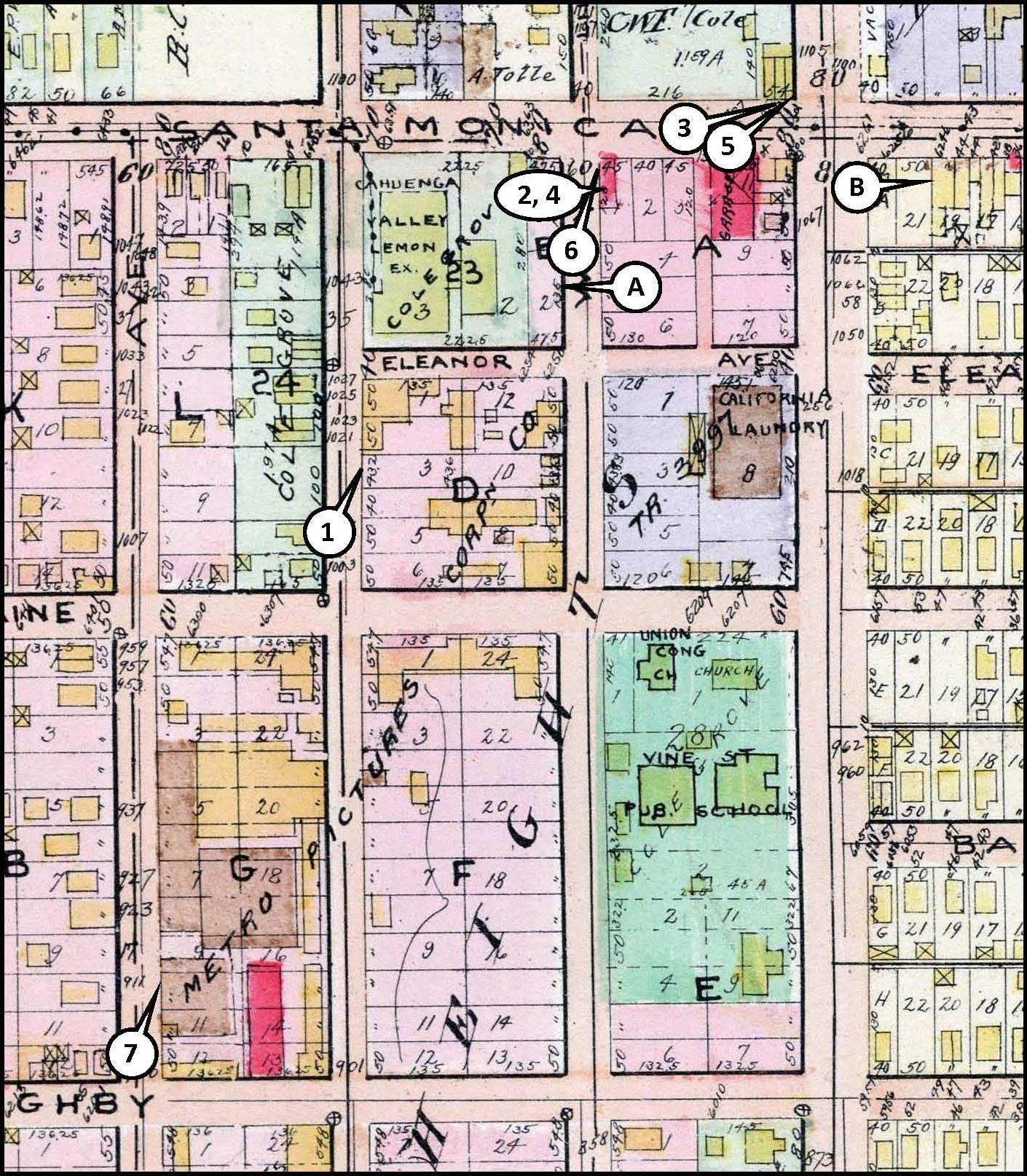
While I was vaguely aware that other modern buildings encroached north of Buster’s studio, I never bothered to investigate them until now. It turns out that a very dense cluster of 10 duplexes was crammed into a tiny corner lot directly across from Buster’s bungalow office. Their addresses ranged from 1051-1051 ½ to 1069-1069 ½ Lillian Way. This 1923 view looks south towards the studio – HollywoodPhotographs.com.

10 duplexes, 20 units, each tiny 4-room unit barely 500 square feet in size. The building permits for these units were all pulled on Christmas Eve, 1921, with construction completed early in 1922. This 1938 photo looking north (right) shows the duplexes on Eleanor and Lillian Way (box) and the warehouse on Santa Monica Blvd. at the upper left. USC Digital Library. Note in both photos that four duplexes with widely-spaced porch entrances flank a very narrow courtyard, while at the end of each narrow courtyard the fifth duplex in the group has closely-spaced porch entrances.

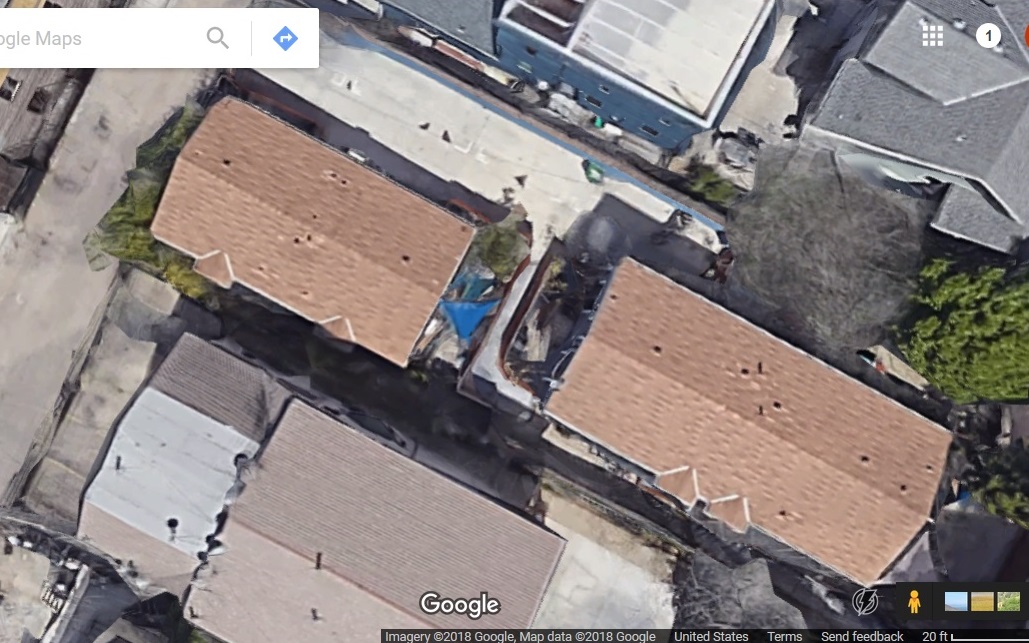
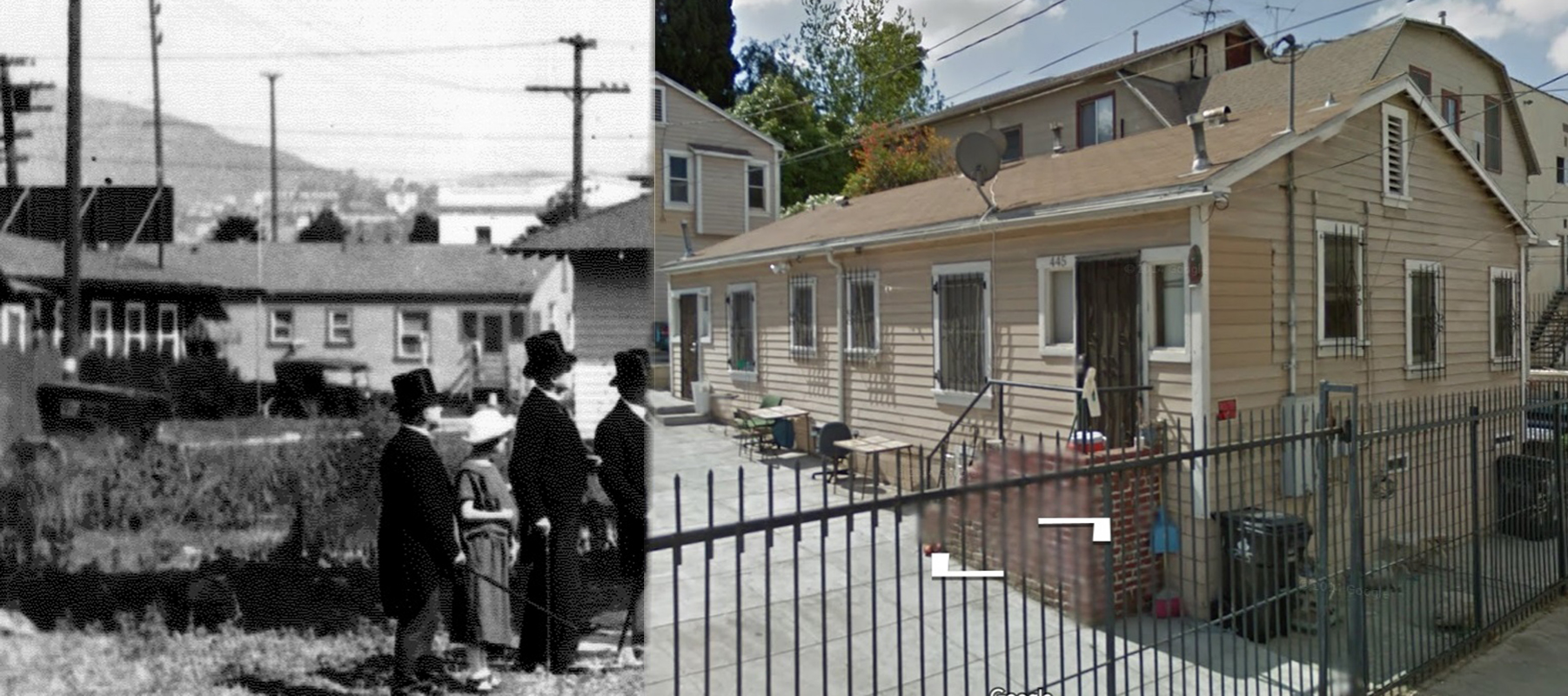
Despite their tiny size, these units were not later demolished, but were relocated, the southern 5 duplexes moved in 1947, and the remaining 5 units in 1955. Above, a view north from a cropped publicity still (left) for The Balloonatic, showing the side, back porch, and corner of one of the 10 duplexes. Though not the same unit in the vintage photo, the color view of 445 Coronado Terrace (the former 1065 – 1065 ½ Lillian Way unit) shows matching back porch and window pattern details. The color view also shows 441 Coronado Terrace (the former 1061 – 1061 ½ Lillian Way unit) up in back. This unit was built atop a tall, sloping foundation, to allow the other end of the unit to front the uphill street.

445 Coronado Place, left, with widely spaced porches, 441 Coronado Place, right, with closely spaced porches.

Presumably these tiny homes were built to accommodate studio employees, both Keaton’s, and the much larger Metro Studios a block further south. When the Hollywood Metro Studios shut down in 1924 to become part of M-G-M in Culver City, the appeal of these homes may have suffered.

From the Los Angeles Times, September 3, 1926, advertising 1065 ½ Lillian Way for rent. Adjusted for inflation, the $30 monthly rent equates to roughly $425 a month today. The unit advertised here now stands at 445 Coronado Terrace, see above.

The widely spaced porches of 445 Coronado Terrace.

Most of the units were moved from Hollywood to much larger parcels in places such as North Hollywood, Van Nuys, and Sherman Oaks. With more land available, it began to make sense to think big, so not surprisingly seven of the units, once relocated, were ultimately demolished to accommodate larger homes.

Remarkably three units still survive, 441 and 445 Coronado Terrace, west of Echo Park, left and above, and below, behind an existing small home at 3048 Wabash Avenue east of Boyle Heights.

3048 Wabash Avenue – the back unit was moved from the Keaton Studio – note the wide porch entrances. The small home to the left was here originally.

This research was possible thanks to the Los Angeles Department of Building and Safety posting searchable historic building records online. You may access these records at https://www.ladbs.org/services/check-status/online-building-records

Color images (C) 2018 Google. Below, the Google Street View of 445 Coronado Terrace.


Posted in Buster Keaton, Keaton Studio, The Goat, The Scarecrow | Tagged , , , , , , , , , | 11 Comments

The Surviving Chaplin “The Circus” Tree

Paul Ayers, attorney, SoCal historian, and Altadena hiking trail expert and restorer, has shared many remarkable location discoveries over the years, including the finale from Charlie Chaplin’s The Circus (1928). Stemming from Paul’s discoveries, we now know a tree that witnessed Chaplin’s finale still survives (see below).

I met Paul after confessing in the first edition of Silent Echoes that I had no clue where Buster Keaton narrowly passed in front of an oncoming train in Sherlock Jr. (1924). Paul wrote to me with the correct solution, included in later editions of the book, and his methodology was stunning.

First, by noting the engine’s number, Paul excluded all Southern Pacific engines and rail lines. Next, given the design of the station at back, the lesser quality of the road bed, Paul’s sense that secondary rail lines are easier to shut down for filming, the lack of hills or desert terrain in the background, etc., Paul correctly surmised it was likely a secondary Santa Fe line in Orange County. Then, leafing through his train history books, Paul found photos from 1924 confirming the exact spot. Buster filmed riding up Richfield Road, crossing Orangethorpe Avenue in Atwood, in what is now Placentia. The rail line is still in active use today.

With similar skill and ingenuity, Paul has correctly identified numerous other locations, including one of my favorites, the final scene from The Circus, where the Little Tramp stands alone in a field watching his lady love and the rest of the circus crew leave him behind.

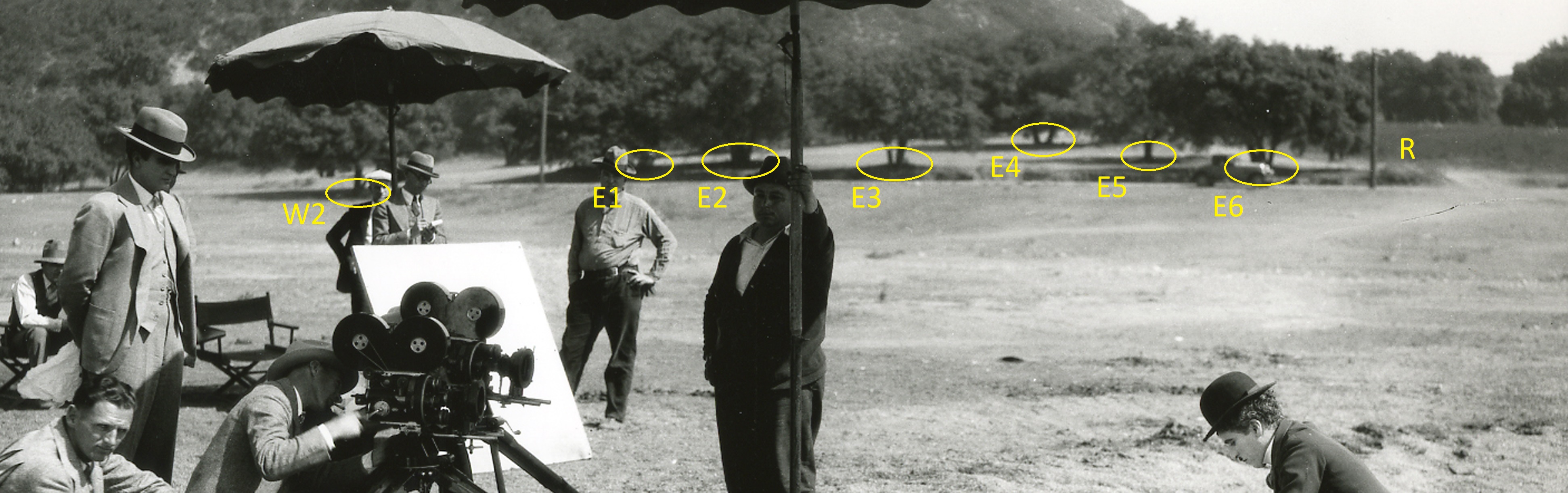
Click to enlarge – looking east towards Verdugo Road, above grade (notice the car within E6). Only the tree west of Verdugo, W2, casts a shadow below the road. The “E” trees stand east of Verdugo, E4-E6 along a side road “R” visible in the 1928 aerial below. Taller, and further east than E1 and E3, E2 appears in the photo below.

Knowing that the studio records mention Chaplin filmed the scene in Glendale, and that no major hills or mountains appear onscreen, Paul correctly surmised it must have been filmed looking south from the mouth of Verdugo Canyon. Triangulating from production stills and other clues in the movie, including auto traffic seen on what turned out to be Verdugo Road, Paul visited the site in person, and by matching ridge lines (a difficult task given all the homes there now), confirmed generally the circus field area as within Glenoaks Blvd., N. Adams Street, and Verdugo Road, north of the Wilson Middle School. I cover this, and Paul’s handiwork, more fully in my Chaplin book Silent Traces.

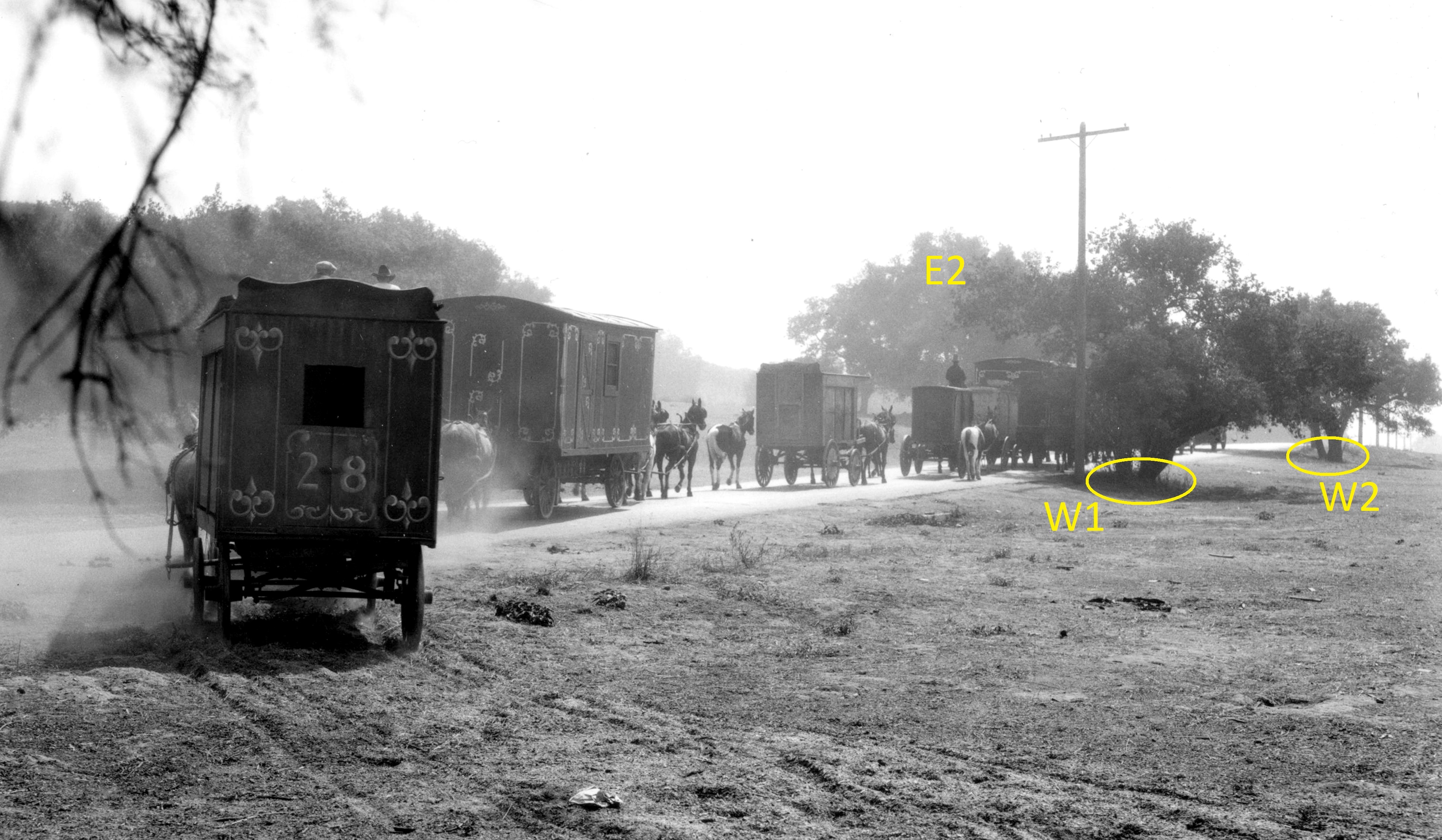
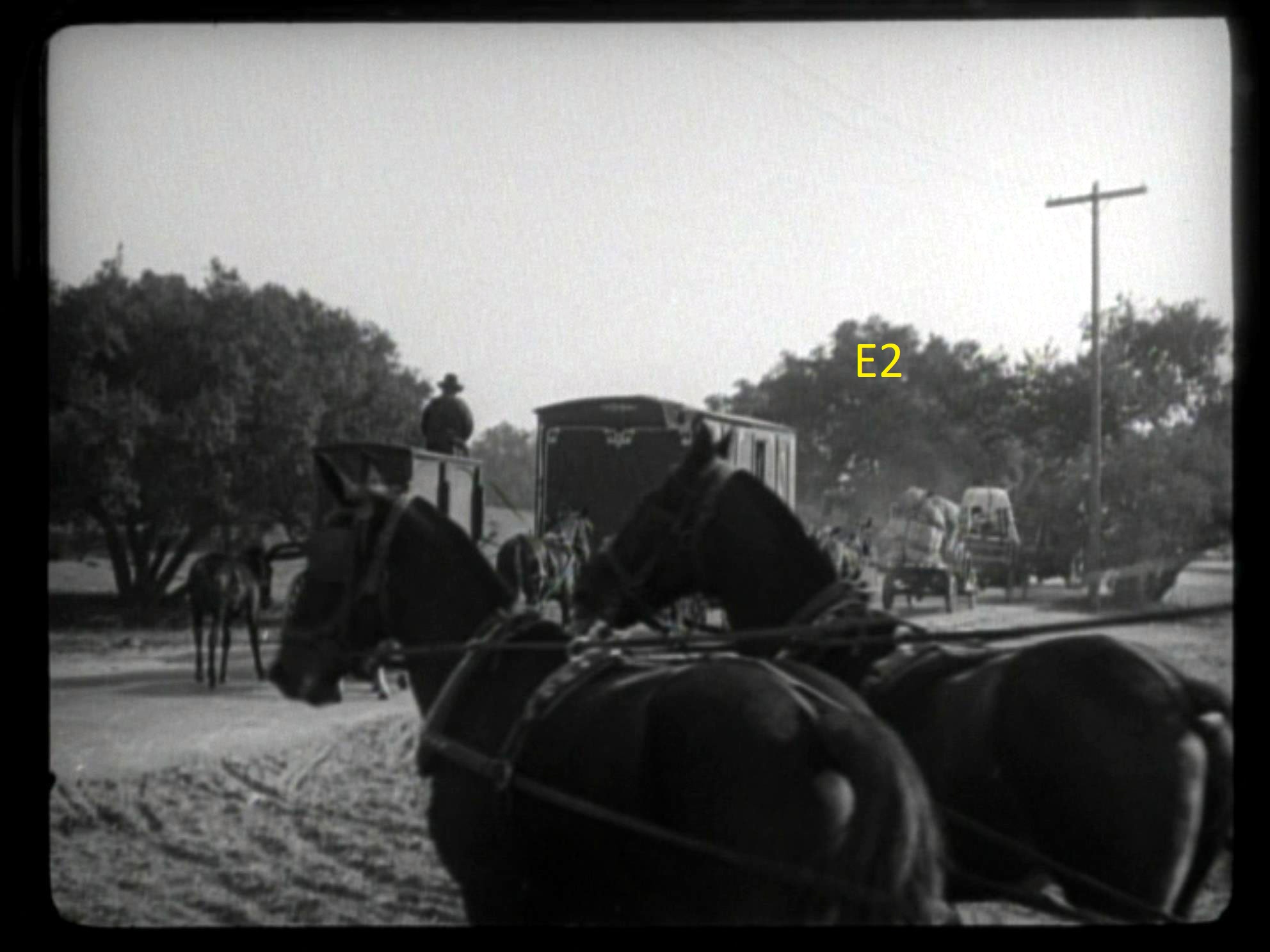
The circus wagon train departs south down Verdugo Road. Only two trees, W1 and W2 stood west of the road, and only W1 stood next to a telephone pole (see W2 in above photo). The surviving tree E2, the tallest, stands across the road.

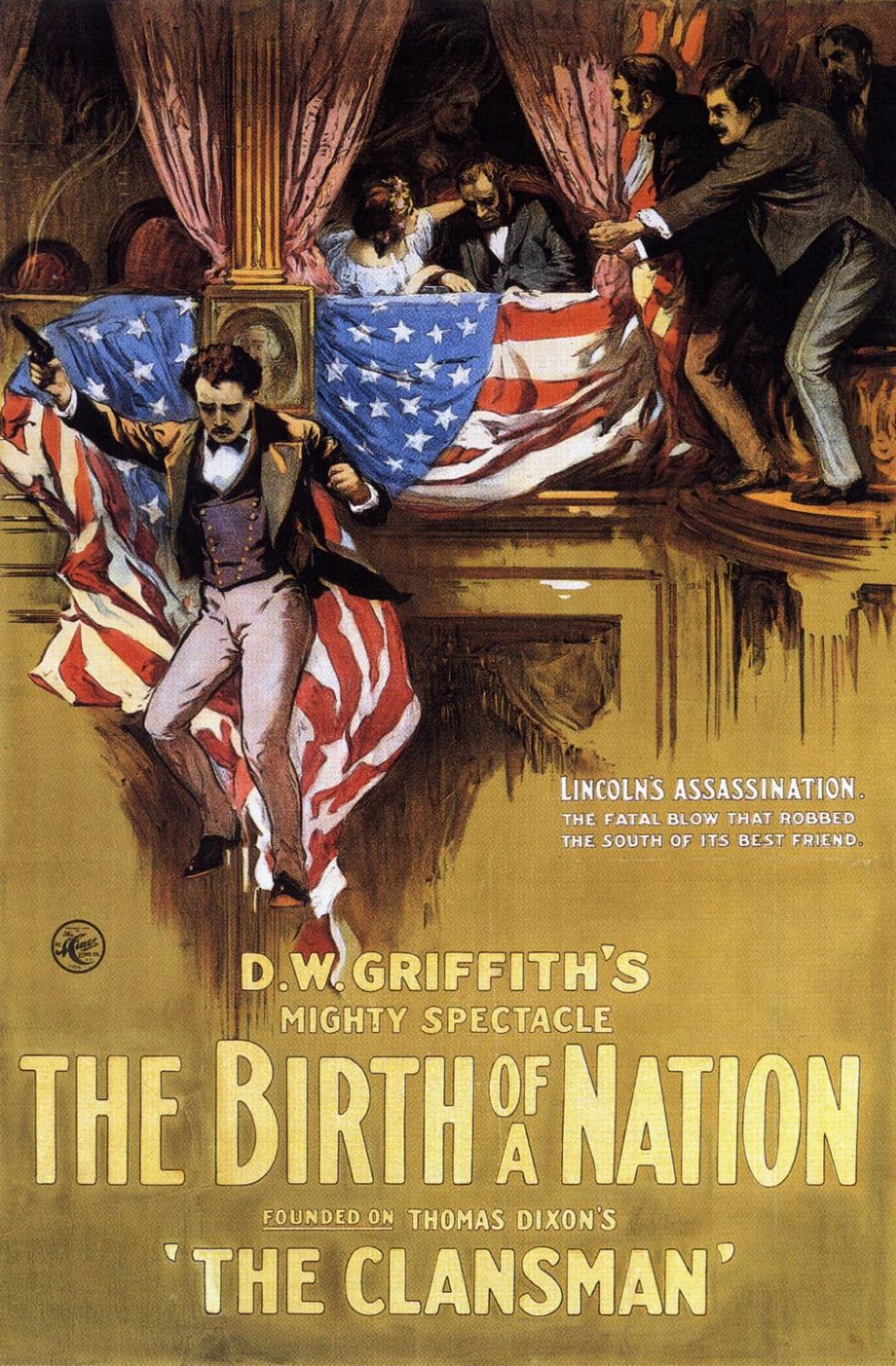
When I recently came upon vintage aerial photos of the Glendale shooting site, I realized there might be trees that witnessed the Chaplin production still standing today. (As I write in another post, certain trees at the Forest Lawn Hollywood Hills Memorial Park appear during the battle field scenes from The Birth of A Nation (1916), and in the 1937 Three Stooges short Playing The Ponies ).

Above, both looking east, with Verdugo Road running north-south (left-right) across the images, these 1928 aerial views show the unique W1-W2 pair of trees west of Verdugo across from a cluster of six trees east of the road (E1-E6), and the side road (R) running beside E4-E6. Reckoning from the W1-W2 trees I was able to identify the corresponding trees in the two production stills annotated above. UC Santa Barbara c-300_k-181.

By 1938 (upper left), Verdugo Road had been widened and paved, losing the west W1-W2 trees in the process, as well as E1 and E3, the easterly trees closest to the road. By 1944 (upper right), homes were built west of Verdugo.

By 1952 the area east of Verdugo was also built over, with sidewalks installed along the east side of the street, leaving only one tree, E2, still standing. Visiting the site on Google Street View, it’s apparent why E2 remains. When they graded along the road to install the eastern sidewalk, they created a large square retaining wall to preserve the tree.

Thus, just as there are trees that remain today having witnessed the making of The Birth of A Nation, a giant old oak tree in Glendale, appearing onscreen at left, witnessed the concluding scenes from The Circus.

Note: Paul was also the key to locating the avalanche of beer barrels scene in the Buster Keaton MGM talkie What No Beer? (1933). (Gif file courtesy of Danny Reid’s fascinating early cinema site Pre-code.comWhat No Beer? review).

All images from Chaplin films made from 1918 onwards, copyright © Roy Export Company Establishment. CHARLES CHAPLIN, CHAPLIN, and the LITTLE TRAMP, photographs from and the names of Mr. Chaplin’s films are trademarks and/or service marks of Bubbles Incorporated SA and/or Roy Export Company Establishment. Used with permission.

Aerial photos UC Santa Barbara FrameFinder. Atwood train photo – Rails Through the Orange Groves: (Vol. II) by Stephen E. Donaldson and William A. Myers, Ronald D. Sands and Edward W. Cochens. What No Beer? © 1933 Turner Entertainment Co. Color images (C) 2017 Google.

The surviving tree at 920 N. Verdugo Road in Glendale.

Posted in Charlie Chaplin, Paul Ayers, Sherlock Jr. | Tagged , , , , , , , , , , , , , | 5 Comments

Charley Chase “Fast Work” Around Hollywood

Comedy fans are cheering the sparkling DVD release of 18 early Charley Chase talkie comedy shorts. Featuring Charley in top form, beautiful prints, and insightful bonus commentary, Charley Chase: At Hal Roach: The Talkies Volume One 1930-31, is simply fantastic. You should buy a copy now to help ensure future volumes will be released.

This post covers Charley in Fast Work (1930), co-starring June Marlowe before she would soon debut in her immortal screen role as Our Gang schoolteacher Miss Crabtree in Teacher’s Pet (1930). June agrees to go out with Charley if he can first get her dad’s permission. Only Charley tries to impress the wrong man, a dapper mental asylum escapee he mistakenly thinks is the father.

The lunatic, played by Dell Henderson, acquires Mr. Marlowe’s identity, portrayed by Charles K. French, when they accidentally knock each other down at a blind corner (above), and exchange business cards as a courtesy (Henderson left, French right, below). The print is so clear you can read Orange Grove Ave. on the street sign. The crash was staged beside the Orange Grove Apartments, now named the Villa Rosa Apartments, at 7850 Sunset Boulevard.

Moments later, Charley drops June off at the Guasti Mansion, 3500 West Adams Boulevard (LAPL below right).

The grounds may appear familiar to Laurel and Hardy fans, as it was here the duo filmed Another Fine Mess later that year. The mansion was built in 1910 by Secondo Guasti, and was later owned by film choreographer Busby Berkeley. The mansion is now home to the Peace Awareness Labyrinth & Gardens and is open for tours.

The mansion appears in numerous films, including Stan Laurel’s early solo silent comedy White Wings (1923) (above left), and again in the Charley Chase DVD set during What A Bozo! (1931) (lower right).

Above, matching scenes from Another Fine Mess (Thelma Todd and Charles K. Gerrard upper left and Harry Bernard right) and Fast Work with Charley and June lower left and arriving by taxi, center.

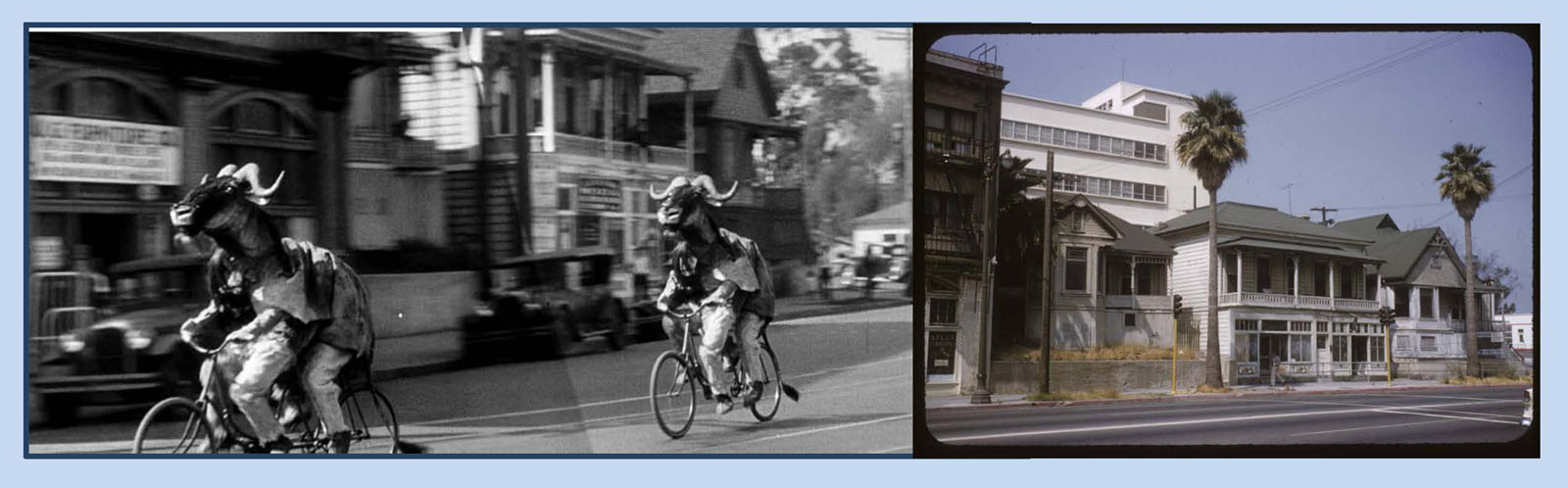
This shot of Charley at the mansion front steps matches Laurel and Hardy fleeing the mansion wearing a wildebeest costume during Another Fine Mess.

Above, overjoyed when June agrees to give him a chance, Charley spies a statue of Venus on the front lawn of the mansion, and runs to caress the lovely figure.

When Charley spies the Venus statue, the historic Wilfandel house at 3425 W. Adams across the street appears in view. Now home to The Wilfandel Club, you can read more about the home at the wonderful Historic Los Angeles Adams Boulevard blogpost for 3425 HERE.

A suspicious cop (Pat Harmon) checks out Charley and then chases after him. Looking NW, these homes at back along 6th Avenue north of Adams are still standing.

Fleeing the cop, Charley and the lunatic also accidentally knock each other down, this time beside the Havenhurst Apartments at the corner of Whitley Avenue and Franklin Avenue. This classic Hollywood apartment stands nearly 12 miles away from the Guasti mansion on Adams appearing in the immediately prior scene.

The escapee offers Mr. Marlowe’s card to Charley as his own. Delighted to meet June’s “father,” Charley takes the lunatic to lunch with hilarious consequences.

Last, a brief traveling shot of Charles French as Mr. Marlowe walking beside the Orange Grove Apartments, on the way to meet his daughter.

You can read all about the Los Angeles hills and tunnels appearing in the concluding scenes from Another Fine Mess (above) at this post HERE.

Fast Work © 1930 Sonar Entertainment, LLC. Produced by Richard M. Roberts and Kit Parker.

Charley Chase: At Hal Roach: The Talkies Volume One 1930-31, titles include The Real McCoy, Whispering Whoopee, All Teed Up, Fifty Million Husbands, Fast Work, Girl Shock, Dollar Dizzy, Looser Than Loose, High C’s, Thundering Tenors, The Pip from Pittsburg, Rough Seas, One of the Smiths, The Panic Is On, Skip the Maloo!, What a Bozo!, and The Hasty Marriage, with bonus comedy “La Señorita de Chicago” (Spanish version of “The Pip from Pittsburg”).

The Gausti Mansion at 3500 West Adams Boulevard today – the formal front lawn and garden is now a parking lot.

Posted in Charley Chase, Hal Roach Studios | Tagged , , , , , , , , , , | 13 Comments

The “Never Give A Sucker An Even Break” Car Chase – Part 2

Universal’s 1941 production Never Give A Sucker An Even Break features W.C. Fields in his final starring role. The film ends with a Keystone Kops-style car chase when Fields frantically drives a matron to the maternity hospital, mistaking her to be pregnant and in labor. (The chase wasn’t part of Fields’ original script – Universal imposed it on him). As shown in Part One, the early scenes were filmed in a produce/warehouse district SE of downtown (see below), where a remarkable number of old buildings and street corners remain unchanged.

Above, the intersection of Santa Fe and E. 7th Street. For Part Tw0, Fields leaves the gritty warehouse district behind for the open expanses of Cahuenga Pass, Glendale, and along Riverside Drive near Universal.

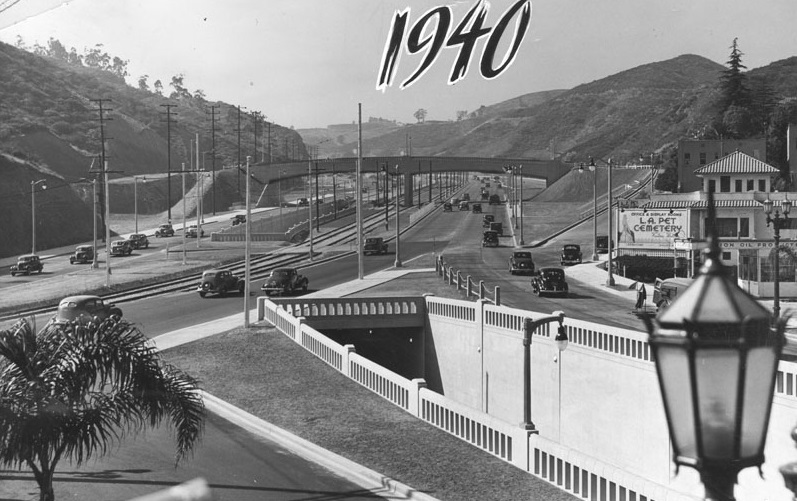
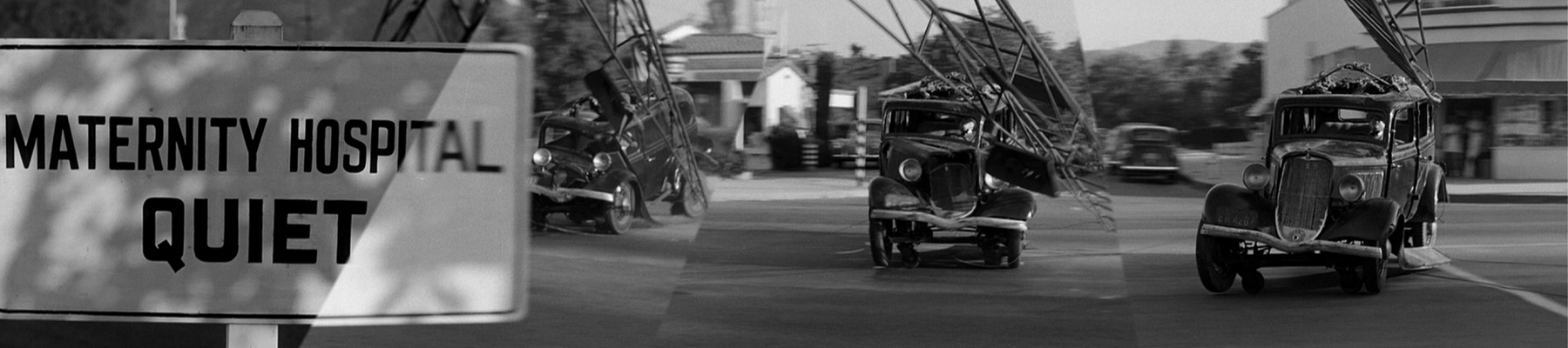
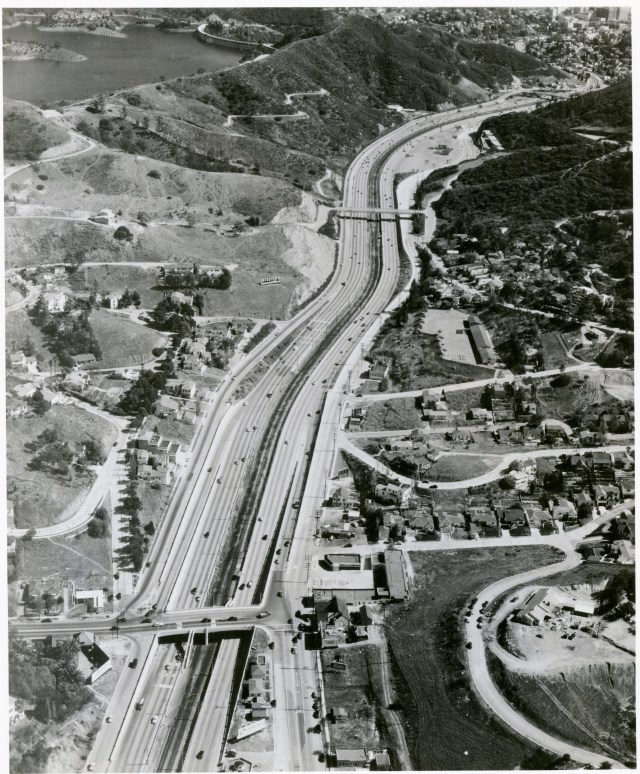
First, looking SE, Fields races right to left (north) along Cahuenga Blvd. West beside the recently opened Cahuenga Pass Freeway. Note the trolley tracks in the center. The eight lane artery, built at a cost of $1,500,000, was dedicated June 15, 1940. Some later stunt scenes were filmed on the freeway, meaning they were somehow able to briefly shut the pass down during the July-August 1941 production.

The panning shot continues from right to left, north, showing the Barham Blvd. overpass across the freeway.

The car veers left sharply up Bennett Drive.

The first home on Bennett Drive still peeks down on Cahuenga.

This view north also reveals a gas station (prices 14¢, 13¢, and 12¢/gallon), still a gas station today, and the side of 3201 Cahuenga, the present home of Valhalla Motion Pictures.

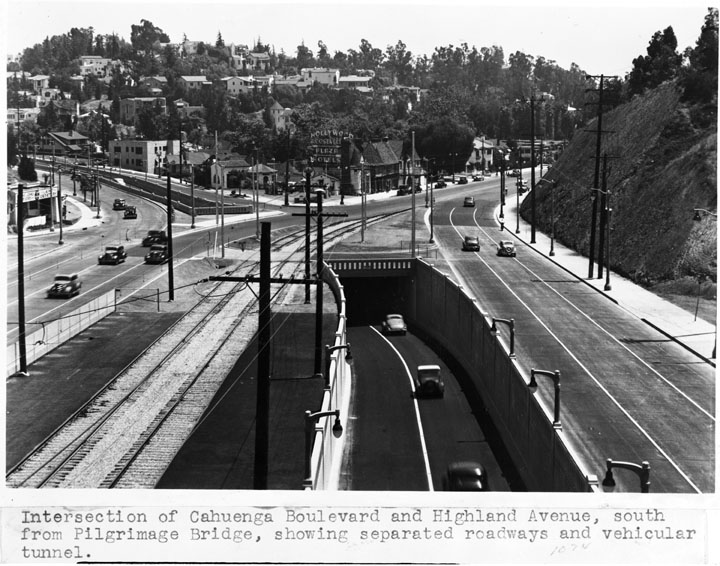
The action jumps south from Barham towards the former Cahuenga underpass near the Pilgrimage Bridge. Fields first circles the modest onramp/offramp north of the bridge (top), then travels south towards the Pilgrimage Bridge spanning the freeway (middle), and then heads into the Cahuenga underpass beyond the bridge (bottom). The freeway was configured so that the main traffic would head south at ground level onto Highland Avenue, while traffic heading south to Cahuenga, a few blocks to the east, was diverted through an underpass. The aerial view looks north, so the onramp is above the bridge, and the underpass entrance is below. If you clink the following URL link, you’ll see in the full photo that the Hollywood Bowl appears to the left of the freeway – Hollywood Bowl.

While I was stumped, eagle-eyed reader Scott Charles correctly identified this One Way Tunnel shot as looking west on Cahuenga towards the eastbound traffic emerging from the underpass. The arrow (right) shows the camera’s point of view. You can read Scott’s full analysis in the comments section below, and HERE.

A closer view, the red box marks the former home at 2313 Fairfield Avenue, the yellow box the last, eastern-most light fixture at the end of the guard rail.

Looking north, not much of an offramp or onramp  – LAPL.

Another view north, the onramp lies just behind the bridge – California State Library.

Matching views south towards the Pilgrimage Bridge.

Looking south at the former Cahuenga underpass entrance – Department of Water and Power.

A final view north of the Cahuenga underpass – LAPL

Fields leaves Cahuenga Pass momentarily, jumping over to the Atwater Village neighborhood of southern Glendale.

Here they race past the Superior Carpet Works building (notice the folded-design facade still present above the windows), still standing at 3058 Glendale Boulevard. The Safeway is now lost to a corner gas station.

Note: this earlier scene above, appearing in the prior post, shows the former Atwater Market (center white building) at 3158 Glendale Boulevard, looking west, with the Pacific Electric trolley tracks to the right. In the far distance stands the Safeway noted above, and the Glendale-Hyperion Bridge, discussed later below.

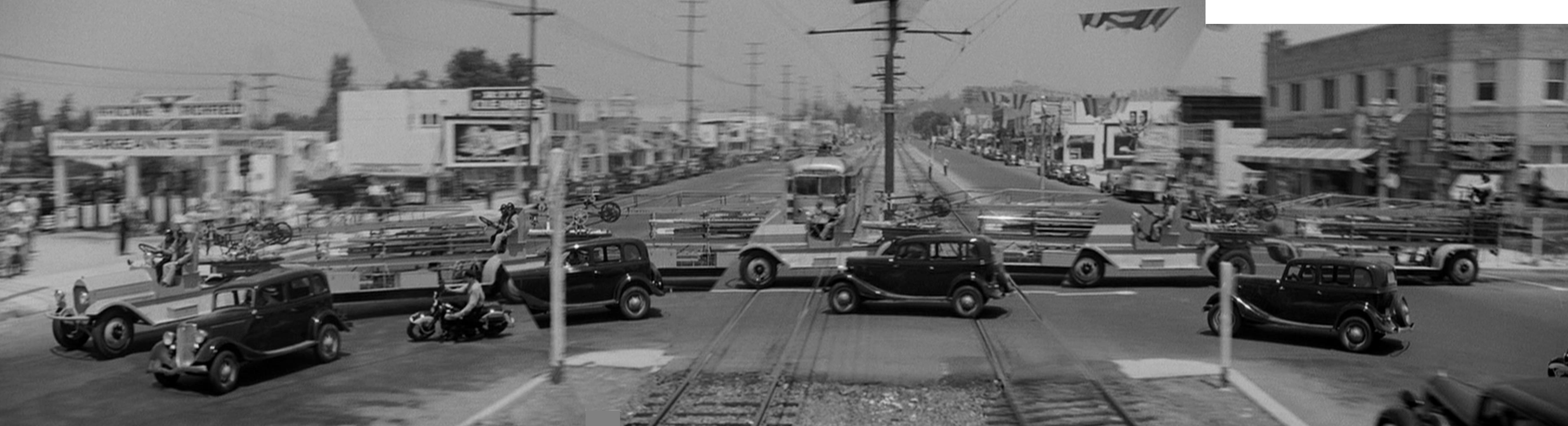
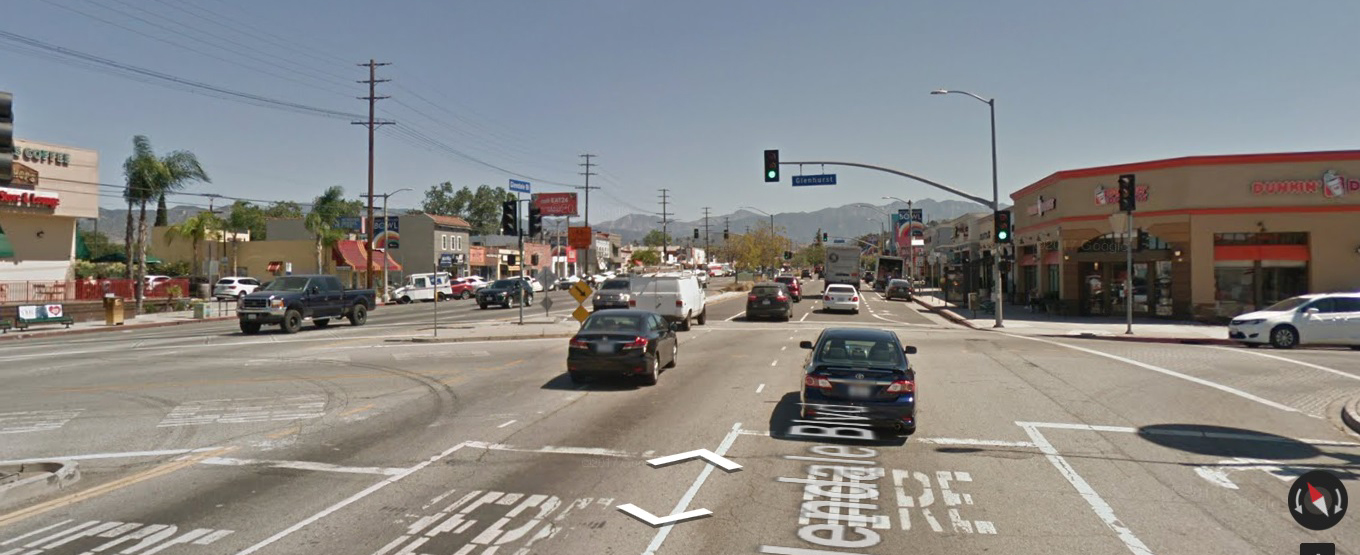
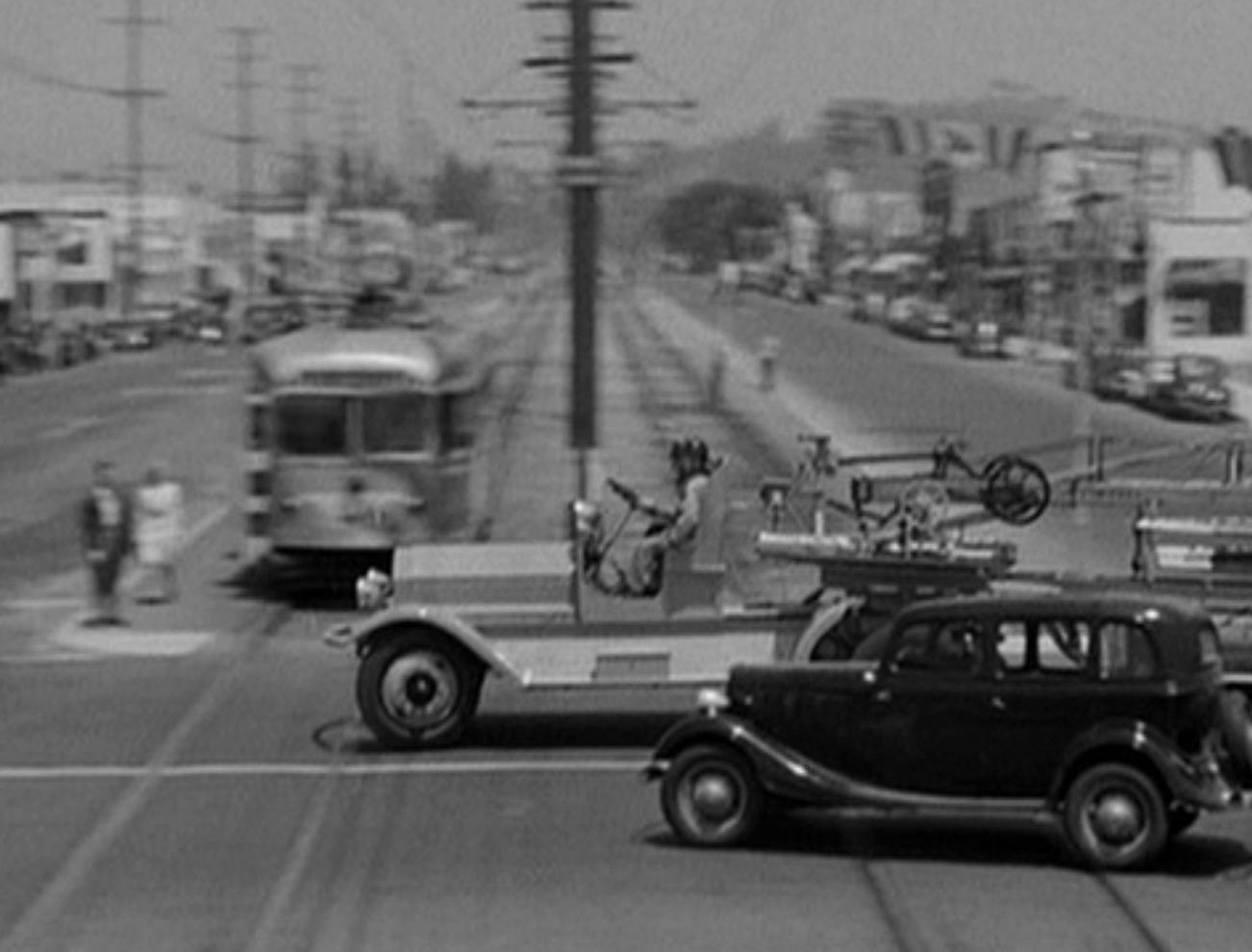
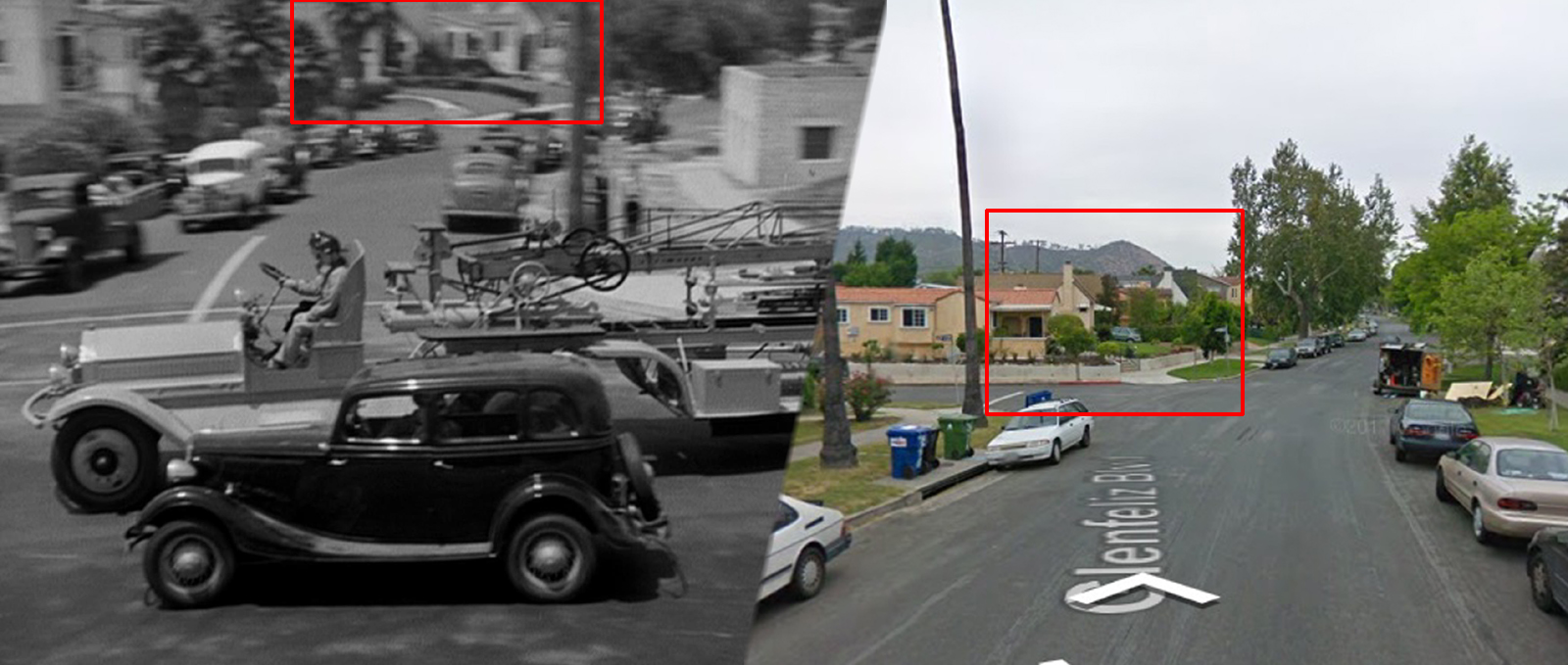
Looking NE, Fields and his motorcycle escorts join up with a fire engine. Together they pull a U turn along Glendale Blvd. at the intersection of Glenhurst Ave. Reader David Sadowski reports a brand new Pacific Electric double-ended PCC appears stopped at the intersection (left). These cars were put into service in November 1940, and were the pride of the interurban railroad. They ran on what would now be called a “light rail” line between Glendale-Burbank and a subway terminal in downtown LA. There are some great views of these same railcars and the PE subway in Down Three Dark Streets (1954) reports David. The Glendale-Burbank line was abandoned in 1955. Above, completing the U-turn, as the crew returns down Glendale past the corner of Glenfeliz Blvd. some matching homes appear at back.

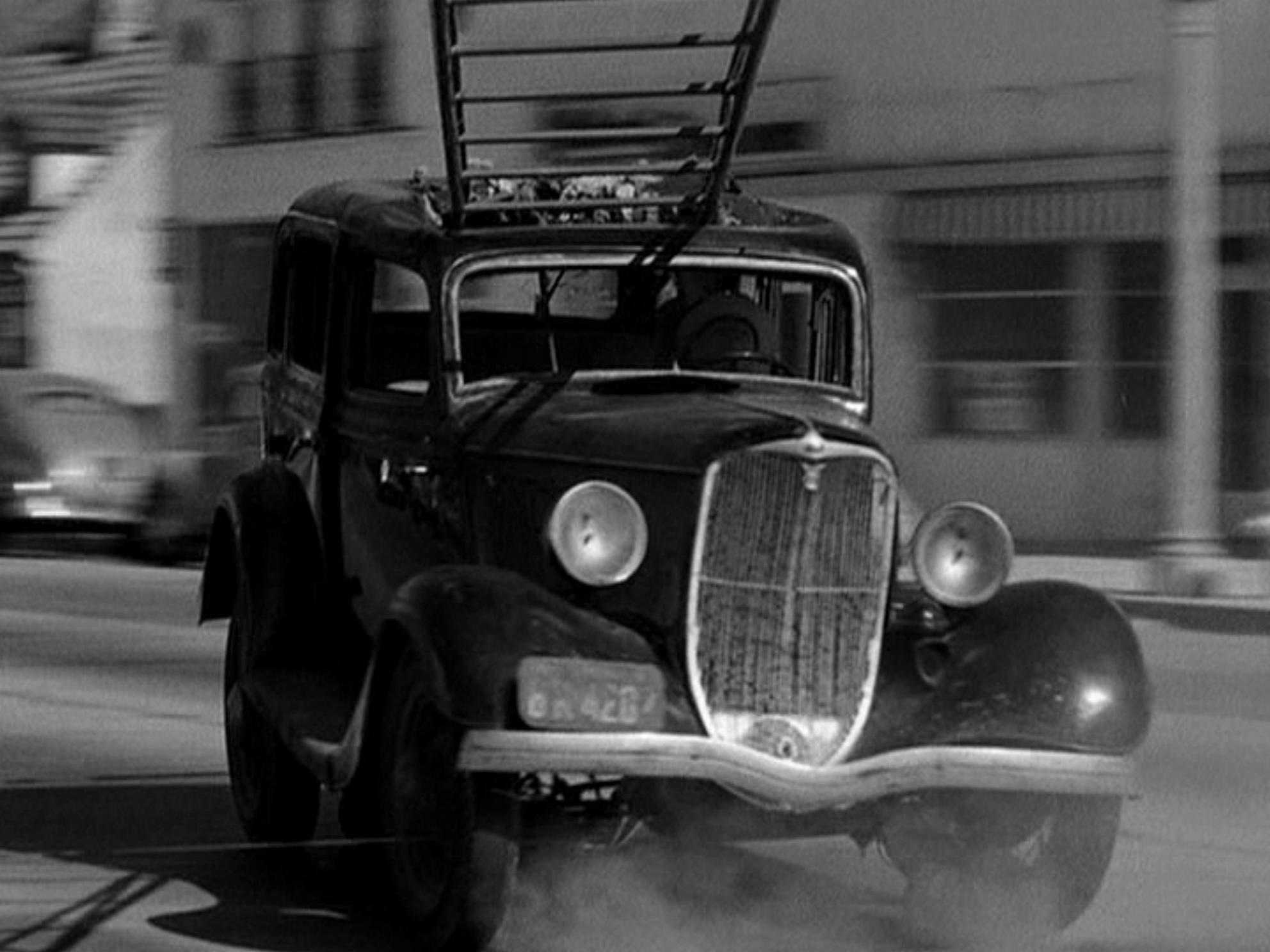
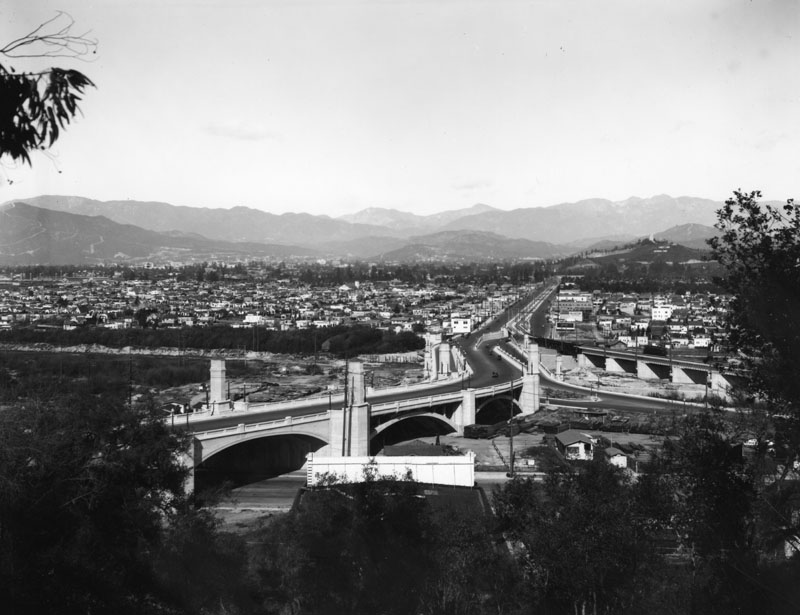
Next, the fire engine’s extension ladder slips loose, hooking its tail end through the roof of Fields’ car. These views above of Fields’ ensnared vehicle looks SW while traveling across the Glendale-Hyperion Bridge. Completed in 1929, the bridge spans over 400 feet of the Atwater section of the Los Angeles River. The lower right image on the bridge shows the trolley line power poles heading across the river. This brief insert shot (left) of Fields spinning 360 degrees was filmed at the intersection of Riverside Drive and Forman Avenue, discussed further below.

The upper view east looks down on the bridge from the Waverly Drive overpass, while the lower view looks east from the bridge itself. At right is a vintage view (LAPL) looking east across the bridge and up Glendale Blvd. You can see the trolley tracks along the middle of the street, and how they veer right, south, across the river, on a separate trestle. The white letters on the back hillside say “Forest Lawn Memorial Park.” The chase now resumes at Cahuenga Pass – below.

Here the camera pans right to left as Fields’ ensnared car travels north along the original, now-shuttered Barham offramp. The road beside the upper railing is Cahuenga Blvd. East. A new stretch of this road, extending further north beyond Barham, is now called W.C. Fields Drive.

Notice the diamond shaped shadow of the four-cornered rig suspended from a crane actually lifting the car. The chimney of 3137 Hollycrest Drive appears at back, now missing its ornamental ironwork.

Still looking south, Fields’ car slams onto the ground beside the former Barham offramp. The matching 1952 color view from the Pacific Electric Historical Society looks south from the Barham overpass towards streetcar #5111 and the southbound Barham passenger station. Alan Weeks Photo, Alan Weeks Collection.

A final view (LAPL) looking north towards the Barham overpass and offramp. The gas station, upper right frame, appears to the left, the back of 3137 Hollycrest Drive, lower right frame, appears to the right. The street on the right edge of the primary photo was later extended past Barham – this new section is now called W.C. Fields Drive. UPDATE – the National Archives has a fantastic 1949 overview aerial photo of the full Cahuenga Pass filming site – you can spot every detail. Access the photo HERE.

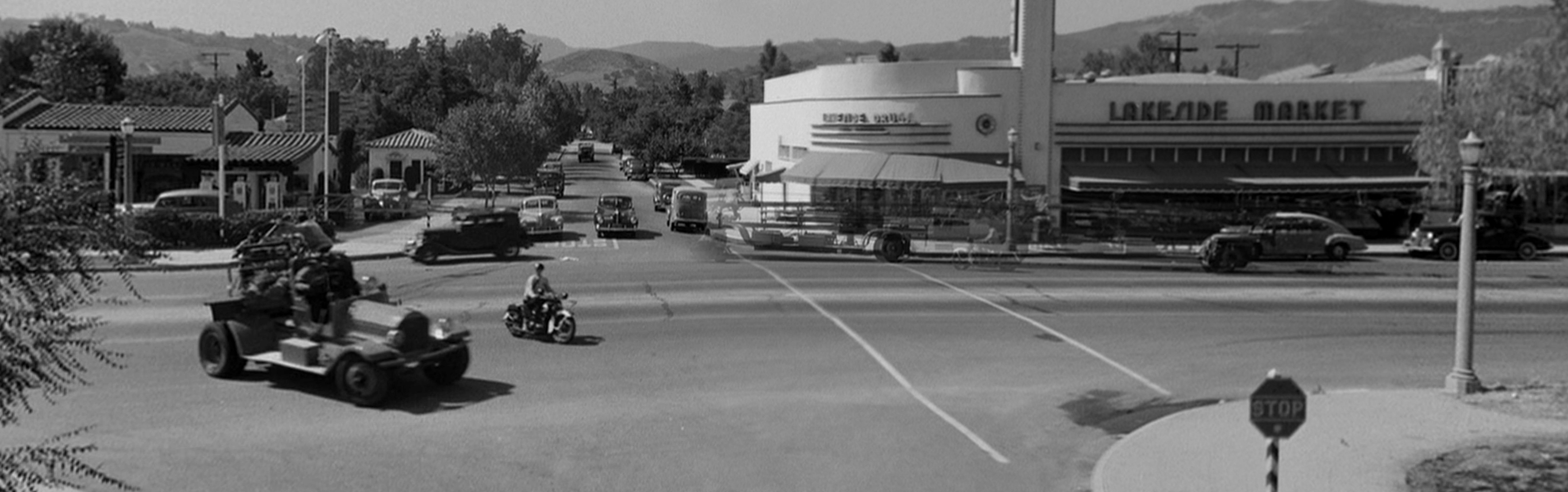
The full crew pull a couple of 360 degree turns beside the former Lakeside Market looking south down Mariota at the intersection with Riverside Drive, a few blocks due north from Universal.

This tight view 360 turn appears for the second time. These matching views look east down Riverside Drive from Forman Ave., two blocks west from the Lakeside Market.

This detail from the 360 degree spin shows 4432 Forman at back.

The same 360 degree spin – the blurry tower at back belongs to the Lakeside Market, two blocks east.

The Kentucky fried chicken dinner restaurant on the NE corner of Forman is now a Japanese restaurant.

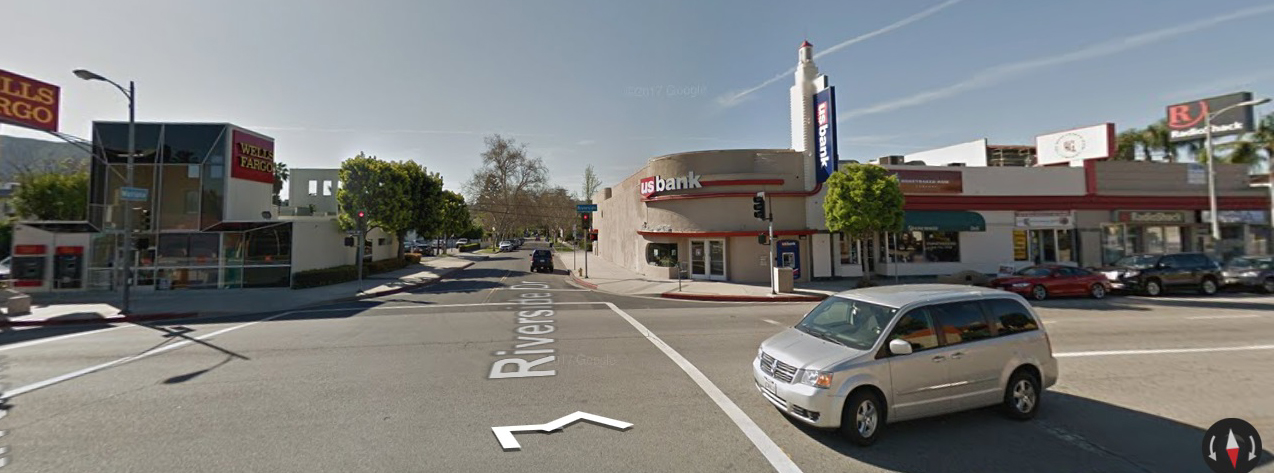
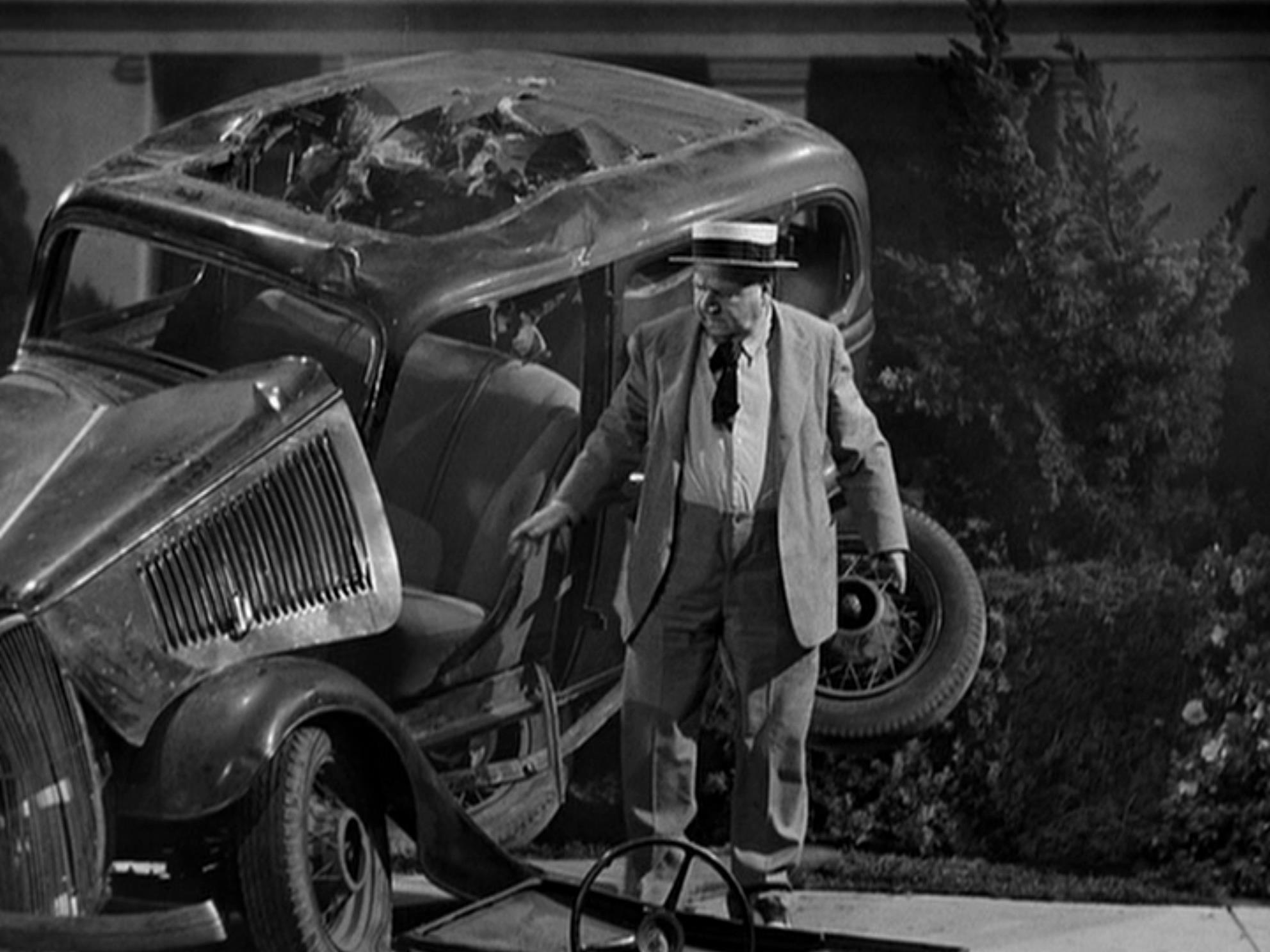
A final spin past the Lakeside Market and a gas station (now a Wells Fargo Bank branch) at the intersection of Riverside and Mariota lands Fields, of all places, at the long sought-after maternity hospital. Asked if he’s OK while gingerly stepping from his wrecked vehicle, Fields quips “Lucky I didn’t have an accident – I’d have never gotten here.”

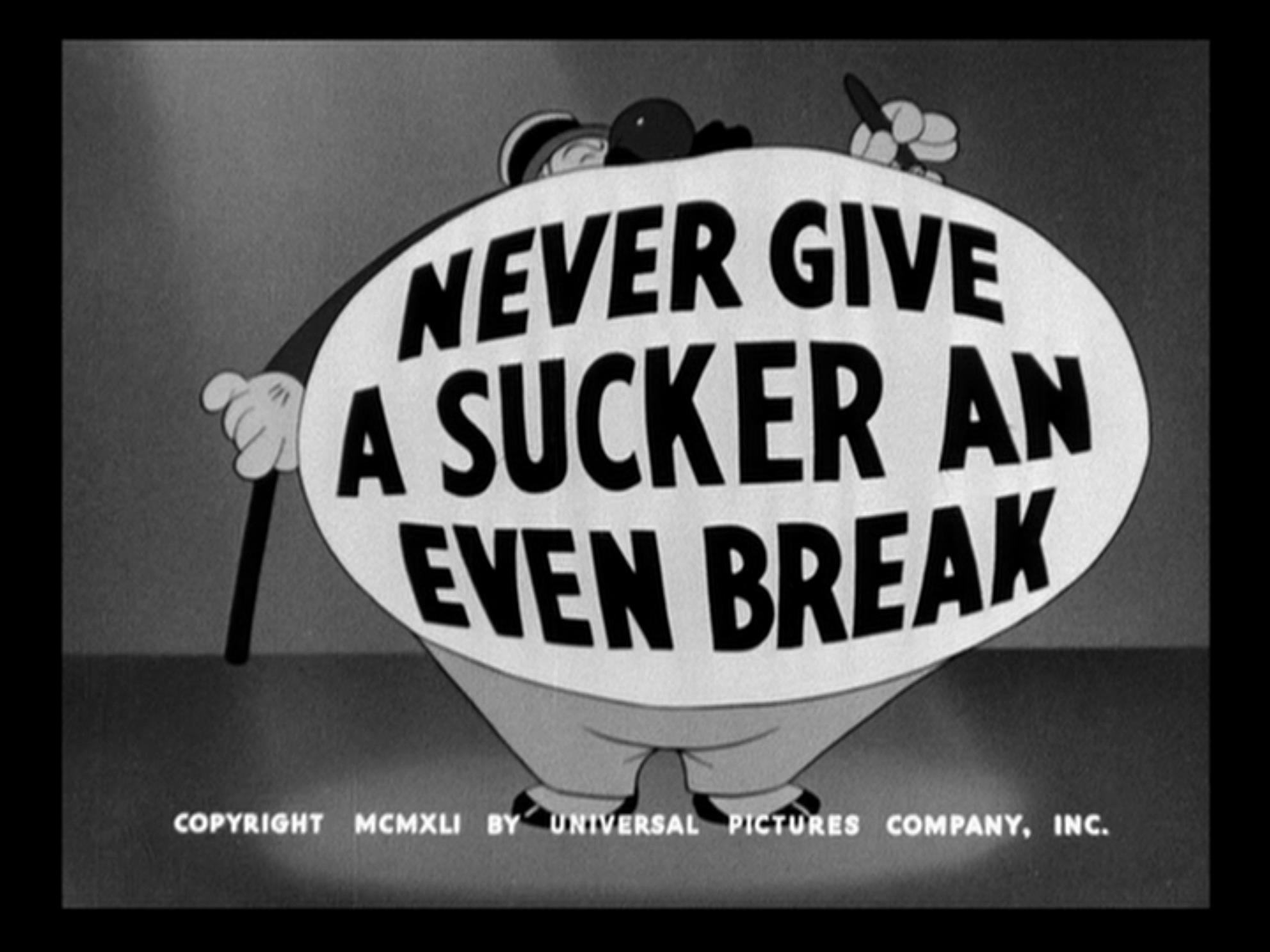
The End – fade to black. While Fields’ drinking and prominent nose were always ripe for caricature, given his poor health and evident nasal rosacea during the film, it seems a bit tone-deaf for Universal to portray him this way for the credits of what proved to be his final starring role.

Box_088_30-n-49-1532-A (2)

UPDATE: this vintage National Archive photo shows exactly where Bill filmed at the Cahuenga Pass.

Be certain to check out all of the downtown warehouses and street corners in Part One of this post.

Never Give A Sucker An Even Break (C) 1941 Universal Pictures Company, Inc. Color images (C) 2017 Google.

Below, Riverside Drive and Mariota, just north of Universal Studios.

Posted in W.C. Fields | Tagged , , , , , , , , , | 12 Comments

The “Never Give A Sucker An Even Break” Car Chase – Part 1

Universal’s 1941 production Never Give A Sucker An Even Break features W.C. Fields in his final starring role. Directed by Edward Cline (Buster Keaton’s early co-writer/director) the movie ends with a frantic Keystone Kops-style car chase around the produce/warehouse district south of downtown, along the newly opened Cahuenga Pass “freeway” in Hollywood, in Glendale, and then finally along Riverside Drive near Universal. The fun starts when Fields mistakes a matron seeking a ride to visit her daughter at the maternity hospital as being in labor herself. Fields drives with her so recklessly that she faints from shock, spurring Fields to drive even faster. With so many identifiable locations the movie requires two posts. [Note: as a fan of Fields’ dry humor I was relieved (?) to learn from biographer James Curtis (W.C. Fields: A Biography) that Universal imposed this uncharacteristic slapstick sequence on Bill, which was not in his original script. Read more details about who actually made the sequence at the end of this post. Also, Charlie Chaplin filmed Work (1915) among similar warehouses a few blocks further north – read more HERE.]

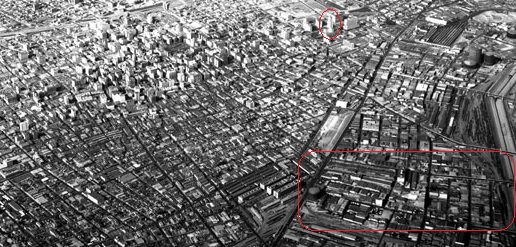
Looking north towards City Hall (oval), with the chase filming area lower right. LAPL.

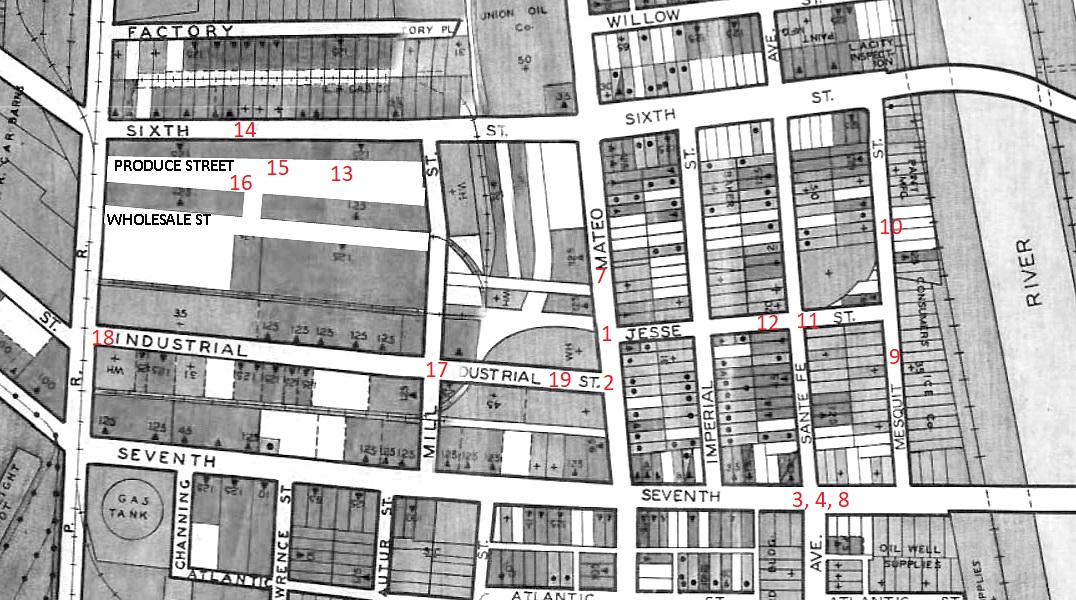
Before jumping to Glendale and parts north to be described in post 2, the first sequence of the race to the hospital was methodically staged in a warehouse district SE of downtown, bounded by Alameda and Mesquit to the west and east, and E. 6th and E. 7th to the north and south (see above). There are nearly two dozen locations depicted here, with a remarkable number of buildings still standing.

1)  Above, the race to the hospital begins south down Mateo Street before turning right, west onto Industrial Street. The red brick building at back, prominent in the modern view, was the former Hill Brothers Coffee plant, at 635 Mateo, featured in scene 7) below.

2)  The car then screeches around the corner from Mateo to west on Industrial. All of the major buildings pictured here in the film are still present, including the former National Biscuit Co. factory on the left and the Star Truck and Warehouse Company on the right.

3)  The car then races west down from the 7th Street Bridge towards the corner of Santa Fe past the large brick Bailey-Schmitz building, a former mattress manufacturer.

4)  Continuing west along E. 7th, Fields’ car passes a traffic cop standing at the corner of Santa Fe – the view looks north.

5)  A brief insert scene jumps from downtown to the former Atwater Market (center white building) at 3158 Glendale Boulevard, looking west, with the Pacific Electric trolley tracks and a light-colored convertible (see scene 7) below) to the right. In the far distance stands the Hyperion Avenue Bridge, to be discussed in part 2 of this post.

6) Scene 5) above continues with the camera panning left (east) towards the corner of Garden Avenue in Glendale, where Fields’ car screeches to a stop and reverses suddenly.

7)  Back in downtown, the light-colored convertible on Glendale Blvd. in scene 5) crashes beside the Hills Brothers Coffee plant at 635 Mateo, looking north.

8)  Back at the corner of Santa Fe and 7th, a cop jumps aboard Fields’ running board (upper left and right) to guide him to the hospital. You can still read “BAILEY-SCHMITZ” along the roof of the upper right image.

9)  The car races north along Mesquit, from 7th towards 6th, as the camera pans quickly right to left. The former warehouses along Mesquit have all been replaced. The center movie frame shows at back the descending deck of the 7th St. Bridge, still seen in the right modern view.

10)  Traveling north along Mesquit, the cop will soon lose the seat of his pants. At back stands the former 6th St. Bridge. Built in 1932 with defective concrete, it was demolished for safety reasons in 2016.

11)  A conspicuous “HOLLYWOOD BLVD” bus turns left (east) from Santa Fe (see street post marked upper left) onto Jesse Street, with an outstretched wooden arm turn indicator that will snare Fields’ cop. The camera quickly pans right along with the bus, then pans back quickly left following the path of Fields’ car, with the now seatless cop still aboard. The north corner of the former Ice & Cold Storage Warehouse on Mesquit visible in scene 9), (box, lower left), appears at back in the far right shot (box) looking east along Jesse towards Mesquit.

12)  With the cop now ensnared on the bus left-turn indicator, this right to left panning shot follows Fields’ cop-free car west along Jesse from Santa Fe. The tall building to the left of each image stands on the NE corner of Jesse and Mateo.

13)  Looking east, the car careens toward the camera along former Produce Street, parallel to and just south of E. 6th Street, with the extant Metropolitan Warehouse at the SE corner of E. 6th and Mill Street standing at back. At the time two very wide private streets, Produce Street and Wholesale Street, were configured around three long, narrow rows of warehouses, the northern-most row appearing at left. Two wide modern rows of warehouses, with different footprints, have replaced the former trio of buildings.

14)  These oblivious pedestrians march south from 6th Street onto Produce Street through an arcade in the narrow warehouse row along the south side of 6th (there is an upper floor above them over the entrance). The building directly across from the former arcade entrance, 1275 E. 6th, is still standing, but given the camera angle does likely not appear in this shot. The next building to the west (left) has been demolished, precluding comparison, and the next building further west, 1269 E. 6th Street, pictured here, could be the building visible through the former arcade, but is likely not. Given the geometry, my sense is the left side of the demolished building across the street is what appears in the shot.

15)  The pedestrians flee the swooping car so quickly that they lose their shoes on the back (Produce Street) side of 1280 E. 6th Street, the right (east) edge of the former arcade. Note: for some reason the shot of the oncoming car (lower left) is reversed when it appears as shown here in the film. (The license plate reads backwards!). For scene 13) above I flipped the image to allow for a true then and now comparison.

16)  Looking south, the camera pans right to left along the opposite side of former Produce Street, from the Certain Teed building supplies company at 1228 Produce Street, towards a break in the street revealing the former California Warehouse further back, standing at 1248 Wholesale Street, running parallel to Produce Street further south. These two private streets were reconfigured extensively when the three rows of warehouses defining them were replaced with two wide rows of buildings. Produce Street was originally quite wide, with numerous railroad tracks running through it, as seen above.

17)  Fields has now acquired a pair of a motorcycle cops escorting him to the hospital. Here they travel east along Industrial Street crossing Mill Street. During this shot they pass a series of elaborately detailed brick buildings, from around 1581 to 1719 Industrial Street, that are all remarkably preserved.

18)  The traveling shot continues east along Industrial, here starting from the west end of the street at the corner of Alameda – the boxes mark matching buildings. I’ve noticed that whenever a movie makes use of a long traveling shot along one street, they nearly always edit the brief shots out of order. Scene 18) should precede scene 17) geographically.

19)  Jumping from the west end of Industrial Street to the east end, the same view appearing earlier in scene 2). The matching larger images show the gate (and railroad freight) entrance to the National Biscuit Co. factory, the smaller images show the former Standard Lumber Company at 1848 Industrial. The somewhat modernized Star Truck and Warehouse Company buildings appear at right.

20)  The warehouse segment concludes as Fields, via rear projection, travels north up Mateo Street towards the Maxwell House Coffee plant near 4th Street.

21)  Here Mateo street veers east to pass north under the 4th Street Bridge.

22)  The Maxwell House building has been on my radar ever since I first noticed it appears in Buster Keaton’s Go West (1925), upper right, filmed showing its 4th Street side. Fields travels left to right in the main photo (LAPL) past the entrance on Mateo towards the corner of 4th. The 4th Street Bridge was constructed in 1930, before this photo was taken. Notice the “Good to the Last Drop” billboard behind Fields at the lower right.

This map shows the various filming spots by number. WPA maps, book 6, sheets 36 and 37. USC Digital Library.

When viewed overall on a map you can see how efficiently they used these few streets. Were they perhaps constrained by a filming permit to only these blocks? My thanks to reader David Sadowski for suggesting I give this film a look – I hadn’t watched it in years.

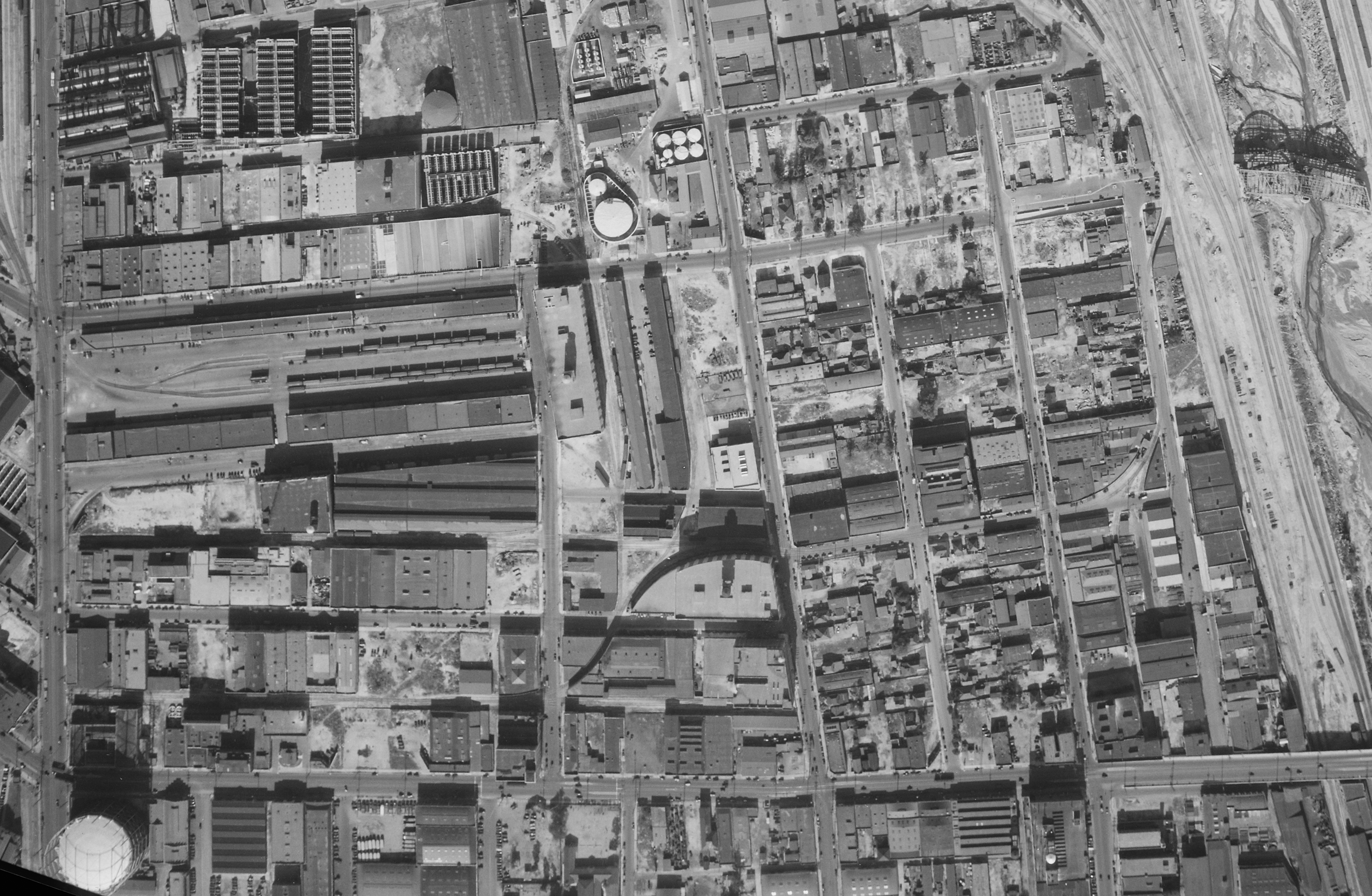
Update – this vintage aerial view shows the same layout as the annotated map above. Flight c-1930_86 UCSB Library.

Update – noted author James Curtis (W.C. Fields: A Biography) writes that Fields didn’t include the car chase in the original screenplay, which was written under his supervision. “We will require the elimination of the ‘motion picture’ within the story,” wrote Universal’s Edward Muhl in his response. “We will also require an action sequence in order to build a climax to the picture.” The chases for both SUCKER and BANK DICK were directed by Ralph Ceder (1898-1951), who started with Sennett and wrote and directed short comedies throughout the silent era. In talkies, he was mostly a second unit director specializing in action sequences. He did a lot of work at Universal, then settled in at MGM, where he contributed to A GUY NAMED JOE, among others. Ceder’s assistant on the SUCKER sequence was Melville Shyer, whose son is the director Charles Shyer.

According to continuity records, Fields shot his first scenes for the film on July 7 and finished on August 16, 1941. The process shots needed for the chase sequence were made on August 14, 15, and 16. Fields dictated a detailed reaction to the first cut of the film on September 4: “The chase is far too long and overdone. Policeman on fender losing his pants and finally getting caught on bus is not funny. The shoes on the street is cheap and unfunny, and the man getting knocked first one way and then the other and waving his arms and legs is antiquated comedy. The hook and ladder is drawn out, therefore rendered unfunny. The line, ‘What a beautiful view of the California climate,’ is omitted” (this line is in the final cut). After the film’s preview, which didn’t go well, Fields added the following on September 18: “The chase can be cut to advantage of the film. It is hilarious but a bit too long.”

Never Give A Sucker An Even Break (C) 1941 Universal Pictures Company, Inc. Color images (C) 2017 Google.

Below, 7th and Santa Fe – you can read Bailey-Schmitz along the right roof line.

Posted in Los Angeles Historic Core, W.C. Fields | Tagged , , , , , , , , , , , , , , , | 12 Comments

Farewell – a sudden lost Our Gang landmark

During the Our Gang comedy Bouncing Babies (1929), Wheezer seeks to return his annoying baby brother to the hospital, unaware that the bundle snuggled in the crib is only a doll. In order to cross a busy intersection, Wheezer throws a handy light bulb onto the ground, tricking the drivers into stopping to check their tires long enough for him to push the crib across the street. Wheezer repeats this trick several times until he’s finally chased off by the cops (right). This scene was staged beside the Bacon Pharmacy, at the NE corner of Tabor and Motor Avenue in Palms, one of the most clearly recognizable film locations in the Our Gang canon. I was shocked to learn that as of a few days ago, this place is no more, another victim to “progress.”

The drug store was built sometime between 1910 and 1924, as it appears in Harold Lloyd’s Girl Shy released that year. Harold (well his stunt double, see above), races past the corner store as he struggles with an unspooling fire hose while attempting to remain on the back of a fire engine. The corner appears too in the 1926 Our Gang comedy Monkey Business (also above), and plays a prominent role in Dog Heaven, another silent Our Gang comedy from 1927, which includes scenes of the store’s interior. Below, from Dog Heaven, Wheezer, two years younger, exits the same store, while Joe Cobb purchases candy inside.

Below, from my Harold Lloyd book, a 1924 map by Dutch graphic artist Piet Schreuders showing Harold’s fire engine racing past the corner store on Tabor, and a photo from Hal Roach movie locations YouTube star Chris Bungo showing the lost store interior.

For over 90 years this modest little building helped time to stand still, where you could visit and imagine what once was. How sad we’ve lost another tangible link to the past.

Posted in Uncategorized | 14 Comments

The Red Kimono – A Vast Record of Early Los Angeles

The Red Kimono (1925), a searing drama notably produced and written by women, captures a remarkably comprehensive visual record of early Los Angeles. From Broadway and posh gated communities to Chinatown and the amusement park piers, these settings, along with numerous stretches of still residential Wilshire Boulevard, and long lost jails, train stations, and skid row locales, all play pivotal roles in the film. [Special note: the movie is featured as part of the December 1, 2018 San Francisco Silent Film Festival Day of Silents program].

Based on real life events, Priscilla Bonner portrays Gabrielle, a naïve young woman betrayed by her lover in New Orleans, who forces her into prostitution. After finding the man later in Los Angeles, Gabrielle kills him, but her story of degradation is so compelling that she is acquitted. A seemingly kind society matron befriends Gabrielle, only to exploit Gabrielle’s notoriety in order to entertain her rich friends. The matron’s kindly chauffeur Frederick, portrayed by Theodore von Eltz, offers Gabrielle a second chance for love.

Kimona – Kimono
potato – potata

Mrs. Wallace Reid, also known as Dorothy Davenport, independently produced the movie, while introducing the story on camera. Dorothy Arzner wrote the script from an original story by Adela Rogers St. Johns. Reid’s husband Wallace Reid was a well-known movie star for Famous Players-Lasky. Tragically, after being seriously injured in a job-related train accident, Wallace was only able to continue working with the aid of morphine. Mr. Reid eventually became addicted and died in 1923.

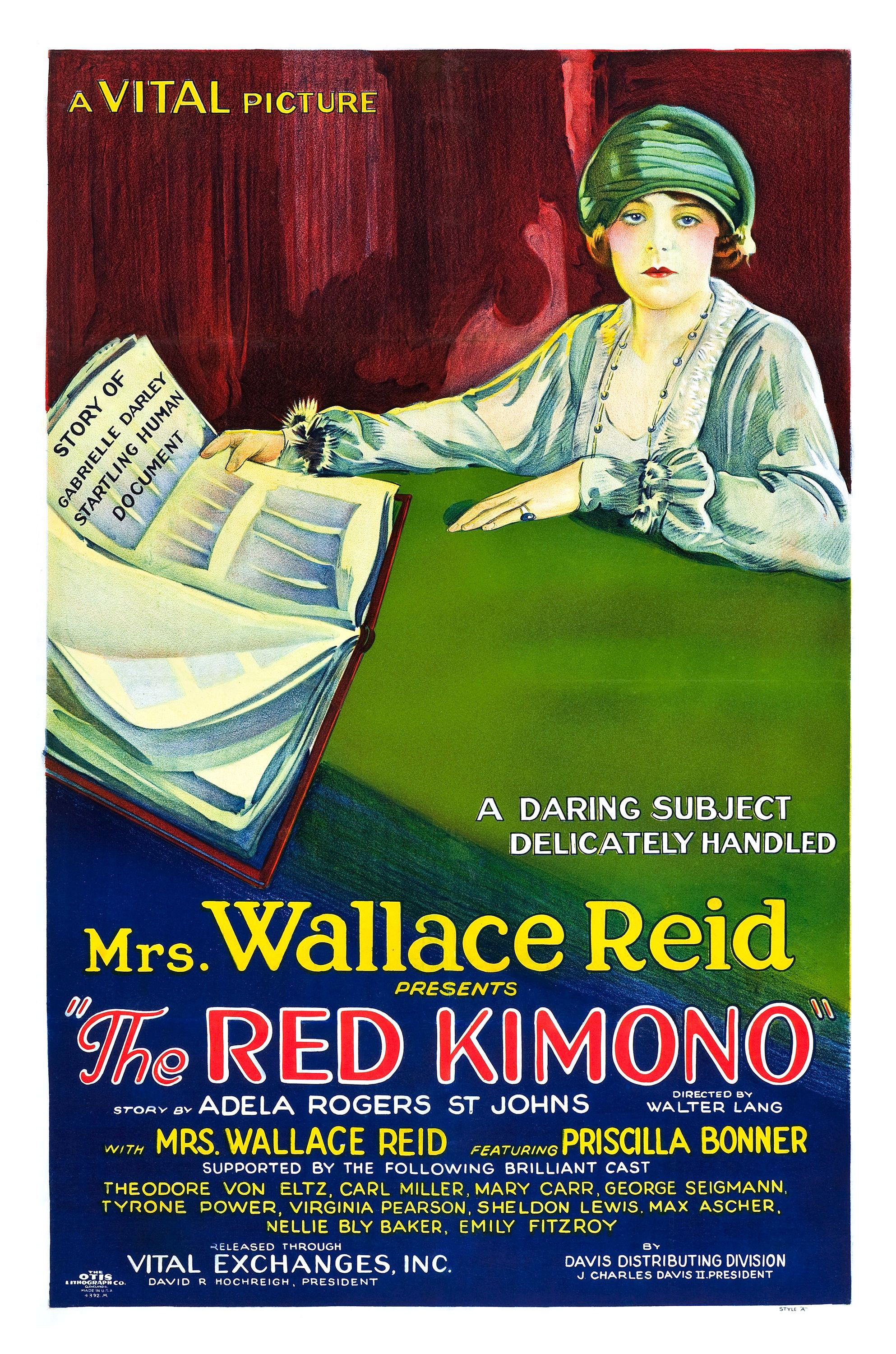
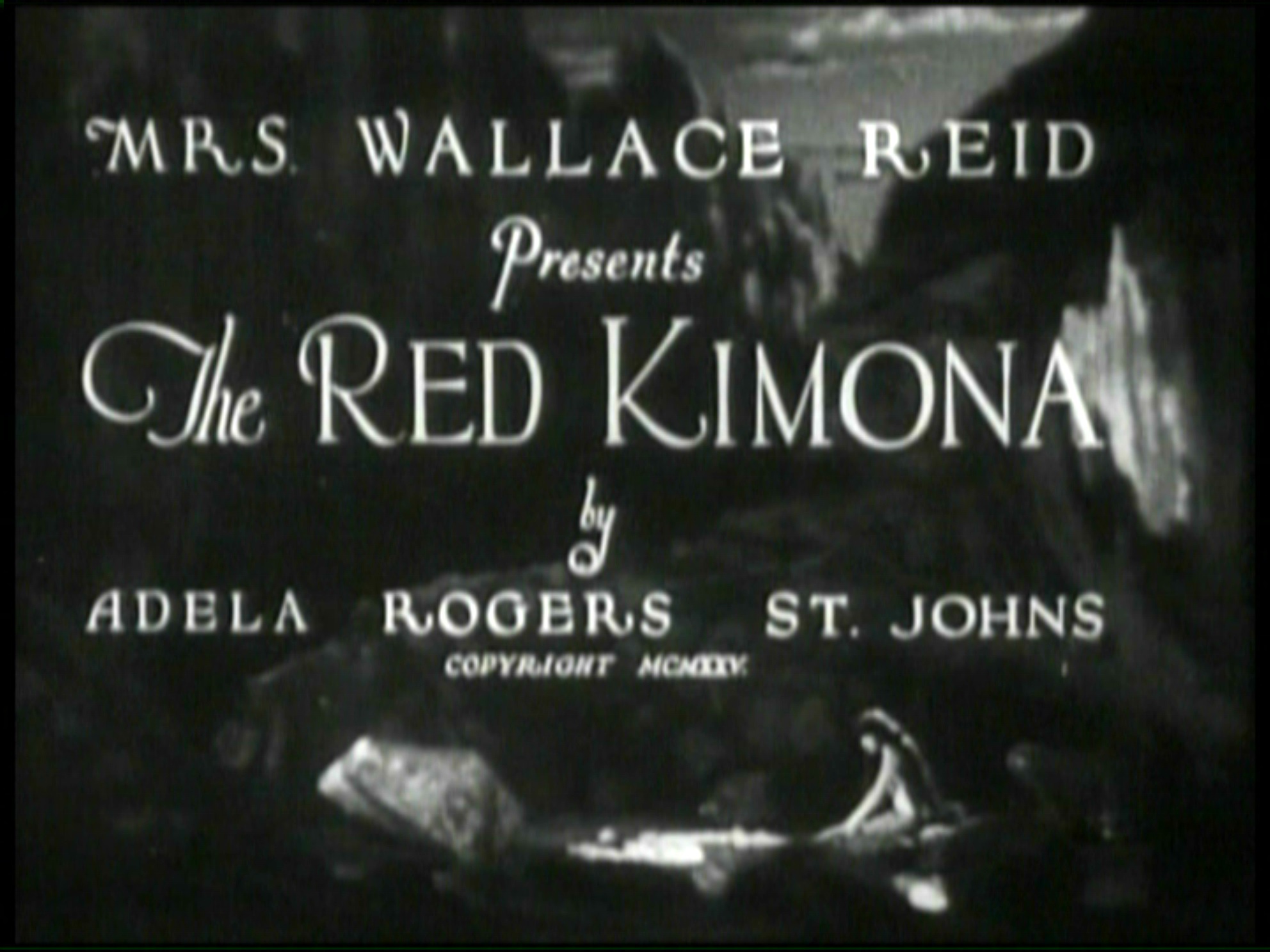
The movie is available on DVD from Kino-Lorber. AND now on a beautiful razor sharp Blu-ray as part of the Pioneers: First Women Filmmakers box set (I wish I had time to upgrade all of the movie frames in this post). Confusingly, screen credits list the title as “The Red Kimona,” while advertisements from the day list it as “The Red Kimono.” Let’s start our 1925 journey across Los Angeles at Fremont Place, below.

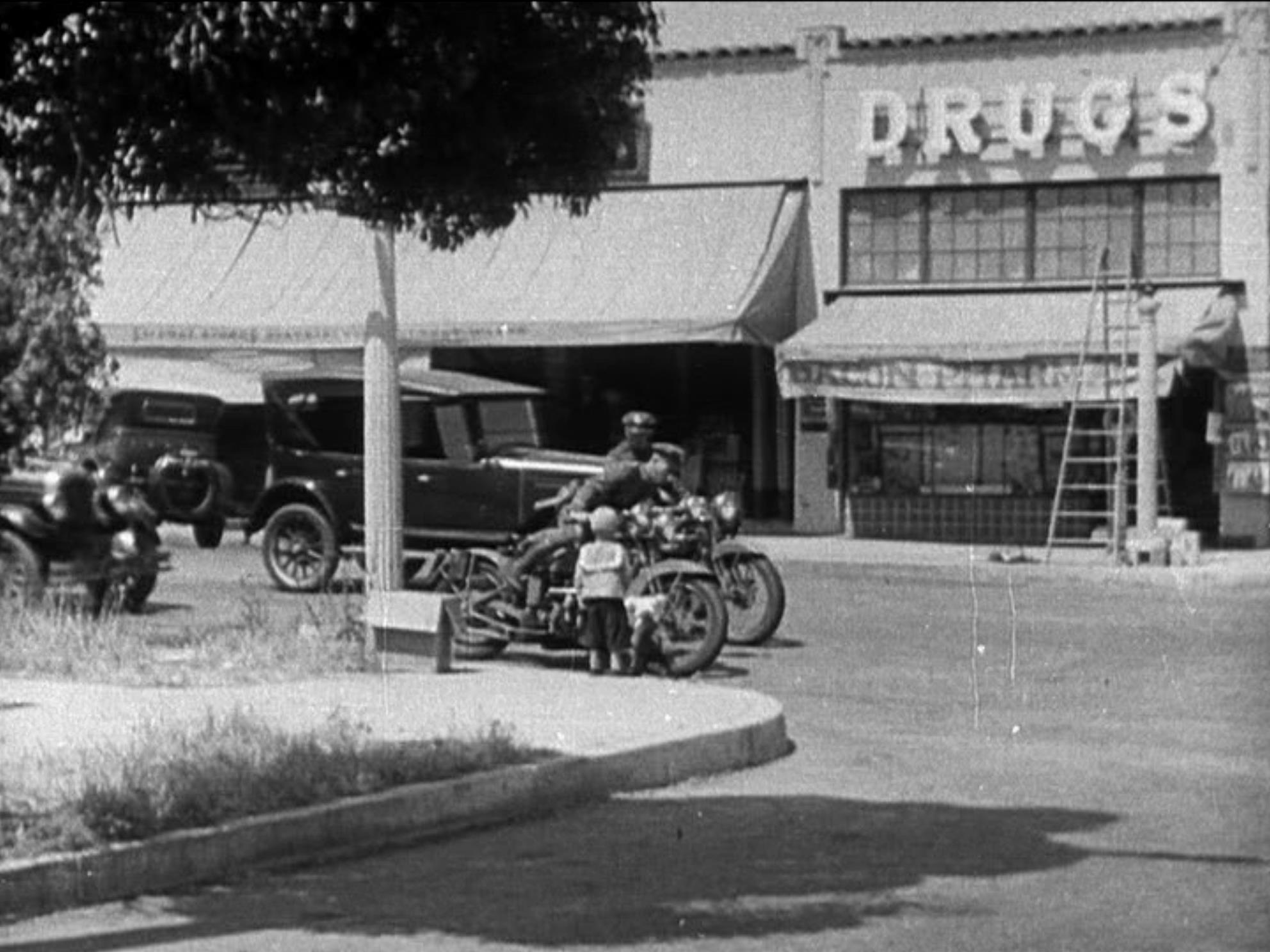
The society matron’s home, still standing, is located at 53 Fremont Place, one of the many magnificent homes built at this small gated community located south of Wilshire Boulevard. Read more at http://fremontplace.blogspot.com/ 

Upper right, Fred greets Gabriella on the steps of 53 Fremont Place. Due east behind them stands a home now lost, the former Aronson mansion at 31 Fremont Place. The home had been moved to Fremont Place in three sections.  http://fremontplace.blogspot.com/2014/11/31-fremont-place-please-see-our.html  Above, at the lower right, is a rare photo of the now lost home, viewed looking west. LAPL.

The matron’s home, upper left, has two famous neighbors still standing to the south across the street. To the SW, 55 Fremont Place, appears in Charlie Chaplin’s The Kid (1921), see Edna Purviance lower left. The view from the matron’s home looking to the SE (upper right) shows 56 Fremont Place, the mansion where Mary Pickford once lived for a year in 1918, and that appears as Jean Harlow’s home in Bombshell (1933) (right center). The vintage aerial view, looking north, shows the three still surviving homes, the Red Kimono’s matron home at the center, with Edna filming The Kid to the left, and the Bombshell home to the right. The three landmark homes still grace Fremont Place.

The surviving gates to Fremont Place appear in the movie and in Chaplin’s Idle Class (1921) (upper right).

Fred takes Gabrielle on a date to the former Abbott Kinney Pier in Venice. Although they purchase tickets for the “Giant Dipper” roller-coaster, they filmed aboard the second “Some Kick” coaster at the far end of the pier. Marc Wanamaker – Bison Archives.

Upper right, Gabrielle checks out the New High Street side of the former LA County Jail, fronting Temple Street, matching a similar view on New High Street from Max Linder’s Seven Years Bad Luck (1921).

Fred learns Gabrielle is set to return to New Orleans. As he races to prevent her from reaching the train station, he drives east down Wilshire past the corner of Vermont, now the site of a modern highrise. USC Digital Library.

Continuing east on Wilshire towards the Park Wilshire apartments on the corner of S. Carondelet, in the distance we see a “T” intersection, where Wilshire originally terminated at the west side of  MacArthur (formerly Westlake) Park. Barely visible, dead center, is a trio of statues (see below).

The trio of statues honors General Harrison Otis, the original founder/publisher of the Los Angeles Times. Buster Keaton (Hard Luck – 1921) filmed beside these statues, as did Billy West and Stan Laurel (not pictured). The aerial view looks east, showing where Wilshire once terminated at the west side of the park. USC Digital Library – LAPL.

Further west (around Ardmore) but still looking east down Wilshire, this 1925 view shows the towering Gaylord Apartments (left), where still solo comedian Stan Laurel filmed On The Front Page (1926) (upper right), and the Talmadge Apartments (right), where Buster Keaton filmed Battling Butler (1925) (lower right). These lone towers are now hemmed in by numerous modern buildings.

A vintage view north of the Gaylord, left, and Talmadge, right, along Wilshire. LAPL.

The race to the train station continues east through the 3rd Street Tunnel, with Angels Flight appearing to the right. Angels Flight has since been relocated half a block further south. USC Digital Library.

Now racing south down Broadway towards the intersection of 5th – the Title Guaranty Building at left, and Walker’s, the red corner building at right.

Now we race east towards the original 1st Street Viaduct (re-built in 1929), before turning right on Santa Fe Avenue, past a billboard promoting train travel to Chicago. LAPL.

Traveling south towards the former Santa Fe train station, an extremely popular filming site. Stan Laurel appears here in Hustling For Health (1919) (upper left). USC Digital Library.

Gabrielle waiting beside the Santa Fe station. LAPL.

Fred arrives at the station, but not in time to prevent Gabrielle from catching the train back home to New Orleans. USC Digital Library.

Fred follows Gabrielle to “New Orleans,” where he pursues her by taxi departing south from the former Southern Pacific depot, on 5th at Central, near the former Santa Fe station.

Fred’s taxi passes The New Orleans Market at right. This immediately caught my eye, as the other side of the corner market appears prominently in Harry Langdon’s comedy Long Pants (1927).

The New Orleans Market stood at the former corner of Aliso and Los Angeles Street just south of the plaza. The (*) marks where Buster knocks out a policeman at this intersection in Cops (1922), and where Harry Langdon (above) also appeared, while the (**) marks Frederick’s taxi scene, filmed looking the opposite direction as shown in the aerial view. This area was all lost to the freeway. LAPL.

Frederick’s taxi scene shows at back the south side of the former Hotel de Paris. Grabbed by a cop, Buster Keaton walked west, along the south side of the Hotel de Paris, during Neighbors (1920). LAPL.

A broad aerial view looking east at the filming area south of the Plaza de Los Angeles (circle of trees at lower left). The former Chinatown (discussed below), demolished to build Union Station, lies due east of the plaza. The purple (*) marks Buster’s knockout shot in Cops (lower right), the yellow (*) marks Fred’s taxi, again filmed looking the other way.

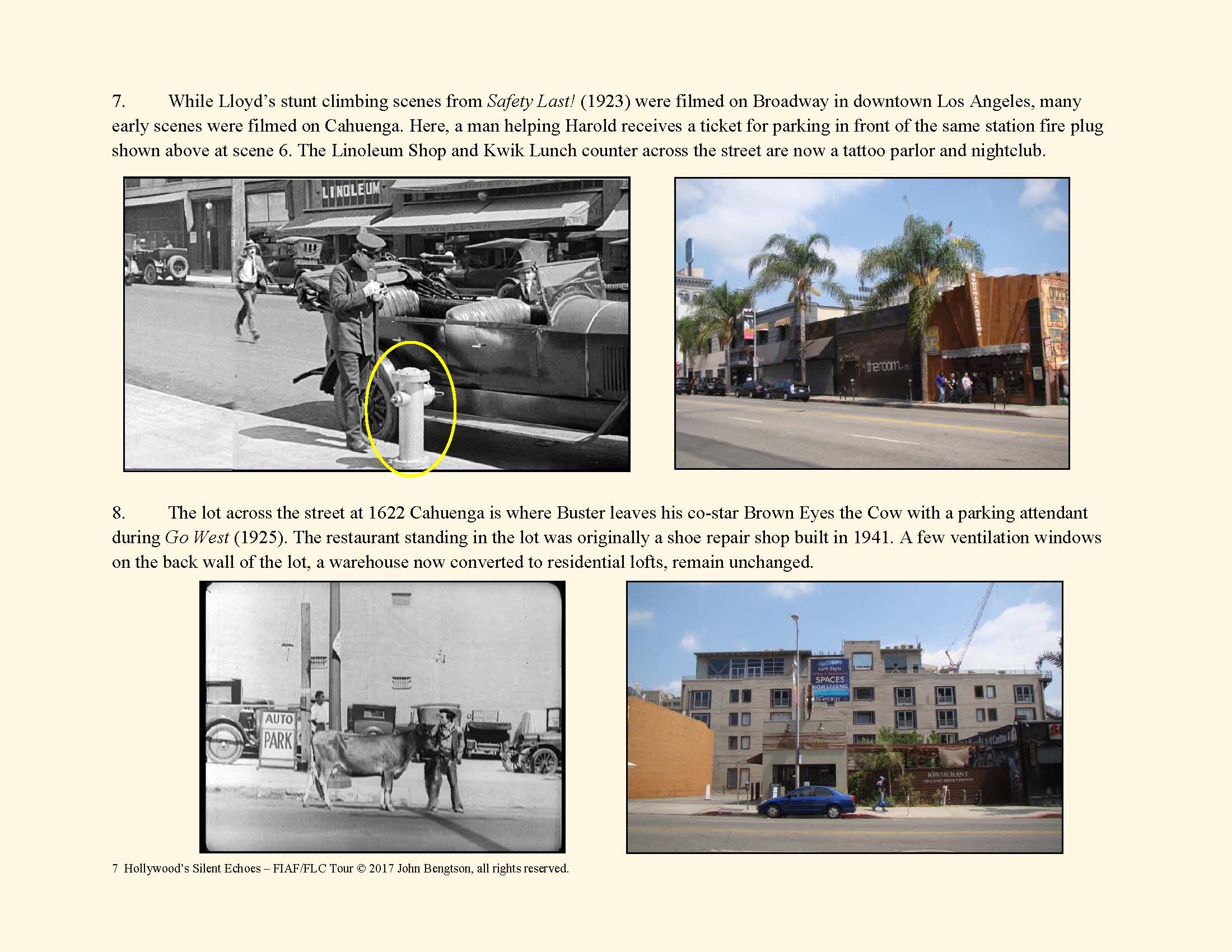
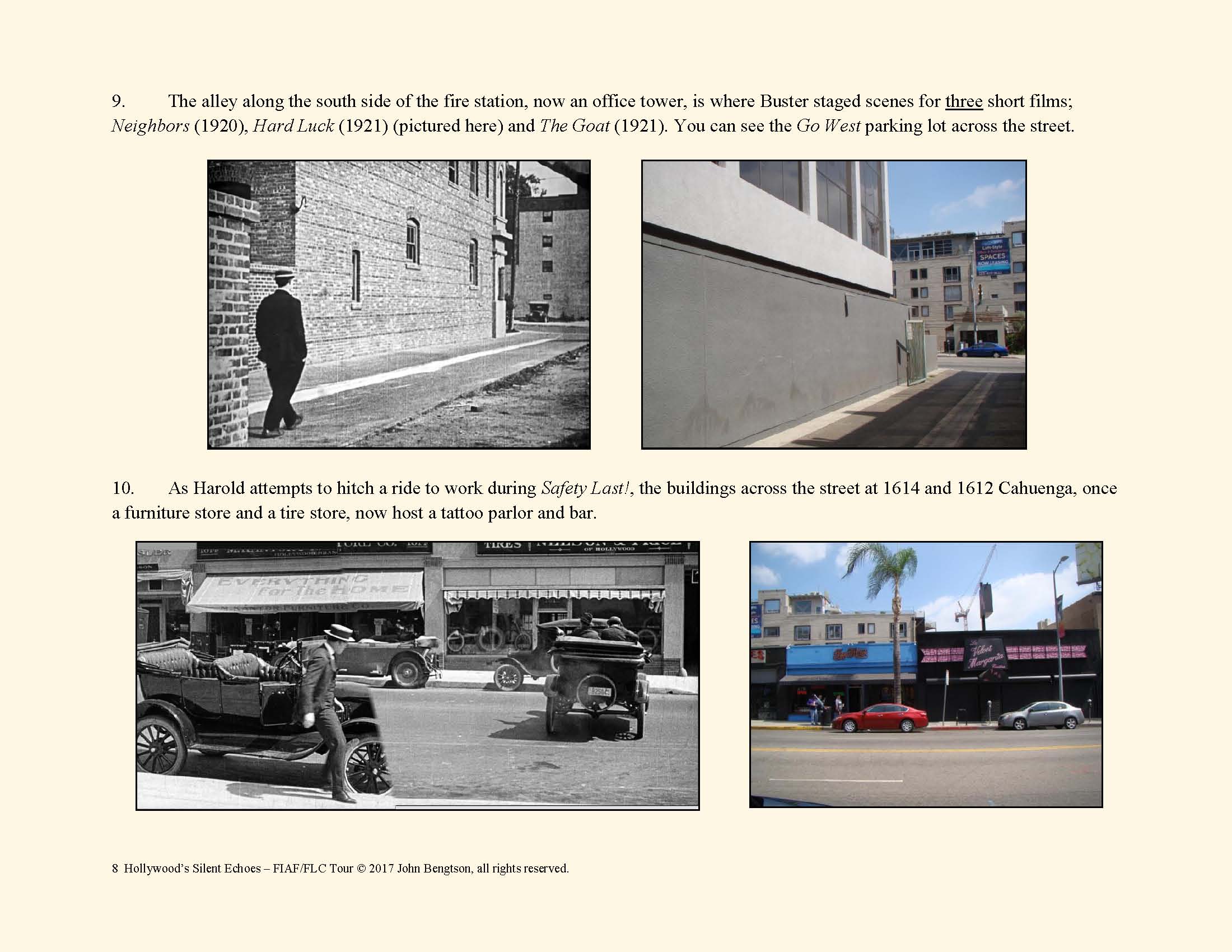
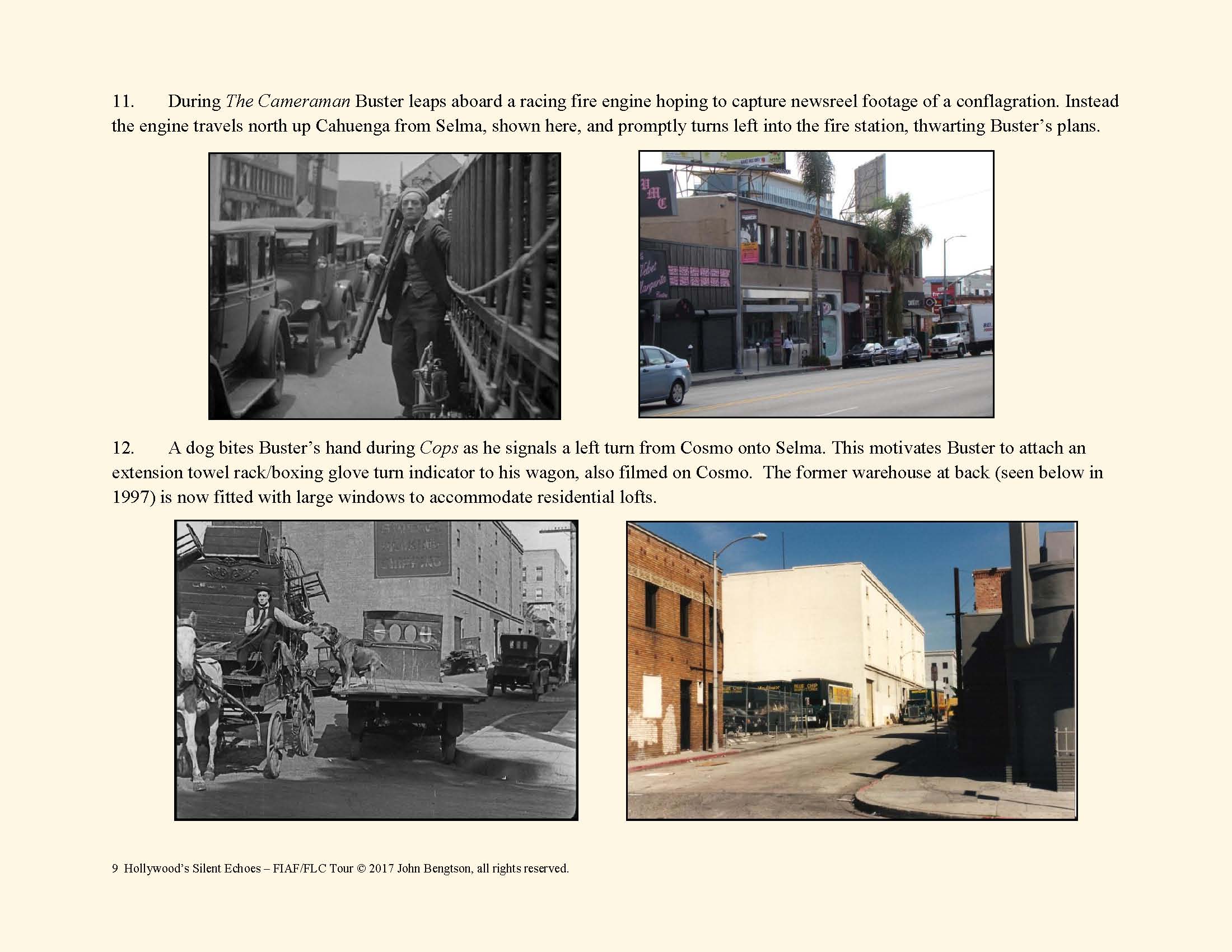
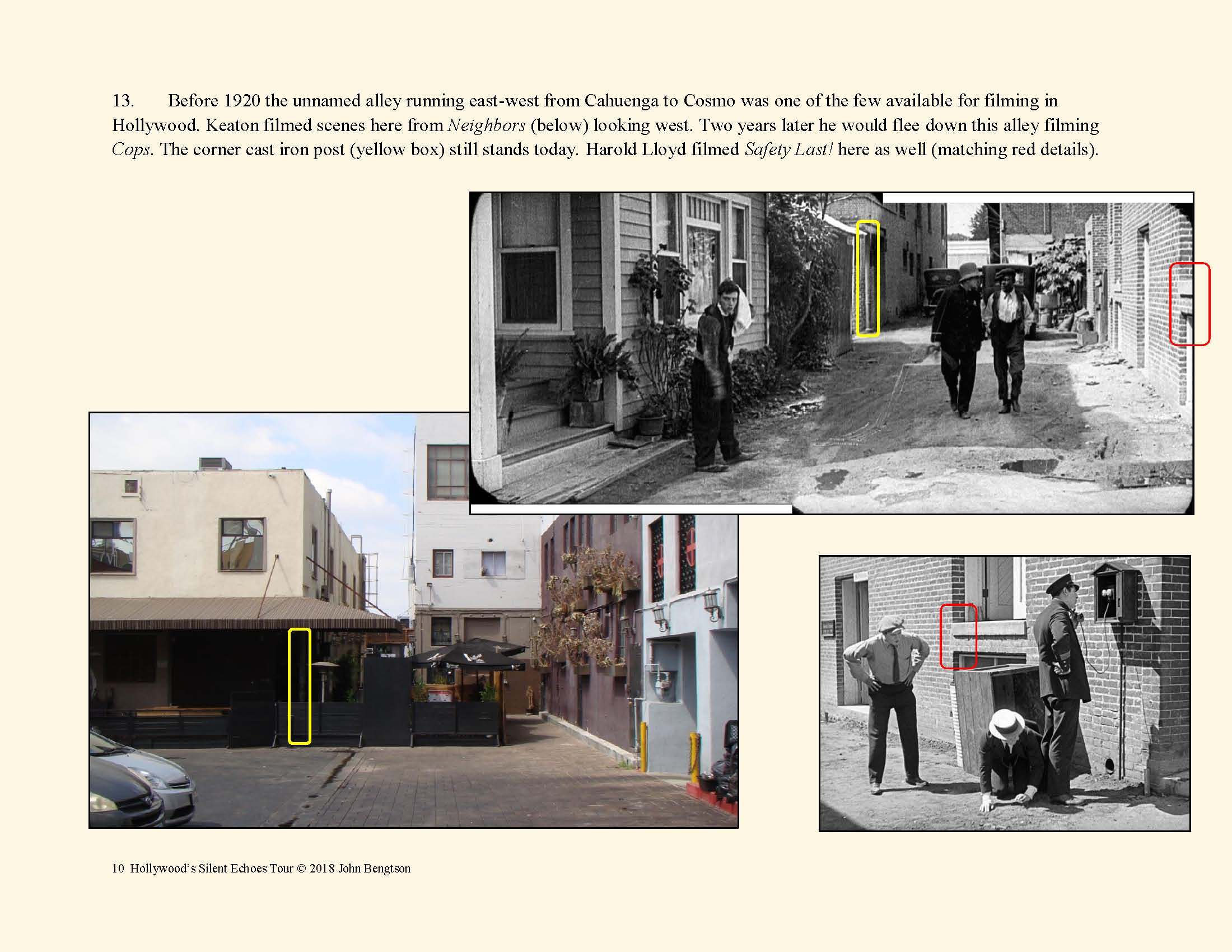
Upper right, Fred’s taxi stops at the corner of Alameda and Aliso – the orange (*). The view looks east towards the many gas tanks east of town. The far right green (*) marks the corner of Alameda and Ducommun, where Buster Keaton filmed many scenes from The Goat (1921), and this boxing glove turn, again from Cops, pictured here (lower right).

Now in the former LA Chinatown (demolished for Union Station), the taxi turns right (south) from Apabalaza onto Juan Street. The doorway left of the pole appears beside Chaplin during Police (1915), showing the same pole. The taxi turned from right to left in the main photo, the same doorway and pole appear near the left center. El Pueblo Photo Archive.

These matching views looks north up Juan towards the SE corner of Apablaza, the corner behind the car. Jackie Coogan appeared in Chaplin’s The Kid, in an opposing view, just around the same SE corner. The building across the street from Jackie appears in the three images directly above. USC Digital Library.

Driving east along Marchesault Street towards Juan Street. The main photo looks west from Juan. El Pueblo Photo Archive.

>sigh< a happy ending.

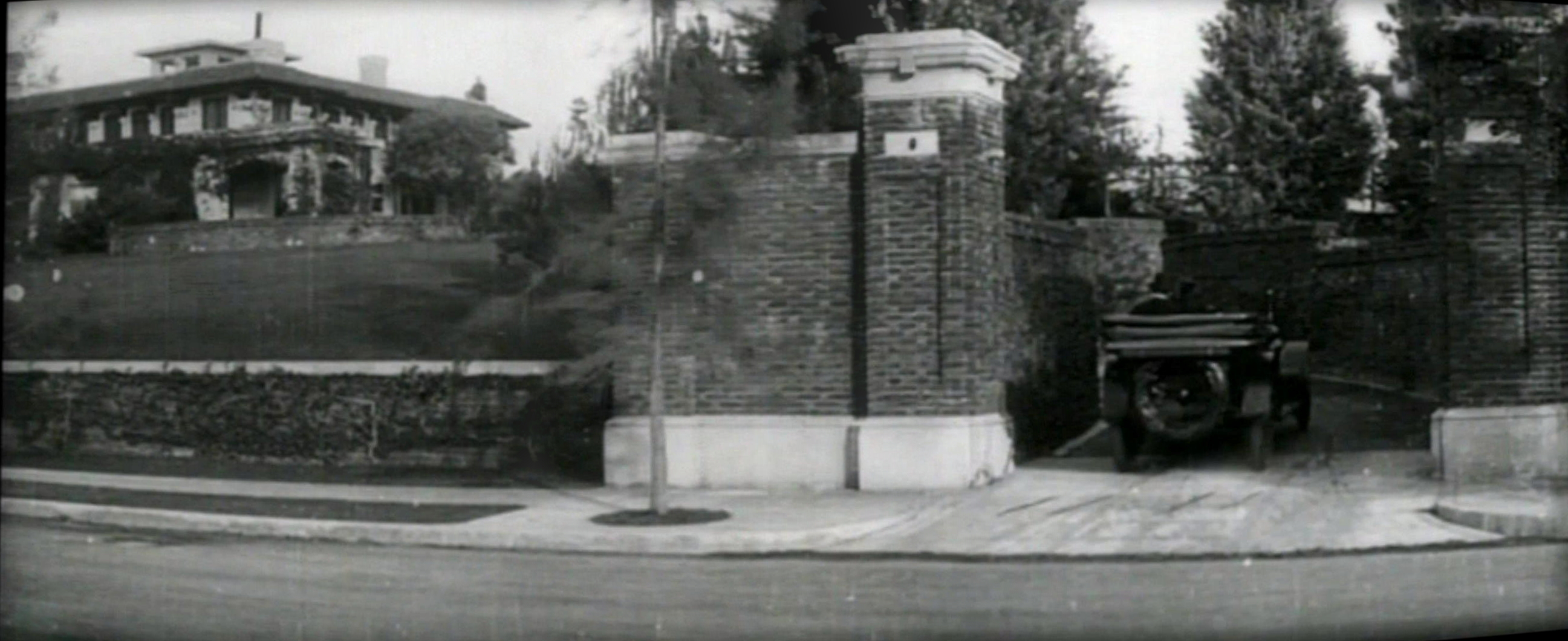
Where is this? It’s one of the few exteriors I couldn’t track down.

The Red Kimono is a perfect example of how the movies can tell socially significant stories, while promoting the historic role women played in making films, but also how even a single movie can capture a vast and unique visual history of what is now almost entirely lost Los Angeles. Discovering this film was especially gratifying for me. Perhaps someday another treasure trove film will appear.

The Red Kimono is available on DVD from Kino-Lorber. And now part of the First Women Filmmakers box set.

Posted in Uncategorized | Tagged , , , , , , , , , , , , , | 11 Comments

Another Lois Weber First – Using Locations

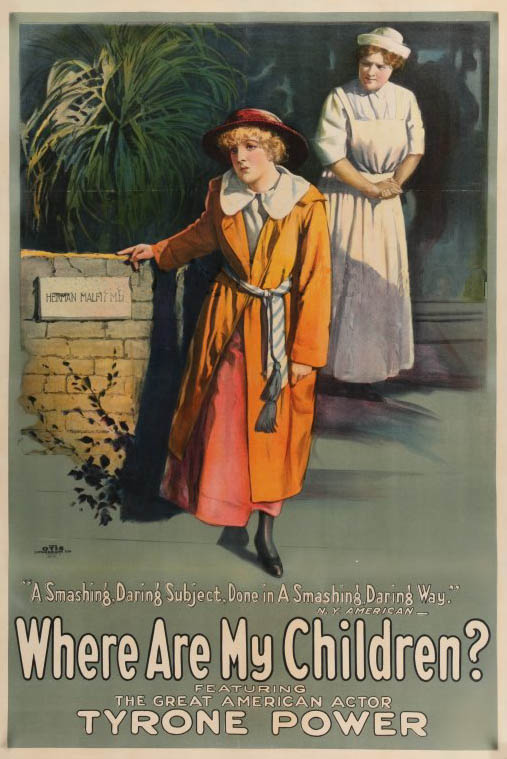
Click to enlarge – the lost Bergstrom Estate at 590 N. Vermont Avenue portrays the District Attorney’s mansion in Lois Weber’s birth-control abortion drama Where Are My Children? (1916). This view shows the south gate automobile entrance. Years later Harry Houdini and Buster Keaton would film at the north pedestrian entrance.

In her day, pioneering producer/director/screenwriter Lois Weber ranked alongside D.W. Griffith and Cecile B. DeMille as one of the most successful and influential filmmakers of any gender. As historian Cari Beauchamp writes, though little known today, Weber was the first American woman to direct a feature length film, the first woman member of the Motion Pictures Directors Association, and even the first woman, years before Mary Pickford, to own an eponymous studio. Weber, the subject of author Shelly

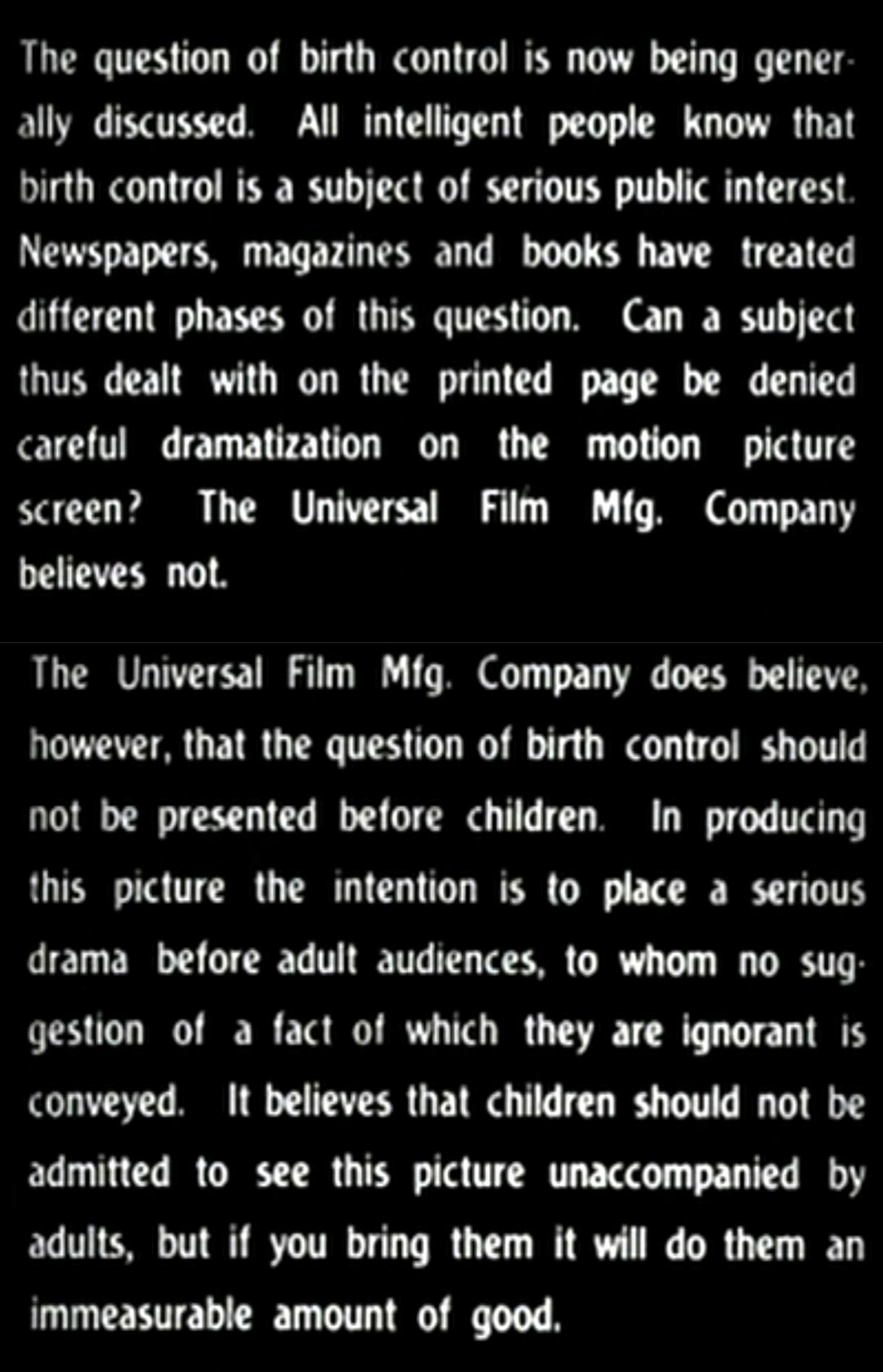
Opening the film, this disclaimer about birth control, remarkable for 1916, likely remains controversial in much of 2017 America.

Stamp’s insightful book “Lois Weber in Early Hollywood,” explains  how Weber was known for tackling social injustice in her films, addressing issues such as drug addiction, birth control, capital punishment, and women’s inequality. Weber also actively mentored and promoted other women in the early film industry. (You can learn more about Lois and other silent-era women directors in the latest Dream Factory episode of Nathan Master’s fascinating LOST LA history series for KCET television.)

While a far less notable accomplishment, as shown here, Weber was also the first to use key filming locations, years before Charlie Chaplin, Buster Keaton, and others would employ these settings in their later films.

Weber’s 1916 drama Where Are My Children? involves a married but childless District Attorney who prosecutes an abortionist, only to learn that his own wife and many of her society friends were among the doctor’s clientele. The concluding scene depicts the lonely DA and his wife staring into their fireplace over the years, visited symbolically by the ‘ghosts’ of the adult children they would never have.

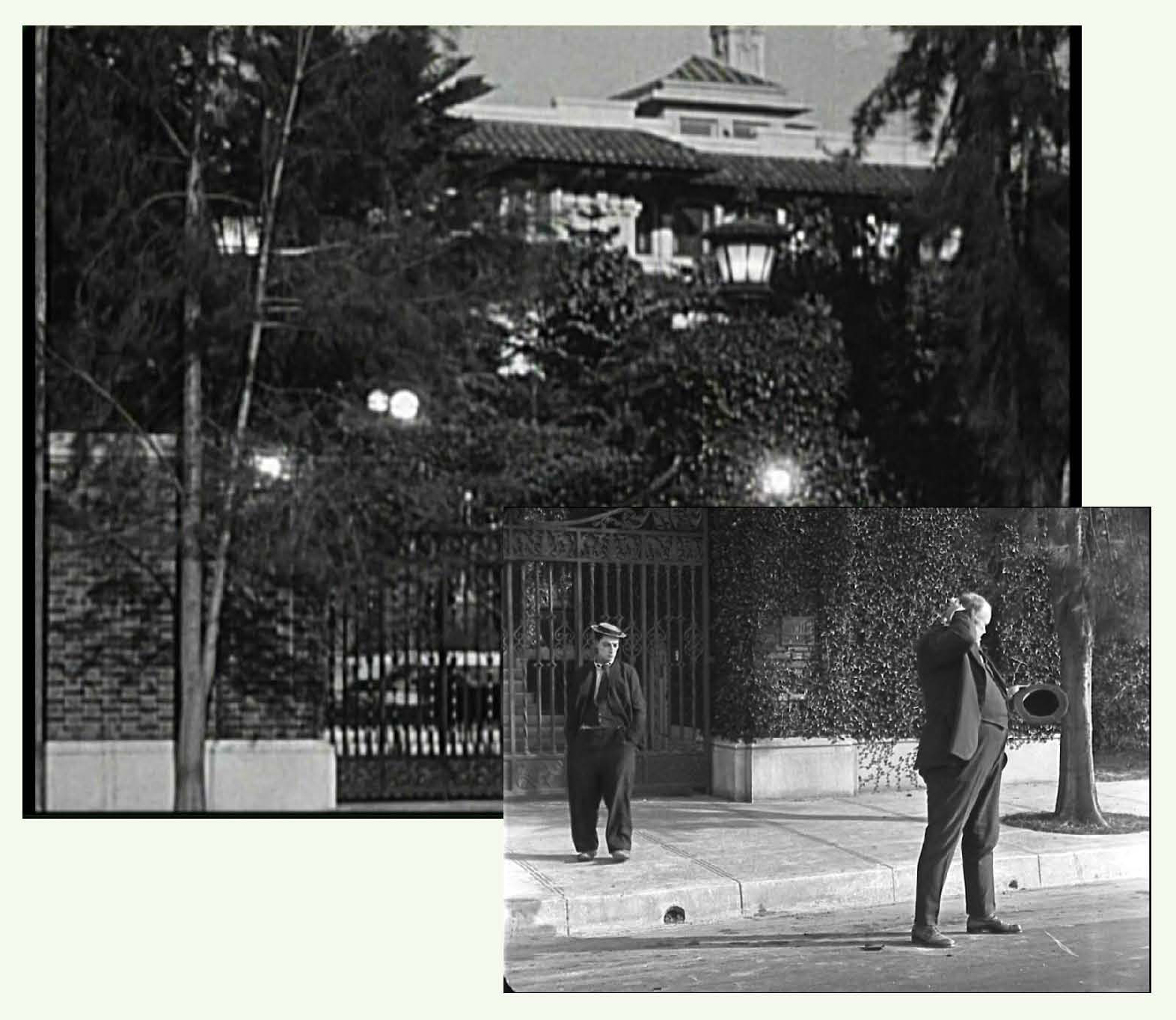
A full view of the north end of the DA’s mansion from Harry Houdini’s The Grim Game (1919), with an insert of the pedestrian entrance gate appearing in Buster Keaton’s Cops (1922).

The many scenes of the DA’s home were filmed at the mansion of noted architect Edwin Bergstrom, later home to theater magnate Alexander Pantages, before it was razed in 1951 to build a Jewish community center (now home to West Coast University). As shown above, Harry Houdini filmed his debut (non-serialized) feature The Grim Game (1919) at the same mansion, and Buster Keaton would later film the opening scenes from Cops (1922) at the north entrance gate (read more about The Grim Game HERE). But pioneer film-maker Lois Weber filmed here first, by several years.

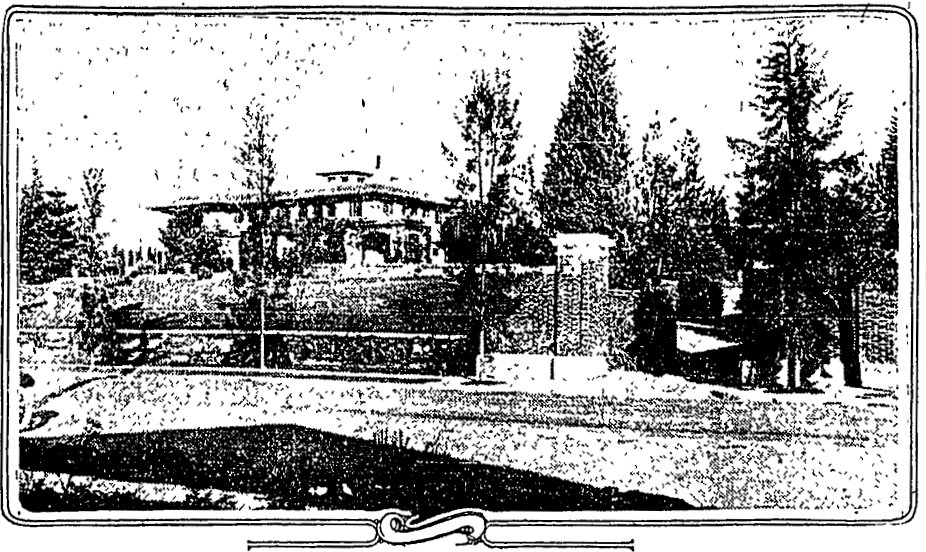
Prior to its appearance in Where Are My Children?, this December 19, 1915 image from the Los Angeles Times was the only view of the mansion I could locate. Aside from entertainment, movies provide invaluable historic reference.

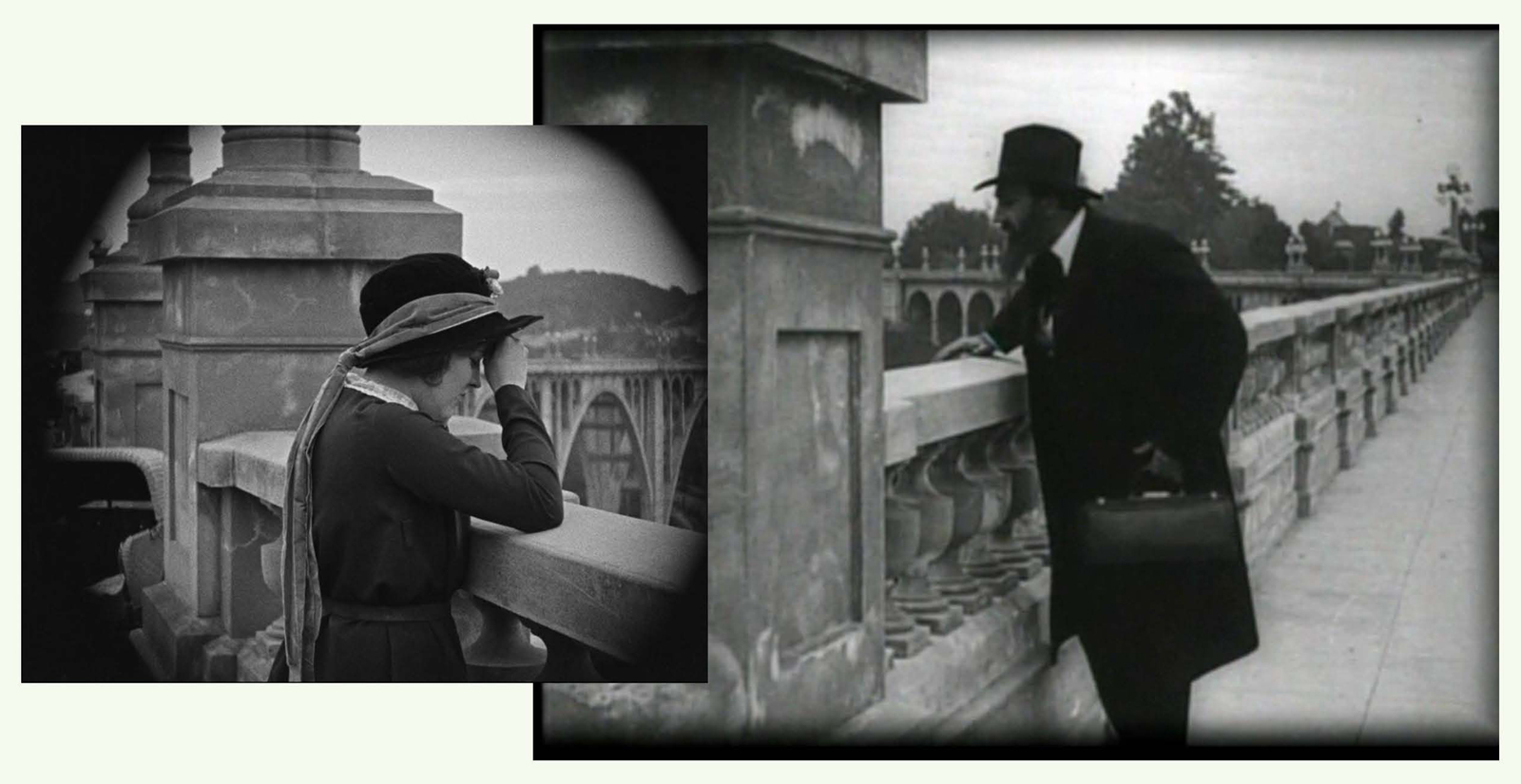
Early in the film the DA, portrayed by Tyrone Power (father of the classic-era actor), prosecutes a physician on obscenity charges for distributing literature about birth control. In his defense, the doctor recounts tragic events from his practice that could have been prevented had the public been educated about contraception. In one story, directly below, the doctor explains how a single mother, abandoned by her lover, committed suicide along with her infant by leaping from a bridge. The bridge portrayed was the Colorado Street Bridge in Pasadena, built in 1913, by then already notorious as a “suicide bridge” in real life. With more than 100 known suicides, the bridge is remodeled today with a modern suicide prevention fence. While I can’t say whether Weber directly influenced Chaplin, Charlie filmed a similar scene on the bridge with Edna Purviance portraying a despondent single mother in The Kid (1921) (decades later Chaplin decided to excise this scene). Again, Weber filmed here first.

Edna Purviance in an original scene from The Kid (1921), cut decades later by Chaplin, and a corresponding scene from Where Are My Children?

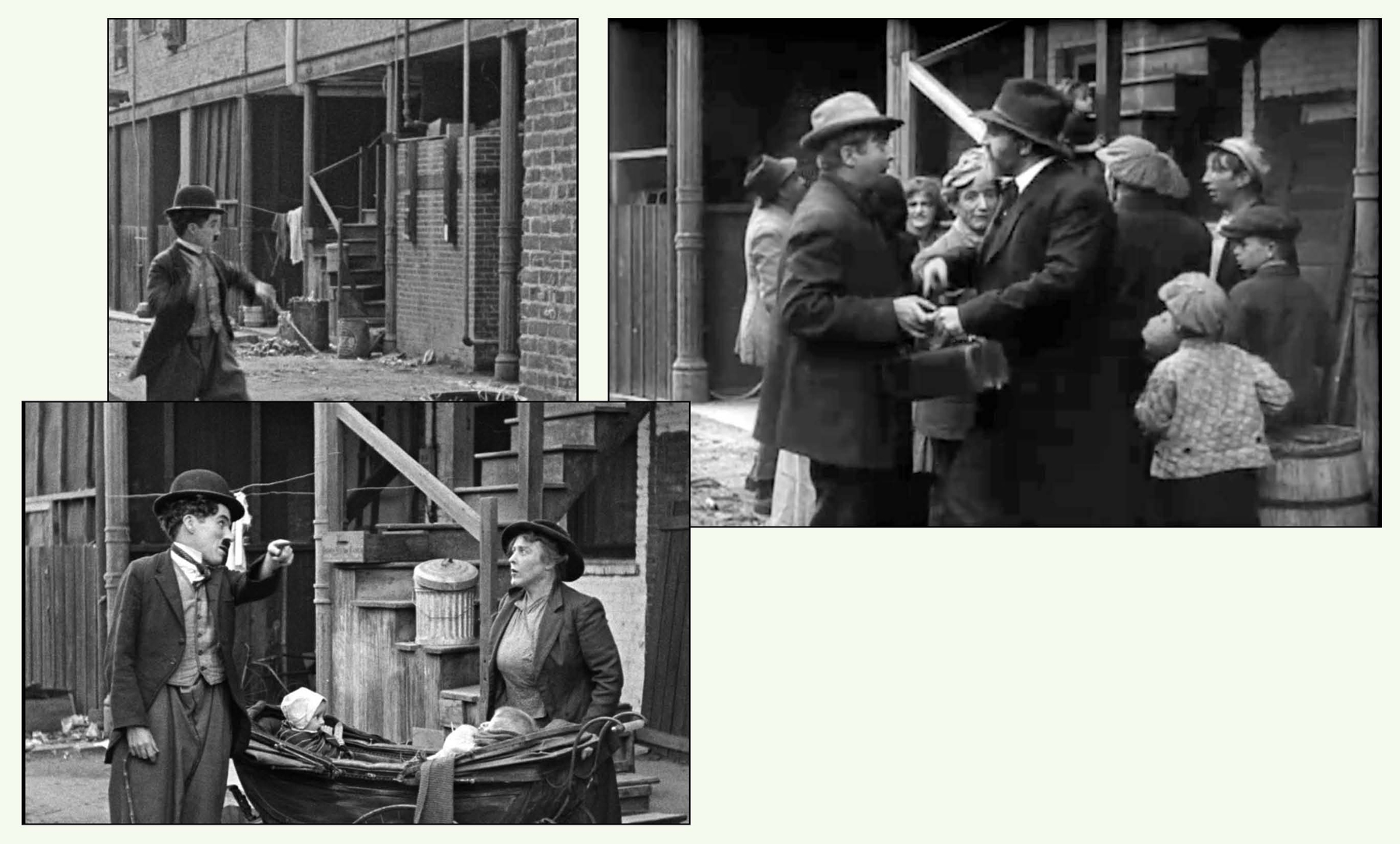
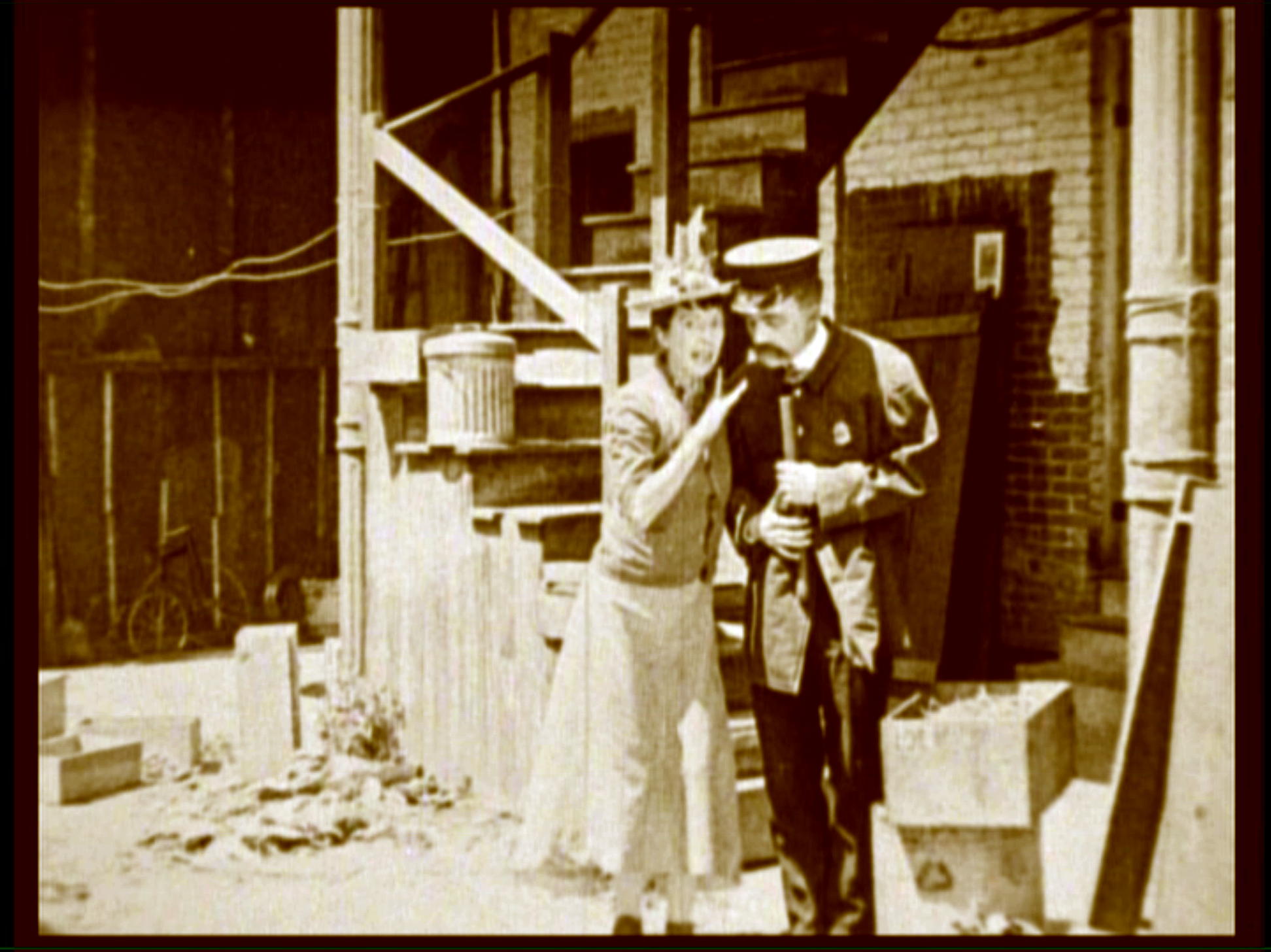
The physician on trial for providing birth control information then describes the poverty and violence endured by poor families overwhelmed by having too many children. His account turns to a rowdy fight filmed in some dingy alleyway, below. Weber staged this scene just south of Hollywood Boulevard, in an alley parallel between Cahuenga and Cosmo – the earliest use (of which I am aware) of what would prove to be a very popular place to film. Here below are comparable scenes staged there from Chaplin’s The Kid – but again, Weber filmed here first.

Click to enlarge – looking south down East Cahuenga alley where Chaplin filmed early scenes from The Kid. The birth control physician appears upper right.

Gale Henry filmed The Detectress (1919) beside the same iron posts and stairway used by Lois and Charlie – she beat Chaplin to the spot as well.

A full then and now view of the alley from The Kid (and Where Are My Children?) appears below.

A full then and now view of the alley where Chaplin (and Lois Weber) filmed.

As shown in this post, Buster Keaton would later film Cops, and Harold Lloyd would film Safety Last! (1923), at the same alley first used by Weber. The Chaplin – Keaton – Lloyd Hollywood Alley.

Roscoe Arbuckle and Mabel Normand in That Little Band of Gold (1915) – they filmed here before Lois.

The former court house on Temple, left and Broadway, right. USC Digital Library

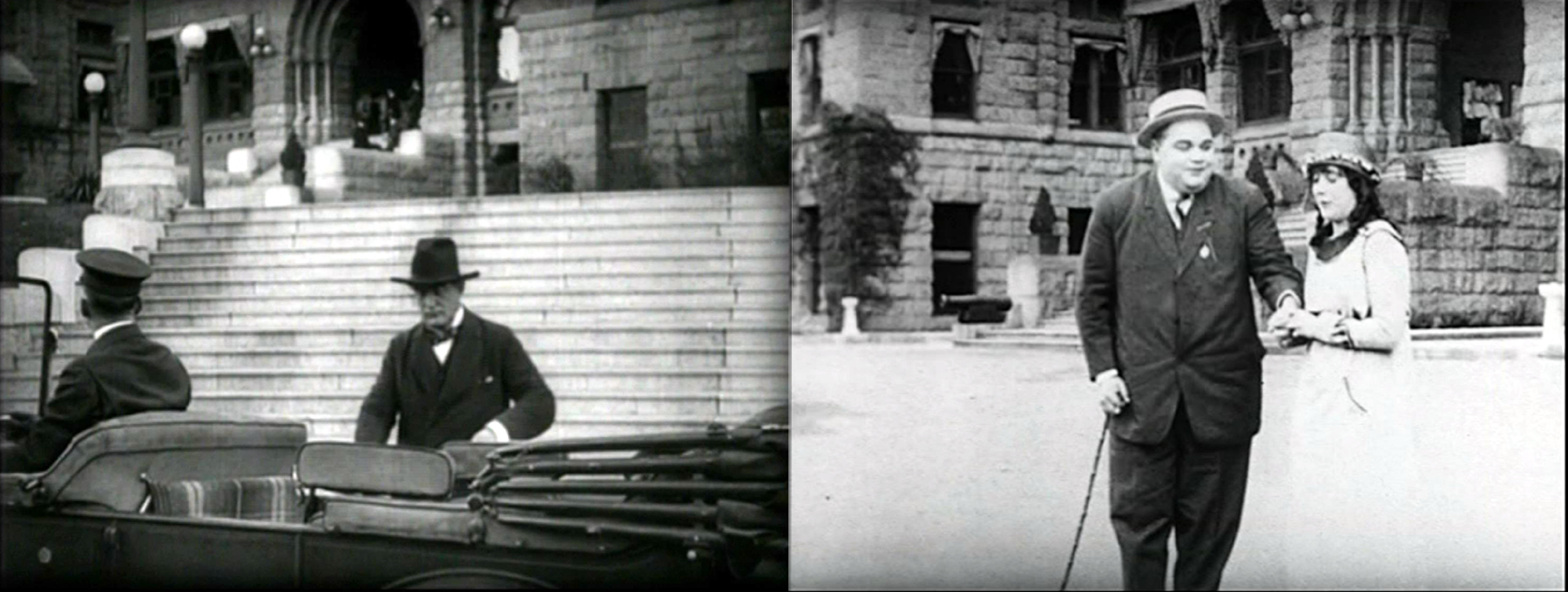
Above left, Where Are My Children? features this scene of the DA leaving what was the actual Los Angeles County Court House (1891 – 1935), later heavily damaged in the 1933 Long Beach earthquake, once situated at the SW corner of Temple and Broadway. The movie view shows the main north entrance facing Broadway, and a similar view appearing in the Roscoe Arbuckle – Mabel Normand Keystone comedy That Little Band of Gold. Filmed in 1915, the Arbuckle directed comedy preceded Weber’s use of the location, but we should note that Mabel Normand, also pictured, was herself an accomplished director. For some reason, in my experience at least, the former court house rarely appears on camera in early film.

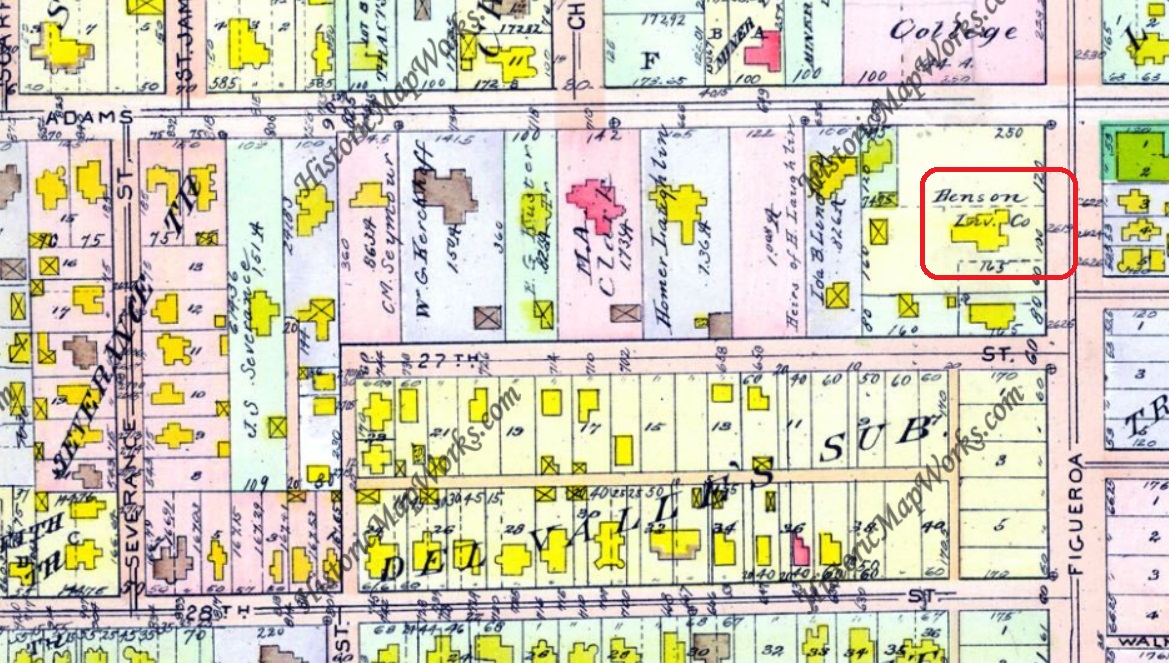
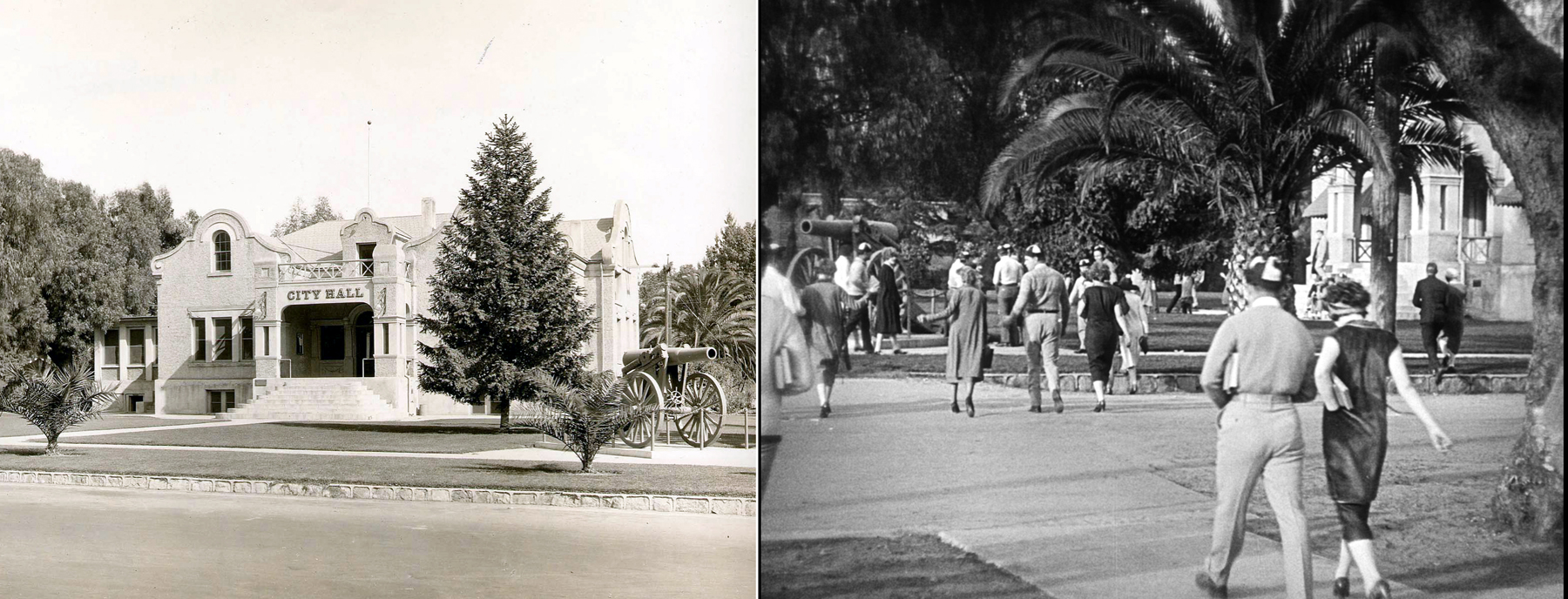
Built in 1914, and established as the Southern California Branch of the University of California in 1919, The Blot (left) features this campus view west towards Millspaugh Hall (demolished in 1960), with a matching view from Buster Keaton’s campus comedy College (1927). With the new UCLA campus grounds in Westwood dedicated in 1926, the original campus shown here became Los Angeles Junior College, known today as Los Angeles City College.

As a final example of Weber’s foremost use of locations, she filmed her 1921 drama The Blot at the campus settings employed by Buster Keaton years later in 1927. Again, Weber filmed here first.

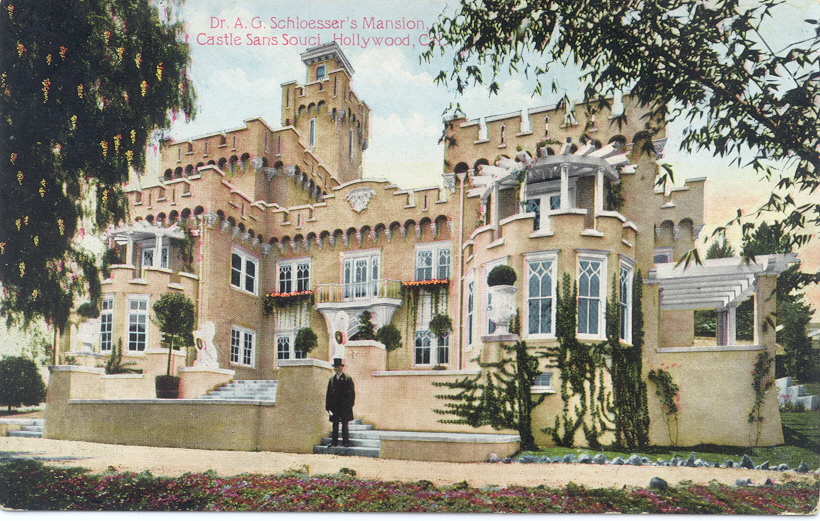
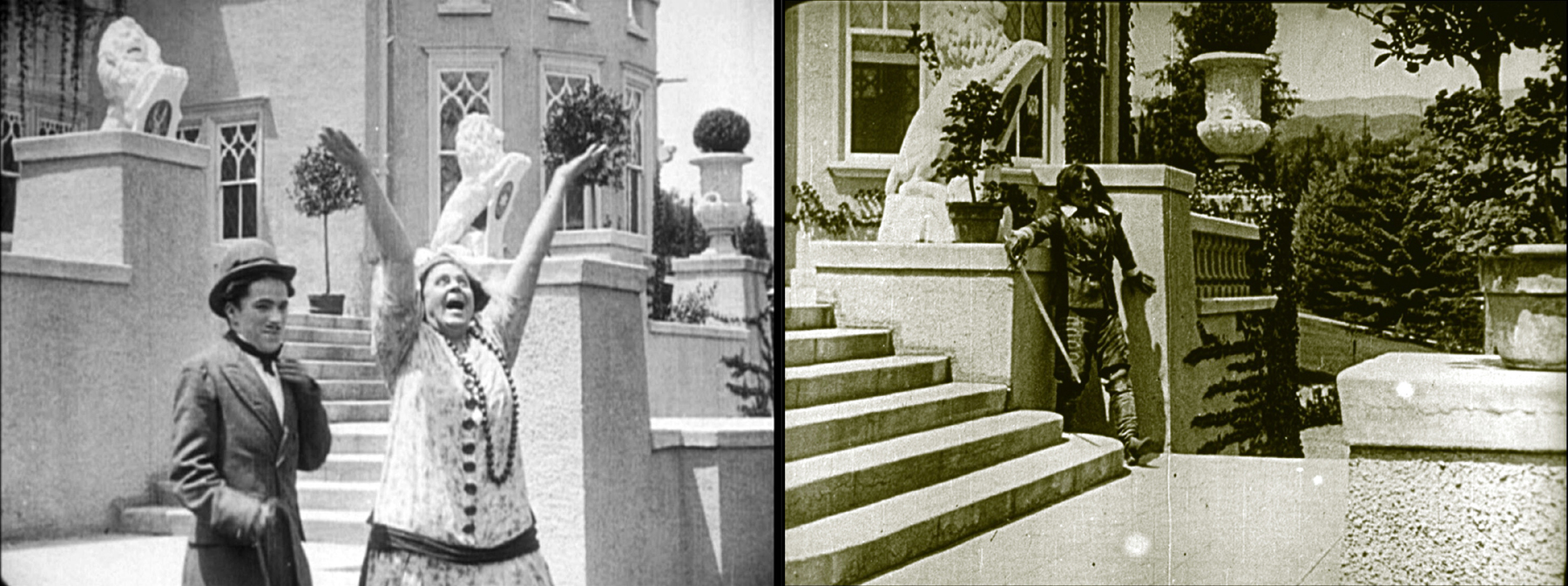
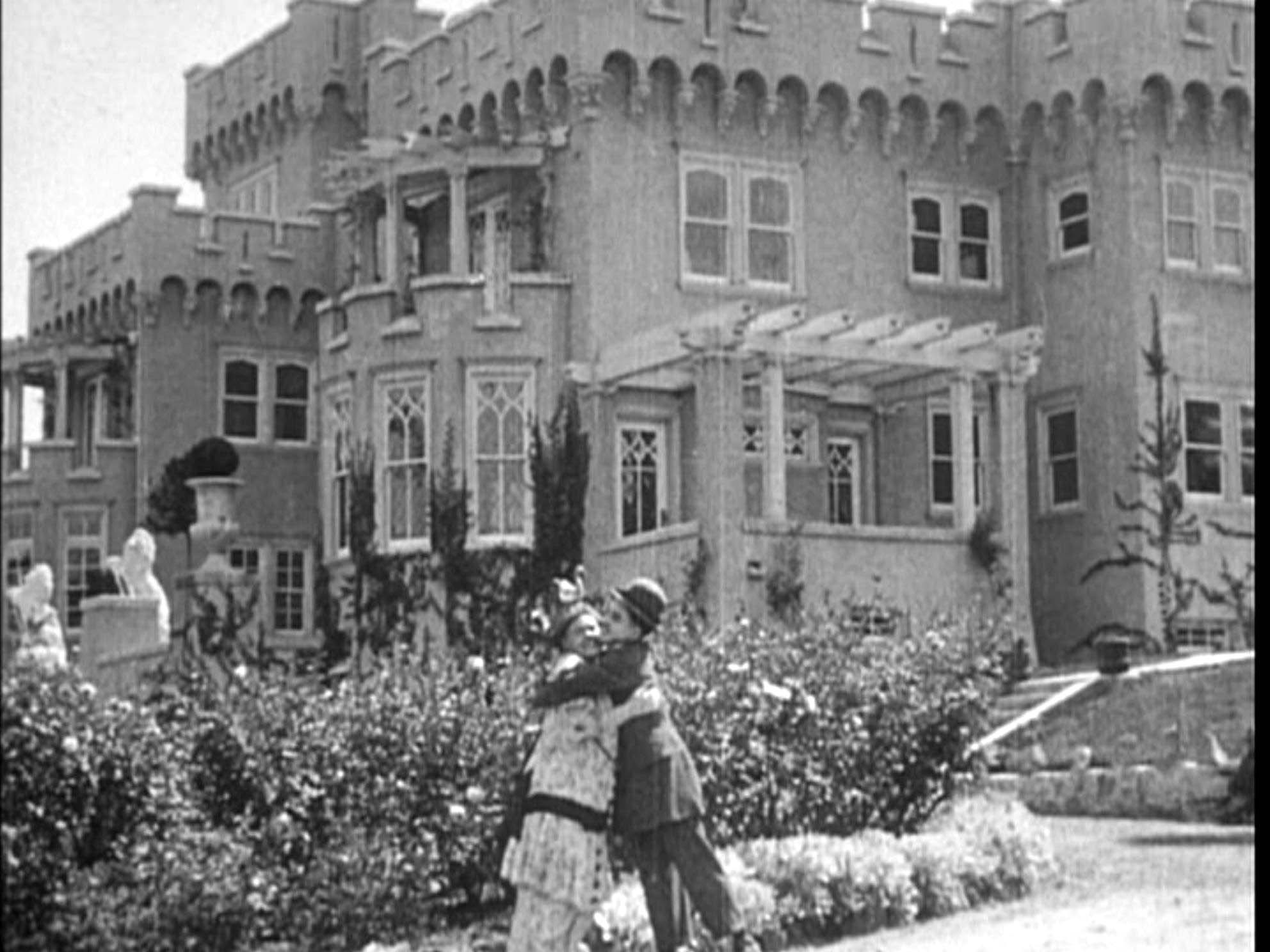
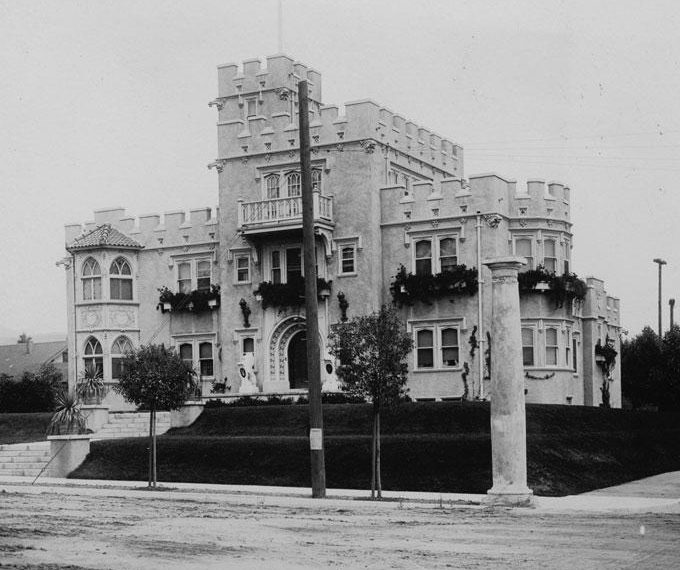
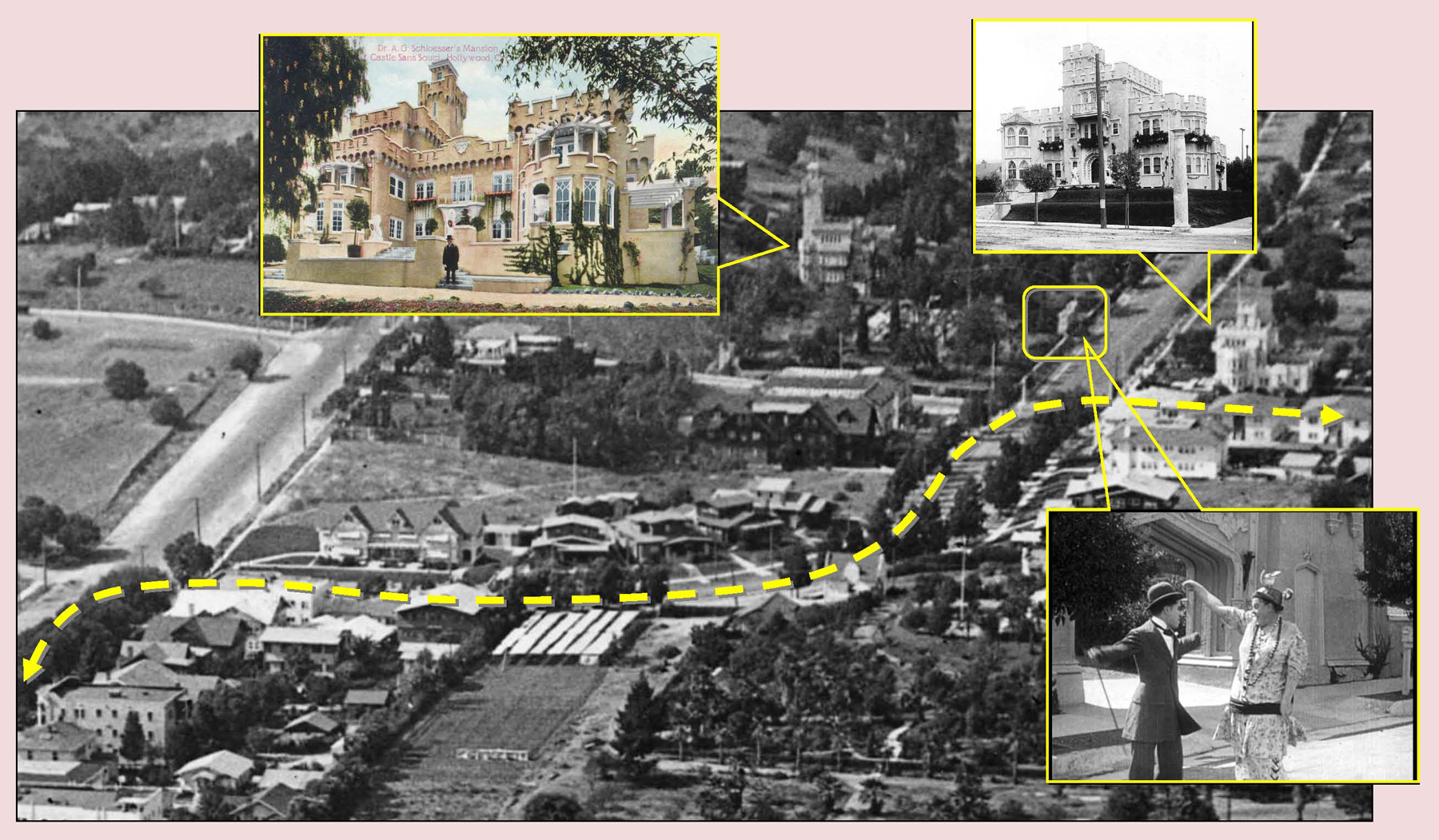
Chaplin and Marie Dressler in Tillie’s Punctured Romance (1914) and Weber’s The Dumb Girl of Portici (1916) at the now lost Castle Sans Souci.

To be fair to Charlie, he did appear in at least one location prior to Weber using it in a film – see matching views above of the Castle Sans Souci appearing both in Tillie’s Punctured Romance and Weber’s The Dumb Girl of Portici – although Chaplin wasn’t the director of that picture. You can read my full post about The Dumb Girl of Portici HERE.

You can learn more about Lois and other silent-era women directors in the latest Dream Factory episode of Nathan Master’s fascinating LOST LA history series for KCET television.

Posted in Lois Weber | Tagged , , , , , , , , | 11 Comments

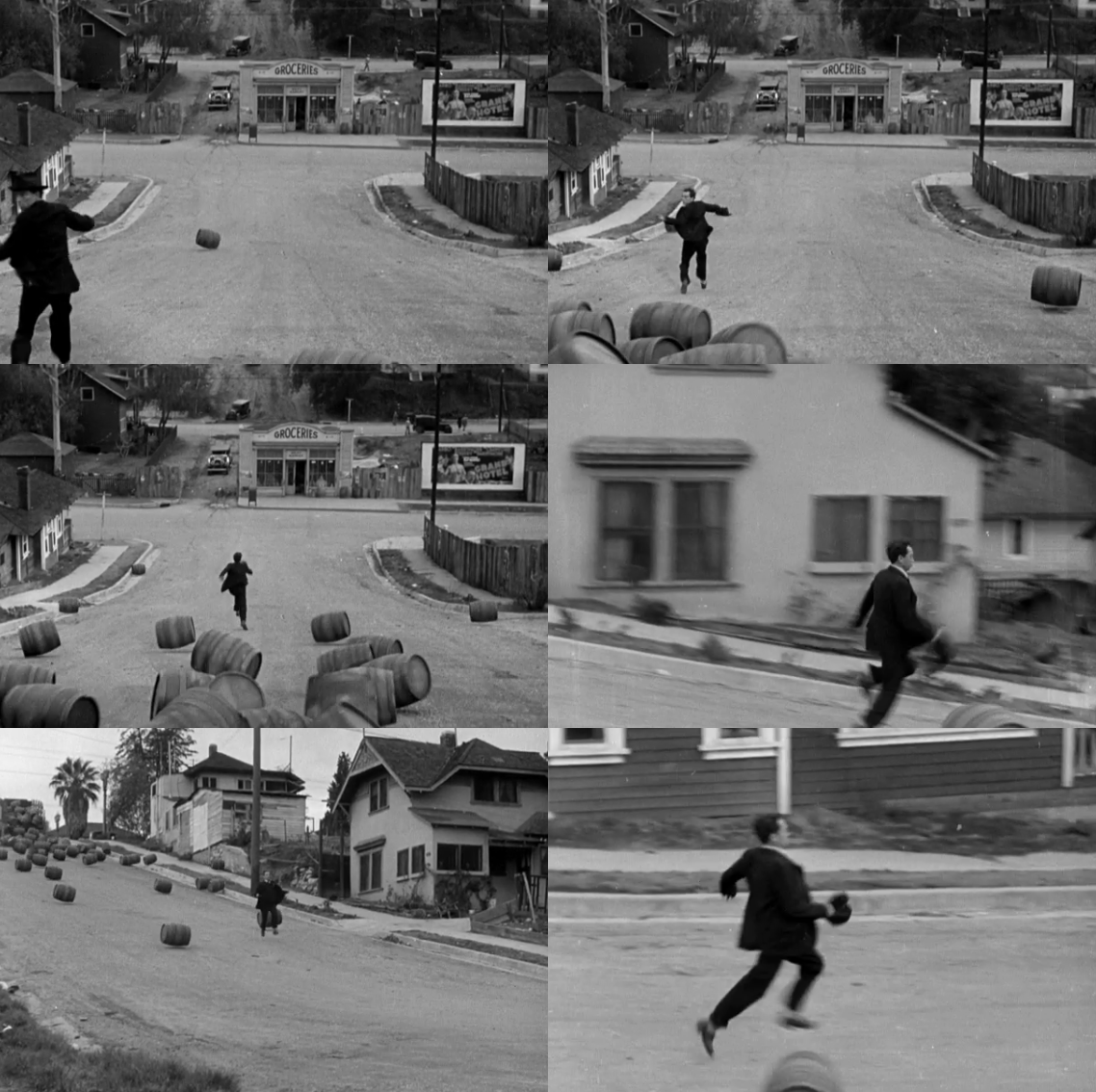
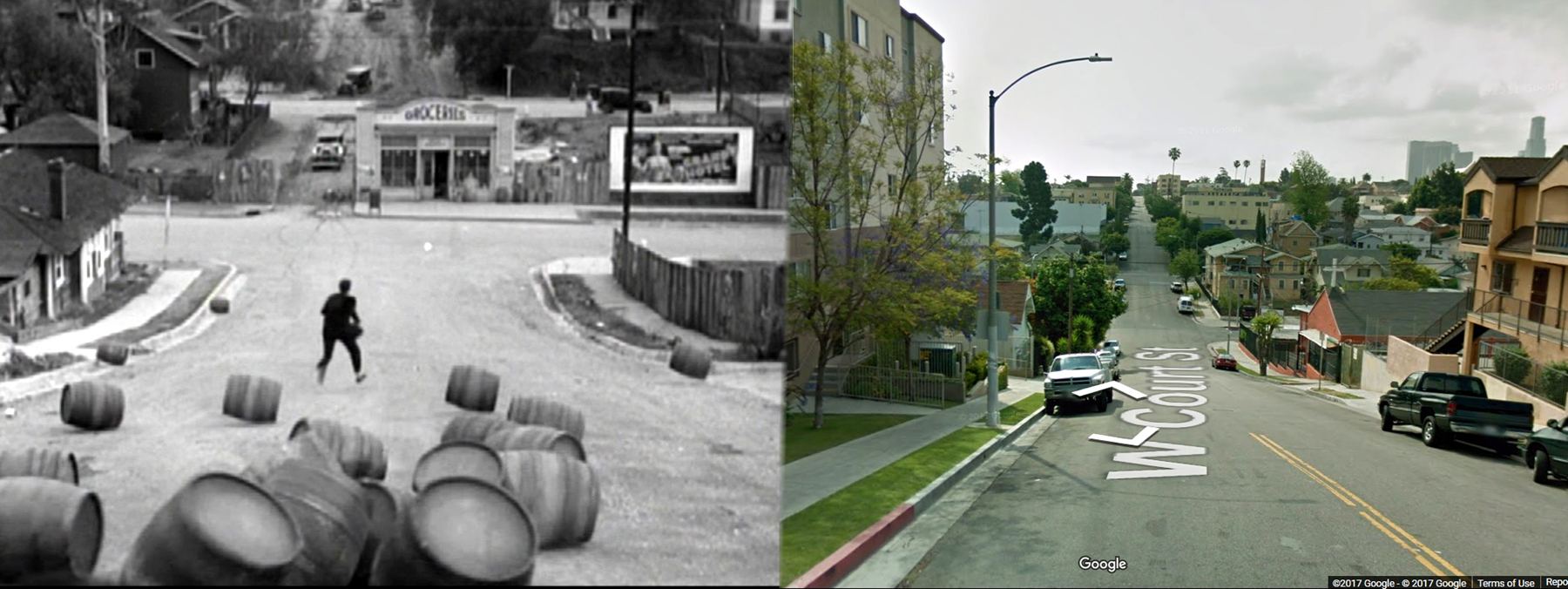
Keaton’s “What No Beer?” Barrel Avalanche

Buster chased by barrels in What No Beer?

As Jim Kline writes in The Complete Films of Buster Keaton, MGM studio head Louis B. Mayer had already drafted Keaton’s termination letter by the time filming of What No Beer? completed in January 1933. For better or worse, this movie marks the pinnacle of Keaton’s success, who would never again appear as an A list star in a major Hollywood production. (Gif file courtesy of Danny Reid’s fascinating early cinema site Pre-code.comWhat No Beer? review).

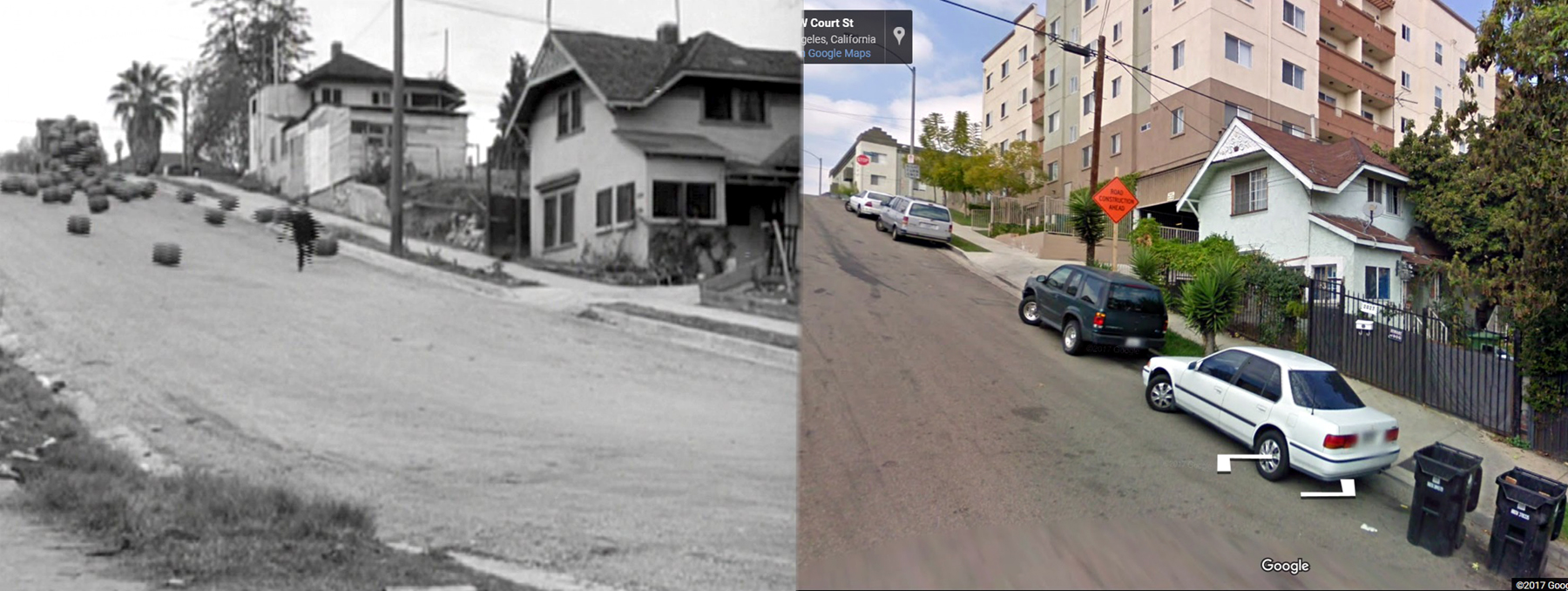
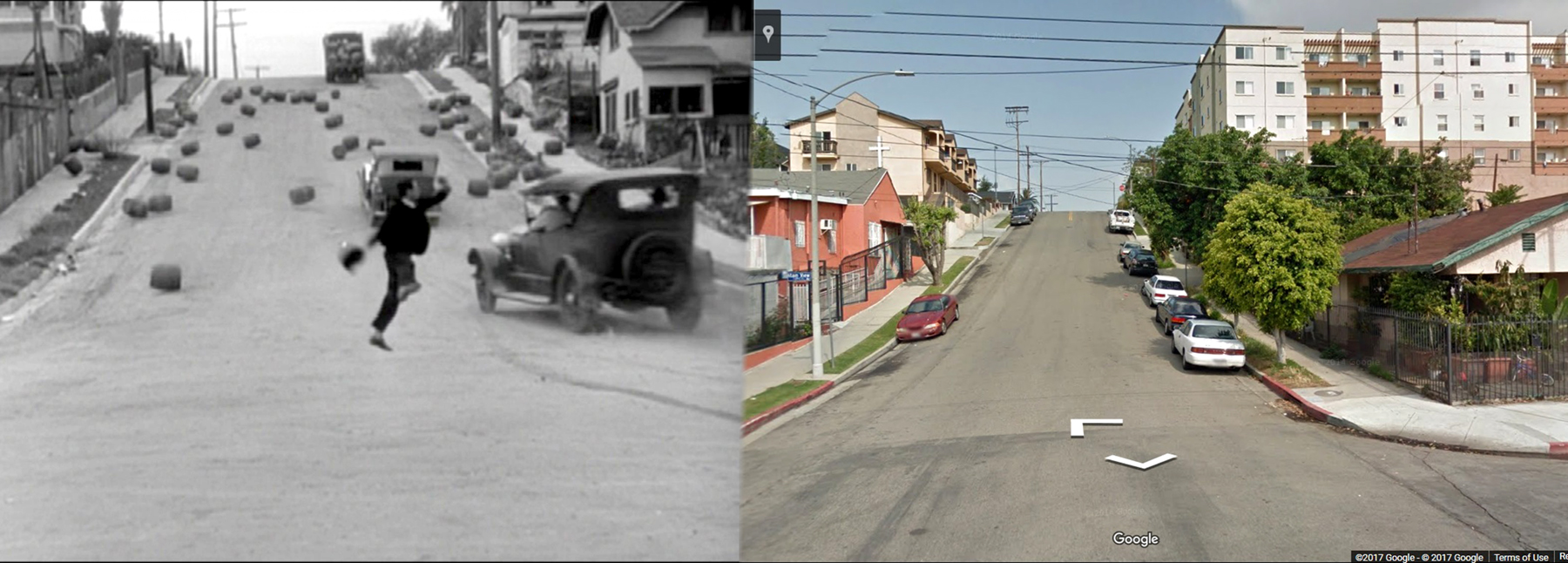
Looking west up Court Street – the steep hill is only one block long.

Although Kline writes What No Beer? was a box-office smash, setting attendance records at New York’s Capitol Theater, Keaton’s unexcused absences during the production, including one where he flew to Mexico and returned home married to his sobriety nurse Mae Scribbens, sealed his fate with the studio boss.

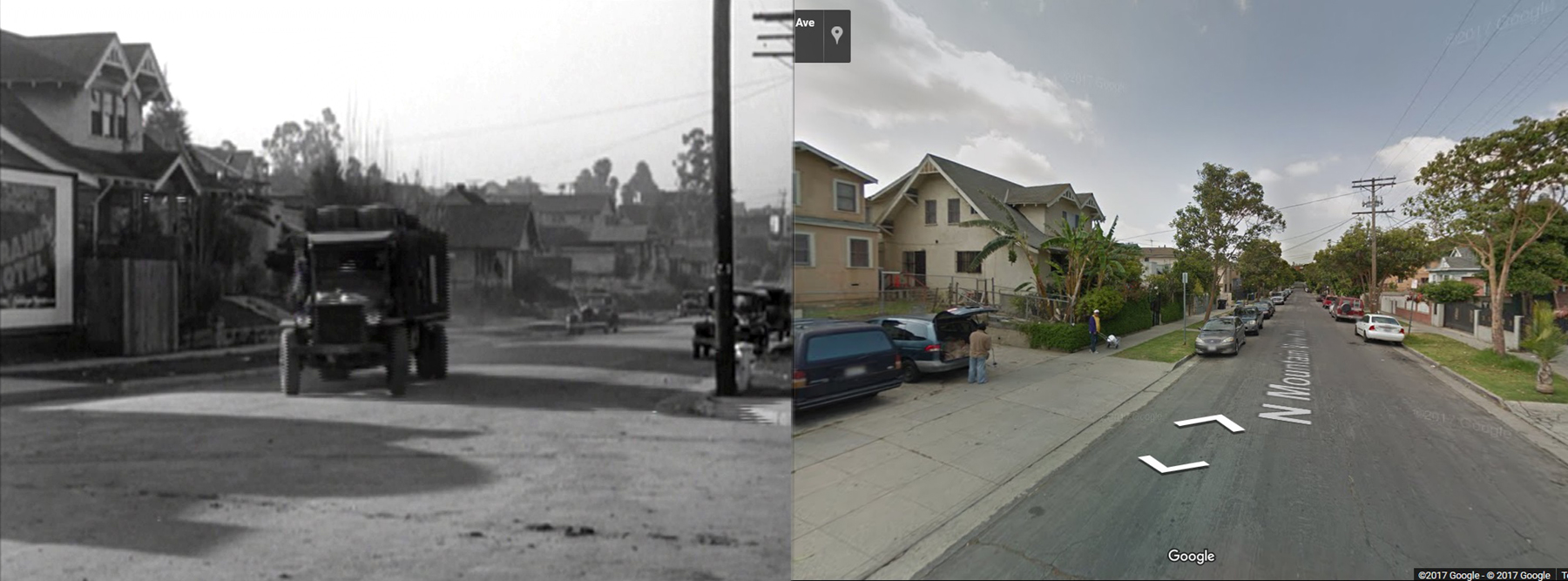
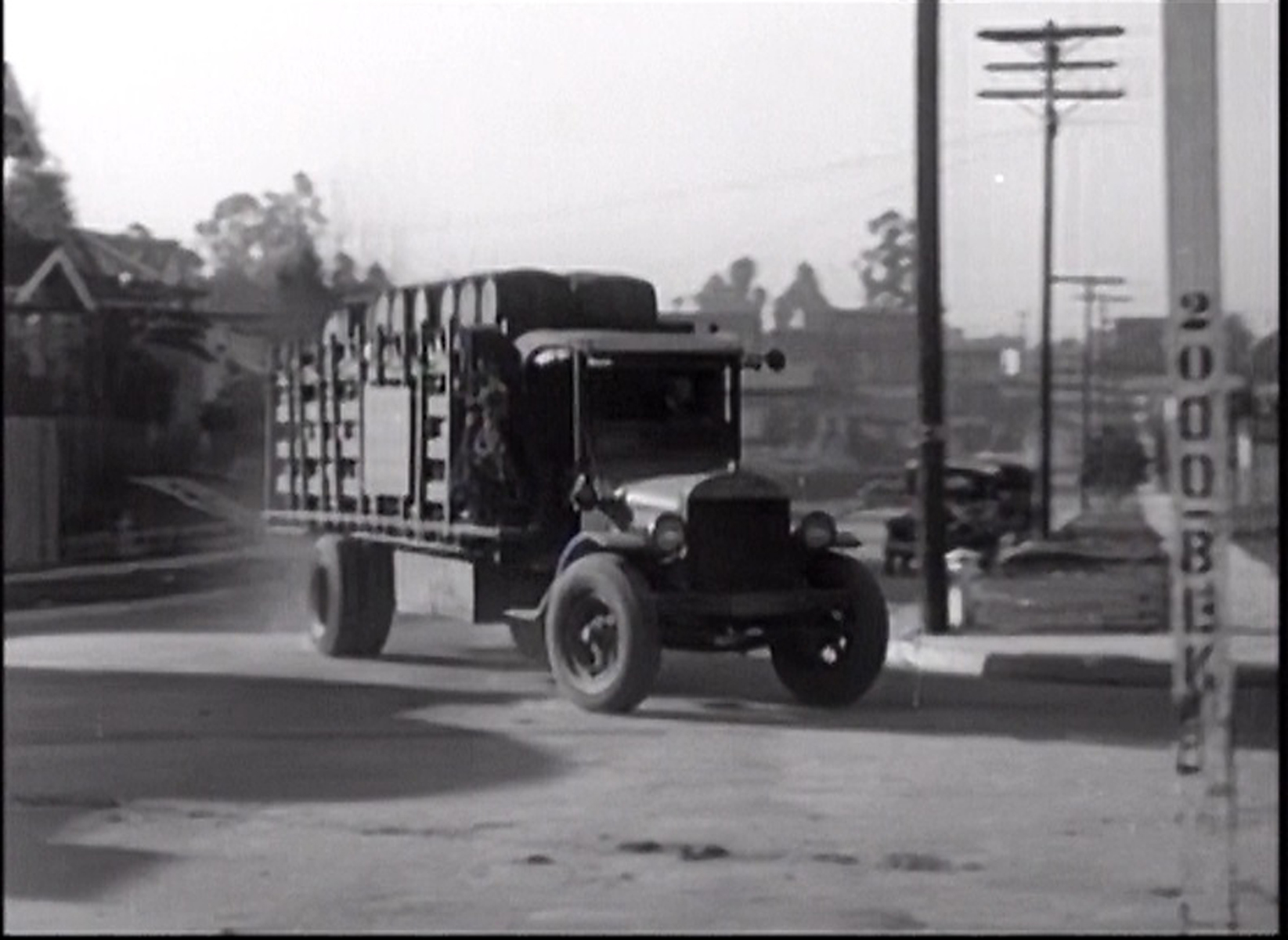
Looking south down Mountain View, as Buster’s beer truck prepares to turn left onto Court Street. The corner lot, vacant at the time, is covered by a billboard advertising MGM’s Grand Hotel. The early morning sun casts the shadow of the grocery store set in front of the truck.

While much has been written about Keaton’s loss of control working for MGM, What No Beer? contains a pure, elaborately staged “Keatonesque” moment, when Buster struggles with a truck load of beer barrels on a steep hill, recalling the avalanche scenes from his silent feature Seven Chances (1925). The costly scene included a full grocery store set, constructed at the bottom of the hill, so a car could smash into it punctuating the sequence finale.

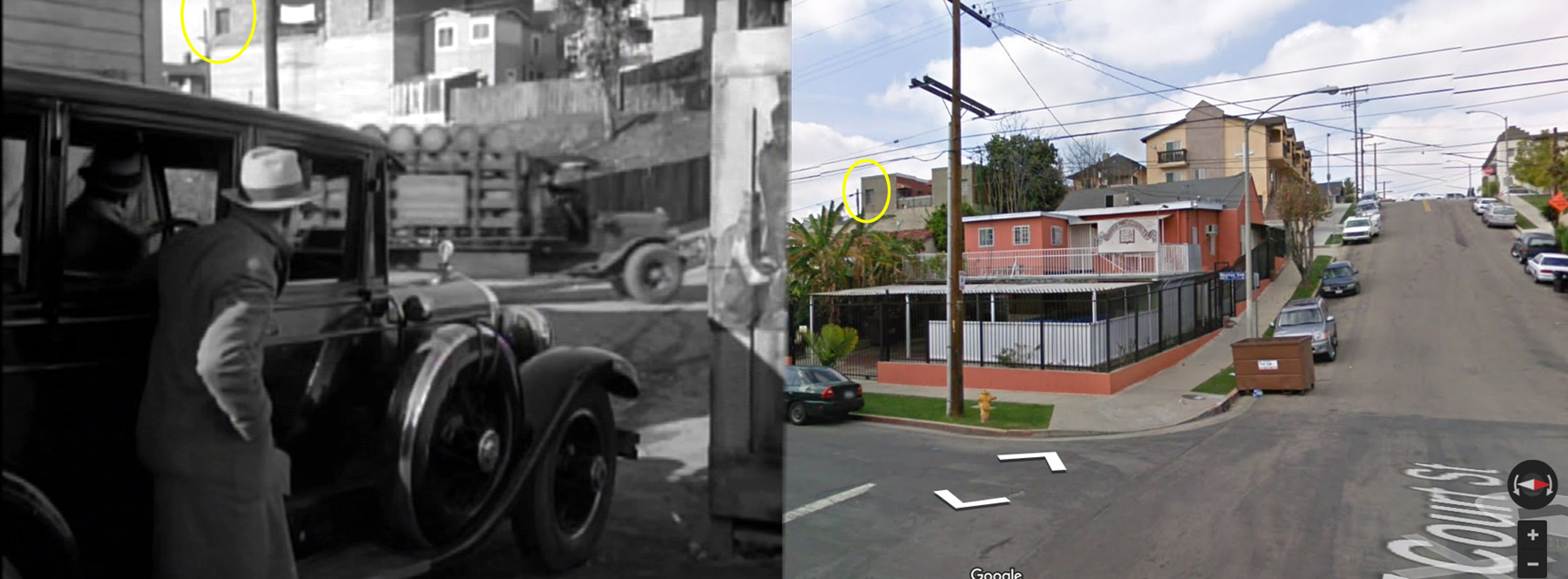
Turning the corner from Mountain View onto Court Street. The ovals match the back windows of a vintage apartment facing Alvarado Street.

It’s wonderful Keaton was permitted to sneak in one last grand cinematic moment before he would begin facing years of adversity – it truly feels like an homage to his prior work. Whatever his state of mind was back then, he must have relished the planning, stunt-work, and camera angles required to pull off this complicated scene. Yet with the hindsight that comes from knowing his life story, the visual metaphor of Buster skidding downhill chased by barrels of booze is almost too painful to watch.

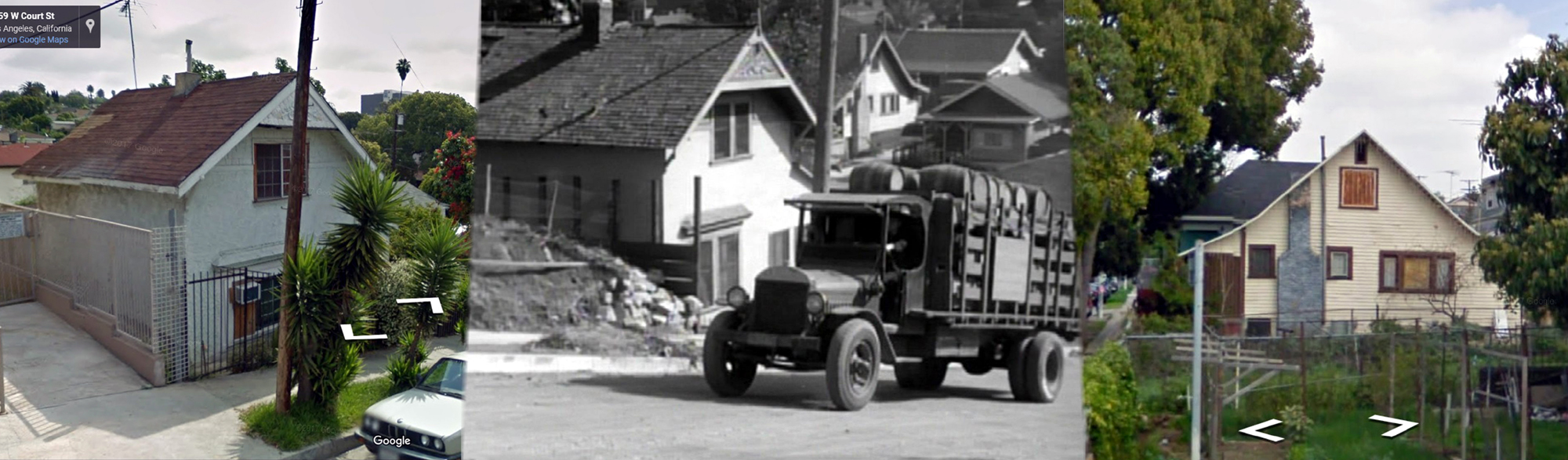
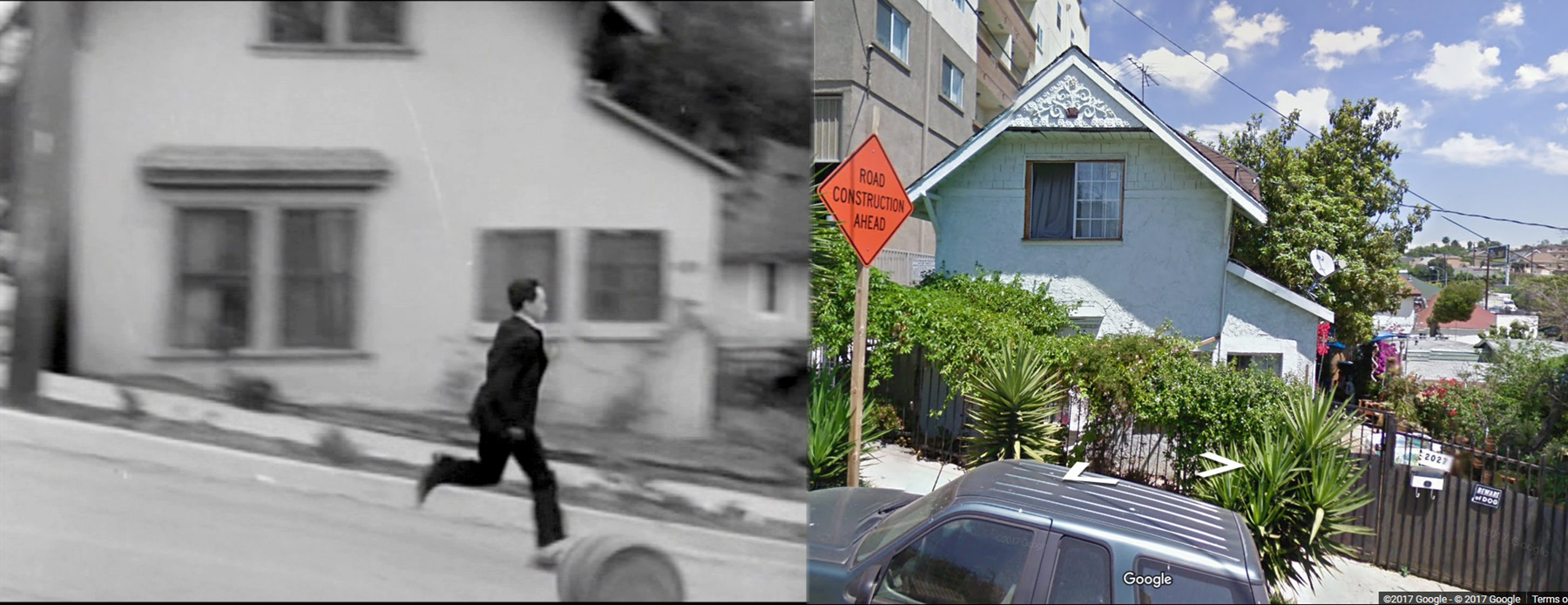
The truck struggles past 2027 Court Street, with the side of 308 N. Mountain View visible at back.

As a locations buff, I’ve been intrigued with this scene ever since I first saw it featured in Kevin Brownlow’s 1987 Keaton documentary A Hard Act to Follow. I knew it had to have been filmed somewhere, but it didn’t seem possible it could ever be found. When TCM broadcast it recently, I marveled at the clear, beautiful print, and noticed one clue during the sequence. As Buster’s truck turns the corner uphill, a vertical street sign reading “2000 BLK” appears for a moment at the far right edge of the screen.

Click to enlarge – looking east down Court Street – the grocery store was a set, not part of a “T” intersection. Notice the Grand Hotel billboard to the right.

Studying all of the shots, the side streets, and the angles of the sun, I mapped out my sense of how the setting was configured, and determined it was likely offset from a true north-south orientation. While I had long assumed the street was some type of “T” intersection, because the print was so clear I could see that the grocery store was actually a set built in the middle of the street. As I often do when stuck for an idea, I emailed my friend Paul Ayers, who has found many significant Keaton, Chaplin, and Lloyd locations. He replied, correctly, that from the age of the buildings and the layout of the hill, he sensed the scene was likely staged somewhere east of Vermont Avenue and north of Venice Boulevard.

Buster runs past 2027 Court Street.

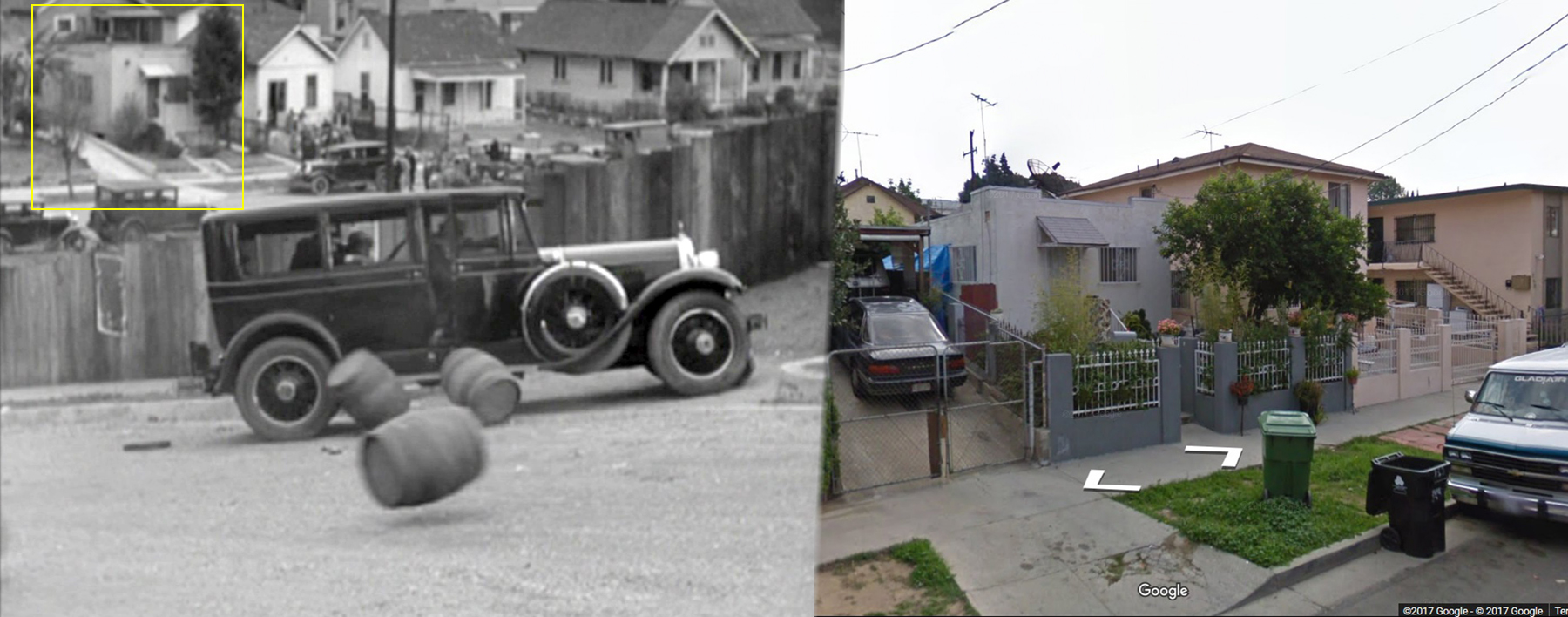
Looking southeast towards Mountain View, one bungalow at back remains.

By pure coincidence I had just stumbled upon the topographical option with Google Maps, allowing you to see hills instead of featureless streets. With this function turned on I could clearly see candidate hills in the region Paul suggested. I noticed one spot where the streets matched my sense of how Buster’s shot was configured, and without even using the “2000 BLK” clue it proved to be the correct spot – the intersection of N. Mountain View Avenue and the 2000 block of Court Street. (Note: the beginning of Court Street, above the Hill Street tunnel, is where the Bradbury Mansion once stood – it was where Harold Lloyd and Hal Roach began their careers, and where Lloyd filmed many early stunt climbing scenes above the tunnel). Having wondered about this scene for 30 years, it was very gratifying to finally see it “in person,” still recognizable, and with so many original buildings still in place.

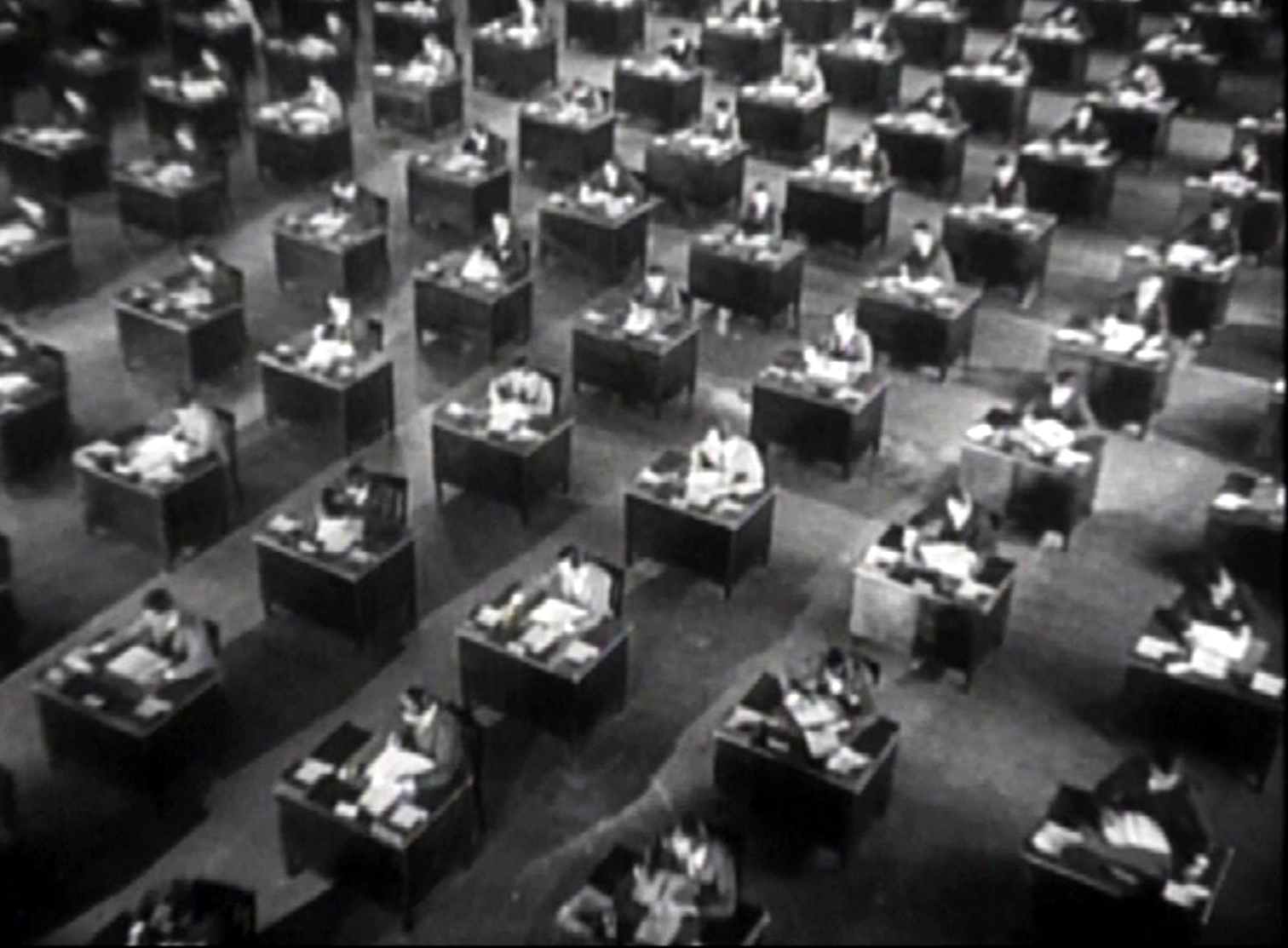
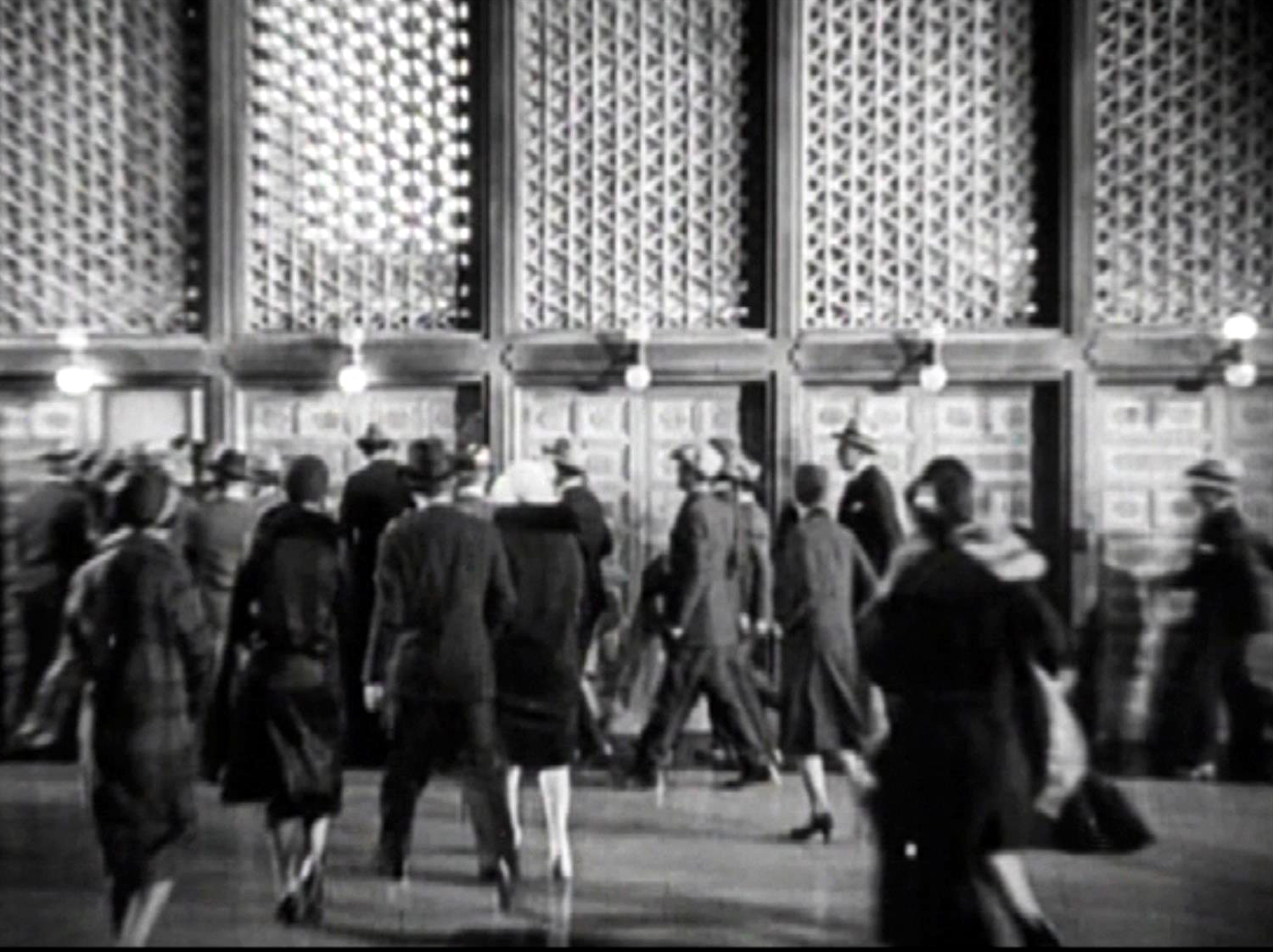
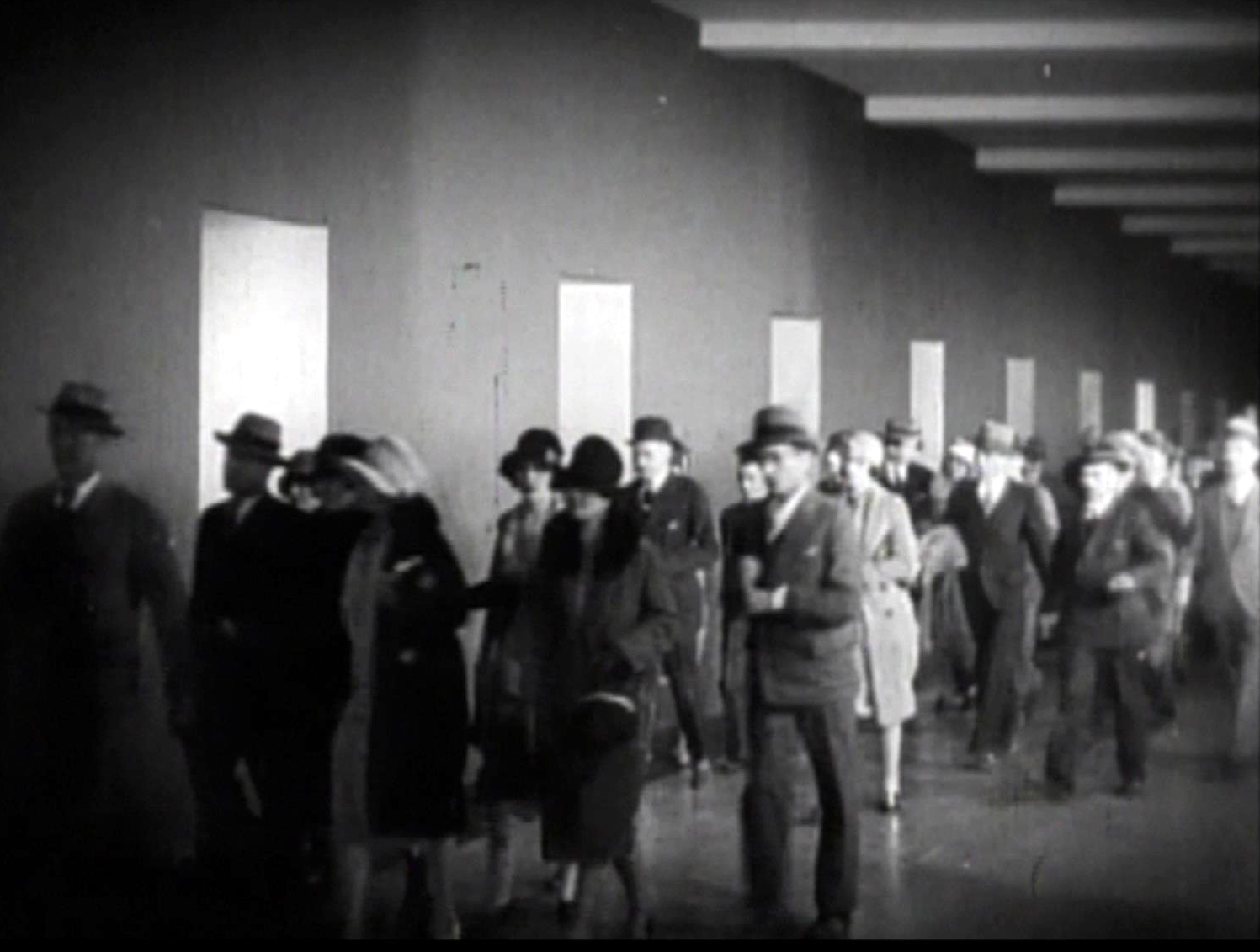
Inexplicably, the film’s celebratory conclusion showing folks returning to work after the repeal of Prohibition includes office scenes cannibalized from the classic King Vidor drama The Crowd (1928) (considered by Kevin Brownlow to be America’s finest silent film), including this iconic overhead shot of endless rows of office workers at their desks. By then silent films were considered so obsolete that their only apparent value was as a cheap source of stock footage. These repurposed scenes were not returned to the original master, so that decades later when Brownlow’s Photoplay Productions restored The Crowd they had to replace the missing footage using elements from a complete 16mm print Eastman House had made for King Vidor. Other New York scenes from The Crowd must have been used elsewhere, as they too are missing except in the 16mm print. Brief office scenes from The Crowd also appear in the previous MGM Keaton vehicle Speak Easily (1932).

What No Beer? © 1933 Turner Entertainment Co. Color images (C) 2017 Google.

Google Street View of Mountain View Avenue and Court Street.

Posted in Buster Keaton, Paul Ayers | Tagged , , , , , , | 15 Comments

Arbuckle – Keaton at the Bronx Biograph Studio

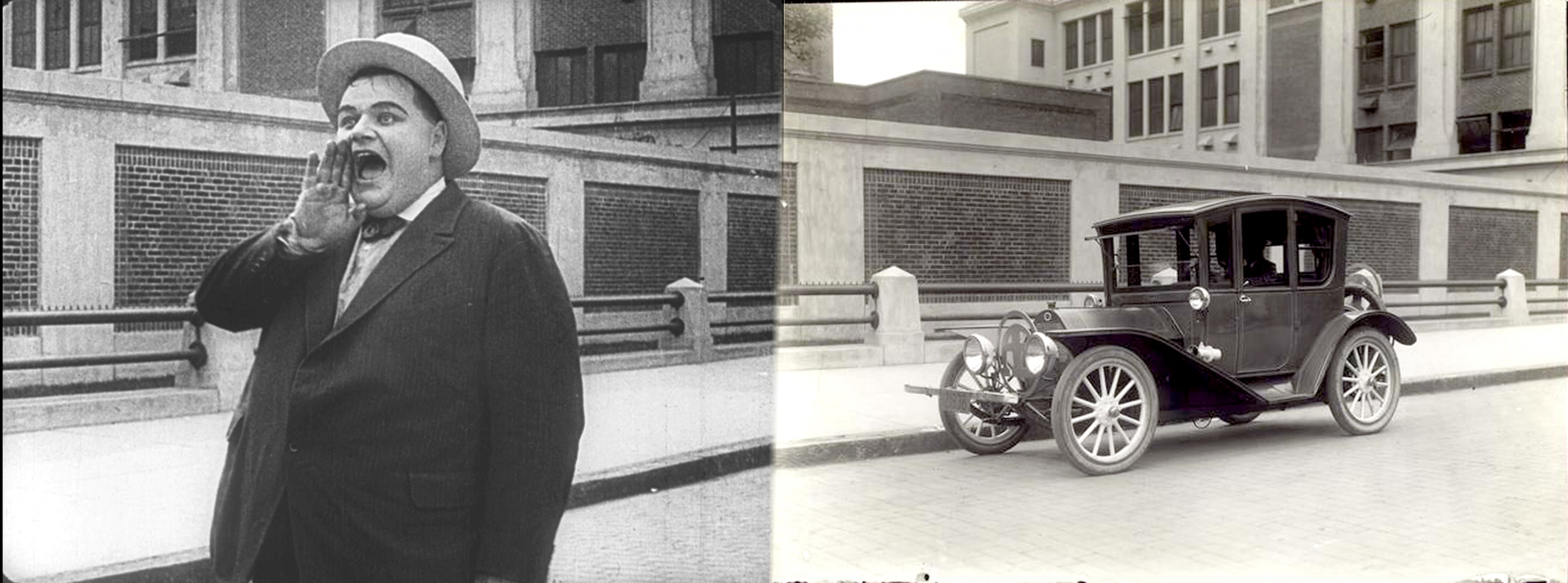
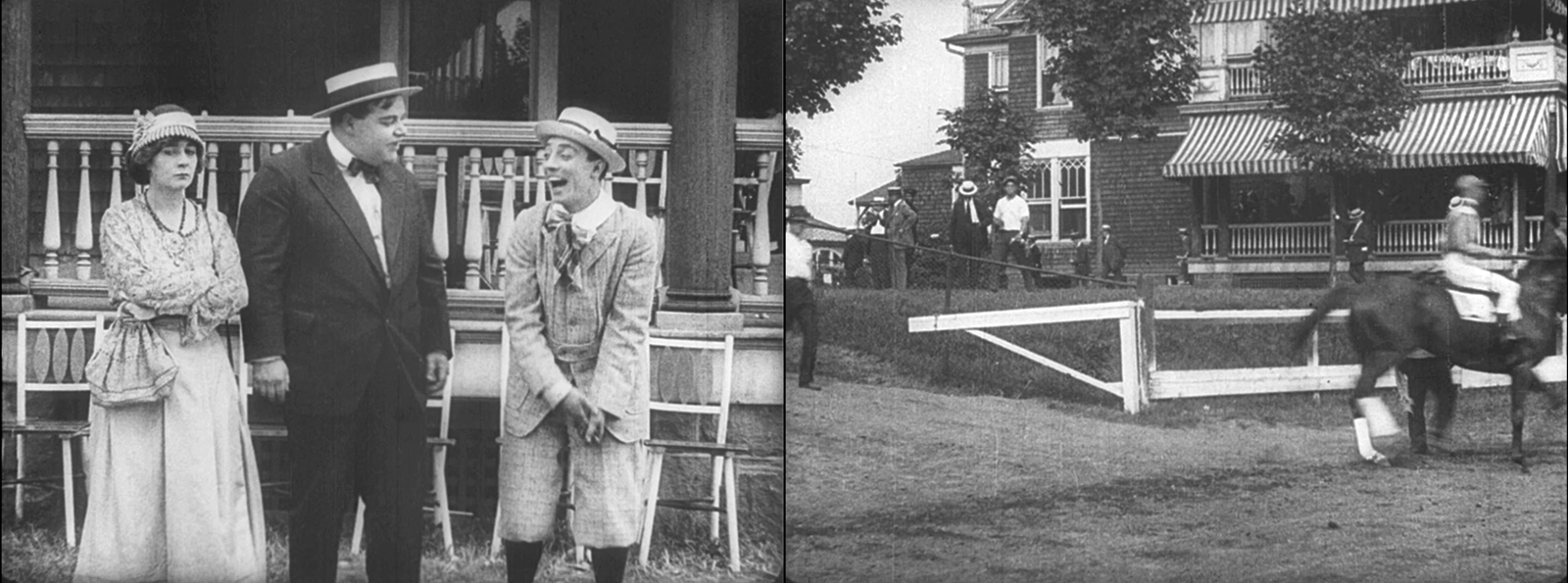
The glass stage Arbuckle used in His Wedding Night. At right, the end of the stage behind Roscoe in Oh Doctor!

Marc Wanamaker Bison Archives

Noted biographer James Curtis contacted me with an intriguing observation. Did a scene from the 1917 Arbuckle-Keaton short Oh Doctor! (above) reveal the large glass rooftop shooting stage of the former Biograph Studio, located at 807 E 175th St in the Bronx? A little digging not only confirmed he was right, but that 100 years later many Bronx locations from that film remain recognizable today. [Note: Arbuckle ended his career filming Vitaphone comedy shorts in Brooklyn – discussed in great detail HERE].

Click to enlarge – a 1921 Biograph map, keyed to 11 locations – NYPL. The top row of buildings, the north side of E 176th St, were all lost to the Cross Bronx Expressway, which devastated the neighborhood.

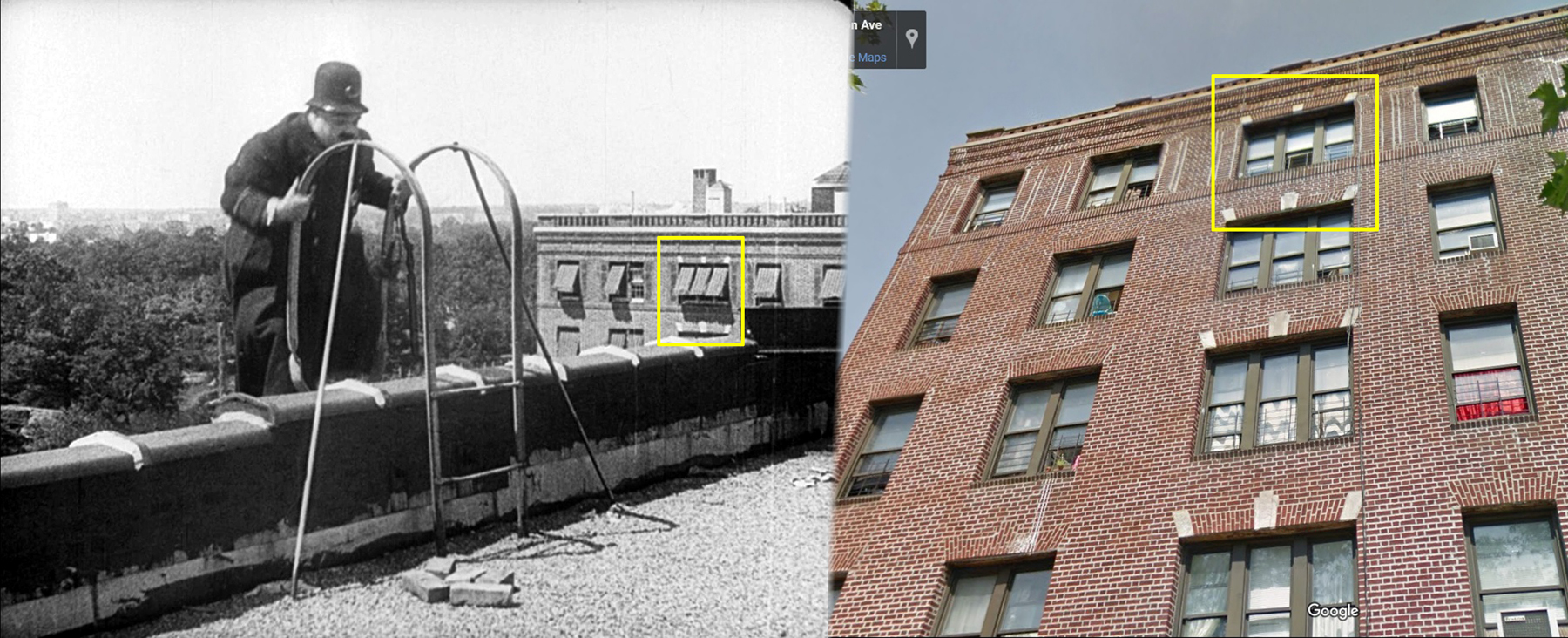
Wearing a borrowed police uniform, Roscoe chases jewel thief Al St. John across a vintage rooftop. Triangulating from the Biograph site, and traveling the streets using Google Street View, I was excited to see that two apartment buildings on Marmion Street are still standing today.

View (11) – Roscoe scales the roof, with Crotona Park and 1783 Marmion at back.

Because Roscoe’s roof (11) had an unobstructed view, and the maps from 1915, 1921, 1938, and 2017 reveal when different buildings were constructed, and demolished, my best guess is Roscoe filmed (11) on the former 5 story apartment at 864 E 175th, now replaced with a smaller building.

View (11) – looking along E 175th St towards the corner of 1801 Marmion (left) and the Biograph office and glass stage (right).

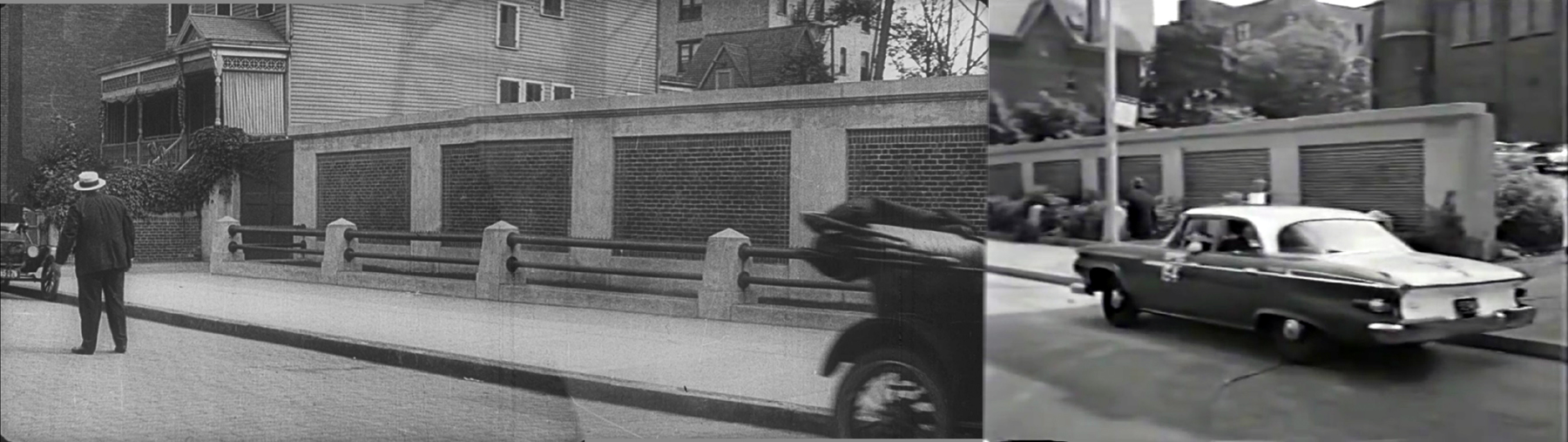
Once I had confirmed site (11), I contacted New York pop culture locations expert Bob Egan (PopSpotNYC.com), who had just identified Buster Keaton’s Manhattan apartment from The Cameraman in this prior post. Bob replied with a fascinating clue – that the opening credits to the early 60’s sitcom Car 54 Where Are You? reveal a view of the Biograph Studio where the show was filmed (see below).

View (11) – the south Biograph office on E 175th (left) and view (6) – the north Biograph laboratory building on E 176th (right).

The Car 54 view (6) down E 176th St provided a view of the segmented light and dark brick wall standing east of the Biograph laboratory building, a wall that appears frequently in Oh Doctor!

View (6) and view (4) – the segmented wall next to the laboratory building. The two apartments behind the word “CAR” are now demolished – a vacant lot.

I should have done this first, but after searching the New York Public Library online digital collection I found an exact match to view (4) from Oh Doctor!

View (4) – the segmented wall standing east of the laboratory building. Reader Carol Tenge points out the giant “AB” (American Biograph logo) on the front of the car. Focusing on the underslung chassis, she determined it is a 1912 Regal 25 Colonial Coupe. Carol also points out the left hand drive, updated electric lights, and updated claxon mounted on the side. NYPL.

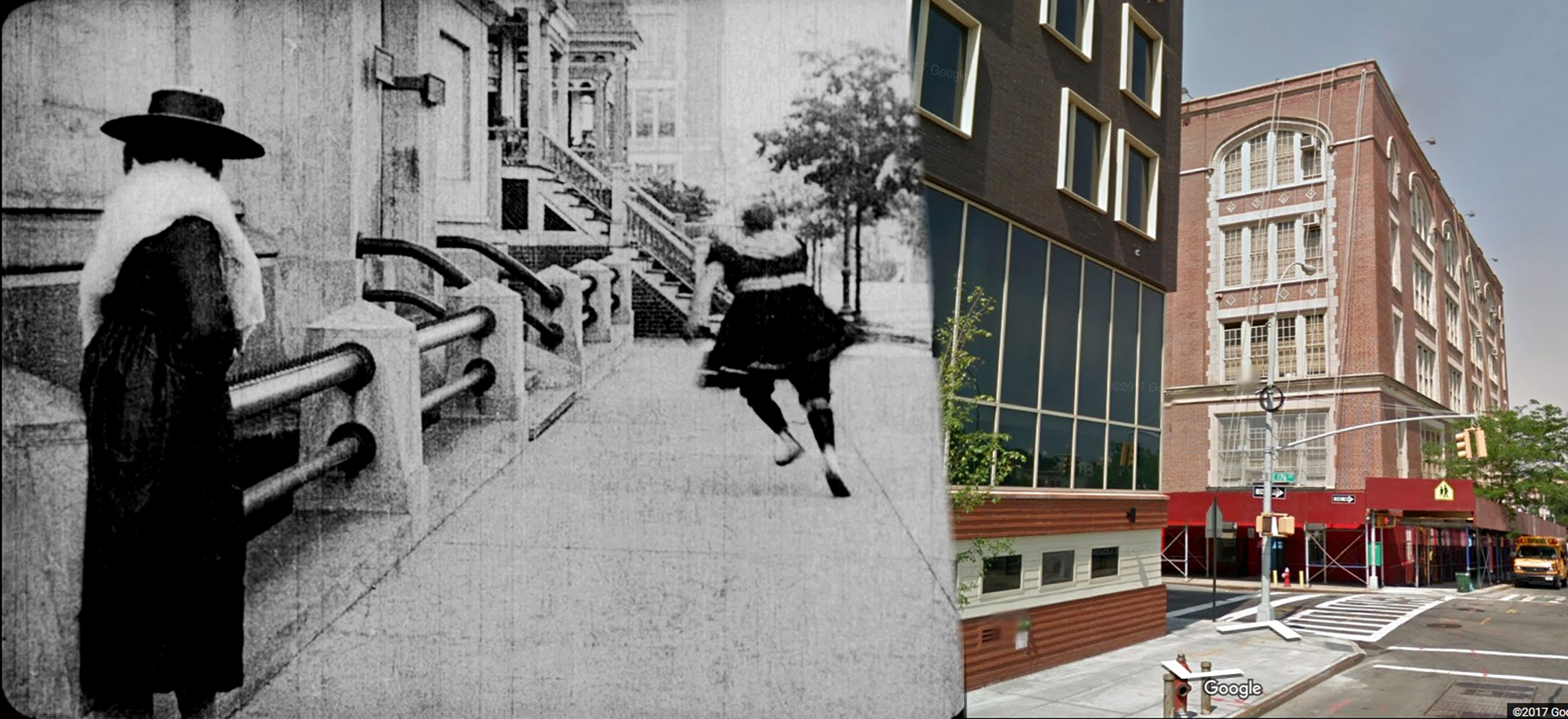
It turns out that Oh Doctor! and the subsequent Arbuckle – Keaton short Coney Island (1917 – see further below) both feature scenes filmed on E 176th in front of the Biograph laboratory building.

View (5) – Roscoe calls for his car to return to him – the existing home on 812 E 176th still appears at back.

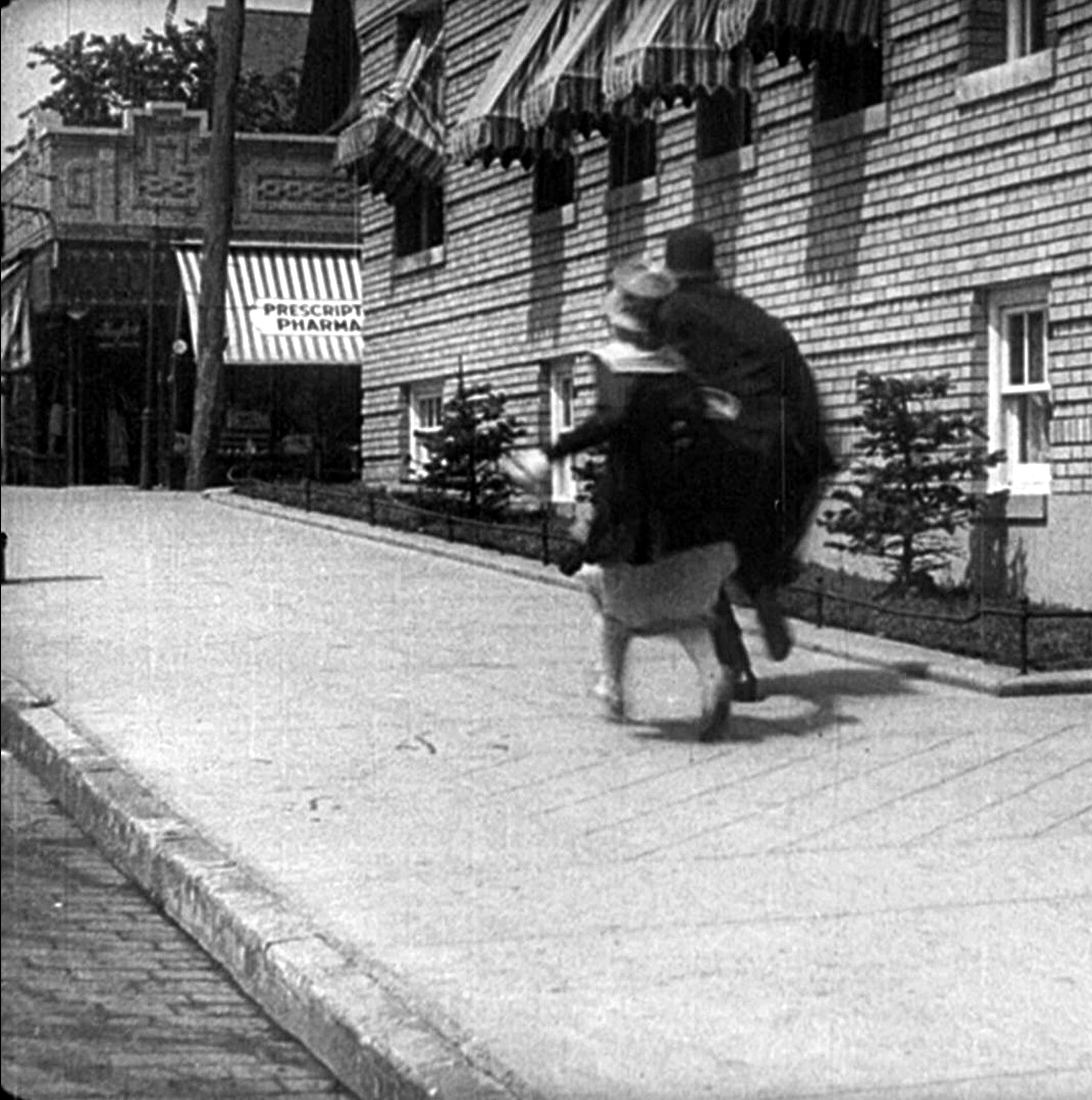
One challenge to investigating this site is that the northern side of E 176th St was demolished to make way for the Cross Bronx Expressway. One casualty is this drug store (left) that once stood at the NW corner of E 176th and Marmion. The same store appears at back in view (8) (right), as Roscoe drags Buster (dressed in drag to do a stunt fall for Roscoe’s wife) west along E 176th towards Marmion – the building to their right was lost to the expressway. In the next scene view (7) below, Roscoe’s wife confronts him standing at the same corner, only looking east down E 176th along the surviving south side of the street.

View (7) looking east from Marmion down the surviving south side of E 176th, towards tall buildings on the corners of Mohegan and Waterloo Streets.

View (7) above looks east down E 176th from Marmion towards the extant Waterloo Apartments, both left of Roscoe, and the narrower apartment on the corner of Mohegan just to the right of Roscoe.

Views (9) and (10) – two images of the NE corner of Marmion and E 175th.

Views (9) and (10) above and below both depict the same corner apartment building that once stood at the NE corner of Marmion and E 175th. As shown below, two homes once stood next to the Biograph office across the street from the apartment.

View (9) left and view (10) right – these homes on E 175th once stood due east of the Biograph office. Buster stands at the corner of Marmion looking down E 175th. Al at back is standing on Marmion between the two wings of the apartment.

The above diagram shows why I first knew it was likely (9) and (10) above were filmed at the corner of Marmion and E 175th, the only corner in the vicinity of the studio that had homes on the left side of the street and a large apartment on the right. The two scenes match the various maps and street slopes.

But thanks to eagle-eyed reader Mark E. Phillips, and his fascinating NYC in Film movie locations blog, this image of the corner he showed me from the NYC Municipal Archives confirms the corner site. For you Jackie Coogan fans, here’s the link to Mark’s New York locations post about The Rag Man (1925).

The fence of the home adjacent to the studio office appears below in 1913 and in view (9). Notice the matching low alternating fence design, and apparent gas lamp.

Click to enlarge – the home adjacent to the Biograph office in 1913, and matching fence in Oh Doctor!Lantern Media.

The home adjacent to the studio was replaced with a large apartment by 1921, but is now a vacant lot. The corner home (#825, see map above) is replaced by a large apartment still standing, while Buster’s 5 story corner apartment is now replaced with 2 story homes. Go figure.

The Biograph laboratory building on E 176th also portrayed the police station in the next Arbuckle – Keaton short Coney Island. During the concluding scene, Roscoe and Al St. John leave the station (view 3 left) after locking the police and Roscoe’s wife in a cell. No sooner do they vow to forsake all women when an enchantress walks by, prompting Al to proclaim “Each man for himself.”

Coney Island – view (2) – Al escorts his new female companion from the Biograph laboratory entrance. The home at 812 E 176th still stands at back.

In a racially insensitive final “joke” that was commonly employed by comedians at the time, Roscoe too notices the back of a woman pass by, and approaches her to say hello. But when she turns to greet him, revealing herself to be Black, Roscoe gasps and flees in shock as the movie fades to a close. Apparently this scene was excised from most prints of the film, but for historical completeness is presented as a supplement to the latest home video release of these films.

Coney Island – view 1 – Roscoe flees west towards the PS No. 44 building still standing on the SW corner of Prospect and E 176th.

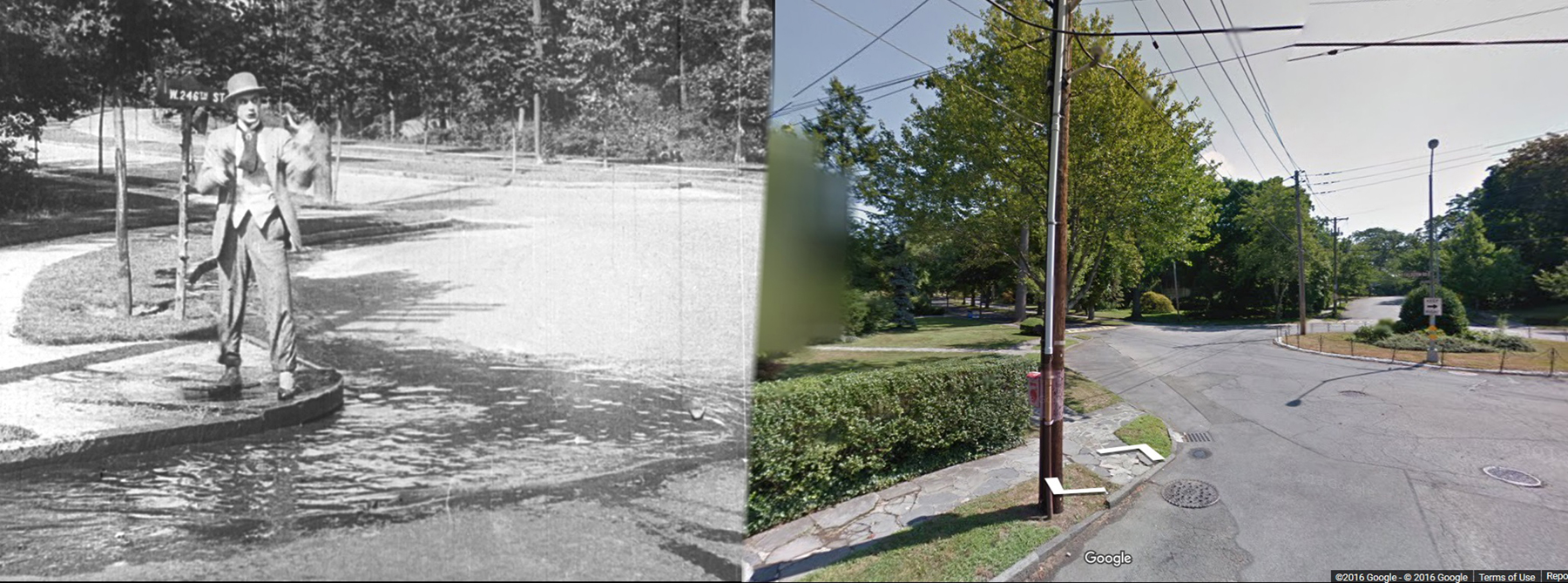
Oh Doctor! begins with Father Roscoe, Mother, and Son Buster arriving at a race track, where Roscoe flirts with another woman, and loses all of his money on a wild bet. The characters are depicted as arriving and departing from the race track by parking their cars in a residential neighborhood beside a rare conspicuous street sign at the NW corner of W 246th and Fieldston in the Bronx, see below.

Oh Doctor! – at W 246th St and Fieldston.

New York pop culture locations expert Bob Egan (PopSpotNYC.com) came through again, by identifying the real track appearing in the film as the Yonkers Raceway.

Son Buster laughs at Pop Roscoe for losing all of his money on a horse that ran the wrong way, as they stand beside the Yonkers Raceway clubhouse.

The Yonkers Raceway in 1905 at left, including the side of the clubhouse at left where Roscoe and Buster filmed (see above), and how it appears in Oh Doctor! This may be the oldest existing movie footage of the still active Empire City harness raceway, located about 10 miles north of the studio.

I’ve documented 4 dozen instances of Keaton filming pickup shots from his various films in front of, or across the street from, his small studio in Hollywood. A perfectly practical thing to do. So it’s not surprising, but also fun to see, that Arbuckle did the same thing, staging so many shots conveniently close to his temporary Biograph home. Be sure to read about Arbuckle’s numerous Vitaphone Brooklyn locations HERE.

1917 and 1961 – matching views from Oh Doctor! and Car 54 Where Are You?

It wasn’t too long ago that Oh Doctor! was considered a lost film! We fans are all so fortunate that these films have been so lovingly restored by Lobster Films.

Oh Doctor! and Coney Island images from Buster Keaton: The Shorts Collection 1917 – 1923 (C) 2016 Kino-Lorber, Lobster Films.

View (7) of the apartments on Mohegan and Waterloo.

Posted in Buster Keaton, Manhattan, New York, Roscoe Arbuckle | Tagged , , , , , , , , , , , , , | 17 Comments

Buster’s Manhattan Apartment – The Cameraman Part III

In a prior post, Bob Egan flexed his Manhattan research skills to locate Marceline Day’s now lost apartment in Buster Keaton’s The Cameraman, 35 West 58th Street. Now Bob has located Buster’s midtown apartment as well, 201 East 52nd Street.

As I spell out in my book Silent Echoes, when Marceline calls Buster to tell him her prior commitment has changed and she is now available to meet him, Buster is so eager that he bolts out the door while she is still talking on the phone, and races down many city blocks, including 5th Avenue, and beside Bergdorf-Goodman (see post) to her place. When she realizes he is no longer on the line, she hangs up in frustration, and turns around to find Buster already standing behind her – “I hope I’m not late.”

When TCM recently broadcast The Cameraman (I now receive TCM in high definition), I was stunned by how beautiful the print looked, and made a point to study Buster’s apartment scene, and the Apartments for Rent sign behind Buster’s entryway. Watching it back and forth in slo-mo the sign looked like it read “Samuel J Weinberg ?59 3rd Ave Cor 52 St.”

I immediately contacted Bob, as he had investigated Buster’s apartment before, although based on my misunderstanding at the time that the name was “Weisberg” not “Weinberg.” Bob quickly reported that the 1929 Manhattan Address Directory had a listing for a “Saml J Weinberg rl est” at 859 3rd Ave, at the NE corner of East 52nd. This phonebook entry clearly matched the sign, explaining why Sam was advertising apartments for rent. Since Second Avenue had elevated train tracks at the time, standing at the corner of 3rd and 52nd, looking east, you would see tracks in the background.

Click to enlarge – Buster’s doorway was at 201 East 52nd, near the left corner.

Bob also sent a vintage map of the block. Knowing that Sam’s office was on the corner of 3rd, if Buster exited the E 52nd St side of Sam’s building, then per the map we’d expect to see a one story building immediately behind Buster, flush with a several story building immediately behind the one story building, with a sidewalk fire plug in front of the flush buildings, then a long row of multi-story buildings all set back further from the sidewalk, then a 5 story building further back that again projects flush to the sidewalk, and then elevated tracks. These elements match exactly both in the movie frame and on the map. Although a modern glass high-rise stands there today, we now know the humble entranceway to 201 E 52nd St once portrayed Buster’s Manhattan apartment.

With this post I now have a dozen postings about Keaton filming The Cameraman and Harold Lloyd filming Speedy in New York. Here’s an INDEX of these other posts.

The 5 story building at 247 E 52nd street (oval) appears in both images.

Thank you Bob for more incredible detective work. Bob’s popular and highly recommended website PopSpotNYC.com explores the visual archeology of “where interesting events in the history of Pop Culture took place; like album cover shots, places where movies and tv shows were filmed, and sites on which paintings were based.”

The Cameraman images (C) 1928 Turner Entertainment Co. Below, looking east from 3rd down E 52nd.

Posted in Manhattan, The Cameraman | Tagged , , , , , , , | 7 Comments

Arbuckle – Keaton – the Good Night Nurse Hot Springs

Click to enlarge. 1907 – the Arrowhead Hot Springs resort beneath the natural arrowhead rock formation. LOC.

Roscoe Arbuckle, Al St. John, and Buster Keaton must have had special fun making their Comique film Good Night Nurse (1918), leaving their Long Beach studio behind to film certain scenes at the Arrowhead Hot Springs resort 75 miles to the east. Nestled in the foothills north of San Bernardino, beneath the giant arrowhead-shaped outcropping lending the region its name, the resort was a popular tourist attraction with long ties to Hollywood. The naturally occurring hot springs were promoted for their curative effects, and the hotel complex appearing in the film was built there in 1905.

Al’s missing teeth

Roscoe portrays a drunken husband, dragged by his frustrated wife to dry out at the No Hope Sanitarium. Buster plays Roscoe’s doctor, while Al portrays one of the orderlies, and, as confirmed by renowned silent comedy expert and author Steve Massa, this fully “cured” discharge patient (right) with missing teeth. Eager to escape, Roscoe dresses in drag with a wig and stolen nurse’s outfit, only to run into a suddenly love-struck Keaton, who smiles and flirts shamelessly with Roscoe.

Roscoe (above) approaches the resort back entrance. USC Digital Library.

Below, the “cured” patient hobbles beside the curved bay of the hotel dining room on the west end of the complex.

Matching views, east and west, of the curved dining room bay. USC Digital Library

The east doorway – tennis court at back

The hot springs were well known to the Native Americans, and Spanish missionaries, leading to the first modest resort that opened here in the 1860s.  The 1906 Sanborn fire insurance map for the resort shows a large bath house for men, complete with a barber shop, adjoining a smaller separate bath house for women, both covered, standing north of the hotel, accessible by an open bridged walkway beside the main entrance. A tennis court adjoined the bath houses to the east, its fence appears behind Roscoe (left). Standing apart from the hotel, further back, was an oval-shaped “Hot Lake,” likely the concrete pool appearing in the film (right), with nearby quarters and dining room for the servants and staff. As a history buff, it’s frustrating to see how little use Arbuckle as director made of the locale. A tight shot of the back entrance porch, a scene played out at the east end of the hotel, nothing on

screen suggests that it was filmed at such a grand and remote locale. While we’re fortunate vintage photos of the hotel are available for study, they were all taken from quite a distance. Thus, a century later, the only detailed views available to us are the brief glimpses appearing in the movie.

Already well-established when the Comique crew came to film, the resort grew in popularity through the years, providing Hollywood types a place to relax and play and get away from it all. By 1938 a group including Joseph M. Schenck, Constance Bennett, Al Jolson, Darryl Zanuck, and Claudette Colbert were reported to have purchased the resort, only to have the hotel burn to the ground the same year. Famed African-American architect Paul R. Williams designed plans for a new six-story resort, opening in 1939, that continued to attract golden-era stars for many years. Esther Williams was a frequent guest, and Humphrey Bogart filmed High Sierra here in 1941. Elizabeth Taylor spent part of her honeymoon (the first one!) here in 1950 – at the time her father-in-law Conrad Hilton owned the place. But as jet travel made far-flung getaways more appealing, the resort lost favor, eventually shutting down in the 1950s. The hotel was purchased by the Campus Crusade for Christ in 1962. Long shuttered, recent accounts say the property is now available for sale.

Click to enlarge. Arbuckle’s crew likely arrived by train. This 1926 railroad map shows the route from the studio in Long Beach, lower left, to the Arrowhead Resort, upper right. It seems like a long way to go for such simple scenes. David Rumsey.

I want to thank Lea Stans, whose informative series of posts about the Arbuckle-Keaton Comique films, including Good Night Nurse, tipped me off about the Arrowhead Resort in the first place. Her Silent-ology blog is dangerous to Google, but always entertaining.

For a full story about the resort, read Ruth Nolan’s article for KCET “The Arrow Rises Again: San Bernardino’s Famed and Forgottern Architectural Wonder.”

The City of San Bernardino also has a great post about the Arrowhead Resort, including photos of the two hotels built there prior to the 1905 hotel.

Good Night Nurse: Buster Keaton – The Shorts Collection, from Kino and Lobster Films.

If you drag this Google view photo down a bit, you’ll see the arrowhead, blocked by the message box.


Posted in Buster Keaton, Roscoe Arbuckle | Tagged , , , , , , , , , | 7 Comments

Chaplin’s San Jose Day Making A Night Out

Charlie beside Chick’s Saloon, with enhanced contrast

Do you know the way to San Jose? It turns out Charlie Chaplin did. Thanks to the Blu-ray clarity of Charlie’s restored Essanay comedies, and the tenacious research by Niles Essanay Silent Film Museum historian David Kiehn, we now know Chaplin and crew filmed saloon scenes from A Night Out (1915) in San Jose beside the Alcantara Building (1903), still standing on the NW corner of Post and Market Streets.

Charlie began fulfilling his one-year Essanay contract at the studio’s primary Chicago facility early in 1915. But after making only one movie there, His New Job, Chaplin fled the frigid Windy City and started his first northern California production, A Night Out, soon after arriving at the Essanay Studio in Niles on January 18. While researching his definitive history book “Broncho Billy and the Essanay Film Company,” David found a local newspaper account from Thursday, January 28, 1915, describing five players from Essanay filming saloon scenes that day on Post Street for a comedy called A Night Out. (Interestingly the story missed the lead – that soon to be world-famous Chaplin was leading the crew.)

The Alcantara Building (1903) still standing at Post (left) and Market (right). Charlie likely filmed on Post just steps from the corner. (C) 2017 Google.

The Market Street face of the Alcantara Building appears at back (center) in this vintage photo.

While capturing some movie frame images to assist the Museum prepare decorations for its upcoming Charlie Chaplin Days festival July 21-23, I noticed what appeared to be the word “CHICKS” (enhanced above and below) barely visible on the sidewalk during the A Night Out saloon scenes, and mentioned this to David. He responded that a notorious liquor racketeer Clarence “Chick” Leddy once ran a saloon at 107 Post Street. More astounding, as revealed

A 1914 map of downtown – Chick’s Saloon at 107 Post Street stood at the corner of Market.

on Google Street View, the vintage saloon building is still standing, with high tech company Electric Cloud as a tenant. Once an eyesore threatened with demolition, the now upscale building was renovated with numerous picture windows along the ground floor on Post Street.

Chick’s Saloon stood at 107 Post, likely near the corner. The words on the doors read “Ridgemore Whiskey,” sold by the Alexander Company of San Jose (see below).

Advertised on the saloon doors above, Ridgemore Whiskey was a local brand.

To be thorough, I checked the 1912 San Jose City Directory and the 1915 Sanborn fire insurance maps. Both sources revealed eight candidate saloons that could have been used for filming. But unless one of these seven other saloon owners also went by the name “Chick” the likely candidate has to be 107 Post Street.

The saloon bar appears visible through the doors.

Per David’s newspaper accounts the San Jose Liquor License Committee recommended granting Mr. Leddy a saloon license for 107 Post Street on March 30, 1909. Yet by 1918 the Civic Council revoked Chick Leddy’s soft drink business license because he had sold $150 of whiskey from the premises. By 1928 Chick Leddy was convicted of murder, with help from his bartender, for beating a salesman to death, apparently for winning too much slot machine money at Chick’s Prohibition-era roadhouse. Despite receiving a life sentence, David reports Chick later bribed his way out of San Quentin, and died in San Jose in 1950.

Click to enlarge – the San Jose skyline circa 1935, looking south. The Alcantara Building (arrow) facing Market Street to the far right, with the dome of St. Joseph’s close by. San Jose State University Gordon Panoramic Collection.

While researching his book, David discovered Charlie also filmed scenes for A Night Out in Oakland beside the Peralta Apartments at 184 13th Street, and the Sierra Apartments at 1502 Alice Street, both still standing near Lake Merritt.

Charlie and fellow comic Ben Turpin beside the Peralta Apartments 184 13th Street in Oakland.

Charlie takes a spill beside the Sierra Apartments at 1502 Alice Street in Oakland.

The Alcantara Building stands just a block north of the historic Cathedral Basilica of St. Joseph (completed in 1885), and the neighboring historic post office building (completed in 1895), now anchor for the San Jose Museum of Art. You can read more about Chaplin filming A Night Out, and locations from all of his other movies, in my book Silent Traces.

Chaplin made five movies at Niles before returning to Hollywood in May 1915, filming a few exterior scenes in San Francisco and Oakland. But we now know Chaplin once made his way to San Jose too.

I want to especially recommend Dan Kamin’s unique Funny Bones performance at the festival on July 22 at 7:30. A gifted comic, author, and renowned Chaplin authority, Dan coached Robert Downey, Jr. in his Oscar-nominated turn in the movie “Chaplin”(which Dan will introduce at the festival July 21) and coached Johnny Depp for the movie “Benny and Joon.” Using film clips and live demonstrations, Dan deconstructs Chaplin’s unique physical comedy and body language, showing how and why Charlie moved the way he moved. Dan’s show is absolutely fascinating, and you’ll leave feeling you’ve seen Charlie in a whole new light. Dan is also performing Funny Bones at the Smith Rafael Film Center in San Rafael on July 20.

Posted in Charlie Chaplin | Tagged , , , , , , , , , , , , , | 7 Comments

Buster Keaton’s Haunted House

My friend architectural writer Steve Vaught made this amazing discovery – the “haunted” mansion appearing in Buster Keaton’s 1921 short film The Haunted House was the former Bonebrake Mansion, once standing on the corner of Adams and Figueroa. Steve noticed the

The Bonebrake Mansion – look how much the palm tree grew by 1921. LAPL

2619 street address appearing on the gate, and that the style of architecture seemed to pre-date 1900. Checking a 1900-era Los Angeles map, Steve found few streets at the time were lengthy enough to have had addresses as high as 2600. Next, by combing through the Sanborn Fire Insurance Maps, Steve eliminated nearly every lengthy street but Figueroa. The Sanborn map footprint for the Bonebrake Mansion at 2619 South Figueroa matched the Keaton house exactly, which these Los Angeles Public Library online photos confirm. As it turned out, the house was torn down later in 1921 to make way for the “new” Auto (AAA) Club Headquarters still standing on that spot. This would explain the home’s rundown condition and availability for use as a movie set.

Villainous Big Joe Roberts at the 2619 gate

Looking north. LAPL.

The house belonged to widowed banker George H. Bonebrake, co-founder of the Semi-Tropic Land and Water Co., Los Angeles. Bonebrake died at home in 1898. By 1902 notorious Arkansas senator Stephen W. Dorsey (once indicted but acquitted of bribery) acquired the property. The same year, shortly after Dorsey married Laura Bigelow, his second wife, and a much younger woman, Dorsey’s secretary sued him, claiming she gave Dorsey “wifely love,” and he was keeping her on the side in a nearby home. Laura Dorsey died at home in 1915, and the property was foreclosed the following year. The Automobile Club of Southern California acquired the property in 1920, completing its headquarters there in 1923.

A third view of the former home. LAPL.

You can read more about the Bonebrake home at the Los Angeles History Blogspot, a fascinating account, home by home, of LA’s premiere historic neighborhoods, including Berkeley Square, Wilshire Boulevard, Adams Boulevard, Windsor Square, Fremont Place, St. James Park, and Westmoreland Place. Fewer and fewer Hollywood ghosts remain, but Steve’s brilliant solution for this over 95 year old mystery would make Sherlock Jr. proud.

Steve is the author of books about architect Gordon B. Kaufman, the Willows historic Palm Springs Inn, and magnificent Hollywood-era homes (Historic Hollywood), and writes about vintage Hollywood homes and apartments at the wildly popular Paradise Leased blog.

The house at Adams and S. Figueroa in 1914. Historic Mapworks.

Note: This post was based on a story I wrote several years ago for The Keaton Chronicle, the publication of the Damfinos, the International Buster Keaton Society. I write a story for the Chronicle each quarter, covering new discoveries not yet revealed in my blog. So join the Damfinos and learn Keaton discoveries before they are published here.

The “new” 1922 Automobile Club of Southern California headquarters at 2601 S. Figueroa.

Posted in Buster Keaton | Tagged , , , , , , , , | 6 Comments

Chaplin – Pavlova – Lois Weber – at the Castle Sans Souci

One highlight of the recently concluded San Francisco Silent Film Festival was the Library of Congress restored presentation of pioneering director Lois Weber’s powerful historic epic The Dumb Girl of Portici (1916), starring world-acclaimed ballet dancer Anna Pavlova in her only film role. Anna portrays a speechless fisher-girl seduced and abandoned by a Spanish nobleman in a tale set during the 17th century peasant uprising against Hapsburg’s occupation of Naples.

Dr. Schloesser posing before his second, larger, castle home. Photo – Dr. Lisa Stein Haven.

Much of the lavish production was filmed on giant sets built at the once rural Universal Studios backlot, where the Monte Carlo casino set from Foolish Wives (1922) and the cathedral set from The Hunchback of Notre Dame (1923) would later stand. But other scenes staged at the nobleman’s palace had a familiar look. It turns out Charlie Chaplin and Marie Dressler had filmed there two years earlier in Tillie’s Punctured Romance (1914), Hollywood’s first feature length comedy, when they quickly marry after incorrectly assuming Marie has inherited her uncle’s fabulous estate. Note the prominent marble lions (above) discussed below.

The trellis garden at left above appears in the background of this scene from TDGOP, while Charlie and Marie revel at the entrance gate to the right. HollywoodPhotographs.com.

Mary Kornman at the Sans Souci front door in the Our Gang short Mary Queen of Tots (1925).

The home featured in both films was Castle Sans Souci, owned by Dr. A.G.R. Schloesser, formerly located at 1901 Argyle in Hollywood. Set in the foothills on a former lemon grove, the castle commanded a breathtaking view, especially from its six-story tower.

Marie and Charlie – note the marble lions far left

Designed by architects Dennis & Farwell, the castle incorporated elements from ancient structures at Oxford, the Castle Glengarry in Scotland, and the Neurenberg Castle in Germany. The castle doorway (above) was an exact copy of the entrance to the city hall in Bremen, Germany, while the entrance was guarded by two Carrara marble lions, prominently visible in both films, which once stood guard over the Palace of the Doges in Venice for nearly 150 years before being shipped to Hollywood. The baronial entrance hall measured 50 x 25 feet, and was finished in oak, with a heavily beamed ceiling 25 feet above the floor, a massive stone fireplace, and a row of niches housing suits of armor. The elaborate grounds were designed by Nils Emitslof, the former landscape artist for the Czar of Russia.

Castle Glengarry – USC Digital Library.

Once a practicing physician, Dr. Schloesser made his fortune in mining and real estate investments, becoming a prominent Hollywood booster, capitalist, and art connoisseur. Traveling the world, Dr. Schloesser collected a gallery of medieval paintings, tapestries, and statuary. Before building Castle Sans Souci in 1912, Dr. Schloesser built a similarly styled castle home four years earlier across the street at 1904 Argyle, known locally as Castle Glengarry, that would later become home to noted silent film star Sessue Hayakawa. Responding to anti-German sentiment during the First World War, Dr. Schloesser, whose name means “castle” in English, legally changed his name to Dr. Castles, a fitting self tribute to his heritage and to two of Hollywood’s greatest now-lost landmarks.

A closer view of the Sans Souci gate – Photo Tommy Dangcil.

Remarkably, Scottish comedian Billie Ritchie, who also played a tramp-like film character, shot Almost a Scandal (1915) at Castle Sans Souci, after Chaplin, but before Lois Weber. These scenes below show the back of the entrance gate at left, and another view north of the porch with one of the marble lions. A link to Ritchie’s film appears at the end of this post.

Billie Ritchie in Almost a Scandal – EYE Filmmuseum.

Click to enlarge – looking north – Castle Sans Souci and Castle Glengarry on Argyle, with Charlie and Marie beside the Sans Souci gate. The dotted line marks the trolley line, left to right, up Vine, across Yucca, up Argyle, and across Franklin, where Harold Lloyd filmed his Girl Shy trolley stunts. The lower left corner of Vine and Yucca is now the site of the iconic Capitol Records Building.

The nearby “S”-shaped Pacific Electric rail line curves (see dotted line above), running west on Franklin, south on Argyle, west on Ivar, and then south on Vine, was the setting for Harold Lloyd’s trolley stunt scenes in Girl Shy (1923), discussed in this post HERE.

Thanks to Dennis Doros and Milestone Films for the frame grabs from The Dumb Girl of Portici, slated to be released this fall. Tillie’s Punctured Romance is available as part of the Chaplin at Keystone DVD collection from Flicker Alley. You can read more about Charlie filming at Castle Sans Souci in my Chaplin film location book Silent Traces.

Castle Sans Souci was demolished in 1928 to make way for the aptly named Castle Argyle Apartments, still standing now perilously close to the later Hollywood freeway, while Castle Glengarry held on until 1956, replaced by the Capitol Gardens Apartments, both shown today on Google Street View below.

The EYE Film Institute of the Netherlands has posted Almost a Scandal (1915) on YouTube, with the Castle Sans Souci scenes starting at 11:20. The opening scenes at 0:25 are filmed at the former Hollywood Bank at the SW corner of Hollywood Boulevard and Cahuenga, the same corner also appearing in Tillie’s Punctured Romance.

Posted in Charlie Chaplin, Lois Weber, Tillie's Punctured Romance | Tagged , , , , , , , , , , , , , | 14 Comments

Harold Lloyd’s The Freshman leads the San Francisco Silent Film Festival

The San Francisco Silent Film Festival kicks off another exciting season with a June 1 screening of Harold Lloyd’s 1925 campus comedy The Freshman at the Castro Theater, accompanied by the Berklee Silent Film Orchestra. The Freshman was Lloyd’s greatest hit, the third biggest release of 1925, and the second most successful comedy of the entire silent film era.

Early USC play at the Colesium –USC Digital Library

College enrollment soared after World War I, nearly doubling during the 1920s, while a new style of red‐blooded sports journalism, and the advent of radio, and live-game broadcasts, turned college football into a national obsession. With his winning personality, leading man looks, and team of clever gag writers, Lloyd was the perfect comedy star to bring the college craze to the big screen.

Looking east (l) and north (r) at the cannon beside the former Ontario City Hall.

Los Angeles County is so large and varied that Lloyd rarely traveled anywhere else to shoot. So it was unusual that Lloyd would travel to remote Ontario, then a small farming town in San Bernardino County, to film his character arriving at school beside the Southern Pacific depot. The former Ontario City Hall, and its Civil War-era cannon once standing on the corner of Euclid and Emporia due west of the train station, appear early in the film.

The former State Exposition Building (Bowen Hall) at Exposition Park, with the sunken rose garden at back. Harold has unwittingly agreed to buy the gang ice cream (l), while Buster strolls near by in College. LAPL.

The USC campus was still rather small in 1925, and the UCLA campus in Westwood would not be established for another five years. So Lloyd filmed the campus scenes at Exposition Park instead, even though USC was just across the street. Buster Keaton would film scenes from his later 1927 campus comedy College at the same corner. You can read more about Harold and Buster filming at Exposition Park at this earlier post.

The ‘new’ 1923 USC locker rooms at Bovard Field, in The Freshman (l) and in College (r).

The USC bleachers at Bovard Field.

The USC football team originally played home games at modest Bovard Field, behind the USC Old College Building, equipped with wooden bleachers that seated only a few thousand people. Out‐manned during the early years, the press dubbed the USC team the “Trojans” for fighting on despite overwhelming odds against better‐equipped opponents. Lloyd filmed all of the football practice scenes at this field, used also for Keaton’s baseball scenes in College, and for the football scenes in Keaton’s Three Ages (1923).

Filming at the Rose Bowl – horseshoe-shaped until the south end was closed over in 1928.

Fueled by the college football craze, California witnessed of the construction of four major stadiums during the early 1920s; Stanford Stadium opened in Palo Alto in 1921, followed by the Rose Bowl in Pasadena in 1922, and both the California Memorial Stadium in Berkeley and the Los Angeles Memorial Coliseum in

Harold – with extras filling the view – at the Colesium

1923. Lloyd created The Freshman by blending footage shot at three of the four stadiums; most playing field sequences were staged at the Rose Bowl, medium views of Harold on the bench, with extras filling in the bleachers behind him, at the Coliseum, and wide full stadium views up at Berkeley.

White shirt in the movie (l) – dark shirt in the production stills (r).

Lloyd began filming The Freshman by jumping straight to the climatic football game sequence, staged at the empty Rose Bowl. But Lloyd soon realized it was a mistake ‐ without understanding his character’s motivation, the sequence just didn’t work. So Lloyd scrapped the early scenes, and filmed the movie in sequential order instead. Lloyd wore a white shirt when he filmed the game sequence for the second time, so his character would stand out from the other players wearing black. In a nod to efficiency, Lloyd kept the production stills taken when he was also wearing black. Thus, there are moments were Lloyd wears a white shirt in the movie, and a black shirt in the matching photographs.

Lloyd filmed the wide stadium view scenes at Cal during the November 22, 1924 Big Game between the University of California and Stanford University. Harold and his crew witnessed an exciting match, as Stanford overcame a 14 point deficit in the final minutes to reach a 20‐20 tie, capping an

Some of Harold’s 90,000 extras at Cal stadium

undefeated season for both teams. Unlike Chaplin and Keaton, who filmed early on several times in San Francisco and near Truckee, filming The Freshman at Berkeley is apparently the first time Harold Lloyd ever left Southern California to shoot. Lloyd quickly shot key scenes on the field during half-time, later joking that he employed 90,000 extras to appear in his film.

Jobyna’s love note to Harold was scribbled on an authentic football program. Holley Adams, pictured here (click to enlarge), played center for USC.

The Freshman is available on Blu-ray from The Criterion Collection. This post is condensed from my visual essay on the disc.

HAROLD LLOYD images and the names of Mr. Lloyd’s films are all trademarks and/or service marks of Harold Lloyd Entertainment Inc. Images and movie frame images reproduced courtesy of The Harold Lloyd Trust and Harold Lloyd Entertainment Inc.

Posted in Harold Lloyd | Tagged , , , , , , , , , , , | Leave a comment

Hollywood’s Silent Echoes – 2017 FIAF/FLC Tour

[Tour download] Late in 1921 a mob of angry police chased Buster Keaton down a narrow Hollywood alley towards Cahuenga Boulevard. Entering the street Buster saw to his right a corner where “America’s Sweetheart” Mary Pickford filmed a scene in 1918 beside what is now an adult book store. To his left Buster saw the former Hollywood fire/police station where he would shoot five different films. All seems lost when Buster boldly stops and turns to face his pursuers – then suddenly, grabbing a passing car one-handed, he flies out of frame to safety. This breathtaking stunt, appearing in Keaton’s most famous short film Cops (1922), was filmed on Cahuenga just south of Hollywood Boulevard.

Unburdened by union rules and truckloads of sound equipment, the silent movie filmmakers roamed freely seeking the best locations to shoot. In the process they created a vast photographic record of early Hollywood and Los Angeles, capturing historic streets and settings that often no longer exist. But as fleeting images projected on a screen, this record remained hidden in plain sight for decades until digital technology allowed us the time to freeze these moments and take a closer look.

Remarkably, the great silent film comedians Charlie Chaplin, Buster Keaton, and Harold Lloyd filmed more frequently on the block of Cahuenga south of Hollywood Boulevard than at any other spot in town. It’s easy to speculate why. All three stars had studios close by (the Keaton Studio was just six blocks to the south), and with its numerous alleys and generic commercial buildings, filming on this “urban” street saved them from making trips to downtown Los Angeles to shoot. More remarkably, each star filmed an iconic masterpiece, The Kid, Cops, and Safety Last!, respectively, at the same Cahuenga alley.

This April 28-30 weekend I was honored to lead guests from 20 countries on a series of Hollywood walking tours for the 2017 FIAF Congress and Film Librarians Conference hosted by the Academy of Motion Picture Arts and Sciences and the UCLA Film and Television Archive. The remainder of this post is a brochure I created for the tour, which can also be downloaded HERE. (I’ve also prepared a full text-only tour all around Hollywood, with over 50 entries, that can be downloaded HERE.)

Posted in Buster Keaton, Charlie Chaplin, Harold Lloyd, Hollywood Tour | Tagged , , , , , , , | 1 Comment

Keaton’s The Goat – the geography of a gag

Buster standing on Lillian Way near the corner of Santa Monica Blvd. – one block from his studio.

Particular yet pragmatic, Buster Keaton would travel hundreds of miles to find just the right setting for a joke, while also filming dozens of mundane locations within steps of his small studio in Hollywood. This post breaks down the geography of one gag from The Goat (1921), revealing how Keaton cleverly and methodically pieced together the diverse backdrops available to him close to home.

(1) the cops race along the studio fence and (2) into a moving van.

Buster crafted this scene using the few backdrops available close to his studio, the lower left square block.

As I explain in my book Silent Echoes, early in The Goat a trio of cops chase Buster around downtown Los Angeles near the Plaza de Los Angeles (inset below). The next shot (1) above shows the trio running south down Cahuenga alongside the Keaton Studio fence. Buster lures the cops into a moving van (2), beside the brick building Bell & Howell built in 1920, still standing at the corner of Santa Monica Blvd. and Lillian Way, one block north of the studio site. Buster quickly escapes from the van and ties the back door shut, smugly watching the van drive away with his tormentors.

I made this discovery thanks to Marc Wanamaker of Bison Archives providing me with a wonderful 1921 photo looking NE towards the Keaton Studio from the former Metro Studio. I somehow noticed a simple, block-like brick building (2, 4) in the background (see below) that reminded me of Keaton’s scene, and soon confirmed the site. The building was extended to the south (right) in 1925.

Click to enlarge – the Keaton Studio – (1) the cops run along the fence, (2) the brick Bell & Howell building appears at back. (3) points to the corner of Santa Monica and Vine (see corner turret), partially obscured. Bison Archives.

Next, Buster sees an aggressive man harass Virginia Fox and her dog (3), filmed looking east along Santa Monica Blvd. from the corner of Vine, and (4) decides to take action. Virginia’s scene was staged only one block north and east from Buster’s studio.

(3) looking east along Santa Monica at Vine and (4) Buster beside the Bell & Howell building on Lillian Way.

Now the home to the Sacred Fools Theater Company, some windows have been walled shut.

(5) Buster defends Virginia, attracting the attention of a cop (6), sending Buster fleeing off camera.

Ever efficient, Buster staged the reaction shot of the cop (6) at the same Bell & Howell building, only looking north towards the corner of Santa Monica. A vacant lot still stood across the street in 1921.

(6) the building originally had a large picture window near the corner, now closed over and sporting a sign for the theater.

Concluding this breathless sequence, Buster enjoys a moment of calm strolling beside the former Metro Studio stages along Cole Avenue, a block south from his studio, only to have the moving van dump the trio of cops at his feet (7). Buster runs off to the left, and in the next scene boards a train at the Inglewood train station about ten miles away, the same station where he staged the finale to One Week.

Click to enlarge – the aerial view of the Metro Studio stages looks SE, while Buster’s shot (7) looks north up Cole. HollywoodPhotographs.com.

Scene (7) was staged a block SW from the Keaton Studio (see map at left). For good measure, Buster filmed later scenes from The Goat where he lures Big Joe Roberts under a dump truck full of rocks (A) along Lillian Way, just north of his studio, looking west toward the Cahuenga Valley Lemon Growers warehouse. The warehouse sign peeks through the trees at back (see below). Buster’s scenes (2), (4), and (6) were filmed on the other side of the street as scene (A), only looking east. By 1922, as documented during a scene from The Balloonatic, the lemon warehouse was torn down to make way for a towering storage warehouse that still stands at Santa Monica and Cahuenga. This warehouse appears during a fire hose scene (inset right) in Keaton’s Go West (1925).

Looking west (A) at the former Cahuenga Valley Lemon Growers warehouse, across the street to the north from Keaton’s studio, and directly across the street from scenes (2), (4), and (6) above. The warehouse sign appears at back.

A final overlap – Buster’s scenes (3) and (5) in The Goat provide a view east towards the same market (B) appearing in Keaton’s The Playhouse (1921). See below, and larger view map above.

The same market appearing in The Goat (5) and The Playhouse (B). Hydro Pura was a popular water softener.

The more I learn about Buster Keaton, the more I marvel at his precision and directorial skills. As shown here, Buster seamlessly weaved seven different settings, all adjacent to his studio, into a brief and hilarious sequence. Below, a modern view north towards the Bell & Howell building, with its southern (right) slightly taller extension that was added in 1925.

Posted in Buster Keaton, Keaton Studio, The Goat | Tagged , , , , , , , , , | 14 Comments

Buster with a Bullitt – Keaton and Steve McQueen’s SF Stunts

Recent posts show Buster Keaton crossed paths with Orson Welles in Venice, California (The High Sign and Touch of Evil), and with Alfred Hitchcock in San Francisco (Day Dreams and Vertigo). This time Keaton and ‘King of Cool’ actor Steve McQueen cross paths filming stunts in the City by the Bay.

Click to enlarge – different actors, different stunts. Keaton falls from a cable car, while McQueen races his Mustang – matching views from Day Dreams and Bullitt.

Intrepid reader ‘Skip’ sensed that McQueen’s celebrated car chase in Bullitt (1968) must somehow intersect with Keaton and Hitchcock’s San Francisco locations, and he was right. Skip found this Bullitt view matching Keaton’s Day Dreams looking SE down Columbus Avenue, with the same prominent apartment block at Mason and Greenwich at back. These comparison views above highlight San Francisco’s decades-long process of acquiring city landmarks. The striking twin church spires appearing at back in the Bullitt shot belong to the Saints Peter and Paul Church at 666 Filbert Street (how did they get that address?), completed in 1924. The church doesn’t appear in the Keaton frame because Buster filmed there in 1922. (Photo: Kjetil Ree.)

The church spires don’t appear below in this 1922 Day Dreams view north at Washington and Powell (visible at back in the modern view) for the same reason.

Washington and Powell today – the Saints Peter and Paul spires peek out at in the far distance.

While Keaton’s views lack the church spires, the Bullitt frame also lacks a landmark, one of the City’s most iconic, the Transamerica Pyramid. Once the City’s tallest building, it dominates any view looking SE down Columbus today. But the Pyramid is nowhere to be seen with McQueen because the tower didn’t begin construction until 1969, the year after Bullitt was released. (Photo: Daniel Schwen.)

Skip also found a three-way Keaton/Hitchcock/McQueen connection, as Jimmy Stewart’s apartment in Vertigo (1958) stands at the corner of Lombard and Jones, overlooking the block of Lombard to the east where Keaton flees an army of police in Day Dreams. During the Bullitt chase, McQueen drives south down Jones towards the corner of Lombard, with Stewart’s apartment (red box above) appearing to the right.

During the thrilling car chase in Bullitt, Steve McQueen drives south down Jones towards Jimmy Stewart’s corner Vertigo apartment on Lombard (box).

From Vertigo, a view east down Lombard, and the block Buster fled (arrow) in Day Dreams. In the Bullitt scene above, McQueen drives left to right along Jones past Jimmy Stewart’s red chimney apartment on the left corner. Read more about Keaton and Vertigo HERE.

Aside from his stunt scene falling off a cable car, Keaton filmed another Day Dreams scene at nearly the same spot, looking east on Lombard from Columbus, where Buster grabs hold of a passing cable car. Shown here, Buster stands in the intersection of Columbus and Lombard, steps from where he later falls off the car. Here too, Keaton’s frame lacks another City landmark – the Coit Tower monument appearing at the upper right was completed in 1933. (Photo: Kkmd.)

Matching views east along Lombard from Columbus (look at all the available parking in 1922!). Coit Tower was completed in 1933.

Skip, who lives in Illinois, also ingeniously discovered the Safety Last! mystery building (the Dresden Apartments, 1919 W 7th Street), the still standing 4 story building human spider Bill Strother climbs early in the movie – read HERE).

You can download a PDF tour of all of Keaton’s San Francisco filming locations HERE. For anyone interested in reading more about the famous Bullitt and Vertigo filming locations, I highly recommend the entertaining and meticulous classic-era San Francisco movie location blog ReelSF. You’ll find a full breakdown of Bullitt HERE, and a full breakdown of Vertigo HERE.

Today the Transamerica Pyramid looms at back over Columbus Avenue.

Posted in Buster Keaton, San Francisco | Tagged , , , , , , , , , | 5 Comments