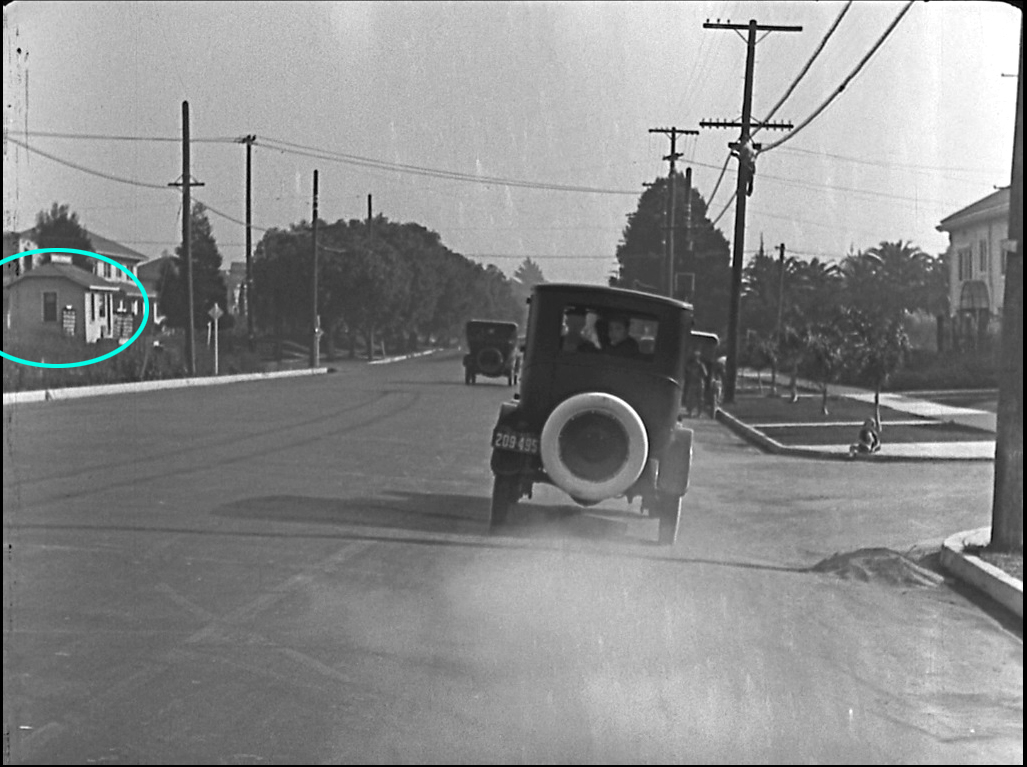
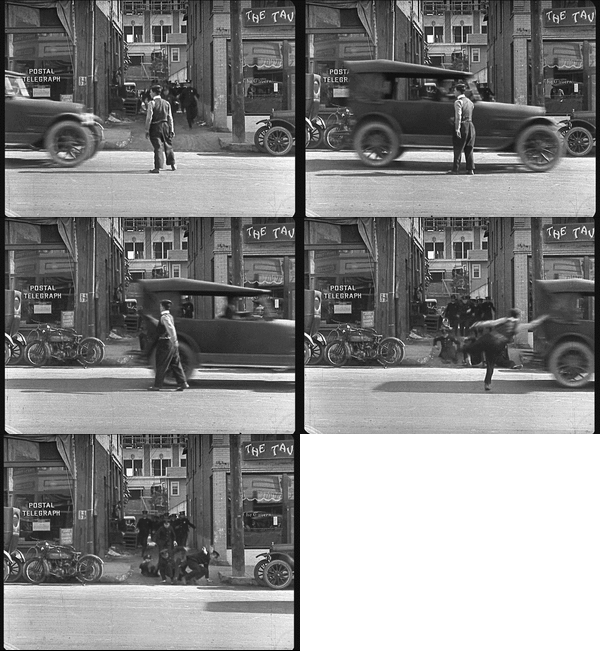
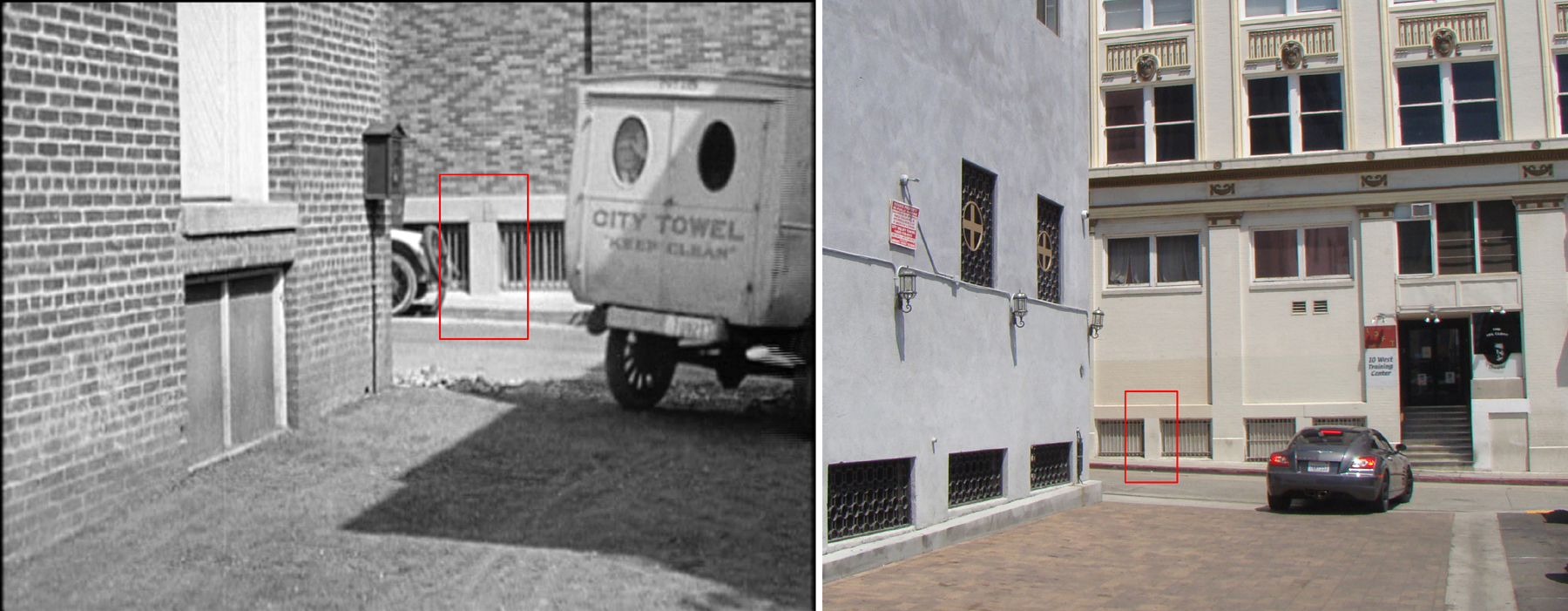
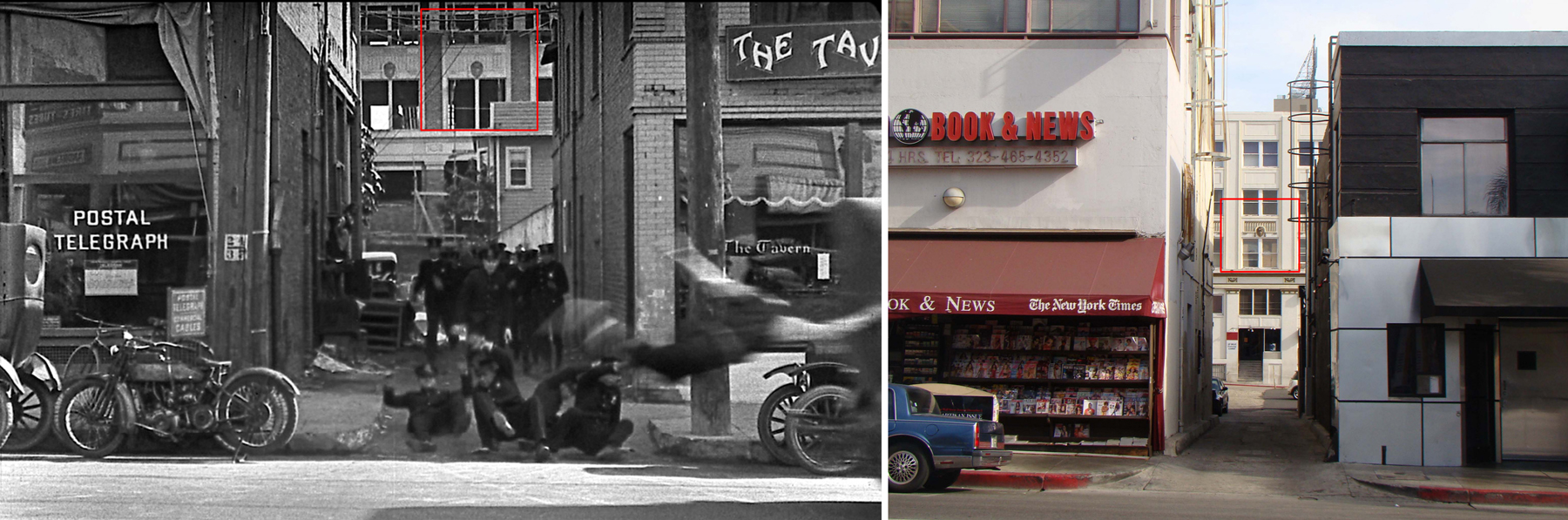
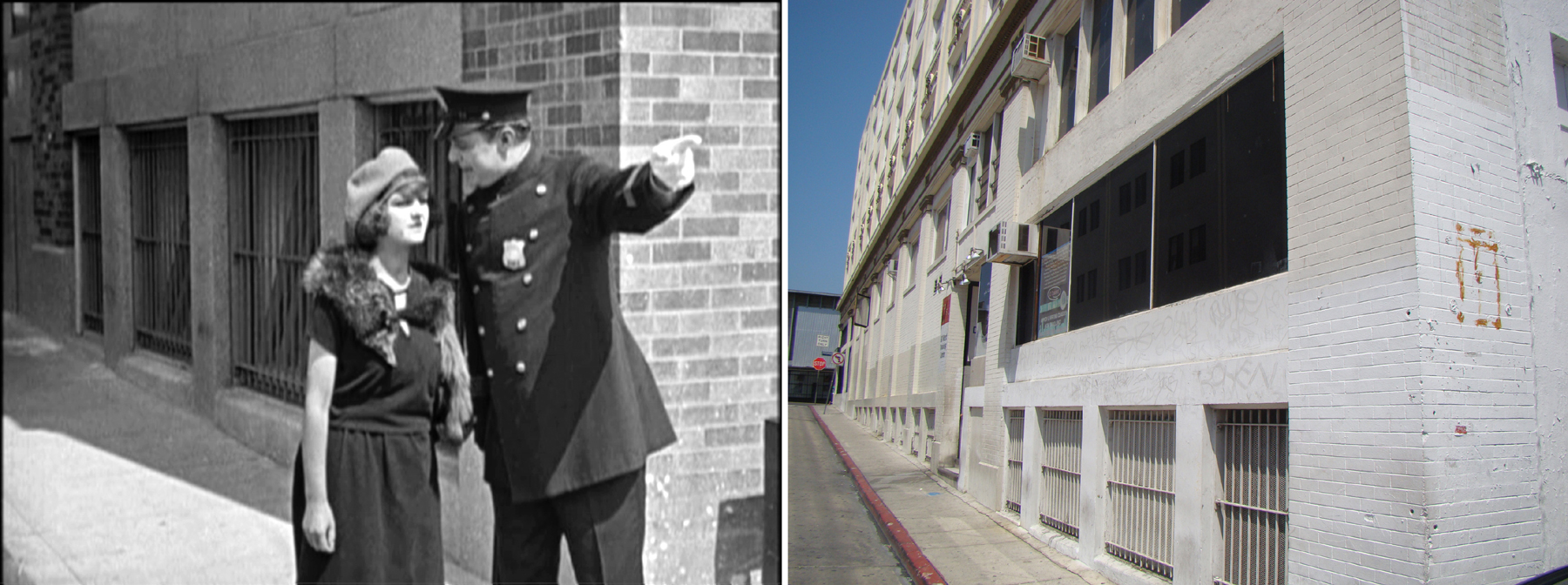
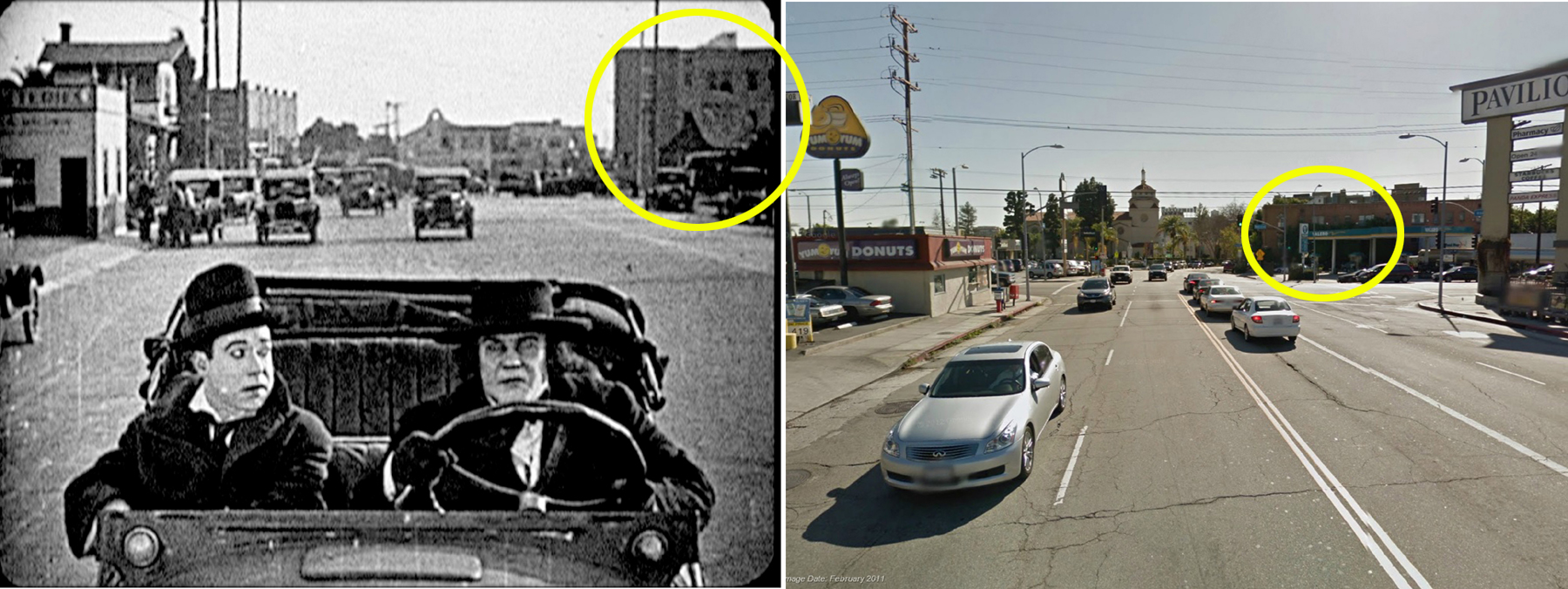
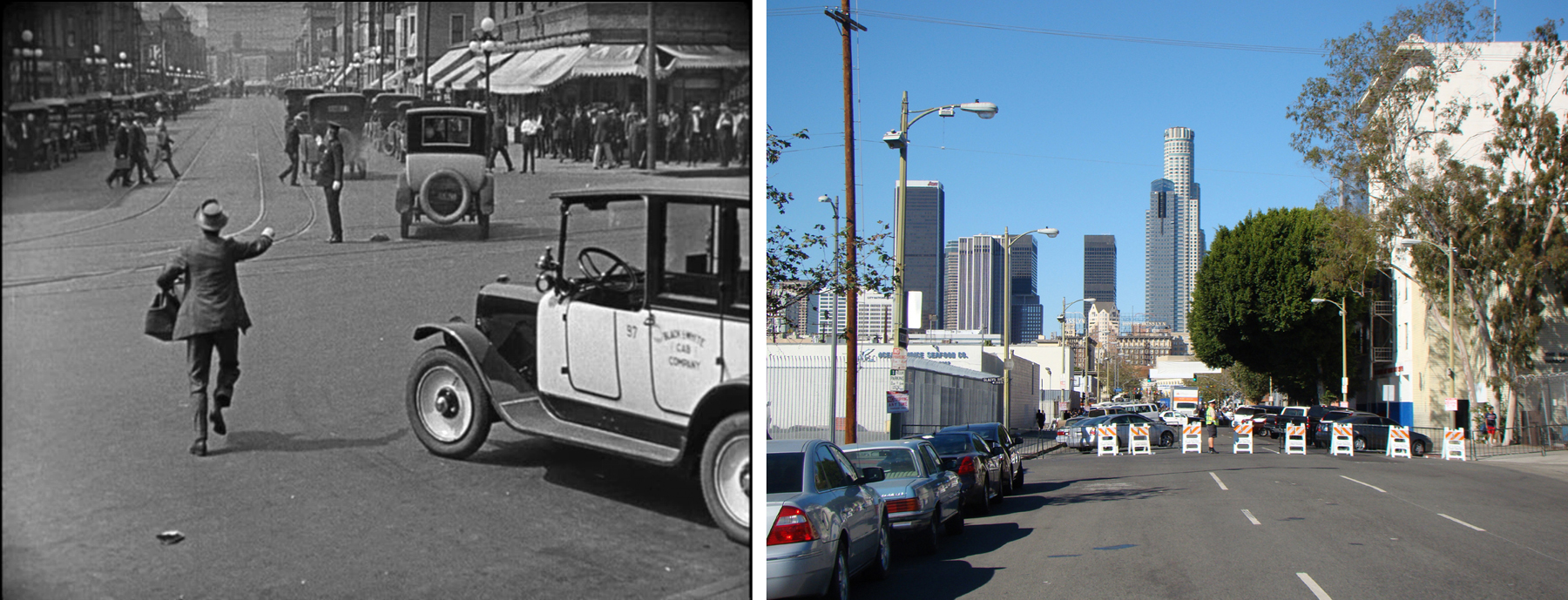
The Last Edition 1925 – filmed in San Francisco (and LA)

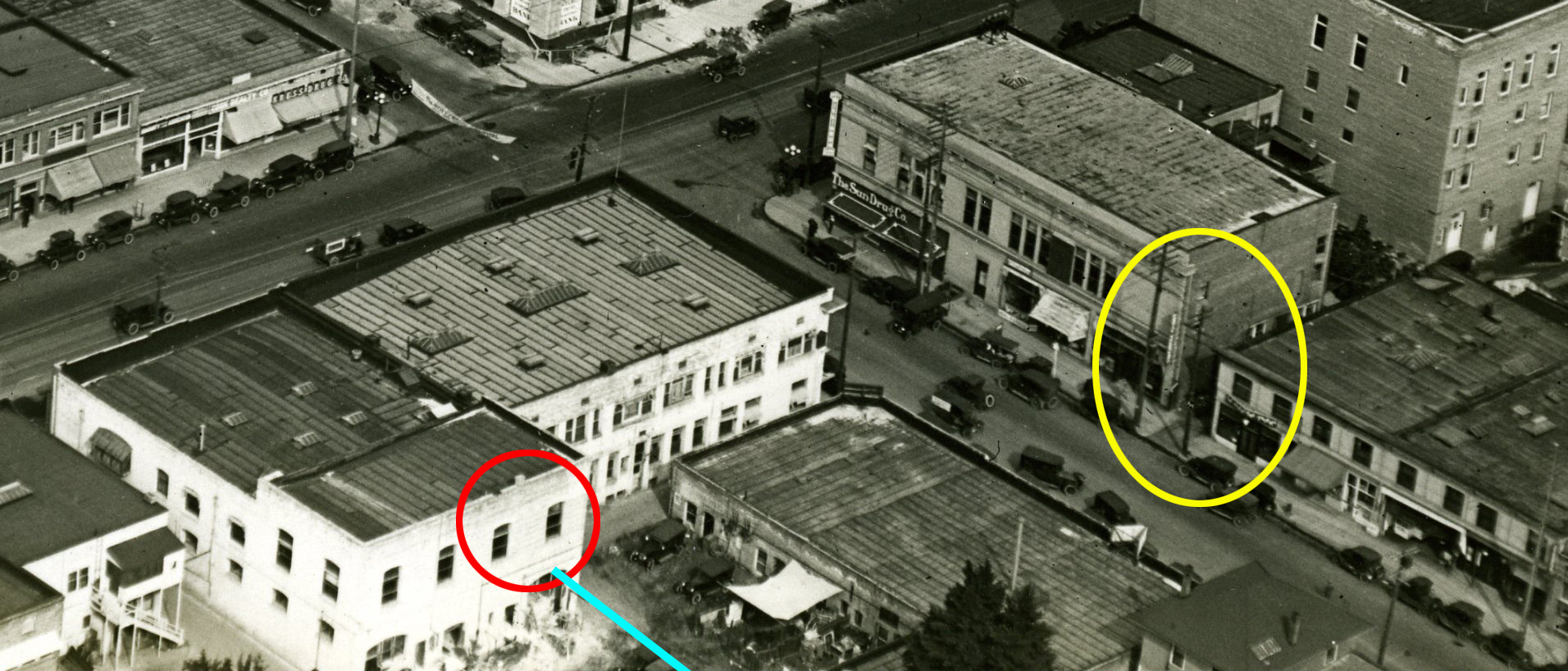
The Last Edition - the Mary Moll Building in Hollywood

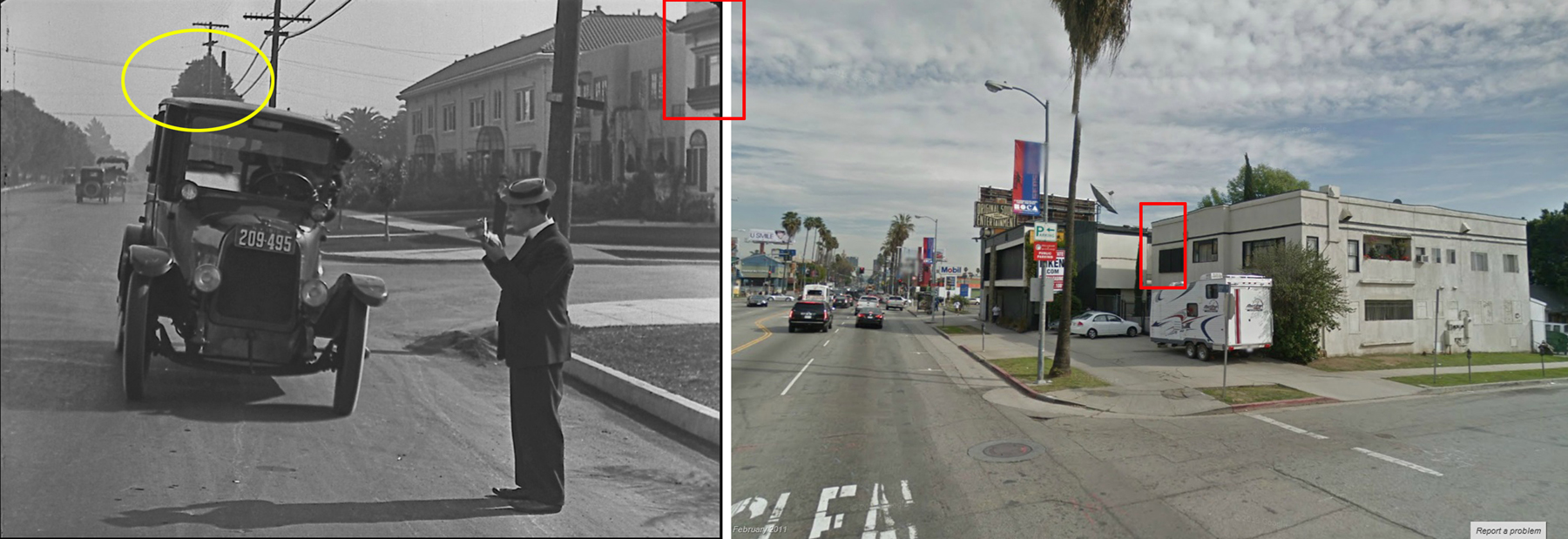
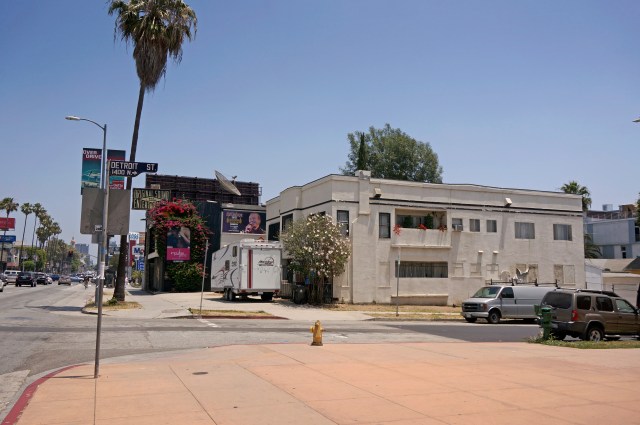
The Last Edition – the Mary Moll Building in Hollywood stands in for San Francisco. (C) 2013 Google.

The San Francisco Silent Film Festival begins Thursday, July 18.  I will be signing books at the festival on Sunday, July 21, following the Kings of Comedy presentation at 10:00 a.m., and before the Safety Last! screening at 8:30 p.m.  I have several posts showing how Harold Lloyd filmed Safety Last!, including two HERE and HERE.

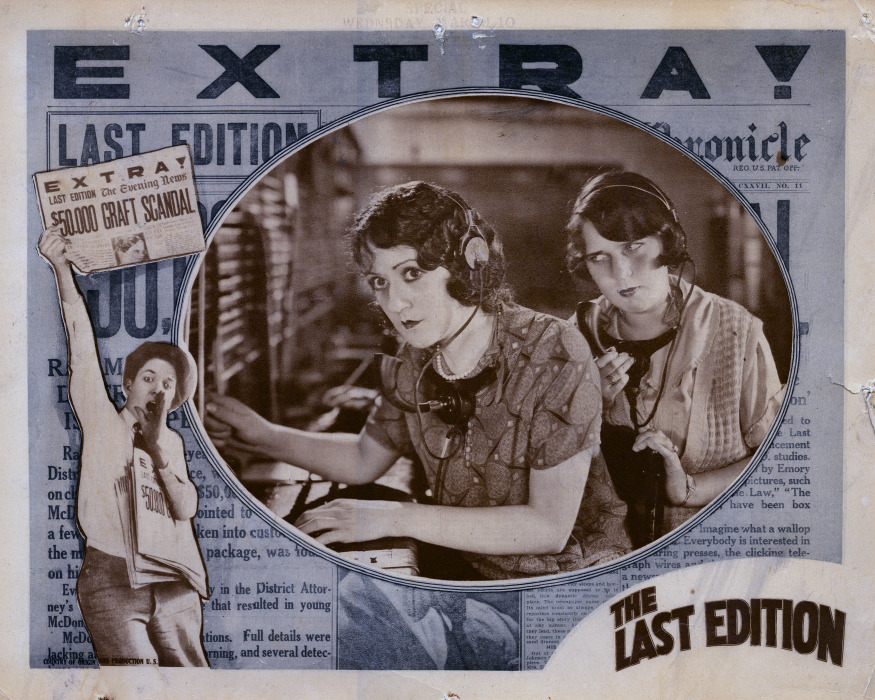
last-edition-lobby-card-300-dpiI am especially looking forward to the Sunday 3:30 p.m. screening of The Last Edition (1925), an adventure-drama filmed on location throughout San Francisco, including many scenes shot at the San Francisco Chronicle newspaper.  As explained by Thomas Gladysz at his post, The Last Edition was considered lost until a unique surviving print was found in 2011 at EYE Film Instituut Nederland, and preserved by SFSFF President Rob Byrne.

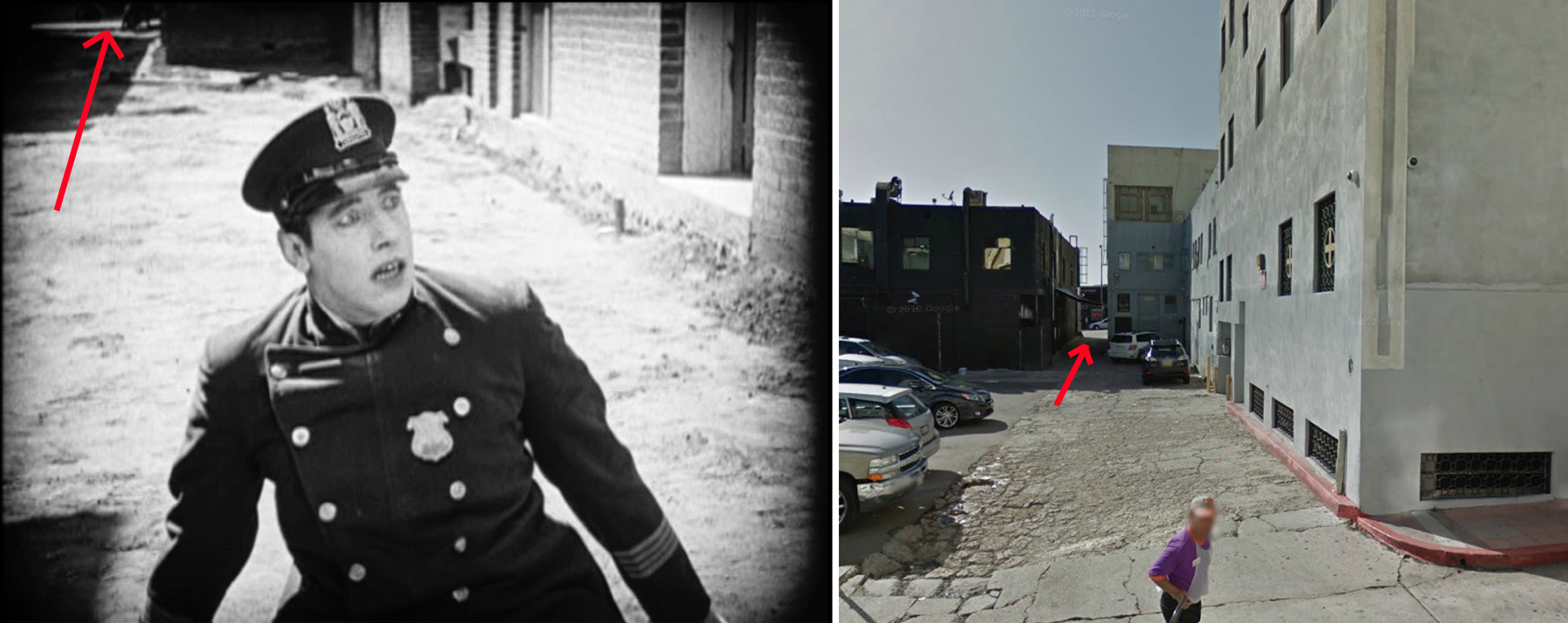
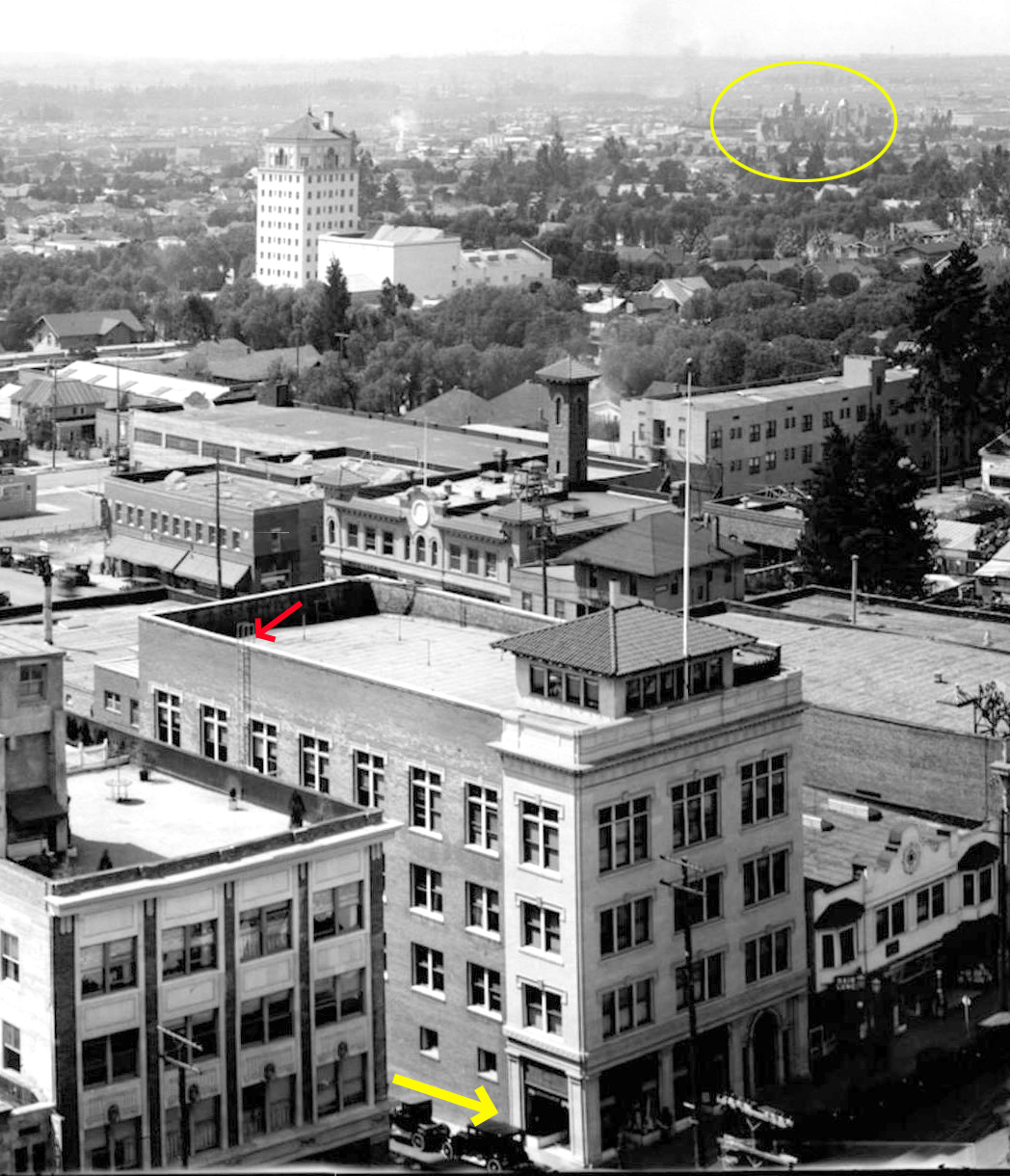
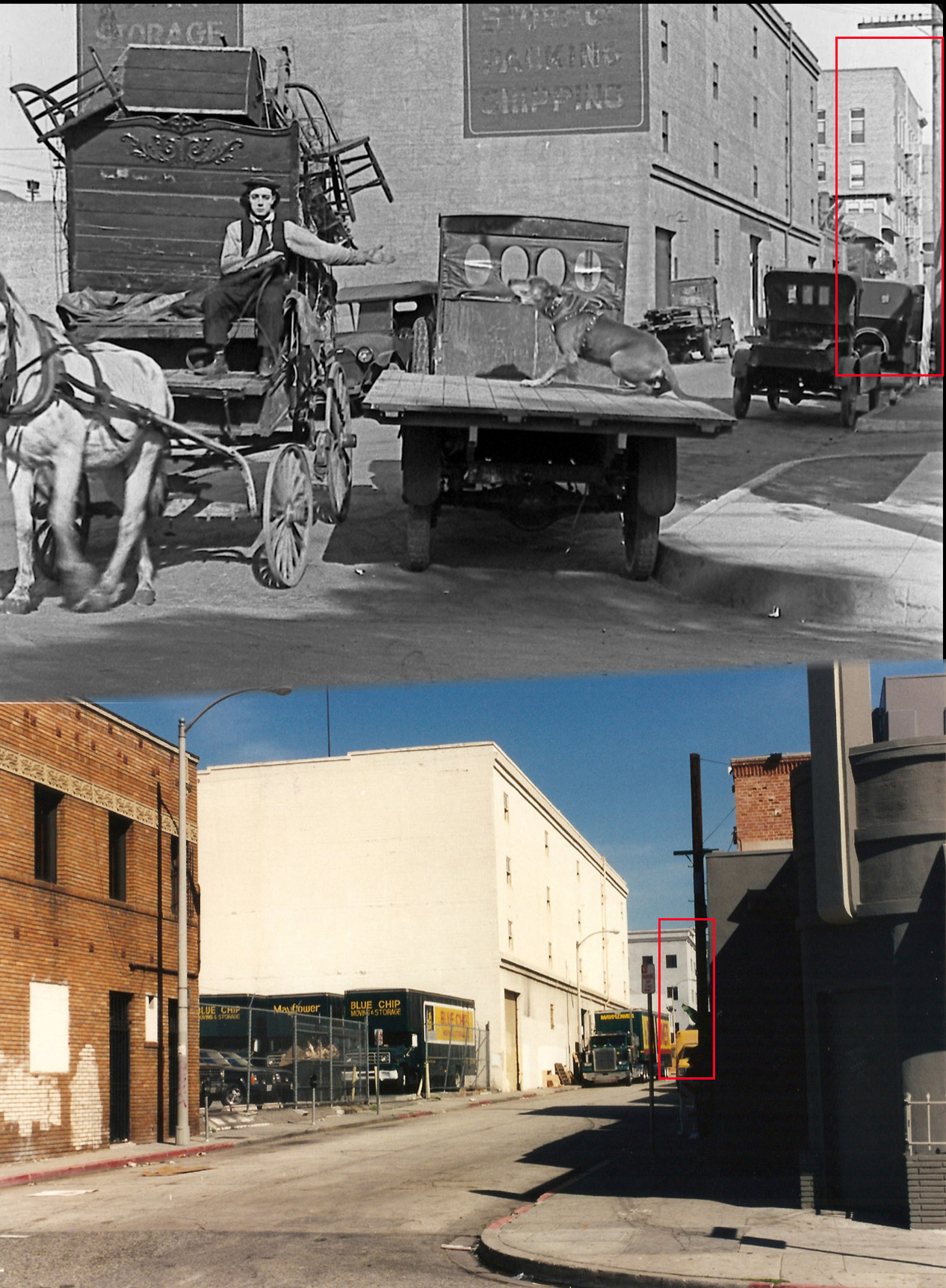
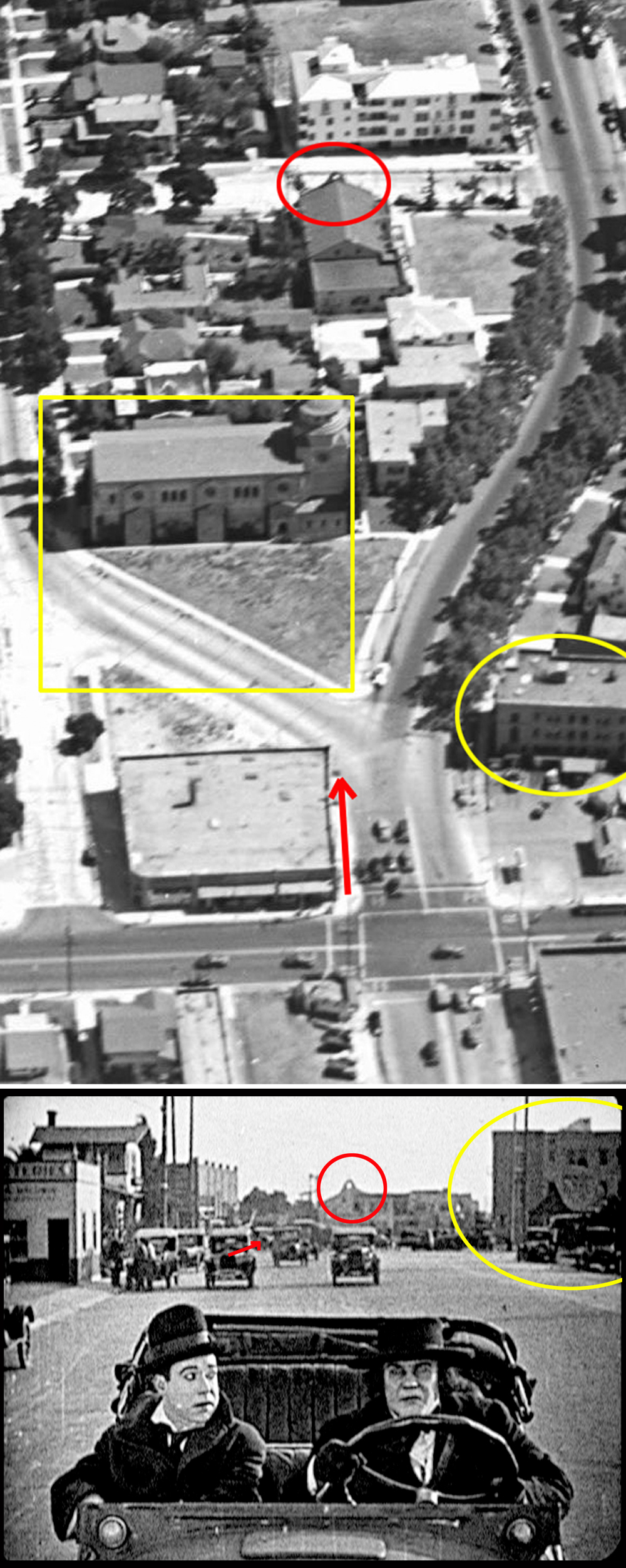
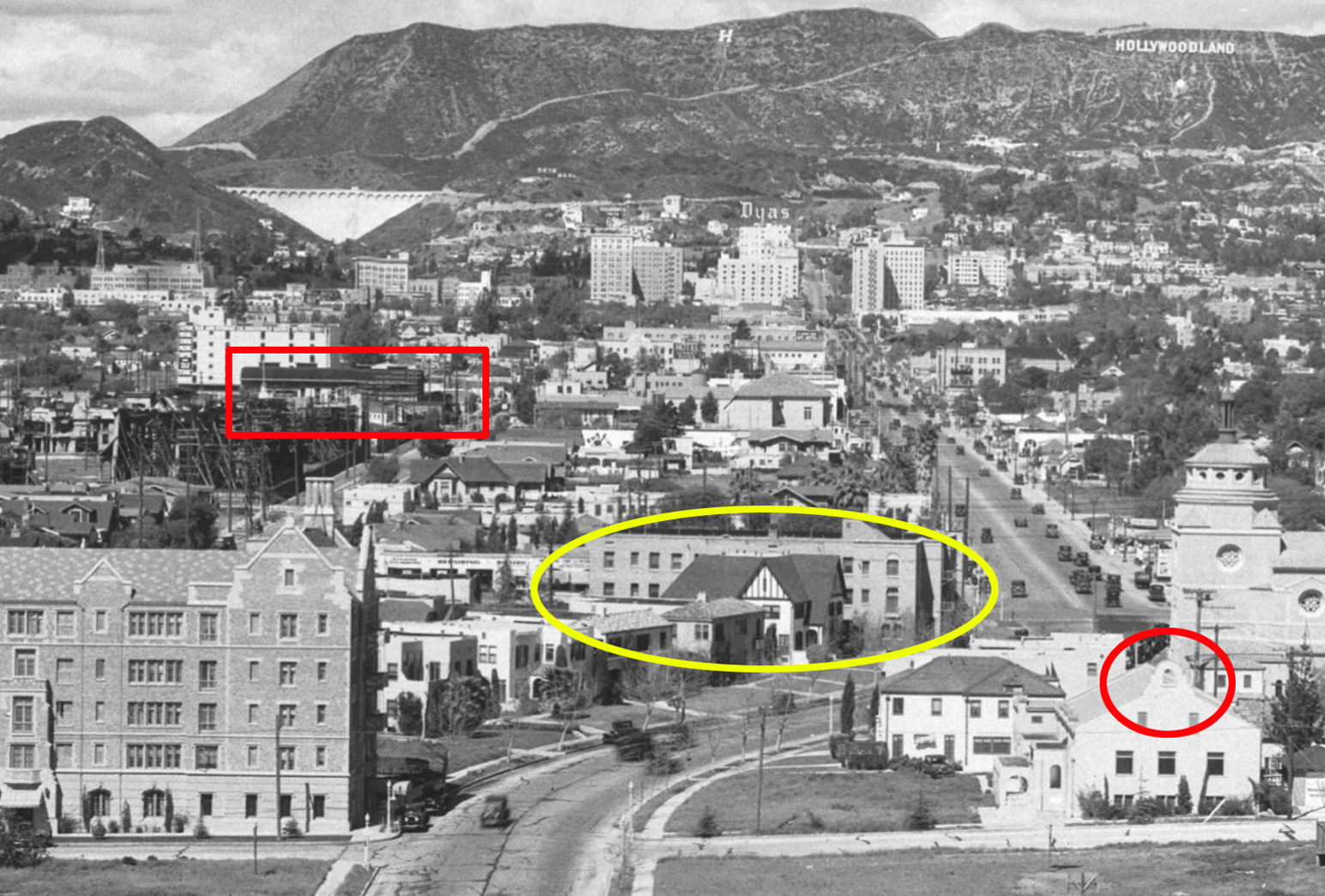
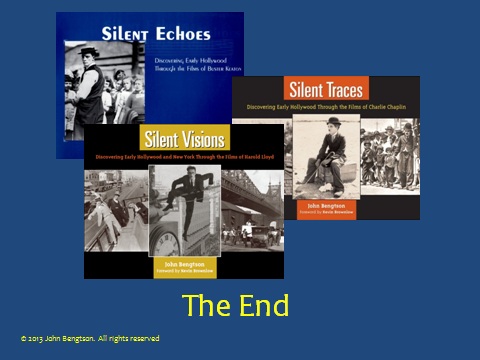
The movie’s website identifies many fascinating San Francisco settings and street corners appearing in the film, and correctly surmises that other, non-identified scenes, must have been filmed in Los Angeles instead.  It was and remains a common practice for movies filmed at faraway locations to be supplemented with pickup shots filmed in Hollywood.  As I explain in my book Silent Visions, Harold Lloyd’s 1928 feature Speedy, filmed extensively on location in New York, contains many sequences where Manhattan and Los Angeles street corners are edited together.  Likewise, as I explain in Silent Echoes, Buster Keaton intercut trolley scenes filmed in San Francisco and Hollywood for his 1922 short film Day Dreams.  [UPDATE: After studying The Last Edition more closely, it contains a sequence that shows Charlie Chaplin filmed  The Kid at the same Hollywood alley where Buster Keaton filmed Cops and Harold Lloyd filmed Safety Last! See post HERE.]

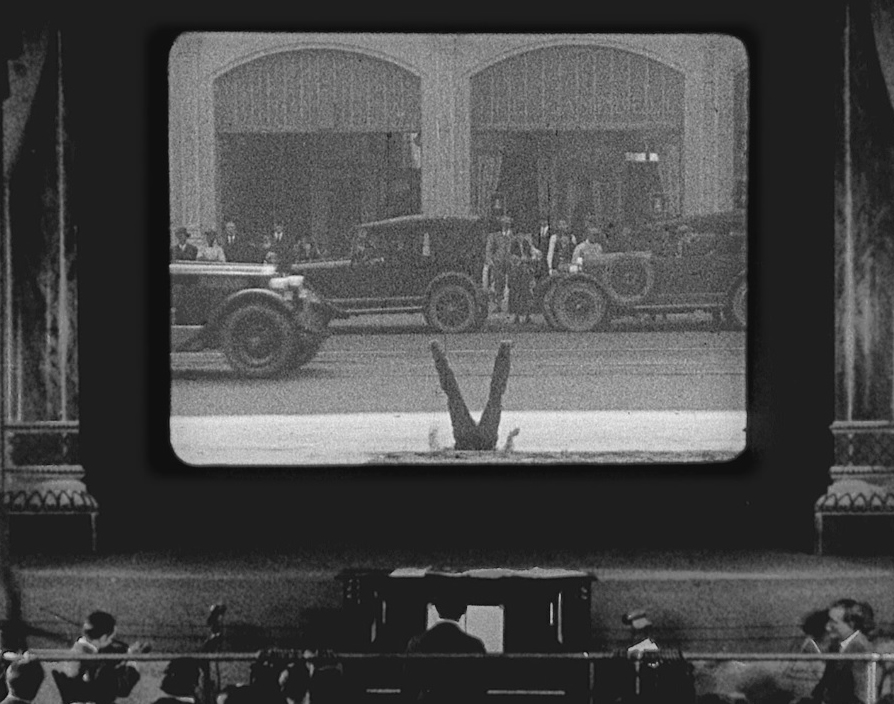
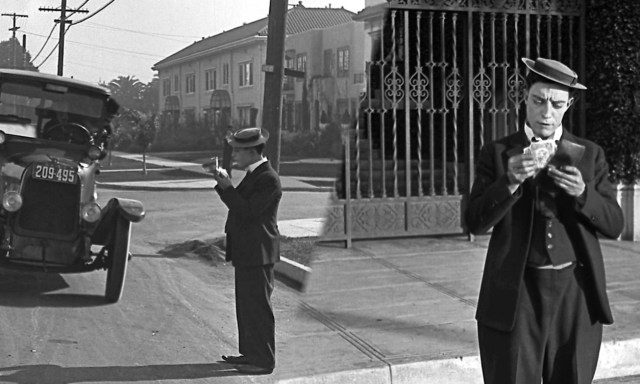
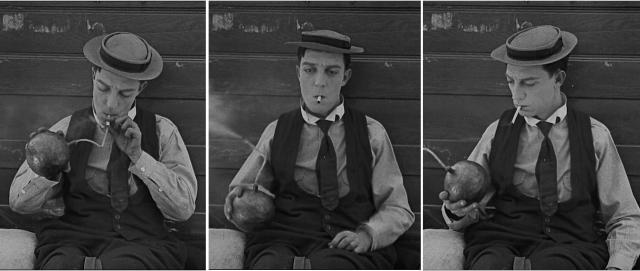
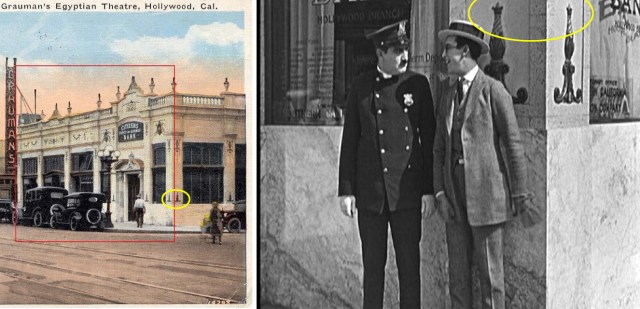
aa9Filling in the blanks, I identify here three Los Angeles settings appearing in The Last Edition.  The first setting at the top of this post, above, was filmed on Hollywood Boulevard in front of the Mary Moll Building.  The automobile pictured above is parked nearly in front of where Grauman’s Chinese Theater would later be built in 1927.  To the right, Buster Keaton falls in front of the Mary Moll Building during the movie-within-a-movie dream sequence from Sherlock Jr. (1924).

ca

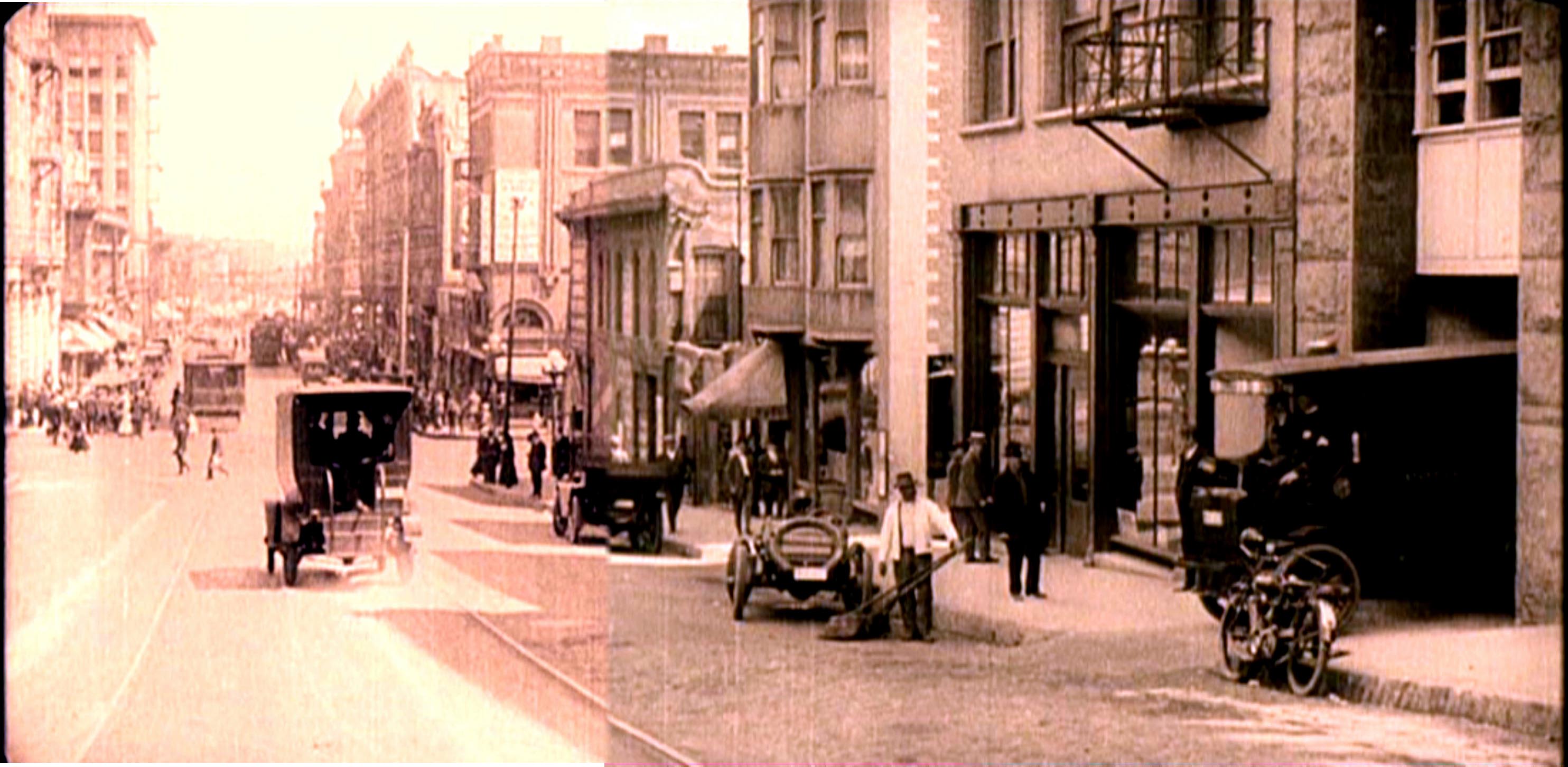
Click to enlarge – looking up Hill Street from 6th Street. LAPL 00039492

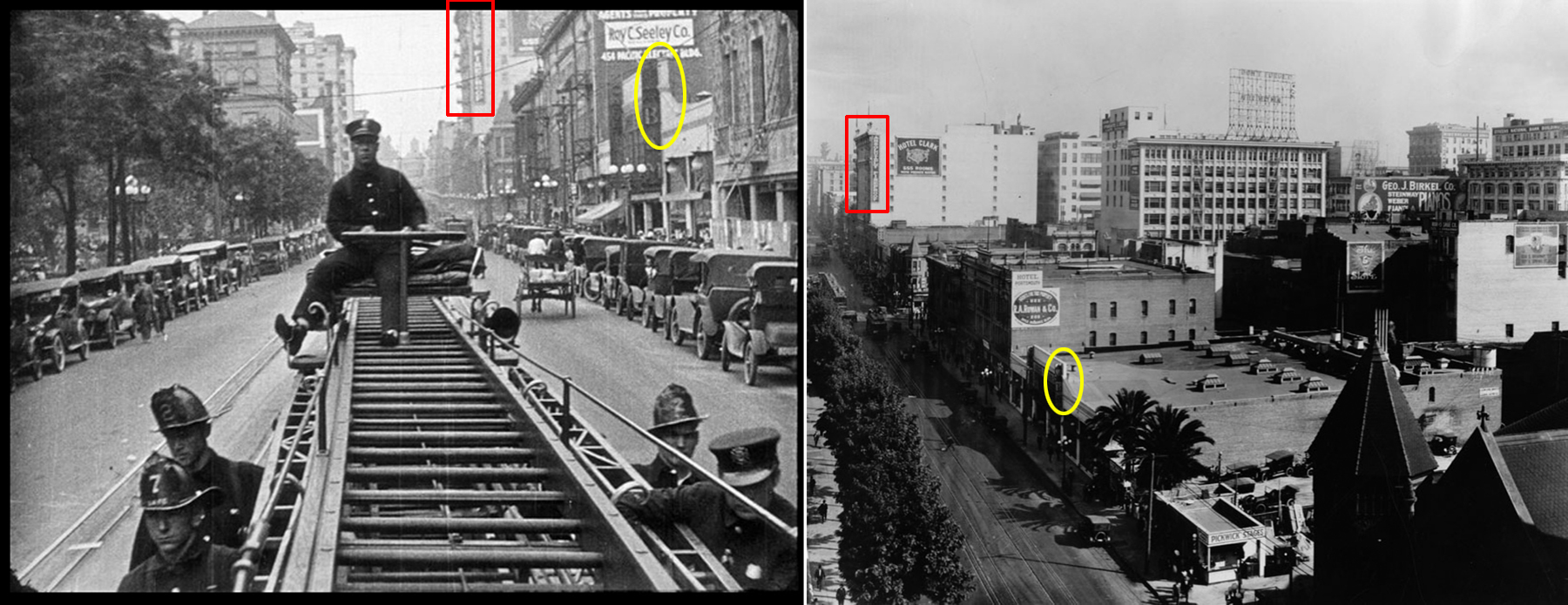
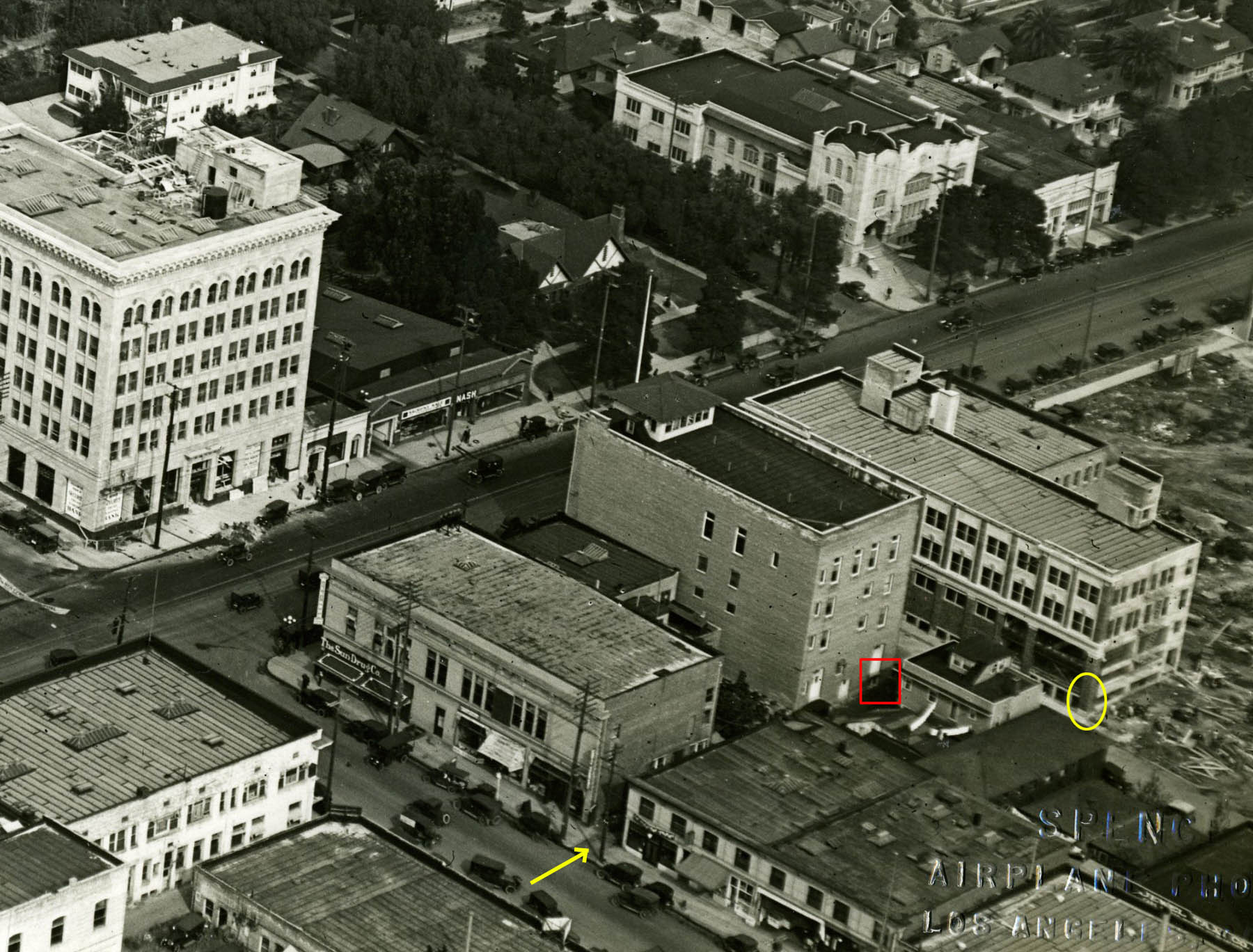
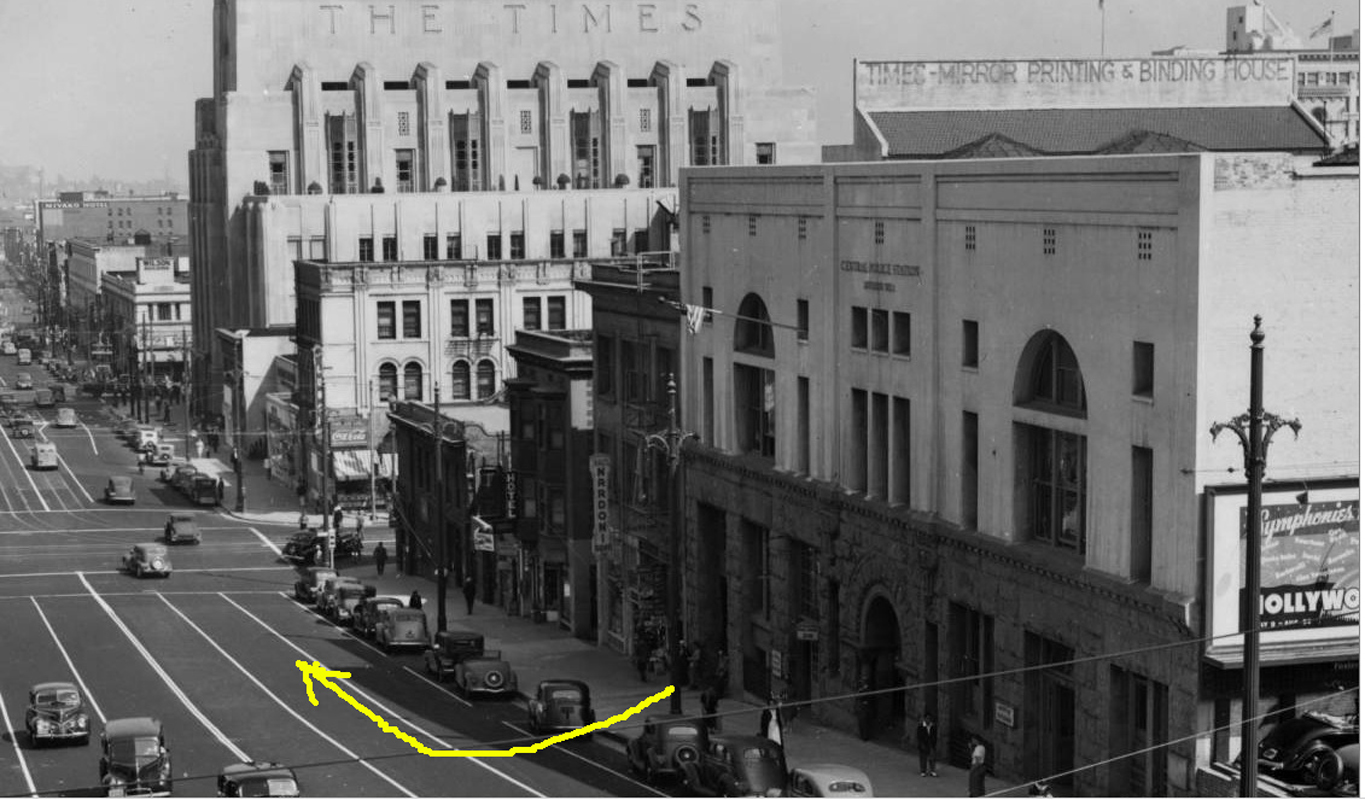
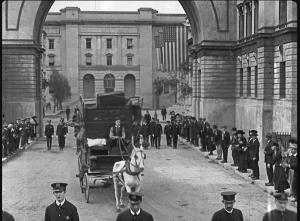
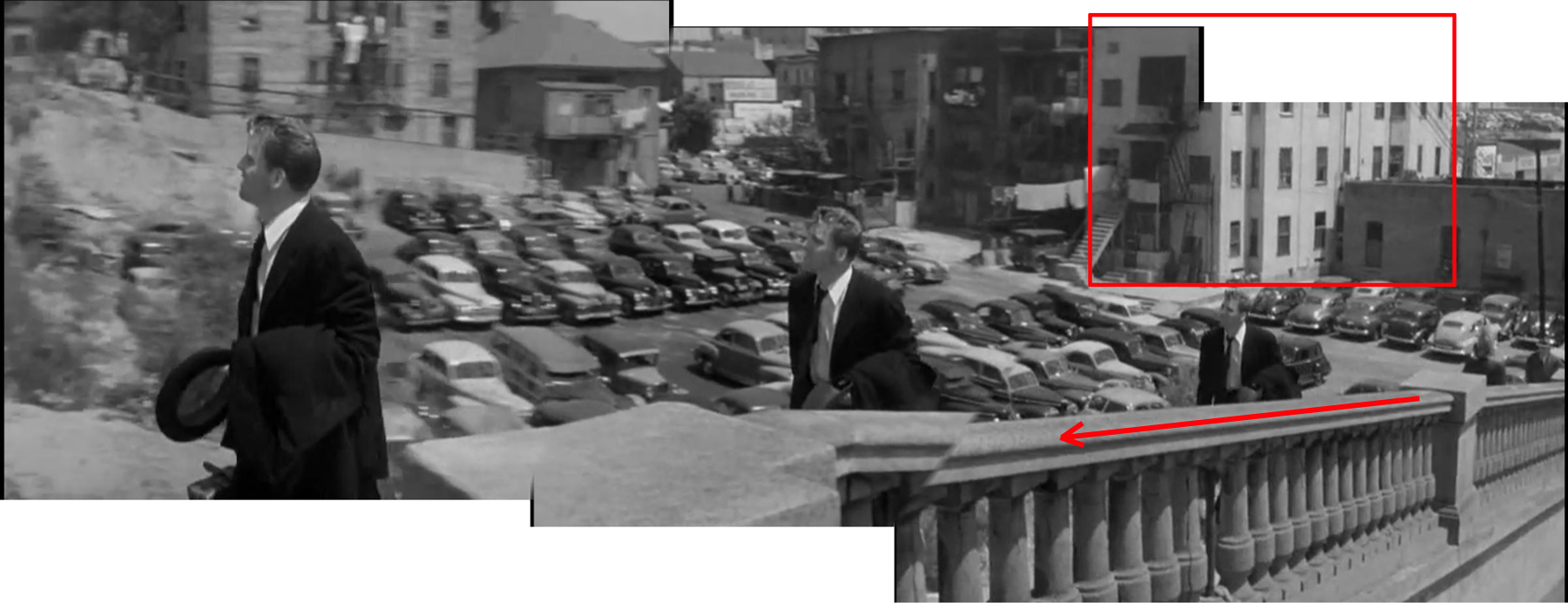
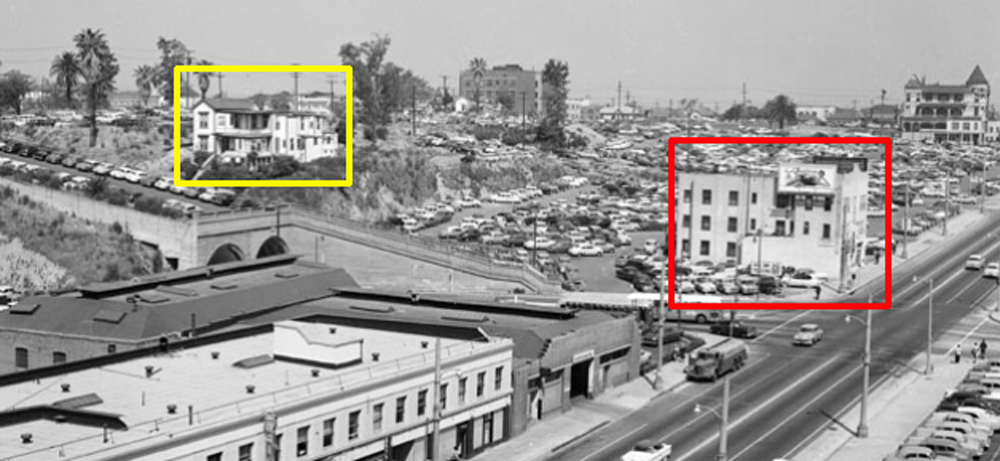
The next view above looks north up Hill Street from 6th Street – the trees along the south side of Pershing Square appear to the left of the movie frame.  The extant Hotel Clark (red box) at 426 S. Hill Street, and the former Boos Bros Cafeteria (yellow oval) at 510 S. Hill Street are identified.

Photo Tommy Dangcil.

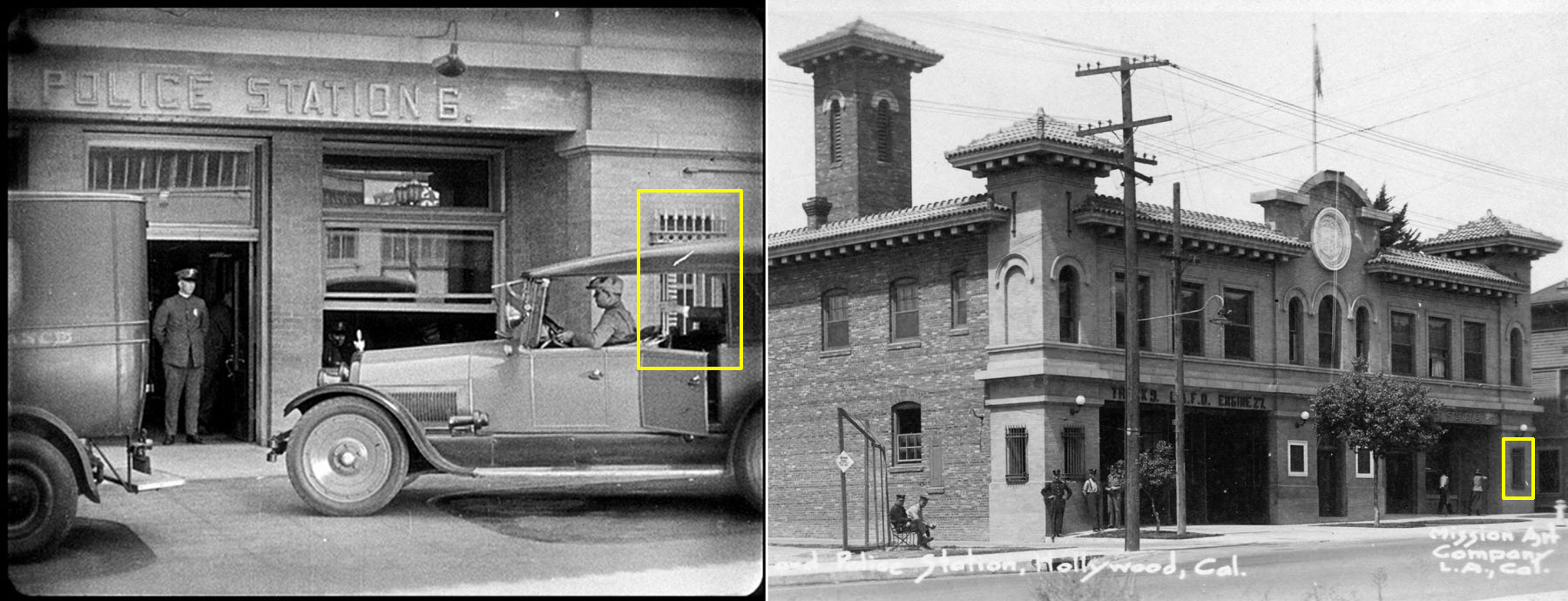
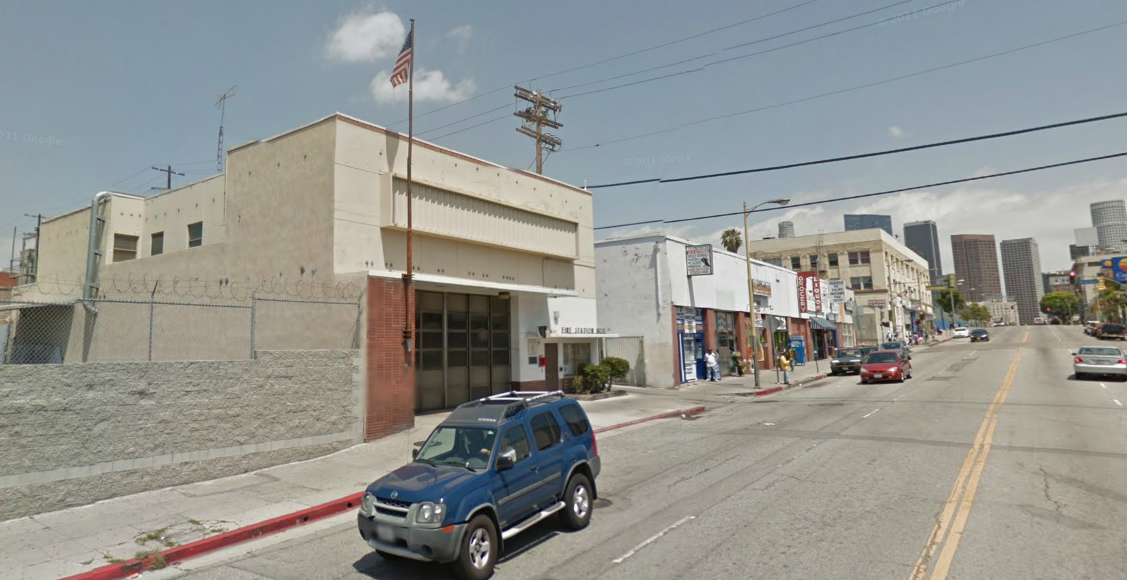
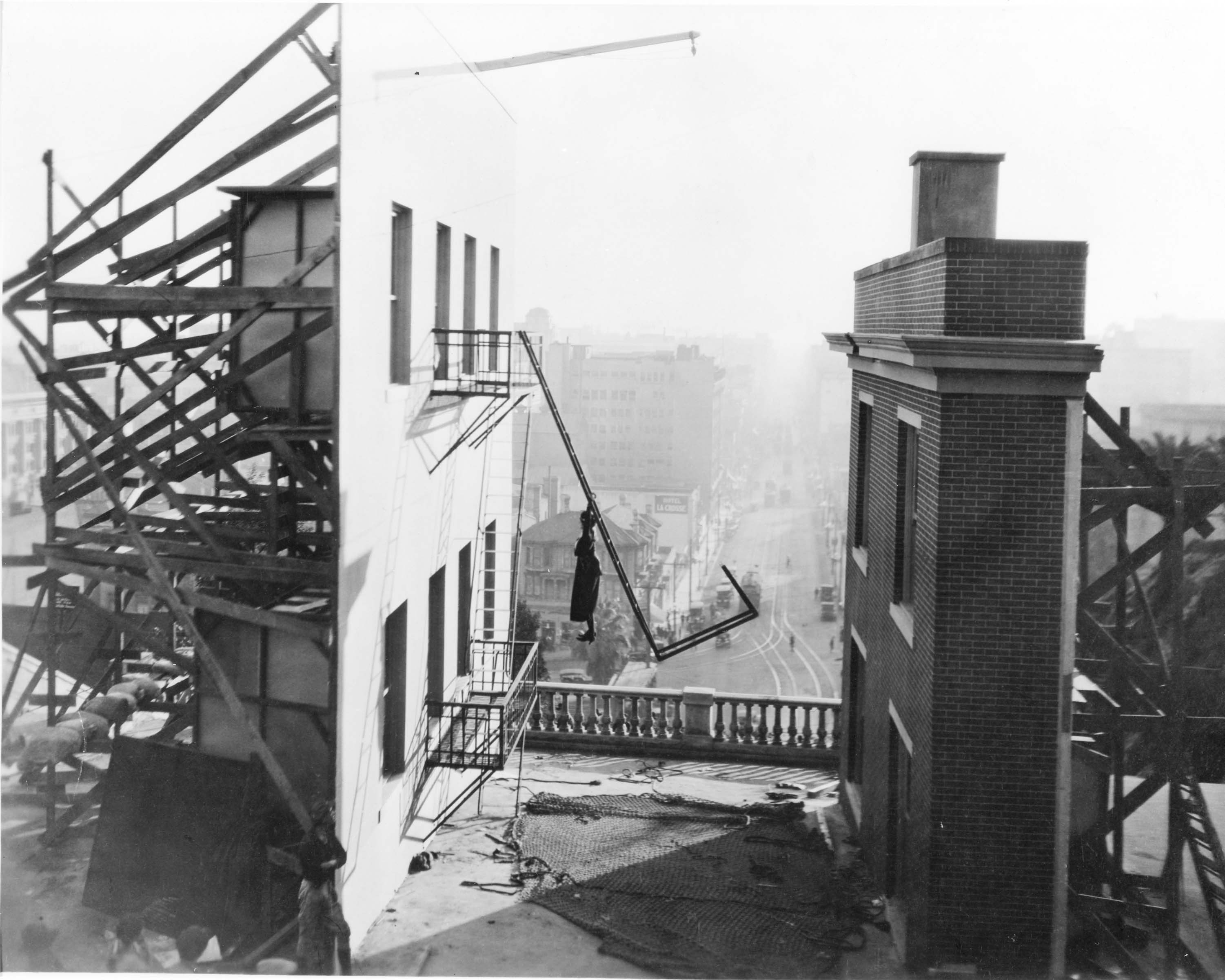
The joint fire-police station appearing in The Last Edition.  Photo Tommy Dangcil.

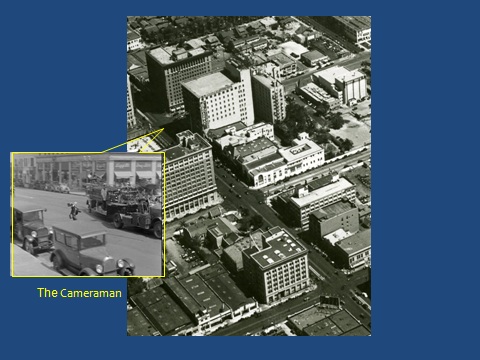
Lastly, the former joint Hollywood Fire and Police Station above, that once stood at 1625 and 1629 Cahuenga Boulevard, makes yet another silent-era film appearance.  The station appeared in Buster Keaton’s feature films Three Ages (1923) and The Cameraman (1928), in Harold Lloyd’s Safety Last! (1923) and Hot Water (1924), and in the Douglas Fairbanks 1917 comedy Flirting With Fate, the 1924 Our Gang short High Society, and the 1925 Harry Langdon comedy Plain Clothes.  You can read more about Keaton filming beside this fire station HERE.

The San Francisco Silent Film Festival

EYE Film Instituut Nederland

Posted in San Francisco, The Last Edition | Tagged , , , , , , , , , , , , | 7 Comments

Silent Era Hollywood Tour – Cinecon 49 – Author Presentation

Cover slide blueAttached to this post is a self-guided written tour to Hollywood silent film locations and studios that I have prepared in connection with the “Hollywood’s Silent Echoes” presentation I will be giving Friday, August 30, 2013, at 10:30 a.m. at the Egyptian Theater, 6712 Hollywood Boulevard, as part of the Cinecon 49 – Classic Film Festival.  With this tour you can follow a number of points I will cover during my presentation.

titlecardThe tour starts at Hollywood and Vine, and encompasses nearly 50 filming locations and historic sites associated with Charlie Chaplin, Buster Keaton, Harold Lloyd, Douglas Fairbanks, and Harry Langdon, including several new discoveries not found in my books or previously posted tours. 

During the lunch break after my talk I will lead a quick walking tour from the theater of the historic 1600 block of Cahuenga nearby.  I look forward to seeing you at Cinecon 49!

Hollywood’s Silent Echoes – Cinecon 49 Classic Film Festival Tour – 2013

Posted in Chaplin Tour, Keaton Tour, Lloyd Tour | Tagged , , , , , , , , , , , , , , , , , | 5 Comments

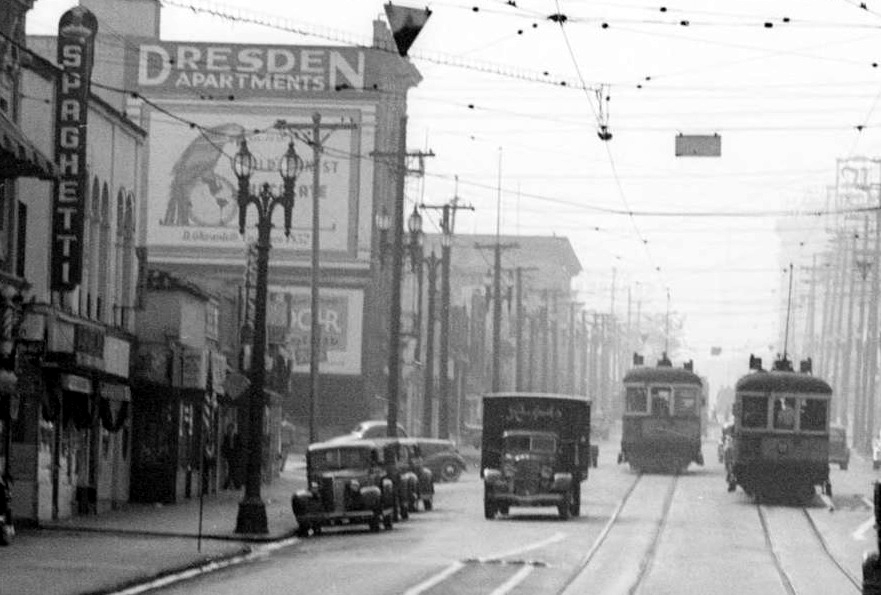
Solved at Last! – the Safety Last! Mystery Building

Harold Lloyd filmed his stunt-climbing “thrill” comedies on the rooftops of eight buildings in the downtown Los Angeles Historic Core.  Remarkably, seven of these eight buildings are still standing.  (In all Lloyd employed 17 buildings in one way or another – see descriptions here.)

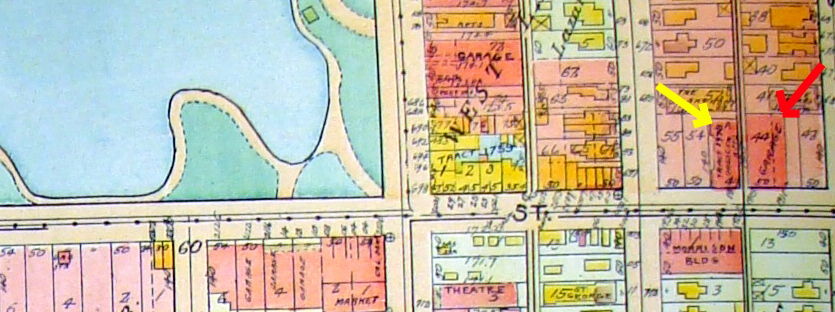
The Dresden Apartments (yellow arrow) and California Garage (red arrow) east of Westlake Park

The Dresden Apartments (yellow arrow) and California Garage (red arrow) on W 7th east of MacArthur Park

ca

The Dresden Apartments and California Garage

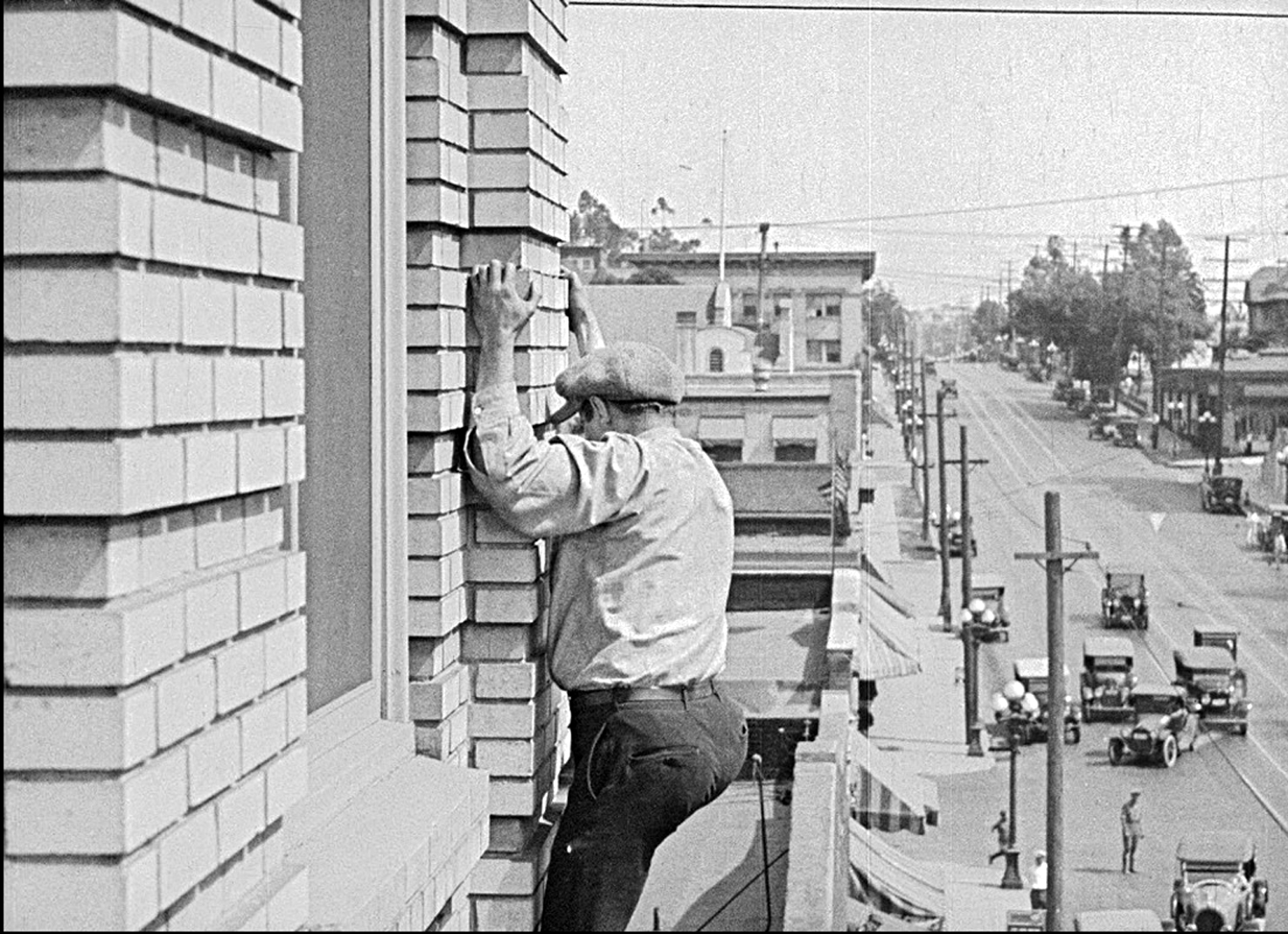
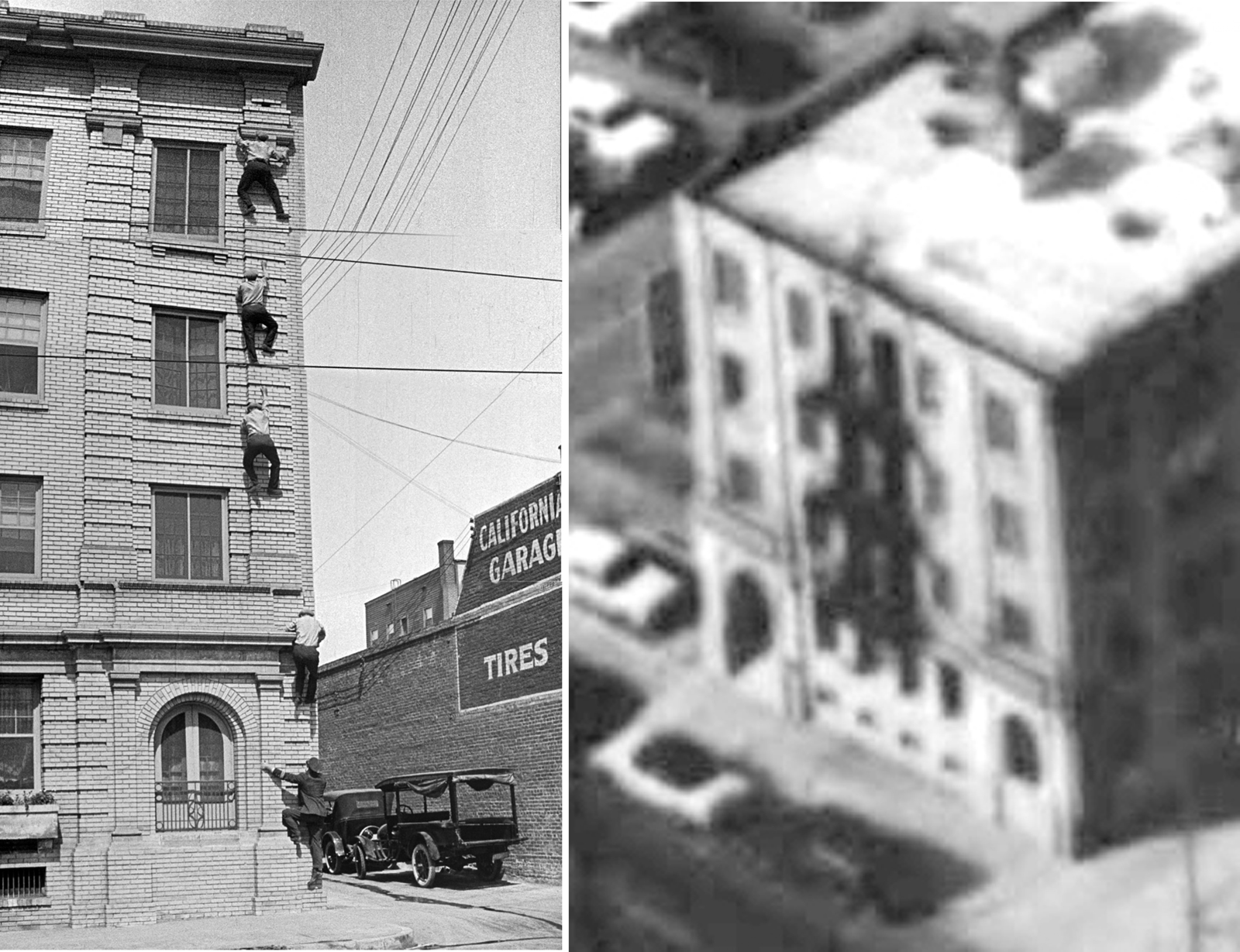
But a mysterious ninth building belongs in the Lloyd Thrill Picture Hall of Fame (see left).  As explained in a prior post, we learn early in Safety Last! (1923) that Harold’s roommate Bill Strother can climb tall buildings when we watch him scale a four-story apartment in order to escape from a cop.  If you click the image of Bill below, you can see how the climbing was controlled with his hands.

ca

Click to enlarge – Bill Strother mid-climb

Despite an abundance of clues, including the fact the building faces an east-west trolley line, and stands beside an alley and a “California Garage” selling tires, the mystery building eluded my detection for years.

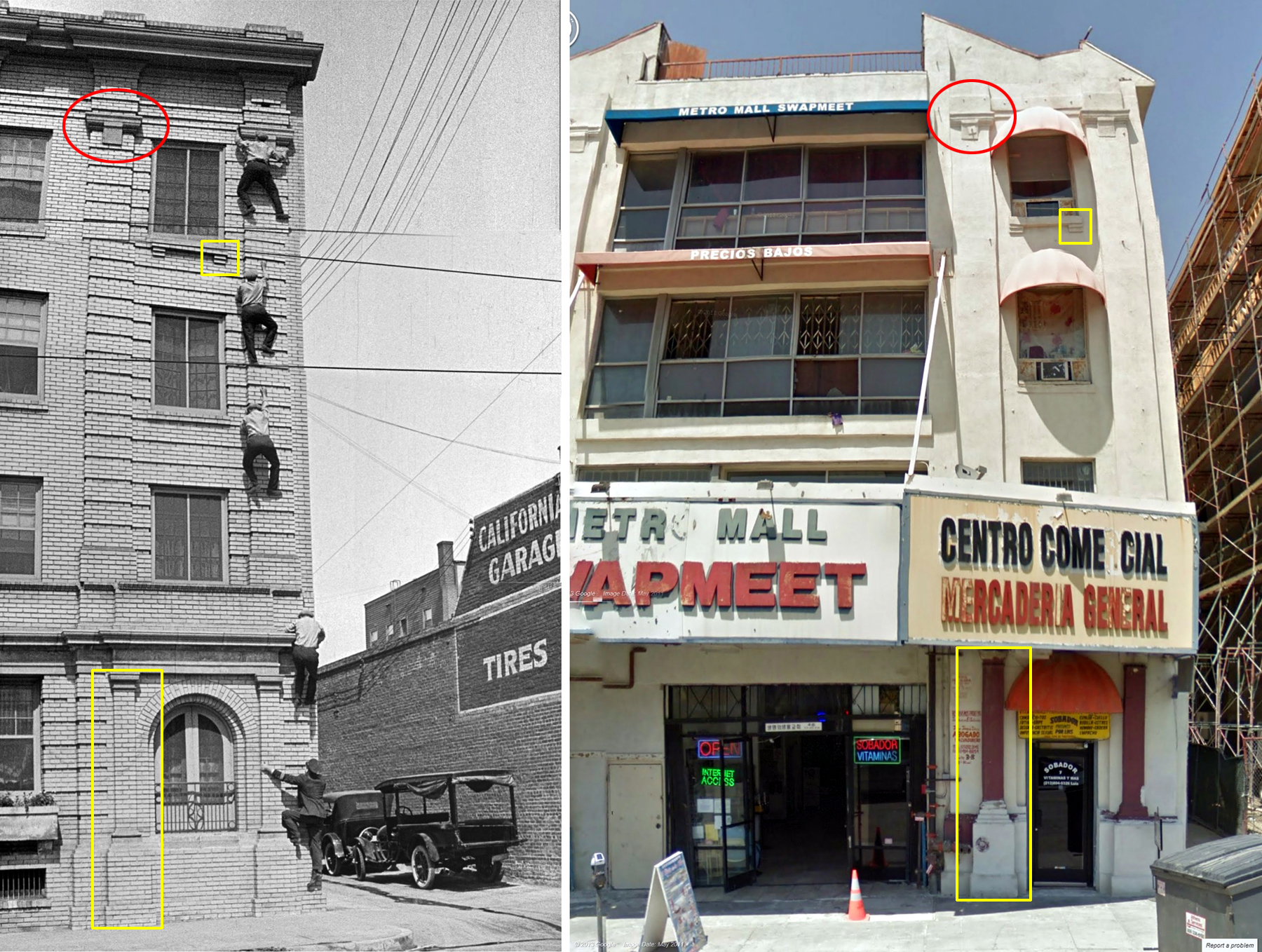
This all changed when “Skip,” a resourceful but publicity-shy reader was able to identify the extant (if heavily remodeled) building as the former Dresden Apartments at 1919 W 7th Street.  As Skip explains, he could not locate the California Garage either – there seems to be simply no historic record of this establishment.  But tracking down a false lead brought Skip’s attention to the Westlake neighborhood, where he had once lived.  So following hunches, and using the Bing’s Birds-Eye aerial view, Skip “flew” around the area until a four story building caught his eye.  The short-long window pattern on the alley side of this building seemed unique to the area, and matched another shot from the movie.

ca

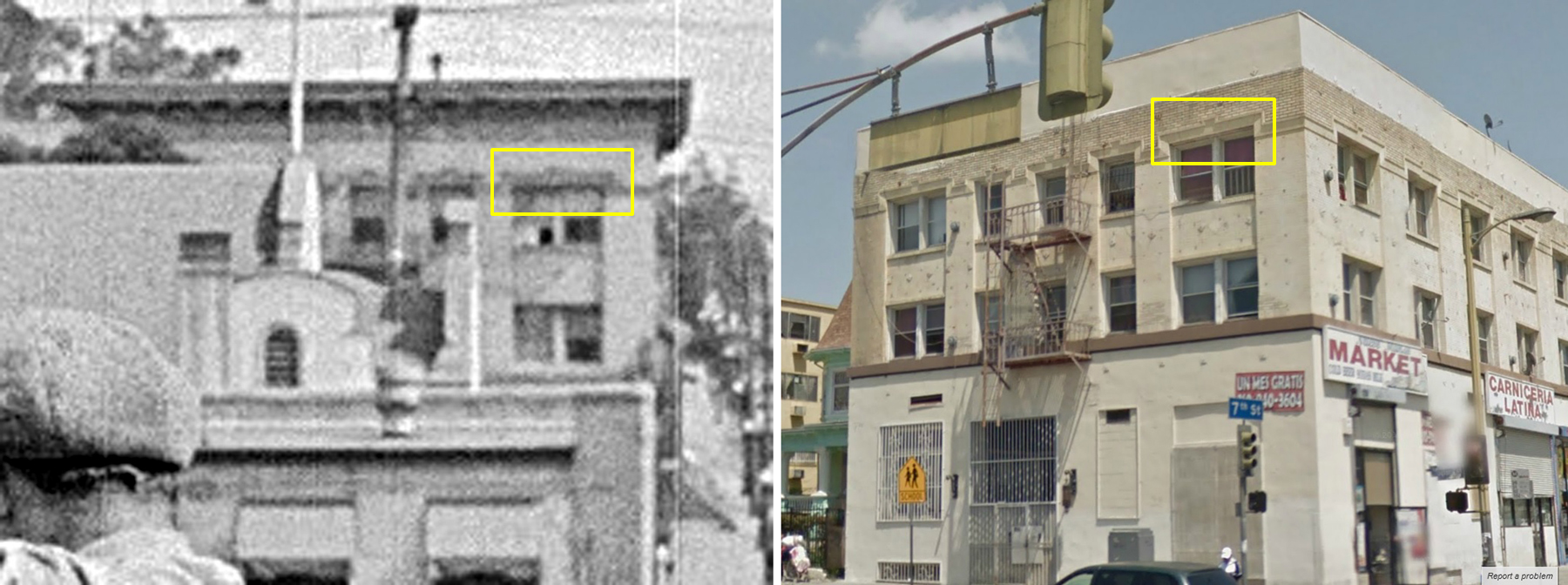
Then and Now – the Dresden Apartments, 1919 W 7th Street. (c) 2013 Google.

As shown above, the front of the 1910 vintage building is now so badly butchered Skip was hesitant at first to contact me about it being a match.  Although initially difficult to see, the remaining architectural elements match up precisely.
ca

1919 W 7th Street.  USC Digital Library

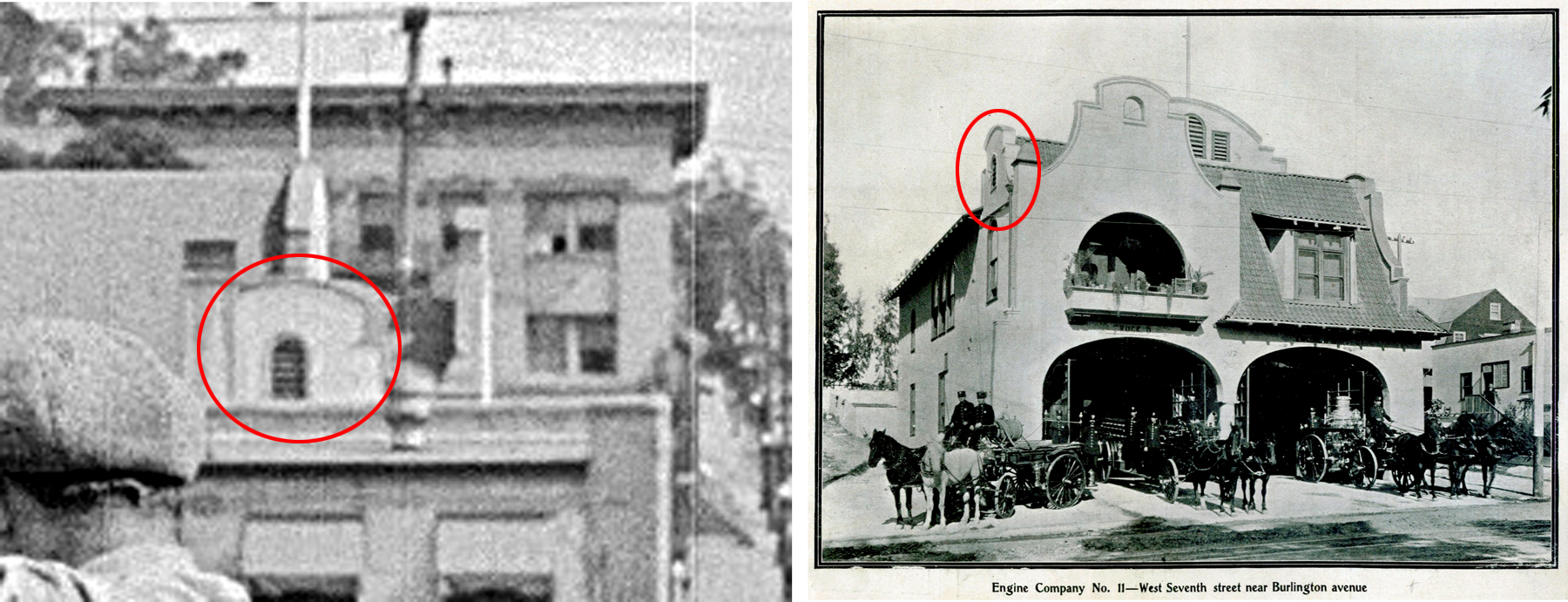
Moreover, vintage aerials photos (left) confirm the match, as do the distinctive parapets of the former L.A.F.D. Engine Co. No. 11 fire station at 1819 W 7th Street that appear down the street.

The Sorrento Apartments at 694 S. Burlington, on the corner of 7th Street, also appear further east down the street.  Harold Lloyd filmed many scenes there for his early 1917 short comedy The Big Idea.

Below, the L.A.F.D. Engine Co. No. 11 fire house.

ca

Click to enlarge.  Looking east past Bill Strother’s cap towards the L.A.F.D. Engine Co. No. 11 – 1819 W 7th Street. Los Angeles Fire Department Historical Archive

Below, the corner of the Sorrento Apartments.

ca

Looking further east towards the Sorrento Apartments, 694 S. Burlington. (c) 2103 Google.

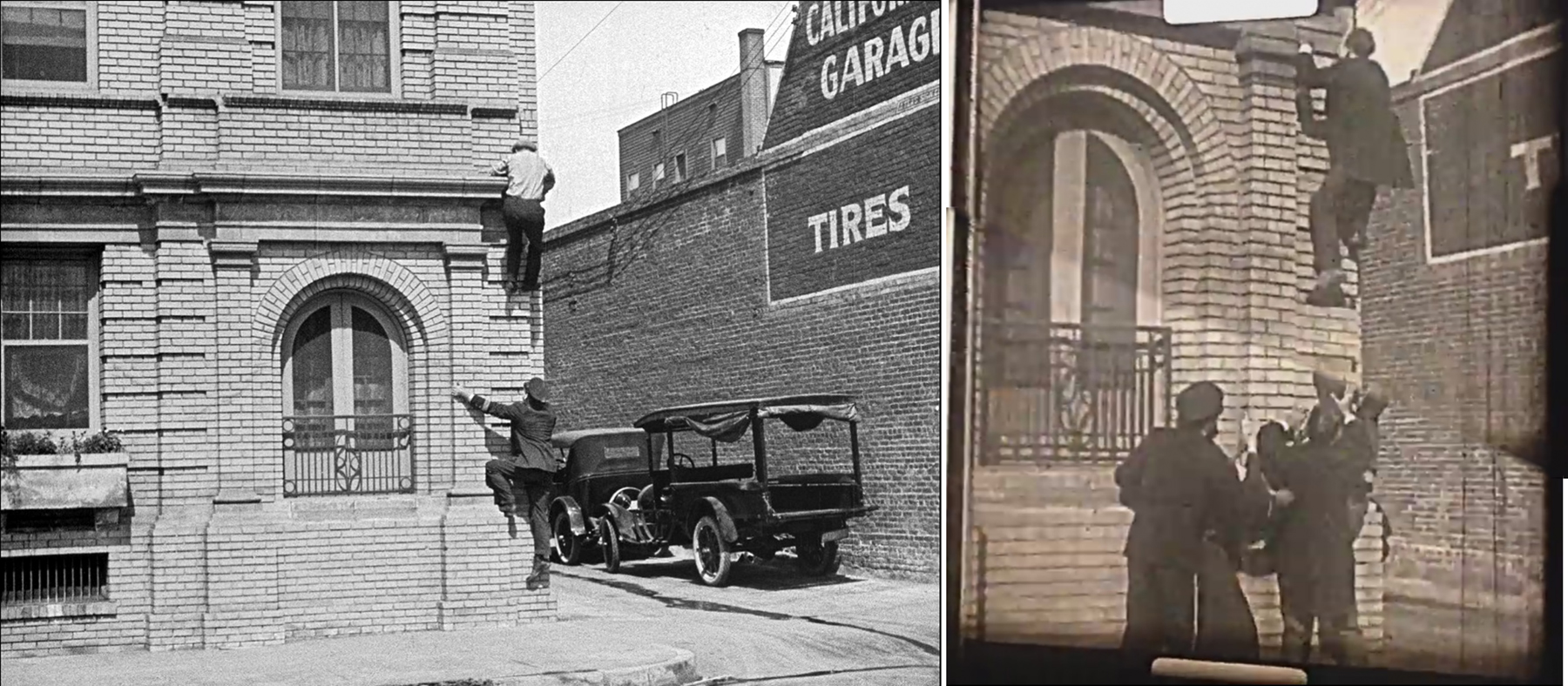
[UPDATE : believe it or not, the ground floor of the Dresden played a similar role in the 1922 Hallroom Boys stunt-climbing comedy High Flyers starring Sidney Smith and Zip Monberg (George Williams). Beginning at 9:34, they start to climb the first floor of the Dresden. My sense is Lloyd used the setting first, as Strother climbed the 12-story International Bank Building for Safety Last! on September 17, 1922, and thus likely climbed the Dresden much earlier that summer. The Hall Room Boys released 16 shorts in 1922, every 3-4 weeks, with High Flyers debuting on December 6, suggesting it was filmed in the fall. The High Flyers finale was filmed above the Hill Street Tunnel, the same as Lloyd used for Never Weaken and other stunt films. How did two film companies both become aware of the Dresden?]
[UPDATE: you can purchase a DVD of High Flyers, together with 13 other Hallroom Boys shorts at this eBay link. The image quality of these 9.5mm films is quite good, far better than the YouTube link below. The 3 DVD set comes with a 26 page booklet including notes about the series, a complete filmography, and contemporary newspaper accounts of each title in the set. Proceeds from the sale go towards the Niles Essanay Silent Film Museum. I had never before heard of the Hallroom Boys, whose films are clever and well-produced. I highly recommend this set.]

Safety Last and High Flyers – both at the Dresden

Below, a 1940 view east down W 7th Street towards the Dresden Apartments.  The Sorrento Apartments stand tall further down the street.

ca

Looking east down 7th Street, circa 1940, at the Dresden and Sorrento Apartments.  USC Digital Archive

The L.A.F.D. Engine Co. No. 11 fire house is still located at 1819 W. 7th Street (below), although it was completely upgraded in 1977.

ca

L.A.F.D. Engine Co. No. 11, 1819 W. 7th Street.  (c) 2013 Google.

This setting has been on the top of my Most Wanted list for years, and I want to express my gratitude to Skip both for his ingenuity in solving the puzzle, and for his kindness in sharing it.  Thank you so much Skip, I really appreciate.

You can read all about how Harold Lloyd filmed Safety Last! in my book Silent Visions and in these prior posts.

A short segment from the Locations and Effects 2013 documentary with Academy-Award winning effects supervisor Craig Barron and the author filmed for the Criterion Collection release of the Safety Last! Blu-ray appears below.

HAROLD LLOYD images and the names of Mr. Lloyd’s films are all trademarks and/or service marks of Harold Lloyd Entertainment Inc. Images and movie frame images reproduced courtesy of The Harold Lloyd Trust and Harold Lloyd Entertainment Inc.  Locations and Effects (C) 2013 The Criterion Collection.

Posted in Harold Lloyd, Lloyd Thrill Pictures, Safety Last! | Tagged , , , , , , , , , , , , , , | 25 Comments

How Harold Lloyd filmed the Safety Last! finale (at three places)

Harold tumbles over the parapet wall, lands on the roof, then strolls off with Mildred

(1) Harold tumbles over the parapet wall, (2) lands safely on the roof, then (3) strolls off with Mildred

Safe at last!

Safe at last!

Safe at last, Harold stumbles over a parapet wall into the arms of his fiance Mildred Davis, capping his hair-raising climb up the 13 story “Bolton Building” in Safety Last! Seeking the perfect angle for each shot, Lloyd staged this brief scene atop three different buildings. Prior posts show how Harold staged the climb, and other posts reveal the Hollywood locations appearing early in the film.  There is also a downtown walking tour.

ca

Above center, while still on the outside ledge of the set built atop 548 Spring Street, Harold clings desperately to Mildred, as the giant extant rooftop sign for the Hotel Rosslyn (1913) at 5th and Main appears above her head.  The reversed movie image at the upper right spells out “NEW MILLION DOLLAR HOTEL ROSSLYN.”  The massive sign points away  from downtown in order to face what were then the three major train stations to the east, the primary mode of travel at the time.  B&W photo USC Digital Library; Color photo Daniel Mayer

As the sequence begins below, Harold stumbles over the parapet from the ledge of the third and highest stunt climbing set, built for the movie atop the Merchants National Bank Building at 548 S. Spring Street.  Notice the “EXAND” sign appearing above him, part of the signage for the extant Alexandria Hotel building up the street.  The vertical arrow of the weather vane below cuts across the dome of the Million Dollar Theater discussed further below.

aa pan 1

Due to the remarkable Blu-ray image quality of the new Criterion Collection release of Safety Last!, during this scene we can read the signage for the Washington Building up the street, the site of the next shot, below.

ca

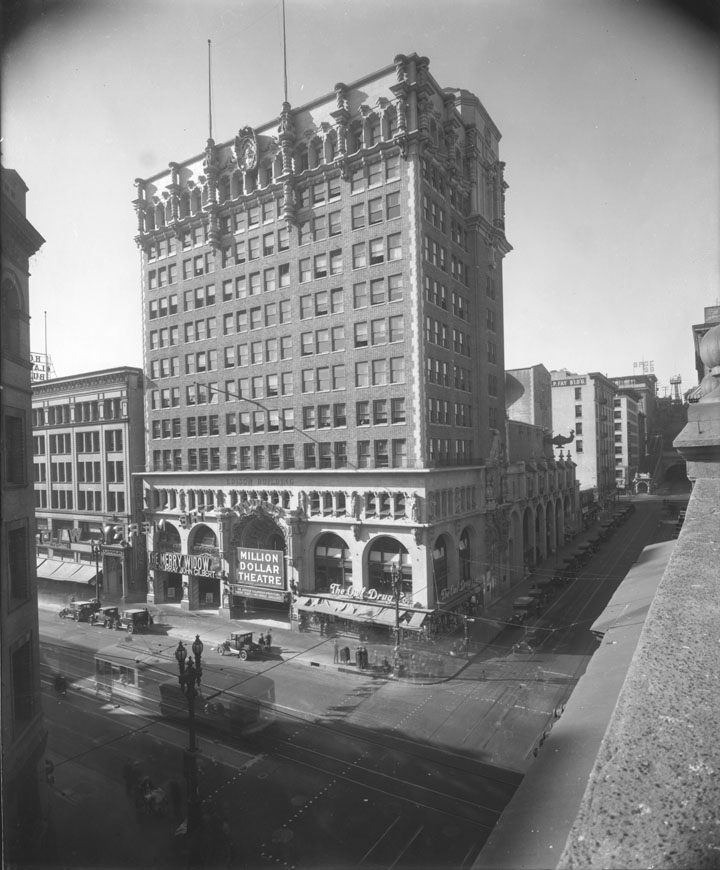
The extant Million Dollar Theater at back.  (c) 2012 Microsoft Corporation, Pictometry Bird’s Eye (c) 2010 Pictometry International Corp.

California State Library

The Million Dollar Theater at 3rd and Broadway – California State Library

The scene continues with Harold stumbling over the parapet wall, and Mildred helping him to his feet.  This was filmed atop the Washington Building mentioned above, at the NW corner of 3rd and Spring (arrow in modern view). Behind them stands the Million Dollar Theater built in 1917 by Sid Grauman, who would later build his famous Egyptian (1922) and Chinese (1927) theaters in Hollywood. The theater’s distinctive dome tower (box) has been a downtown landmark for over 95 years. The five-story Bradbury Building (oval) lies behind them out of view.  Notice the Bradbury’s large glass atrium roof.

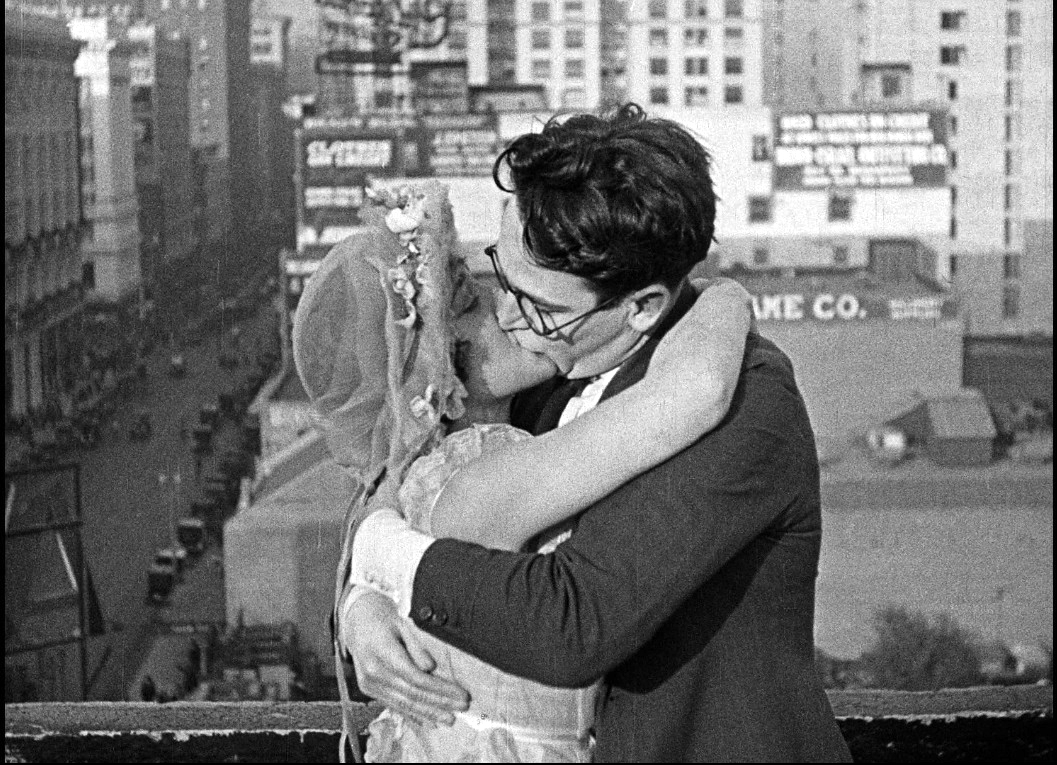
q11111111111For their climatic kiss, Harold and Mildred return to 908 S. Broadway, the same building where Lloyd had previously staged the sequence hanging from the hands of the clock.  This setting is readily confirmed by the distinctive wall signs appearing in the background, including the extant sign for J. EPSTEIN LADIES TAILOR on the wall of 820 S. Broadway.  Harold and Mildred were married in real life on February 10, 1923, a few weeks before the movie’s April 1, 1923 premiere.

The final shot from the movie (below) showing Harold and Mildred walking off into the sunset was also filmed on the roof of 908 S. Broadway.  The matching contemporary image is from the 2013 Locations and Effects documentary Academy-Award winning visual effects supervisor Craig Barron and I prepared as a supplement to the Criterion release.  The view in each image looks to the Blackstone Department Store Building across the street.

The final scene from Safety Last! (explanation to follow)

Click to enlarge.  The final scene from Safety Last!, with Craig Barron, center, and the author at right, as they appear in the Locations and Effects documentary included with the Criterion release.

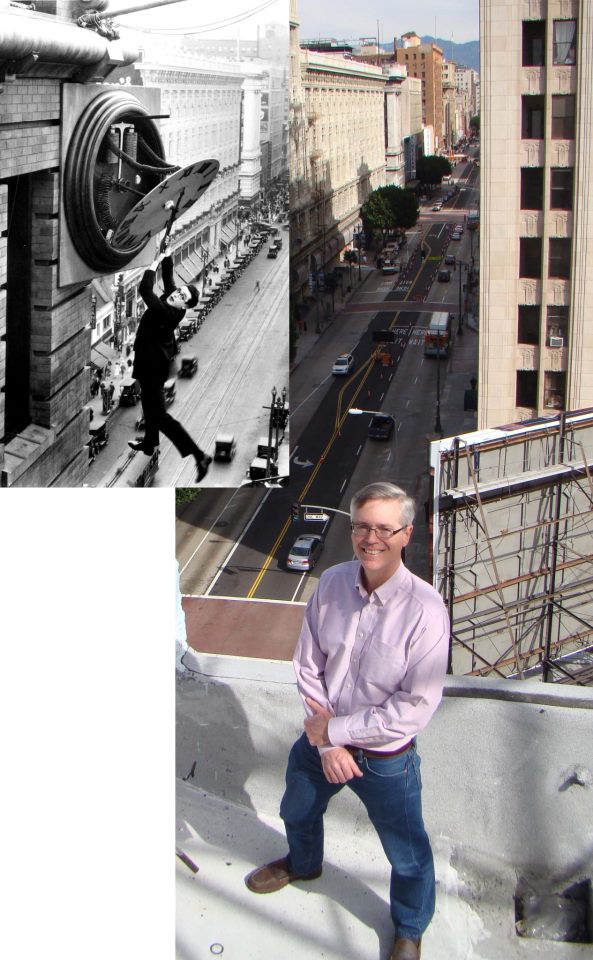
The author at 908 S. Broadway.

The author at 908 S. Broadway.

Based on the geometry of the publicity photographs and movie scenes, Lloyd must have built the clock-facade set on the roof of the small structure facing Harold in the above shot, the same small structure behind Craig’s right hand.  As part of the new Criterion documentary, Craig has prepared an amazing 3D simulation revealing how the clock stunt effect was created.  For an extra measure of authenticity, Craig, Harold Lloyd’s granddaughter Suzanne Lloyd, and I each filmed our interviews for the Criterion release in the basement of 908 S. Broadway, the building where Harold’s most famous scenes were filmed.  It was an honor, and great fun, working on the program, and I hope you will check it out.  A portion of the program appears below.

HAROLD LLOYD images and the names of Mr. Lloyd’s films are all trademarks and/or service marks of Harold Lloyd Entertainment Inc. Images and movie frame images reproduced courtesy of The Harold Lloyd Trust and Harold Lloyd Entertainment Inc.  Locations and Effects (C) 2013 The Criterion Collection.

To learn more about how Harold Lloyd filmed Safety Last! be sure to check out my other posts, and my book Silent Visions.

908 S. Broadway is now home to fashion jewelry designer Tarina Tarantino’s Sparkle Factory.  Tarina and her husband Alfonso Campos were so gracious to allow us to film there.

The map below identifies the three extant buildings in this post from which Harold filmed scenes for Safety Last!  D marks the spot of the former triangular two-story Los Angeles Investment Co. Building near Broadway and Olympic, where Lloyd built the first (and lowest) of three rooftop stunt climbing sets.

Posted in Harold Lloyd, Lloyd Thrill Pictures, Los Angeles Historic Core, Safety Last! | Tagged , , , , , , , , , , , , , , , | 10 Comments

Leave it to Harold (and Beaver) at the Long Beach Pike

pan 0101In a prior post I wrote how an idyllic Skokie, Illinois street once stood in for Mayfield on Leave It to BeaverAlthough that episode has no connection to silent movies, I was surprised to see that the Season 5, Episode 21 installment “Beaver’s Fear” does.  During the show older brother Wally and his cool older friends allow young Theodore to tag along on their trip to the “Bell Port” amusement park in order to qualify for a group discount.  Shaken by Eddie Haskell’s constant teasing, Beaver has doubts about withstanding the roller coaster, but in the end Beaver has a great time, while Eddie freaks out, and must be carried bodily from the coach at the end of the ride.

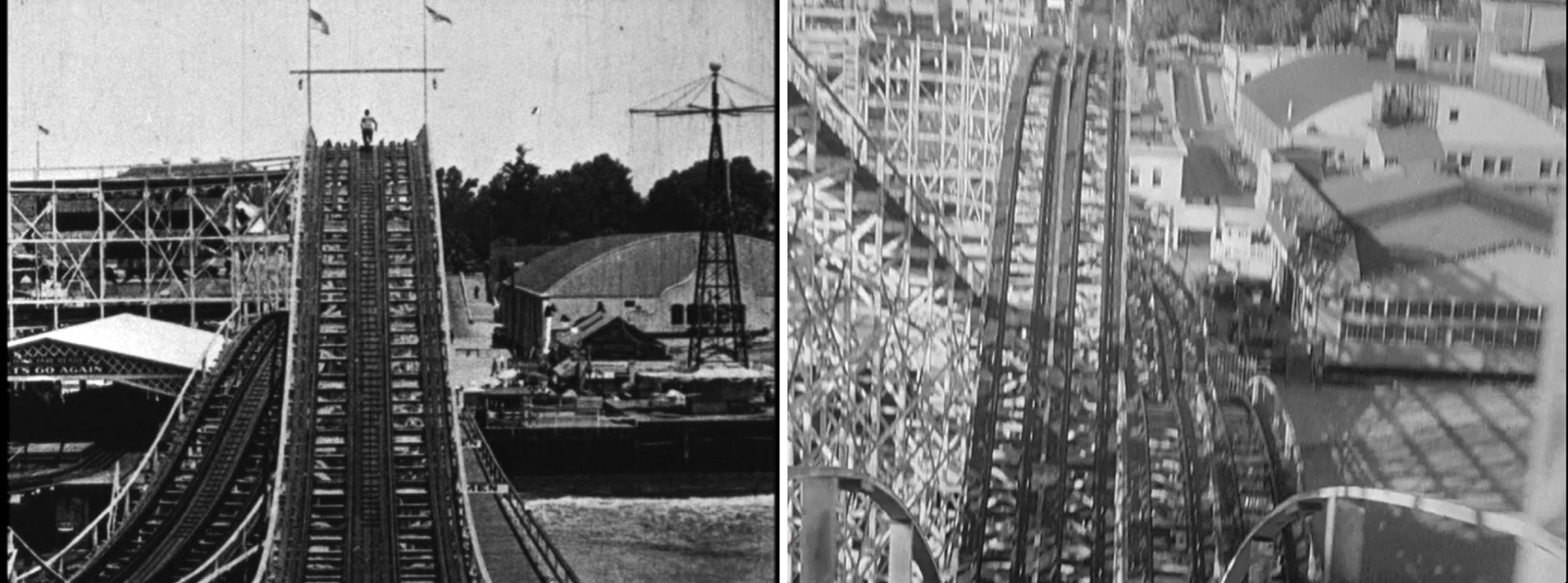
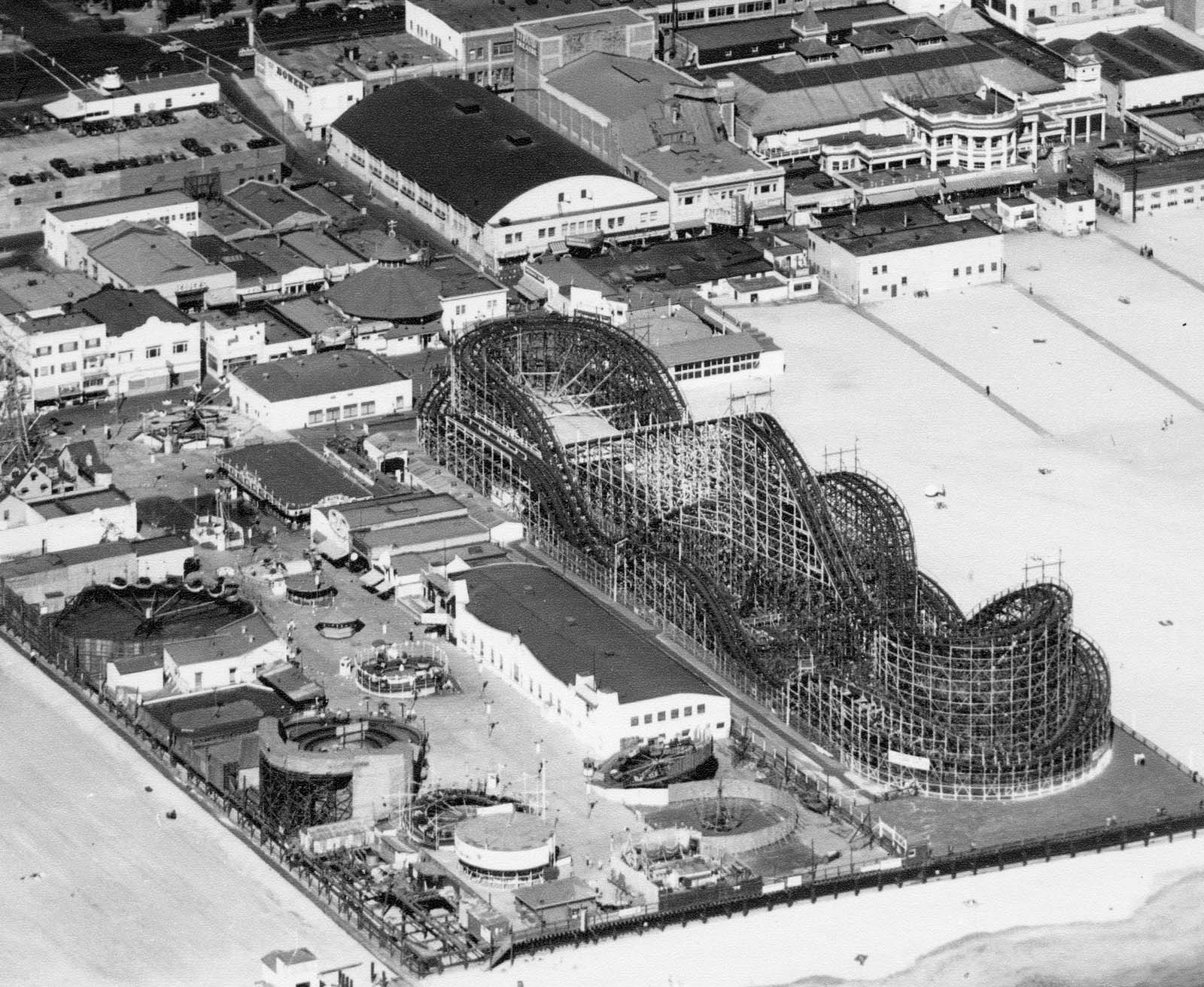
The former Cyclone twin-track racing roller coaster at the Long Beach Pike (1915-1968) stood in for the Bell Port attraction.  Although the rear projection footage is about as convincing as Ken Osmond’s acting during the scene (see both above), it nonetheless provides a fascinating photographic record of the long lost coaster, one of the last twin-track (or racing) coasters in the country at the time of its demise.

Click to enlarge.  The Loff Hippodrome tower, housing the Pike Carousel, appears behind Harold Lloyd

Click to enlarge. The Loff Hippodrome tower, housing the Pike Carousel, appears behind Harold Lloyd during a scene from Number Please? (1920) to the left, and in the Beaver episode to the right.

The twin racing coaster was originally called the Jackrabbit Racer at the time Harold Lloyd filmed Number Please? there in 1920, but was renamed The Cyclone in 1930 after it was upgraded with higher peaks and longer drops.  The Loff Hippodrome shown above and to the right housed a distinctive carousel that appeared both in Number Please? and in Buster Keaton’s 1920 comedy The High Sign.  My book Silent Visions explores in detail all of the beach-side amusement parks appearing in Lloyd’s films.

Lloyd was not the first comedian to feature the Pike’s star attraction in an early film.  Below, the Roscoe Arbuckle – Buster Keaton – Al St. John comedy The Cook (1918) also included many scenes shot on the twin-track coaster.

ca

Click to enlarge.  At left from The Cook, Al St. John streaks uphill between the twin tracks – to the right a matching shot from the Beaver episode.  The curved roof of the Majestic Ballroom (and skating rink) appears at back to the right in both images.

ca

A view of The Cyclone racing roller coaster.  The tower to the Loff Hippodrome appears due north of the coaster.  LAPL 00074673

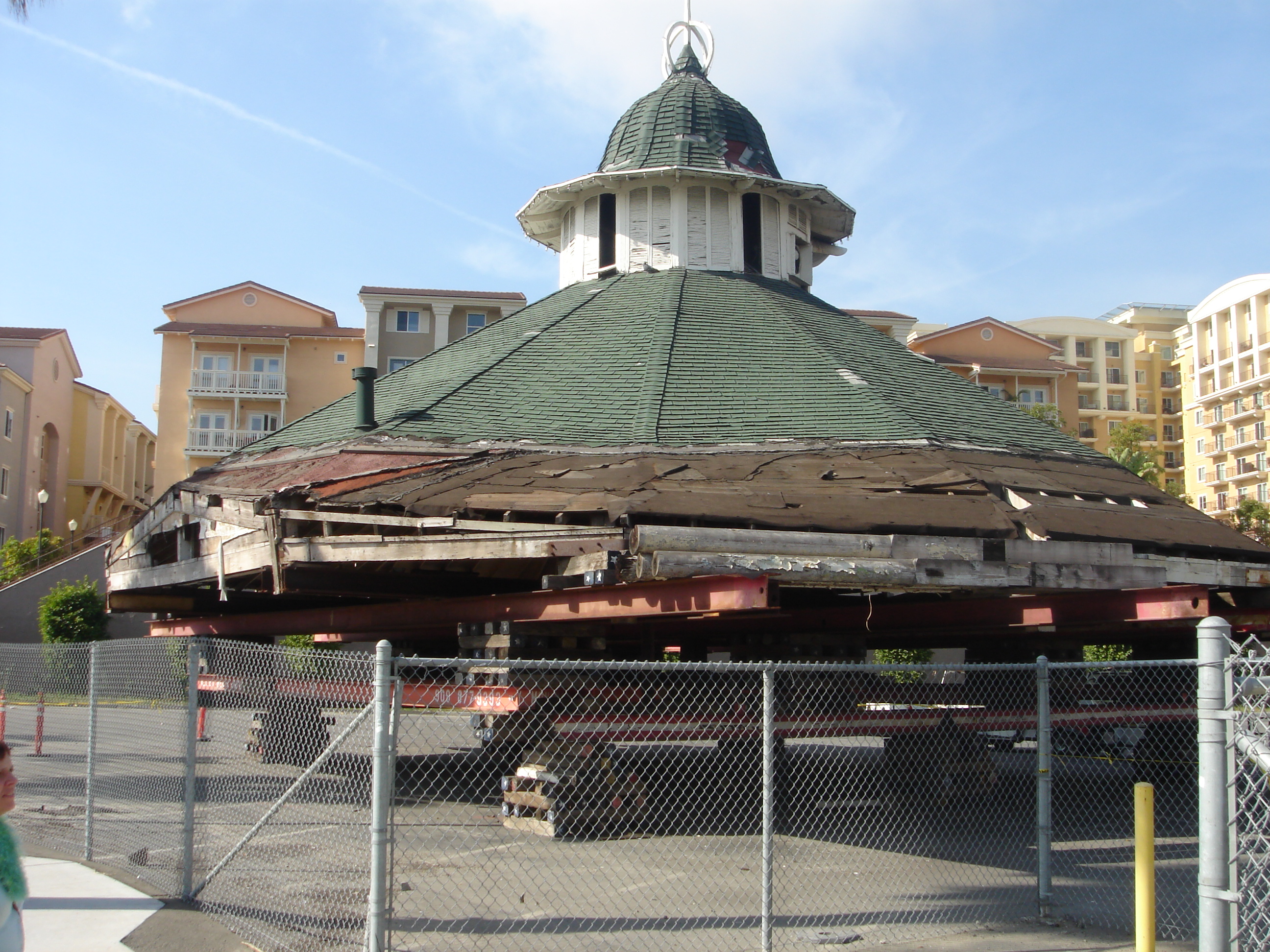
In one of my earliest posts, I write about the Long Beach Goatland attraction that appears during the Arbuckle-Keaton-St. John comedy The Cook, and how the surviving Loff Hippodrome roof and cupola tower (right) sits in a nearby parking lot.  Sadly, a check on Google Street View shows that the cupola is no longer there.  [[UPDATE: Reader Charles Rogers, below, writes that the cupola has been moved to some storage yard between the 710 freeway, 16th, Gaylord, and the Los Angeles River. You can see it behind a fence in Google Street View HERE.]] The Pike and Silver Spray Pier were torn down long ago, although the Rainbow Harbor entertainment center that stands there today (see below) has a Ferris Wheel.

Harold and Rich

Harold and Rich

Note: in a Six Degrees of Kevin Bacon connection, director Rich Correll, who as a young man was Harold Lloyd’s friend and film archivist, and who remains a leading Lloyd expert and staunch Lloyd proponent, had earlier been a child actor on Leave It to Beaver, portraying Beaver’s friend Richard Rickover.  Although Rich did not appear in the Bell Port amusement park sequence, he does appear in the same episode, providing another link between the show and the silent era.

HAROLD LLOYD images and the names of Mr. Lloyd’s films are all trademarks and/or service marks of Harold Lloyd Entertainment Inc. Images and movie frame images reproduced courtesy of The Harold Lloyd Trust and Harold Lloyd Entertainment Inc.

Leave it to Beaver – (C) 1962 Revue Studios.

Posted in Buster Keaton, Harold Lloyd, Leave It To Beaver, TV Shows | Tagged , , , , , , , , , , , , , , , , , , | 13 Comments

How Charlie Chaplin made The Kid (older post)

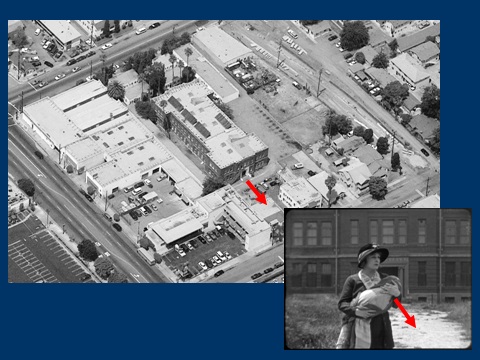
In an early post I uploaded a PowerPoint presentation highlighting some of the historic settings in Chinatown and the Plaza de Los Angeles where Chaplin filmed his early masterpiece The Kid (1921).  You can download the 60 MB file here.   In honor of The San Francisco Silent Film Festival’s January 11, 2014 screening of The Kid, I am presenting a few static images from this presentation.  You can read about all of the locations, many not covered here, in my book Silent Traces.

01

02

03040506

07

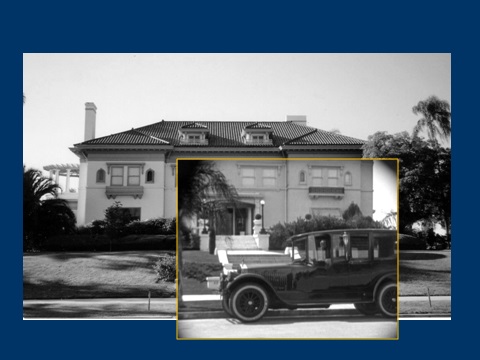
Here is a post about The Artist being filmed at the Pickford Mansion and The Kid mansion.

08

09 10 11 12 13 14 15 16 17 Ducommun slide 19 20

21 22

Here is a full post about Chaplin filming The Kid on Olvera Street

23 24 25

All images from Chaplin films made from 1918 onwards, copyright © Roy Export Company Establishment. CHARLES CHAPLIN, CHAPLIN, and the LITTLE TRAMP, photographs from and the names of Mr. Chaplin’s films are trademarks and/or service marks of Bubbles Incorporated SA and/or Roy Export Company Establishment. Used with permission.

Posted in Charlie Chaplin, Chinatown, The Kid | Tagged , , , , , , , , , , , , , , | 4 Comments

On the Fence – Keaton’s stunts in Cops and Our Hospitality

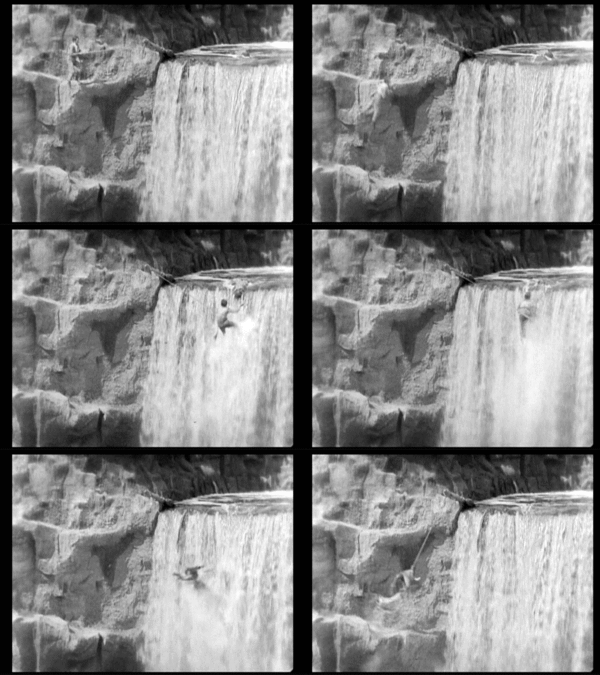
picasion.com_5a5de6ea85d3581e8a74c655aa7a919aIn a recent post I showed how Buster Keaton staged his daring waterfall rescue from Our Hospitality (1923).  In honor of the Los Angeles Chamber Orchestra’s presentation of Our Hospitality this June 8 at Royce Hall on the UCLA campus, here is another circa 1920s view of the “T” shaped pool on the former Brunton Studio backlot, now part of Paramount, where Buster filmed this amazing stunt.

http://www.flickr.com/photos/49487266@N07/7143228635/in/photolist-bTdV1p-8miiJe

Click to enlarge – San Diego Air and Space Museum

On the fence

On the fence

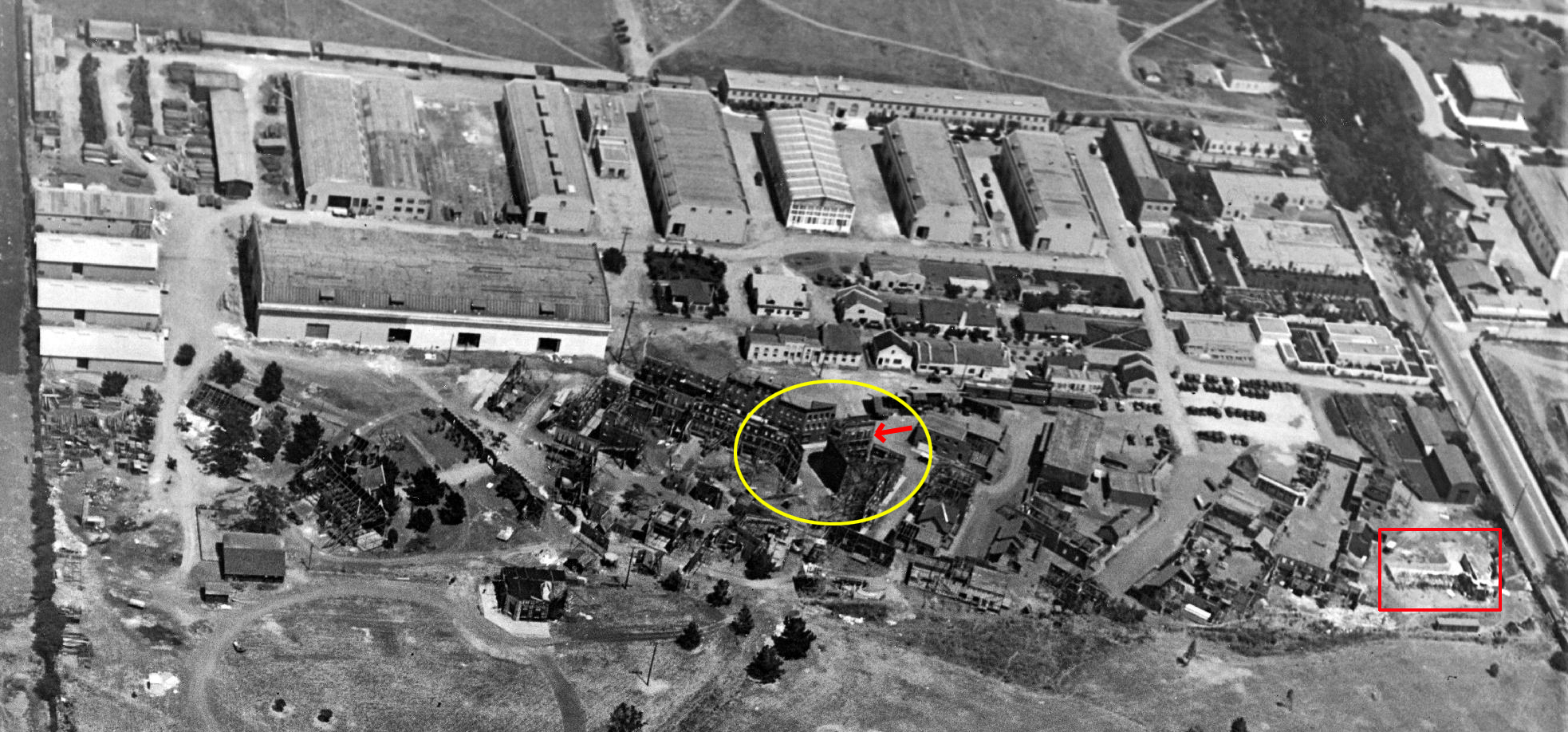
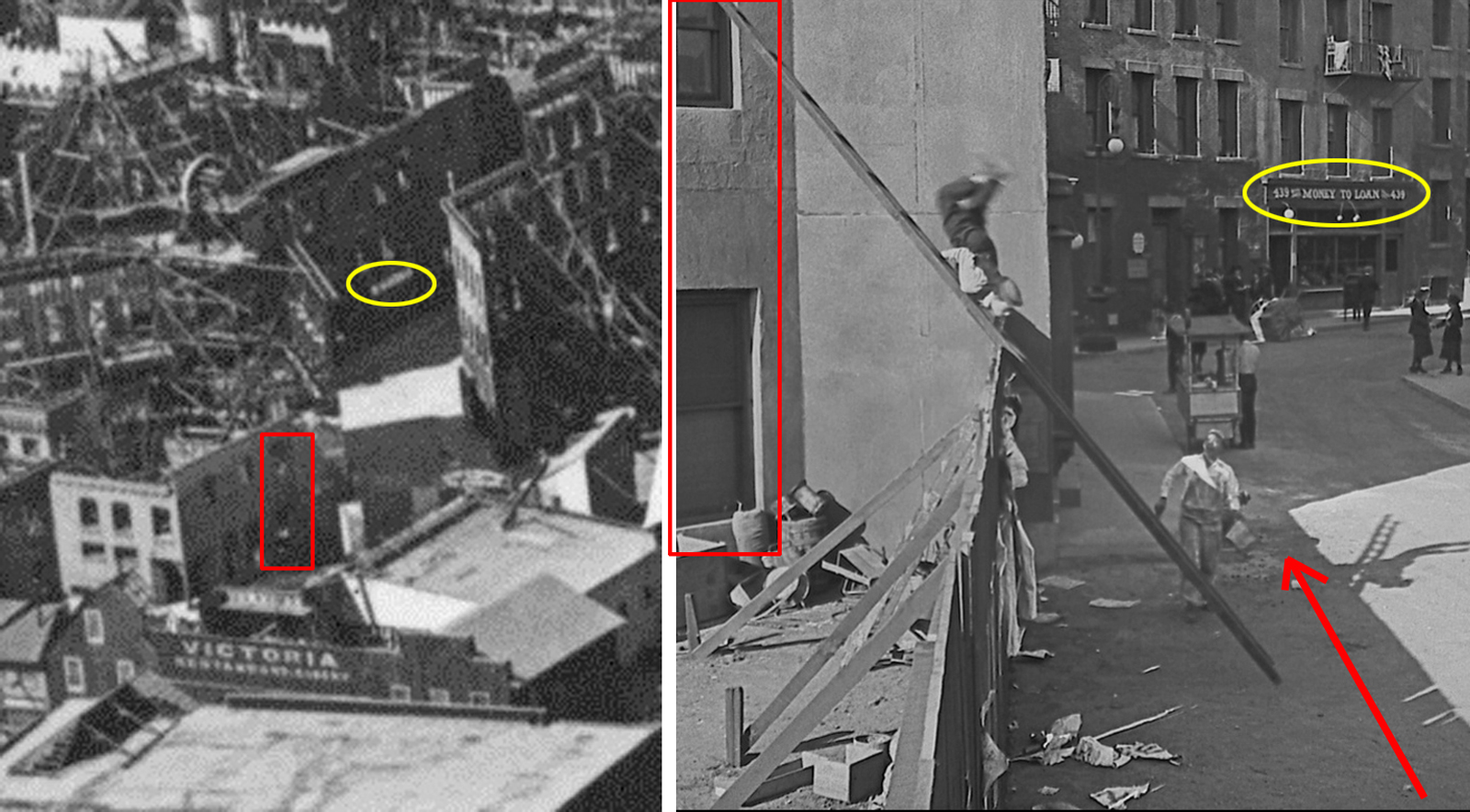
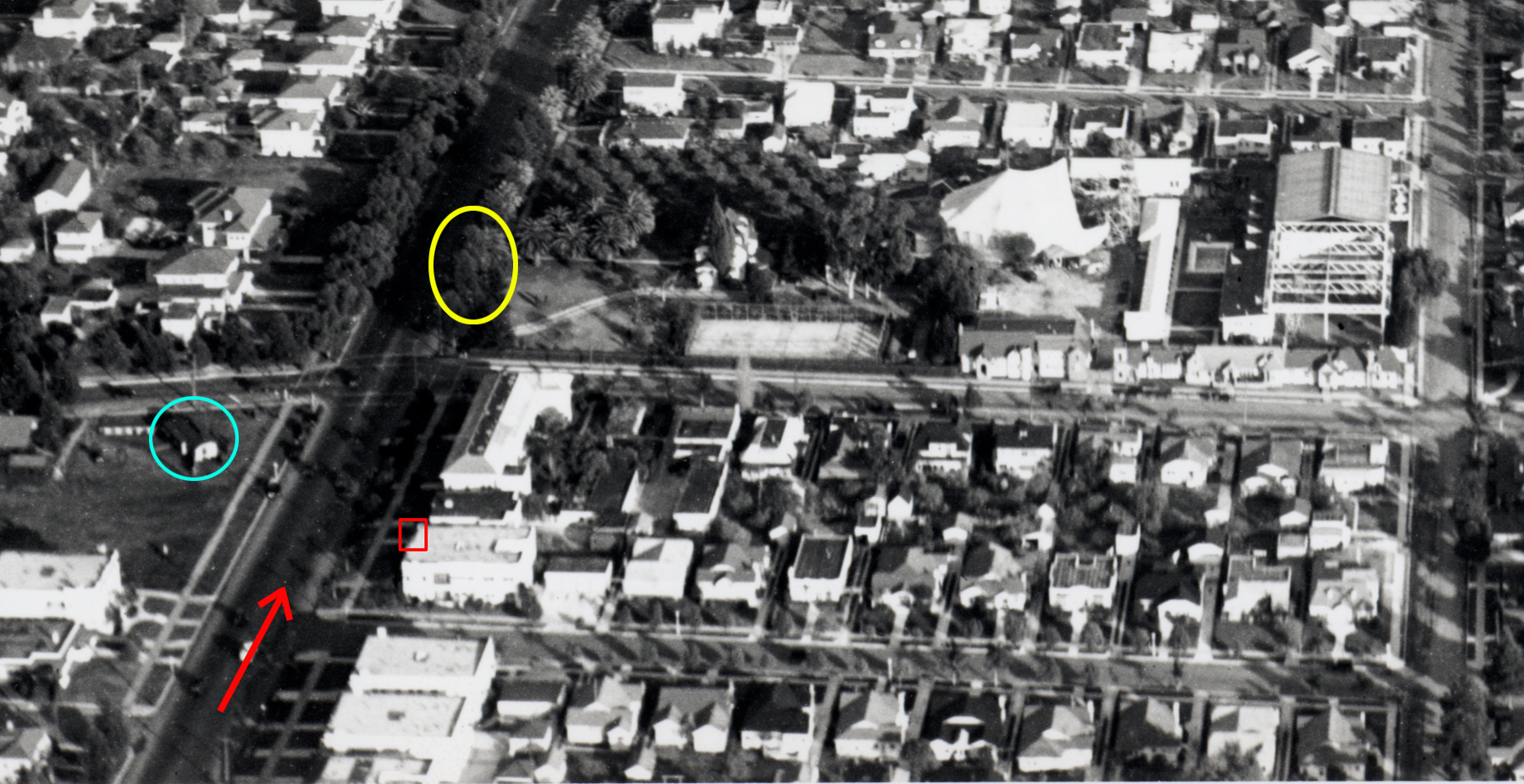
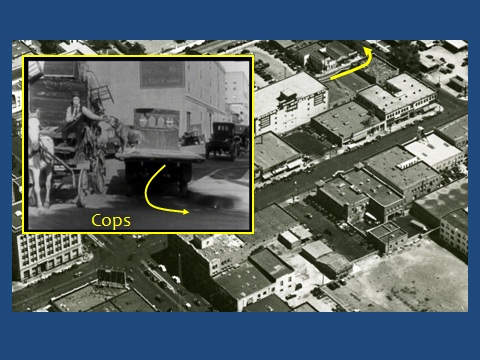
The above view looks east – the red box marks the “T” shaped plunge near Melrose Avenue running along the far right.  The yellow oval above marks a “Y”-shaped urban set that Buster used for a famous stunt on top of a fence (at left) in his 1922 short comedy Cops.  Below, another view of the plunge (red box) and urban set (yellow oval), this time looking north from Melrose along the bottom towards the Hollywood Forever Cemetery at the top.

Click to enlarge

Click to enlarge hollywoodphotographs.com

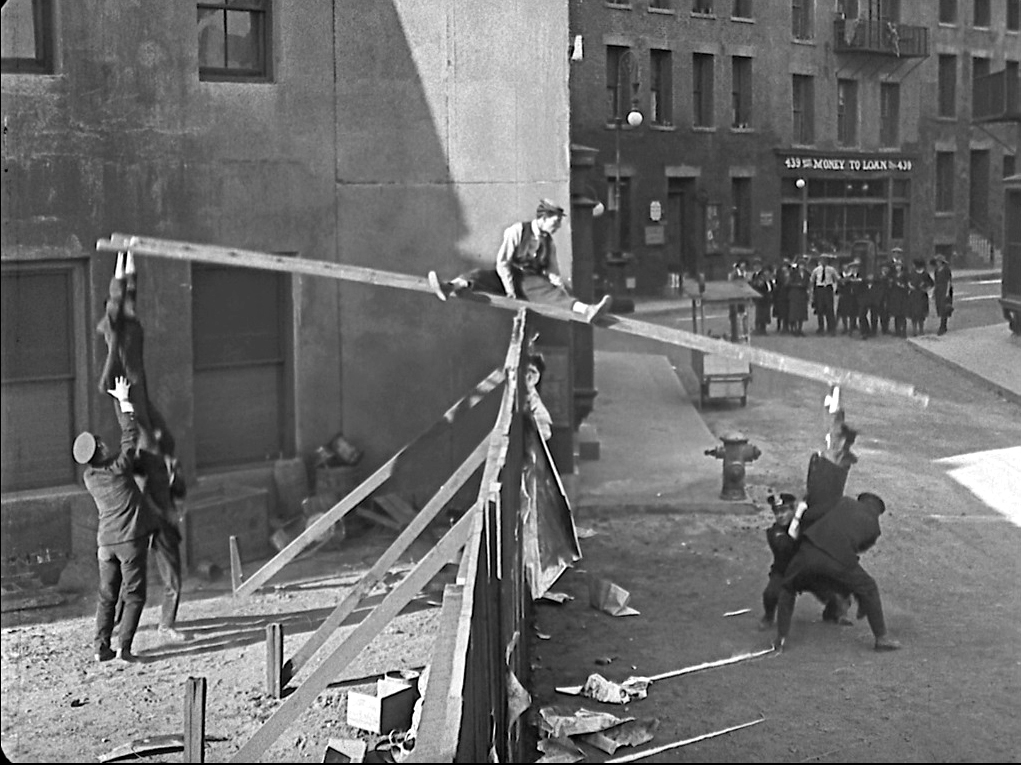
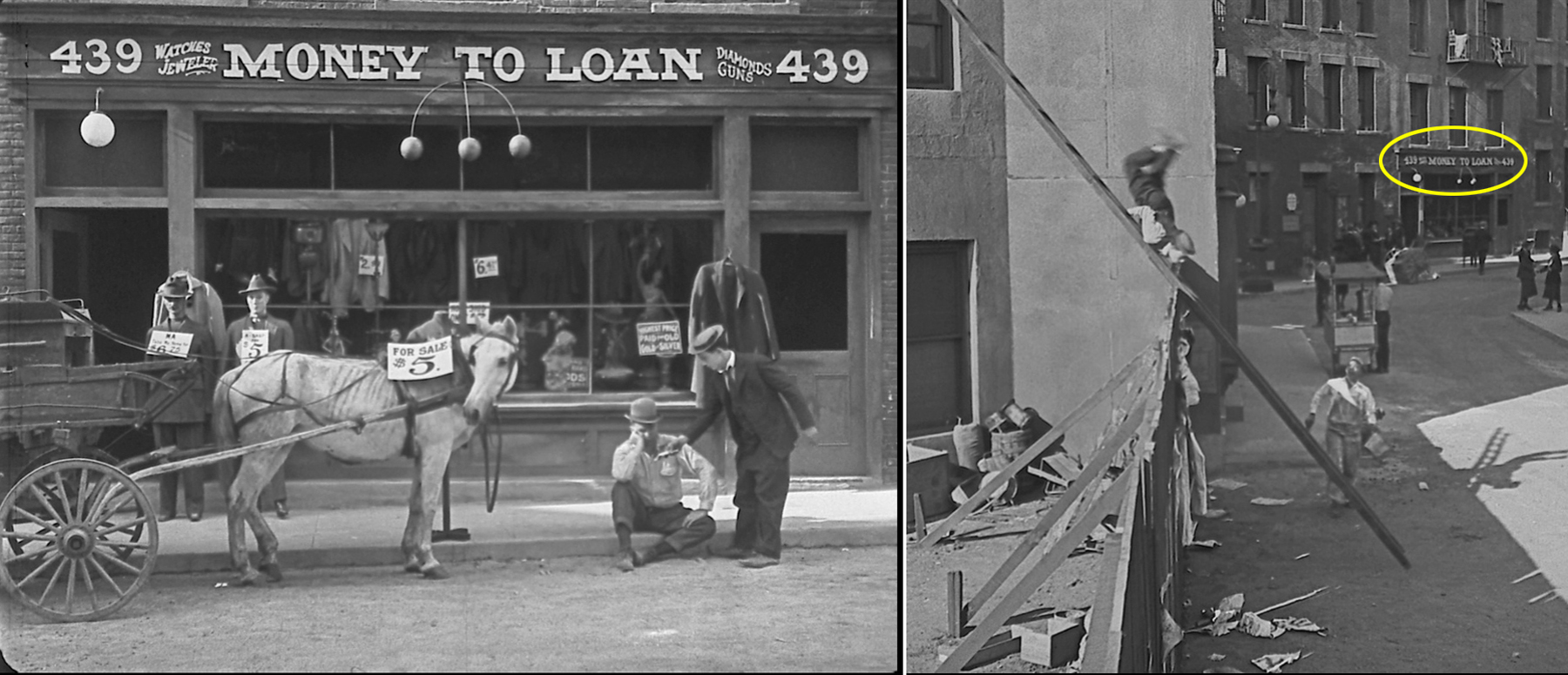
Early in the movie Cops, Buster mistakenly believes he has purchased a horse and wagon from a street bum for $5.00.  Behind them is a “MONEY TO LOAN” pawn shop set.  This same set appears during Buster’s fence stunt.

Cops backlot pan 1

Zooming in on the above northern looking aerial view, we get a direct view of where Buster filmed these scenes from Cops.

ca

Click to enlarge.  The directional arrow matches the arrow in the top-most aerial view.

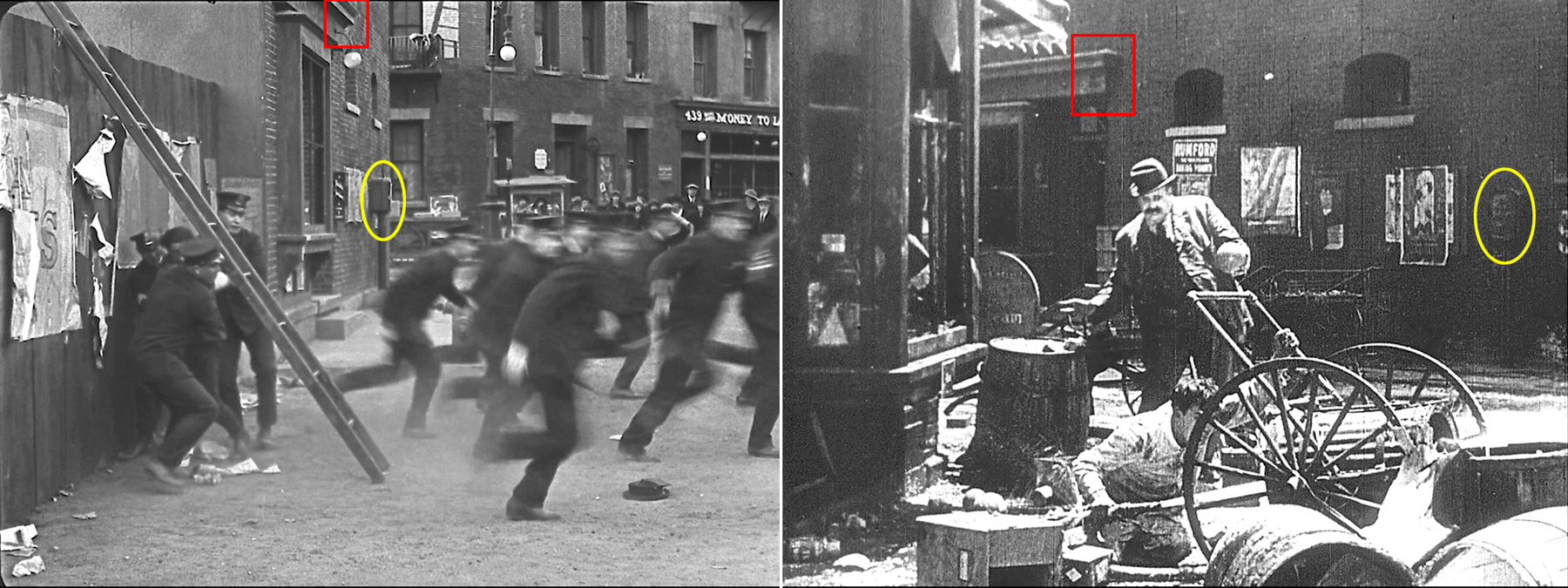
Buster also filmed scenes from his later comedy short Day Dreams (1922) at the same urban street set on the former Brunton backlot (see below).

Both from Day Dreams.  The view to the left looks south along the Brunton Studio

Both from Day Dreams. The view to the left looks south along the Brunton Studio “Y”-shaped street set – the Cops fence location is out of view around the corner to the left.  The “MONEY TO LOAN” sign appearing behind Big Joe Roberts at the right is marked with a yellow oval on the left.

The views above show how Buster used the “Y”-shaped street set for Day Dreams. Below, we can see portions of the Cops set as it appears in Day Dreams.

ca

Click to enlarge.  The same entrance cornice (red box) and policeman’s call box (yellow oval) appear in both Cops to the left and Day Dreams to the right.

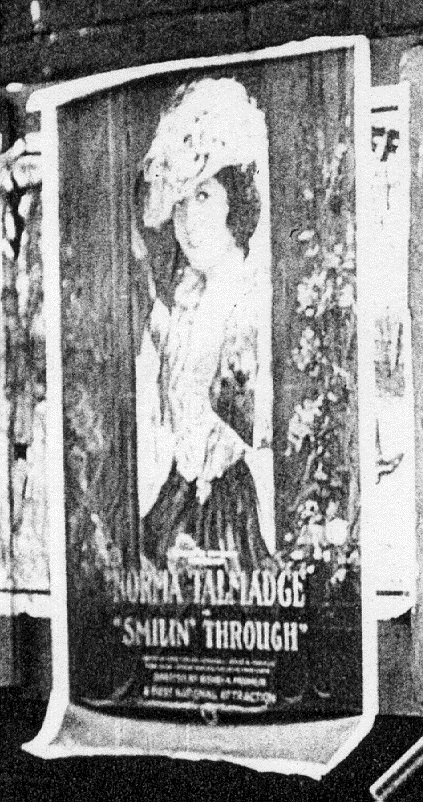
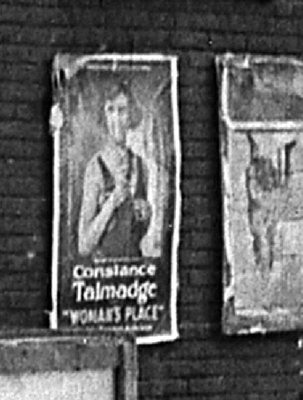
NormaThe matching views above show how the elements from the Cops fence set appear in Buster’s later film Day Dreams.  Buster used the same “Y”-shaped set further in Day Dreams for the failed-thespian sequence where Buster is physically kicked out of a theater.  As a discreet homage to his two sisters-in-law, the famous actresses Norma and Constance Talmadge, Buster placed movie posters from their films on the theater wall.  This poster (left) from Norma’s 1922 feature Smilin’ Through can be seen in the right movie frame above, just to the left of the yellow oval.  Also featured is a poster for Constance Talmadge’s 1921 rom-com Woman’s Place.dd 28

I explain on bonus features of the Kino-Lorber Keaton Short Films collection, and hope to write here in future posts, how Buster also filmed scenes from Cops on the backlots of the former Metro Studio, directly across the street from his own small studio in Hollywood, and at the Goldwyn Studio in Culver City.

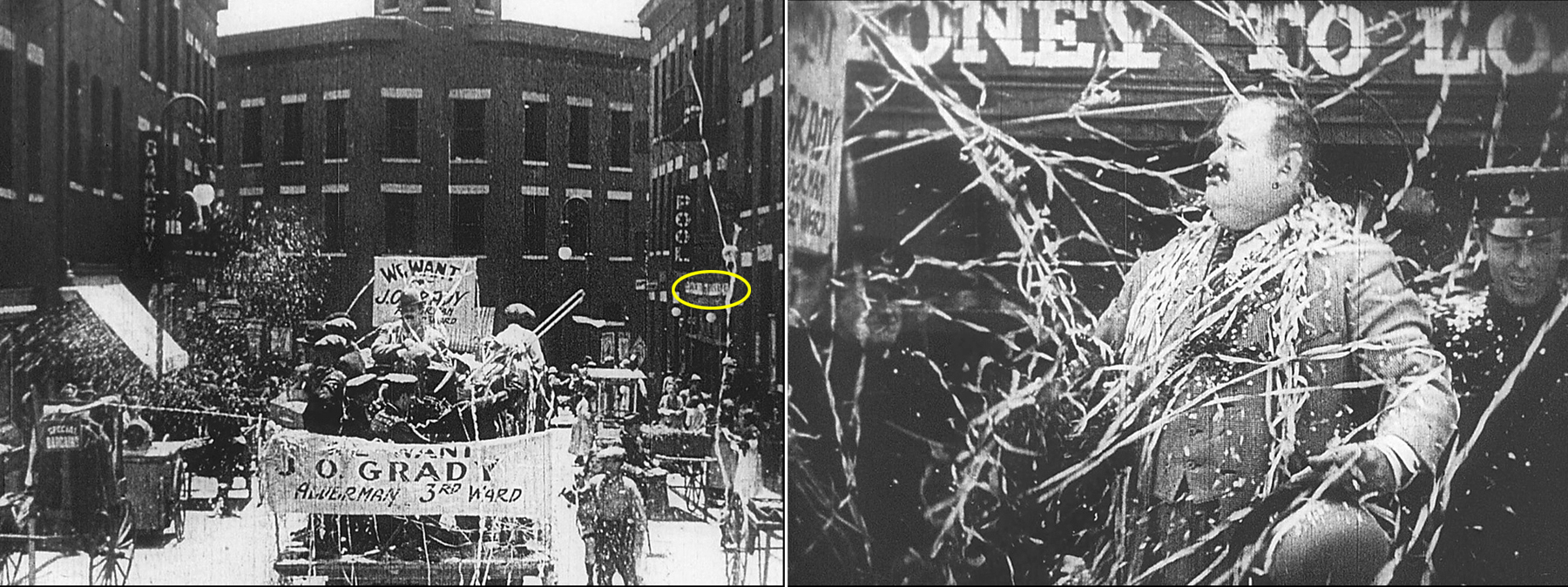
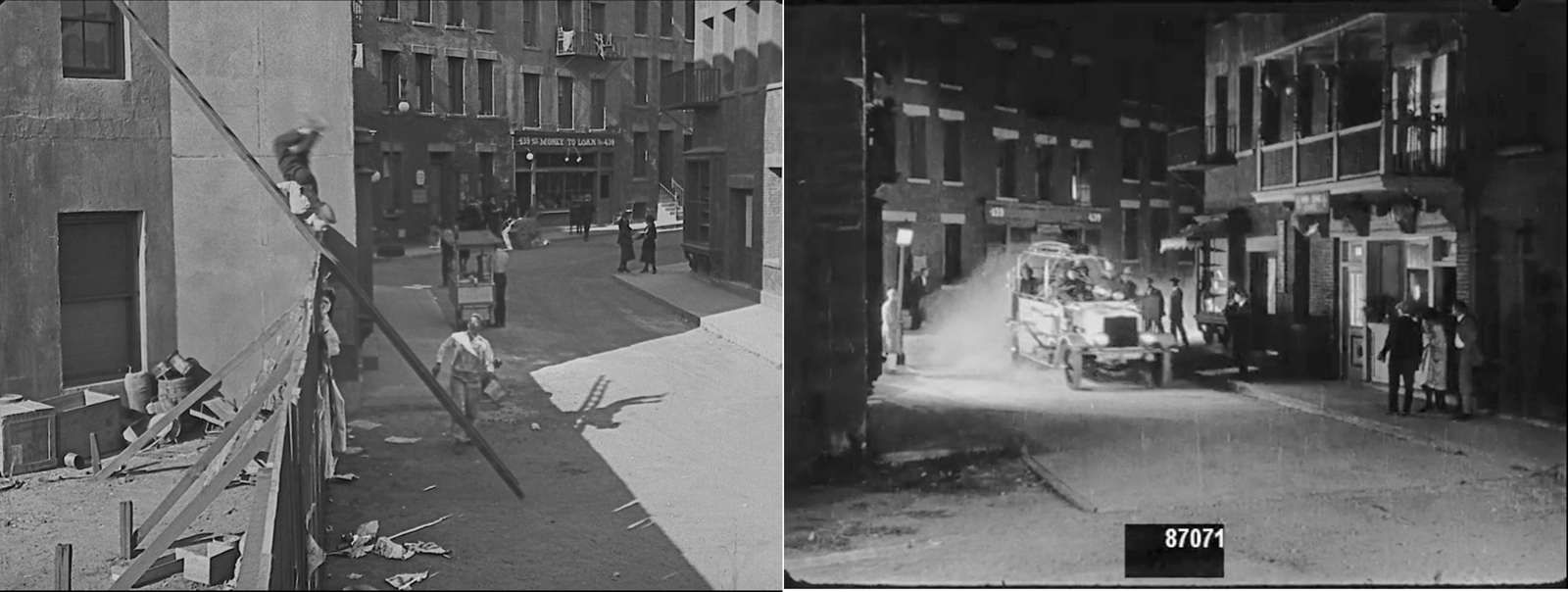
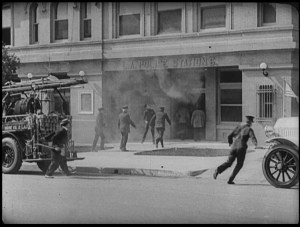
PS – as I write HERE, the 1925 crime-busting newspaper drama The Last Edition, that re-premiered at the 2013 San Francisco Silent Film Festival, provided the visual link to show that Charlie Chaplin filmed The Kid, Buster Keaton filmed Cops, and Harold Lloyd filmed Safety Last! all at the same alley in Hollywood.  As shown below, the drama also filmed a racing firetruck at the Brunton Studio where Buster filmed the fence stunt in Cops.

You can read all about Buster filming Cops at the Brunton Studio at this link HERE

Buster early in 1922 – The Last Edition in 1925 – you can still read the 439 address at back.

Cops, Day Dreams, and Our Hospitality licensed by Douris UK, Ltd.

The blue square in the Google aerial view below is the current Paramount Studios pool/parking lot.  The Brunton plunge stood to the lower right of the corner of Windsor Blvd. and Valentino Pl.
Posted in Buster Keaton, Cops | Tagged , , , , , , , , , , , , , , | 12 Comments

Keaton location to be demolished – photo help?

I just discovered where Keaton filmed a scene from Cops (1922), as Big Joe Roberts retrieves his wallet from Buster (but not its cash contents) by leaning out to grab it from a passing taxi.  The scene was filmed at the corner of Sunset and Detroit, a block diagonally from the Chaplin Studio.

Cops Sunset at Detroit pan

One apartment appearing in the scene is (momentarily) still standing, but I found online that a demolition permit for the building was issued just last week, on May 24, 2013.  [Update: the building site was completely demolished in early September.] The view looks east down Sunset from Detroit. The yellow oval marks the trees along Sunset in front of the mansion, north of the Chaplin Studio on La Brea, where Charlie’s brother Syd resided.

Click to enlarge. The red box and yellow oval match the above movie frame. The Chaplin Studio backlot shows a half-circus tent set built for Chaplin's 1928 feature The Circus     Click to enlarge. The red box and yellow oval match the above movie frame. The Chaplin Studio backlot shows a half-circus tent set built for Chaplin's 1928 feature The Circus

Click to enlarge. The red box and yellow oval match the above movie frame. The blue oval is a small real estate office, see below.  The Chaplin Studio backlot shows a tent built for Chaplin’s 1928 feature The Circus

Notice the little girl watching, sitting on the corner, and the telephone lineman above her.

Buster rides off with Joe’s taxi and cash.  Notice the little girl watching, sitting on the corner, and the telephone lineman above her. The corner real estate office (blue oval) appears in the aerial view above.

The apartment at 7130 W. Sunset Blvd. will not be standing much longer, but perhaps some Keaton fan in the Hollywood area could dash over and take some photos before it disappears.

This is the first time in 15 years that I have become aware of a location at the same time its demolition was imminent.

Thank you for any help –
John Bengtson

PS – no matter what, I love the fact that Buster filmed this scene around the corner from the Chaplin Studio!  Some how knowing this makes me appreciate Cops, Charlie, and Buster all the more.

UPDATE: As shown below, these two scenes with Joe’s wallet were filmed miles apart, here at Sunset and Detroit, and at the Bergstrom estate at 590 N. Vermont, where Harry Houdini filmed The Grim Game in 1919.

Cops pan 02

Sunset at Detroit (left) and 590 N. Vermont (right).

M. David Mullen ASC

A last view before the wrecking ball. Photo – M. David Mullen ASC

Cops licensed by Douris UK, Ltd.

Google Street View of the new construction.

Posted in Buster Keaton, Chaplin Studio, Cops, Hollywood Tour | Tagged , , , , , , , , , , | 15 Comments

How Harold Lloyd Filmed Safety Last (the parts on the ground)

Hollywood Boulevard and Cahuenga - circa 1922

Click to enlarge – Hollywood Boulevard and Cahuenga – circa 1922

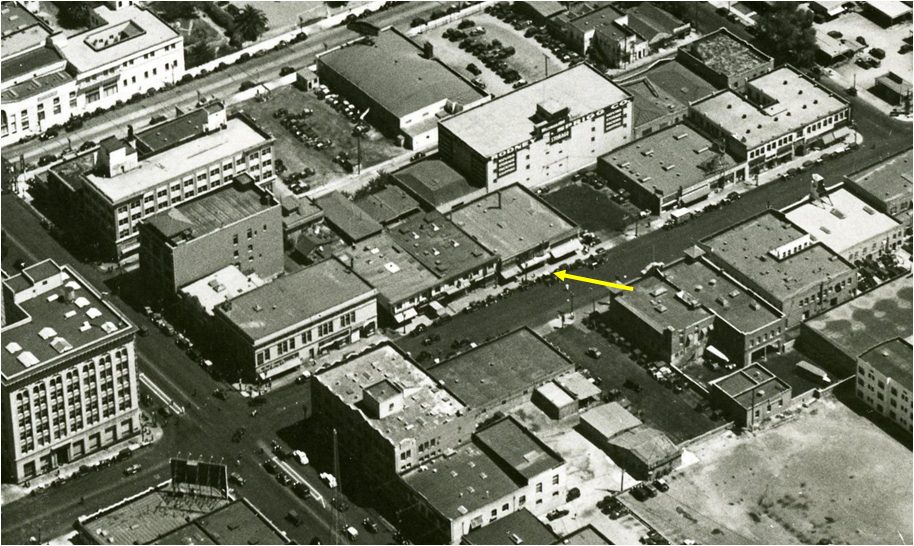
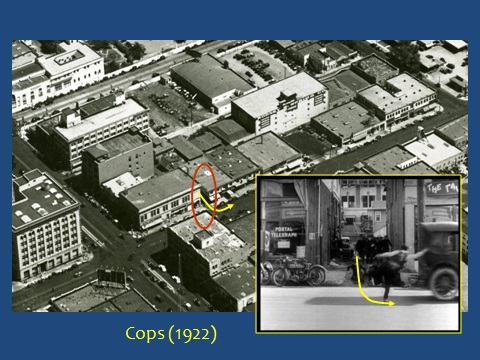
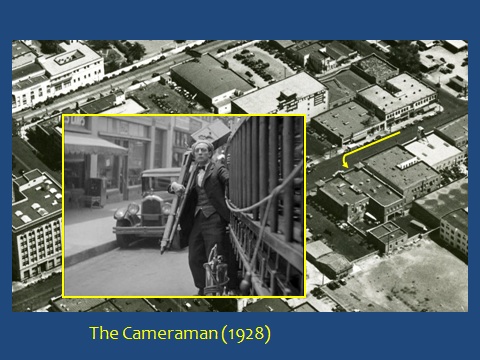
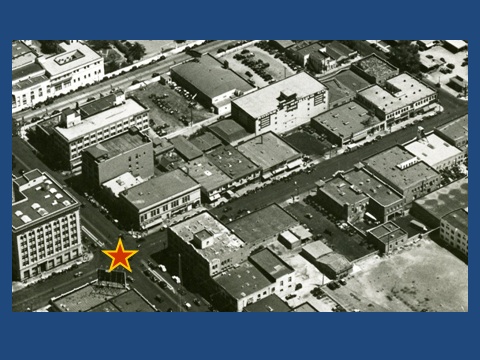
fast picasion.com_53e1010fe992a49c23ce86710a38857bThe alleys at the SE corner of Hollywood Boulevard and Cahuenga are certainly the most historically significant silent film locations in town.  The yellow arrow above marks the alley entrance from which Buster Keaton grabs a passing car one-handed in Cops (1922).  But the back of the same alley portrayed the employee entrance of the De Vore Department Store (red box above), where Harold Lloyd’s character works in Safety Last! (1923).  I explain how Harold filmed the hanging-from-the-clock stunt in Safety Last! at this post, and how Cosmos Street, the alley connected to the alley shown here, also appears in Safety Last! and Cops at this post.  But we’ll focus now on how two of the most iconic silent film comedies were filmed at the same spot. [Note: in a later post I show that Charlie Chaplin also filmed scenes from The Kid (1921) here – three masterpieces at the same spot you can still visit today.]

a pan 1

To begin, in Safety Last! go-getter Harold always arrives early for work, but finds himself, after a moment’s distraction, locked in the back of a laundry wagon, with a deaf teamster at the wheel unable to hear Harold’s cries for help.  As shown above, the wagon turns south from the “Cops” alley onto Cosmo Street.  The Markham building to the left has been re-modeled over the years (in fact the upper floor has been removed), but the Palmer Building at back (once home to the Hollywood Daily Citizen newspaper) confirms the location.

a pan 2

Later in the film, Harold formulates a plan to sneak into work late, by posing as a store mannequin.  The red boxes show matching elements of the Palmer Building.

a pan 3

You can see matching window elements on the Palmer Building in this view from Cops.  As evident, the building was still under construction when Buster filmed here early in 1922, but was completed by the time Harold filmed late that same year.  The building on the left side of the alley was rebuilt in the 1930s, causing the alley to become a bit more narrow.

a pan 4

In Safety Last! Harold convinces his room-mate Bill Strother to play rough-house with a policeman who was Harold’s friend back home.  Bill knocks down the wrong cop, played by Noah Young, who ends up chasing Bill for the remainder of the film.  This establishing shot above of Harold’s policeman friend was filmed looking north up Cosmo Street at the SW corner of the Palmer Building.  It matches the yellow oval on the top aerial view.

today pan 5

This shot of Noah Young knocked to the ground looks west down the Cops alley (arrow), the same point of view Buster saw when he ran down the alley preparing for his amazing stunt.  Note: time does not stand still.  The alleyway marked with the arrow has recently been closed to vehicles to make room for outdoor dining, and the driveway on Cahuenga leading into the Cops alley is now blocked to traffic with a raised curb and pedestrian sidewalk.

Image2

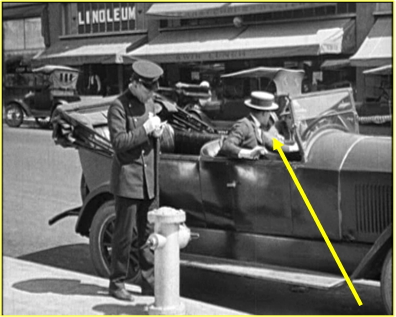
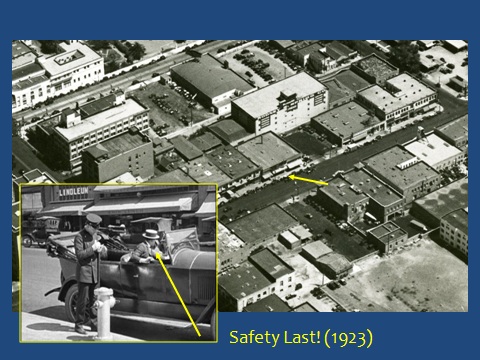
Image3Safety Last! also contains a number of early scenes filmed on Cahuenga.  At the left, a man giving Harold a lift back to work is ticketed for parking in front of a fire plug.  The buildings behind Harold stand on Cahuenga a bit south of the Cops alley, while the arrow corresponds to the aerial view above.  The fire plug stood in front of the former joint fire/police station once located at 1625-1929 Cahuenga, that appeared in Buster Keaton’s feature films Three Ages (1923) and The Cameraman (1928).  You can read more about the former fire/police station at this post.

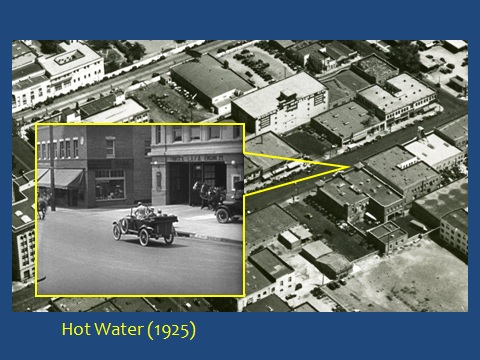
132 - Image3 cThe movie frame at the right, from Harold Lloyd’s Hot Water (1924), shows the front of the fire station, and the same fire plug (red oval) that appears in the Safety Last! frame above.

Aerial photographs from HollywoodPhotographs.com.

A short segment from the Locations and Effects 2013 documentary with Academy-Award winning effects supervisor Craig Barron and the author filmed for the Criterion Collection release of the Safety Last! Blu-ray appears below.

HAROLD LLOYD images and the names of Mr. Lloyd’s films are all trademarks and/or service marks of Harold Lloyd Entertainment Inc. Images and movie frame images reproduced courtesy of The Harold Lloyd Trust and Harold Lloyd Entertainment Inc.  Cops licensed by Douris UK, Ltd.

A view west down the Cops alley from Cosmo Street.

Posted in Buster Keaton, Cops, Harold Lloyd, Hollywood Tour, Lloyd Thrill Pictures, Safety Last! | Tagged , , , , , , , , , , , , , , , | 7 Comments

Douglas Fairbanks, Edge of Doom, and Film Noir

Click to enlarge. Looking east down 1st Street from the former City Jail (at right)

Click to enlarge. Looking east down 1st Street towards Broadway from the former City Jail (at right)

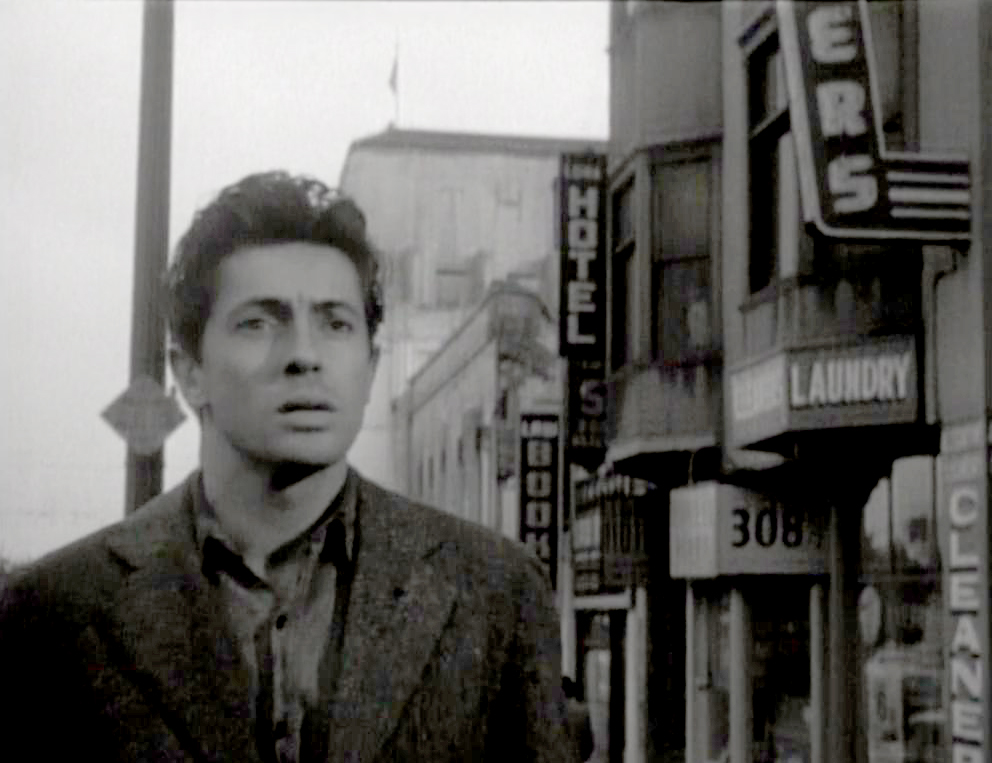
Farley Granger in Edge of Doom

Farley Granger in Edge of Doom.  The twin bay windows to his left appear in the center, above.  The “modern” Los Angeles Times Building, that opened in 1935, stands tall in the far background.

During Douglas Fairbanks’ 1916 short comedy The Mystery of the Leaping Fish (part of the Fairbanks Modern Musketeer DVD set from Flicker Alley), a police van races from HQ down a quaint, post Victorian era Los Angeles street.  Thirty-four years later, the same setting appears in the bleak film noir drama Edge of Doom, the same film, as I explain in this prior post, that shares a common setting on Witmer Street with both Harold Lloyd’s 1928 comedy feature Speedy, and the popular contemporary television sit-com The Office.  As shown here, both the 1916 Fairbanks movie and the 1950 drama contain scenes filmed at the former Los Angeles City Jail (1897-1954) that once stood at 320-330 1st Street between Hill and Broadway.

ca

Click to enlarge.  The City Jail (cut off from bottom) stood on 1st Street between Hill Street to the left  (note the early landmark twin-bore Hill Street Tunnel) and Broadway, at the center of the photo.  The arrow points east down 1st Street starting from Broadway towards the Wilson Building (oval) at 1st and Spring.  LAPL Photo 00044288

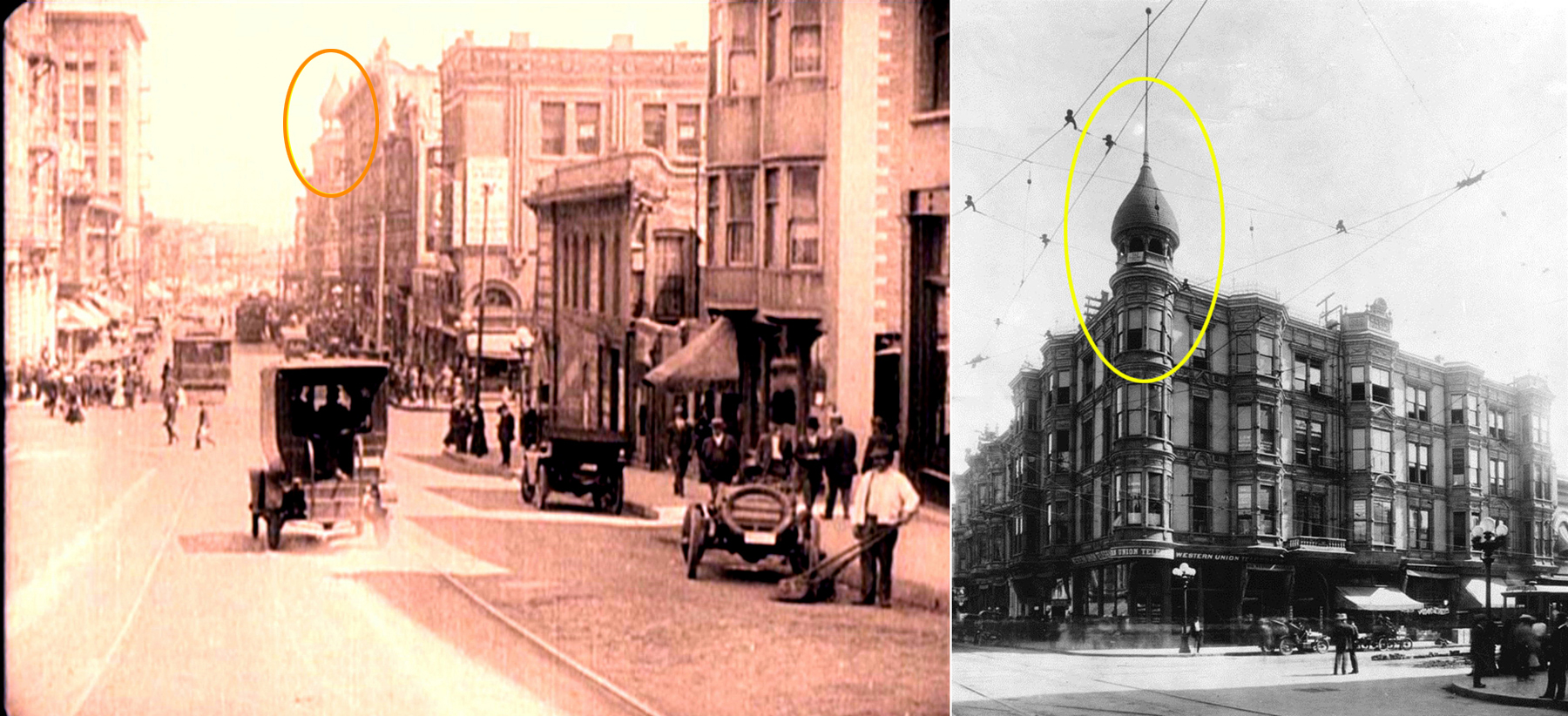
Click to enlarge. Both images show the distinctive dome tower of the Wilson Building that once stood at 1st and Spring. Tagging this unique dome was the clue to solving this location mystery.

Click to enlarge. Both images show the distinctive dome tower of the Wilson Building that once stood at 1st and Spring. Tagging this unique dome was the key to solving this location mystery.  The third Los Angeles Times Building (1912-1934) at 1st and Broadway appears to the far left of the movie frame.  It was here that Charlie Chaplin filmed his first movie Making A Living in 1914.  The tall building at the far left background was lost to create City Hall Park.  Photo LAPL 00018907

Click to enlarge.

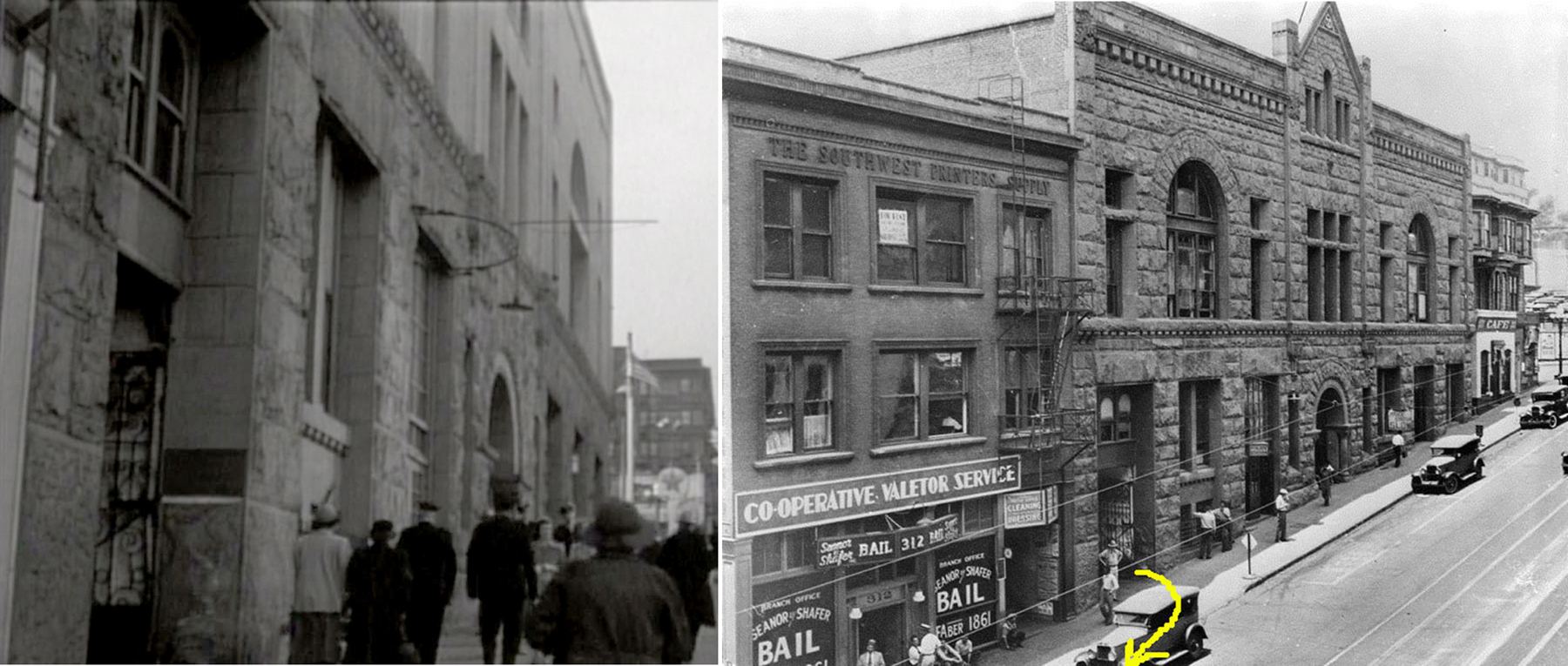
Click to enlarge.  The jail vehicle entrance appears at the far left edge in this Edge of Doom movie frame, and is marked with an arrow showing the path of the police wagon in the 1916 Fairbanks movie frames above.  Notice the triangular parapet that once stood atop the jail.  Photo LAPL 00037446

ca

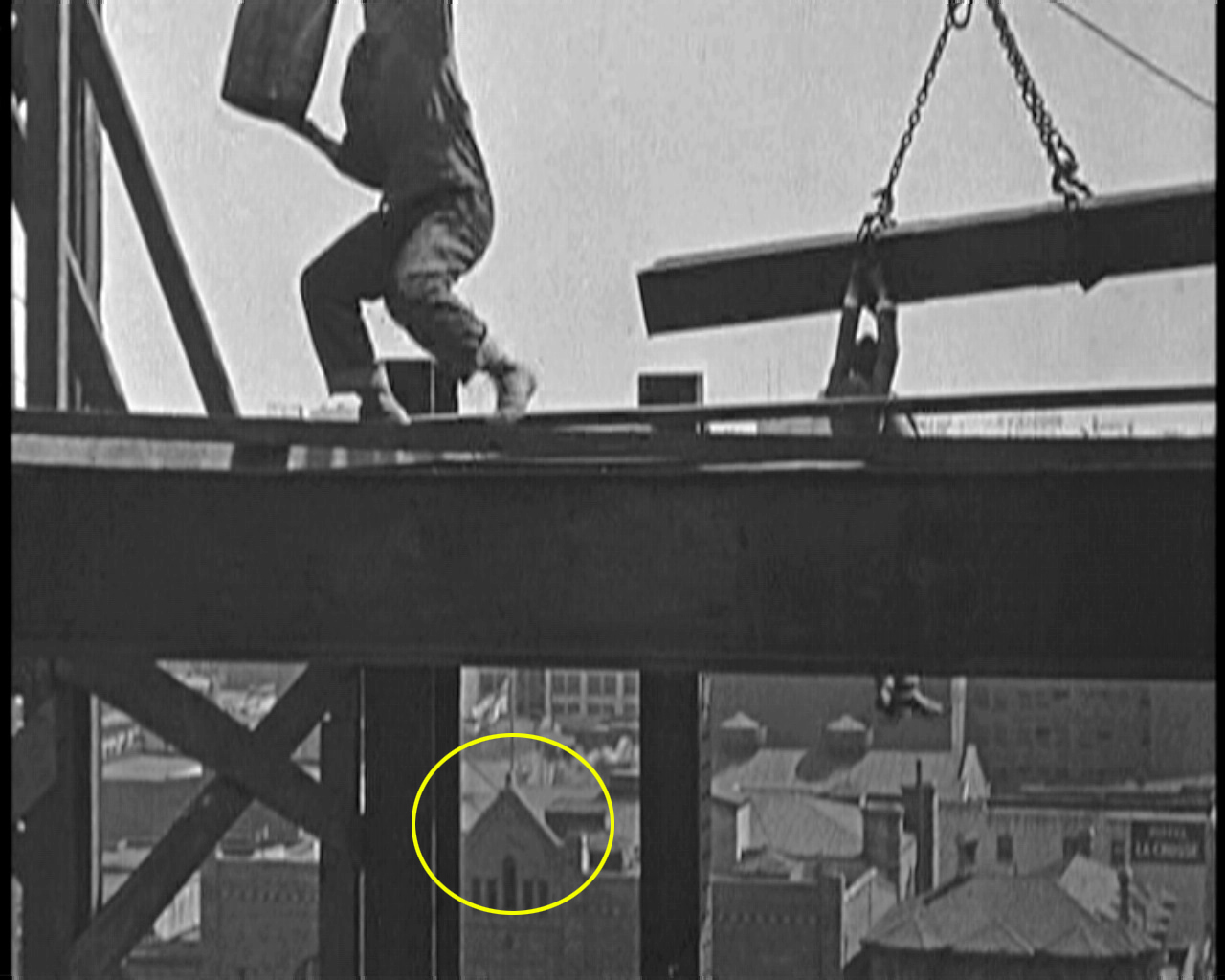
Harold Lloyd in Never Weaken.  The oval marks the jail parapet visible in the above right photo

Because the City Jail was located near Hill Street, it frequently appeared in the background of the various stunt and thrill comedies filmed above the Hill Street Tunnel overlooking 1st Street.  This scene to the left from Harold Lloyd’s third stunt climbing comedy Never Weaken (1921) shows the jail in the background (oval).  You can read more about how Lloyd filmed stunt comedies above the Hill Street Tunnel at this post HERE.

ca

This view matches the Farley Granger movie frame above.  The arrow matches the police wagon route, above.  By this point the City Jail’s distinctive triangular parapet had been removed.  USC Digital Archive CHS-33276

The Mystery of the Leaping Fish is an odd film, known for Fairbanks’ comic portrayal of a manic, drug-addled detective named Coke Ennyday.  Whenever he needs a boost to defeat the villains, Doug injects himself with a fresh syringe, and like Popeye after eating his spinach, quickly dispatches the crooks.  It is also a historically rich film, containing many scenes filmed near the Long Beach Pike, and beside Chinatown’s Ferguson Alley.  I hope someday to discuss these other locations in a future post.  But as shown here, Fairbanks now joins his brethren Chaplin, Keaton, and Lloyd, in filming at the classic downtown street corners that would later appear in film noir.

The Mystery of the Leaping Fish (1916)—Douglas Fairbanks: A Modern Musketeer Collection (David Shepard, Film Preservation Associates, Jeffrey Masino, Flicker Alley LLC).  Edge of Doom Copyright 1950 The Samuel Goldwyn Company.  HAROLD LLOYD images and the names of Mr. Lloyd’s films are all trademarks and/or service marks of Harold Lloyd Entertainment Inc. Images and movie frame images reproduced courtesy of The Harold Lloyd Trust and Harold Lloyd Entertainment Inc.

Below, only the 1935 Los Angeles Times Building remains in this 2011 view.

Posted in Douglas Fairbanks, Film Noir, Harold Lloyd, Los Angeles Historic Core | Tagged , , , , , , , , , , , , | 4 Comments

Author Appearance at TCM Classic Film Festival – Free Tour

Cover slideAttached to this post is a self-guided tour to Hollywood silent film locations and studios that I have prepared in connection with the “Hollywood’s Silent Echoes” presentation I will be giving April 28, 2013, at 3:00 p.m. at Club TCM in the Hollywood Roosevelt Hotel, as part of the Turner Classic Movie Channel Film Festival April 25-28.  Although my talk is open only to festival passholders, with this tour you can follow a number of points I will cover during my presentation.

I will also discuss filming locations appearing in Buster Keaton’s 1926 masterpiece The General, which will be presented in a world premiere restoration.  You can learn more about The General filming locations here.  I will also have a special article appearing in the festival program, and will be doing a book-signing after my talk.

The tour starts at Hollywood and Vine, and encompasses over 40 filming locations and historic sites associated with Charlie Chaplin, Buster Keaton, and Harold Lloyd, including new discoveries not found in my books.

Club TCM Hollywood’s Silent Echoes Tour 2013

This year’s TCM Festival promises to be more exciting than ever – I hope to meet some of you there.

Posted in Chaplin Tour, Hollywood Tour, Keaton Tour, Lloyd Tour, Uncategorized | Tagged , , , , , , , , , , , , , | 5 Comments

Cops and Safety Last! – the Cosmo Alley Connection

pan 01We learn early in Safety Last! (1923) that Harold Lloyd’s roommate Bill Strother can climb tall buildings when we watch him escape from a policeman by scaling a four-story apartment building (left).  [NOTE: “Skip,” a resourceful and eagle-eyed reader, was able to identify this extant (if heavily remodeled) building as the former Dresden Apartments at 1919 W 7th Street.  You can find my write up about it here.]  The location of this building (perhaps now lost) continues to elude me, despite numerous telling clues, including the fact the building was situated on a trolley line, and stood adjacent to an alley across from a “California Garage” that sold tires.  Does anyone know where this might be?

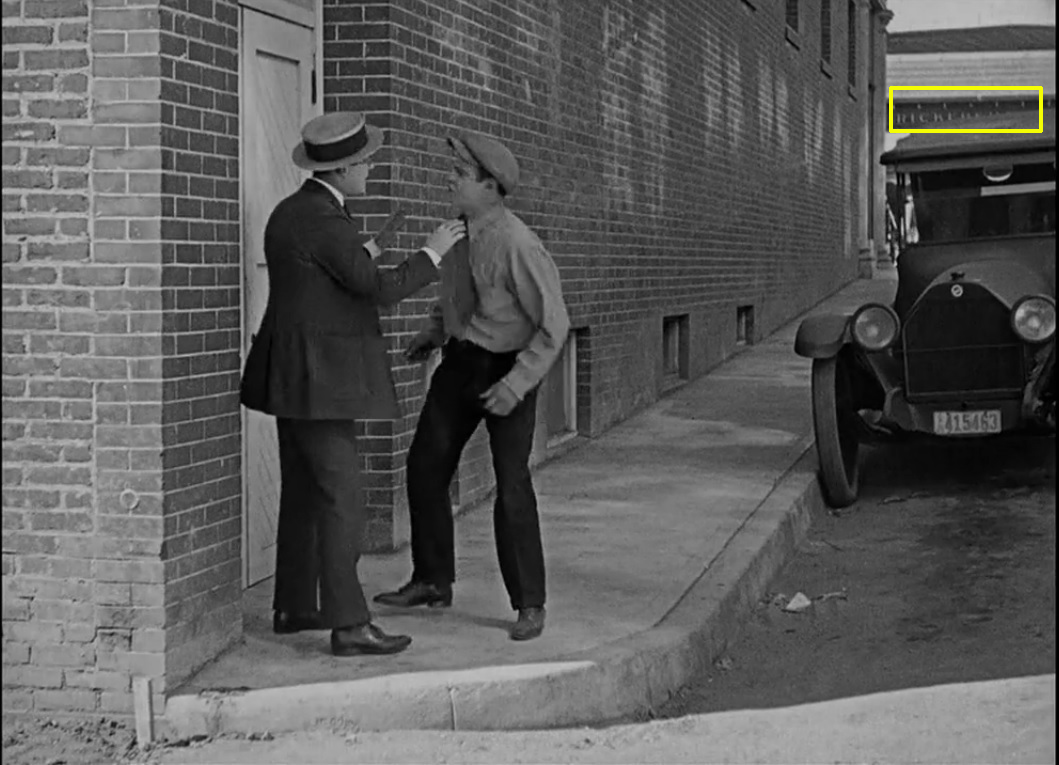
Moments later in the movie, Bill meets up with Harold after scampering down a fire escape (below).  The scene is edited as if Bill is returning to an alley behind the same building he had just climbed, but it does not match the alley appearing in the prior scenes.  Thanks to the remarkable clarity from the pending Criterion Collection Blu-ray release of Safety Last!, we now know that this scene with Harold and Bill was filmed in Hollywood beside the Markham Building on Cosmo, the same alley where Buster Keaton filmed scenes appearing in his famous short film Cops (1922).  You can read how Harold Lloyd filmed Safety Last! HERE.

HL and Bill box

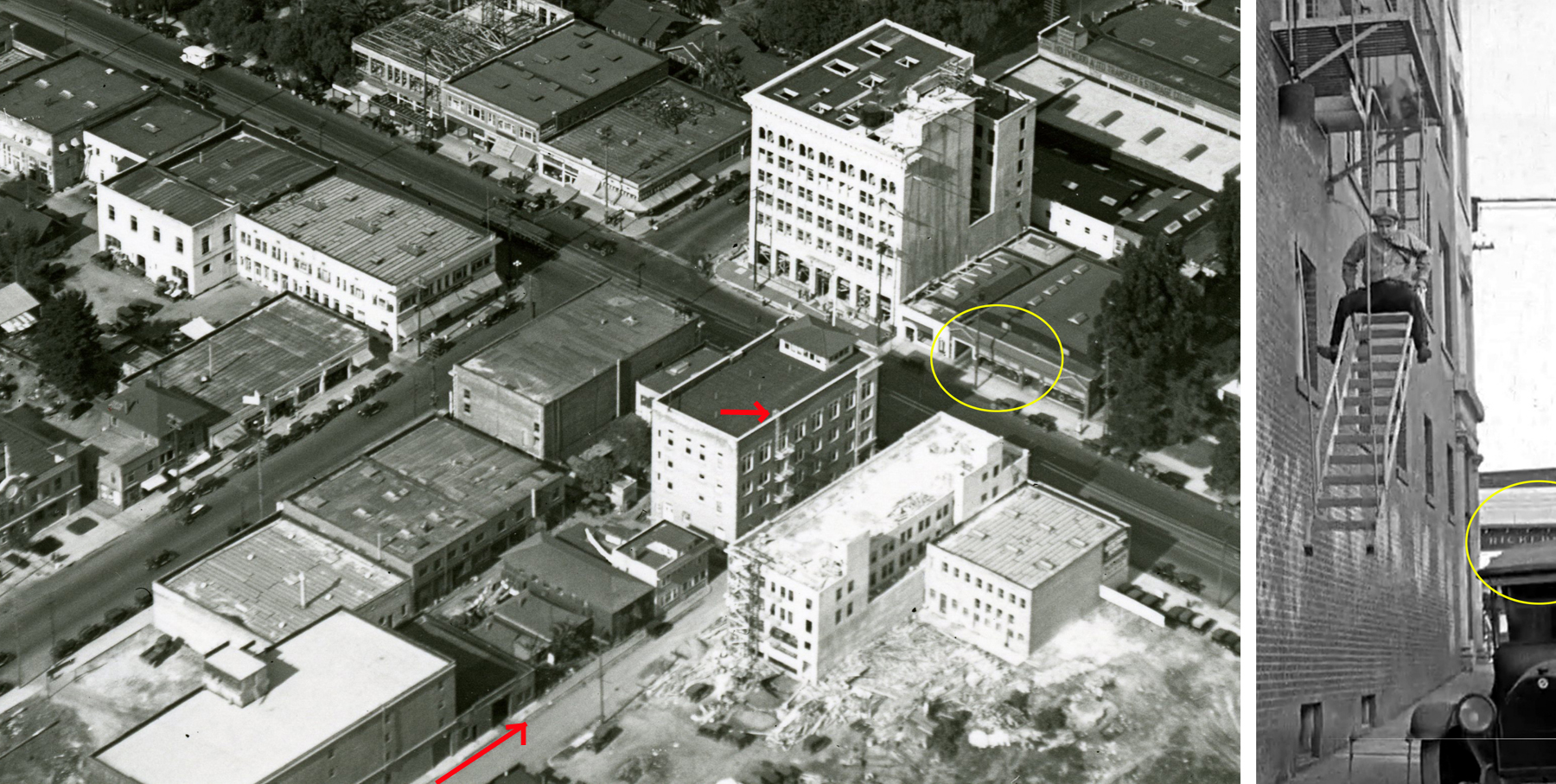
During the scene, as Bill descends the ladder you can see busy traffic behind him along what turns out to be Hollywood Boulevard, and a sign across the street that reads “RICKERSH …” .  In 1923, the RICKERSHAUSER & MILLER auto dealership stood at 6369 Hollywood Boulevard, directly across the street from where the alley Cosmo terminates.  Comparing vintage views of the Markham Building with the movie frames confirms the setting.

Click to enlarge.

Click to enlarge.  Bill Strother scampers down the Markham Building fire escape.

Los Angeles Public Library

Los Angeles Public Library

This 1922 aerial view above shows the Rickershauser dealership (oval) on Hollywood Boulevard across from the Markham Building, near the intersection of Cahuenga to the left.  The rooftop arrow above shows the fire escape used by Bill to descend to the alley, and the arrow to the lower left above shows the point of view looking north up Cosmo for the scene from Cops described further below.  At left is a closer view of the auto dealer across the street from Cosmo.

Click to enlarge

Click to enlarge.  Front view of the Markham Building.  The Huntington Library.

The Thief of Bagdad set

The Thief of Bagdad set

This 1924 view above shows the front of the Markham Building facing Hollywood Boulevard alongside Cosmo.  The yellow arrow marks the point of view in Safety Last! looking north up Cosmo, the red arrow marks the fire escape ladder used by Bill Strother, and the yellow oval at back marks the towering set for the 1924 Douglas Fairbanks fantasy adventure The Thief of Bagdad, built on the Pickford-Fairbanks Studio at 7200 Santa Monica Boulevard.  The Thief of Bagdad is also now available on Blu-ray.

During Cops below, as Buster Keaton signals a left hand turn from Cosmo onto Selma, his hand is bitten by a dog.  The spot where Lloyd filmed beside the Markham Building can be seen in the far background (red box below).

ca

Buster Keaton in Cops looking north up Cosmo towards the Markham Building.

The back of the Markham Building is also marked with a red box in the 1997 modern view above.  You can see that at some point the fourth floor of the building was removed.

The neighborhood of Hollywood and Cahuenga depicted here was a very popular place for the silent comedians to film, which I describe in great detail in my books, and in many posts, including these concerning one block in Hollywood, describing Toberman Hall in Hollywood, and explaining nearby stunts performed by Harold Lloyd and Buster Keaton.  You can read about how Harold filmed Safety Last! at this post.

Aerial photographs from HollywoodPhotographs.com.

HAROLD LLOYD images and the names of Mr. Lloyd’s films are all trademarks and/or service marks of Harold Lloyd Entertainment Inc. Images and movie frame images reproduced courtesy of The Harold Lloyd Trust and Harold Lloyd Entertainment Inc.  Cops licensed by Douris UK, Ltd.

Posted in Buster Keaton, Cops, Harold Lloyd, Hollywood Tour, Safety Last! | Tagged , , , , , , , , , , , , , , | 17 Comments

Keaton – Seven Chances Filmed Close to Studio

(You’ll find most Seven Chances filming locations at this earlier post.) Now that the Keaton films are all available on Blu-ray, I not only continue to make new discoveries, but to my great satisfaction I am also increasingly able to place these filming locations into a broader context.  As we will see, this scene below from Seven Chances (1925) was filmed just a few blocks away from Buster’s small studio.

Buster eyes a potential bride walking from Melrose down Rossmore.

Buster eyes a potential bride walking south from Melrose down Rossmore.

The premise of Seven Chances (see related post HERE) requires Buster to become married by 7:00 pm in order to inherit a fortune.  Before Buster outruns an army of angry brides at the film’s climax, he approaches a number of random women on the street.  In this “joke” above, Buster recoils after realizing the potential bride he approached from behind is actually an African-American.  Although this joke is overtly racial (one of the few in Keaton’s oeuvre), modern audiences may not realize that at the time it would have been illegal for Buster to marry this woman.  It was not until 1948 that the California Supreme Court struck down California’s anti-miscegenation laws, the first time since the Reconstruction that a state had declared such laws to be unconstitutional.

Despite several clues, including the unusual curved street, and what appeared to be some type of church steeple (red oval) in the background, this setting eluded me for many years.

wow

Click to enlarge.  Harry Langdon and Vernon Dent travel north up Vine from Melrose in His Marriage Wow

But once I could read on the Blu-ray the 658 – 656 street numbers above the doorways during this scene, I realized it was likely filmed looking south from somewhere along Melrose Avenue, and eventually identified the setting as 658 N. Rossmore Avenue. Melrose is where the curved street Rossmore continues further north into Hollywood re-named as Vine Street.

This matching circa 1938 aerial view at left looks south, and shows Buster’s path beside the retail stores (arrow), the small church built in 1922 at 600 N. Rossmore, at the time called the Rossmore Avenue Congregational Church (red oval), and the extant Rossmore Apartments, built in 1924, at 649 N. Rossmore Avenue (yellow oval).  The yellow box marks Arden Place, a newer “Y” branch street addition that was not present in 1925, that runs from Rossmore into Arden Boulevard, and the larger and more modern Christ the King Catholic Church built in 1927.

Also above to the left appear Harry Langdon and Vernon Dent, driving north up Vine from Melrose, in their 1925 Sennett Studio comedy His Marriage Wow.  Their view looks south down Vine towards the same retail store (arrow), church (red oval), and apartments (yellow oval) on Rossmore, as in the left Keaton frame at the top of this post.

Click to enlarge.

Click to enlarge. The red box marks the Keaton Studio at Lillian Way and Eleanor, the asterisks mark abandoned lots and sets of the former Metro Studio (by then Metro had left to merge into M-G-M in Culver City), the arrow at right marks Buster’s path down Rossmore from Melrose, and the yellow oval marks the extant Rossmore Apartments.  Los Angeles Public Library

caa

Click to enlarge. Another view looking north towards the Keaton Studio (red box), the Rossmore Apartments (yellow oval) and the original Rossmore Avenue Congregational Church (red oval).  USC Digital Archive

today

Above, matching then and now views south down Vine towards Melrose and the extant Rossmore Apartments.  Below, the Rossmore Avenue Congregational Church building as it appears today.

Check out my Seven Chances YouTube video

Seven Chances (C) 1925 Buster Keaton Productions, Inc.  (C) renewed 1953 Loew’s Inc., licensed by Douris UK, Ltd.

Posted in Buster Keaton, Harry Langdon, Keaton Studio, Seven Chances | Tagged , , , , , , , , , , , | 16 Comments

Leave it to Skokie, and Beaver, and Ward’s Joke Letter

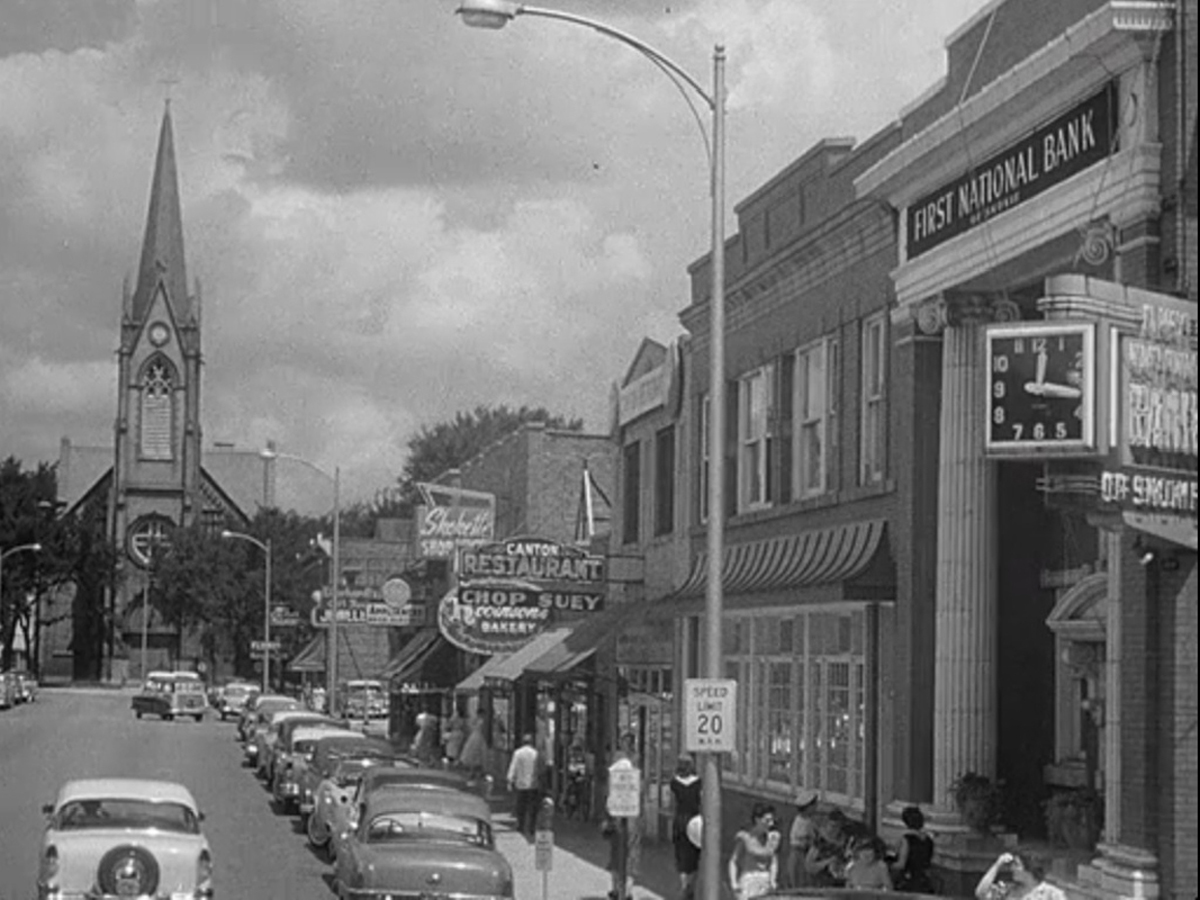
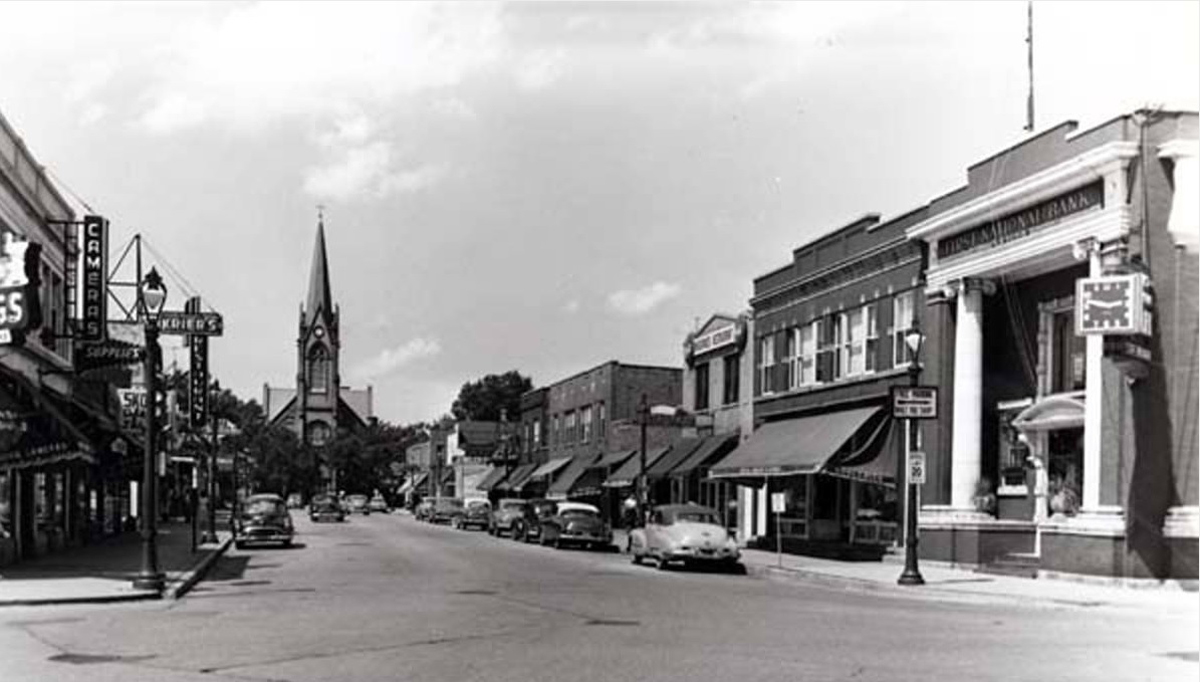
This post has nothing to do with silent movies (these posts connecting Beaver to Long Beach and to Santa Monica do), but I’ve really been enjoying watching Leave it to Beaver on Netflix instant streaming.  When they showed this idyllic small town main street during a scene from “Beaver’s Fortune” (Season 3:Episode 10; first broadcast December 5, 1959), I had to hit the freeze frame to figure it out.

Leave it to Skokie

Leave it to Skokie

ca

Skokie Public Library, Skokie History Project

Although Beaver takes place in “Mayfield,” set in an undetermined state that must have “Springfield” (the rootless home town featured in The Simpsons) for its neighbor, it turns out Skokie, Illinois appears during this stock footage shot (no actors from the show appear in this scene).  The view looks north up Lincoln Avenue from Oakton Street towards St. Peter’s Catholic Church, originally built in 1894.

I was able to solve this easily enough, because even though Beaver was first broadcast over the airwaves in decidedly low-tech, low resolution, it was shot on 35mm “HD” film stock.  I sensed a word on the bank sign said “Skokie,” and was proven right.

(C) 2012 Google Inc.

North up Lincoln at Warren Street, Skokie Illinois – (C) 2013 Google Inc.

It’s sad to see that the east side of Lincoln Avenue appearing during the scene has been replaced by a 1980s era bank plaza and related commercial buildings.  The west side of Lincoln, appearing off camera, is relatively unchanged.

Watching a prior episode “Her Idol” (Season 2: Episode 6; first broadcast November 6, 1958), I nearly fell out of my chair when I noticed I was able to read this letter sent home from Beaver’s grade school principal.  The person responsible for creating the prop letter obviously relied on the fact that the letter would appear only briefly on camera, in low resolution, without realizing that decades later technological advances would provide bored viewers such as myself the ability to scrutinize his handiwork.  The full text of this letter appears below.

Beaver letter s2 eps 6

Mr. Ward Cleaver

485 Mapleton Drive

Mayfield, State

My Dear Mr. Cleaver:

This paragraph has absolutely nothing to do with anything.  It is here merely to fill up space. Still, it is words, rather than repeated letters, since the latter might not give the proper appearance, namely, that of an actual note.

For that matter, all of this is nonsense, and the only part of this that is to be read is the last paragraph, which part is the inspired creation of the producers of this very fine series.

Another paragraph of stuff. Now is the time for all good men to come to the aid of their party. The quick brown fox jumps over the lazy dog. My typing is lousy, but the typewriter isn’t so hot either. After all, why should I take the blame for these mechanical imperfections, with which all of us must contend. Lew Burdette just hit a home run and Milwaukee leads seven to one in the series. This is the last line of the filler material of the note. No, my mistake, that was only the next to last. This is last.

I hope you can find a suitable explanation for Theodore’s unusual conduct.

Yours truly,

Cornelia Rayburn

Beaver letter s2 eps 6 03Well, after decoding this secret message, I felt pretty smug, but not being able to leave well enough alone, it crossed my mind to Google the text I had just deciphered, and low and behold, the Curious Case of the Beaver Letter had already been properly explored, long ago, at one of my favorite websites, Shorpy.com, “History in HD,” a site that posts fascinating high resolution vintage photographs.  It turns out the reference to Lew Burdette ties the letter to Game 2 of the World Series between the Yankees and the Braves, played October 2, 1958, about a month before the episode aired.  Here’s the link to the Shorpy treatment of Beaver’s letter.  It makes me wonder what other Easter eggs from early television lie waiting to be discovered.

Leave it to Beaver – (C) 1958 Gomalco Productions, Inc.; (C) 1959 Revue Productions, Inc.

Posted in Leave It To Beaver, TV Shows | Tagged , , | 17 Comments

Chaplin – Keaton – Lloyd – One Block in Silent-Era Hollywood (update)

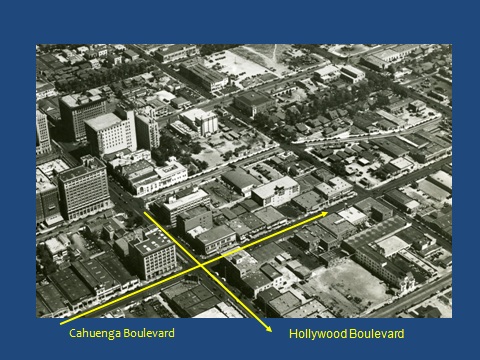
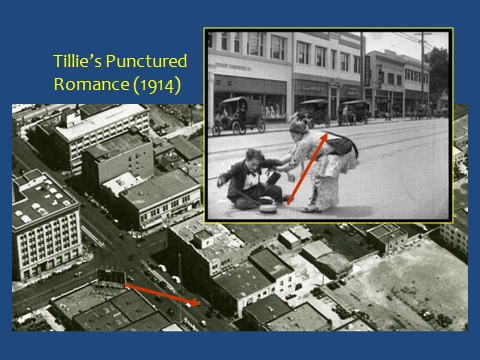
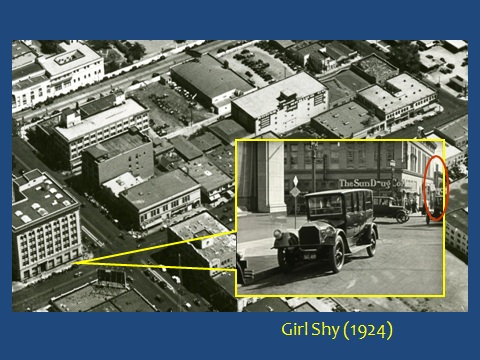
The intersection of Hollywood Boulevard and Cahuenga Boulevard was a popular film setting for silent-era comedies.  At the far end of this post is a link to download an animated 15 MB PowerPoint presentation showing thirteen (but not all) Chaplin, Keaton, and Lloyd filming locations near this historic intersection.  If you prefer, here are some static images from the slide show.  You can read more about the Toberman Building below appearing in Tillie’s Punctured Romance (1914) at this link HERE.

01 02 03 04 05 06 07 08 09 10 11 12 13 14 15 16

You will need a PowerPoint viewer to watch the show, and can download a PowerPoint viewer at this site.

Chaplin Keaton Lloyd – One Block in Silent Era Hollywood

All images from Chaplin films made from 1918 onwards, copyright © Roy Export Company Establishment. CHARLES CHAPLIN, CHAPLIN, and the LITTLE TRAMP, photographs from and the names of Mr. Chaplin’s films are trademarks and/or service marks of Bubbles Incorporated SA and/or Roy Export Company Establishment. Used with permission.

Keaton frame images reproduced courtesy of The Douris Corporation, David Shepard, Film Preservation Associates, and Kino International Corporation.  The Cameraman (C) 1928 Turner Entertainment Co.

HAROLD LLOYD images and the names of Mr. Lloyd’s films are all trademarks and/or service marks of Harold Lloyd Entertainment Inc. Images and movie frame images reproduced courtesy of The Harold Lloyd Trust and Harold Lloyd Entertainment Inc.

HollywoodPhotographs.com – Bruce Torrence Historic Hollywood Collection (link).

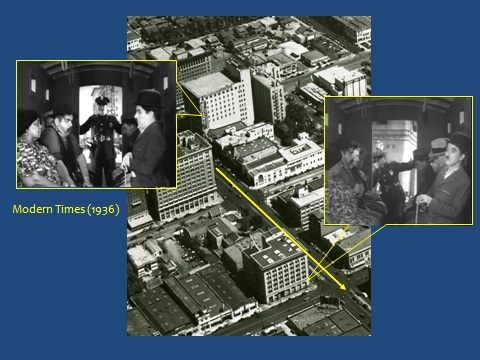
Posted in Buster Keaton, Chaplin Tour, Charlie Chaplin, Cops, Girl Shy, Harold Lloyd, Hollywood Tour, Hot Water, Keaton Studio, Keaton Tour, Lloyd Studio, Modern Times, Safety Last!, The Cameraman | Tagged , , , , , , , , , | 3 Comments

Keaton – Wings – Noir – and the SP Depot

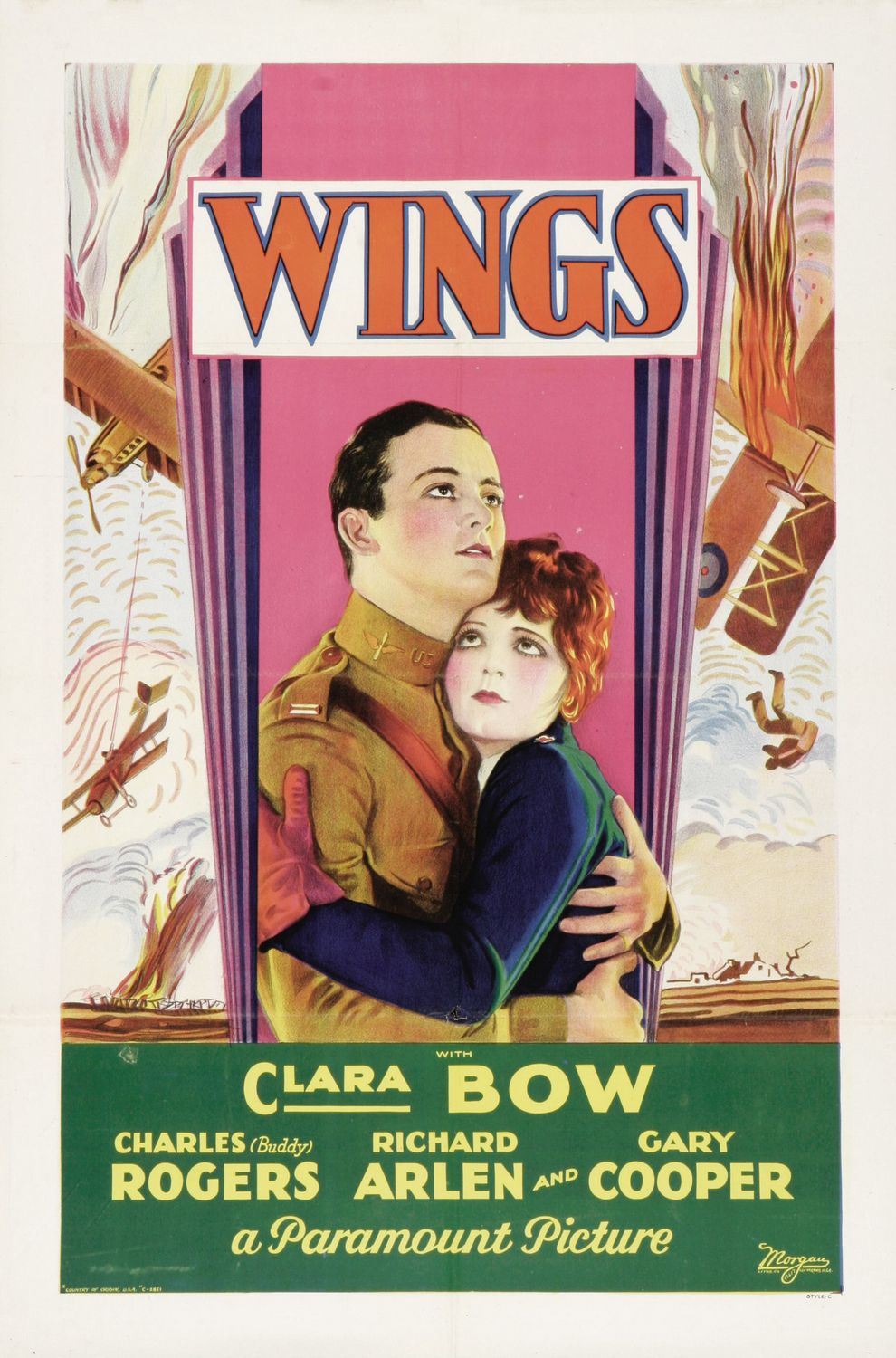
Wings_posterWings, a 1927 World War I fighter pilot movie, was the first production to win the Academy Award for Best Picture.  To capture realistic point of view shots of the actors engaged in aerial dog fights, the two leads Charles “Buddy” Rogers and Richard Arlen actually piloted their own bi-planes, with motorized cameras affixed to the cockpit recording their faces and the action and swooping landscapes behind them.  The movie’s thrilling aerial cinematography will never be surpassed because it was all staged for real.  Most of the movie was filmed on location at Kelly Field in San Antonio, Texas.

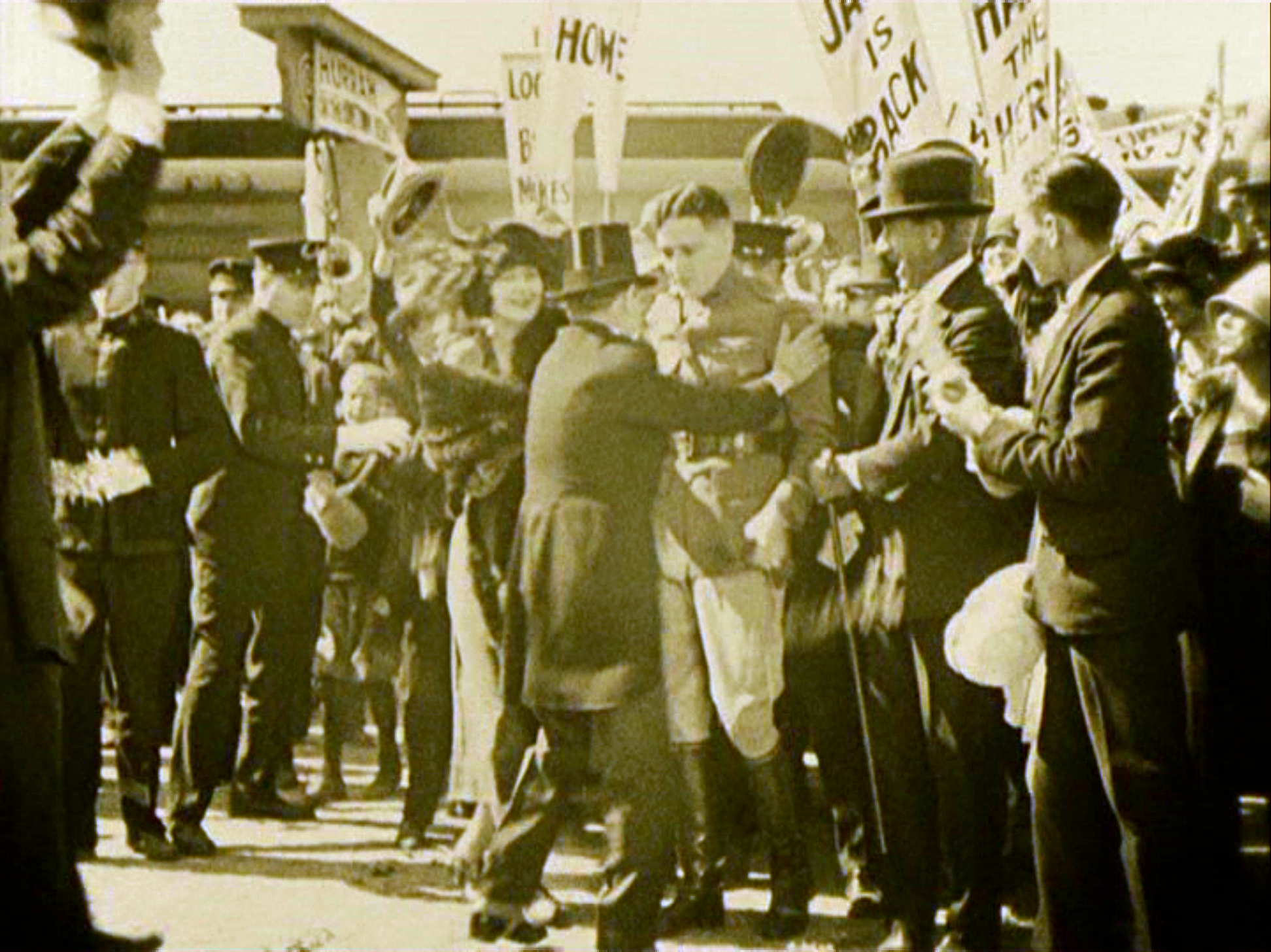
Buddy Rogers returns home

Buddy Rogers returns home … to Glendale

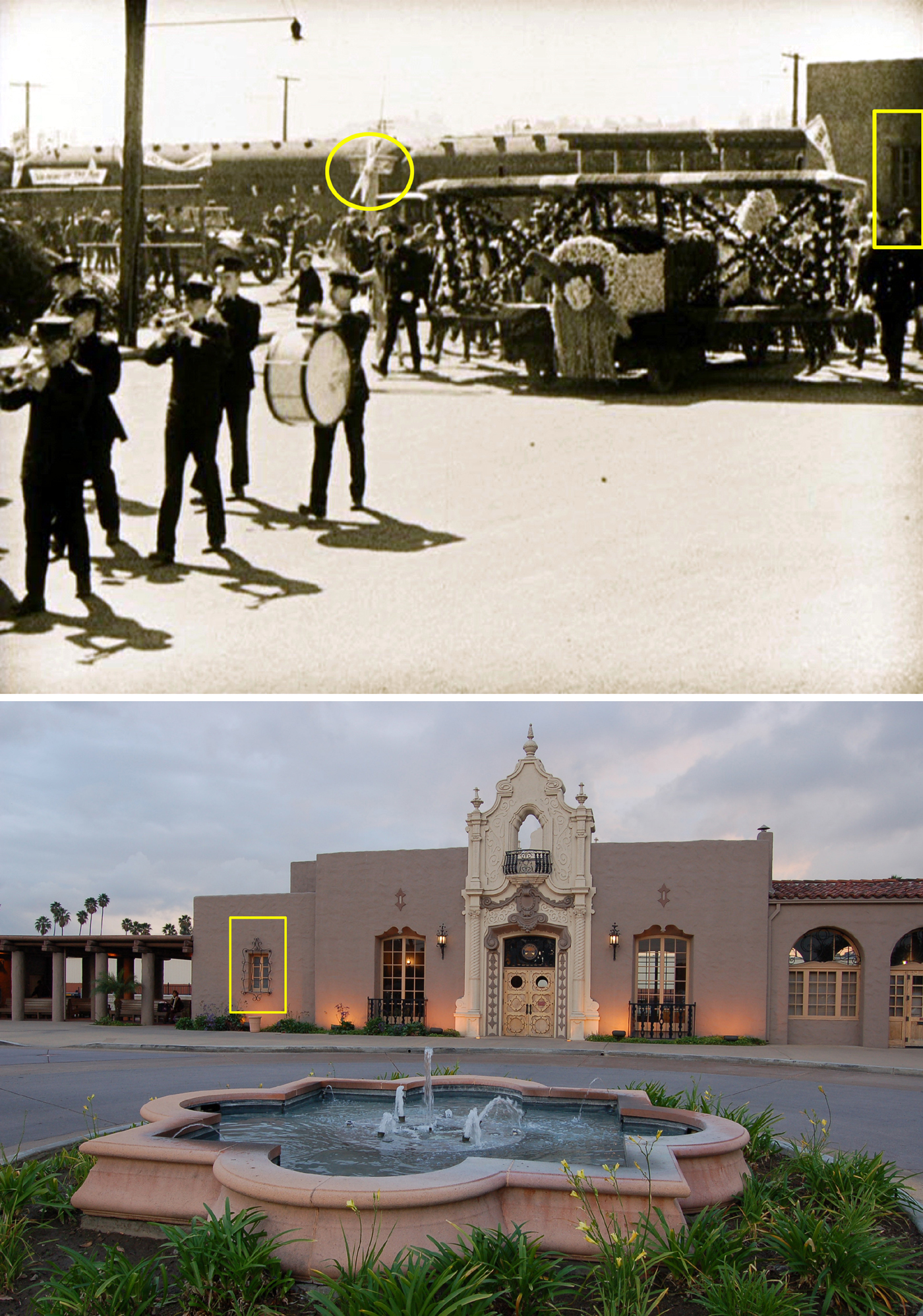
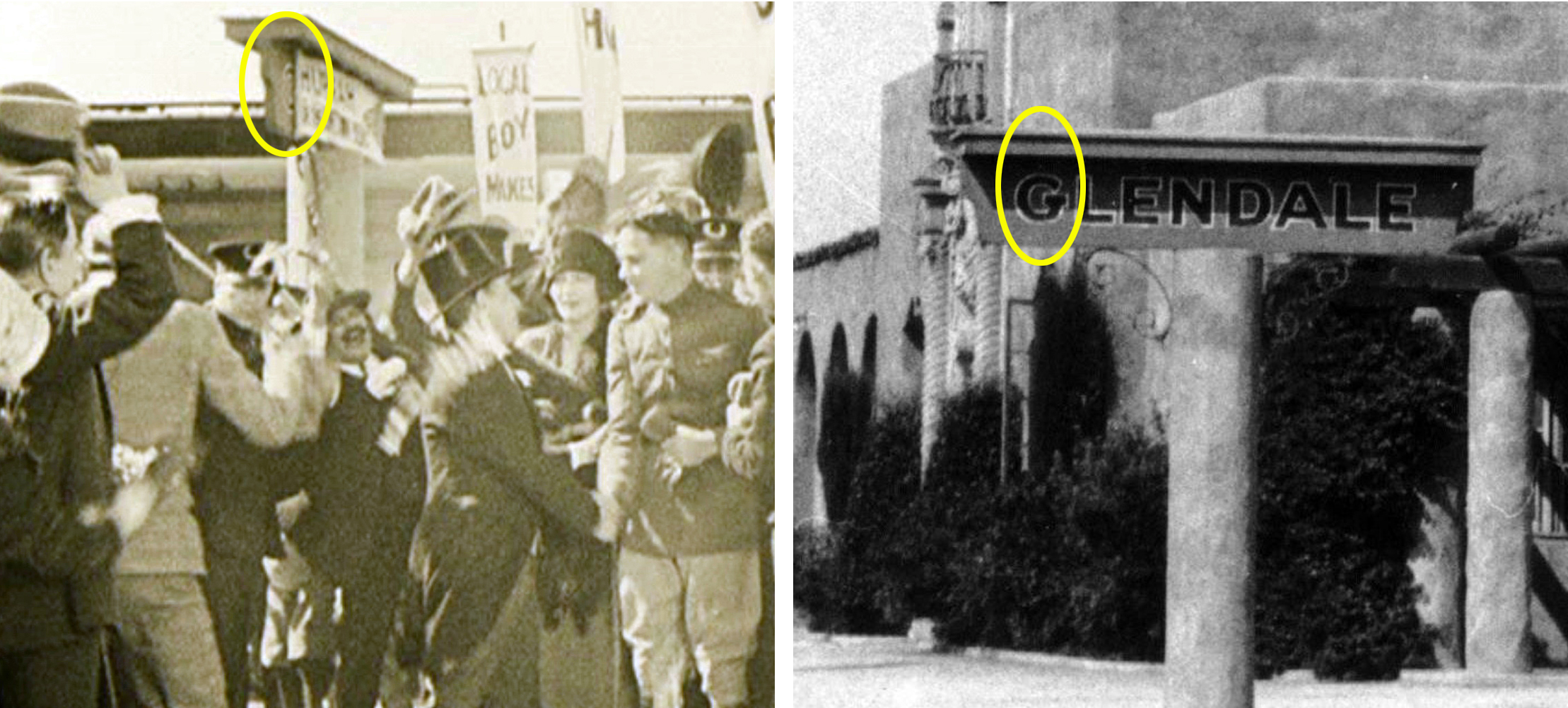
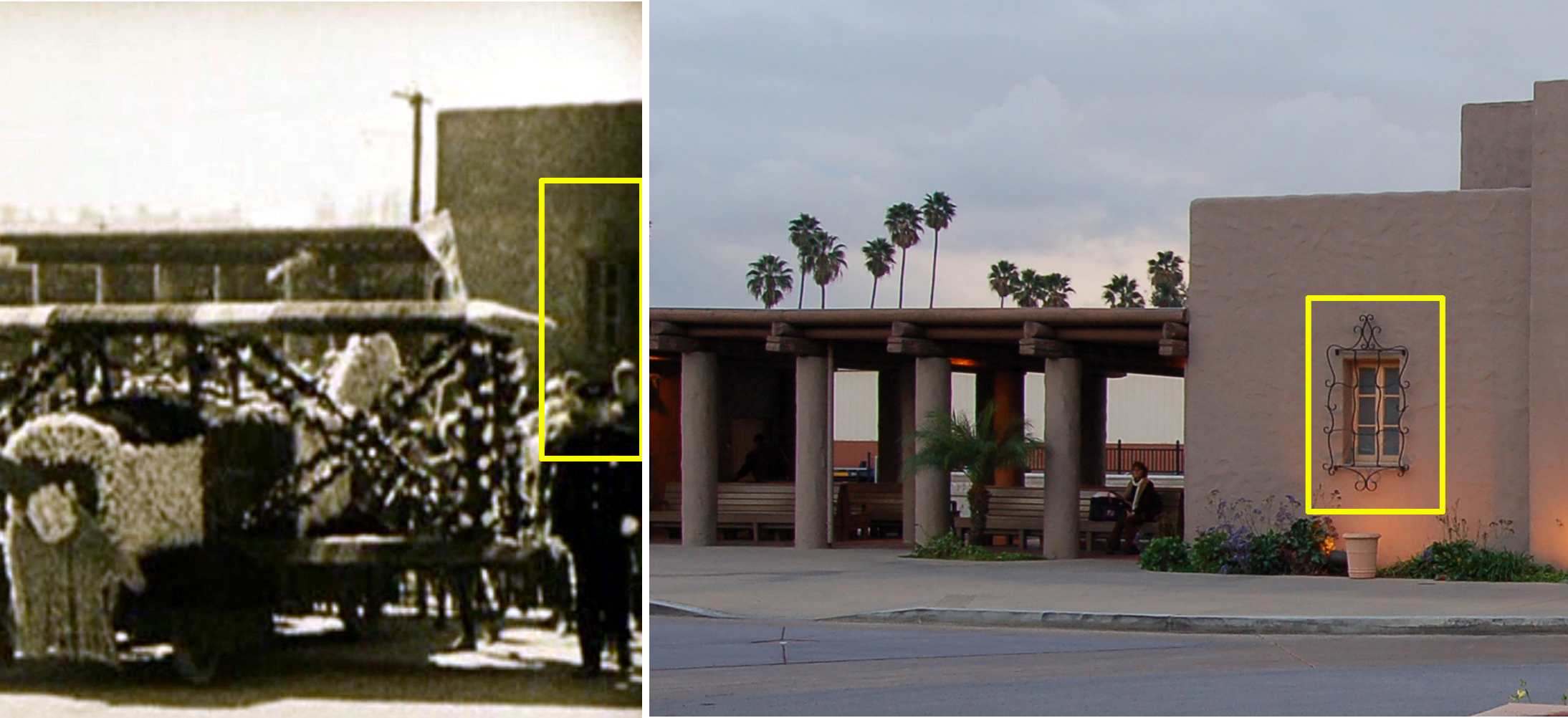
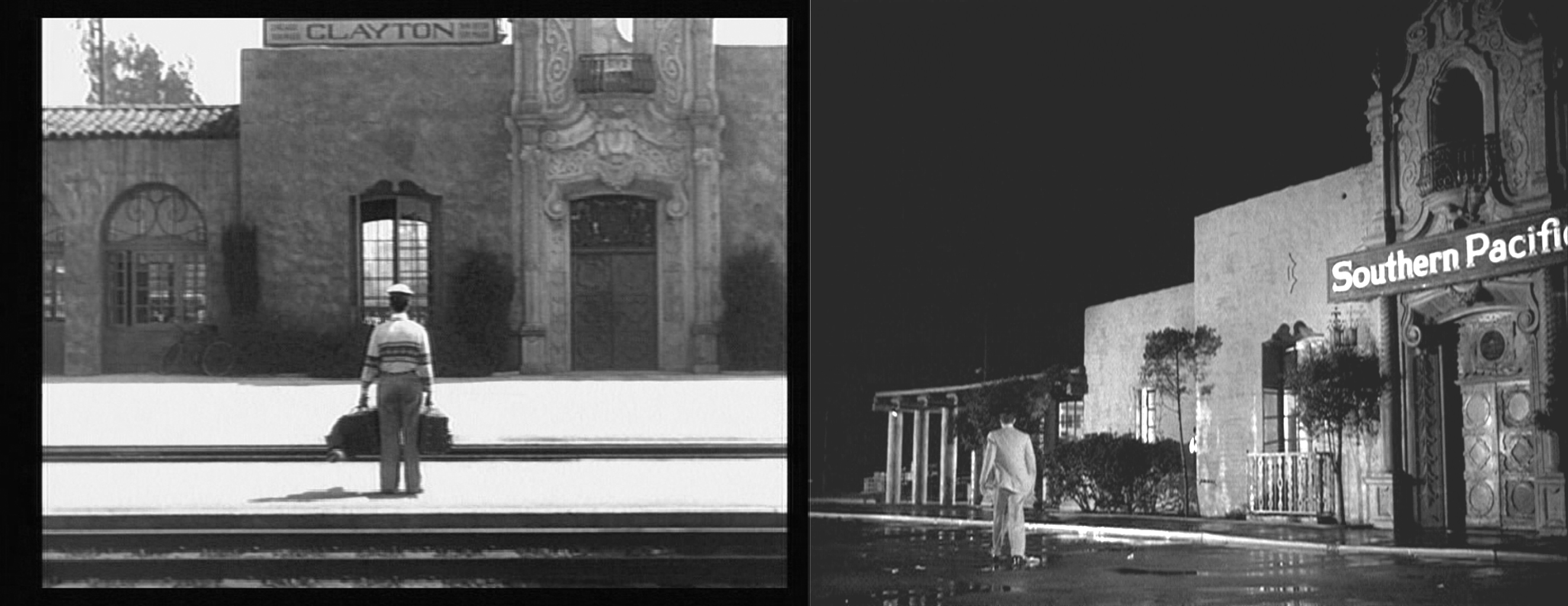
Continuing with posts concerning Southern Pacific depots appearing in silent film (see HERE and HERE), a concluding scene from Wings was filmed at the SP depot in Glendale, now called the Glendale Amtrak train station, the same station Buster Keaton used the same year when filming his campus comedy College (1927) and also appearing in the film noir classic Act of Violence (1948) (see both below).  Towards the end of Wings Buddy Rogers’s character returns home from the war, and receives a hero’s welcome at his local train station.  Although very little of the station appears on camera, several clues confirm the site.  Since Buddy’s white picket-fence home-town was implied to be set in “middle America” (i.e., not in Southern California), I have to infer that the elaborate Spanish baroque-style building was deliberately kept off camera to avoid breaking the illusion.

The celebratory procession shows the station sign and window

The celebratory procession shows the Glendale station sign (oval) and window (box).  Photo courtesy Atwater Village Newbie.

Compare the sign

Click to enlarge and compare the signs – you can see the letter “G” outlined in white in both images.  They attempted to cover up the Glendale sign with a “welcome ” sign when filming.  USC Digital Archive.

A closer view of the matching windows

Click to enlarge – a closer view of the matching windows

The remainder of this post is a re-post of Buster Keaton’s brush with film noir (see Harold Lloyd’s prior noir posts HERE, HERE, and HERE, and Charlie Chaplin’s noir post HERE), when filming College at the back, rather than the front of, the same Glendale station appearing in Wings.

Buster Keaton in College (1927) to the left, and Van Heflin in Act of Violence (1948) right.

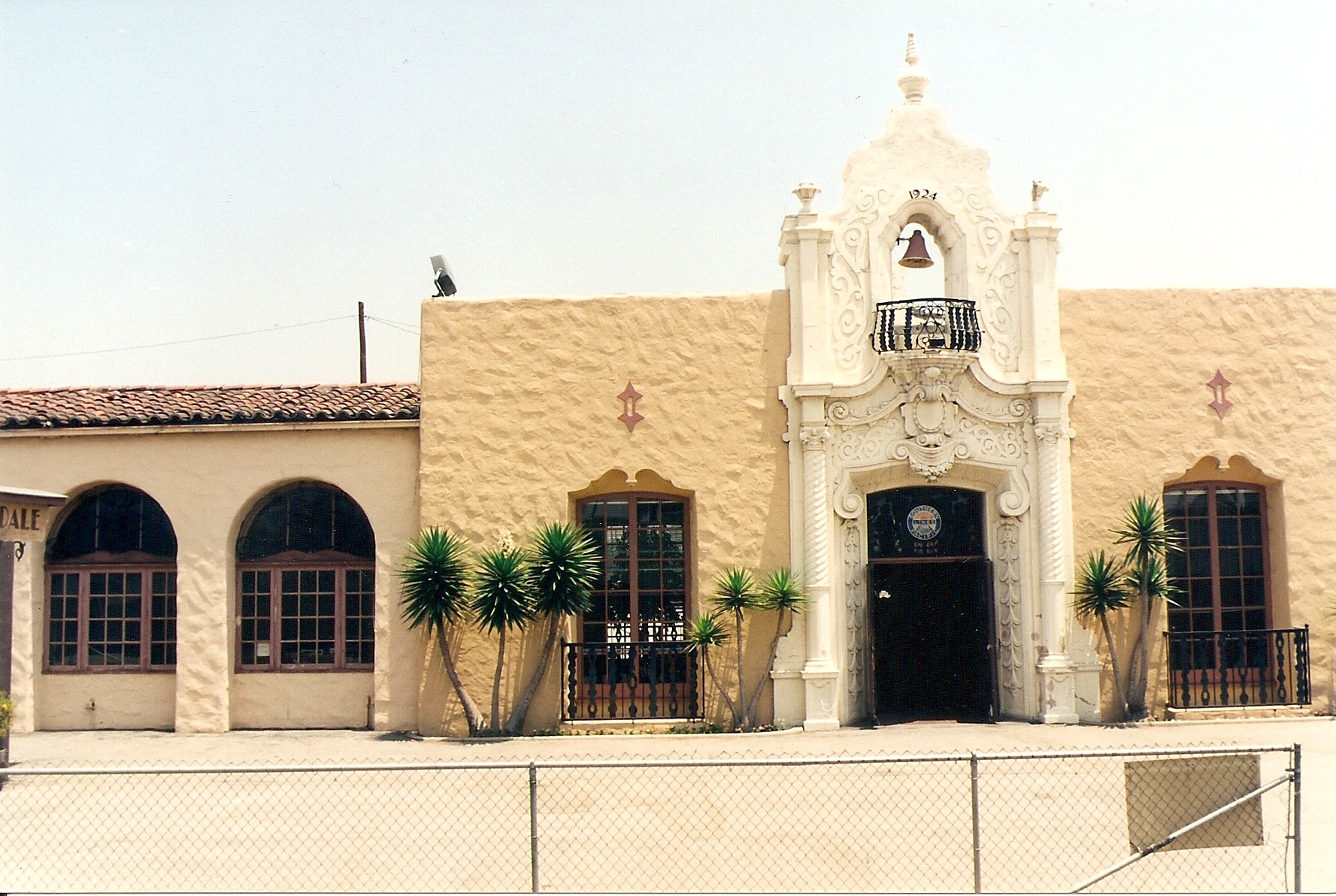
The station is now the Glendale Amtrak Station.

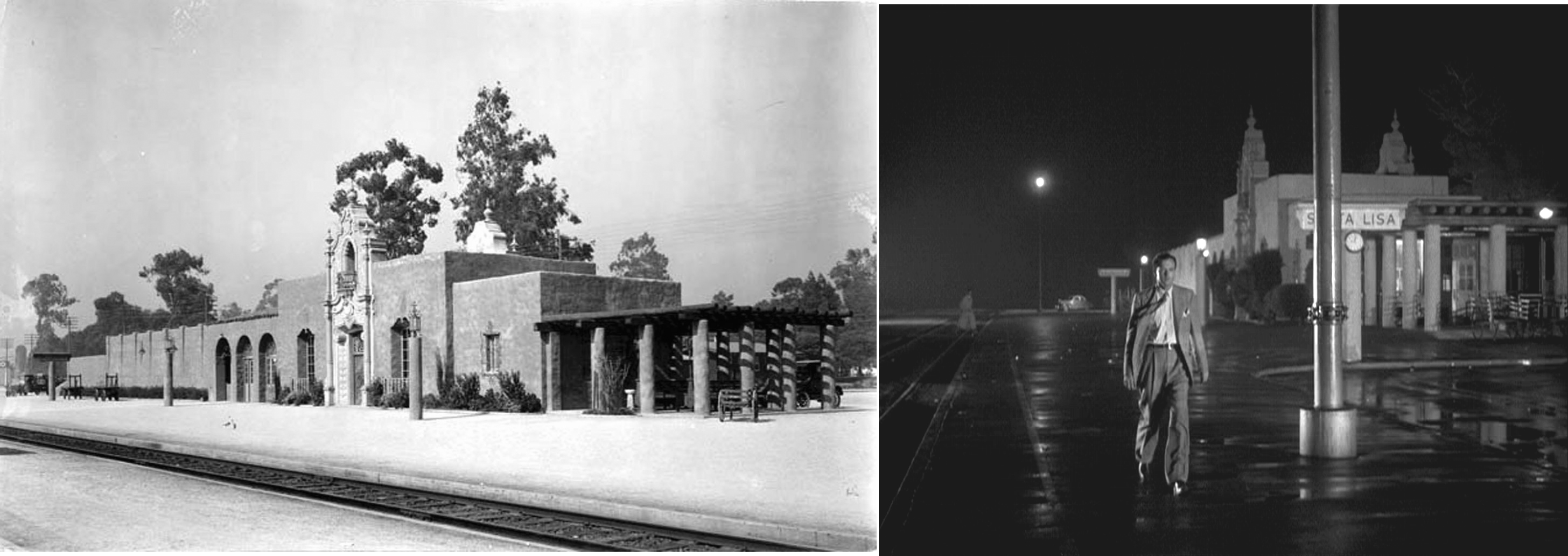
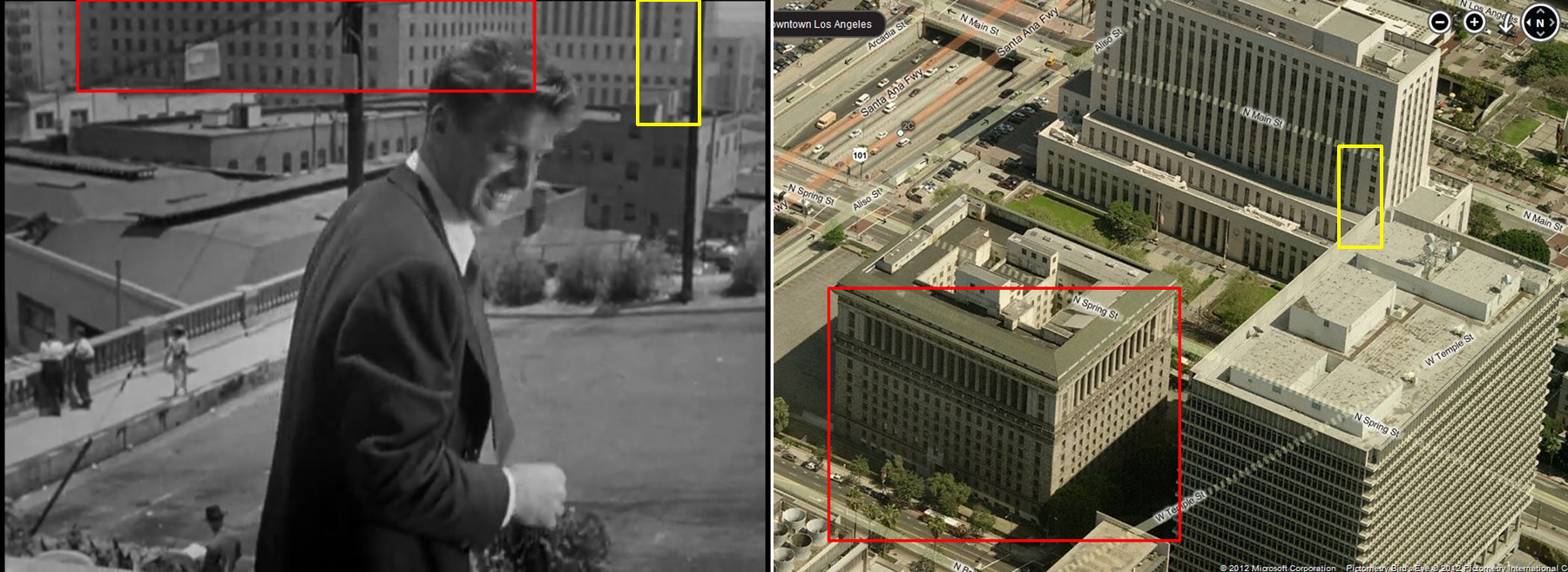
The Glendale Southern Pacific station was barely three years old when Buster Keaton used it to portray the station for Clayton, the fictitious college town where Buster’s character pursues higher learning in the 1927 comedy College. Above to the right, the station was also the setting for the climax to Act of Violence, a 1948 noir drama starring Van Heflin and Robert Ryan, who portray re-united army veterans who were once imprisoned together in a German POW camp during WWII.  Act of Violence contains several scenes filmed on Court Hill, near the Hill Street Tunnel, and on Bunker Hill, near Angels Flight.  Unfortunately, these nighttime scenes are darkly lit, and tightly framed, so there is not much to see.

Matching views looking north.  Glendale is re-named Santa Lisa for the Act of Violence shot. California History Room, California State Library, Sacramento, California.

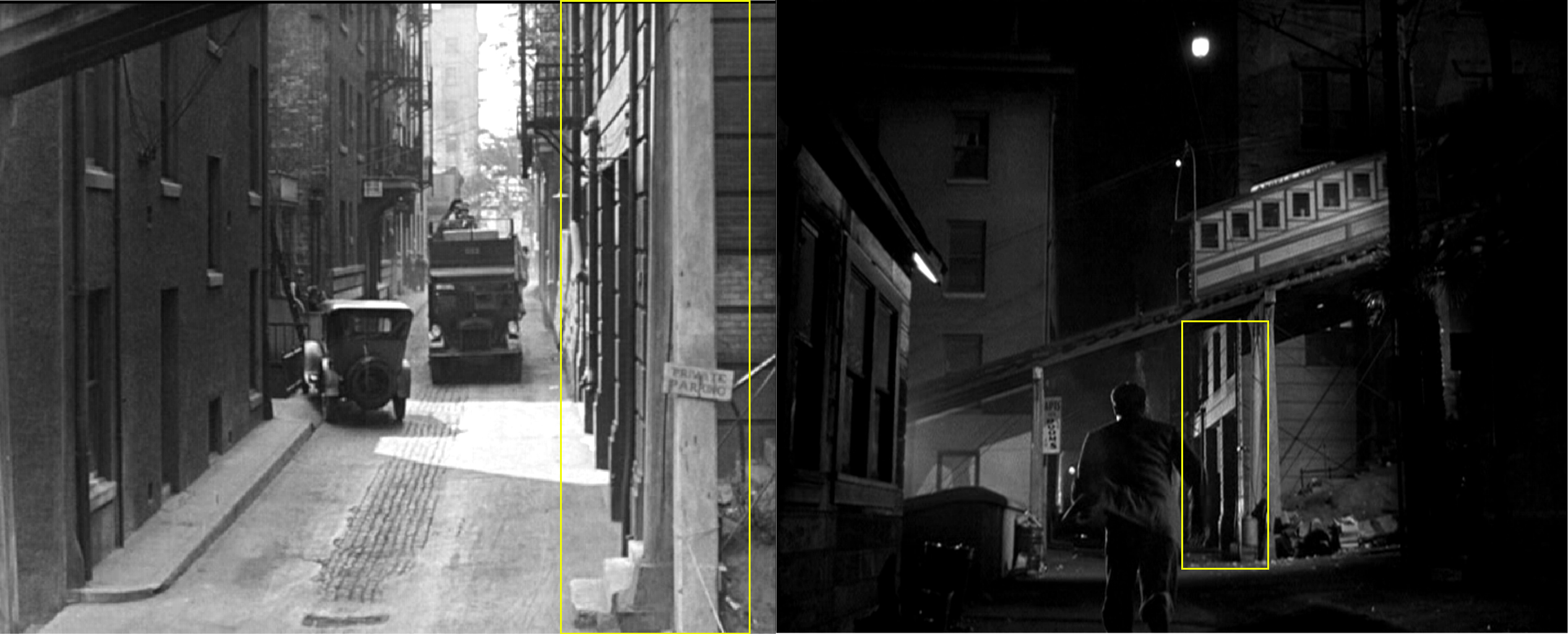
Act of Violence does contain a nice view of Clay Street, the narrow alley running between and parallel to Hill Street and Olive Street, and underneath the mid-way point of the Angels Flight elevated tracks.  As shown below, Harold Lloyd filmed a runaway bus stunt on Clay Street for his 1926 comedy feature For Heaven’s Sake.

Earlier during Act of Violence, Van Heflin runs south down Clay Street towards Angels Flight.   The same Clay Street setting appears during the wild double-decker bus chase in Harold Lloyd’s 1926 comedy For Heaven’s Sake, above left.  The same area of Clay Street is marked with a yellow box in each image.

Harold Lloyd filmed many other movies on Bunker Hill, and I will explore more Lloyd/noir connections in further posts.

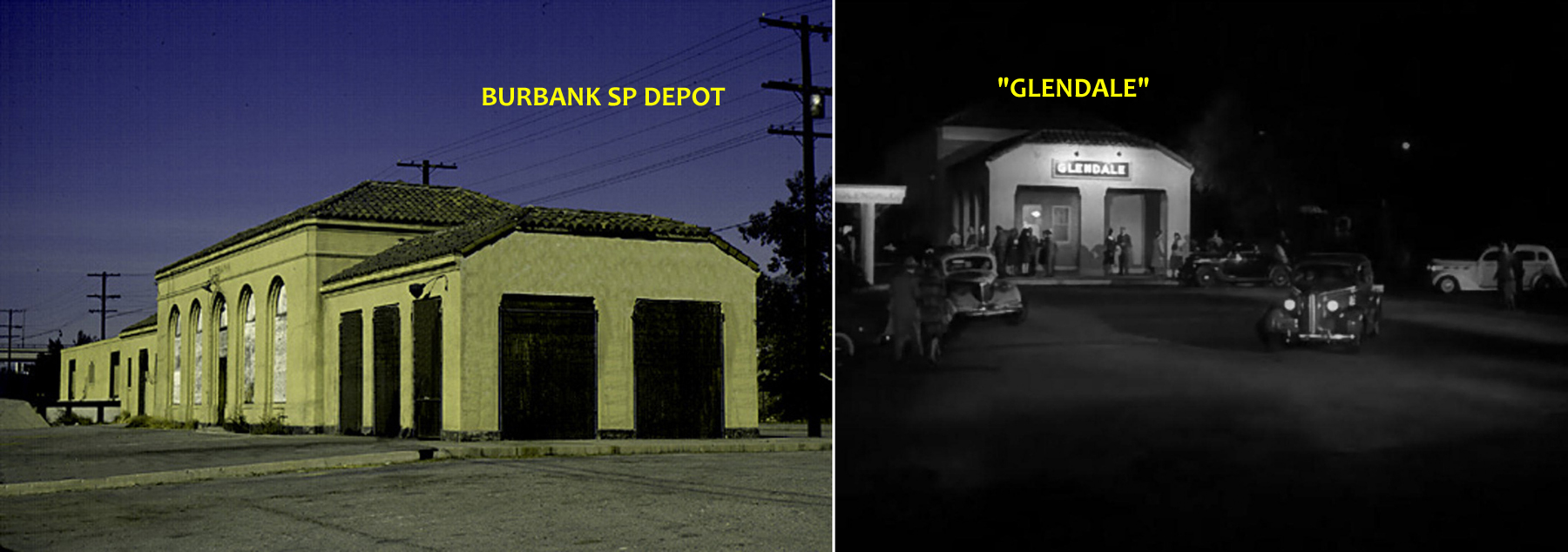
As Lindsay Blake proves in her wonderful I’m Not a Stalker film and TV location blog, the noir classic Double Indemnity (1944), starring Barbara Stanwyck and Fred MacMurray was NOT filmed at the Glendale station, but actually the Burbank station, even though a “GLENDALE” sign appears during the scenes in the movie.   Instead, for some reason they put a “GLENDALE” sign on the Burbank station for the shot.  You can read about this and several other movies filmed at the Glendale station in Lindsay’s post HERE.

Burbank plays "Glendale" in Double Indemnity

Burbank plays “Glendale” in Double Indemnity. Ron Reiring – http://www.flickr.com/photos/84263554@N00/6622573375/

Wings Paramount Home Entertainment.

College frame images reproduced courtesy of The Douris Corporation, David Shepard, Film Preservation Associates, and Kino International Corporation.

HAROLD LLOYD images and the names of Mr. Lloyd’s films are all trademarks and/or service marks of Harold Lloyd Entertainment Inc. Images and movie frame images reproduced courtesy of The Harold Lloyd Trust and Harold Lloyd Entertainment Inc.

Act of Violence copyright 1948 Loew’s Incorporated.

Posted in Buster Keaton, College, Film Noir | Tagged , , , , , , , , , , , , , , , | 2 Comments

Silent Cameos of the lost Southern Pacific Depot

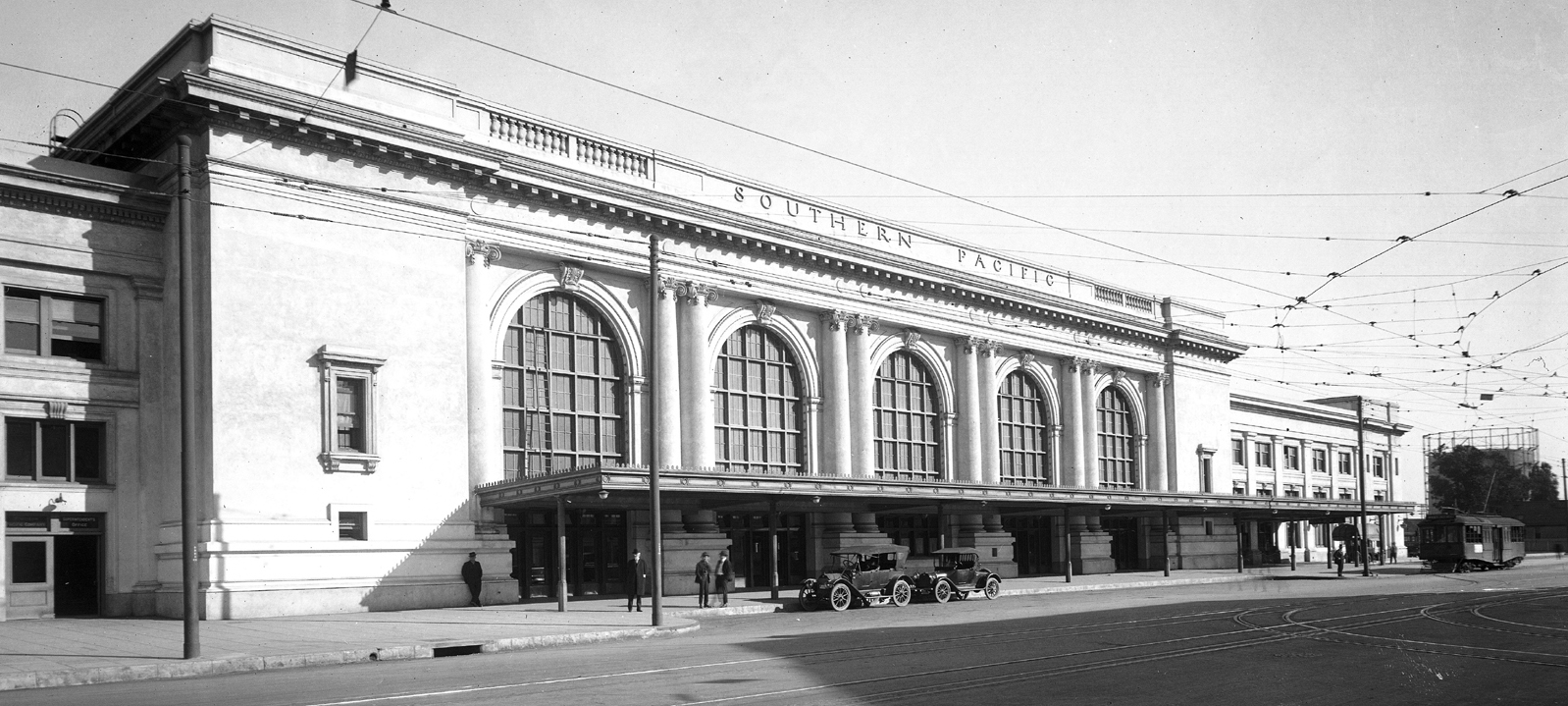
The former Southern Pacific Depot at 5th and Central

The former Southern Pacific Depot at 5th and Central (in service from 1915 to 1939) – USC Digital Archive

Before the beautiful downtown Los Angeles Union Train Station opened in 1939, built on the site of the original Chinatown, the various railroads serving L.A. each operated from their own stations.  Union Station helped to reduce downtown noise and congestion by consolidating the Union Pacific, Santa Fe, and Southern Pacific city entrances and stations into a single terminal.  As with so many other Los Angeles landmarks now lost to the wrecking ball, glimpses of the former Southern Pacific Depot, that once stood at E. 5th Street and Central Avenue (pictured above), are unwittingly preserved in the background of numerous silent comedies.

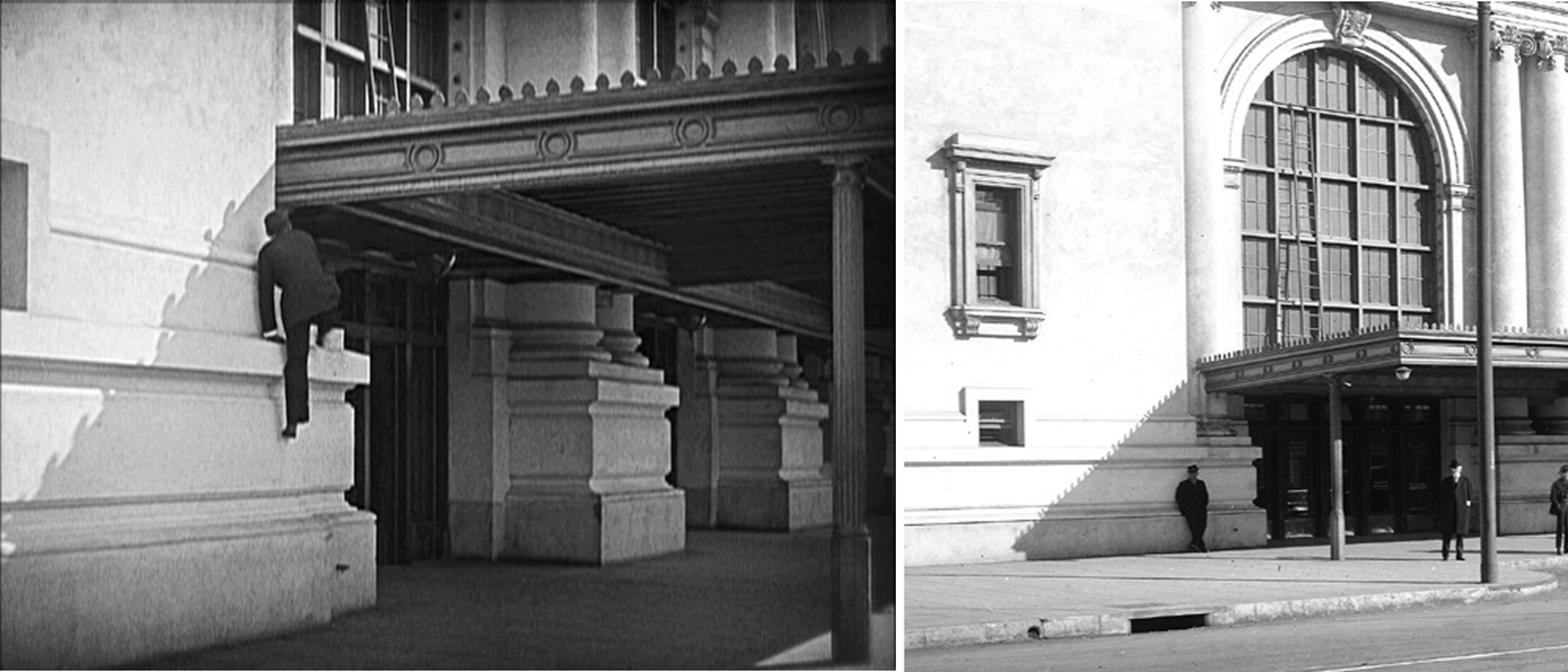
Doug

Douglas Fairbanks at the Southern Pacific Depot – When the Clouds Roll By

One early appearance comes during a stunt from the Douglas Fairbanks comedy When the Clouds Roll By (1919), as Doug scampers up the Southern Pacific Depot’s front awning (above).

ca

The former Arcade Depot (1889 – 1914) USC Digital Archive

The Southern Pacific Depot opened to great fanfare on June 12, 1915.  Built at a cost of $750,000 on the site of the former Arcade Depot (1889 – 1914), the Southern Pacific Depot was touted as the nation’s finest building of its kind west of Kansas City.  The station was 572 feet long, with a concourse 280 feet long, by 80 feet wide and 50 feet high.   Ten passenger tracks, protected by four concrete umbrella sheds each 780 feet long, were accessed by subways so that passengers no longer needed to cross tracks to reach their particular trains.

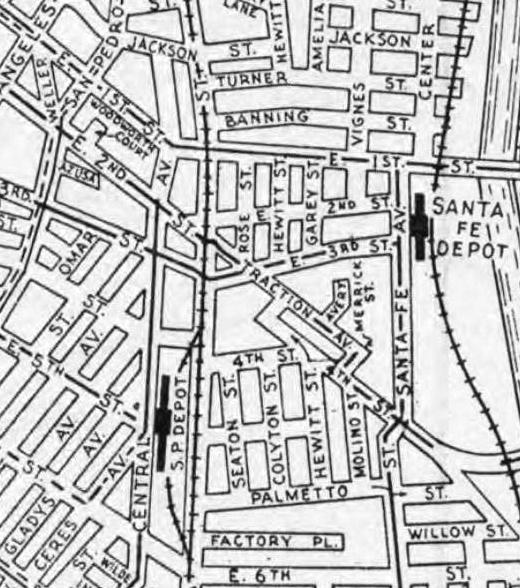
Two now lost stations - the extant Union Station that replaced these two stations is several blocks further north on this map.

Two now lost stations – the extant Union Station, that replaced the SP and Santa Fe Depots, stands several blocks further north on this map.

The Southern Pacific Depot played a key role in Harold Lloyd’s 1924 feature comedy Girl Shy.  As I explain in my book Silent Visions, Harold and lead actress Jobyna Ralston are filmed arriving in town at the Santa Fe Depot on Santa Fe Avenue near 1st Street.  Yet they say their good-byes to one another in front of the Southern Pacific Depot, several blocks to the west, as shown on this vintage map (left).

As I may discuss in a later post, the Santa Fe Depot was a popular place to film, appearing in numerous Hal Roach Studios productions including Charley Chase’s Crazy Like A Fox (1926), Laurel & Hardy’s Berth Marks (1929), the Our Gang comedy Choo-Choo! (1932), and in Lloyd’s independently produced talking picture Movie Crazy (1932).

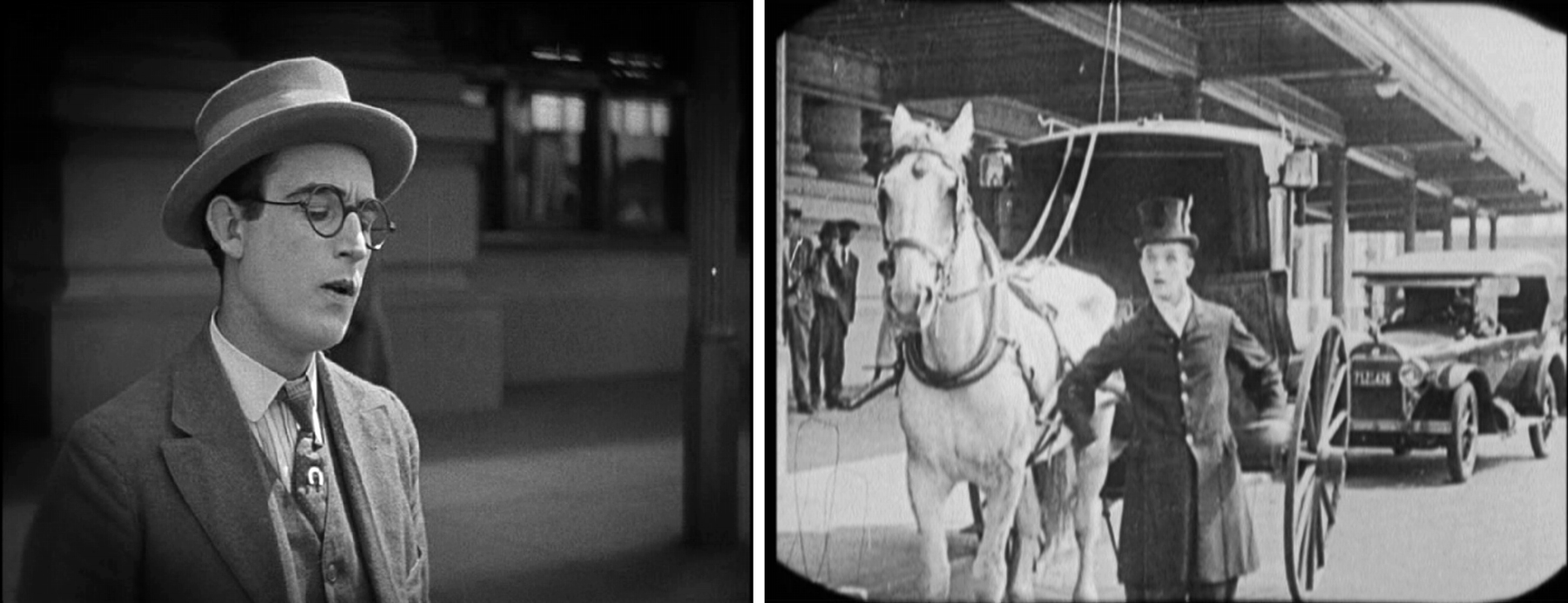
Below, Harold Lloyd at left, in front of the Southern Pacific Depot in Girl Shy, and Stan Laurel playing a hansom cab driver in his pre-Oliver Hardy solo comedy Mother’s Joy (1923).

ca

Harold Lloyd and Stan Laurel both in front of the Southern Pacific Depot.

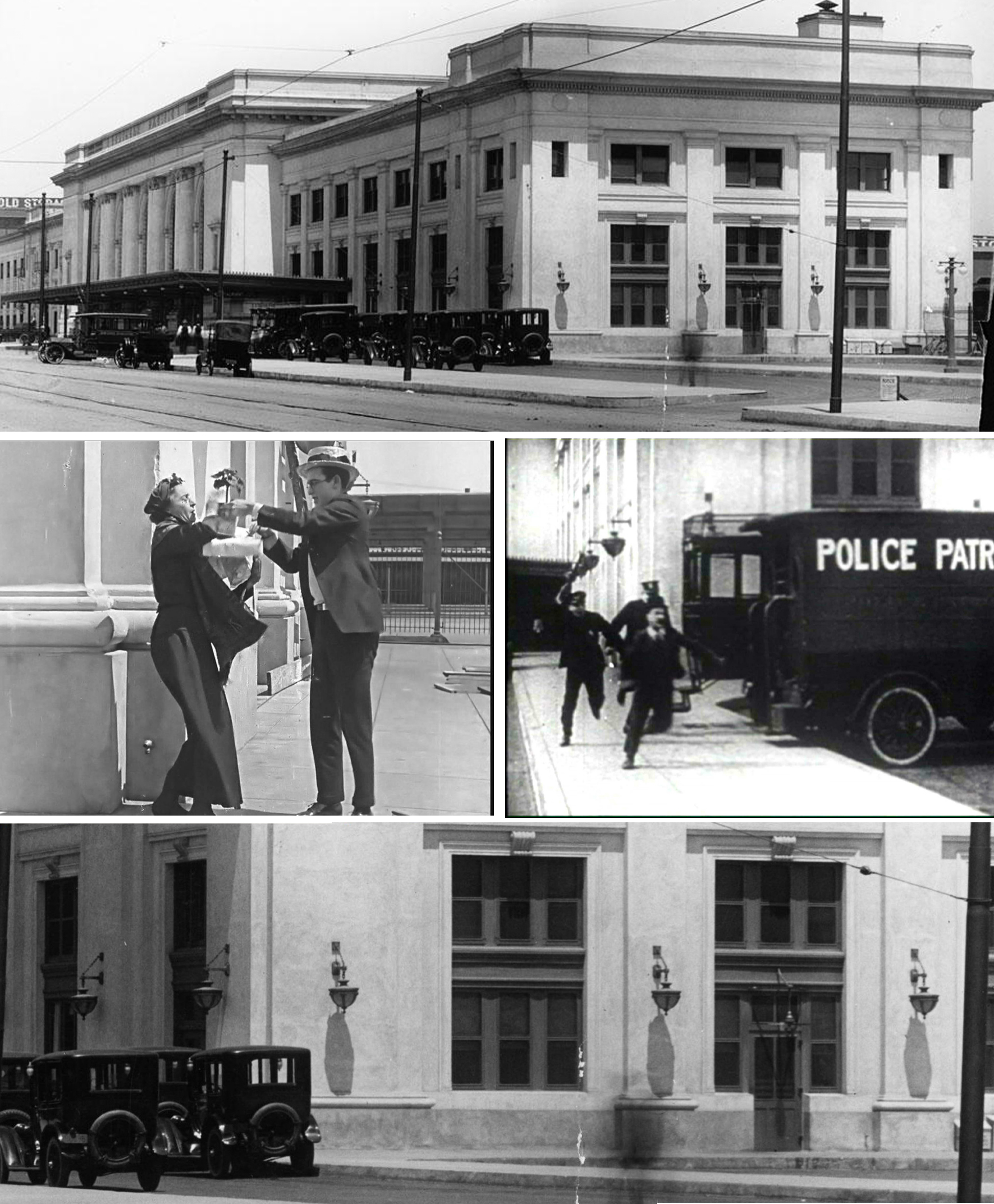
Filmmakers not only captured the western (front) side of the Southern Pacific Depot, the south end of the station (the side facing the sun all day) also appears in vintage comedies.  In Just Neighbors (1919) (see left below) Harold Lloyd races around the station corner attempting to catch the next train home, when he runs into several people blocking his way.  In Be Reasonable (1921), Billy Bevan (see right below) flees the police by racing south from the station during a lengthy chase, presaging Buster Keaton’s similar chase in Cops (1922).  Notice the former station’s distinctive light fixtures along the corner walls.

ca

Left – Harold Lloyd in Just Neighbors; right – Billy Bevan in Be Reasonable.  USC Digital Archive

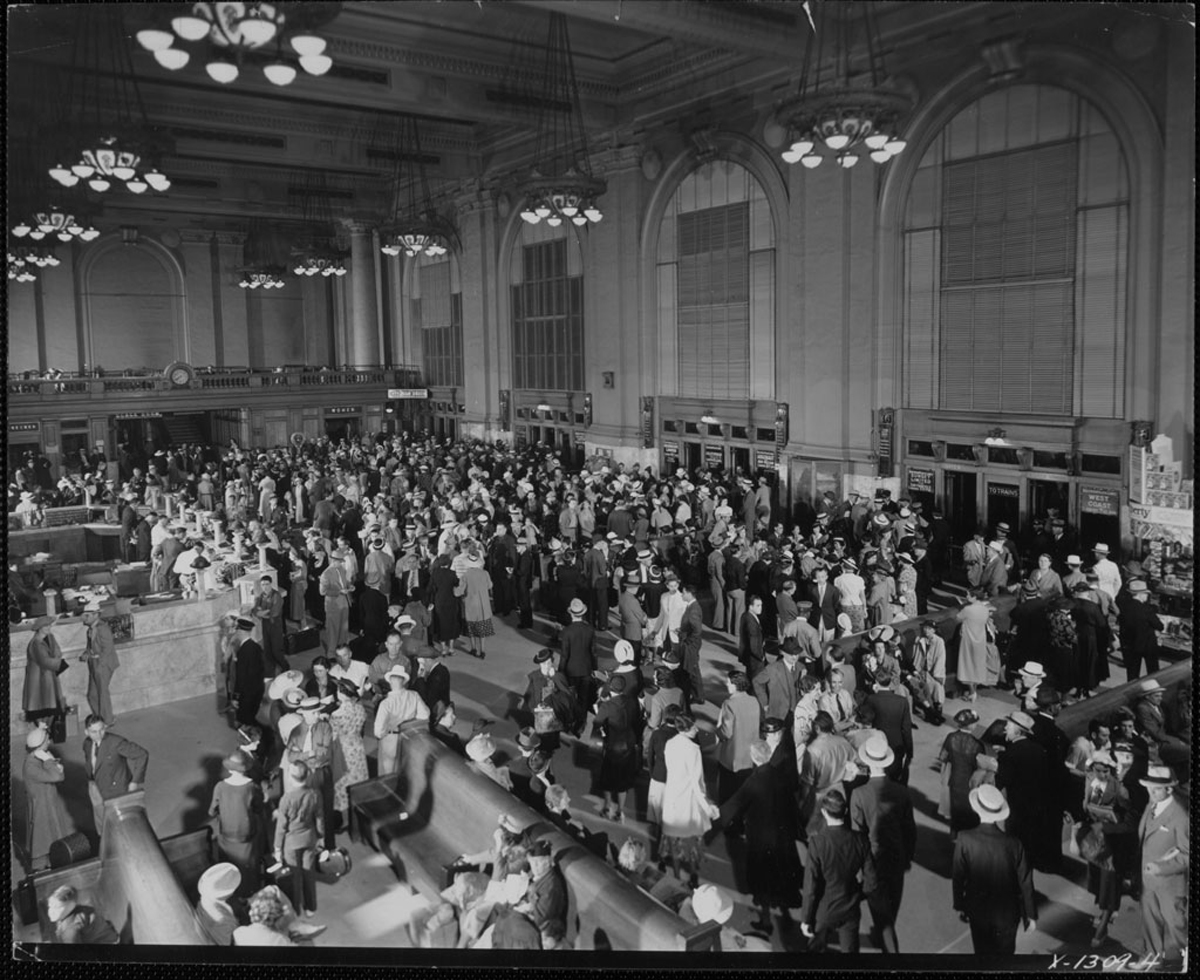
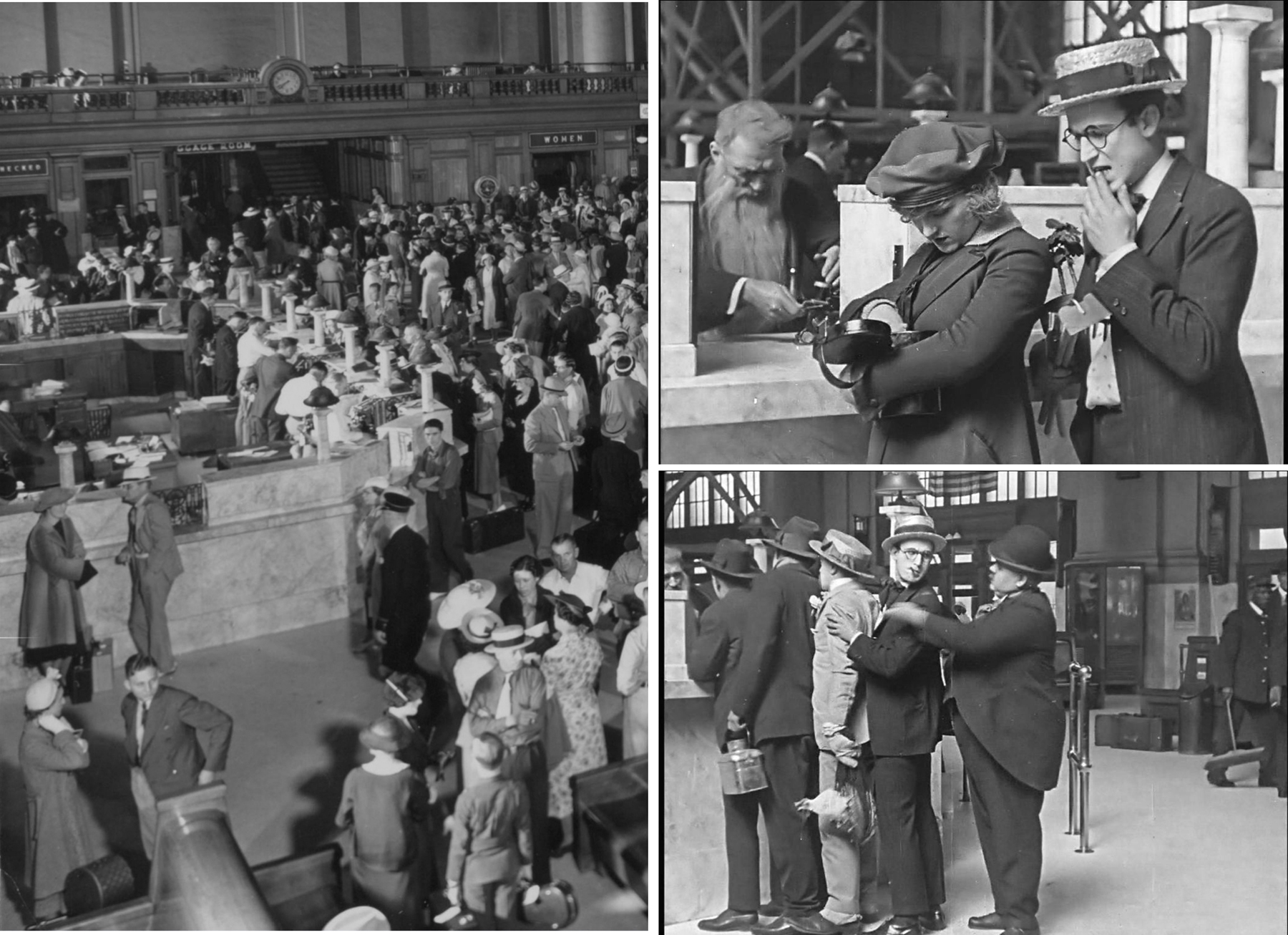
Harold Lloyd’s short film Just Neighbors also provides some remarkably rare views of the interior of the lost station.  Compare this photo below, with scenes from Harold’s movie.

ca

A rare interior view of the Southern Pacific Depot – USC Digital Archive.  Note: the archive credits this photo as around 1956, perhaps a typo for the more likely 1936.

ca

Click to enlarge.  Harold’s ticket counter appears left center.

Below, the extant Rosslyn Hotel (1913) at 5th and Main appears in the background during a scene from Girl Shy as Harold runs west after Jobyna’s taxi cab down 5th Street from the Southern Pacific Depot.  In the matching modern view, the US Bank Tower, the tallest building on the West Coast, dominates the skyline.  At 1,018 feet, the building stands nearly seven times as tall as the 150-foot height limit imposed in Los Angeles for many decades.  I don’t think anyone involved with filming Harold’s scene could have imagined that the downtown skyline would someday appear this way.

ca

Click to enlarge.  Harold runs down 5th Street from the Southern Pacific Depot – a matching modern view.

Below, the cold storage distribution facility, standing on the site of the Southern Pacific Depot today, was completed in May 1958.

To see where Buster Keaton filmed several movies at the Inglewood and Chatsworth depots, check out this earlier post Buster’s Trains – One Week to Speak Easily.

When the Clouds Roll By (1919)—Douglas Fairbanks: A Modern Musketeer Collection (David Shepard, Film Preservation Associates, Jeffrey Masino, Flicker Alley LLC).

HAROLD LLOYD images and the names of Mr. Lloyd’s films are all trademarks and/or service marks of Harold Lloyd Entertainment Inc. Images and movie frame images reproduced courtesy of The Harold Lloyd Trust and Harold Lloyd Entertainment Inc.

Mother’s Joy (1923)—The Stan Laurel Collection Slapstick Symposium (Eric Lange and Serge Bromberg, Lobster Films).

Be Reasonable (1921)—American Slapstick 2 Collection (All Day Entertainment, David Kalat).

Posted in Douglas Fairbanks, Girl Shy, Hal Roach Studios, Harold Lloyd, Los Angeles Historic Core, Stan Laurel | Tagged , , , , , , , , , , , , , , , , , , , , | 14 Comments

Front and Back Cameos – 100 years of a Hollywood landmark

ca

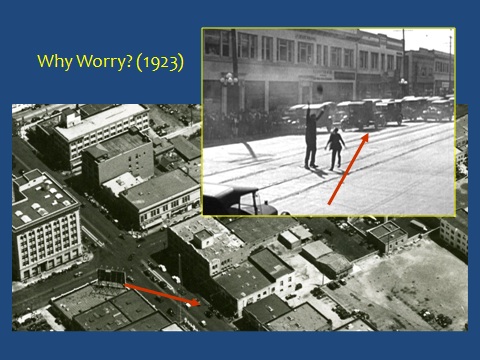
In Why Worry? above, Harold Lloyd’s friend the giant celebrates news of Harold becoming a father.

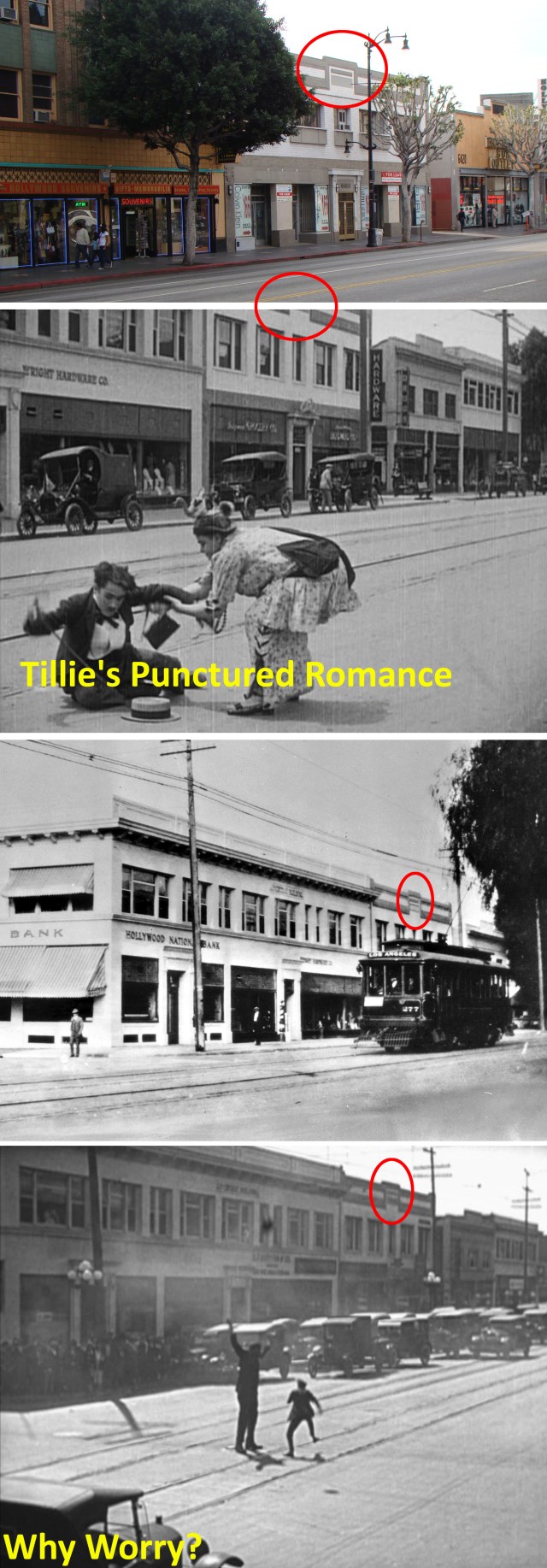
Toberman Hall has stood at 6410-6414 Hollywood Boulevard (each oval above) since 1907.  Its original two-story neighbor to the left, at the southwest corner of Cahuenga and Hollywood Boulevard (pictured in the black & white images above) was expanded into a four-story building in 1931 (see color image above).  As shown, Toberman Hall witnessed the antics of Marie Dressler and a young Charlie Chaplin in the first Hollywood-produced feature length comedy Tillie’s Punctured Romance (1914), and a decade later appeared in Harold Lloyd’s 1923 feature Why Worry?

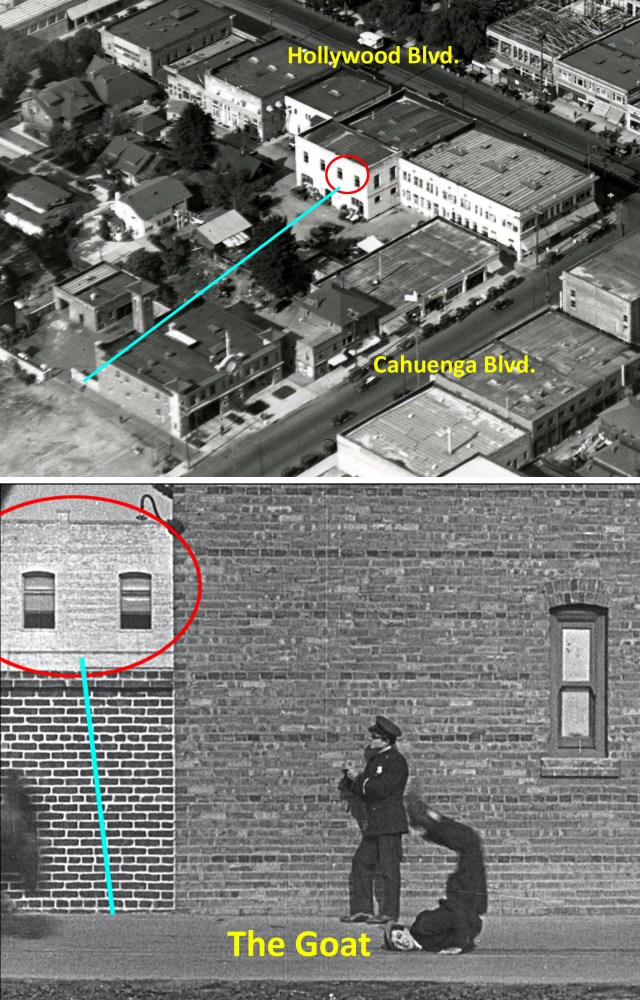
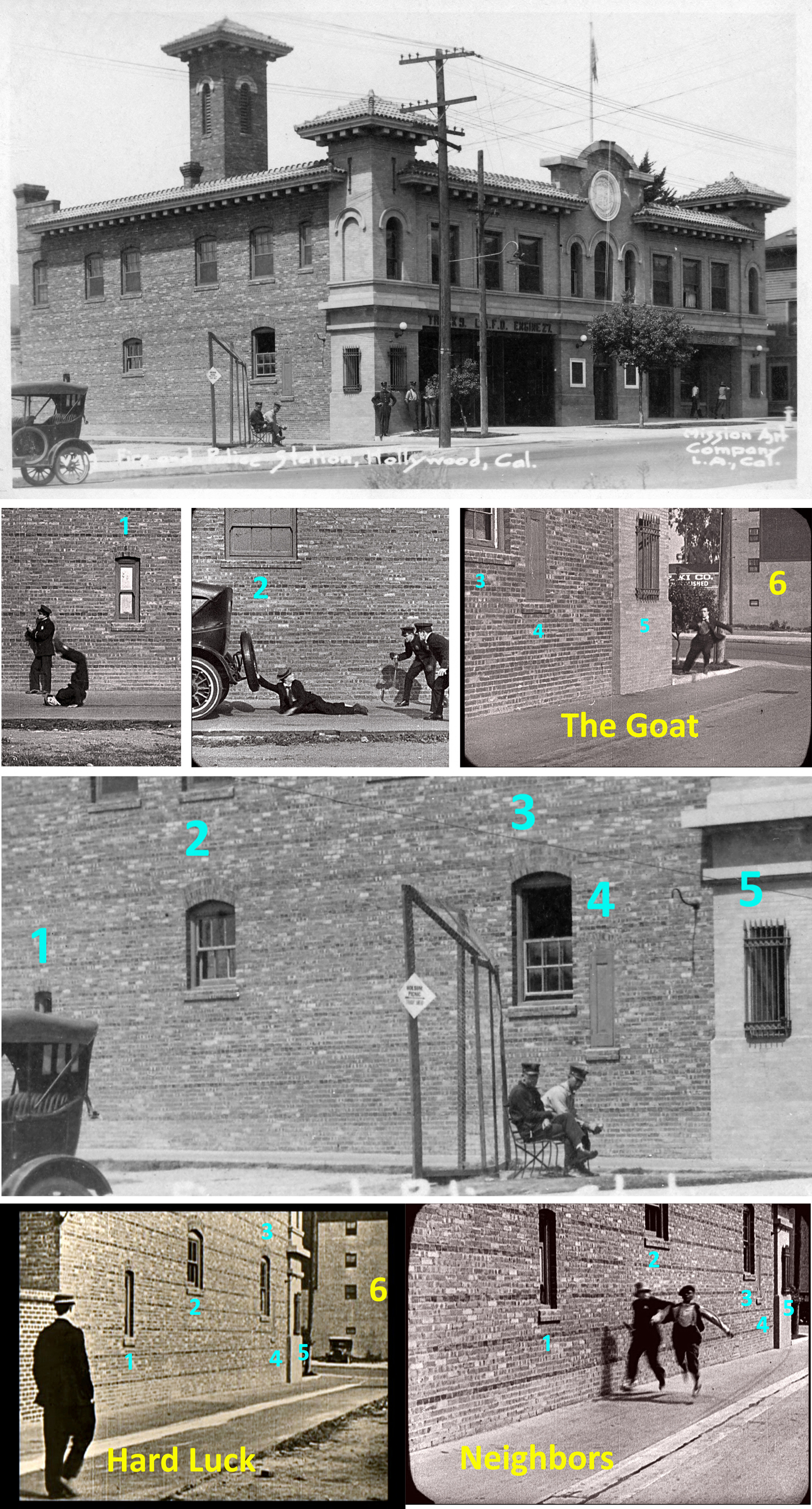
As shown, the back of Toberman Hall (red oval below) appears in Buster Keaton’s 1921 short comedy The Goat, where Buster filmed a scene in the alley alongside the former fire/police station facing Cahuenga.

ca

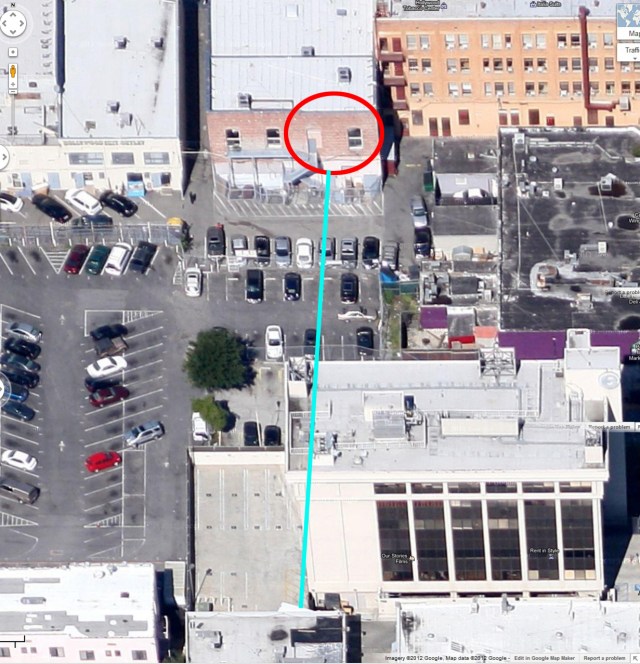
During the above scene from The Goat, Buster lands face down in an alley after being dragged into view by a speeding car, barely visible at the left.  Behind him is a low brick wall and the south side of the joint Hollywood Fire and Police Station that stood at 1625 and 1629 Cahuenga Boulevard.  The red ovals above identify matching windows of the back of Toberman Hall, and the point of view (blue line) from the fire station alley.  The aerial view above shows that this alley originally had no building along the other side.

ca

A modern office building now stands along the extant fire station alley.  (C) 2012 Google.

This modern aerial view above shows the back of the extant Toberman Hall, aligned with the extant fire station alley, with the fire/police station replaced by a modern office building.

How do I know Keaton filmed this scene in the fire station alley, showing the back of Toberman Hall, especially since the station was destroyed by fire in December 1979?  Hollywood author and historian Tommy Dangcil (Hollywood 1900-1950 in Vintage Postcards, and Hollywood Studios) provided me with this post card that links the clues all together.

Click to enlarge. The unique fire station alley windows (1-5) and the Go West parking lot (6) across the street. Photo Tommy Dangcil.

Click to enlarge. The unique fire station alley windows (1-5) and the Go West parking lot (6) across the street. Photo Tommy Dangcil.

ca

Buster at the fire/police station in Three Ages

The Hollywood Fire and Police Station (see full view above) stood at 1625-1629 Cahuenga Boulevard.  As I discuss in my books Silent Echoes and Silent Visions, the station appeared in Buster Keaton’s feature films Three Ages (1923) (see left) and The Cameraman (1928), as well as in Harold Lloyd’s Safety Last! (1923) and Hot Water (1924).  What’s more, we can see from the unique window configuration (1-5 above) that Keaton used the fire station alley for three different films, The Goat, Hard Luck (1921), and Neighbors (1920).

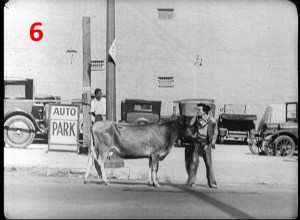
(6) Buster and Brown Eyes in Go West, across the street from the fire/police station.

(6) Buster and Brown Eyes in Go West, across the street from the fire/police station.

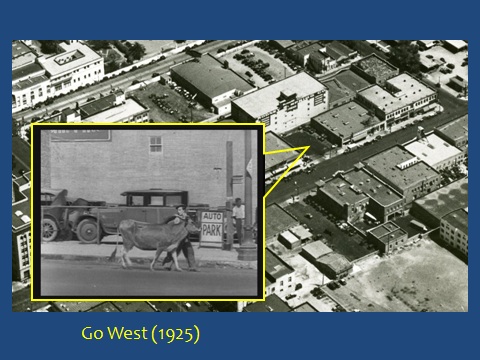
During scenes from The Goat Buster runs past the corner of the fire station (above right) and hides under a car parked in the fire station alley.  When the car drives off, revealing Buster to the police, he grabs the bumper for a quick getaway (above center), only to land on his face moments later (above left).  These three shots reveal the five unique fire station windows (1-5) identified above.  The above scene from Hard Luck shows Keaton before hitching a ride on the back of a passing car, revealing the entire length of the fire station alley (this shot appears only on the Keaton Plus DVD version of the film), while the above scene from Neighbors shows a policeman harassing a man he mistakenly thinks is Buster.   Last, the views in The Goat and Hard Luck down the fire station alley reveal the small parking lot across the street (6) where Buster left his pet cow Brown Eyes during his 1925 feature Go West (inset).

ca

Plenty of room and sun to film.

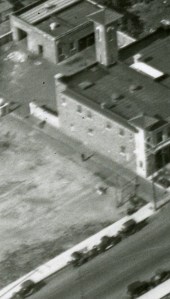
Why did Keaton film at this alley so frequently?  As shown in this 1922 vintage aerial view (left), the fire station alley originally had no building along its south flank, exposing the length of the alley to the sun nearly all day long, and providing unobstructed room to place cameras and equipment.  Moreover, the alley was situated off of the same block of Cahuenga where Keaton filmed many other scenes, and was close to the Keaton Studio just a few blocks to the south.

To see many more amazing photos of this old fire station, visit the Photo Gallery at the Los Angeles Fire Department Historical Archive, and open the photos for Fire Station 27.  Then, mid-way down the page click the 1913-1930 link (the years this station was in service) to see many exterior and interior historic photos.

This final view shows the back of Toberman Hall (red oval) relative to the alley (yellow oval) where Keaton grabbed a passing car one-handed in Cops (1922) (see post HERE).

Click to enlarge. Another 1922 view of Toberman Hall (red oval) in relation to the Cops alley (yellow oval).

Click to enlarge. Another 1922 view of Toberman Hall (red oval) in relation to the Cops alley (yellow oval).

Historic aerial photos from Bruce Torrence, at HollywoodPhotographs.com.

Tillie’s Punctured Romance Copyright 2010 by Lobster Films for the Chaplin at Keystone Project, from Flicker Alley.  All images from Chaplin films made from 1918 onwards, copyright © Roy Export Company Establishment. CHARLES CHAPLIN, CHAPLIN, and the LITTLE TRAMP, photographs from and the names of Mr. Chaplin’s films are trademarks and/or service marks of Bubbles Incorporated SA and/or Roy Export Company Establishment. Used with permission.

The Goat, Three Ages, and Go West are licensed by Douris UK, Ltd., and are all available on Blu-ray from Kino Lorber.

HAROLD LLOYD images and the names of Mr. Lloyd’s films are all trademarks and/or service marks of Harold Lloyd Entertainment Inc. Images and movie frame images reproduced courtesy of The Harold Lloyd Trust and Harold Lloyd Entertainment Inc.

Below, the fire station alley to the left, and the back of Toberman Hall to the right.

Posted in Buster Keaton, Charlie Chaplin, Harold Lloyd, Hollywood Tour, The Goat, Tillie's Punctured Romance | Tagged , , , , , , , , , , , | 14 Comments

Keaton’s Short Fuse – Cops, Musso & Frank, and enduring Hollywood history

ca

What do I do with this now?  Buster blithely lights a cigarette in Cops.

ca

Buster on parade, filmed in 1922 at the Goldwyn Studio in Culver City, prior to the creation of M-G-M in 1924.

At one point during Buster Keaton’s most famous short film Cops (1922), Buster finds himself and his newly acquired horse-cart full of furniture in the middle of the annual Policeman’s Day Parade.  After politely tipping his hat in recognition to the parade-route crowds, Buster pulls out a cigarette and fumbles for a light.   At that moment, an anarchist (an overused silent comedy trope, but grounded in real-life tragedies such as the 1920 Wall Street bombing and 1910 Los Angeles Times Building bombing) tosses a bomb from a rooftop that lands conveniently on Buster’s bench.  While other comedians at the time might have mugged hysterically reacting to this predicament, Buster blithely notices the sputtering fuse, puts the flame to good use to light his cigarette, and then serenely ponders how to dispose of the no-longer-useful object.  The brief scene is one Keaton’s most iconic, a three-second long vignette of Buster’s unique persona.

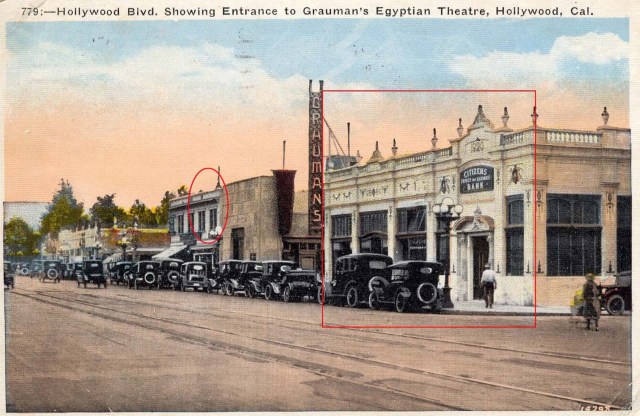
As revealed in this story, the amazing detail in the new Kino Lorber Blu-ray release of Keaton’s films allows us to solve where this rooftop scene was filmed, and discover its amazing connection to two venerable Hollywood institutions; the legendary eatery Musso & Frank, and Grauman’s Egyptian Theater, today home to The American Cinematheque.

ca

Looking west – the bomber atop 6667 Hollywood Blvd., current site of the Musso & Frank Grill – the original grill site at 6669 stands next door out of view.  The oval and box (match below) flank the Egyptian Theater under construction.

ca

Looking east – the oval and box flanking the theater match those above.  Courtesy Tommy Dangcil

Click to enlarge

Click to enlarge

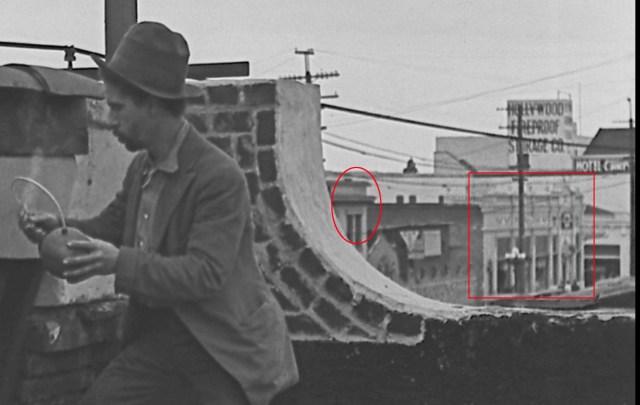
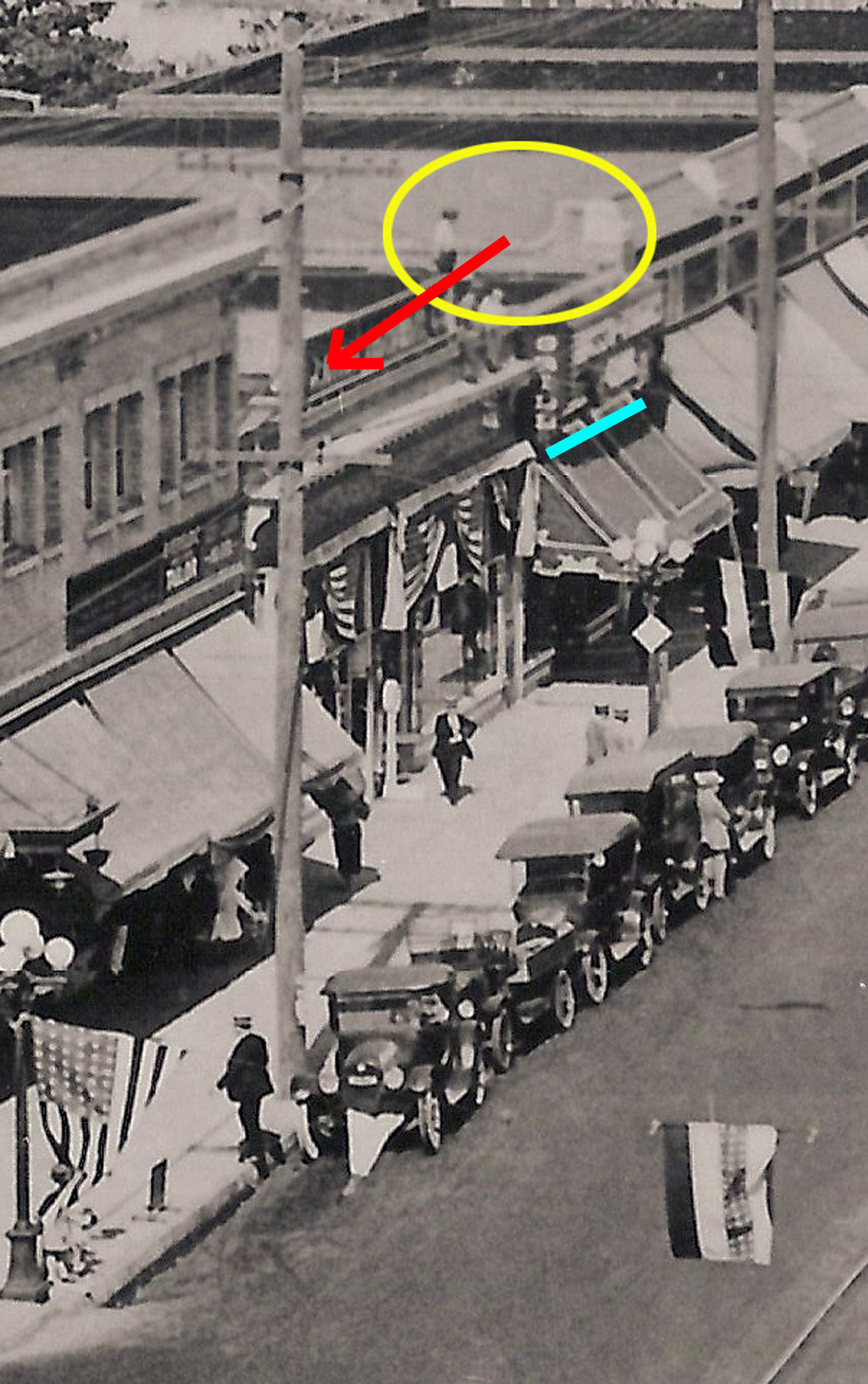
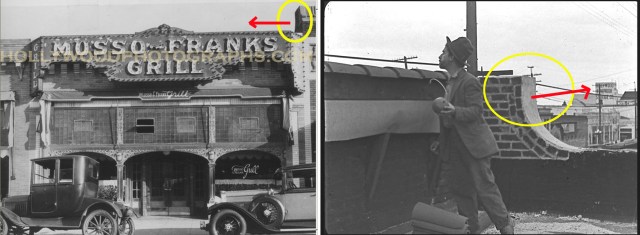
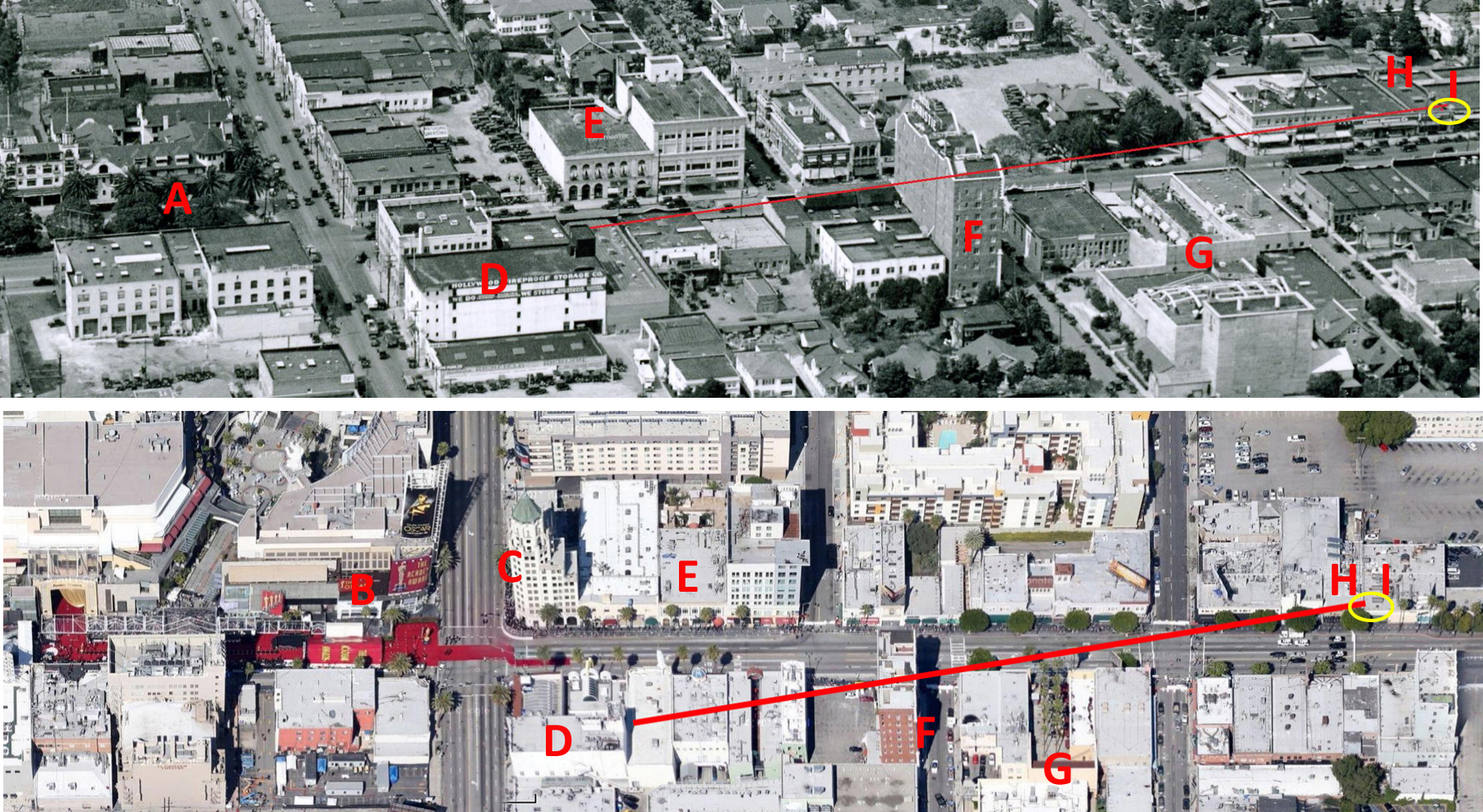
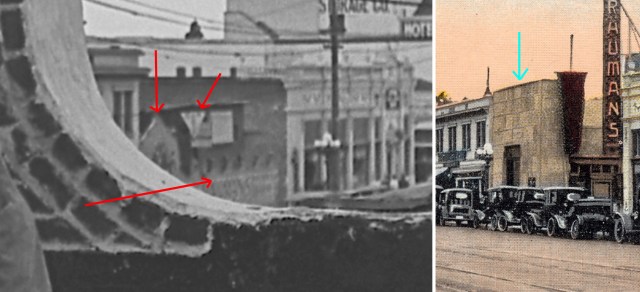
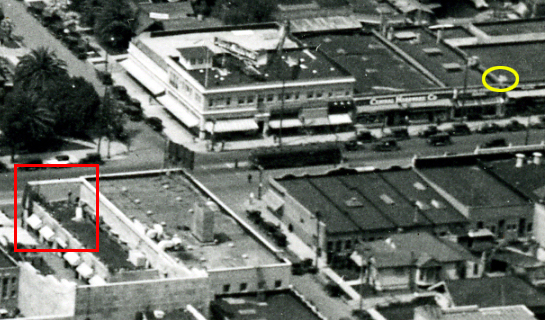
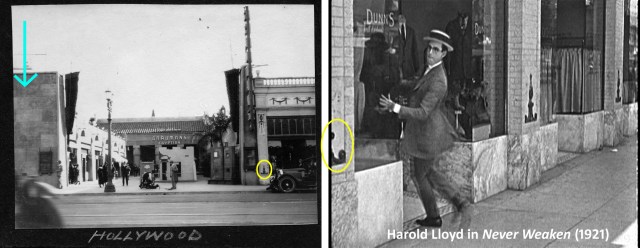
It turns out the anarchist was standing on the rooftop of 6667 Hollywood Boulevard, the modern day home to the Musso & Frank Grill restaurant, founded in 1919.  But at the time of filming (in 1922), the original (and shorter) Musso & Frank building (at 6669), stood immediately next door to the west, just below view behind the bomber.  I solved this puzzle by reckoning from the Hollywood Fireproof Storage Building visible in the background of the movie frame.  It still stands today, reconfigured in 1935 as the Max Factor Building on Highland Avenue, and now home to the Hollywood Museum.  The arrows at left, and below, all point west down Hollywood Boulevard from the rooftop corner where the bomber stood (yellow oval).  The blue line at left underscores the grill sign.

ca

The original Musso & Frank Grill, at 6669 Hollywood Blvd. courtesy HollywoodPhotographs.com.  The oval marks the west edge of 6667 Hollywood Blvd., the current home to Musso & Frank.  The arrow points west in both images.

ca

This circa 1928 view looks east – the palm trees in front of the Hotel Hollywood stand at the lower left corner of Hollywood and Highland.  Los Angeles Public Library.

Below, a final overview aligning the rooftop bomber and the Hollywood Storage building.

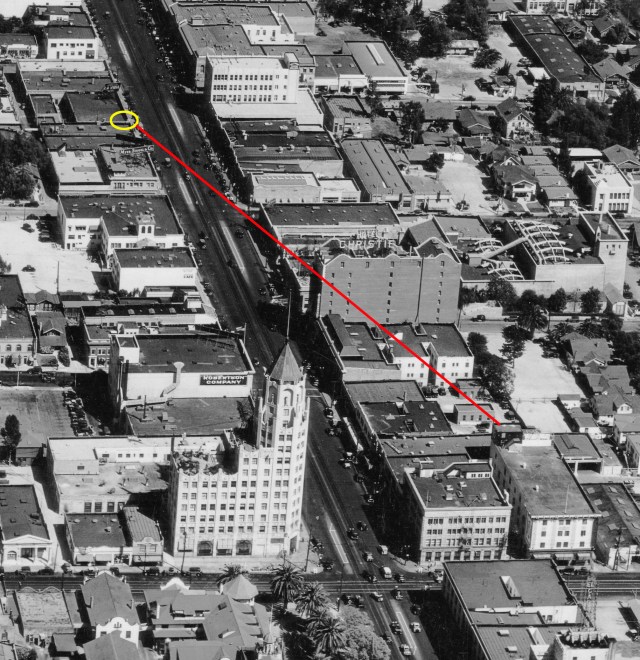
Hollywood Then (1926) and Now.  (A) marks the Hotel Hollywood, now (B) the Hollywood and Highland entertainment center (there are red carpets in the street for the Oscar ceremonies), (C) the First National Bank tower (completed in 1928), (D) the Hollywood Fireproof Storage building, now the Hollywood Museum, (E) the Montmartre restaurant building, (F) the Hotel Christie (opened in 1923), (G) the south end of the Egyptian Theater forecourt (opened in 1922), (H) 6669 Hollywood Blvd. (the original Musso & Frank site), and (I) 6667 Hollywood Blvd., the current Musson & Frank site.  b&w image HollywoodPhotgraphs.com – color image (C) 2012 Google.

Click to enlarge – Hollywood Then (1926) and Now. (A) marks the Hotel Hollywood, now (B) the Hollywood and Highland entertainment center (there are red carpets in the street for the Oscar ceremonies), (C) the First National Bank tower (completed in 1928), (D) the Hollywood Fireproof Storage building, now the Hollywood Museum, (E) the Montmartre restaurant building, (F) the Hotel Christie (opened in 1923), (G) the south end of the Egyptian Theater forecourt (opened in 1922), (H) 6669 Hollywood Blvd. (the original Musso & Frank site), and (I) 6667 Hollywood Blvd., the current Musson & Frank site. b&w image HollywoodPhotgraphs.com – color image (C) 2012 Google.

There is more to this story.  George Wead’s bibliography of Keaton reports that Buster filmed Cops between December 1921 and January 1922 (thanks David B. Pearson).  Though a bit difficult to discern, the rooftop bomber shot also provides an early view of the Egyptian Theater site, taken ten months or so before the theater opened.  The Los Angeles Times reported, following a May 7, 1921 dedication ceremony, that construction of Sid Grauman’s so-called Hollywood Theater was planned to start May 9, 1921, and that with rushed construction it was anticipated to open by November 1921.  A later November 4, 1921 story said that barring unforeseen circumstances the theater would likely open by February 1922.  Yet the theater did not open until October 18, 1922, with the premiere of Douglas Fairbanks’s epic adventure Robin Hood.

Close-up view of Egyptian Theater construction site.  The triangle (right arrow) I believe is a street car traffic sign, suspended from a wire across the street.  The bottom arrow points across what appears to be the top edge of billboards pasted on a construction site fence fronting the sidewalk.  The mystery is the left arrow, pointing down toward a pitched face building that appears to have Gothic-arched windows.  A  squat, block-shaped Egyptian-style structure was later built at this spot.

Close-up view of Egyptian Theater construction site. I believe the triangle (right red arrow) is a street car traffic sign, suspended from a wire across the street. The bottom arrow points across what appears to be the top edge of billboards pasted on a construction site fence fronting the sidewalk. The mystery is the left arrow, pointing down toward a pitched face building that appears to have Gothic-arched windows. A tall, block-shaped Egyptian-style structure (blue arrow) was later built at this spot.

The theater is known for its large forecourt fronting Hollywood Boulevard, framed to the east by a long narrow commercial building forming one side of the court leading to the theater doors (see below).  It appears from the frame above that at one time the face of this commercial wing had a different style than the tall, block-shaped face that was later built.

ca

The bomber (oval) and the tall false front face to the Egyptian commercial wing (box).

You can see on the above image that the commercial wing is only one story tall, and that the tall blocked-shaped face of the wing (box) is a false front.  So maybe the face of this wing was originally the pitched-roof face visible in the Keaton frame.

ca

Above, the original Egyptian Theater forecourt – the blue arrow marks the tall, two-story false front to the one story commercial wing.  The Dunn’s Men’s Shop, to the right of the forecourt (yellow oval), appears in Harold Lloyd’s 1921 short comedy Never Weaken.  The store was replaced by the Pig ‘N Whistle restaurant in 1927.

Harold also filmed at the corner of Hollywood Blvd. and McCadden Place, as shown.

Harold also filmed at the corner of Hollywood Blvd. and McCadden Place, as shown.

Cops is licensed by Douris UK, Ltd., and available as part to the Kino Lorber Buster Keaton: The Short Film Collection (1920-1923).

HAROLD LLOYD images and the names of Mr. Lloyd’s films are all trademarks and/or service marks of Harold Lloyd Entertainment Inc. Images and movie frame images reproduced courtesy of The Harold Lloyd Trust and Harold Lloyd Entertainment Inc.

Posted in Buster Keaton, Cops, Hollywood Tour | Tagged , , , , , , , , , , , , , , | 6 Comments

Harold Lloyd – Film Noir – Criss Cross and the Hill Street Tunnel

Burt Lancaster in Criss Cross along the north end of the Hill Street Tunnel. The box marks where Lloyd filmed.

A set for The Terror Trail (1921) overlooking the south end of the Hill Street Tunnel – Marc Wanamaker Bison Archives

Harold Lloyd, Buster Keaton, and many other silent comedians filmed stunt comedy sequences by building sets on Court Hill overlooking the south end of the former Hill Street Tunnel.  As shown at left, filming a set against the street far below, while cropping the tunnel balustrade from view, created the illusion of great height.  This remarkable setting was also adjacent to the magnificent Bradbury Mansion, one of the city’s finest original homes, that was later used as an early movie studio by Charlie Chaplin, Harold Lloyd, and Hal Roach, and was close to Court Flight, the city’s second (and now lost) funicular railway.  You can see more pictures of the Bradbury Mansion, Court Flight, and the south end of the Hill Street Tunnel, in this earlier post (HERE), and can read all about them in my three books.  (Note: this is my sixth post so far connecting silent comedy and film noir – there will be many more, especially regarding Harold Lloyd.  You can link to these other noir posts HERE).
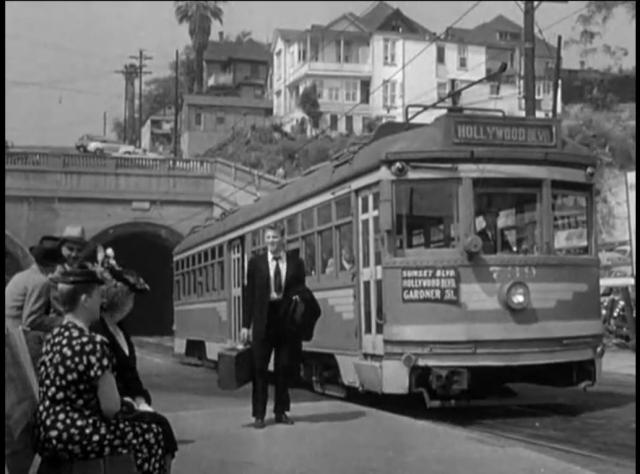
Burt Lancaster in Criss Cross at the north end of the Hill Street Tunnel.  The top of this blog shows him walking by the back railing toward 215 N. Hill Street, the big white house in the back, discussed later.

Lizzies of the Field

While the south end of the Hill Street Tunnel appears in dozens of silent comedies, the first film appearance of the north end of the Hill Street Tunnel of which I am aware is in the Burt Lancaster film noir drama Criss Cross (1949), co-starring a young and lovely Yvonne De Carlo as the femme fatale, who would later play matriarch Lilly Munster in the 1960s sitcom The Munsters.*   In the above frame, Burt returns to Los Angeles by exiting a trolley at the north end of the Hill Street Tunnel at the corner of Temple.  As shown at the end of this post on Google Street View, this corner, now part of the Los Angeles Civic Center, is redeveloped beyond recognition.  The homes, the tunnel, and even the hill have all been graded flat.  (*I realize now that during the Mack Sennett comedy Lizzies of the Field (1924) there is a brief shot approaching the north end of the tunnel – see inset).
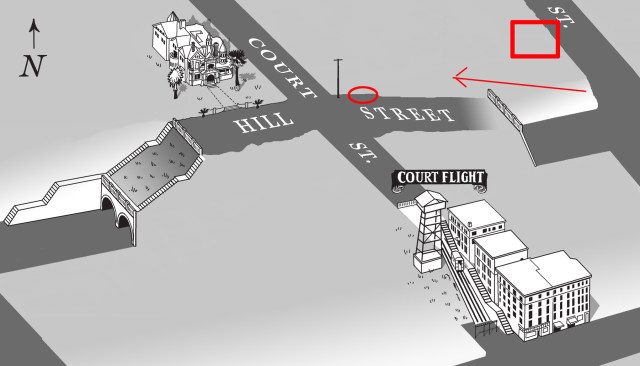
Court Hill – the north end of the Hill Street Tunnel (right) relative to the Bradbury Mansion and Court Flight.  Map by Piet Schreuders
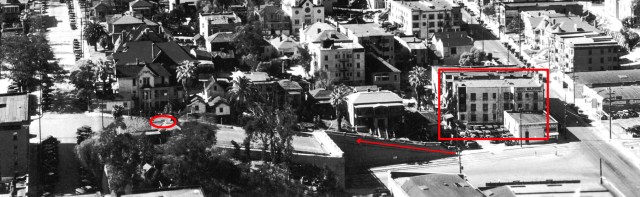
A view from City Hall comparable to the map above – the arrow shows Burt’s path as shown at the top of this post.  The box is enlarged below.  The oval marks Yvonne’s car, discussed later.

Harold Lloyd in Take A Chance before the Majestic Apartments at 406 W Temple – steps from the north end of the Hill Street Tunnel.

As explained here, and in future posts, Harold Lloyd frequently filmed scenes from his early short comedies within steps of the former Bradbury Mansion studio on Court Hill, providing rare glimpses of this long-lost Los Angeles neighborhood that was later excavated and graded flat.  Take A Chance (1918, shown above), was filmed at 406 Temple near the north end of the Hill Street Tunnel, just steps from where Burt Lancaster exited the trolley in Criss Cross.  Down to his last dime, when Harold exits the Majestic Apartments situated directly between a barber shop and a restaurant, he flips the coin to decide whether to eat, or to spruce himself up, only to lose the dime in a storm drain.
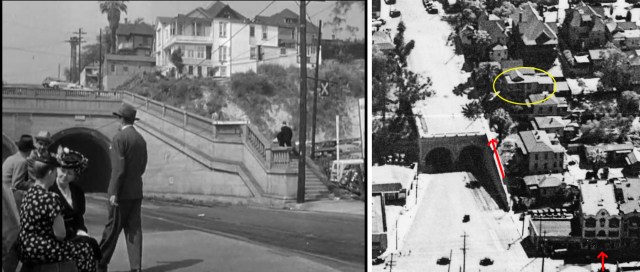
The right arrow points to Harold – the left arrow follows Burt towards the big white house 215 Hill St (yellow oval).

The prominent white house at 215 N. Hill Street portrayed Burt’s family home in Criss Cross.  This view below shows that this home (yellow box) and the Majestic Apartments (red box) were two of the last structures standing before Court Hill was excavated.

Burt filmed at 215 Hill St (yellow box), Harold at the Majestic on Temple (red box) – Los Angeles Public Library

At left, Burt climbs the long flight of steps from the sidewalk up to his family’s home front porch at 215 N. Hill Street.  Later, when Burt traverses back down the steps to the sidewalk (below), in a reverse view you can seen the flat terrace that stood above the north end of the Hill Street Tunnel, and details of some Civic Center buildings in the background.

Looking south towards the terrace above the north end of the Hill Street Tunnel.  The red box marks the extant Hall of Justice, completed in 1925.  The building to the left of the red box in the movie frame was the former Alhambra Hotel.  It originally stood on the corner of Temple and Broadway, and was moved laterally further north up Broadway to clear the site for the Hall of Justice on the corner.  The Alhambra stood for years beside the south face of the Broadway Tunnel, another Los Angeles landmark lost to history.  The yellow box marks the same corner of the United States District Court House.  (C) 2012 Microsoft Corporation – Pictometry Bird’s Eye (C) 2012 Pictometry International Corp.

This aerial below shows the line of sight from the front porch of 215 N. Hill Street towards the corner of the Hall of Justice at the corner of Temple and Broadway.
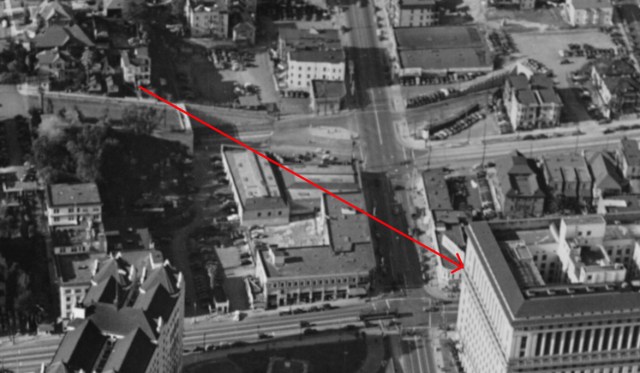
USC Digital Archive

Criss Cross also has scenes filmed near Angels Flight, and Clay Street, the alley running underneath the Angels Flight elevated tracks, that appear during sequences in Harold Lloyd’s feature comedy For Heaven’s Sake (1926), but I’ll save these comparisons for another day.

The future Mrs. Lilly Munster beside a very Munsteresque house

In closing, here above is a view of Yvonne De Carlo waiting in a convertible parked on Hill Street along the south face of 401 Court Street, the large home on the corner of Hill and Court Street that once stood across from the Bradbury Mansion.  The Bradbury was demolished in 1929, but its neighbor, pictured here, held on until at least the 1948 filming of Criss Cross, but did not survive long enough to appear in the 1951 Sanborn Fire Insurance maps.  The relative position of Yvonne’s car is marked with an oval on the map and aerial views above.

My book Silent Visions devotes an entire chapter to Harold Lloyd filming on Bunker Hill.  Look for future posts of Harold filming at noir classic settings.

HAROLD LLOYD images and the names of Mr. Lloyd’s films are all trademarks and/or service marks of Harold Lloyd Entertainment Inc. Images and movie frame images reproduced courtesy of The Harold Lloyd Trust and Harold Lloyd Entertainment Inc.

Criss Cross (C) 1948 Universal Pictures Company, Inc.

This Google Street View of the corner of Hill and Temple matches the large movie frame of Burt Lancaster exiting the trolley above.  Today the Bradbury Mansion, the Hill Street Tunnel, Court Flight, and Court Hill itself, are just memories.

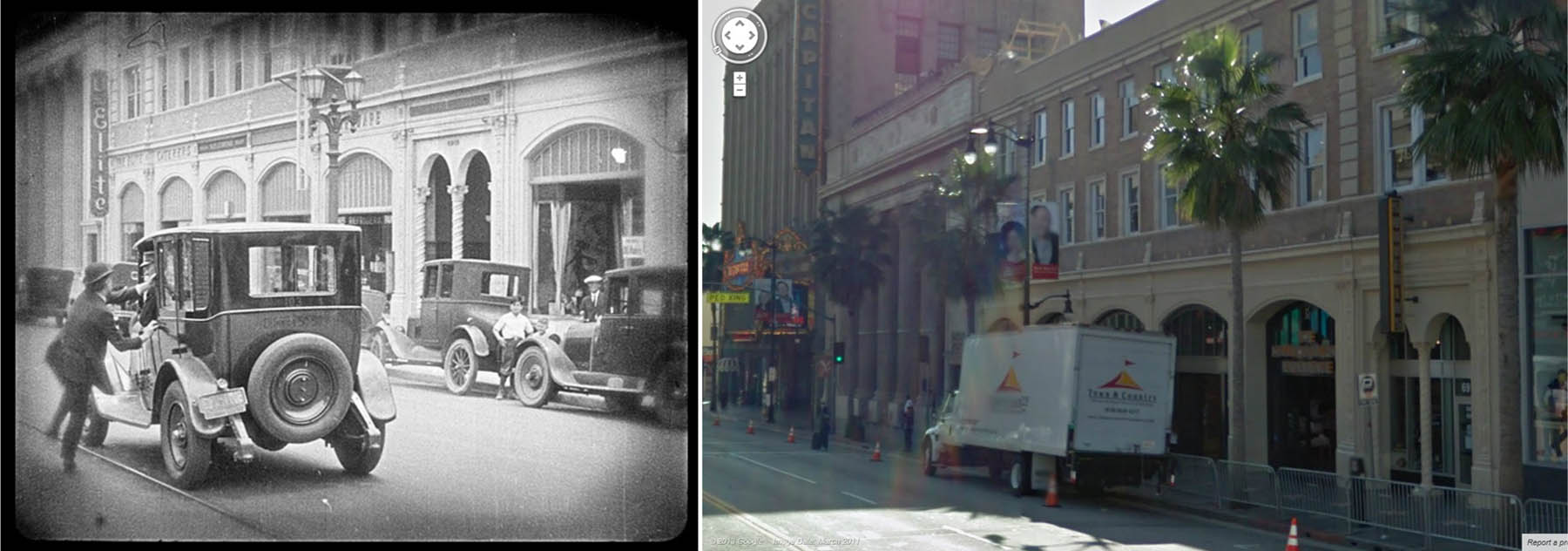
Posted in Bunker Hill, Film Noir, Harold Lloyd, Los Angeles Historic Core, Los Angeles Tunnels | Tagged , , , , , , , , , , , | 16 Comments