How Harold Lloyd Filmed the Girl Shy Trolley Stunts

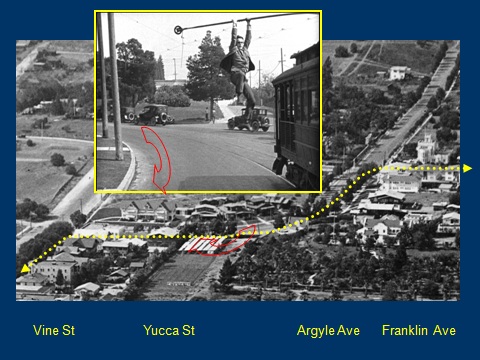
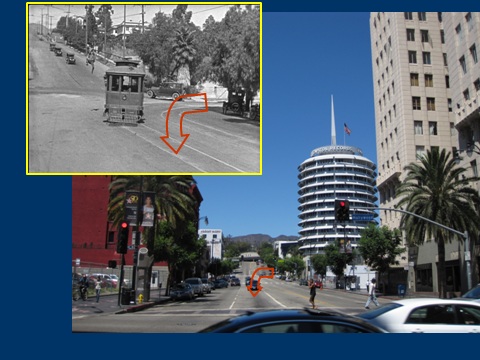
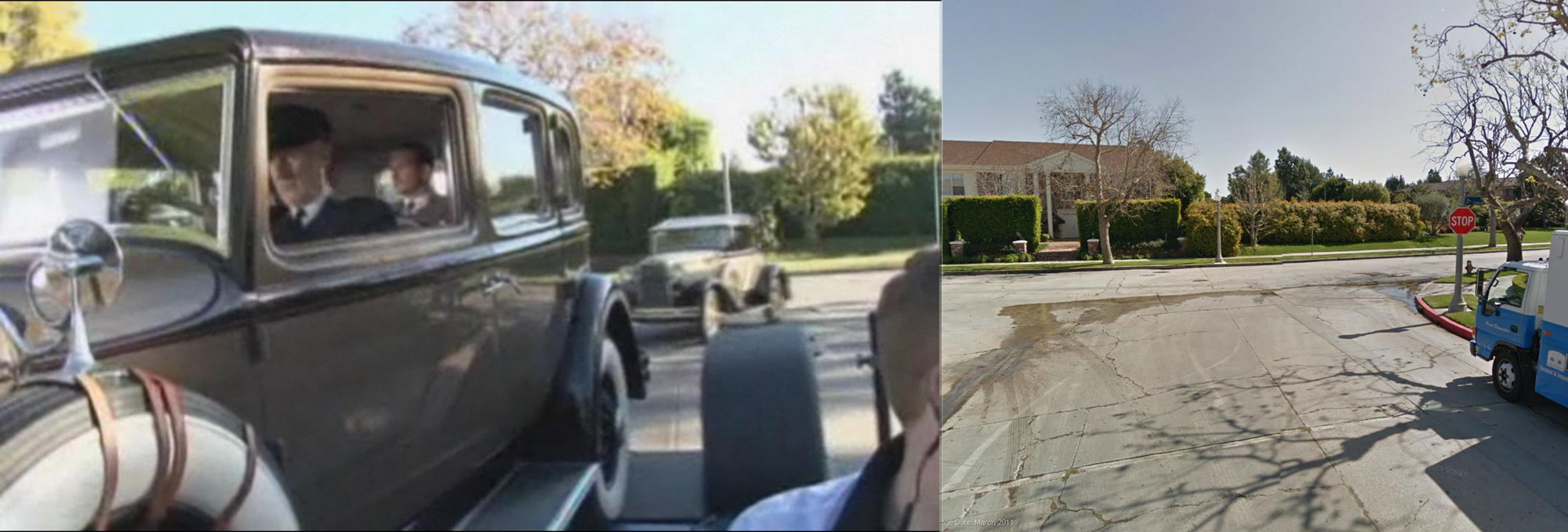
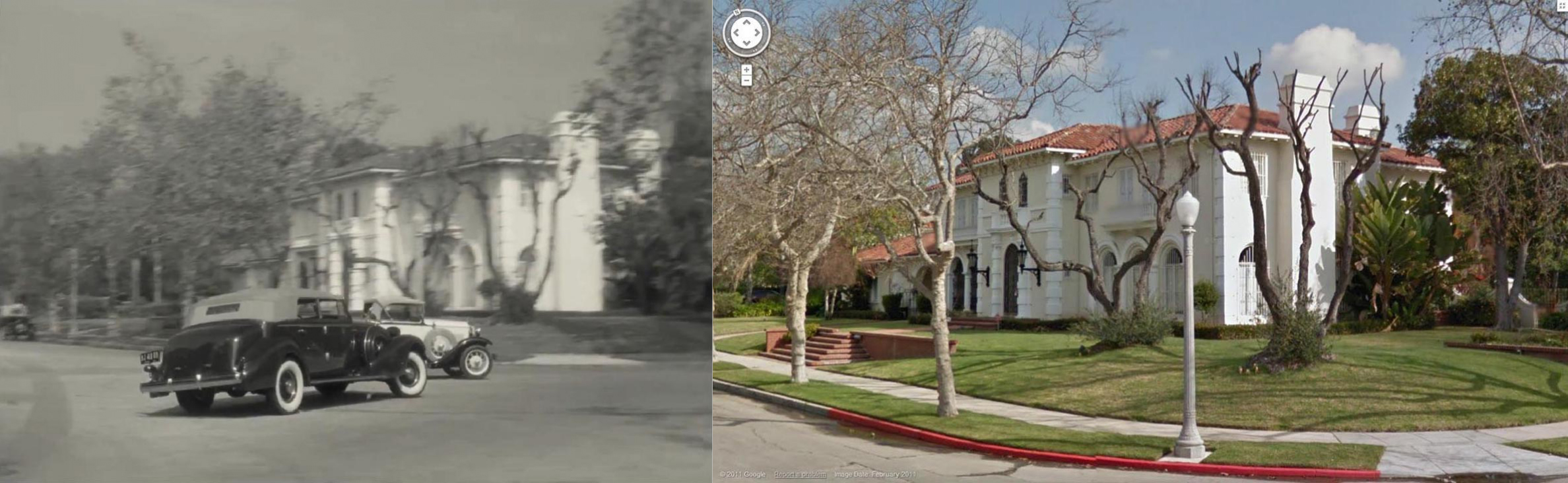
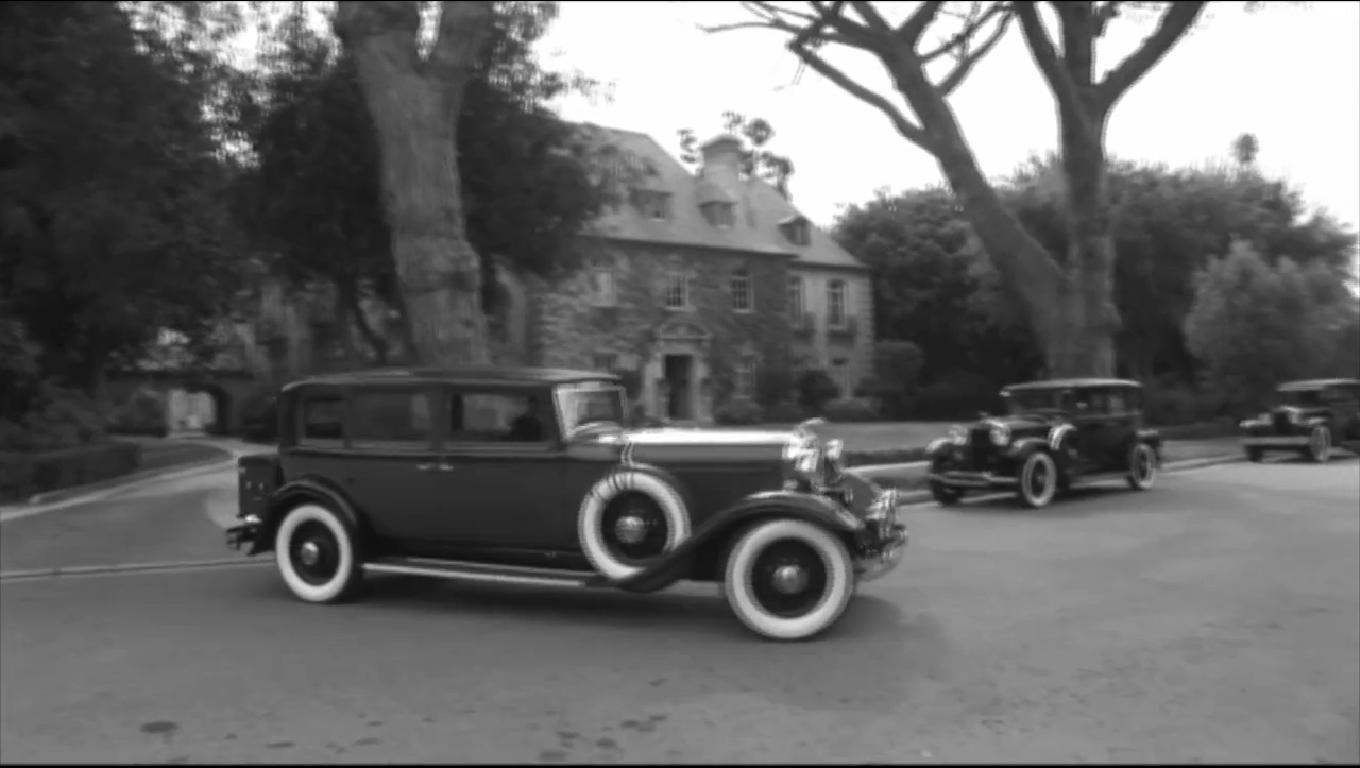
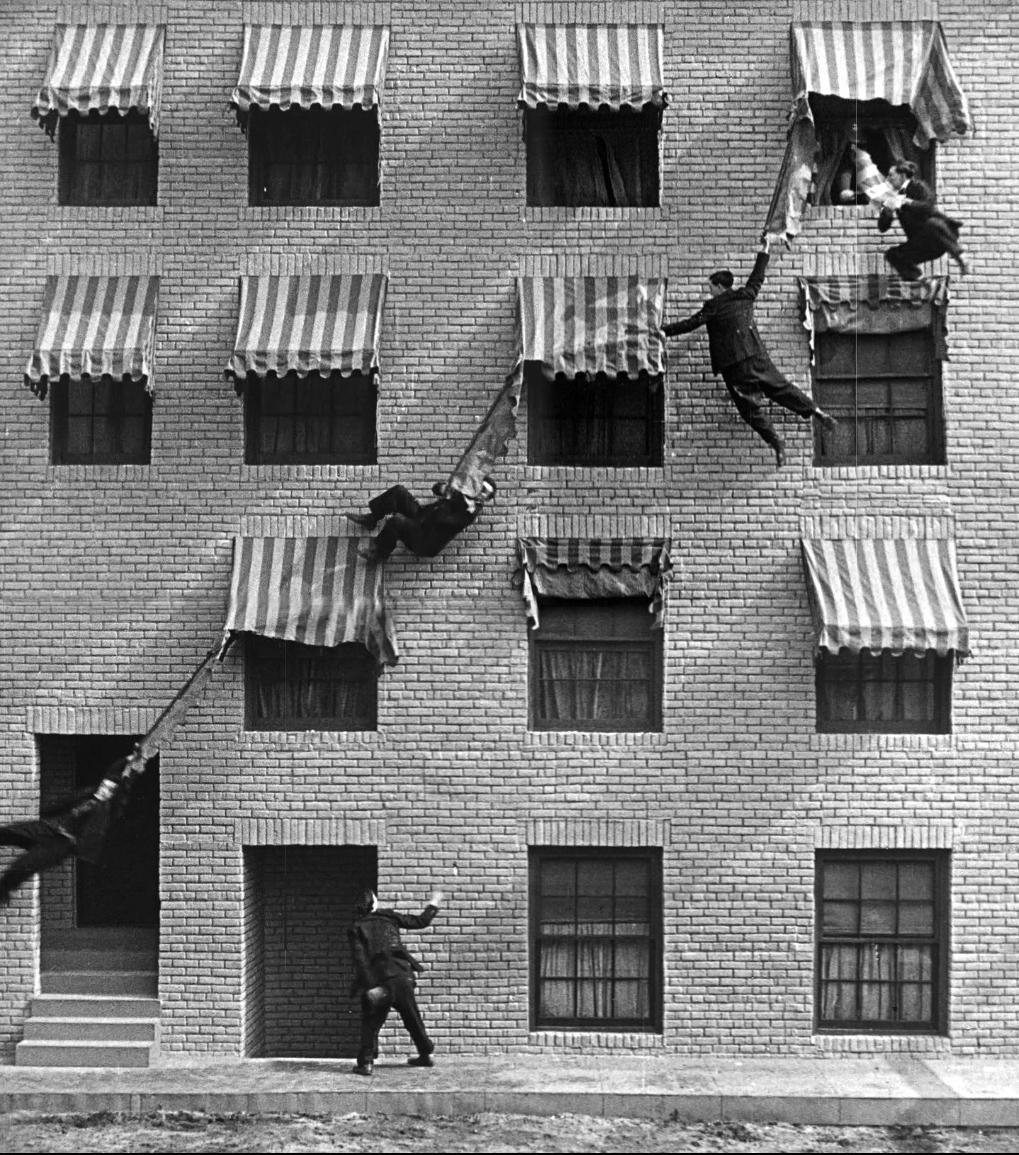
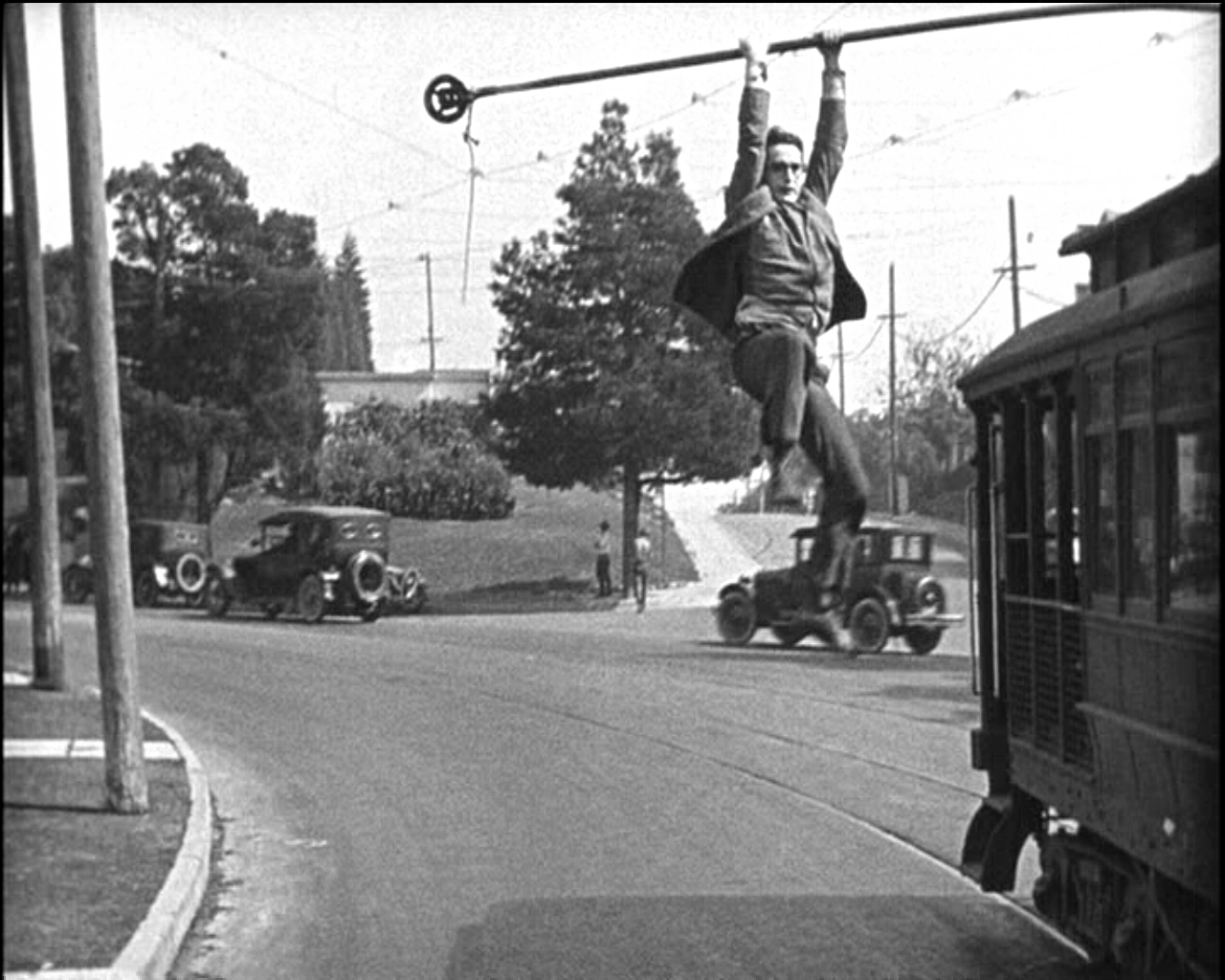
Harold Lloyd’s trolley stunts from Girl Shy.  Filmed looking east as Argyle turns into Yucca.

Following the great success of Safety Last! (1923), Harold Lloyd further cemented his reputation as a dare-devil comic with his first independently produced feature comedy Girl Shy (1924).  In that film, Harold discovers the woman he loves is about to marry a bigamist, and in a frantic race to the altar, Harold dashes all across Southern California by every conceivable mode of transport in order to halt the wedding.  During one sequence Harold finds himself hanging from the pole of a runaway trolley car.

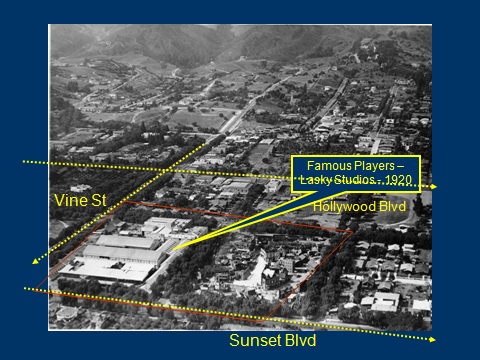
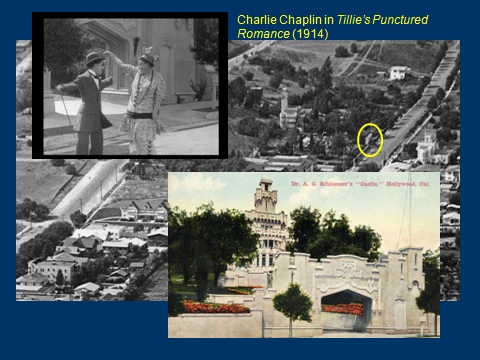
The sequence was filmed in a residential neighborhood just a block away from the famous intersection of Hollywood and Vine, along the route of the former Pacific Electric Railway, as it transitioned from running east-west along Hollywood Boulevard, to running east-west along Franklin Avenue, through a rapid succession of alternating left and right turns along Vine Street, Yucca Street, and Argyle Avenue.  Lloyd’s crew filmed the runaway trolley sequence from various vantage points at each corner to capture nearly a dozen unique looking shots from this one setting.  Here are static slides from the PowerPoint presentation you can download.
01 02 03 04 05 06 07 09 10 11 12 13

You can download below a 10.4 MB PowerPoint presentation showing a brief overview of where and how Lloyd filmed the Girl Shy trolley stunt in Hollywood.  Most of the slides are animated, so wait a moment each time before clicking the “next” button.

How Harold Lloyd filmed the Girl Shy trolley stunts – John Bengtson

You will need a PowerPoint viewer to watch the show, and can download a free PowerPoint viewer at this site.
From Safety Last!

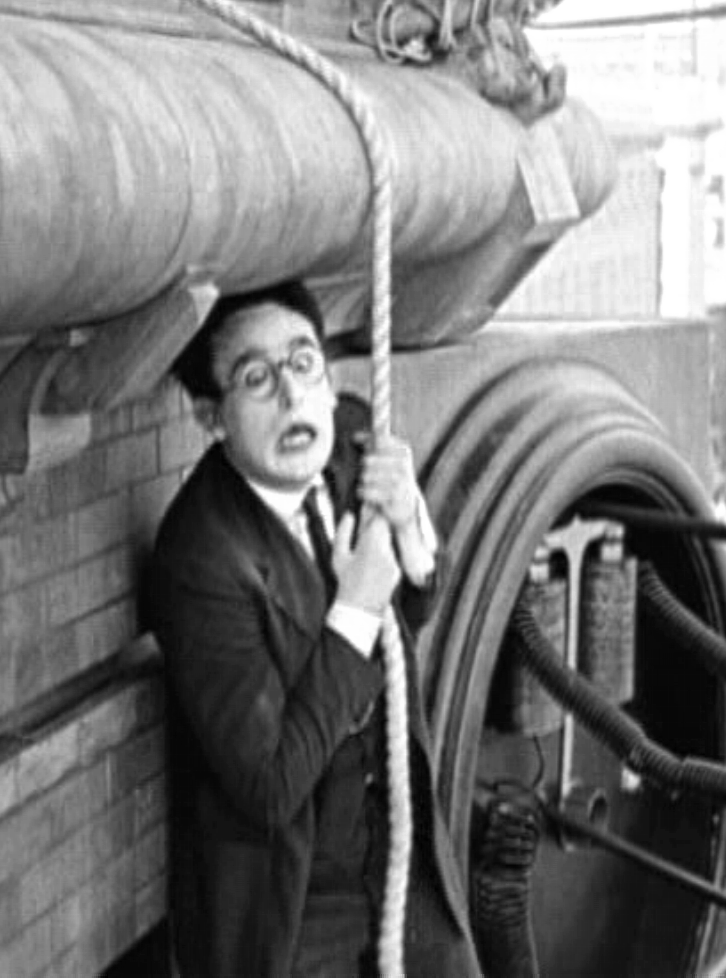
As with his stunt-work hanging from the clock in Safety Last!, audiences were generally unaware that Harold had only one complete hand when hanging from the trolley car in Girl Shy.   As shown to the left, Harold’s incomplete right hand (he wore a glove covering a prosthetic thumb and index finger) prevents him from fully grabbing hold of the rope.  You can read how Lloyd injured his hand, and resorted to a bit of movie magic when memorializing his handprints in cement at the forecourt to Grauman’s Chinese Theater, in this earlier post.
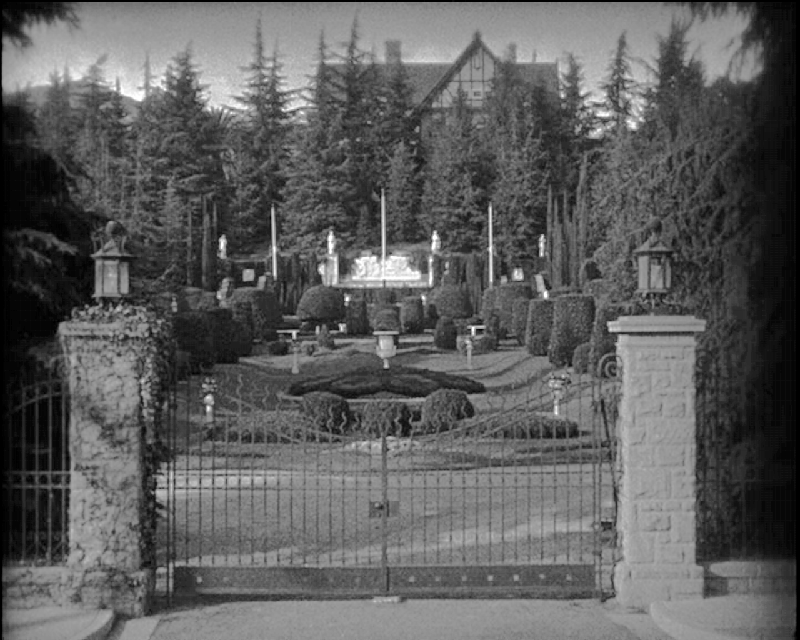
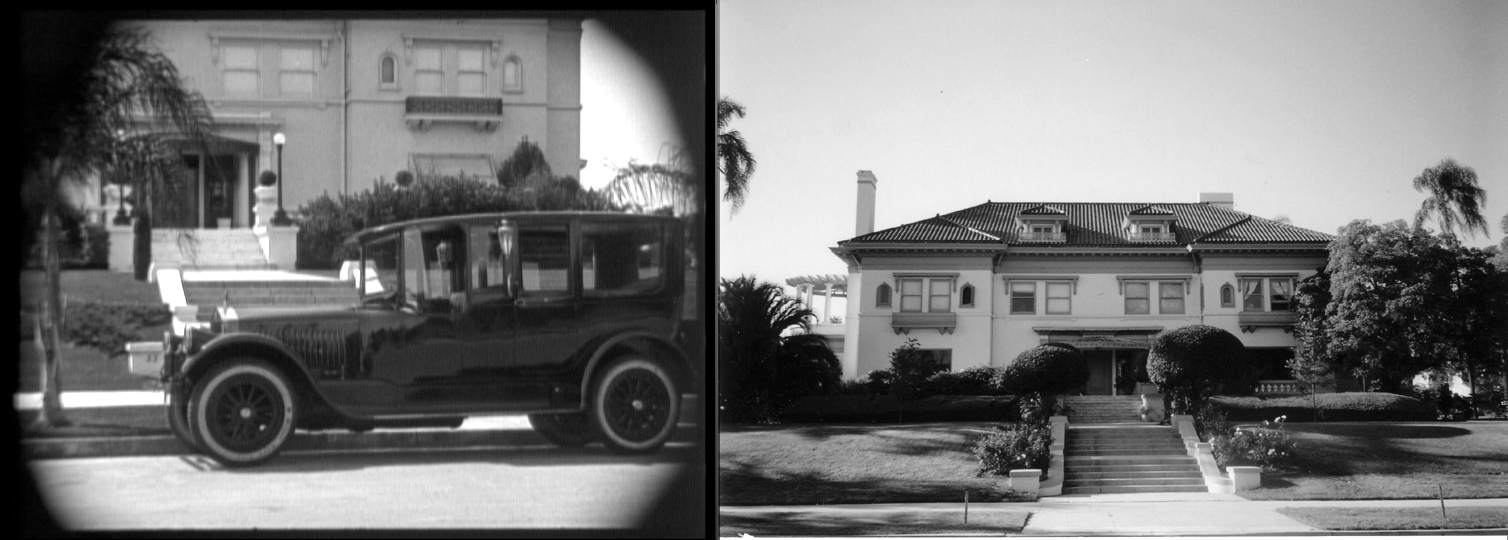
The former Holmby House.

My book Silent Visions documents Lloyd’s elaborate race to the altar in great detail, staged on the streets of Hollywood, San Fernando, Altadena, Palms, Culver City, Bunker Hill, Rampart Village, Fort Moore Hill, and downtown Los Angeles, as Harold commandeers automobiles, fire engines, motorcycles, trolleys, and horse wagons in his quest.   The wedding was staged at Holmby House, now lost, the magnificent estate owned by retail magnate Arthur Letts, owner of Bullock’s Department Store.  You can see where Harold filmed atop Bunker Hill in this later post.

I am also posting here, once again, a tour of several silent-era Hollywood locations Harold Lloyd used in Girl Shy, and various other films, as well as the sites for the Lloyd, Chaplin, and Keaton Studios.

Harold Lloyd Hollywood Film Locations – Silent Visions

HAROLD LLOYD images and the names of Mr. Lloyd’s films are all trademarks and/or service marks of Harold Lloyd Entertainment Inc. Images and movie frame images reproduced courtesy of The Harold Lloyd Trust and Harold Lloyd Entertainment Inc.

The site of the trolley stunts, along North Argyle and Yucca, on Google Maps.
Posted in Girl Shy, Harold Lloyd, Hollywood Tour, Lloyd Thrill Pictures | Tagged , , , , , , , , | 10 Comments

Keaton’s Highland Goat Garage

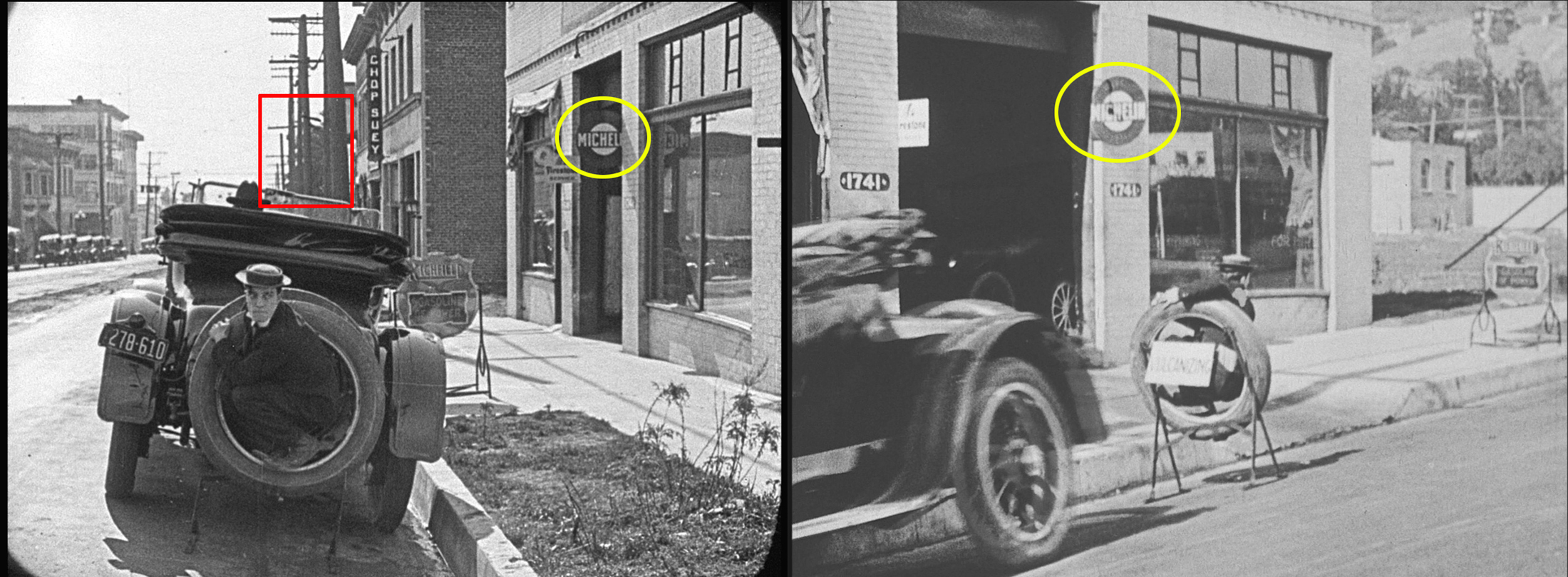
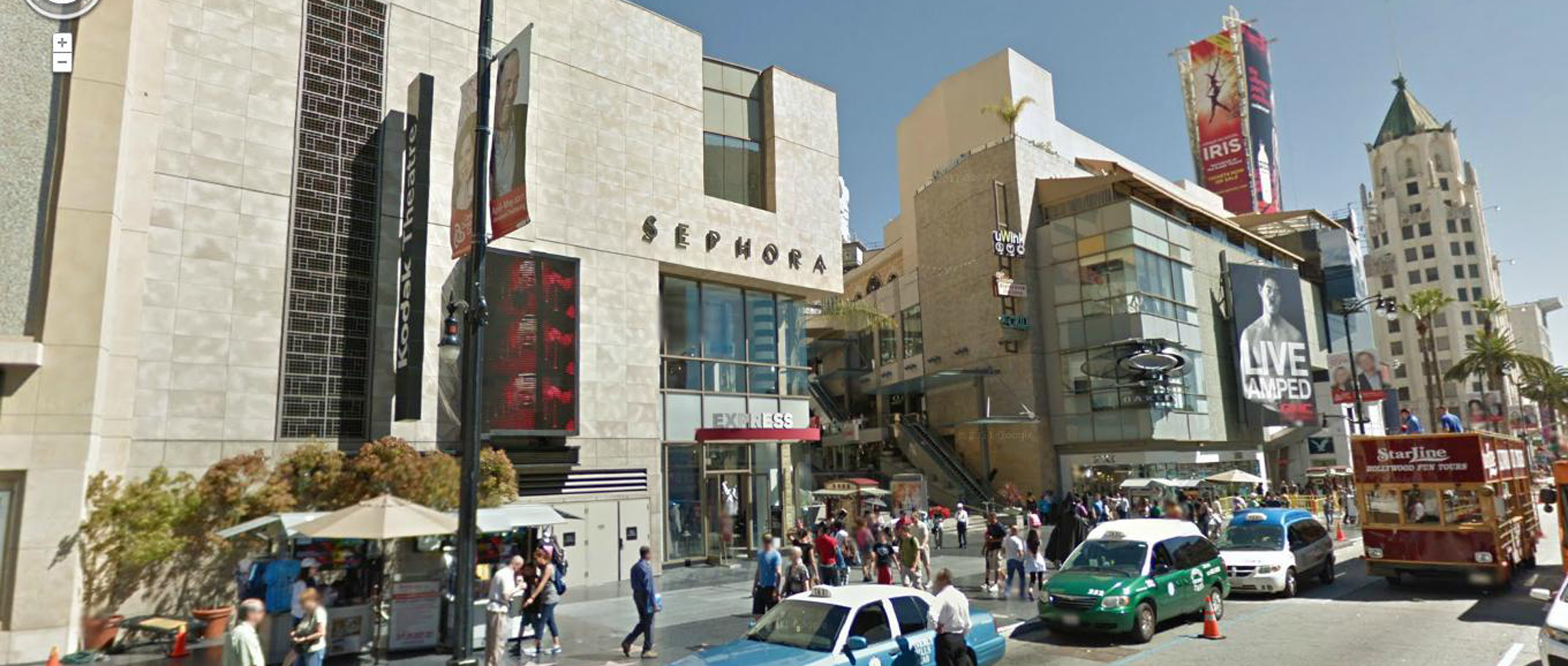
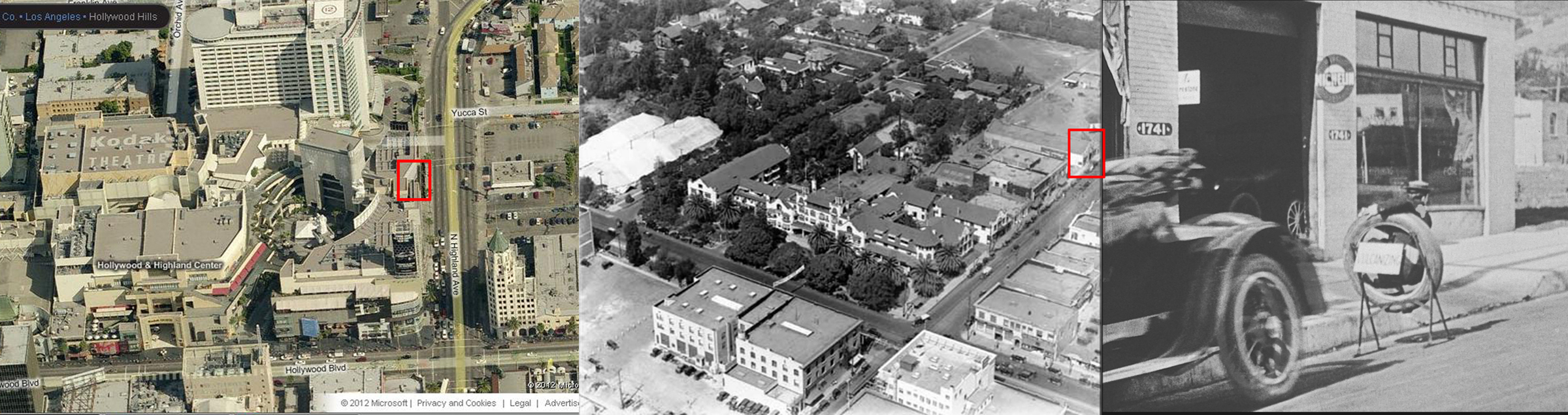
Click to enlarge.  Keaton filmed a scene from The Goat at the Hollywood A.1. Garage (box) up from the corner of the former Hollywood Hotel, now the site of the Hollywood and Highland retail and entertainment center.    Left (c) 2012 Microsoft Corporation, Pictometry Bird’s Eye (c) 2010 Pictometry International Corp.  Center image Security Pacific National Bank Photograph Collection/Los Angeles Public Library.

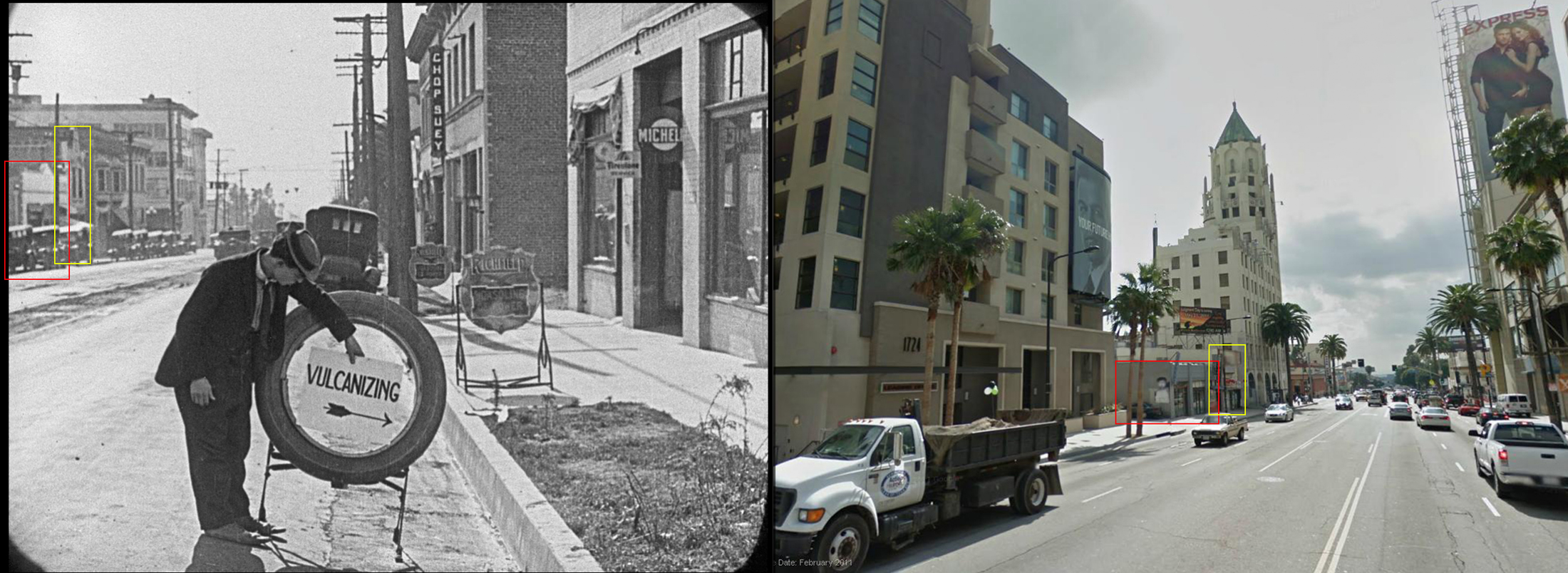
During the frantic chase in Buster Keaton’s 1921 short film The Goat, Buster attempts to flee the police by leaping onto the rear spare tire of a departing car, only to find himself sitting instead on a freestanding auto garage ad for tire vulcanizing.

Two versions of the same gag, from alternate vantage points looking up or down Highland Avenue in Hollywood.  Keaton placed himself either further up or down the street so that the garage would appear in each shot.  The red box marks the palm trees in front of the former Hollywood Hotel that stood on the NW corner of Hollywood and Highland.  The ovals mark the same Michelin tire sign.

Remarkably, this joke is one of the few from Keaton’s entire silent career for which an outtake exists, included as a bonus feature on the new Kino Blu-ray release Buster Keaton: The Shorts Collection (1920-1923).  The alternate take (above right), clearly shows a 1741 address for the garage, an invaluable clue.

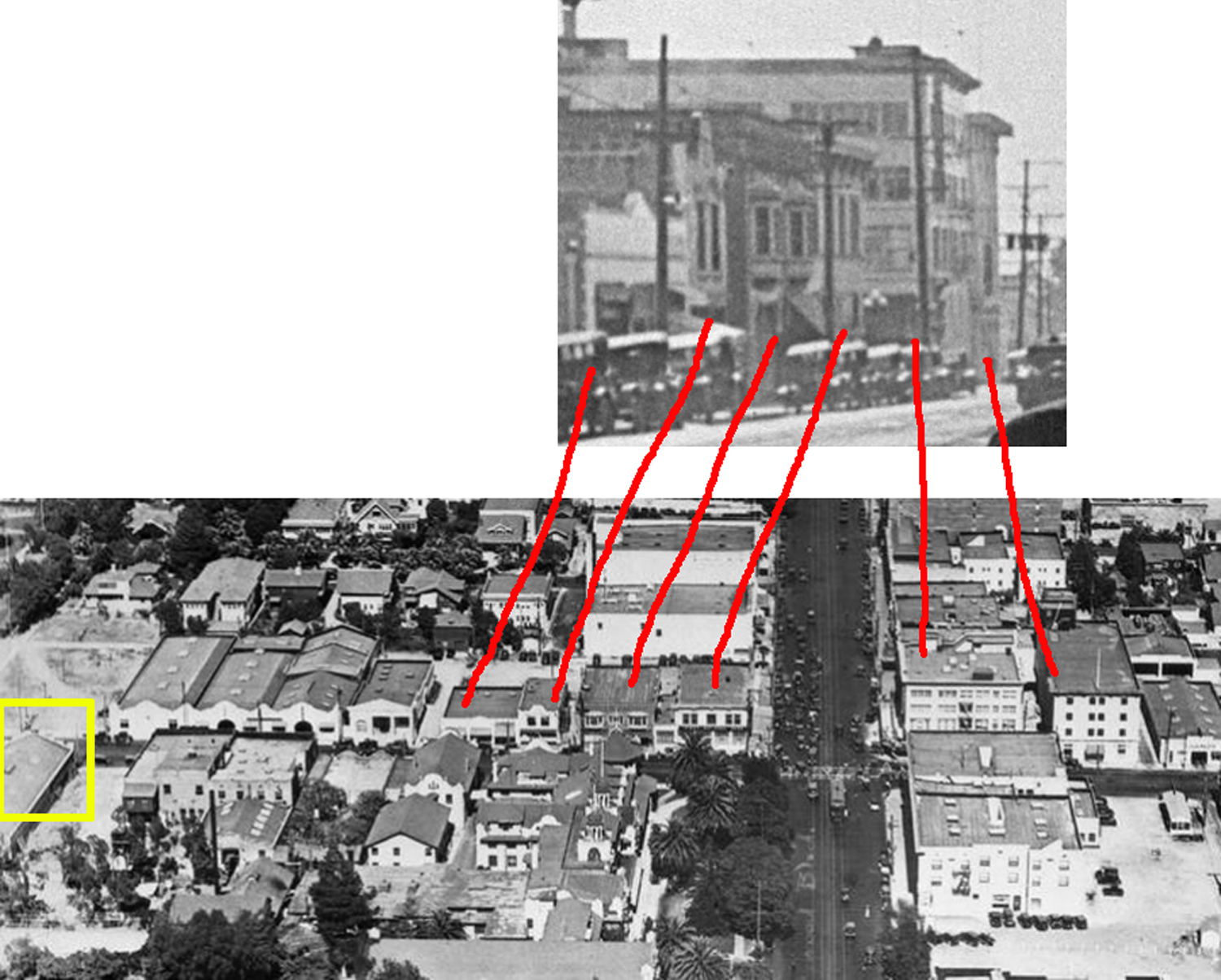
Film location sleuth Paul Ayers had long suspected this gag was filmed looking south on Highland Avenue towards Hollywood Boulevard.  Thanks to the Blu-ray high resolution we can confirm the spot positively.

Click to enlarge.  This bottom view looks east down Hollywood Boulevard from Highland.  The yellow box marks the Hollywood A.1. Garage at 1741 Highland.  The red lines match up images from the background of the movie frame with the buildings on the street.  The palms trees to the left of the street stand before the Hollywood Hotel.  California Historical Society, Title Insurance and Trust Photo Collection, Department of Special Collections, University of Southern California.

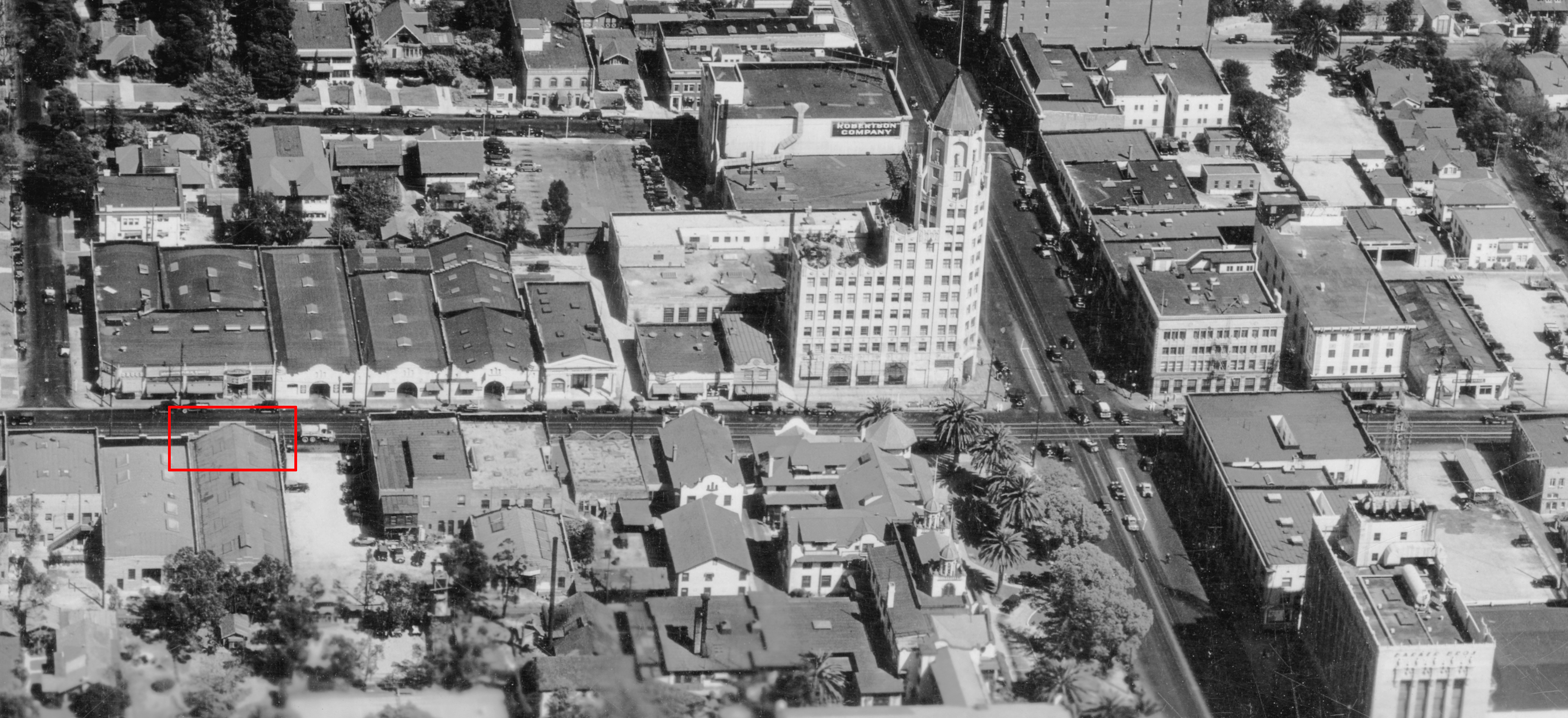
The two story First National Trust and Savings Bank branch office across from the Hollywood Hotel, on the NE corner of Hollywood and Highland, appears in the background of Keaton’s scene.  It was demolished in late 1927 to make way for the 190 foot tall First National Bank building completed in 1928, and recognized today as one of Hollywood’s most prominent landmarks.  This comparable aerial view below matches the aerial view above, but for the new bank tower.

A comparable view, looking east down Hollywood Boulevard, of the Hollywood A.1. Garage (box), and the extant First National Bank Building tower now standing on the NE corner of Highland.  The First National Building was designed by Meyer and Holler, the same architects that designed Grauman’s Egyptian and Chinese Theaters.  Security Pacific National Bank Photograph Collection/Los Angeles Public Library.

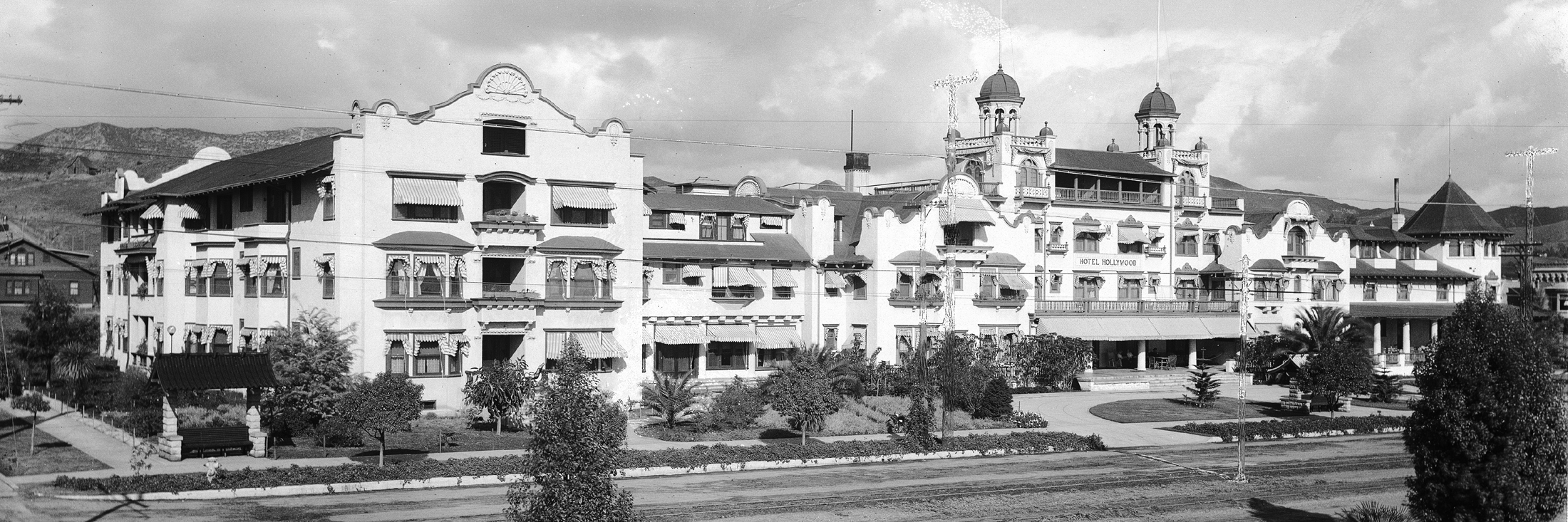
Built in 1903, the Hollywood Hotel (below) was a Hollywood institution for decades, until falling in decline, and being demolished in 1956.  Charlie Chaplin, Mabel Normand, and Marie Dressler filmed scenes from Tillie’s Punctured Romance (1914) on the hotel’s front porch.

The former Hollywood Hotel on the NW corner of Hollywood and Highland – compare to matching view below.  California Historical Society, Title Insurance and Trust Photo Collection, Department of Special Collections, University of Southern California. 

A comparable view of the Hollywood Hotel site today, as the First National Bank tower looks on from the right. (C) 2012 Google.

Click to enlarge. Looking south from 1741 N. Highland. The two small buildings up from the corner of Hollywood Blvd. (red and yellow boxes), still stand, although heavily re-modeled. (C) 2012 Google.

The Goat licensed by Douris UK, Ltd.

1741 N. Highland Ave., Los Angeles, CA

Posted in Buster Keaton, Hollywood Tour, The Goat | Tagged , , , , , , , , , | 7 Comments

How Harold Lloyd Filmed Safety Last!

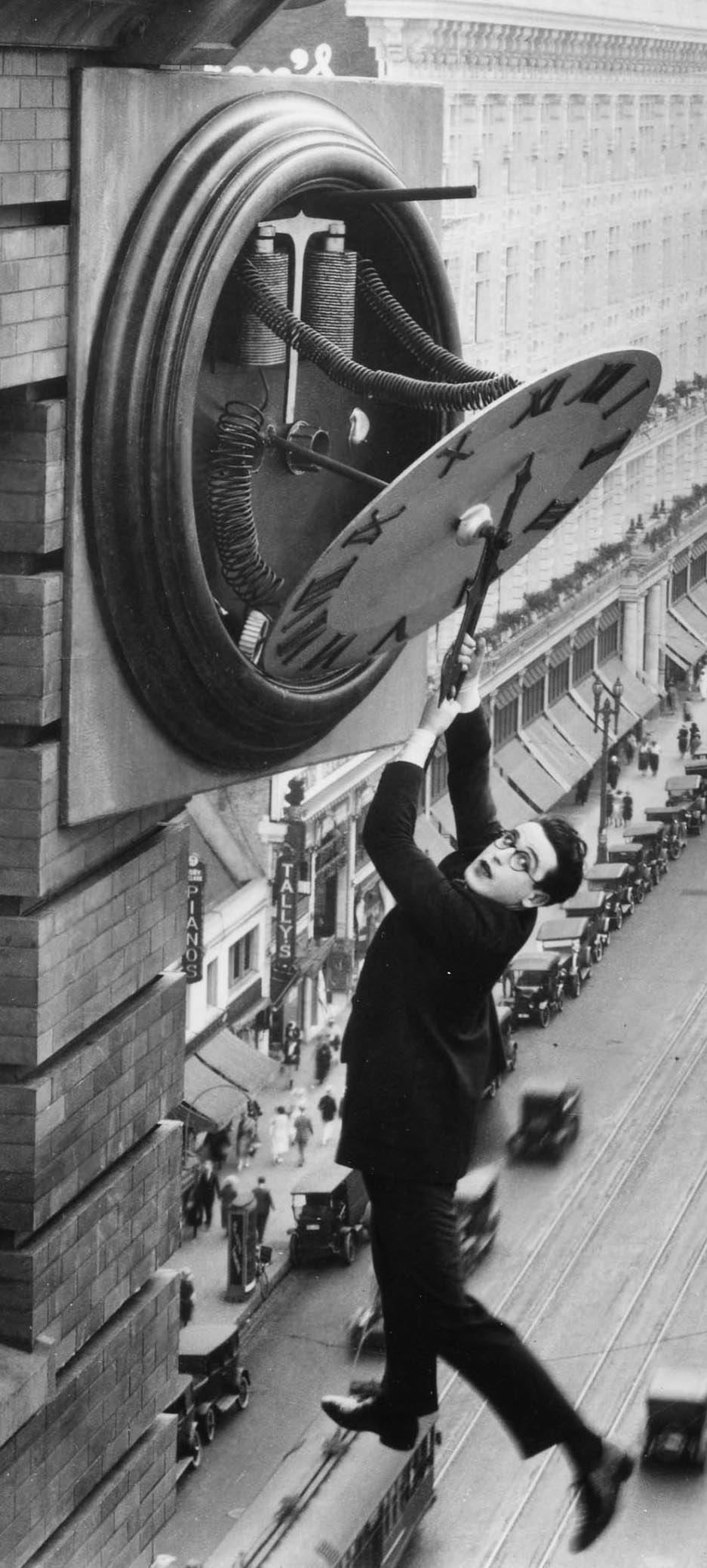
108 - T Lloyd Safety Last Tally's Broadway Theatre below 2 crp The image of Harold Lloyd hanging desperately from the hands of a skyscraper clock during Safety Last! (1923) is one of the greatest icons in cinematic history.  Using maps, aerial views, and vintage photographs, my book Silent Visions shows how Harold filmed each of his five stunt-climbing comedies within the downtown Los Angeles Historic Core, while documenting the burgeoning urban skyline as it appears in the background of his films. I had the honor of introducing Safety Last! in 2016 at the Orpheum Theater as part of the Los Angeles Conservancy’s Last Remaining Seats. Below, from my YouTube Channel, a fully updated video tour, showing Harold’s climb atop 5 buildings in downtown LA, and many other locations.

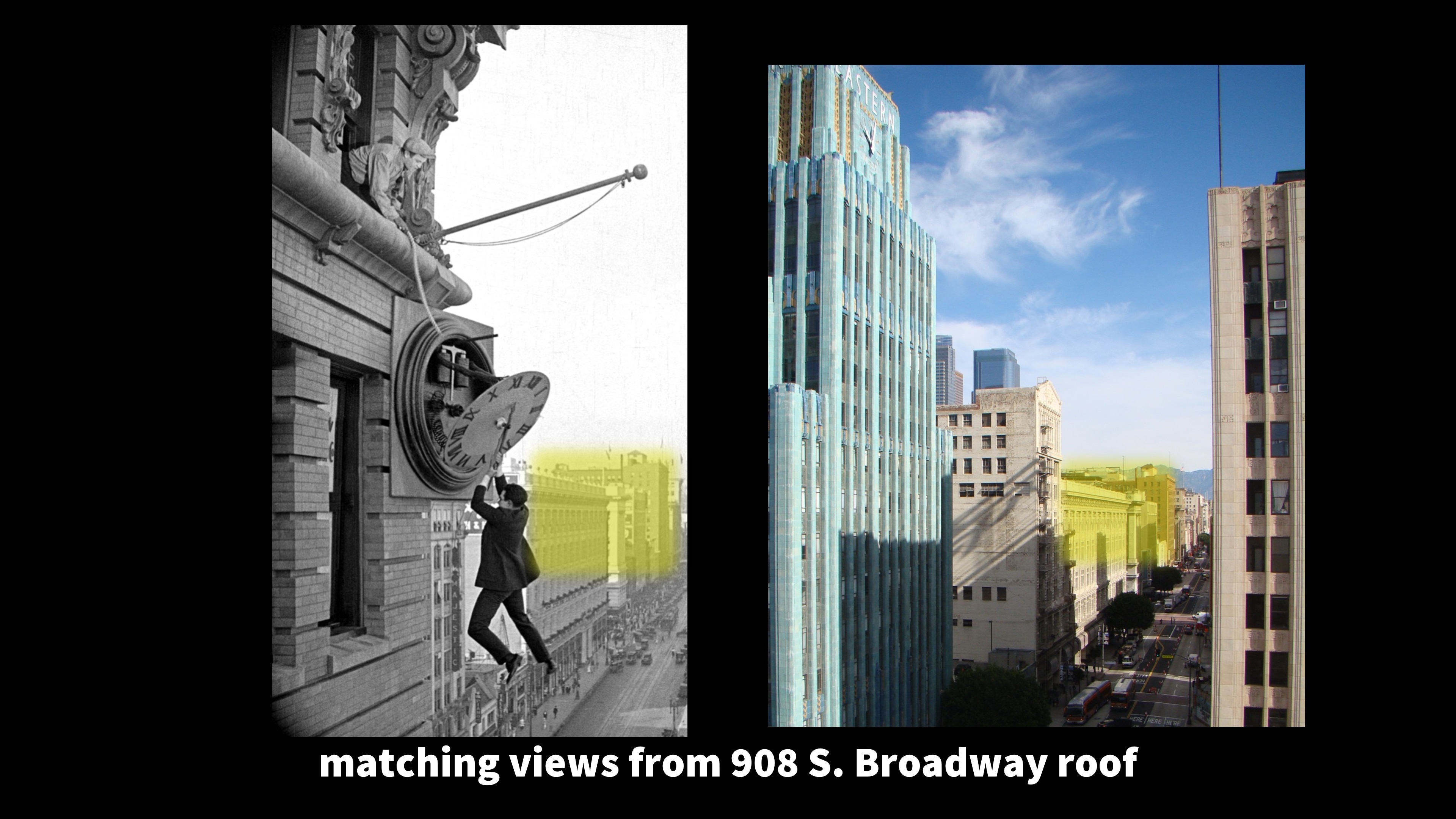
On the roof of 908 S. Broadway from Safety Last! and the YouTube video clip

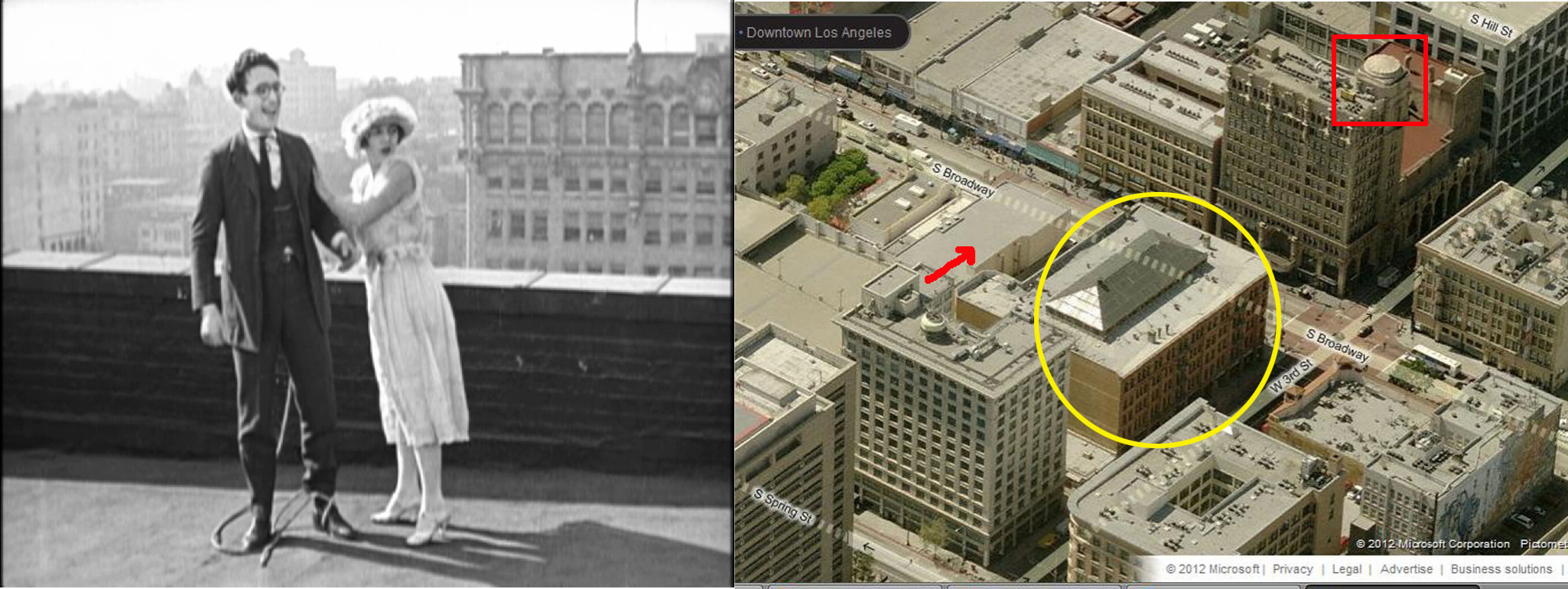
The closing scene from Safety Last! (left) was filmed on the roof of 908 S. Broadway, the same building where the clock stunt climbing set was built. The same roof (right), now supporting the steel girder foundation for a large antennae, appears during the Criterion Collection Locations and Effects mini clip.

The slides below from the YouTube video show how the many Safety Last! stunts were created, as well as where Harold filmed near Exposition Park and USC, and many places in Hollywood, including the Chaplin-Keaton-Lloyd Alley below. You can access HERE a self-guided walking tour of the downtown locations appearing in Safety Last!, Never Weaken, and Feet First. (In all Lloyd employed 17 downtown buildings during his “thrill” comedies – see a PDF list of descriptions here).

HH title card CKL Alley[Note: on the ground, Charlie Chaplin, Buster Keaton and Harold Lloyd filmed scenes from their masterpieces The Kid (1921), Cops (1922) and Safety Last! at the same Hollywood alley you can still visit today. Hollywood Heritage celebrated the Chaplin-Keaton-Lloyd Alley by installing an honorary plaque. Cheers to Hollywood Heritage, a California nonprofit public benefit 501(c)(3) corporation. If you want to honor a favorite star, or to recognize Hollywood’s origins and hidden history, please consider making a tax-deductible donation, and please share this campaign.]

I encourage you to watch the Safety Last! YouTube, and to check out the many other silent location videos posted about Charlie Chaplin, Buster Keaton, and the Chaplin-Keaton-Lloyd Alley on the Silent Locations YouTube Channel.

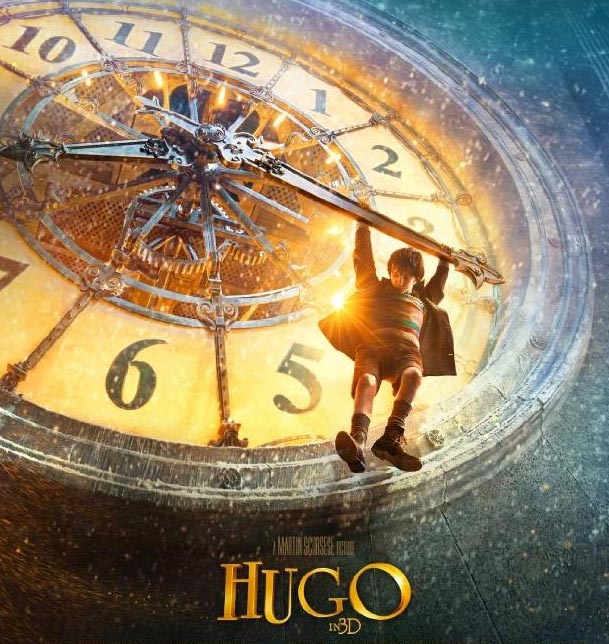
The multiple Oscar-winning movie Hugo pays tribute to Safety Last!; first by including a clip of the Lloyd movie within the film, and also when the young hero Hugo Cabret finds himself hanging from a train station clock. Hugo (C) 2011 Paramount Pictures

You can check out my other posts about Safety Last! here.

A short segment from the Locations and Effects 2013 documentary with Academy-Award winning effects supervisor Craig Barron and the author filmed for the Criterion Collection release of the Safety Last! Blu-ray appears below.

To see where Harold filmed his amazing comedies, be sure to check out my book Silent Visions

If you need a good laugh, or want to raise your spirits, just listen to Michael Mortilla’s audio-only recording of the audience laughing and squealing with delight while watching Safety Last!  It’s great to play as background music – the swells and squeals of laughter just grow and grow. The audience squeals and screams really kick in around 18:20

Michael Mortilla accompanying Safety Last!

HAROLD LLOYD images and the names of Mr. Lloyd’s films are all trademarks and/or service marks of Harold Lloyd Entertainment Inc. Images and movie frame images reproduced courtesy of The Harold Lloyd Trust and Harold Lloyd Entertainment Inc.

Chaplin-Keaton-Lloyd-sign

Hollywood Heritage celebrated the Chaplin-Keaton-Lloyd Alley by installing an honorary plaque. Cheers to Hollywood Heritage, a California nonprofit public benefit 501(c)(3) corporation. If you want to honor a favorite star, or to recognize Hollywood’s origins and hidden history, please consider making a tax-deductible donation, and please share this campaign. You may also show support by posting a review on Google Maps. Prototype alley sign design by noted Dutch graphic artist – Piet Schreuders. Download a 4-page brochure HERE. This video further explains the alley – if you can, please share with others and leave a thumbs up.

The site of the clock set, built on the roof of 908 S. Broadway on Google Maps.

Posted in Harold Lloyd, Lloyd Thrill Pictures, Los Angeles Historic Core, Safety Last! | Tagged , , , , , , , , , , , , , , , , , , , | 51 Comments

The Artist Locations – Part 6 – Uggie Saves The Day

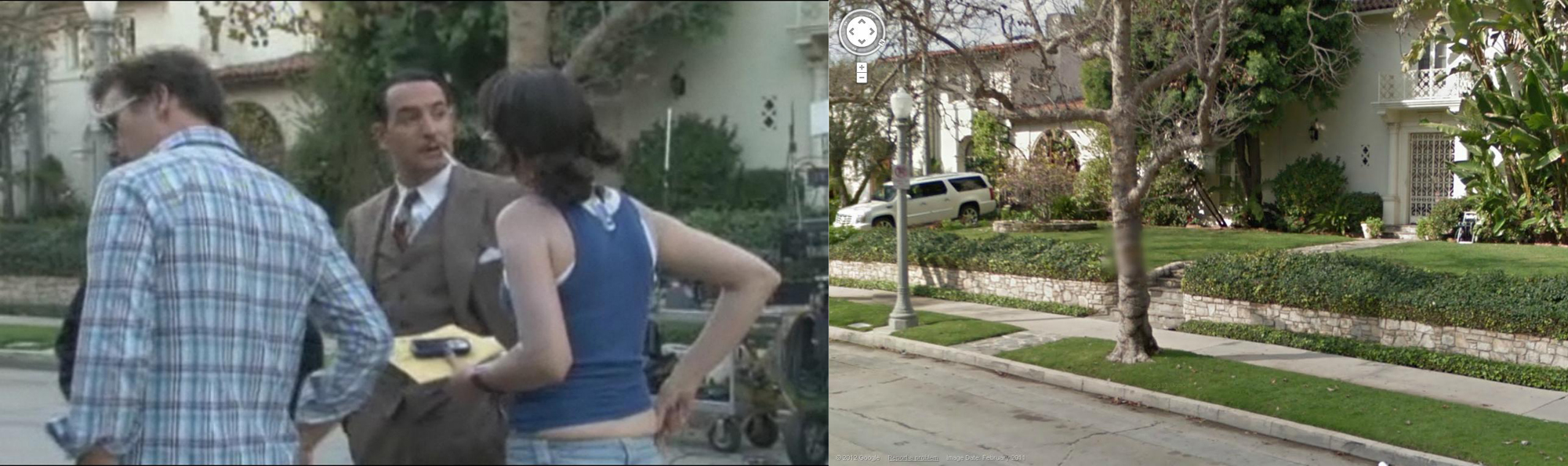
Oscar-winning Best Director Michel Hazanavicius, Oscar-winning Best Actor Jean Dujardin, and an unidentified crew member standing in front of 121 S. Hudson Ave. between takes filming The Artist. (C) 2012 Google.

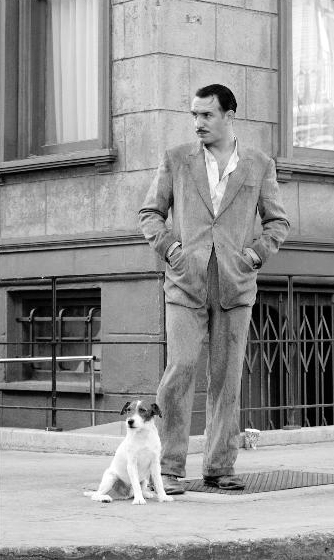
Uggie and George - The Weinstein Company

What an Oscar night!  The two biggest winners, The Artist, and Hugo, both pay homage to early cinema, and the best animated short, the beautiful and moving The Fantastic Flying Books of Mr. Morris Lessmore, pays tribute in part to Buster Keaton.

You don’t need to speak French in order to enjoy this behind the scenes video, posted in early 2011, showing Oscar-winning Best Director Michel Hazanavicius and crew on location in Los Angeles filming scenes from The Artist.   I was able to capture from one scene where Uggie the Dog begs a policeman to follow him in order to rescue Uggie’s master, the down and out actor George Valentin, portrayed by Oscar-winning Best Actor Jean Dujardin.   I will likely post more stories about The Artist once it is released on video, but until then, let’s see where Uggie saves the day.

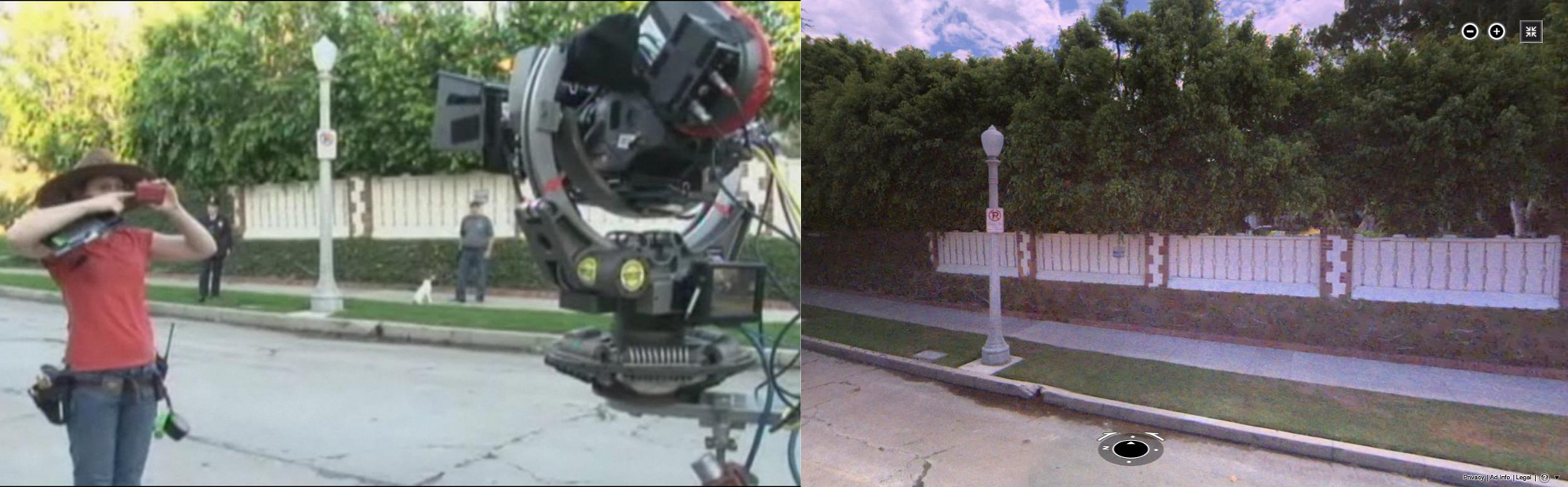
The cop and Uggie between takes - standing at the back of 104 S. Hudson Ave. (C) 2011 Microsoft Corporation.

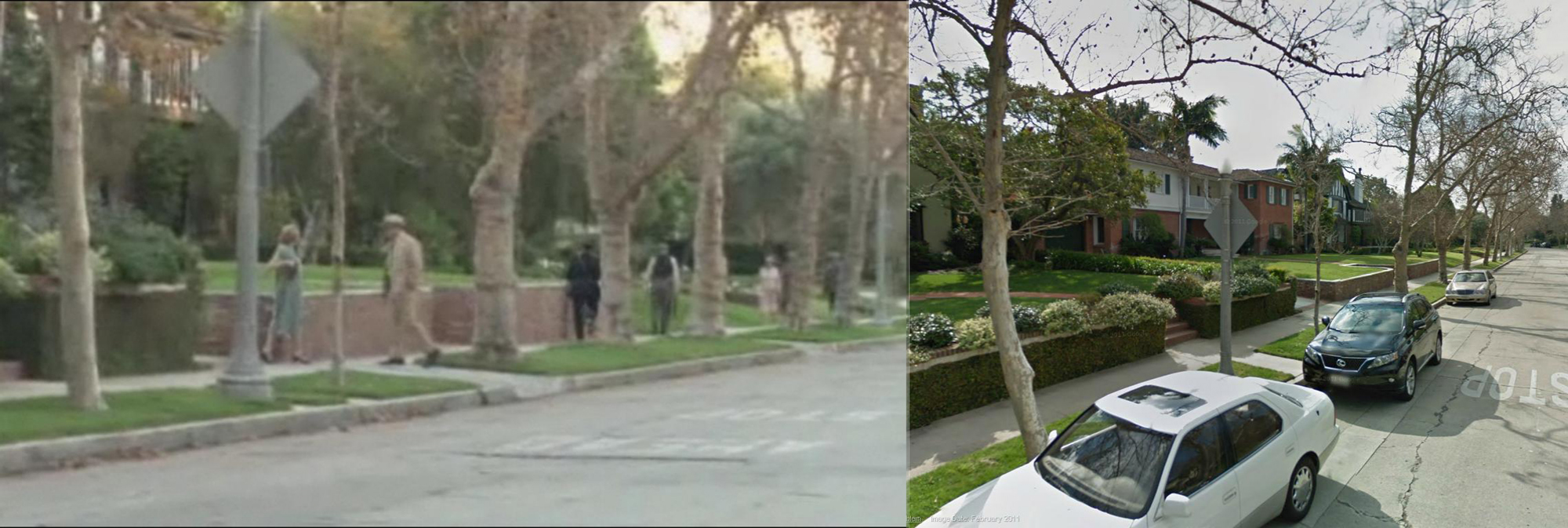
Above, Uggie encounters the policeman alongside this distinctive fence at the back end of 104 S. Hudson Avenue.   After capturing the cop’s attention, Uggie and the cop race south down the street, past the low brick retaining wall of 134 S. Hudson Ave. (see below).

Uggie and the cop race by 134 S. Hudson Ave. (C) 2012 Google.

During an unrelated sequence from the behind the scenes video, we see Clifton the chauffeur, played by James Cromwell, drive Jean while turning north from W. 2nd Street onto Hudson Place (see below).

The corner of W. 2nd Street and Hudson Place. (C) 2012 Google.

Unlike my prior five posts that explain historic connections between The Artist and the great silent stars of the past, this post only shows contemporary locations.  Thus, for a moment I was concerned I had strayed from the premise of my blog.  But then I chuckled when I realized this blog discusses the locations from silent films, which is precisely what The Artist is intended to be.   So if the hoopla over The Artist should ever lead to the production of another contemporary silent film, you can look for analysis of that film here as well.

The Artist (C) La Petite Reine, The Weinstein Company.

Posted in The Artist | Tagged , , , , , | 6 Comments

The Artist – Locations 1 of 5, Chaplin, and Pickford (repost)

The movie marquee appearing in The Artist stands on the Warner Bros. backlot.

Set in Hollywood during 1927 to 1932, The Artist depicts the romance between a fading silent film star and a rising “talkie” ingénue.  The Artist has received glowing reviews and numerous awards, and is noteworthy for being presented in black & white, and without spoken dialog.  What’s more, the lead actors, the writer/director, and most of the crew are all French, who traveled to Los Angeles to film the movie at authentic Hollywood studios and locations.

While the Los Angeles Times beat me with news of several locales appearing in the film, I’ve gleaned a few locations the Times did not cover, including a connection to Charlie Chaplin, below.

The Artist – vintage cars race past the NE corner of S. Hudson Avenue and W. 2nd Street.  (c) 2011 Google

The ingénue character Peppy Miller, played by Bérénice Bejo, skyrockets to wealth and fame, and soon sets up house in a fabulous mansion, located at 56 Fremont Place.  The palatial home was occupied for a time in 1918-1919 by America’s Sweetheart, silent film superstar Mary Pickford.  Pickford was one of the most savvy business-persons in Hollywood, co-founding United Artists in 1919 with her future husband Douglas Fairbanks, and fellow partners Charlie Chaplin and director D. W. Griffith.

56 Fremont Place was home to Mary Pickford from August 1918 to August 1919.  It appears in the background from this scene (above left) appearing in Charlie Chaplin’s The Kid, and as the home of Peppy Miller in The Artist (above right).  The box marks the same corner of the house in each image. 

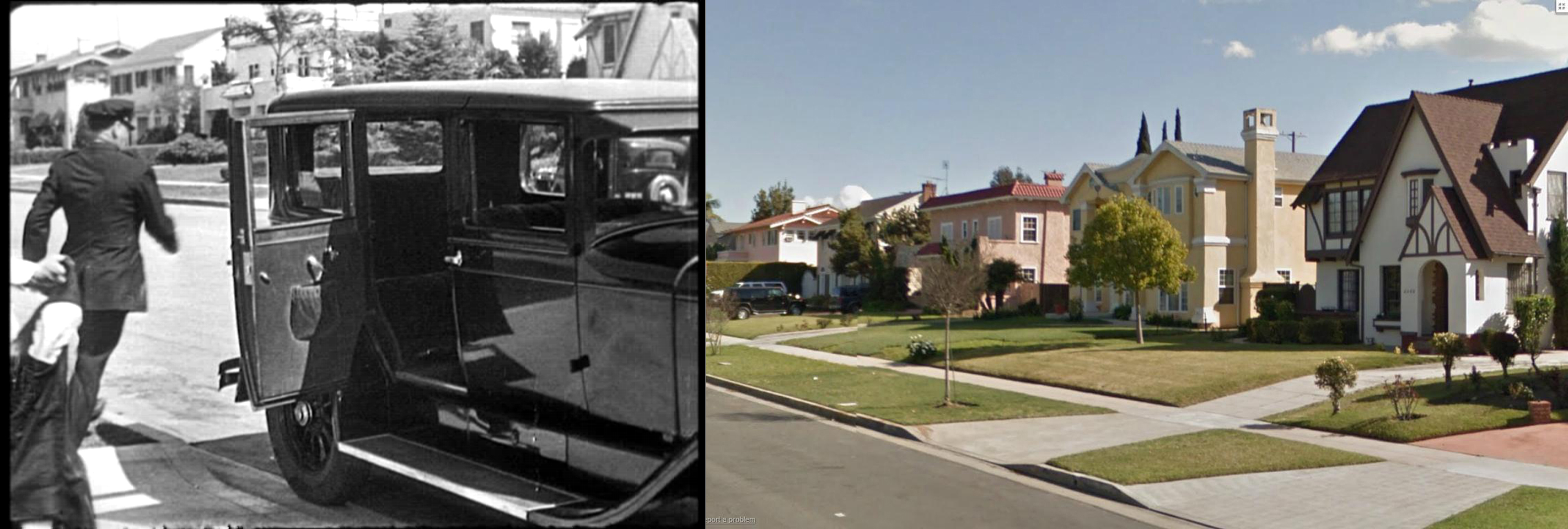
Charlie Chaplin no doubt visited Mary at her home at 56 Fremont Place in 1919, and was thus already familiar with the neighborhood when he used it to stage an important early scene from his 1921 masterpiece The Kid, named one of the 2011 entries into the National Film Registry of the Library of Congress.   During this scene, an unwed mother played by Edna Purviance abandons her infant son in the backseat of a limousine parked in front of 55 Fremont Place, the home directly across the street from Mary’s home.  Thieves steal the car before Edna can return to reclaim her child.  Upon discovering the baby, the thieves leave him in the gutter, where Charlie finds him, and raises the kid as his own.

55 Fremont Place, as it appears in Charlie Chaplin’s The Kid.  This beautiful home was recently owned by prize-fighting legend Muhammad Ali, and stands directly across the street from 56 Fremont Place, the former Mary Pickford home appearing in The Artist.

Edna Purviance in The Kid at 55 Fremont Place.

George Valentin’s mansion at 104 Fremont Place.  In 1927 the trees in front of the home would have been much smaller.

French actor Jean Dujardin plays George Valentin, the male lead in The Artist, a charming, swash-buckling movie star character fashioned after Douglas Fairbanks.  Actual footage of Fairbanks performing stunts from his 1920 landmark film The Mark of Zorro appears in The Artist during a montage of scenes supposedly played by George.  The mansion where George lives is located at 104 Fremont Place (above, and marked in the photo below), behind the home Chaplin used when filming The Kid.

George Valentin’s home in The Artist was located at 104 Fremont Place (left box), behind the home Chaplin used in The Kid (oval), itself across the street from the Mary Pickford – Peppy Miller home (right box) beyond the bottom edge of this photo.   California Historical Society, Title Insurance and Trust Photo Collection, Department of Special Collections, University of Southern California.

One of the greatest challenges when attempting to recreate vintage Los Angeles today is the mature landscaping.  Back in the 1920s all of the subdivisions were new, and most homes had no trees to block the view.   This aerial view below shows how Fremont Place would more likely have looked during the era depicted in The Artist.

Click to enlarge.  The oval marks the section of Fremont Place where The Kid and The Artist were filmed.   104 Fremont Place, appearing as George’s home, was not yet built at the time this photo was taken.  It appears as the vacant lot within the left edge of the oval.  The Kid mansion stands near the center of the oval, while the Mary Pickford – Peppy Miller home is near the lower right edge of the oval.  The long diagonal line just above the oval is Wilshire Boulevard, the next major street several blocks above Wilshire is 3rd Street.   Security Pacific National Bank Photograph Collection/Los Angeles Public Library.

  (c) 2011 Microsoft Corporation, Pictometry Bird’s Eye (c) 2010 Pictometry International Corp.

There is also a scene in the movie where Uggie the dog summons a policeman on the street for help.  The corner street sign reading “OAKWOOD AVE, 6100 W” appears in the shot, placing the scene at the corner of N. June Street and Oakwood, below.

Check out Part 3 of this series for connections to Harold Lloyd’s Safety Last!, and Part 4 for connections to the Bradbury Building and Bradbury Mansion, and Part 5 for connections to Charlie Chaplin’s City Lights.

For more photos and location information about Chaplin filming The Kid visit this PowerPoint presentation on my blog, and my book Silent TracesAnd as I mentioned, the LA Times story has a number of locations worth exploring.   Thanks also to Carol Kiefer, the Art Department Coordinator who worked on The Artist, for assistance with this post.  She reports that the Bugatti driving scene was filmed at the Big Sky Movie Ranch in Simi Valley (which has a landing airstrip), the torture laboratory and cells were filmed at the Eagle Rock Substation, Zimmer’s office, the secretary’s office, the store room, and the auction house were all filmed at the Wilshire Ebell Theater, and that the hospital was the American Film Institute building.   The Tears of Love theater interior was the Los Angeles Theater at 630 S. Broadway.

UPDATE – Lindsay Blake’s ImNotAStalker.Com has several posts with even more locations from The Artist; including George’s duplex apartment; the history of the Red Studios where much of The Artist was filmed; and of the AFI “hospital” and the Wilshire Ebell where many interior scenes were filmed.

PS – The Wilshire Ebell Theater, a 743 Lucerne Boulevard, is also just steps away from the Mary Pickford home on Fremont Place.

The Artist (C) La Petite Reine, The Weinstein Company.  All images from Chaplin films made from 1918 onwards, copyright © Roy Export Company Establishment. CHARLES CHAPLIN, CHAPLIN, and the LITTLE TRAMP, photographs from and the names of Mr. Chaplin’s films are trademarks and/or service marks of Bubbles Incorporated SA and/or Roy Export Company Establishment. Used with permission.

Posted in Buster Keaton, Charlie Chaplin, Mary Pickford, One Week, The Artist, The Kid | Tagged , , , , , , , , , , , | 7 Comments

Mr. Keaton’s Neighborhood

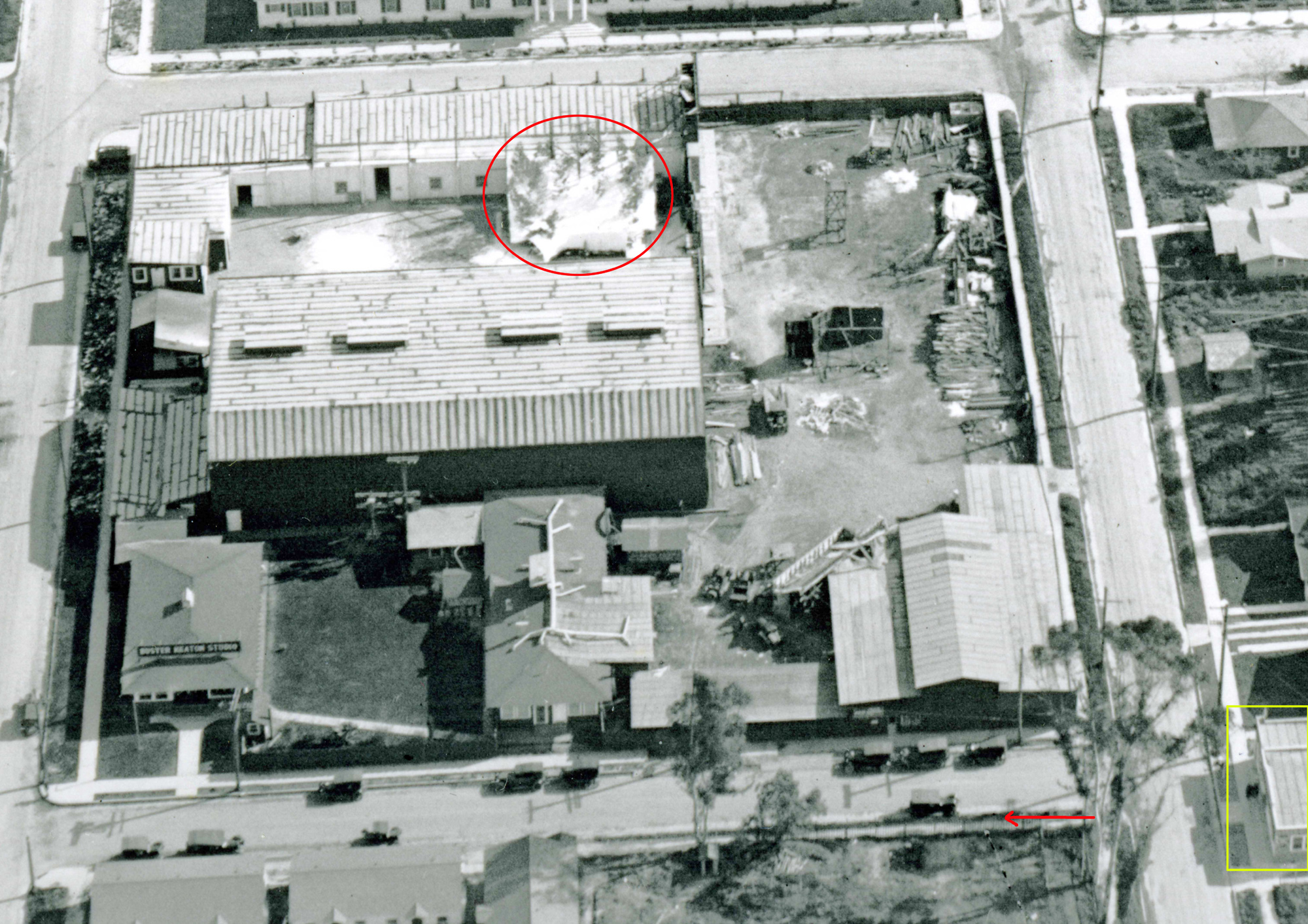
Buster Keaton would travel hundreds of miles to find just the right setting for a shot.  But he was also practical, and filmed dozens of exterior scenes at or adjacent to his small studio.  I am not aware of any documentary or newsreel footage taken of the Keaton Studio, and thus, the glimpses of Keaton’s home turf appearing in the background of his films are likely the only movie records we have.  (I write more about this in the About Silent Locations section on my blog, and in my first post, while my book Silent Echoes covers these discoveries in great detail.)  Since acquiring other aerial views of the Keaton Studio, and the new Keaton Blu-ray releases, I have made several more discoveries about filming at the Keaton Studio, and describe a few of them here.

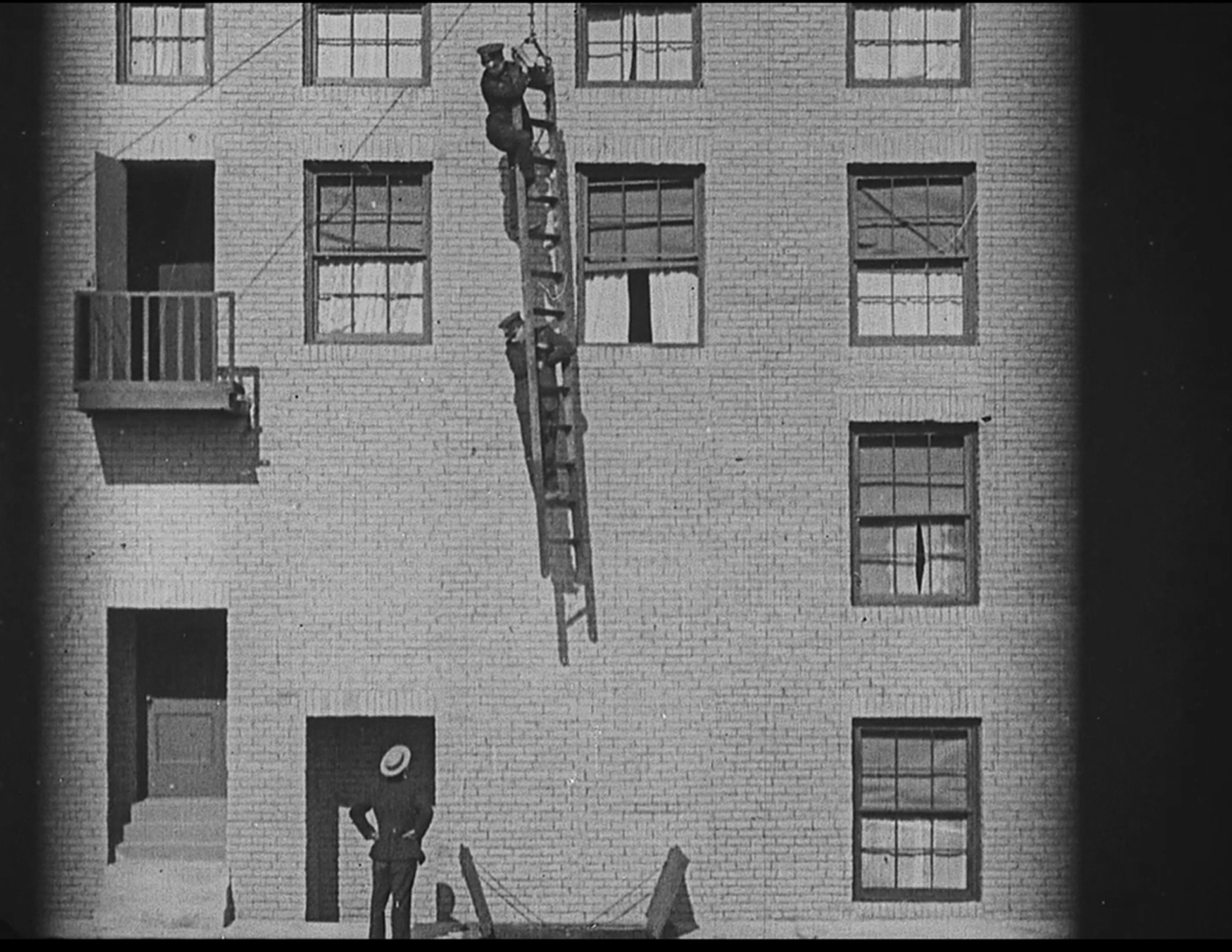
Click to enlarge.  Two scenes from Day Dreams filmed on the Keaton Studio backlot, adjacent to the oval, below.  At the right, Buster waits for a ladder holding some cops to fall into a delivery chute.

Day Dreams.  This scene was cropped to highlight the action, AND to cover up how narrow the set was.

During Keaton’s short film Day Dreams (1922), Buster lures the police chasing him up a fire escape, and returns to earth on the escape ladder’s counter-balance weight.  Keaton hitches the weight to a departing delivery truck, which pulls the ladder free from the wall, leaving the police suspended in air, until the wire snaps, and they drop into the sidewalk delivery chute Buster has opened at their feet.  The grocery set appearing behind the truck, and the 04-my-wives-pan-bestbuilding wall appearing during the scene, were built at the Keaton Studio, as shown above.  On the Blu-ray you can see the outline of three window openings on the set that were covered over during the filming, perhaps so the police would stand out more against the blank wall. [UPDATE] – this unusual set was actually built in order for Buster to perform a remarkable stunt escaping the police, in this recently restored additional footage from the closing scene of My Wife’s Relations (1922) – see full post about this new footage HERE.

The Frozen North

The Frozen North

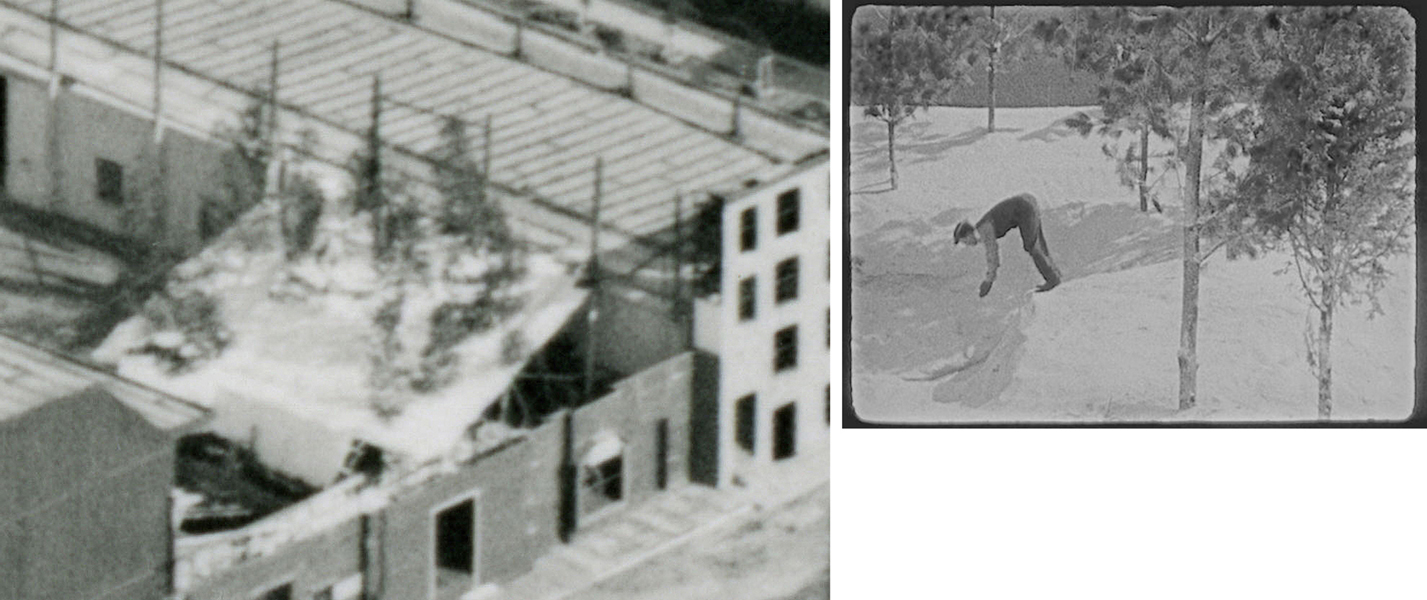
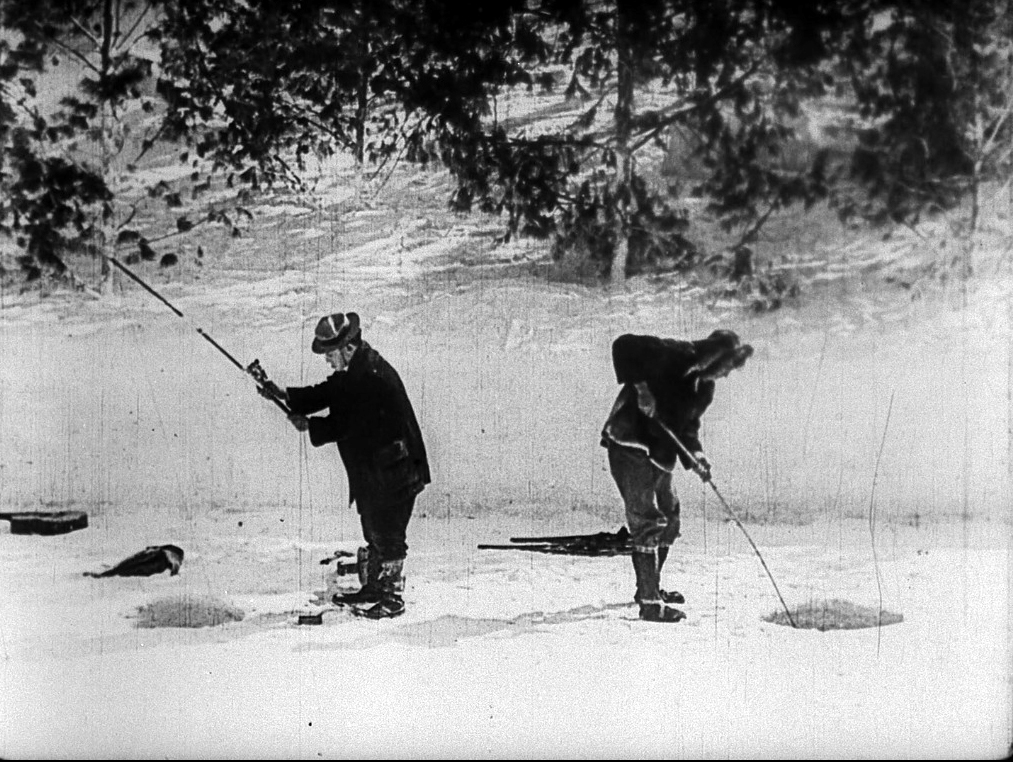
During his feature comedy Sherlock Jr. (1924), Buster plays a movie projectionist who dreams himself into the movie he is projecting.  Upon entering the movie “world,” Buster finds himself stationary as the movie background edits behind him.  Thus, Buster first finds himself in a garden, then on a city street, then in a jungle, and so forth.  Stranded on a coastal rock, Buster dives into the surf, only to land instead in a snow bank built at the studio (shown above).  Buster used real outdoor exteriors for other settings during this sequence, but for some reason decided it was preferable to use fake snow.  [UPDATE: The snowbank was actually a leftover set built for a gag in Keaton’s The Frozen North (1922), where Buster and another ice fisherman are unaware they have hooked each other’s lines.  The snow bank set was built with ice-holes high enough off of the ground to allow the other fisherman to dive into the frozen “lake” and emerge from Buster’s side.

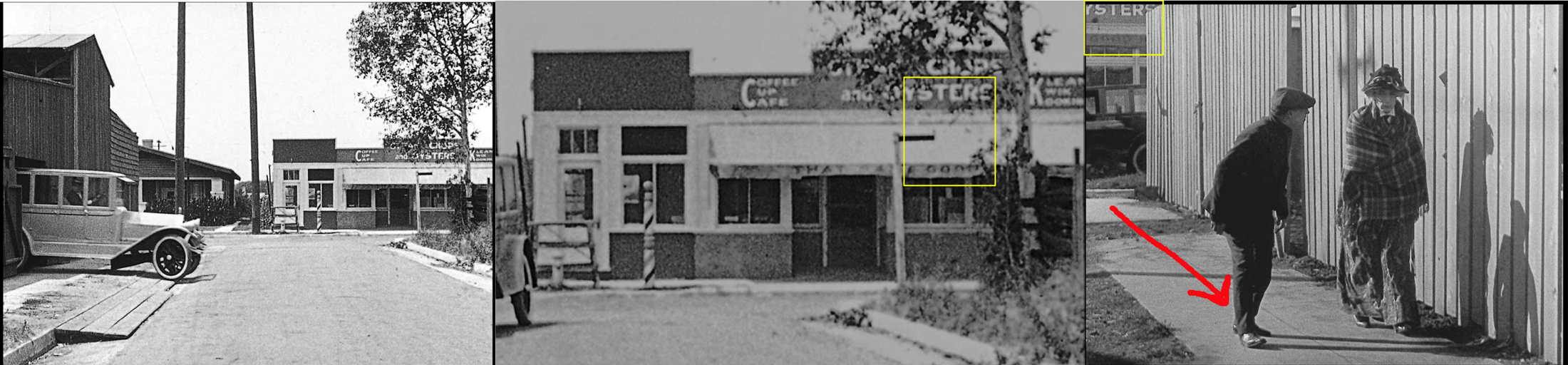
Click to enlarge.  The sign for the Coffee Cup Cafe (yellow box), appearing in Keaton’s short comedy The Blacksmith (left), appears behind Buster during this scene from Sherlock Jr. (right).   The arrow and yellow boxes correspond with the aerial photo above, and below.

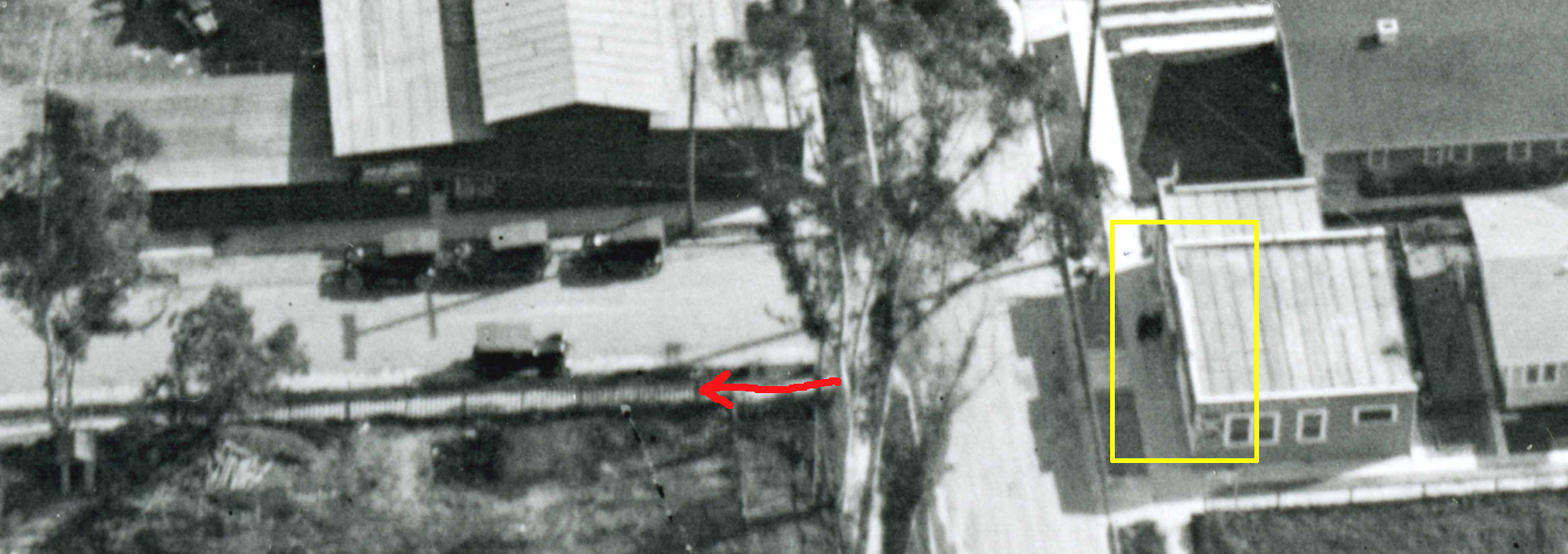
The arrow marks Buster’s path above – walking away from the Coffee Cup Cafe.  The fence alongside Buster in the above right frame was not yet built at the time this photo was taken.  Bruce Torrence Hollywood Historical Collection – HollywoodPhotographs.com.

Later in Sherlock Jr. Buster’s dream character becomes a master detective held captive by villains.  Buster escapes by diving through an open window, across which his assistant has stretched out a beggar-woman costume.   Buster dives into the dress, and out the window, in one continuous movement.  Moments later (see above), a villain confronts Buster while in disguise on a sidewalk directly across the street from the Keaton Studio barn.

Click to enlarge.  The Blacksmith and the Coffee Cup Cafe, home to Klean Kwik Kooking.

The studio barn, formerly at the corner of Eleanor and Cahuenga, appears prominently during Keaton’s 1922 short film The Blacksmith (see left).  As a customer backs his gleaming white car into the barn for repairs, we can see the barber pole for Sol Weisman’s barbershop, at 1031 Cahuenga, standing in the background.  Next door is the Coffee Cup Cafe, home of Klean Kwik Kooking, serving STEAKS CHOPS and OYSTERS.  A portion of this OYSTERS sign (yellow box above) appears behind Buster after his escape in Sherlock Jr.   It’s fun to imagine – did Keaton and crew eat at the Coffee Cup regularly?  Did any one visit Sol for a haircut?  Also, the barber and cafe buildings were built brand new in 1922, a block from the large Metro Studios.  They must have counted on lots of business from Metro, and been impacted when Metro merged into M-G-M, and moved to Culver City a few years later.  I can find no record of the cafe other than its appearance in these films, and wonder how long it survived.  A full view of the studio appears below.

This full view of the Keaton Studio shows the snow bank set (oval) discussed above, relative to the Coffee Cup Cafe (yellow box).  Bruce Torrence Hollywood Historical Collection -HollywoodPhotographs.com.

Charlie Chaplin used exterior views of his studio to film scenes (or deleted scenes) from Shoulder Arms, A Day’s Pleasure, The Kid, and A Woman of Paris, and the Bradbury Mansion, and its environs appear in several early Harold Lloyd shorts.  But far more so than Chaplin or Lloyd, Keaton filmed over 40 scenes near and around his studio.  I will be posting more of these new discoveries at a later date.

Day Dreams, Sherlock Jr., and The Blacksmith licensed by Douris UK, Ltd.

Studio aerial photographs from HollywoodPhotographs.com

A view today of the Keaton Studio site.  The commemorative sidewalk plaque in the foreground should be across the street.

Posted in Buster Keaton, Daydreams, Keaton Studio, Sherlock Jr. | Tagged , , , , , , , , , | 16 Comments

New York, Harold Lloyd, and Adam Sandler?!

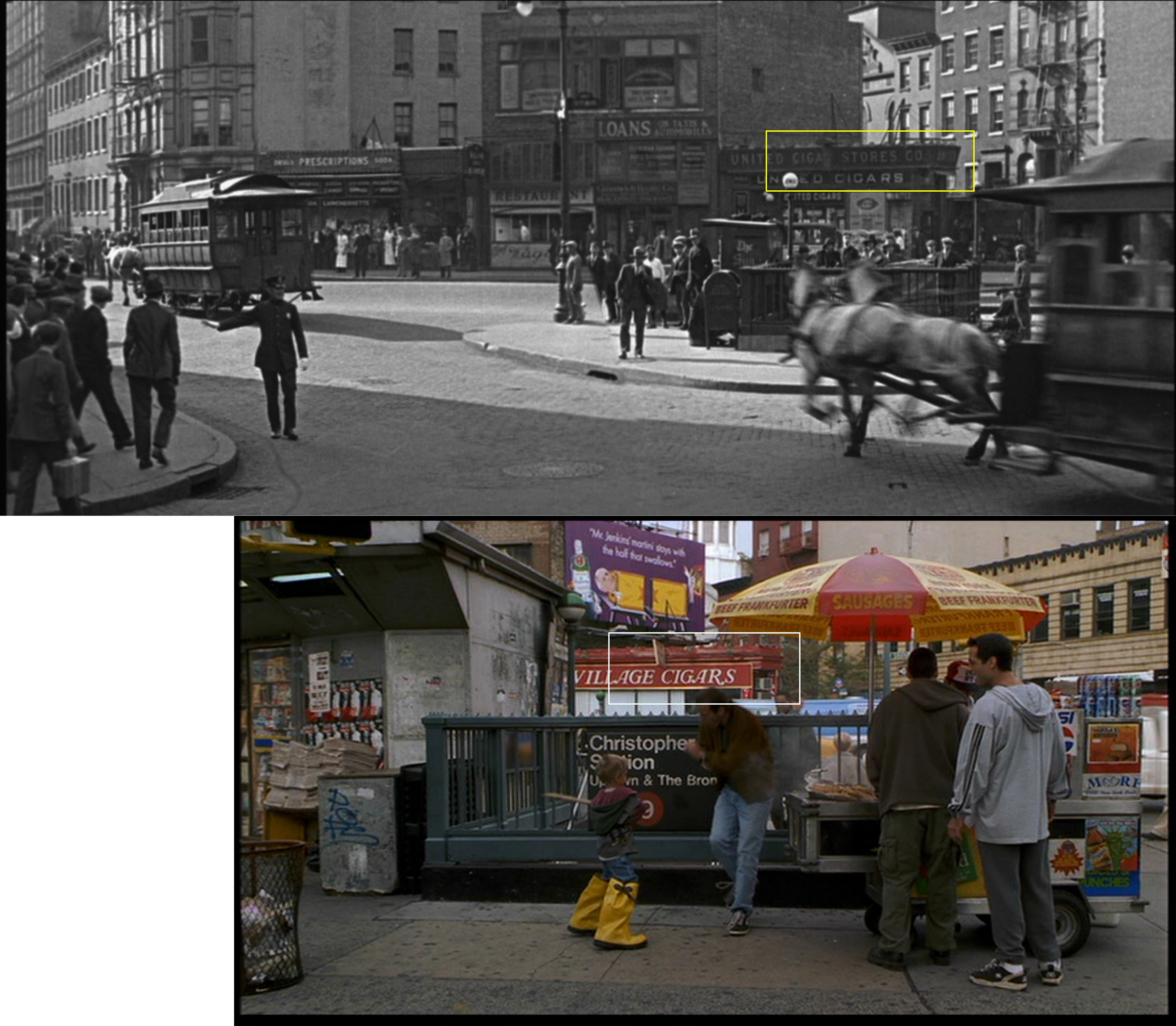
After matching The Artist (2011) and Harold Lloyd in a prior post, how about pairing Harold and Adam Sandler for an encore?  I haven’t seen many of Sandler’s films, but once I realized Big Daddy was shot on location in New York, it didn’t take long to discover Sandler had crossed paths with Lloyd’s 1928 production of Speedy.   Lloyd filmed so filmed extensively in Manhattan that there are likely common locations between Speedy and nearly every New York-based film succeeding it.  You can see Speedy in person when I present it at 3:10 pm on Sunday, October 21, 2012, and at 7:30 pm on Monday, October 22, at Film Forum, 209 West Houston Street, New York, NY 10014.

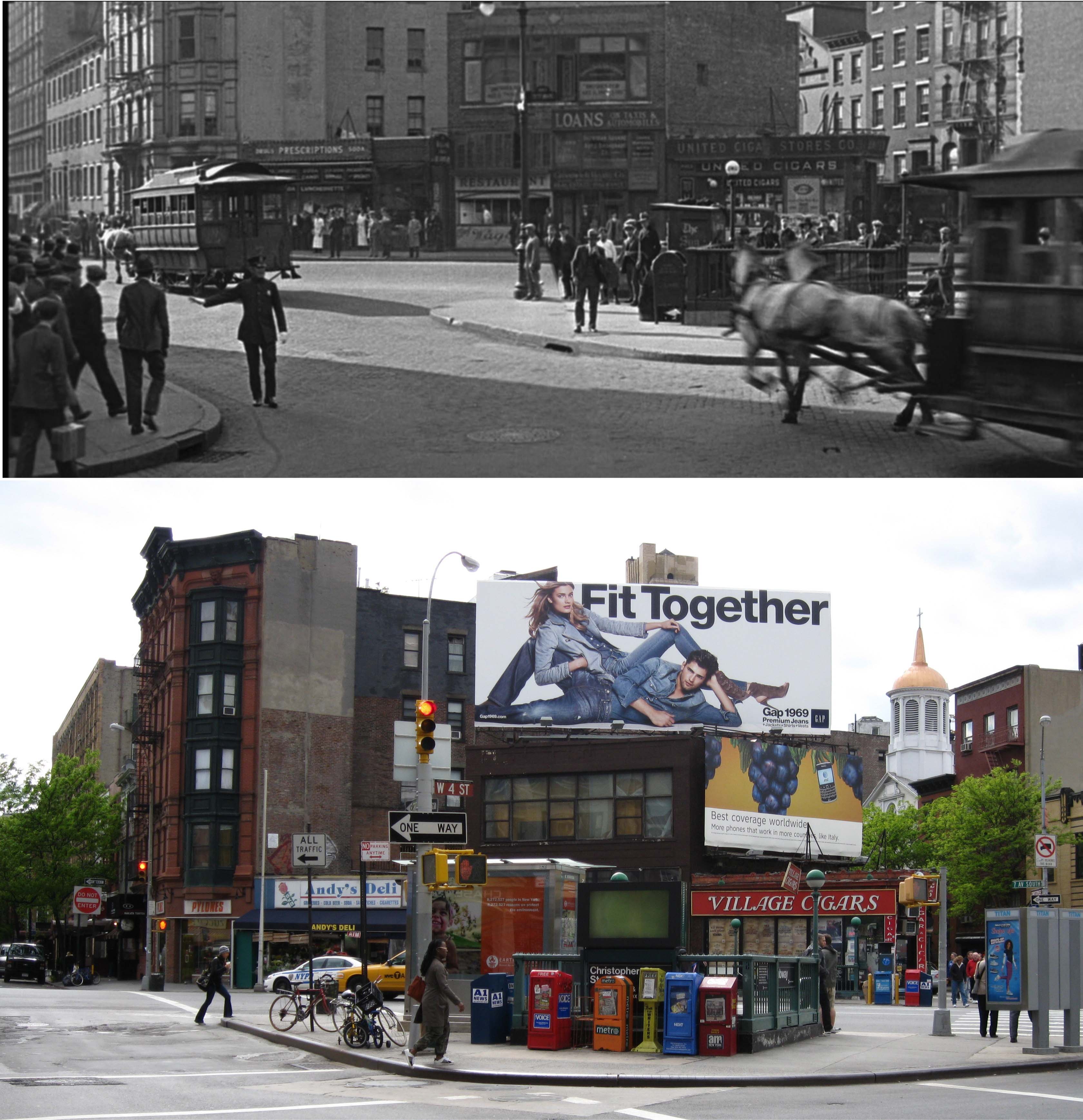
Click to enlarge.  The Christopher Street Sheridan Square subway entrance in Manhattan.  The box in each image marks the same cigar store, as it appeared in 1927 during the filming of Speedy, and as it appeared in 1999 in Big Daddy.  The store still stands there today.   The white pillars above the cigar store in the color image are part of the steeple to St. John’s Lutheran Church, built in 1821.

click to enlarge.  Speedy then and now

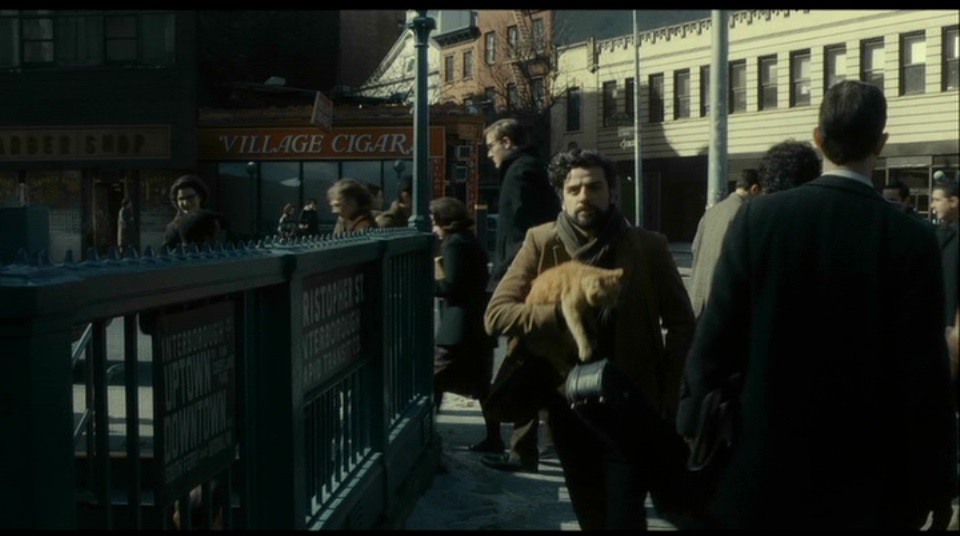
During the climatic race home in Speedy, Harold charges a horse-drawn trolley across Manhattan, from Grove Street and 4th Street, past the Christopher Street Sheridan Square subway entrance, towards 7th Avenue.   I write about this in greater detail in a prior post.  Big Daddy used the same setting, above, for a scene where Sandler’s character impresses his friends by demonstrating that the young foster child in his care can dangle a loogie nearly all the way to the ground before sucking it back up into his mouth.  [Update: the subway entrance appears again in the recent film Inside Llewyn Davis (below)].

Inside Llewyn Davis

Deja vu – Inside Llewyn Davis (2013)

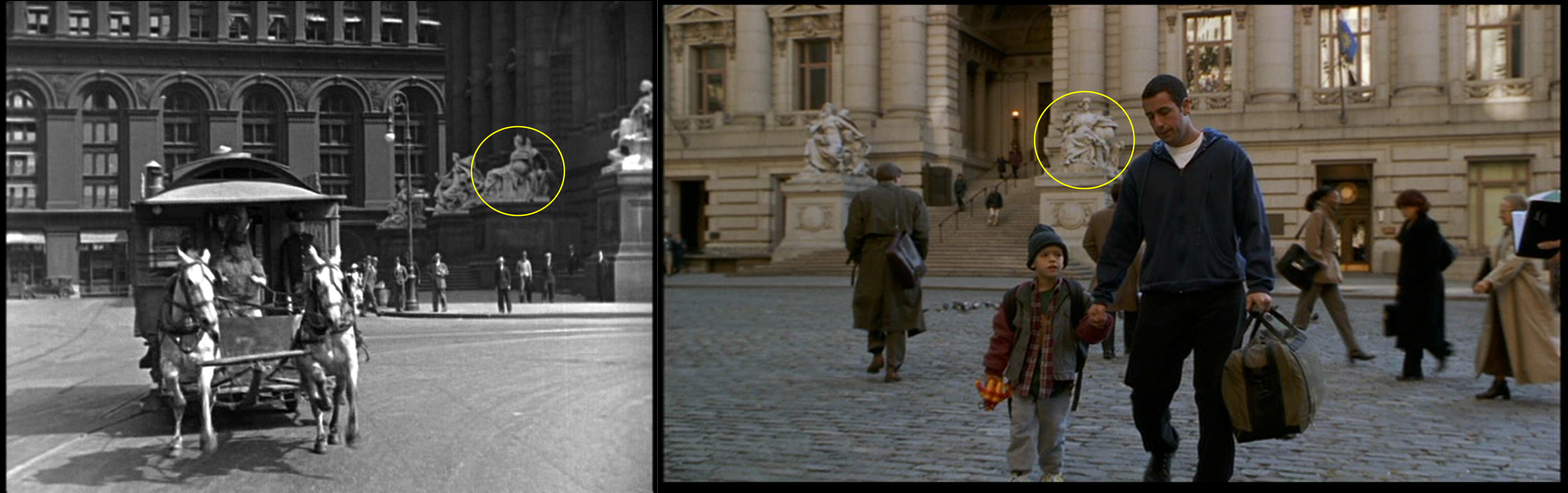
The oval marks the same statuary in front of the U.S. Customs House.

Harold continues his race home in Speedy along the south end of Bowling Green Park, beside the former U.S. Customs House, now the home of the Smithsonian Institute’s National Museum of the American Indian.   In Big Daddy, Sandler uses a phone booth at Bowling Green to call his father for advice.   The four allegorical sculptural groups in front of the museum, representing the Four Continents; Asia, America, Europe, and Africa, were created by artist Daniel Chester French between 1903-1907.

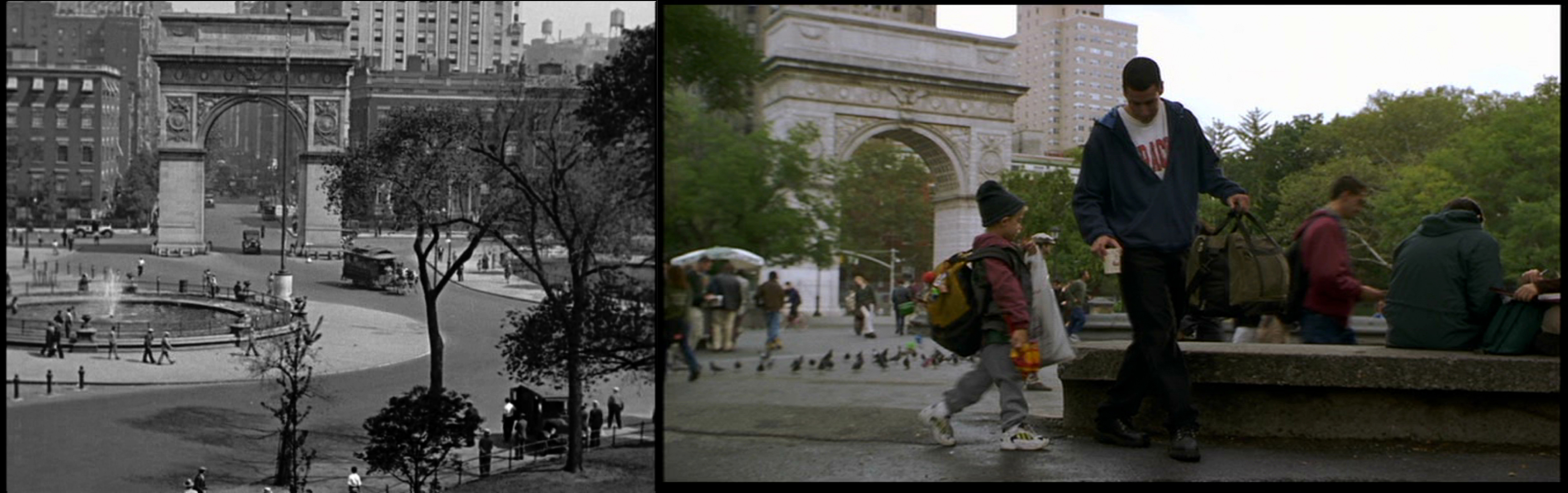
The Washington Arch Memorial at Washington Square Park.

Above, Harold races through the archway at Washington Square Park.  The Washington Memorial Arch was fashioned after the Arc de Triomphe in Paris by Gilded-Age architect Stanford White, and was dedicated in 1895.  Vehicular traffic along 5th Avenue was permitted through the arch, and across the park, until the 1960s.  Sandler used the park to film a scene where he allows the foster child in his care to change his name from Julian to Frankenstein.

You can read all about Harold Lloyd filming Speedy in Manhattan, and Coney Island, and Brooklyn (and in downtown Los Angeles) in my book Silent VisionsThe section on Speedy is nearly 100 pages long, and is filled with wonderful vintage photos of New York.

My blog also has several other Lloyd-Manhattan posts, including a tour of Brooklyn locations in Speedy, an overview of Speedy Manhattan locations, including three annotated Google maps, a post showing where Lloyd and Buster Keaton crossed paths in New York, and posts about Babe Ruth AND Lou Gehrig’s cameo appearances in Speedy.

For more New York locations appearing in Big Daddy, check out these websites:  http://onthesetofnewyork.com/bigdaddy.html  and http://www.themoviemap.com/film-locations/bb/big-daddy-1999/

HAROLD LLOYD images and the names of Mr. Lloyd’s films are all trademarks and/or service marks of Harold Lloyd Entertainment Inc. Images and movie frame images reproduced courtesy of The Harold Lloyd Trust and Harold Lloyd Entertainment Inc.  Big Daddy (C) 1999 Columbia Pictures Industries, Inc.

Posted in Harold Lloyd, Lloyd Tour, Manhattan, New York, Speedy | Tagged , , , , , , , , , , | 1 Comment

The Artist Locations Part 5 – Chaplin’s City Lights

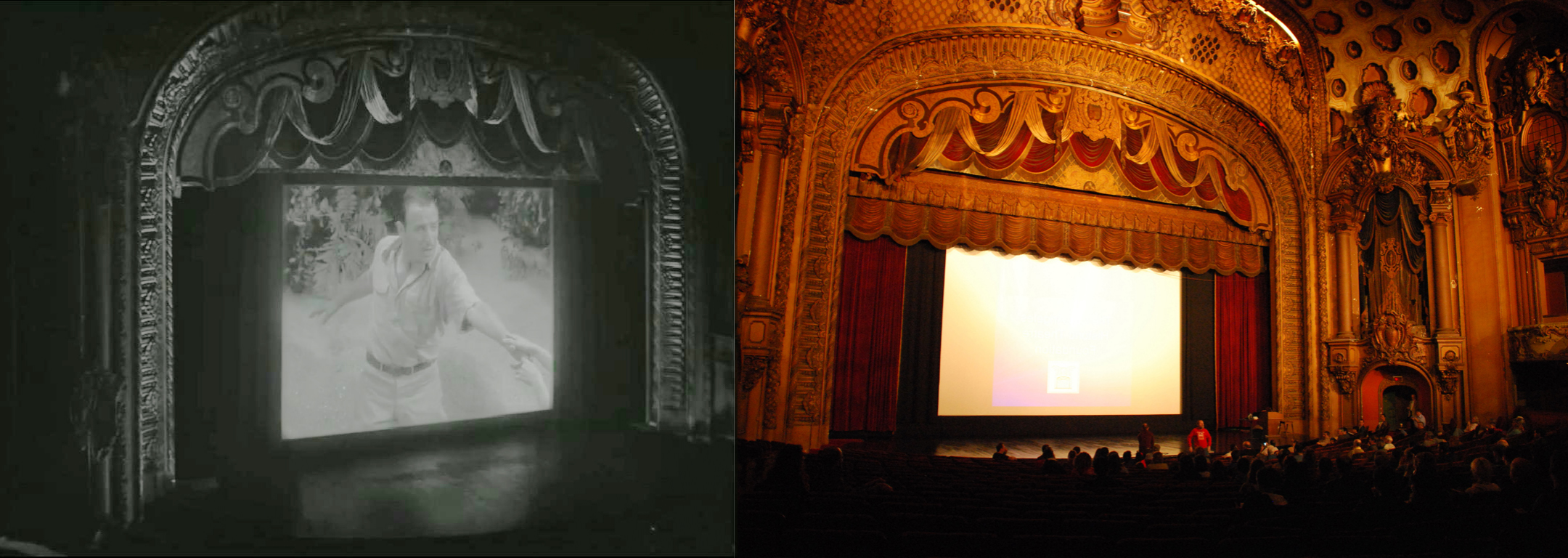
Click to enlarge. From The Artist, character George Valentin's Tears of Love on the Los Angeles Theater screen, at left. Color image Floyd B. Bariscale http://www.flickr.com/photos/7294653@N07/3394648314/ca

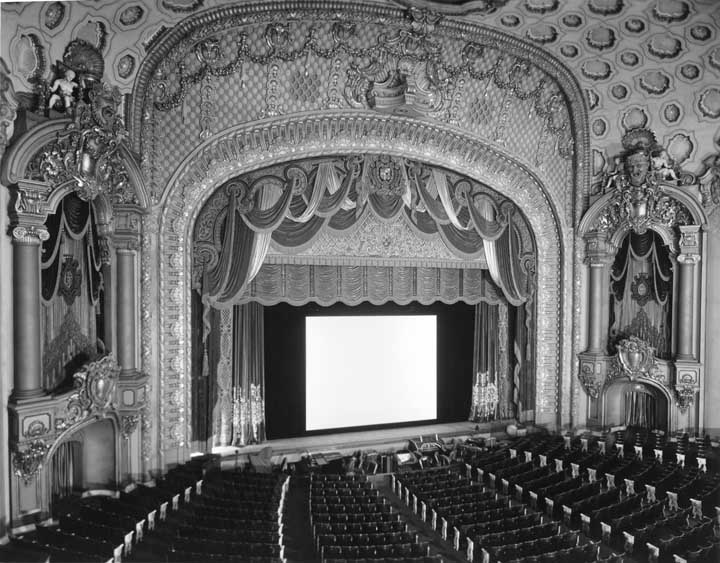
In a tribute to the theater's namesake, the Great Seal of the City of Los Angeles hangs above the proscenium arch - circa 1931. California State Library Mott-Merge Collection

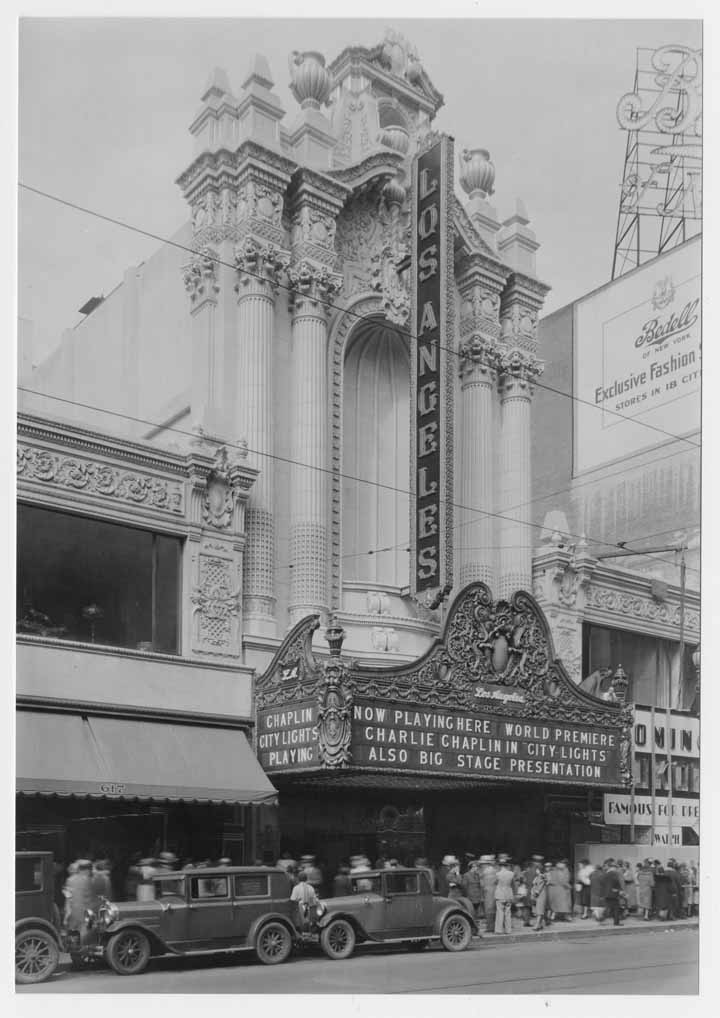
The Los Angeles Theater, located at 615 S. Broadway in the Los Angeles Theater District, has a remarkable connection to two of the most audacious hit movies in Hollywood history, Charlie Chaplin’s City Lights (1931), and Michel Hazanavicius’ The Artist (2011).  Filmed 80 years apart, the two movies share a common conceit  – both, against all odds, are presented without spoken dialog.  Just as newspaper accounts today are abuzz with how bold it is for The Artist to be presented in the digital era without spoken dialog, contemporary newspapers stories marveled at Chaplin’s endeavors to continue with the silent format.  The January 29, 1931 Los Angeles Times description of City Lights as the first non-dialogue film of importance to be produced since the advent of the talkies” could apply to The Artist today.

The screen of the Los Angeles Theater appears in The Artist during the premiere of character George Valentin’s self-financed production Tears of Love (see above), a silent flop that wipes out George financially.  The screen of the Los Angeles Theater had witnessed such high stakes drama once before, as it was here, in real life, that Charlie Chaplin premiered his self-financed silent production, City Lights, on January 30, 1931, the inaugural screening for the newly opened theater.   Fortunately for Chaplin, City Lights was a tremendous financial and critical success, cementing his reputation as a risk-taking artist who refused to bow to popular trends.

Click to enlarge. California State Library Mott-Merge Collection

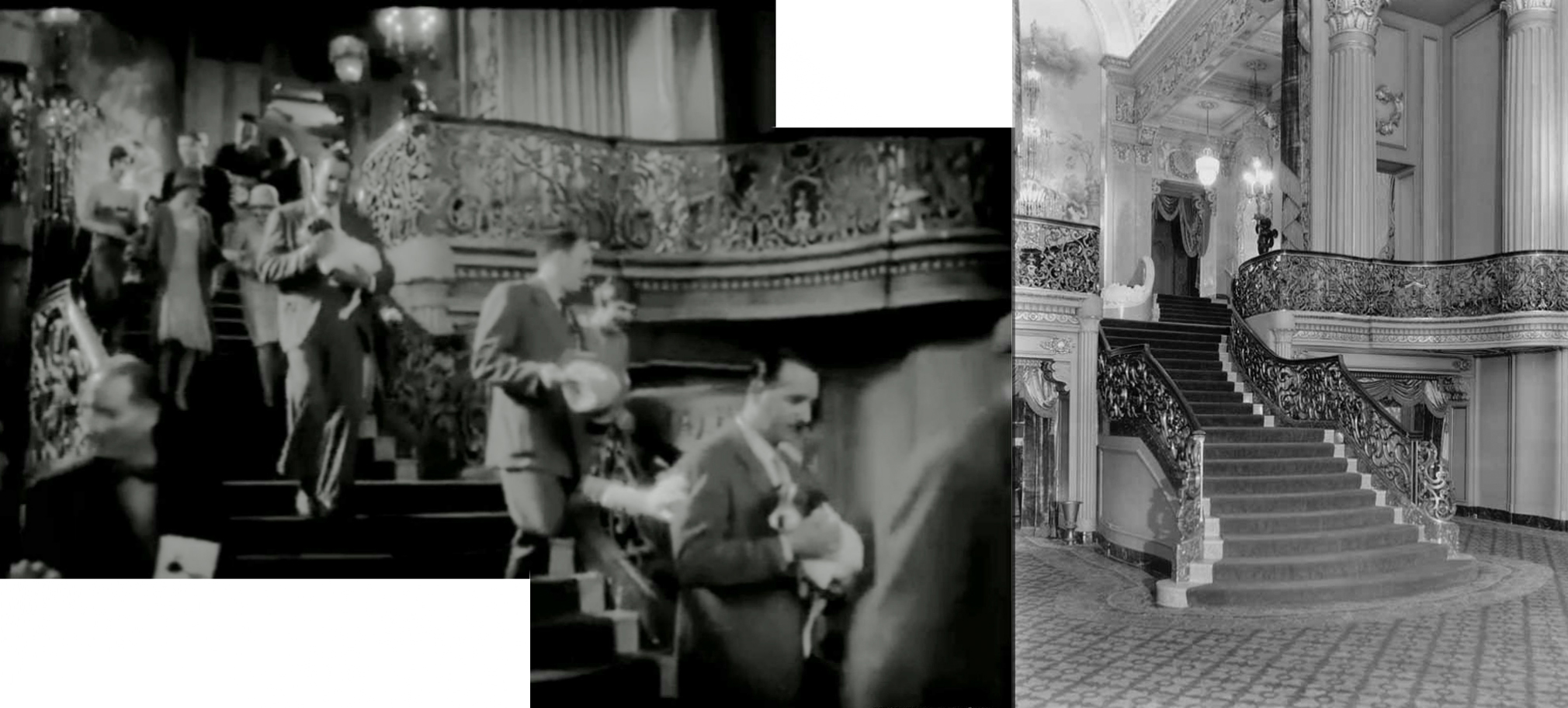
The lobby of the Los Angeles Theater appears later in The Artist (at left), as George, now down on his luck, and Uggie the dog attend a screening of character Peppy Miller’s latest hit movie Guardian Angel.  As George leaves the screening, a woman stops him as he descends the lobby stairs.  But she is not a fan who remembers George from the past – she just wants to pet the dog hello.

The lavish French Baroque-styled Los Angeles Theater was Broadway’s last great movie palace.  Although built in 1930, after the Crash, it was designed to surpass the opulent neighboring palaces built during the Roaring 20’s.   (The nearby Orpheum Theater, built in 1926, also appears in The Artist, see this post).  The lobby features gilt ornamentation, bronze bannisters, mirrors, and crystal chandeliers, all centered around a sun-burst motif.  The main auditorium, which could easily seat 3000 persons, has 2200 seats, allowing much extra room between rows for the comfort of patrons.  The theater’s many innovations included individual electric cigaret-lighters on every dressing table in the ladies’ French cosmetic room, with cosmeticians and maids in attendance; a limit of six seats to a row, doing away with the annoyance caused by late arrivals; two children’s playrooms and a sound-proof nursery; a model cafe; an exhibition room for objets d’art; and a club lounge with a dancing floor; all while a periscope system of prisms relayed the projection of the identical picture shown on the screen in the main auditorium to miniature screens in the lounge rooms and in the nursery.

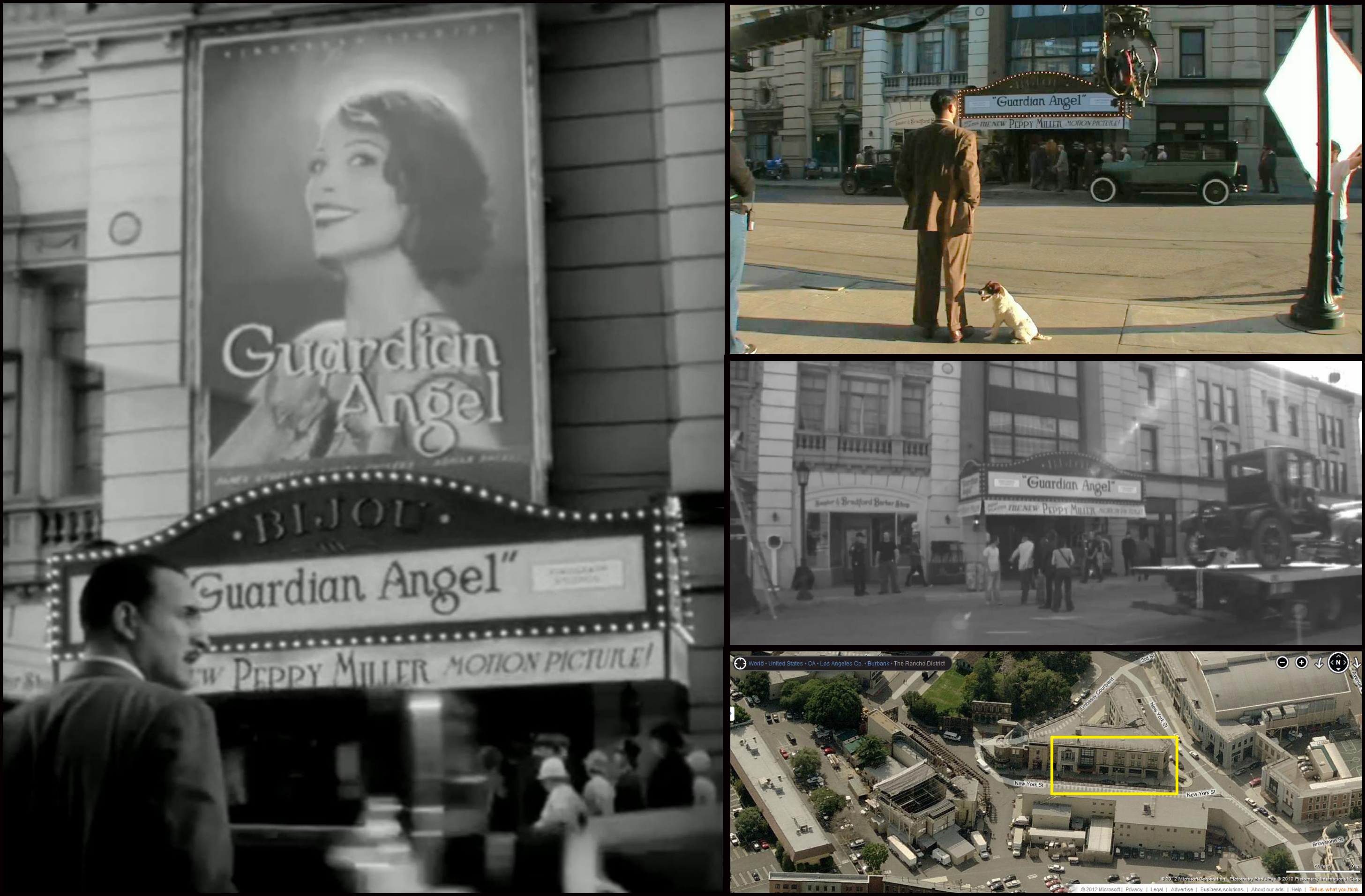
The exterior shots of the theater screening Peppy Miller’s Guardian Angel were filmed on the Warner Bros. backlot, across the street from the set used for the theater marquee showing George Valentin’s film A Russian Affair, and later Peppy’s hit film Beauty Spot.  I show how the Beauty Spot marquee fits on the WB backlot in my original post in this series.  By enlarging the aerial view below, you can see the row of exterior sets where the Guardian Angel sequence was staged.  Apparently the large billboard of Peppy below was added in post-production, as it does appear in the behind-the-scenes shots below.

Click to enlarge. Aerial view (c) 2011 Microsoft Corporation, Pictometry Bird's Eye (c) 2010 Pictometry International Corp.

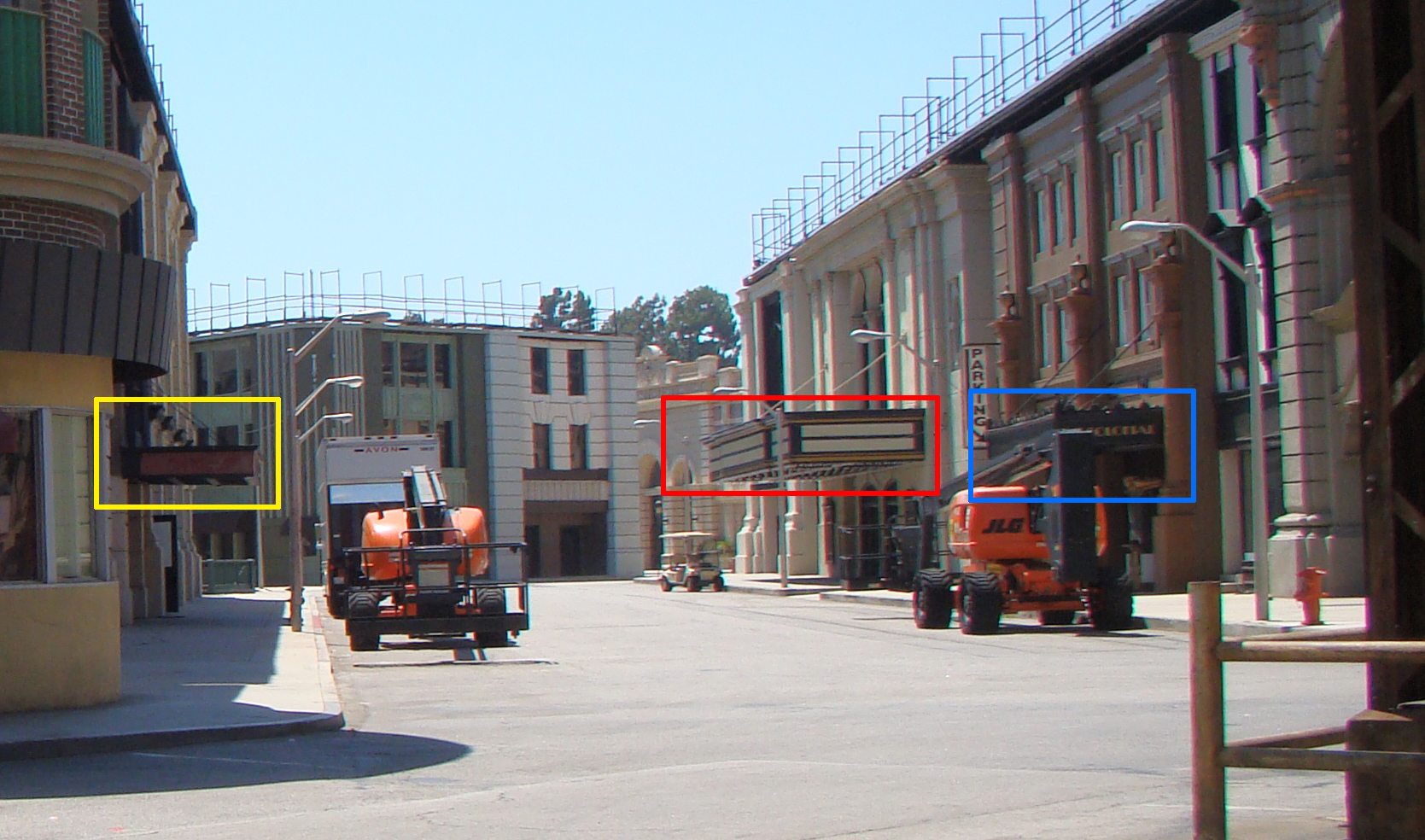
This view below shows the Warner Bros. backlot street where all of the movie theater exteriors from The Artist were filmed.  The colored boxes help to distinguish each use.

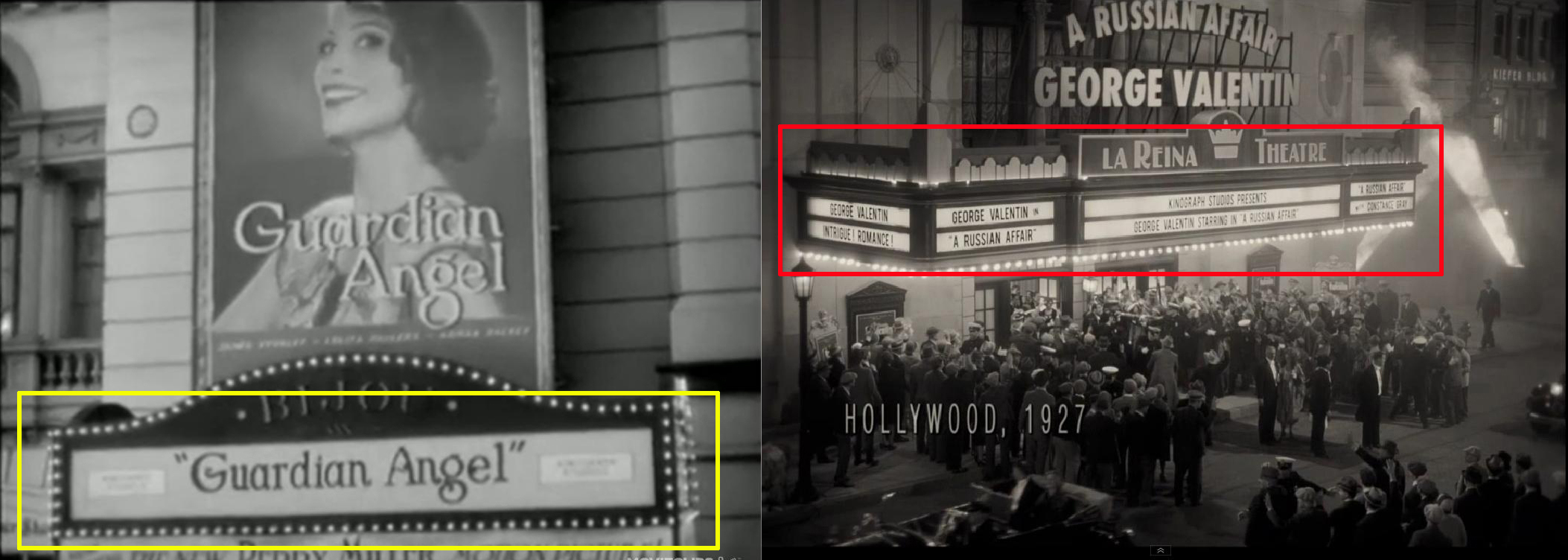
On the Warner Bros. backlot. The yellow box marks the Guardian Angel marquee (below left), the red box marks the A Russian Affair and Beauty Spot marquee (below right), and the blue box marks the marquee used for George's doomed silent film Tears of Love.

These two marquees stand on opposite sides of the same Warner Bros. backlot street

The Artist (C) La Petite Reine, The Weinstein Company.  

All images from Chaplin films made from 1918 onwards, copyright © Roy Export Company Establishment. CHARLES CHAPLIN, CHAPLIN, and the LITTLE TRAMP, photographs from and the names of Mr. Chaplin’s films are trademarks and/or service marks of Bubbles Incorporated SA and/or Roy Export Company Establishment. Used with permission.

1931 - the world premiere of City Lights at the Los Angeles Theater. California State Library Mott-Merge Collection

The Los Angeles Theater, 615 S. Broadway, Los Angeles, host venue to the world premiere of City Lights (left).

Posted in Charlie Chaplin, City Lights, Los Angeles Historic Core, The Artist | Tagged , , , , , , , , , , , | 9 Comments

Chaplin’s Modern (Los Angeles) Times

Chaplin's Jackson Street filming site (right) lines up perfectly with the 4th Los Angeles Times Building (left)

Making A Living beside the 3rd LA Times Building

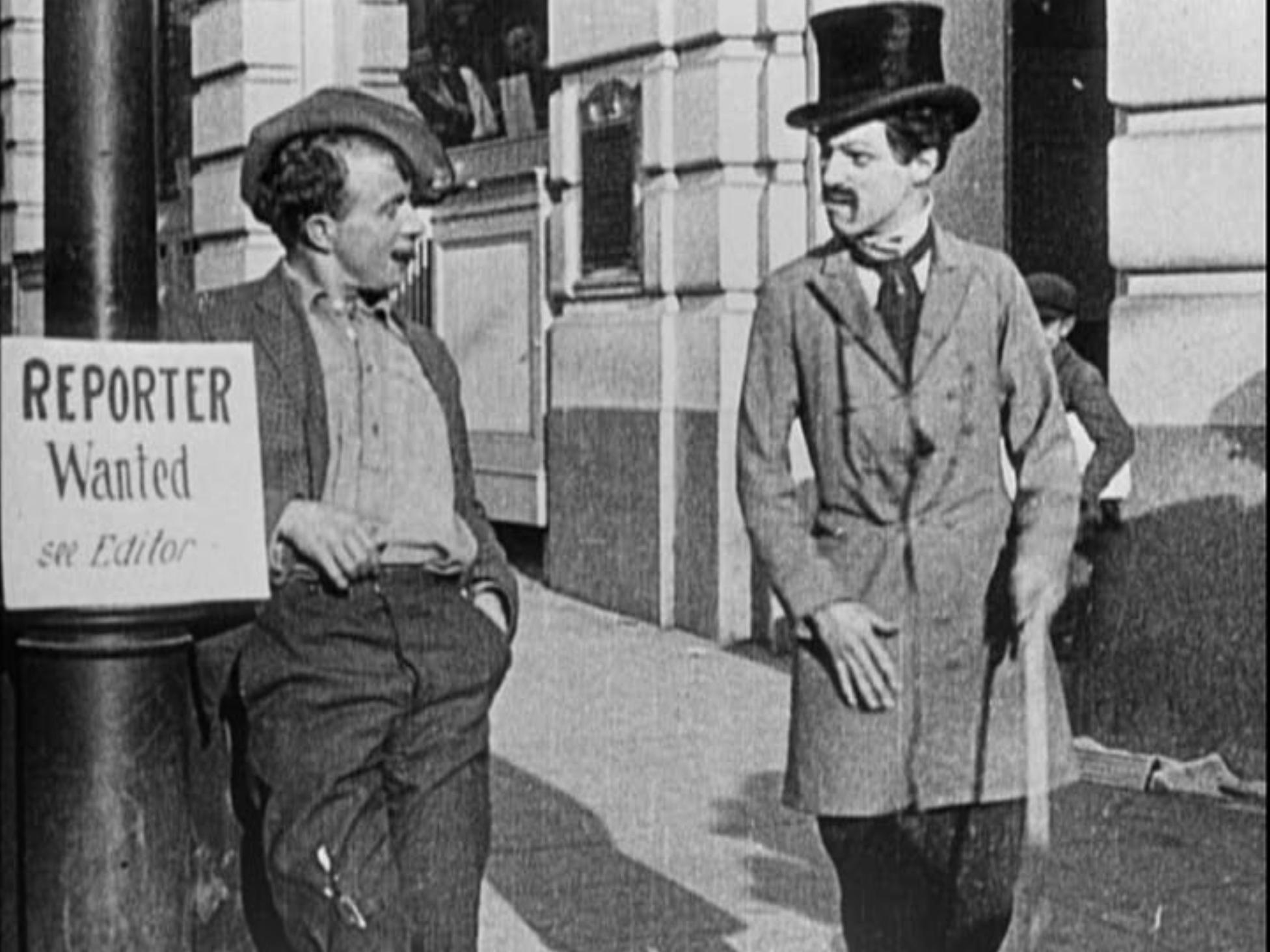
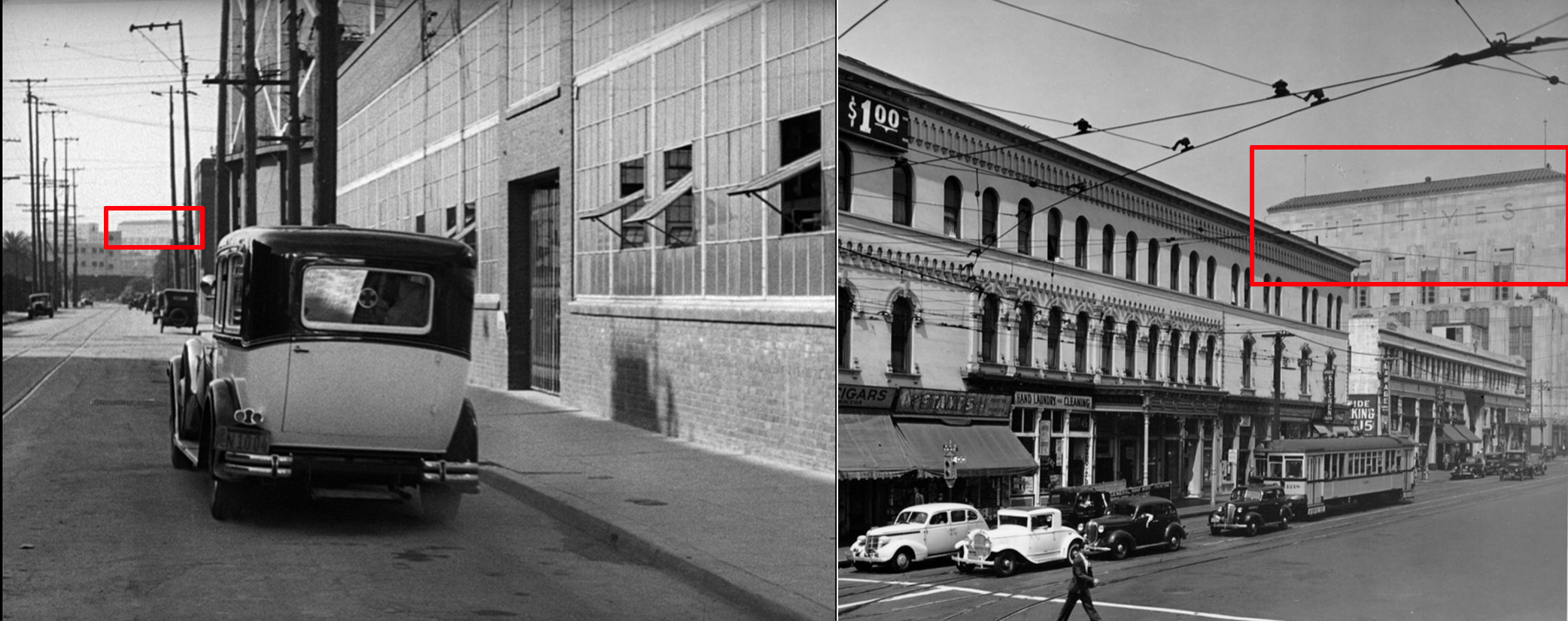
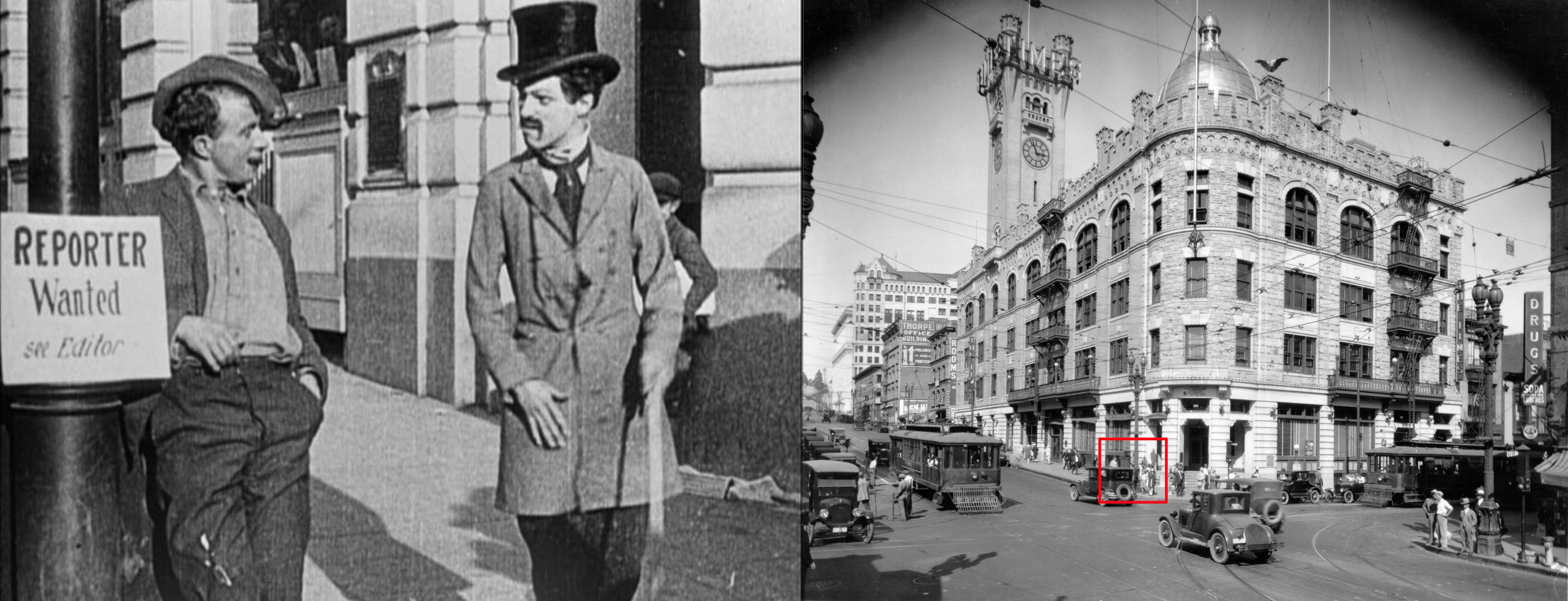
As I explain in my visual essay included in the Criterion Collection Blu-ray edition of Charlie Chaplin’s Modern Times (1936), Chaplin filmed scenes for his first movie Making A Living (1914) beside the third Los Angeles Times Building that once stood on the corner of 1st and Broadway.   Thanks to the clear resolution of the Criterion release, we now know Chaplin’s final silent film Modern Times (well, final film without spoken dialog) is connected to the fourth Los Angeles Times Building that opened in 1935.

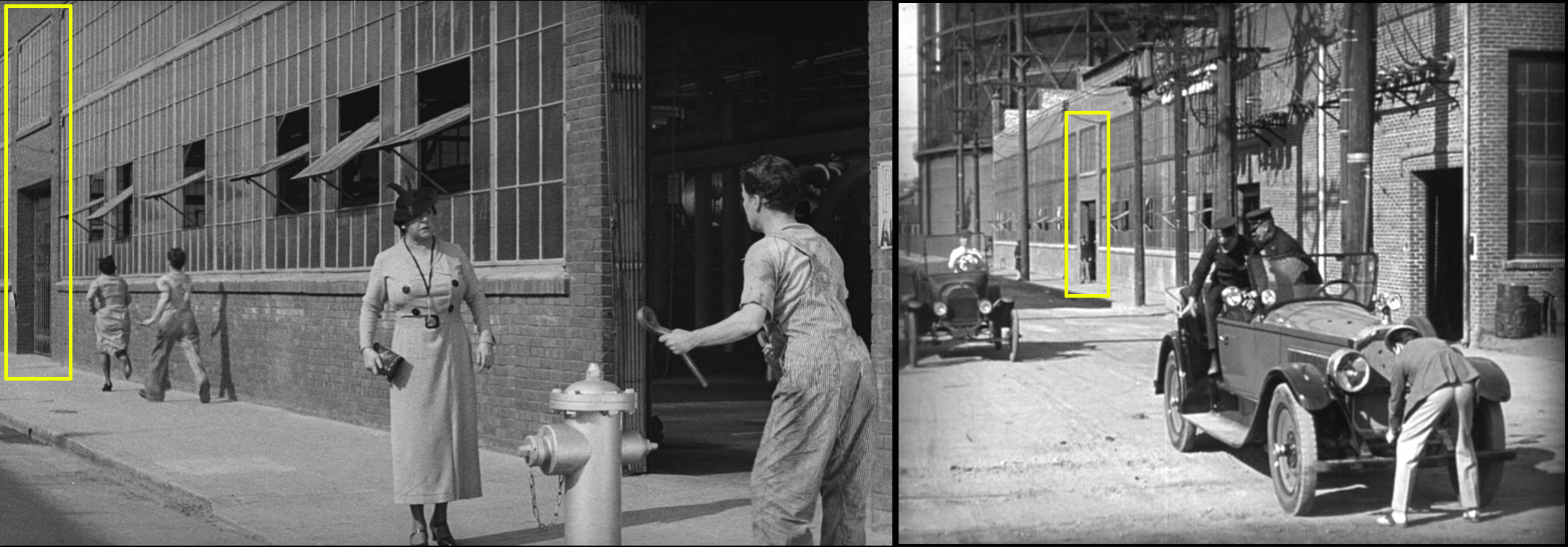
During Modern Times factory worker Charlie tightens bolts on an ever-accelerating assembly line, eventually suffering a nervous breakdown.  After attempting to tighten the suggestive buttons on a matron’s dress (below left), he is carted off to a sanatorium (further below left).  These scenes were filmed on Jackson Street beside the Southern California Gas Company gas manufacturing plant, explained in further detail in my prior post about the noir connections to Modern Times, and in full detail in my book.

Click to enlarge. Matching views of the Jackson Street side of the Ducommun gas manufacturing plant, from Modern Times, left, and Harold Lloyd's 1926 feature For Heaven's Sake, at the right. The yellow box marks the same doorway in each image.

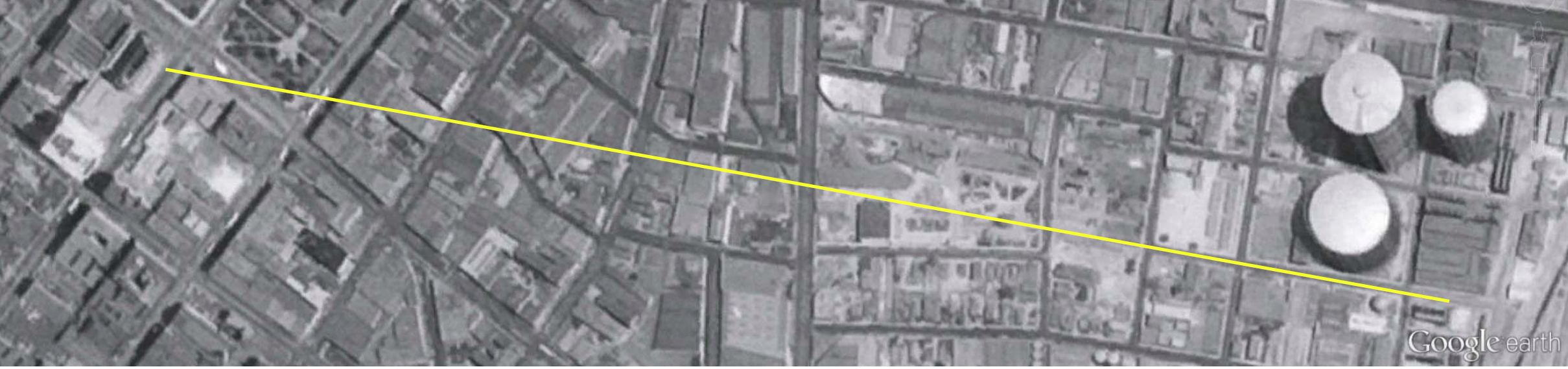
As Chaplin’s ambulance heads west down Jackson Street below left, the high resolution Blu-ray image reveals the profile of the recently opened fourth Los Angeles Times Building in the far distance.  The 1948 aerial image at the top of this post shows how the filming site lines up directly with the Times Building.

Click to enlarge. Looking west down Jackson Street straight at the side of the fourth Los Angeles Times Building in the far distance. Right image, "Dick" Whittington Photography Collection, 1924-1987, Department of Special Collections, University of Southern California

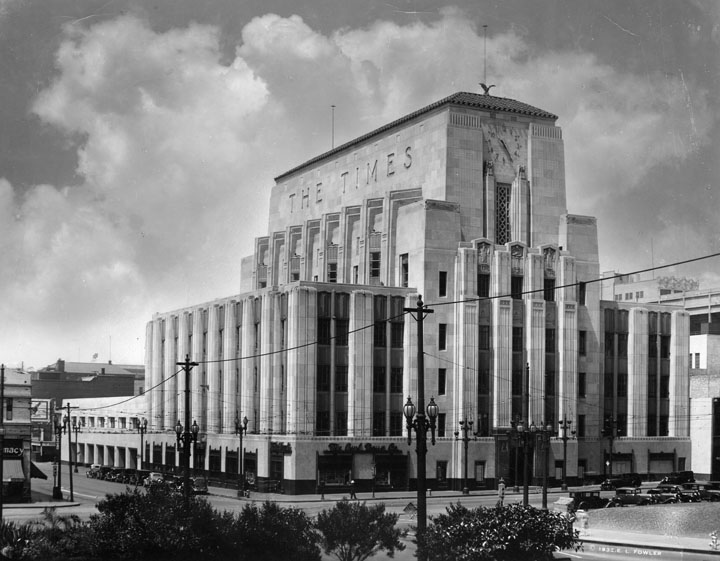
Circa 1935 - the fourth LA Times Building at 1st and Spring. Security Pacific National Bank Photograph Collection/Los Angeles Public Library

The cornerstone for the fourth Los Angeles Times Building, at 1st and Spring, was laid on April 10, 1934.  When the Time Building opened July 1, 1935, it was the largest newspaper building in the western United States.  The building was designed by Gordon B. Kaufmann, who also designed Hoover Dam, and the Athenaeum at the California Institute of Technology in Pasadena.  Kaufmann’s Modern design for the Times Building won a gold medal at the 1937 Paris Exposition.  The fourth Times Building has since been greatly expanded, and is still in use today.  The building is open for tours twice a month.

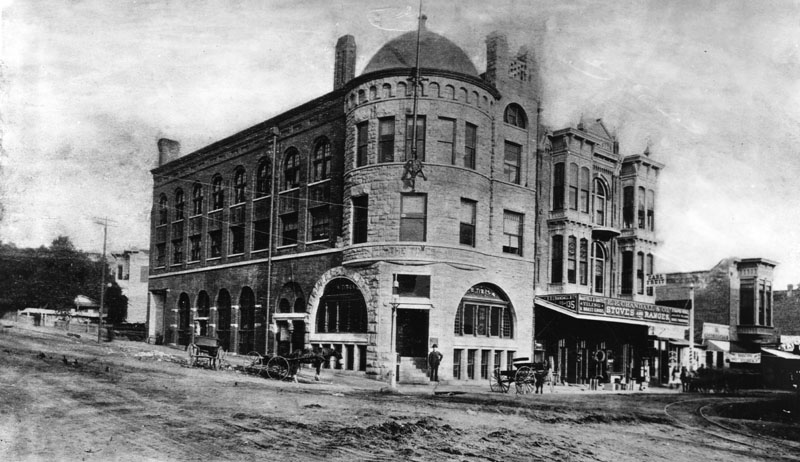
The fourth Times Building on Spring replaced the former third Times Building at 1st and Broadway, completed in 1912, and well-known at the time for its landmark crenelated clock tower and golden dome (see below right).  The third Times Building stood on the same site as the second Times Building, built in 1887, that was demolished by a bomb blast in 1910 during a bitter labor dispute between the paper and union organizers.  The first Times Building was constructed at Temple and New High Streets in 1881.

Click to enlarge. The third Los Angeles Times Building at 1st and Broadway. The red box marks Chaplin's position from Making A Living, his debut film. Security Pacific National Bank Photograph Collection/Los Angeles Public Library

The second Los Angeles Times Building, on the same corner as the third, was destroyed by pro-union bombers in 1910. Security Pacific National Bank Photograph Collection/Los Angeles Public Library

My visual essay regarding Chaplin’s Keystone films, featured as part of the Flicker Alley Chaplin at Keystone DVD set, also discusses his debut beside the former third Los Angeles Times Building.  You can see the essay here.

The original Los Angeles Times Building, circa 1881, stood on the corner of Temple and New High Streets. Security Pacific National Bank Photograph Collection/Los Angeles Public Library

All images from Chaplin films made from 1918 onwards, copyright © Roy Export Company Establishment. CHARLES CHAPLIN, CHAPLIN, and the LITTLE TRAMP, photographs from and the names of Mr. Chaplin’s films are trademarks and/or service marks of Bubbles Incorporated SA and/or Roy Export Company Establishment. Used with permission.

Making A Living (C) 2010 by Lobster Films for the Chaplin Keystone Project; Flicker Alley, LLC.

HAROLD LLOYD images and the names of Mr. Lloyd’s films are all trademarks and/or service marks of Harold Lloyd Entertainment Inc. Images and movie frame images reproduced courtesy of The Harold Lloyd Trust and Harold Lloyd Entertainment Inc.

Vintage aerial (C) Google.

The Los Angeles Times Building

Posted in Charlie Chaplin, For Heaven's Sake, Harold Lloyd, Modern Times | Tagged , , , , , , , , , , , | 8 Comments

The Artist Locations Part 4, Bradbury, Chaplin, and Lloyd

During a pivotal scene in The Artist (2011), fading silent film star George Valentin and rising ingénue Peppy Miller pass each other on a staircase at the Kinograph Studios where they work, their career trajectories mirrored by their relative positions on the stairs.  Peppy stops to look back down on George, and blows him a kiss, which George catches and puts in his pocket for safekeeping.

The Bradbury Building staircase appearing in The Artist.  Color image Kansas Sebastian; http://www.flickr.com/photos/kansas_sebastian/4714604271/sizes/l/in/photostream/

Kansas Sebastian, above

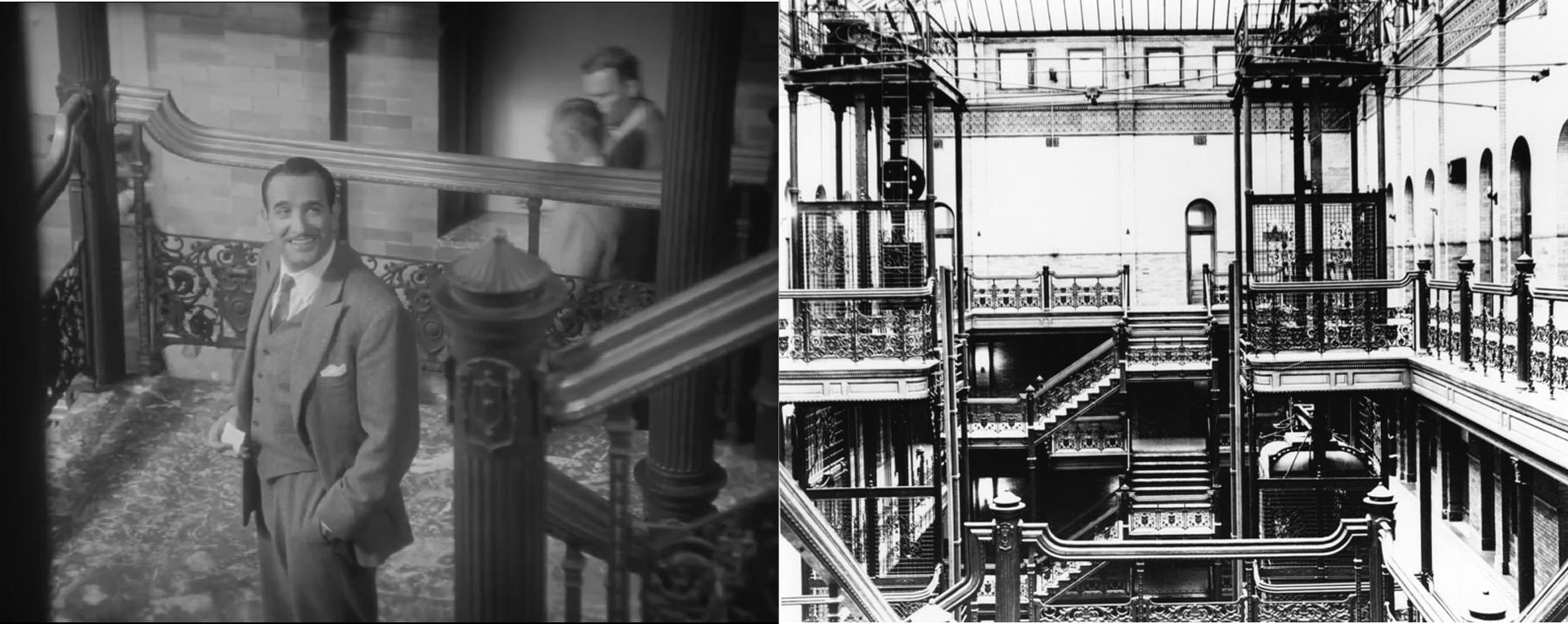
Sharp-eyed movie fans will recognize the setting for this scene as the interior of the Bradbury Building, at 304 S. Broadway in Los Angeles, across the street from the historic Million Dollar Theater.  Perhaps best remembered for its appearance during the Ridley Scott 1982 sci-fi classic Blade Runner, the Bradbury Building has had starring roles in such noir classics as D.O.A (1950), and was featured recently in (500) Days of Summer (2009).  The Bradbury Building was built in 1893 by mining millionaire Lewis Bradbury, and remains the oldest commercial building in Los Angeles.  Its plain façade belies its internal five-story glass-roofed atrium, filled with intricate railings and bird-cage elevators.

Jean Dujardin as George Valentin, on the steps of the Bradbury Building.  A vintage photo of the lobby matches the movie frame above.  Security Pacific National Bank Photograph Collection/Los Angeles Public Library

Although it doesn’t appear in his movie, Harold Lloyd filmed a concluding scene to his epic thrill comedy masterpiece, Safety Last! (below), just across the way from the Bradbury Building.

Click to enlarge. Harold Lloyd and his future wife Mildred Davis in Safety Last! at 3rd and Spring in downtown Los Angeles (arrow in modern view). Behind them stands the Million Dollar Theater built in 1917 by Sid Grauman, who would later build his famous Egyptian (1922) and Chinese (1927) theaters in Hollywood.  The theater’s distinctive dome tower (box) has been a downtown landmark for 95 years.  The five-story Bradbury Building (oval) lies behind them out of view.  Notice the Bradbury’s large glass atrium roof. (c) 2012 Microsoft Corporation, Pictometry Bird’s Eye (c) 2010 Pictometry International Corp.

Time on his hands

Harold Lloyd filmed a brief scene with Mildred Davis, his future wife, for the conclusion to Safety Last! (1923) atop the Washington Building at 3rd and Spring, across from the Bradbury Building at 3rd and Broadway.  Lloyd staged his climb up a thirteen story building in Safety Last! by constructing sets atop three increasingly taller buildings.  As addressed in my prior post, the famous scene where Harold hangs from the hands of a clock was filmed atop 908 S. Broadway, near the Orpheum Theater where the opening scenes for The Artist were filmed.   As I explain in my book Silent Visions, the sequence in Safety Last! where Harold safely reunites with his girlfriend after climbing the skyscraper was filmed atop three different buildings, including the Washington Building shown here.  The Bradbury Building stands directly behind Harold and Mildred in the shot above, but at five stories tall, the building is too short to appear in view.   

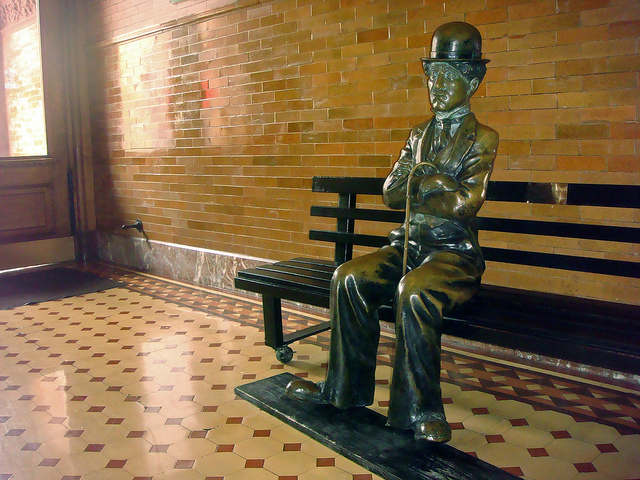
A figure of Charlie Chaplin in the Bradbury Building lobby. Kansas Sebastian; http://www.flickr.com/photos/kansas_sebastian/4715231690/sizes/z/in/photostream/

Although they could not show it during The Artist, another connection between the Bradbury Building and the silent film era is this charming statue of Charlie Chaplin that sits today on a bench within the building lobby.

Click to enlarge.  This 1928 photo shows the towering Los Angeles City Hall nearing completion.  The Bradbury Mansion (1887-1929) stood on the former Court Hill (oval), above the former Hill Street Tunnel.   The extant Bradbury Building (1893) stands at 304 S. Broadway (box).  California Historical Society, Title Insurance and Trust Photo Collection, Department of Special Collections, University of Southern California

California Historical Society, Title Insurance and Trust Photo Collection, Department of Special Collections, University of Southern California

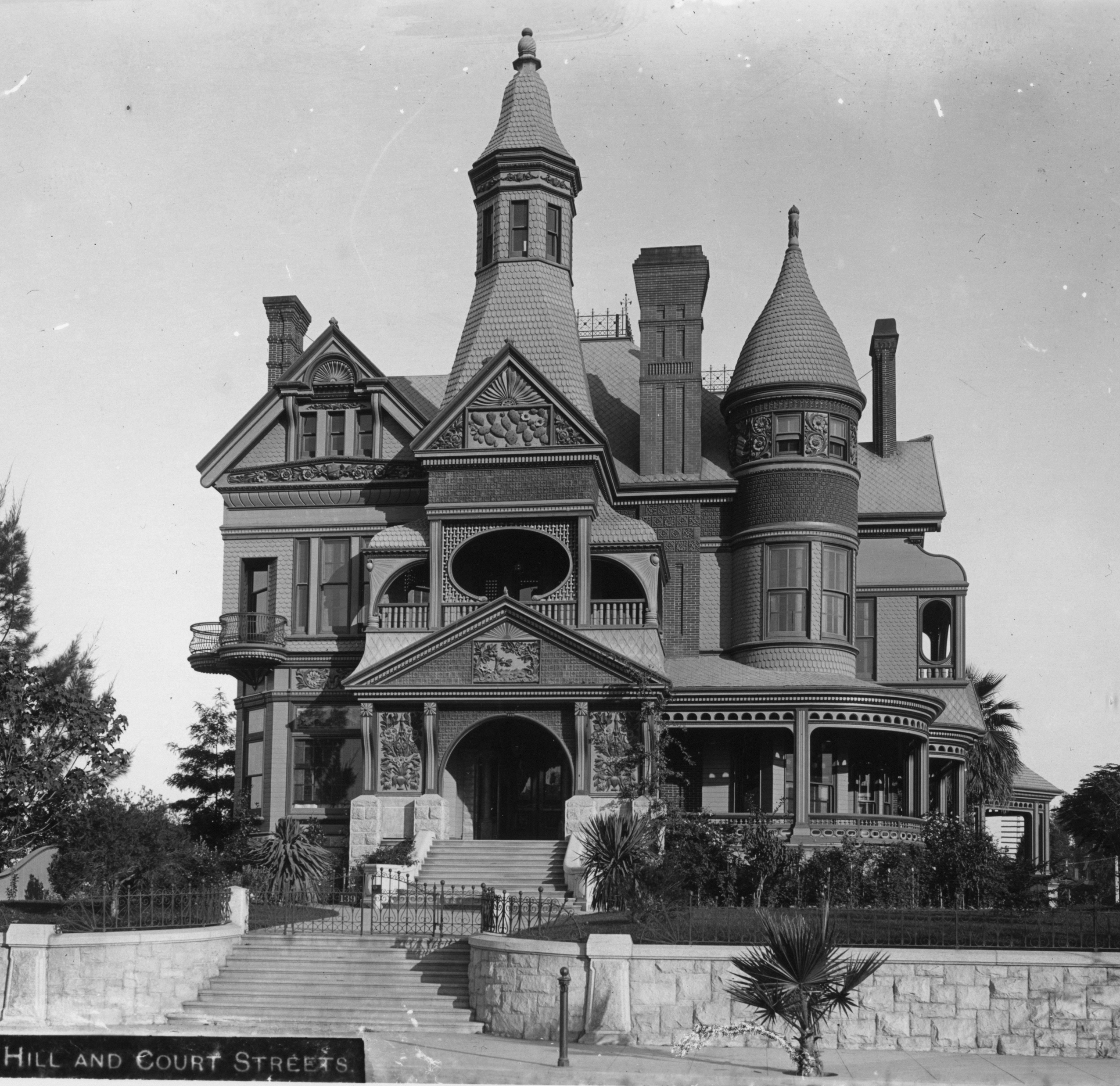
Despite its frequent use as a movie location, Mr. Bradbury’s office building on Broadway was not his only connection to film history.  The elaborate Bradbury mansion, built in 1887 atop Court Hill overlooking the former County Court House (1891-1935), and at the time the city’s finest home, would later be used as one of Los Angeles’ earliest movie studios.

It was here that future silent film star Harold Lloyd, and producer Hal Roach (best known for his Laurel & Hardy and Our Gang comedies), first joined forces in 1915 to create their earliest films.  The pair, along with Lloyd co-stars Bebe Daniels and Snub Pollard, created more than one hundred films during their time working together at the mansion.  Lloyd and Roach remained at the mansion until 1920, when Roach built new facilities out in Culver City.

Work (1915)

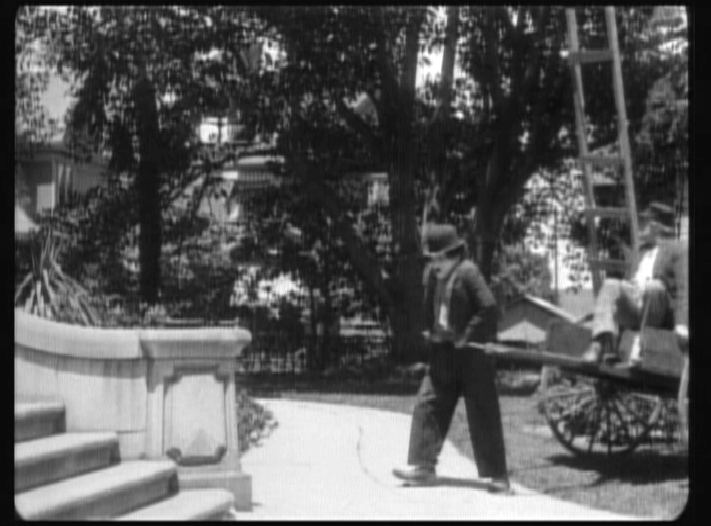
Charlie Chaplin also filmed at the Bradbury Mansion for a few months in 1915 while fulfilling his Essanay Studios contract, just a year after he began his meteoric career at the Keystone Studio.  At left, Chaplin appears on the Bradbury mansion front steps during a sequence from his Essanay comedy Work (1915).

The Bradbury Mansion dominated Court Hill, a once swanky neighborhood perched on a small hill overlooking the nascent Los Angeles civic center, standing between Fort Moore Hill to the east, and Bunker Hill to the west.  Originally Court Hill had no tunnel, but a single bore was completed in 1909 to accommodate trolley traffic from Hollywood, and a second bore for automobiles was completed a few years later.

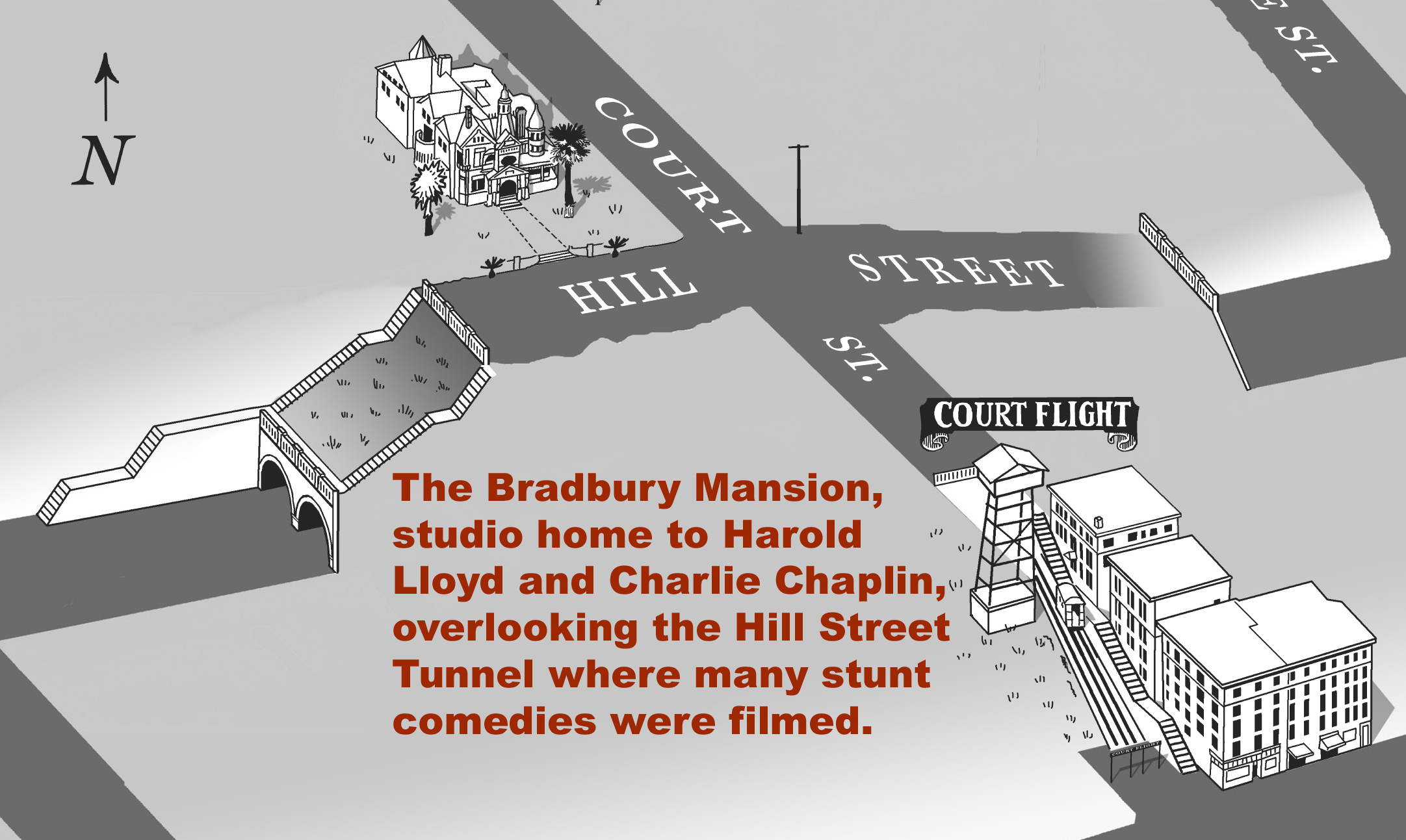
Click to enlarge.  Map by Piet Schreuders

Click to enlarge.  At left, Harold Lloyd in High and Dizzy.  At right, a similar set built overlooking the twin bore Hill Street Tunnel, for the 1921  Universal serial The Terror Trail.  A mannequin is hanging from the broken fire escape. The oval at right helps to show Lloyd’s relative position above the ground in the left movie frame.  The Bradbury Mansion, used as Lloyd’s studio at the time, lies just off camera to the right.  Marc Wanamaker – Bison Archives

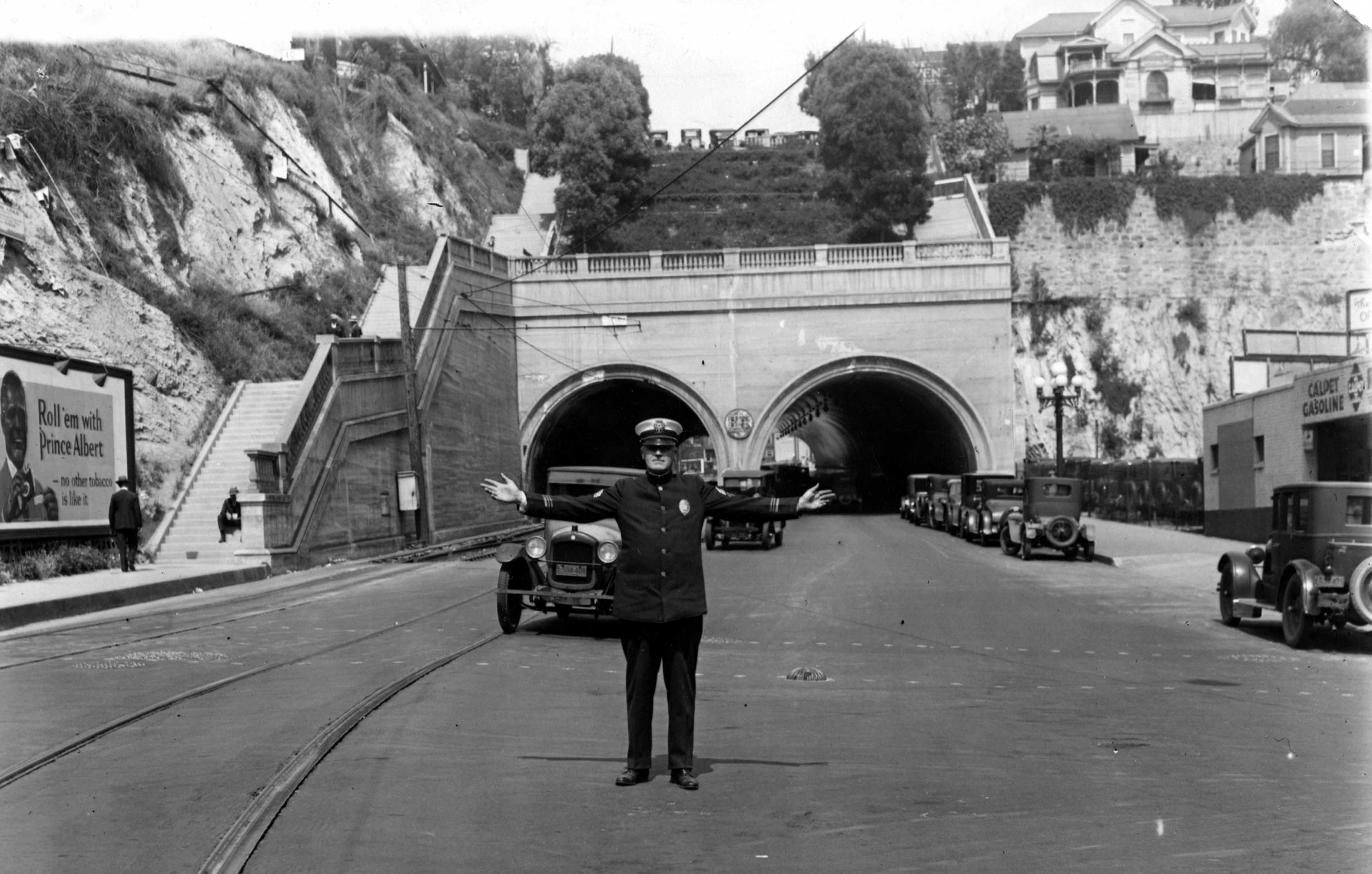
The distinctive twin-bore Hill Street Tunnel was a local landmark.  The Bradbury Mansion, cut off in this image, stood above the left staircase.  Security Pacific National Bank Photograph Collection/Los Angeles Public Library

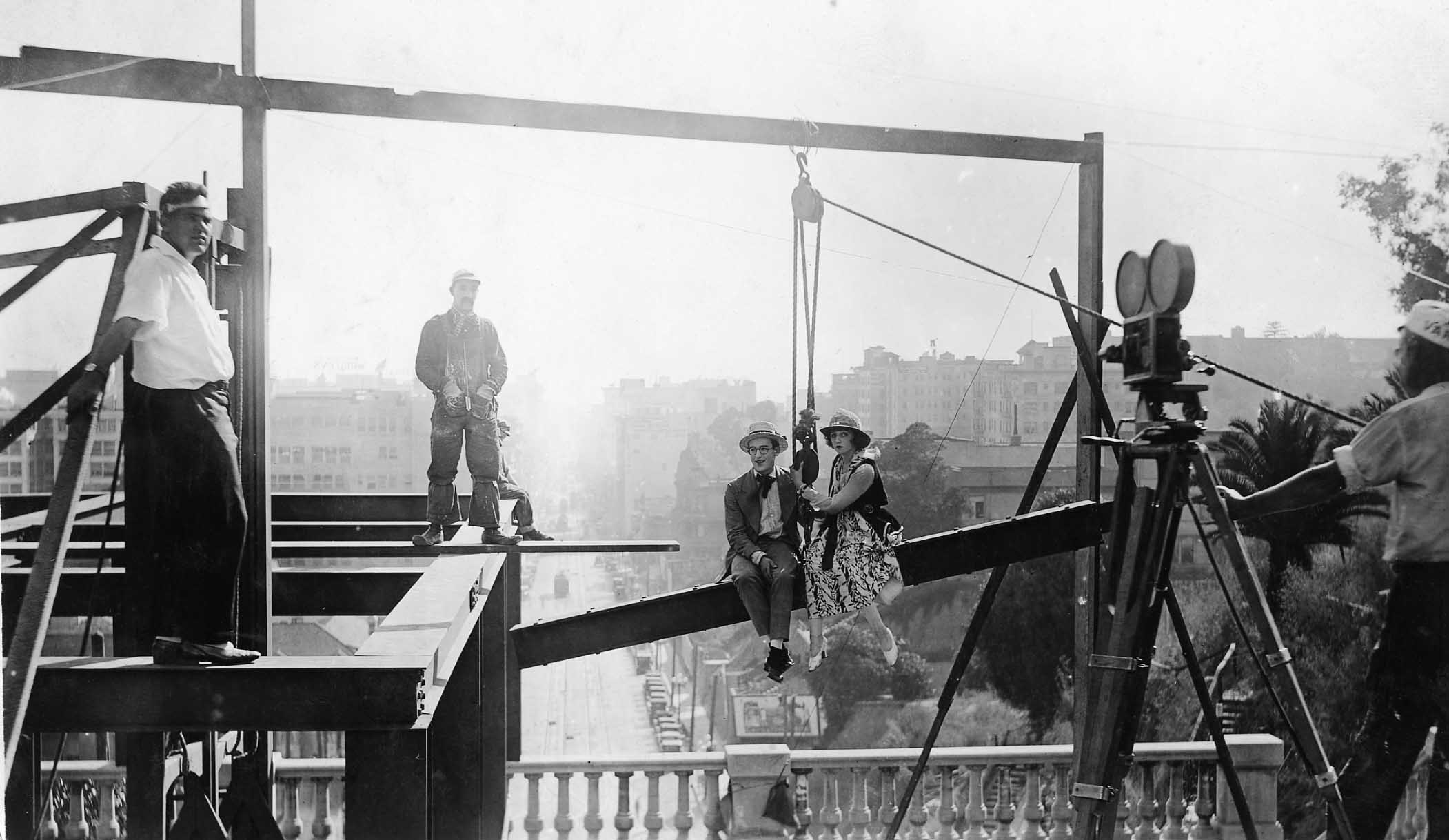
The Bradbury Mansion stood near the unique twin-bore Hill Street Tunnel running beneath Court Hill.  It was from the western balustrade on Court Street, overlooking the Hill Street Tunnel, that Harold Lloyd filmed his earliest stunt comedies.  Constructing a movie set near the balustrade, and filming it against the city streets far below, created the illusion that the set was high above the ground.  Many comedians filmed here during the silent-era to exploit this effect.  The example above is from Harold Lloyd’s second “thrill” comedy High and Dizzy (1919).  Buster Keaton built a set similar to one shown above for a stunt from his first feature comedy Three Ages (1923), and Charlie Chaplin filmed a brief scene from Shoulder Arms (1918) beside the balustrade as well.

Harold Lloyd’s first “thrill” comedy, Look Out Below (1919) filmed beside the Hill Street Tunnel balustrade.  Producer Hal Roach stands to the far left, with Lloyd co-star comedian Snub Pollard at back.  Lloyd’s first leading lady, Bebe Daniels, sits beside Lloyd on the beam.  The Bradbury Mansion, off camera to the right, was home for many years to the Rolin Film Company, the studio founded by in 1914 Roach and Daniel Linthicum, that would be re-named the Hal Roach Studios when production moved to new facilities in Culver City in 1920.  Lloyd worked with Roach for many years before leaving, amicably, to form his own production company in 1924.  Marc Wanamaker – Bison Archives

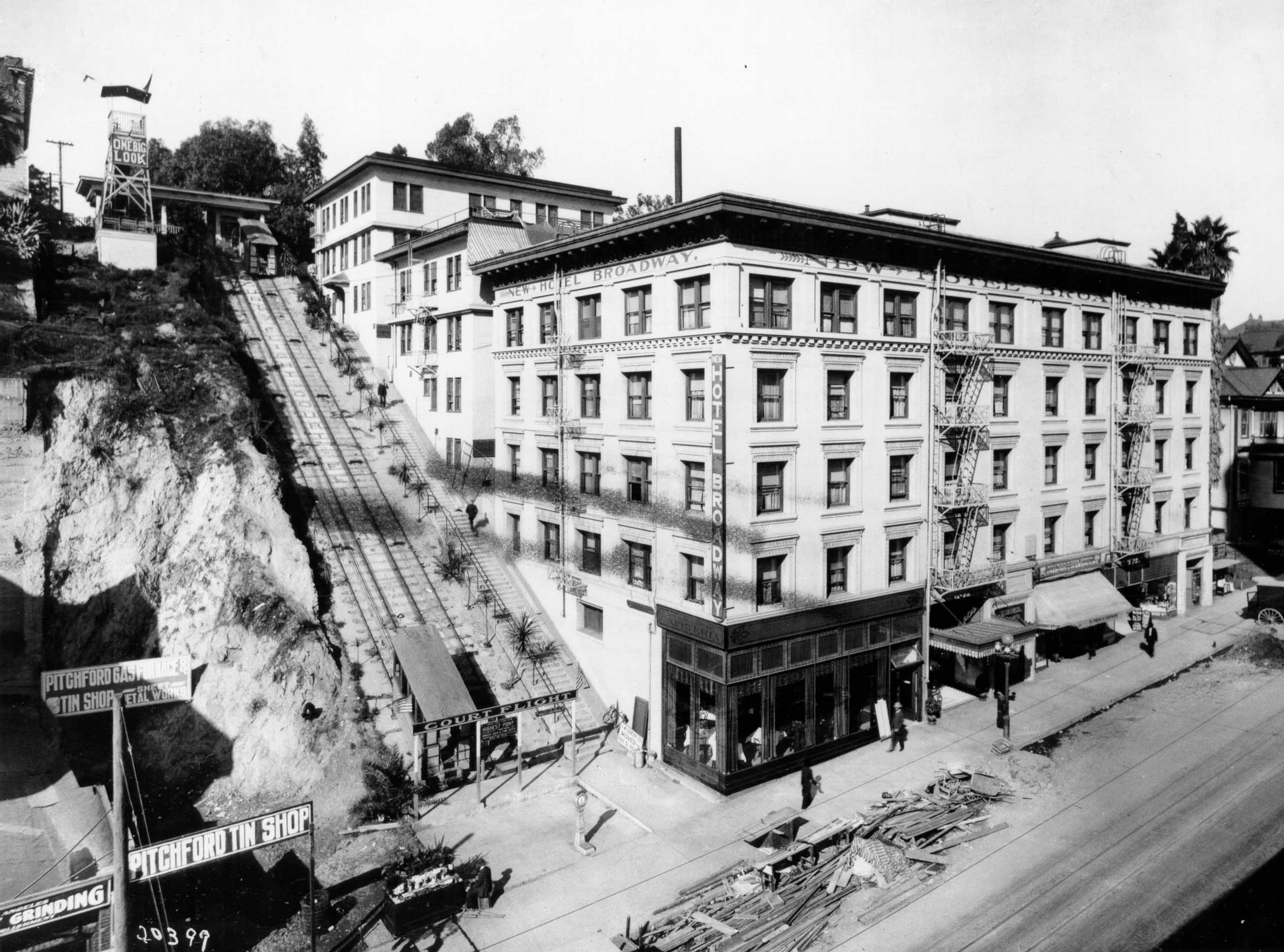
The Court Flight funicular railway leading up to the Bradbury Mansion site. Security Pacific National Bank Photograph Collection/Los Angeles Public Library. 

The Bradbury Mansion was also served by the second of Los Angeles’s two funicular railways.  While many Los Angelenos are familiar with Angels Flight, the original funicular railway built beside the Third Street Tunnel in 1901 to serve Bunker Hill, and recently returned to service following decades in storage, a second railway named Court Flight ran from Broadway to the top of Court Hill for nearly 40 years, until it was abandoned in 1943.   For many years the judges working at the Court House on Broadway would take their lunch breaks by crossing the street to Court Flight, and riding uphill to a restaurant operating out of the Bradbury Mansion.   After the Bradbury Mansion was demolished in 1929, its former site was used as a hilltop parking lot for city government employees.   The Hill Street Tunnel was demolished in 1955, and Court Hill itself was graded flat and hauled away one truckload at a time, to make way for more state and city government buildings.   Today the site of the former Bradbury Mansion along Hill Street is several stories in the air above the current sidewalk.

The Artist (C) La Petite Reine, The Weinstein Company.   Work (1915), (c) 1999 Film Preservation Associates.

HAROLD LLOYD images and the names of Mr. Lloyd’s films are all trademarks and/or service marks of Harold Lloyd Entertainment Inc. Images and movie frame images reproduced courtesy of The Harold Lloyd Trust and Harold Lloyd Entertainment Inc.

The Bradbury Building

Posted in Angels Flight, Charlie Chaplin, Hal Roach Studios, Harold Lloyd, Lloyd Thrill Pictures, Los Angeles Historic Core, Los Angeles Tunnels, Safety Last!, The Artist | Tagged , , , , , , , , , , , , , , , , , , , , , , , , , | 20 Comments

The Artist Locations Part 3, Harold Lloyd, and Safety Last!

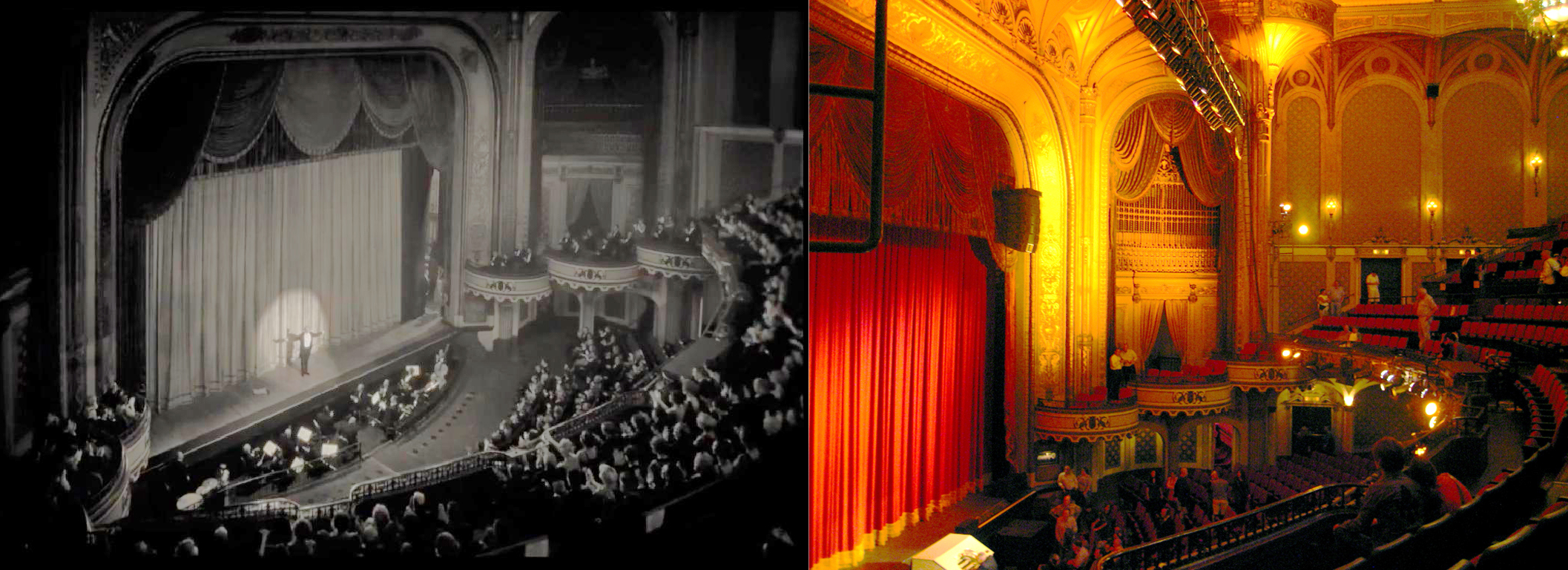
The Artist, George Valentin, portrayed by Jean Dujardin, takes a bow on the historic Orpheum Theater stage. Color image by Kara Brugman; http://www.flickr.com/photos/hyperbolation/2675673050/

After first posting about the location and studio connections between The Artist (2011) and Charlie Chaplin and Mary Pickford, and then posting about the connections between The Artist and Roger Rabbit and Buster Keaton, it’s time for Harold Lloyd to get in on the act.

The Artist begins with the triumphant 1927 Hollywood premiere of silent film star George Valentin’s latest hit movie, A Russian Affair.  In my first post I explain that the Warner Bros. backlot stood in for exterior shots of the theater.  The interior scenes, where George basks in the adulation of his fans, was filmed inside the historic Orpheum Theater, located in the heart of the Los Angeles Historic Core, at 842 S. Broadway.

Click to enlarge. This circa 1928 photo looks up Broadway from Tenth Street (now Olympic). The newly completed Los Angeles City Hall appears as the white tower in the far background. Harold Lloyd filmed the clock stunt from Safety Last! (1923) on the roof top of 908 S. Broadway (red oval above), just steps away from the Orpheum Theater that opened in 1926. Today the Art Deco Ninth and Broadway Building, completed in 1930, obscures the painted Orpheum Theater wall sign. The yellow oval marks where Lloyd returned to film climbing stunts in Feet First (1930), see further below. California Historical Society, Title Insurance and Trust Photo Collection, Department of Special Collections, University of Southern California.

The Orpheum Theater first opened February 15, 1926.  No expense was spared in the theater’s design and construction, from its beautiful marble lobby and magnificent chandeliers, to the leaded glass panels beneath its enormous balcony.  In its heyday, Will Rogers, Jack Benny, Burns and Allen, Edgar Bergen and Charlie McCarthy, and the Marx Brothers all played at the Orpheum.  Mr. Orpheum, for whom the theater was named, was the “O” of RKO Pictures (Radio-Keith-Orpheum).   The theater’s famous Mighty Wurlitzer pipe organ is the last remaining originally installed theater organ in Los Angeles.  The theater is one of the crown jewels of the Broadway movie palaces located in the downtown Historic Core, and appears frequently in movie and television productions.

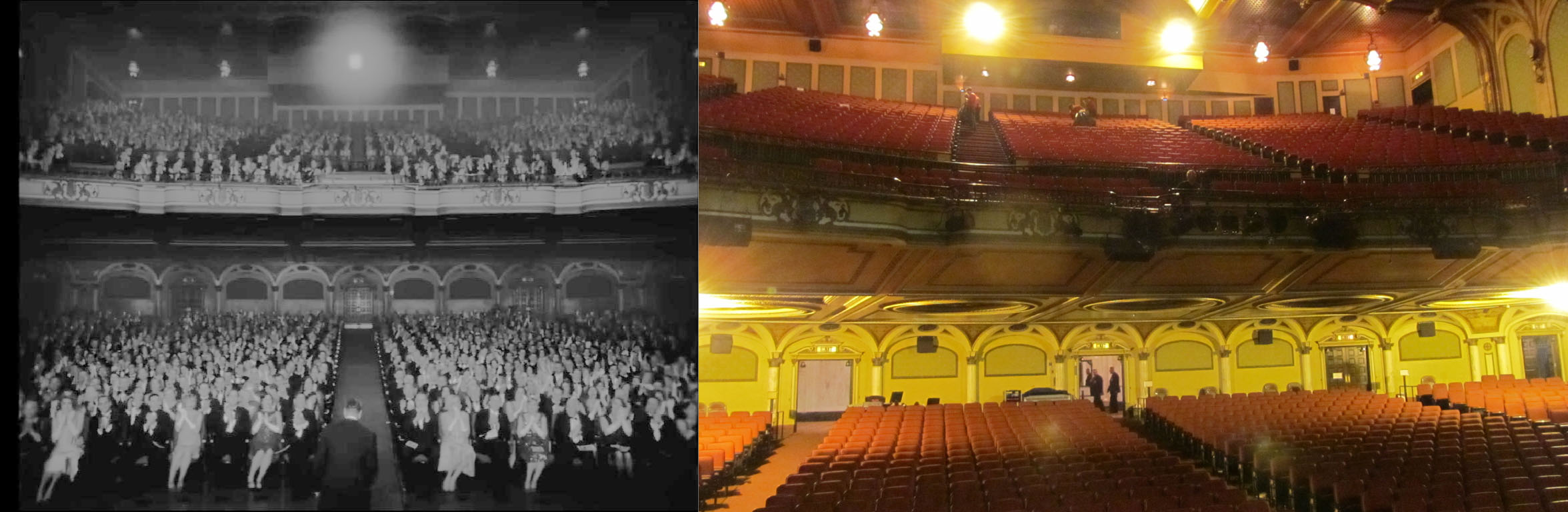
Matching views from the Orpheum Theater stage, appearing in The Artist, and following the Los Angeles Conservancy's 2011 screening of Safety Last!

Harold Lloyd filmed his iconic skyscraper clock sequence from Safety Last!, and similar death-dying scenes from his second talking picture Feet First, on the rooftops of extant buildings located just steps from the Orpheum Theater appearing in The Artist.  In all, Lloyd filmed five building-climbing stunt pictures in the Los Angeles Historic Core, which I dissect in great detail in my Harold Lloyd location book Silent Visions.

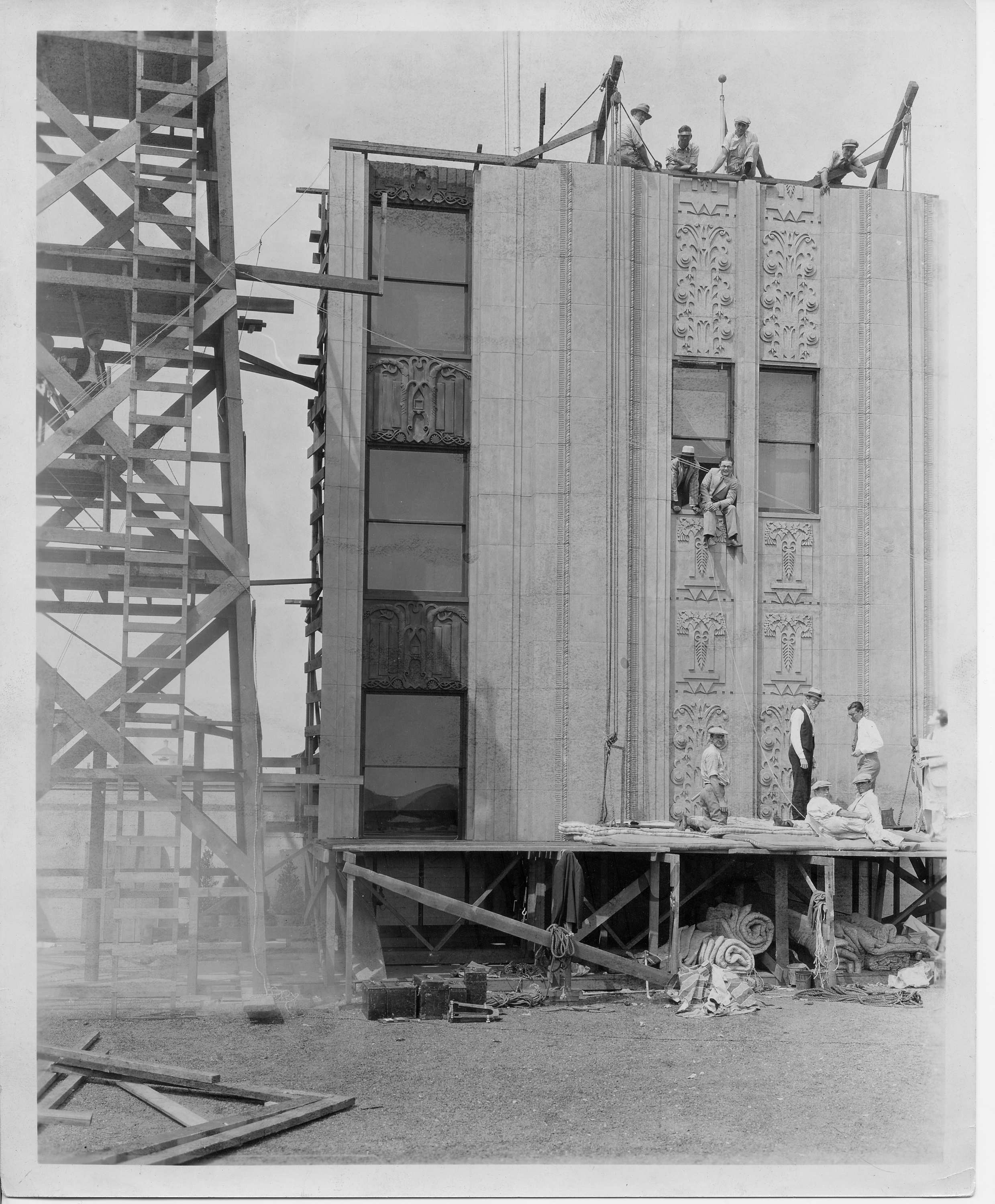
Click to enlarge. Harold Lloyd filmed similar climbing stunts for his second talking feature Feet First atop the Southern California Gas Company Building, the yellow oval in the prior historic photo. His rooftop set appears in greater detail at the right. Lloyd built a similar set and camera tower for the clock sequence in Safety Last!, filmed atop 908 S. Broadway, the building marked with a red oval above. The vertical blade sign for the Orpheum Theater is marked with a yellow box in both images. The Academy of Motion Picture Arts and Sciences. Color image Jeffrey Castel De Oro.

Click to enlarge - during the filming of Feet First (1930).

Lloyd achieved the illusion of filming at great height by constructing the facade of a building atop a tall building, adjacent to a tall camera tower.  The camera looked down from the tower on the face of the set, and the street far below, while keeping the real building’s roof outside the bottom of the movie frame.  Because the camera recorded exactly what was there to be seen, these scenes crackle with authenticity that blue-screen computer effects fail to replicate.

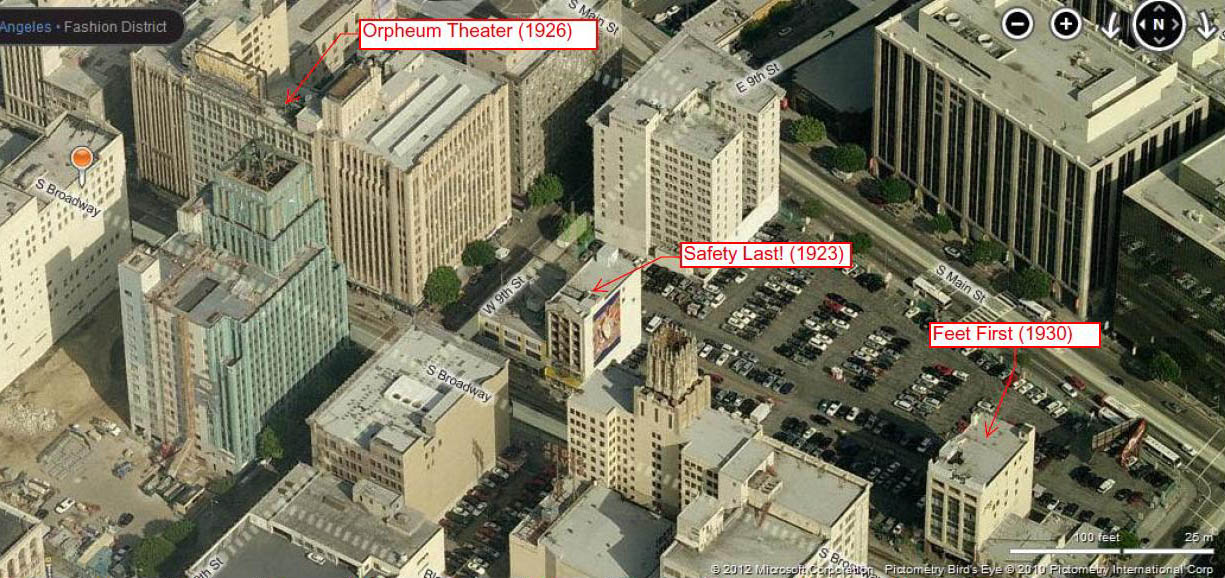
This aerial view shows the proximity of the Orpheum Theater to where Lloyd filmed stunt scenes from Safety Last! and Feet First. (c) 2012 Microsoft Corporation, Pictometry Bird's Eye (c) 2010 Pictometry International Corp.

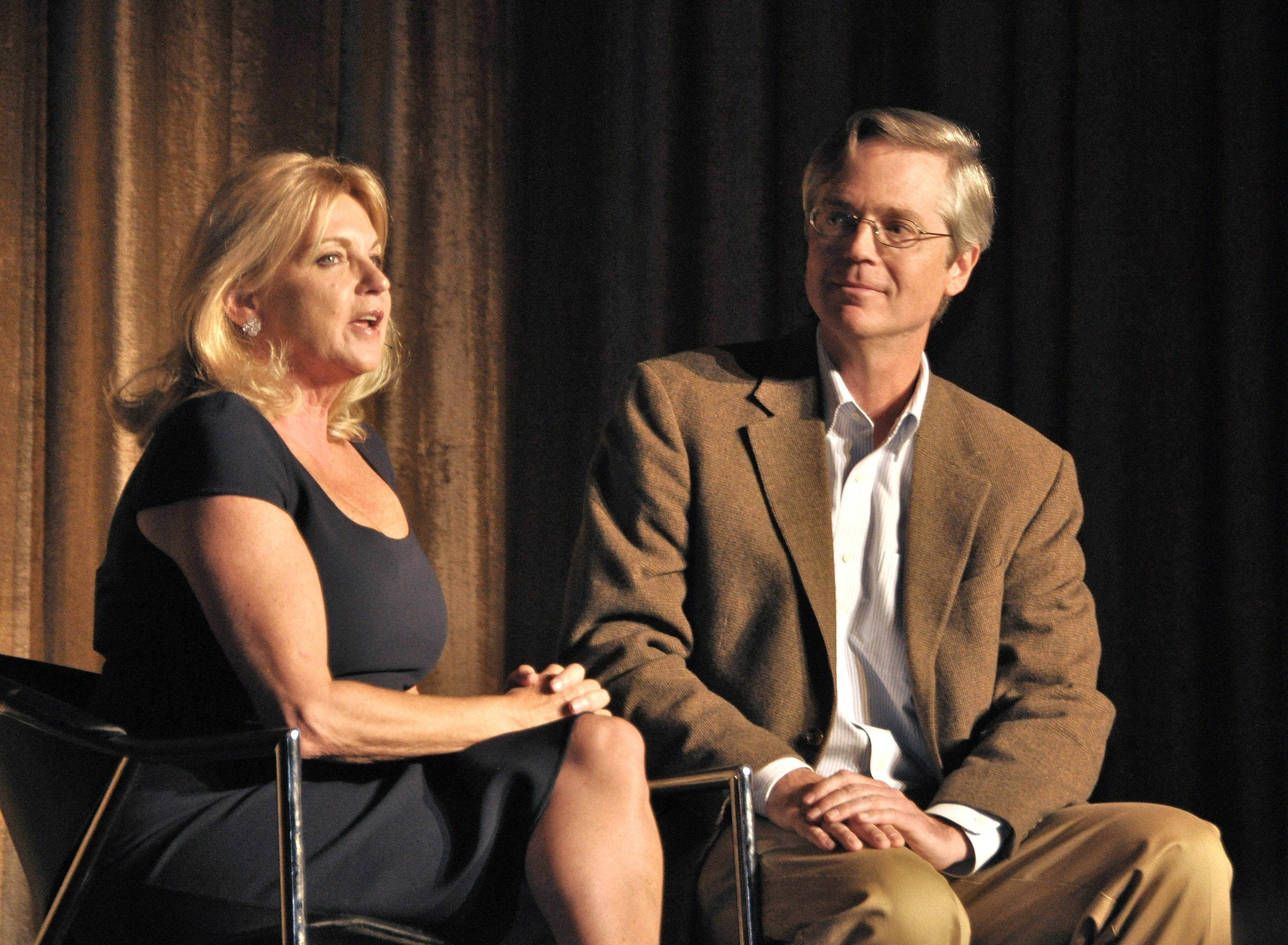
Suzanne Lloyd and the author introducing Safety Last! at the Orpheum Theater, by Stephen Russo, GSC Productions.

Harold’s grand-daughter Suzanne Lloyd and I had the honor of introducing a sold-out screening of Safety Last! on June 29, 2011 at the Orpheum Theatre, in conjunction with the Los Angeles Conservancy’s “Last Remaining Seats.”  As part of the show, I prepared a self-guided walking tour of the downtown Los Angeles locations used by Harold Lloyd in Safety Last!, along with locations from Lloyd’s climbing stunts in Never Weaken (1921) and Feet First (1930), and behind the scenes images showing how Lloyd staged his famous skyscraper-climbing sequences.  You can access the tour here.  Harold Lloyd Safety Last Tour – Silent Visions.

Be sure to see Part 4 of my posts about the The Artist here.

Another of my posts about Safety Last! appears here.

The Artist (C) La Petite Reine, The Weinstein Company. 

HAROLD LLOYD images and the names of Mr. Lloyd’s films are all trademarks and/or service marks of Harold Lloyd Entertainment Inc. Images and movie frame images reproduced courtesy of The Harold Lloyd Trust and Harold Lloyd Entertainment Inc.

The Orpheum Theater 

Posted in Harold Lloyd, Lloyd Studio, Lloyd Thrill Pictures, Lloyd Tour, Los Angeles Historic Core, Safety Last!, The Artist | Tagged , , , , , , , , , , , , , , , , | 10 Comments

The Artist Locations Part 2, Roger Rabbit, and Buster Keaton’s Debut – One Week

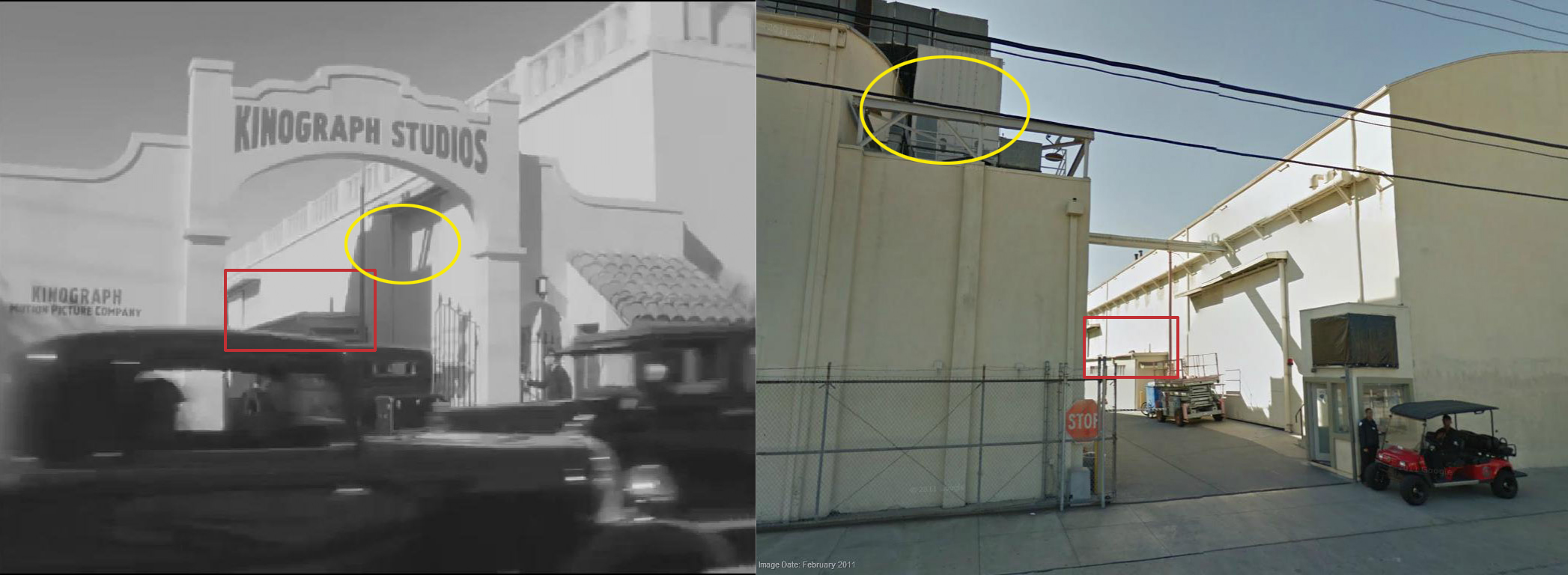
Click to enlarge. The Kinograph Studio entryway and other studio scenes portrayed in The Artist were filmed at the Red Studios, 846 N. Cahuenga Boulevard. The Lillian Way entrance pictured here was fixed up to appear in the movie. The red box marks the same sliding door and shed in both images. The left yellow oval marks the shadow cast by the modern day rooftop air-conditioning unit (the right yellow oval), replaced with open sky in the movie frame. The other entrance to the Red Studios on Cahuenga was used in Who Framed Roger Rabbit ?, see end of post below. (c) 2011 Google.

The Artist depicts the romance between a fading silent film star and a rising “talkie” ingénue, set in Hollywood during 1927 to 1932.  Writer-director Michel Hazanavicius, and his mostly French cast and crew, traveled to California to film at true Hollywood locations in order to re-create the magic of the past.   Continuing my prior post about locations appearing in the movie, I explain here how The Artist was filmed just steps away from Buster Keaton’s small studio, and where he filmed his debut solo short film One Week (1920).

Buster Keaton's home in One Week stood on the block bounded by Lillian Way, Waring, Cahuenga, and Willoughby, now occupied by the Red Studios appearing in The Artist.

The Kinograph Studio entryway and other studio scenes portrayed in The Artist were filmed at the Red Studios, 846 N. Cahuenga Boulevard, two blocks due south from the former Buster Keaton Studios, and across the street, to the south, from the former Metro Studios.

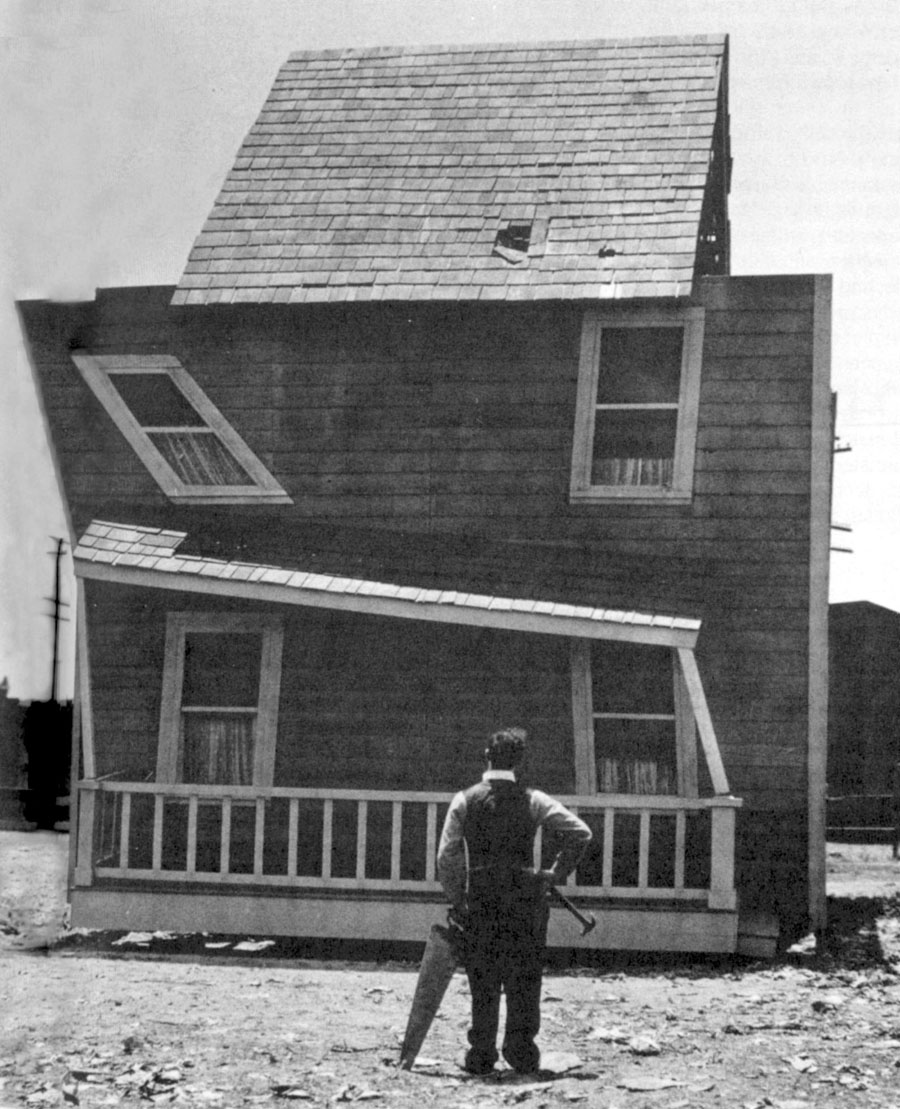
From between 1920 to 1928, Buster created 19 short films, and ten feature comedies, from his studio located in Hollywood at Eleanor and Lillian Way.  Before being folded into MGM, the former Metro Studios were located adjacent to Buster’s lot.  For many years the block on which the Red Studios now stands was used as a backlot for the Metro Studios to build exterior sets.   It was here that Buster Keaton constructed his disastrous build-it-yourself two-story home for his debut independent short film One Week (1920).

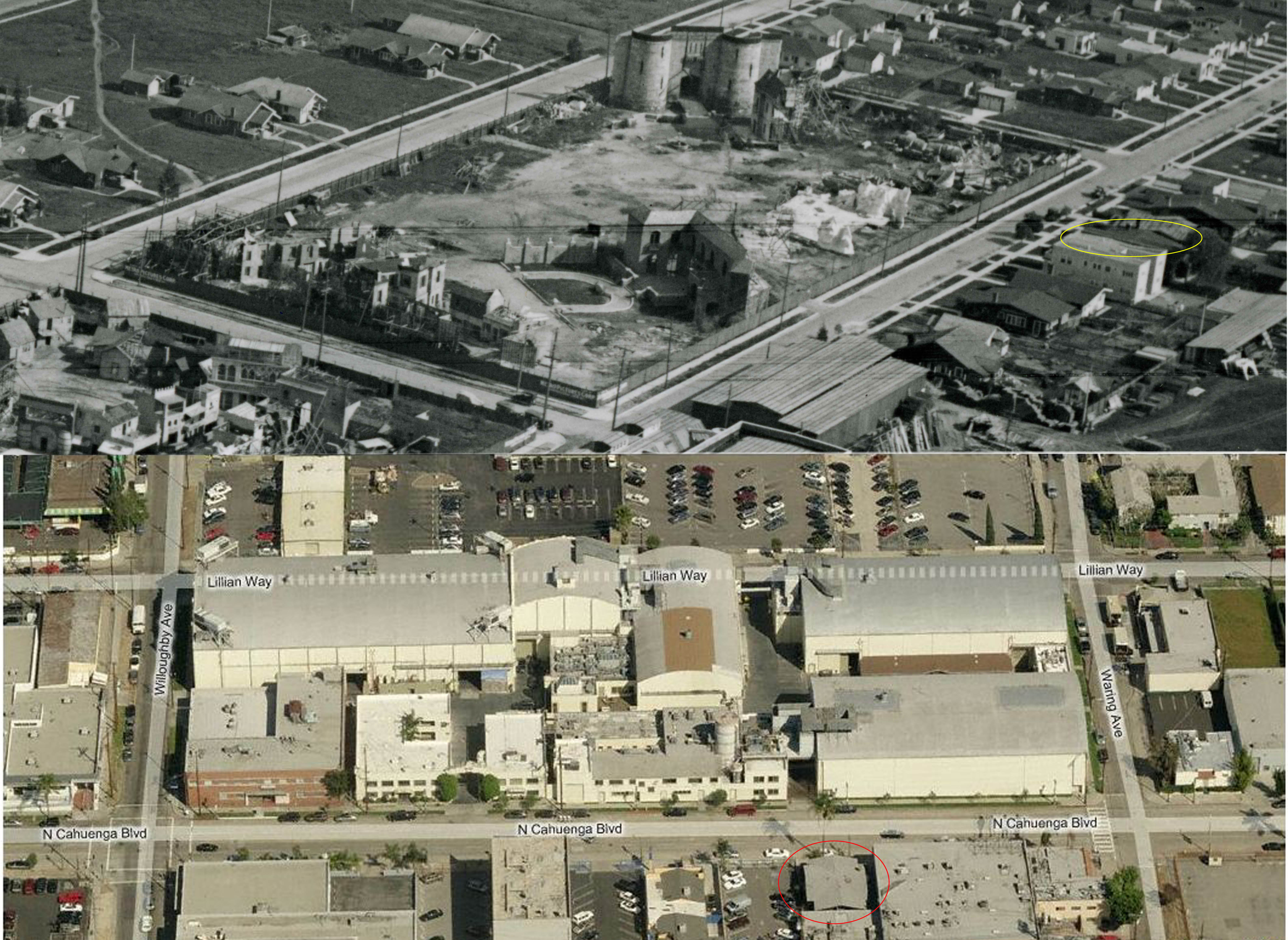
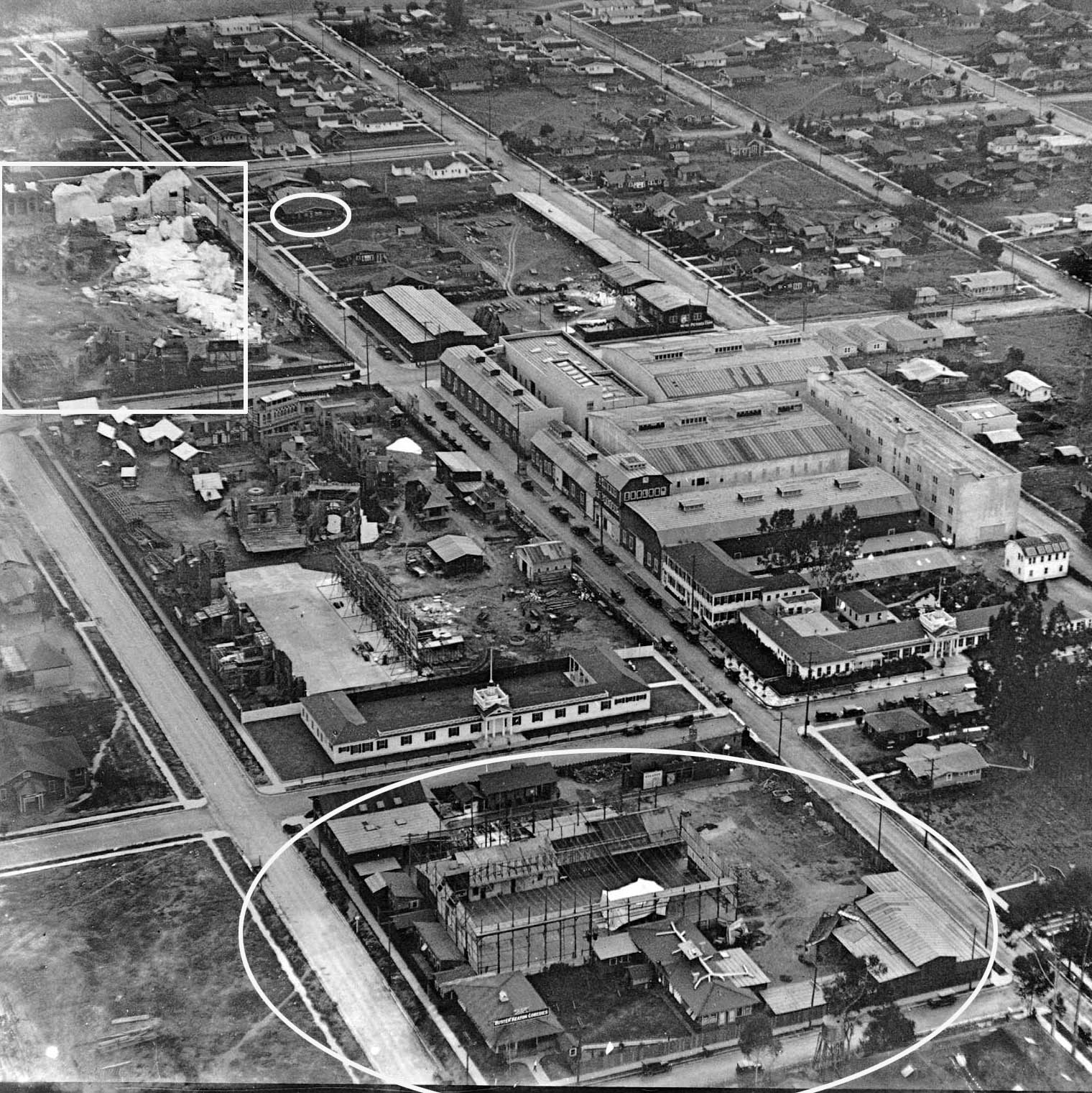
Click to enlarge. The block bounded by Lillian Way, Waring, Cahuenga, and Willoughby, was a backlot for the former Metro Studios, and is today the site for the Red Studios used to film The Artist. Notice the large castle set in the far corner of Lillian Way and Waring. The bungalow at 817 Cahuenga (the upper yellow oval) partially blocked by the apartment in the circa 1925 image above, still stands on Cahuenga today (red oval directly above), the only structure to appear in both images. Vintage image Bruce Torrence Hollywood Historical Collection. Aerial image (c) 2011 Microsoft Corporation, Pictometry Bird's Eye (c) 2010 Pictometry International Corp.

This circa 1925 aerial view of the Metro backlot above shows the block on which the Red Studios would be later built.  The aerial view looks to the SE, while the matching modern view looks east.  The same bungalow, at 817 N. Cahuenga Boulevard, across the street from the Red Studios, appears in both images – the only original structure to survive.  This same bungalow appears during scenes from Buster Keaton’s One Week, described further below.

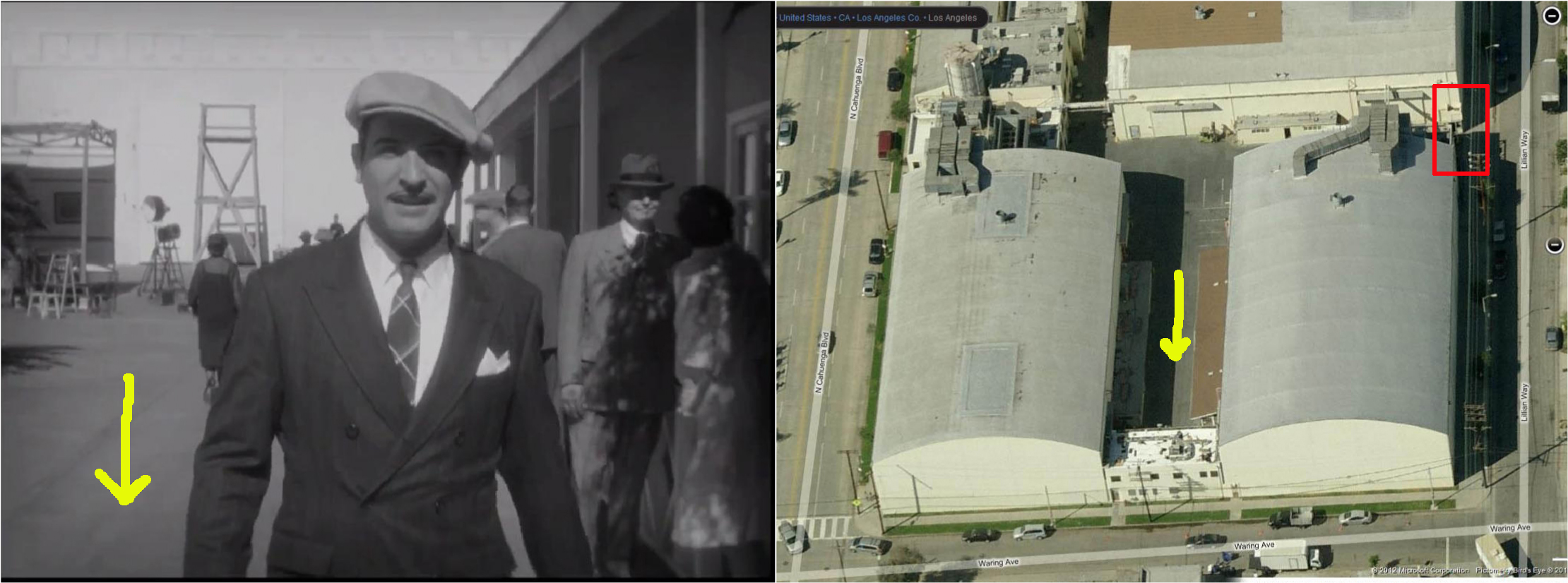
Jean Dujardin, as George Valentin, strolling south within the Red Studios, beside a studio covered porch. The red box marks the Lillian Way entrance to the studio (appearing as the Kinograph Studio during the film) as described at the top of this post.

Several scenes from The Artist that take place on the fictional Kinograph Studio grounds, including this shot above, were filmed at the Red Studios.

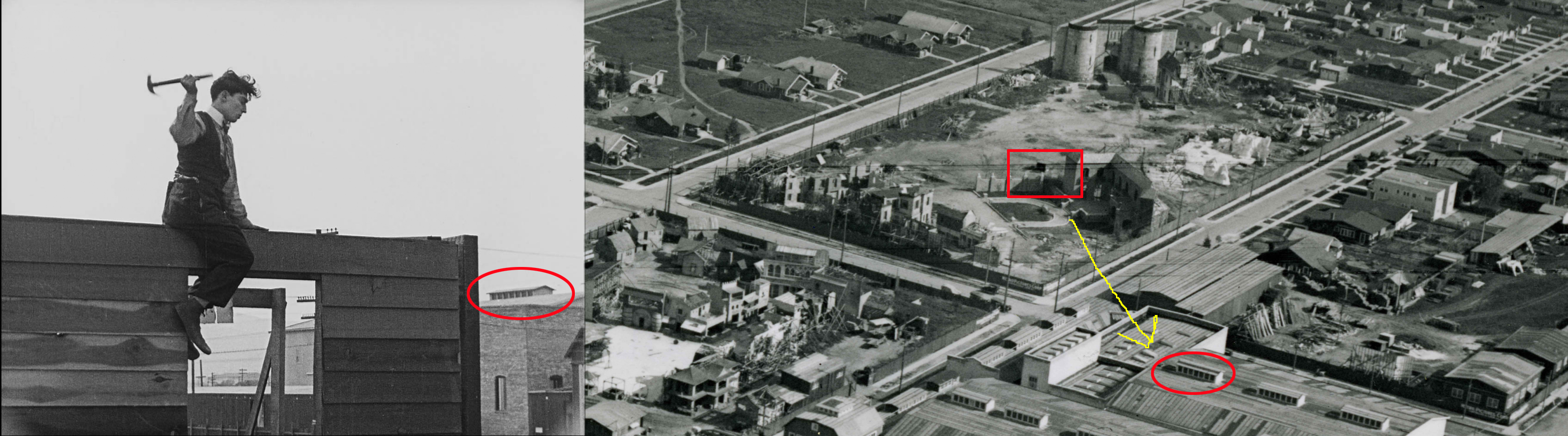
Click to enlarge. Buster building his home in One Week on the Metro backlot. The red oval in each image marks the same Metro Studio filming stage rooftop ventilation shed. The red box, now in the middle of the Red Studios lot where The Artist was filmed, is the approximate spot where Buster's One Week house set was constructed. The yellow arrow shows the point of view of the movie frame to the left.

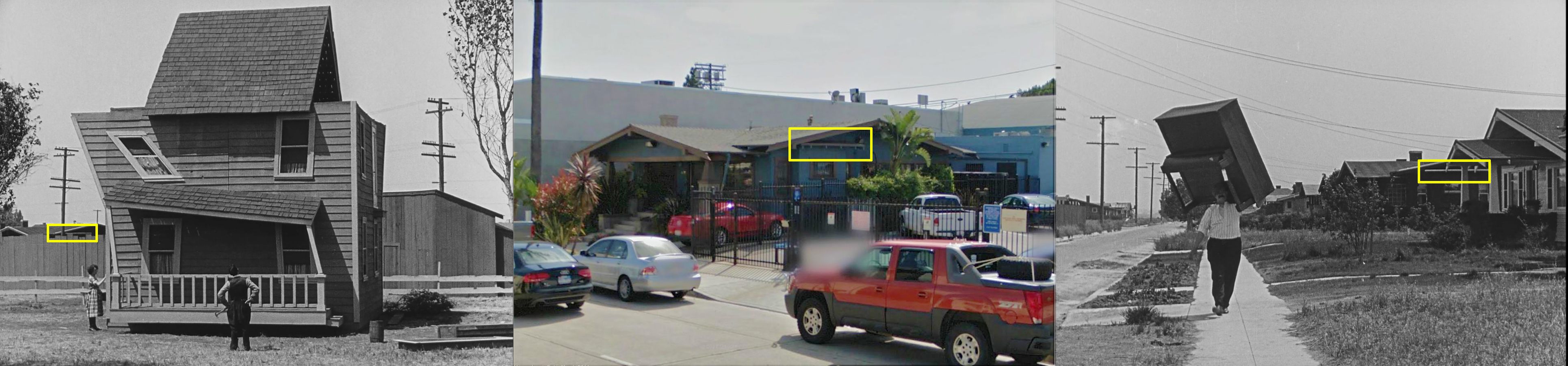
Above, Buster builds his do-it-yourself home during a scene from One Week, filmed at the future site of the Red Studios .  A portion of a Metro Studio filming stage appears in the background.  Below, the surviving bungalow at 817 N. Cahuenga, discussed above, appears in two scenes from One Week.  Buster’s finished house is all contorted because his rival had secretly re-numbered the boxes to Buster’s do-it-yourself kit.  In the movie frame to the lower right, a piano-mover delivers Buster’s piano, walking north up Cahuenga past the 817 address.  You can see the bungalow on Google Street View at the end of this post.

Click to enlarge. The bungalow at 817 N. Cahuenga, across the street from the Red Studios, appears in these two scenes from Buster Keaton's 1920 debut short film One Week. The yellow box marks the same distinctive horizontal trim piece in each image.

Circa 1921 view, looking south at the small Keaton Studio in the foreground (oval), and the future site of the Red Studios (box) at back, with the two blocks of the Metro Studios standing in between. The small oval at back marks the same bungalow at 817 N. Cahuenga. Bruce Torrence Hollywood Historical Collection

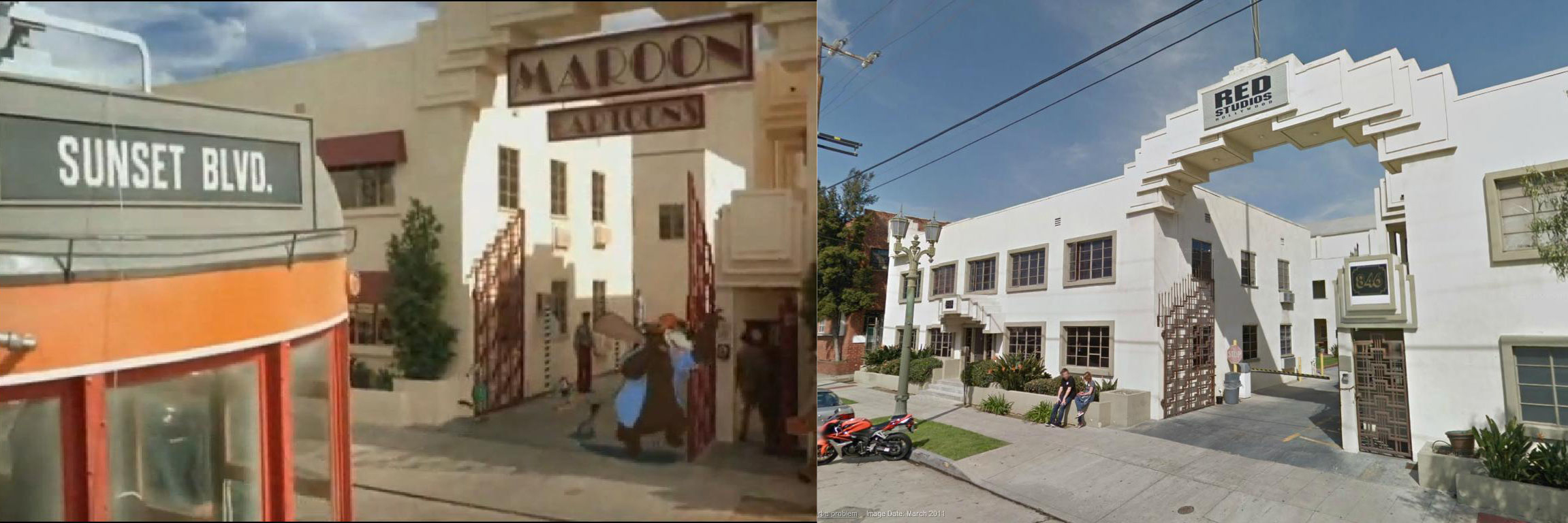
The more prominent Cahuenga entrance to the Red Studios was employed to portray another vintage Hollywood studio, Maroon Cartoons, for the 1988 animated-live action classic Who Framed Roger Rabbit?

The 846 Cahuenga entrance to the Red Studios portrayed the Maroon Cartoon Studios in Who Framed Roger Rabbit? (C) Google Inc.

For more photos and location information about  One Week, see my book Silent Echoes.  As mentioned in my prior post, this LA Times story describes a number of locations from The Artist worth exploring.

You can learn more about the classic Hollywood studio backlots at this wonderful Yahoo Groups forum http://groups.yahoo.com/group/StudioBacklots/

The Artist (C) La Petite Reine, The Weinstein Company.  One Week licensed by Douris UK, Ltd.  Who Framed Roger Rabbit? (C) Touchstone Pictures.

Posted in Buster Keaton, Keaton Studio, One Week, The Artist | Tagged , , , , , , , , , | 7 Comments

The Artist – Locations, Chaplin, and Pickford

The movie marquee appearing in The Artist stands on the Warner Bros. backlot.

Set in Hollywood during 1927 to 1932, The Artist depicts the romance between a fading silent film star and a rising “talkie” ingénue.  The Artist has received glowing reviews and numerous awards, and is noteworthy for being presented in black & white, and without spoken dialog.  What’s more, the lead actors, the writer/director, and most of the crew are all French, who traveled to Los Angeles to film the movie at authentic Hollywood studios and locations.

While the Los Angeles Times beat me with news of several locales appearing in the film, I’ve gleaned a few locations the Times did not cover, including a connection to Charlie Chaplin, below.

The Artist - vintage cars race past the NE corner of S. Hudson Avenue and W. 2nd Street. (c) 2011 Google

The ingénue character Peppy Miller, played by Bérénice Bejo, skyrockets to wealth and fame, and soon sets up house in a fabulous mansion, located at 56 Fremont Place.  The palatial home was occupied for a time in 1918-1919 by America’s Sweetheart, silent film superstar Mary Pickford.  Pickford was one of the most savvy business-persons in Hollywood, co-founding United Artists in 1919 with her future husband Douglas Fairbanks, and fellow partners Charlie Chaplin and director D. W. Griffith.

56 Fremont Place was home to Mary Pickford from August 1918 to August 1919. It appears in the background from this scene (above left) appearing in Charlie Chaplin's The Kid, and as the home of Peppy Miller in The Artist (above right). The box marks the same corner of the house in each image.

Charlie Chaplin no doubt visited Mary at her home at 56 Fremont Place in 1919, and was thus already familiar with the neighborhood when he used it to stage an important early scene from his 1921 masterpiece The Kid, named one of the 2011 entries into the National Film Registry of the Library of Congress.   During this scene, an unwed mother played by Edna Purviance abandons her infant son in the backseat of a limousine parked in front of 55 Fremont Place, the home directly across the street from Mary’s home.  Thieves steal the car before Edna can return to reclaim her child.  Upon discovering the baby, the thieves leave him in the gutter, where Charlie finds him, and raises the kid as his own.

55 Fremont Place, as it appears in Charlie Chaplin's The Kid. This beautiful home was recently owned by prize-fighting legend Muhammad Ali, and stands directly across the street from 56 Fremont Place, the former Mary Pickford home appearing in The Artist.

Edna Purviance in The Kid at 55 Fremont Place.

George Valentin's mansion at 104 Fremont Place. In 1927 the trees in front of the home would have been much smaller.

French actor Jean Dujardin plays George Valentin, the male lead in The Artist, a charming, swash-buckling movie star character fashioned after Douglas Fairbanks.  Actual footage of Fairbanks performing stunts from his 1920 landmark film The Mark of Zorro appears in The Artist during a montage of scenes supposedly played by George.  The mansion where George lives is located at 104 Fremont Place (above, and marked in the photo below), behind the home Chaplin used when filming The Kid.

George Valentin's home in The Artist was located at 104 Fremont Place (left box), behind the home Chaplin used in The Kid (oval), itself across the street from the Mary Pickford - Peppy Miller home (right box) beyond the bottom edge of this photo. California Historical Society, Title Insurance and Trust Photo Collection, Department of Special Collections, University of Southern California.

One of the greatest challenges when attempting to recreate vintage Los Angeles today is the mature landscaping.  Back in the 1920s all of the subdivisions were new, and most homes had no trees to block the view.   This aerial view below shows how Fremont Place would more likely have looked during the era depicted in The Artist.

Click to enlarge. The oval marks the section of Fremont Place where The Kid and The Artist were filmed. 104 Fremont Place, appearing as George's home, was not yet built at the time this photo was taken. It appears as the vacant lot within the left edge of the oval. The Kid mansion stands near the center of the oval, while the Mary Pickford - Peppy Miller home is near the lower right edge of the oval. The long diagonal line just above the oval is Wilshire Boulevard, the next major street several blocks above Wilshire is 3rd Street. Security Pacific National Bank Photograph Collection/Los Angeles Public Library.

(c) 2011 Microsoft Corporation, Pictometry Bird's Eye (c) 2010 Pictometry International Corp.

There is also a scene in the movie where Uggie the dog summons a policeman on the street for help.  The corner street sign reading “OAKWOOD AVE, 6100 W” appears in the shot, placing the scene at the corner of N. June Street and Oakwood, below.

Check out Part 3 of this series for connections to Harold Lloyd’s Safety Last!, and Part 4 for connections to the Bradbury Building and Bradbury Mansion, and Part 5 for connections to Charlie Chaplin’s City Lights.

For more photos and location information about Chaplin filming The Kid visit this PowerPoint presentation on my blog, and my book Silent TracesAnd as I mentioned, the LA Times story has a number of locations worth exploring.   Thanks also to Carol Kiefer, the Art Department Coordinator who worked on The Artist, for assistance with this post.  She reports that the Bugatti driving scene was filmed at the Big Sky Movie Ranch in Simi Valley (which has a landing airstrip), the torture laboratory and cells were filmed at the Eagle Rock Substation, Zimmer’s office, the secretary’s office, the store room, and the auction house were all filmed at the Wilshire Ebell Theater, and that the hospital was the American Film Institute building.   The Tears of Love theater interior was the Los Angeles Theater at 630 S. Broadway.

UPDATE – Lindsay Blake’s ImNotAStalker.Com has several posts with even more locations from The Artist; including George’s duplex apartment; the history of the Red Studios where much of The Artist was filmed; and of the AFI “hospital” and the Wilshire Ebell where many interior scenes were filmed.

PS – The Wilshire Ebell Theater, a 743 Lucerne Boulevard, is also just steps away from the Mary Pickford home on Fremont Place.

The Artist (C) La Petite Reine, The Weinstein Company.  All images from Chaplin films made from 1918 onwards, copyright © Roy Export Company Establishment. CHARLES CHAPLIN, CHAPLIN, and the LITTLE TRAMP, photographs from and the names of Mr. Chaplin’s films are trademarks and/or service marks of Bubbles Incorporated SA and/or Roy Export Company Establishment. Used with permission.

Posted in Buster Keaton, Charlie Chaplin, One Week, The Artist, The Kid | Tagged , , , , , , , , , , , | 20 Comments

Charming Third Time for Seven Chances

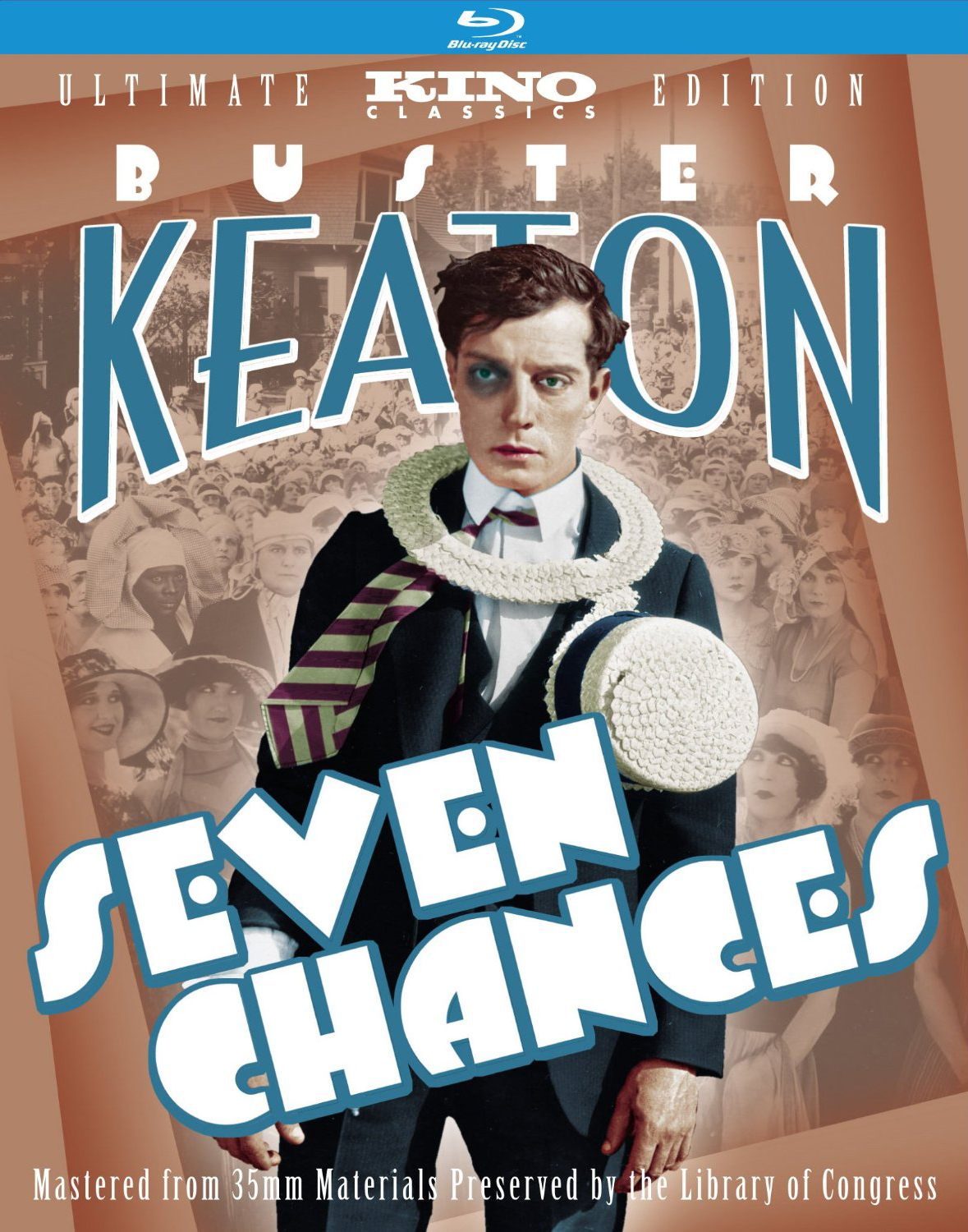
Seven Chances is Buster Keaton’s latest Blu-ray release from Kino Lorber.  During the film Buster eludes an army of angry jilted brides as he attempts to marry his sweetheart in time to inherit a fortune.  After owning the film first on Laserdisc, and then again on DVD, for me this beautiful Blu-ray production definitely makes the third time the charm.

"I saw him first!" The late Mrs. Eleanor Keaton

I prepared a visual essay about the shooting locations as a bonus program for the release, and am very pleased with how it turned out.  Most of the program covers new locations not presented in my book Silent Echoes, including the Flint Mansion standing in for a country club early in the film, a duck hunting scene filmed at the Playa del Rey marshlands, and shots of Buster racing along Santa Monica Boulevard directly across the street from the Pickford-Fairbanks Studio.

Here come the brides

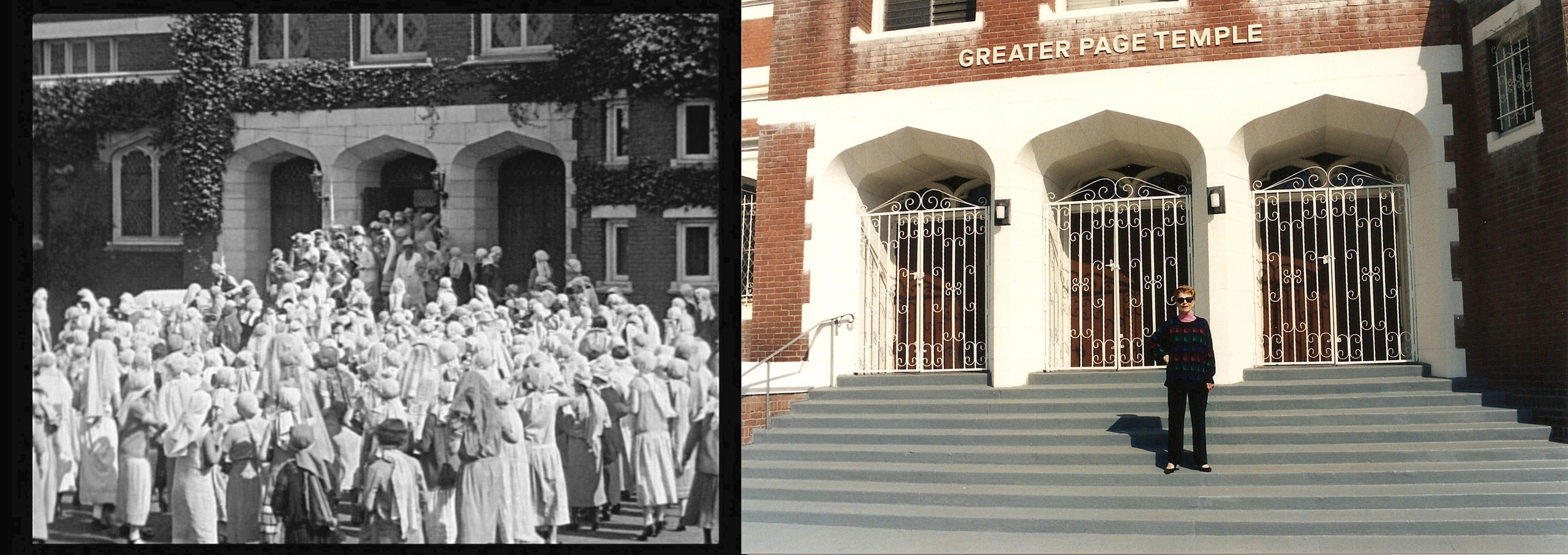
One of the joys in working on my books was meeting Buster’s widow Eleanor Keaton.  I drove her around Los Angeles one afternoon towards the end of her life, and took her to the Seven Chances church.  She joked, as she posed on the steps, that whereas hundreds before her had failed, she was the one woman who had succeeded in marrying Buster.

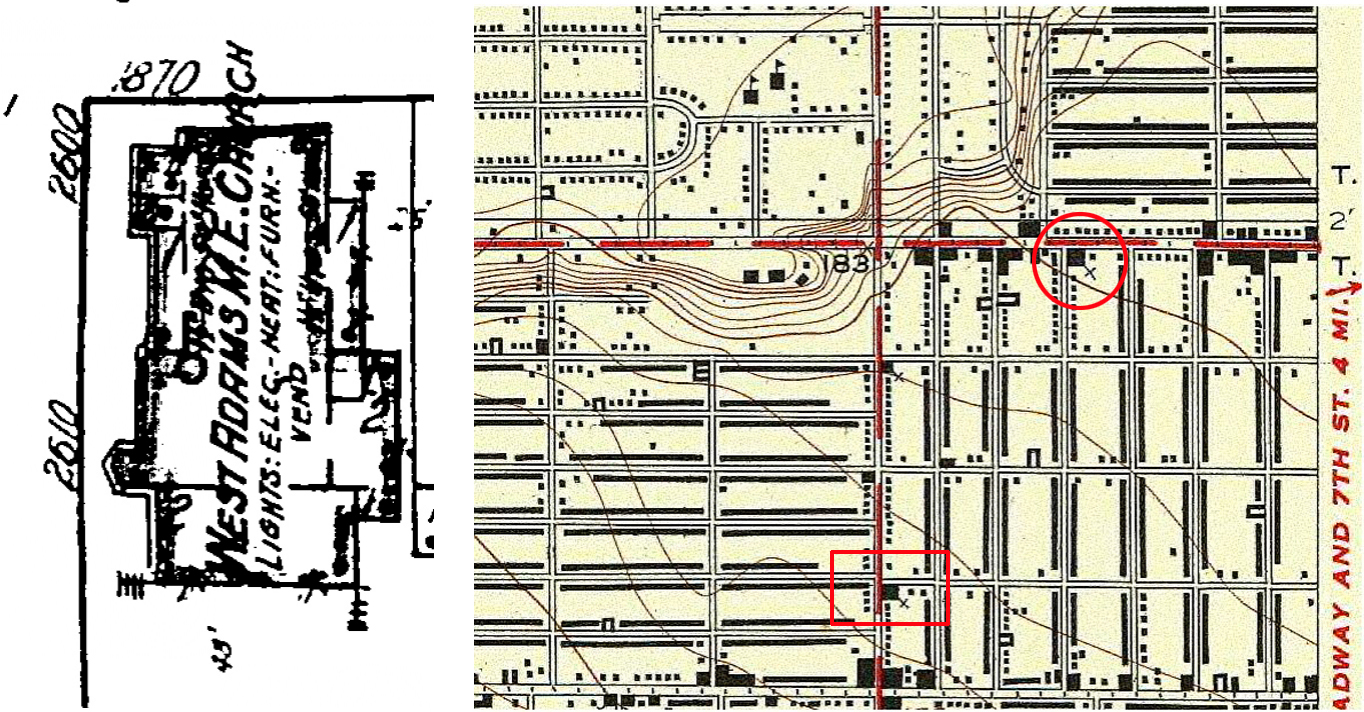
I used these maps siting in the library at UC Berkeley to solve the church's whereabouts. The box shows a non-candidate church, the circle shows the church appearing in the film.

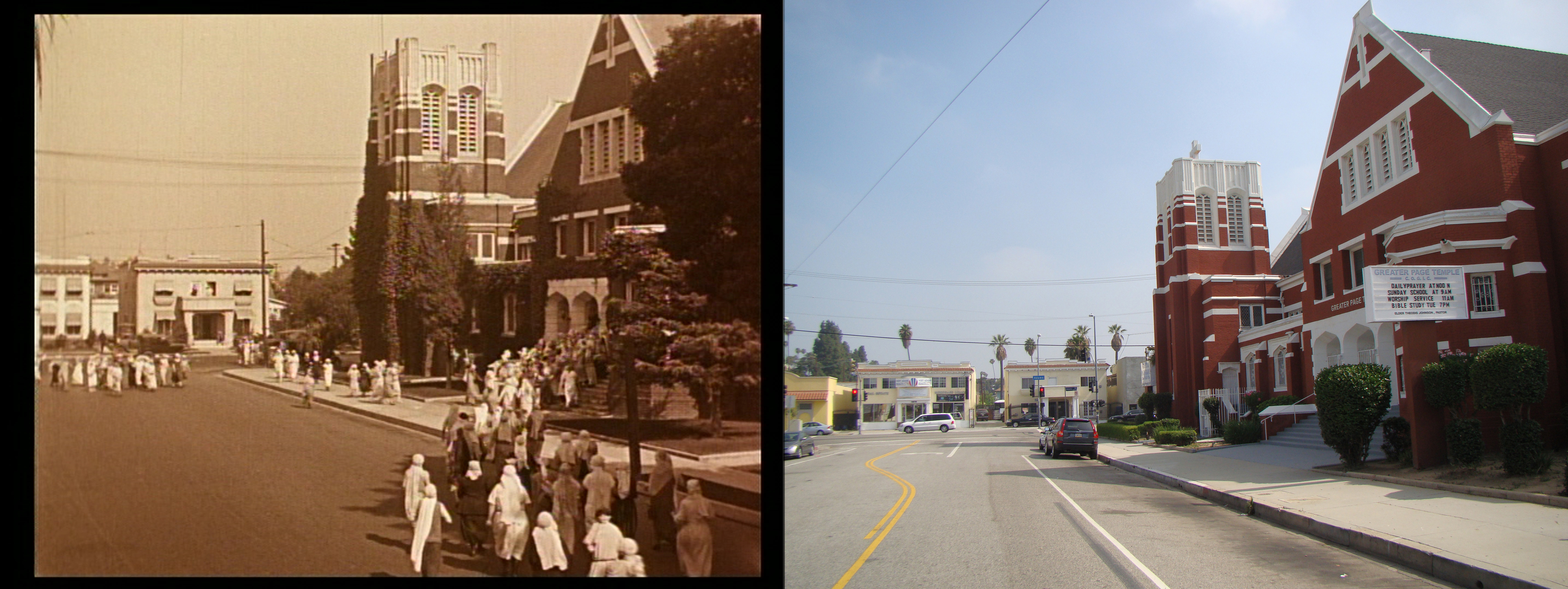
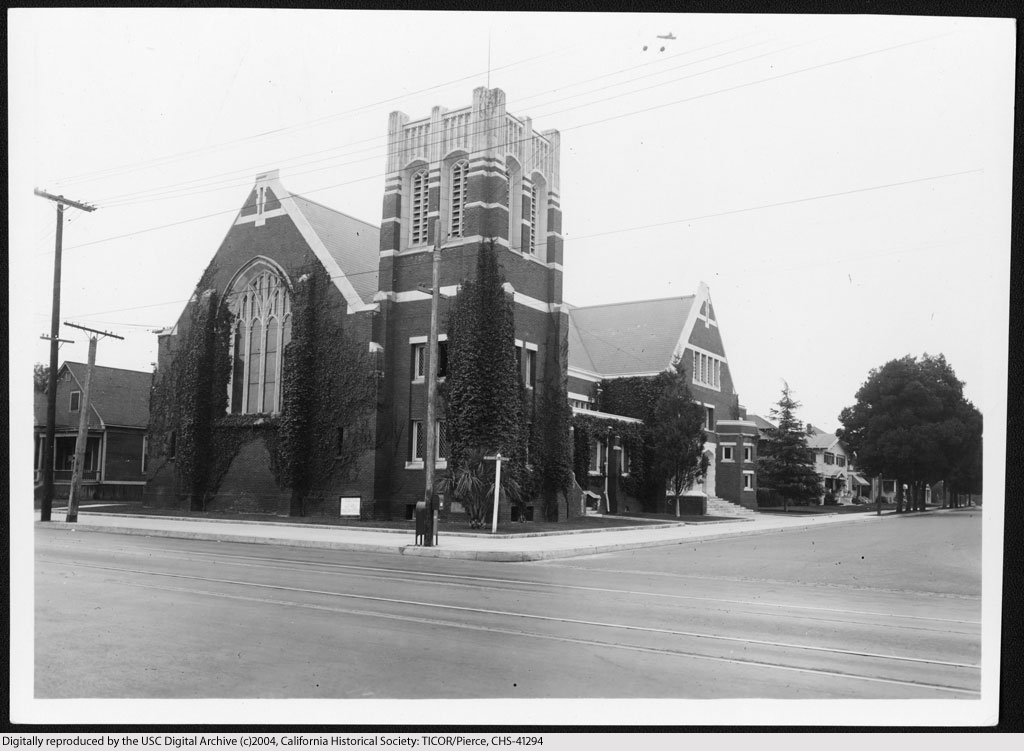
Originally the West Adams Methodist Church, the church appearing in the film is now called the Greater Page Temple, at 2610 South La Salle Avenue.  I located the church in 1997 by noticing it stood on the SE corner of a “T” intersection.  Sitting in the UC Berkeley map library, I identified several candidates by searching vintage USGS topological maps for churches standing on the appropriate corner, and confirmed the correct one by comparing the Sanborn Fire Insurance Map of each candidate to the image in the film.  In an era preceding Google Street View, I had to wait several months for my next visit to Los Angeles before learning that the church is still standing.

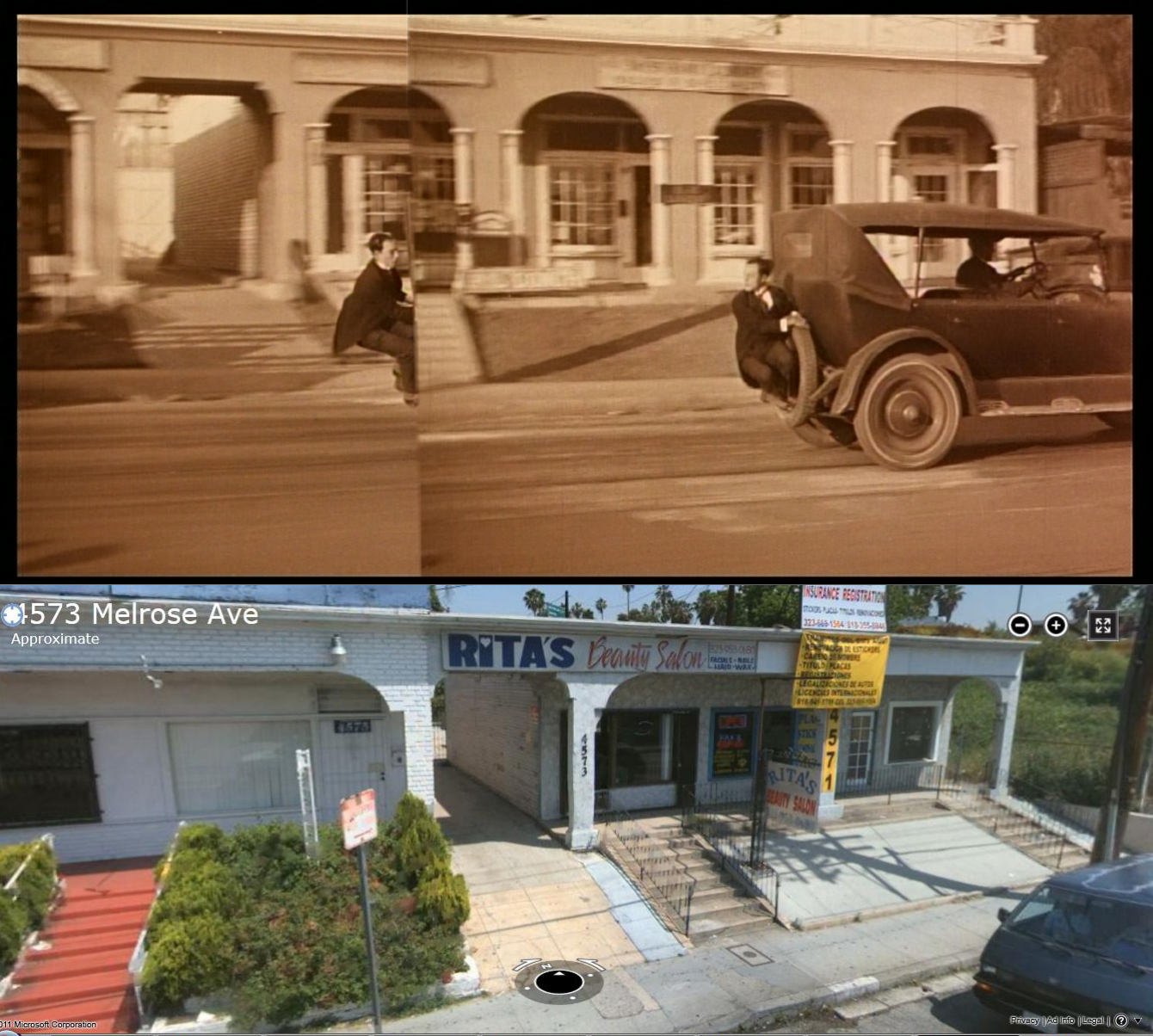
As with each new Blu-ray release, the additional clarity and resolution leads to further discoveries.  One scene that had puzzled me shows Buster hitching a ride on the spare tire of a moving car, while passing a storefront with unusual features, including numerous archways, a narrow alley bisecting the buildings, and stairways leading down from the store doorways to the street.

Bing Streetside: (C) 2011 Microsoft Corporation

On the Blu-ray I could now barely discern words that appeared to say “SWISS HAND LAUNDRY.”  A quick check with the online vintage City Directories hosted by the Los Angeles Public Library showed that the laundry was located at 4571 Melrose Avenue.  The unusual building still stands today, minus a couple of arches.

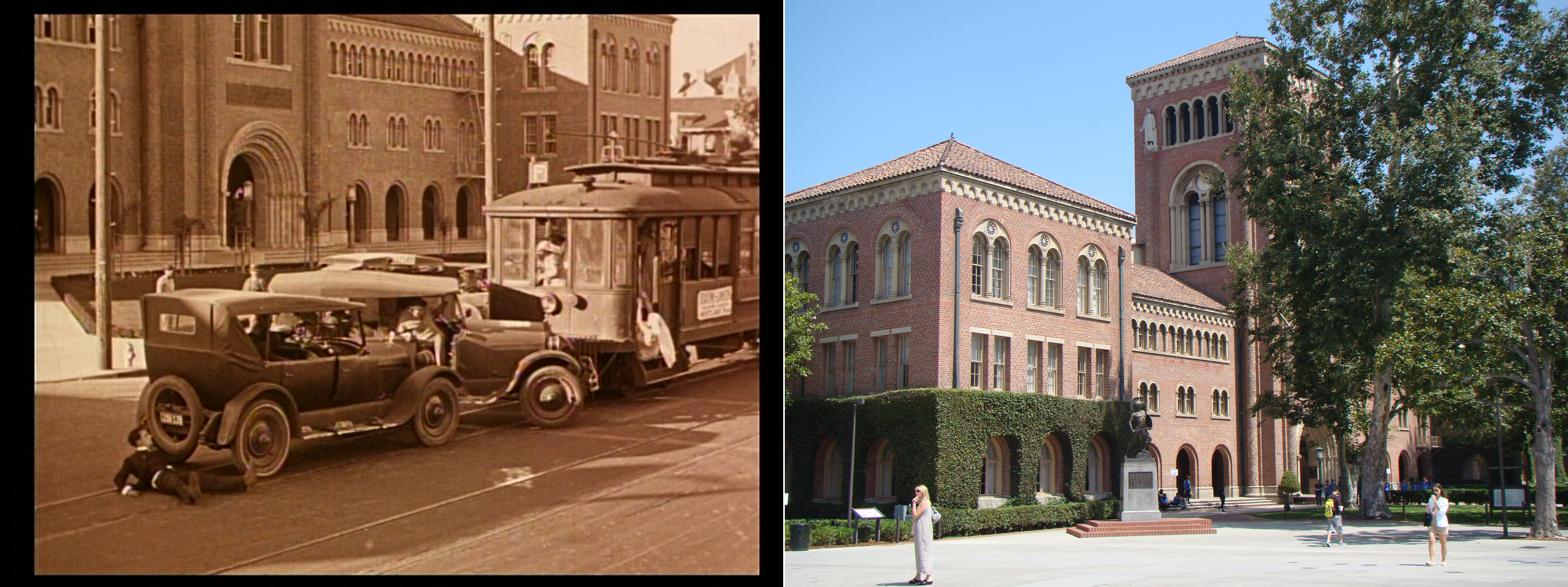
Buster collides with a trolley in front of the Bovard Auditorium and Administration Building at USC. The campus pedestrian mall used to be a busy street with an active trolley line.

Through the magic of film editing, immediately after Buster jumps aboard the car on Melrose, it crashes with a trolley in front of the Bovard Auditorium and Administration Building on the USC Campus, nearly eight miles away.

(C) 1925 Buster Keaton Productions, Inc.  (C) renewed 1953 Loew’s Inc.  Frame images reproduced courtesy of The Douris Corporation, David Shepard, Film Preservation Associates, and Kino International Corporation.  Photo USC Digital Archive (C) 2004 California Historical Society.  [Note: the frame captures are from the DVD – I haven’t the technology yet to capture Blu-ray images.]

Posted in Buster Keaton, Seven Chances, USC | Tagged , , , , , , , , | 10 Comments

Win a Copy of Silent Visions in TCM December Contest

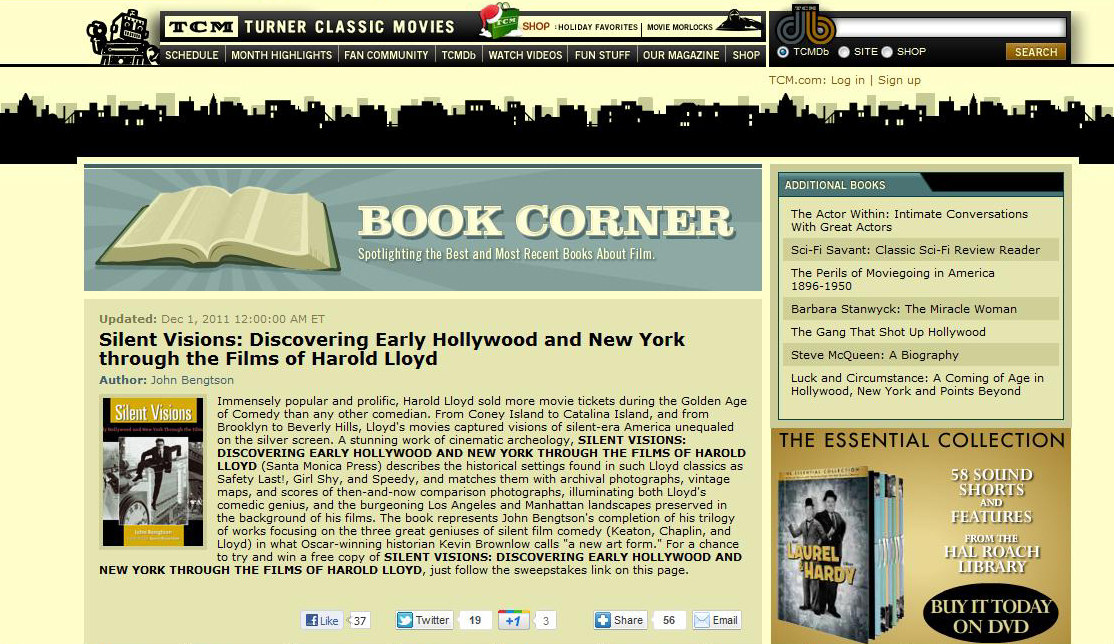
My Harold Lloyd book Silent Visions is the Turner Classic Movies “Book Corner” selection for the month of December.   Visit the TCM site below and you can register for a chance to win one of 15 copies of my book.

Do the math – only a finite number of movie fans will enter, and there are 15 copies to be awarded.  You actually have something greater than an astronomically slim chance of winning!   So visit the site, hit the “LIKE” or Twitter button, and enter today!

TCM’s Book Corner Sweepstakes

NO PURCHASE NECESSARY to enter the “December Book Corner Sweepstakes.” Sweepstakes open to all legal residents of the 50 U.S. & D.C., age 18 or older who have Internet access as of 11/30/11. Subject to Official Rules and void where prohibited. Sweepstakes starts 12:00:00p.m. ET on 12/01/11; ends 11:59:59p.m. ET on 12/31/11. For Official Rules and entry information, send a SASE to: “December Book Corner Sweepstakes,” 1050 Techwood Drive, N.W., Atlanta, GA 30318 or log on to http://www.tcm.com. Sponsor: Turner Entertainment Networks, Inc.

Posted in Uncategorized | Tagged , , , , | Leave a comment

Buster’s Manhattan Project – on Film

Film

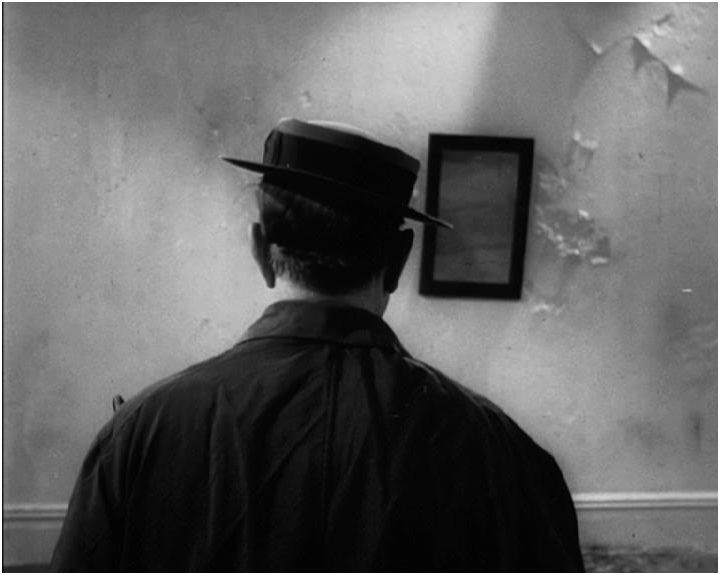
During the summer of 1964, Buster Keaton and Samuel Beckett collaborated making a black and white, avant garde, nearly silent short movie entitled Film.  Keaton, who is seen only from the rear, plays a man attempting to evade perception, eluding everyone except himself.  It was Beckett’s only screenplay, and one of Keaton’s final films.

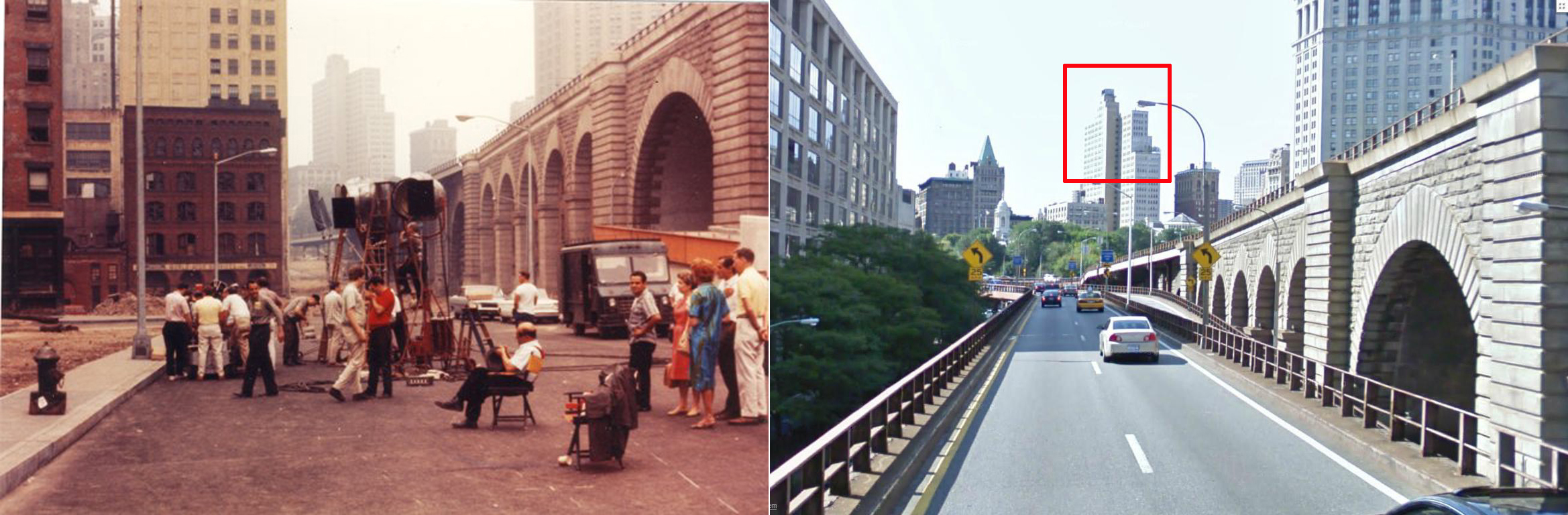
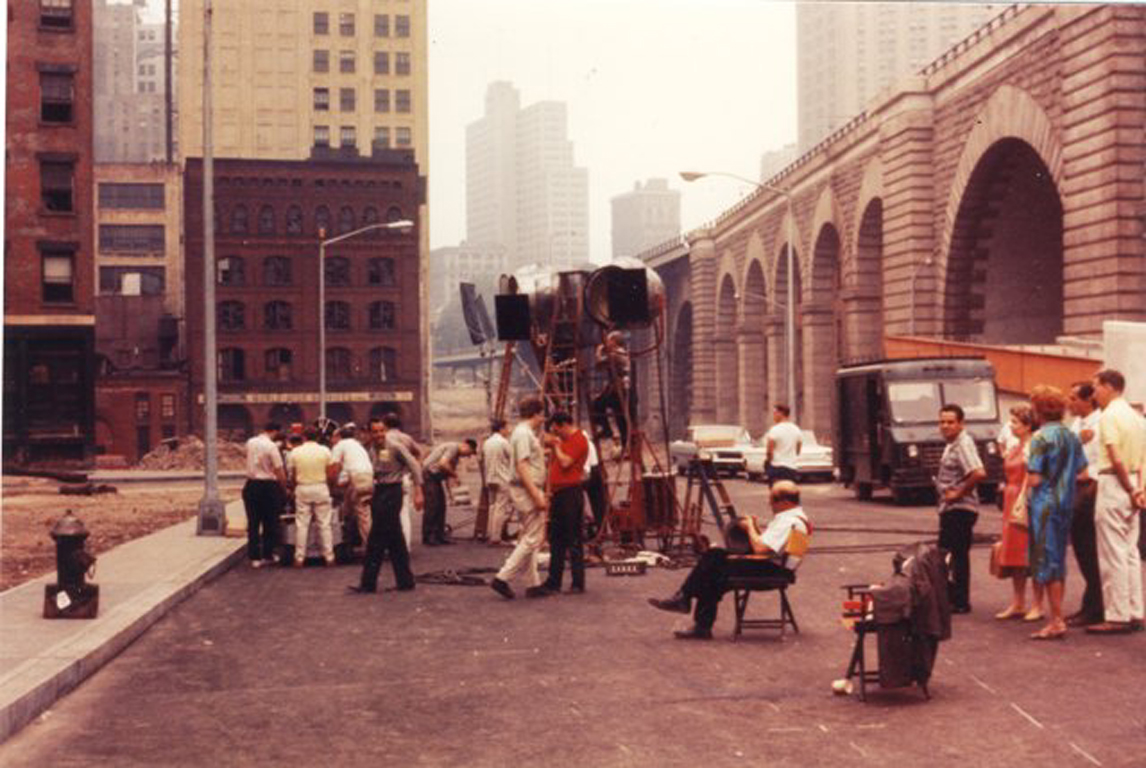
Production began on July 20, 1964, by filming exteriors within the shadow of the Brooklyn Bridge.  Film critic Leonard Maltin, then a young teenager, had read about the planned shooting in the newspaper, and traveled from his home in New Jersey to witness Keaton at work.  Leonard brought along a handful of stills for Buster to autograph, and spent a few moments chatting with Buster between takes.

Click to enlarge. The red box marks the Manhattan Project Building (see below). At right, Google Street View (C) 2011 Google

Keaton began his career in New York with the Roscoe Arbuckle short film The Butcher Boy (1917), filmed at the old Colony Studio at 318-320 E. 48th Street, and made five more short films with Arbuckle on the East Coast; A Reckless Romeo, The Rough House, His Wedding Night, Oh, Doctor!, and Fatty at Coney Island, all released in 1917.  Keaton returned to New York to film a few sequences on location for his 1928 silent masterpiece The Cameraman (see new discovery here), and would later film three of his short films for Educational Pictures; Blue Blazes, The Chemist, and Mixed Magic , all released in 1936, at Educational’s New York Studios.

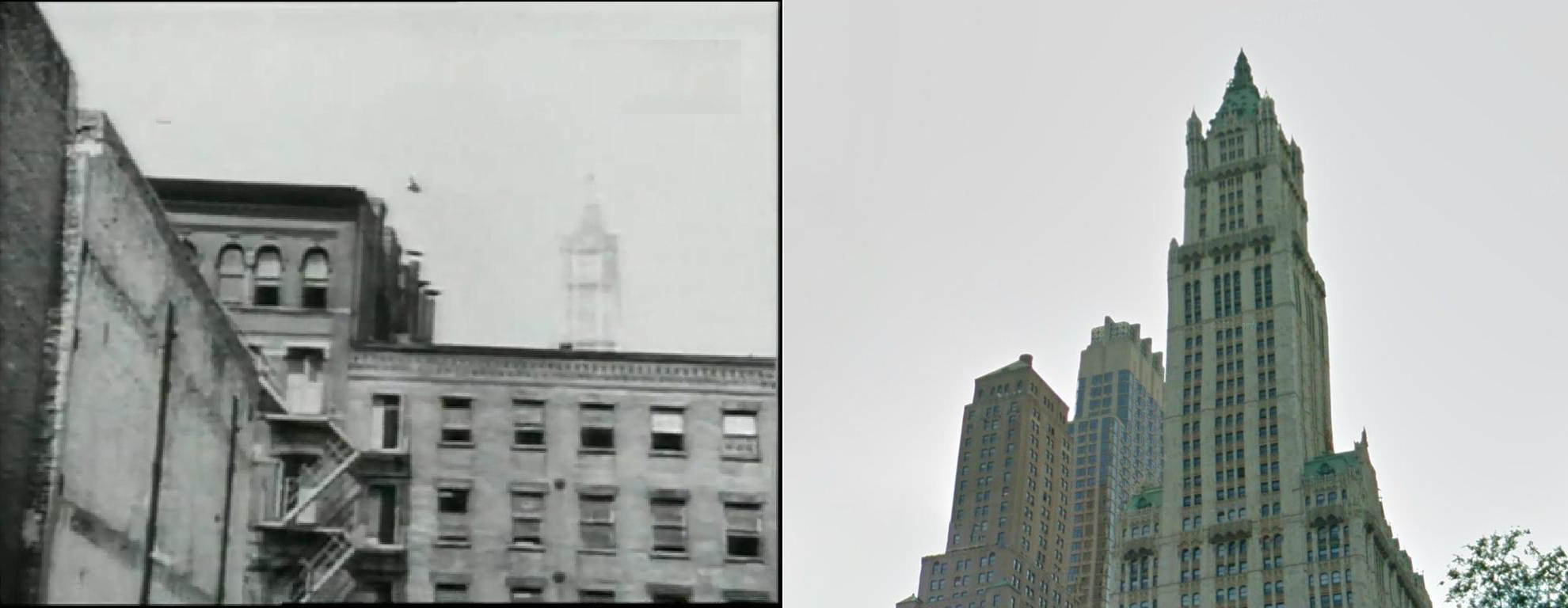
Looking west, Buster is sitting in the middle of Frankfort Street, east of the former corner of Cliff Street, that ran north through an arch under the Brooklyn Bridge. Cliff Street was immediately west of Pearl Street. The tall yellow building stood on the corner of Gold Street and Frankfort. The shorter red building in front of the yellow building stood on the former corner of Jacob Street and Frankfort. The center building in the far background is the Manhattan Project Building.

The prominent building in the center background above, overlooking City Hall Park, and known today as Tower 270 (also known as 270 Broadway and the Arthur Levitt State Office Building), served as the secret headquarters for the Manhattan Project during World War II.  The Army Corps of Engineers’ North Atlantic Division, responsible for building ports and airfields, was already situated in the building.  When the Corps was made responsible for developing the atomic bomb, it brought the new project into its existing headquarters.  Dr. Robert S. Norris writes that in order to avoid undue attention, the Corps followed standard bureaucratic protocol for naming new regional organizations.  Thus, the new project, based in Manhattan, was named the innocuous-sounding Manhattan Engineer District, which in time was shortened to the Manhattan Project.  You can read the full New York Times story about the building’s history here.

During the opening scene from Film, the tip of the Woolworth Building rises above the now lost foreground buildings. At right, the Woolworth Building: Google Street View (c) 2011 Google

Click to enlarge. The two color photos look east down Frankfort towards Pearl Street. The red oval at right marks Samuel Beckett at the filming site, to the left of him is the Brooklyn Bridge tower. Buster is sitting about where the "O" of "Frankfort" is on the central map, between Cliff Street at the top, and Pearl Street/Franklin Square at the bottom. The triangular pink building on the map was already demolished at the time of filming. It stood where the dirt lies on the left photo.

Posted in Buster Keaton, Manhattan, New York | Tagged , , , , , , | 2 Comments

Laurel and Hardy – Home at Last

Comedy fans across the country celebrated the recent release of Laurel & Hardy: The Essential Collection, a 10 DVD set from RHI Entertainment that contains all of the duo’s sound era short films, and several feature films, that had otherwise been unavailable on video release for years.

From Me and My Pal - looking north up Wellington Road towards Washington Blvd. The far distant house (yellow oval, see also below) stands at 1857 Wellington Road.

The DVD set contains one bonus feature after my own heart – a visit to several Laurel & Hardy filming locations presented by Richard W. Bann, Robert Satterfield, Jimmy Wiley Jr., and Jimmy Wiley III.

The father of the bride, James Finlayson, arrives to check on Ollie's whereabouts.

I was especially interested to see the residential street locations appearing in Me and My Pal (1933) discovered by Messrs. Wiley, where best man Stan gives groom-to-be Ollie a jigsaw puzzle that is so mesmerizing the Boys end up missing the wedding in order to complete the puzzle.  During the film various taxi drivers, delivery boys, and policemen become ensnared by the alluring puzzle.

Stan and Ollie filmed in front of 2115 Wellington Road (pin). To the left up Wellington are the traffic medians that were a clue to Messrs. Wiley. Circled in yellow is the background house mentioned above. The Los Angeles Railway "W" trolley line ran along Washington, the wide street running up-down at the left.

On the bonus program Messrs. Wiley identify two clues in the background that lead to their discovery; a traffic median dividing the wide street, and a trolley line crossing the street in the background.

A cops tickets Ollie's waiting taxi parked in front of 2115 Wellington Road. The house across the street shown here is 2108 Wellington Road.

While the bonus program informs us generally that the setting was in the Lafayette Square neighborhood, it does not provide the particular address.  So to complete this post I had to do a little detective work of my own.  The primary scenes were filmed in front of 2115 Wellington, south of Washington Avenue, where the busy Los Angeles Railway “W” trolley line once ran.

Matching view looks up Wellington Road.

Me and My Pal (B&W) (C) 1933 CCA; (C) Hal Roach Studios, Inc. ; (C) 2011 RHI Entertainment Distribution, LLC.

Google Street View (C) 2011 Google.  Bing Maps Bird’s Eye – © 2011 NAVTEQ, Pictometry Bird’s Eye © 2011 Pictometry International Corp., © 2011 Microsoft Corporation.

Posted in Hal Roach Studios, Laurel and Hardy, Oliver Hardy, Stan Laurel, Uncategorized | Tagged , , , , , , | 3 Comments

Chaplin – Keaton – Lloyd – One Block in Silent-Era Hollywood

The intersection of Hollywood Boulevard and Cahuenga Boulevard was a popular film setting for silent-era comedies.  Attached below for download is a 15 MB PowerPoint presentation showing thirteen (but not all) Chaplin, Keaton, and Lloyd filming locations near this historic intersection.  Most of the slides are animated, so wait a moment each time before clicking the “next” button.  You will need a PowerPoint viewer to watch the show, and can download a PowerPoint viewer at this site.

Chaplin Keaton Lloyd – One Block in Silent Era Hollywood

A frame from a 15MB animated PowerPoint presentation highlighting Chaplin, Keaton, and Lloyd filming locations near the intersection of Hollywood Boulevard and Cahuenga Boulevard.

All images from Chaplin films made from 1918 onwards, copyright © Roy Export Company Establishment. CHARLES CHAPLIN, CHAPLIN, and the LITTLE TRAMP, photographs from and the names of Mr. Chaplin’s films are trademarks and/or service marks of Bubbles Incorporated SA and/or Roy Export Company Establishment. Used with permission.

Keaton frame images reproduced courtesy of The Douris Corporation, David Shepard, Film Preservation Associates, and Kino International Corporation.  The Cameraman (C) 1928 Turner Entertainment Co.

HAROLD LLOYD images and the names of Mr. Lloyd’s films are all trademarks and/or service marks of Harold Lloyd Entertainment Inc. Images and movie frame images reproduced courtesy of The Harold Lloyd Trust and Harold Lloyd Entertainment Inc.

Bruce Torrence Historic Hollywood Collection (link).

Posted in Buster Keaton, Chaplin Tour, Charlie Chaplin, Cops, Girl Shy, Harold Lloyd, Hollywood Tour, Hot Water, Keaton Studio, Keaton Tour, Lloyd Studio, Modern Times, Safety Last!, The Cameraman | Tagged , , , , , , , , , | 5 Comments

Chaplin’s Kid Autos – They Were What ?!?

100+ years ago, Jan. 10-11, 1914, Chaplin’s first public appearance dressed as The Little Tramp, in Kid Auto Races at Venice, Cal., at the corner of Main and Westminster in Venice, CA.

The Junior Vanderbilt Cup Race

Inducted now into the National Film Registry of the Library of Congress, Kid Auto Races at Venice, Cal. was Charlie Chaplin’s second motion picture release, and the first release to feature his Little Tramp persona.  It was filmed at the Junior Vanderbilt Cup Race held in Venice, California on Saturday, January 10, 1914, and at the children’s pushmobile race held there the following day.  The weekend shoot capped a busy week for Charlie at Mack Sennett’s Keystone Studio following the holidays.  (Note: Brent Walker, author of the definitive Sennett Studio history Mack Sennett’s Fun Factory reports Chaplin commenced shooting Mabel’s Strange Predicament (1914), in which Charlie wears the tramp costume for the first time, prior to the weekend filming of Kid Auto, but Mabel was not finished and released until after Kid Auto was released.  Thus, the Venice race that Saturday was the first time members of the public had ever witnessed Charlie dressed as the Little Tramp.)

In my book Silent Traces I explain how Chaplin filmed most of the scenes from Kid Auto at the corner of Second (now Main Street) and Westminster in Venice, while looking either north, south, or west, and how several background homes and buildings there are still standing.  I have posted a few photos here.

Main and Westminster, looking west towards the ocean, at what was a hillside country club with tennis courts (fences), and what is now the Westminster Dog Park.

Although the film title mentions a “Kid Auto Race,” I was never able to determine what in the world was a Kid Auto Race?  Thankfully, Todd von Hoffmann, associated with www.VeniceHeritageMuseum.org, and co-author of The Von Hoffmann Bros.’ Big Damn Book of Sheer Manliness, contacted me with the solution, as reported in the May, 1914 issue of Technical World Magazine.

From Technical World Magazine, May 1914

The Kid Auto Race at Venice was, in fact, a sanctioned ten-mile race in which fourteen year old boys piloted home-made one or two-cylinder cars, many adapted from motorcycle engines, while vying for a share of $250 in prize money (that’s ~$6,500 today!).  From today’s litigate-first, bubble-wrap your child perspective, it is almost inconceivable that untrained and unlicensed youths, without helmets, safety equipment, or even seat belts, were once actively encouraged to race one another along the streets of Santa Monica and Venice.

Click to enlarge.  A photo of the Kid Auto Race appearing in Technical World Magazine (upper left), a modern view up Main from Westminster (lower right), and two comparable movie frames.

The article also describes the pushmobile race held the following day, where Chaplin was also filmed, as motorless carts raced down a steep ramp.  Three of the houses pictured in the background below are still standing (see Google Street View links in the caption).  In the far background between Charlie 3 and 4 stands the former Race Thru The Clouds twin-track racing roller coaster, once located along the former Venice Lagoon.

Looking south from Main (at the time Second) and Westminster, at the pushmobile ramp.  Three homes in the back, the far left on San Juan, the other two along Horizon Avenue, still remain (Google Street View links).

I have set forth the complete text of the magazine article below.  While the reporter duly transcribed his narrative of the event, he was either oblivious to, or deliberately chose to ignore, the antics portrayed by Chaplin there at the time.

May, 1914 Technical World Magazine, submitted by Todd von Hoffmann, http://www.VeniceHeritageMuseum.org

Forty youngsters dare-deviled around a ten-mile course at Venice, California some little time ago in the Junior Vanderbilt Cup Race. They all had homemade one- or two-cylinder cars and they were all after one of the six silver cups and a share in two hundred and fifty dollars of prize money.

Albert Van Vrankin, Jr. sailed home with first prize in a little over thirty-seven minutes, although in the middle of the race he ran into a ditch, turned turtle, and had to extricate himself and his car.

The starting line for the Kid Auto Race at Venice

Most of the machines were ingenious adaptations of motorcycle engines to four-wheel crafts. Many of these cars, some of which are easily controlled, are capable of amazing speed.

At the race, the ten thousand spectators, including Barney Oldfield, Earl Cooper, and Teddy Tetzlaff, who judged the finish, cheered wildly as the contestants whirled around the track.

Regular road racing rules the contest and the fourteen-year-olds traveled the course with splendid judgment and the daring of older heads.

Besides the Junior Vanderbilt, there were races for pushmobiles, which furnished a great deal of amusement for the crowd. A broad incline was used to give the pushcars a good start and most of the boys had trouble in getting to the bottom right side up.  Some of the spills looked dangerous to the crowd but none of the drivers were injured.

The difficulties of the boys in constructing cars for the Vanderbilt are told only by the perfection of the machines, because the adaptation of a motorcycle engine to an automobile is a very difficult mechanical job. The dozens of cycle car manufacturers that have sprung up within the last few months have given testimony freely that the thing can’t be done. A special motor for the little car of the “common people” has been built by most of the manufacturers, and many different schemes of transmission and differential have been used.

Chaplin-Keaton-Lloyd-sign

Charlie, Buster, and Harold each filmed a masterpiece at an alley you can still visit today. Please help support naming the alley by posting a review on Google Maps. Prototype alley sign design by noted Dutch graphic artist – Piet Schreuders. Download a 4-page brochure about the alley HERE. This video further explains the alley – if you can, please leave a thumbs up and share it with others.

All images from Chaplin films made from 1918 onwards, copyright © Roy Export Company Establishment. CHARLES CHAPLIN, CHAPLIN, and the LITTLE TRAMP, photographs from and the names of Mr. Chaplin’s films are trademarks and/or service marks of Bubbles Incorporated SA and/or Roy Export Company Establishment. Used with permission.

Posted in Charlie Chaplin, Venice | Tagged , , , , , , , , , | 9 Comments

New Photos – Babe Ruth’s Orphanage Cameo in Speedy

Babe Ruth’s hilarious cameo appearance is one of the many highlights in Harold Lloyd’s final silent comedy Speedy (1928), which I am presenting at 3:10 pm on Sunday, October 21, 2012, and at 7:30 pm on Monday, October 22,  at Film Forum, 209 West Houston Street, New York, NY 10014, based on the discoveries in my new Lloyd book Silent Visions.  Using animated slides I will lead viewers to dozens of landmarks and forgotten byways across town, in what is the first comprehensive study of New York’s most prominent role in a major silent film.  I previously posted about Lou Gehrig’s surprise cameo during Ruth’s cameo here, and you can read my prior posts about Speedy here.

The former Hebrew Orphan Asylum, and how it appears during Speedy.

Taking a break from his record-breaking 60 home run season, Babe appears in the film tossing out autographed baseballs at the former Hebrew Orphan Asylum in Hamilton Heights, across the street from the City College of New York campus.  Afterwards, Harold, playing a star-struck novice cabbie, takes Babe on a hair-raising ride across town to Yankee Stadium.

By coincidence, Tom Shieber, Senior Curator at the National Baseball Hall of Fame and Museum, was attempting to identify photos of Ruth visiting an orphanage, and being aware of my Keaton book, contacted me yesterday for assistance identifying the photos.  After exchanging emails, I was delighted to confirm to Tom that his photos were taken at the Hebrew Orphan Asylum during Ruth’s filming of Speedy, and in turn, was delighted to receive these three rare photos of Babe posted here.

Click to enlarge.   The back of the former Lewisohn Stadium, on Amsterdam Avenue across from the home, appears in the far right image, as Lloyd assists Ruth into the cab.   National Baseball Hall of Fame and Museum.

Tom and I have yet to find newspaper coverage of Babe’s visit to the home, but the CorbisImages.com photo of Babe (BE034424) taken there that day was captioned September 15, 1927.  This means Babe’s visit took place after hitting home runs 51 and 52 during a September 13th double-header, and preceded home run number 53 the next day.  Babe hit his record-breaking 60th home run on September 30, 1927.

In all, Babe had a very busy time the week of his appearance in Speedy.  To begin, Ruth played a total of eight games that week, including double-headers on Tuesday and Saturday. On Monday, his only day off, Babe appeared in court to address charges he had allegedly assaulted a man on the street, and was cleared of the charges that Friday. On Thursday, Babe not only filmed at the home, and apparently his other scenes for the movie, but also found time to squeeze in a game at Yankee Stadium that afternoon.

The Jewish Child Care Association has an account and another photo of Babe’s visit here.  You can read all about the Hebrew Orphan Asylum, and how it was once nearly sold to became the site for the original Yankee Stadium, in my new Harold Lloyd book Silent Visions.

You can access a tour of Lloyd’s filming in Brooklyn in this prior post.

HAROLD LLOYD images and the names of Mr. Lloyd’s films are all trademarks and/or service marks of Harold Lloyd Entertainment Inc. Images and movie frame images reproduced courtesy of The Harold Lloyd Trust and Harold Lloyd Entertainment Inc.

Photos courtesy of the National Baseball Hall of Fame and Museum, Beth Goffe.

The site of the former asylum is now the Jacob H. Schiff Playground, 1540 Amsterdam Avenue, in New York.

Posted in Harold Lloyd, Manhattan, New York, Speedy | Tagged , , , , , , , , , , | 4 Comments