
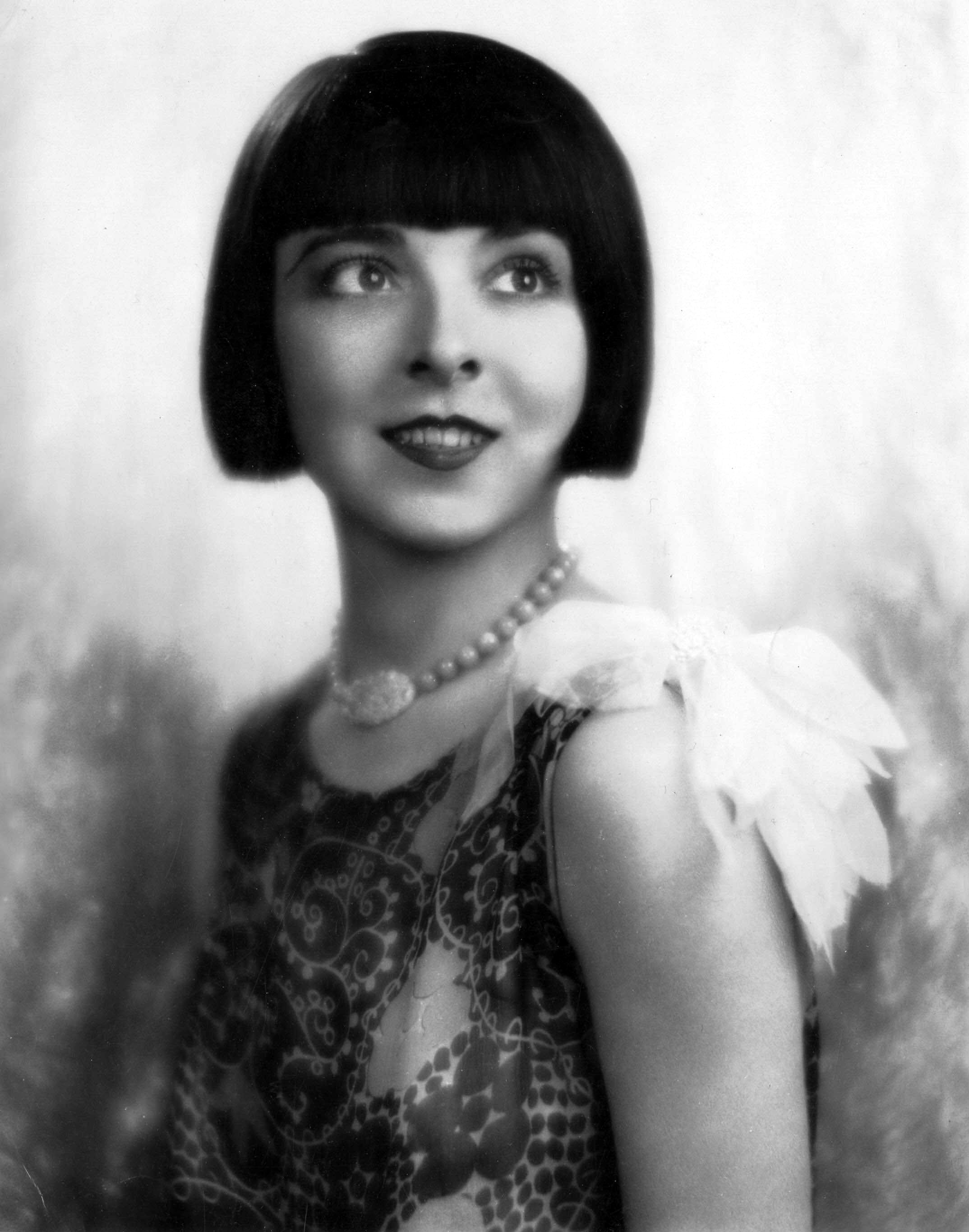
 Hollywood was a small, undeveloped community during the early years of cinema. Cahuenga Blvd, now a major thoroughfare, once ran south for two blocks from Hollywood Blvd past Selma to where it ended at Sunset Blvd. Through traffic would then zig-zag, turning left on Sunset and continuing right, south along Townsend, now Ivar, a half block further east. In these early years, and early stages of their careers, future flapper superstar Colleen Moore and stone-faced Buster Keaton filmed matching scenes at the former “T” intersection of Cahuenga and Sunset. As shown below, Stan Laurel filmed an early solo comedy there as well.
During A Roman Scandal (1919) leading man Earl Rodney wishes to marry stage-struck Colleen, a wannabe actress who defers his marriage proposal to pursue her thespian dreams. You can view a beautiful scan of the entire film at Joseph Blough’s wonderful YouTube channel.

 Out for a stroll, starting at 04:17 HERE, Earl and Colleen notice a publicity billboard (inset) for a live stage production of The Fall of Rome. Notice “MORGAN HARDWARE,” 1503 Cahuenga, at back. Colleen and Earl attend the show, and when the lead actors go on strike, they are hired to replace them.


Above, twin views of Morgan Hardware – a production still from an unidentified comedy, and a modern view with a palm tree standing where “MORGAN” could once be seen.


Above, Stan Laurel (at the corner disguised in a giant dog costume) flees (fleas?) the police in The Pest (1922). You can clearly see the SUNSET BLVD sign and barely make out MORGAN HARDWARE between the ladders.


More views of Morgan Hardware. Above left, during a scene from Day Dreams (1922), presented as if filmed on a cable car in San Francisco, Buster rides east along Sunset looking north past the corner of Cahuenga. The word “HARDWARE” appears left of the cop’s elbow. As explained at 03:04 of my YouTube video about Buster Keaton’s San Francisco Footsteps, Sunset did not have a trolley line, so Buster is filming on a prop trolley being towed close to the south curb, not on a real trolley on tracks moving down the center of the street. That’s why the same-direction auto traffic passes behind Buster during the scene. Above right, an unidentified comedy presented by the Library of Congress Mostly Lost Film Festival, looking SW to Morgan Hardware and the corner of Sunset.


Above, during One Week (1920), newly-wed Buster grabs a policeman’s hat and whistle to rescue his bride from a car driven by his rival. This view to the right also looks SW – notice the matching warehouse air vents in both images.


Above left, impersonating the cop, Buster orders his rival’s car to stop. Above right, Earl and Colleen admire the billboard for the play. Both views look west from the NE corner of Cahuenga toward the Sunset Roofing Company.


Matching views then and now SW along Sunset from Cahuenga, once a “T” intersection. Click to enlarge the One Week frame and you can barely read “The Sunset Roofing Co.” at back.
 Click to enlarge – this view looks west down Sunset past Cahuenga, toward the towering Hollywood Athletic Club building on the corner of Schrader at back, and where Earl and Colleen stood on the corner beside the former Hollywood Laundry facility. LAPL.


This closer view shows where the billboard was placed beside the former Hollywood Laundry.


Traveling east along Sunset in Day Dreams, before reaching the corner of Cahuenga above, Buster first passes the circular arched entrance along the side of the building.
 As explained in my book Silent Echoes, and in Buster’s San Francisco Footsteps YouTube video, the initial clues for identifying Buster’s traveling shot were the bottom half of the letters “HOLL” “OOD” “LAU” painted on the background wall. Not surprisingly, San Francisco did not have a Hollywood Laundry, but guess who did!
 Now looking south, here’s an early panoramic view along Sunset forming the back end of the “T” intersection with Cahuenga. The road continues south past the corner of Townsend to the left. Notice the P.F. Pursel & Son Sunset Stable, also appearing below. HollywoodPhotographs.com.


Above left, a frame from the 1915 (!) Lyons & Moran comedy Pruning The Movies, looking south down Cahuenga toward the “T” intersection at Sunset and P.F. Pursel & Son. Above right, looking east down Sunset with Pursel at center, the 1919 Billie Rhodes comedy A Two-Cylinder Courtship. This 1919 movie also contained scenes that identified matching locales appearing in Keaton’s 1921 shorts The Play House and The Goat – see post Solved! Buster Keaton’s Mystery Colegrove Building.


Then and Now – Buster and his rescued bride Sybil Seely reclaim their car in One Week looking east down Sunset Blvd from the corner of Ivar, a short half-block east from Cahuenga. The Muller Bros. Auto Supplies at 6380 Sunset, pictured on the corner, was ultimately replaced by the Cinerama Dome Theatre.
 Click to enlarge – a final view SW at Sunset (red) and the 1500 block of Cahuenga (orange) south of Selma. The image of Buster in The Goat running by the Toribuchi Grocery at 1546 Cahuenga (green), led to one of my all-time favorite discoveries – that at a time when few ethnic Japanese lived anywhere in Los Angeles, the 1500 block was once home to a small, seemingly forgotten Japanese enclave, with stores, lodging, a bath, a school, and a small church. Read all about it here – Silent Hollywood’s Japanese Enclave.
 As explained in numerous posts, the 1600 block of Cahuenga between Hollywood Blvd and Selma was likely the most widely used filming location in early silent films. Mary Pickford, Douglas Fairbanks, Colleen Moore, Stan Laurel, Harry Langdon, Our Gang, Dorothy Devore, Oliver Hardy, and many more filmed there, and it was the favorite block in Hollywood for Charlie Chaplin, Buster Keaton, and Harold Lloyd to film. But as seen here, the 1500 block, now with its lost “T” intersection, has its own rich silent film history.
 The TCM Classic Film Festival will screen Buster Keaton’s Sherlock Jr. (1924) together with The Goat at the beautifully restored Egyptian Theatre this Sunday April 21 at 7:30 pm. This YouTube video shows how Buster staged Sherlock Jr. all across Southern California, including new discoveries.
 Harold Lloyd’s masterpiece The Kid Brother (1928) was recently screened at the San Francisco Silent Film Festival. I created a visual essay for the beautiful Criterion Collection Blu-ray release of the film, The Kid Brother Was Close to Home, which you can read about HERE. Buster’s screening at the Egyptian Theatre will be accompanied by the magnificent Mont Alto Motion Picture Orchestra.
Below, the former “T” intersection of Sunset and Cahuenga – spin the image around for a full 360 degree view.


 Chaplin-Keaton-Lloyd film locations (and more)
John, I very much enjoy the “Then and Now” images you continually share, especially when a building from a movie shot still stands (whether recognizable or not).
I muse over the “Now” images with their modern traffic and pedestrians, blissfully unaware of the cinematic ghosts in their company.
Thanks again for another winner!
Greg in Palm Springs
LikeLiked by 1 person
I love this then and now so much. I sometimes hate some of the change that has went on…but it’s so interesting. You could be standing in a spot in your favorite Keaton or Chaplin movie and not know it.
LikeLiked by 1 person